

ISO/IEC 9593-3:1990
(Main)Information technology — Computer graphics — Programmer's Hierarchical Interactive Graphics System (PHIGS) language bindings — Part 3: ADA
General Information
- Abstract
- Status
- Published
- Publication Date
- 11-Apr-1990
- Current Stage
- 9093 - International Standard confirmed
- Start Date
- 08-Dec-2021
- Completion Date
- 29-Aug-2026


Overview
ISO/IEC 9593-3:1990 specifies the Ada language binding for the Programmer’s Hierarchical Interactive Graphics System (PHIGS). PHIGS itself (defined in ISO/IEC 9592) is a language‑independent graphics system; this part defines how PHIGS is embedded and used from Ada programs. The standard defines Ada packages, type mappings, function/procedure names, error handling conventions, multi‑tasking considerations, and auxiliary utility packages to ensure consistent, portable PHIGS implementations for Ada.
Key Topics
- Language binding semantics - One‑to‑one mapping of PHIGS operations to Ada procedures (with a few overloaded functions such as INQ_TEXT_EXTENT for different text models).
- Data mapping and types - PHIGS primitive and composite types (integers, reals, strings, points, vectors, matrices, lists, sets, records) are mapped to Ada scalar types, record types, arrays or private types; specialized packages (e.g., PHIGS_TYPES, PHIGS_LIST_UTILITIES) declare these types.
- Error handling - Standardized ERROR_HANDLING/ERROR_LOGGING procedures are provided; implementations supply default and exception‑raising bodies (PHIGS_ERROR). Inquiry functions return error indicators rather than raising Ada exceptions.
- Conformance and packaging - Requirements for conformance with ISO/IEC 9592 semantics and naming; PHIGS must be available as an Ada library unit with specified names and packages.
- Implementation & host dependencies - Notes on portability issues tied to Ada compilers and runtime (storage, tasking, string/file formats); PHIGS_CONFIGURATION package allows implementation-specific adaptations.
- Multi‑tasking - Guidance on Ada tasking interactions and constraints when using PHIGS.
- Contents and utilities - Extensive function lists, tables (data types, abbreviations, error codes), utility subprograms, and annexes with compilable specification and example programs.
Applications
- Software developers and library implementers creating PHIGS implementations or bindings for Ada compilers.
- CAD, visualization and scientific graphics systems that use Ada and need a standard graphics API for structured, hierarchical modeling.
- System integrators ensuring portability of graphics applications across Ada environments by following standardized type and error semantics.
- Standards compliance and verification teams validating that an Ada PHIGS implementation meets international specifications.
Related Standards (if applicable)
- ISO/IEC 9592 - PHIGS language‑independent functional description (core semantics).
- ISO 8652:1987 - Ada programming language standard (referenced for language conformance).
- Other parts of ISO/IEC 9593 - additional language bindings and supporting documents.
Keywords: ISO/IEC 9593-3:1990, PHIGS Ada binding, PHIGS, Ada, computer graphics standard, language binding, PHIGS types, error handling, multi‑tasking, portability.
Relations
- Effective Date
- 06-Jun-2022
- Effective Date
- 15-Apr-2008
Get Certified
Connect with accredited certification bodies for this standard

BSI Group
BSI (British Standards Institution) is the business standards company that helps organizations make excellence a habit.

NYCE
Mexican standards and certification body.
Sponsored listings
Frequently Asked Questions
ISO/IEC 9593-3:1990 is a standard published by the International Organization for Standardization (ISO). Its full title is "Information technology — Computer graphics — Programmer's Hierarchical Interactive Graphics System (PHIGS) language bindings — Part 3: ADA". This standard covers: Information technology — Computer graphics — Programmer's Hierarchical Interactive Graphics System (PHIGS) language bindings — Part 3: ADA
Information technology — Computer graphics — Programmer's Hierarchical Interactive Graphics System (PHIGS) language bindings — Part 3: ADA
ISO/IEC 9593-3:1990 is classified under the following ICS (International Classification for Standards) categories: 35.060 - Languages used in information technology; 35.140 - Computer graphics. The ICS classification helps identify the subject area and facilitates finding related standards.
ISO/IEC 9593-3:1990 has the following relationships with other standards: It is inter standard links to ISO/IEC 9593-3:1990/Amd 1:1994; is excused to ISO/IEC 9593-3:1990/Amd 1:1994. Understanding these relationships helps ensure you are using the most current and applicable version of the standard.
ISO/IEC 9593-3:1990 is available in PDF format for immediate download after purchase. The document can be added to your cart and obtained through the secure checkout process. Digital delivery ensures instant access to the complete standard document.
Standards Content (Sample)
lso/lEc
INTERNATIONAL
9593-3
STANDARD
First edition
1990-04- 15
Information technology - Computer graphics -
Programmer’s Hierarchical Interactive Graphits
System (PHIGS) language bindings Y
Part 3 :
Ada
Technologies de Knformation - lnfographie - lnterfaces langage avec PHIGS -
Partie 3 : Ada
Reference number
ISO/IEC 9593-3 : 1990 (EI
ISOAEC 959393 : 1990 (E)
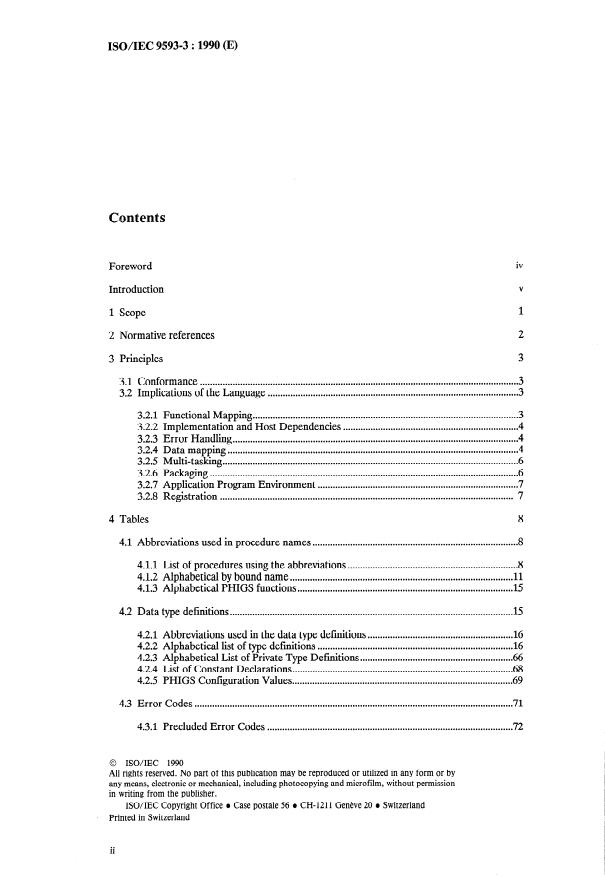
Contents
iv
Foreword
V
Introduction
1 Scope
2 Normative references
3 Principles
3.1 Conformance .
3.2 Implications of the Language .
..........................................................................................................
3.2.1 Functional Mapping
......................................................................
3.2.2 Implementation and Host Dependencies
..................................................................................................................
3.2.3 Error Handling
....................................................................................................................
3.2.4 Data mapping
......................................................................................................................
3.2.5 Multi-tasking
3.2.6 Packaging .
................................................................................
3.2.7 Application Program Environment
3.2.8 Registration .
4 Tables
. . . . . . . . . . . . . . . .*.
4.1 Abbreviations used in nrocedure names
A
4.1.1 List of procedures using the abbreviations .
.........................................................................................
4.1.2 Alphabetical by bound name
Alphabetical PHIGS functions . 15
4.1.3
4.2 Data type definitions .
.......................................................... 16
4.2.1 Abbreviations used in the data type defmitions
.............................................................................. 16
4.2.2 Alphabetical list of type deftitions
............................................................. 66
4.2.3 Alphabetical List of Private Type Deftitions
........................................................................................ 68
4.2.4 List of Constant Declarations
........................................................................................ 69
4.2.5 PHIGS Configuration Values
. . . . . . . . . . . . . . . . . . . . . . . . . . . . . . . . . . . . . . . . . . . . . . . . . . . . . . . . . . . . . . . . . . . . . . . . . . . . . . . . . . . . . . . . . . . . . . . . . . . . . . . . . . . . . . . . . . . . . . . . .
4.3 Error Codes
. . . . . . . . . . . . . . . . . . . . . . . . .~. 72
4.3.1 Precluded Error Codes
0 ISO/IEC 1990
All rights reserved. No part of this publication may be reproduced or utilized in any form or by
any means, electronie or mechanical, including photocopying and microfilm, without Permission
in writing from the publisher.
ISO/IEC Copyright Office l Case postale 56 l CH-121 1 Geneve 20 l Switzerland
. Printed in Switzerland
ii
ISO/IEC 9593-3 : 1990 (E)
5 Functions in the Ada Binding of PHIGS
.......................................................................................................................
5.1 Control functions
.......................................................................................................
5.2 Output primitive functions
.............................................................................................
5.3 Attribute specification functions
..................................................................................
5.4 Transformation and clipping functions
......................................................................................................
5.5 Structure content functions
............................................................................................
5.6 Structure manipulation functions
.......................................................................................................
5.7 Structure display functions
......................................................................................................
5.8 Structure archive functions
5.9 Input functions .
5.10 Metafile functions .
5.11 Inquiry functions .
.........................................................................................................
5.12 Error control functions
...................................................................................................
5.13 Special interface functions
............................................................................................................
5.14 Additional Functions
.............................................
5.14.1 Subprograms for Manipulating Input Data Records
.........................................................
5.14.2 PHIGS Generic Coordinate System Package
........................................................................
5.14.3 PHIGS Generic List Utility Package
...........................................................................
5.14.4 PHIGS Name Set Facility Package
..............................................................
5.14.5 Deallocation of structure element records
5.14.6 Metafile Function Utilities .
5.15 Conformal Variants . . . . . . . . . . . .Y.
Annexes
A Compilable PHIGS Specification
_ B Cross Reference Listing of Implementation Defined Items
C Example Programs
................................................................................................
C.l Example Program 1: STAR
................................................................................................
C.2 Example Program 2: IRON
...................................................................................
C.3 Example Program 3: DYNASTAR
POLYLINE .
C.4 Example Program 4: TRANSFORM
.....................................................................
C.5 Example Program 5: SHOW LINETWES
D PHIGS Multi-Tasking
E Index
. . .
ISO/IEC 9593-3 : 1990 (E)
Foreword
ISO (the International Organization for Standardization) and IEC (the International Electrotechnical Commission)
together form a System for worldwide standardization as a whole. National bodies that are members of ISO or IEC
participate in the development of International Standards through technical committees established by the respective
organization to deal with particular fields of technical activity. ISO and IEC technical committees collaborate in fields of
mutual interest. Other international organizations, governmental and non-governmental, in liaison with ISO and IEC, also
take part in the work.
In the field of information technology, ISO and IEC have established a joint technical committee, ISO/IEC JTC 1. Draft
International Standards adopted by the joint technical committee are circulated to national bodies for approval before
their acceptance as International Standards. They are approved in accordance with procedures requiring at least 75 ?70
approval by the national bodies voting.
International Standard ISOAEC 9593-3 was prepared by Technical Committee ISOAEC JTC 1, Information technology.
ISOAEC 9593-3 : 1990 (E)
Introduction
ISO/IEC 9592 is specified in a language independent manner and needs to be embedded in language
dependent layers (language bindings) for use with particular programming languages.
The purpose of this part of ISO/IEC 9593 is to define a Standard binding of PHIGS to the Ada Computer
programming language.
This page intentionally left blank
ISO/IEC 9593-3 : 1990 (E)
INTERNATIONAL STANDARD
Information technology - Computer graphics -
~
Programmer’s Hierarchical Interactive Graphits System
(PHIGS) language bindings -
Part 3 :
Ada
1 Scope
ISO/IEC 9592 specifies a language independent nucleus of a graphics System. For integration. into a
programming language, PHIGS is embedded in a language dependent layer obeying the particular conventions
of that language. This part of ISO/IEC 9593 specifies such a language dependent layer for the Ada Computer
programming language.
ISO/IEC 9593-3 : 1990 (E)
Normative references
2 Normative references
The following Standards contain provisions which, through reference in this text, constitute provisions of this
part of ISO/IEC 9593. At the time of publication, the editions indicated were valid. All Standards are subject
to revision, and Parties to agreements based onthis part of ISO/IEC 9593 are encouraged to investigate the
possibility of applying the most recent editions of the Standards listed below. Members of IEC and ISO
maintain registers of currently valid International Standards.
ISO 8652 : 1987, Programming languages -Ada (Endorsement of ANSI Standard 1815A-1983).
Computer gaphics - Programmerk Hierarchical
ISO/IEC 95924 : 1989, Information processing systems -
Interactive Graphits System (PHIGS) - Part 1: Functional description.
ISO/IEC 9593-3 : 1990 (E)
Principles
3 Principles
The PHIGS Binding to Ada is intended to be implementation independent except as it tan be adapted by the
PHIGS CONFIGURATION package. The PHIGS Binding to Ada makes no assumptions concerning the
availabixty of implementation dependent facilities defined by the Ada language. It does, however, limit the use
of multi-tasking as described in 3.2.5. The Ada Compiler shall be able to support the number of declarations
contained in this PHIGS Binding to Ada.
This binding does not make any assumptions regarding the machine representation of the predefined Ada
numeric types.
This binding assumes that the application programmer will supply an error file name, archive file names, and
connection identifiers that are in an acceptable format for the Ada implementation.
This binding makes no assumptions ,regarding the format of a string specifying an error file name, archive file
names, or connection identifiers for devices or metafiles.
3.1 Conformance
This binding incorporates the rules of conformance defined in the PHIGS Standard (ISO/IEC 9592) for
PHIGS implernentations, with these additional requirements specifically defined for Ada implernentations of
PHIGS.
The following criteria are established for determining conformance or non-conformance of an implementation
to this binding:
- The semantics of an implementation shall be those stated in ISO/IEC 9592 as modified or extended for
Ada as stated in this part of ISO/IEC 9593.
- The package corresponding to PHIGS shall be an available Ada library unit, with all names as specifred
by this part of ISO/IEC 9593.
3.2 Implications of the Language
3.2.1 Functional Mapping
The functions of PHIGS are all mapped to Ada procedures. The mapping utilizes a one-to-one correspondence
between the PHIGS functions and Ada procedures except for the PHIGS function INQUIRE TEXT EXTENT.
This function is mapped to two overloaded Ada functions each named INQ TEXT EXTENT one which
ISOAEC 9593-3 : 1990 (E)
Implications of the Language Principles
supports modelling text and one which supports annotation text. Certain functi .ons required by the binding but
not defined by PHIGS are mapped to Ada functions and procedures.
3.2.2 Implementation and Host Dependencies
.
There are a number of implementation and host dependencies associated with the Ada Compiler and runtime
System used. These will affect the portability of application programs and their use of PHIGS. The application
programmer should follow accepted practices for ensuring portability of Ada programs to avoid introducing
Problems when rehosting the application on another System. Implementation dependencies include runtime
storage management and processor management. ,
3.23 Error Handling
The inquiry functions utilize error indicator Parameters for the error returns, and do not raise Ada exceptions.
The application program shall ensure that these error indicators are checked before attempting to access other
Parameters, since Ada implernentations are not required to raise an exception if an undefined value is accessed.
The error handling requirements of PHIGS tan be summ arized as follows:
By default, a procedure named ERROR HANDLING will be provided that simply reports the error by
1.
calling ERROR LOGGING. This is calkd from the PHIGS function that detects the error.
2. The ERROR HANDLING procedure may be replaced by one defined by the User.
The procedure ERROR HANDLING is defined as a library subprogram:
with PHIGS TYPES;
use PHIGS TYPES;
procedure ERROR HANDLING
(ERROR INDICÄTOR : in ERROR NUMBER;
PHIGS ~WNCTION : in STRING;
: inFILE ID := DEFAULT ERROR FILE);
ERROR FILE
--
The procedure ERROR HANDLING is defined as a library subprogram,
--
and is not declared withii package PHIGS.
This binding defines two different bodies for this subprogram; each shall be supplied by the implementation.
The default body is the one required by PHIGS semantics. It simply calls ERROR LOGGING and returns.
The second body calls ERROR LOGGING and then raises the exception PHIGS ERROR. The PHIGS
function shall be written so as nÖt to handle PHIGS ERROR (this is a requirementof the implementation).
Thus, by Ada rules, the exception will be propagatedback to the application program that called the PHIGS
function in which the error was detected.
The means by which the user replaces the default body by either the exception-raising version or another one of
his or her choosing is dependent upon the Ada library manager. Some implernentations support multiple
Versions of a body with a Single specification or otherwise allow hierarchical libraries with the sharing of
common units. In other implernentations, it may be necessary to duplicate the PHIGS library for each version
of ERROR HANDLING.
3.2.4 Data mapping
The simple and compound data types of PHIGS are bound to a variety of Ada scalar and compound types.
Constraints on permitted values are reflected where possible in the type definitions. The general
correspondence between the PHIGS data types and Ada binding data types is summarized below:
ISO/IEC 9593-3 : 1990 (E)
Implications of the Language
Principles
- PHIGS integer types (1) are mapped to Ada integer types.
- PHIGS real types (R) are mapped to Ada floating-Point types.
- PHIGS string types (S) are mapped to the predefined Ada type STRING, or to a type providing for
variable length strings.
-
PHIGS Point types (P2, P3) are mapped to Ada record types.
-
PHIGS vector types (V2, V3) are mapped to Ada record types.
- PHIGS enumeration types (E) are mapped to Ada enumeration types.
The PHIGS name set composite type
- PHIGS name types (NM) are mapped to an Ada integer type.
A set of subprograms for operating on objects of this
SET(NM) is mapped to an Ada private type.
private type is explicitly defined by this binding.
- PHIGS filter types (FR) are mapped to an Ada record type.
PHIGS pick paths are mapped to an
- PHIGS pick path item type (PP) is mapped to an Ada record type.
Ada array type.
- PHIGS element reference type (ER) is mapped to an Ada record type.
- PHIGS half-space types (HS2, HS3) are mapped to Ada record types.
- PHIGS font/precision pair type (FP) is mapped to an Ada record type.
- PHIGS structure element type (SE) is mapped to an Ada record type.
- PHIGS posted structure type (PS) is mapped to an Ada record type.
- PHIGS bounding range types (B) are mapped to Ada record types.
- PHIGS colour specification type (CLR) is mapped to an Ada record type.
- PHIGS chromaticity coefficient type (CC) is mapped to an Ada record type.
- PHIGS connection identifier type (C) is mapped to the Ada STRING type.
- PHIGS file types (F) are mapped to Ada STRING types.
- PHIGS workstation type (W) is mapped to an Ada integer type.
- PHIGS modehing clipping volume type (MCV) is not used by the binding. Implernentations tan map
this type to an implementation specific private type.
- PHIGS generalized drawing primitive identifier types (G2, G3) are mapped to Ada integer types.
- PHIGS generalized structure element identifier type (GS) is mapped to an Ada integer type.
- PHIGS archive file identifier type (AI) is mapped to an Ada integer type.
- PHIGS pick identifier type (PI) is mapped to an Ada integer type.
I
PHIGS escape identifier type (EI) is mapped to an Ada integer type.
- PHIGS function name type (FN) is mapped to an Ada type providing for variable length strings.
ISO/IEC 9593-3 : 1990 (E)
Implications of the Language Principles
- PHIG workstation identifier type (WI) is mapped to an Ada integer type.
- PHIGS tuples are mapped to Ada record types.
- PHIGS matrices are mapped to Ada array types.
ng for
- PHIGS arrays are mapped to either an unconstrained Ada array type, or to a record providi
variable length arrays.
- PHIGS lists are mapped to an Ada private type declared in the generic PHIGS LIST UTILITIES
package.
- PHIGS set are mapped to Ada private types with generic accessing functions provided
necessary.
- PHIGS data records are mapped to Ada private types. In some cases, a set of subprograms for
operating on the data records is explicitly defined by this binding. This is because the content and
An implementation of PHIGS may provide
structure of the data record is implementation dependent.
other subprograms for manipulating implementation dependent data records.
Additional types used by the binding are declared as needed in a manner compatible with the PHIGS types.
3.2.5 Multi-tasking
The Ada language definition provides explicit support for concurrency. The Ada tasking model includes
facilities for declaring and allocating tasks, and operations allowing intertask communication and
synchronization.
The PHIGS Standard, and hence this binding Standard, neither requires nor prohibits an implementation from
protecting against Problems which could arise from asynchronous access to the PHIGS data structures from
concurrent tasks. Implernentors of PHIGS should provide information in the user’s documentation regarding
whether protection against such Problems is implemented.
Annex D contains guidelines for implementors who want to support multi-tasking application programs. This
annex does not form an integral part of the binding Standard, but provides additional information.
32.6 Packaging
The PHIGS Standard defines all of its graphic functionality as a cohesive whole. An implementation of PHIGS
shall implement the entire functionality of PHIGS. To support this concept, this binding defines a Single Ada
package which corresponds to all of the PHIGS functionality. This package is named
package PHIGS is . . . end PHIGS;
Associated with this package is a data type package which provides the type declarations as defined in 4.2 and
the exception defined in 4.3. This package is
package PHIGS TYPES is . . . end PHIGS TYPES;
A minimal program referencing PHIGS is shown below.
with PHIGS,
PHIGS TYPES;
procedure APPLICATION is
begin
ISO/IEC 9593-3 : 1990 (E)
Implications of the Language
Principles
null;
end APPLICATION;
Several additional Ada packages are defined in this binding. These packages are
- generic package PHIGS COORDINATE SYSTEM
- generic package PHIGS LIST UTILITIES
- package PHIGS NAME SET FACILITY
- package PHIGS CONFIGURATION
in the PHIGS TYPES package described above.
These packages support the declaration types
PHIGS COORDINATE SYSTEM is a generic package which defines & assortment of types supporting each
of the FHIGS coordinatc Systems. PHIGS LIST UTILITIES is also a generic package which provides type
declarations and operations for list tkes Kuhich correspond to the PHIGS list types. The
PHIGS NAME SET FACILITY package defmes private types for name sets and provides functions for
buildinc and manipulating name Sets. The PHIGS CONFIGURATION package sets implementation
dependent limit values for various types defmed in this biñding. The PHIGS CONFIGURATION package also
provides for possible application modification of these limits.
3.2.7 Application Program Environment
An application program utilizing an Ada implementation of PHIGS will need to be aware of the environment in
which both PHIGS and the application program reside.
One aspect of the environment is the Ada program library. The Ada language requires that the application
program have access to the program library in which the PHIGS Software resides. The Ada Standard ISO 8652
does not specify whether there is a Single library or multiple libraries, or how access to the libraries is granted
or managed. The user’s documentation for the PHIGS implementation should specify where the PHIGS library
exists in the System, and how access to the library is acquired.
Input/Output interfaces are also implementation-dependent, and are required to be described in the user’s
documentation. Besides the obvious graphics device interface information, interfaces to the file System shall be
included in the documentation. Specifically, this includes the interface to the PHIGS error file, archive files,
and metafile storage.
Subclause 3.2.2 discusses implications about the application program environment which may also apply to
application programs.
3.2.8 Registration’
PHIGS reserves certain value ranges for registration as graphical items. The registered graphical items will be
bound to Ada (and other programming languages). The registered item bindings will be consistent with the
binding presented in this document.
1) I?or the purpose of this International Standard and according to the rules for the designation and Operation of registration authorities
in the ISO/IEC JTC 1 procedures, the ISO and IEC Councils have designated the National Institute of Standards and Technologe
(National Computer Systems Laboratory) A-266 Technology Building, Gaithersburg, MD 20899, USA, to act as registration authority.
ISO/IEC 9593-3 : 1990 (E)
Implications of the Language
Tables
4 Tables
4.1 Abbreviations used in procedure names
ASF aspect Source flag
CHAR Character
ESC escape
GDP generalized drawing primitive
GSE generalized structure element
HLHSR hidden line/hidden surface removal
INQ inquire
PHIGS Programmer’s Hierarchical Interactive Graphits System
U unregistered
WS workstation
4.1.1 List of procedures using the abbreviations
ASF SETJNDMDUAL ASF
CHAR SET ANNOTATION TEXT CHAR HEIGHT
SET-ANNOTATION-TEXT-CHAR-UP VECI’OR
SET.-CHAR EXPANSIONjÄ~Oi? -
SET-CHAR-HEIGHI-’
SET-WAR-SPACING
SET;CHARIUP VE(TTOR
ESC PHIGSJSCAPE.GENERALIZED ESC
PHIGSJSC < name of the escape Frocedure > ESC
PHIGSJJES?- c name of the escape procedure > .ESC
INQ GDP (2D)
GDP
INQ-GDP (3D)
INQ-LIST OF AVAILABLE GDP (2D)
INQ-LIST-OF-AVAILABLE-GDP (3D)
PHIGS GDP.GENERALIZED GDP
PHIGSIGDP-< name of the GGP procedure > .GDP
PHIGSUGDP-< name of the GDP procedure > .GDP
GSE INQ GSE FACILITIES
INQ-LIS’l?OF AVAILAiLE GSE
PHI& G~E.G?kNERALIZE~ GSE
PHIGSIGSE-< name of the GS%5 procedure > .GSE
PHIGSJJGSE- < name of the GSE procedure > .GSE
HLHSR INQ-HLHSR-FACILITIES
INQ HLHSR MODE
SET-HLHSR-IDENTIFIER
SET-HLHSR-MODE
INQ-ALLCONFLICI’ING STRUCTURES
INQ
c(cIm
b4cIWHH
uc(nw zzz ZZZZ
zzzzz
zzzz Qcm QQQQ
QQQQQ
I I I
lQIQIQIQl nncl dn’rb
dz’ch’o
WS?
*w rgzz
sj;,m
@EX
,dC
w#gg
WZ
l~ly m”IM
pp- IV7
8 UUI I
2!z
Bmq
’ ‘~‘*‘* . !F
cf 8 F
dL;P
fb-
-tl
ff!
-agq
-“w ga,&l
IQ
gm
M’r
bi 3
>
$3
m 0
Eis
O>Q
c1
k i$ zdr
Cl d
” ti
zEl
Z
ISOAEC 9593-3 : 1990 (E)
Abbreviations used in procedure
cames Tables
INQPHIGS-FACILITIES
INQ PICK DEVICE STATE (2D)
INQ-PICK-DEVICE-STATE (3D)
INQ-POLTLINE F&ILITIES
INQPOLYLINI-REPRESENI’ATION
INQ-POLYMAmR FACILITIES
INQ-POLYMARKER-REPRESENTA’IION
INQPOSTED STRU-CTURES
INQ-PREDEHNED COLOUR REPRESENTATION
INQ-PREDEFINED-EDGE REPRESENTATION
INQ-PREDEFINED-INTEIÜOR REPRESENTATION
INQ-PREDEFINED-PA’ITERN -iXEPRESENTATION
INQ-PREDEFINED-POLYLIm REPRESENTATION
INQ-PREDEFINED-POLYMA-R REPRESENTATION
INQ-PREDEFINED-TEXT REPRESi%I’ATION
INQ-PREDEFINED-VIEW-REPRESENTATION
INQ-SET OF OPEfl WS -
INQ-SET-OF-WS Tö WHICH POSTED
INQ-STRiNG-DE%ICi? STAm(2D)
INQ-STRING-DEVICE-STATE (3D)
INQ-STROE DEVICE STATE (2D)
INQ-STROKE-DEVICE-STATE (3D)
INQSTRUmRE IDE-mFIERS
INQ-STRUCI’URE-STATE VALUE
INQ-STRUCTURE-STATU.3
INQSYSTEM STA?& VALUE
INQITEXT-E%TENT (text)
INQ TEXT EXTENT (annotation text)
INQ-TEXT-FACILITIES
INQ-TEXT-REPRESENTATION
INQ-VALUÄTOR DEVICE STATE (2D)
INQ-VALUATOR-DEVICE-STATE (3D)
INQ-VIEW FACIciTIES -
INQ-VIEW-REPRESENTATION
INQ-WS CÄTEGORY
INQ-WS-CLASSIFICATION
INQ-WS-CONNECIION AND TYPE
INQ-WS-STATE TABLE LENGTHS
INQ-WS-STATE-VALUE
INQ-WS-TRANSFORMATION (2D)
INQ-WS-TRANSFORMATION (3D)
PHIGS CLOSE PHIGS
EMERGENCY CLOSE PHIGS
INQ PHIGS FÄCILITIB
OP& PHIGS
U PHIGS UESC c name of the escape procedure > ESC
PHIGSUGDP < name of the GDP orocedure > .GDP
PHIGS-UGSE -< name of the GSE irocedure > .GSE
WS CLOSE WS
INQ DkNAMICS OF WS ATTRIBUTES
INQ-LIST OF AvAItiBcE WS TYPES
INQSETÖFÖPEN WS - -
INQSET-OFWS Tö WHICH POSTED
INQ-WS cA’-J%GöRY- -
INQ-WS-CLASSIFICATION
INQ-WS-CONNEmON AND TYPE
INQ-WS-STATE TABLI? LENGTHS
INQ-WS-STA=-VALUE
INQ-WS-TRANSFORMATION (2D)
INQ-WS-TRANSFORMATION (3D)
OPE!& WS
SET WS VIEWPORT(2D)
SET.-WS-VIEWPORT (3D)
SET-WS-WINDOW (2D)
SET-WS-WINDOW (3D)
UPIj-Am-WS
ISOAEC 9593-3 : 1990 (E)
Abbreviations used in procedure names
Tables
4.1.2 Alphabetical by bound name
This subclause alphabetically lists the Ada procedures corresponding to each PHIGS function. Instances in
which the binding of a name corresponds to more than one PHIGS function indicates the use of Ada
overloading.
ADD NAMES TO SET add names to set
ANNOTATION TEXT RELATIVE annotation text relative
ANNOTATION-TEXT-RELATIVE annotation text relative 3
APPLICATION-DATA- application data
ARCHIVE ALC STRUCTURES archive all structures
ARCHIVE-STRÜCTURE NE’IWORKS archive structure networks
ARCHIVE-STRUCIURES archive structures
AWAIT E%NT await event
BUILD -TRANSFORMATION MATRIX build transformation matrix
BUILD-TRANSFORMATIONSMATRIX build transformation matrix 3
CELL ÄRRAY
cell array
CELL-ARRAY
cell array 3
CHANGE STRUCTURE IDENTIFIER Change structure identifier
CHANGE-STRUCIURE-IDENTIFIER ANDJEFERENCES Change structure identifier and references
CHANGE-STRUCTURE-REFERENCJ?S Change structure references
CLOSE ARCHIVE-FILE- close archive file
CLOSE-PHIGS close PHIGS
CLOSE-STRUCTURE
close structure
CLOSEWS close workstation
COMPÖSE MATRIX compose matrix
COMPOSE-MATRIX
compose matrix 3
COMPOSETRANSFORMATION MATRIX compose transformation matrix
COMPOSE-TRANSFORMATION-MATRIX compose transformation matrix 3
COPY ALL ELEMENTS FROM-STRUCTURE copy all elements from structure
DELETE ALL STRUCI’ÜRES
delete all structures
DELETE-ALL-STRUCIURES FROM-ARCHIVE delete all structures from archive
DELETl-ELEMENT -
delete element
DELETE-ELEMENT RANGE delete element range
DELETE-ELEMENTS BETWEEN-LABELS delete elements between labels
DELETE-STRUCI’URi5 delete structure
DELETE-STRUCI’URE NETWORK delete structure network
DELETE-STRUCIURE-NETWORKS FROM-ARCHIVE delete structure networks from archive
DELETE-STRUCI’URES-FROM-ARCHIVE delete structures from archive
ELEMENT SEARCH element search
EMERGENCY CLOSE PHIGS emergency close PHIGS
EMPTY STRU-CI’URE- empty structure
ERROR-HANDLING error handling
ERROR-LOGGING error logging
ESCAPE escape
EVALUATE VIEW MAPPING MATRIX evaluate view mapping matrix
EVALUATE-VIEW-MAPPING-MATRIX evaluate view mapping matrix 3
EVALUATE-VIEW-ORIENTABON MATRIX evaluate view orientation matrix
EVALUATE-VIEW-0RIENTATION;MATRIX evaluate view orientation matrix 3
EXECUTE STRUaRE execute structure
FILL AREÄ
fill area
FILL-AREA fill area 3
FILL-AREA SET fill area set
FILL-AREA-SET fill area set 3
FLUSH DEVICE EVENTS flush device events
GENERALIZED GDP generalized drawing primitive
GENERALIZED-GDP generalized drawing primitive 3
GENERALIZED-GSE generalized structure element
GET CHOICE - get choice
GET-ITEM TYPE FROM-METAFILE get item type from metafile
GET-LOCÄTOR - get locator
GET-LOCATOR get locator 3
GET-PICK get pick
GET-STRING get string
GET-STROKE get stroke
ISO/IEC 9593-3 : 1990 (E)
.
Abbreviations used in procedure names
Tables
GET STROKE get stroke 3
GET-VALUATOR get valuator
INCI%MENTAL SPATIAL SEARCH incremental spatial search
INCREMENTAL-SPATIAL$ARCH incremental spatial search 3
INITIALIZE CHÖICE initialize choice
INJTIALIZE-CHOICE initialize choice 3
INITIALIZE-LOCATOR initialize locator
INITIALIZE-LOCATOR initialize locator 3
INITIALIZE-PICK initialize pick
INITIALIZE-PICK initialize pick 3
INITIALIZE-STRING initialize string
INITIALIZE-STRING initialize string 3
INITIALIZE-STROKE initialize stroke
INITIALIZE-STROKE initialize stroke 3
INITIALIZE-VALUATOR initialize valuator
INITIALIZE-VALUATOR initialize valuator 3
INQ ALL CÖNFLICTING STRUCTURES inquire all conflicting structures
INQ-MOTATION FACTLITIES inquire annotation facilities
INQ-ARCHIVE FILi?S inquire archive files
INQ-ARCHIVESTATE VALUE inquire archive state value
INQ-CHOICE DEVLCE~STATE inquire choice device state
INQ-CHOICE-DEVICE-STATE inquire choice device state 3
INQ-COLOUR FACILI’i?IES inquire colour facilities
INQ-COLOUR-MODEL inquire colour model
INQ-COLOUR-MODEL FACILITIES inquire colour model facilities
INQ-COLOUR-REPRES~NTATION inquire colour representation
INQ-CONFLIC?’ RESOLUTTON inquire conflict resolution
INQ-CONFLImNG STRUCTURES IN NETWORK inquire conflicting structures in network
INQ-CURRENT ELEMENT CONTl?ii- inquire current element content
INQ-CURRENT-ELEMENT-TYPE AND SIZE inquire current element type and size
INQ-DEFAULT-CHOICE D%VICE DATÄ inquire default choice device data
INQ-DEFAULT-CHOICE-DEVICE-DATA inquire default choice device data 3
INQ-DEFAULT-DISPLAY UPDATE STATE inquire default display update state
INQ-DEFAULT-LOCATOR DEVICE DATA inquire default locator device data
INQ-DEFAULT-LOCATOR-DEVICE-DATA inquire default locator device data 3
INQ-DEFAULTPICK DE-CE DATÄ inquire default pick device data
INQ-DEFAULT-PICK-DEVICE-DATA inquire default pick device data 3
INQ-DEFAULT-STRING DEVizE DATA inquire default string device data
INQ-DEFAULT-STRING-DEVICE-DATA inquire default string device data 3
INQ-DEFAULT-STR0K.E DEVICE DATA inquire default stroke device data
INQ-DEFAULT-STROKE-DEVICE-DATA inquire default stroke device data 3
INQ-DEFAULT-VALUATÖR DEVFCE DATA inquire default valuator device data
INQ-DEFAULT-VALUATORIDEVICEIDATA inquire default valuator device data 3
INQ-DISPLAY SPACE SIZE inquire display space size
INQ-DISPLAY-SPACE-SLZE inquire display space size 3
INQ-DISPLAY-UPDATE STATE inquire display update state
INQ-DYNAMICS OF STRUCIURES inquire dynamics of structures
inquire dynamics of workstation attributes
INQ-DYNAMICS-OF-WS ATTRIBUTES
inquire edge facilities
INQ-EDGE FAC~LITiEs -
INQ-EDGE-REPRESENTATION inquire edge representation
INQ-EDIT MODE inquire edit mode
INQ-ELEMENT CONTENT inquire element content
INQ-ELEMENT-POINTER inquire elemen t pointer
INQ-ELEMENT-TYPE AND SIZE inquire element type and size
INQ-ERRORHÄNDLiNG-MODE inquire error handling mode
INQ-GDP inquire generalized drawing primitives
INQ-GDP inquire generalized drawing primitives 3
INQ-GSE FACILITIES inquire generalized structure element facilities
INQ-HIGHLIGHTING FILTER inquire highlighting filter
INQ-HLHSR FACILIT%S inquire hlhsr facilities
INQ-HLHSR-MODE inquire hlhsr mode
INQINPUT QUEUE OVERFLOW inquire input queue Overflow
INQ-INTEtiOR FAC?iLITIES inquire interior facilities
INQ-INTERIOR-REPRESENTATION inquire interior representation
INQ-1NVISIBILI;ry FILTER inquire invisibility filter
INQ-LIST OF AVÄhBLE GDP inquire list of available generalized drawing primitives
INQ-LIST-OF-AVAILABLE-GDP inquire list of available generalized drawing primitives 3
INQ-LIST-OF-AVAILABLE-GSE inquire list of available generalized structure elements
INQ-LIST-OF-AVAILABLE-WS TYPES inquire list of available workstation types
INQ-LIST-OF-COLOUR INDICES inquire list of colour indices
INQlr;rST~OF~EDGE-INI>ICES inquire list of edge indices
ISO/IEC 9593-3 : 1990 (E)
Abbreviations used in procedure names
Tables
inquire list of interior indices
INQ LIST OF INTERIOR INDICES
INQ-LIST-OF-PATTERN iNDICES inquire list of pattem indices
INQ-LIST-OF-POLYLINE INDICES inquire list of polyline indices
INQ-LIST-OF-POLYMARKER INDICES inquire list of polymarker indices
INQ-LIST-OF-TEXT INDICES- inquire list of text indices
INQ-LIST-OF-VIEW-INDICES inquire list of view indices
INQ-LOCÄTÖR DEfiCE STATE inquire locator device state
INQ-LOCATOR-DEVICE-STATT3 inquire locator device state 3
inquire modehing clipping facilities
INQMODELLING CLIPfiNG FACILITIES
INQ-MORE SIMU~TANEOUS EVENTS inquire more simultaneous events
inquire number of available logical input devices
INQ-NUMBER OF AVAILABCE LOGICAL INPUT-DEVICES
INQ-NUMBER-OF-DISPLAY~PIüORITIES~%JPPORTED inquire number of structure priorities supported
inquire open structure
INQ-OPEN STibJC?‘URE
INQ-PATHS TO ANCESTORS inquire paths to ancestors
inquire paths to descendants
INQ-PATHS-TO-DESCENDANTS
INQ-PATTE-RN FACILITIES inquire Pattern facilities
INQ-PATTERN-REPRESENTATLON inquire Pattern representation
INQ-PHIGS FA~ILITIES inquire phigs facilities
inquire pick device state
INQ-PICK DEVTCE sTATE
INQ-PICK-DEVICE-STATE inquire pick device state 3
INQ-POLYLINE FÄCILITIES inquire polyline facilities
INQ-POLYLINE-REPRESENTATION inquire polyline representation
inquire polymarker facilities
INQ-POLYMARbR FACILITIES
INQ-POLYMARKER-REPRESENTATLON inquire polymarker representation
inquire posted structures
INQPOSTED STRU-mRES
inquire predefined colour representation
INQ-PREDEl?iNED COLOUR REPRESENTATION
inquire predefined edge representation
INQ-PREDEFINED-EDGE REPRESENTATION
inquire predefined interior representation
INQ-PREDEFINED-INTEIÜOR REPRESENTATION
inquire predefined Pattern representation
INQ-PREDEFINED-PATTERN -iPRESENTATION
inquire predefined polyline representation
INQPREDEFINED-POLYLINE REPRESENTATION
inquire predefined polymarker representation
INQ-PREDEFINED-POLYMARKER REPRESENTATION
inquire predefined text representation
INQ-PREDEFINED-TEXT REPRESENTATION
inquire predefined view representation
INQ-PREDEFINED-VIEW;REPRESENTATION
inquire set of open workstations
INQSET OF OPEN WS
inquire set of workstations to which posted
INQSET-OFWS Tö WHICH POSTED
INQ-STRiNG-DEVICE STATE inquire string device state
inquire string device state 3
INQ-STRING-DEVICE-STATE
inquire stroke device state
INQ-STROKE DEVICE STATE
inquire stroke device state 3
INQ-STROKE-DEVICE-STATE
inquire structure identifiers
INQ-STRUCTÜRE IDE-NTIFIERS
inquire structure state value
INQ-STRUCI’URI-STATE VALUE
inquire structure Status
INQ-STRUCIURE-STATUS
inquire System state value
INQ-SYSTEM STÄm VALUE
inquire text extent
INQ?HXl’ EmNT (text)
INQ-TEXT-EXTENT (annotation text) inquire text extent
inquire text facilities
INQ-TEXT-FACILITIES
INQ-TEXT-REPRESENTATION inquire text representation
INQ-VALUÄTOR DEVICE STATE inquire valuator device state
INQ-VALUATOR-DEVICEISTATE inquire valuator device state 3
INQ-VIEW FACIciTIES inquire view facilities
inquire view representation
INQ-VIEW-REPRESENTATION
INQ-WS CÄTEGORY inquire workstation category
inquire workstation classification
INQ-WS-CLASSIFICATION
INQ-WS-CONNECTION AND TYPE inquire workstation connection and type
inquire workstation state table lengths
INQ-WS-STATE TABLE LENGTHS
INQ-WS-STATE-VALUJ?- inquire workstation state value
inquire workstation transformation
INQ-WS-TRANSFORMATION
INQ-WS-TRANSFORMATION inquire workstation transformation 3
interpret item
INTERPRETJTEM
label
LABEL
message
MESSAGE
offset element pointer
OFFSET ELEMENT POINTER
OPEN ÄRCHIVEJiiE open archive fill
OPEN-PHIGS open PHIGS
OPEN-STRUCI’URE open structure
OPEN-WS open workstation
polyline
POLYbNE
POLYLINE polyline 3
polymarker
POLYMARKER
POLYMARKER polymarker 3
post structure
POSTSTRUCI’URE
ISO/IEC 9593-3 : 1990 (E)
Abbieviations used in procedure names
Tables
READ ITEM FROM METAFILE
read item from metafile
REDRÄW GL STRÜCI’URES redraw all structures
REMOVE-NAMES FROMSET
remove names from set
REQUm CHOICE request choice
REQUEST-LOCATOR
request locator
REQUEST-LOCATOR
request locator 3
REQUEST-PICK
request pick
REQUEST-STRING
request string
REQUEST-STROKE
request stroke
REQUEST-STROKE
request stroke 3
REQUEST-VALUATOR
request valuator
RESTORE-MODELLING CLIPPINGVOLUME restore modehing clipping volume
RETRIEVE ALL STRUC?i!URES retrieve all structures
RETRIEVE-PATT% TO ANCESTORS
retrieve paths to ancestors
RETRIEVE-PATHS-TO-DESCENDANTS
retrieve paths to descendants
RETRIEVE-STRUmR IDENTIFIERS
retrieve structure identifiers
RETRIEVE-STRUCI’URE-NETWORKS
retrieve structure networks
RETRIEVEISTRUCTURES
retrieve structures
ROTATE rotate
ROTATE X rotate x
ROTATE-Y rotate y
ROTATE-Z rotate z
SAMPLE-CHOKE
Sample choice
SAMPLE-LOCATOR Sample locator
SAMPLE-LOCATOR sample locator 3
SAMPLE-PICK sample pick
SAMPLE-STRING sample string
SAMPLE-STROKE Sample stroke
SAMPLE-STROKE sample stroke 3
SAMPLE~VALUATOR sample valuator
SCALE scale
SCALE scale 3
W-I’ ANNOTATION STYLE set annotation style
SET-ANNOTATION-TEXT ALIGNMENT set annotation text alignment
SET-ANNOTATION-TEXT-CHAR HEIGHT set annotation text Character height
SET-ANNOTATION-TEXT-CHAR-UP-VECTOR set annotation text Character up vector
SET-ANNOTATION-TEXT-PATH- set annotation text path
SET-CHAR EXPANSION-FACTOR set Character expansion factor
SET-CHAR-HEIGHT set Character height
SET-CHAR-SPACING set Character spacing
SET-CHAR-UP VECTOR set Character up vector
SET-CHOICE MODE set choice mode
SET-COLOUR MODEL set colour model
SET-COLOUR-REPRESENTATION set colour representation
SET-CONFLIC%’ RESOLUTION set conflict resolution
SET-DISPLAY ÜPDATE STATE set display update state
SET-EDGE CÖLOUR-INDEX set edge colour index
SET-EDGE-FLAG set edge flag
SET-EDGE-INDEX
set edge index
SET-EDGE-REPRESENTATION set edge representation
SET-EDGE=I”YPE set edgetype
SET-EDGEWIDTH SCALE-FACTOR set edgewidth scale factor
SET-EDIT MODE - set edit mode
SET-ELEMENT POINTER set element pointer
SET-ELEMENT-POINTER AT LABEL set element pointer at label
SET-ERROR HÄNDLING-MODE set error handling mode
SET-GLOBti TRANSFORMATION set global transformation
SET-GLOBAL-TRANSFORMATION set global transformation 3
SET-HIGHLICfi3TING FILTER set highlighting filter
SET-HLHSR IDENTlFi[ER set hlhsr identifier
SET-HLHSR-MODE set hlhsr mode
SET-INDIVIDUAL ASF set individual asf
SET-INTERIOR CÖLOUR-INDEX set interior colour index
SET-INTERIOR-INDEX set interior index
SET-INTERIOR-REPRESENTATION set interior representation
SET-INTERIOR-STYLE set interior style
SET-INTERIOR-STYLE INDEX set interior style index
SET-INVISIBILmJIL’j?ER set invisibility filter
set linetype
SET-LINETYPE
SET-LINEWIDTH SCALE FACTOR set linewidth scale factor
set local transformation
SETILOCAL-TRANSFORMATION
ISOAEC 959393:1990(E)
Abbreviations used in procedure names
Tables
SET LOCAL TRANSFORMATION set local transformation 3
SET-LOCATÖR MODE set locator mode
SET-MARKER SIZE SCALE-FACTOR set marker size scale factor
SET-MARKER-TYPE set marker type
SET-MODELLFNG CLIPPING INDICATOR set modelling clipping indicator
SET-MODELLING-CLIPPING-VOLUME set modelling clipping volume
SET-MODELLING-CLIPPING-VOLUME set modelling clipping volume 3
SET-PATTERN RT%ERENCE-POINT set Pattern reference point
SET-PATTERN-REFERENCE-POINT-ANDJECTORS set Pattern reference point and vectors
SET-PATTERN-REPRESENTÄTION set Pattern representation
SET-PATTERN-SIZE set Pattern size
SET-PICK FIL’l%R set pick filter
SET-PICK-IDENTIFIER set pick identifier
SET-PICK-MODE set pick mode
SET-POLYLINE COLOUR-INDEX set polyline colour index
SET-POLYLINE-INDEX set polyline index
SET-POLYLINE-REPRESENTATION set polyline representation
SET-POLYMARKER COLOUR-INDEX set polymarker colour index
set polymarker index
SET-POLYMARKER-INDEX
SET-POLYMARKER-REPRESENTATION set polymarker representation
set string mode
SET-STRING MODE?-
SET-STROE MODE set stroke mode
set text alignment
SET-TEXT tiIGNMENT
SET-TEXT-COLOUR-INDEX set text colour index
set text font
SET-TEXT-FONT
SET-TEXT-INDEX set text index
set text path
SET-TEXT-PATH
SET-TEXT-PRECISION set text precision
SET-TEXT-REPRESENTATION set text representation
SET-VALUÄTOR MODE set valuator mode
set view index
SET-VIEW INDEX
SET-VIEW-REPRESENON set view representation
set view representation 3
SE!!-VIEW-REPRESENON
SET-VIEW-TRANSFORMATION~INPUT~PRIORITY set view transformation input priority
set workstation viewport
SET-WS HEWPORT
SET-WS-VIEWPORT set workstation viewport 3
SET-WS-WINDOW set workstation window
SET-WSIWINDOW set workstation window 3
text
TE?rr
TEXT text 3
TRANSFORM POINT transform point
TRANSFORMIPOINT transform point 3
translate
TRANSLATE
TRANSLATE translate 3
Unpost all structures
UNPOST ALL STRUCI’URES
UNPOST-STRÜCIURE Unpost structure
update workstation
UPDATE? WS
write item to metafile
WRITE l?i-‘EM TO METAFILE
4.13 Alphabetical PHIGS functions
The functions are in the Same Order when listed alphabetically according to the PHIGS function names as they
Therefore, the table provided in 4.1.2
are when listed alphabetically according to the bound names.
alphabetically lists the PHIGS functions.
4.2 Data type definitions
ISOAEC 9593-3 : 1990 (E)
Tables
Data type deftitions
4.2.1 Abbreviations used in the data type definitions
archive closed
ARCL
archive open
AROP
as soon as possible
ASAP
aspect Source flag
ASF
AST1 at some time
BNIG before next interaction globally
BNIL before next interaction locally
CBS tan be simulated
CHAR Character
css central structure store
DC device coordinate
GDP generalized drawing primiti
...