

ISO 20810:2026
(Main)Whole grain — Definition and technical criteria
General Information
- Abstract
This document specifies the definition and technical criteria for whole grain as a food ingredient (or “raw material”) and further specifies the requirements for designating whole-grain foods derived from cereals and certain pseudocereals on packaging, labelling and claims. The document is applicable to business-to-business and business-to-consumer communication, to the food trade and to food labelling and claims. The definition and technical criteria are only applicable to post-harvest/collecting of the grain. The document specifies technical criteria to all food and beverage companies, applicable to all organizations, regardless of size or complexity. This document is intended for use in business-to-business and business-to-consumer communications, relationships in the global supply chain, the international trade of food products, and food labelling and claims. NOTE The definition, technical criteria and criteria for food labelling and claims are generic. This document does not specify detailed criteria or technical guidance for specific types of grains and products.
- Status
- Published
- Publication Date
- 31-May-2026
- Technical Committee
- ISO/TC 34/SC 4 - Cereals and pulses
- Drafting Committee
- ISO/TC 34/SC 4 - Cereals and pulses
- Current Stage
- 6060 - International Standard published
- Start Date
- 01-Jun-2026
- Due Date
- 16-Apr-2027
- Completion Date
- 01-Jun-2026
Buy Documents
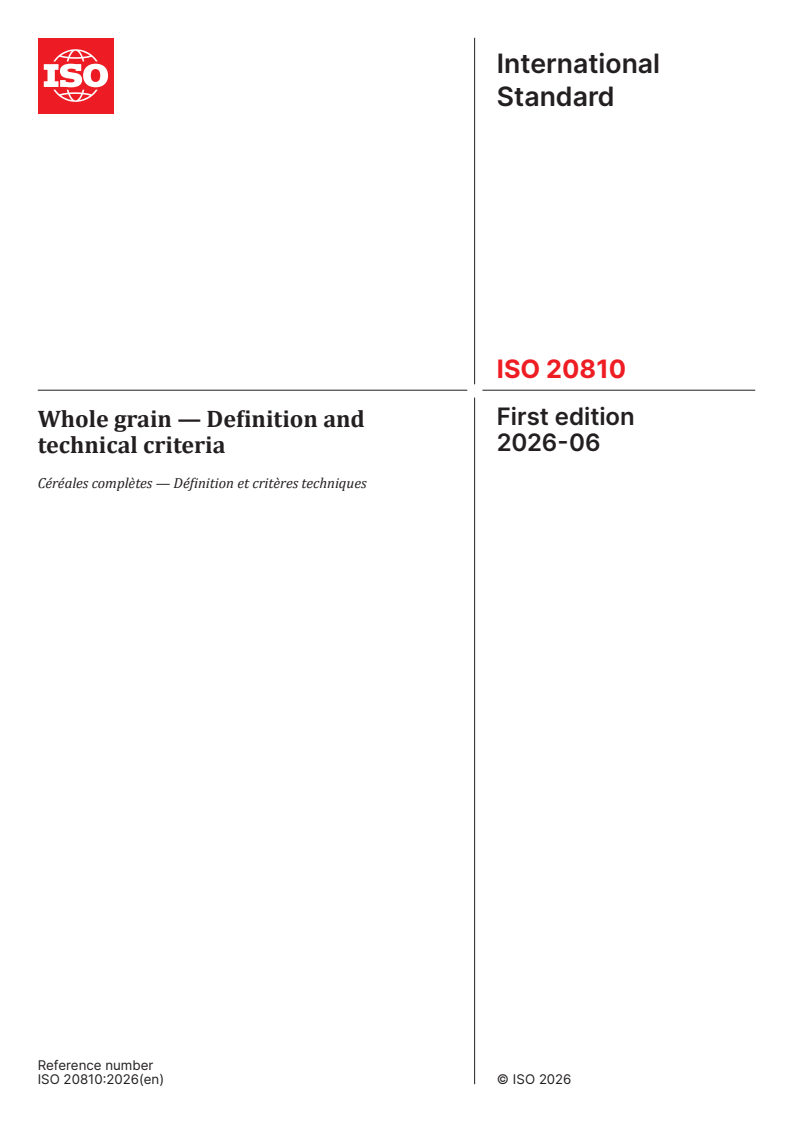
ISO 20810:2026 - Whole grain — Definition and technical criteria
ISO 20810:2026 - Céréales complètes — Définition et critères techniques
Overview
ISO 20810:2026 - Whole grain - Definition and technical criteria is an international standard developed by the International Organization for Standardization (ISO). It defines what constitutes whole grain as a food ingredient and outlines technical criteria for labeling and claims related to whole-grain foods derived from cereals and specific pseudocereals. Covering post-harvest considerations, ISO 20810:2026 is relevant for food manufacturers, regulatory bodies, and stakeholders throughout the global supply chain. The document enables consistent, evidence-based communication and trade practices through harmonized terminology and requirements for both business-to-business and business-to-consumer purposes.
Key Topics
Definition of Whole Grain
The standard specifies that whole grain refers to cereal grains and certain pseudocereals where all anatomical parts (endosperm, germ, and bran) are present in the same proportions as in the intact kernel, post-harvest and after processing.Technical Criteria for Ingredients
- Applies to both cereals (Poaceae family) and select pseudocereals (such as quinoa, amaranth, and buckwheat).
- Allows temporary separation of grain fractions, provided all components are recombined in original proportions.
- Permits minimal, unavoidable losses of grain components during processing, if consistent with safety and quality standards.
- Establishes conditions for processed, malted, or sprouted grains to be considered whole grain.
Criteria for Labelling and Claims
- Outlines minimum thresholds for whole-grain content in food products based on dry mass:
- At least 25% whole-grain ingredients for a "source of whole grain" or similar claim.
- At least 50% whole-grain ingredients for using whole grain in the product name (e.g., "whole grain bread").
- Requires claims and labels to be clear, not misleading, and compliant with applicable regulations.
- Provides guidance for calculating whole-grain content on a dry-mass basis.
- Outlines minimum thresholds for whole-grain content in food products based on dry mass:
Applications
Adopting ISO 20810:2026 supports:
Food Industry Standardization
Enables consistent formulation and designation of products marketed as whole-grain, facilitating product development and trade.Global Supply Chain Communication
Promotes clear, harmonized definitions for whole grain across international markets, reducing confusion and supporting fair competition.Compliance and Labeling
Assists businesses in accurately labeling whole-grain foods and complying with international and national regulations regarding food labeling and claims.Consumer Confidence
Helps consumers make informed choices based on standardized definitions and reliable labeling of whole-grain products.Regulatory Alignment
Provides a reference point for national and international food authorities seeking to harmonize standards and regulations related to whole grains.
Related Standards
ISO 5526 - Cereals, pulses and other food grains - Nomenclature
Reference for classifying cereals and pseudocereals.ISO 5527:2015 - Cereals - Vocabulary
Offers consistent terminology for cereal-related products.ISO 712 (all parts) - Cereals and cereal products - Determination of moisture content
Essential for calculating whole-grain content on a dry-mass basis.Codex Alimentarius Standards
- CXS 1-1985: General Standard for the Labelling of Prepackaged Foods
- CXG 1-1979: General Guidelines on Claims
Global Definitions
Draws from recognized consensus definitions established by international bodies such as the Whole Grain Initiative and the International Association for Cereal Science and Technology.
By following ISO 20810:2026, organizations can ensure accuracy and consistency in the use of whole grain terminology, improve food labeling integrity, and enhance trust in whole-grain claims across supply chains and markets worldwide.
Buy Documents
ISO 20810:2026 - Whole grain — Definition and technical criteria
ISO 20810:2026 - Céréales complètes — Définition et critères techniques
Get Certified
Connect with accredited certification bodies for this standard

BSI Group
BSI (British Standards Institution) is the business standards company that helps organizations make excellence a habit.

Bureau Veritas
Bureau Veritas is a world leader in laboratory testing, inspection and certification services.

DNV
DNV is an independent assurance and risk management provider.
Sponsored listings
Frequently Asked Questions
ISO 20810:2026 is a standard published by the International Organization for Standardization (ISO). Its full title is "Whole grain — Definition and technical criteria". This standard covers: This document specifies the definition and technical criteria for whole grain as a food ingredient (or “raw material”) and further specifies the requirements for designating whole-grain foods derived from cereals and certain pseudocereals on packaging, labelling and claims. The document is applicable to business-to-business and business-to-consumer communication, to the food trade and to food labelling and claims. The definition and technical criteria are only applicable to post-harvest/collecting of the grain. The document specifies technical criteria to all food and beverage companies, applicable to all organizations, regardless of size or complexity. This document is intended for use in business-to-business and business-to-consumer communications, relationships in the global supply chain, the international trade of food products, and food labelling and claims. NOTE The definition, technical criteria and criteria for food labelling and claims are generic. This document does not specify detailed criteria or technical guidance for specific types of grains and products.
This document specifies the definition and technical criteria for whole grain as a food ingredient (or “raw material”) and further specifies the requirements for designating whole-grain foods derived from cereals and certain pseudocereals on packaging, labelling and claims. The document is applicable to business-to-business and business-to-consumer communication, to the food trade and to food labelling and claims. The definition and technical criteria are only applicable to post-harvest/collecting of the grain. The document specifies technical criteria to all food and beverage companies, applicable to all organizations, regardless of size or complexity. This document is intended for use in business-to-business and business-to-consumer communications, relationships in the global supply chain, the international trade of food products, and food labelling and claims. NOTE The definition, technical criteria and criteria for food labelling and claims are generic. This document does not specify detailed criteria or technical guidance for specific types of grains and products.
ISO 20810:2026 is classified under the following ICS (International Classification for Standards) categories: 67.060 - Cereals, pulses and derived products. The ICS classification helps identify the subject area and facilitates finding related standards.
ISO 20810:2026 is available in PDF format for immediate download after purchase. The document can be added to your cart and obtained through the secure checkout process. Digital delivery ensures instant access to the complete standard document.
Standards Content (Sample)
International
Standard
ISO 20810
First edition
Whole grain — Definition and
2026-06
technical criteria
Céréales complètes — Définition et critères techniques
Reference number
© ISO 2026
All rights reserved. Unless otherwise specified, or required in the context of its implementation, no part of this publication may
be reproduced or utilized otherwise in any form or by any means, electronic or mechanical, including photocopying, or posting on
the internet or an intranet, without prior written permission. Permission can be requested from either ISO at the address below
or ISO’s member body in the country of the requester.
ISO copyright office
CP 401 • Ch. de Blandonnet 8
CH-1214 Vernier, Geneva
Phone: +41 22 749 01 11
Email: copyright@iso.org
Website: www.iso.org
Published in Switzerland
ii
Contents Page
Foreword .iv
Introduction .v
1 Scope . 1
2 Normative references . 1
3 Terms and definitions . 1
4 Technical criteria for whole grain as a food ingredient . 3
5 Technical criteria for labelling and claims for whole-grain foods and foods containing
whole grains . 3
Annex A (informative) Calculation of the percentage of whole-grain ingredients based on dry
mass . 4
Bibliography . 5
iii
Foreword
ISO (the International Organization for Standardization) is a worldwide federation of national standards
bodies (ISO member bodies). The work of preparing International Standards is normally carried out through
ISO technical committees. Each member body interested in a subject for which a technical committee
has been established has the right to be represented on that committee. International organizations,
governmental and non-governmental, in liaison with ISO, also take part in the work. ISO collaborates closely
with the International Electrotechnical Commission (IEC) on all matters of electrotechnical standardization.
The procedures used to develop this document and those intended for its further maintenance are described
in the ISO/IEC Directives, Part 1. In particular, the different approval criteria needed for the different types
of ISO document should be noted. This document was drafted in accordance with the editorial rules of the
ISO/IEC Directives, Part 2 (see www.iso.org/directives).
ISO draws attention to the possibility that the implementation of this document may involve the use of (a)
patent(s). ISO takes no position concerning the evidence, validity or applicability of any claimed patent
rights in respect thereof. As of the date of publication of this document, ISO had not received notice of (a)
patent(s) which may be required to implement this document. However, implementers are cautioned that
this may not represent the latest information, which may be obtained from the patent database available at
www.iso.org/patents. ISO shall not be held responsible for identifying any or all such patent rights.
Any trade name used in this document is information given for the convenience of users and does not
constitute an endorsement.
For an explanation of the voluntary nature of standards, the meaning of ISO specific terms and expressions
related to conformity assessment, as well as information about ISO’s adherence to the World Trade
Organization (WTO) principles in the Technical Barriers to Trade (TBT), see www.iso.org/iso/foreword.html.
This document was prepared by Technical Committee ISO/TC 34, Food products, Subcommittee SC 4, Cereals
and pulses.
Any feedback or questions on this document should be directed to the user’s national standards body. A
complete listing of these bodies can be found at www.iso.org/members.html.
iv
Introduction
The purpose of this document is to provide the definition and technical criteria for whole grain as a food
ingredient (or “raw material”) for use by the food and beverage industry at a global level, as well as technical
criteria for food labelling and claims for whole-grain foods and foods containing whole grains.
In drafting these technical criteria, the Technical Committee has taken into account the consensus definitions
[1]
of whole grain as a food ingredient, and that of whole-grain foods developed by the Whole Grain Initiative
Working Group of the International Association for Cereal Science and Technology (ICC), and ratified by
the Cereals & Grains Association (formerly American Association of Cereal Chemists International), ICC
and the European-based Health Grain Forum. In addition to the technical criteria itself, the publication
and its supplementary materials provide referenced background information, with explanations, and
recommendations for matters to be determined at national level.
It is noted that current definitions for whole grain as food ingredient only refer to cereal grains and certain
pseudocereals and are similar around the globe, whereas definitions of whole-grain foods show major
differences. Both the existence of two types of definitions and the major differences in whole-grain food
definitions are causing confusion. This document therefore includes one whole-grain definition: for whole
grain as food ingredient. For whole-grain foods technical criteria for food labelling and claims are provided,
derived from the definition in Reference [1].
Conformity to this document helps to ensure a level playing field and fair practices in business-to-business
relationships, international trade, and food labelling and claims.
NOTE Legally required information, food labelling or claims, or other applicable legal requirements can apply.
v
International Standard ISO 20810:2026(en)
Whole grain — Definition and technical criteria
1 Scope
This document specifies the definition and technical criteria for whole grain as a food ingredient (or “raw
material”) and further specifies the requirements for designating whole-grain foods derived from cereals
and certain pseudocereals on packaging, labelling and claims.
The document is applicable to business-to-business and business-to-consumer communication, to the food
trade and to food labelling and claims.
The definition and technical criteria are only applicable to post-harvest/collecting of the grain.
The document specifies technical criteria to all food and beverage companies, applicable to all organizations,
regardless of size or complexity. This document is intended for use in business-to-business and business-to-
consumer communications, relationships in the global supply chain, the international trade of food products,
and food labelling and claims.
NOTE The definition, technical criteria and criteria for food labelling and claims are generic. This document does
not specify detailed criteria or technical guidance for specific types of grains and products.
2 Normative references
There are no normative references in this document.
3 Terms and definitions
For the purposes of this document, the following terms and definitions apply.
ISO and IEC maintain terminology databases for use in standardization at the following addresses:
— ISO Online browsing platform: available at https:// www .iso .org/ obp
— IEC Electropedia: available at https:// www .electrop
...
Norme
internationale
ISO 20810
Première édition
Céréales complètes — Définition et
2026-06
critères techniques
Whole grain — Definition and technical criteria
Numéro de référence
DOCUMENT PROTÉGÉ PAR COPYRIGHT
© ISO 2026
Tous droits réservés. Sauf prescription différente ou nécessité dans le contexte de sa mise en œuvre, aucune partie de cette
publication ne peut être reproduite ni utilisée sous quelque forme que ce soit et par aucun procédé, électronique ou mécanique,
y compris la photocopie, ou la diffusion sur l’internet ou sur un intranet, sans autorisation écrite préalable. Une autorisation peut
être demandée à l’ISO à l’adresse ci-après ou au comité membre de l’ISO dans le pays du demandeur.
ISO copyright office
Case postale 401 • Ch. de Blandonnet 8
CH-1214 Vernier, Genève
Tél.: +41 22 749 01 11
E-mail: copyright@iso.org
Web: www.iso.org
Publié en Suisse
ii
Sommaire Page
Avant-propos .iv
Introduction .v
1 Domaine d’application . 1
2 Références normatives . 1
3 Termes et définitions . 1
4 Critères techniques pour les céréales complètes en tant qu’ingrédient alimentaire . 3
5 Critères techniques pour l’étiquetage des denrées alimentaires et les allégations
applicables aux aliments à base de céréales complètes et aux aliments contenant des
céréales complètes . 3
Annexe A (informative) Calcul du pourcentage d’ingrédients sous forme de céréales complètes
sur la base de la masse sèche . 5
Bibliographie . 7
iii
Avant-propos
L’ISO (Organisation internationale de normalisation) est une fédération mondiale d’organismes nationaux
de normalisation (comités membres de l’ISO). L’élaboration des Normes internationales est en général
confiée aux comités techniques de l’ISO. Chaque comité membre intéressé par une étude a le droit de faire
partie du comité technique créé à cet effet. Les organisations internationales, gouvernementales et non
gouvernementales, en liaison avec l’ISO participent également aux travaux. L’ISO collabore étroitement avec
la Commission électrotechnique internationale (IEC) en ce qui concerne la normalisation électrotechnique.
Les procédures utilisées pour élaborer le présent document et celles destinées à sa mise à jour sont
décrites dans les Directives ISO/IEC, Partie 1. Il convient, en particulier, de prendre note des différents
critères d’approbation requis pour les différents types de documents ISO. Le présent document a
été rédigé conformément aux règles de rédaction données dans les Directives ISO/IEC, Partie 2 (voir
www.iso.org/directives).
L’ISO attire l’attention sur le fait que la mise en application du présent document peut entraîner l’utilisation
d’un ou de plusieurs brevets. L’ISO ne prend pas position quant à la preuve, à la validité et à l’applicabilité de
tout droit de brevet revendiqué à cet égard. À la date de publication du présent document, l’ISO n’avait pas
reçu notification qu’un ou plusieurs brevets pouvaient être nécessaires à sa mise en application. Toutefois,
il y a lieu d’avertir les responsables de la mise en application du présent document que des informations
plus récentes sont susceptibles de figurer dans la base de données de brevets, disponible à l’adresse
www.iso.org/brevets. L’ISO ne saurait être tenue pour responsable de ne pas avoir identifié tout ou partie de
tels droits de propriété.
Les appellations commerciales éventuellement mentionnées dans le présent document sont données pour
information, par souci de commodité, à l’intention des utilisateurs et ne sauraient constituer un engagement.
Pour une explication de la nature volontaire des normes, la signification des termes et expressions
spécifiques de l’ISO liés à l’évaluation de la conformité, ou pour toute information au sujet de l’adhésion de
l’ISO aux principes de l’Organisation mondiale du commerce (OMC) concernant les obstacles techniques au
commerce (OTC), voir www.iso.org/avant-propos.
Le présent document a été élaboré par le comité technique ISO/TC 34, Produits alimentaires, sous-comité
SC 4, Céréales et légumineuses.
Il convient que l’utilisateur adresse tout retour d’information ou toute question concernant le présent
document à l’organisme national de normalisation de son pays. Une liste exhaustive desdits organismes se
trouve à l’adresse www.iso.org/fr/members.html.
iv
Introduction
L’objectif du présent document est de fournir la définition et les critères techniques pour les céréales
complètes en tant qu’ingrédient alimentaire (ou “matière première ”) à l’usage de l’industrie agroalimentaire
au niveau mondial, ainsi que les critères techniques pour l’étiquetage des denrées alimentaires et les
allégations pour les aliments à base de céréales complètes et les aliments contenant des céréales complètes.
Lors de la rédaction de ces critères techniques, le Comité technique a pris en compte les définitions
consensuelles des céréales complètes en tant qu’ingrédient alimentaire, et celles des aliments à base
[1]
de céréales complètes élaborées par le Groupe de travail de l’Initiative sur les céréales complètes de
l’International Association for Cereal Science and Technology (ICC), et ratifiées par la Cereals & Grains
Association (anciennement American Association of Cereal Chemists International), l’ICC et le Forum
européen HealthGrain. En plus des critères techniques eux-mêmes, la publication et ses documents
complémentaires fournissent des informations de base référencées, avec des explications et des
recommandations sur des questions à déterminer au niveau national.
Il est à noter que les définitions actuelles des céréales complètes en tant qu’ingrédient alimentaire ne se
réfèrent qu’aux grains de céréales et à certaines pseudocéréales et sont similaires dans le monde entier,
tandis que les définitions des aliments à base de céréales complètes présentent des différences majeures.
L’existence de deux types de définitions et les principales différences dans les définitions des aliments à base
de céréales complètes sont une source de confusion. Le présent document comprend donc une définition
unique des céréales complètes: celle relative aux céréales complètes en tant qu’ingrédient alimentaire. Pour
les aliments à base de céréales complètes, des critères techniques dérivés de la définition de la référence [1]
sont fournis pour l’étiquetage des denrées alimentaires et les allégations.
La conformité au présent document contribue à assurer des conditions de concurrence équitables et des
pratiques équitables dans les relations entre entreprises, le commerce international, l’étiquetage des denrées
alimentaires et les allégations.
NOTE Des informations légalement requises, l’étiquetage des denrées alimentaires ou les allégations, ou d’autres
exigences légales applicables peuvent s’appliquer.
v
Norme internationale ISO 20810:2026(fr)
Céréales complètes — Définition et critères techniques
1 Domaine d’application
Le présent document spécifie la définition et les critères techniques pour les céréales complètes en tant
qu’ingrédient alimentaire (ou “matière première ”) et spécifie en outre les exigences relatives à la désignation
des aliments à base de céréales complètes dérivés de céréales et de certaines pseudocéréales sur l’emballage,
l’étiquetage des denrées alimentaires et dans les allégations.
Le document est applicable à la communication entre entreprises et entre entreprises et consommateurs, au
commerce alimentaire et à l’étiquetage des denrées alimentaires et aux allégations.
La définition et les critères techniques s’appliquent uniquement après la récolte/collecte du grain.
Le document spécifie des critères techniques pour toutes les entreprises agroalimentaires, applicables à
tous les organismes, quelle que soit leur taille ou leur complexité. Le présent document est destiné à être
utilisé dans les communications entre entreprises et entre entreprises et consommateurs, les relations
dans la filière alimentaire mondiale, le commerce international des produits alimentaires et l’étiquetage des
denrées alimentaires et les allégations.
NOTE La définition, les critères techniques et les critères d’étiquetage des denrées alimentaires et d’allégations
sont génériques. Le présent document ne spécifie pas de critères détaillés ni de recommandations techniques pour des
types spécifiques de grains et de produits.
2 Références normatives
Le présent document ne contient aucune référence normative.
3 Termes et définitions
Pour les besoins du présent document, les termes et définitions suivants s’appliquent.
L’ISO et l’IEC tiennent à jour des bases de données terminologiques destinées à être utilisées en normalisation,
consultables aux adresses suivantes:
— ISO Online browsing platform: disponible à l’adresse https:// www .iso .org/ obp
— IEC Electropedia: disponible à l’adresse https:// www .electropedia .org/
3.1
céréale
graines issues de plantes généralement cultivées, appartenant à la famille des Poaceae
Note 1 à l'article: La liste de ces plantes est donnée dans l’ISO 5526.
[SOURCE: ISO 5527:2015, 2.1.5, modifiée — Note à l’article ajoutée.]
3.2
pseudocéréale
graines issues de plantes généralement cultivées, n’appartena
...