

ISO 6721-6:2019
(Main)Plastics — Determination of dynamic mechanical properties — Part 6: Shear vibration — Non-resonance method
General Information
- Abstract
This document describes a forced, non-resonance method for determining the components of the shear complex modulus G* of polymers at frequencies typically in the range 0,01 Hz to 100 Hz. Higher-frequency measurements can be made, but significant errors in the dynamic properties measured are likely to result (see 10.2.2 and 10.2.3). The method is suitable for measuring dynamic storage moduli in the range 0,1 MPa to 50 MPa. NOTE Although materials with moduli greater than 50 MPa can be studied, more accurate measurements of their dynamic shear properties can be made using a torsional mode of deformation (see ISO 6721-2 and ISO 6721-7). This method is particularly suited to the measurement of loss factors greater than 0,02 and can therefore be conveniently used to study the variation of dynamic properties with temperature and frequency through most of the glass-rubber relaxation region (see ISO 6721-1). The availability of data determined over wide ranges of both frequency and temperature enables master plots to be derived, using frequency/temperature shift procedures, which display dynamic properties over an extended frequency range at different temperatures.
- Status
- Published
- Publication Date
- 16-Apr-2019
- Technical Committee
- ISO/TC 61/SC 5 - Physical-chemical properties
- Drafting Committee
- ISO/TC 61/SC 5/WG 8 - Thermal analysis
- Current Stage
- 9093 - International Standard confirmed
- Start Date
- 06-Jun-2024
- Completion Date
- 29-Aug-2026
Buy Documents

ISO 6721-6:2019 - Plastics -- Determination of dynamic mechanical properties
ISO 6721-6:2019 - Plastics — Determination of dynamic mechanical properties — Part 6: Shear vibration — Non-resonance method/17/2019
Overview
ISO 6721-6:2019 - Plastics - Determination of dynamic mechanical properties - Part 6: Shear vibration - Non-resonance method describes a forced, non-resonant test method to determine the shear complex modulus (G*) of polymers. The standard covers measurements at frequencies typically from 0.01 Hz to 100 Hz, is suited to storage moduli from 0.1 MPa to 50 MPa, and is optimized for loss-factor (tan δ) measurements > 0.02. It explains principle, apparatus, specimen preparation, test procedure, data reduction (G′, G″, tan δ), and reporting requirements.
Key topics and requirements
- Test principle: Apply sinusoidal shear force/deformation below the assembly’s fundamental shear resonance and measure force, displacement and phase angle to compute G′ (storage), G″ (loss) and tan δ.
- Frequency & modulus ranges: Typical frequency 0.01–100 Hz; reliable storage moduli ~0.1–50 MPa. Higher-frequency data can introduce significant errors.
- Apparatus essentials:
- Shear loading assembly with rigid clamps and low thermal conductance
- Force and displacement transducers (calibrated and traceable)
- Electronic data-processing with specified accuracies (amplitude ±1%, phase ±0.1°, frequency ±10%)
- Temperature control and measurement per ISO 6721-1
- Specimens: Bonded or clamped polymer specimens between metal end-pieces; dimensions and preparation per clause requirements; dimensional variation ≤ 3% recommended.
- Quality & corrections:
- Avoid test assembly resonance (see clauses on resonance avoidance and transducer correction)
- Apply apparatus compliance corrections if clamped/bolted connections add compliance
- Transducer calibration accuracy: traceable and typically ±2% for minimum amplitudes
- Data handling: Calculation formulas for G′, G″ and tan δ, presentation as functions of temperature, and generation of frequency–temperature master plots using shift procedures.
- Reporting and precision: Clause guidance on precision, test atmosphere, conditioning and required test report items.
Applications and users
ISO 6721-6 is used for:
- Material R&D: characterizing viscoelastic behavior across glass–rubber transition regions
- Quality control: verifying dynamic shear properties for production batches
- Product development: evaluating damping (loss factor) and mechanical performance under cyclic shear
- Academic research: constructing master curves using frequency/temperature shift techniques Typical users include polymer testing laboratories, materials scientists, manufacturers of plastics and elastomers, instrument vendors (DMA/DMT systems), and standards/quality engineers.
Related standards
- ISO 6721-1 - General principles for dynamic mechanical properties
- ISO 6721-2 and ISO 6721-7 - Torsional deformation methods (recommended for stiffer materials >50 MPa)
- Relevant normative references are cited within ISO 6721-6 for specimen conditioning and temperature control.
Keywords: ISO 6721-6, plastics testing, shear vibration, non-resonance method, shear complex modulus, dynamic mechanical properties, tan δ, master plots.
Relations
- Effective Date
- 25-Aug-2026
- Effective Date
- 10-Feb-2026
- Effective Date
- 28-Jan-2017
- Effective Date
- 28-Jan-2017
Buy Documents
ISO 6721-6:2019 - Plastics -- Determination of dynamic mechanical properties
ISO 6721-6:2019 - Plastics — Determination of dynamic mechanical properties — Part 6: Shear vibration — Non-resonance method/17/2019
Get Certified
Connect with accredited certification bodies for this standard

DIN CERTCO
DIN Group product certification.

Smithers Quality Assessments
US management systems and product certification.
Sponsored listings
Frequently Asked Questions
ISO 6721-6:2019 is a standard published by the International Organization for Standardization (ISO). Its full title is "Plastics — Determination of dynamic mechanical properties — Part 6: Shear vibration — Non-resonance method". This standard covers: This document describes a forced, non-resonance method for determining the components of the shear complex modulus G* of polymers at frequencies typically in the range 0,01 Hz to 100 Hz. Higher-frequency measurements can be made, but significant errors in the dynamic properties measured are likely to result (see 10.2.2 and 10.2.3). The method is suitable for measuring dynamic storage moduli in the range 0,1 MPa to 50 MPa. NOTE Although materials with moduli greater than 50 MPa can be studied, more accurate measurements of their dynamic shear properties can be made using a torsional mode of deformation (see ISO 6721-2 and ISO 6721-7). This method is particularly suited to the measurement of loss factors greater than 0,02 and can therefore be conveniently used to study the variation of dynamic properties with temperature and frequency through most of the glass-rubber relaxation region (see ISO 6721-1). The availability of data determined over wide ranges of both frequency and temperature enables master plots to be derived, using frequency/temperature shift procedures, which display dynamic properties over an extended frequency range at different temperatures.
This document describes a forced, non-resonance method for determining the components of the shear complex modulus G* of polymers at frequencies typically in the range 0,01 Hz to 100 Hz. Higher-frequency measurements can be made, but significant errors in the dynamic properties measured are likely to result (see 10.2.2 and 10.2.3). The method is suitable for measuring dynamic storage moduli in the range 0,1 MPa to 50 MPa. NOTE Although materials with moduli greater than 50 MPa can be studied, more accurate measurements of their dynamic shear properties can be made using a torsional mode of deformation (see ISO 6721-2 and ISO 6721-7). This method is particularly suited to the measurement of loss factors greater than 0,02 and can therefore be conveniently used to study the variation of dynamic properties with temperature and frequency through most of the glass-rubber relaxation region (see ISO 6721-1). The availability of data determined over wide ranges of both frequency and temperature enables master plots to be derived, using frequency/temperature shift procedures, which display dynamic properties over an extended frequency range at different temperatures.
ISO 6721-6:2019 is classified under the following ICS (International Classification for Standards) categories: 83.080.01 - Plastics in general. The ICS classification helps identify the subject area and facilitates finding related standards.
ISO 6721-6:2019 has the following relationships with other standards: It is inter standard links to EN ISO 6721-1:2019, EN IEC 62788-5-1:2020, ISO 6721-6:1996, ISO 6721-6:1996/Amd 1:2007. Understanding these relationships helps ensure you are using the most current and applicable version of the standard.
ISO 6721-6:2019 is available in PDF format for immediate download after purchase. The document can be added to your cart and obtained through the secure checkout process. Digital delivery ensures instant access to the complete standard document.
Standards Content (Sample)
INTERNATIONAL ISO
STANDARD 6721-6
Second edition
2019-04
Plastics — Determination of dynamic
mechanical properties —
Part 6:
Shear vibration — Non-resonance
method
Plastiques — Détermination des propriétés mécaniques
dynamiques —
Partie 6: Vibration en cisaillement — Méthode hors résonance
Reference number
©
ISO 2019
© ISO 2019
All rights reserved. Unless otherwise specified, or required in the context of its implementation, no part of this publication may
be reproduced or utilized otherwise in any form or by any means, electronic or mechanical, including photocopying, or posting
on the internet or an intranet, without prior written permission. Permission can be requested from either ISO at the address
below or ISO’s member body in the country of the requester.
ISO copyright office
CP 401 • Ch. de Blandonnet 8
CH-1214 Vernier, Geneva
Phone: +41 22 749 01 11
Fax: +41 22 749 09 47
Email: copyright@iso.org
Website: www.iso.org
Published in Switzerland
ii © ISO 2019 – All rights reserved
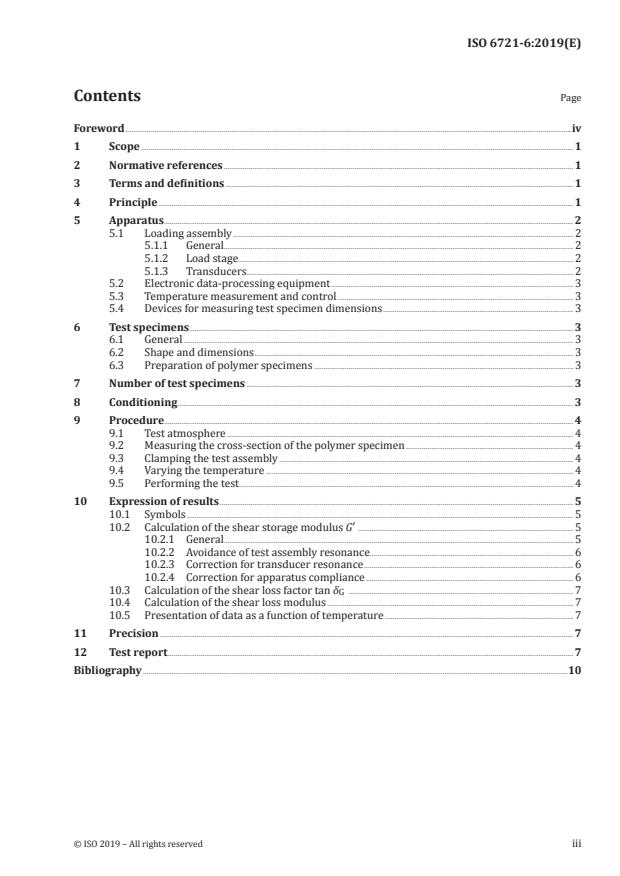
Contents Page
Foreword .iv
1 Scope . 1
2 Normative references . 1
3 Terms and definitions . 1
4 Principle . 1
5 Apparatus . 2
5.1 Loading assembly . 2
5.1.1 General. 2
5.1.2 Load stage . 2
5.1.3 Transducers. 2
5.2 Electronic data-processing equipment . 3
5.3 Temperature measurement and control . 3
5.4 Devices for measuring test specimen dimensions . 3
6 Test specimens. 3
6.1 General . 3
6.2 Shape and dimensions . 3
6.3 Preparation of polymer specimens . 3
7 Number of test specimens . 3
8 Conditioning . 3
9 Procedure. 4
9.1 Test atmosphere . 4
9.2 Measuring the cross-section of the polymer specimen . 4
9.3 Clamping the test assembly . 4
9.4 Varying the temperature . 4
9.5 Performing the test. 4
10 Expression of results . 5
10.1 Symbols . 5
10.2 Calculation of the shear storage modulus G′ . 5
10.2.1 General. 5
10.2.2 Avoidance of test assembly resonance. 6
10.2.3 Correction for transducer resonance . 6
10.2.4 Correction for apparatus compliance . 6
10.3 Calculation of the shear loss factor tan δ . 7
G
10.4 Calculation of the shear loss modulus . 7
10.5 Presentation of data as a function of temperature . 7
11 Precision . 7
12 Test report . 7
Bibliography .10
Foreword
ISO (the International Organization for Standardization) is a worldwide federation of national standards
bodies (ISO member bodies). The work of preparing International Standards is normally carried out
through ISO technical committees. Each member body interested in a subject for which a technical
committee has been established has the right to be represented on that committee. International
organizations, governmental and non-governmental, in liaison with ISO, also take part in the work.
ISO collaborates closely with the International Electrotechnical Commission (IEC) on all matters of
electrotechnical standardization.
The procedures used to develop this document and those intended for its further maintenance are
described in the ISO/IEC Directives, Part 1. In particular, the different approval criteria needed for the
different types of ISO documents should be noted. This document was drafted in accordance with the
editorial rules of the ISO/IEC Directives, Part 2 (see www .iso .org/directives).
Attention is drawn to the possibility that some of the elements of this document may be the subject of
patent rights. ISO shall not be held responsible for identifying any or all such patent rights. Details of
any patent rights identified during the development of the document will be in the Introduction and/or
on the ISO list of patent declarations received (see www .iso .org/patents).
Any trade name used in this document is information given for the convenience of users and does not
constitute an endorsement.
For an explanation of the voluntary nature of standards, the meaning of ISO specific terms and
expressions related to conformity assessment, as well as information about ISO's adherence to the
World Trade Organization (WTO) principles in the Technical Barriers to Trade (TBT), see www .iso
.org/iso/foreword .html.
This document was prepared by Technical Committee ISO/TC 61, Plastics, Subcommittee SC 5, Physical-
chemical properties.
This second edition cancels and replaces the first edition (ISO 6721-6:1996), which has been technically
revised. It also incorporates the Amendment ISO 6721-6:1996/Amd.1:2007. The main changes compared
to the previous edition are as follows:
— the document has been revised editorially;
— normative references have been changed to undated.
A list of all parts in the ISO 6721 series can be found on the ISO website.
Any feedback or questions on this document should be directed to the user’s national standards body. A
complete listing of these bodies can be found at www .iso .org/members .html.
iv © ISO 2019 – All rights reserved
INTERNATIONAL STANDARD ISO 6721-6:2019(E)
Plastics — Determination of dynamic mechanical
properties —
Part 6:
Shear vibration — Non-resonance method
1 Scope
This document describes a forced, non-resonance method for determining the components of the
shear complex modulus G* of polymers at frequencies typically in the range 0,01 Hz to 100 Hz. Higher-
frequency measurements can be made, but significant errors in the dynamic properties measured are
likely to result (see 10.2.2 and 10.2.3). The method is suitable for measuring dynamic storage moduli in
the range 0,1 MPa to 50 MPa.
NOTE Although materials with moduli greater than 50 MPa can be studied, more accurate measurements
of their dynamic shear properties can be made using a torsional mode of deformation (see ISO 6721-2 and
ISO 6721-7).
This method is particularly suited to the measurement of loss factors greater than 0,02 and can
therefore be conveniently used to study the variation of dynamic properties with temperature and
frequency through most of the glass-rubber relaxation region (see ISO 6721-1). The availability of data
determined over wide ranges of both frequency and temperature enables master plots to be derived,
using frequency/temperature shift procedures, which display dynamic properties over an extended
frequency range at different temperatures.
2 Normative references
The following documents are referred to in the text in such a way that some or all of their content
constitutes requirements of this document. For dated references, only the edition cited applies. For
undated references, the latest edition of the referenced document (including any amendments) applies.
ISO 6721-1, Plastics — Determination of dynamic mechanical properties — Part 1: General principles
3 Terms and definitions
For the purposes of this document, the terms and definitions given in ISO 6721-1 apply.
ISO and IEC maintain terminological databases for use in standardization at the following addresses:
— ISO Online browsing platform: available at https: //www .iso .org/obp
— IEC Electropedia: available at http: //www .electropedia .org/
4 Principle
A test-specimen assembly is subjected to a sinusoidal shear force or deformation at a frequency
significantly below the fundamental shear resonance frequency (see 10.2.2). The amplitudes of the
force and displacement cycles applied to the test-specimen assembly and the phase angle between
these cycles are measured. The storage and loss components of the shear complex modulus and the loss
factor are calculated using formulae given in Clause 10.
5 Apparatus
5.1 Loading assembly
5.1.1 General
The requirements for the loading assembly are that it shall permit measurements of the amplitudes of,
and phase angle between, the force and displacement cycles for a test specimen assembly subjected to
a sinusoidal shear force or deformation. Various designs of apparatus are possible: a suitable version is
shown schematically in Figure 1. The shear test-specimen assembly consists of two identical specimens
S of the polymer bonded to or clamped between metal end-pieces P and P . A sinusoidal force is
1 2
generated by the vibrator V and applied to the two outer end-pieces P of the test-specimen assembly
through the clamping device C of the shear load stage. The amplitude and frequency of the vibrator
table displacement are variable and monitored by the transducer D. The test-specimen assembly is held
at its centre P by a fixed clamp C , and thus each specimen S of the polymer is subjected to simple
2 2
shear deformations of equal magnitude. The sinusoid
...
INTERNATIONAL ISO
STANDARD 6721-6
Second edition
2019-04
Plastics — Determination of dynamic
mechanical properties —
Part 6:
Shear vibration — Non-resonance
method
Plastiques — Détermination des propriétés mécaniques
dynamiques —
Partie 6: Vibration en cisaillement — Méthode hors résonance
Reference number
©
ISO 2019
© ISO 2019
All rights reserved. Unless otherwise specified, or required in the context of its implementation, no part of this publication may
be reproduced or utilized otherwise in any form or by any means, electronic or mechanical, including photocopying, or posting
on the internet or an intranet, without prior written permission. Permission can be requested from either ISO at the address
below or ISO’s member body in the country of the requester.
ISO copyright office
CP 401 • Ch. de Blandonnet 8
CH-1214 Vernier, Geneva
Phone: +41 22 749 01 11
Fax: +41 22 749 09 47
Email: copyright@iso.org
Website: www.iso.org
Published in Switzerland
ii © ISO 2019 – All rights reserved
Contents Page
Foreword .iv
1 Scope . 1
2 Normative references . 1
3 Terms and definitions . 1
4 Principle . 1
5 Apparatus . 2
5.1 Loading assembly . 2
5.1.1 General. 2
5.1.2 Load stage . 2
5.1.3 Transducers. 2
5.2 Electronic data-processing equipment . 3
5.3 Temperature measurement and control . 3
5.4 Devices for measuring test specimen dimensions . 3
6 Test specimens. 3
6.1 General . 3
6.2 Shape and dimensions . 3
6.3 Preparation of polymer specimens . 3
7 Number of test specimens . 3
8 Conditioning . 3
9 Procedure. 4
9.1 Test atmosphere . 4
9.2 Measuring the cross-section of the polymer specimen . 4
9.3 Clamping the test assembly . 4
9.4 Varying the temperature . 4
9.5 Performing the test. 4
10 Expression of results . 5
10.1 Symbols . 5
10.2 Calculation of the shear storage modulus G′ . 5
10.2.1 General. 5
10.2.2 Avoidance of test assembly resonance. 6
10.2.3 Correction for transducer resonance . 6
10.2.4 Correction for apparatus compliance . 6
10.3 Calculation of the shear loss factor tan δ . 7
G
10.4 Calculation of the shear loss modulus . 7
10.5 Presentation of data as a function of temperature . 7
11 Precision . 7
12 Test report . 7
Bibliography .10
Foreword
ISO (the International Organization for Standardization) is a worldwide federation of national standards
bodies (ISO member bodies). The work of preparing International Standards is normally carried out
through ISO technical committees. Each member body interested in a subject for which a technical
committee has been established has the right to be represented on that committee. International
organizations, governmental and non-governmental, in liaison with ISO, also take part in the work.
ISO collaborates closely with the International Electrotechnical Commission (IEC) on all matters of
electrotechnical standardization.
The procedures used to develop this document and those intended for its further maintenance are
described in the ISO/IEC Directives, Part 1. In particular, the different approval criteria needed for the
different types of ISO documents should be noted. This document was drafted in accordance with the
editorial rules of the ISO/IEC Directives, Part 2 (see www .iso .org/directives).
Attention is drawn to the possibility that some of the elements of this document may be the subject of
patent rights. ISO shall not be held responsible for identifying any or all such patent rights. Details of
any patent rights identified during the development of the document will be in the Introduction and/or
on the ISO list of patent declarations received (see www .iso .org/patents).
Any trade name used in this document is information given for the convenience of users and does not
constitute an endorsement.
For an explanation of the voluntary nature of standards, the meaning of ISO specific terms and
expressions related to conformity assessment, as well as information about ISO's adherence to the
World Trade Organization (WTO) principles in the Technical Barriers to Trade (TBT), see www .iso
.org/iso/foreword .html.
This document was prepared by Technical Committee ISO/TC 61, Plastics, Subcommittee SC 5, Physical-
chemical properties.
This second edition cancels and replaces the first edition (ISO 6721-6:1996), which has been technically
revised. It also incorporates the Amendment ISO 6721-6:1996/Amd.1:2007. The main changes compared
to the previous edition are as follows:
— the document has been revised editorially;
— normative references have been changed to undated.
A list of all parts in the ISO 6721 series can be found on the ISO website.
Any feedback or questions on this document should be directed to the user’s national standards body. A
complete listing of these bodies can be found at www .iso .org/members .html.
iv © ISO 2019 – All rights reserved
INTERNATIONAL STANDARD ISO 6721-6:2019(E)
Plastics — Determination of dynamic mechanical
properties —
Part 6:
Shear vibration — Non-resonance method
1 Scope
This document describes a forced, non-resonance method for determining the components of the
shear complex modulus G* of polymers at frequencies typically in the range 0,01 Hz to 100 Hz. Higher-
frequency measurements can be made, but significant errors in the dynamic properties measured are
likely to result (see 10.2.2 and 10.2.3). The method is suitable for measuring dynamic storage moduli in
the range 0,1 MPa to 50 MPa.
NOTE Although materials with moduli greater than 50 MPa can be studied, more accurate measurements
of their dynamic shear properties can be made using a torsional mode of deformation (see ISO 6721-2 and
ISO 6721-7).
This method is particularly suited to the measurement of loss factors greater than 0,02 and can
therefore be conveniently used to study the variation of dynamic properties with temperature and
frequency through most of the glass-rubber relaxation region (see ISO 6721-1). The availability of data
determined over wide ranges of both frequency and temperature enables master plots to be derived,
using frequency/temperature shift procedures, which display dynamic properties over an extended
frequency range at different temperatures.
2 Normative references
The following documents are referred to in the text in such a way that some or all of their content
constitutes requirements of this document. For dated references, only the edition cited applies. For
undated references, the latest edition of the referenced document (including any amendments) applies.
ISO 6721-1, Plastics — Determination of dynamic mechanical properties — Part 1: General principles
3 Terms and definitions
For the purposes of this document, the terms and definitions given in ISO 6721-1 apply.
ISO and IEC maintain terminological databases for use in standardization at the following addresses:
— ISO Online browsing platform: available at https: //www .iso .org/obp
— IEC Electropedia: available at http: //www .electropedia .org/
4 Principle
A test-specimen assembly is subjected to a sinusoidal shear force or deformation at a frequency
significantly below the fundamental shear resonance frequency (see 10.2.2). The amplitudes of the
force and displacement cycles applied to the test-specimen assembly and the phase angle between
these cycles are measured. The storage and loss components of the shear complex modulus and the loss
factor are calculated using formulae given in Clause 10.
5 Apparatus
5.1 Loading assembly
5.1.1 General
The requirements for the loading assembly are that it shall permit measurements of the amplitudes of,
and phase angle between, the force and displacement cycles for a test specimen assembly subjected to
a sinusoidal shear force or deformation. Various designs of apparatus are possible: a suitable version is
shown schematically in Figure 1. The shear test-specimen assembly consists of two identical specimens
S of the polymer bonded to or clamped between metal end-pieces P and P . A sinusoidal force is
1 2
generated by the vibrator V and applied to the two outer end-pieces P of the test-specimen assembly
through the clamping device C of the shear load stage. The amplitude and frequency of the vibrator
table displacement are variable and monitored by the transducer D. The test-specimen assembly is held
at its centre P by a fixed clamp C , and thus each specimen S of the polymer is subjected to simple
2 2
shear deformations of equal magnitude. The sinusoid
...