


ISO 7356:1985
(Main)Oils of thujone-containing Artemisia and oil of sage (Salvia officinalis Linnaeus) — Determination of alpha- and beta-thujone content — Gas chromatographic method on packed columns
Oils of thujone-containing Artemisia and oil of sage (Salvia officinalis Linnaeus) — Determination of alpha- and beta-thujone content — Gas chromatographic method on packed columns
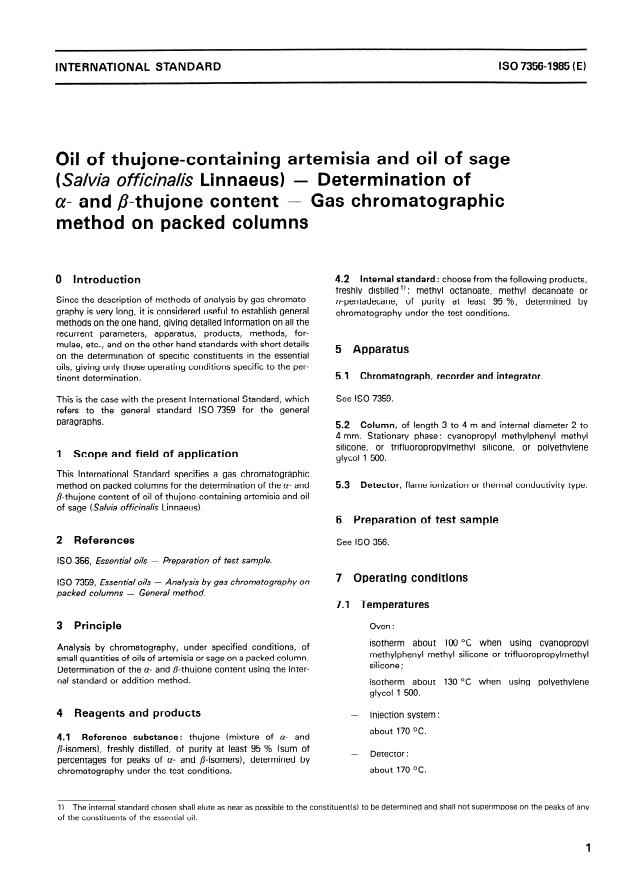
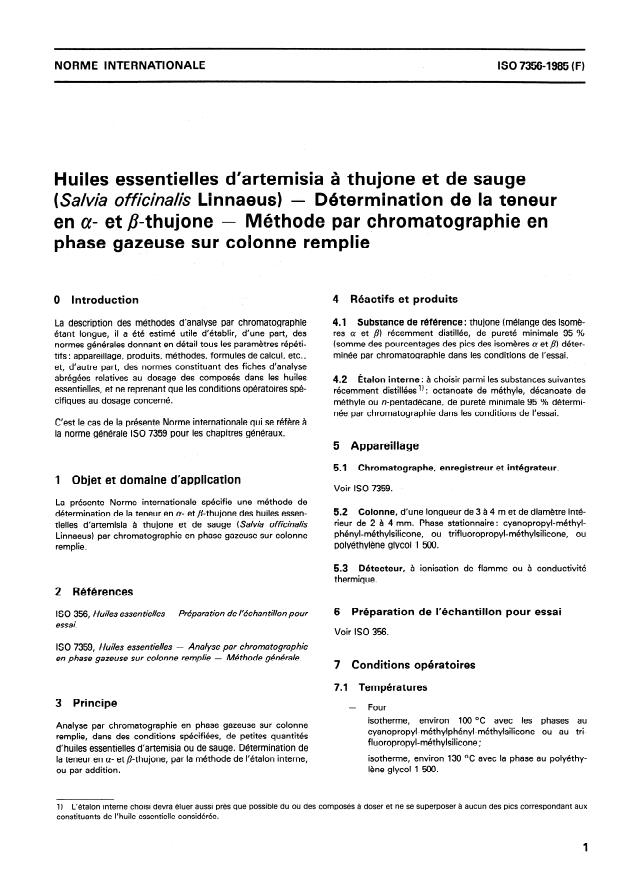
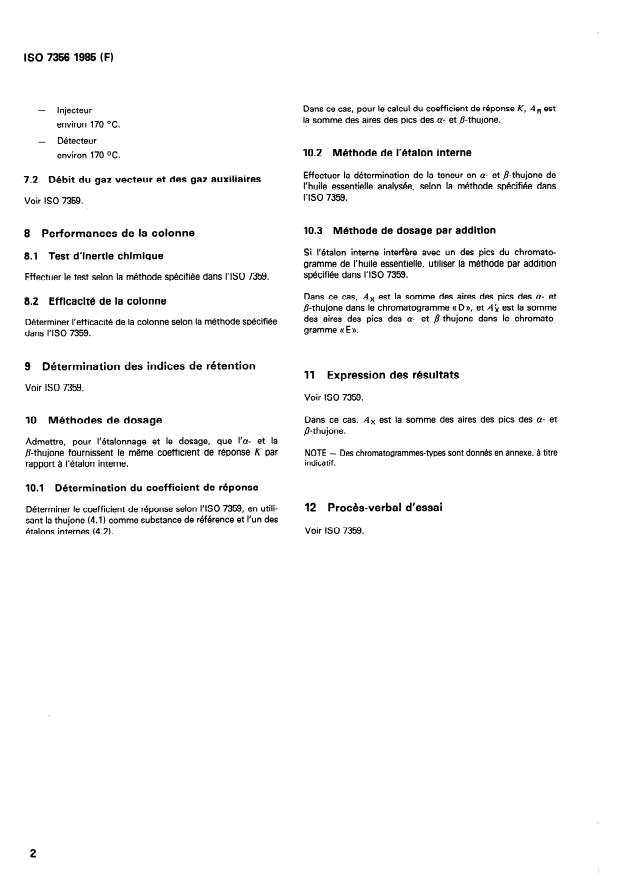
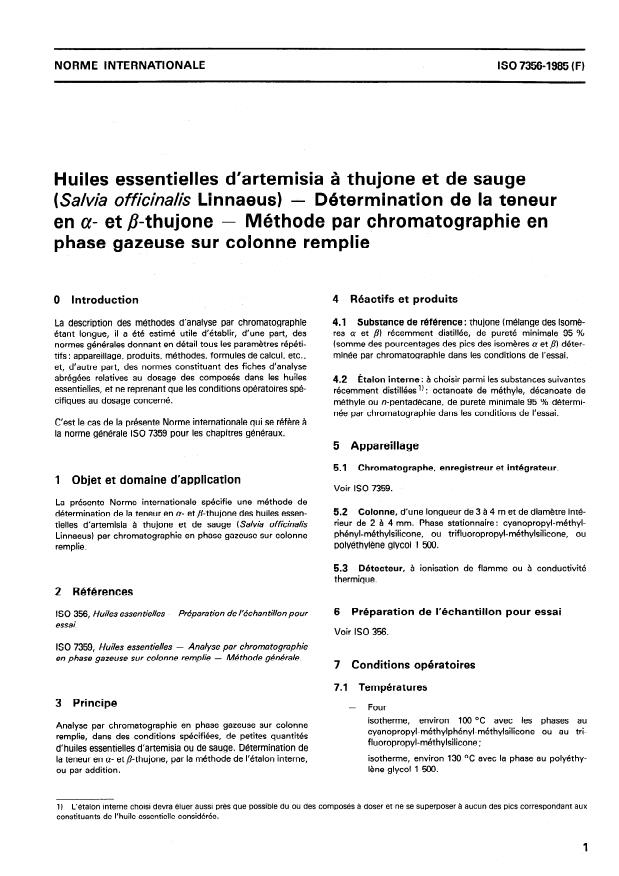
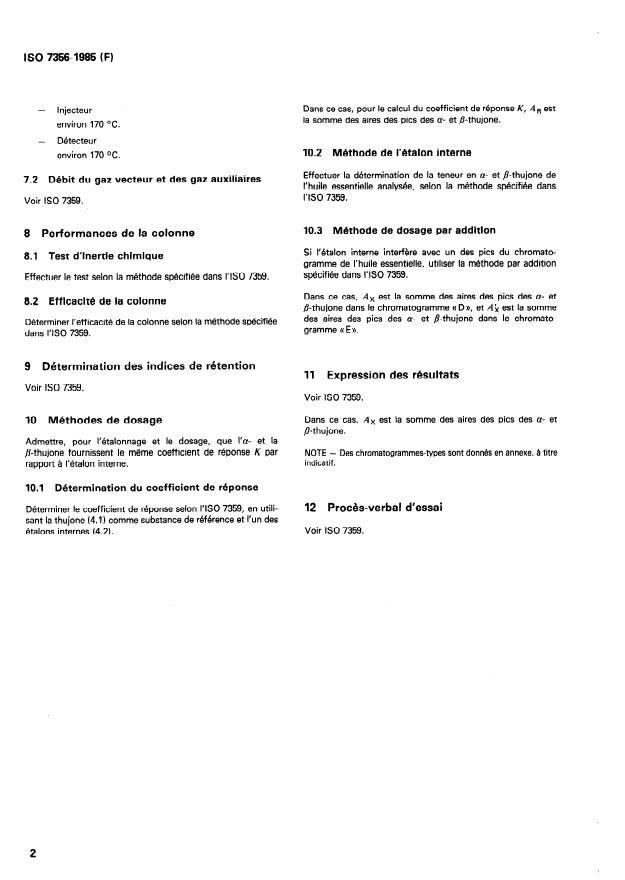
A small quantity of the oils is analyzed under specified conditions. The alpha- and beta-thujone contents are determined by using the internal standard or addition method. As stationary phase are used cyanopropyl methylphenyl methyl silicone, or trifluoropropylmethyl silicone, or polyethylene glycol 1500. Operating temperatures: Oven: isotherm about 100 °C when using cyanopropyl methylphenyl methyl silicone or trifluoropropylmethyl silicone; isotherm about 130-°C when using polyethylene glycol 1500. Injection system and detector: about 170 °C.
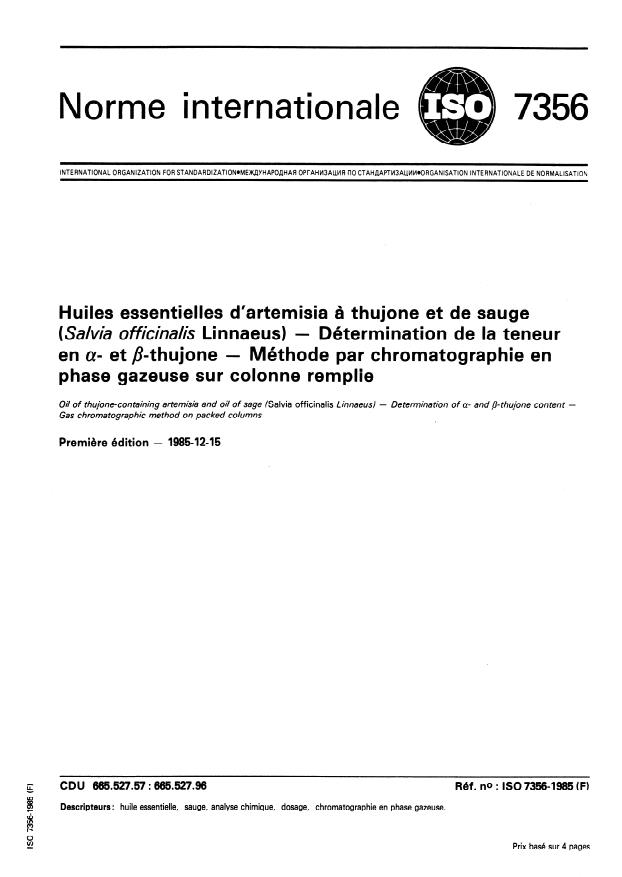
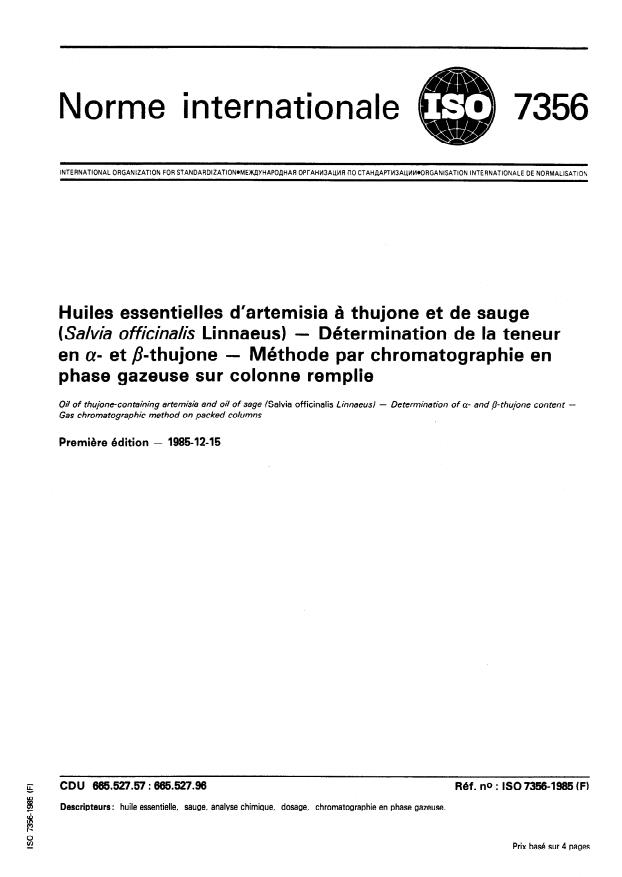
Huiles essentielles d'artemisia à thujone et de sauge (Salvia officinalis Linnaeus) — Détermination de la teneur en alpha- et bêta-thujone — Méthode par chromatographie en phase gazeuse sur colonne remplie
General Information
- Status
- Withdrawn
- Publication Date
- 18-Dec-1985
- Withdrawal Date
- 18-Dec-1985
- Technical Committee
- ISO/TC 54 - Essential oils
- Drafting Committee
- ISO/TC 54 - Essential oils
- Current Stage
- 9599 - Withdrawal of International Standard
- Start Date
- 05-Mar-2007
- Completion Date
- 14-Feb-2026
Relations
- Consolidated By
ISO/TS 17263:2003 - Automatic vehicle and equipment identification — Intermodal goods transport — System parameters - Effective Date
- 06-Jun-2022
Buy Documents
ISO 7356:1985 - Oils of thujone-containing Artemisia and oil of sage (Salvia officinalis Linnaeus) -- Determination of alpha- and beta-thujone content -- Gas chromatographic method on packed columns
ISO 7356:1985 - Huiles essentielles d'artemisia a thujone et de sauge (Salvia officinalis Linnaeus) -- Détermination de la teneur en alpha- et beta-thujone -- Méthode par chromatographie en phase gazeuse sur colonne remplie
ISO 7356:1985 - Huiles essentielles d'artemisia a thujone et de sauge (Salvia officinalis Linnaeus) -- Détermination de la teneur en alpha- et beta-thujone -- Méthode par chromatographie en phase gazeuse sur colonne remplie
Get Certified
Connect with accredited certification bodies for this standard

ECOCERT
Organic and sustainability certification.

Eurofins Food Testing Global
Global leader in food, environment, and pharmaceutical product testing.

Intertek Bangladesh
Intertek certification and testing services in Bangladesh.
Sponsored listings
Frequently Asked Questions
ISO 7356:1985 is a standard published by the International Organization for Standardization (ISO). Its full title is "Oils of thujone-containing Artemisia and oil of sage (Salvia officinalis Linnaeus) — Determination of alpha- and beta-thujone content — Gas chromatographic method on packed columns". This standard covers: A small quantity of the oils is analyzed under specified conditions. The alpha- and beta-thujone contents are determined by using the internal standard or addition method. As stationary phase are used cyanopropyl methylphenyl methyl silicone, or trifluoropropylmethyl silicone, or polyethylene glycol 1500. Operating temperatures: Oven: isotherm about 100 °C when using cyanopropyl methylphenyl methyl silicone or trifluoropropylmethyl silicone; isotherm about 130-°C when using polyethylene glycol 1500. Injection system and detector: about 170 °C.
A small quantity of the oils is analyzed under specified conditions. The alpha- and beta-thujone contents are determined by using the internal standard or addition method. As stationary phase are used cyanopropyl methylphenyl methyl silicone, or trifluoropropylmethyl silicone, or polyethylene glycol 1500. Operating temperatures: Oven: isotherm about 100 °C when using cyanopropyl methylphenyl methyl silicone or trifluoropropylmethyl silicone; isotherm about 130-°C when using polyethylene glycol 1500. Injection system and detector: about 170 °C.
ISO 7356:1985 is classified under the following ICS (International Classification for Standards) categories: 71.100.60 - Essential oils. The ICS classification helps identify the subject area and facilitates finding related standards.
ISO 7356:1985 has the following relationships with other standards: It is inter standard links to ISO/TS 17263:2003. Understanding these relationships helps ensure you are using the most current and applicable version of the standard.
ISO 7356:1985 is available in PDF format for immediate download after purchase. The document can be added to your cart and obtained through the secure checkout process. Digital delivery ensures instant access to the complete standard document.
Standards Content (Sample)
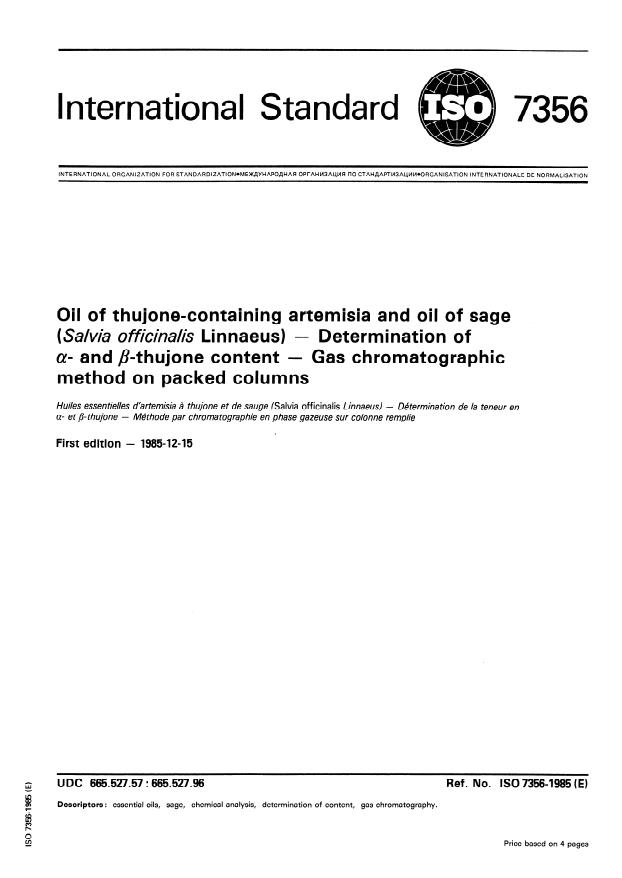
International Standard
INTERNATIONAL ORGANIZATION FOR STANDARDIZATION.MEXfiYHAPOfiHAR OPrAHM3AUMR i-l0 CTAH,!JAPTkl3ALWlkl*ORGANISATION INTERNATIONALE DE NORMALISATION
Oil of thujone-containing artemisia and oil of sage
(Salvla officinaks Linnaeus) - Determination of
a- and fl-thujone content - Gas chromatographic
method on packed columns
Huiles essentielles d’artemisia 2 thujone et de sauge (Salvia off icinalis Linnaeus) - Dktermina tion de Ia teneur en
AMhode par Chromatographie en phase gazeuse sur colonne remplie
a- et ß-thujone -
First edition - 19854245
Ref. No. ISO 73564985 (E)
UDC 665.527.57 : 665.527.96
Descriptors : essential oils, sage, Chemical analysis, determination of content, gas chromatography.
Price based on 4 pages
Foreword
ISO (the International Organization for Standardization) is a worldwide federation of
national Standards bodies (ISO member bodies). The work of preparing International
Standards is normally carried out through ISO technical committees. Esch member
body interested in a subject for which a technical committee has been established has
the right to be represented on that committee. International organizations, govern-
mental and non-governmental, in liaison with ISO, also take part in the work.
Draft International Standards adopted by the technical committees are circulated to
the member bodies for approval before their acceptance as International Standards by
the ISO Council. They are approved in accordance with ISO procedures requiring at
least 75 % approval by the member bodies voting.
International Standard ISO 7356 was prepared by Technical Committee ISO/TC 54,
Essential 017s.
Users should note that all International Standards undergo revision from time to time
and that any reference made herein to any other International Standard implies its
latest edition, unless otherwise stated.
0 International Organkation for Standardkation, 1985
Printed in Switzerland
ISO 7356-1985 (El
INTERNATIONAL STANDARD
Oil of thujone-containing artemisia and oil of sage
(Salvia officinalis Linnaeus) - Determination of
a- and ß-thujone content - Gas chromatographic
method on packed columns
4.2 lnternal Standard: choose from the following products,
0 lntroduction
freshly distilled ‘) : methyl octanoate, methyl decanoate or
Since the description of methods of analysis by gas chromato-
n-pentadecane, of purity at least 95 %, determined by
graphy is very long, it is considered useful to establish general
chromatography under the test conditions.
methods on the one hand, giving detailed information on all the
recurrent Parameters, apparatus, products, methods, for-
mulae, etc., and on the other hand Standards with short details
5 Apparatus
on the determination of specific constituents in the essential
oils, giving only those operating conditions specific to the per-
5.1 Chromatograph, recorder and integrator.
tinent determination.
See ISO 7359.
This is the case with the present International Standard, which
refers to the general Standard ISO 7359 for the general
Paragraphs.
5.2 Column, of length 3 to 4 m and internal diameter 2 to
4 mm. Stationary Phase: cyanopropyl methylphenyl methyl
Silicone, or trifluoropropylmethyl Silicone, or polyethylene
1 Scope and field of application
glycol 1 500.
This International Standard specifies a gas chromatographic
5.3 Detector, flame ionization or thermal conductivity type.
method on packed columns for the determination of the a- and
ß-thujone content of oil of thujone-containing artemisia and oil
of sage (Salvia officinalis Linnaeus).
6 Preparation of test Sample
2 References
See ISO 356.
ISO 356, Essential oils - Bepara tion 0 f test Sample.
7 Operating conditions
ISO 7359, Essential
...
Norme internationale
INTERNATIONAL ORGANIZATION FOR STANDARDIZATION*MEIKJJYHAPO~HAR OPrAHM3AlJMR Il0 CTAH~APTM3Al@lM.ORGANISATION INTERNATIONALE DE NORMALISATIOh
Huiles essentielles d’artemisia à thujone et de sauge
(Sakia officinalk Linnaeus) - Détermination de la teneur
Méthode par chromatographie en
en a- et P-thujone -
phase gazeuse sur colonne remplie
Oil of thujone-containing artemisia and oîf of sage (Salvia officinalis Limaeus) - Determination of a- and p- thujone content -
Gas chromatographic method on packed columns
Première édition - 19854245
R6f. no : ISO 73564985 (FI
CDU 665.527.57: 665.527.96
Descripteurs : huile essentielle, sauge, analyse chimique, dosage, chromatographie en phase gazeuse.
Prix basé sur 4 pages
Avant-propos
L’ISO (Organisation internationale de normalisation) est une fédération mondiale
d’organismes nationaux de normalisation (comités membres de I’ISO). L’élaboration
des Normes internationales est confiée aux comités techniques de I’ISO. Chaque
comité membre intéressé par une étude a le droit de faire partie du comité technique
créé à cet effet. Les organisations internationales, gouvernementales et non gouverne-
mentales, en liaison avec I’ISO participent également aux travaux.
Les projets de Normes internationales adoptés par les comités techniques sont soumis
aux comités membres pour approbation, avant leur acceptation comme Normes inter-
nationales par le Conseil de I’ISO. Les Normes internationales sont approuvées confor-
mément aux procédures de I’ISO qui requièrent l’approbation de 75 % au moins des
comités membres votants.
comité
La Norme internationale ISO 7356 a été élaborée par le technique ISO/TC 54,
Huiles essentielles.
L’attention des utilisateurs est attirée sur le fait que toutes les Normes internationales
sont de temps en temps soumises à révision et que toute référence faite à une autre
Norme internationale dans le présent document implique qu’il s’agit, sauf indication
contraire, de la dernière édition.
@ Organisation internationale de normalisation, 1985
Imprimé en Suisse
NORME INTERNATIONALE ISO 7356-1985 (F)
Huiles essentielles d’artemisia à thujone et de sauge
(Sa/via officinatk Linnaeus) - Détermination de la teneur
Méthode par bhromatographie en
en a- et P-thujone -
phase gazeuse sur colonne remplie
4 Réactifs et produits
0 Introduction
4.1 Substance de référence: thujone (mélange des isomè-
La description des méthodes d’analyse par chromatographie
res a et p) récemment distillée, de pureté minimale 95 %
étant longue, il a été estimé utile d’établir, d’une part, des
(somme des pourcentages des pics des isoméres a et /J) déter-
normes générales donnant en détail tous les paramètres répéti-
tifs : appareillage, produits, méthodes, formules de calcul, etc., minée par chromatographie dans les conditions de l’essai.
et, d’autre part, des normes constituant des fiches d’analyse
abrégées relatives au dosage des composés dans les huiles
4.2 Étalon interne : à choisir parmi les substances suivantes
essentielles, et ne reprenant que les conditions opératoires spé-
récemment distillées ‘) : octanoate de méthyle, décanoate de
cifiques au dosage concerné.
méthyle ou n-pentadécane, de pureté minimale 95 % détermi-
par chromatographie dans les conditions de l’essai.
née
C’est le cas de la présente Norme internationale qui se réfère à
la norme générale ISO 7359 pour les chapitres généraux.
5 Appareillage
Chromatographe, enregistreur et intégrateur.
51 .
1 Objet et domaine d’application
Voir ISO 7359.
La présente Norme internationale spécifie une méthode de
5.2 Colonne, d’une longueur de 3 à 4 m et de diamètre inté-
détermination de la teneur en a- et fl-thujone des huiles essen-
rieur de 2 à 4 mm. Phase stationnaire: cyanopropyl-méthyl-
tielles d’artemisia à thujone et de sauge (Salvia officinalis
phényl-méthylsilicone, ou trifluoropropyl-méthylsilicone, ou
Linnaeus) par chromatographie en phase gazeuse sur colonne
polyéthylène glycol 1 500.
remplie.
5.3 Détecteur, à ionisation de flamme ou à con
...
Norme internationale
INTERNATIONAL ORGANIZATION FOR STANDARDIZATION*MEIKJJYHAPO~HAR OPrAHM3AlJMR Il0 CTAH~APTM3Al@lM.ORGANISATION INTERNATIONALE DE NORMALISATIOh
Huiles essentielles d’artemisia à thujone et de sauge
(Sakia officinalk Linnaeus) - Détermination de la teneur
Méthode par chromatographie en
en a- et P-thujone -
phase gazeuse sur colonne remplie
Oil of thujone-containing artemisia and oîf of sage (Salvia officinalis Limaeus) - Determination of a- and p- thujone content -
Gas chromatographic method on packed columns
Première édition - 19854245
R6f. no : ISO 73564985 (FI
CDU 665.527.57: 665.527.96
Descripteurs : huile essentielle, sauge, analyse chimique, dosage, chromatographie en phase gazeuse.
Prix basé sur 4 pages
Avant-propos
L’ISO (Organisation internationale de normalisation) est une fédération mondiale
d’organismes nationaux de normalisation (comités membres de I’ISO). L’élaboration
des Normes internationales est confiée aux comités techniques de I’ISO. Chaque
comité membre intéressé par une étude a le droit de faire partie du comité technique
créé à cet effet. Les organisations internationales, gouvernementales et non gouverne-
mentales, en liaison avec I’ISO participent également aux travaux.
Les projets de Normes internationales adoptés par les comités techniques sont soumis
aux comités membres pour approbation, avant leur acceptation comme Normes inter-
nationales par le Conseil de I’ISO. Les Normes internationales sont approuvées confor-
mément aux procédures de I’ISO qui requièrent l’approbation de 75 % au moins des
comités membres votants.
comité
La Norme internationale ISO 7356 a été élaborée par le technique ISO/TC 54,
Huiles essentielles.
L’attention des utilisateurs est attirée sur le fait que toutes les Normes internationales
sont de temps en temps soumises à révision et que toute référence faite à une autre
Norme internationale dans le présent document implique qu’il s’agit, sauf indication
contraire, de la dernière édition.
@ Organisation internationale de normalisation, 1985
Imprimé en Suisse
NORME INTERNATIONALE ISO 7356-1985 (F)
Huiles essentielles d’artemisia à thujone et de sauge
(Sa/via officinatk Linnaeus) - Détermination de la teneur
Méthode par bhromatographie en
en a- et P-thujone -
phase gazeuse sur colonne remplie
4 Réactifs et produits
0 Introduction
4.1 Substance de référence: thujone (mélange des isomè-
La description des méthodes d’analyse par chromatographie
res a et p) récemment distillée, de pureté minimale 95 %
étant longue, il a été estimé utile d’établir, d’une part, des
(somme des pourcentages des pics des isoméres a et /J) déter-
normes générales donnant en détail tous les paramètres répéti-
tifs : appareillage, produits, méthodes, formules de calcul, etc., minée par chromatographie dans les conditions de l’essai.
et, d’autre part, des normes constituant des fiches d’analyse
abrégées relatives au dosage des composés dans les huiles
4.2 Étalon interne : à choisir parmi les substances suivantes
essentielles, et ne reprenant que les conditions opératoires spé-
récemment distillées ‘) : octanoate de méthyle, décanoate de
cifiques au dosage concerné.
méthyle ou n-pentadécane, de pureté minimale 95 % détermi-
par chromatographie dans les conditions de l’essai.
née
C’est le cas de la présente Norme internationale qui se réfère à
la norme générale ISO 7359 pour les chapitres généraux.
5 Appareillage
Chromatographe, enregistreur et intégrateur.
51 .
1 Objet et domaine d’application
Voir ISO 7359.
La présente Norme internationale spécifie une méthode de
5.2 Colonne, d’une longueur de 3 à 4 m et de diamètre inté-
détermination de la teneur en a- et fl-thujone des huiles essen-
rieur de 2 à 4 mm. Phase stationnaire: cyanopropyl-méthyl-
tielles d’artemisia à thujone et de sauge (Salvia officinalis
phényl-méthylsilicone, ou trifluoropropyl-méthylsilicone, ou
Linnaeus) par chromatographie en phase gazeuse sur colonne
polyéthylène glycol 1 500.
remplie.
5.3 Détecteur, à ionisation de flamme ou à con
...
Questions, Comments and Discussion
Ask us and Technical Secretary will try to provide an answer. You can facilitate discussion about the standard in here.
Loading comments...