

ISO 4913:1981
(Main)Textiles — Cotton fibres — Determination of length (span length) and uniformity index
General Information
- Abstract
This method is applicable to fibres taken from raw or partially processed cotton, but not to fibres taken from blends of cotton with other fibres, or to fibres recovered from cotton yarns or fabrics. The main terms are defined.
- Status
- Published
- Publication Date
- 31-Jan-1981
- Technical Committee
- ISO/TC 38/SC 23 - Fibres and yarns
- Drafting Committee
- ISO/TC 38/SC 23 - Fibres and yarns
- Current Stage
- 9093 - International Standard confirmed
- Start Date
- 06-May-2025
- Completion Date
- 29-Aug-2026
Buy Documents

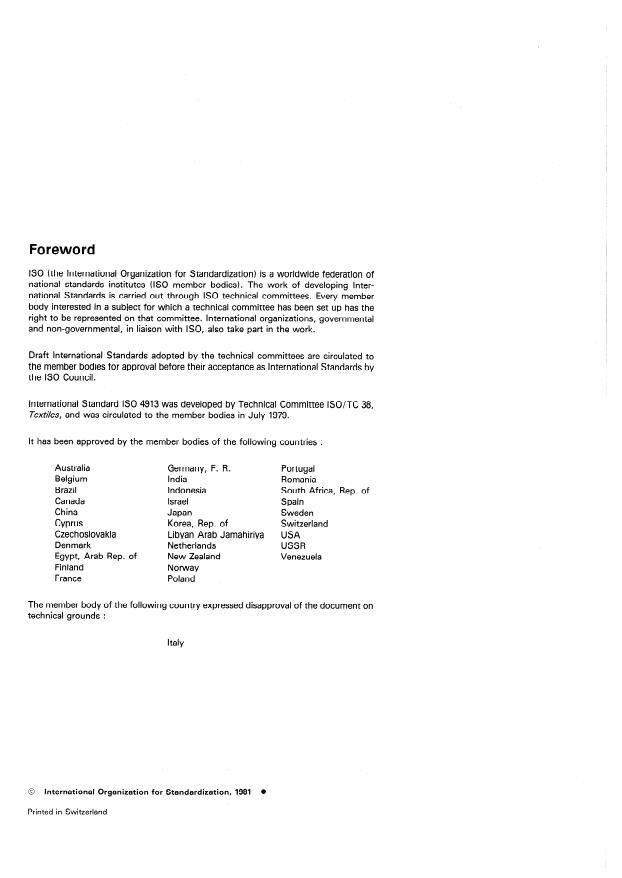

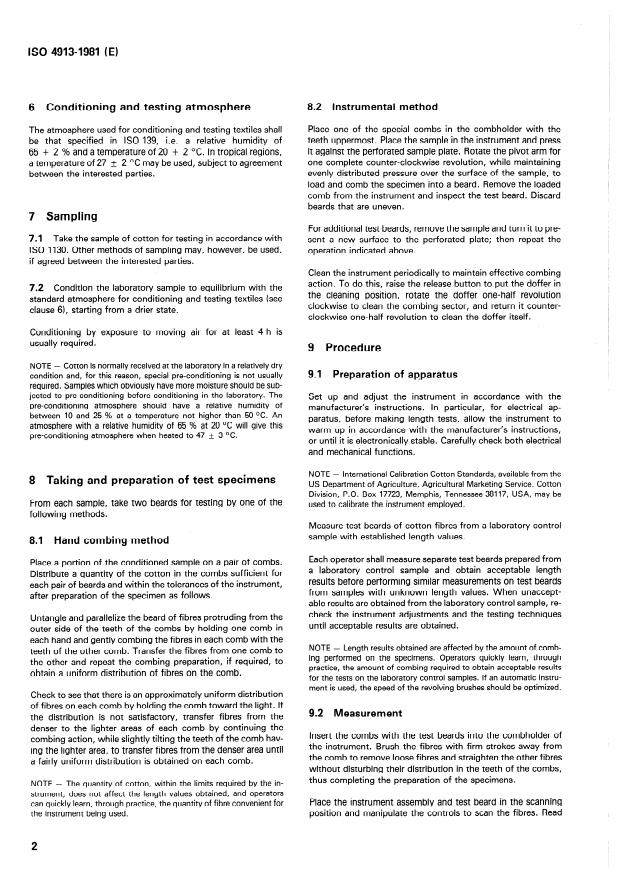
ISO 4913:1981 - Textiles — Cotton fibres — Determination of length (span length) and uniformity index Released:2/1/1981

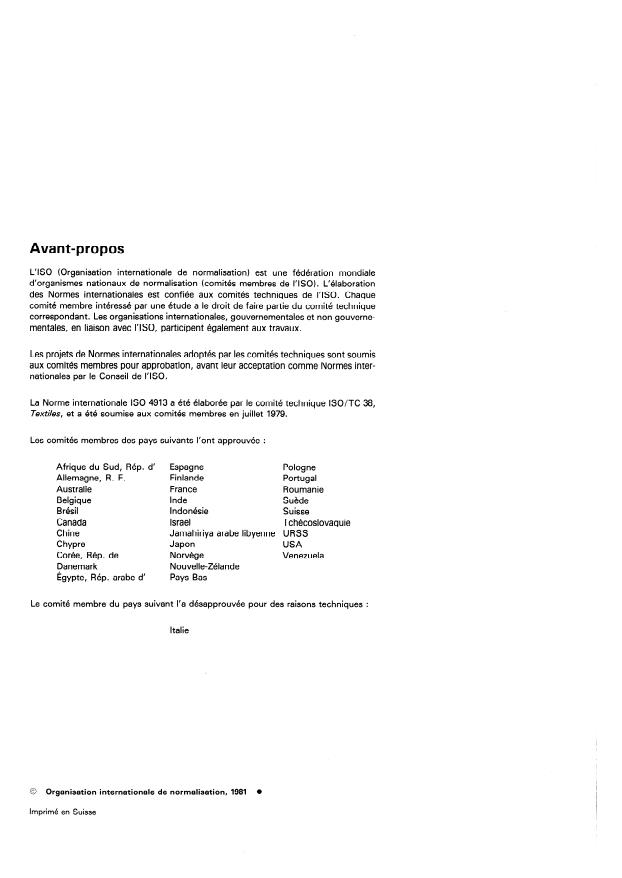

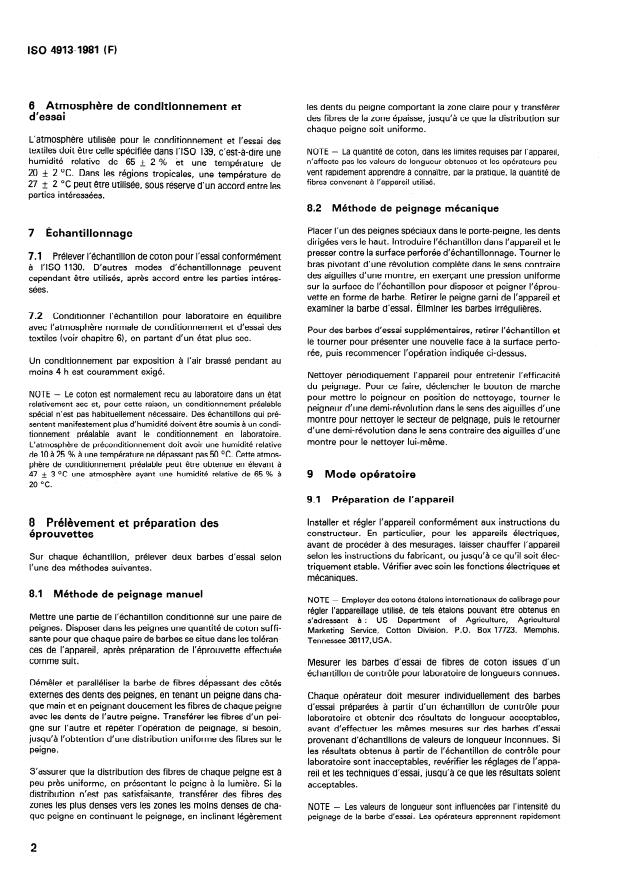
ISO 4913:1981 - Textiles — Fibres de coton — Détermination de la longueur pincée (span length) et de l'indice d'uniformité Released:2/1/1981


ISO 4913:1981 - Textiles — Fibres de coton — Détermination de la longueur pincée (span length) et de l'indice d'uniformité Released:2/1/1981
Overview
ISO 4913:1981 is an international standard published by the International Organization for Standardization (ISO) that specifies a method for determining the length (span length) and uniformity index of cotton fibres. This standard applies exclusively to fibres taken from raw or partially processed cotton and excludes fibres from cotton blends or recycled from cotton yarns or fabrics.
The methodology described in ISO 4913:1981 uses optical instruments to measure the minimal lengths achieved by specified percentages of fibres in a test tuft (barbe d’essai). The uniformity index is then calculated as the ratio of these minimal lengths, providing a quantitative assessment of fibre length distribution. Accurate fibre length measurement is crucial for quality control in the textile industry, affecting yarn strength, appearance, and fabric performance.
Key Topics
Scope and Application
Applicable to raw or partially processed cotton fibres only; not suitable for cotton blends or recycled cotton fibres.Definitions
- Barbe d’essai: A tuft of cotton fibres prepared by combing, intended for optical measurement.
- Span length: The minimal length of fibres reached by a specified percentage of the tuft.
- Uniformity index: Ratio (in percentage) of the smallest to largest span lengths measured at different fibre percentages, indicating fibre length uniformity.
Sample Conditioning
Samples must be conditioned under standard atmospheric conditions of 65 ± 2% relative humidity and 20 ± 2 °C (or 27 ± 2 °C in tropical regions), as specified in ISO 139.Test Preparation
Two methods for sample preparation:- Manual combing using specialized combs to create uniform tufts.
- Mechanical combing with an apparatus that distributes fibres consistently across pegs.
Optical Measurement
Utilizes an optical measurement device designed for cotton fibres, measuring optical density distribution across the tuft length. Measurements are performed at specified density percentages to derive span lengths.Calculation
The uniformity index is calculated using the formula:Uniformity Index (%) = (Minimum Span Length / Maximum Span Length) × 100
This index quantifies fibre length uniformity in the sample.Test Reporting
Test reports must include:- ISO 4913:1981 reference
- Mean span lengths and uniformity index (rounded appropriately)
- Percentage of density optical chosen for measurement
- Type of test apparatus and method of combing used
- Origin of the cotton sample (raw, partially processed, or waste)
- Any operational details or incidents affecting results
Applications
ISO 4913:1981 is essential for textile manufacturers, quality control laboratories, and researchers who need reliable, standardized methods to:
- Assess fibre length and uniformity, which directly influence yarn quality and fabric properties.
- Monitor cotton fibre quality during different stages of processing.
- Compare raw cotton fibre batches for procurement decisions.
- Ensure consistency in cotton fibre measurement worldwide through standardized procedures.
- Support breeding and cultivation programs by providing objective fibre length data.
This standard enhances the precision of fibre quality assessments, contributing to higher efficiency in the textile production chain and improved end-product consistency.
Related Standards
ISO 139: Textiles - Standard Atmospheres for Conditioning and Testing
Specifies the atmospheric conditions under which textile samples, including cotton fibres, should be conditioned and tested to ensure consistent results.ISO 1130: Textiles - Sampling Procedures for Testing
Defines sampling methods and guidelines to ensure representative cotton fibre samples are selected for analysis.
Adherence to ISO 4913:1981 in conjunction with these complementary standards enables reliable and reproducible testing, fostering international comparability and confidence in cotton fibre quality assessments.
Keywords: ISO 4913, cotton fibres, span length, uniformity index, textile testing, fibre length measurement, optical measurement, cotton quality standard, raw cotton testing, textile industry standards.
Buy Documents
ISO 4913:1981 - Textiles — Cotton fibres — Determination of length (span length) and uniformity index Released:2/1/1981
ISO 4913:1981 - Textiles — Fibres de coton — Détermination de la longueur pincée (span length) et de l'indice d'uniformité Released:2/1/1981
ISO 4913:1981 - Textiles — Fibres de coton — Détermination de la longueur pincée (span length) et de l'indice d'uniformité Released:2/1/1981
Get Certified
Connect with accredited certification bodies for this standard

Control Union Certifications
Global certification for agriculture and sustainability.

Hohenstein Institut
Textile testing and certification.

Bureau Veritas Bangladesh
Bureau Veritas certification services in Bangladesh.
Sponsored listings
Frequently Asked Questions
ISO 4913:1981 is a standard published by the International Organization for Standardization (ISO). Its full title is "Textiles — Cotton fibres — Determination of length (span length) and uniformity index". This standard covers: This method is applicable to fibres taken from raw or partially processed cotton, but not to fibres taken from blends of cotton with other fibres, or to fibres recovered from cotton yarns or fabrics. The main terms are defined.
This method is applicable to fibres taken from raw or partially processed cotton, but not to fibres taken from blends of cotton with other fibres, or to fibres recovered from cotton yarns or fabrics. The main terms are defined.
ISO 4913:1981 is classified under the following ICS (International Classification for Standards) categories: 59.060.10 - Natural fibres. The ICS classification helps identify the subject area and facilitates finding related standards.
ISO 4913:1981 is available in PDF format for immediate download after purchase. The document can be added to your cart and obtained through the secure checkout process. Digital delivery ensures instant access to the complete standard document.
Standards Content (Sample)
International Standard
INTERNATIONAL ORGANIZATION FOR STANDARDIZATION@ME~YHAPO~HAR OPrAHM3AUMR fl0 CTAH~APTM3Al.&lM.ORGANlSATlON INTERNATIONALE DE NORMALISATION
Textiles - Cotton fibres - Determination of length (span
length) and uniformity index
Textiles - Fibres de coton - Determination de Ia longueur pincee (span length) et de l ’indice d ’uniformit6
First edition - 1981-02-01
?; ,‘r.
.., 1
U DC 677.21.222.26
Ref. No. ISO4913-1981 (E)
Descriptors : textiles, cotton fibres, tests, measurement, length, test specimen conditioning, combing.
Price based on 3 pages
Foreword
ISO (the International Organization for Standardization) is a worldwide federation of
national Standards institutes (ISO member bedies). The work of developing Inter-
national Standards is carried out through ISO technical committees. Every member
body interested in a subject for which a technical committee has been set up has the
right to be represented on that committee. International organizations, governmental
and non-governmental, in liaison with ISO, also take part in the work.
Draft International Standards adopted by the technical committees are circulated to
the member bodies for approval before their acceptance as International Standards by
the ISO Council.
International Standard ISO 4913 was developed by Technical Committee ISO/TC 38,
Texti/es, and was circulated to the member bodies in July 1979.
It has been approved by the member bodies of the following countries :
Australia Germany, F. R. Portugal
Belgium India Romania
Brazil Indonesia South Africa, Rep. of
Spain
Canada Israel
China Japan Sweden
Cyprus Korea, Rep. of Switzerland
USA
Czechoslovakia Libyan Arab Jamahiriya
Denmark Netherlands USSR
Venezuela
Egypt, Arab Rep. of New Zealand
Finland Norway
France Poland
The member body of the following country expressed disapproval of the document on
technical grounds
Italy
International Organkation for Standardkation, 1981
Printed in Switzeriand
ISO 4913-1981 (EI
INTERNATIONAL STANDARD
Textiles - Cotton fibres - Determination of length (span
length) and uniformity index
3.2 amount of fibre : A measure of the Optical density of a
0 Introduction
test beard, the distribution of fibres at various distances from
In commercial transactions, the length of cotton fibre is deter- the comb being proportional to the Optical density.
mined by an expert in classing.1) This length does not,
however, provide an indication of length distribution.
3.3 length (span length) : The minimum length attained by
a specified percentage of the fibres in a test beard, corre-
This International Standard describes a method of using an
sponding to a determined percentage of the Optical density of
Optical device for the determination of the minimum length
the beard.
attained by a specified percentage of fibres in a test beard. The
ratio of the minimum lengths attained by two specified percen-
The first section of the length investigated, which is normally
tages of fibres in a test beard constitutes a uniformity index.
situated at a distance of 3,8 mm from the line of gripping of the
comb, is taken as the reference base of 100 % Optical density.
1 Scope and field of application
3.4 uniformity index : The ratio between two span lengths,
the smaller value being expressed as a percentage of the higher
This International Standard specifies a method of test for the
value.
determination of the lengthz) and uniformity index of cotton
fibres by scanning a test beard in an Optical device.
NOTE - The length of cotton measured should be reported in
millimetres. However, it is accepted that, for the comparison of lengths
The method is applicable to fibres taken from raw or partially
by the classer, inch units as low as 1/32 in may be used.
processed cotton, but not to fibres taken from blends of cotton
with other fibres, or to fibres recovered from cotton yarns or
fabrics.
4 Principle
Preparation of a test beard either by manual combing or by use
2 References
of an appropriate automatic apparatus. Me; Isurement of the
ues of length.
Optical density of this beard, for different val
ISO 139, Textles - Standard atmospheres for conditioning
and testing.
index of uniform-
Calculation, from the values obtained, of the
ity of the fibres in the Sample.
ISO 1130, TextJe fibres - Some methods of sampling for
tes ting.
5 Apparatus
3 Definitions
5.1 Testing instrument, suitable for optically scanning
For the purpose of this International Standard, the following beards of cotton fibres.3)
definitions apply.
5.2 Combs, for preparing and holding test beards.
3.1 test beard : Cotton fibres protruding from a comb
where they have been laid at random, and which have been
NOTE - Combs may be either hand type or designed for use in a
combed into a beard. special test beard preparation device.
1) Usually called a “classer ”.
2) Usually referred to as “span length ”.
3) A suitable instrument is available commercially. Details may be obtained from the Secretariat of ISO/TC 38 (BSI) or the ISO Central Secretariat.
Other instruments may be used if adapted to accept the combs.
ISO 4913-1981
(El
6 Conditioning and testing atmosphere 82 . Instrumental method
The atmosphere used for conditioning and testing textiles shall Place one of the special combs in the combholder with the
be that specified in ISO 139, i.e. a relative humidity of teeth uppermost. Place the Sample in the instrument and press
65 + 2 % and a temperature of 20 & 2 OC. In tropical regions, it against the perforated Sample plate. Rotate the Pivot arm for
a temperature of 27 + 2 OC may be used, subject to agreement one complete counter-clockwise revolution, while maintaining
between the interested Parties. evenly distributed pressure over the surface of the Sample, to
load and comb the specimen into a beard. Remove the loaded
comb from the instrument and inspect the test beard. Discard
beards that are uneven.
7 Sampling
For additional test beards, remove the Sample and turn it to pre-
7.1 Take the Sample of cotton for testing in accordance with
sent a new surface to the perforated plate; then repeat the
ISO 1130. Other methods of sampling may, however, be used,
Operation indicated above.
...
-
Norme internationale
INTERNATIONAL ORGANIZATION FOR STANDARDIZATION.ME)KL1YHAPO~HAR OPTAHM3AUMR Il0 CTAH~APTkl3Al@WWORGANISATION INTERNATIONALE DE NORMALISATION
Textiles - Fibres de coton - Détermination de la
longueur pincée (span length) et de l’indice d’uniformité
Textiles - Co tton fibres - Determination of lengtb (span length) and uniformity index
Première édition - 1981-02-01
CDU 677.21.222.26 Réf. no : ISO 4913-1981 (F)
Descripteurs : textile, fibre de coton, essai, mesurage, longueur, préparation de spécimen d’essai, peignage.
Prix basé sur 3 pages
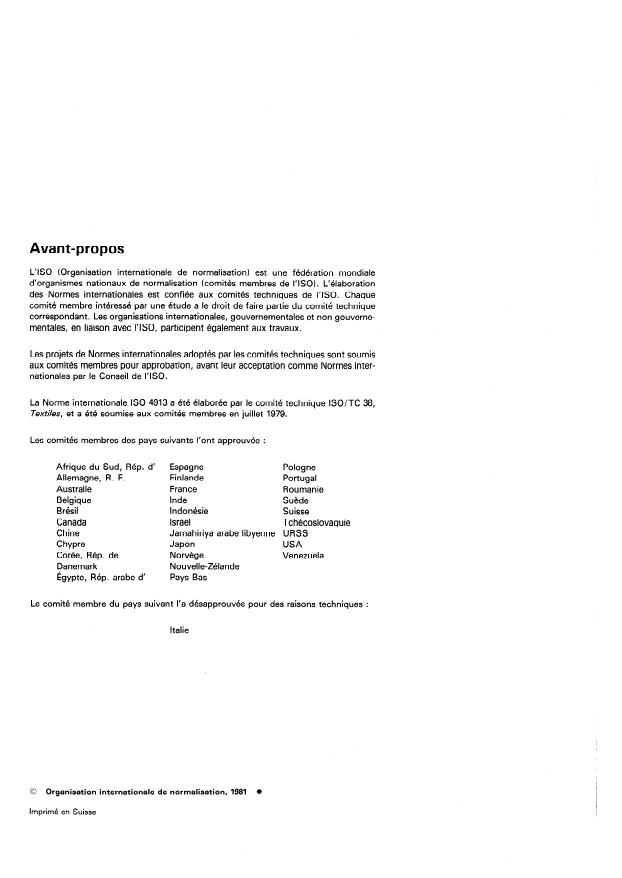
Avant-propos
L’ISO (Organisation internationale de normalisation) est une fédération mondiale
d’organismes nationaux de normalisation (comités membres de I’ISO). L’élaboration
des Normes internationales est confiée aux comités techniques de I’ISO. Chaque
comité membre intéressé par une étude a le droit de faire partie du comité technique
correspondant. Les organisations internationales, gouvernementales et non gouverne-
mentales, en liaison avec I’ISO, participent également aux travaux.
Les projets de Normes internationales adoptés par les comités techniques sont soumis
aux comités membres pour approbation, avant leur acceptation comme Normes inter-
nationales par le Conseil de I’ISO.
La Norme internationale ISO 4913 a été élaborée par le comité technique ISO/TC 38,
Textiles, et a été soumise aux comités membres en juillet 1979.
Les comités membres des pays suivants l’ont approuvée :
Pologne
Afrique du Sud, Rép. d’ Espagne
Finlande Portugal
Allemagne, R. F.
Australie France Roumanie
Inde Suède
Belgique
Brésil Indonésie Suisse
Tchécoslovaquie
Canada Israël
Jamahiriya arabe libyenne URSS
Chine
Chypre Japon USA
Norvège Venezuela
Corée, Rép. de
Danemark Nouvelle-Zélande
Egypte, Rép. arabe d’ Pays-Bas
Le comité membre du pays suivant l’a désapprouvée pour des raisons techniques :
Italie
@ Organisation internationale de normalisation, 1981 0
Imprimé en Suisse
ISO 4913-1981 (F)
NORME INTERNATIONALE
Textiles - Fibres de coton - Détermination de la
longueur pincée (span length) et de l’indice d’uniformité
0 Introduction
3.2 teneur en fibres : Mesure de la densité optique d’une
barbe d’essai, la distribution des fibres à diverses distances du
Dans les transactions commerciales, la longueur des fibres de
peigne étant proportionnelle à cette densité optique.
coton est déterminée par un expert en classement.1) Cette lon-
gueur ne donne, cependant, pas d’indication sur la distribution
3.3 longueur pincée (span lengthl : Longueur minimale
de longueur.
atteinte par un pourcentage spécifié de fibres d’une barbe
d’essai, correspondant à un pourcentage déterminé de densité
La présente Norme internationale décrit une méthode utilisant
optique de la barbe.
un appareil optique permettant de déterminer la longueur mini-
male atteinte par un pourcentage spécifié de fibres d’une barbe
La première section de longueur explorée, qui se situe générale-
d’essai. Le rapport des longueurs minimales atteintes par deux
ment à une distance de 3,8 mm de la ligne de pincage du pei-
pourcentages spécifiés de fibres d’une barbe d’essai constitue
gne, est prise comme base de référence de 100 % de densité
un indice d’uniformité.
optique.
indice d’uniformité : Rapport de deux longueurs pin-
1 Objet et domaine d’application
cées, la valeur la plus petite étant exprimée en pourcentage de
la valeur la plus élevée.
La présente Norme internationale spécifie une méthode de
détermination de longueurs pincées et de l’indice d’uniformité
NOTE - La longueur de coton mesurée doit être exprimée en millimè-
des fibres de coton par l’examen d’une barbe d’essai à l’aide
tres. Toutefois, pour une comparaison des longueurs par le classeur,
d’un appareil optique.
des unités en inches allant jusqu’au 1/32 in peuvent être utilisées.
La méthode est applicable aux fibres de coton brut ou partielle-
ment traité, mais pas aux fibres provenant de mélanges de
4 Principe
coton avec d’autres fibres, ni aux fibres extraites de fils ou
d’étoffes de coton.
Préparation d’une barbe d’essai, soit par peignage manuel, soit
par utilisation d’un appareil automatique approprié. Mesurage
de la densité optique de cette barbe, pour différentes valeurs de
2 Références
longueur.
ISO 139, Texti/es - Atmosphères normales de conditionne-
Calcul, à partir des valeurs mesurées, de l’indice d’uniformité
ment et d’essai.
des fibres composant l’échantillon.
Diverses méthodes d’échantillon-
ISO 1130, Fibres textiles -
nage en vue des essais.
5 Appareillage
3 Définitions
5.1 Appareil d’essai, concu pour le mesurage optique de
barbes de fibres de coton?)
Dans le cadre de la présente Norme internationale, les défini-
tions suivantes sont applicables.
5.2 Peignes, pour préparer et tenir les barbes.
3.1 barbe d’essai : Fibres de coton dépassant d’un peigne
NOTE - Les peignes peuvent être soit de type manuel, soit concus
où elles sont disposées au hasard, et qui ont été peignées en
pour être utilisés dans un appareil spécialement prévu pour la prépara-
forme de barbe. tion de la barbe d’essai.
1) Couramment appelé wlasseurk
2) Un appareil convenable est disponible dans le commerce. Des détails peuvent être obtenus auprès du secrétariat de I’ISO/TC 38 (BSI) ou auprès
du Secrétariat central de I’ISO. D’autres appareils peuvent être utilisés, s’ils sont susceptibles de recevoir des peignes.
ISO 4913-1981 (F)
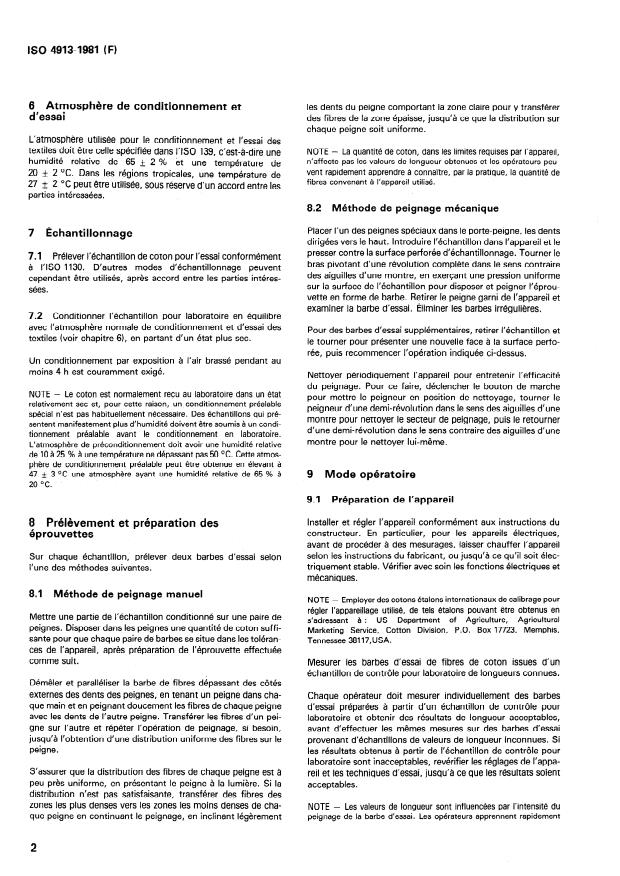
6 Atmosphère de conditionnement et
les dents du peigne comportant la zone claire pour y transférer
d’essai des fibres de la zone épaisse, jusqu’à ce que la distribution sur
chaque peigne soit uniforme.
L’atmosphère utilisée pour le conditionnement et l’essai des
textiles doit être celle spécifiée dans I’ISO 139, c’est-à-dire une
NOTE - La quantité de coton, dans les limites requises par l’appareil,
humidité relative de 65 -f 2 % et une température de n’affecte pas les valeurs de longueur obtenues et les opérateurs peu-
vent rapidement apprendre à connaître, par la pratique, la quantité de
20 rt 2 OC. Dans les régions tropicales, une température de
fibres convenant à l’appareil utilisé.
27 + 2 OC peut être utilisée, sous réserve d’un accord entre les
parties intéressées.
8.2 Méthode de peignage mécanique
Placer l’un des peignes spéciaux dans le porte-peigne, les dents
7 Échantillonnage
dirigées vers le haut. Introduire l’échantillon dans l’appareil et le
presser contre la surface perforée d’échantillonnage. Tourner le
7.1 Prélever l’échantillon de coton pour l’essai conformément
bras pivotant d’une révolution complète dans le sens contraire
à I’ISO 1130. D’autres modes d’échantillonnage peuvent
des aiguilles d’une montre, en exercant une pression uniforme
cependant être utilisés, après accord entre les parties intéres-
sur la surface de l’
...
-
Norme internationale
INTERNATIONAL ORGANIZATION FOR STANDARDIZATION.ME)KL1YHAPO~HAR OPTAHM3AUMR Il0 CTAH~APTkl3Al@WWORGANISATION INTERNATIONALE DE NORMALISATION
Textiles - Fibres de coton - Détermination de la
longueur pincée (span length) et de l’indice d’uniformité
Textiles - Co tton fibres - Determination of lengtb (span length) and uniformity index
Première édition - 1981-02-01
CDU 677.21.222.26 Réf. no : ISO 4913-1981 (F)
Descripteurs : textile, fibre de coton, essai, mesurage, longueur, préparation de spécimen d’essai, peignage.
Prix basé sur 3 pages
Avant-propos
L’ISO (Organisation internationale de normalisation) est une fédération mondiale
d’organismes nationaux de normalisation (comités membres de I’ISO). L’élaboration
des Normes internationales est confiée aux comités techniques de I’ISO. Chaque
comité membre intéressé par une étude a le droit de faire partie du comité technique
correspondant. Les organisations internationales, gouvernementales et non gouverne-
mentales, en liaison avec I’ISO, participent également aux travaux.
Les projets de Normes internationales adoptés par les comités techniques sont soumis
aux comités membres pour approbation, avant leur acceptation comme Normes inter-
nationales par le Conseil de I’ISO.
La Norme internationale ISO 4913 a été élaborée par le comité technique ISO/TC 38,
Textiles, et a été soumise aux comités membres en juillet 1979.
Les comités membres des pays suivants l’ont approuvée :
Pologne
Afrique du Sud, Rép. d’ Espagne
Finlande Portugal
Allemagne, R. F.
Australie France Roumanie
Inde Suède
Belgique
Brésil Indonésie Suisse
Tchécoslovaquie
Canada Israël
Jamahiriya arabe libyenne URSS
Chine
Chypre Japon USA
Norvège Venezuela
Corée, Rép. de
Danemark Nouvelle-Zélande
Egypte, Rép. arabe d’ Pays-Bas
Le comité membre du pays suivant l’a désapprouvée pour des raisons techniques :
Italie
@ Organisation internationale de normalisation, 1981 0
Imprimé en Suisse
ISO 4913-1981 (F)
NORME INTERNATIONALE
Textiles - Fibres de coton - Détermination de la
longueur pincée (span length) et de l’indice d’uniformité
0 Introduction
3.2 teneur en fibres : Mesure de la densité optique d’une
barbe d’essai, la distribution des fibres à diverses distances du
Dans les transactions commerciales, la longueur des fibres de
peigne étant proportionnelle à cette densité optique.
coton est déterminée par un expert en classement.1) Cette lon-
gueur ne donne, cependant, pas d’indication sur la distribution
3.3 longueur pincée (span lengthl : Longueur minimale
de longueur.
atteinte par un pourcentage spécifié de fibres d’une barbe
d’essai, correspondant à un pourcentage déterminé de densité
La présente Norme internationale décrit une méthode utilisant
optique de la barbe.
un appareil optique permettant de déterminer la longueur mini-
male atteinte par un pourcentage spécifié de fibres d’une barbe
La première section de longueur explorée, qui se situe générale-
d’essai. Le rapport des longueurs minimales atteintes par deux
ment à une distance de 3,8 mm de la ligne de pincage du pei-
pourcentages spécifiés de fibres d’une barbe d’essai constitue
gne, est prise comme base de référence de 100 % de densité
un indice d’uniformité.
optique.
indice d’uniformité : Rapport de deux longueurs pin-
1 Objet et domaine d’application
cées, la valeur la plus petite étant exprimée en pourcentage de
la valeur la plus élevée.
La présente Norme internationale spécifie une méthode de
détermination de longueurs pincées et de l’indice d’uniformité
NOTE - La longueur de coton mesurée doit être exprimée en millimè-
des fibres de coton par l’examen d’une barbe d’essai à l’aide
tres. Toutefois, pour une comparaison des longueurs par le classeur,
d’un appareil optique.
des unités en inches allant jusqu’au 1/32 in peuvent être utilisées.
La méthode est applicable aux fibres de coton brut ou partielle-
ment traité, mais pas aux fibres provenant de mélanges de
4 Principe
coton avec d’autres fibres, ni aux fibres extraites de fils ou
d’étoffes de coton.
Préparation d’une barbe d’essai, soit par peignage manuel, soit
par utilisation d’un appareil automatique approprié. Mesurage
de la densité optique de cette barbe, pour différentes valeurs de
2 Références
longueur.
ISO 139, Texti/es - Atmosphères normales de conditionne-
Calcul, à partir des valeurs mesurées, de l’indice d’uniformité
ment et d’essai.
des fibres composant l’échantillon.
Diverses méthodes d’échantillon-
ISO 1130, Fibres textiles -
nage en vue des essais.
5 Appareillage
3 Définitions
5.1 Appareil d’essai, concu pour le mesurage optique de
barbes de fibres de coton?)
Dans le cadre de la présente Norme internationale, les défini-
tions suivantes sont applicables.
5.2 Peignes, pour préparer et tenir les barbes.
3.1 barbe d’essai : Fibres de coton dépassant d’un peigne
NOTE - Les peignes peuvent être soit de type manuel, soit concus
où elles sont disposées au hasard, et qui ont été peignées en
pour être utilisés dans un appareil spécialement prévu pour la prépara-
forme de barbe. tion de la barbe d’essai.
1) Couramment appelé wlasseurk
2) Un appareil convenable est disponible dans le commerce. Des détails peuvent être obtenus auprès du secrétariat de I’ISO/TC 38 (BSI) ou auprès
du Secrétariat central de I’ISO. D’autres appareils peuvent être utilisés, s’ils sont susceptibles de recevoir des peignes.
ISO 4913-1981 (F)
6 Atmosphère de conditionnement et
les dents du peigne comportant la zone claire pour y transférer
d’essai des fibres de la zone épaisse, jusqu’à ce que la distribution sur
chaque peigne soit uniforme.
L’atmosphère utilisée pour le conditionnement et l’essai des
textiles doit être celle spécifiée dans I’ISO 139, c’est-à-dire une
NOTE - La quantité de coton, dans les limites requises par l’appareil,
humidité relative de 65 -f 2 % et une température de n’affecte pas les valeurs de longueur obtenues et les opérateurs peu-
vent rapidement apprendre à connaître, par la pratique, la quantité de
20 rt 2 OC. Dans les régions tropicales, une température de
fibres convenant à l’appareil utilisé.
27 + 2 OC peut être utilisée, sous réserve d’un accord entre les
parties intéressées.
8.2 Méthode de peignage mécanique
Placer l’un des peignes spéciaux dans le porte-peigne, les dents
7 Échantillonnage
dirigées vers le haut. Introduire l’échantillon dans l’appareil et le
presser contre la surface perforée d’échantillonnage. Tourner le
7.1 Prélever l’échantillon de coton pour l’essai conformément
bras pivotant d’une révolution complète dans le sens contraire
à I’ISO 1130. D’autres modes d’échantillonnage peuvent
des aiguilles d’une montre, en exercant une pression uniforme
cependant être utilisés, après accord entre les parties intéres-
sur la surface de l’
...