

ISO 2370:2019
(Main)Textiles — Determination of fineness of flax fibres — Permeametric methods
General Information
- Abstract
This document specifies three permeametric methods for the determination of the fineness of flax fibres. — Constant flow method, with two compressions, using a test piece of parallel fibres (see Clause 5); — Simplified constant flow method, with one compression, using a test piece of fibres distributed "at random" (see Clause 6); — Constant pressure method, with one compression, using a test piece of fibres distributed "at random" (see Clause 7). This document is applicable to the various forms possible for flax fibres, i.e. long strands, broken strands, all kinds of tow and at all stages of manufacture of these substances.
- Status
- Published
- Publication Date
- 09-Jan-2019
- Technical Committee
- ISO/TC 38/SC 23 - Fibres and yarns
- Drafting Committee
- ISO/TC 38/SC 23/WG 2 - Fibres - Natural cellulosic
- Current Stage
- 9093 - International Standard confirmed
- Start Date
- 06-Jan-2025
- Completion Date
- 29-Aug-2026
Buy Documents





ISO 2370:2019 - Textiles -- Determination of fineness of flax fibres -- Permeametric methods
ISO 2370:2019 - Textiles — Determination of fineness of flax fibres — Permeametric methods/10/2019

ISO 2370:2019 - Textiles -- Détermination de la finesse des fibres de lin -- Méthodes perméamétriques
ISO 2370:2019 - Textiles — Détermination de la finesse des fibres de lin — Méthodes perméamétriques/24/2019
Overview
ISO 2370:2019 - Textiles - Determination of fineness of flax fibres - Permeametric methods defines laboratory procedures to measure the fineness of flax (linseed) fibres using permeametric (air‑flow) techniques. The standard specifies three validated methods - two constant‑flow variants and one constant‑pressure method - applicable to flax in all forms (long strands, broken strands, tow, slivers) and at all stages of manufacture.
Key topics and technical requirements
- Three permeametric methods
- Constant flow method (Clause 5): uses a test piece of parallel fibres and two compressions to obtain two resistance measurements and calculate specific surface and density.
- Simplified constant flow method (Clause 6): uses fibres distributed “at random”, one compression, and a single resistance measurement.
- Constant pressure method (Clause 7): constant pressure measurement with one compression for randomly distributed test pieces.
- Test pieces and sampling
- Test pieces typically are wads about 80 mm ± 1 mm long; for the parallel‑fibre method masses are specified (e.g., 2.8 g to 3.2 g depending on material). Sampling is to be representative and may use methods in ISO 1130.
- Measured quantities
- Resistance of a wad to airflow (R), specific surface (A), index of specific surface (A′) and the index of fineness standard (IFS) derived from permeametric data.
- Apparatus & controls
- Apparatus components specified include an air tap/compressor, pressure gauge, output control (butterfly valve), output meter (e.g., soap‑bubble meter), measuring chamber and manometer. Minimum compressed air pressure and gauge ranges are given in the standard.
- Environmental conditions
- Conditioning and testing in the standard textile atmosphere defined by ISO 139.
- Quality control
- Procedures for controlling apparatus functioning, calculating results and preparing a test report are included.
Applications and who uses it
ISO 2370:2019 is used by:
- Textile testing laboratories performing flax fibre characterization
- Flax processors and scutching/card clothing operations monitoring fibre quality
- Spinning mills and composite material manufacturers requiring fineness data for processing or product specification
- Quality assurance and standards teams establishing acceptance criteria or reference data
Practical benefits include repeatable, comparable fineness measurements that inform processing decisions (e.g., carding, drafting, spinning) and material selection.
Related standards
- ISO 139 - Standard atmospheres for conditioning and testing textiles (conditioning requirements referenced)
- ISO 1130 - Textile fibres - Sampling methods for testing (sampling guidance)
Keywords: ISO 2370, fineness of flax fibres, permeametric methods, constant flow method, constant pressure method, textile testing, flax fibre fineness determination.
Relations
- Effective Date
- 17-Dec-2016
Buy Documents
ISO 2370:2019 - Textiles -- Determination of fineness of flax fibres -- Permeametric methods
ISO 2370:2019 - Textiles — Determination of fineness of flax fibres — Permeametric methods/10/2019
ISO 2370:2019 - Textiles -- Détermination de la finesse des fibres de lin -- Méthodes perméamétriques
ISO 2370:2019 - Textiles — Détermination de la finesse des fibres de lin — Méthodes perméamétriques/24/2019
Get Certified
Connect with accredited certification bodies for this standard

Control Union Certifications
Global certification for agriculture and sustainability.

Hohenstein Institut
Textile testing and certification.

Bureau Veritas Bangladesh
Bureau Veritas certification services in Bangladesh.
Sponsored listings
Frequently Asked Questions
ISO 2370:2019 is a standard published by the International Organization for Standardization (ISO). Its full title is "Textiles — Determination of fineness of flax fibres — Permeametric methods". This standard covers: This document specifies three permeametric methods for the determination of the fineness of flax fibres. — Constant flow method, with two compressions, using a test piece of parallel fibres (see Clause 5); — Simplified constant flow method, with one compression, using a test piece of fibres distributed "at random" (see Clause 6); — Constant pressure method, with one compression, using a test piece of fibres distributed "at random" (see Clause 7). This document is applicable to the various forms possible for flax fibres, i.e. long strands, broken strands, all kinds of tow and at all stages of manufacture of these substances.
This document specifies three permeametric methods for the determination of the fineness of flax fibres. — Constant flow method, with two compressions, using a test piece of parallel fibres (see Clause 5); — Simplified constant flow method, with one compression, using a test piece of fibres distributed "at random" (see Clause 6); — Constant pressure method, with one compression, using a test piece of fibres distributed "at random" (see Clause 7). This document is applicable to the various forms possible for flax fibres, i.e. long strands, broken strands, all kinds of tow and at all stages of manufacture of these substances.
ISO 2370:2019 is classified under the following ICS (International Classification for Standards) categories: 59.060.10 - Natural fibres. The ICS classification helps identify the subject area and facilitates finding related standards.
ISO 2370:2019 has the following relationships with other standards: It is inter standard links to ISO 2370:1980. Understanding these relationships helps ensure you are using the most current and applicable version of the standard.
ISO 2370:2019 is available in PDF format for immediate download after purchase. The document can be added to your cart and obtained through the secure checkout process. Digital delivery ensures instant access to the complete standard document.
Standards Content (Sample)
SLOVENSKI STANDARD
01-oktober-2020
Nadomešča:
SIST ISO 2370:1995
Tekstilije - Določevanje finosti lanenih vlaken - Metode merjenja prepustnosti
Textiles - Determination of fineness of flax fibres - Permeametric methods
Textiles - Détermination de la finesse des fibres de lin - Méthodes perméamétriques
Ta slovenski standard je istoveten z: ISO 2370:2019
ICS:
59.060.10 Naravna vlakna Natural fibres
2003-01.Slovenski inštitut za standardizacijo. Razmnoževanje celote ali delov tega standarda ni dovoljeno.
INTERNATIONAL ISO
STANDARD 2370
Third edition
2019-01
Textiles — Determination of fineness
of flax fibres — Permeametric methods
Textiles — Détermination de la finesse des fibres de lin — Méthodes
perméamétriques
Reference number
©
ISO 2019
COPYRIGHT PROTECTED DOCUMENT
© ISO 2019
All rights reserved. Unless otherwise specified, or required in the context of its implementation, no part of this publication may
be reproduced or utilized otherwise in any form or by any means, electronic or mechanical, including photocopying, or posting
on the internet or an intranet, without prior written permission. Permission can be requested from either ISO at the address
below or ISO’s member body in the country of the requester.
ISO copyright office
CP 401 • Ch. de Blandonnet 8
CH-1214 Vernier, Geneva
Phone: +41 22 749 01 11
Fax: +41 22 749 09 47
Email: copyright@iso.org
Website: www.iso.org
Published in Switzerland
ii © ISO 2019 – All rights reserved
Contents Page
Foreword .iv
Introduction .v
1 Scope . 1
2 Normative references . 1
3 Terms and definitions . 1
4 Conditioning and test atmosphere . 2
5 Constant flow method . 2
5.1 Principle . 2
5.2 Sampling . 2
5.3 Test pieces . 2
5.3.1 Requirement . 2
5.3.2 Preparation . 2
5.4 Apparatus . 3
5.5 Procedure . 4
5.5.1 Determination of output . 4
5.5.2 Measurement of resistance, R . 4
5.5.3 Measurement of resistance, R .
2 5
5.6 Control of apparatus functioning . 6
5.7 Calculation and expression of results. 6
6 Simplified constant flow method . 7
6.1 Principle . 7
6.2 Sampling . 7
6.3 Test pieces . 8
6.3.1 Requirement . 8
6.3.2 Preparation . 8
6.3.3 Determination of the mass of the test pieces . 8
6.4 Apparatus . 8
6.5 Procedure .10
6.6 Control of apparatus functioning .11
6.7 Calculation and expression of results.11
7 Constant pressure method .11
7.1 Principle .11
7.2 Sampling .11
7.3 Test pieces .12
7.3.1 Requirement .12
7.3.2 Preparation .12
7.3.3 Determination of the mass of the test pieces .12
7.4 Apparatus .12
7.5 Procedure .12
7.6 Control of apparatus functioning .13
7.7 Calculation and expression of results.13
8 Test report .13
Annex A (normative) Carding of flax tow in wads .14
Annex B (normative) Conversion of test results in constant flow method .17
Foreword
ISO (the International Organization for Standardization) is a worldwide federation of national standards
bodies (ISO member bodies). The work of preparing International Standards is normally carried out
through ISO technical committees. Each member body interested in a subject for which a technical
committee has been established has the right to be represented on that committee. International
organizations, governmental and non-governmental, in liaison with ISO, also take part in the work.
ISO collaborates closely with the International Electrotechnical Commission (IEC) on all matters of
electrotechnical standardization.
The procedures used to develop this document and those intended for its further maintenance are
described in the ISO/IEC Directives, Part 1. In particular, the different approval criteria needed for the
different types of ISO documents should be noted. This document was drafted in accordance with the
editorial rules of the ISO/IEC Directives, Part 2 (see www .iso .org/directives).
Attention is drawn to the possibility that some of the elements of this document may be the subject of
patent rights. ISO shall not be held responsible for identifying any or all such patent rights. Details of
any patent rights identified during the development of the document will be in the Introduction and/or
on the ISO list of patent declarations received (see www .iso .org/patents).
Any trade name used in this document is information given for the convenience of users and does not
constitute an endorsement.
For an explanation of the voluntary nature of standards, the meaning of ISO specific terms and
expressions related to conformity assessment, as well as information about ISO's adherence to the
World Trade Organization (WTO) principles in the Technical Barriers to Trade (TBT) see www .iso
.org/iso/foreword .html.
This document was prepared by Technical Committee ISO/TC 38, Textiles, Subcommittee SC 23, Fibres
and yarns.
Any feedback or questions on this document should be directed to the user’s national standards body. A
complete listing of these bodies can be found at www .iso .org/members .html.
This third edition cancels and replaces the second edition (ISO 2370:1980), which has been technically
revised. The main changes compared to the previous edition are as follows:
— addition of the third method for the determination of the fineness of flax fibres as Clause 7, “Constant
pressure method”;
— deletion of Annex C and Annex D.
iv © ISO 2019 – All rights reserved
Introduction
Fineness can be considered as a vital characteristic of flax. However, because of their special structure,
the measurement of the fineness of such fibres presents a difficult problem.
Whereas cotton, wool, man-made fibres, etc., form individual fibres of a given dimension and are easily
separated one from the other, flax fibres form, after retting and scutching, fibre strands. These consist
of a certain number of ultimate fibres, bound together more or less imperfectly by pectic substances
which give certain fibres a branching form. During the spinning operations, these fibre strands are
progressively divided without such a process ending in the complete separation into ultimate fibres.
In these conditions, determination of the fineness of flax fibres presents the following difficulties.
— Difficulty from the continuous alteration of the amount of division of the substance during the
spinning. One cannot therefore refer to fineness as such, but only to fineness corresponding to a
state consecutive to a given operation. It will therefore always be necessary to specify the state in
which the substance is found when making any measurement.
— Difficulty, from the fact that the separation of the fibrous elements is a delicate operation, which
also results from the constitution of the substance.
Taking these difficulties into account, “permeametric” methods seem most suitable for measuring the
fineness of bast.
INTERNATIONAL STANDARD ISO 2370:2019(E)
Textiles — Determination of fineness of flax fibres —
Permeametric methods
1 Scope
This document specifies three permeametric methods for the determination of the fineness of flax fibres.
— Constant flow method, with two compressions, using a test piece of parallel fibres (see Clause 5);
— Simplified constant flow method, with one compression, using a test piece of fibres distributed “at
random” (see Clause 6);
— Constant pressure method, with one compression, using a test piece of fibres distributed “at random”
(see Clause 7).
This document is applicable to the various forms possible for flax fibres, i.e. long strands, broken
strands, all kinds of tow and at all stages of manufacture of these substances.
2 Normative references
The following documents are referred to in the text in such a way that some or all of their content
constitutes requirements of this document. For dated references, only the edition cited applies. For
undated references, the latest edition of the referenced document (including any amendments) applies.
ISO 139, Textiles — Standard atmospheres for conditioning and testing
ISO 1130, Textile fibres — Some methods of sampling for testing
3 Terms and definitions
For the purposes of this document, the following terms and definitions apply.
ISO and IEC maintain terminological databases for use in standardization at the following addresses:
— ISO Online browsing platform: available at https: //www .iso .org/obp
— IEC Electropedia: available at http: //www .electropedia .org/
3.1
wad of fibre
fibrous mass introduced into the centre channel of a cylindrical casing forming the test piece and on
which the measurement will be made
Note 1 to entry: In the constant flow method, the fibrous elements forming the wad are placed parallel to the
axis of the casing. In the simplified constant flow method and constant pressure method, the fibrous mass is
introduced into a chamber so that the fibres forming the wad are placed at random. In all three methods, it is
essential that the density of the filling is as regular as possible.
3.2
resistance of a wad of fibres to the passage of air in laminar flow
R
quotient of the depression ΔP (hPa) produced by the wad of fibres (3.1) to flow Q (cm /s) passing
through it
Note 1 to entry: It is expressed in hPa·s/cm .
3.3
specific surface of a wad of fibres
A
quotient of the total side surface of the constituent fibrous elements by their volume
2 3
Note 1 to entry: It is expressed in cm /cm .
3.4
index of specific surface of a wad of fibres
A’
arithmetic product of the specific surface (A) and the square root of the product of the viscosity of the
air (μ) and a dimensionless empirical factor of proportionality (k)
3.5
index of fineness standard
IFS
index of fineness determined by a conventional method (gravimetric method) on reference lots
Note 1 to entry: Itis relatively close to values expressed by the Tex system.
Note 2 to entry: Compensation is permitted for the fact that the fineness of flax fibres cannot be defined in an
absolute manner.
4 Conditioning and test atmosphere
Weighing and measuring shall be carried out in the standard atmosphere for conditioning and testing
of textiles, defined in ISO 139, on test pieces previously conditioned in the same atmosphere.
5 Constant flow method
5.1 Principle
Measurement of the resistance to the passage of air of a wad of parallel fibres of given mass placed
successively in two casings of specified size but different diameters, then, from the two values obtained,
deduction of the index of specific surface of the wad and the density of the fibres, which characterize
the fineness of the fibres.
5.2 Sampling
Samples shall be representative of a batch.
Sampling shall be carried out by one of the methods given in ISO 1130.
5.3 Test pieces
5.3.1 Requirement
The test piece shall consist of a stub of parallel fibres about 80 mm ± 1 mm long, having a mass between
2,8 g and 3,2 g, depending on the material. Five test pieces shall be prepared for each sampling.
5.3.2 Preparation
5.3.2.1 Scutched or hackled flax
Cut from the desired place (for example top, middle, bottom) stubs 80 mm ± 1 mm long.
2 © ISO 2019 – All rights reserved
5.3.2.2 Flax tow
Carry out carding to make the fibres parallel by using hand carding machines as specified in Annex A.
Cut from the middle stubs 80 mm ± 1 mm long.
5.3.2.3 Slivers
Take, at intervals, sections about 80 mm ± 1 mm long. Bring together the various stubs and take the
mass required for the test.
5.4 Apparatus
5.4.1 Apparatus, shown in Figure 1.
Key
A air tap E output meter
B gauge F measuring chamber
C butterfly valve for output control G threaded cap
D three-way tap M manometer
a
To compressor.
Figure 1 — Apparatus for the constant flow method
5.4.1.1 Air tap, A, below an air chamber (minimum pressure 0,15 MPa) fed by a compressor or by a
general dry compressed air line.
5.4.1.2 Gauge, B, graduated from 0 MPa to 0,2 MPa, with a control device.
3 3
5.4.1.3 Butterfly valve for output control, C, (0,15 cm /s to 0,85 cm /s).
5.4.1.4 Three-way tap, D.
5.4.1.5 Soap bubble output meter, E, or any other apparatus permitting precise measurement of
low output.
5.4.1.6 Measuring chamber, F, into which the casing containing the parallel fibres is placed. The edge of
this casing, fitted with a supple joint, comes against the edge of F and is retained there by a threaded cap G.
5.4.1.7 Threaded cap, G, having a circular opening.
5.4.1.8 Water manometer, M, formed by a tube with variable tilt permitting readings of maximum
depression corresponding to 250 mm, 50 mm, 25 mm and 12,5 mm, according to the tilt. One of the ends
is open to the air and the other connected to the chamber F.
5.4.2 Casings, 10 mm high and with diameters of 10 mm and 11 mm (to the nearest 10 μm) respectively.
5.4.3 Circular sharp blade, mounted on a rapidly rotating axle.
5.4.4 Balance, with a resolution of 0,01 g.
5.5 Procedure
5.5.1 Determination of output
3 3
Adjust the output controlled by butterfly valve C to 0,50 cm /s ± 0,01 cm /s. Determine the exact output
before each series of measurements. For this purpose:
— leave the apparatus connected to the flow for 30 min to obtain a stationary flow, the initial pressure
being controlled at 0,1 MPa;
— open the three-way tap, D, in the direction of the output meter. Determine the time necessary for a
bubble to obtain a predetermined level corresponding to 50 cm . Take the mean of five measurements.
The
...
INTERNATIONAL ISO
STANDARD 2370
Third edition
2019-01
Textiles — Determination of fineness
of flax fibres — Permeametric methods
Textiles — Détermination de la finesse des fibres de lin — Méthodes
perméamétriques
Reference number
©
ISO 2019
COPYRIGHT PROTECTED DOCUMENT
© ISO 2019
All rights reserved. Unless otherwise specified, or required in the context of its implementation, no part of this publication may
be reproduced or utilized otherwise in any form or by any means, electronic or mechanical, including photocopying, or posting
on the internet or an intranet, without prior written permission. Permission can be requested from either ISO at the address
below or ISO’s member body in the country of the requester.
ISO copyright office
CP 401 • Ch. de Blandonnet 8
CH-1214 Vernier, Geneva
Phone: +41 22 749 01 11
Fax: +41 22 749 09 47
Email: copyright@iso.org
Website: www.iso.org
Published in Switzerland
ii © ISO 2019 – All rights reserved
Contents Page
Foreword .iv
Introduction .v
1 Scope . 1
2 Normative references . 1
3 Terms and definitions . 1
4 Conditioning and test atmosphere . 2
5 Constant flow method . 2
5.1 Principle . 2
5.2 Sampling . 2
5.3 Test pieces . 2
5.3.1 Requirement . 2
5.3.2 Preparation . 2
5.4 Apparatus . 3
5.5 Procedure . 4
5.5.1 Determination of output . 4
5.5.2 Measurement of resistance, R . 4
5.5.3 Measurement of resistance, R .
2 5
5.6 Control of apparatus functioning . 6
5.7 Calculation and expression of results. 6
6 Simplified constant flow method . 7
6.1 Principle . 7
6.2 Sampling . 7
6.3 Test pieces . 8
6.3.1 Requirement . 8
6.3.2 Preparation . 8
6.3.3 Determination of the mass of the test pieces . 8
6.4 Apparatus . 8
6.5 Procedure .10
6.6 Control of apparatus functioning .11
6.7 Calculation and expression of results.11
7 Constant pressure method .11
7.1 Principle .11
7.2 Sampling .11
7.3 Test pieces .12
7.3.1 Requirement .12
7.3.2 Preparation .12
7.3.3 Determination of the mass of the test pieces .12
7.4 Apparatus .12
7.5 Procedure .12
7.6 Control of apparatus functioning .13
7.7 Calculation and expression of results.13
8 Test report .13
Annex A (normative) Carding of flax tow in wads .14
Annex B (normative) Conversion of test results in constant flow method .17
Foreword
ISO (the International Organization for Standardization) is a worldwide federation of national standards
bodies (ISO member bodies). The work of preparing International Standards is normally carried out
through ISO technical committees. Each member body interested in a subject for which a technical
committee has been established has the right to be represented on that committee. International
organizations, governmental and non-governmental, in liaison with ISO, also take part in the work.
ISO collaborates closely with the International Electrotechnical Commission (IEC) on all matters of
electrotechnical standardization.
The procedures used to develop this document and those intended for its further maintenance are
described in the ISO/IEC Directives, Part 1. In particular, the different approval criteria needed for the
different types of ISO documents should be noted. This document was drafted in accordance with the
editorial rules of the ISO/IEC Directives, Part 2 (see www .iso .org/directives).
Attention is drawn to the possibility that some of the elements of this document may be the subject of
patent rights. ISO shall not be held responsible for identifying any or all such patent rights. Details of
any patent rights identified during the development of the document will be in the Introduction and/or
on the ISO list of patent declarations received (see www .iso .org/patents).
Any trade name used in this document is information given for the convenience of users and does not
constitute an endorsement.
For an explanation of the voluntary nature of standards, the meaning of ISO specific terms and
expressions related to conformity assessment, as well as information about ISO's adherence to the
World Trade Organization (WTO) principles in the Technical Barriers to Trade (TBT) see www .iso
.org/iso/foreword .html.
This document was prepared by Technical Committee ISO/TC 38, Textiles, Subcommittee SC 23, Fibres
and yarns.
Any feedback or questions on this document should be directed to the user’s national standards body. A
complete listing of these bodies can be found at www .iso .org/members .html.
This third edition cancels and replaces the second edition (ISO 2370:1980), which has been technically
revised. The main changes compared to the previous edition are as follows:
— addition of the third method for the determination of the fineness of flax fibres as Clause 7, “Constant
pressure method”;
— deletion of Annex C and Annex D.
iv © ISO 2019 – All rights reserved
Introduction
Fineness can be considered as a vital characteristic of flax. However, because of their special structure,
the measurement of the fineness of such fibres presents a difficult problem.
Whereas cotton, wool, man-made fibres, etc., form individual fibres of a given dimension and are easily
separated one from the other, flax fibres form, after retting and scutching, fibre strands. These consist
of a certain number of ultimate fibres, bound together more or less imperfectly by pectic substances
which give certain fibres a branching form. During the spinning operations, these fibre strands are
progressively divided without such a process ending in the complete separation into ultimate fibres.
In these conditions, determination of the fineness of flax fibres presents the following difficulties.
— Difficulty from the continuous alteration of the amount of division of the substance during the
spinning. One cannot therefore refer to fineness as such, but only to fineness corresponding to a
state consecutive to a given operation. It will therefore always be necessary to specify the state in
which the substance is found when making any measurement.
— Difficulty, from the fact that the separation of the fibrous elements is a delicate operation, which
also results from the constitution of the substance.
Taking these difficulties into account, “permeametric” methods seem most suitable for measuring the
fineness of bast.
INTERNATIONAL STANDARD ISO 2370:2019(E)
Textiles — Determination of fineness of flax fibres —
Permeametric methods
1 Scope
This document specifies three permeametric methods for the determination of the fineness of flax fibres.
— Constant flow method, with two compressions, using a test piece of parallel fibres (see Clause 5);
— Simplified constant flow method, with one compression, using a test piece of fibres distributed “at
random” (see Clause 6);
— Constant pressure method, with one compression, using a test piece of fibres distributed “at random”
(see Clause 7).
This document is applicable to the various forms possible for flax fibres, i.e. long strands, broken
strands, all kinds of tow and at all stages of manufacture of these substances.
2 Normative references
The following documents are referred to in the text in such a way that some or all of their content
constitutes requirements of this document. For dated references, only the edition cited applies. For
undated references, the latest edition of the referenced document (including any amendments) applies.
ISO 139, Textiles — Standard atmospheres for conditioning and testing
ISO 1130, Textile fibres — Some methods of sampling for testing
3 Terms and definitions
For the purposes of this document, the following terms and definitions apply.
ISO and IEC maintain terminological databases for use in standardization at the following addresses:
— ISO Online browsing platform: available at https: //www .iso .org/obp
— IEC Electropedia: available at http: //www .electropedia .org/
3.1
wad of fibre
fibrous mass introduced into the centre channel of a cylindrical casing forming the test piece and on
which the measurement will be made
Note 1 to entry: In the constant flow method, the fibrous elements forming the wad are placed parallel to the
axis of the casing. In the simplified constant flow method and constant pressure method, the fibrous mass is
introduced into a chamber so that the fibres forming the wad are placed at random. In all three methods, it is
essential that the density of the filling is as regular as possible.
3.2
resistance of a wad of fibres to the passage of air in laminar flow
R
quotient of the depression ΔP (hPa) produced by the wad of fibres (3.1) to flow Q (cm /s) passing
through it
Note 1 to entry: It is expressed in hPa·s/cm .
3.3
specific surface of a wad of fibres
A
quotient of the total side surface of the constituent fibrous elements by their volume
2 3
Note 1 to entry: It is expressed in cm /cm .
3.4
index of specific surface of a wad of fibres
A’
arithmetic product of the specific surface (A) and the square root of the product of the viscosity of the
air (μ) and a dimensionless empirical factor of proportionality (k)
3.5
index of fineness standard
IFS
index of fineness determined by a conventional method (gravimetric method) on reference lots
Note 1 to entry: Itis relatively close to values expressed by the Tex system.
Note 2 to entry: Compensation is permitted for the fact that the fineness of flax fibres cannot be defined in an
absolute manner.
4 Conditioning and test atmosphere
Weighing and measuring shall be carried out in the standard atmosphere for conditioning and testing
of textiles, defined in ISO 139, on test pieces previously conditioned in the same atmosphere.
5 Constant flow method
5.1 Principle
Measurement of the resistance to the passage of air of a wad of parallel fibres of given mass placed
successively in two casings of specified size but different diameters, then, from the two values obtained,
deduction of the index of specific surface of the wad and the density of the fibres, which characterize
the fineness of the fibres.
5.2 Sampling
Samples shall be representative of a batch.
Sampling shall be carried out by one of the methods given in ISO 1130.
5.3 Test pieces
5.3.1 Requirement
The test piece shall consist of a stub of parallel fibres about 80 mm ± 1 mm long, having a mass between
2,8 g and 3,2 g, depending on the material. Five test pieces shall be prepared for each sampling.
5.3.2 Preparation
5.3.2.1 Scutched or hackled flax
Cut from the desired place (for example top, middle, bottom) stubs 80 mm ± 1 mm long.
2 © ISO 2019 – All rights reserved
5.3.2.2 Flax tow
Carry out carding to make the fibres parallel by using hand carding machines as specified in Annex A.
Cut from the middle stubs 80 mm ± 1 mm long.
5.3.2.3 Slivers
Take, at intervals, sections about 80 mm ± 1 mm long. Bring together the various stubs and take the
mass required for the test.
5.4 Apparatus
5.4.1 Apparatus, shown in Figure 1.
Key
A air tap E output meter
B gauge F measuring chamber
C butterfly valve for output control G threaded cap
D three-way tap M manometer
a
To compressor.
Figure 1 — Apparatus for the constant flow method
5.4.1.1 Air tap, A, below an air chamber (minimum pressure 0,15 MPa) fed by a compressor or by a
general dry compressed air line.
5.4.1.2 Gauge, B, graduated from 0 MPa to 0,2 MPa, with a control device.
3 3
5.4.1.3 Butterfly valve for output control, C, (0,15 cm /s to 0,85 cm /s).
5.4.1.4 Three-way tap, D.
5.4.1.5 Soap bubble output meter, E, or any other apparatus permitting precise measurement of
low output.
5.4.1.6 Measuring chamber, F, into which the casing containing the parallel fibres is placed. The edge of
this casing, fitted with a supple joint, comes against the edge of F and is retained there by a threaded cap G.
5.4.1.7 Threaded cap, G, having a circular opening.
5.4.1.8 Water manometer, M, formed by a tube with variable tilt permitting readings of maximum
depression corresponding to 250 mm, 50 mm, 25 mm and 12,5 mm, according to the tilt. One of the ends
is open to the air and the other connected to the chamber F.
5.4.2 Casings, 10 mm high and with diameters of 10 mm and 11 mm (to the nearest 10 μm) respectively.
5.4.3 Circular sharp blade, mounted on a rapidly rotating axle.
5.4.4 Balance, with a resolution of 0,01 g.
5.5 Procedure
5.5.1 Determination of output
3 3
Adjust the output controlled by butterfly valve C to 0,50 cm /s ± 0,01 cm /s. Determine the exact output
before each series of measurements. For this purpose:
— leave the apparatus connected to the flow for 30 min to obtain a stationary flow, the initial pressure
being controlled at 0,1 MPa;
— open the three-way tap, D, in the direction of the output meter. Determine the time necessary for a
bubble to obtain a predetermined level corresponding to 50 cm . Take the mean of five measurements.
The butterfly valve, C, permits maintenance of the output at a constant value, even in the case of
variation of the initial pressure or the counter pressure.
5.5.2 Measurement of resistance, R
Introduce the parallel fibres of flax(scutched, hackled) or prepared parallel fibres (tow or slivers) into
the channel of the 10 mm diameter casing, as shown in Figure 2. Cut the fibres which stick out of the
chan
...
INTERNATIONAL ISO
STANDARD 2370
Third edition
2019-01
Textiles — Determination of fineness
of flax fibres — Permeametric methods
Textiles — Détermination de la finesse des fibres de lin — Méthodes
perméamétriques
Reference number
©
ISO 2019
COPYRIGHT PROTECTED DOCUMENT
© ISO 2019
All rights reserved. Unless otherwise specified, or required in the context of its implementation, no part of this publication may
be reproduced or utilized otherwise in any form or by any means, electronic or mechanical, including photocopying, or posting
on the internet or an intranet, without prior written permission. Permission can be requested from either ISO at the address
below or ISO’s member body in the country of the requester.
ISO copyright office
CP 401 • Ch. de Blandonnet 8
CH-1214 Vernier, Geneva
Phone: +41 22 749 01 11
Fax: +41 22 749 09 47
Email: copyright@iso.org
Website: www.iso.org
Published in Switzerland
ii © ISO 2019 – All rights reserved
Contents Page
Foreword .iv
Introduction .v
1 Scope . 1
2 Normative references . 1
3 Terms and definitions . 1
4 Conditioning and test atmosphere . 2
5 Constant flow method . 2
5.1 Principle . 2
5.2 Sampling . 2
5.3 Test pieces . 2
5.3.1 Requirement . 2
5.3.2 Preparation . 2
5.4 Apparatus . 3
5.5 Procedure . 4
5.5.1 Determination of output . 4
5.5.2 Measurement of resistance, R . 4
5.5.3 Measurement of resistance, R .
2 5
5.6 Control of apparatus functioning . 6
5.7 Calculation and expression of results. 6
6 Simplified constant flow method . 7
6.1 Principle . 7
6.2 Sampling . 7
6.3 Test pieces . 8
6.3.1 Requirement . 8
6.3.2 Preparation . 8
6.3.3 Determination of the mass of the test pieces . 8
6.4 Apparatus . 8
6.5 Procedure .10
6.6 Control of apparatus functioning .11
6.7 Calculation and expression of results.11
7 Constant pressure method .11
7.1 Principle .11
7.2 Sampling .11
7.3 Test pieces .12
7.3.1 Requirement .12
7.3.2 Preparation .12
7.3.3 Determination of the mass of the test pieces .12
7.4 Apparatus .12
7.5 Procedure .12
7.6 Control of apparatus functioning .13
7.7 Calculation and expression of results.13
8 Test report .13
Annex A (normative) Carding of flax tow in wads .14
Annex B (normative) Conversion of test results in constant flow method .17
Foreword
ISO (the International Organization for Standardization) is a worldwide federation of national standards
bodies (ISO member bodies). The work of preparing International Standards is normally carried out
through ISO technical committees. Each member body interested in a subject for which a technical
committee has been established has the right to be represented on that committee. International
organizations, governmental and non-governmental, in liaison with ISO, also take part in the work.
ISO collaborates closely with the International Electrotechnical Commission (IEC) on all matters of
electrotechnical standardization.
The procedures used to develop this document and those intended for its further maintenance are
described in the ISO/IEC Directives, Part 1. In particular, the different approval criteria needed for the
different types of ISO documents should be noted. This document was drafted in accordance with the
editorial rules of the ISO/IEC Directives, Part 2 (see www .iso .org/directives).
Attention is drawn to the possibility that some of the elements of this document may be the subject of
patent rights. ISO shall not be held responsible for identifying any or all such patent rights. Details of
any patent rights identified during the development of the document will be in the Introduction and/or
on the ISO list of patent declarations received (see www .iso .org/patents).
Any trade name used in this document is information given for the convenience of users and does not
constitute an endorsement.
For an explanation of the voluntary nature of standards, the meaning of ISO specific terms and
expressions related to conformity assessment, as well as information about ISO's adherence to the
World Trade Organization (WTO) principles in the Technical Barriers to Trade (TBT) see www .iso
.org/iso/foreword .html.
This document was prepared by Technical Committee ISO/TC 38, Textiles, Subcommittee SC 23, Fibres
and yarns.
Any feedback or questions on this document should be directed to the user’s national standards body. A
complete listing of these bodies can be found at www .iso .org/members .html.
This third edition cancels and replaces the second edition (ISO 2370:1980), which has been technically
revised. The main changes compared to the previous edition are as follows:
— addition of the third method for the determination of the fineness of flax fibres as Clause 7, “Constant
pressure method”;
— deletion of Annex C and Annex D.
iv © ISO 2019 – All rights reserved
Introduction
Fineness can be considered as a vital characteristic of flax. However, because of their special structure,
the measurement of the fineness of such fibres presents a difficult problem.
Whereas cotton, wool, man-made fibres, etc., form individual fibres of a given dimension and are easily
separated one from the other, flax fibres form, after retting and scutching, fibre strands. These consist
of a certain number of ultimate fibres, bound together more or less imperfectly by pectic substances
which give certain fibres a branching form. During the spinning operations, these fibre strands are
progressively divided without such a process ending in the complete separation into ultimate fibres.
In these conditions, determination of the fineness of flax fibres presents the following difficulties.
— Difficulty from the continuous alteration of the amount of division of the substance during the
spinning. One cannot therefore refer to fineness as such, but only to fineness corresponding to a
state consecutive to a given operation. It will therefore always be necessary to specify the state in
which the substance is found when making any measurement.
— Difficulty, from the fact that the separation of the fibrous elements is a delicate operation, which
also results from the constitution of the substance.
Taking these difficulties into account, “permeametric” methods seem most suitable for measuring the
fineness of bast.
INTERNATIONAL STANDARD ISO 2370:2019(E)
Textiles — Determination of fineness of flax fibres —
Permeametric methods
1 Scope
This document specifies three permeametric methods for the determination of the fineness of flax fibres.
— Constant flow method, with two compressions, using a test piece of parallel fibres (see Clause 5);
— Simplified constant flow method, with one compression, using a test piece of fibres distributed “at
random” (see Clause 6);
— Constant pressure method, with one compression, using a test piece of fibres distributed “at random”
(see Clause 7).
This document is applicable to the various forms possible for flax fibres, i.e. long strands, broken
strands, all kinds of tow and at all stages of manufacture of these substances.
2 Normative references
The following documents are referred to in the text in such a way that some or all of their content
constitutes requirements of this document. For dated references, only the edition cited applies. For
undated references, the latest edition of the referenced document (including any amendments) applies.
ISO 139, Textiles — Standard atmospheres for conditioning and testing
ISO 1130, Textile fibres — Some methods of sampling for testing
3 Terms and definitions
For the purposes of this document, the following terms and definitions apply.
ISO and IEC maintain terminological databases for use in standardization at the following addresses:
— ISO Online browsing platform: available at https: //www .iso .org/obp
— IEC Electropedia: available at http: //www .electropedia .org/
3.1
wad of fibre
fibrous mass introduced into the centre channel of a cylindrical casing forming the test piece and on
which the measurement will be made
Note 1 to entry: In the constant flow method, the fibrous elements forming the wad are placed parallel to the
axis of the casing. In the simplified constant flow method and constant pressure method, the fibrous mass is
introduced into a chamber so that the fibres forming the wad are placed at random. In all three methods, it is
essential that the density of the filling is as regular as possible.
3.2
resistance of a wad of fibres to the passage of air in laminar flow
R
quotient of the depression ΔP (hPa) produced by the wad of fibres (3.1) to flow Q (cm /s) passing
through it
Note 1 to entry: It is expressed in hPa·s/cm .
3.3
specific surface of a wad of fibres
A
quotient of the total side surface of the constituent fibrous elements by their volume
2 3
Note 1 to entry: It is expressed in cm /cm .
3.4
index of specific surface of a wad of fibres
A’
arithmetic product of the specific surface (A) and the square root of the product of the viscosity of the
air (μ) and a dimensionless empirical factor of proportionality (k)
3.5
index of fineness standard
IFS
index of fineness determined by a conventional method (gravimetric method) on reference lots
Note 1 to entry: Itis relatively close to values expressed by the Tex system.
Note 2 to entry: Compensation is permitted for the fact that the fineness of flax fibres cannot be defined in an
absolute manner.
4 Conditioning and test atmosphere
Weighing and measuring shall be carried out in the standard atmosphere for conditioning and testing
of textiles, defined in ISO 139, on test pieces previously conditioned in the same atmosphere.
5 Constant flow method
5.1 Principle
Measurement of the resistance to the passage of air of a wad of parallel fibres of given mass placed
successively in two casings of specified size but different diameters, then, from the two values obtained,
deduction of the index of specific surface of the wad and the density of the fibres, which characterize
the fineness of the fibres.
5.2 Sampling
Samples shall be representative of a batch.
Sampling shall be carried out by one of the methods given in ISO 1130.
5.3 Test pieces
5.3.1 Requirement
The test piece shall consist of a stub of parallel fibres about 80 mm ± 1 mm long, having a mass between
2,8 g and 3,2 g, depending on the material. Five test pieces shall be prepared for each sampling.
5.3.2 Preparation
5.3.2.1 Scutched or hackled flax
Cut from the desired place (for example top, middle, bottom) stubs 80 mm ± 1 mm long.
2 © ISO 2019 – All rights reserved
5.3.2.2 Flax tow
Carry out carding to make the fibres parallel by using hand carding machines as specified in Annex A.
Cut from the middle stubs 80 mm ± 1 mm long.
5.3.2.3 Slivers
Take, at intervals, sections about 80 mm ± 1 mm long. Bring together the various stubs and take the
mass required for the test.
5.4 Apparatus
5.4.1 Apparatus, shown in Figure 1.
Key
A air tap E output meter
B gauge F measuring chamber
C butterfly valve for output control G threaded cap
D three-way tap M manometer
a
To compressor.
Figure 1 — Apparatus for the constant flow method
5.4.1.1 Air tap, A, below an air chamber (minimum pressure 0,15 MPa) fed by a compressor or by a
general dry compressed air line.
5.4.1.2 Gauge, B, graduated from 0 MPa to 0,2 MPa, with a control device.
3 3
5.4.1.3 Butterfly valve for output control, C, (0,15 cm /s to 0,85 cm /s).
5.4.1.4 Three-way tap, D.
5.4.1.5 Soap bubble output meter, E, or any other apparatus permitting precise measurement of
low output.
5.4.1.6 Measuring chamber, F, into which the casing containing the parallel fibres is placed. The edge of
this casing, fitted with a supple joint, comes against the edge of F and is retained there by a threaded cap G.
5.4.1.7 Threaded cap, G, having a circular opening.
5.4.1.8 Water manometer, M, formed by a tube with variable tilt permitting readings of maximum
depression corresponding to 250 mm, 50 mm, 25 mm and 12,5 mm, according to the tilt. One of the ends
is open to the air and the other connected to the chamber F.
5.4.2 Casings, 10 mm high and with diameters of 10 mm and 11 mm (to the nearest 10 μm) respectively.
5.4.3 Circular sharp blade, mounted on a rapidly rotating axle.
5.4.4 Balance, with a resolution of 0,01 g.
5.5 Procedure
5.5.1 Determination of output
3 3
Adjust the output controlled by butterfly valve C to 0,50 cm /s ± 0,01 cm /s. Determine the exact output
before each series of measurements. For this purpose:
— leave the apparatus connected to the flow for 30 min to obtain a stationary flow, the initial pressure
being controlled at 0,1 MPa;
— open the three-way tap, D, in the direction of the output meter. Determine the time necessary for a
bubble to obtain a predetermined level corresponding to 50 cm . Take the mean of five measurements.
The butterfly valve, C, permits maintenance of the output at a constant value, even in the case of
variation of the initial pressure or the counter pressure.
5.5.2 Measurement of resistance, R
Introduce the parallel fibres of flax(scutched, hackled) or prepared parallel fibres (tow or slivers) into
the channel of the 10 mm diameter casing, as shown in Figure 2. Cut the fibres which stick out of the
chan
...
NORME ISO
INTERNATIONALE 2370
Troisième édition
2019-01
Textiles — Détermination de la
finesse des fibres de lin — Méthodes
perméamétriques
Textiles — Determination of fineness of flax fibres — Permeametric
methods
Numéro de référence
©
ISO 2019
DOCUMENT PROTÉGÉ PAR COPYRIGHT
© ISO 2019
Tous droits réservés. Sauf prescription différente ou nécessité dans le contexte de sa mise en œuvre, aucune partie de cette
publication ne peut être reproduite ni utilisée sous quelque forme que ce soit et par aucun procédé, électronique ou mécanique,
y compris la photocopie, ou la diffusion sur l’internet ou sur un intranet, sans autorisation écrite préalable. Une autorisation peut
être demandée à l’ISO à l’adresse ci-après ou au comité membre de l’ISO dans le pays du demandeur.
ISO copyright office
Case postale 401 • Ch. de Blandonnet 8
CH-1214 Vernier, Genève
Tél.: +41 22 749 01 11
Fax: +41 22 749 09 47
E-mail: copyright@iso.org
Web: www.iso.org
Publié en Suisse
ii © ISO 2019 – Tous droits réservés
Sommaire Page
Avant-propos .iv
Introduction .v
1 Domaine d’application . 1
2 Références normatives . 1
3 Termes et définitions . 1
4 Atmosphère de conditionnement et d’essai . 2
5 Méthode à débit constant . 2
5.1 Principe . 2
5.2 Échantillonnage . 2
5.3 Éprouvettes . 3
5.3.1 Exigence. 3
5.3.2 Préparation . 3
5.4 Appareillage. 3
5.5 Mode opératoire . 5
5.5.1 Détermination du débit . . 5
5.5.2 Mesurage de la résistance, R .
1 5
5.5.3 Mesurage de la résistance, R .
2 6
5.6 Contrôle du fonctionnement de l’appareil . 7
5.7 Calculs et expression des résultats . 7
6 Méthode à débit constant simplifiée . 8
6.1 Principe . 8
6.2 Échantillonnage . 8
6.3 Éprouvettes . 9
6.3.1 Exigence. 9
6.3.2 Préparation . 9
6.3.3 Détermination de la masse des éprouvettes . 9
6.4 Appareillage. 9
6.5 Mode opératoire .11
6.6 Contrôle du fonctionnement de l’appareil .12
6.7 Calculs et expression des résultats .12
7 Méthode à pression constante.12
7.1 Principe .12
7.2 Échantillonnage .13
7.3 Éprouvettes .13
7.3.1 Exigence.13
7.3.2 Préparation .13
7.3.3 Détermination de la masse des éprouvettes .13
7.4 Appareillage.13
7.5 Mode opératoire .13
7.6 Contrôle du fonctionnement de l’appareil .14
7.7 Calculs et expression des résultats .14
8 Rapport d’essai .14
Annexe A (normative) Préparation de tampons par cardage des étoupes de lin .16
Annexe B (normative) Conversion des résultats d’essai pour la méthode à débit constant .19
Avant-propos
L’ISO (Organisation internationale de normalisation) est une fédération mondiale d’organismes
nationaux de normalisation (comités membres de l’ISO). L’élaboration des Normes internationales est
en général confiée aux comités techniques de l’ISO. Chaque comité membre intéressé par une étude
a le droit de faire partie du comité technique créé à cet effet. Les organisations internationales,
gouvernementales et non gouvernementales, en liaison avec l’ISO participent également aux travaux.
L’ISO collabore étroitement avec la Commission électrotechnique internationale (IEC) en ce qui
concerne la normalisation électrotechnique.
Les procédures utilisées pour élaborer le présent document et celles destinées à sa mise à jour sont
décrites dans les Directives ISO/IEC, Partie 1. Il convient, en particulier, de prendre note des différents
critères d’approbation requis pour les différents types de documents ISO. Le présent document a été
rédigé conformément aux règles de rédaction données dans les Directives ISO/IEC, Partie 2 (voir www
.iso .org/directives).
L’attention est attirée sur le fait que certains des éléments du présent document peuvent faire l’objet de
droits de propriété intellectuelle ou de droits analogues. L’ISO ne saurait être tenue pour responsable
de ne pas avoir identifié de tels droits de propriété et averti de leur existence. Les détails concernant
les références aux droits de propriété intellectuelle ou autres droits analogues identifiés lors de
l’élaboration du document sont indiqués dans l’Introduction et/ou dans la liste des déclarations de
brevets reçues par l’ISO (voir www .iso .org/brevets).
Les appellations commerciales éventuellement mentionnées dans le présent document sont données
pour information, par souci de commodité, à l’intention des utilisateurs et ne sauraient constituer un
engagement.
Pour une explication de la nature volontaire des normes, la signification des termes et expressions
spécifiques de l’ISO liés à l’évaluation de la conformité, ou pour toute information au sujet de l’adhésion
de l’ISO aux principes de l’Organisation mondiale du commerce (OMC) concernant les obstacles
techniques au commerce (OTC), voir le lien suivant: www .iso .org/iso/fr/avant -propos.
Le présent document a été élaboré par le comité technique ISO/TC 38, Textiles, sous-comité SC 23, Fibres
et fils.
Il convient que l’utilisateur adresse tout retour d’information ou toute question concernant le présent
document à l’organisme national de normalisation de son pays. Une liste exhaustive desdits organismes
se trouve à l’adresse www .iso .org/fr/members .html.
Cette troisième édition annule et remplace la deuxième édition (ISO 2370:1980), qui a fait l’objet d’une
révision technique. Les principales modifications par rapport à l’édition précédente sont les suivantes:
— ajout d’une troisième méthode pour la détermination de la finesse des fibres de lin à l’Article 7
«Méthode à pression constante»;
— suppression de l’Annexe C et de l’Annexe D.
iv © ISO 2019 – Tous droits réservés
Introduction
La finesse peut être considérée comme une caractéristique essentielle du lin. Toutefois, à cause de leur
structure particulière, le mesurage de la finesse de ces fibres constitue un problème difficile.
En effet, alors que le coton, la laine, les fibres chimiques, etc., se présentent sous forme de fibres
individuelles, de section bien définie et aisément séparables les unes des autres, les fibres de lin se
présentent, après rouissage et teillage, sous forme de fibres techniques. Celles-ci sont constituées d’un
certain nombre de fibres élémentaires agglutinées plus ou moins imparfaitement entre elles par des
matières pectiques, ce qui donne à certaines fibres une forme branchue. Au cours des opérations de
filature, les fibres techniques sont progressivement divisées sans que ce processus aboutisse à une
séparation complète en fibres élémentaires.
Dans ces conditions, la détermination de la finesse des fibres de lin présente les difficultés suivantes:
— difficulté résultant de la modification continuelle du degré de division de la matière au cours du
processus de filature. On ne peut donc parler intrinsèquement de finesse, mais bien d’une finesse
correspondant à un état résultant d’une opération donnée. Il faudra donc toujours spécifier l’état
dans lequel se trouve la matière sur laquelle a été effectué le mesurage;
— difficulté due au fait que la séparation des éléments fibreux est une opération délicate, qui résulte
elle aussi de la constitution de la matière.
Compte tenu de ces difficultés, les méthodes «perméamétriques» semblent être les plus appropriées au
mesurage de la finesse des fibres libériennes.
NORME INTERNATIONALE ISO 2370:2019(F)
Textiles — Détermination de la finesse des fibres de lin —
Méthodes perméamétriques
1 Domaine d’application
Le présent document spécifie trois méthodes perméamétriques pour la détermination de la finesse des
fibres de lin:
— une méthode à débit constant, à deux compressions, utilisant une éprouvette de fibres parallèles
(voir l’Article 5);
— une méthode à débit constant simplifiée, à une compression, utilisant une éprouvette de fibres
disposées «au hasard» (voir l’Article 6);
— une méthode à pression constante, à une compression, utilisant une éprouvette de fibres disposées
«au hasard» (voir l’Article 7).
Le présent document s’applique aux diverses formes sous lesquelles se présentent les fibres de lin, c’est-
à-dire longs brins, lin brisé, étoupes sous toutes leurs formes et aux divers stades de transformation de
ces matières.
2 Références normatives
Les documents suivants sont cités dans le texte de sorte qu’ils constituent, pour tout ou partie de leur
contenu, des exigences du présent document. Pour les références datées, seule l’édition citée s’applique.
Pour les références non datées, la dernière édition du document de référence s'applique (y compris les
éventuels amendements).
ISO 139, Textiles — Atmosphères normales de conditionnement et d'essai
ISO 1130, Fibres textiles — Diverses méthodes d'échantillonnage en vue des essais
3 Termes et définitions
Pour les besoins du présent document, les termes et définitions suivants s’appliquent.
L’ISO et l’IEC tiennent à jour des bases de données terminologiques destinées à être utilisées en
normalisation, consultables aux adresses suivantes:
— ISO Online browsing platform: disponible à l’adresse https: //www .iso .org/obp
— IEC Electropedia: disponible à l’adresse http: //www .electropedia .org/
3.1
tampon de fibres
masse fibreuse introduite dans le canal central d’un manchon cylindrique, constituant l’éprouvette et
sur laquelle est effectué le mesurage
Note 1 à l'article: Dans la méthode à débit constant, les éléments fibreux constituant le tampon sont disposés
parallèlement à l’axe du manchon. Dans la méthode à débit constant simplifiée et la méthode à pression constante,
la masse fibreuse est introduite dans une chambre, de façon que les fibres constituant le tampon soient disposées
au hasard. Dans les trois méthodes, il est indispensable que la densité de remplissage soit aussi régulière que
possible.
3.2
résistance du tampon de fibres au passage de l’air en écoulement laminaire
R
quotient de la dépression ΔP (hPa), provoquée par le tampon de fibres (3.1), par le débit Q (cm /s) qui le
traverse
Note 1 à l'article: Elle est exprimée en hPa·s/cm .
3.3
surface spécifique du tampon de fibres
A
quotient de la surface latérale totale des éléments fibreux constitutifs par leur volume
2 3
Note 1 à l'article: Elle est exprimée en cm /cm .
3.4
indice de surface spécifique du tampon de fibres
A’
produit arithmétique de la surface spécifique (A) et de la racine carrée du produit de la viscosité de
l’air (μ) et d’un facteur empirique de proportionnalité sans dimension (k)
3.5
indice de finesse
IFS
indice de finesse déterminé par une méthode conventionnelle (méthode gravimétrique) sur des lots de
référence
Note 1 à l'article: Il est relativement proche des valeurs exprimées par le système Tex.
Note 2 à l'article: Une compensation est permise en raison du fait que la finesse des fibres de lin ne peut être
établie de façon absolue.
4 Atmosphère de conditionnement et d’essai
Les pesées et les mesurages doivent être effectués dans l’atmosphère normale de conditionnement et
d’essai des textiles, définie dans l’ISO 139, sur des éprouvettes préalablement conditionnées dans la
même atmosphère.
5 Méthode à débit constant
5.1 Principe
Mesurage de la résistance au passage de l’air d’un tampon de fibres parallèles de masse déterminée,
placé successivement dans deux manchons de dimensions bien déterminées, mais de diamètres
différents, puis à partir des deux valeurs obtenues, déduction de l’indice de surface spécifique du
tampon et de la masse volumique des fibres, qui caractérisent la finesse des fibres.
5.2 Échantillonnage
Les échantillons doivent être représentatifs du lot.
L’échantillonnage doit être effectué selon l’une des méthodes décrites dans l’ISO 1130.
2 © ISO 2019 – Tous droits réservés
5.3 Éprouvettes
5.3.1 Exigence
L’éprouvette doit être constituée par un tronçon de fibres parallèles de 80 mm ± 1 mm de longueur
environ, ayant une masse comprise entre 2,8 g et 3,2 g selon la matière. Cinq éprouvettes doivent être
préparées pour chaque échantillonnage.
5.3.2 Préparation
5.3.2.1 Lin teillé ou lin peigné
Découper aux endroits désirés (par exemple tête, milieu, pied) des tronçons de 80 mm ± 1 mm de long.
5.3.2.2 Étoupes de lin
Faire subir à la matière un cardage en vue de rendre les fibres parallèles, au moyen de cardettes à main
comme spécifié dans l’Annexe A. Découper au milieu des tronçons de 80 mm ± 1 mm de long.
5.3.2.3 Rubans
Découper, en différents endroits, une longueur de 80 mm ± 1 mm. Réunir ces différents tronçons et
prélever la masse de matière nécessaire à l’exécution de l’essai.
5.4 Appareillage
5.4.1 Appareillage, représenté à la Figure 1.
Légende
A robinet à air E débitmètre
B manomètre F chambre de mesurage
C robinet à papillon à débit réglé G couvercle fileté
D robinet à trois voies M manomètre
a
Vers compresseur.
Figure 1 — Appareillage pour la méthode à débit constant
5.4.1.1 Robinet à air, A, en aval d’une chambre à air (pression minimale 0,15 MPa) alimentée par un
compresseur ou une ligne générale d’air comprimé sec.
5.4.1.2 Manomètre, B, gradué de 0 MPa à 0,2 MPa, avec dispositif de réglage.
3 3
5.4.1.3 Robinet à papillon à débit réglé, C (de 0,15 cm /s à 0,85 cm /s).
5.4.1.4 Robinet à trois voies, D.
5.4.1.5 Débitmètre à bulle de savon, E, ou tout autre appareil permettant un mesurage précis de
débits faibles.
5.4.1.6 Chambre de mesurage, F, qui reçoit le manchon contenant les fibres parallélisées. Le rebord
de ce manchon, muni d’un joint souple, vient s’appliquer sur le pourtour de F et y est maintenu par un
couvercle fileté, G.
5.4.1.7 Couvercle fileté, G, muni d’une ouverture circulaire.
4 © ISO 2019 – Tous droits réservés
5.4.1.8 Manomètre à eau, M, constitué d’un tube à inclinaison variable permettant des lectures de
surpressions maximales correspondant à 250 mm, 50 mm, 25 mm et 12,5 mm, selon l’inclinaison du
tube. Une des extrémités s’ouvre à l’air libre et l’autre est reliée à la chambre F.
5.4.2 Manchons, de hauteur 10 mm et de diamètres respectivement égaux à 10 mm et 11 mm (à
10 μm près).
5.4.3 Lame tranchante circulaire, montée sur un axe tournant à vitesse élevée.
5.4.4 Balance, d’une résolution de 0,01 g.
5.5 Mode opératoire
5.5.1 Détermination du débit
3 3
Fixer le débit préréglé par le robinet à papillon C à 0,50 cm /s ± 0,01 cm /s. Déterminer toutefois le
débit exact avant chaque série de mesures. À cet effet:
— laisser l’appareil branché durant 30 min pour obtenir un régime stationnaire, la pression initiale
étant réglée à 0,1 MPa;
— ouvrir le robinet à trois voies D en direction du débitmètre. Déterminer le temps nécessaire pour
qu’une bulle de savon atteigne un repère prédéterminé correspondant à 50 cm . Prendre la moyenne
de cinq mesures.
Le robinet à papillon à débit réglé C permet de maintenir le débit à une valeur constante, même en cas
de variation de la pression initiale ou de la contrepression.
5.5.2 Mesurage de la résistance, R
Introduire les fibres de lin parallèles (lin teillé ou peigné) ou rendues parallèles (étoupes ou rubans)
dans le canal du manchon de 10 mm de diamètre, en opérant comme indiqué à la Figure 2. Couper les
fibres qui débordent du canal à l’aide de la lame circulaire tranchante tournant à vitesse élevée; durant
cette opération, le manchon doit tourner à vitesse réduite.
Mettre l’appareil en marche, introduire le manchon dans la chambre et visser le couvercle G. Après
stabilisation de la surpression, lire la hau
...
NORME ISO
INTERNATIONALE 2370
Troisième édition
2019-01
Textiles — Détermination de la
finesse des fibres de lin — Méthodes
perméamétriques
Textiles — Determination of fineness of flax fibres — Permeametric
methods
Numéro de référence
©
ISO 2019
DOCUMENT PROTÉGÉ PAR COPYRIGHT
© ISO 2019
Tous droits réservés. Sauf prescription différente ou nécessité dans le contexte de sa mise en œuvre, aucune partie de cette
publication ne peut être reproduite ni utilisée sous quelque forme que ce soit et par aucun procédé, électronique ou mécanique,
y compris la photocopie, ou la diffusion sur l’internet ou sur un intranet, sans autorisation écrite préalable. Une autorisation peut
être demandée à l’ISO à l’adresse ci-après ou au comité membre de l’ISO dans le pays du demandeur.
ISO copyright office
Case postale 401 • Ch. de Blandonnet 8
CH-1214 Vernier, Genève
Tél.: +41 22 749 01 11
Fax: +41 22 749 09 47
E-mail: copyright@iso.org
Web: www.iso.org
Publié en Suisse
ii © ISO 2019 – Tous droits réservés
Sommaire Page
Avant-propos .iv
Introduction .v
1 Domaine d’application . 1
2 Références normatives . 1
3 Termes et définitions . 1
4 Atmosphère de conditionnement et d’essai . 2
5 Méthode à débit constant . 2
5.1 Principe . 2
5.2 Échantillonnage . 2
5.3 Éprouvettes . 3
5.3.1 Exigence. 3
5.3.2 Préparation . 3
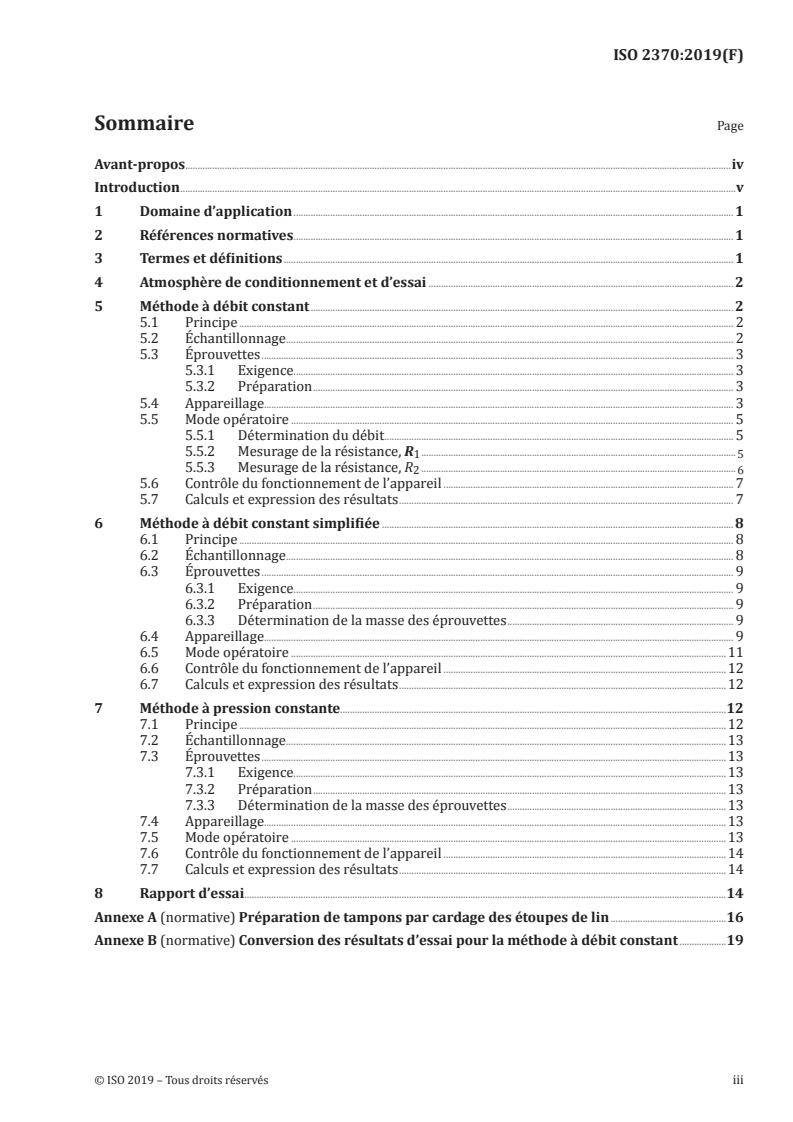
5.4 Appareillage. 3
5.5 Mode opératoire . 5
5.5.1 Détermination du débit . . 5
5.5.2 Mesurage de la résistance, R .
1 5
5.5.3 Mesurage de la résistance, R .
2 6
5.6 Contrôle du fonctionnement de l’appareil . 7
5.7 Calculs et expression des résultats . 7
6 Méthode à débit constant simplifiée . 8
6.1 Principe . 8
6.2 Échantillonnage . 8
6.3 Éprouvettes . 9
6.3.1 Exigence. 9
6.3.2 Préparation . 9
6.3.3 Détermination de la masse des éprouvettes . 9
6.4 Appareillage. 9
6.5 Mode opératoire .11
6.6 Contrôle du fonctionnement de l’appareil .12
6.7 Calculs et expression des résultats .12
7 Méthode à pression constante.12
7.1 Principe .12
7.2 Échantillonnage .13
7.3 Éprouvettes .13
7.3.1 Exigence.13
7.3.2 Préparation .13
7.3.3 Détermination de la masse des éprouvettes .13
7.4 Appareillage.13
7.5 Mode opératoire .13
7.6 Contrôle du fonctionnement de l’appareil .14
7.7 Calculs et expression des résultats .14
8 Rapport d’essai .14
Annexe A (normative) Préparation de tampons par cardage des étoupes de lin .16
Annexe B (normative) Conversion des résultats d’essai pour la méthode à débit constant .19
Avant-propos
L’ISO (Organisation internationale de normalisation) est une fédération mondiale d’organismes
nationaux de normalisation (comités membres de l’ISO). L’élaboration des Normes internationales est
en général confiée aux comités techniques de l’ISO. Chaque comité membre intéressé par une étude
a le droit de faire partie du comité technique créé à cet effet. Les organisations internationales,
gouvernementales et non gouvernementales, en liaison avec l’ISO participent également aux travaux.
L’ISO collabore étroitement avec la Commission électrotechnique internationale (IEC) en ce qui
concerne la normalisation électrotechnique.
Les procédures utilisées pour élaborer le présent document et celles destinées à sa mise à jour sont
décrites dans les Directives ISO/IEC, Partie 1. Il convient, en particulier, de prendre note des différents
critères d’approbation requis pour les différents types de documents ISO. Le présent document a été
rédigé conformément aux règles de rédaction données dans les Directives ISO/IEC, Partie 2 (voir www
.iso .org/directives).
L’attention est attirée sur le fait que certains des éléments du présent document peuvent faire l’objet de
droits de propriété intellectuelle ou de droits analogues. L’ISO ne saurait être tenue pour responsable
de ne pas avoir identifié de tels droits de propriété et averti de leur existence. Les détails concernant
les références aux droits de propriété intellectuelle ou autres droits analogues identifiés lors de
l’élaboration du document sont indiqués dans l’Introduction et/ou dans la liste des déclarations de
brevets reçues par l’ISO (voir www .iso .org/brevets).
Les appellations commerciales éventuellement mentionnées dans le présent document sont données
pour information, par souci de commodité, à l’intention des utilisateurs et ne sauraient constituer un
engagement.
Pour une explication de la nature volontaire des normes, la signification des termes et expressions
spécifiques de l’ISO liés à l’évaluation de la conformité, ou pour toute information au sujet de l’adhésion
de l’ISO aux principes de l’Organisation mondiale du commerce (OMC) concernant les obstacles
techniques au commerce (OTC), voir le lien suivant: www .iso .org/iso/fr/avant -propos.
Le présent document a été élaboré par le comité technique ISO/TC 38, Textiles, sous-comité SC 23, Fibres
et fils.
Il convient que l’utilisateur adresse tout retour d’information ou toute question concernant le présent
document à l’organisme national de normalisation de son pays. Une liste exhaustive desdits organismes
se trouve à l’adresse www .iso .org/fr/members .html.
Cette troisième édition annule et remplace la deuxième édition (ISO 2370:1980), qui a fait l’objet d’une
révision technique. Les principales modifications par rapport à l’édition précédente sont les suivantes:
— ajout d’une troisième méthode pour la détermination de la finesse des fibres de lin à l’Article 7
«Méthode à pression constante»;
— suppression de l’Annexe C et de l’Annexe D.
iv © ISO 2019 – Tous droits réservés
Introduction
La finesse peut être considérée comme une caractéristique essentielle du lin. Toutefois, à cause de leur
structure particulière, le mesurage de la finesse de ces fibres constitue un problème difficile.
En effet, alors que le coton, la laine, les fibres chimiques, etc., se présentent sous forme de fibres
individuelles, de section bien définie et aisément séparables les unes des autres, les fibres de lin se
présentent, après rouissage et teillage, sous forme de fibres techniques. Celles-ci sont constituées d’un
certain nombre de fibres élémentaires agglutinées plus ou moins imparfaitement entre elles par des
matières pectiques, ce qui donne à certaines fibres une forme branchue. Au cours des opérations de
filature, les fibres techniques sont progressivement divisées sans que ce processus aboutisse à une
séparation complète en fibres élémentaires.
Dans ces conditions, la détermination de la finesse des fibres de lin présente les difficultés suivantes:
— difficulté résultant de la modification continuelle du degré de division de la matière au cours du
processus de filature. On ne peut donc parler intrinsèquement de finesse, mais bien d’une finesse
correspondant à un état résultant d’une opération donnée. Il faudra donc toujours spécifier l’état
dans lequel se trouve la matière sur laquelle a été effectué le mesurage;
— difficulté due au fait que la séparation des éléments fibreux est une opération délicate, qui résulte
elle aussi de la constitution de la matière.
Compte tenu de ces difficultés, les méthodes «perméamétriques» semblent être les plus appropriées au
mesurage de la finesse des fibres libériennes.
NORME INTERNATIONALE ISO 2370:2019(F)
Textiles — Détermination de la finesse des fibres de lin —
Méthodes perméamétriques
1 Domaine d’application
Le présent document spécifie trois méthodes perméamétriques pour la détermination de la finesse des
fibres de lin:
— une méthode à débit constant, à deux compressions, utilisant une éprouvette de fibres parallèles
(voir l’Article 5);
— une méthode à débit constant simplifiée, à une compression, utilisant une éprouvette de fibres
disposées «au hasard» (voir l’Article 6);
— une méthode à pression constante, à une compression, utilisant une éprouvette de fibres disposées
«au hasard» (voir l’Article 7).
Le présent document s’applique aux diverses formes sous lesquelles se présentent les fibres de lin, c’est-
à-dire longs brins, lin brisé, étoupes sous toutes leurs formes et aux divers stades de transformation de
ces matières.
2 Références normatives
Les documents suivants sont cités dans le texte de sorte qu’ils constituent, pour tout ou partie de leur
contenu, des exigences du présent document. Pour les références datées, seule l’édition citée s’applique.
Pour les références non datées, la dernière édition du document de référence s'applique (y compris les
éventuels amendements).
ISO 139, Textiles — Atmosphères normales de conditionnement et d'essai
ISO 1130, Fibres textiles — Diverses méthodes d'échantillonnage en vue des essais
3 Termes et définitions
Pour les besoins du présent document, les termes et définitions suivants s’appliquent.
L’ISO et l’IEC tiennent à jour des bases de données terminologiques destinées à être utilisées en
normalisation, consultables aux adresses suivantes:
— ISO Online browsing platform: disponible à l’adresse https: //www .iso .org/obp
— IEC Electropedia: disponible à l’adresse http: //www .electropedia .org/
3.1
tampon de fibres
masse fibreuse introduite dans le canal central d’un manchon cylindrique, constituant l’éprouvette et
sur laquelle est effectué le mesurage
Note 1 à l'article: Dans la méthode à débit constant, les éléments fibreux constituant le tampon sont disposés
parallèlement à l’axe du manchon. Dans la méthode à débit constant simplifiée et la méthode à pression constante,
la masse fibreuse est introduite dans une chambre, de façon que les fibres constituant le tampon soient disposées
au hasard. Dans les trois méthodes, il est indispensable que la densité de remplissage soit aussi régulière que
possible.
3.2
résistance du tampon de fibres au passage de l’air en écoulement laminaire
R
quotient de la dépression ΔP (hPa), provoquée par le tampon de fibres (3.1), par le débit Q (cm /s) qui le
traverse
Note 1 à l'article: Elle est exprimée en hPa·s/cm .
3.3
surface spécifique du tampon de fibres
A
quotient de la surface latérale totale des éléments fibreux constitutifs par leur volume
2 3
Note 1 à l'article: Elle est exprimée en cm /cm .
3.4
indice de surface spécifique du tampon de fibres
A’
produit arithmétique de la surface spécifique (A) et de la racine carrée du produit de la viscosité de
l’air (μ) et d’un facteur empirique de proportionnalité sans dimension (k)
3.5
indice de finesse
IFS
indice de finesse déterminé par une méthode conventionnelle (méthode gravimétrique) sur des lots de
référence
Note 1 à l'article: Il est relativement proche des valeurs exprimées par le système Tex.
Note 2 à l'article: Une compensation est permise en raison du fait que la finesse des fibres de lin ne peut être
établie de façon absolue.
4 Atmosphère de conditionnement et d’essai
Les pesées et les mesurages doivent être effectués dans l’atmosphère normale de conditionnement et
d’essai des textiles, définie dans l’ISO 139, sur des éprouvettes préalablement conditionnées dans la
même atmosphère.
5 Méthode à débit constant
5.1 Principe
Mesurage de la résistance au passage de l’air d’un tampon de fibres parallèles de masse déterminée,
placé successivement dans deux manchons de dimensions bien déterminées, mais de diamètres
différents, puis à partir des deux valeurs obtenues, déduction de l’indice de surface spécifique du
tampon et de la masse volumique des fibres, qui caractérisent la finesse des fibres.
5.2 Échantillonnage
Les échantillons doivent être représentatifs du lot.
L’échantillonnage doit être effectué selon l’une des méthodes décrites dans l’ISO 1130.
2 © ISO 2019 – Tous droits réservés
5.3 Éprouvettes
5.3.1 Exigence
L’éprouvette doit être constituée par un tronçon de fibres parallèles de 80 mm ± 1 mm de longueur
environ, ayant une masse comprise entre 2,8 g et 3,2 g selon la matière. Cinq éprouvettes doivent être
préparées pour chaque échantillonnage.
5.3.2 Préparation
5.3.2.1 Lin teillé ou lin peigné
Découper aux endroits désirés (par exemple tête, milieu, pied) des tronçons de 80 mm ± 1 mm de long.
5.3.2.2 Étoupes de lin
Faire subir à la matière un cardage en vue de rendre les fibres parallèles, au moyen de cardettes à main
comme spécifié dans l’Annexe A. Découper au milieu des tronçons de 80 mm ± 1 mm de long.
5.3.2.3 Rubans
Découper, en différents endroits, une longueur de 80 mm ± 1 mm. Réunir ces différents tronçons et
prélever la masse de matière nécessaire à l’exécution de l’essai.
5.4 Appareillage
5.4.1 Appareillage, représenté à la Figure 1.
Légende
A robinet à air E débitmètre
B manomètre F chambre de mesurage
C robinet à papillon à débit réglé G couvercle fileté
D robinet à trois voies M manomètre
a
Vers compresseur.
Figure 1 — Appareillage pour la méthode à débit constant
5.4.1.1 Robinet à air, A, en aval d’une chambre à air (pression minimale 0,15 MPa) alimentée par un
compresseur ou une ligne générale d’air comprimé sec.
5.4.1.2 Manomètre, B, gradué de 0 MPa à 0,2 MPa, avec dispositif de réglage.
3 3
5.4.1.3 Robinet à papillon à débit réglé, C (de 0,15 cm /s à 0,85 cm /s).
5.4.1.4 Robinet à trois voies, D.
5.4.1.5 Débitmètre à bulle de savon, E, ou tout autre appareil permettant un mesurage précis de
débits faibles.
5.4.1.6 Chambre de mesurage, F, qui reçoit le manchon contenant les fibres parallélisées. Le rebord
de ce manchon, muni d’un joint souple, vient s’appliquer sur le pourtour de F et y est maintenu par un
couvercle fileté, G.
5.4.1.7 Couvercle fileté, G, muni d’une ouverture circulaire.
4 © ISO 2019 – Tous droits réservés
5.4.1.8 Manomètre à eau, M, constitué d’un tube à inclinaison variable permettant des lectures de
surpressions maximales correspondant à 250 mm, 50 mm, 25 mm et 12,5 mm, selon l’inclinaison du
tube. Une des extrémités s’ouvre à l’air libre et l’autre est reliée à la chambre F.
5.4.2 Manchons, de hauteur 10 mm et de diamètres respectivement égaux à 10 mm et 11 mm (à
10 μm près).
5.4.3 Lame tranchante circulaire, montée sur un axe tournant à vitesse élevée.
5.4.4 Balance, d’une résolution de 0,01 g.
5.5 Mode opératoire
5.5.1 Détermination du débit
3 3
Fixer le débit préréglé par le robinet à papillon C à 0,50 cm /s ± 0,01 cm /s. Déterminer toutefois le
débit exact avant chaque série de mesures. À cet effet:
— laisser l’appareil branché durant 30 min pour obtenir un régime stationnaire, la pression initiale
étant réglée à 0,1 MPa;
— ouvrir le robinet à trois voies D en direction du débitmètre. Déterminer le temps nécessaire pour
qu’une bulle de savon atteigne un repère prédéterminé correspondant à 50 cm . Prendre la moyenne
de cinq mesures.
Le robinet à papillon à débit réglé C permet de maintenir le débit à une valeur constante, même en cas
de variation de la pression initiale ou de la contrepression.
5.5.2 Mesurage de la résistance, R
Introduire les fibres de lin parallèles (lin teillé ou peigné) ou rendues parallèles (étoupes ou rubans)
dans le canal du manchon de 10 mm de diamètre, en opérant comme indiqué à la Figure 2. Couper les
fibres qui débordent du canal à l’aide de la lame circulaire tranchante tournant à vitesse élevée; durant
cette opération, le manchon doit tourner à vitesse réduite.
Mettre l’appareil en marche, introduire le manchon dans la chambre et visser le couvercle G. Après
stabilisation de la surpression, lire la hau
...