


ISO/IEC 8651-4:1991
(Main)Information technology — Computer graphics — Graphical Kernel System (GKS) language bindings — Part 4:
Information technology — Computer graphics — Graphical Kernel System (GKS) language bindings — Part 4:
Technologies de l'information — Infographie — Système graphique de base (GKS) — Interface langage — Partie 4:
General Information
- Status
- Withdrawn
- Publication Date
- 17-Dec-1991
- Withdrawal Date
- 17-Dec-1991
- Current Stage
- 9599 - Withdrawal of International Standard
- Start Date
- 15-Jun-1995
- Completion Date
- 14-Feb-2026
Relations
- Effective Date
- 15-Apr-2008
Get Certified
Connect with accredited certification bodies for this standard

BSI Group
BSI (British Standards Institution) is the business standards company that helps organizations make excellence a habit.

NYCE
Mexican standards and certification body.
Sponsored listings
Frequently Asked Questions
ISO/IEC 8651-4:1991 is a standard published by the International Organization for Standardization (ISO). Its full title is "Information technology — Computer graphics — Graphical Kernel System (GKS) language bindings — Part 4:". This standard covers: Information technology — Computer graphics — Graphical Kernel System (GKS) language bindings — Part 4:
Information technology — Computer graphics — Graphical Kernel System (GKS) language bindings — Part 4:
ISO/IEC 8651-4:1991 is classified under the following ICS (International Classification for Standards) categories: 35.060 - Languages used in information technology; 35.140 - Computer graphics. The ICS classification helps identify the subject area and facilitates finding related standards.
ISO/IEC 8651-4:1991 has the following relationships with other standards: It is inter standard links to ISO/IEC 8651-4:1995. Understanding these relationships helps ensure you are using the most current and applicable version of the standard.
ISO/IEC 8651-4:1991 is available in PDF format for immediate download after purchase. The document can be added to your cart and obtained through the secure checkout process. Digital delivery ensures instant access to the complete standard document.
Standards Content (Sample)
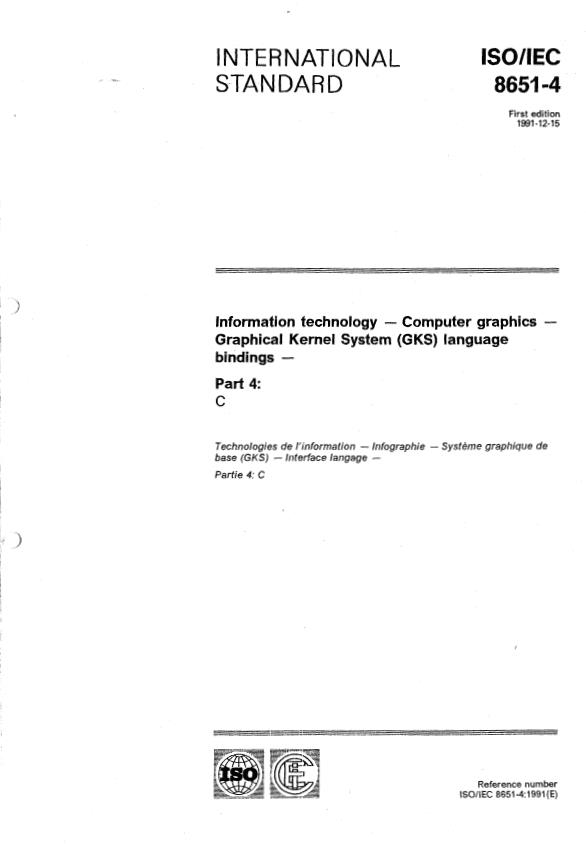
ISOIIEC
I N TE R NAT I O NA L
STANDARD
8651 -4
First edition
1991 - 12- 1 5
Information technology - Computer graphics -
Graphical Kernel System (GKS) language
bindings -
Part 4:
C
Technologies de I'inforniation - infographie - Système graphique de
base (GKS) - interface langage -
Partie 4: C
Reference number
ISO/IEC 8651 -4A991 (E)
ISOhEC 8651-4 : 1991(E)
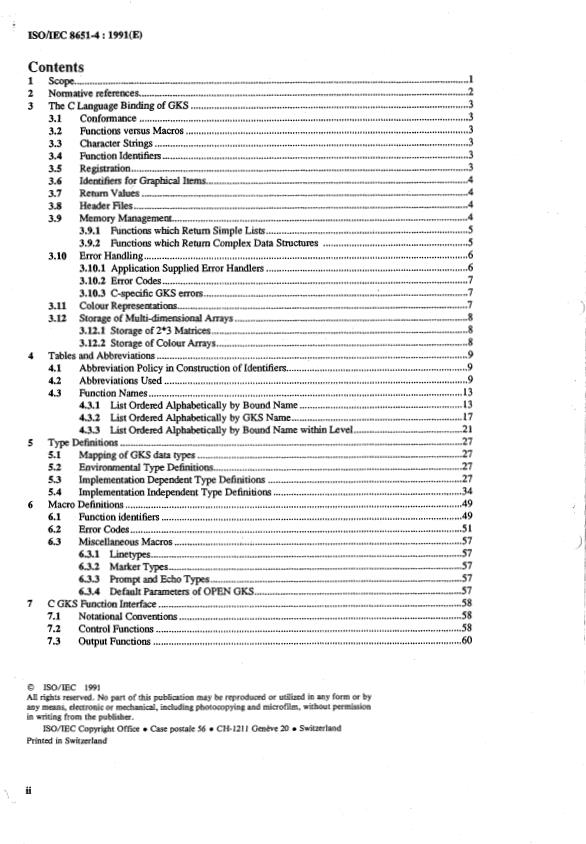
Contents
.................................................................................................................................
scop . _ 1
...............................................................................................................................
2 Normative references 2
The C Language Binding of GKS . 3
.-I
Conform~ce . 3
3.1
Functiom versus Macros . 3
3.2
Character Strings . 3
3.3
Function Identifiers . 3
3.4
Registration . 3
3.5
Identifiers for Graphical Items . 4
3.6
Remm Values . 4
3.7
Header Files . 4
3.8
Memory Management . 4
3.9
Functions which Return Simple Lists . 5
3.9.1
3.9.2 Functions which Remm Complex Data structures . 5
.............................................................................................................................
3.10 Error Hadling 6
..............................................................................
3.10.1 Application Supplied Error Handlers
3.10.2 Error Codes . 7
3.10.3 C-specific GKS errors . 7
Colour Representatio ns . 7
3.11
Storage of Multi-dimensional Arrays . 8
3.12
3.12.1 Storage of 2*3 Matices . 8
3.12.2 Storage of Colour Arrays . 8
Tables and Abbreviations .
Abbreviation Policy in Construction of Identifiers . 9
4.1
4.2 Abbreviations Used . 9
4.3 Function Names . 13
...............................................................
4.3.1 List Ordered Alphabetically by Bound Name 13
4.3.2 List Ordeed Alphabetically by GKS Name . 17
List Ordered Alphabetically by Bound Name within Level . 21
4.3.3
Type Definitions . 27
Mapping of GKS data types . 27
5.1
Environmental Type Definitions . 27
5.2
Implementation Dependent Type Definitions . 27
5.3
5.4 Implementation Independent Type Definitions . 34
Macro Definitions . 49
6.1 Function identifiers . 49
6.2 Error Codes . 51
6.3 Miscellaneous Macros . 57
6.3.1 Lineiypes . 57
6.3.2 Marker Types . 57
6.3.3 Prompt and Echo Types . 57
6.3.4 Default Parameters of OPEN GKS . 57
C GKS Function Interface . 58
7.1 Notational Conventions . 58
7.2 ConiIol Functions . 58
7.3 output Functions . 60
0 ISO/IEC 1991
All rights reserved . No part of this publication may be reproduced or utilized in any form or by
any means. electronic or mechanical. including photocopying and microfilm. without permission
in writing from the publisher .
ISOAEC Copyright Office 0 Case postale 56 0 CH-121 1 Genève 20 0 Switzerland
Printed in Switzerland
ISO/IEC 8651-4 : 1991(E)
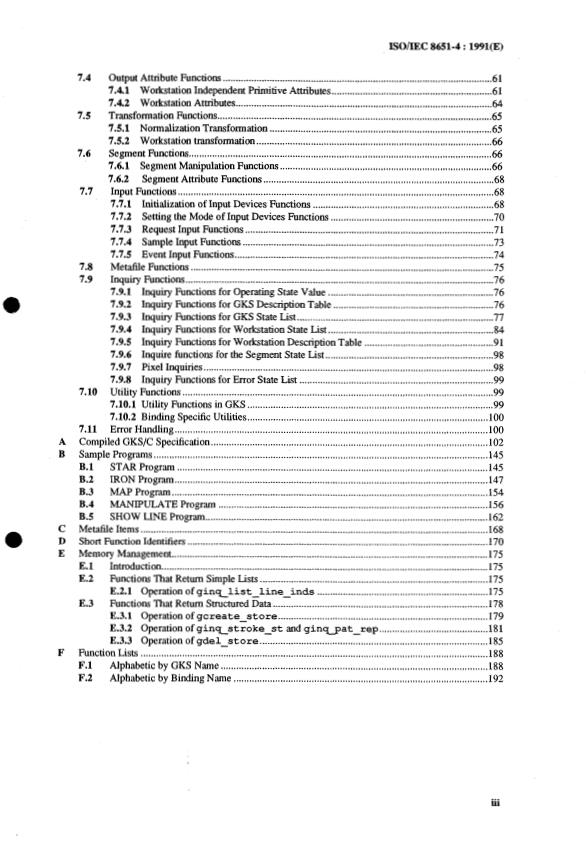
Output Attribute Functions . 61
7.4
7.4.1 Workstation Independent Primitive Attributes . 61
7.4.2 Workstation Attributes . 64
7.5 Transformation Functions . 65
7.5.1 Normalization Transformation . 65
7.5.2 Workstation transformation . 66
7.6 Segment Functions . 66
7.6.1 Segment Manipulation Functions . 66
7.6.2 Segment Attribute Functions . 68
.......................................................................................................................... 68
7.7 Input Functions
7.7.1 Initialization of Input Devices Functions . 68
7.7.2 Setting the Mode of Input Devices Functions . 70
7.7.3 Request Input Functions . 71
7.7.4 Sample Input Functions . 73
7.7.5 Event Input Functions . 74
7.8 Metaile Functions . 75
7.9 Inquiry Functions . 76
7.9.1 Inquiry Functions for Operating State Value . 76
7.9.2 Inquiry Functions for GKS Description Table . 76
7.9.3 Inquiry Functions for GKS State List . 77
7.9.4 Inquiry Functions for Workstation State List . 84
7.9.5 Inquiry Functions for Workstation Description Table . 91
7.9.6 Inquire functions for the Segment State List . 98
7.9.7 Pixel Inquiries . 98
7.9.8 Inquiry Functions for Error State List . 99
7.10 Utility Functions . 99
7.10.1 Utility Functions in GKS . 99
7.10.2 Binding Specific Utilities . 100
7.11 Error Handlin ç! . 100
.
A
Compiled GKS/C Specification . 102
B
Sample Programs . 14j
B.l STAR Program . 14j
B.2 IRON Program . 147
B.3 MAP Program . 1j4
B.4 MANIPULATE Program . 156
B.5
SHOW LINE Program . 162
C Metafîle Items . 168
D Short Function Identifiers . 170
E Memory Management . 175
E.l Introduction . 175
E.2 Functions That Return Simple Lists . 175
E.2.1 Operation of ginq-list-line-inds . 175
E.3 Functions That Return Structured Data . 178
E.3.1 Operation of gcreate-store . 179
E.3.2
Operation of ginq-stroke-st and ginQpat-rep . 181
E.3.3 Operation of gdel-store . 185
F Function Lists . 188
F.l Alphabetic by GKS Name . 188
F.2 Alphabetic by Binding Name . 192
üi
I
ISOhEC 8651-4 : 1991(E)
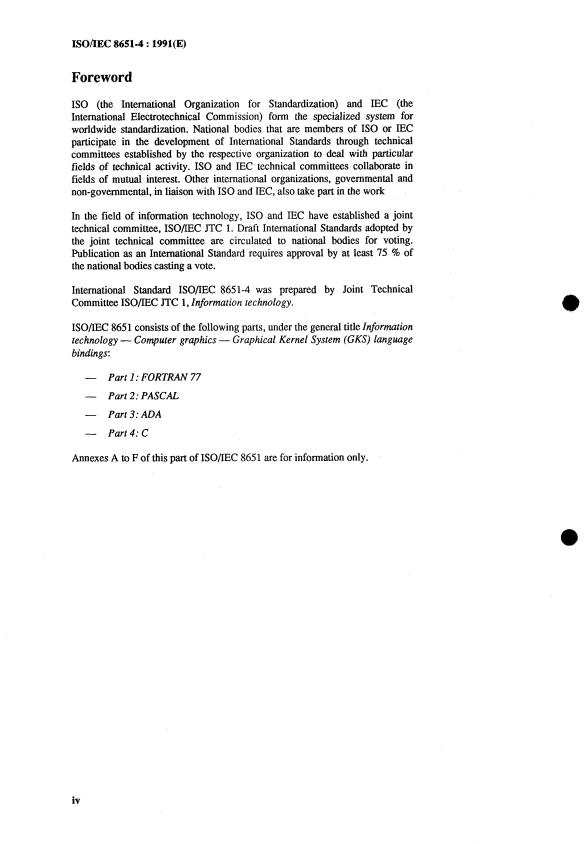
Foreword
IS0 (the International Organization for Standardization) and IEC (the
International Electrotechnical Commission) form the specialized system for
worldwide standardization. National bodies that are members of IS0 or IEC
of International Standards through technical
participate in the development
committees established by the respective organization to deal with particular
fields of technical activity. IS0 and IEC technical committees collaborate in
fields of mutual interest. Other international organizations, governmental and
non-governmental, in liaison with IS0 and IEC, also take part in the work
In the field of information technology, IS0 and IEC have established a joint
1. Draft International Standards adopted by
technical committee, ISO/IEC JTC
the joint technical committee are circulated to national bodies for voting.
Publication as an International Standard requires approval by at least 75 % of
the national bodies casting a vote.
International Standard ISO/IEC 865 1-4 was prepared by Joint Technical
Committee ISO/iEC JTC 1, Information fechnology.
ISO/iEC 8651 consists of the following parts, under the general title Information
technology - Computer graphics - Graphical Kernel System (GKS) language
bindings:
- Part 1: FORTRAN 77
- Part 2: PASCAL,
- Part3:ADA
- Part4: C
Annexes A to F of this part of ISO/IEC 865 1 are for information only.
iv
ISO/IEC 8651-4 : 1991(E)
Introduction
The Graphical Kernel System (GKS) functional description is registered as IS0 7942 : 1985. As explained
of IS0 7942, that International Standard is specified in a language
in the Scope and Field of Application
independent manner and needs to be embedded in language dependent layers (language bindings) for use
with particular programming languages.
The purpose of this part of ISO/IEC 8651 is to define a standard binding for the C computer programming
language.
V
INTERNATIONAL STANDARD ISO/IEC 8651-4:1991(E)
Information technology - Computer graphics -
Graphical Kernel System (GKS) language bindings -
Part 4:
C
1 Scope
The Graphical Kernel System (GKS), IS0 7942 : 1985 , specifies a language independent nucleus of a
graphics system. For integration into a programming language, GKS is embedded in a language dependent
layer obeying the particular conventions of that language. This part of ISODEC 8651 specifies such a
language dependent layer for the C language.
ISOhEC 8651-4 : 1991(E) GKSIC
2 Normative references
The following standards contain provisions which, through reference in this text, constitute provision of
this part of ISO/IEC 8651. At the time of publication, the editions indicated were valid. All standards are
subject to revisions, and parties to agreements based on this part of ISO/IEC 865 1 are encouraged to inves-
tigate the possibility of applying the most recent editions of the standards indicated below. Members of
IEC and IS0 maintain registers of currently valid International Standards.
IS0 7942:1985, Information processing systems - Computer graphics - Graphical Kernel System (GKS)
functional description.
ISO/IEC 865 1-1: 1988, Information processing systems - Computer graphics - Graphical Kernel System
(GKS) - language bindings - Part 1 : FORTRAN.
ISO/IEC 88064: 1991, Information technology - Computer graphics - Graphical Kernel System for Three
Dimensions (GKS3D) language bindings - Part 4 : C.
ISO/IEC 9899:1990, Programming languages - C.
ISO/IEC TR 9973: 1988, Information processing - Procedures for registration of graphical items.
GKS/C ISO/IEC 8651-4 : 1991(E)
3 The C Language Binding of GKS
The C language binding of GKS shall be as described in clauses 3,4,5 and 6.
3.1 Conformance
This part of ISO/IEC 8651 incorporates the rules of conformance defined in the GKS Standard (IS0 7942)
for GKS implementations, with those additional requirements specifically defined for C bindings in GKS.
The following criteria shall determine conformance of an implementation to this part of ISO/iEC 8651:
In order to conform, an implementation of the C binding of GKS shall implement a specific level of
GKS as specified in IS0 7942. It shall make visible all of the declarations in the C binding specified in
this part of ISO/iEC 8651 for that same level of GKS and all lower levels and for a specific level of C.
Thus, for example, the syntax of the function names shali be precisely as specified in the binding and
parameters shall be of the data types stated in the binding.
3.2 Functions versus Macros
An implementation may substitute macros for functions. However, the macros shali be designed so that
side-effects work properly. In general, a macro cannot be used to replace the error handling function
gerr - hand. See also 3.10.
3.3 Character Strings
The C language represents character strings as an array of characters terminated by the null character (i.e.
\O ). This means that the null character is not usable as a printable character.
3.4 Function Identifiers
The function names of GKS are all mapped to C functions which begin with the letter g. Words and
phrases used in the GKS function names are often abbreviated in the representation and are always
separated with the underscore character "-". The set of such abbreviations is given in 4.2, and the result-
ing C function names are listed in 4.3. For example, the abbreviation for the GKS function DELETE SEG-
MENT FROM WORKSTATION is gdel-seg-ws. del, seg, and ws are abbreviations for
DELETE, SEGMENT, and WORKSTATION. The conjunctive FROM is mapped to the null string.
The C standard (ISO/iEC 9899) requires that compilers recognize internal identifiers which are distinct in
at least 31 characters. That standard also requires that external identifiers (i.e. those seen by the linker) be
recognized to a minimum of six characters, independent of case.
Implementations which run in environments where two distinct C internai identifiers would be equivalent,
if they were both external identifiers, shall include a set of #de£ ines in the header file which equate the
long names to a set of short names. A possible set of short names for a compiler that accepts only eight
characters for external definitions may be found in annex D.
3.5 Registration
IS0 7942 reserves certain value ranges for registration' as graphical items. The registered graphical items
will be bound to the C programming language (and other programming languages). The registered item
binding will be consistent with the binding presented in this part of ISODEC 8651.
')For the purpose of this part of ISO/IEC 8651 and according to the rules for the designation and operation of registration
IS0 and JEC councils have designaied the National Institute of Standards and
authorities in the ISO/lEC Directives, the
Technology (institute of Computer Sciences and Technology), A-266 Technology Building, Gaithersburg, MD 20899,
USA to act as registration authority.
ISOhEC 8651-4 : 1991(E) GKS/C
The C Language Binding of GKS
Identifiers for Graphical Items
3.6 Identifiers for Graphical Items
Generalized Drawing Primitives and Escape functions are referenced via identifiers. This part of ISOflEC
8651 specifies the fonnat of the identifiers but it does not specify the registration of the identifiers. The
identifiers m used as arguments to the functions ggdp and gescape.
An implementation may also represent GDPs and Escapes as separate functions, but this is not required.
There are two formats for these identifiers. One format is for registered GDPs and Escapes and the other
format is for unregistered GDPs and Escapes.
The format for registered GDP identifiers is:
#define GGDP-Rn (n) /* Inr is the registered GDP id. */
The format for unregistered GDP identifiers is:
#define GGDP-Un (-n) /* Inr is implementation dependent */
The format for registered Escape function identifiers is:
#define GESCAPE-FUI (n) /* ,nr is the registered Escape id. */
The format for unregistered Escape function identifiers is:
#define GEÇCAPE-Un (-n) /* ,nr is implementation dependent */
3.7 Return Values
Ail GKS/C functions return void.
3.8 Header Files
C provides a mechanism to allow external files to be included in a compilation. Clause 5 of this part of
ISOflEC 8651 describes the data types that shall be defined in the file gks . h which should be included in
any application program that intends to use GKS via the C binding.
Gdata). The type
This part of ISO/iEC 8651 uses the data type size-t (as a field in the data type
size-t is environment-dependent (e.g. int, long int, unsigned int) and is defined in the file
. Therefore the file gks . h shali also include the file .
Additional implementation-dependent items may be placed in this file if needed. These items should start
with the sentinel “G’ or “g”, as far as applicable.
The file gks . h shaii also contain external declarations for ali GKS/C functions because they return
void. For example, the declaration for the function gopen-gks would look like this:
extern void gopen-gks(char *err-file, size-t mem-units);
3.9 Memory Management
The application shall aliocate the memory needed for the data returned by the implementation. In general,
the application will allocate a C structure and pass a pointer to that structure to an inquiry routine, which
wiil then place information into the structure. However, a number of inquiry functions return variable
length data, the length of which is not known a priori by the application.
These functions faii into two classes. One class of functions returns a simple, homogeneous, list of items.
For example, the function INQUIRE SET OF SEGMENT NAMES returns a list of the segment names in
use. The other class returns complex, heterogeneous data structures. For example, the function INQUIRE
LOCATOR DEVICE STATE returns the device state which includes a locator data record; the data record
of these two classes
can contain arbitrarily complex implementation-defined data structures. The binding
3.10 describes the errors that can be invoked during
of functions is described in detail below. Subclause
execution of functions which use the memory management policy.
GKS/C ISO/IEC 8651-4 : 1991(E)
The C Language Binding of GKS Memory Management
3.9.1 Functions which Return Simple Lists
Inquiry functions which return a list of items are bound such that the application can inquire about a por-
tion of the list. This list is a subset of the implementation’s internai list and is called the application’s list.
This allows the application to process the implementation’s list in a piecewise manner rather than ail at
once.
The application allocates the memory for a list and passes that list to the implementation. The implementa-
tion places the results of the inquiry into the list. In order to support this policy of memory management,
three additional parameters have been added to functions which return lists:
a) nun-elemsappl-list: An integer input parameter which is the length of the application’s list.
The value of nun-elems-appï-iist indicates the number of items (i.e. list elements) which will
fit into the application list. A value of O is valid and allows the application to determine the size of the
implementation’s list (which is returned via nun-elems-impl-list) without having the imple-
mentation return any of the elements of its list. If nun-elemsappl-list is negative,
GE-APPL-LIST-LENGTH-LT - ZERO is returned as the vdue of the error indicator parameter.
b) start-ind: An integer input parameter which is an index into the implementation’s list. (Index O is
the first element of both the implementation’s and application’s list.) start-ind indicates the first
item in the implementation’s list that is copied into index O of the application’s list. Items are copied
sequentiaiiy from the implementation’s list into the application’s list until the application’s list is full or
there are no more items in the implementation’s list. If start-ind is out of range, error
GE-START-IND-INVAL is returned as the value of the error indicator parameter.
c) nun-eiems-impl-list: An output parameter which is a pointer to an integer. The implementation
stores into this parameter the number of items that are in the implementation’s list.
In annex E, a possible underlying mechanism is described.
3.9.2 Functions which Return Complex Data Structures
The data returned by the ESCAPE function and the functions which return input device data records or pat-
tern tables can be complex in structure. They cannot be represented by a simple list of items. It would be an
onerous task for the application to have to allocate and prepare data structures for these routines. In order
to facilitate this task of using these inquiry functions, the binding defines a new resource, called a Store, to
manage the memory for these functions.
The Store resource is opaque to the application. The application does not know the structure of the Store or
how it is implemented. The Store is defined as a void * . This part of ISO/IEC 8651 defines two new
functions which create (in CREATE STORE, bound as gcreate - store) and delete (in DELETE
STORE, bound as del-store) a Store.
A Store is used by the implementation to manage the memory needed by the functions which return com-
plex data structures. Without specifying an implementation of a Store, it is safe to say that it will contain
and control memory needed to hold the data returned by these functions and also contain some bookkeep-
ing information about the contents and size of the memory.
The semantics of the Store resource provide two levels of memory management. The implementation is
responsible for managing the memory at a low level because it uses, reuses, allocates and deaiiocates
memory from the system in order to return information to the application. But the application is ultimately
responsible for managing the memory at a high level because it creates and deletes Stores.
A Store is passed as a parameter to a function returning complex data structures. Another parameter to this
function is a pointer to a pointer to a structure which defines the format of the returned data. The Store
contains memory for the structure and any additional memory referenced by fields within the structure. The
application accesses the returned data through its pointer to the structure. It does not use the Store to access
the data.
A Store continues to hold the information from the function until the Store is deleted by the DELETE
STORE function or until the Store is used as an argument to a subsequent function, which returns complex
ISOhEC 8651-4 : 1991(E) GKS/C
Memory Management The C Language Binding of GKS
data structures. At that time, the old information is replaced with the new. Thus multiple calls to functions
overwrite the contents of a Store. A Store oniy contains the results of the last function.
This part of ISO/IEC 8651 defmes two new errors that can occur when using or creating a Store; these
errors are described in 3.10.3. For most functions using a Store, these and other errors are returned via the
"error indicator" parameter. However, the function ESCAPE does not have an error indicator parameter.
For this function, the error reporting mechanism is used when an error is encountered. For this function, the
implementation shall, in addition to reporting the error, set the pointer to the returned data to NULL when
an error occurs. See the binding of these functions for more information.
The definitions for the functions CREATE STORE and DELETE STORE follow:
CREATE STORE GKOP, WSOP, WSAC, SGOP LOa
Parameters:
out error indicator I
out store STORE
Effect: Creates a Store and returns a handle to it in the output parameter store. If the Store cannot be creat-
store parameter is set to NULL and the error indicator is set to one of the foilowing error values:
ed, the
8 GKS not in proper state; GKS shall be in one of the states GKOP, WSOP, WSAC or SGOP
2203 Error while allocating Store
Errors: None.
DELETE STORE GKOP, WSOP, WSAC, SGOP LOa
Parameters:
out error indicator I
IdOut store
STORE
Effect: Deletes the Store and all internai resources associated with it. If there is not an error, the parameter
store will be set to NULL to signify that it is no longer valid. If an error is detected, the error indicator
is set to one of the following values:
8 GKS not in proper state; GKS shall be in one of the states GKOP, WSOP, WSAC or SGOP
Errors: None.
In 7.10.2, the C specification of these functions is given. In annex E, a possible underlying mechanism is
illusirated.
3.10 Error Handling
3.10.1 Application Supplied Error Handlers
User-defined error handlers shd accept the same arguments as the standard error handier. The user-
defined error handier is specified by the utility function (see also 7.10.2)
GKS/C : 1991(E)
ISO/IEC 8651-4
The C Language Binding of GKS Error Handling
SET ERROR HANDLER GKCL, GKOP, WSOP, WSAC, SGOP LOa
Parameters:
In New error handling function Function
out Old error handling function Function
Effect: Sets the GKS error handling function to New error handlingfunction and returns the current error
handling function to Old error handling function.
Errors: None.
Application defined error handling functions accept the same arguments as the standard error handler. They
may invoke the standard error logging function ERROR LOGGING.
IS0 7942 defines the initial error handling function to be ERROR HANDLING, that is, the value of the
parameter Old error handlingfunction points to ERROR HANDLING, when SET ERROR HANDLER is
called for the first time.
When the application changes the error handling function, the implementation will invoke the new function
when an error is detected. If the application calls the default error handling function ERROR HANDLING,
ERROR HANDLING will always call the function ERROR LOGGING.
If New error kundler is not a valid pointer, the error handling will automatically be done by the standard
error handler ERROR HANDLING.
User-defined error handlers may invoke the standard error logging function ERROR LOGGING.
3.10.2 Error Codes
Hard coding numbers into a program decreases its maintainability. Therefore, this part of ISO/IEC 8651
defines a set of constants for the GKS error numbers. Each error constant begins with the characters GE-.
See also 6.2 for the error macros.
3.10.3 C-specific GKS errors
This part of ISO/IEC 8651 knows some specific error messages. This section gives the messages and the
error macros.
Value Message
2200 Start index out of range
Is issued when the start index is less than zero or larger
than the last element in the implementation’s list
2201 Length of application list is negative
Is issued when the length of the application’s list is less than zero
2202 Enumeration type out of range
Is issued when a parameter value whose type is an enumeration is out range of the enumeration
2203 Error while allocating Store
Is issued when an error is detected during CREATE STORE
2204 Error while allocating memory for Store
Is issued when a function using a Store is unable to allocate memory for the Store
3.11 Colour Representations
A union type definition is used for colour bundles, guaranteeing upward compatibility with GKS-3D/C
(RGB and CIE L*u*v* 1976).
(ISO/IEC 8806-4), which supports at least two colour models
IsOhEC 8651-4 : 1991(E)
GKS/C
Storage of multi-dimensional arraystt
The C Language Binding of GKS
3.12 Storage of Multi-dimensional Arrays
3.12.1 Storage of 2*3 Matrices
The entries of Gtran-matrix data types shall be stored such that the segment transformation is defined
by
Tp.x = mat[O,OI*p.x + mat[O,ll*p.y + mat[0,21;
Tp.y = mat[l,O]*p.x + mat[l,l]*p.y t mat[l,2];
where p is a 2D point, Tp its transformation and mat is of type Gtran-matrix.
3.12.2 Storage of Colour Arrays
The enhies of Gpatrep data types shall be stored such that the colour index at the (i,j)-th entry is given
by
Coh-indi,! = colr-rect .colr-array[i + DX*j];
i = O, ., DX-1; j = O, ., DY-1;
DX = colr-rect.dims.size-x; DY = colr-rect.dirns.size_y;
where colr-rect is of type Gpat-rep.
ISO/IEC 8651-4 : 1991(E)
GKSlC
4 Tables
4.1 Abbreviation Policy in Construction of Identifiers
In the construction of the several data types, function names, etc., the following policy is applied:
1) All identifiers in the C binding are abbreviated using the same abbreviations for every component
and using underscores to denote blanks;
2) The plural of an expression is constructed by adding an "s" after its abbreviation; so, for example,
"vector" is abbreviated to "vec" and "vectors" is abbreviated to "vecs"; if an expression is mapped
to NULL, so will be its plural;
3) Digits are also preceded by underscores;
4) The words POLYLINE, POLYMARKER and FILL AREA are not abbreviated in the output primi-
tive function names; in ail other cases they are abbreviated using the list in 4.2;
5) Construction of GKS/C identifiers:
a) Function names:
"g" (lower case) followed by abbreviated function name in lower case;
b) Datatypes:
"G" (upper case) followed by abbreviated data type in lower case:
c) Fields of data types: the following refinements are used: "redundant" (words in the field name
that are identical to those in the structure name) parts are omitted, if the context allows this; thus
the colour index in the field of Gxxx-bundle is abbreviated to colr-ind, because the
context makes clear which colour index is used
d) Function macros:
"Gf n - " followed by abbreviation of function name;
e) GKSM item types:
"Gksm-" followed by abbreviation of item name:
f) Error macros:
"GE-" followed by some abbreviated expression:
g) Fields of enumeration types:
"G" (upper case) followed by a prefix followed by an abbreviation of the field name; this prefix
ali the fields are in upper case;
is constant for each enumeration field
4.2 Table of Abbreviations Used
In this table, only words which are abbreviated are listed. They are used for
function names;
data types;
fields of data types;
error macros;
GKSM item types.
The word "NULL" denotes those words which m deleted completely when forming function names or
data types.
Abbreviation
Word or Phrase
NULL
accepted
GKS/C
ISOhEC 8651-4 : 1991(E)
Tables
Table of Abbreviations Used
accum
accumulate
NULL
action
act
actual
add
addition
alignment align
alloc
allocate
NULL
and
application
aPP1
arith
arithmetic
as soon as possible
sap
asf
aspect source flag
assoc
associate(d)
asti
at some time
NULL
at
attr
attribute
avail
availability
avail
available
bnig
before the next interaction globally
bnü
before the next interaction locally
NULL
between
buf
buffer
cant
cannot
cat
category
Ctr
centre
char
character
class
classification
clip
clipping
colr
colour
concat
concatenation
cond
)
conditionai( ly
corn
connection
ctrl
control
coord
coordinate
CIlf
corner
CUT
current
dash
dashed
def
default
defer
deferral
del
delete
del
deletion
det
detectabiliîy
det
detectable
dc
device coordinate(s)
NULL
s)
device(
digit
digital
dim
dimension
display
diSP
dot
dotted
duplicate dUP
dynamic dYn
equal eq
err
error
GKSIC
ISO/IEC 8651-4 : 1991(E)
Tables
Table of Abbreviations Used
evaluate
evai
expansion
expm
facility
fac
factor
NULL
fiil area
fill
from
NULL
function
func
generalized drawing primitive
gdP
gks closed
gkcl
gks open
&OP
gksm NULL
graphical
graph
handiing hand
height
ht
highlighted
highl
highlighting
highl
horizontal
hor
identifier
id
immediate(1y) imm
re generation
implicit irg
implicit
imp1
in use
NULL
in
NULL
index
ind
indicator
ind
individual
indiv
initial
init
initialize
init
input/output io
input
in
inquire
inq
integer
int
interior
int
invalid
inval
invisible
invis
length
NULL
less than or equal
le
less than
It
level x x = Oa, Ob, .)
lx (with
library
lib
locator
loc
logical
NULL
mapping
map
maximum
max
memory
mem
metafiie input
mi
metafiie output
mo
minimum
min
modification
mod
monochrome
monochr
necessary
nec
nominal
nom
GKSIC
ISOhEC 8651-4 : 1991(E)
Tables
Table of Abbreviations Used
normal norm
normalization norm
normalized device coordinate(s) ndc
number num
of NULL
on NULL
operating
OP
output and input outin
output out
overflow overf
paraiiel( ogram)
Paral
pattern
Pat
pending pend
pointer
P@
line
pol y line
polymarker marker
position
POS
precision prec
predefîned pred
presence pres
primitive
P"
priority
Pli
prompt and echo type
Pet
prompt
Pr
queue NULL
record NULL
rectangle rect
red green blue (colour model)
rgb
reference ref
regeneration regen
r
registered
re1
relative
representation
rep
request(ed)
req
rubber rub
NULL
scale factor
segment open
%OP
segment
seg
select sel
simultaneous(1y) simult
spacing space
specification specif
specified specif
state st
storage store
supported NULL
suppressed
SuPPr
to NULL
tracking track
transform(ation) tm
unavailable unavail
undefined undef
OKS/C
ISO/IEC 8651-4 : 1991(E)
Tables
Table of Abbreviations Used
undetectable undet
unregistered U
update
Upd
used NULL
valuator Val
value NULL
vector vec
vertical vert
viewport
VP
visibility Vis
visible vis
which NULL
window win
with NULL
workstation active wsac
workstation independent segment store wiss
workstation open
wsop
workstation ws
world coordinate wc
4.3 Function Names
4.3.1 List Ordered Alphabetically by Bound Name
gaccum-tran-mat rix ACCUMULATE TRANSFORMATION MA=
gactivate-ws ACTIVATE WORKSTATION
gassoc-seg-ws ASSOCIATE SEGMENT WiTH WORKSTATION
gawaitevent AWAIT EVENT
gcell-array CELL ARRAY
gclear-ws CLEm WORKSTATION
gclose-gks CLOSE GKS
gclose-seg CLOSE SEGMENT
gclose-ws CLOSE WORKSTATION
COPY SEGMENT FROM WORKSTATION
9coPY-Seg-ws
gcreate-seg CREATE SEGMENT
gcreate-store
CREATE STORE (GKS/C only)
gdeactivate-ws DEACTIVATE WORKSTATION
gde 1-seg DELETE SEGMENT
gdel-seg-ws DELETE SEGMENT FROM WORKSTATION
gdel-s t ore DELETE STORE (GKS/C only)
gemergencyclose-gks EMERGENCY CLOSE GKS
ger r-hand ERROR "DLNG
ge rr-log ERROR LOGGING
gescape ESCAPE
geval-t ran-mat rix EVALUATE TRANSFORMATION MATRiX
g f i 11-a rea FILL AREA
gflush-events FLUSH DEVICE EVENTS
GENERALIZED DRAWING PRIMITIVE
SSdP
ggetchoice GET CHOICE
ggetitem-type
GET ITEM TYPE FROM GKSM
gge tl o c GET LOCATOR
gget_pick GET PICK
ISOhEC 8651-4 : 1991(E) GKSIC
Function Names
Tables
gget-string GET STRING
gget-stroke GET STROKE
gge t-va 1 GET VALUATOR
ginit-choice INITIALISE CHOICE
ginit-loc INITIALISE LOCATOR
ginitgick INITIALISE PICK
ginitst ring INITIALISE STRING
ginit-st roke INITIALISE STROKE
g in i t-va 1 INITIALISE VALUATOR
gineasf s INQUIRE ASPECT SOURCE FLAGS
ginechar-base-vec INQUIRE CHARACTER BASE VECTOR
ginechar-expan INQUIRE CHARACTER EXPANSION FACTOR
ginechar-ht INQUIRE CHARACTER HEIGHT
ginechar-space INQUIRE CHARACTER SPACING
ginechar-up-vec INQUIRE CHARACTER UP VECTOR
ginechar-width INQUIRE CHARACTER WIDTH
ginechoice-st INQUIRE CHOICE DEVICE STATE
ginec 1 ip INQUIRE CLIPPING
ginecolr-f acs NQUIRE COLOUR FACUITIES
ginecolr-rep INQUIRE COLOUR REPRESENTATION
ginecur-indiv-at t rs NQUIRE CURRENT INDiViûUAL ATïRIBUTE VALUES
ginq-cur-norm-t ran-nun INQUIRE CURRENT NORMALIZATION TRANSFORMATION NUMBER
ginecurgick-id INQUIRE CURRENT PICK DENTiFiER VALUE
ginecurgrim-att rs INQUIRE CURRENT PRIMITIVE ATTRIBUTE VALUES
ginedef-choice-data
INQUIRE DEFAULT CHOICE DEVICE DATA
ginedef-defer-sts
INQUIRE DEFAULT DEFERRAL STATE VALUES
ginedef-loc-data
INQUIRE DEFAULT LOCATOR DEVICE DATA
g inede fsic k-da t a
INQUIRE DEFAULT PICK DEVICE DATA
ginq-àef-stringdata
INQUIRE DEFAULT STRING DEVICE DATA
ginedef-stroke-data
INQUIRE DEFAULT STROKE DEVICE DATA
ginedef-val-data INQUIRE DEFAULT VALUATOR DEVICE DATA
ginedisp-space-size INQUIRE DISPLAY SPACE SIZE
ginedyn-mod-seg-attrs INQUIRE DYNAMIC MODIFICATION OF SEGMENT AlTRIBUTES
ginq-dyn-mod-wsatt rs INQUIRE DYNAMIC MODIFICATION OF WORKSTATION ATTRIBUTES
ginq_fill-colr-ind INQUIRE FILL AREA COLOUR INDEX
ginef ill-f acs INQUIRE FILL AREA FACILITIES
gin%£ ill-ind INQUIRE FILL AREA INDEX
ginq_€ill-int-style INQUIRE FILL AREA INTERIOR STYLE
ginef ill-rep INQUIRE FILL AREA REPRESENTATION
ginefill-style-ind INQUIRE FILL AREA SME INDEX
INQUIRE GENERALIZED DRAWING PRIMITIVE
ginegdp
ginq-in-over f INQUIRE INPüT QUEUE OVERFLOW
ginq_level-gks INQUIRE LEVEL OF GKS
gineline-colr-ind INQUIRE POLYLiNE COLOUR INDEX
gineline-f acs INQUIRE POLYLINE FACILiTIES
INQURE PûLYLiNE INDEX
gineline-ind
gineline-rep
INQUIRE POLYLINE REPRESENTATION
ginelinetype INQUIRE LINETYPE
ginelinewidth INQUIRE LiNEWiûïïi SCALE FACTOR
ginq-listavail-gdps OF AVAILABLE GENERALIZED DRAWING PRIMITIVES
INQUIRE LIST
ginq-list-avail-ws-types OF AVAILABLE WORKSTATION TYPES
INQUIRE LIST
ginq-listcolr-inds INQUIRE LIST OF COLOUR iNDICES
ISOIIEC 8651-4 : 1991(E)
GKS/C
Function Names
Tables
ginelist-fill-inds INQUIRE LIST OF FILL AREA INDICES
ginq-list-line-inds INQUIRE LIST OF POLYLINE INDICES
ginel i s t-marke r-inds INQUIRE LIST OF POLYMARKER INDICES
ginq-list-nom-tran-nw INQUIRE LIST OF NORMALIZATION TRANSFORMATION NUMBERS
ginelistgat-inds INQUIRE LIST OF PATïERN INDICES
ginelist-text-inds INQUIRE LIST OF TEXT INDICES
gineloc-st INQUIRE LOCATOR DEVICE STATE
ginq-marker-colr-ind INQUIRE POLYMARKER COLOUR INDEX
ginemarker-f acs INQUIRE POLYMARKER FACILITIES
ginem rke r-ind INQUIRE POLYMARKER iNDEX
ginq-ma rke r-rep INQUIRE POLYMARKER REPRESENTATION
ginem rke r-s i ze INQUIRE MARKER SIZE SCALE FACTOR
g inema r ke r-t ype INQUIRE MARKER TYPE
ginq-max-nom-t ran-num INQUIRE MAXIMUM NORMALIZATION TRANSFORMATION NUMBER
ginemax-ws-st-t ables INQUIRE MAXIMUM LENGTH OF WORKSTATION S
...
Questions, Comments and Discussion
Ask us and Technical Secretary will try to provide an answer. You can facilitate discussion about the standard in here.
Loading comments...