

ISO/IEC 10646:2020
(Main)Information technology — Universal coded character set (UCS)
General Information
- Abstract
This document specifies the architecture of the UCS; defines terms used for the UCS; describes the general structure of the UCS codespace; specifies the assigned planes of the UCS: the Basic Multilingual Plane (BMP) of the UCS, the Supplementary Multilingual Plane (SMP), the Supplementary Ideographic Plane (SIP), the Tertiary Ideographic Plane (TIP), and the Supplementary Special-purpose Plane (SSP); defines a set of graphic characters used in scripts and the written form of languages on a world-wide scale; specifies the names for the graphic characters and format characters of the BMP, SMP, SIP, TIP, SSP and their coded representations within the UCS codespace; specifies the coded representations for control characters and private use characters; specifies three encoding forms of the UCS: UTF-8, UTF-16, and UTF-32; specifies seven encoding schemes of the UCS: UTF-8, UTF-16, UTF-16BE, UTF-16LE, UTF-32, UTF-32BE, and UTF-32LE; specifies the management of future additions to this coded character set. NOTE The determination of suitability of these characters for use as identifiers in programming languages is not specified by this document but can be found in an external reference. See Annex U.
- Status
- Published
- Publication Date
- 20-Dec-2020
- Technical Committee
- ISO/IEC JTC 1/SC 2 - Coded character sets
- Drafting Committee
- ISO/IEC JTC 1/SC 2/WG 2 - Universal coded character set
- Current Stage
- 9092 - International Standard to be revised
- Start Date
- 14-Jun-2024
- Completion Date
- 29-Aug-2026
Overview
ISO/IEC 10646:2020 - Information technology - Universal coded character set (UCS) defines the architecture and coded character repertoire for global text representation. The standard specifies the UCS codespace, named graphic and format characters across multiple planes (Basic Multilingual Plane - BMP; Supplementary Multilingual Plane - SMP; Supplementary Ideographic Plane - SIP; Tertiary Ideographic Plane - TIP; Supplementary Special-purpose Plane - SSP), and the mechanisms used to encode those characters in software and systems.
Keywords: ISO/IEC 10646, Universal Coded Character Set, UCS, UTF-8, UTF-16, UTF-32, character encoding, Unicode collections, BMP, SMP
Key technical topics and requirements
- Architecture and codespace: Defines structure, terminology, types of code points, and naming conventions for characters and control functions.
- Assigned planes and character repertoires: Specifies BMP, SMP, SIP, TIP and SSP and the set of graphic characters used for world languages and scripts.
- Character naming and code charts: Standardized character names, short identifiers (UIDs), and published code charts and name lists.
- Control and private-use characters: Coded representations for control characters and private use areas.
- Encoding forms and schemes:
- Encoding forms: UTF-8, UTF-16, UTF-32
- Encoding schemes: UTF-8, UTF-16, UTF-16BE, UTF-16LE, UTF-32, UTF-32BE, UTF-32LE
- Normalization and combining behavior: Rules for combining characters, canonical ordering, normalization forms and grapheme handling.
- Bidirectional text and presentation: Mirroring rules and directionality for mixed-script text (e.g., Arabic/Hebrew).
- Variation selectors and sequences: Support for standardized variation sequences and presentation variants.
- Revision and management: Procedures for updating the UCS and managing future additions (including source references for CJK, Tangut, Nüshu).
- Conformance and subsets: Rules for conformance, limited/selected subsets, and subset identification.
Note: Determination of suitability of these characters for programming language identifiers is outside this document (see Annex U for external references).
Practical applications and users
ISO/IEC 10646 is essential for:
- Software developers implementing text processing, file formats, APIs and libraries
- Operating system and platform vendors ensuring consistent text handling
- Font designers and typographers mapping glyphs to code points
- Localization and internationalization engineers handling multilingual data
- Database architects and data interchange systems ensuring interoperability
- Standards bodies and protocol designers referencing a canonical coded character set
Adopting ISO/IEC 10646 ensures reliable storage, interchange, rendering and processing of global text across web, mobile, enterprise and embedded systems.
Related standards
- Unicode Consortium materials and Unicode character database (ISO/IEC 10646 references and aligns with Unicode collections)
- Encoding specifications: UTF-8, UTF-16 and UTF-32 transformation formats (normative in the standard)
For implementation, consult the code charts, Annexes (UTF-8/UTF-16 transformation formats), and conformance clauses in ISO/IEC 10646:2020.
Relations
- Effective Date
- 25-Aug-2026
- Referred By
CEN/TS 17489-2:2024 - Secure and interoperable European Breeder Documents — Part 2: Data model - Effective Date
- 25-Aug-2026
- Effective Date
- 25-Aug-2026
- Effective Date
- 25-Aug-2026
- Effective Date
- 25-Aug-2026
- Effective Date
- 25-Aug-2026
- Effective Date
- 17-Jun-2026
- Effective Date
- 10-Feb-2026
- Effective Date
- 10-Feb-2026
- Effective Date
- 10-Feb-2026
- Effective Date
- 10-Feb-2026
- Effective Date
- 10-Feb-2026
- Effective Date
- 10-Feb-2026
- Effective Date
- 06-Jun-2022
- Effective Date
- 23-Apr-2020
Get Certified
Connect with accredited certification bodies for this standard

BSI Group
BSI (British Standards Institution) is the business standards company that helps organizations make excellence a habit.

NYCE
Mexican standards and certification body.
Sponsored listings
Frequently Asked Questions
ISO/IEC 10646:2020 is a standard published by the International Organization for Standardization (ISO). Its full title is "Information technology — Universal coded character set (UCS)". This standard covers: This document specifies the architecture of the UCS; defines terms used for the UCS; describes the general structure of the UCS codespace; specifies the assigned planes of the UCS: the Basic Multilingual Plane (BMP) of the UCS, the Supplementary Multilingual Plane (SMP), the Supplementary Ideographic Plane (SIP), the Tertiary Ideographic Plane (TIP), and the Supplementary Special-purpose Plane (SSP); defines a set of graphic characters used in scripts and the written form of languages on a world-wide scale; specifies the names for the graphic characters and format characters of the BMP, SMP, SIP, TIP, SSP and their coded representations within the UCS codespace; specifies the coded representations for control characters and private use characters; specifies three encoding forms of the UCS: UTF-8, UTF-16, and UTF-32; specifies seven encoding schemes of the UCS: UTF-8, UTF-16, UTF-16BE, UTF-16LE, UTF-32, UTF-32BE, and UTF-32LE; specifies the management of future additions to this coded character set. NOTE The determination of suitability of these characters for use as identifiers in programming languages is not specified by this document but can be found in an external reference. See Annex U.
This document specifies the architecture of the UCS; defines terms used for the UCS; describes the general structure of the UCS codespace; specifies the assigned planes of the UCS: the Basic Multilingual Plane (BMP) of the UCS, the Supplementary Multilingual Plane (SMP), the Supplementary Ideographic Plane (SIP), the Tertiary Ideographic Plane (TIP), and the Supplementary Special-purpose Plane (SSP); defines a set of graphic characters used in scripts and the written form of languages on a world-wide scale; specifies the names for the graphic characters and format characters of the BMP, SMP, SIP, TIP, SSP and their coded representations within the UCS codespace; specifies the coded representations for control characters and private use characters; specifies three encoding forms of the UCS: UTF-8, UTF-16, and UTF-32; specifies seven encoding schemes of the UCS: UTF-8, UTF-16, UTF-16BE, UTF-16LE, UTF-32, UTF-32BE, and UTF-32LE; specifies the management of future additions to this coded character set. NOTE The determination of suitability of these characters for use as identifiers in programming languages is not specified by this document but can be found in an external reference. See Annex U.
ISO/IEC 10646:2020 is classified under the following ICS (International Classification for Standards) categories: 35.040.10 - Coding of character sets. The ICS classification helps identify the subject area and facilitates finding related standards.
ISO/IEC 10646:2020 has the following relationships with other standards: It is inter standard links to EN 17650:2022, CEN/TS 17489-2:2024, EN ISO 17573-3:2024, EN ISO 12006-3:2022, EN ISO 6709:2022, EN ISO/IEC 19788-1:2025, EN 18219:2026, EN IEC 61131-3:2025, EN IEC 61158-6-2:2023, EN IEC 61400-15-1:2025, EN IEC 61158-5-10:2023, EN IEC 61158-5-2:2023, EN IEC 61158-6-10:2023, ISO/IEC 10646:2020/Amd 1:2023, ISO/IEC 10646:2017/Amd 2:2019. Understanding these relationships helps ensure you are using the most current and applicable version of the standard.
ISO/IEC 10646:2020 is available in PDF format for immediate download after purchase. The document can be added to your cart and obtained through the secure checkout process. Digital delivery ensures instant access to the complete standard document.
Standards Content (Sample)
INTERNATIONAL ISO/IEC
STANDARD 10646
Sixth edition
2020-12
Information technology — Universal
coded character set (UCS)
Technologies de l'information — Jeu universel de caractères codés (JUC)
Reference number
©
ISO/IEC 2020
© ISO/IEC 2020
All rights reserved. Unless otherwise specified, or required in the context of its implementation, no part of this publication may
be reproduced or utilized otherwise in any form or by any means, electronic or mechanical, including photocopying, or posting
on the internet or an intranet, without prior written permission. Permission can be requested from either ISO at the address
below or ISO’s member body in the country of the requester.
ISO copyright office
CP 401 • Ch. de Blandonnet 8
CH-1214 Vernier, Geneva
Phone: +41 22 749 01 11
Email: copyright@iso.org
Website: www.iso.org
Published in Switzerland
ii © ISO/IEC 2020 – All rights reserved
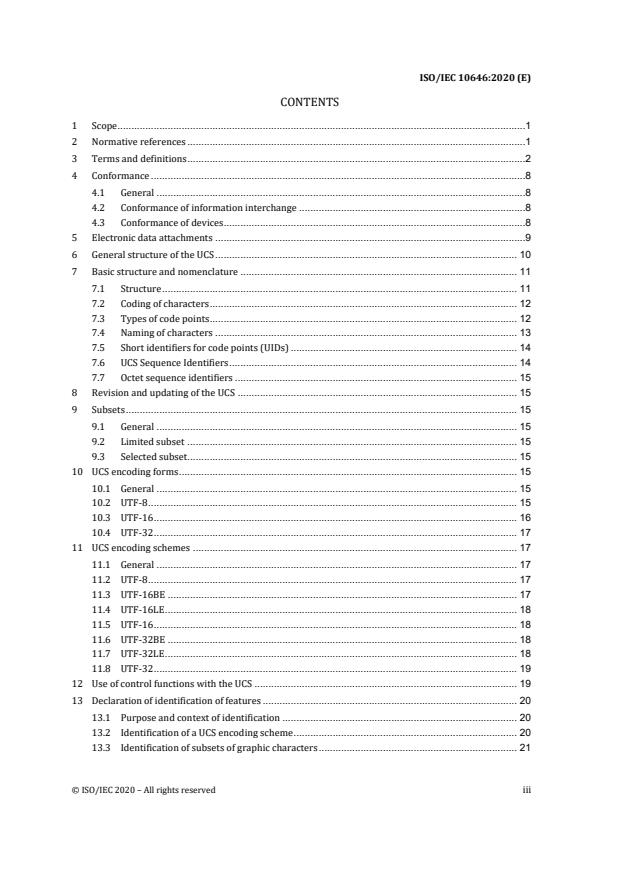
CONTENTS
1 Scope .1
2 Normative references .1
3 Terms and definitions .2
4 Conformance .8
4.1 General .8
4.2 Conformance of information interchange .8
4.3 Conformance of devices.8
5 Electronic data attachments .9
6 General structure of the UCS . 10
7 Basic structure and nomenclature . 11
7.1 Structure . 11
7.2 Coding of characters . 12
7.3 Types of code points . 12
7.4 Naming of characters . 13
7.5 Short identifiers for code points (UIDs) . 14
7.6 UCS Sequence Identifiers . 14
7.7 Octet sequence identifiers . 15
8 Revision and updating of the UCS . 15
9 Subsets . 15
9.1 General . 15
9.2 Limited subset . 15
9.3 Selected subset. 15
10 UCS encoding forms . 15
10.1 General . 15
10.2 UTF-8 . 15
10.3 UTF-16 . 16
10.4 UTF-32 . 17
11 UCS encoding schemes . 17
11.1 General . 17
11.2 UTF-8 . 17
11.3 UTF-16BE . 17
11.4 UTF-16LE . 18
11.5 UTF-16 . 18
11.6 UTF-32BE . 18
11.7 UTF-32LE . 18
11.8 UTF-32 . 19
12 Use of control functions with the UCS . 19
13 Declaration of identification of features . 20
13.1 Purpose and context of identification . 20
13.2 Identification of a UCS encoding scheme . 20
13.3 Identification of subsets of graphic characters . 21
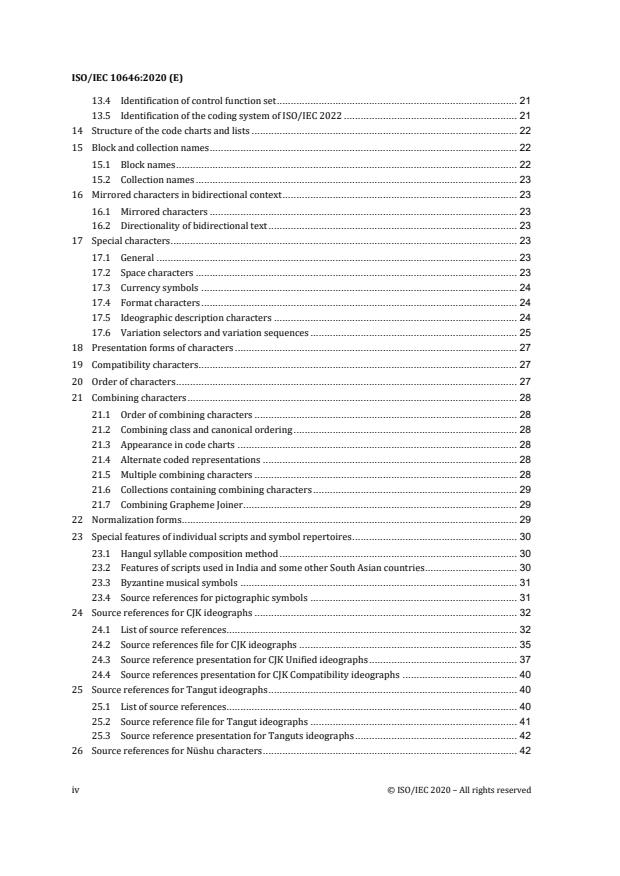
© ISO/IEC 2020 – All rights reserved iii
13.4 Identification of control function set . 21
13.5 Identification of the coding system of ISO/IEC 2022 . 21
14 Structure of the code charts and lists . 22
15 Block and collection names . 22
15.1 Block names . 22
15.2 Collection names . 23
16 Mirrored characters in bidirectional context . 23
16.1 Mirrored characters . 23
16.2 Directionality of bidirectional text . 23
17 Special characters . 23
17.1 General . 23
17.2 Space characters . 23
17.3 Currency symbols . 24
17.4 Format characters . 24
17.5 Ideographic description characters . 24
17.6 Variation selectors and variation sequences . 25
18 Presentation forms of characters . 27
19 Compatibility characters . 27
20 Order of characters . 27
21 Combining characters . 28
21.1 Order of combining characters . 28
21.2 Combining class and canonical ordering . 28
21.3 Appearance in code charts . 28
21.4 Alternate coded representations . 28
21.5 Multiple combining characters . 28
21.6 Collections containing combining characters . 29
21.7 Combining Grapheme Joiner . 29
22 Normalization forms. 29
23 Special features of individual scripts and symbol repertoires . 30
23.1 Hangul syllable composition method . 30
23.2 Features of scripts used in India and some other South Asian countries . 30
23.3 Byzantine musical symbols . 31
23.4 Source references for pictographic symbols . 31
24 Source references for CJK ideographs . 32
24.1 List of source references. 32
24.2 Source references file for CJK ideographs . 35
24.3 Source reference presentation for CJK Unified ideographs . 37
24.4 Source references presentation for CJK Compatibility ideographs . 40
25 Source references for Tangut ideographs . 40
25.1 List of source references. 40
25.2 Source reference file for Tangut ideographs . 41
25.3 Source reference presentation for Tanguts ideographs . 42
26 Source references for Nüshu characters . 42
iv © ISO/IEC 2020 – All rights reserved
26.1 List of source references. 42
26.2 Source reference file for Nüshu characters . 42
27 Character names and annotations . 43
27.1 Entity names . 43
27.2 Name formation . 43
27.3 Single name . 44
27.4 Name immutability . 44
27.5 Name uniqueness . 44
27.6 Character names for CJK ideographs . 45
27.7 Character names for Tangut ideographs . 45
27.8 Character names for Nüshu characters . 45
27.9 Character names for Khitan Small Script characters . 46
27.10 Character names for Hangul syllables . 46
28 Named UCS Sequence Identifiers . 47
29 Structure of the Basic Multilingual Plane . 49
30 Structure of the Supplementary Multilingual Plane for scripts and symbols (SMP) . 51
31 Structure of the Supplementary Ideographic Plane (SIP) . 54
32 Structure of the Tertiary Ideographic Plane (TIP) . 55
33 Structure of the Supplementary Special-purpose Plane (SSP) . 56
34 Code charts and lists of character names . 57
34.1 General . 57
34.2 Code chart . 57
34.3 Character names list . 57
34.4 Summary of standardized variation sequences . 58
34.5 Code charts and lists of character names . 58
Annex A (normative) Collections of graphic characters for subsets . 2743
A.1 Collections of coded graphic characters . 2743
A.2 Blocks lists . 2750
A.3 Fixed collections of the whole UCS (except Unicode collections) . 2753
A.4 CJK collections. 2756
A.5 Other collections . 2757
A.6 Unicode collections . 2761
Annex B (normative) List of combining characters . 2763
Annex C (normative) Transformation format for planes 01 to 10 of the UCS (UTF-16) . 2764
Annex D (normative) UCS Transformation Format 8 (UTF-8) . 2765
Annex E (normative) Mirrored characters in bidirectional context . 2766
Annex F (informative) Format characters . 2767
F.1 General format characters . 2767
F.2 Script-specific format characters . 2769
F.3 Interlinear annotation characters . 2770
F.4 Subtending format characters . 2770
F.5 Shorthand format characters . 2771
F.6 Invisible mathematical operators . 2771
© ISO/IEC 2020 – All rights reserved v
F.7 Western musical symbols . 2771
F.8 Language tagging using Tag characters . 2772
Annex G (informative) Alphabetically sorted list of character names . 2774
Annex H (informative) The use of “signatures” to identify UCS . 2775
Annex I (informative) Ideographic description characters . 2776
I.1 General . 2776
I.2 Syntax of an ideographic description sequence . 2776
I.3 Individual definitions of the ideographic description characters . 2777
Annex J (informative) Recommendation for combined receiving/originating devices with internal
storage . 2779
Annex K (informative) Notations of octet value representations . 2780
Annex L (informative) Character naming guidelines . 2781
Annex M (informative) Sources of characters . 2784
Annex N (informative) External references to character repertoires . 2785
N.1 Methods of reference to character repertoires and their coding . 2785
N.2 Identification of ASN.1 character abstract syntaxes . 2785
N.3 Identification of ASN.1 character transfer syntaxes . 2786
Annex P (informative) Additional information on CJK Unified ideographs . 2787
Annex Q (informative) Code mapping table for Hangul syllables . 2790
Annex R (informative) Names of Hangul syllables . 2791
Annex S (informative) Procedure for the unification and arrangement of CJK ideographs . 2792
S.1 Unification procedure . 2792
S.2 Arrangement procedure . 2796
S.3 Source separation examples . 2796
S.4 Non-unification examples . 2801
Annex T (informative) Language tagging using Tag Characters . 2803
Annex U (informative) Characters in identifiers . 2804
vi © ISO/IEC 2020 – All rights reserved
Foreword
ISO (the International Organization for Standardization) and IEC (the International Electrotechnical
Commission) form the specialized system for worldwide standardization. National bodies that are members
of ISO or IEC participate in the development of International Standards through technical committees
established by the respective organization to deal with particular fields of technical activity. ISO and IEC
technical committees collaborate in fields of mutual interest. Other international organizations, governmental
and non-governmental, in liaison with ISO and IEC, also take part in the work.
The procedures used to develop this document and those intended for its further maintenance are described in
the ISO/IEC Directives, Part 1. In particular, the different approval criteria needed for the different types of ISO
documents should be noted. This document was drafted in accordance with the editorial rules of the ISO/IEC
Directives, Part 2 (see www.iso.org/directives).
Attention is drawn to the possibility that some of the elements of this document may be the subject of patent
rights. ISO and IEC shall not be held responsible for identifying any or all such patent rights. Details of
any patent rights identified during the development of the document will be in the Introduction and/or on the
ISO list of patent declarations received (see www.iso.org/patents) or the IEC list of patent declarations
received (see http://patents.iec.ch).
Any trade name used in this document is information given for the convenience of users and does not constitute
an endorsement.
For an explanation of the voluntary nature of standards, the meaning of ISO specific terms and expressions
related to conformity assessment, as well as information about ISO's adherence to the World Trade
Organiza-tion (WTO) principles in the Technical Barriers to Trade (TBT), see www.iso.org/iso/
foreword.html.
This document was prepared by Joint Technical Committee ISO/IEC JTC 1, Information technology,
Subcommittee SC 2, Coded character sets.
This sixth edition of ISO/IEC 10646 cancels and replaces the fifth edition (ISO/IEC 10646:2017), which has
been technically revised. It also incorporates ISO/IEC 10646:2017/Amd 1:2019 and ISO/IEC
10646:2017/Amd 2:2019.
This edition includes the following significant changes with respect to the previous edition:
— New scripts covered: Chorasmian, Dives Akuru, Dogra, Elymaic, Gunjala Gondi, Hanifi Rohingya, Khitan
Small Script, Makasar, Medefaidrin, Nandinagari, Nyiakeng Puachue Hmong, Old Sogdian, Sogdian, Ye-
zidi, Wancho;
— Existing scripts significantly extended: Georgian, CJK Unified Ideographs (Extension G);
— New symbol sets: Chess Symbols, Symbols for Legacy Computing;
— New set of Emoji symbols.
Any feedback or questions on this document should be directed to the user’s national standards body. A
complete listing of these bodies can be found at www.iso.org/members.html.
© ISO/IEC 2020 – All rights reserved vii
Introduction
This document specifies the Universal Coded Character Set (UCS). It is applicable to the representation, trans-
mission, interchange, processing, storage, input and presentation of the written form of the languages of the
world as well as additional symbols.
By defining a consistent way of encoding multilingual text it enables the exchange of data internationally. The
information technology industry gains data stability, greater global interoperability and data interchange. This
International Standard has been widely adopted in new Internet protocols and implemented in modern oper-
ating systems and computer languages. This edition covers over 130 000 characters from the world’s scripts.
The UCS is an encoding system different from that specified in ISO/IEC 2022. The method to designate UCS from
ISO/IEC 2022 is specified in 13.2.
A graphic character will be assigned only one code point in the standard, located either in the BMP or in one of
the supplementary planes.
viii © ISO/IEC 2020 – All rights reserved
Information technology — Universal
Coded Character Set (UCS)
1 Scope
This document
— specifies the architecture of the UCS;
— defines terms used for the UCS;
— describes the general structure of the UCS codespace;
— specifies the assigned planes of the UCS: the Basic Multilingual Plane (BMP) of the UCS, the Supplemen-
tary Multilingual Plane (SMP), the Supplementary Ideographic Plane (SIP), the Tertiary Ideographic
Plane (TIP), and the Supplementary Special-purpose Plane (SSP);
— defines a set of graphic characters used in scripts and the written form of languages on a world-wide
scale;
— specifies the names for the graphic characters and format characters of the BMP, SMP, SIP, TIP, SSP and
their coded representations within the UCS codespace;
— specifies the coded representations for control characters and private use characters;
— specifies three encoding forms of the UCS: UTF-8, UTF-16, and UTF-32;
— specifies seven encoding schemes of the UCS: UTF-8, UTF-16, UTF-16BE, UTF-16LE, UTF-32, UTF-32BE,
and UTF-32LE;
— specifies the management of future additions to this coded character set.
NOTE – The determination of suitability of these characters for use as identifiers in programming languages is not specified by this
document but can be found in an external reference. See Annex U.
2 Normative references
The following documents are referred to in the text in such a way that some or all of their content constitutes
requirements of this document. For dated references, only the edition cited applies. For undated references, the
latest edition of the referenced document (including any amendments) applies.
ISO/IEC 2022 Information technology — Character code structure and extension techniques.
ISO/IEC 6429 Information technology — Control functions for coded character sets.
Unicode Standard Annex, UAX #9, The Unicode Bidirectional Algorithm:
http://www.unicode.org/reports/tr9/tr9-42.html
Unicode Standard Annex, UAX #15, Unicode Normalization Forms:
http://www.unicode.org/reports/tr15/tr15-50.html
Unicode Technical Standard, UTS #37, Ideographic Variation Database:
http://www.unicode.org/reports/tr37/tr37-12.html
Unicode Standard Version 13.0, Chapter 4, Character Properties
http://www.unicode.org/versions/Unicode13.0.0/ch04.pdf
Section 4.3, Combining Classes – Normative
Section 4.5, General Category – Normative
Section 4.7, Bidi Mirrored – Normative
Unicode Standard Version 12.1, Age Property:
https://www.unicode.org/Public/13.0.0/ucd/DerivedAge.txt
© ISO/IEC 2020 – All rights reserved 1
Note – Parts of this document which use machine-readable format are available as electronic data attachments. See Clause 5.
3 Terms and definitions
For the purposes of this document, the following terms and definitions apply.
ISO and IEC maintain terminological databases for use in standardization at the following addresses:
— IEC Electropedia: available at http://www.electropedia.org/
— ISO Online browsing platform: available at http://www.iso.org/obp
3.1
base character
graphic character which is not a combining character
Note 1 to entry – Most graphic characters are base characters. This sense of graphic combination does not preclude the presentation
of base characters from adopting different contextual forms or from participating in ligatures.
Note 2 to entry – A base character typically does not graphically combine with preceding characters. There are exceptions for some
complex writing systems.
3.2
Basic Multilingual Plane
BMP
plane 00 of the UCS codespace
3.3
block
contiguous range of code points to which a set of characters that share common characteristics, such as a script,
are allocated; a block does not overlap another block; one or more of the code points within a block may have
no character allocated to them
3.4
canonical form
form with which characters of this coded character set are specified using a single code point within the UCS
codespace
Note 1 to entry – The canonical form is not to be confused with an encoding form which describes the relationship between UCS code
points and one or several code units (see 3.23).
3.5
character
member of a set of elements used for the organization, control, or representation of textual data
Note 1 to entry – A graphic symbol can be represented by a sequence of one or several coded characters.
3.6
character boundary
(code unit sequence) demarcation between the last code unit of a coded character and the first code unit of the
next coded character
3.7
code chart
code table
rectangular array showing the representation of coded characters allocated within a range of the UCS codespace
3.8
coded character
association between a character and a code point
2 © ISO/IEC 2020 – All rights reserved
3.9
code point
code position
value in the UCS codespace
Note 1 to entry – Code points in the UCS codespace are integer values. Throughout this document, UCS code points are cited in hexa-
decimal. UCS code points range from 0 to 10FFFF.
3.10
code unit
minimal bit combination that can represent a unit of encoded text for processing or interchange
Note 1 to entry – Examples of code units are octets (8-bit code units) used in the UTF-8 encoding form, 16-bit code units in the UTF-
16 encoding form, and 32-bit code units in the UTF-32 encoding form.
3.11
code unit sequence
CC-data-element
coded-character-data-element
element of interchanged information that is specified to consist of a sequence of code units, in accordance with
one or more identified standards for coded character sets
Note 1 to entry – Such sequence can contain code units associated with any type of code point (see 7.3).
Note 2 to entry – Since its second edition: ISO/IEC 10646:2011, this document does not use implementation levels. Its definition of
code unit sequence corresponds to the former unrestricted implementation level 3. Other definitions of code unit sequence, previ-
ously known as level 1 and 2, are deprecated. To maintain compatibility with these previous editions, in the context of identification
of coded representation in International Standards such as ISO/IEC 8824 and ISO/IEC 8825, the concept of implementation level can
still be referenced as ‘Implementation level 3’. See Annex N.
3.12
collection
numbered and named set of entities made of code points or sequences of code points, the sequences conforming
to Normalization C; code points lie within one or more identified ranges
Note 1 to entry – Non extended collections do not contain sequences of code points (see 3.25 for extended collection).
Note 2 to entry – If any of the identified ranges include code points to which no character is allocated, the repertoire of the collection
will change if an additional character is assigned to any of those code points at a future amendment of this document. However, it is
intended that the collection number and name will remain unchanged in future editions of this document.
3.13
combining character
character which has General Category values of Spacing Combining Mark (Mc), Non Spacing Mark (Mn), and
Enclosing Mark (Me)
Note 1 to entry – These characters are intended for combination with the preceding base character, or with a sequence of combining
characters preceded by a base character (see also 3.17).
3.14
combining class
value associated with each combining character determining its typographical interaction and its canonical or-
dering within a sequence of combining character
Note 1 to entry – See 21.2 for details on canonical ordering.
3.15
compatibility character
graphic character included as a coded character of this document primarily for compatibility with existing
coded character sets
© ISO/IEC 2020 – All rights reserved 3
3.16
composite sequence
combining character sequence
sequence of graphic characters consisting of a base character followed by one or more combining characters,
ZERO WIDTH JOINER, or ZERO WIDTH NON-JOINER
Note 1 to entry – See also 3.14.
Note 2 to entry – A graphic symbol for a composite sequence generally consists of the combination of the graphic symbols of each
character in the sequence.
Note 3 to entry – A composite sequence can be used to represent characters not encoded in the repertoire of this document.
3.17
control character
control function the coded representation of which consists of a single code point
Note 1 to entry – Although control characters are often ‘named’ using terms such as DELETE, FORM FEED, ESC, these qualifiers do
not correspond to formal character names. See Clause 12 for a list of the long names used by ISO/IEC 6429 in association with the
control characters.
3.18
control function
action that affects the recording, processing, transmission, or interpretation of data, and that is represented by
a code unit sequence
3.19
decomposition mapping
mapping from a character to a sequence of one or more characters
Note 1 to entry – Decomposition mappings are of two types: canonical decompositions, and compatibility decompositions. These are
used in the derivation of various normalization forms (see Clause 22). The code charts for various blocks include decomposition
mappings and distinguish between the two types of mapping (see 34.3).
3.20
default state
state that is assumed when no state has been explicitly specified
Note 1 to entry – See F.2.1, F.2.2, and F.2.3.
3.21
device
component of information processing equipment which can transmit and/or receive coded information within
code unit sequences
Note 1 to entry – It may be an input/output device in the conventional sense, or a process such as an application program or gateway
function.
3.22
encoding form
form that determines how each UCS code point for a UCS character is to be expressed as one or more code units
used by the encoding form
Note 1 to entry – This document specifies UTF-8, UTF-16, and UTF-32.
3.23
encoding scheme
scheme that specifies the serialization of the code units from the encoding form into octets
Note 1 to entry – Some of the UCS encoding schemes have the same labels as UCS encoding form. However, references to encoding
schemes and encoding forms generally occur in different contexts. UCS encoding forms refer to in-memory and application interface
representation of textual data. UCS encoding schemes refer to octet-serialized textual data.
4 © ISO/IEC 2020 – All rights reserved
3.24
extended collection
collection for which the entities can also consist of sequences of code points that are in Normalization Form C
(NFC)
Note 1 to entry – Some collections such as 3 LATIN EXTENDED-A, 4 LATIN EXTENDED-B, 15 ARABIC EXTENDED, and many more,
have the term ‘extended’ in their name. This does not make them extended collections.
Note 2 to entry – See Clause 22 for discussion of Normalization Form C.
Note 3 to entry – The sequences of code points are typically referenced by Named UCS Sequence Identifiers (NUSI) (see Clause 28).
3.25
fixed collection
collection in which every code point within the identified range(s) has a character allocated to it, and which is
intended to remain unchanged in future editions of this document
3.26
format character
character whose primary function is to affect the layout or processing of characters around it, or that is pre-
sented in a complex, graphic interaction with neighbouring characters
Note 1 to entry – A format character generally does not have a visible representation of its own.
3.27
General Category
GC
value assigned to each UCS code point which determines its major class, such as letter, punctuation, and symbol
Note 1 to entry – Possible values are two-letter abbreviations for the General Category in the Unicode Standard (see reference to the
current Unicode Standard General Category in Clause 2).
Note 2 to entry – When referred as a group containing all GC values sharing the same first letter, the group may be described using
the first letter only. For example, ‘L’ stands for all letters: ‘Lu’, ‘Ll’, ‘Lt’, ‘Lm’, and ‘Lo’.
3.28
graphic character
character, other than a control function or a format character, that has a visual representation normally hand-
written, printed, or displayed
3.29
graphic symbol
visual representation of a graphic character or of a composite sequence
3.30
high-surrogate code point
code point in the range D800 to DBFF
Note 1 to entry – Reserved for use in UTF-16 (see 10.3).
3.31
high-surrogate code unit
16-bit code unit in the range D800 to DBFF and used in UTF-16
Note 1 to entry – A high-surrogate code unit is used as the leading code unit of a surrogate pair (see also 3.39, 3.54, and 10.3).
3.32
ill-formed code unit sequence
UCS code unit sequence that purports to be in a UCS encoding form that does not conform to the specification
of that encoding form
EXAMPLE – An unpaired surrogate code unit is an ill-formed code unit sequence.
© ISO/IEC 2020 – All rights reserved 5
3.33
ill-formed code unit subsequence
non-empty subsequence of a code unit sequence X that does not contain any code units that also belong to a
minimal well-formed code unit subsequence of X
Note 1 to entry – An ill-formed code unit subsequence cannot overlap with a minimal well-formed code unit subsequence.
3.34
interchange
transfer of character coded data from one user to another, using telecommunication means or interchangeable
media
Note 1 to entry – Interchange implies data serialization and the use of a UCS encoding scheme.
3.35
ISO/IEC 10646-1
former subdivision of ISO/IEC 10646 containing the specification of the overall UCS architecture and the Basic
Multilingual Plane (BMP)
Note 1 to entry – It is also referred to as Part 1 of ISO/IEC 10646.
Note 2 to entry – There are a first and a second Edition of ISO/IEC 10646-1.
3.36
ISO/IEC 10646-2
former subdivision of ISO/IEC 10646 containing the specification of the Supplementary Multilingual Plane
(SMP), the Supplementary Ideographic Plane (SIP) and the Supplementary Special-purpose Plane (SSP)
Note 1 to entry – It is also referred to as Part 2 of ISO/IEC 10646.
Note 2 to entry – There is only a first edition of ISO/IEC 10646-2.
3.37
low-surrogate code point
code point in the range DC00 to DFFF
Note 1 to entry – Reserved for the use of UTF-16 (see 10.3).
3.38
low-surrogate code unit
16-bit code unit in the range DC00 to DFFF and used in UTF-16
Note 1 to entry – A low-surrogate code unit is used as the trailing code unit of a surrogate pair (see also 3.32, 3.54, and 10.3).
3.39
minimal well-formed code unit sequence
well-formed code unit sequence that maps to a single UCS scalar value
3.40
mirrored character
character whose image is mirrored horizontally in text that is laid out from right to left
3.41
octet
8-bit code unit
Note 1 to entry – The value is expressed in hexadecimal notation from 00 to FF in this document (see Annex K).
3.42
plane
subdivision of the UCS codespace consisting of 65 536 contiguous code points beginning at a multiple of 65 536
Note 1 to entry – The 17 UCS planes can be identified by a hexadecimal number from 00 to 10.
6 © ISO/IEC 2020 – All rights reserved
3.43
presentation
process of writing, printing, or displaying a graphic symbol
3.44
presentation form
(in the presentation of some scripts) form of a graphic symbol representing a character that depends on the
position of the character relative to other characters
3.45
private use plane
plane within this coded character set, the content of which is not specified in this document
Note 1 to entry – Planes 0F and 10 are private use planes.
3.46
repertoire
specified set of characters that are represented in a coded character set
3.47
row
subdivision of a plane consisting of 256 contiguous code points beginning at a multiple of 256
Note 1 to entry – Within the context of a given plane, rows can be identified by a hexadecimal number from 00 to FF.
3.48
script
set of graphic characters used for the written form of one or more languages
3.49
supplementary plane
plane other than Plane 00 of the UCS codespace
Note 1 to entry – A supplementary plane accommodates characters which have not been allocated to the Basic Multilingual Plane.
3.50
Supplementary Multilingual Plane
SMP
plane 01 of the UCS codespace
3.51
Supplementary Ideographic Plane
SIP
plane 02 of the UCS codespace
3.52
Supplementary Special-purpose Plane
SSP
plane 0E of the UCS codespace
3.53
surrogate pair
UTF-16 encoded representation for a single supplementary-plane character that consists of a sequence of two
16-bit code units, where the first value of the pair is a high-surrogate code unit and the second value is a low-
surrogate code unit
3.54
Tertiary Ideographic Plane
TIP
plane 03 of the UCS codespace
© ISO/IEC 2020 – All rights reserved 7
3.55
UCS codespace
codespace consisting of the integers from 0 to 10FFFF (hexadecimal) available for assigning the repertoire of
the UCS characters
3.56
UCS scalar value
any UCS code point except high-surrogate and low-surrogate code points
3.57
unpaired surrogate code unit
code unit in a a UTF-16 code unit sequence that is either a high-surrogate code unit that is not immediately
followed by a low-surrogate unit, or a low-surrogate code unit that is not immediately preceded by a high-sur-
rogate code unit
Note 1 to entry – Any unpaired surrogate code unit constitutes an ill-formed code unit sequence.
3.58
user
person or other entity that invokes the service provided by a device
Note 1 to entry – This entity can be a process such as an
...