

ISO 3217:1974
(Main)Oil of lemongrass (Cymbopogon citratus)
General Information
- Abstract
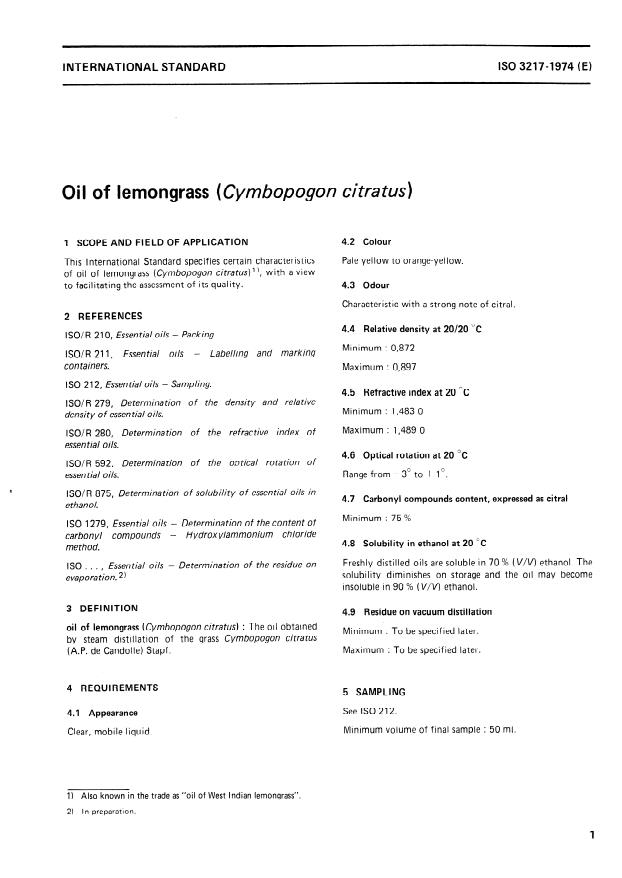
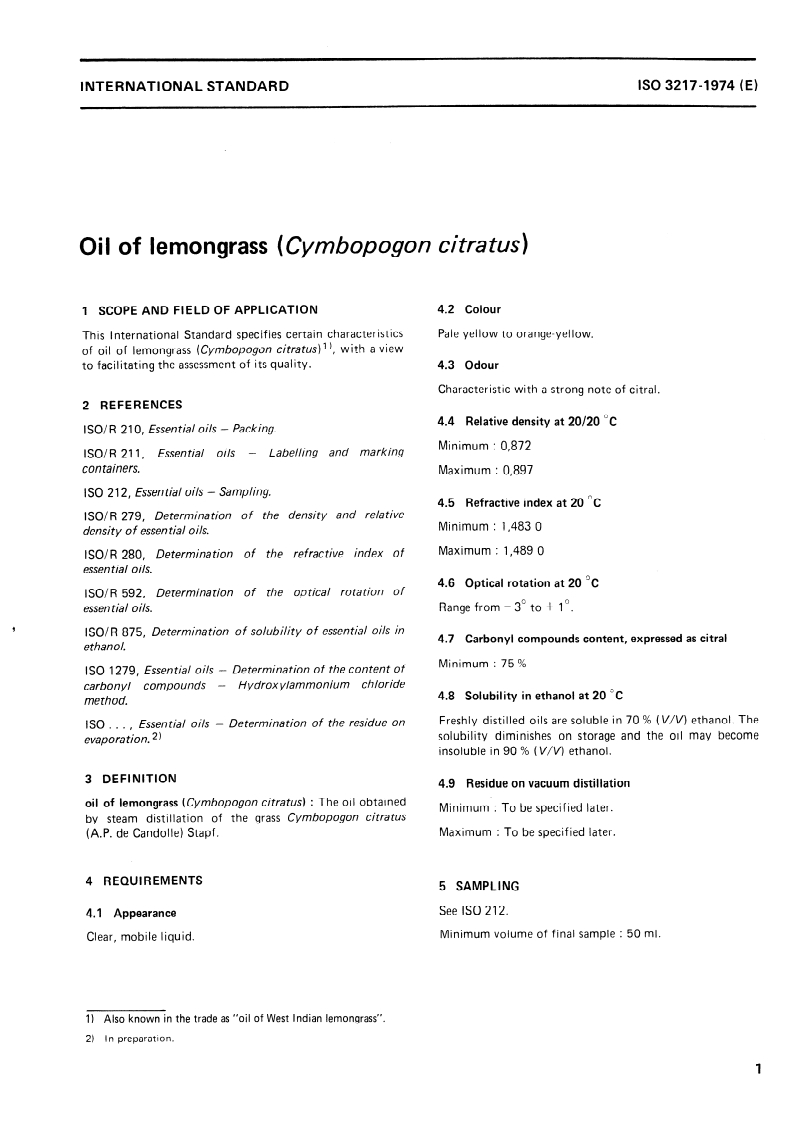
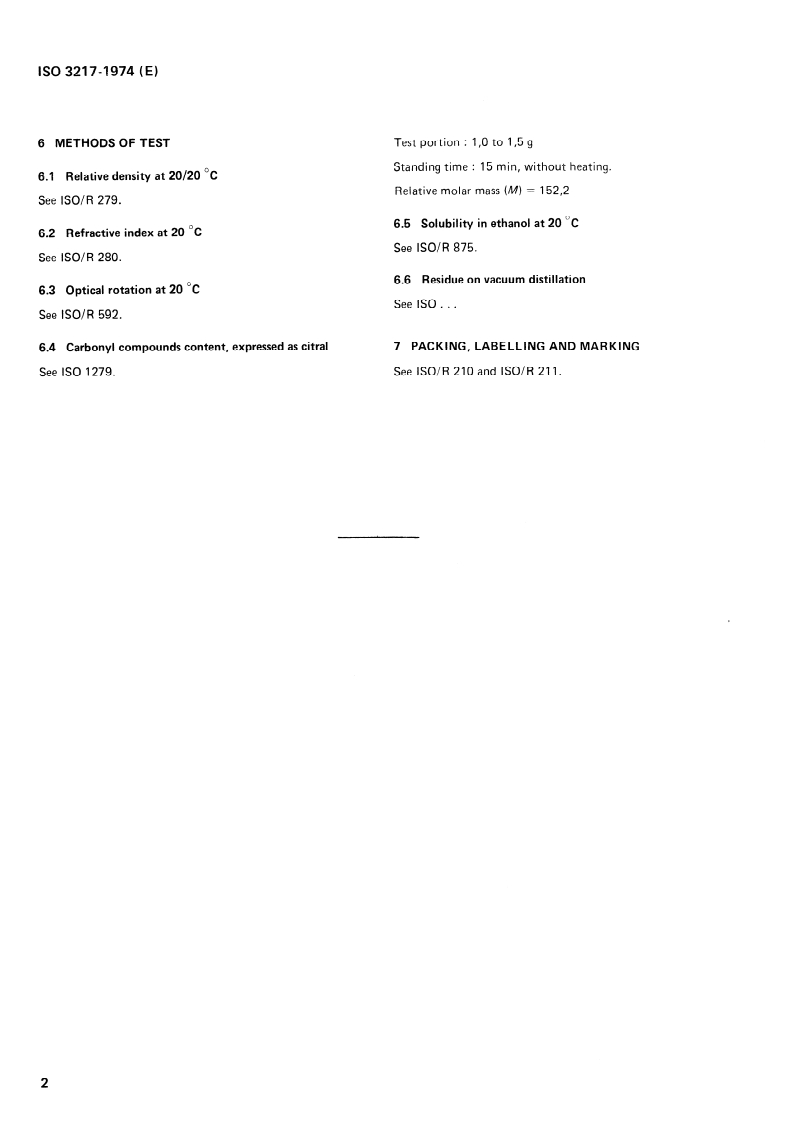
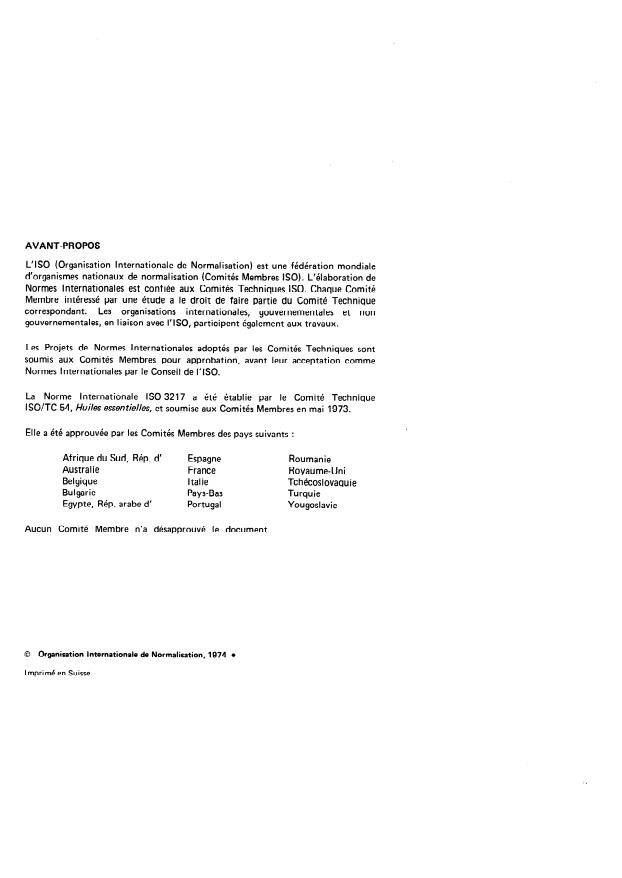
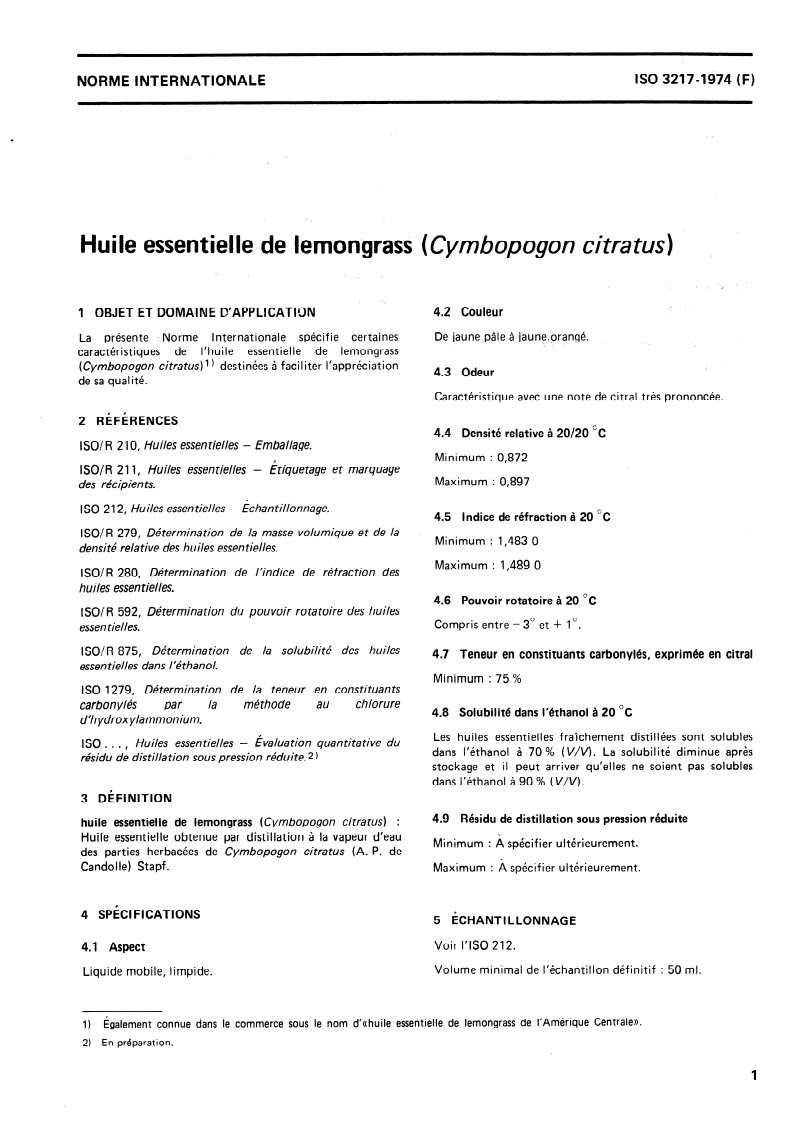
The Standard specifies the following characteristics of the oil. Appearance: Clear, mobile liquid. Colour: Pale yellow to orange-yellow. Odour: Characteristic with a strong note of citral. Relative density at 20/20 °C: 0,872 - 0,897. Refractive index at 20 °C: 1,4830 - 1,4890. Optical rotation at 20 °C: Range from - 3 to + 1 . Carbonyl compounds content, expressed as citral: Minimum 75 %. Solubility in ethanol at 20 °C: Freshly distilled oils are soluble in 70 % (V/V) ethanol.
- Status
- Published
- Publication Date
- 31-Jul-1974
- Technical Committee
- ISO/TC 54 - Essential oils
- Drafting Committee
- ISO/TC 54 - Essential oils
- Current Stage
- 9093 - International Standard confirmed
- Start Date
- 21-Oct-2021
- Completion Date
- 29-Aug-2026
Buy Documents

ISO 3217:1974 - Oil of lemongrass (Cymbopogon citratus)
ISO 3217:1974 - Oil of lemongrass (Cymbopogon citratus)/1/1974



ISO 3217:1974 - Huile essentielle de lemongrass (Cymbopogon citratus)



ISO 3217:1974 - Huile essentielle de lemongrass (Cymbopogon citratus)
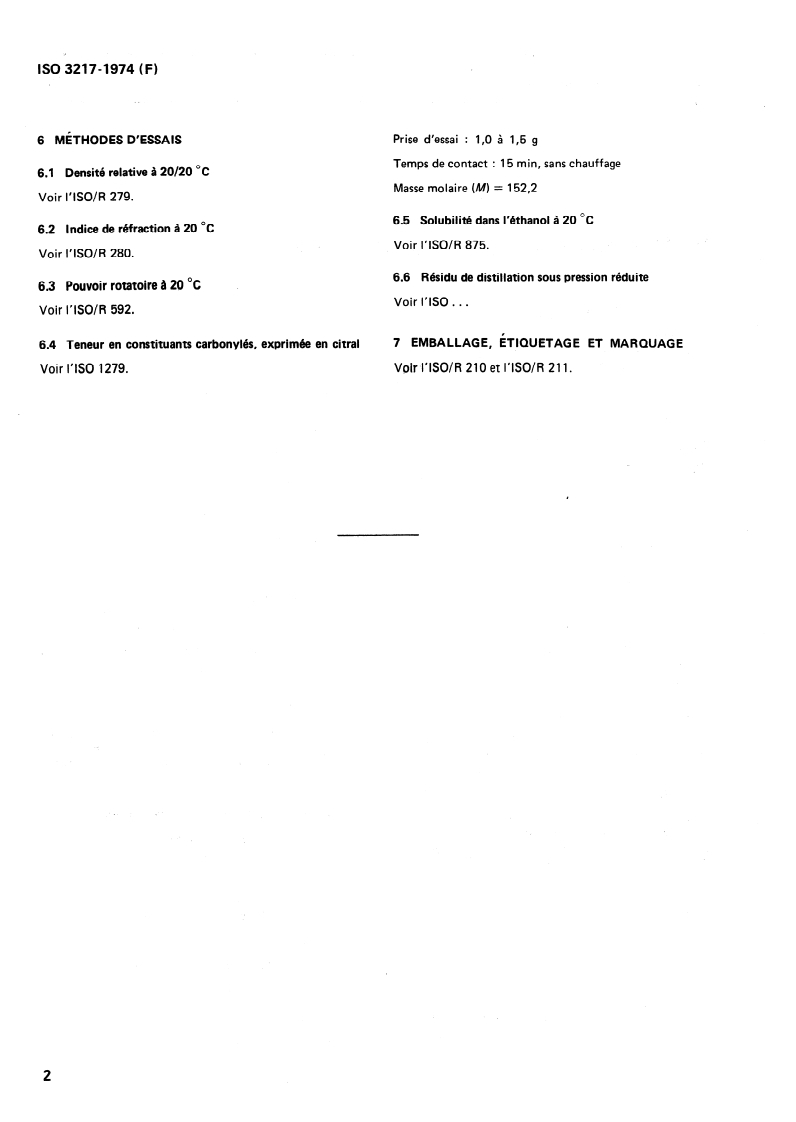
ISO 3217:1974 - Huile essentielle de lemongrass (Cymbopogon citratus)/1/1974
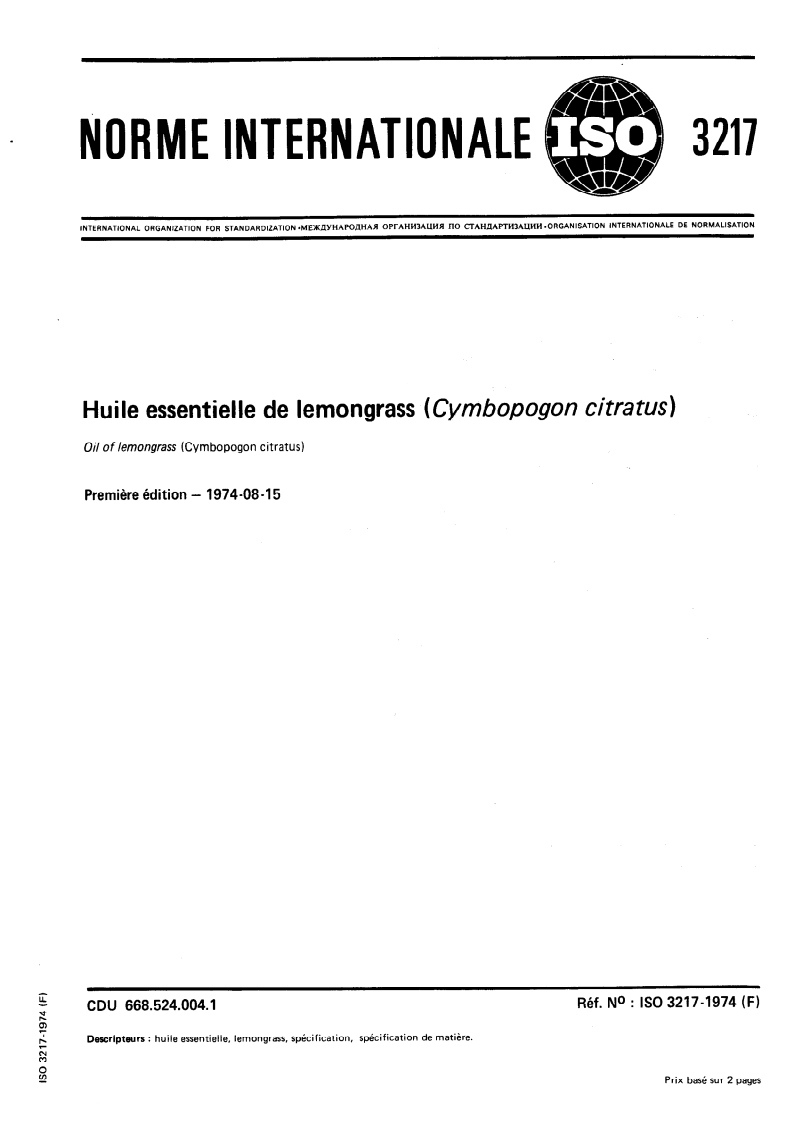
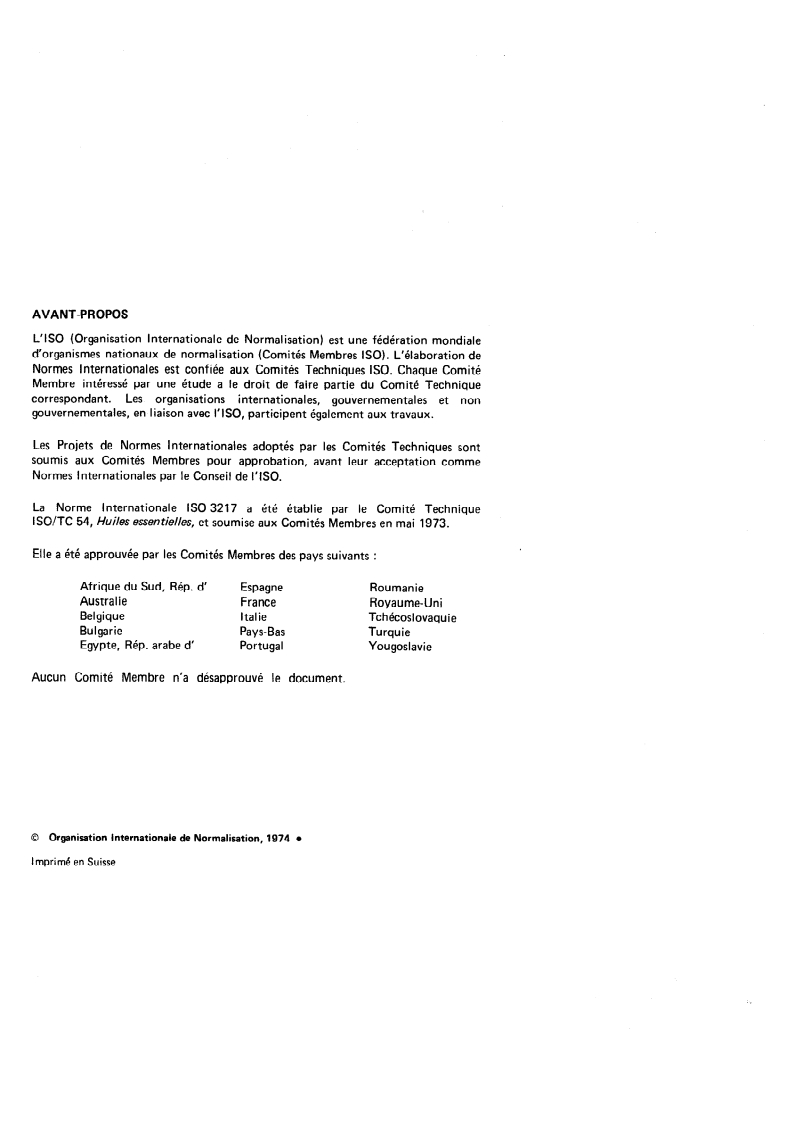
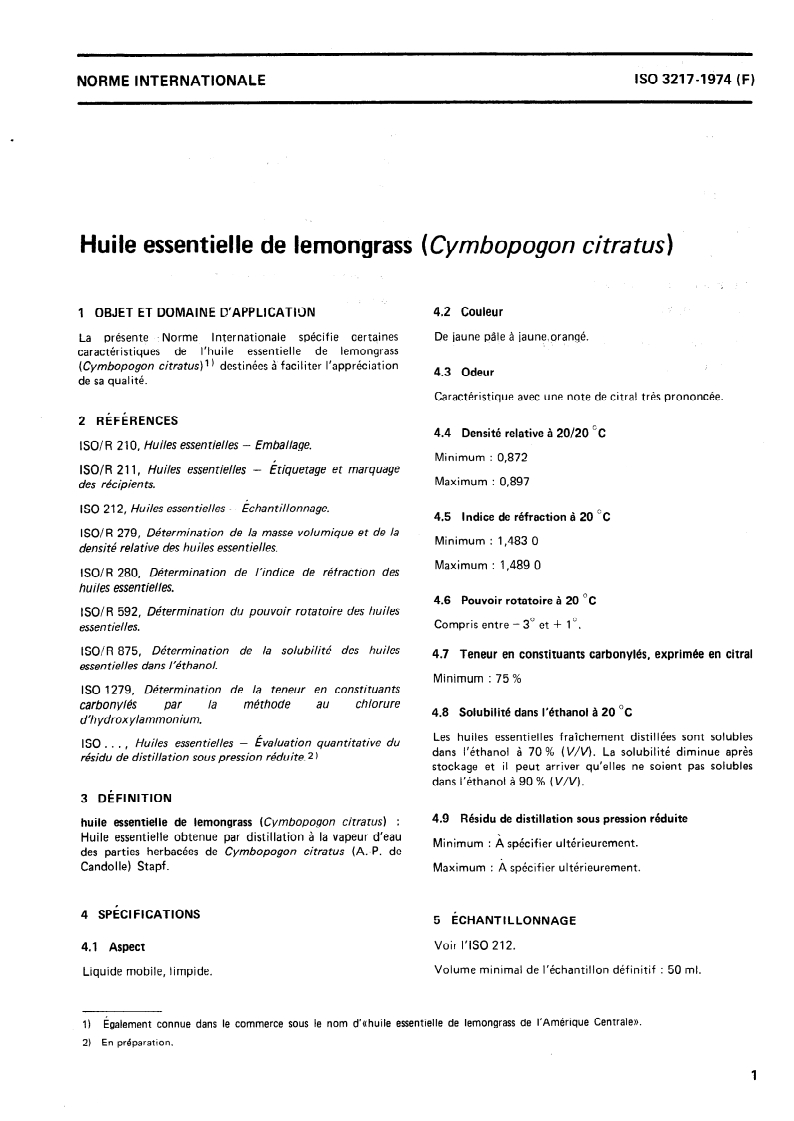
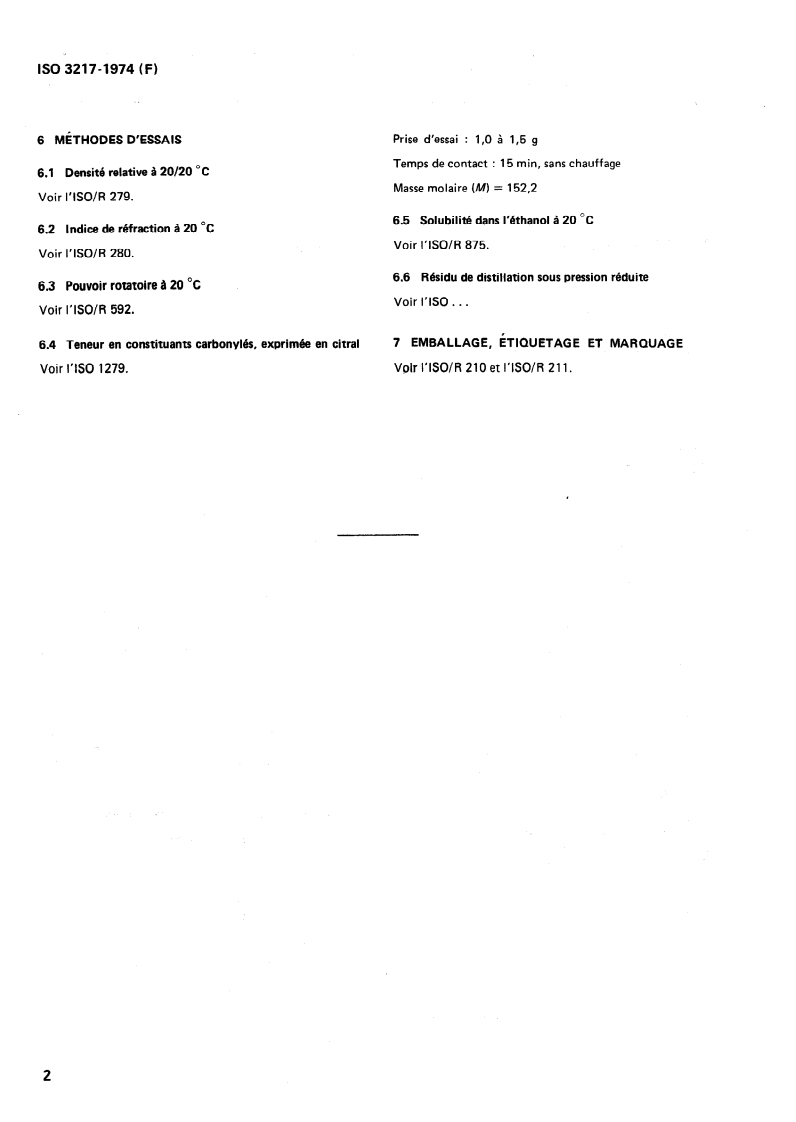
ISO 3217:1974 - Huile essentielle de lemongrass (Cymbopogon citratus)/1/1974
Overview
ISO 3217:1974 is an international standard published by the International Organization for Standardization (ISO) that specifies the key characteristics of oil of lemongrass (Cymbopogon citratus). This essential oil, widely used in perfumery, aromatherapy, cosmetics, and pharmaceuticals, requires standardized quality benchmarks to ensure consistency and authenticity across global markets.
The standard focuses on physical and chemical properties defining the quality of lemongrass oil, such as appearance, color, odor, density, refractive index, optical rotation, carbonyl compound content (expressed as citral), and solubility in ethanol. These parameters form a comprehensive specification to facilitate quality control and regulatory compliance.
Key Topics
- Appearance: Oil of lemongrass is characterized by a clear, mobile liquid state, ensuring it is free from cloudiness or particulate matter.
- Color: Ranges from pale yellow to orange-yellow, indicative of proper distillation and freshness.
- Odor: Strong, characteristic scent with a pronounced citral note, the key component responsible for lemongrass's distinctive fragrance.
- Relative Density at 20/20 °C: Must be between 0.872 and 0.897, important for identifying purity and concentration.
- Refractive Index at 20 °C: Values from 1.4830 to 1.4890, used for verifying the product’s identity and detecting adulteration.
- Optical Rotation at 20 °C: Range from -3° to +1°, reflecting the chiral nature of the constituents.
- Carbonyl Compounds Content: A minimum of 75% citral content, a crucial quality marker indicating potent fragrance and therapeutic properties.
- Solubility in Ethanol at 20 °C: Freshly distilled lemongrass oil is soluble in 70% (V/V) ethanol. Solubility may decrease with storage and concentration changes, affecting formulation compatibility.
Applications
ISO 3217:1974 serves as a vital tool for producers, importers, exporters, and quality assurance laboratories involved with lemongrass essential oil. By adhering to this standard, stakeholders can ensure:
- Quality Assurance: Confirm that the oil meets globally recognized criteria for purity and composition.
- Regulatory Compliance: Facilitate international trade by complying with standardized testing and labeling requirements.
- Product Development: Support manufacturers in formulating cosmetics, aromatherapy products, and pharmaceuticals with consistent raw material quality.
- Authentication and Anti-Adulteration: Detect adulterants and ensure the natural origin of lemongrass oil through precise measurement of physical and chemical parameters.
- R&D and Innovation: Provide a clear framework for researchers studying the oil’s properties and potential new uses.
Related Standards
ISO 3217:1974 works in conjunction with several other ISO standards to provide comprehensive guidance on essential oils:
- ISO 212 – Sampling of Essential Oils: Procedures for taking representative samples of oils for laboratory testing.
- ISO/R 210 – Packaging of Essential Oils: Recommendations for suitable packaging ensuring product integrity.
- ISO/R 211 – Labeling and Marking of Containers: Guidelines for clear and accurate labeling of essential oil containers.
- ISO/R 279 – Determination of Density and Relative Density of Essential Oils.
- ISO/R 280 – Determination of Refractive Index of Essential Oils.
- ISO/R 592 – Determination of Optical Rotation.
- ISO 1279 – Determination of Carbonyl Compounds Content by Hydroxylamine Chloride Method.
These related standards support the implementation of ISO 3217 by covering sampling, testing methods, packaging, and labeling, ensuring a comprehensive approach to quality control in the essential oil industry.
Implementing ISO 3217 ensures the consistent production and verification of high-quality oil of lemongrass, benefiting manufacturers, traders, and consumers by fostering trust and facilitating global market access for this valuable natural product.
Relations
- Consolidated By
ISO 15983:2002 - Open end blind rivets with break pull mandrel and protruding head — A2/A2 - Effective Date
- 06-Jun-2022
Buy Documents
ISO 3217:1974 - Oil of lemongrass (Cymbopogon citratus)
ISO 3217:1974 - Oil of lemongrass (Cymbopogon citratus)/1/1974
ISO 3217:1974 - Huile essentielle de lemongrass (Cymbopogon citratus)
ISO 3217:1974 - Huile essentielle de lemongrass (Cymbopogon citratus)
ISO 3217:1974 - Huile essentielle de lemongrass (Cymbopogon citratus)/1/1974
ISO 3217:1974 - Huile essentielle de lemongrass (Cymbopogon citratus)/1/1974
Get Certified
Connect with accredited certification bodies for this standard

ECOCERT
Organic and sustainability certification.

Eurofins Food Testing Global
Global leader in food, environment, and pharmaceutical product testing.

Intertek Bangladesh
Intertek certification and testing services in Bangladesh.
Sponsored listings
Frequently Asked Questions
ISO 3217:1974 is a standard published by the International Organization for Standardization (ISO). Its full title is "Oil of lemongrass (Cymbopogon citratus)". This standard covers: The Standard specifies the following characteristics of the oil. Appearance: Clear, mobile liquid. Colour: Pale yellow to orange-yellow. Odour: Characteristic with a strong note of citral. Relative density at 20/20 °C: 0,872 - 0,897. Refractive index at 20 °C: 1,4830 - 1,4890. Optical rotation at 20 °C: Range from - 3 to + 1 . Carbonyl compounds content, expressed as citral: Minimum 75 %. Solubility in ethanol at 20 °C: Freshly distilled oils are soluble in 70 % (V/V) ethanol.
The Standard specifies the following characteristics of the oil. Appearance: Clear, mobile liquid. Colour: Pale yellow to orange-yellow. Odour: Characteristic with a strong note of citral. Relative density at 20/20 °C: 0,872 - 0,897. Refractive index at 20 °C: 1,4830 - 1,4890. Optical rotation at 20 °C: Range from - 3 to + 1 . Carbonyl compounds content, expressed as citral: Minimum 75 %. Solubility in ethanol at 20 °C: Freshly distilled oils are soluble in 70 % (V/V) ethanol.
ISO 3217:1974 is classified under the following ICS (International Classification for Standards) categories: 71.100.60 - Essential oils. The ICS classification helps identify the subject area and facilitates finding related standards.
ISO 3217:1974 has the following relationships with other standards: It is inter standard links to ISO 15983:2002. Understanding these relationships helps ensure you are using the most current and applicable version of the standard.
ISO 3217:1974 is available in PDF format for immediate download after purchase. The document can be added to your cart and obtained through the secure checkout process. Digital delivery ensures instant access to the complete standard document.
Standards Content (Sample)
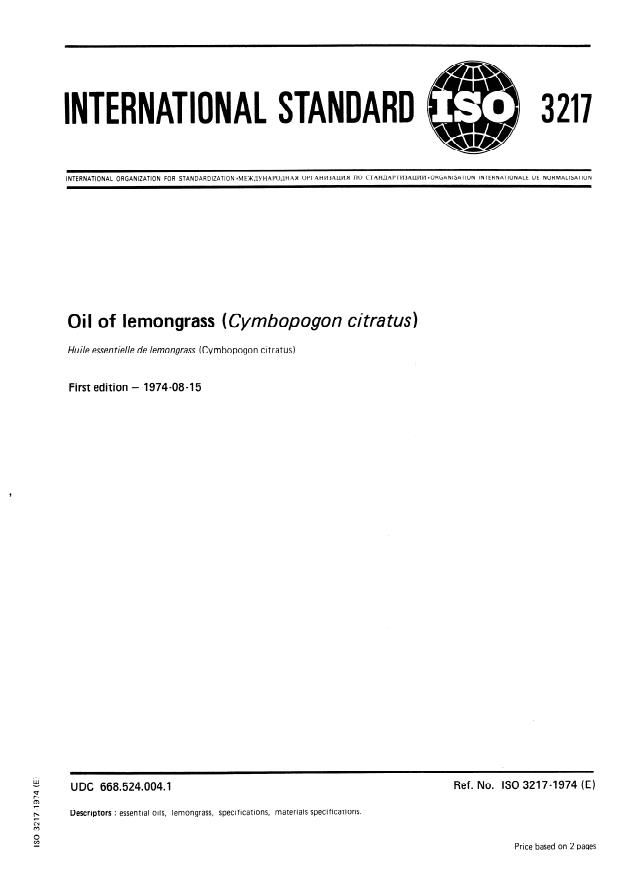
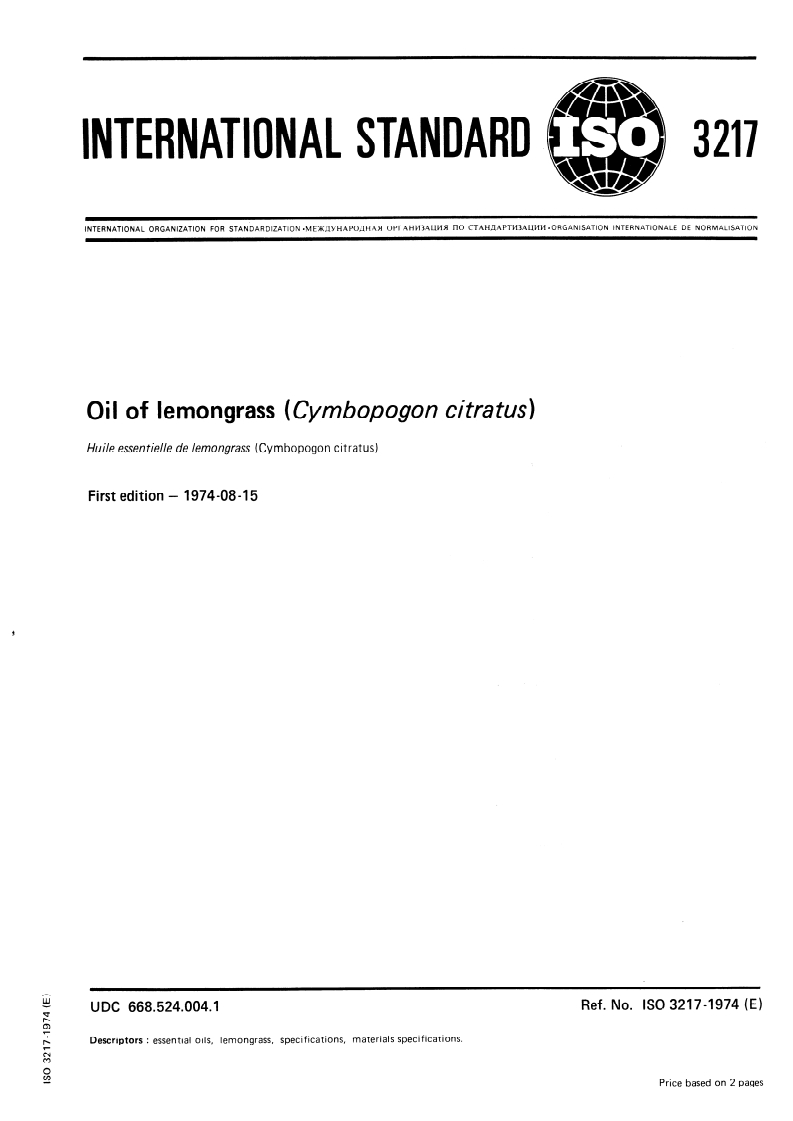
INTERNATIONAL STANDARD
INTERNATIONAL ORGANIZATION FOR STANDARDIZATION .MEXflYHAPOflHAfl OPI-AHM3AUMR i-IO CTAH~APTM3AUMM~ORGANISATION INTERNATIONALE DE NORMALISATION
Oil of lemongrass (Cymbopogon citratus)
Hui/e essentielle de lemongrass (Cymbopogon citratus)
First edition - 1974-08-15
Ref. No. ISQ 3217-1974 (E)
U DC 668.524.004.1
Descriptors : essential oiis, lemongrass, specifications, materials specifications.
Price based on 2 pages
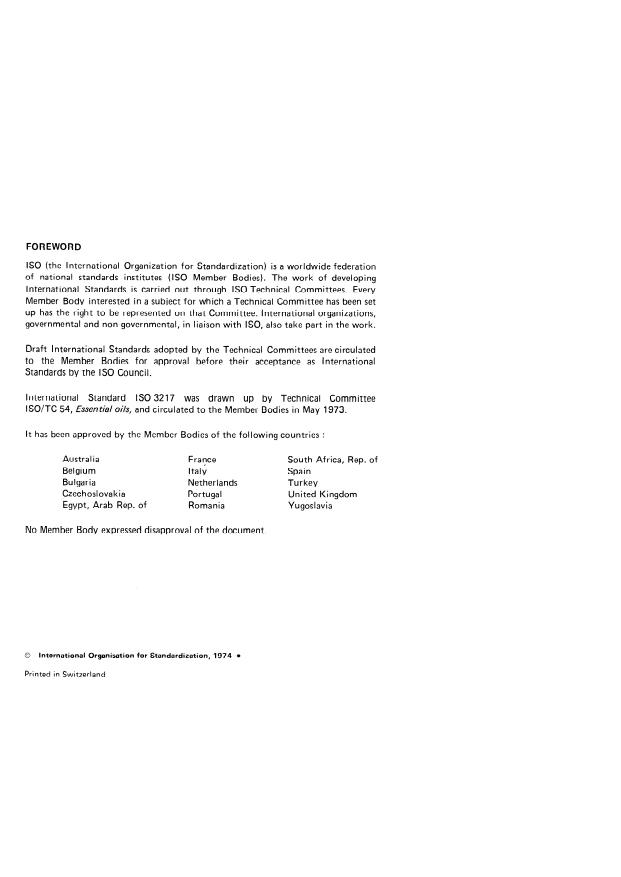
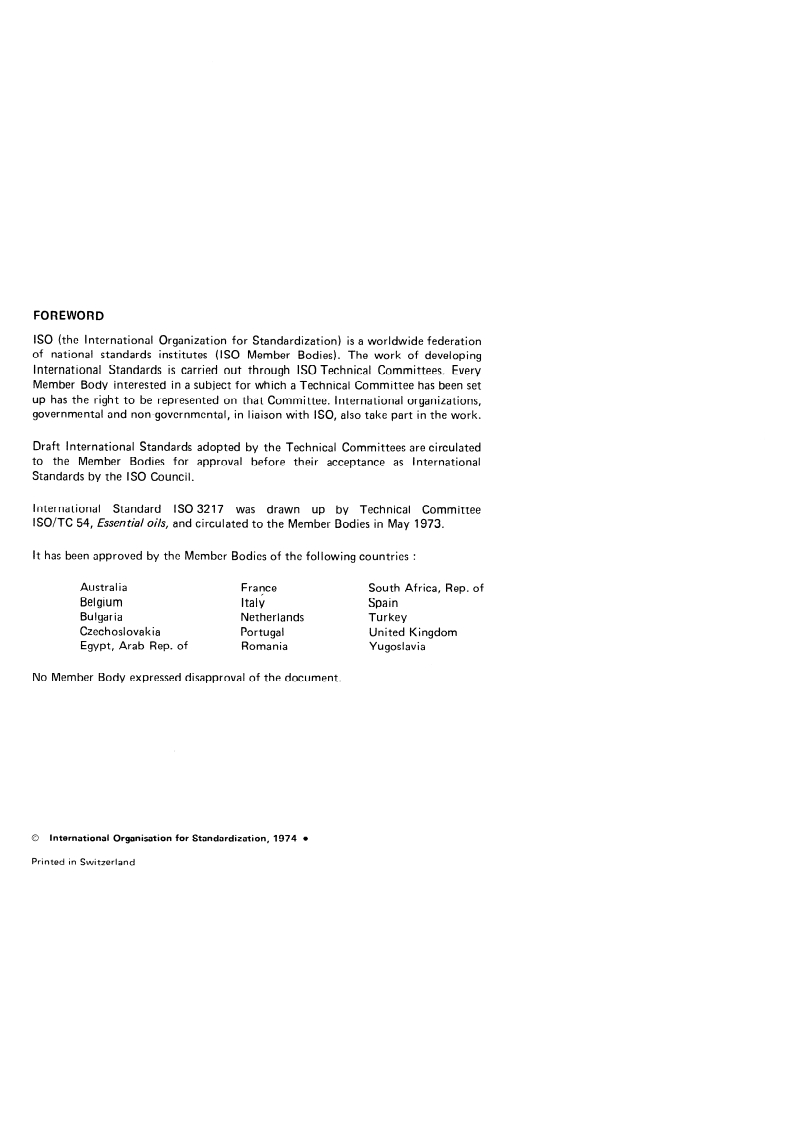
FOREWORD
ISO (the International Organization for Standardization) is a worldwide federation
of national Standards institutes (ISO Member Bodies). The work of developing
International Standards is carried out through ISO Technical Committees. Every
Member Body interested in a subject for which a Technical Committee has been set
up has the right to be represented on that Committee. International organizations,
governmental and non-governmental, in liaison with ISO, also take part in the work.
Draft International Standards adopted by the Technical Committees are circulated
to the Member Bodies for approval before their acceptance as International
Standards by the ISO Council.
International Standard ISO 3217 was drawn up by Technical Committee
ISO/TC 54, Essential oils, and circulated to the Member Bodies in May 1973.
lt has been approved by the Member Bodies of the following countries :
Australia France
South Africa, Rep. of
Belgium ltaiy Spain
Bulgaria Netherlands Turkey
Czechoslovakia Portugal United Kingdom
Egypt, Arab Rep. of Romania Yugoslavia
No Member Body expressed disapproval of the document.
@ International Organisation for Standardization, 1974 l
Printed in Switzerland
INTERNATIONAL STANDARD
ISO 3217-1974 (E)
Oil of lemongrass (Cymbopogon citratus)
1 SCOPE AND FIELD OF APPLICATION 4.2 Colour
This International Standard specifies certain characteristics Pale yellow to orange-yellow.
of oil of lemongrass (Cymbopogon citratus)‘), with a view
to facilitating the assessment of its quality.
4.3 Odour
Characteristic with a strong note of citral.
2 REFERENCES
...
INTERNATIONAL STANDARD
INTERNATIONAL ORGANIZATION FOR STANDARDIZATION .MEXflYHAPOflHAfl OPI-AHM3AUMR i-IO CTAH~APTM3AUMM~ORGANISATION INTERNATIONALE DE NORMALISATION
Oil of lemongrass (Cymbopogon citratus)
Hui/e essentielle de lemongrass (Cymbopogon citratus)
First edition - 1974-08-15
Ref. No. ISQ 3217-1974 (E)
U DC 668.524.004.1
Descriptors : essential oiis, lemongrass, specifications, materials specifications.
Price based on 2 pages
FOREWORD
ISO (the International Organization for Standardization) is a worldwide federation
of national Standards institutes (ISO Member Bodies). The work of developing
International Standards is carried out through ISO Technical Committees. Every
Member Body interested in a subject for which a Technical Committee has been set
up has the right to be represented on that Committee. International organizations,
governmental and non-governmental, in liaison with ISO, also take part in the work.
Draft International Standards adopted by the Technical Committees are circulated
to the Member Bodies for approval before their acceptance as International
Standards by the ISO Council.
International Standard ISO 3217 was drawn up by Technical Committee
ISO/TC 54, Essential oils, and circulated to the Member Bodies in May 1973.
lt has been approved by the Member Bodies of the following countries :
Australia France
South Africa, Rep. of
Belgium ltaiy Spain
Bulgaria Netherlands Turkey
Czechoslovakia Portugal United Kingdom
Egypt, Arab Rep. of Romania Yugoslavia
No Member Body expressed disapproval of the document.
@ International Organisation for Standardization, 1974 l
Printed in Switzerland
INTERNATIONAL STANDARD
ISO 3217-1974 (E)
Oil of lemongrass (Cymbopogon citratus)
1 SCOPE AND FIELD OF APPLICATION 4.2 Colour
This International Standard specifies certain characteristics Pale yellow to orange-yellow.
of oil of lemongrass (Cymbopogon citratus)‘), with a view
to facilitating the assessment of its quality.
4.3 Odour
Characteristic with a strong note of citral.
2 REFERENCES
...
hIORME INTERNATIONALE 3217
INTERNATIONAL ORGANIZATION FOR STANDARDIZATION .MEXAYHAPOAHAR OPTAHW3AUMII n0 CTAH~APTM3A~WW.ORGANISATION INTERNATIONALE DE NORMALISATION
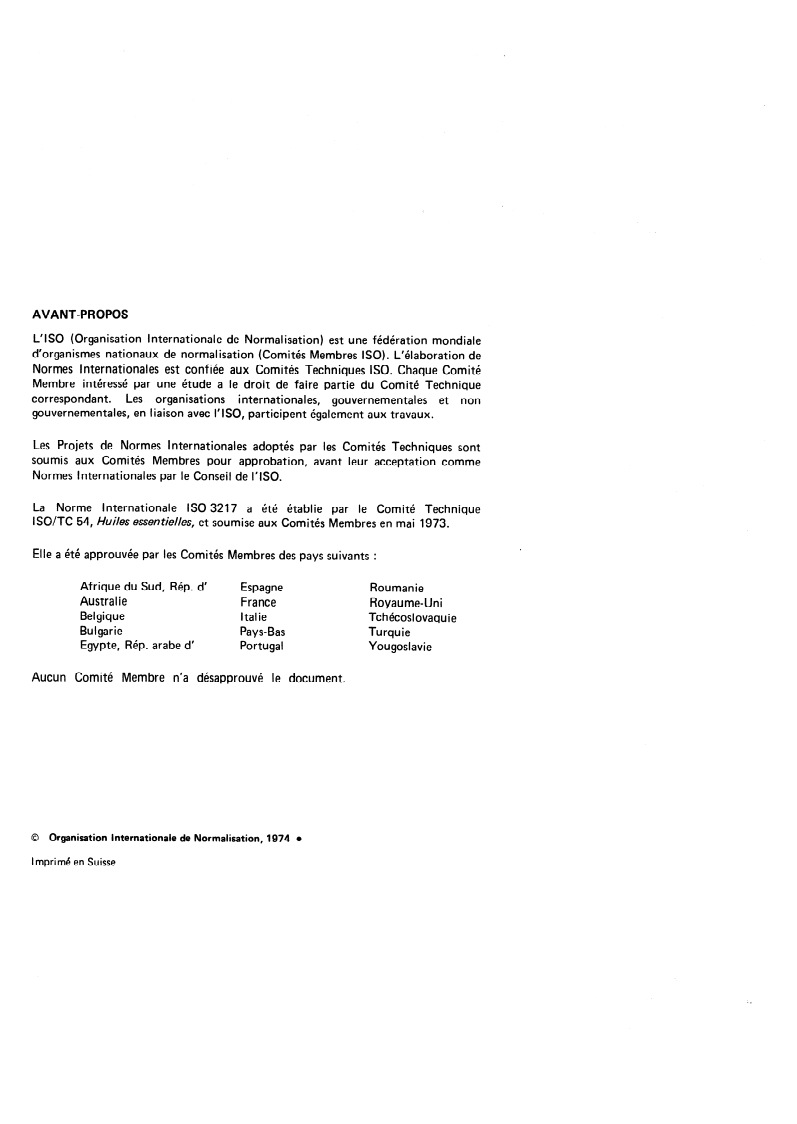
Huile essentielle de lemongrass (Cymbopogon citratus)
Oil of lemongrass (Cymbopogon citratus)
Première édition - 1974-08-l 5
Réf. NO : ISO 3217-1974 (F)
CDU 668.524.004.1
Descripteurs : huile essentielle, lemongrass, spécification, spécification de matière.
Prix basé sur 2 pages
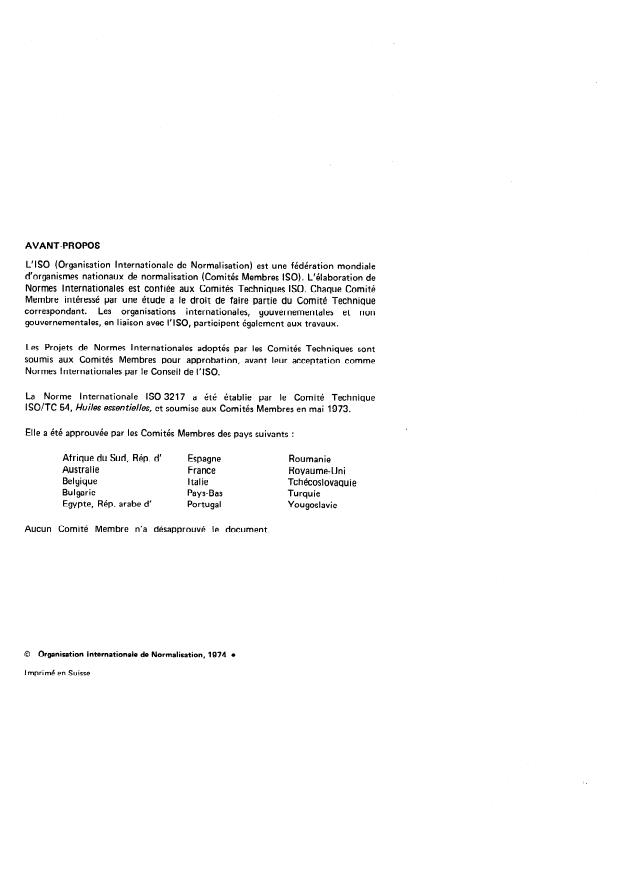
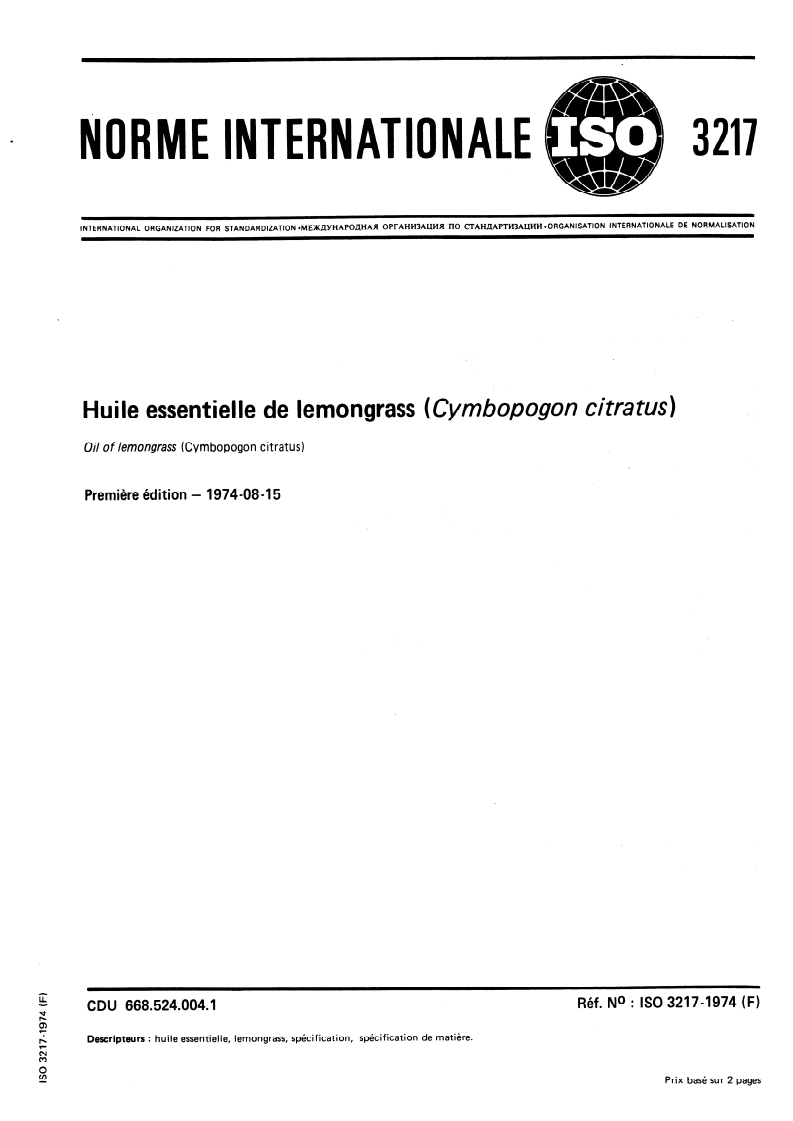
AVANT-PROPOS
L’ISO (Organisation Internationale de Normalisation) est une fédération mondiale
d’organismes nationaux de normalisation (Comités Membres ISO). L’élaboration de
Normes Internationales est confiée aux Comités Techniques ISO. Chaque Comité
Membre intéressé par une étude a le droit de faire partie du Comité Technique
correspondant. Les organisations internationales, gouvernementales et non
gouvernementales, en liaison avec I’ISO, participent également aux travaux.
Les Projets de Normes Internationales adoptés par les Comités Techniques sont
soumis aux Comités Membres pour approbation, avant leur acceptation comme
Normes Internationales par le Conseil de I’ISO.
La Norme Internationale ISO 3217 a été établie par le Comité Technique
ISO/TC 54, Huiles essentie//es, et soumise aux Comités Membres en mai 1973.
Elle a été approuvée par les Comités Membres des pays suivants :
Afrique du Sud, Rép. d’
Espagne Roumanie
Australie
France Royaume-Uni
Belgique Italie Tchécoslovaquie
Bulgarie Turquie
Pays-Bas
Egypte, Rép. arabe d’
Portugal Yougoslavie
Aucun Comité Membre n’a désapprouvé le document.
0 Organisation Internationale de Normalisation, 1974 l
I mprim4 en Suisse
ISO 3217-1974 (F)
NORME INTERNATIONALE
Huile essentielle de lemongrass
(Cymbopogon titra tus)
4.2 Couleur
1 OBJET ET DOMAINE D’APPLICATION
La présente . Norme Internationale spécifie certaines De jaune pâle à jaune,orangé.
.
‘,
caractéristiques de I’huile essentielle de lemongrass
(Cymbopogon citratus) ’ ) destinées à faciliter l’appréciation
4.3 Odeur
de sa qualité.
Caractéristique avec une note de citral très prononcée.
2 RÉFÉRENCES
4.4 Densité relative à 20/20 “C
ISO/ R 2 10, Huiles essentielles - Emballage.
Minimum : 0,872
ISO/R 211, Huiles essentielles - Étiquetage et marquage
M
...
hIORME INTERNATIONALE 3217
INTERNATIONAL ORGANIZATION FOR STANDARDIZATION .MEXAYHAPOAHAR OPTAHW3AUMII n0 CTAH~APTM3A~WW.ORGANISATION INTERNATIONALE DE NORMALISATION
Huile essentielle de lemongrass (Cymbopogon citratus)
Oil of lemongrass (Cymbopogon citratus)
Première édition - 1974-08-l 5
Réf. NO : ISO 3217-1974 (F)
CDU 668.524.004.1
Descripteurs : huile essentielle, lemongrass, spécification, spécification de matière.
Prix basé sur 2 pages
AVANT-PROPOS
L’ISO (Organisation Internationale de Normalisation) est une fédération mondiale
d’organismes nationaux de normalisation (Comités Membres ISO). L’élaboration de
Normes Internationales est confiée aux Comités Techniques ISO. Chaque Comité
Membre intéressé par une étude a le droit de faire partie du Comité Technique
correspondant. Les organisations internationales, gouvernementales et non
gouvernementales, en liaison avec I’ISO, participent également aux travaux.
Les Projets de Normes Internationales adoptés par les Comités Techniques sont
soumis aux Comités Membres pour approbation, avant leur acceptation comme
Normes Internationales par le Conseil de I’ISO.
La Norme Internationale ISO 3217 a été établie par le Comité Technique
ISO/TC 54, Huiles essentie//es, et soumise aux Comités Membres en mai 1973.
Elle a été approuvée par les Comités Membres des pays suivants :
Afrique du Sud, Rép. d’
Espagne Roumanie
Australie
France Royaume-Uni
Belgique Italie Tchécoslovaquie
Bulgarie Turquie
Pays-Bas
Egypte, Rép. arabe d’
Portugal Yougoslavie
Aucun Comité Membre n’a désapprouvé le document.
0 Organisation Internationale de Normalisation, 1974 l
I mprim4 en Suisse
ISO 3217-1974 (F)
NORME INTERNATIONALE
Huile essentielle de lemongrass
(Cymbopogon titra tus)
4.2 Couleur
1 OBJET ET DOMAINE D’APPLICATION
La présente . Norme Internationale spécifie certaines De jaune pâle à jaune,orangé.
.
‘,
caractéristiques de I’huile essentielle de lemongrass
(Cymbopogon citratus) ’ ) destinées à faciliter l’appréciation
4.3 Odeur
de sa qualité.
Caractéristique avec une note de citral très prononcée.
2 RÉFÉRENCES
4.4 Densité relative à 20/20 “C
ISO/ R 2 10, Huiles essentielles - Emballage.
Minimum : 0,872
ISO/R 211, Huiles essentielles - Étiquetage et marquage
M
...
hIORME INTERNATIONALE 3217
INTERNATIONAL ORGANIZATION FOR STANDARDIZATION .MEXAYHAPOAHAR OPTAHW3AUMII n0 CTAH~APTM3A~WW.ORGANISATION INTERNATIONALE DE NORMALISATION
Huile essentielle de lemongrass (Cymbopogon citratus)
Oil of lemongrass (Cymbopogon citratus)
Première édition - 1974-08-l 5
Réf. NO : ISO 3217-1974 (F)
CDU 668.524.004.1
Descripteurs : huile essentielle, lemongrass, spécification, spécification de matière.
Prix basé sur 2 pages
AVANT-PROPOS
L’ISO (Organisation Internationale de Normalisation) est une fédération mondiale
d’organismes nationaux de normalisation (Comités Membres ISO). L’élaboration de
Normes Internationales est confiée aux Comités Techniques ISO. Chaque Comité
Membre intéressé par une étude a le droit de faire partie du Comité Technique
correspondant. Les organisations internationales, gouvernementales et non
gouvernementales, en liaison avec I’ISO, participent également aux travaux.
Les Projets de Normes Internationales adoptés par les Comités Techniques sont
soumis aux Comités Membres pour approbation, avant leur acceptation comme
Normes Internationales par le Conseil de I’ISO.
La Norme Internationale ISO 3217 a été établie par le Comité Technique
ISO/TC 54, Huiles essentie//es, et soumise aux Comités Membres en mai 1973.
Elle a été approuvée par les Comités Membres des pays suivants :
Afrique du Sud, Rép. d’
Espagne Roumanie
Australie
France Royaume-Uni
Belgique Italie Tchécoslovaquie
Bulgarie Turquie
Pays-Bas
Egypte, Rép. arabe d’
Portugal Yougoslavie
Aucun Comité Membre n’a désapprouvé le document.
0 Organisation Internationale de Normalisation, 1974 l
I mprim4 en Suisse
ISO 3217-1974 (F)
NORME INTERNATIONALE
Huile essentielle de lemongrass
(Cymbopogon titra tus)
4.2 Couleur
1 OBJET ET DOMAINE D’APPLICATION
La présente . Norme Internationale spécifie certaines De jaune pâle à jaune,orangé.
.
‘,
caractéristiques de I’huile essentielle de lemongrass
(Cymbopogon citratus) ’ ) destinées à faciliter l’appréciation
4.3 Odeur
de sa qualité.
Caractéristique avec une note de citral très prononcée.
2 RÉFÉRENCES
4.4 Densité relative à 20/20 “C
ISO/ R 2 10, Huiles essentielles - Emballage.
Minimum : 0,872
ISO/R 211, Huiles essentielles - Étiquetage et marquage
M
...
hIORME INTERNATIONALE 3217
INTERNATIONAL ORGANIZATION FOR STANDARDIZATION .MEXAYHAPOAHAR OPTAHW3AUMII n0 CTAH~APTM3A~WW.ORGANISATION INTERNATIONALE DE NORMALISATION
Huile essentielle de lemongrass (Cymbopogon citratus)
Oil of lemongrass (Cymbopogon citratus)
Première édition - 1974-08-l 5
Réf. NO : ISO 3217-1974 (F)
CDU 668.524.004.1
Descripteurs : huile essentielle, lemongrass, spécification, spécification de matière.
Prix basé sur 2 pages
AVANT-PROPOS
L’ISO (Organisation Internationale de Normalisation) est une fédération mondiale
d’organismes nationaux de normalisation (Comités Membres ISO). L’élaboration de
Normes Internationales est confiée aux Comités Techniques ISO. Chaque Comité
Membre intéressé par une étude a le droit de faire partie du Comité Technique
correspondant. Les organisations internationales, gouvernementales et non
gouvernementales, en liaison avec I’ISO, participent également aux travaux.
Les Projets de Normes Internationales adoptés par les Comités Techniques sont
soumis aux Comités Membres pour approbation, avant leur acceptation comme
Normes Internationales par le Conseil de I’ISO.
La Norme Internationale ISO 3217 a été établie par le Comité Technique
ISO/TC 54, Huiles essentie//es, et soumise aux Comités Membres en mai 1973.
Elle a été approuvée par les Comités Membres des pays suivants :
Afrique du Sud, Rép. d’
Espagne Roumanie
Australie
France Royaume-Uni
Belgique Italie Tchécoslovaquie
Bulgarie Turquie
Pays-Bas
Egypte, Rép. arabe d’
Portugal Yougoslavie
Aucun Comité Membre n’a désapprouvé le document.
0 Organisation Internationale de Normalisation, 1974 l
I mprim4 en Suisse
ISO 3217-1974 (F)
NORME INTERNATIONALE
Huile essentielle de lemongrass
(Cymbopogon titra tus)
4.2 Couleur
1 OBJET ET DOMAINE D’APPLICATION
La présente . Norme Internationale spécifie certaines De jaune pâle à jaune,orangé.
.
‘,
caractéristiques de I’huile essentielle de lemongrass
(Cymbopogon citratus) ’ ) destinées à faciliter l’appréciation
4.3 Odeur
de sa qualité.
Caractéristique avec une note de citral très prononcée.
2 RÉFÉRENCES
4.4 Densité relative à 20/20 “C
ISO/ R 2 10, Huiles essentielles - Emballage.
Minimum : 0,872
ISO/R 211, Huiles essentielles - Étiquetage et marquage
M
...