

ISO 7240-14:2013
(Main)Fire detection and alarm systems — Part 14: Design, installation, commissioning and service of fire detection and fire alarm systems in and around buildings
General Information
- Abstract
ISO 7240-14:2013 specifies the design, installation, commissioning, and service requirements for a fire detection and alarm system (FDAS), which is primarily intended to provide early detection of fire and notification within one or more specified indoor or outdoor areas for the protection of lives. The FDAS includes automatic detection of a fire and manual initiation of a fire alarm, with audible and visual warning to people within the detection area. ISO 7240-14:2013 also specifies requirements for FDAS capable of providing signals to audible warning systems in accordance with ISO 7240-19, to initiate the operation of ancillary technical services, such as fixed fire extinguishing systems, and to other precautions and actions. The protection of property is outside the scope of ISO 7240-14:2013. However, the requirements specified herein may be used as recommendations for property protection.
- Status
- Published
- Publication Date
- 28-Jul-2013
- Technical Committee
- ISO/TC 21/SC 3 - Fire detection and alarm systems
- Drafting Committee
- ISO/TC 21/SC 3 - Fire detection and alarm systems
- Current Stage
- 9093 - International Standard confirmed
- Start Date
- 15-Sep-2025
- Completion Date
- 29-Aug-2026

Overview
ISO 7240-14:2013 is the ISO standard for fire detection and alarm systems (FDAS) covering the design, installation, commissioning and service of fire detection and fire alarm systems in and around buildings. Its primary aim is early detection and timely notification to protect life by specifying requirements for automatic detection, manual alarm initiation, and audible/visual warnings. The standard also addresses interfaces to ancillary technical services (for example fixed extinguishing systems) and to audible warning systems in accordance with ISO 7240‑19. Protection of property is explicitly outside its scope, though the guidance may be used as recommendations for property protection.
Key topics and technical requirements
ISO 7240‑14 organizes practical requirements for life‑safety FDAS and includes, among others:
- System design and responsibilities - roles and qualifications for designers, installers and maintainers; required documentation and design deliverables.
- Equipment and materials - quality, environmental requirements and compatibility of components.
- Detection design - zoning, detector selection, detector sensitivity and response characteristics, detector location and spacing.
- Manual call points and alarm devices - requirements for manual alarm initiation and audible/visual warning devices.
- Control and indicating equipment - performance, interfaces, power supply and backup supply considerations.
- Commissioning and testing - prescribed commissioning procedures, documentation and certification of correct operation.
- Service and maintenance - service plans, routine tests, records, and qualifications for service personnel.
- Integration and ancillary services - signal outputs to sound systems (ISO 7240‑19), fire suppression systems, smoke/heat control, remote monitoring and delay management.
- Abnormal situations and alterations - guidance for handling faults, system changes and upgrades.
(Annex A provides informative material such as power source calculations.)
Practical applications and users
ISO 7240‑14 is intended for professionals responsible for life‑safety fire alarm systems, including:
- Fire safety designers and consultants
- System integrators and installers
- Commissioning engineers and test teams
- Facilities and building managers responsible for operation and maintenance
- Service providers and maintenance contractors
- Authorities Having Jurisdiction (AHJs) and certification bodies
Use cases include designing new FDAS for commercial, institutional or public buildings; commissioning and certifying installations; and establishing ongoing inspection, testing and maintenance regimes.
Related standards
ISO 7240 is a multipart suite. Relevant related parts include: ISO 7240‑1 (general), ISO 7240‑2 (control and indicating equipment), ISO 7240‑19 (sound systems for emergency purposes), and parts covering detectors, manual call points and other components. Referencing related ISO 7240 parts ensures compatibility across system components and functions.
Keywords: ISO 7240-14, fire detection and alarm systems, FDAS design, fire alarm installation, commissioning, maintenance, ISO fire alarm standard.
Relations
- Effective Date
- 25-Dec-2010
Get Certified
Connect with accredited certification bodies for this standard

CIS Institut d.o.o.
Personal Protective Equipment (PPE) certification body. Notified Body NB-2890 for EU Regulation 2016/425 PPE.

Kiwa BDA Testing
Building and construction product certification.
Kmetijski inštitut Slovenije
Agricultural Institute of Slovenia. Soil testing, plant health, agricultural product analysis.
Sponsored listings
Frequently Asked Questions
ISO 7240-14:2013 is a standard published by the International Organization for Standardization (ISO). Its full title is "Fire detection and alarm systems — Part 14: Design, installation, commissioning and service of fire detection and fire alarm systems in and around buildings". This standard covers: ISO 7240-14:2013 specifies the design, installation, commissioning, and service requirements for a fire detection and alarm system (FDAS), which is primarily intended to provide early detection of fire and notification within one or more specified indoor or outdoor areas for the protection of lives. The FDAS includes automatic detection of a fire and manual initiation of a fire alarm, with audible and visual warning to people within the detection area. ISO 7240-14:2013 also specifies requirements for FDAS capable of providing signals to audible warning systems in accordance with ISO 7240-19, to initiate the operation of ancillary technical services, such as fixed fire extinguishing systems, and to other precautions and actions. The protection of property is outside the scope of ISO 7240-14:2013. However, the requirements specified herein may be used as recommendations for property protection.
ISO 7240-14:2013 specifies the design, installation, commissioning, and service requirements for a fire detection and alarm system (FDAS), which is primarily intended to provide early detection of fire and notification within one or more specified indoor or outdoor areas for the protection of lives. The FDAS includes automatic detection of a fire and manual initiation of a fire alarm, with audible and visual warning to people within the detection area. ISO 7240-14:2013 also specifies requirements for FDAS capable of providing signals to audible warning systems in accordance with ISO 7240-19, to initiate the operation of ancillary technical services, such as fixed fire extinguishing systems, and to other precautions and actions. The protection of property is outside the scope of ISO 7240-14:2013. However, the requirements specified herein may be used as recommendations for property protection.
ISO 7240-14:2013 is classified under the following ICS (International Classification for Standards) categories: 13.220.20 - Fire protection. The ICS classification helps identify the subject area and facilitates finding related standards.
ISO 7240-14:2013 has the following relationships with other standards: It is inter standard links to ISO/TR 7240-14:2003. Understanding these relationships helps ensure you are using the most current and applicable version of the standard.
ISO 7240-14:2013 is available in PDF format for immediate download after purchase. The document can be added to your cart and obtained through the secure checkout process. Digital delivery ensures instant access to the complete standard document.
Standards Content (Sample)
INTERNATIONAL ISO
STANDARD 7240-14
First edition
2013-08-01
Fire detection and alarm systems —
Part 14:
Design, installation, commissioning
and service of fire detection and fire
alarm systems in and around buildings
Systèmes de détection et d’alarme d’incendie —
Partie 14: Conception, installation, prise en charge et entretien des
systèmes de détection d’incendie et d’alarme d’incendie à l’intérieur et
autour des bâtiments
Reference number
©
ISO 2013
© ISO 2013
All rights reserved. Unless otherwise specified, no part of this publication may be reproduced or utilized otherwise in any form
or by any means, electronic or mechanical, including photocopying, or posting on the internet or an intranet, without prior
written permission. Permission can be requested from either ISO at the address below or ISO’s member body in the country of
the requester.
ISO copyright office
Case postale 56 • CH-1211 Geneva 20
Tel. + 41 22 749 01 11
Fax + 41 22 749 09 47
E-mail copyright@iso.org
Web www.iso.org
Published in Switzerland
ii © ISO 2013 – All rights reserved
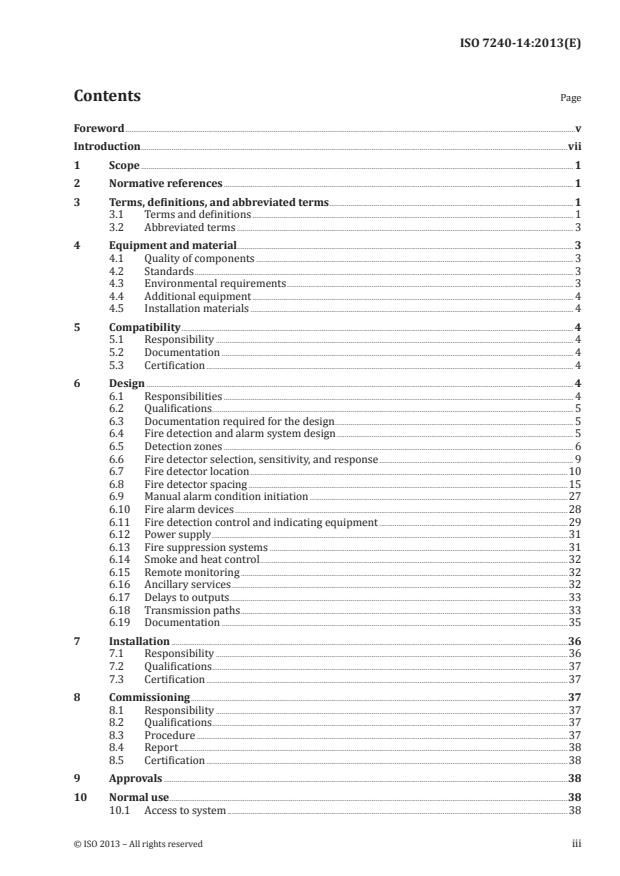
Contents Page
Foreword .v
Introduction .vii
1 Scope . 1
2 Normative references . 1
3 Terms, definitions, and abbreviated terms . 1
3.1 Terms and definitions . 1
3.2 Abbreviated terms . 3
4 Equipment and material . 3
4.1 Quality of components . 3
4.2 Standards . 3
4.3 Environmental requirements . 3
4.4 Additional equipment . 4
4.5 Installation materials . 4
5 Compatibility . 4
5.1 Responsibility . 4
5.2 Documentation . 4
5.3 Certification . 4
6 Design . 4
6.1 Responsibilities . 4
6.2 Qualifications . 5
6.3 Documentation required for the design . 5
6.4 Fire detection and alarm system design . 5
6.5 Detection zones . 6
6.6 Fire detector selection, sensitivity, and response . 9
6.7 Fire detector location .10
6.8 Fire detector spacing .15
6.9 Manual alarm condition initiation .27
6.10 Fire alarm devices .28
6.11 Fire detection control and indicating equipment .29
6.12 Power supply .31
6.13 Fire suppression systems .31
6.14 Smoke and heat control .32
6.15 Remote monitoring .32
6.16 Ancillary services .32
6.17 Delays to outputs.33
6.18 Transmission paths .33
6.19 Documentation .35
7 Installation .36
7.1 Responsibility .36
7.2 Qualifications .37
7.3 Certification .37
8 Commissioning .37
8.1 Responsibility .37
8.2 Qualifications .37
8.3 Procedure .37
8.4 Report .38
8.5 Certification .38
9 Approvals .38
10 Normal use .38
10.1 Access to system .38
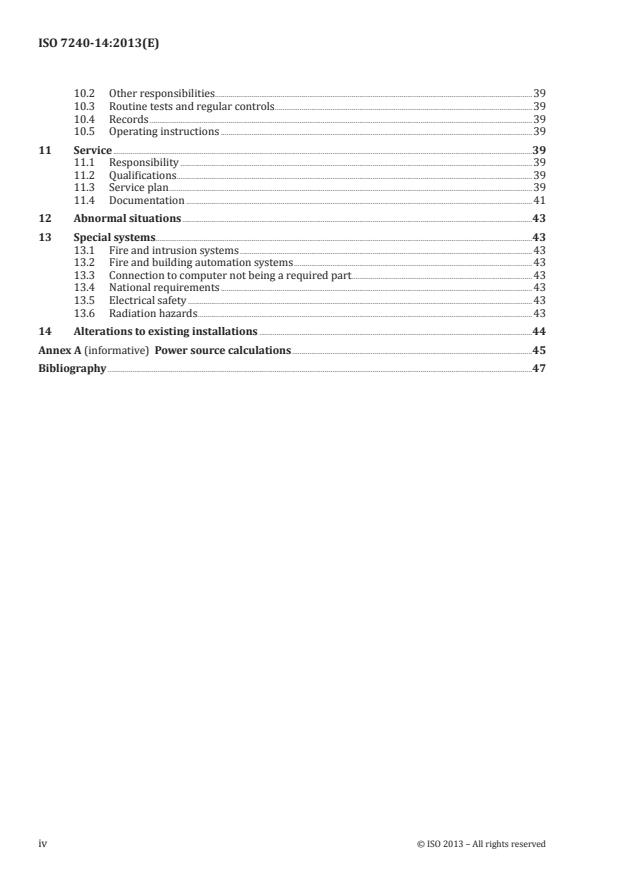
10.2 Other responsibilities .39
10.3 Routine tests and regular controls .39
10.4 Records .39
10.5 Operating instructions .39
11 Service .39
11.1 Responsibility .39
11.2 Qualifications .39
11.3 Service plan .39
11.4 Documentation .41
12 Abnormal situations .43
13 Special systems.43
13.1 Fire and intrusion systems .43
13.2 Fire and building automation systems .43
13.3 Connection to computer not being a required part.43
13.4 National requirements .43
13.5 Electrical safety .43
13.6 Radiation hazards .43
14 Alterations to existing installations .44
Annex A (informative) Power source calculations .45
Bibliography .47
iv © ISO 2013 – All rights reserved
Foreword
ISO (the International Organization for Standardization) is a worldwide federation of national standards
bodies (ISO member bodies). The work of preparing International Standards is normally carried out
through ISO technical committees. Each member body interested in a subject for which a technical
committee has been established has the right to be represented on that committee. International
organizations, governmental and non-governmental, in liaison with ISO, also take part in the work.
ISO collaborates closely with the International Electrotechnical Commission (IEC) on all matters of
electrotechnical standardization.
The procedures used to develop this document and those intended for its further maintenance are
described in the ISO/IEC Directives, Part 1. In particular the different approval criteria needed for the
different types of ISO documents should be noted. This document was drafted in accordance with the
editorial rules of the ISO/IEC Directives, Part 2. www.iso.org/directives
Attention is drawn to the possibility that some of the elements of this document may be the subject of
patent rights. ISO shall not be held responsible for identifying any or all such patent rights. Details of
any patent rights identified during the development of the document will be in the Introduction and/or
on the ISO list of patent declarations received. www.iso.org/patents
Any trade name used in this document is information given for the convenience of users and does not
constitute an endorsement.
The committee responsible for this document is ISO/TC 21, Equipment for fire protection and fire fighting,
Subcommittee SC 3, Fire detection and alarm systems.
This first edition cancels and replaces ISO/TR 7240-14:2003.
ISO 7240 consists of the following parts, under the general title Fire detection and alarm systems:
— Part 1: General and definitions
— Part 2: Control and indicating equipment
— Part 3: Audible alarm devices
— Part 4: Power supply equipment
— Part 5: Point-type heat detectors
— Part 6: Carbon monoxide fire detectors using electro-chemical cells
— Part 7: Point-type smoke detectors using scattered light, transmitted light or ionization
— Part 8: Carbon monoxide fire detectors using an electro-chemical cell in combination with a heat sensor
— Part 9: Test fires for fire detectors [Technical Specification]
— Part 10: Point-type flame detectors
— Part 11: Manual call points
— Part 12: Line type smoke detectors using a transmitted light beam
— Part 13: Compatibility assessment of system components
— Part 14: Design, installation, commissioning and service of fire detection and fire alarm systems in and
around buildings
— Part 15: Point type fire detectors using scattered light, transmitted light or ionization sensors in
combination with a heat sensor
— Part 16: Sound system control and indicating equipment
— Part 17: Short-circuit isolators
— Part 18: Input/output devices
— Part 19: Design, installation, commissioning and service of sound systems for emergency purposes
— Part 20: Aspirating smoke detectors
— Part 21: Routing equipment
— Part 22: Smoke-detection equipment for ducts
— Part 23: Visual alarm devices
— Part 24: Sound-system loudspeakers
— Part 25: Components using radio transmission paths
— Part 27: Point-type fire detectors using a scattered-light, transmitted-light or optical or ionization
smoke sensors, an electrochemical-cell carbon-monoxide sensor and a heat sensor
— Part 28: Fire protection control equipment
The following part is under preparation:
— Part 29: Video fire detectors
vi © ISO 2013 – All rights reserved
Introduction
The installation of a fire detection and alarm system can only be successfully accomplished if the
following conditions are fulfilled:
— materials are of a suitable quality;
— special knowledge in the field of fire detection and fire alarm;
— skilled personnel to carry out the work.
Although the quality of the material can be ensured by proper standards and quality audits, the overall
effectiveness of an installation depends widely on the quality of work, the experience of the designer
and installer, and regular service.
This part of ISO 7240 has been prepared by ISO/TC 21/SC 3. A number of existing national codes and
standards were reviewed during the preparation of this edition of this part of ISO 7240. Although there
are minor differences in, for example, detector spacing requirements, each code or standard has the
same objective of early fire detection. This part of ISO 7240 specifies the minimum requirements for fire
detection and alarm systems using equipment complying with ISO 7240.
INTERNATIONAL STANDARD ISO 7240-14:2013(E)
Fire detection and alarm systems —
Part 14:
Design, installation, commissioning and service of fire
detection and fire alarm systems in and around buildings
1 Scope
This part of ISO 7240 specifies the design, installation, commissioning, and service requirements for
a fire detection and alarm system (FDAS) (see ISO 7240-1, Figure 1), which is primarily intended to
provide early detection of fire and notification within one or more specified indoor or outdoor areas for
the protection of lives. The FDAS includes automatic detection of a fire and manual initiation of a fire
alarm, with audible and visual warning to people within the detection area.
This part of ISO 7240 also specifies requirements for FDAS capable of providing signals to audible
warning systems in accordance with ISO 7240-19, to initiate the operation of ancillary technical services,
such as fixed fire extinguishing systems, and to other precautions and actions.
The protection of property is outside the scope of this part of ISO 7240. However, the requirements
specified herein may be used as recommendations for property protection.
2 Normative references
The following documents, in whole or in part, are normatively referenced in this document and are
indispensable for its application. For dated references, only the edition cited applies. For undated
references, the latest edition of the referenced document (including any amendments) applies.
ISO 7240 (all parts), Fire detection and alarm systems
ISO 8201, Acoustics — Audible emergency evacuation signal
ISO 21927 (all parts), Smoke and heat control systems
IEC 60331-23, Tests for electric cables under fire conditions — Circuit integrity — Part 23: Procedures and
requirements — Electric data cables
IEC 60331-25, Tests for electric cables under fire conditions — Circuit integrity — Part 25: Procedures and
requirements — Optical fibre cables
IEC 60364, Electrical installations of buildings
IEC 61672-1:2002, Electroacoustics — Sound level meters — Part 1: Specifications
3 Terms, definitions, and abbreviated terms
3.1 Terms and definitions
For the purposes of this document, the terms and definitions given in ISO 7240-1 and the following apply.
3.1.1
alarm zone
DEPRECATED: emergency loudspeaker zone
geographic subdivision of the premises in which one or more alarm devices are installed and for which
a common zonal alarm indication is provided
3.1.2
area of coverage
area, inside and/or outside a building or structure, where the FDAS meets the requirements of this
part of ISO 7240
Note 1 to entry: Certain parts of an area can be excluded (see 6.7.3).
3.1.3
contiguous
adjacent to, and mutually accessible
3.1.4
designated entry point
location where access is gained to the building in an emergency
3.1.5
detection zone
geographic subdivision of the premises in which one or more points are installed and for which a
common zonal detection indication is provided
3.1.6
enclosure
space defined by boundary elements
[SOURCE: ISO/TR 13387-6:1999, 3.2]
Note 1 to entry: Typical enclosures are walls, floors, and ceilings of buildings and do not refer to cabinets used to
house equipment.
3.1.7
escape route
path of escape from any part of a building to a final exit
3.1.8
extra-low voltage
any voltage which cannot exceed AC 50 V or DC 120 V
3.1.9
fire compartment
reference volume delimited by construction elements for which fire resistance has been chosen according
to the plausible fire that could break out within this volume or penetrate into it
[SOURCE: ISO 26802:2010, 3.20]
3.1.10
level surface
surface, roof, or ceiling with a gradient less than or equal to 1 in 8
3.1.11
monitoring service provider
agency or organization that receives FDAS signals
3.1.12
quiescent condition
functional condition characterized by the absence of the alarm, fault warning and disabled and test conditions
2 © ISO 2013 – All rights reserved
3.1.13
sloping surface
surface, roof, or ceiling with a gradient greater than 1 in 8
Note 1 to entry: A sloping surface may not be flat and includes barrel-vaulted ceilings.
3.1.14
sole occupancy unit
room or other part of a building for occupation by one or joint owners, lessees, tenants, or other occupiers
to the exclusion of any other owner, lessee, tenant, or other occupiers
3.2 Abbreviated terms
CO carbon monoxide
EMC electromagnetic compatibility
FDAS fire detection and alarm system
FACIE fire alarm control and indicating equipment
FDCIE fire detection control and indicating equipment
4 Equipment and material
4.1 Quality of components
4.1.1 Components used as part of the FDAS shall be designed and manufactured in accordance with a
recognized quality system.
4.1.2 The equipment manufacturer shall make available to the FDAS designer information about the
manufacturer’s quality assurance system to satisfy the designer that the components selected for the
FDAS are suitable for the application.
4.2 Standards
4.2.1 Where available, components of the FDAS shall comply with equipment specified in ISO 7240.
If International Standards do not exist, then the equipment shall comply with standards permitted by
national requirements.
4.2.2 Equipment used in the FDAS shall be certified for compliance with the relevant part of ISO 7240
or other International Standards, as appropriate, by a testing laboratory that is accredited by a national
body to assess equipment in accordance with the relevant standard. Where assessment has not been
made by an independent party, the designer shall identify the components and describe why assessment
has not been undertaken.
4.3 Environmental requirements
Each item of equipment shall be installed within an environment for which it has been certified.
Additional requirements may apply in special cases, e.g.:
— potentially explosive atmospheres;
— special EMC requirements;
— extreme climatic conditions.
4.4 Additional equipment
4.4.1 Additional equipment (e.g. remote terminals or graphic displays) may be included in the design
of, or connected to the FDAS.
4.4.2 The operation of the FDAS shall not be reliant on the additional equipment.
4.4.3 Failure of any additional equipment shall not affect the correct operation of the FDAS.
4.5 Installation materials
4.5.1 Installation material (e.g. cable clamps, centenary cables, and cable trays) shall be of a suitable
rating, size, and strength to meet the design load requirements.
4.5.2 Connectors and distribution boxes shall be suitable for the size of cables used in the FDAS.
5 Compatibility
5.1 Responsibility
5.1.1 The designer shall ensure that equipment complying with ISO 7240 used in the FDAS has been
independently assessed as compatible with the FDCIE, in accordance with ISO 7240-13.
5.1.2 Where the design of the FDAS allows the use of additional equipment connected to the FDCIE
(e.g. remote terminals or graphic displays), the designer shall ensure that the equipment has been
assessed as compatible with the FDCIE, in accordance with ISO 7240-13.
5.1.3 Where the requirements of ISO 7240-13 do not directly apply, then it may be used as a guide to
prepare a suitable compatibility assessment procedure.
5.2 Documentation
The designer shall prepare a list of all components used in the FDAS and identify which components
are compatible.
5.3 Certification
5.3.1 Certification of compatibility of equipment used in the FDAS shall be included in the design
documentation for the FDAS.
5.3.2 Where assessment has not been made by an independent party, the designer shall identify the
components and describe why assessment has not been undertaken.
5.3.3 Where the FDAS interfaces to another system (e.g. building-management system) using voltage-
free relay outputs, then self-assessment may be made by the designer and documented accordingly.
5.3.4 Where the fire detection system interfaces to another system (e.g. fire alarm system) using a
high-level link (e.g. serial data communication), the designer shall prepare a suitable test plan to ensure
reliable interfacing, including the testing of failure and fault modes. This may be done in conjunction
with the equipment manufacturer.
6 Design
6.1 Responsibilities
Design of the FDAS, including components and usage requirements, shall be undertaken in a systematic
process in accordance with a quality system. A document shall be signed by a responsible person
4 © ISO 2013 – All rights reserved
describing the field of responsibility in such detail that undefined areas and areas overlapping with
other responsibilities are avoided.
6.2 Qualifications
The design of the FDAS shall be undertaken by persons having professional qualifications or experience
relevant to the scope of the particular design requirements. Experience may include
— an engineer with proven experience in the field of fire detection and alarm technology,
— an experienced consulting company, or
— an experienced FDAS designer.
NOTE National regulations might exist for the registration and recognition of individuals with the requisite
qualifications and experience. The recognition might form part of a recognized competency framework.
6.3 Documentation required for the design
6.3.1 The designer shall have access to documentation necessary to design the FDAS, in accordance
with the requirements of this part of ISO 7240. Documentation shall include the following:
— plans of the building;
— use of the building (where known);
— occupancy of the building (where known);
— description of the hazard, including proposed use of detection zones and alarm zones;
— description of the environmental conditions, such as
— temperature,
— humidity,
— corrosive atmosphere,
— electromagnetic influences (e.g. areas subject to severe thunderstorms);
— description of the environment where the equipment is installed (e.g. occupancy of the building,
hazardous locations);
— description of the infrastructure of the environment (e.g. traffic conditions, communications,
electricity supply, fire brigade access, water supply, etc.).
6.3.2 The designer shall state any assumptions made and provide justifications for solutions selected.
6.4 Fire detection and alarm system design
6.4.1 An FDAS shall be designed in accordance with requirements of this part of ISO 7240. The design
criteria shall satisfy national fire safety objectives and include
— environmental conditions,
— type of occupancy,
— probability of ignition,
— rate of fire growth,
— rapid detection of fire,
— timely evacuation of people (including the use of alarm zones, phased evacuation, or other evacuation
strategies), and
— minimization of unwanted alarms.
NOTE Where national fire safety objectives or regulations do not exist, it is important that the designer
applies fire safety engineering principles and a risk-based approach to the design.
6.4.2 The design may exclude from the area of coverage defined areas rarely or never occupied by
people or combustible material.
6.4.3 Where complete fire detection coverage (with excluded areas identified in 6.4.2) is not required,
and as permitted by national regulations, the following areas may be included within the scope of the
design (see 6.3):
— one or more fire compartment(s);
— part of a fire compartment;
— escape route(s); and
NOTE 1 Escape route coverage may not detect a fire at the source of the fire.
— equipment within a building.
NOTE 2 Detectors are typically mounted within or adjacent to the equipment cabinet.
6.4.4 Where automatic detection is not required, and as permitted by national regulations, a system
of manual call points may be installed (see 6.9).
6.4.5 Where the design of the FDAS includes the use of optional functions specified in the relevant
equipment standards, the use of the option and the reason shall be included in the design documentation.
NOTE National regulations might require the use of some optional functions or might prohibit the use of
some optional functions.
6.4.6 The design shall consider any national regulations that place other limitations on the design, such as
a) the size of detection zones and alarm zones;
b) the maximum number of points installed in a detection zone;
c) limitations of circuits including automatic and manual initiating devices;
d) interface requirements to a sound system for emergency purposes;
e) special requirements for circuits having both detectors and alarm devices;
f) special requirements for the combination of initiating and alarm circuits;
g) requirements for fire alarm and fault warning transmission systems;
h) use of installation material, such as shielded cable, conduits, etc;
i) installations in explosive atmospheres.
6.5 Detection zones
6.5.1 General
The building shall be divided into detection zones so that the origin of the alarm can be quickly
determined from the indications at the FDCIE and on the detectors.
6 © ISO 2013 – All rights reserved
6.5.2 Detection zone limitations
2 2
6.5.2.1 A detection zone shall be limited to no more than 2 000 m of contiguous floor area or 2 000 m
of non-contiguous floor area with no entrances to adjacent areas being separated by more than 10 m
and visible from each other. The longest dimension shall not exceed 100 m and shall be confined to one
storey. Areas with no access from inside the building shall be displayed as separate detection zones
from those having internal access. For an example of detection zone allocation, see Figure 1.
Dimensions in metres
Key
remote indicator (required only when doors kept locked)
remote indicator
(a) Industrial
8 © ISO 2013 – All rights reserved
Key
remote indicator required when access is restricted
(b) Retail/Commercial
Figure 1 — Example detection zone allocation for contiguous and non-contiguous areas
6.5.2.2 A mezzanine level, open to and accessible from the floor with which it is associated, may be
treated as part of the detection zone for that floor.
6.5.2.3 Detectors protecting concealed spaces not exceeding 500 m may be connected to the detection
zone on the same floor, provided that the total number of detectors does not exceed 40.
6.5.2.4 Detection zones may be subdivided, such that signals from individual devices, or groups of
devices, may also be indicated at the FDCIE, thus providing more detailed information on the location of
an event, in addition to the indication of the affected detection zone.
6.5.2.5 Detectors displayed individually shall not be identified as separate detection zones unless
representing the only detector within an enclosure.
6.5.2.6 A single detection zone shall not intersect more than one alarm zone.
6.6 Fire detector selection, sensitivity, and response
6.6.1 The type and sensitivity of detectors shall be selected to meet the design objectives for the FDAS,
including the fire risk, proposed mounting height, area of coverage, and environmental conditions inside
the building.
NOTE In situations where the use of smoke detectors might result in unwanted alarms, other approaches can
be considered, for example:
a) relocation of the detector;
b) use of other types of detectors, including multisensor detectors. The use of heat detectors to replace required
smoke detectors is not recommended but might be required in some environments;
c) use of dependency on more than one alarm signal.
6.6.2 Where the relevant part of ISO 7240 allows more than one sensitivity class or where a
manufacturer has equipment that allows sensitivity settings, the sensitivity for detectors shall be
specified for each detector installed in the building.
6.6.3 The FDAS response may be delayed by the use of dependency on more than one alarm signal, as
specified in ISO 7240-2. Where used, the following equipment shall not be configured to use the function:
a) manual call points;
b) FDCIE connected to other FDCIE;
c) detectors installed in hazardous areas;
d) fire suppression systems;
e) line-type smoke detectors using a transmitted optical beam, where a beam-interrupt fault overrides
the alarm state;
f) detection zones using static response heat detectors;
g) detection verification algorithms that will cause a subsequent delay in the detector alarm response
of more than 60 s;
h) detectors that may take more than 60 s to become functional after a reset.
NOTE Since alarm dependency delays the initiation of an alarm signal, it is important to first try other efforts
to eliminate unwanted alarm signals.
6.7 Fire detector location
6.7.1 General
Detector locations and spacing shall include evaluation of room geometry and risk, such as
— ceiling height,
— ceiling structure,
— furniture,
— occupancy, and
— application (e.g. computer room).
6.7.2 Locations requiring fire detectors
6.7.2.1 General
6.7.2.1.1 The following considerations shall apply in determining the location of detectors to
be installed.
a) Smoke detectors using scattered light or transmitted light (refer to ISO 7240-7, ISO 7240-15, and
ISO 7240-27), or CO fire detectors and heat sensors (refer to ISO 7240-8 and ISO 7240-27) shall be
installed in all sleeping areas.
b) Smoke detectors using scattered light or transmitted light shall be installed in all exits, passageways,
corridors, hallways, or other similar areas that are part of a path of travel to an exit.
c) Where an area is divided into sections by walls, partitions, or storage racks, reaching within 300 mm
of the ceiling (or the soffits of the joists where there is no ceiling), each section shall be treated as a
room and shall include detectors.
d) A clear space of at least 100 mm radius, to a depth of 600 mm, shall be maintained from the detector
or sampling point.
e) Detector alarm indicators shall be visible from the path of normal entry to the area.
f) Detectors shall be installed so that the “on” or “off” condition of the alarm indicator shall be
discernible from a trafficable area.
NOTE Additional detectors might be required where any special structural features or conditions exist.
6.7.2.1.2 Where detectors incorporating more than one sensor are installed and the detector is
adjusted for use with one sensor, installation requirements for the operational sensor shall apply.
6.7.2.2 Accessible service tunnels
Non-fire-isolated accessible service tunnels that provide communication between buildings or sections
thereof shall have detectors installed (see also 6.7.2.8).
6.7.2.3 Air-handling systems
6.7.2.3.1 Smoke detection equipment for ducts (refer to ISO 7240-22) shall be used for monitoring
air in ducts.
10 © ISO 2013 – All rights reserved
6.7.2.3.2 Within air-handling systems, detectors shall be provided in the following locations:
a) return-air system — Buildings with a return-air-handling system serving more than one enclosure,
not provided with smoke detection within the occupied space, shall have smoke detectors installed
adjacent to the return/relief/economy air inlet or use smoke detection equipment for ducts to
sample air from the common return air inlets.
NOTE 1 The effect of dilution might prevent operation of a common return-air detector if smoke is only
entering the duct from a single return air grill.
NOTE 2 In areas where the air handling systems result in high (e.g. > 1 m/s) airflows within the enclosure
(such as computer rooms and telecommunications facilities), a detector with a high sensitivity might be
required to detect smoke which may not be detected by ceiling-mounted detectors.
b) supply-air ducts — Air-handling plant supplying air to more than one storey within the building shall
have a smoke detector installed as close as practicable to the plant to detect smoke downstream
from the supply air fan.
NOTE Shutting down the air-handling equipment upon the operation of any detector associated with the
air-handling systems within the building will help prevent the spread of smoke throughout the building.
c) exhaust ducts — Ducts that are used for exhausting cooking fumes, flammable vapours, lint material,
and the like shall have at least one detector at the furthest practicable downstream point of the duct.
NOTE Detectors for this application need to be carefully selected to suit the environment so that
unwanted alarms are minimized. A fully sealed heat detector would normally be used.
6.7.2.3.3 Each detector mounted within an air-handling system shall be indicated as a separate
detection zone at the FDCIE.
6.7.2.3.4 Detectors installed in air-handling systems shall be provided with permanent indelible
labels, stating detection zone designation, affixed adjacent to the detectors.
6.7.2.3.5 Integral alarm indicators on smoke detectors located in air-handling systems shall be
clearly visible. Where this condition cannot be met, remote indicators shall be installed and labelled
appropriately (see 6.7.2.4.3).
6.7.2.4 Concealed spaces
6.7.2.4.1 General
6.7.2.4.1.1 Detectors shall be installed in all concealed spaces. Exemptions are provided in 6.7.3.
6.7.2.4.1.2 Access for maintenance of detectors installed within concealed spaces shall be provided.
Where personnel entry to the concealed space is required, the access dimensions shall be not less than
450 mm × 350 mm.
6.7.2.4.2 Electrical equipment
6.7.2.4.2.1 Where a concealed space contains electrical lighting or power equipment that is fully
within the concealed space and is connected to an electrical supply in excess of extra-low voltage, a
detector shall be mounted on the ceiling of the concealed space within 1,5 m measured horizontally
from the equipment. Where the mounting surface is a sloping surface, the detector shall be mounted on
the high side of the equipment.
6.7.2.4.2.2 Detection is not required when light fittings are not rated above 100 W, power equipment
with moving parts is not rated above 100 W, or other power equipment is not rated above 500 W.
NOTE 1 For the purpose of this part of ISO 7240, electrical wiring and any enclosures of light fittings not
deemed combustible, which protrude into a concealed space, are not regarded as electrical equipment.
NOTE 2 The detector used in the protection of the electrical equipment does not necessarily constitute
protection of the concealed space.
6.7.2.4.3 Remote indicators for fire detectors
6.7.2.4.3.1 Where a detector indicator is not visible from a normally occupied area, remote indicators
shall be used to indicate a detector in alarm (see 6.7.2.4.3.6 for exceptions).
6.7.2.4.3.2 Remote indicators for rooms, cupboards, or similar areas shall be installed adjacent to
the door giving access to the detector(s).
6.7.2.4.3.3 Remote indicators for concealed spaces shall be installed in an accessible area as close as
practicable to the detector.
6.7.2.4.3.4 Where a detector is mounted under removable flooring such as in a computer room and
the detector location is not indicated at the FDCIE, a label shall be affixed to the ceiling or ceiling grid
immediately above the detector indicating the location of the detector below.
6.7.2.4.3.5 A common remote indicator for multiple detectors, or multiple sampling holes of a single
aspirating detector, within a single room or sole occupancy unit may be used.
6.7.2.4.3.6 Remote indicators are not required where
a) the detector location is indicated at the FDCIE, or
b) the concealed space is accessible and
1) has a height
...