


ISO/TR 13618:1993
(Main)Code of practice for the safe operation of work-holding chucks used on lathes
Code of practice for the safe operation of work-holding chucks used on lathes
Lignes directrices pour l'utilisation sûre des mandrins porte-pièce de tour
General Information
- Status
- Withdrawn
- Publication Date
- 20-Oct-1993
- Withdrawal Date
- 20-Oct-1993
- Technical Committee
- ISO/TC 39/SC 8 - Work holding spindles and chucks
- Drafting Committee
- ISO/TC 39/SC 8 - Work holding spindles and chucks
- Current Stage
- 9599 - Withdrawal of International Standard
- Start Date
- 08-Jun-1999
- Completion Date
- 14-Feb-2026

Get Certified
Connect with accredited certification bodies for this standard

National Aerospace and Defense Contractors Accreditation Program (NADCAP)
Global cooperative program for special process quality in aerospace.
CARES (UK Certification Authority for Reinforcing Steels)
UK certification for reinforcing steels and construction.
DVS-ZERT GmbH
German welding certification society.
Sponsored listings
Frequently Asked Questions
ISO/TR 13618:1993 is a technical report published by the International Organization for Standardization (ISO). Its full title is "Code of practice for the safe operation of work-holding chucks used on lathes". This standard covers: Code of practice for the safe operation of work-holding chucks used on lathes
Code of practice for the safe operation of work-holding chucks used on lathes
ISO/TR 13618:1993 is classified under the following ICS (International Classification for Standards) categories: 25.060.20 - Dividing and tool-workpiece holding devices. The ICS classification helps identify the subject area and facilitates finding related standards.
ISO/TR 13618:1993 is available in PDF format for immediate download after purchase. The document can be added to your cart and obtained through the secure checkout process. Digital delivery ensures instant access to the complete standard document.
Standards Content (Sample)
TECHNICAL
IS0
REPORT
TR 13618
First edition
1993-1 1-01
Code of practice for the safe operation of
work-holding chucks used on lathes
Lignes directrices pour l’utilisation sûre des mandrins porte-pièce de tour
Reference number
ISO/TR 136181 993(E)
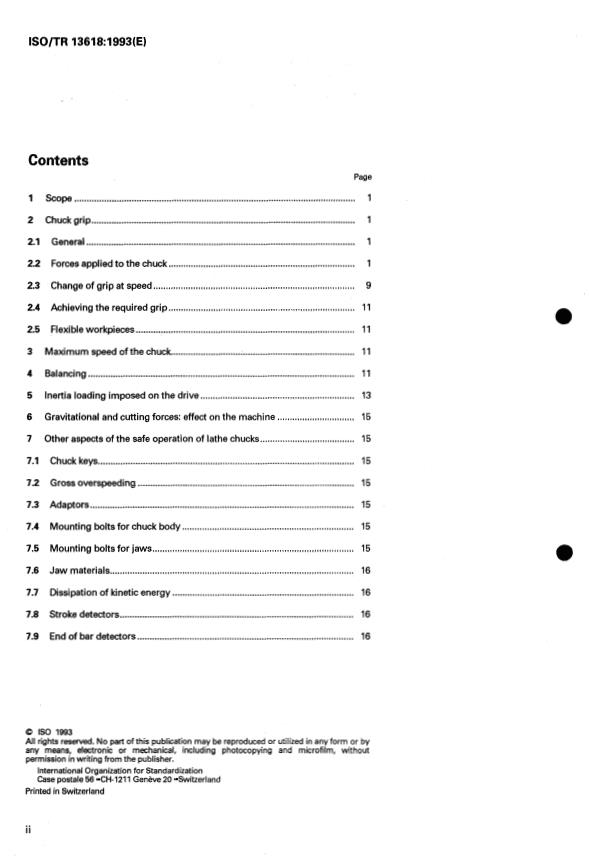
Contents
Page
1 scope . 1
2 Chuck grip .
2.1 General . 1
2.2 Forces applied to the chuck .
2.3 Change of grip at speed . 9
2.4 Achieving the required grip . 11
2.5 Flexible workpieces . 11
3 Maximum speed of the chuck . 11
4 Balancing .
5 Inertia loading imposed on the drive . 13
6 Gravitational and cutting forces: effect on the machine . 15
7 Other aspects ofthe safe operation of lathe chucks . 15
Chuck keys .
7.1
7.2 Gross overspeeding .
Adaptors .
7.3
Mounting bolts for chuck body . 15
7.4
Mounting bolts for jaws . 15
7.5
Jaw materials . 16
7.6
Dissipation of kinetic energy . 16
7.7
7.8 Stroke detectors .
7.9 End of bar detectors .
(D IS0 1993
All rights reserved . No part of this publication may be reproduced or utilized in any form or by
any means. electronic or mechanical. including photocopying and microfilm. without
permission in writing from the publisher .
International Organization for Standardization
Case postale 56 CH-121 1 Genève 20 Switzerland
Printed in Switrerland
ii
8 Summary of the responsibilities of machine tool manufacturer, chuck
manufacturer and . 16
Appendices
A Estimation of power available at the cutting zone . 18
B Radial stiffness and out-of-roundness of ring held in jaws . 18
C Measurement of the inertia of irregular components . 19
D Worked example . 37
E Bibliography . 52
...
III
ISO/TR 1361 8: 1993(E)
Foreword
IS0 (the International Organization for Standardization) is a worldwide
federation of national standards bodies (IS0 member bodies). The work of
preparing International Standards is normally carried out through IS0 technical
committees. Each member body interested in a subject for which a technical
committee has been established has the right to be represented on that
committee. International organizations, governmental and non-governmental, in
liaison with ISO, also take part in the work. IS0 collaborates closely with the
International Electrotechnical Commission (IEC) on all matters of electrotechnical
standardization.
The main task of technical committees is to prepare International Standards, but
in exceptional circumstances a technical committee may propose the publication
of a Technical Report of one of the following types:
- type 1, when the required support cannot be obtained for the publication of
an International Standard, despite repeated efforts;
I
- type 2, when the subject is still under technical development or where for
any other reason there is the future but not immediate possibility of an
agreement on an International Standard;
- type 3, when a technical committee has collected data of a different kind
from that which is normally published as an International Standard ("state of
the art", for example).
Technical Reports of types 1 and 2 are subject to review within three years of
publication, to decide whether they can be transformed into International Stan-
dards. Technical Reports of type 3 do not necessarily have to be reviewed until
the data they provide are considered to be no longer valid or useful.
ISO/TR 13618, which is a Technical Report of type 2, was prepared by Technical
Committee iSO/TC 39, Machine fools, Sub-Committee SC 8, Chucks.
This document is being issued in the type 2 Technical Report series of publica-
tions (according to subclause G.4.2.2. of part 1 of the ISO/IEC Directives, 1992) as
a "prospective standard for provisional application" in the field of work-holding
chucks for machine tools because there is an urgent need for guidance on how
standards in this field should be used to meet an identified need. This Technical
Report reproduces practically verbatim British Standard BS 1983-5:1989 and
implements it as an IS0 Technical Report. For the user's convenience, where
possible, references to national standards have been changed to refer to Inter-
national Standards.
This document is not to be regarded as an "International Standard". It is pro-
posed for provisional application so that information and experience of its use in
practice may be gathered. Comments on the content of this document should be
sent to the IS0 Central Secretariat.
I iv
ISO/TR 1361 8 1993(E)
A review of this type 2 Technical Report will be carried out not later than two
years after its publication with the options of extension for another two years;
conversion into an International Standard; or withdrawal.
Appendices A to E of this Technical Report are for information only.
a
a
V
ISO/TR 1361 8 1993(E)
Introduction
Lathe chucks operated at any speed are potentially very dangerous. They
have to be suitably guarded in order to ensure that personnel do not come
into contact with a moving chuck and that parts released from the chuck (for
whatever reason) cannot be thrown at personnel either directly or after a
ricochet. Power chuck controls also have to be suitably interlocked such that
workpieces are not inadvertently released. These safety aspects are covered
in IS0 13046.
However, because of the versatility of lathe chucks, it follows that chuck
designers and manufacturers cannot know the full range of uses to which
their chucks will be put (i.e. range of machines on which a chuck may be
mounted, type of jaws to be fitted, type of workpiece to be held). It is
essential, therefore, for the user to take some responsibility for the applica-
tion of a chuck. Further, in order that such duties can reasonably be under-
taken by the user, it is essential that sufficient design data are available and
that methods of calculation and/or of testing are specified. The machine tool
manufacturer will also be involved in certain aspects of these problems.
This Technical Report attempts to outline the duties of, and to provide some
of the necessary information needed by:
a) the machine tool manufacturer;
b) the chuck manufacturer; i
c) the chuck user.
However, because of the large number of chucks already in use, it is necess-
ary also to attempt to recommend the proper course of action regarding the
application of existing chucks for which the required design data were not,
in fact, transmitted from manufacturer to user and which are now unobtain-
able.
TECHNICAL REPORT ISO/TR 13618:1993(E)
Code of practice for the safe
operation of work-holding
chucks used on lathes
2.2 Forces applied to the chuck
1 Scope
2.2.1 General, The forces and torques applied via the
This Technical Report identifies and describes safe practices for
workpiece to the jaws of the chuck can be represented
design and operation of workholding chucks used on turning
by four terms:
machines.
ZFax the total axial thrust;
The technical aspects covered by this code concern:
ZFr the total radial force;
(a) the adequacy of the gripping force in the chuck;
EMd the total torque (about the spindle axis);
(b) the fact that at excessive speed there may be failure
ZMk the total (tilting) moment (about an axis
of chuck components (fracture or excessive yielding);
perpendicular to the spindle in the transverse
(c) acceptable degrees of lack of balance and consequent
centre plane of the jaws).
vi bration;
Each cutting tool, deadweight force and out-of-balance
(d) the inertia loading imposed on the machine drive
force and torque makes a contribution, usually to two or
both by the chuck and by the workpiece;
more of these total forces and torques, hence each contri-
(e) gravitational forces arising from the mass of the bution has to be calculated or measured.
chuck and workpiece, together in some circumstances
Evaluation of mass induced forces requires values of
with cutting forces, and their effect on the machine;
density (see table 1) unless components can be weighed.
Evaluation of dynamic forces involves also the eccentricity,
(f) other aspects concerning the safe operation of
e (see clause 4).
lathe chucks.
Whilst primarily intended for application to lever and
Table 1. Typical value of density, p
wedge type power chucks, including centrifugally compen-
sated types, this code of practice can and should also be
kg/m3
applied to manual chucks, but in such cases it is necessary
Magnesium alloy 1800
to know the input torque.
Aluminium alloy 2750
NOTE 1. It should be recognized that even when a torque wrench
or power driver is used, the grip is known to a lesser accuracy than,
Iron 7500
say, that of a power chuck having an hydraulically operated
Steel 7850
drawbar.
Zinc 7000
0 NOTE 2. Publications referred to in this Technical Report are listed
Tin 7290
in Appendix E.
Copper 8780
Nickel 8800
2 Chuckgrip
8280 (on average)
Brass
2.1 General
It should be recognized that there will be change of grip as
2.2.2 Cutting forces and torques. There are many elaborate
the rotational speed increases even when the chuck has
methods of calculating cutting forces and these methods
centrifugal com pensat ion.
are not precluded. Nevertheless the following simple
In the case of uncompensated, or only partially compen-
methods are deemed to be sufficiently accurate.
sated, chucks set up for external grip, i.e. the jaws move
(a) For turning, facing and boring:
inwards radially as the chuck is tightened, then an increase
(1) Estimate the tangential cutting force,
in rotational speed causes a loss of grip. However, when set
up for internal grip an increase in rotational speed causes F, (in N), as:
an increase in grip. Over-compensation has the opposite
F, =depth of cut (in mm)
effect, i.e. an external grip increases with speed. However
x feed (in mm)
over-compensation is not recommended in general because
x specific cutting force (in N/mm2)
it may lead to progressive tightening if the speed is cycled
where the specific cutting force is taken from table 2.
up and down repeatedly.
It is essential that the chuck gripping condition is evaluated
by the user or by tooling experts employed by him.
Table 2. Specific cutting forces, k,, for turning, facing and boring
Material I Tensile I Brinell
strength hardness
number*
0.1 mm 0.2 mm 0.4 mm 0.8 mm
N/mmz N/mmz
N/mmz HB N/mm2 N/mm2
3600 2600 1900 1360
Carbon steels low carbon (0.1 5 % C) up to 490 up to 150
2100 1520
low carbon (0.25 % C) 490to 580 150 to 200 4000 2900
2200 1560
medium carbon (0.4 % C) 580to 680 180 to 250 4200 3000
2300 1640
high carbon (0.55 % C) 680to 830 200to300 4400 3150
3200 2300 1700 1240
Cast steel 290to 490
1900 1360
490to 680 3600 2600
3900 2850 2050 1500
1 680+
4700 3400 2450 1760
Alloy steels 680to 830
5000 3600 2600 1850
830to 970
970 to 1370 5300 3800 2750 2000
5700 41 O0 3000 2150
1390 to 1750
c
Stainless steel I 580to 680 I I 5200 3750 I2700 I
Tool steel I 1460to1750 I I5700 I4100 I3000 I2150 I
Manganese hardened steel 6600 4800 3500 ,2520
Cast iron I I 200 to 250 I 2900 I 2080 I 1500 I 1080 1
Cast iron, alloy I I 250to400 I3200 I2300 I 1700 I1200 I
2400 1750 1250 920
Tempered cast iron
1520 1100 800
Copper
I 1900 I 1360
Copper with commutator mica (collectors) I I
Brass I I 80to120 1 1600 I1150
1400 1000
Cast copper
3400 2450
Cast bronze
I 940 I 700 I 560 I 430 I
Zinc alloy Zn-Al IO-Cu2 I I
1050 760
Pure aluminium
Aluminium alloy with high Si content 1400 1000
(1 1 % to 13 %. Si)
Piston alloy AI, Si (toughened) 1400 1000 700 520
I 1250 I 900 I 650 I 480
G AI-Si
I
1150 840 600 430
Other aluminium castings up to 290
1400 1000 700 520
290 to 420
I I I I
Wrouqht aluminium alloys I 420to579 I I 1700 I 1220
580 420
Magnesium alloys
I
480 350 250 I 180
Hard rubber, ebonite
480 350
Rubber free insulating compound
Novotex, Bakelite, Pertinaz
2””l
380 280
Hard paper, cardboard
- -
- 90
Hard graphite (nuclear)
+See IS0 4964.
-
ISO/TR 13618: 1993(E)
NOTE. When surfacing on a lathe, the depth of cut is measured (b) For drilling (and, approximately, for deep-hole
radially and the feed axially but when facing the depth of cut is
boring) :
measured axially and the feed radially.
(1) Estimate the drilling torque, M (in Nam), as:
Alternatively estimate the power, P (in W), available
M= 1.2k x C,
as in appendix A and derive the cutting force as
where:
follows:
k is the work material factor taken from table 3;
Cutting speed,
V (in m/s) = n x cutting diameter (in m)
C, is the torque factor, taken from figure 4,
x spindle speed (in r/s)
for the drill diameter and feed rate in use.
P
(2) Estimate the feed force, Fa (in N), as:
Tangential cutting force, F, = -
V
F=kf x F,,
(2) Increase F, by 1 %for each degree of top rake
where:
less than 10 O, add 10 %to allow for tool wear.
kf is a work material factor taken from table 4;
(3) Usually, feed force x O.6Fs. (For difficult
F,? is a force factor taken either from figure 5 (for
materials at slow speed, e.g. titanium, feed force
drills of all sizes in brass and aluminium and
= Fs.)
for drills up to 12 mm diameter in steel and
The feed force lies parallel to the spindle axis when
cast iron) or from figure 6 (for drills of 16 mm
cylindrical turning or boring, i.e. F, in figures 1
and over in steel and cast iron).
to 3. It lies perpendicular to the spindle axis when
NOTE 1. The information given in table 4 and figures 5 and 6 is
facing, i.e. F, in figures 1 to 3.
based on two separate series of tests and does, therefore, show small
discrepancies in the region of 12 mm to 16 mm drill diameter.
(4) Separating force % O.25Fs and may usually be
NOTE 2. This calculation may be omitted if the workpiece is
neglected. The separating force lies perpendicular
axially located by the chuck.
to the spindle axis when cylindrical turning or boring,
i.e. F, in figures 1 to 3. It lies parallel to the spindle
axis when facing, i.e. F, in figures 1 to 3.
Table 3. Work material factor, k, for drilling (and deep hole boring) torque
Typical specifications k
Description
Steels:
220 M 07 (En 1 a) 4 to 4.5
Low carbon sulphurized (0.1 % C)
240 M 07 (En Ib)
Low carbon low sulphur (0.2 % C) 080 A 22 (En 3)
(0.25 % C) 070 M 20 (En 4)
(0.3 % C) 080 M 30 (En 5) 5 to 5.5
(0.35 % C) 070 M 26 (En 6)
(0.1 %C) 045 M 10 (En 32)
080 M 40 (En 8) 4 to 4.5
Medium carbon (0.4 % C)
High carbon (0.55 % C) 070 M 55 (En 9)
709 M 40 (En 19)
Alloy steels
817 M 40 (En 24) 6 to 6.5
826 M 40 (En 26)
Brass 2 .O
1.6
Aluminium alloy (cast)
Cast iron: grey
Feed rate >0.7 mm/r
2.0
< 0.6 mm/r 3.0
Malleable iron
2.7
Feed rate > 0.7 mm/r
< 0.6 mm/r 3.5
~~
(c) For tapping:
Table 5. Value of work material factor, k,
(1) Estimate the torque, M (in N.m), as: for tapping
M=k x ct x cd x cm
k
Brinell
Material
where:
hardness
number*
k is the work material factor from table 5;
~
Ct is the tap factor from table 6;
HB
cd is the thread depth factor from table 7;
200 1.8
Grey cast iron
Cm is the thread factor from table 8.
1.9
Increase by 50 % to allow for tap wear. 1.6
Malleable cast iron
1.8
(2) Feed forces when tapping are not easy to
estimate and are, in general small enough to be Stee I s :
ignored. 2 .O
low carbon (0.1 5 % C)
2.4
low carbon (0.25 % C)
3.1
high carbon (0.55 % C)
3.5
typical alloy steel
Table 4. Work material factor, kf, for drilling (and deep
0.7
Aluminium alloys
O .4
Magnesium alloys
1.4
Brass
Material
0.7
Leaded brass
O .8
Phosphor bronze
12mm 16mm
*See IS0 4964.
800 180
Low carbon steel (up to 0.25 % C)
(all feed rates)
1100 200
Medium carbon steel (over 0.3 % c)
I
(all feed rates)
Table 6. Value of tap factor, Ct
Grey cast iron
feed rate > 0.7 mm/r ct
640 100
< 0.6 mm/r
Spiral-point 1 .O
Malleable cast iron
Helical flute RH 1.3
380 90
feed rate > 0.7 mm/r
1.7
Straight flute: in general
500 120
< 0.6 mm/r
but over 40 mm dia. length of
1.3
thread less than one diameter
Brass
feed rate >0.7 mm/r
300 1
< 0.6 mm/r
Aluminium
feed rate > 0.7 mm/r
< 0.6 mm/r 600
Table 7. Values of thread depth factor, cd,
for tapping
Depth of Cd
thread
%
0.57
65 0.75
75 0.9
80 1 .O
85 1 .I
Basic
major dia
asic
inor dia.
I- =I ;(e;; thread 1
I
hole dia.
A
Percentage depth of thread = - x 100
B
where:
A = basic major diameter - core hole diameter
B = basic major diameter - basic minor diameter
ISO/TR 1361 8:1993[E)
~~
~~
Table 8. Values of thread factor, Cm, for tapping
(a) IS0 metric coarse pitch series
Diameter X pitch
M3 x 0.5 0.1
M4 x 0.7 0.22
M5 x 0.8 0.35
M6 XI 0.63
1.3
M8 x 1.25
M10x 1.5 2.2
MI2 x 1.75 3.5
M16x 2 6.0
M20 x 2.5 11
M24 x 3 19
M30 x 3.5
M36 x 4 48
M42 x 4.5 69
M48 x 5 96
M56 x 5.5 133
M64 x 6 179
(b) IS0 metric constant pitch series
Diameter Pitch (mm)
- -
1 1.25 1.5 2 3 4 6
-
mm
Cm Cm
Cm Cm crn Cm Cm
8 0.9 1.3
10 1 .I 1.6 2.2
12 1.3 2 .O 2.7 4.4
16 1.8 3.7 6.0
20 2.3 4.7 7.7
24 2.8 5.6 9.3
7.1 11.8 24
30 3.5
8.6 14.3 29 48
42 10.0 16.7 34 56
39 65
48 11.5 19
13.5 22 46 76
15.5 26 53 88 179
72 17.5 29 60 99 202
80 19.0 32 66 111 226
75 256
90 36 125
139 285
1 O0 40 83
45 92 154 315
51 105 175 360
57 118 196 404
160 65 135 225 463
180 73 152 253 522
ISO/TR 1361 8 1993(E)
(c) B.S.W. (e) B.S.P.
Diameter threads Nominal Outside threads
Cm
per inch diameter diameter per inch
in in in
'14 26 0.6 '/8 0.383 28 0.9
5/~6 22 1 .I '/4 0.518 19 2.5
0.656 19 3.2
3/8 20 1.6 3/8
16 3.2 0.825 14 6.8
'/2 '/2
14 5.1 0.902 14 7.5
5/8 5/8
12 8.1 3/4 1 .O41 14 8.7
3/4
"/8 11 11 1.189 10
'/8
1 1 1.309 17
10 15 11
1 '/8 9 20 1 '/4 1.650 11 22
9 1.882 11 25
1 '/4 23 1 '12
8 34 2.116 11 28
1 '/2 1 3/4
7 51 2 2.347 11 31
1 3/4
2 7 58 2 '/4 2.587 11 34
2 '/4 6 86 2 '12 2.960 11 39
2 '/2 6 96 2 3/4 3.210 11 43
3 5 161 3 3.4 60 11 46
3 '/2 4 '/2 227
4 261
4 '12
(f) Inch-based constant-pitch series
Pitch (threads per inch)
Diameter
(d) B.S.F.
8 12
16 20
Diameter threads
per inch
in
in
1 11
6.6 4.5
20 1 '/8 12.4 7.5 5
'/4
1.5
18 1 '/4 13.8 8.3 5.6
5/16
2.3
16 1 3/8 15.3 9.2 6.2
3/8
5.2
12 1 '12 34 16.7 10.1 6.8
'/2
7.7 40 19.6
11 1 314 11.8 7.9
5/8
10 11 2 46 23 13.5
3/4 9.1
9 16 l/4 52 25 15.2 10.2
"/a 2
1 8 22 2 '/2 58 28 17 11.4
7 32 2 3/4 64 31 19 12.5
1 '/8
35 3 70 34
1 '14 7 '/2 20 13.7
6 56 76
1 '/2 3 '/4
5 91 82
1 3/4 3 '/2
2 '/2 126 3 3/4 88
4 175 4 94
2 '/4
4 196
2 '12
3 300
3 '12
3 '/2 3 '14
4 3 532
2.2.5 Inclined slides and multiple slides. When an inclined
2.2.3 Loading on the chuck: overhung workpiece, simple
slide is used the cutting forces act at a different point and
tooling. The loading on the chuck for an overhung work-
in different directions, see figure 3, where they are
piece, using simple tooling, is the easiest case to analyse.
denoted by FSi, F,,, Fpi, for a slide rotated by angle, a,
Referring to figure 1 :
from the 'horizontal' position.
Axially ZFaX = F, +
The forces, torques and moments F,, F, and F, then
become:
axial thrust (drilling)
Axial force, Fv = Fvi
I'
longitudinal feed force (turning)
Radial forces at the axis,
F, = Fsi cosa + F,, sina
andFp=FpIcosa-Fsisina
NOTE 1. These terms replace F, and F, in the equations in 2.2.3.
dz
Torque about the axis = F,i 2
static unbalance torque
(neglect if nominally
dz .
symmetrical workpiece) NOTE 2. This term replaces F, - in the equations in 2.2.3.
Moment in a vertical plane"
cutting torque (turning)
I
dz
Radial force ZFr* = = FsIz - Fvi - COS@
(F, - WgI2 + (FPI2 + Wo2e
NOTE 3. This term replaces F,/, in the equations in 2.2.3
I I
Moment in a horizontal plane"
Dynamic out-of-balance
(w = 27~ NI60 where N is
dz
= F,I, - Fvi - sina
the spindle speed in rlmin)
(neglect if nominally
NOTE 4. This term replaces Fplz in the equations in 2.2.3.
symmetrical workpiece)
In the case of multiple slides, each slide is treated as inclined
and the resultant values are summed as follows, where the
r.m.s. of cutting
I
suffix j indicates the slide:
forces + deadweight
Axially, Fv = ZFvij
Radially, F, = XFsj
Tilting moment * =
and F, = XFpj
Torque = Z: FSii ($)
Moments in Fs plane
Moment in vertical plane*
4 I
Dynamic out-of-balance
Moments in F, plane
(neglect if nominally
symmetrical workpiece)
Moment in horizontal plane*
Non-rotating Rotating
Fpj/zj - Fvij (zi) - sina)
2.2.4 Loading on the chuck: vertical spindle, simple
2.2.6 Requiredgrip. The values of ZFax, ZMd are used
tooling. From figure 2:
as follows to establish the total grip, F,,, needed to
ZFax = Fv + Fvax + Wg
prevent slip:
where p,, is the coefficient of friction given in table 9.
NOTE. When the workpiece is axially located by the chuck XFaX
may be treated as zero provided it has a positive value initially.
in setting safety factors; no numerical criteria are available.
'These items can, at present, be used only subjectively
F,,
The choice between tangential and axial values in table 9
2.3 Change of grip at speed
is somewhat arbitrary. When there is no positive axial
It is essential that the chuck manufacturer provides graphs,
location tangential values for psp should be used if the
figure 8 being an example, showing the change of grip at
torque term (2LiMdldsp) is predominant, i.e. for most
various speeds when the chuck is fitted with standard jaws
turning operations. For drilling however when the term
positioned flush with the outside diameter, inwardly
Li Fa, predominates it is acceptable to select a value of
stepped (see figure 9(c)). Supplementary data for outwardly-
psp from the axial column of table 9.
stepped jaws and for smaller radii would be acceptable,
The grip Fsp then has to be increased by a factor, S,,
as additional curves or on separate graphs, as would
in order to provide for:
comparable data for blank jaws. The information may be
calculated or obtained experimentally using a stiff load
(a) a margin of safety to cater for values of LiMk;
transducer, e.g. one having a steel load path. Results
(b) any further margin of safety.
obtained using a flexible load transducer, e.g. of the
(The force of LiFr will cause radial deflection of the work-
hydraulic type, are not acceptable.
piece but no criteria are available, currently, to establish
NOTE 1. The transducer should, preferably, be some 10 times stiffer
I imits.)
than the chuck.
A minimum of S, = 2 is to be adopted, increased as
The chuck manufacturer also has to state the masses of
necessary to cater for large values of LiMk (for which
base jaws and any top jaws supplied and give the location
I, > dsp probably) and other adverse factors, and a factor
of their centres of mass (both being marked, preferably,
S,, = 1.5 is used to provide a margin of safety when
on the jaws).
calculating the required total static grip, (Fspo) given by:
The chuck user has to read off, from the graphs, the change
Fspo = Ssp (FspzSz + Fc) in grip, F, (in N), arising from the change in speed:
for external grip (jaws moving radially inwards to grip)
(a) an increase for internal gripping;
Fspo = ssp (Fsp2 Sz - Fc) (b) a decrease for external gripping. (See 2.1.)
for internal grip (jaws moving radially outwards to grip)
Unless an internal grip has to be limited by the need to
where F, is the centrifugal force on jaws, see 2.3. avoid marking or distorting the workpiece, it is quicker
and preferable to assume F, = O.
2.2.7 Effect of a tailstock centre. If a tailstock centre is
The loss of grip'should not normally be allowed to exceed
used then the loading situation at the chuck becomes
one half of its original value.
complex. Two approximate simplifications are possible.
Where the conditions of use are not covered by the graphs
(a) When the workpiece is not axially located by the
available the chuck user has to calculate the change of grip,
chuck then an overestimate, and hence a safe estimate
F,, of uncompensated chucks as:
of the forces is obtained if the tailstock is ignored and
F, = o2 Li(ml R1)
the calculations made as for an overhung workpiece.
This approach is justified on the basis that should the
where:
workpiece slip in the chuck then it may well slip off
m1,2 etc. are the masses of the jaw components (in kg);
the tailstock centre.
R1,? etc. refer to the radii of their centres of mass
(b) When the workpiece is axially located by the chuck
(in m);
then:
~3 is the angular velocity (in rad/s) = 2nN/60 where
ZF,, = O;
N is the spindle speed in (r/min).
LiFr* is evaluated after applying the multiplying
Figure 10 shows a log-log plot of F, covering the range of
factor given in figure 7 to each component;
chuck speeds, from 10 r/min to 10 O00 r/min, and products
LiMd is evaluated as for an overhung workpiece;
of jaw mass (in kg) x radius of centre of mass (in m) from
LiMk* is evaluated after applying the multiplying
0,001 kg.m to 100 kgam.
factor given in figure 7 to each component.
For example, a 5 kg jaw set at 250 mm radius will have an
Thus the effect of a tailstock centre is to modify the values
mr value of 5 x 0.25 = 1.25 kg.m and when rotated at
of ZFv* and EMk* thus leading to the subjective choice
750 r/min will cause a loss of grip per jaw of
of lower values for the safety factor S,.
(27r x 750/60)2 x 1.25 = 771 1 N.
NOTE. No guidelines are available to deal with this aspect; moreover
NOTE 2. Where the jaw data are not available from the chuck
the values of Zfr* and of ZMk* will usually besmall. Hence,
manufacturer or where the user has designed and manufactured
at present, it is recommended that ZFr* and xMk* be neglected.
the jaw, the user has to determine the required information on the
mass and the position of the centre of gravity by calculation or by
measurement.
at present, be used only subjectively in setting safety factors; no numerical criteria are available.
'These items can,
ISO/TR 1361 81993(E)
-
'O,
C
.-
U
E
C
.-
LD
c- v
c! in
O0 O O
coco -WO WO6
220 F
N.-! v in
O00 O20
owm
77-
O00
dolo
cq
vtin
O00
O0
wow (voco (uwo
9-5- -niv vc!
O00 O00 O02
Loco- ZWN
99r 7-
O00 O00
I
A=
c
O
E
v)
Ea2
ISO/TR 1361 8: 1993(E)
Compensated chucks have to be operated strictly in
(b) Externalgrip. Initially calculate the required
accordance with manufacturers' instructions. The use of
grip (i.e. Fçpo) as in 2.2. If this grip is acceptable from
other jaws can lead to over or under compensation,
the point of view of geometric distortion, apply it,
both effects being dangerous; the former may lead to
or an even greater grip, as in 2.4(e) using distortion as
progressive tightening up as speeds change while the latter
the criterion instead of indentation, otherwise treat
can lead to loss of grip as for an uncompensated chuck.
as item (c).
NOTE 3. The 'compensating' part of the chuck can be represented,
(c) Where it is required to take advantage of the
in the preceding equation, by a negative mr term.
flexibility of the workpiece in reducing the loss of
external grip it is necessary to know the flexibility of
2.4 Achieving the required grip
the chuck, obtained preferably from the chuck manu-
It is essential that the chuck manufacturer provides a graph
facturer, by direct measurement or by loss of grip on a
showing actuating torque (or drawbar pull) v. grip achieved
grip transducer of known stiffness. The loss of grip can
for the chuck in the as new condition.
then be calculated as in figure 11 illustrated in figure 12.
The chuck user has to ensure that the chuck is kept in
good condition, i.e. cleaned and relubricated according to
the instructions supplied with it and recalibrated as
3 Maximum speed of the chuck
necessary, for example every 12 months. It is important
that the correct lubricant is used.
It is essential that the chuck manufacturer states the
The maximum operating torque or force (as appropriate)
maximum speed permissible for the chuck. This speed has
should normally be used for all rigid workpieces but with
to be supported by overspeed type-testing results such that
the following provisos and exceptions.
the chuck type will have been run up to speeds 50 % above
(a) If the required grip is less than 50 % of the available
the maximum speed when fitted with soft jaw blanks of
grip according to the manufacturer's graph then there
specified mass set to maximum radius as in figure 9.
are no provisos.
NOTE. Tests using standard hard jaws can only be deemed suffi-
(b) If the required grip exceeds 75 % of the available
cient in the case where one-piece jaws are used and when facilities
grip but is not more than 90 %then the chuck has to for fitting soft jaws are not provided.
have been serviced and recalibrated within, say,
All chuck bodies have to be subjected to inspection for
3 months.
cracks.
(c) If the required grip exceeds 90 %of the available
The chuck user is responsible for conducting overspeed
grip then the chuck has to be rechecked before use.
tests if jaws heavier or at greater radius than the standard
conditions described above are to be used at speeds
(d) Where adequate grip cannot be achieved then
exceeding 75 % of the maximum speed quoted by the
cutting forces and/or spindle speed have to be reduced.
chuck manufacturer.
(e) If a grip less than the maximum is required in order
Where it proves impossible to obtain the necessary data
to avoid surface markings then the provisos of (a), (b)
from the chuck manufacturer the maximum peripheral
(c) apply but reading actual grip instead of available
and
speed has to be limited to:
grip; the actuating torque being chosen accordingly.
NOTE. Soft and/or wrap round jaws can be used in order to reduce (a) 18 m/s for chuck bodies made of cast iron;
surface marking on the workpiece.
(b) 24 m/s for chuck bodies made of ductile iron;
(f) Where a reduced grip is acceptable by virtue of the
(c) 32 m/s for chuck bodies made of steel.
flexibility of the workpiece then the required grip
The maximum peripheral speeds in revolutions per minute
should be calculated according to 2.4 not 2.1.
for various diameters of chuck bodies are given in table IO.
2.5 Flexible workpieces
When flexible workpieces are gripped in a multi-jaw chuck,
the workpiece distorts and the change in grip at speed is
4 Balancing
much less.
The equations in appendix B enable the distortion and the
4.1 Spindle and chuck
diametral stiffness to be calculated.
It is essential that the machine tool manufacturer and chuck
NOTE. The appendix also illustrates the fact that six equally
manufacturer state the grade of balance of their respective
loaded jaws cause much less distortion than three.
products in accordance with IS0 1940-1.
Several situations can arise which need slightly different
NOTE 1. The specific unbalance, e, is defined as the permissible
treatment.
residual unbalance, U, divided by the mass, m. Because the unit
of U is g.mm and the mass is in kg, then it is convenient for e to be
(a) Internalgrip. Initially do not rely on any increase
in pm, and it represents the radial displacement of the centre of
in grip being available (i.e. in 2.2, F, = O) although in
mass from the axis of rotation. The quality grade is the resultant
fact a small increase.may occur.
circular velocity, that is ew, in mm/s, and when curves of constant
quality are plotted on axes of Ulm (or e), V.W. the graph in
figure 13 is obtained.
ISO/TR 1361 8:1993(E)
4.3 Dynamic behaviour
Table IO. Maximum peripheral speeds for various
In the case of lathes in particular, where there is often a
diameters of chuck bodies
rocking mode at a frequency of around 20 Hz to 40 Hz,
i.e. 1200 r/min to 2400 r/min, and where there is also a
Body I Maximum peripheral speed
machine fundamental corresponding to a speed usually
~~
diameter
above the maximum spindle speed, then the relationship
Cast iron Ductile iron Steel
between out-of-balance and resulting velocity is rather
mm complicated. Evaluation of this relationship needs a
r/min r/min r/min
measurement, or calculation, of effective mass and
80 4 297 9 730
7 639
out-of-balance. Moreover, at speeds around the rocking
1 O0
3 438 4 984 6 112
mode natural frequency, it is also necessary to know the
125 2 750
3 667 4 889
damping coefficient.
160 2 149 2 865
3 820
The problem of specifying permitted unbalance can best
200 1719 2 292
3 056
be handled by measurement of the velocity of the conse-
250 1 375 1833 2 447
quent vibration. Figure 14 shows a plot of such measure-
31 5
1 O91 1 455 1 940
ments. The off-peak readings are essentially a measurement
400 859
1146 1 528
of general vibrations at the natural frequency of around
500 686
917 1 222
26 Hz. The minor peaks are probably where harmonics of
630 547 728 970
the spindle rotational frequency coincide with the natural
I frequency. The major peak is the effect of out-of-balance
and is at spindle rotational frequency. A simple velocity
measurement would show this type of response but could
not identify the actual frequency components.
Four of the many recommended grades are specifically
related to machine tools:
4.4 Dealing with out-of-balance workpieces
(a) G 6,3 machine tools and general machinery;
The following procedures are recommended.
(b) G 2,5 machine tool drives;
(a) The machine manufacturer should:
(c) G 1 ,O grinding machine drives;
(1) ensure that normal installation practice does no
result in a natural frequency below 10 Hz;
(d) G 0,4 armatures of precision grinders.
(2) fit a velocity transducer (or other suitable instru-
For general purposes G 2,5 is recommended both for the
mentation) on to the housing of the front spindle
spindle and for the chuck when mounted on a reference
bearing with its axis normal to the spindle and lying
is one having a very good quality of balance
spindle, that
usually in a horizontal plane (unless tests have shown
(i.e. G 0,4) and trueness of mounting faces. For example a
that more severe vibration occurs in other directions);
3000 r/min spindle of quality G 2,5 has to have an e value
the transducer should respond to frequencies above
of 8 pm to carry a chuck and maintain quality to G 2,5.
8 Hz, the output being set to trigger a warning or
An e value of 8 pm implies that run out and wobble of the
cut-out device;
critical surfaces, at the nose, should be of this order or
(3) provide upon request, a graph showing the
better.
x eccentricity' v. 'spindle
maximum permitted 'mass
NOTE 2. Spindles and chuck when graded in this way will usually
speed'.
perform to the same grade when mounted together.
(b) It is essential that the user ensures that the installer
4.2 Workpiece balance
measures the lowest natural frequency of the machine
and that a label is affixed warning the operator never to
When one considers the workpiece as well as the spindle
run unbalanced workpieces at speeds within 25 %of
and chuck, it is not practicable to recommend a quality of
this frequency.
balance as in 4.1. However, vibrations can also be assessed
on the basis of the r.m.s. amplitude of the velocity they
(c) When the workpiece is obviously unbalanced the
produce, see for example IS0 2372, where ranges from
user should first consider the use of a process in which
0.071 mm/s to 71 mm/s are proposed and their appropriate
the workpiece does not rotate, or he should balance the
applications listed. If one examines this table and considers
workpiece (any balance weights added have to be
class II application, machine tool experience is that group A
securely fastened). Secondly, he should consider using
(i.e. velocities less than 1.12 mm/s) is nearly always accept-
a face plate (and balancing that if possible; if not
able and group D (i.e. velocities exceeding 7.1 mm/d is
item (2) below applies). Only thirdly should he permit
rarely acceptable while the area covered by groups B and C
the use of chuck provided certain precautions are taken
(i.e. velocities from 1.12 mm/s to 7.1 mm/s) is uncertain.
as follows.
ISO/TR 136181993(E)
(1) When an unbalanced workpiece is held in a chuck, spindle speeds may be given, or a separate value may be
given for each spindle speed.
it may be possible to balance the assembly by adding
so, the out-of-balance terms
masses to the chuck. Even NOTE. The values quoted will usually be chosen to suit the most
it be motor, clutches, brake or any
of the equations in 2.2.3 are still applicable as far as severe limiting feature whether
other component.
chuck grip is concerned and so the grip has to be
calculated, accordingly, after choosing the lowest At the discretion of the machine tool manufacturer the
practicable cutting speed. value(s) quoted may be qualified according to the
frequency of starting and/or stopping.
(2) Calculate, when balancing is not possible,
the 'mass x eccentricity' and refer to the graph The chuck manufacturer has to state the inertia of the
supplied by the machine manufacturer to ascertain chuck. Normally the inertia of the chuck fitted with
the maximum permitted speed. The actual speed standard jaws and set to maximum gripping diameter
should be given and, preferably, this inertia should be
selected has to be below this permitted speed.
marked on the body of the chuck.
In some cases the resulting speed may be well below
a normal speed for the operation.
The chuck user should ensure that the total chuck and
workpiece inertia does not lead to the permitted values
being exceeded. Methods of calculating the inertia,
(i.e. mass x (radius of gyration)') of the simple shapes are
5 Inertia loading imposed on the drive
shown in table 11, and a practical method of measuring
the inertia of complicated shapes is given in appendix C.
It is necessary for the machine tool manufacturer to state
Typical values of inertia, J, which apply to chucks wherein
0 the total maximum inertia permitted for the chuck and
the jaws are outwardly offset and lie flush against the
workpiece together. A single inertia value applicable to all
external diameter, dl , are given in table 12.
ISO/TR 1361 8: 1993(El
Table 11. Radii of gyration and moments of inertia
kz (Inertia = mka ) inertia (in terms of p)
Shape and axis of rotation
Hollow cvlinder
do2 + diz
d(dO4 -di4)
P
Rectangular prism
abd (b2 + d2)
d2 + b2
4d2 +b2 + 12rd+ 12r2 abd(4d2+b2+12rd+12r2)
P 12
Cylinder
d nd’ (412 + 3d2)
41’ + 3dZ
P
-
161 + 3d’ + 48rl+ 48r’ nd21(1612 + 3d2 + 48rl+ 48r2
P
t
Toothed profile
0.4 pl (do4 - di4 )
(approx.)
ISO/TR 1361 8: 1993(E)
In the interests of maximum safety, consideration should
Table 12. Typical values of inertia for chucks
be given to using:
where jaws are outwardly offset and lie flush
(a) a spring to eject the key as soon as it is released (it is
against the outside diameter
both acceptable and preferable for the spring to be
fitted to the key); or
J
(b) an interlock to prevent spindle rotation under power
Hand Power
I unless the key is returned to a holder fitted with a
detector (a magnetic code, if possible, as this is less
mm kg.m2
easily disabled by the operator than a switch); or
-
80 0.0012
(c) any other similar device.
-
1 O0
0.003
-
125 0.012
7.2 Gross overspeeding
160 O .O3 0.04
In the interests of maximum safety, consideration should
200 0.10 0.10
be given, not only to fitting warning+plates, but also to
250 0.25 0.3
positive methods of preventing gross overspeeding such as:
31 5 0.70 O .8
(a) high-speed spindle noses containing special features,
400 2.10 2 .O
such as pins, grooves and cut outs, which permit a
500 5.20 5 .O
matching high-speed chuck to be mounted but inhibit
630 1 1 .O 14.0
the mounting of a non-matching low-speed chuck;
e
NOTE. Some manufacturers vary the locking arrangement accord-
NOTE. These figures are taken from DIN 6386 : Parts 1 and 2.
ing to the speed range.
(b) a mechanical guard, trip or interlock which inhibits
high-speed selection when a chuck having too large a
diameter is mounted or, alternatively, inhibits mounting
a large diameter chuck when high-speed is selected;
6 Gravitational and cutting forces: effect on
(c) where appropriate, provision of a separate high-
the machine
speed inhibit in addition to any programmed speed
selection;
(d) means to prevent an irregular and, hence, unbalanced
It is essential that the machine tool manufacturer specifies
workpiece being run at speeds acceptable to the chuck
at the
values which define both the loading permitted
and size of workpiece but dangerous in view of the
spindle nose and the axial positions of the bearing centre-
unbalance (see also 4.2).
lines with respect to the nose generally.
It is essential that the chuck manufacturer states the mass
7.3 Adaptors
of the chuck and, in the case of chucks likely to be used on
The practice of user design, manufacture and application
horizontal spindles, the position of the centre of mass.
of adaptor/mounting plates is recognized as necessary.
Normally the mass of the chuck as fitte
...
Questions, Comments and Discussion
Ask us and Technical Secretary will try to provide an answer. You can facilitate discussion about the standard in here.
Loading comments...