

ISO 12167-2:2021
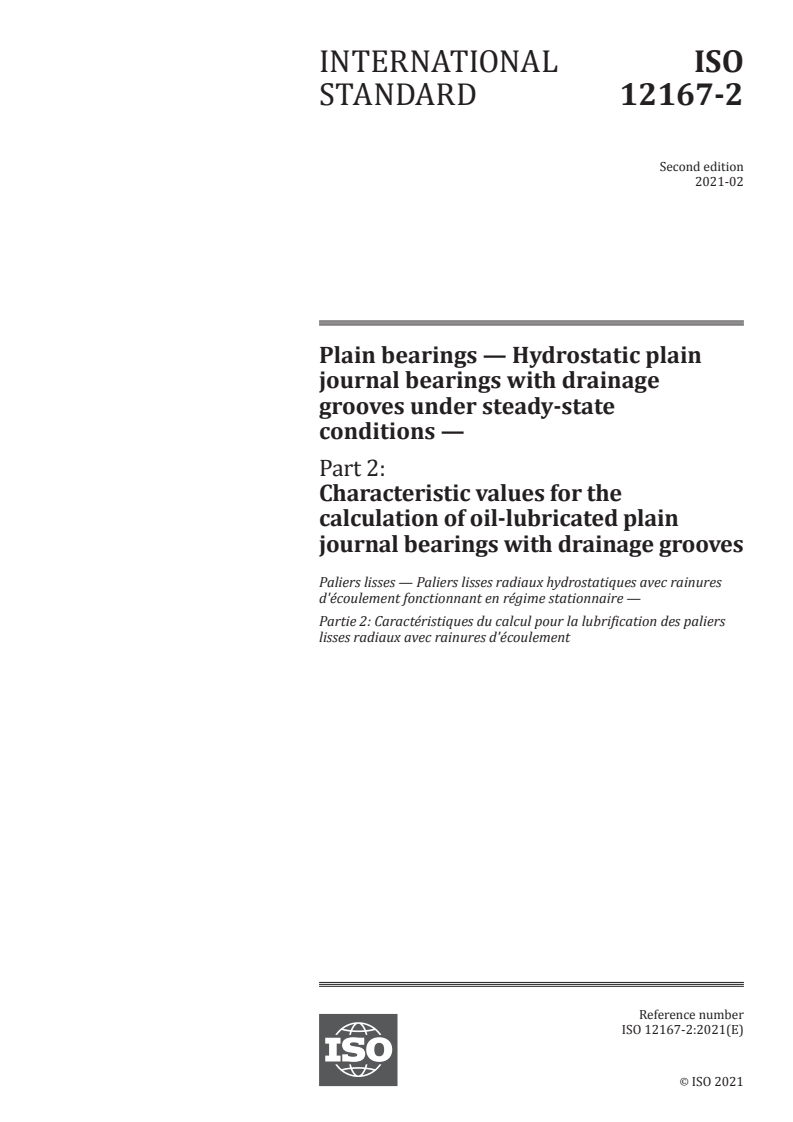
(Main)Plain bearings — Hydrostatic plain journal bearings with drainage grooves under steady-state conditions — Part 2: Characteristic values for the calculation of oil-lubricated plain journal bearings with drainage grooves
General Information
- Abstract
This document specifies, in graphic form, characteristic values used in the calculation of oil-lubricated plain journal bearings with drainage grooves.
- Status
- Published
- Publication Date
- 09-Feb-2021
- Current Stage
- 9060 - Close of review
- Completion Date
- 02-Sep-2031
Buy Documents

ISO 12167-2:2021 - Plain bearings -- Hydrostatic plain journal bearings with drainage grooves under steady-state conditions
ISO 12167-2:2021 - Plain bearings — Hydrostatic plain journal bearings with drainage grooves under steady-state conditions — Part 2: Characteristic values for the calculation of oil-lubricated plain journal bearings with drainage grooves/10/2021
Overview - ISO 12167-2:2021 (Hydrostatic plain journal bearings, drainage grooves)
ISO 12167-2:2021 specifies characteristic values in graphic form used for the calculation and preliminary design of oil‑lubricated hydrostatic plain journal bearings with drainage grooves under steady‑state conditions. Published as Part 2 of the ISO 12167 series, this second edition complements ISO 12167‑1 by providing diagrams, Table 1 and Figures 1–13 that supply designers with standardised data for hydrostatic plain journal bearings, including load and power characteristics for bearings with recesses and grooves.
Key topics and technical requirements
- Scope and basis: Values are intended for oil‑lubricated, hydrostatic plain journal bearings with drainage grooves; steady‑state, isothermal analysis is used as a first‑order approach (see Introduction).
- Graphic characteristic values: Diagrams and Table 1 provide values such as load‑carrying capacity (F*), attitude angle (β), total power (Ptot), and minimum recess pressure (Pmin) for a range of geometry and operating parameters.
- Typical parameters covered: Relative eccentricity (ε), land and recess dimensions (l/B, l/D, b/D), number of recesses (Z), resistance ratio (κ), speed‑dependent parameter (K), relative frictional pressure (π) and normalized pressure/load factors (P*, ξ). Table 1 lists characteristic values for an example “optimized bearing” parameter set (e.g., ε = 0.4; h = 40·C; α = 0; b/D = 0.05; P* = 2; l/B = 0.1; ξ = 1).
- Design context: Values are to be used in calculations in accordance with ISO 12167‑1. Explanations of symbols and worked calculation examples are covered in Part 1.
- Limitations: This part provides standardised characteristic values and diagrams; it does not replace detailed, modern numerical analyses (e.g., non‑isothermal, transient CFD/thermo‑hydrodynamic studies) when those are required.
Applications and who uses it
- Bearing designers and mechanical engineers: For preliminary sizing, selection and optimization of hydrostatic plain journal bearings with drainage grooves.
- Rotating equipment manufacturers: To standardise bearing design choices, estimate load capacity and power loss and ensure compatibility with ISO 12167‑1 calculation methods.
- Tribologists and maintenance engineers: For assessment of recess geometry effects, expected attitude angles and minimum recess pressures under steady operation.
- Industry sectors: Power generation, turbomachinery, heavy machinery, gearboxes and any application that uses oil‑lubricated hydrostatic plain bearings.
Related standards
- ISO 12167‑1 - Calculation of oil‑lubricated plain journal bearings with drainage grooves (normative companion referenced throughout Part 2).
- ISO 12167 series and work by ISO/TC 123 (Plain bearings) for broader plain bearing standards and calculation methods.
Keywords: ISO 12167-2, hydrostatic plain journal bearings, drainage grooves, characteristic values, oil‑lubricated bearings, bearing calculation, load‑carrying capacity, Ptot, eccentricity, bearing design.
Relations
- Effective Date
- 23-Apr-2020
Buy Documents
ISO 12167-2:2021 - Plain bearings -- Hydrostatic plain journal bearings with drainage grooves under steady-state conditions
ISO 12167-2:2021 - Plain bearings — Hydrostatic plain journal bearings with drainage grooves under steady-state conditions — Part 2: Characteristic values for the calculation of oil-lubricated plain journal bearings with drainage grooves/10/2021
Frequently Asked Questions
ISO 12167-2:2021 is a standard published by the International Organization for Standardization (ISO). Its full title is "Plain bearings — Hydrostatic plain journal bearings with drainage grooves under steady-state conditions — Part 2: Characteristic values for the calculation of oil-lubricated plain journal bearings with drainage grooves". This standard covers: This document specifies, in graphic form, characteristic values used in the calculation of oil-lubricated plain journal bearings with drainage grooves.
This document specifies, in graphic form, characteristic values used in the calculation of oil-lubricated plain journal bearings with drainage grooves.
ISO 12167-2:2021 is classified under the following ICS (International Classification for Standards) categories: 21.100.10 - Plain bearings. The ICS classification helps identify the subject area and facilitates finding related standards.
ISO 12167-2:2021 has the following relationships with other standards: It is inter standard links to ISO 12167-2:2001. Understanding these relationships helps ensure you are using the most current and applicable version of the standard.
ISO 12167-2:2021 is available in PDF format for immediate download after purchase. The document can be added to your cart and obtained through the secure checkout process. Digital delivery ensures instant access to the complete standard document.
Standards Content (Sample)
INTERNATIONAL ISO
STANDARD 12167-2
Second edition
2021-02
Plain bearings — Hydrostatic plain
journal bearings with drainage
grooves under steady-state
conditions —
Part 2:
Characteristic values for the
calculation of oil-lubricated plain
journal bearings with drainage grooves
Paliers lisses — Paliers lisses radiaux hydrostatiques avec rainures
d'écoulement fonctionnant en régime stationnaire —
Partie 2: Caractéristiques du calcul pour la lubrification des paliers
lisses radiaux avec rainures d'écoulement
Reference number
©
ISO 2021
© ISO 2021
All rights reserved. Unless otherwise specified, or required in the context of its implementation, no part of this publication may
be reproduced or utilized otherwise in any form or by any means, electronic or mechanical, including photocopying, or posting
on the internet or an intranet, without prior written permission. Permission can be requested from either ISO at the address
below or ISO’s member body in the country of the requester.
ISO copyright office
CP 401 • Ch. de Blandonnet 8
CH-1214 Vernier, Geneva
Phone: +41 22 749 01 11
Email: copyright@iso.org
Website: www.iso.org
Published in Switzerland
ii © ISO 2021 – All rights reserved
Contents Page
Foreword .iv
Introduction .v
1 Scope . 1
2 Normative references . 1
3 Terms and definitions . 1
4 Characteristic values . 1
Foreword
ISO (the International Organization for Standardization) is a worldwide federation of national standards
bodies (ISO member bodies). The work of preparing International Standards is normally carried out
through ISO technical committees. Each member body interested in a subject for which a technical
committee has been established has the right to be represented on that committee. International
organizations, governmental and non-governmental, in liaison with ISO, also take part in the work.
ISO collaborates closely with the International Electrotechnical Commission (IEC) on all matters of
electrotechnical standardization.
The procedures used to develop this document and those intended for its further maintenance are
described in the ISO/IEC Directives, Part 1. In particular, the different approval criteria needed for the
different types of ISO documents should be noted. This document was drafted in accordance with the
editorial rules of the ISO/IEC Directives, Part 2 (see www .iso .org/ directives).
Attention is drawn to the possibility that some of the elements of this document may be the subject of
patent rights. ISO shall not be held responsible for identifying any or all such patent rights. Details of
any patent rights identified during the development of the document will be in the Introduction and/or
on the ISO list of patent declarations received (see www .iso .org/ patents).
Any trade name used in this document is information given for the convenience of users and does not
constitute an endorsement.
For an explanation of the voluntary nature of standards, the meaning of ISO specific terms and
expressions related to conformity assessment, as well as information about ISO's adherence to the
World Trade Organization (WTO) principles in the Technical Barriers to Trade (TBT), see www .iso .org/
iso/ foreword .html.
This document was prepared by Technical Committee ISO/TC 123, Plain bearings, Subcommittee SC 8,
Calculation methods for plain bearings and their applications.
This second edition cancels and replaces the first edition (ISO 12167-2:2001), which has been technically
revised.
The main changes compared to the previous edition are as follows:
— adjustment to ISO/IEC Directives, Part 2:2018;
— correction of typographical errors.
A list of all parts in the ISO 12167 series can be found on the ISO website.
Any feedback or questions on this document should be directed to the user’s national standards body. A
complete listing of these bodies can be found at www .iso .org/ members .html.
iv © ISO 2021 – All rights reserved
Introduction
The results come from isothermal analysis and are just a first approach of the bearings behaviour and
in no case the results can be opposed to those obtained by and published in international documents
based on modern theories.
INTERNATIONAL STANDARD ISO 12167-2:2021(E)
Plain bearings — Hydrostatic plain journal bearings with
drainage grooves under steady-state conditions —
Part 2:
Characteristic values for the calculation of oil-lubricated
plain journal bearings with drainage grooves
1 Scope
This document specifies, in graphic form, characteristic values used in the calculation of oil-lubricated
plain journal bearings with drainage groove
...
INTERNATIONAL ISO
STANDARD 12167-2
Second edition
2021-02
Plain bearings — Hydrostatic plain
journal bearings with drainage
grooves under steady-state
conditions —
Part 2:
Characteristic values for the
calculation of oil-lubricated plain
journal bearings with drainage grooves
Paliers lisses — Paliers lisses radiaux hydrostatiques avec rainures
d'écoulement fonctionnant en régime stationnaire —
Partie 2: Caractéristiques du calcul pour la lubrification des paliers
lisses radiaux avec rainures d'écoulement
Reference number
©
ISO 2021
© ISO 2021
All rights reserved. Unless otherwise specified, or required in the context of its implementation, no part of this publication may
be reproduced or utilized otherwise in any form or by any means, electronic or mechanical, including photocopying, or posting
on the internet or an intranet, without prior written permission. Permission can be requested from either ISO at the address
below or ISO’s member body in the country of the requester.
ISO copyright office
CP 401 • Ch. de Blandonnet 8
CH-1214 Vernier, Geneva
Phone: +41 22 749 01 11
Email: copyright@iso.org
Website: www.iso.org
Published in Switzerland
ii © ISO 2021 – All rights reserved
Contents Page
Foreword .iv
Introduction .v
1 Scope . 1
2 Normative references . 1
3 Terms and definitions . 1
4 Characteristic values . 1
Foreword
ISO (the International Organization for Standardization) is a worldwide federation of national standards
bodies (ISO member bodies). The work of preparing International Standards is normally carried out
through ISO technical committees. Each member body interested in a subject for which a technical
committee has been established has the right to be represented on that committee. International
organizations, governmental and non-governmental, in liaison with ISO, also take part in the work.
ISO collaborates closely with the International Electrotechnical Commission (IEC) on all matters of
electrotechnical standardization.
The procedures used to develop this document and those intended for its further maintenance are
described in the ISO/IEC Directives, Part 1. In particular, the different approval criteria needed for the
different types of ISO documents should be noted. This document was drafted in accordance with the
editorial rules of the ISO/IEC Directives, Part 2 (see www .iso .org/ directives).
Attention is drawn to the possibility that some of the elements of this document may be the subject of
patent rights. ISO shall not be held responsible for identifying any or all such patent rights. Details of
any patent rights identified during the development of the document will be in the Introduction and/or
on the ISO list of patent declarations received (see www .iso .org/ patents).
Any trade name used in this document is information given for the convenience of users and does not
constitute an endorsement.
For an explanation of the voluntary nature of standards, the meaning of ISO specific terms and
expressions related to conformity assessment, as well as information about ISO's adherence to the
World Trade Organization (WTO) principles in the Technical Barriers to Trade (TBT), see www .iso .org/
iso/ foreword .html.
This document was prepared by Technical Committee ISO/TC 123, Plain bearings, Subcommittee SC 8,
Calculation methods for plain bearings and their applications.
This second edition cancels and replaces the first edition (ISO 12167-2:2001), which has been technically
revised.
The main changes compared to the previous edition are as follows:
— adjustment to ISO/IEC Directives, Part 2:2018;
— correction of typographical errors.
A list of all parts in the ISO 12167 series can be found on the ISO website.
Any feedback or questions on this document should be directed to the user’s national standards body. A
complete listing of these bodies can be found at www .iso .org/ members .html.
iv © ISO 2021 – All rights reserved
Introduction
The results come from isothermal analysis and are just a first approach of the bearings behaviour and
in no case the results can be opposed to those obtained by and published in international documents
based on modern theories.
INTERNATIONAL STANDARD ISO 12167-2:2021(E)
Plain bearings — Hydrostatic plain journal bearings with
drainage grooves under steady-state conditions —
Part 2:
Characteristic values for the calculation of oil-lubricated
plain journal bearings with drainage grooves
1 Scope
This document specifies, in graphic form, characteristic values used in the calculation of oil-lubricated
plain journal bearings with drainage groove
...