

ISO 3925:2014
(Main)Unsealed radioactive substances — Identification and documentation
- Abstract
ISO 3925:2014 establishes the requirements for the identification and documentation of unsealed radioactive substances issued commercially by suppliers and which are intended for further handling or processing, either physical or chemical. Requirements for radiopharmaceuticals and standard sources are not covered.
- Status
- Published
- Publication Date
- 05-Jan-2014
- Technical Committee
- ISO/TC 85/SC 2 - Radiological protection
- Drafting Committee
- ISO/TC 85/SC 2/WG 11 - Sealed sources
- Current Stage
- 9093 - International Standard confirmed - 90 Review
- Start Date
- 11-Dec-2025
Buy Documents
ISO 3925:2014 - Unsealed radioactive substances — Identification and documentation Released:1/6/2014

ISO 3925:2014 - Substances radioactives non scellées — Identification et documentation Released:1/6/2014
Overview
ISO 3925:2014 - Unsealed radioactive substances - Identification and documentation specifies requirements for labeling and documentation of commercially supplied unsealed radioactive substances intended for further physical or chemical handling. The standard excludes radiopharmaceuticals and standard sources. It promotes traceability, safe handling, and quality control by defining minimum identification marks on immediate containers and a comprehensive certificate of composition and activity.
Key topics and technical requirements
ISO 3925:2014 focuses on two main areas:
- Identification (labeling of immediate containers)
- Durable, legible marking with:
- Manufacturer’s name or symbol
- Radionuclide identification (chemical symbol and mass number) and, where physically possible, the chemical preparation name
- Radiation symbol in accordance with ISO 361 and, if space permits, the word “RADIOACTIVE”
- Cross-reference to the certificate
- Durable, legible marking with:
- Documentation (supplier’s certificate)
- Certificate must include, as appropriate: manufacturer name and address; preparation name and chemical form; radionuclide mass number and symbol; cross-reference to the container label; physical form and solvent; mass or volume; activity concentration and/or specific activity with stated date/time (and each radionuclide activity for mixtures); activity at a stated time/date; radionuclidic purity; radiochemical purity; chemical purity/impurities; pH (acidity/alkalinity); production and expiry dates; quantity and nature of any inactive materials; storage conditions; and nature of the immediate container.
- Normative references
- ISO 361 (basic ionizing radiation symbol) and ISO 921 (nuclear energy glossary) are cited as essential references.
Practical applications and intended users
ISO 3925:2014 is primarily used by:
- Suppliers and manufacturers of unsealed radioactive substances to ensure consistent labeling and to produce compliant certificates.
- Laboratories, research institutions, and industrial processing facilities that receive, handle, or chemically process unsealed radioactive materials and require accurate activity and purity information for planning and safety.
- Quality assurance, regulatory and compliance teams who need documented evidence of radionuclidic/radiochemical purity, activity concentrations, and storage requirements for audits and recordkeeping.
- Procurement and inventory managers who rely on standardized identification to track materials and maintain safe storage.
Practical benefits include improved traceability, better risk management for handling radioactive materials, streamlined regulatory compliance, and consistent supplier-to-user communication.
Related standards
- ISO 361 - Basic ionizing radiation symbol (labeling requirement referenced in ISO 3925)
- ISO 921 - Nuclear energy glossary (definitions used in the standard)
Keywords: ISO 3925, unsealed radioactive substances, identification, documentation, radionuclidic purity, radiochemical purity, activity concentration, supplier certificate.
Relations
- Effective Date
- 16-Jul-2011
Buy Documents
ISO 3925:2014 - Unsealed radioactive substances — Identification and documentation Released:1/6/2014
ISO 3925:2014 - Substances radioactives non scellées — Identification et documentation Released:1/6/2014
Get Certified
Connect with accredited certification bodies for this standard

CIS Institut d.o.o.
Personal Protective Equipment (PPE) certification body. Notified Body NB-2890 for EU Regulation 2016/425 PPE.

Kiwa BDA Testing
Building and construction product certification.
Kmetijski inštitut Slovenije
Agricultural Institute of Slovenia. Soil testing, plant health, agricultural product analysis.
Sponsored listings
Frequently Asked Questions
ISO 3925:2014 is a standard published by the International Organization for Standardization (ISO). Its full title is "Unsealed radioactive substances — Identification and documentation". This standard covers: ISO 3925:2014 establishes the requirements for the identification and documentation of unsealed radioactive substances issued commercially by suppliers and which are intended for further handling or processing, either physical or chemical. Requirements for radiopharmaceuticals and standard sources are not covered.
ISO 3925:2014 establishes the requirements for the identification and documentation of unsealed radioactive substances issued commercially by suppliers and which are intended for further handling or processing, either physical or chemical. Requirements for radiopharmaceuticals and standard sources are not covered.
ISO 3925:2014 is classified under the following ICS (International Classification for Standards) categories: 13.280 - Radiation protection. The ICS classification helps identify the subject area and facilitates finding related standards.
ISO 3925:2014 has the following relationships with other standards: It is inter standard links to ISO 3925:1978. Understanding these relationships helps ensure you are using the most current and applicable version of the standard.
ISO 3925:2014 is available in PDF format for immediate download after purchase. The document can be added to your cart and obtained through the secure checkout process. Digital delivery ensures instant access to the complete standard document.
Standards Content (Sample)
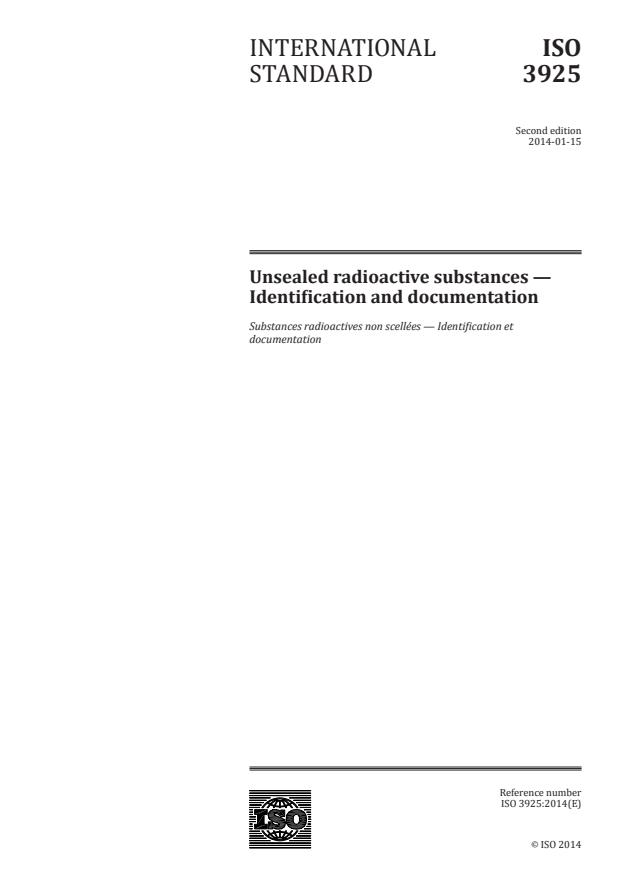
INTERNATIONAL ISO
STANDARD 3925
Second edition
2014-01-15
Unsealed radioactive substances —
Identification and documentation
Substances radioactives non scellées — Identification et
documentation
Reference number
©
ISO 2014
© ISO 2014
All rights reserved. Unless otherwise specified, no part of this publication may be reproduced or utilized otherwise in any form
or by any means, electronic or mechanical, including photocopying, or posting on the internet or an intranet, without prior
written permission. Permission can be requested from either ISO at the address below or ISO’s member body in the country of
the requester.
ISO copyright office
Case postale 56 • CH-1211 Geneva 20
Tel. + 41 22 749 01 11
Fax + 41 22 749 09 47
E-mail copyright@iso.org
Web www.iso.org
Published in Switzerland
ii © ISO 2014 – All rights reserved
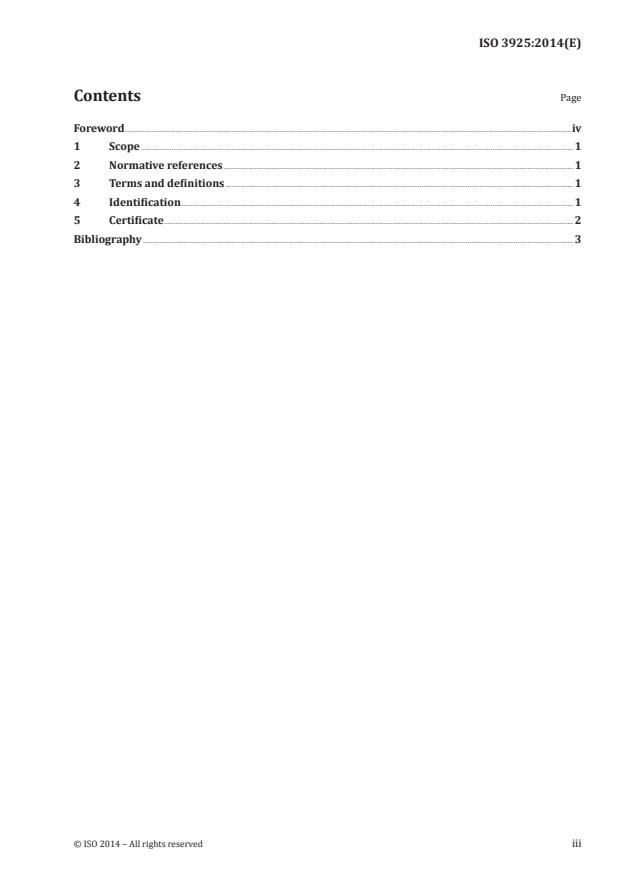
Contents Page
Foreword .iv
1 Scope . 1
2 Normative references . 1
3 Terms and definitions . 1
4 Identification . 1
5 Certificate . 2
Bibliography . 3
Foreword
ISO (the International Organization for Standardization) is a worldwide federation of national standards
bodies (ISO member bodies). The work of preparing International Standards is normally carried out
through ISO technical committees. Each member body interested in a subject for which a technical
committee has been established has the right to be represented on that committee. International
organizations, governmental and non-governmental, in liaison with ISO, also take part in the work.
ISO collaborates closely with the International Electrotechnical Commission (IEC) on all matters of
electrotechnical standardization.
The procedures used to develop this document and those intended for its further maintenance are
described in the ISO/IEC Directives, Part 1. In particular the different approval criteria needed for the
different types of ISO documents should be noted. This document was drafted in accordance with the
editorial rules of the ISO/IEC Directives, Part 2. www.iso.org/directives
Attention is drawn to the possibility that some of the elements of this document may be the subject of
patent rights. ISO shall not be held responsible for identifying any or all such patent rights. Details of any
patent rights identified during the development of the document will be in the Introduction and/or on
the ISO list of patent declarations received. www.iso.org/patents
Any trade name used in this document is information given for the convenience of users and does not
constitute an endorsement.
For an explanation on the mea
...
NORME ISO
INTERNATIONALE 3925
Deuxième édition
2014-01-15
Substances radioactives non
scellées — Identification et
documentation
Unsealed radioactive substances — Identification and documentation
Numéro de référence
©
ISO 2014
DOCUMENT PROTÉGÉ PAR COPYRIGHT
© ISO 2014
Droits de reproduction réservés. Sauf indication contraire, aucune partie de cette publication ne peut être reproduite ni utilisée
sous quelque forme que ce soit et par aucun procédé, électronique ou mécanique, y compris la photocopie, l’affichage sur
l’internet ou sur un Intranet, sans autorisation écrite préalable. Les demandes d’autorisation peuvent être adressées à l’ISO à
l’adresse ci-après ou au comité membre de l’ISO dans le pays du demandeur.
ISO copyright office
Case postale 56 • CH-1211 Geneva 20
Tel. + 41 22 749 01 11
Fax + 41 22 749 09 47
E-mail copyright@iso.org
Web www.iso.org
Publié en Suisse
ii © ISO 2014 – Tous droits réservés
Sommaire Page
Avant-propos .iv
1 Domaine d’application . 1
2 Références normatives . 1
3 Termes et définitions . 1
4 Identification . 2
5 Certificat . 2
Bibliographie . 3
Avant-propos
L’ISO (Organisation internationale de normalisation) est une fédération mondiale d’organismes
nationaux de normalisation (comités membres de l’ISO). L’élaboration des Normes internationales est
en général confiée aux comités techniques de l’ISO. Chaque comité membre intéressé par une étude
a le droit de faire partie du comité technique créé à cet effet. Les organisations internationales,
gouvernementales et non gouvernementales, en liaison avec l’ISO participent également aux travaux.
L’ISO collabore étroitement avec la Commission électrotechnique internationale (CEI) en ce qui concerne
la normalisation électrotechnique.
Les procédures utilisées pour élaborer ce document et celles prévues pour sa maintenance ultérieure
sont décrites dans les Directives ISO/CEI, Partie 1. En particulier, on notera les différents critères
d’approbation nécessaires pour les différents types de documents ISO. Le présent document est rédigé
conformément aux règles données dans les Directives ISO/CEI, Partie 2. www.iso.org/directives
L’attention est appelée sur le fait que certains des éléments du présent document peuvent faire l’objet de
droits de propriété intellectuelle ou de droits analogues. L’ISO ne saurait être tenue pour responsable
de ne pas avoir identifié de tels droits de propriété et averti de leur existence. Les détails des droits
de propriété industrielle identifiés durant l’élaboration du présent document sont précisés dans
l’Introduction et/ou dans la liste des déclarations de droit reçues par ISO. www.iso.org/patents
Tout nom de marque utilisé dans le présent document est une information donnée par convenance aux
utilisateurs et ne vaut pas comme endossement.
Pour une explication de la signification des termes spécifiques ISO et des expressions relatives
...