


ISO 15619
(Main)Reciprocating internal combustion engines — Measurement method for exhaust silencers — Sound power level of exhaust noise and insertion loss using sound pressure and power loss ratio
Reciprocating internal combustion engines — Measurement method for exhaust silencers — Sound power level of exhaust noise and insertion loss using sound pressure and power loss ratio
ISO 15619:2013 specifies the measurement method and requirements for exhaust silencers which is installed on reciprocating internal combustion engines, including laboratory measurement and site measurement.
Moteurs alternatifs à combustion interne — Méthode de mesure pour silencieux d'échappement — Niveau de puissance acoustique du bruit à l'échappement et perte par insertion à partir de la pression acoustique et du rapport de perte de puissance
General Information
Relations

Standards Content (Sample)
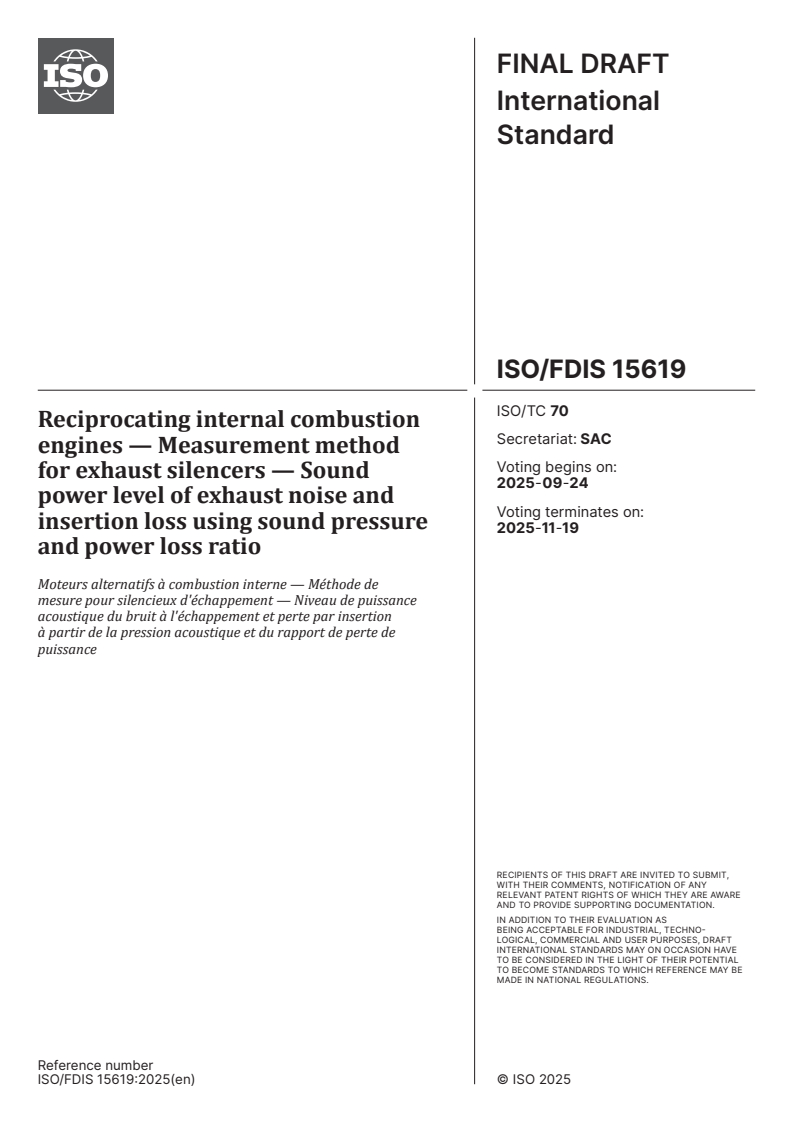
FINAL DRAFT
International
Standard
ISO/FDIS 15619
ISO/TC 70
Reciprocating internal combustion
Secretariat: SAC
engines — Measurement method
Voting begins on:
for exhaust silencers — Sound
2025-09-24
power level of exhaust noise and
Voting terminates on:
insertion loss using sound pressure
2025-11-19
and power loss ratio
Moteurs alternatifs à combustion interne — Méthode de
mesure pour silencieux d'échappement — Niveau de puissance
acoustique du bruit à l'échappement et perte par insertion
à partir de la pression acoustique et du rapport de perte de
puissance
RECIPIENTS OF THIS DRAFT ARE INVITED TO SUBMIT,
WITH THEIR COMMENTS, NOTIFICATION OF ANY
RELEVANT PATENT RIGHTS OF WHICH THEY ARE AWARE
AND TO PROVIDE SUPPOR TING DOCUMENTATION.
IN ADDITION TO THEIR EVALUATION AS
BEING ACCEPTABLE FOR INDUSTRIAL, TECHNO
LOGICAL, COMMERCIAL AND USER PURPOSES, DRAFT
INTERNATIONAL STANDARDS MAY ON OCCASION HAVE
TO BE CONSIDERED IN THE LIGHT OF THEIR POTENTIAL
TO BECOME STAN DARDS TO WHICH REFERENCE MAY BE
MADE IN NATIONAL REGULATIONS.
Reference number
ISO/FDIS 15619:2025(en) © ISO 2025
FINAL DRAFT
ISO/FDIS 15619:2025(en)
International
Standard
ISO/FDIS 15619
ISO/TC 70
Reciprocating internal combustion
Secretariat: SAC
engines — Measurement method
Voting begins on:
for exhaust silencers — Sound
power level of exhaust noise and
Voting terminates on:
insertion loss using sound pressure
and power loss ratio
Moteurs alternatifs à combustion interne — Méthode de
mesure pour silencieux d'échappement — Niveau de puissance
acoustique du bruit à l'échappement et perte par insertion
à partir de la pression acoustique et du rapport de perte de
puissance
RECIPIENTS OF THIS DRAFT ARE INVITED TO SUBMIT,
WITH THEIR COMMENTS, NOTIFICATION OF ANY
RELEVANT PATENT RIGHTS OF WHICH THEY ARE AWARE
AND TO PROVIDE SUPPOR TING DOCUMENTATION.
© ISO 2025
IN ADDITION TO THEIR EVALUATION AS
All rights reserved. Unless otherwise specified, or required in the context of its implementation, no part of this publication may
BEING ACCEPTABLE FOR INDUSTRIAL, TECHNO
LOGICAL, COMMERCIAL AND USER PURPOSES, DRAFT
be reproduced or utilized otherwise in any form or by any means, electronic or mechanical, including photocopying, or posting on
INTERNATIONAL STANDARDS MAY ON OCCASION HAVE
the internet or an intranet, without prior written permission. Permission can be requested from either ISO at the address below
TO BE CONSIDERED IN THE LIGHT OF THEIR POTENTIAL
or ISO’s member body in the country of the requester.
TO BECOME STAN DARDS TO WHICH REFERENCE MAY BE
MADE IN NATIONAL REGULATIONS.
ISO copyright office
CP 401 • Ch. de Blandonnet 8
CH-1214 Vernier, Geneva
Phone: +41 22 749 01 11
Email: copyright@iso.org
Website: www.iso.org
Published in Switzerland Reference number
ISO/FDIS 15619:2025(en) © ISO 2025
ii
ISO/FDIS 15619:2025(en)
Contents Page
Foreword .v
Introduction .vi
1 Scope . 1
2 Normative references . 1
3 Terms and definitions . 1
4 Test environment . 6
4.1 General .6
4.1.1 Engineering method .6
4.1.2 Survey method .6
4.2 Criteria for background noise .7
4.2.1 Engineering method relative criteria .7
4.2.2 Absolute criteria .7
4.2.3 Statement of non-conformity with criteria .7
4.2.4 Survey method .8
4.3 Criterion for acoustic adequacy of test environment .8
4.3.1 Engineering method .8
4.3.2 Survey method .9
5 Instrumentation . 9
5.1 General .9
5.2 Calibration .9
5.3 Use .10
6 Installation and operation of noise source under test for laboratory measurement .10
6.1 General .10
6.2 Source location .10
6.2.1 Engineering method .10
6.2.2 Survey method .10
6.3 Installation requirements .11
6.3.1 General .11
6.3.2 Straight transition pipe .11
6.3.3 Bent transition pipe . 12
6.3.4 Exhaust emission control systems and devices. 12
6.4 Operation condition . 12
7 Measurement .12
7.1 General . 12
7.2 Measurement uncertainty . 13
7.2.1 Engineering method . 13
7.2.2 Survey method . 13
7.3 Laboratory measurement .14
7.3.1 Microphone arrays.14
7.3.2 Determination of engine power .18
7.4 Site measurement .19
8 Calculation .22
8.1 General . 22
8.2 Calculation of sound power level of exhaust noise . 22
8.2.1 Calculation of mean time-averaged sound pressure levels . 22
8.2.2 Corrections for background noise . 22
8.2.3 Corrections for environment . 23
8.2.4 Calculation of surface time-averaged sound pressure levels . 23
8.2.5 Calculation of sound power levels . 23
8.3 Calculation of insertion loss .24
8.4 Calculation of power loss ratio .24
iii
ISO/FDIS 15619:2025(en)
9 Information to be recorded .24
9.1 General .24
9.2 Description of the tested exhaust silencer and substitution pipe .24
9.3 Description of the engine on which the exhaust silencer is installed .24
9.4 Acoustic environment .24
9.5 Description of instrumentation . . 25
9.6 Acoustical data . 25
10 Test report .25
Annex A (normative) Qualification procedures for the acoustic environment .26
Annex B (informative) Measurement procedure for pressure loss.30
Annex C (informative) Calculation of A-weighted sound power levels from frequency band levels .31
Annex D (normative) Sound power level under reference meteorological conditions .33
Bibliography .35
iv
ISO/FDIS 15619:2025(en)
Foreword
ISO (the International Organization for Standardization) is a worldwide federation of national standards
bodies (ISO member bodies). The work of preparing International Standards is normally carried out through
ISO technical committees. Each member body interested in a subject for which a technical committee
has been established has the right to be represented on that committee. International organizations,
governmental and non-governmental, in liaison with ISO, also take part in the work. ISO collaborates closely
with the International Electrotechnical Commission (IEC) on all matters of electrotechnical standardization.
The procedures used to develop this document and those intended for its further maintenance are described
in the ISO/IEC Directives, Part 1. In particular, the different approval criteria needed for the different types
of ISO document should be noted. This document was drafted in accordance with the editorial rules of the
ISO/IEC Directives, Part 2 (see www.iso.org/directives).
ISO draws attention to the possibility that the implementation of this document may involve the use of (a)
patent(s). ISO takes no position concerning the evidence, validity or applicability of any claimed patent
rights in respect thereof. As of the date of publication of this document, ISO had not received notice of (a)
patent(s) which may be required to implement this document. However, implementers are cautioned that
this may not represent the latest information, which may be obtained from the patent database available at
www.iso.org/patents. ISO shall not be held responsible for identifying any or all such patent rights.
Any trade name used in this document is information given for the convenience of users and does not
constitute an endorsement.
For an explanation of the voluntary nature of standards, the meaning of ISO specific terms and expressions
related to conformity assessment, as well as information about ISO's adherence to the World Trade
Organization (WTO) principles in the Technical Barriers to Trade (TBT), see www.iso.org/iso/foreword.html.
This document was prepared by Technical Committee ISO/TC 70, Internal Combustion Engines.
This second edition cancels and replaces the first edition (ISO 15619:2013), which has been technically
revised.
The main changes are as follows:
— added sources for terms and definitions cited in clause 3.
— deleted 4.2.1.2 of the original document;
— described the use of the instrument in the 7.1 as a separate subclause 5.3;
— removed duplicate descriptions mentioned in ISO 3046-1 and revised the text appropriately in 6.4 and 7.3.2;
— moved 1.1 in the original document to 7.2;
— revised descriptions in A.3.3;
— bibliography supplement.
Any feedback or questions on this document should be directed to the user’s national standards body. A
complete listing of these bodies can be found at www.iso.org/members.html.
v
ISO/FDIS 15619:2025(en)
Introduction
This document specifies methods for measuring the sound power level of exhaust noise and the insertion
loss of exhaust silencers installed on reciprocating internal combustion engines and a method for measuring
the power loss ratio of reciprocating internal combustion engines.
Sound power level of exhaust noise, insertion loss, and transmission loss are parameters to characterize
the acoustic performance of exhaust silencers. Sound power levels of exhaust noise and insertion loss
are important parameters to characterize the acoustic matching performance of exhaust silencers and
reciprocating internal combustion engines. Transmission loss is the difference in sound power level
of exhaust noise between the noise before and after transmitting through the exhaust silencer, which is
the parameter to characterize the acoustic performance of the exhaust silencer itself and not relevant
to the reciprocating internal combustion engine. Power loss ratio and pressure loss are parameters to
characterize the aerodynamic performance of exhaust silencers. Power loss ratio is an important parameter
to characterize the aerodynamic matching performance of exhaust silencers and reciprocating internal
combustion engines, whereas resistance coefficient which is closely related to pressure loss is to characterize
the aerodynamic performance of the exhaust silencer itself and is irrelevant with the reciprocating internal
combustion engine on which the exhaust silencer is installed. The matching parameters of the sound
power level of exhaust noise, the insertion loss, and the power loss ratio are used in this document as the
measurement parameters.
For sound power level of exhaust noise, the measurement results at 90° direction and 45° direction can be
different. The measurement results at 45° direction is slightly greater than the actual value, the measurement
results at 90° direction is much closer to the actual results. For insertion loss, the measurement results
at 90° direction and 45° direction may be different, but the measurement uncertainty at 90° direction is
smaller than that at 45° direction. Measurement at 90° direction is used for the laboratory measurement
(engineering method). The measurement at 90° or 45° direction is used for laboratory measurement (survey
method). The measurement at 45° direction is used for site measurement.
vi
FINAL DRAFT International Standard ISO/FDIS 15619:2025(en)
Reciprocating internal combustion engines — Measurement
method for exhaust silencers — Sound power level of exhaust
noise and insertion loss using sound pressure and power
loss ratio
1 Scope
This document specifies a measurement method and requirements for exhaust silencers which are installed
on reciprocating internal combustion engines, including laboratory measurement and site measurement.
This document applies to all exhaust silencers installed on reciprocating internal combustion engines falling
within the field of application of ISO 3046 1. This document can also apply to other exhaust silencers for
which no suitable International Standard exists.
NOTE Throughout the text, exhaust silencer is referred to as silencer and reciprocating internal combustion
engine as engine.
2 Normative references
The following documents are referred to in the text in such a way that some or all of their content constitutes
requirements of this document. For dated references, only the edition cited applies. For undated references,
the latest edition of the referenced document (including any amendments) applies.
ISO 3046-1, Reciprocating internal combustion engines — Performance — Part 1: Declarations of power, fuel
and lubricating oil consumptions, and test methods — Additional requirements for engines for general use
ISO 3046-3, Reciprocating internal combustion engines — Performance — Part 3: Test measurements
ISO 6926, Acoustics — Requirements for the performance and calibration of reference sound sources used for
the determination of sound power levels
ISO 7967-12, Reciprocating internal combustion engines — Vocabulary of components and systems — Part 12:
Exhaust emission control systems
IEC 60942, Electroacoustics — Sound calibrators
IEC 61260-1, Electroacoustics — Octave-band and fractional-octave-band filters
IEC 61672-1, Electroacoustics —Sound level meters —Part 1: Specifications
3 Terms and definitions
For the purposes of this document, the terms and definitions given in ISO 3046-1, ISO 3046-3, ISO 6926,
ISO 7967-12, IEC 60942, IEC 61260-1 and IEC 61672-1 and the following apply.
ISO and IEC maintain terminology databases for use in standardization at the following addresses:
— ISO Online browsing platform: available at https:// www .iso .org/ obp
— IEC Electropedia: available at https:// www .electropedia .org/
ISO/FDIS 15619:2025(en)
3.1
sound pressure
p
difference between instantaneous pressure and static pressure, expressed in pascals
[SOURCE: ISO 3744:2010, 3.1]
3.2
sound pressure level
L
p
ten times the logarithm to the base 10 of the ratio of the square of the sound pressure, p (3.1), to the square of
a reference value, p
p
L =10lg (1)
p
p
where the reference value, p , is 20 μPa
Note 1 to entry: If specific frequency and time weightings, as specified in IEC 61672–1, and/or specific frequency
bands are applied, this is indicated by appropriate subscripts, e.g. L denotes the A-weighted sound pressure level.
pA
Note 2 to entry: It is expressed in decibels.
[SOURCE: ISO 3744:2010, 3.2]
3.3
time-averaged sound pressure level
L
p,T
ten times the logarithm to the base 10 of the ratio of the time average of the square of the sound pressure, p
(3.1), during a stated time interval of duration, T (starting at t and ending at t ), to the square of a reference
1 2
value, p text of the definition
t
2
pt dt
()
∫
t
T
L =10lg (2)
pT,
p
where the reference value, p , is 20 μPa
Note 1 to entry: In general, the subscript “T” is omitted since time-averaged sound pressure levels are necessarily
determined over a certain measurement time interval.
Note 2 to entry: Time-averaged sound pressure levels are often A-weighted, in which case they are denoted by L ,
pA,T
which is usually abbreviated as L .
pA
Note 3 to entry: It is expressed in decibels.
[SOURCE: ISO 3744:2010, 3.3]
3.4
surface time-averaged sound pressure level
L
p
mean (energy average) of the time-averaged sound pressure levels (3.2) over all the microphone positions,
or traverses, on the measurement surface (3.11), with the background noise correction, K (3.13), and the
environmental correction, K (3.14), applied
Note 1 to entry: It is expressed in decibels.
[SOURCE: ISO 3744:2010, 3.18]
ISO/FDIS 15619:2025(en)
3.5
measurement time interval
T
portion or a multiple of an operational period or operational cycle of the noise source under test for which
the time-averaged sound pressure level (3.2) is determined
Note 1 to entry: It is expressed in seconds.
[SOURCE: ISO 3744:2010, 3.5]
3.6
acoustic free field
sound field in a homogeneous, isotropic medium free of boundaries
Note 1 to entry: In practice, an acoustic free field is a field in which the influence of reflections at the boundaries or
other disturbing objects are negligible over the frequency range of interest.
[SOURCE: ISO 3744:2010, 3.6]
3.7
reflecting plane
sound-reflecting planar surface on which the noise source under test is located
[SOURCE: ISO 3744:2010, 3.8]
3.8
acoustic free field over a reflecting plane
acoustic free field (3.6) in the half-space above an infinite reflecting plane (3.7) in the absence of any other
obstacles
[SOURCE: ISO 3744:2010, 3.7]
3.9
frequency range of interest
for general purposes, the frequency range of octave bands with nominal mid-band frequencies from 63 Hz to
8 000 Hz (including one-third octave bands with mid-band frequencies from 50 Hz to 10 000 Hz)
Note 1 to entry: For special purposes, the frequency range can be extended or reduced, provided that the test
environment and instrument specifications are satisfactory for use over the modified frequency range. Changes to the
frequency range of interest are included in the test report.
[SOURCE: ISO 3744:2010, 3.9]
3.10
measurement radius
r
radius of a spherical measurement surface (3.11)
Note 1 to entry: It is expressed in metres.
[SOURCE: ISO 3744:2010, 3.13]
3.11
measurement surface
hypothetical spherical surface of area, S, on which the microphone positions are located at which the sound
pressure levels (3.2) are measured, enveloping the noise source under test
[SOURCE: ISO 3744:2010, 3.14]
ISO/FDIS 15619:2025(en)
3.12
background noise
noise from all sources other than the noise source under test
Note 1 to entry: Background noise includes contributions from airborne sound, noise from structure-borne vibration,
and electrical noise in the instrumentation.
[SOURCE: ISO 3744:2010, 3.15]
3.13
background noise correction
K
correction applied to the mean (energy average) of the time-averaged sound pressure levels (3.2) over all the
microphone positions on the measurement surface (3.11), to account for the influence of background noise (3.12)
Note 1 to entry: The background noise correction is frequency dependent; the correction in the case of a frequency band
is denoted by K , where f denotes the relevant mid-band frequency, and that in the case of A-weighting is denoted by K .
1f 1A
Note 2 to entry: It is expressed in decibels.
[SOURCE: ISO 3744:2010, 3.16]
3.14
environmental correction
K
correction applied to the mean (energy average) of the time-averaged sound pressure levels (3.2) over all the
microphone positions on the measurement surface (3.11), to account for the influence of reflected sound.
Note 1 to entry: The environmental correction is frequency dependent; the correction in the case of a frequency band is
denoted by K , where f denotes the relevant mid-band frequency, and that in the case of A-weighting is denoted by K .
2f 2A
Note 2 to entry: In general, the environmental correction depends on the area of the measurement surfaceand, usually,
K increases with S.
Note 3 to entry: It is expressed in decibels.
[SOURCE: ISO 3744:2010, 3.17]
3.15
sound power
P
through a surface, the product of the sound pressure, p (3.1), and the component of the particle velocity, u , at
n
a point on the surface in the direction normal to the surface, integrated over that surface
Note 1 to entry: The quantity relates to the rate per time at which airborne sound energy is radiated by a source.
Note 2 to entry: It is expressed in watts.
[SOURCE: ISO 3744:2010, 3.20]
3.16
sound power level
L
W
ten times the logarithm to the base 10 of the ratio of the sound power (3.15) of a source, W, to a reference
value, W
W
L =10lg (3)
W
W
where the reference value, W , is 1 pW
Note 1 to entry: If a specific frequency weighting, as specified in IEC 61672–1, and/or specific frequency bands are
applied, this is indicated by appropriate subscripts, e.g. L denotes the A-weighted sound power level.
WA
ISO/FDIS 15619:2025(en)
Note 2 to entry: It is expressed in decibels.
[SOURCE: ISO 3744:2010, 3.21]
3.17
exhaust silencer
chamber with acoustic lining and/or special structure designed to reduce exhaust noise
Note 1 to entry: The ICE exhaust silencer generally comprises the entire part from its inlet but does not include the
exhaust manifold and pipe.
3.18
substitution pipe
rigid, non-absorbing pipe with no secondary noise having the same length and the same cross section area
of outlet as the tested silencer
3.19
straight transition pipe
straight pipe used to connect two pipes of different cross section areas
3.20
bent transition pipe
bent pipe used to change the airflow direction and to connect two pipes of the same cross section area
3.21
centre distance of several exhaust outlets
b
double average distance from one exhaust outlet to the geometric centre of all exhaust outlets
3.22
insertion loss
D
loss of sound power (3.15) due to the insertion of a component or device at some point in a transmission system
DL=−L (4)
1(WWSP)(AC)
where
L is the sound power level of exhaust noise when the substitution pipe is installed on the engine,
W(SP)
in decibels;
L is the sound power level of exhaust noise when the silencer is installed on the engine, in
W(AC)
decibels.
Note 1 to entry: Specifically, it is the difference between the sound power level of exhaust noise when the substitution
pipe is installed on the engine and when the exhaust silencer is installed on the engine. It is expressed in decibels.
ISO/FDIS 15619:2025(en)
3.23
power loss ratio
r
p
ratio of the difference between the engine power when the substitution pipe (3.18) is installed on the engine
and when the exhaust silencer (3.17) is installed on the engine, to the engine power with the substitution pipe
(3.18) installed on the engine in the declared condition
PP−
r(SP) r(ES)
r = ×100 % (5)
P
P
r(SP)
where
P is the engine power when the substitution pipe is installed on the engine under standard
r(SP)
reference condition, in kilowatts;
P is the engine power when the exhaust silencer is installed on the engine under standard
r(ES)
reference condition, in kilowatts.
Note 1 to entry: It is expressed in percentage.
4 Test environment
4.1 General
Environmental conditions having an adverse effect on the microphones used for the measurements (e.g.
strong electric or magnetic fields, wind, impingement of air discharge from the noise source being tested,
high temperatures) shall be avoided. The instructions of the manufacturer of the measuring instrumentation
regarding adverse environmental conditions shall be followed.
In an outdoor area, care shall be taken to minimize the effects of adverse meteorological conditions (e.g.
temperature, humidity, wind, precipitation) on sound propagation and sound generation over the frequency
range of interest or on the background noise during the course of the measurements.
When the altitude is higher than 1 500 meters, the sound power level should be corrected in accordance
with the baseline meteorological conditions specified in Annex D.
When a reflecting surface is not a ground plane or is not an integral part of a test room surface, particular
care should be exercised to ensure that the plane does not radiate any appreciable sound due to vibrations.
4.1.1 Engineering method
The test environments that are applicable for measurements in accordance with this document are the
following:
a) a laboratory room or a flat outdoor area which is adequately isolated from background noise (see 4.2)
and which provides an acoustic free field over a reflecting plane;
b) a room or a flat outdoor area which is adequately isolated from background noise (see 4.2) and in which
an environmental correction can be applied to allow for a limited contribution from the reverberant
field to the sound pressures on the measurement surface.
4.1.2 Survey method
The test environment that is applicable for measurements in accordance with this document is a room
or a flat outdoor area which is adequately isolated from background noise (see 4.2) and which meets the
qualification requirements of 4.3.
ISO/FDIS 15619:2025(en)
4.2 Criteria for background noise
4.2.1 Engineering method relative criteria
4.2.1.1 General
The time-averaged sound pressure level of the background noise measured and averaged (see 8.2.1) over the
microphone positions or traverses on the measurement surface shall be at least 6 dB, and preferably more
than 15 dB, below the corresponding uncorrected time-averaged sound pressure level of the noise source
under test when measured in the presence of this background noise. For measurements in frequency bands,
this requirement shall be met in each frequency band within the frequency range of interest.
If this requirement is met, the background noise criteria of this document are satisfied.
4.2.1.2 A-weighted measurements
If the A-weighted sound power level is to be determined from frequency band levels and reported, the
following steps shall be followed to determine whether this quantity meets the background noise criteria of
this document.
a) The A-weighted sound power level is computed in accordance with the procedures in this document
using the data from every frequency band within the frequency range of interest.
b) The A-weighted sound power level is recalculated, but excluding those bands for which ΔL < 6 dB (see 8.2.2).
p
If the difference between these two sound power levels is less than 0,5 dB, the A-weighted sound power level
determined from the data for all bands may be considered as conforming to the background noise criteria of
this document.
4.2.2 Absolute criteria
If it can be demonstrated that the background noise levels in the test room at the time of the measurements
are less than or equal to those given in Table 1 for all bands within the frequency range of interest, the
measurements can be taken as having met the background noise requirements of this document, even if
the 6 dB requirement (see 4.2.1.1) is not met for all bands. It can be assumed that the source emits little or
no measurable noise in these frequency bands and that the data reported represent an upper bound to the
sound power level in these bands.
In the case where some of the measured time-averaged levels from the source under test are less than or
equal to those given in Table 1, the frequency range of interest may be restricted to a contiguous range of
frequencies that includes both the lowest and highest frequencies at which the sound pressure level from
the noise source exceeds the corresponding value in Table 1. In such cases, the applicable frequency range of
interest shall be reported.
4.2.3 Statement of non-conformity with criteria
If neither the relative criteria of 4.2.1 nor the absolute criteria in 4.2.2 are met, the report shall clearly
state that the background noise requirements of this document have not been met and, in the case of
frequency band measurements, shall identify the particular frequency bands that do not meet the criteria.
Furthermore, the report shall not state or imply that the measurements have been made “in full conformity”
with this document.
ISO/FDIS 15619:2025(en)
Table 1 — Maximum background noise in the test room for absolute criteria
One-third octave mid-band frequency Maximum band sound pressure level
Hz dB
50 44
63 38
80 32
100 27
125 22
160 16
200 13
250 11
315 9
400 8
500 7
630 7
800 7
1 000 7
1 250 7
1 600 7
2 000 7
2 500 8
3 150 8
4 000 8
5 000 8
6 300 8
8 000 12
10 000 14
4.2.4 Survey method
The A-weighted sound pressure levels due to background noise averaged over the microphone positions
shall be at least 3 dB below the mean sound pressure level due to the noise source under test in operation
when measured in the presence of this background noise (see 8.2.1).
4.3 Criterion for acoustic adequacy of test environment
4.3.1 Engineering method
4.3.1.1 General
A test room shall provide a measurement surface that lies inside a sound field that is essentially free of
undesired sound reflections from the room boundaries or nearby objects (apart from the floor).
As long as it is practicable, the test environment shall be free from reflecting objects other than the reflecting
plane(s).
NOTE 1 An object in the proximity of the noise source under test can be considered to be sound reflecting if its
width (e.g. diameter of a pole or supporting member) exceeds one-tenth of its distance from the reference box.
ISO/FDIS 15619:2025(en)
The reflecting plane(s) shall extend at least 0,5 m beyond the projection of the measurement surface on the
plane(s). The sound absorption coefficient of the reflecting plane(s) shall be less than 0,1 over the frequency
range of interest.
NOTE 2 Smooth concrete or smooth sealed asphalt surface(s) are generally satisfactory.
Annex A specifies procedures for determining the magnitude of the environmental correction, K , to account
for deviations of the test environment from the ideal condition. Measurements in accordance with this
document are only valid where K ≤ 4 dB.
2A
The environmental correction, K , is assumed to be zero for measurements made in hemi-anechoic rooms
which meet the requirements of ISO 3745.
For an outdoor space which consists of a hard, flat ground surface, such as asphalt or concrete, with no
sound-reflecting objects within a distance from the noise source equal to 10 times the greatest distance
from the geometric centre of the source to the lowest measurement points, it shall be assumed that the
environmental correction K is less than 0,5 dB and can be neglected.
4.3.1.2 Criterion for environmental correction
The environmental correction, K , shall first be determined without reference to frequency band data,
2A
using one of the procedures of Annex A. Then:
a) if K > 4 dB, this document is not applicable;
2A
b) if K ≤ 4 dB, measurements may be made in accordance with this document, either in frequency bands
2A
or A-weighted.
Where it is decided to make measurements in frequency bands, the relevant environmental correction K
shall be determined in each band over the frequency range of interest in accordance with A.2, or calculated
from each band of A.3.1 and A.3.4 in the test frequency range. All measurements to determine L of a noise
W
source shall be made in frequency bands. L shall be calculated using the frequency-band levels (see
WA
Annex C).
4.3.2 Survey method
Annex A specifies procedures for determining the magnitude of the environmental correction, K , to
2A
account for deviations of the test environment from the ideal condition. Measurements in accordance with
this document are only valid where K ≤ 7 dB.
2A
5 Instrumentation
5.1 General
The instrumentation system, including the microphones, cables, and windscreens, if used, shall meet the
requirements of IEC 61672-1:2017, class 1 for results of accuracy grade 2 and class 2 for results of accuracy
grade 3, and the filters shall meet the requirements of IEC 61260:2014, class 1.
The sound level meter in acoustic measurement includes traditional handheld sound level meter and data
acquisition and analysis equipment.
5.2 Calibration
Before and after each series of measurements, a sound calibrator meeting the requirements of IEC 60942:2017,
class 1 shall be applied to each microphone to verify the calibration of the entire measuring system at one
or more frequencies within the frequency range of interest. Without any adjustment, the difference between
the readings made before and after each series of measurements shall be less than or equal to 0,5 dB. If this
value is exceeded, the results of the series of measurements shall be discarded.
ISO/FDIS 15619:2025(en)
The calibration of the sound calibrator, the conformance of the instrumentation system with the
requirements of IEC 61672-1, the conformance of the filter set with the requirements of IEC 61260, and, if
used, the conformance of the reference sound source with the requirements of ISO 6926 shall be verified at
intervals in a laboratory making calibrations traceable to appropriate standards.
The sound calibrator should be calibrated at intervals not exceeding 1 y, the reference sound source should
be calibrated at intervals not exceeding 2 y, the conformance of the instrumentation system with the
requirements of IEC 61672 1 should be verified at intervals not exceeding 2 y, and the conformance of the
filter set with the requirements of IEC 61260-1 should be verified at intervals not exceeding 2 y. Applicable
national regulations that specify different requirements can exist.
5.3 Use
To minimize the influence of observers on the measurements, the microphones shall preferably be mounted
on a rigid frame or stand and be connected to the sound level meter by a cable. It is essential to ensure that
the rigid frame or stand is not connected to the vibrating surface.
The microphone shall always be oriented in such a way that the angle of incidence of the sound waves is that
for which the microphone is calibrated and always be oriented to the centre of the exhaust outlet.
The time-averaged sound pressure level shall be measured using an integrating sound level meter. If the
sound level meter is used to measure time-weighting sound pressure level, the time-weighting characteristic
“S” shall be used for the engine operated in steady condition and the time-weighting characteristic “F” shall
be used for the engine operated in accelerated or decelerated condition which can be expressed as the time-
averaged sound pressure level if measured.
The period of observation for the A-weighted sound pressure level shall be at least 4 s, preferably 8 s or longer.
For the frequency bands centred on or below 160 Hz, the period of observation shall be at least 16 s. For the
frequency bands centred on or above 200 Hz, the period of observation shall be at least 8 s.
6 Installation and operation of noise source under test for laboratory measurement
6.1 General
The manner in which the silencer under test is installed and operated can have a signifi
...
ISO/DISFDIS 15619:2024(en)
ISO/TC 70/WG 13
Secretariat: SAC
Date: 2024-11-05
Reciprocating internal combustion engines — — Measurement
method for exhaust silencers — Sound power level of exhaust noise
and insertion loss using sound pressure and power loss ratio
Moteurs alternatifs à combustion interne — Méthode de mesure pour silencieux d'échappement — Niveau de
puissance acoustique du bruit à l'échappement et perte par insertion à partir de la pression acoustique et du
rapport de perte de puissance
FDIS stage
ISO #####-#:####(X/FDIS 15619:2025(en)
All rights reserved. Unless otherwise specified, or required in the context of its implementation, no part of this publication
may be reproduced or utilized otherwise in any form or by any means, electronic or mechanical, including photocopying,
or posting on the internet or an intranet, without prior written permission. Permission can be requested from either ISO
at the address below or ISO’s member body in the country of the requester.
ISO copyright office
CP 401 • Ch. de Blandonnet 8
CH-1214 Vernier, Geneva
Phone: + 41 22 749 01 11
EmailE-mail: copyright@iso.org
Website: www.iso.orgwww.iso.org
Published in Switzerland
ii © ISO #### 2025 – All rights reserved
ii
ISO/DISFDIS 15619:20242025(en)
Contents
Foreword . vi
Introduction . viii
1 Scope . 1
2 Normative references . 1
3 Terms and definitions . 1
4 Test environment. 7
5 Instrumentation . 10
6 Installation and operation of noise source under test for laboratory measurement . 11
7 Measurement . 14
8 Calculation . 27
9 Information to be recorded . 30
10 Test report . 31
Annex A (normative) Qualification procedures for the acoustic environment. 32
Annex B (informative) Measurement procedure for pressure loss . 37
Annex C (informative) Calculation of A-weighted sound power levels from frequency band
levels . 38
Annex D (normative) Sound power level under reference meteorological conditions . 40
Bibliography . 42
Foreword . v
Introduction . vi
1 Scope . 1
2 Normative references . 2
3 Terms and definitions . 3
4 Test environment. 7
4.1 General . 7
4.1.1 Engineering method . 7
4.1.2 Survey method . 8
4.2 Criteria for background noise . 8
4.2.1 Engineering method relative criteria . 8
4.2.2 Absolute criteria . 8
4.2.3 Statement of non-conformity with criteria . 9
4.2.4 Survey method . 10
4.3 Criterion for acoustic adequacy of test environment . 10
4.3.1 Engineering method . 10
4.3.2 Survey method . 11
iii
ISO #####-#:####(X/FDIS 15619:2025(en)
5 Instrumentation . 11
5.1 General . 11
5.2 Calibration . 11
5.3 Use . 11
6 Installation and operation of noise source under test for laboratory measurement . 12
6.1 General . 12
6.2 Source location . 12
6.2.1 Engineering method . 12
6.2.2 Survey method . 12
6.3 Installation requirements . 12
6.3.1 General . 12
6.3.2 Straight transition pipe . 13
6.3.3 Bent transition pipe . 13
6.4 Operation condition . 14
7 Measurement . 14
7.1 General . 14
7.2 Measurement uncertainty . 15
7.2.1 Engineering method . 15
7.2.2 Survey method . 15
7.3 Laboratory measurement . 16
7.3.1 Microphone arrays . 16
7.3.2 Determination of engine power . 19
7.4 Site measurement . 19
8 Calculation . 22
8.1 General . 22
8.2 Calculation of sound power level of exhaust noise . 22
8.2.1 Calculation of mean time-averaged sound pressure levels . 22
8.2.2 Corrections for background noise . 23
8.2.3 Corrections for environment . 23
8.2.4 Calculation of surface time-averaged sound pressure levels . 24
8.2.5 Calculation of sound power levels . 24
8.3 Calculation of insertion loss . 24
8.4 Calculation of power loss ratio . 25
9 Information to be recorded . 25
9.1 General . 25
9.2 Description of the tested exhaust silencer and substitution pipe . 25
9.3 Description of the engine on which the exhaust silencer is installed . 25
9.4 Acoustic environment . 25
9.5 Description of instrumentation . 25
9.6 Acoustical data . 26
10 Test report . 26
Annex A (normative) Qualification procedures for the acoustic environment . 27
A.1 General . 27
A.2 Absolute comparison test . 27
A.2.1 General . 27
A.2.2 Locations of reference sound source in test environment . 28
A.3 Determination of the environmental correction based on room absorption . 28
A.3.1 General . 28
iv © ISO #### 2025 – All rights reserved
iv
ISO/DISFDIS 15619:20242025(en)
A.3.2 Reverberation method . 28
A.3.3 Two-surface method . 28
A.3.4 Determination of the equivalent absorption A with a reference sound source (direct
method) . 29
A.3.5 Approximate method for measurements made with A-weighting . 30
Annex B (informative) Measurement procedure for pressure loss . 31
B.1 General . 31
B.2 Calculation of pressure loss . 31
Annex C (normative) Calculation of A-weighted sound power levels from frequency band levels32
C.1 A-weighted sound power levels . 32
C.2 Values of j and A for use in calculations . 32
j
Annex D (normative) Sound power level under reference meteorological conditions . 34
D.1 34
Bibliography . 36
v
ISO #####-#:####(X/FDIS 15619:2025(en)
Foreword
ISO (the International Organization for Standardization) is a worldwide federation of national standards
bodies (ISO member bodies). The work of preparing International Standards is normally carried out through
ISO technical committees. Each member body interested in a subject for which a technical committee has been
established has the right to be represented on that committee. International organizations, governmental and
non-governmental, in liaison with ISO, also take part in the work. ISO collaborates closely with the
International Electrotechnical Commission (IEC) on all matters of electrotechnical standardization.
The procedures used to develop this document and those intended for its further maintenance are described
in the ISO/IEC Directives, Part 1. In particular, the different approval criteria needed for the different types of
ISO document should be noted. This document was drafted in accordance with the editorial rules of the
ISO/IEC Directives, Part 2 (see www.iso.org/directives).
ISO draws attention to the possibility that the implementation of this document may involve the use of (a)
patent(s). ISO takes no position concerning the evidence, validity or applicability of any claimed patent rights
in respect thereof. As of the date of publication of this document, ISO had not received notice of (a) patent(s)
which may be required to implement this document. However, implementers are cautioned that this may not
represent the latest information, which may be obtained from the patent database available at
www.iso.org/patents.www.iso.org/patents. ISO shall not be held responsible for identifying any or all such
patent rights.
Any trade name used in this document is information given for the convenience of users and does not
constitute an endorsement.
For an explanation of the voluntary nature of standards, the meaning of ISO specific terms and expressions
related to conformity assessment, as well as information about ISO's adherence to the World Trade
Organization (WTO) principles in the Technical Barriers to Trade (TBT), see
www.iso.org/iso/foreword.htmlwww.iso.org/iso/foreword.html.
This document was prepared by Technical Committee ISO/TC 70, Internal Combustion Engines.
This second edition cancels and replaces the first edition (ISO 15619:2013), which has been technically
revised.
The main changes are as follows:
— — added sources for terms and definitions cited in clause 3.3.
— — deleted 4.2.1.24.2.1.2 of the original document;
— — described the use of the instrument in the 7.17.1 as a separate subclause 5.3;5.3;
— — removed duplicate descriptions mentioned in ISO 3046-1 and revised the text appropriately in 6.46.4
and 7.3.2;7.3.2;
— — moved 1.1 in the original document to 7.2;7.2;
— — revised descriptions in A.3.3;A.3.3;
— — bibliography supplement.
Any feedback or questions on this document should be directed to the user’s national standards body. A
complete listing of these bodies can be found at www.iso.org/members.html.
Field Code Changed
vi © ISO #### 2025 – All rights reserved
vi
ISO/DISFDIS 15619:20242025(en)
vii
ISO #####-#:####(X/FDIS 15619:2025(en)
Introduction
This document specifies methods for measuring the sound power level of exhaust noise and the insertion loss
of exhaust silencers installed on reciprocating internal combustion engines and a method for measuring the
power loss ratio of reciprocating internal combustion engines.
Sound power level of exhaust noise, insertion loss, and transmission loss are parameters to characterize the
acoustic performance of exhaust silencers. Sound power levels of exhaust noise and insertion loss are
important parameters to characterize the acoustic matching performance of exhaust silencers and
reciprocating internal combustion engines. Transmission loss is the difference in sound power level of exhaust
noise between the noise before and after transmitting through the exhaust silencer, which is the parameter to
characterize the acoustic performance of the exhaust silencer itself and not relevant to the reciprocating
internal combustion engine. Power loss ratio and pressure loss are parameters to characterize the
aerodynamic performance of exhaust silencers. Power loss ratio is an important parameter to characterize
the aerodynamic matching performance of exhaust silencers and reciprocating internal combustion engines,
whereas resistance coefficient which is closely related to pressure loss is to characterize the aerodynamic
performance of the exhaust silencer itself and is irrelevant with the reciprocating internal combustion engine
on which the exhaust silencer is installed. The matching parameters of the sound power level of exhaust noise,
the insertion loss, and the power loss ratio are used in this document as the measurement parameters.
For sound power level of exhaust noise, the measurement results at 90° direction and 45° direction can be
different. The measurement results at 45° direction is slightly greater than the actual value, the measurement
results at 90° direction is much closer to the actual results. For insertion loss, the measurement results at 90°
direction and 45° direction may be different, but the measurement uncertainty at 90° direction is smaller than
that at 45° direction. Measurement at 90° direction is used for the laboratory measurement (engineering
method). The measurement at 90° or 45° direction is used for laboratory measurement (survey method). The
measurement at 45° direction is used for site measurement.
viii © ISO #### 2025 – All rights reserved
viii
DRAFT International Standard ISO/DIS 15619:2024(en)
Reciprocating internal combustion engines — Measurement method
for exhaust silencers — Sound power level of exhaust noise and
insertion loss using sound pressure and power loss ratio
1 Scope
This document specifies a measurement method and requirements for exhaust silencers which are installed
on reciprocating internal combustion engines, including laboratory measurement and site measurement.
This document applies to all exhaust silencers installed on reciprocating internal combustion engines falling
within the field of application of ISO 3046 1. This document can also apply to other exhaust silencers for which
no suitable International Standard exists.
NOTE Throughout the text, exhaust silencer is referred to as silencer and reciprocating internal combustion engine
as engine.
2 Normative references
The following documents are referred to in the text in such a way that some or all of their content constitutes
requirements of this document. For dated references, only the edition cited applies. For undated references,
the latest edition of the referenced document (including any amendments) applies.
ISO 3046--1, Reciprocating internal combustion engines — Performance — Part 1: Declarations of power, fuel
and lubricating oil consumptions, and test methods — Additional requirements for engines for general use
ISO 3046--3, Reciprocating internal combustion engines — Performance — Part 3: Test measurements
ISO 6926, Acoustics — Requirements for the performance and calibration of reference sound sources used for the
determination of sound power levels
ISO 7967--12, Reciprocating internal combustion engines — Vocabulary of components and systems — Part 12:
Exhaust emission control systems
IEC 60942, Electroacoustics — Sound calibrators
IEC 61260--1, Electroacoustics — Octave-band and fractional-octave-band filters
IEC 61672--1, Electroacoustics —Sound level meters —Part 1: Specifications
3 Terms and definitions
For the purposes of this document, the terms and definitions given in ISO 3046-1, ISO 3046-3, ISO 6926, ISO
7967--12, IEC 60942, IEC 61260-1 and IEC 61672-1 and the following apply.
ISO and IEC maintain terminology databases for use in standardization at the following addresses:
— — ISO Online browsing platform: available at https://www.iso.org/obphttps://www.iso.org/obp
— — IEC Electropedia: available at https://www.electropedia.org/https://www.electropedia.org/
ISO #####-#:####(X/FDIS 15619:2025(en)
3.1 3.1
sound pressure
p
difference between instantaneous pressure and static pressure, expressed in pascals
[SOURCE: ISO 3744:2010, 3.1]
3.2 3.2
sound pressure level
Lp
ten times the logarithm to the base 10 of the ratio of the square of the sound pressure, p (3.1),(3.1), to the
square of a reference value, p0
p 𝑝
L 10lg 𝐿 = 10lg (1)
p 𝑝 2
2 𝑝
p
where the reference value, p , is 20 μPa
Note 1 to entry: If specific frequency and time weightings, as specified in IEC 61672–1, and/or specific frequency bands
are applied, this is indicated by appropriate subscripts, e.g. LpA denotes the A-weighted sound pressure level.
Note 2 to entry: It is expressed in decibels.
[SOURCE: ISO 3744:2010, 3.2]
3.3 3.3
time-averaged sound pressure level
Lp,T
ten times the logarithm to the base 10 of the ratio of the time average of the square of the sound pressure, p
(3.1),(3.1), during a stated time interval of duration, T (starting at t and ending at t ), to the square of a
1 2
reference value, p text of the definition
t
2
p t dt
t
T
L 10lg (2)
pT,
p
1 𝑡
2 2
∫ 𝑝 (𝑡) d𝑡
𝑡
𝑇 1
𝐿 = 10lg[ ] (2)
𝑝,𝑇 2
𝑝
where the reference value, p , is 20 μPa
Note 1 to entry: In general, the subscript “T” is omitted since time-averaged sound pressure levels are necessarily
determined over a certain measurement time interval.
Note 2 to entry: Time-averaged sound pressure levels are often A-weighted, in which case they are denoted by L ,
pA,T
which is usually abbreviated as LpA.
Note 3 to entry: It is expressed in decibels.
[SOURCE: ISO 3744:2010, 3.3]
2 © ISO #### 2025 – All rights reserved
ISO/DISFDIS 15619:20242025(en)
3.4 3.4
surface time-averaged sound pressure level
L
p
¯
𝐿
𝑝
mean (energy average) of the time-averaged sound pressure levels (3.3)(3.2) over all the microphone positions,
or traverses, on the measurement surface (3.11),(3.11), with the background noise correction, K (3.13),(3.13),
and the environmental correction, K2 (3.14),(3.14), applied
Note 1 to entry: It is expressed in decibels.
[SOURCE: ISO 3744:2010, 3.18]
3.5 3.5
measurement time interval
T
portion or a multiple of an operational period or operational cycle of the noise source under test for which the
time-averaged sound pressure level (3.3)(3.2) is determined
Note 1 to entry: It is expressed in seconds.
[SOURCE: ISO 3744:2010, 3.5]
3.6 3.6
acoustic free field
sound field in a homogeneous, isotropic medium free of boundaries
Note 1 to entry: In practice, an acoustic free field is a field in which the influence of reflections at the boundaries or
other disturbing objects are negligible over the frequency range of interest.
[SOURCE: ISO 3744:2010, 3.6]
3.7 3.7
reflecting plane
sound-reflecting planar surface on which the noise source under test is located
[SOURCE: ISO 3744:2010, 3.8]
3.8 3.8
acoustic free field over a reflecting plane
acoustic free field (3.6)(3.6) in the half-space above an infinite reflecting plane (3.7)(3.7) in the absence of any
other obstacles
[SOURCE: ISO 3744:2010, 3.7]
3.9 3.9
frequency range of interest
for general purposes, the frequency range of octave bands with nominal mid-band frequencies from 63 Hz to
8 000 Hz (including one-third octave bands with mid-band frequencies from 50 Hz to 10 000 Hz)
Note 1 to entry: For special purposes, the frequency range can be extended or reduced, provided that the test
environment and instrument specifications are satisfactory for use over the modified frequency range. Changes to the
frequency range of interest are included in the test report.
[SOURCE: ISO 3744:2010, 3.9]
ISO #####-#:####(X/FDIS 15619:2025(en)
3.10 3.10
measurement radius
r
radius of a spherical measurement surface (3.11)(3.11)
Note 1 to entry: It is expressed in metres.
[SOURCE: ISO 3744:2010, 3.13]
3.11 3.11
measurement surface
hypothetical spherical surface of area, S, on which the microphone positions are located at which the sound
pressure levels (3.2)(3.2) are measured, enveloping the noise source under test
[SOURCE: ISO 3744:2010, 3.14]
3.12 3.12
background noise
noise from all sources other than the noise source under test
Note 1 to entry: Background noise includes contributions from airborne sound, noise from structure-borne vibration,
and electrical noise in the instrumentation.
[SOURCE: ISO 3744:2010, 3.15]
3.13 3.13
background noise correction
K1
correction applied to the mean (energy average) of the time-averaged sound pressure levels (3.3)(3.2) over all
the microphone positions on the measurement surface (3.11),(3.11), to account for the influence of background
noise (3.12)(3.12)
Note 1 to entry: The background noise correction is frequency dependent; the correction in the case of a frequency band
is denoted by K1f, where f denotes the relevant mid-band frequency, and that in the case of A-weighting is denoted by K1A.
Note 2 to entry: It is expressed in decibels.
[SOURCE: ISO 3744:2010, 3.16]
3.14 3.14
environmental correction
K
correction applied to the mean (energy average) of the time-averaged sound pressure levels (3.3)(3.2) over all
the microphone positions on the measurement surface (3.11),(3.11), to account for the influence of reflected
sound.
Note 1 to entry: The environmental correction is frequency dependent; the correction in the case of a frequency band
is denoted by K , where f denotes the relevant mid-band frequency, and that in the case of A-weighting is denoted by K .
2f 2A
Note 2 to entry: In general, the environmental correction depends on the area of the measurement surfaceand, usually,
K increases with S.
Note 3 to entry: It is expressed in decibels.
[SOURCE: ISO 3744:2010, 3.17]
4 © ISO #### 2025 – All rights reserved
ISO/DISFDIS 15619:20242025(en)
3.15 3.15
sound power
P
through a surface, the product of the sound pressure, p (3.1),(3.1), and the component of the particle velocity,
u , at a point on the surface in the direction normal to the surface, integrated over that surface
n
Note 1 to entry: The quantity relates to the rate per time at which airborne sound energy is radiated by a source.
Note 2 to entry: It is expressed in watts.
[SOURCE: ISO 3744:2010, 3.20]
3.16 3.16
sound power level
LW
ten times the logarithm to the base 10 of the ratio of the sound power (3.15)(3.15) of a source, W, to a reference
value, W
W 𝑊
L 10lg 𝐿 = 10lg (3)
W 𝑊
𝑊
W
where the reference value, W , is 1 pW
Note 1 to entry: If a specific frequency weighting, as specified in IEC 61672–1, and/or specific frequency bands are
applied, this is indicated by appropriate subscripts, e.g. LWA denotes the A-weighted sound power level.
Note 2 to entry: It is expressed in decibels.
[SOURCE: ISO 3744:2010, 3.21]
3.17 3.17
exhaust silencer
chamber with acoustic lining and/or special structure designed to reduce exhaust noise
Note 1 to entry: The ICE exhaust silencer generally comprises the entire part from its inlet but does not include the
exhaust manifold and pipe.
3.18 3.18
substitution pipe
rigid, non-absorbing pipe andwith no secondary noise having the same length and the same cross section area
of outlet as the tested silencer
3.19 3.19
straight transition pipe
straight pipe used to connect two pipes of different cross section areas
3.20 3.20
bent transition pipe
bent pipe used to change the airflow direction and to connect two pipes of the same cross section area
3.21 3.21
centre distance of several exhaust outlets
b
double average distance from one exhaust outlet to the geometric centre of all exhaust outlets
ISO #####-#:####(X/FDIS 15619:2025(en)
3.22 3.22
insertion loss
D
loss of sound power (3.15)(3.15) due to the insertion of a component or device at some point in a transmission
system
𝐷 = 𝐿 − 𝐿 (4)
1 𝑊(SP) 𝑊(AC)
where
𝐿 is the sound power level of exhaust noise when the substitution pipe is installed on the engine, in decibels;
𝑊(SP)
𝐿 is the sound power level of exhaust noise when the silencer is installed on the engine, in decibels.
𝑊(AC)
Note 1 to entry: Specifically, it is the difference between the sound power level of exhaust noise when the substitution
pipe is installed on the engine and when the exhaust silencer is installed on the engine. It is expressed in decibels.
DL L (4)
1WW(SP) (AC)
where
L is the sound power level of exhaust noise when the substitution pipe is installed on the
W (SP)
engine, in decibels;
is the sound power level of exhaust noise when the silencer is installed on the engine, in
L
W (AC)
decibels.
3.23 3.23
power loss ratio
r
p
ratio of the difference between the engine power when the substitution pipe (3.18)(3.18) is installed on the
engine and when the exhaust silencer (3.17)(3.17) is installed on the engine, to the engine power with the
substitution pipe (3.18)(3.18) installed on the engine in the declared condition
Note 1 to entry: It is expressed in percentage.
PP
r(SP) r(ES)
r 100%
(5)
P
P
r(SP)
𝑃 −𝑃
r(SP) r(ES)
𝑟 = × 100% (5)
P
𝑃
r(SP)
where
is the engine power when the substitution pipe is installed on the engine under standard
P
r(SP)
reference condition, in kilowatts;
P is the engine power when the exhaust silencer is installed on the engine under standard
r(ES)
reference condition, in kilowatts.
𝑃 is the engine power when the substitution pipe is installed on the engine under standard reference condition, in
r(SP)
kilowatts;
𝑃 is the engine power when the exhaust silencer is installed on the engine under standard reference condition, in
r(ES)
kilowatts.
Note 1 to entry: It is expressed in percentage.
6 © ISO #### 2025 – All rights reserved
ISO/DISFDIS 15619:20242025(en)
4 Test environment
4.1 General
Environmental conditions having an adverse effect on the microphones used for the measurements (e.g.
strong electric or magnetic fields, wind, impingement of air discharge from the noise source being tested, high
temperatures) shall be avoided. The instructions of the manufacturer of the measuring instrumentation
regarding adverse environmental conditions shall be followed.
In an outdoor area, care shall be taken to minimize the effects of adverse meteorological conditions (e.g.
temperature, humidity, wind, precipitation) on sound propagation and sound generation over the frequency
range of interest or on the background noise during the course of the measurements.
When the altitude is higher than 1 500 meters, the sound power level should be corrected in accordance with
the baseline meteorological conditions specified in Appendix D.Annex D.
When a reflecting surface is not a ground plane or is not an integral part of a test room surface, particular care
should be exercised to ensure that the plane does not radiate any appreciable sound due to vibrations.
4.1.1 Engineering method
The test environments that are applicable for measurements in accordance with this document are the
following:
a) a) a laboratory room or a flat outdoor area which is adequately isolated from background noise
(see 4.2)4.2) and which provides an acoustic free field over a reflecting plane;
b) b) a room or a flat outdoor area which is adequately isolated from background noise (see 4.2)4.2)
and in which an environmental correction can be applied to allow for a limited contribution from the
reverberant field to the sound pressures on the measurement surface.
4.1.2 Survey method
The test environment that is applicable for measurements in accordance with this document is a room or a
flat outdoor area which is adequately isolated from background noise (see 4.2)4.2) and which meets the
qualification requirements of 4.3.4.3.
4.2 Criteria for background noise
4.2.1 Engineering method relative criteria
4.2.1.1 General
The time-averaged sound pressure level of the background noise measured and averaged (see 8.2.1)8.2.1)
over the microphone positions or traverses on the measurement surface shall be at least 6 dB, and preferably
more than 15 dB, below the corresponding uncorrected time-averaged sound pressure level of the noise
source under test when measured in the presence of this background noise. For measurements in frequency
bands, this requirement shall be met in each frequency band within the frequency range of interest.
If this requirement is met, the background noise criteria of this document are satisfied.
4.2.1.2 A-weighted measurements
If the A-weighted sound power level is to be determined from frequency band levels and reported, the
following steps shall be followed to determine whether this quantity meets the background noise criteria of
this document.
ISO #####-#:####(X/FDIS 15619:2025(en)
a) a) The A-weighted sound power level is computed in accordance with the procedures in this
document using the data from every frequency band within the frequency range of interest.
b) b) The A-weighted sound power level is recalculated, but excluding those bands for which ΔL <
p
6 dB (see 8.2.2).8.2.2).
If the difference between these two sound power levels is less than 0,5 dB, the A-weighted sound power level
determined from the data for all bands may be considered as conforming to the background noise criteria of
this document.
4.2.2 Absolute criteria
If it can be demonstrated that the background noise levels in the test room at the time of the measurements
are less than or equal to those given in Table 1Table 1 for all bands within the frequency range of interest, the
measurements can be taken as having met the background noise requirements of this document, even if the
6 dB requirement (see 4.2.1.1)4.2.1.1) is not met for all bands. It can be assumed that the source emits little
or no measurable noise in these frequency bands and that the data reported represent an upper bound to the
sound power level in these bands.
In the case where some of the measured time-averaged levels from the source under test are less than or equal
to those given in Table 1,Table 1, the frequency range of interest may be restricted to a contiguous range of
frequencies that includes both the lowest and highest frequencies at which the sound pressure level from the
noise source exceeds the corresponding value in Table 1.Table 1. In such cases, the applicable frequency range
of interest shall be reported.
4.2.3 Statement of non-conformity with criteria
If neither the relative criteria of 4.2.14.2.1 nor the absolute criteria in 4.2.24.2.2 are met, the report shall clearly
state that the background noise requirements of this document have not been met and, in the case of frequency
band measurements, shall identify the particular frequency bands that do not meet the criteria. Furthermore,
the report shall not state or imply that the measurements have been made “in full conformity” with this
document.
Table 1 — Maximum background noise in the test room for absolute criteria
One-third octave mid-band frequency Maximum band sound pressure level
Hz dB
50 44
63 38
80 32
100 27
125 22
160 16
200 13
250 11
315 9
400 8
500 7
630 7
800 7
8 © ISO #### 2025 – All rights reserved
ISO/DISFDIS 15619:20242025(en)
One-third octave mid-band frequency Maximum band sound pressure level
Hz dB
1 000 7
1 250 7
1 600 7
2 000 7
2 500 8
3 150 8
4 000 8
5 000 8
6 300 8
8 000 12
10 000 14
4.2.4 Survey method
The A-weighted sound pressure levels due to background noise averaged over the microphone positions shall
be at least 3 dB below the mean sound pressure level due to the noise source under test in operation when
measured in the presence of this background noise (see 8.2.1).8.2.1).
4.3 Criterion for acoustic adequacy of test environment
4.3.1 Engineering method
4.3.1.1 General
A test room shall provide a measurement surface that lies inside a sound field that is essentially free of
undesired sound reflections from the room boundaries or nearby objects (apart from the floor).
As long as it is practicable, the test environment shall be free from reflecting objects other than the reflecting
plane(s).
NOTE 1 An object in the proximity of the noise source under test can be considered to be sound reflecting if its width
(e.g. diameter of a pole or supporting member) exceeds one-tenth of its distance from the reference box.
The reflecting plane(s) shall extend at least 0,5 m beyond the projection of the measurement surface on the
plane(s). The sound absorption coefficient of the reflecting plane(s) shall be less than 0,1 over the frequency
range of interest.
NOTE 2 Smooth concrete or smooth sealed asphalt surface(s) are generally satisfactory.
Annex AAnnex A specifies procedures for determining the magnitude of the environmental correction, K2, to
account for deviations of the test environment from the ideal condition. Measurements in accordance with
this document are only valid where K ≤ 4 dB.
2A
The environmental correction, K , is assumed to be zero for measurements made in hemi-anechoic rooms
which meet the requirements of ISO 3745.
For an outdoor space which consists of a hard, flat ground surface, such as asphalt or concrete, with no sound-
reflecting objects within a distance from the noise source equal to 10 times the greatest distance from the
ISO #####-#:####(X/FDIS 15619:2025(en)
geometric centre of the source to the lowest measurement points, it shall be assumed that the environmental
correction K is less than 0,5 dB and can be neglected.
4.3.1.2 Criterion for environmental correction
The environmental correction, K , shall first be determined without reference to frequency band data, using
2A
one of the procedures of Annex A.Annex A. Then:
a) a) if K > 4 dB, this document is not applicable;
2A
b) b) if K2A ≤ 4 dB, measurements may be made in accordance with this document, either in
frequency bands or A-weighted.
Where it is decided to make measurements in frequency bands, the relevant environmental correction K shall
be determined in each band over the frequency range of interest in accordance with A.2 ,A.2, or calculated
from each band of A.3.1A.3.1 and A.3.4A.3.4 in the test frequency range. All measurements to determine LW of
a noise source shall be made in frequency bands. L shall be calculated using the frequency-band levels (see
WA
Annex C).Annex C).
4.3.2 Survey method
Annex AAnnex A specifies procedures for determining the magnitude of the environmental correction, K2A, to
account for deviations of the test environment from the ideal condition. Measurements in accordance with
this document are only valid where K ≤ 7 dB.
2A
5 Instrumentation
5.1 General
The instrumentation system, including the microphones, cables, and windscreens, if used, shall meet the
requirements of IEC 61672-1:2017, class 1 for results of accuracy grade 2 and class 2 for results of accuracy
grade 3, and the filters shall meet the requirements of IEC 61260:2014, class 1.
The sound level meter in acoustic measurement includes traditional handheld sound level meter and data
acquisition and analysis equipment.
5.2 Calibration
Before and after each series of measurements, a sound calibrator meeting the requirements of IEC
60942:2017, class 1 shall be applied to each microphone to verify the calibration of the entire measuring
system at one or more frequencies within the frequency range of interest. Without any adjustment, the
difference between the readings made before and after each series of measurements shall be less than or equal
to 0,5 dB. If this value is exceeded, the results of the series of measurements shall be discarded.
The calibration of the sound calibrator, the conform
...
Questions, Comments and Discussion
Ask us and Technical Secretary will try to provide an answer. You can facilitate discussion about the standard in here.
Loading comments...