


ISO/IEC 19831:2015
(Main)Cloud Infrastructure Management Interface (CIMI) Model and RESTful HTTP-based Protocol — An Interface for Managing Cloud Infrastructure
Cloud Infrastructure Management Interface (CIMI) Model and RESTful HTTP-based Protocol — An Interface for Managing Cloud Infrastructure
ISO/IEC 19831:2015 describes the model and protocol for management interactions between a cloud Infrastructure as a Service (IaaS) Provider and the Consumers of an IaaS service. The basic resources of IaaS (machines, storage, and networks) are modeled with the goal of providing Consumer management access to an implementation of IaaS and facilitating portability between cloud implementations that support the specification. This document specifies a Representational State Transfer (REST)-style protocol using HTTP. However, the underlying model is not specific to HTTP, and it is possible to map it to other protocols as well. CIMI addresses the management of the lifecycle of infrastructure provided by a Provider. CIMI does not extend beyond infrastructure management to the control of the applications and services that the Consumer chooses to run on the infrastructure provided as a service by the Provider. Although CIMI may be to some extent applicable to other cloud service models, such as Platform as a Service ("PaaS") or Storage as a Service ("SaaS"), these uses are outside the design goals of CIMI.
Model d'interface de management de l'infrastructure du nuage informatique (CIMI) et protocole RESTful basé HTTP — Une interface pour le management de l'infrastructure du nuage informatique
General Information
- Status
- Published
- Publication Date
- 21-Apr-2015
- Technical Committee
- ISO/IEC JTC 1 - Information technology
- Drafting Committee
- ISO/IEC JTC 1 - Information technology
- Current Stage
- 9060 - Close of review
- Completion Date
- 02-Sep-2031
Buy Documents

ISO/IEC 19831:2015 - Cloud Infrastructure Management Interface (CIMI) Model and RESTful HTTP-based Protocol -- An Interface for Managing Cloud Infrastructure

ISO/IEC 19831:2015 - Cloud Infrastructure Management Interface (CIMI) Model and RESTful HTTP-based Protocol — An Interface for Managing Cloud Infrastructure/22/2015
Overview - ISO/IEC 19831:2015 (CIMI)
ISO/IEC 19831:2015 defines the Cloud Infrastructure Management Interface (CIMI) - a vendor-neutral model and RESTful, HTTP-based protocol for managing Infrastructure as a Service (IaaS). The standard models core IaaS resources (machines, storage/volumes, networks) and specifies a Representational State Transfer (REST)-style API to enable lifecycle management, interoperability, and portability between cloud implementations. While the protocol example uses HTTP/REST, the underlying model is protocol-agnostic and can be mapped to other transports.
Key technical topics and requirements
- Resource model and metadata
- Standard resource types: System, Machine, Volume, Network, Templates, Credentials, Monitoring (jobs, meters, event logs), and related Collections.
- Common attributes, resource metadata, capability descriptors and extensibility mechanisms.
- RESTful HTTP protocol details
- URI space design, media types, request headers, and query parameter semantics.
- CRUD operations for lifecycle management (create, read, update, delete) and resource-specific actions.
- Data types and serialization
- Standardized core data types (boolean, dateTime, duration, integer, string, ref, map, structure, byte[], URI, arrays, collections, “any” type).
- Rules for attribute constraints, units, identifiers, and serializations for JSON/XML representations.
- Interoperability and portability
- Support for OVF (Open Virtualization Format) integration (normative annex) to import/export virtual appliance descriptors.
- Mechanisms to map CIMI model to other protocols beyond HTTP.
- Security and operations
- Dedicated section on security considerations; explicit modeling of credentials and access-related resources.
- Extensibility and versioning
- Resource wrappers, extensible attributes, and a document versioning scheme to support protocol evolution.
Practical applications and who uses it
- Cloud service providers (IaaS) - to implement standardized management APIs that enable customers to provision and manage compute, storage and network resources.
- Cloud consumers and integrators - to automate multi-cloud deployment, lifecycle operations, and achieve portability across compliant providers.
- Cloud management platforms, orchestration tools, and middleware vendors - to map internal resource constructs to a standard model enabling interoperability.
- DevOps teams and platform architects - to design tooling and workflows that rely on a stable, standards-based cloud API.
Related standards and keywords
- Related formats/standards: OVF (Open Virtualization Format) (annexed in CIMI), HTTP/REST best practices, cloud API interoperability standards.
- SEO keywords: ISO/IEC 19831, CIMI, Cloud Infrastructure Management Interface, IaaS API, RESTful cloud API, cloud portability, OVF support, cloud lifecycle management.
Buy Documents
ISO/IEC 19831:2015 - Cloud Infrastructure Management Interface (CIMI) Model and RESTful HTTP-based Protocol -- An Interface for Managing Cloud Infrastructure
ISO/IEC 19831:2015 - Cloud Infrastructure Management Interface (CIMI) Model and RESTful HTTP-based Protocol — An Interface for Managing Cloud Infrastructure/22/2015
Get Certified
Connect with accredited certification bodies for this standard

BSI Group
BSI (British Standards Institution) is the business standards company that helps organizations make excellence a habit.

NYCE
Mexican standards and certification body.
Sponsored listings
Frequently Asked Questions
ISO/IEC 19831:2015 is a standard published by the International Organization for Standardization (ISO). Its full title is "Cloud Infrastructure Management Interface (CIMI) Model and RESTful HTTP-based Protocol — An Interface for Managing Cloud Infrastructure". This standard covers: ISO/IEC 19831:2015 describes the model and protocol for management interactions between a cloud Infrastructure as a Service (IaaS) Provider and the Consumers of an IaaS service. The basic resources of IaaS (machines, storage, and networks) are modeled with the goal of providing Consumer management access to an implementation of IaaS and facilitating portability between cloud implementations that support the specification. This document specifies a Representational State Transfer (REST)-style protocol using HTTP. However, the underlying model is not specific to HTTP, and it is possible to map it to other protocols as well. CIMI addresses the management of the lifecycle of infrastructure provided by a Provider. CIMI does not extend beyond infrastructure management to the control of the applications and services that the Consumer chooses to run on the infrastructure provided as a service by the Provider. Although CIMI may be to some extent applicable to other cloud service models, such as Platform as a Service ("PaaS") or Storage as a Service ("SaaS"), these uses are outside the design goals of CIMI.
ISO/IEC 19831:2015 describes the model and protocol for management interactions between a cloud Infrastructure as a Service (IaaS) Provider and the Consumers of an IaaS service. The basic resources of IaaS (machines, storage, and networks) are modeled with the goal of providing Consumer management access to an implementation of IaaS and facilitating portability between cloud implementations that support the specification. This document specifies a Representational State Transfer (REST)-style protocol using HTTP. However, the underlying model is not specific to HTTP, and it is possible to map it to other protocols as well. CIMI addresses the management of the lifecycle of infrastructure provided by a Provider. CIMI does not extend beyond infrastructure management to the control of the applications and services that the Consumer chooses to run on the infrastructure provided as a service by the Provider. Although CIMI may be to some extent applicable to other cloud service models, such as Platform as a Service ("PaaS") or Storage as a Service ("SaaS"), these uses are outside the design goals of CIMI.
ISO/IEC 19831:2015 is classified under the following ICS (International Classification for Standards) categories: 35.100.05 - Multilayer applications. The ICS classification helps identify the subject area and facilitates finding related standards.
ISO/IEC 19831:2015 is available in PDF format for immediate download after purchase. The document can be added to your cart and obtained through the secure checkout process. Digital delivery ensures instant access to the complete standard document.
Standards Content (Sample)
INTERNATIONAL ISO/IEC
STANDARD 19831
First edition
2015-05-01
Cloud Infrastructure Management
Interface (CIMI) Model and RESTful
HTTP-based Protocol — An Interface for
Managing Cloud Infrastructure
Model d'interface de management de l'infrastructure du nuage
informatique (CIMI) et protocole RESTful basé HTTP — Une interface
pour le management de l'infrastructure du nuage informatique
Reference number
©
ISO/IEC 2015
© ISO/IEC 2015
All rights reserved. Unless otherwise specified, no part of this publication may be reproduced or utilized otherwise in any form or by any
means, electronic or mechanical, including photocopying, or posting on the internet or an intranet, without prior written permission.
Permission can be requested from either ISO at the address below or ISO’s member body in the country of the requester.
ISO copyright office
Case postale 56 CH-1211 Geneva 20
Tel. + 41 22 749 01 11
Fax + 41 22 749 09 47
E-mail copyright@iso.org
Web www.iso.org
Published in Switzerland
ii © ISO/IEC 2015 – All rights reserved
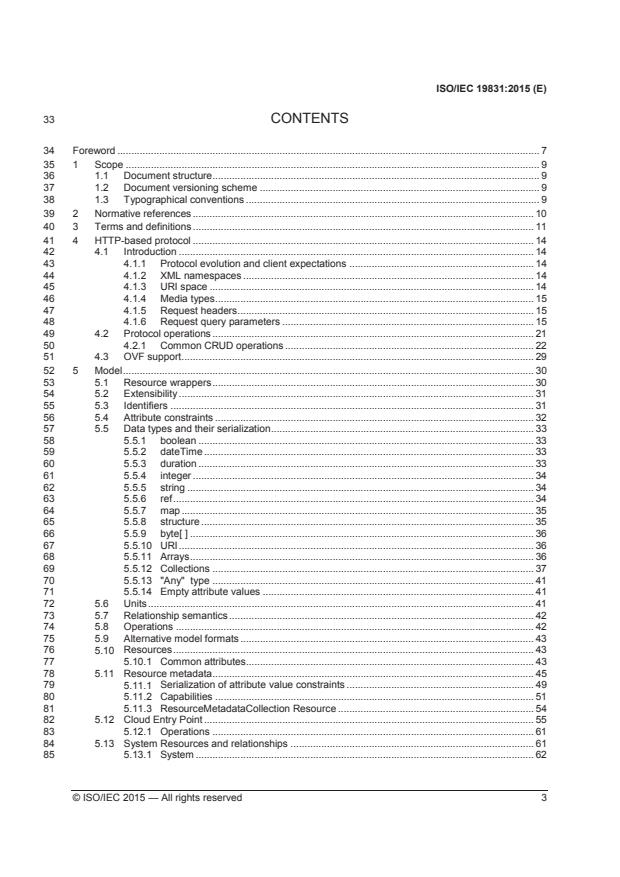
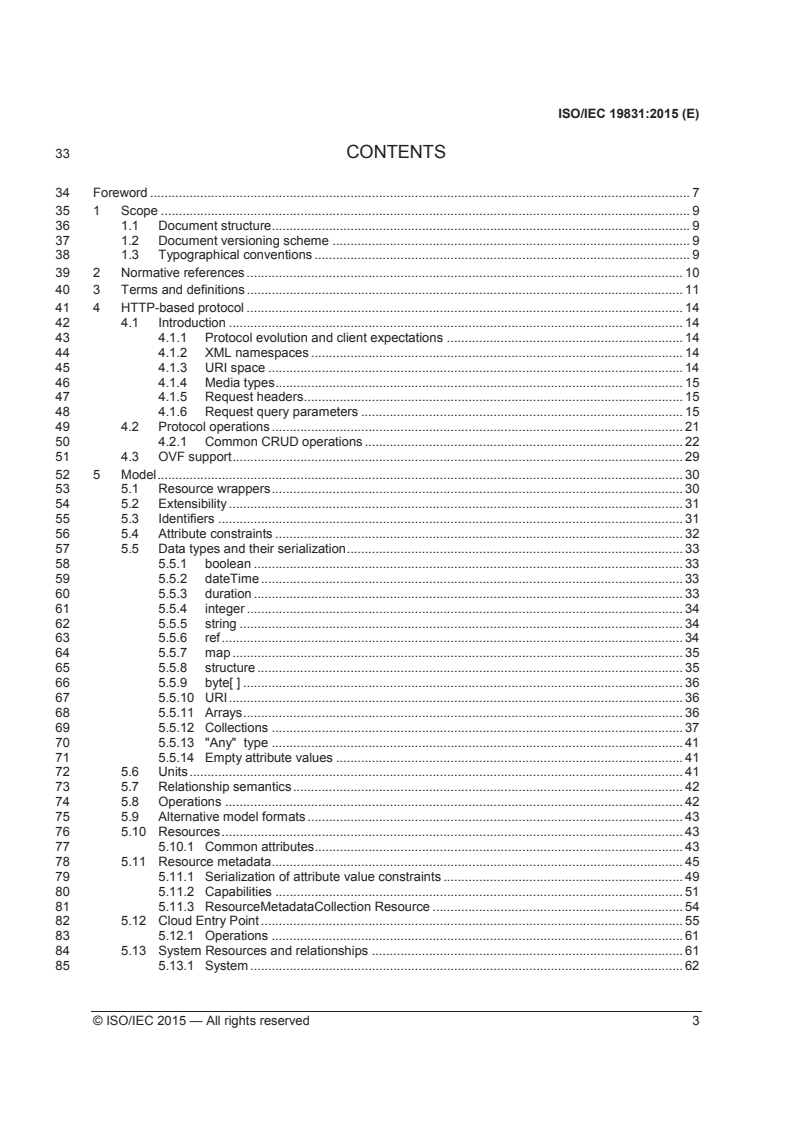
33 CONTENTS
34 Foreword . 7
35 1 Scope . 9
36 1.1 Document structure . 9
37 1.2 Document versioning scheme . 9
38 1.3 Typographical conventions . 9
39 2 Normative references . 10
40 3 Terms and definitions . 11
41 4 HTTP-based protocol . 14
42 4.1 Introduction . 14
43 4.1.1 Protocol evolution and client expectations . 14
44 4.1.2 XML namespaces . 14
45 4.1.3 URI space . 14
46 4.1.4 Media types . 15
47 4.1.5 Request headers. 15
48 4.1.6 Request query parameters . 15
49 4.2 Protocol operations . 21
50 4.2.1 Common CRUD operations . 22
51 4.3 OVF support . 29
52 5 Model . 30
53 5.1 Resource wrappers . 30
54 5.2 Extensibility . 31
55 5.3 Identifiers . 31
56 5.4 Attribute constraints . 32
57 5.5 Data types and their serialization . 33
58 5.5.1 boolean . 33
59 5.5.2 dateTime . 33
60 5.5.3 duration . 33
61 5.5.4 integer . 34
62 5.5.5 string . 34
63 5.5.6 ref . 34
64 5.5.7 map . 35
65 5.5.8 structure . 35
66 5.5.9 byte[ ] . 36
67 5.5.10 URI . 36
68 5.5.11 Arrays . 36
69 5.5.12 Collections . 37
70 5.5.13 "Any" type . 41
71 5.5.14 Empty attribute values . 41
72 5.6 Units . 41
73 5.7 Relationship semantics . 42
74 5.8 Operations . 42
75 5.9 Alternative model formats . 43
76 5.10 Resources . 43
77 5.10.1 Common attributes. 43
78 5.11 Resource metadata . 45
79 5.11.1 Serialization of attribute value constraints . 49
80 5.11.2 Capabilities . 51
81 5.11.3 ResourceMetadataCollection Resource . 54
82 5.12 Cloud Entry Point . 55
83 5.12.1 Operations . 61
84 5.13 System Resources and relationships . 61
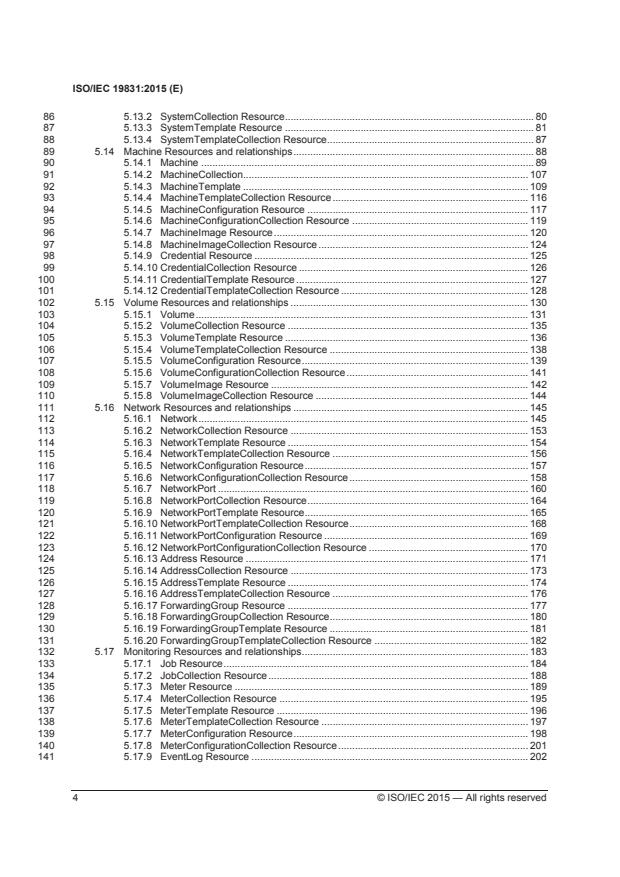
85 5.13.1 System . 62
© ISO/IEC 2015 — All rights reserved 3
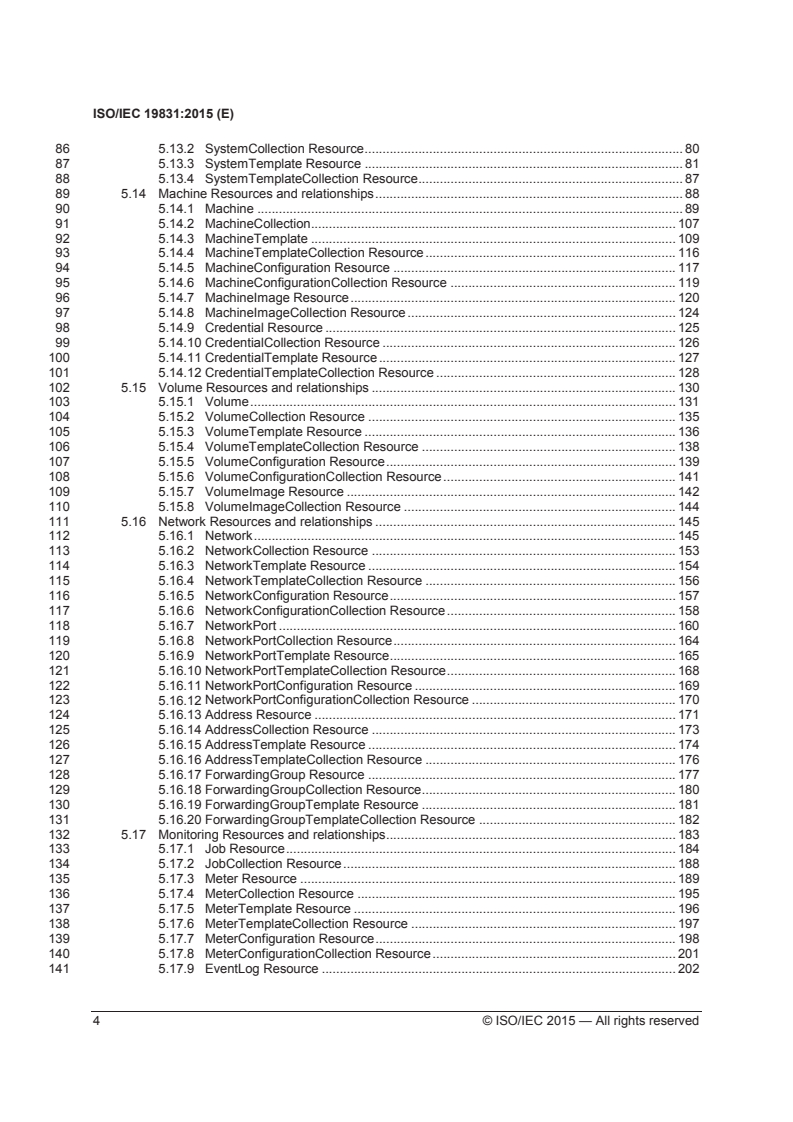
86 5.13.2 SystemCollection Resource . 80
87 5.13.3 SystemTemplate Resource . 81
88 5.13.4 SystemTemplateCollection Resource. 87
89 5.14 Machine Resources and relationships . 88
90 5.14.1 Machine . 89
91 5.14.2 MachineCollection. 107
92 5.14.3 MachineTemplate . 109
93 5.14.4 MachineTemplateCollection Resource . 116
94 5.14.5 MachineConfiguration Resource . 117
95 5.14.6 MachineConfigurationCollection Resource . 119
96 5.14.7 MachineImage Resource . 120
97 5.14.8 MachineImageCollection Resource . 124
98 5.14.9 Credential Resource . 125
99 5.14.10 CredentialCollection Resource . 126
100 5.14.11 CredentialTemplate Resource . 127
101 5.14.12 CredentialTemplateCollection Resource . 128
102 5.15 Volume Resources and relationships . 130
103 5.15.1 Volume . 131
104 5.15.2 VolumeCollection Resource . 135
105 5.15.3 VolumeTemplate Resource . 136
106 5.15.4 VolumeTemplateCollection Resource . 138
107 5.15.5 VolumeConfiguration Resource . 139
108 5.15.6 VolumeConfigurationCollection Resource . 141
109 5.15.7 VolumeImage Resource . 142
110 5.15.8 VolumeImageCollection Resource . 144
111 5.16 Network Resources and relationships . 145
112 5.16.1 Network . 145
113 5.16.2 NetworkCollection Resource . 153
114 5.16.3 NetworkTemplate Resource . 154
115 5.16.4 NetworkTemplateCollection Resource . 156
116 5.16.5 NetworkConfiguration Resource . 157
117 5.16.6 NetworkConfigurationCollection Resource . 158
118 5.16.7 NetworkPort . 160
119 5.16.8 NetworkPortCollection Resource . 164
120 5.16.9 NetworkPortTemplate Resource . 165
121 5.16.10 NetworkPortTemplateCollection Resource . 168
122 5.16.11 NetworkPortConfiguration Resource . 169
123 5.16.12 NetworkPortConfigurationCollection Resource . 170
124 5.16.13 Address Resource . 171
125 5.16.14 AddressCollection Resource . 173
126 5.16.15 AddressTemplate Resource . 174
127 5.16.16 AddressTemplateCollection Resource . 176
128 5.16.17 ForwardingGroup Resource . 177
129 5.16.18 ForwardingGroupCollection Resource. 180
130 5.16.19 ForwardingGroupTemplate Resource . 181
131 5.16.20 ForwardingGroupTemplateCollection Resource . 182
132 5.17 Monitoring Resources and relationships. 183
133 5.17.1 Job Resource . 184
134 5.17.2 JobCollection Resource . 188
135 5.17.3 Meter Resource . 189
136 5.17.4 MeterCollection Resource . 195
137 5.17.5 MeterTemplate Resource . 196
138 5.17.6 MeterTemplateCollection Resource . 197
139 5.17.7 MeterConfiguration Resource . 198
140 5.17.8 MeterConfigurationCollection Resource . 201
141 5.17.9 EventLog Resource . 202
4 © ISO/IEC 2015 — All rights reserved
142 5.17.10 EventLogCollection Resource . 205
143 5.17.11 EventLogTemplate Resource . 206
144 5.17.12 EventLogTemplateCollection Resource . 207
145 5.17.13 Event Resource . 208
146 6 Security considerations . 216
147 ANNEX A (normative) OVF support in CIMI . 217
148 ANNEX B (informative) XML Schema . 219
149 ANNEX C (informative) Change log . 220
151 Figures
152 Figure 1 - Cloud Entry Point . 56
153 Figure 2 - System Resources. 62
154 Figure 3 - Machine Resources . 89
155 Figure 4 - Volume Resources . 130
156 Figure 5 - Network Resources . 145
157 Figure 6 - Monitoring Resources . 184
159 Tables
160 Table 1 – XML namespaces . 14
161 Table 2 – Named structure. 35
162 Table 3 – Converting a relative URI to an absolute URI . 36
163 Table 4 – Numerical equivalents for attributes . 42
164 Table 5 – Common attributes . 43
165 Table 7 – Capability URIs . 51
166 Table 8 – CloudEntryPoint attributes . 56
167 Table 9 – System attributes . 63
168 Table 10 – SystemSystem attributes . 67
169 Table 11 – SystemMachine attributes . 68
170 Table 12 – SystemCredential attributes . 70
171 Table 13 – SystemVolume attributes . 71
Table 14 – SystemNetwork attributes . 72
173 Table 15 – SystemNetworkPort attributes . 74
174 Table 16 – SystemAddress attributes . 75
175 Table 17 – SystemForwardingGroup attributes . 76
176 Table 18 – SystemTemplate attributes . 82
177 Table 19 – Machine attributes . 89
178 Table 20 – Disk attributes . 93
179 Table 21 – MachineVolume attributes . 94
180 Table 22 – MachineNetworkInterface attributes . 96
181 Table 23 – MachineNetworkInterfaceAddress attributes . 98
182 Table 24 – MachineSnapshot attributes . 100
183 Table 25 – MachineTemplate attributes . 109
184 Table 26 – MachineConfiguration attributes . 117
185 Table 27 – MachineImage attributes . 120
© ISO/IEC 2015 — All rights reserved 5
186 Table 28 – Credential attributes . 125
187 Table 29 – UserName/Password attributes . 125
188 Table 30 – Public key attributes . 125
189 Table 31 – CredentialTemplate attributes . 127
190 Table 32 – Volume attributes . 131
191 Table 33 – VolumeVolumeImage attributes . 133
192 Table 34 – VolumeTemplate attributes . 136
193 Table 35 – VolumeConfiguration attributes. 140
194 Table 36 – VolumeImage attributes . 142
195 Table 37 – Network attributes . 145
196 Table 38 – NetworkTemplate attributes . 154
197 Table 39 – NetworkConfiguration attributes . 157
198 Table 40 – NetworkPort attributes . 160
199 Table 41 – NetworkPortTemplate attributes . 165
200 Table 42 – NetworkPortConfiguration attributes . 169
201 Table 43 – Address attributes . 171
202 Table 44 – AddressTemplate attributes . 174
203 Table 45 – ForwardingGroup attributes . 178
204 Table 46 – ForwardingGroupNetwork attributes . 179
205 Table 47 – ForwardingGroupTemplate attributes . 181
206 Table 48 – Job attributes . 185
207 Table 49 – Meter attributes . 189
208 Table 50 – Sample attributes . 192
209 Table 51 – MeterTemplate attributes . 196
210 Table 52 – MeterConfiguration attributes . 198
211 Table 53 – aspect URIs . 200
212 Table 54 – EventLog attributes . 202
213 Table 55 – EventLogTemplate attributes . 206
214 Table 56 – Event attributes . 208
215 Table 57 – type URIs . 211
6 © ISO/IEC 2015 — All rights reserved
218 Foreword
219 The Cloud Infrastructure Management Interface (CIMI) Model and RESTful HTTP-based Protocol
220 specification (DSP0263) was prepared by the DMTF Cloud Management Working Group. It defines a
221 logical model for the management of resources within the Infrastructure as a Service domain.
222 DMTF is a not-for-profit association of industry members dedicated to promoting enterprise and systems
223 management and interoperability.
224 Acknowledgments
225 The DMTF acknowledges the following individuals for their contributions to this document:
226 Editors (past and present):
227 x Marios Andreou – Red Hat
228 x Doug Davis – IBM
229 x Jacques Durand – Fujitsu
230 x Gilbert Pilz – Oracle
231 Contributors:
232 x Ghazanfar Ali – ZTE Corporation
233 x Marios Andreou – Red Hat
234 x Keith Bankston – Microsoft Corporation
235 x Winston Bumpus – VMware Inc.
236 x Nathan Burkhart – Microsoft Corporation
237 x Mark Carlson – Oracle
238 x Steve Carter – Novell
239 x Junsheng Chu – ZTE Corporation
240 x Josh Cohen – Microsoft Corporation
241 x Derek Coleman – Hewlett-Packard Company
242 x John Crandall – Brocade Communications Systems
243 x Doug Davis – IBM
244 x Jim Davis – WBEM Solutions
245 x Fernando de la Iglesia – Telefónica
246 x Hiroshi Dempo – NEC Corporation
247 x Jacques Durand – Fujitsu
248 x Yigal Edery – Microsoft Corporation
249 x George Ericson – EMC
250 x Colleen Evans – Microsoft Corporation
251 x Norbert Floeren – Ericsson AB
252 x Robert Freund – Hitachi, Ltd.
253 x Fermín Galán – Telefónica
254 x Krishnan Gopalan – Microsoft Corporation
255 x Kazunori Iwasa – Fujitsu
256 x Mark Johnson – IBM
257 x Bhumip Khasnabish – ZTE Corporation
258 x Dies Köper – Fujitsu
259 x Vincent Kowalski – BMC Software
260 x Ruby Krishnaswamy – France Telecom Group
261 x Lawrence Lamers – VMware Inc.
262 x Paul Lipton – CA Technologies
263 x James Livingston – NEC Corporation
264 x Vince Lubsey – Virtustream Inc.
© ISO/IEC 2015 — All rights reserved 7
265 x David Lutterkort – Red Hat
266 x Fred Maciel – Hitachi, Ltd.
267 x Andreas Maier – IBM
268 x Ashok Malhotra – Oracle
269 x Jeff Mischkinsky – Oracle
270 x Jesus Molina – Fujitsu
271 x Efraim Moscovich – CA Technologies
272 x Bryan Murray – Hewlett-Packard Company
273 x Steven Neely – Cisco
274 x Ryuichi Ogawa – NEC Corporation
275 x John Parchem– Microsoft Corporation
276 x Shishir Pardikar – Citrix Systems Inc.
277 x Miguel Peñalvo – Telefónica
278 x Gilbert Pilz – Oracle
279 x Alvaro Polo – Telefónica
280 x Enrico Ronco – Telecom Italia
281 x Federico Rossini – Telecom Italia
282 x Matthew Rutkowski – IBM
283 x Tom Rutt – Fujitsu
284 x Hemal Shah – Broadcom
285 x Nihar Shah – Microsoft Corporation
286 x Alan Sill – Texas Tech University
287 x Zhexuan Song – Huawei
288 x Marvin Waschke – CA Technologies
289 x Eric Wells – Hitachi, Ltd.
290 x Jeff Wheeler – Huawei
291 x Maarten Wiggers – Fujitsu
292 x Daniel Wilson – Ericsson AB
293 x Steve Winkler – SAP AG
294 x Jack Yu – Oracle
295 x Aaron Zhang – Huawei
296 x HengLiang Zhang – Huawei
8 © ISO/IEC 2015 — All rights reserved
298 Cloud Infrastructure Management Interface (CIMI) Model and
299 RESTful HTTP-based Protocol
300 1 Scope
301 This specification describes the model and protocol for management interactions between a cloud
302 Infrastructure as a Service (IaaS) Provider and the Consumers of an IaaS service. The basic resources of
303 IaaS (machines, storage, and networks) are modeled with the goal of providing Consumer management
304 access to an implementation of IaaS and facilitating portability between cloud implementations that
305 support the specification. This document specifies a Representational State Transfer (REST)-style
306 protocol using HTTP. However, the underlying model is not specific to HTTP, and it is possible to map it
307 to other protocols as well.
308 CIMI addresses the management of the lifecycle of infrastructure provided by a Provider. CIMI does not
309 extend beyond infrastructure management to the control of the applications and services that the
310 Consumer chooses to run on the infrastructure provided as a service by the Provider. Although CIMI may
311 be to some extent applicable to other cloud service models, such as Platform as a Service ("PaaS") or
312 Storage as a Service ("SaaS"), these uses are outside the design goals of CIMI.
313 1.1 Document structure
314 This document defines a model and a RESTful HTTP-based protocol.
315 The core REST patterns are defined first and, after each resource is defined, any HTTP-specific
316 information for that resource is specified.
317 1.2 Document versioning scheme
318 This document adheres to the versioning scheme defined in clause 6.3 of DSP4004.
319 As the specification changes over time certain features might be deprecated. These are identified in the
320 specification and should not be supported. Each of these deprecated features is clearly denoted in the
321 clause in which they were previously defined.
322 1.3 Typographical conventions
323 This specification uses the following conventions:
324 In the narrative text of the specification:
325 x The regular or narrative font is Arial.
326 x Proper CIMI nouns such as Resource names, attribute names, operation names, reserved
327 variable names are in Courier font. (e.g. Machine, volumes, $expand). The plural form
328 applies to such names to indicate several instances of such Resources (e.g. Machines,
329 Systems).
330 x Examples text are in small Courier font and over a darker background.
331 x Quotes are used for any text that needs be distinguished as name or value of a particular
332 concept (e.g. the "value constraints" attribute, the “Resource Name” column, a “false” value). In
333 such cases, the string in quotes is always qualified by the concept it is an instance of.
334 x Names for CIMI concepts that may be common English words but have a very specific meaning
335 in CIMI, are in narrative font but capitalized, e.g. Provider, Consumer, Resource, Collection.
© ISO/IEC 2015 — All rights reserved 9
336 When used in their common English sense they remain lower-case. However, CIMI modeling
337 concepts that are used in a commonly understood manner remain in lower-case, such as:
338 attribute, operation.
339 Inside tables describing the Resource data model:
340 x The narrative font is used for all terms, as the table structure qualifies them sufficiently.
341 x Where textual descriptions are introduced, the rules for narrative text apply.
342 x If a name is used as types (i.e., names of embedded structures as well as atomic types such as
343 "integer", "string"), are in italic.
344 x Names that are just placeholders for actual names that may vary with each model instance, are
345 between < > (e.g., ).
346 Where the serialization of Resources is described, a pseudo-schema notation is used with the following
347 conventions:
348 x Values in italics indicate data types instead of literal values.
349 x Characters are appended to items to indicate cardinality:
350 – "?" (0 or 1)
351 – "*" (0 or more)
352 – "+" (1 or more)
353 x Vertical bars, "|", denote choice. For example, "a|b" means a choice between "a" and "b".
354 x Parentheses, "(" and ")", are used to indicate the scope of the operators "?", "*", "+" and "|".
355 x Ellipses (i.e., ".") indicate points of extensibility. Note that the lack of an ellipses does not mean
356 no extensibility point exists, rather it is just not explicitly called out - usually for the sake of
357 brevity.
358 Operation names Create, Update, Delete, Read are abstract operations that convey the semantics of
359 concrete corresponding operations, such as HTTP methods or CIMI operation URIs.
360 2 Normative references
361 The following referenced documents are indispensable for the application of this document. For dated
362 or versioned references, only the edition cited (including any corrigenda or DMTF update versions)
363 applies. For references without a date or version, the latest published edition of the referenced document
364 (including any corrigenda or DMTF update versions) applies.
365 DMTF DSP0223, Generic Operations 1.0,
366 http://www.dmtf.org/standards/published_documents/DSP0223_1.0.pdf
367 DMTF DSP0243, Open Virtualization Format Specification 1.1,
368 http://www.dmtf.org/sites/default/files/standards/documents/DSP0243_1.1.pdf
369 DMTF DSP1001, Management Profile Specification Usage Guide 1.1,
370 http://www.dmtf.org/standards/published_documents/DSP1001_1.1.pdf
371 DMTF DSP4004, DMTF Release Process 2.4,
372 http://www.dmtf.org/sites/default/files/standards/documents/DSP4004_2.4.pdf
373 IANA HTTP Header Registry, http://www.iana.org/assignments/message-headers/perm-headers.html
10 © ISO/IEC 2015 — All rights reserved
374 IEC 80000-13:2008, International Organization for Standardization, Geneva, Switzerland, Quantities and
375 units – Part 13: Information science and technology, April 2008,
376 http://www.iso.org/iso/catalogue_detail?csnumber=31898
377 IETF RFC2616, R. Fielding et al, Hypertext Transfer Protocol -- HTTP/1.1,
378 http://www.ietf.org/rfc/rfc2616.txt
379 IETF RFC3986, T.Berners-Lee et al, Uniform Resource Identifiers (URI): Generic Syntax, August 1998,
380 http://www.ietf.org/rfc/rfc3986.txt
381 IETF RFC4627, D. Crockford, The application/json Media Type for JavaScript Object Notation (JSON),
382 July 2006, http://www.ietf.org/rfc/rfc4627.txt
383 IETF RFC5246, T. Dierks and E. Rescorla, The Transport Layer Security (TLS) Protocol Version 1.2,
384 http://www.ietf.org/rfc/rfc5246.txt
385 ISO 8601:20044, International Organization for Standardization, Geneva, Switzerland, Data elements and
386 interchange formats -- Information interchange - - Representation of dates and times, March 2008,
387 http://www.iso.org/iso/iso_catalogue/ catalogue_tc/catalogue_detail.htm?csnumber=40874
388 ISO/IEC 14977:1996, Roger S. Scowen, Extended BNF — A generic base standard. Software
389 Engineering Standards Symposium 1993.
390 http://www.iso.org/iso/catalogue_detail?csnumber=26153
391 ISO/IEC Directives, Part 2, Rules for the structure and drafting of International Standards,
392 http://isotc.iso.org/livelink/livelink.exe?func=ll&objId=4230456&objAction=browse&sort=subtype
393 NIST Special Publication 800-145, Peter Mell and Timothy Grance, The NIST Definition of Cloud
394 Computing, Sept. 2011, http://csrc.nist.gov/publications/nistpubs/800-145/SP800-145.pdf
395 NIST Special Publication 500-292, Fang Liu, Jin Tong, Jian Mao, Robert Bohn, John Messina, Lee
396 Badger and Dawn Leaf, NIST Cloud Computing Reference Architecture, Sept. 2011,
397 http://collaborate.nist.gov/twiki-cloud-
398 computing/pub/CloudComputing/ReferenceArchitectureTaxonomy/NIST_SP_500-292_-_090611.pdf
399 Representational State Transfer, Roy Fielding, Doctoral dissertation, University of California, Architectural
400 Styles and the Design of Network-based Software Architectures (Chapter 5), 2000,
401 http://www.ics.uci.edu/~fielding/pubs/dissertation/rest_arch_style.htm
402 XMLSchema - Part 1, World Wide Web Consortium (W3C) Recommendation, H. Thompson, et al.,
403 Editors, XML Schema Part 1: Structures Second Edition, 28 October 2004,
404 http://www.w3.org/TR/xmlschema-1/
405 XMLSchema - Part 2, World Wide Web Consortium (W3C) Recommendation, P. Biron, A. Malhotra,
406 Editors, XML Schema Part 2: Datatypes (Second Edition), 28 October 2004,
407 http://www.w3.org/TR/xmlschema-2/
408 3 Terms and definitions
409 In this document, some terms have a specific meaning beyond the normal English meaning. Those terms
410 are defined in this clause.
411 The terms "shall" ("required"), "shall not," "should" ("recommended"), "should not" ("not recommended"),
412 "may," "need not" ("not required"), "can" and "cannot" in this document are to be interpreted as described
413 in ISO/IEC Directives, Part 2, Annex H. The terms in parenthesis are alternatives for the preceding term,
414 for use in exceptional cases when the preceding term cannot be used for linguistic reasons. Note that
415 ISO/IEC Directives, Part 2, Annex H specifies additional alternatives. Occurrences of such additional
416 alternatives shall be interpreted in their normal English meaning.
© ISO/IEC 2015 — All rights reserved 11
417 The terms "clause," "subclause," "paragraph," and "annex" in this document are to be interpreted as
418 described in ISO/IEC Directives, Part 2, Clause 5.
419 The terms "normative" and "informative" in this document are to be interpreted as described in ISO/IEC
420 Directives, Part 2, Clause 3. In this document, clauses, subclauses, or annexes labeled "(informative)" do
421 not contain normative content. Notes and examples are always informative elements.
422 The terms defined in DSP4004, DSP0223, and DSP1001 apply to this document. The following additional
423 terms are used in this document.
424 3.1
425 authentication
426 The process of verifying a claim, made by a subject, that it should be allowed to act on behalf of a given
427 principal (person, service, etc.). Typical authentication mechanisms involve the use of
428 username/password combination or public/private key pairs.
429 3.2
430 authorization
431 The process of verifying that an authenticated principal (person, service, etc.) has permission to perform
432 certain operations (e.g., read, update) on specific Resources. (Also known as Access Control.)
433 3.3
434 cloud
435 Synonymous with “cloud computing” as defined in section 2 of the NIST Definition of Cloud Computing
436 [SP800-145].
437 3.4
438 Cloud Service Consumer
439 A category of actors that includes the Consumer Business Manager (who approves business and
440 financial expenditures for consumed services; accounts for used service instances; establishes business
441 relationships; sets up accounts, budget, and terms; etc.); the Consumer Service Administrator (who
442 requests service instances and changes to service instances; purchases services within the business
443 relationship; creates Service Users (including policies); allocates resources, such as computer and
444 storage; generates reports, such as usage; etc.); and Service Users (who use service instances provided
445 by a Cloud Service Provider). The term "Consumer" is used if the indicated action or activity could involve
446 one or more of the above actors. In cases where the distinction between the actors in this category is
447 relevant, the more detailed term is used.
448 For purposes of comparison and alignment, it should be noted that a Cloud Service Consumer is
449 equivalent to the “Cloud Consumer” actor defined in the NIST Reference Architecture [SP500-292].
450 3.5
451 Cloud Service Provider
452 A category of actors that includes the Service Operations Manager (who manages the technical
453 infrastructure required for providing cloud services; monitors and measures performance and utilization
454 against SLAs; provides reports from monitoring and measurement; etc.); Service Business Manager (who
455 offers all types of services developed by cloud service developers; accounts for services potentially
456 offered by service Providers themselves and services offered on behalf of cloud service developers;
457 establishes a portfolio of business relationships; and sets up accounts and terms for Consumers, etc.);
458 and Service Transition Manager (who enables a customer to use the cloud service, including
459 "onboarding", integration, and process adoption; defines and creates service offerings based on
460 Templates and Configurations that can be used by Consumers and are populated into the catalog; etc.).
461 The term "Provider" is used if the indicated action or activity could involve one or more of the above
462 actors. In cases where the distinction between the actors in the category is relevant, the more detailed
463 term is used.
12 © ISO/IEC 2015 — All rights reserved
464 For purposes of comparison and alignment, it should be noted that a Cloud Service Provider is equivalent
465 to the “Cloud Provider” actor defined in the NIST Reference Architecture [SP500-292].
466 3.6
467 Collection
468 A particular kind of Resource that contains a collection of other Resources and has a representation and
469 serialization defined in this specification. Synonym for “CIMI collection”.
470 3.7
471 Configuration
472 A set of metadata, the values of which serve as the parameters of a discrete conformation of a specific
473 type of virtual resource.
474 3.8
475 Infrastructure as a Service (IaaS)
476 A cloud computing service model defined in section 2 of the NIST Definition of Cloud Computing [SP800-
477 145].
478 3.9
479 message confidentiality
480 A quality of a message that prevents anyone but the intended receiver(s) from viewing its contents.
481 3.10
482 message integrity
483 A quality of a message that allows a receiver of that message to determine whether the contents of the
484 message have been altered since its creation.
485 3.11
486 Resource
487 A representation of an entity managed by the [Cloud Service] Provider that is generally available to the
488 [Cloud Service] Consumer to access or operate on by the way of the in
...
INTERNATIONAL ISO/IEC
STANDARD 19831
First edition
2015-05-01
Cloud Infrastructure Management
Interface (CIMI) Model and RESTful
HTTP-based Protocol — An Interface for
Managing Cloud Infrastructure
Model d'interface de management de l'infrastructure du nuage
informatique (CIMI) et protocole RESTful basé HTTP — Une interface
pour le management de l'infrastructure du nuage informatique
Reference number
©
ISO/IEC 2015
© ISO/IEC 2015
All rights reserved. Unless otherwise specified, no part of this publication may be reproduced or utilized otherwise in any form or by any
means, electronic or mechanical, including photocopying, or posting on the internet or an intranet, without prior written permission.
Permission can be requested from either ISO at the address below or ISO’s member body in the country of the requester.
ISO copyright office
Case postale 56 CH-1211 Geneva 20
Tel. + 41 22 749 01 11
Fax + 41 22 749 09 47
E-mail copyright@iso.org
Web www.iso.org
Published in Switzerland
ii © ISO/IEC 2015 – All rights reserved
33 CONTENTS
34 Foreword . 7
35 1 Scope . 9
36 1.1 Document structure . 9
37 1.2 Document versioning scheme . 9
38 1.3 Typographical conventions . 9
39 2 Normative references . 10
40 3 Terms and definitions . 11
41 4 HTTP-based protocol . 14
42 4.1 Introduction . 14
43 4.1.1 Protocol evolution and client expectations . 14
44 4.1.2 XML namespaces . 14
45 4.1.3 URI space . 14
46 4.1.4 Media types . 15
47 4.1.5 Request headers. 15
48 4.1.6 Request query parameters . 15
49 4.2 Protocol operations . 21
50 4.2.1 Common CRUD operations . 22
51 4.3 OVF support . 29
52 5 Model . 30
53 5.1 Resource wrappers . 30
54 5.2 Extensibility . 31
55 5.3 Identifiers . 31
56 5.4 Attribute constraints . 32
57 5.5 Data types and their serialization . 33
58 5.5.1 boolean . 33
59 5.5.2 dateTime . 33
60 5.5.3 duration . 33
61 5.5.4 integer . 34
62 5.5.5 string . 34
63 5.5.6 ref . 34
64 5.5.7 map . 35
65 5.5.8 structure . 35
66 5.5.9 byte[ ] . 36
67 5.5.10 URI . 36
68 5.5.11 Arrays . 36
69 5.5.12 Collections . 37
70 5.5.13 "Any" type . 41
71 5.5.14 Empty attribute values . 41
72 5.6 Units . 41
73 5.7 Relationship semantics . 42
74 5.8 Operations . 42
75 5.9 Alternative model formats . 43
76 5.10 Resources . 43
77 5.10.1 Common attributes. 43
78 5.11 Resource metadata . 45
79 5.11.1 Serialization of attribute value constraints . 49
80 5.11.2 Capabilities . 51
81 5.11.3 ResourceMetadataCollection Resource . 54
82 5.12 Cloud Entry Point . 55
83 5.12.1 Operations . 61
84 5.13 System Resources and relationships . 61
85 5.13.1 System . 62
© ISO/IEC 2015 — All rights reserved 3
86 5.13.2 SystemCollection Resource . 80
87 5.13.3 SystemTemplate Resource . 81
88 5.13.4 SystemTemplateCollection Resource. 87
89 5.14 Machine Resources and relationships . 88
90 5.14.1 Machine . 89
91 5.14.2 MachineCollection. 107
92 5.14.3 MachineTemplate . 109
93 5.14.4 MachineTemplateCollection Resource . 116
94 5.14.5 MachineConfiguration Resource . 117
95 5.14.6 MachineConfigurationCollection Resource . 119
96 5.14.7 MachineImage Resource . 120
97 5.14.8 MachineImageCollection Resource . 124
98 5.14.9 Credential Resource . 125
99 5.14.10 CredentialCollection Resource . 126
100 5.14.11 CredentialTemplate Resource . 127
101 5.14.12 CredentialTemplateCollection Resource . 128
102 5.15 Volume Resources and relationships . 130
103 5.15.1 Volume . 131
104 5.15.2 VolumeCollection Resource . 135
105 5.15.3 VolumeTemplate Resource . 136
106 5.15.4 VolumeTemplateCollection Resource . 138
107 5.15.5 VolumeConfiguration Resource . 139
108 5.15.6 VolumeConfigurationCollection Resource . 141
109 5.15.7 VolumeImage Resource . 142
110 5.15.8 VolumeImageCollection Resource . 144
111 5.16 Network Resources and relationships . 145
112 5.16.1 Network . 145
113 5.16.2 NetworkCollection Resource . 153
114 5.16.3 NetworkTemplate Resource . 154
115 5.16.4 NetworkTemplateCollection Resource . 156
116 5.16.5 NetworkConfiguration Resource . 157
117 5.16.6 NetworkConfigurationCollection Resource . 158
118 5.16.7 NetworkPort . 160
119 5.16.8 NetworkPortCollection Resource . 164
120 5.16.9 NetworkPortTemplate Resource . 165
121 5.16.10 NetworkPortTemplateCollection Resource . 168
122 5.16.11 NetworkPortConfiguration Resource . 169
123 5.16.12 NetworkPortConfigurationCollection Resource . 170
124 5.16.13 Address Resource . 171
125 5.16.14 AddressCollection Resource . 173
126 5.16.15 AddressTemplate Resource . 174
127 5.16.16 AddressTemplateCollection Resource . 176
128 5.16.17 ForwardingGroup Resource . 177
129 5.16.18 ForwardingGroupCollection Resource. 180
130 5.16.19 ForwardingGroupTemplate Resource . 181
131 5.16.20 ForwardingGroupTemplateCollection Resource . 182
132 5.17 Monitoring Resources and relationships. 183
133 5.17.1 Job Resource . 184
134 5.17.2 JobCollection Resource . 188
135 5.17.3 Meter Resource . 189
136 5.17.4 MeterCollection Resource . 195
137 5.17.5 MeterTemplate Resource . 196
138 5.17.6 MeterTemplateCollection Resource . 197
139 5.17.7 MeterConfiguration Resource . 198
140 5.17.8 MeterConfigurationCollection Resource . 201
141 5.17.9 EventLog Resource . 202
4 © ISO/IEC 2015 — All rights reserved
142 5.17.10 EventLogCollection Resource . 205
143 5.17.11 EventLogTemplate Resource . 206
144 5.17.12 EventLogTemplateCollection Resource . 207
145 5.17.13 Event Resource . 208
146 6 Security considerations . 216
147 ANNEX A (normative) OVF support in CIMI . 217
148 ANNEX B (informative) XML Schema . 219
149 ANNEX C (informative) Change log . 220
151 Figures
152 Figure 1 - Cloud Entry Point . 56
153 Figure 2 - System Resources. 62
154 Figure 3 - Machine Resources . 89
155 Figure 4 - Volume Resources . 130
156 Figure 5 - Network Resources . 145
157 Figure 6 - Monitoring Resources . 184
159 Tables
160 Table 1 – XML namespaces . 14
161 Table 2 – Named structure. 35
162 Table 3 – Converting a relative URI to an absolute URI . 36
163 Table 4 – Numerical equivalents for attributes . 42
164 Table 5 – Common attributes . 43
165 Table 7 – Capability URIs . 51
166 Table 8 – CloudEntryPoint attributes . 56
167 Table 9 – System attributes . 63
168 Table 10 – SystemSystem attributes . 67
169 Table 11 – SystemMachine attributes . 68
170 Table 12 – SystemCredential attributes . 70
171 Table 13 – SystemVolume attributes . 71
Table 14 – SystemNetwork attributes . 72
173 Table 15 – SystemNetworkPort attributes . 74
174 Table 16 – SystemAddress attributes . 75
175 Table 17 – SystemForwardingGroup attributes . 76
176 Table 18 – SystemTemplate attributes . 82
177 Table 19 – Machine attributes . 89
178 Table 20 – Disk attributes . 93
179 Table 21 – MachineVolume attributes . 94
180 Table 22 – MachineNetworkInterface attributes . 96
181 Table 23 – MachineNetworkInterfaceAddress attributes . 98
182 Table 24 – MachineSnapshot attributes . 100
183 Table 25 – MachineTemplate attributes . 109
184 Table 26 – MachineConfiguration attributes . 117
185 Table 27 – MachineImage attributes . 120
© ISO/IEC 2015 — All rights reserved 5
186 Table 28 – Credential attributes . 125
187 Table 29 – UserName/Password attributes . 125
188 Table 30 – Public key attributes . 125
189 Table 31 – CredentialTemplate attributes . 127
190 Table 32 – Volume attributes . 131
191 Table 33 – VolumeVolumeImage attributes . 133
192 Table 34 – VolumeTemplate attributes . 136
193 Table 35 – VolumeConfiguration attributes. 140
194 Table 36 – VolumeImage attributes . 142
195 Table 37 – Network attributes . 145
196 Table 38 – NetworkTemplate attributes . 154
197 Table 39 – NetworkConfiguration attributes . 157
198 Table 40 – NetworkPort attributes . 160
199 Table 41 – NetworkPortTemplate attributes . 165
200 Table 42 – NetworkPortConfiguration attributes . 169
201 Table 43 – Address attributes . 171
202 Table 44 – AddressTemplate attributes . 174
203 Table 45 – ForwardingGroup attributes . 178
204 Table 46 – ForwardingGroupNetwork attributes . 179
205 Table 47 – ForwardingGroupTemplate attributes . 181
206 Table 48 – Job attributes . 185
207 Table 49 – Meter attributes . 189
208 Table 50 – Sample attributes . 192
209 Table 51 – MeterTemplate attributes . 196
210 Table 52 – MeterConfiguration attributes . 198
211 Table 53 – aspect URIs . 200
212 Table 54 – EventLog attributes . 202
213 Table 55 – EventLogTemplate attributes . 206
214 Table 56 – Event attributes . 208
215 Table 57 – type URIs . 211
6 © ISO/IEC 2015 — All rights reserved
218 Foreword
219 The Cloud Infrastructure Management Interface (CIMI) Model and RESTful HTTP-based Protocol
220 specification (DSP0263) was prepared by the DMTF Cloud Management Working Group. It defines a
221 logical model for the management of resources within the Infrastructure as a Service domain.
222 DMTF is a not-for-profit association of industry members dedicated to promoting enterprise and systems
223 management and interoperability.
224 Acknowledgments
225 The DMTF acknowledges the following individuals for their contributions to this document:
226 Editors (past and present):
227 x Marios Andreou – Red Hat
228 x Doug Davis – IBM
229 x Jacques Durand – Fujitsu
230 x Gilbert Pilz – Oracle
231 Contributors:
232 x Ghazanfar Ali – ZTE Corporation
233 x Marios Andreou – Red Hat
234 x Keith Bankston – Microsoft Corporation
235 x Winston Bumpus – VMware Inc.
236 x Nathan Burkhart – Microsoft Corporation
237 x Mark Carlson – Oracle
238 x Steve Carter – Novell
239 x Junsheng Chu – ZTE Corporation
240 x Josh Cohen – Microsoft Corporation
241 x Derek Coleman – Hewlett-Packard Company
242 x John Crandall – Brocade Communications Systems
243 x Doug Davis – IBM
244 x Jim Davis – WBEM Solutions
245 x Fernando de la Iglesia – Telefónica
246 x Hiroshi Dempo – NEC Corporation
247 x Jacques Durand – Fujitsu
248 x Yigal Edery – Microsoft Corporation
249 x George Ericson – EMC
250 x Colleen Evans – Microsoft Corporation
251 x Norbert Floeren – Ericsson AB
252 x Robert Freund – Hitachi, Ltd.
253 x Fermín Galán – Telefónica
254 x Krishnan Gopalan – Microsoft Corporation
255 x Kazunori Iwasa – Fujitsu
256 x Mark Johnson – IBM
257 x Bhumip Khasnabish – ZTE Corporation
258 x Dies Köper – Fujitsu
259 x Vincent Kowalski – BMC Software
260 x Ruby Krishnaswamy – France Telecom Group
261 x Lawrence Lamers – VMware Inc.
262 x Paul Lipton – CA Technologies
263 x James Livingston – NEC Corporation
264 x Vince Lubsey – Virtustream Inc.
© ISO/IEC 2015 — All rights reserved 7
265 x David Lutterkort – Red Hat
266 x Fred Maciel – Hitachi, Ltd.
267 x Andreas Maier – IBM
268 x Ashok Malhotra – Oracle
269 x Jeff Mischkinsky – Oracle
270 x Jesus Molina – Fujitsu
271 x Efraim Moscovich – CA Technologies
272 x Bryan Murray – Hewlett-Packard Company
273 x Steven Neely – Cisco
274 x Ryuichi Ogawa – NEC Corporation
275 x John Parchem– Microsoft Corporation
276 x Shishir Pardikar – Citrix Systems Inc.
277 x Miguel Peñalvo – Telefónica
278 x Gilbert Pilz – Oracle
279 x Alvaro Polo – Telefónica
280 x Enrico Ronco – Telecom Italia
281 x Federico Rossini – Telecom Italia
282 x Matthew Rutkowski – IBM
283 x Tom Rutt – Fujitsu
284 x Hemal Shah – Broadcom
285 x Nihar Shah – Microsoft Corporation
286 x Alan Sill – Texas Tech University
287 x Zhexuan Song – Huawei
288 x Marvin Waschke – CA Technologies
289 x Eric Wells – Hitachi, Ltd.
290 x Jeff Wheeler – Huawei
291 x Maarten Wiggers – Fujitsu
292 x Daniel Wilson – Ericsson AB
293 x Steve Winkler – SAP AG
294 x Jack Yu – Oracle
295 x Aaron Zhang – Huawei
296 x HengLiang Zhang – Huawei
8 © ISO/IEC 2015 — All rights reserved
298 Cloud Infrastructure Management Interface (CIMI) Model and
299 RESTful HTTP-based Protocol
300 1 Scope
301 This specification describes the model and protocol for management interactions between a cloud
302 Infrastructure as a Service (IaaS) Provider and the Consumers of an IaaS service. The basic resources of
303 IaaS (machines, storage, and networks) are modeled with the goal of providing Consumer management
304 access to an implementation of IaaS and facilitating portability between cloud implementations that
305 support the specification. This document specifies a Representational State Transfer (REST)-style
306 protocol using HTTP. However, the underlying model is not specific to HTTP, and it is possible to map it
307 to other protocols as well.
308 CIMI addresses the management of the lifecycle of infrastructure provided by a Provider. CIMI does not
309 extend beyond infrastructure management to the control of the applications and services that the
310 Consumer chooses to run on the infrastructure provided as a service by the Provider. Although CIMI may
311 be to some extent applicable to other cloud service models, such as Platform as a Service ("PaaS") or
312 Storage as a Service ("SaaS"), these uses are outside the design goals of CIMI.
313 1.1 Document structure
314 This document defines a model and a RESTful HTTP-based protocol.
315 The core REST patterns are defined first and, after each resource is defined, any HTTP-specific
316 information for that resource is specified.
317 1.2 Document versioning scheme
318 This document adheres to the versioning scheme defined in clause 6.3 of DSP4004.
319 As the specification changes over time certain features might be deprecated. These are identified in the
320 specification and should not be supported. Each of these deprecated features is clearly denoted in the
321 clause in which they were previously defined.
322 1.3 Typographical conventions
323 This specification uses the following conventions:
324 In the narrative text of the specification:
325 x The regular or narrative font is Arial.
326 x Proper CIMI nouns such as Resource names, attribute names, operation names, reserved
327 variable names are in Courier font. (e.g. Machine, volumes, $expand). The plural form
328 applies to such names to indicate several instances of such Resources (e.g. Machines,
329 Systems).
330 x Examples text are in small Courier font and over a darker background.
331 x Quotes are used for any text that needs be distinguished as name or value of a particular
332 concept (e.g. the "value constraints" attribute, the “Resource Name” column, a “false” value). In
333 such cases, the string in quotes is always qualified by the concept it is an instance of.
334 x Names for CIMI concepts that may be common English words but have a very specific meaning
335 in CIMI, are in narrative font but capitalized, e.g. Provider, Consumer, Resource, Collection.
© ISO/IEC 2015 — All rights reserved 9
336 When used in their common English sense they remain lower-case. However, CIMI modeling
337 concepts that are used in a commonly understood manner remain in lower-case, such as:
338 attribute, operation.
339 Inside tables describing the Resource data model:
340 x The narrative font is used for all terms, as the table structure qualifies them sufficiently.
341 x Where textual descriptions are introduced, the rules for narrative text apply.
342 x If a name is used as types (i.e., names of embedded structures as well as atomic types such as
343 "integer", "string"), are in italic.
344 x Names that are just placeholders for actual names that may vary with each model instance, are
345 between < > (e.g., ).
346 Where the serialization of Resources is described, a pseudo-schema notation is used with the following
347 conventions:
348 x Values in italics indicate data types instead of literal values.
349 x Characters are appended to items to indicate cardinality:
350 – "?" (0 or 1)
351 – "*" (0 or more)
352 – "+" (1 or more)
353 x Vertical bars, "|", denote choice. For example, "a|b" means a choice between "a" and "b".
354 x Parentheses, "(" and ")", are used to indicate the scope of the operators "?", "*", "+" and "|".
355 x Ellipses (i.e., ".") indicate points of extensibility. Note that the lack of an ellipses does not mean
356 no extensibility point exists, rather it is just not explicitly called out - usually for the sake of
357 brevity.
358 Operation names Create, Update, Delete, Read are abstract operations that convey the semantics of
359 concrete corresponding operations, such as HTTP methods or CIMI operation URIs.
360 2 Normative references
361 The following referenced documents are indispensable for the application of this document. For dated
362 or versioned references, only the edition cited (including any corrigenda or DMTF update versions)
363 applies. For references without a date or version, the latest published edition of the referenced document
364 (including any corrigenda or DMTF update versions) applies.
365 DMTF DSP0223, Generic Operations 1.0,
366 http://www.dmtf.org/standards/published_documents/DSP0223_1.0.pdf
367 DMTF DSP0243, Open Virtualization Format Specification 1.1,
368 http://www.dmtf.org/sites/default/files/standards/documents/DSP0243_1.1.pdf
369 DMTF DSP1001, Management Profile Specification Usage Guide 1.1,
370 http://www.dmtf.org/standards/published_documents/DSP1001_1.1.pdf
371 DMTF DSP4004, DMTF Release Process 2.4,
372 http://www.dmtf.org/sites/default/files/standards/documents/DSP4004_2.4.pdf
373 IANA HTTP Header Registry, http://www.iana.org/assignments/message-headers/perm-headers.html
10 © ISO/IEC 2015 — All rights reserved
374 IEC 80000-13:2008, International Organization for Standardization, Geneva, Switzerland, Quantities and
375 units – Part 13: Information science and technology, April 2008,
376 http://www.iso.org/iso/catalogue_detail?csnumber=31898
377 IETF RFC2616, R. Fielding et al, Hypertext Transfer Protocol -- HTTP/1.1,
378 http://www.ietf.org/rfc/rfc2616.txt
379 IETF RFC3986, T.Berners-Lee et al, Uniform Resource Identifiers (URI): Generic Syntax, August 1998,
380 http://www.ietf.org/rfc/rfc3986.txt
381 IETF RFC4627, D. Crockford, The application/json Media Type for JavaScript Object Notation (JSON),
382 July 2006, http://www.ietf.org/rfc/rfc4627.txt
383 IETF RFC5246, T. Dierks and E. Rescorla, The Transport Layer Security (TLS) Protocol Version 1.2,
384 http://www.ietf.org/rfc/rfc5246.txt
385 ISO 8601:20044, International Organization for Standardization, Geneva, Switzerland, Data elements and
386 interchange formats -- Information interchange - - Representation of dates and times, March 2008,
387 http://www.iso.org/iso/iso_catalogue/ catalogue_tc/catalogue_detail.htm?csnumber=40874
388 ISO/IEC 14977:1996, Roger S. Scowen, Extended BNF — A generic base standard. Software
389 Engineering Standards Symposium 1993.
390 http://www.iso.org/iso/catalogue_detail?csnumber=26153
391 ISO/IEC Directives, Part 2, Rules for the structure and drafting of International Standards,
392 http://isotc.iso.org/livelink/livelink.exe?func=ll&objId=4230456&objAction=browse&sort=subtype
393 NIST Special Publication 800-145, Peter Mell and Timothy Grance, The NIST Definition of Cloud
394 Computing, Sept. 2011, http://csrc.nist.gov/publications/nistpubs/800-145/SP800-145.pdf
395 NIST Special Publication 500-292, Fang Liu, Jin Tong, Jian Mao, Robert Bohn, John Messina, Lee
396 Badger and Dawn Leaf, NIST Cloud Computing Reference Architecture, Sept. 2011,
397 http://collaborate.nist.gov/twiki-cloud-
398 computing/pub/CloudComputing/ReferenceArchitectureTaxonomy/NIST_SP_500-292_-_090611.pdf
399 Representational State Transfer, Roy Fielding, Doctoral dissertation, University of California, Architectural
400 Styles and the Design of Network-based Software Architectures (Chapter 5), 2000,
401 http://www.ics.uci.edu/~fielding/pubs/dissertation/rest_arch_style.htm
402 XMLSchema - Part 1, World Wide Web Consortium (W3C) Recommendation, H. Thompson, et al.,
403 Editors, XML Schema Part 1: Structures Second Edition, 28 October 2004,
404 http://www.w3.org/TR/xmlschema-1/
405 XMLSchema - Part 2, World Wide Web Consortium (W3C) Recommendation, P. Biron, A. Malhotra,
406 Editors, XML Schema Part 2: Datatypes (Second Edition), 28 October 2004,
407 http://www.w3.org/TR/xmlschema-2/
408 3 Terms and definitions
409 In this document, some terms have a specific meaning beyond the normal English meaning. Those terms
410 are defined in this clause.
411 The terms "shall" ("required"), "shall not," "should" ("recommended"), "should not" ("not recommended"),
412 "may," "need not" ("not required"), "can" and "cannot" in this document are to be interpreted as described
413 in ISO/IEC Directives, Part 2, Annex H. The terms in parenthesis are alternatives for the preceding term,
414 for use in exceptional cases when the preceding term cannot be used for linguistic reasons. Note that
415 ISO/IEC Directives, Part 2, Annex H specifies additional alternatives. Occurrences of such additional
416 alternatives shall be interpreted in their normal English meaning.
© ISO/IEC 2015 — All rights reserved 11
417 The terms "clause," "subclause," "paragraph," and "annex" in this document are to be interpreted as
418 described in ISO/IEC Directives, Part 2, Clause 5.
419 The terms "normative" and "informative" in this document are to be interpreted as described in ISO/IEC
420 Directives, Part 2, Clause 3. In this document, clauses, subclauses, or annexes labeled "(informative)" do
421 not contain normative content. Notes and examples are always informative elements.
422 The terms defined in DSP4004, DSP0223, and DSP1001 apply to this document. The following additional
423 terms are used in this document.
424 3.1
425 authentication
426 The process of verifying a claim, made by a subject, that it should be allowed to act on behalf of a given
427 principal (person, service, etc.). Typical authentication mechanisms involve the use of
428 username/password combination or public/private key pairs.
429 3.2
430 authorization
431 The process of verifying that an authenticated principal (person, service, etc.) has permission to perform
432 certain operations (e.g., read, update) on specific Resources. (Also known as Access Control.)
433 3.3
434 cloud
435 Synonymous with “cloud computing” as defined in section 2 of the NIST Definition of Cloud Computing
436 [SP800-145].
437 3.4
438 Cloud Service Consumer
439 A category of actors that includes the Consumer Business Manager (who approves business and
440 financial expenditures for consumed services; accounts for used service instances; establishes business
441 relationships; sets up accounts, budget, and terms; etc.); the Consumer Service Administrator (who
442 requests service instances and changes to service instances; purchases services within the business
443 relationship; creates Service Users (including policies); allocates resources, such as computer and
444 storage; generates reports, such as usage; etc.); and Service Users (who use service instances provided
445 by a Cloud Service Provider). The term "Consumer" is used if the indicated action or activity could involve
446 one or more of the above actors. In cases where the distinction between the actors in this category is
447 relevant, the more detailed term is used.
448 For purposes of comparison and alignment, it should be noted that a Cloud Service Consumer is
449 equivalent to the “Cloud Consumer” actor defined in the NIST Reference Architecture [SP500-292].
450 3.5
451 Cloud Service Provider
452 A category of actors that includes the Service Operations Manager (who manages the technical
453 infrastructure required for providing cloud services; monitors and measures performance and utilization
454 against SLAs; provides reports from monitoring and measurement; etc.); Service Business Manager (who
455 offers all types of services developed by cloud service developers; accounts for services potentially
456 offered by service Providers themselves and services offered on behalf of cloud service developers;
457 establishes a portfolio of business relationships; and sets up accounts and terms for Consumers, etc.);
458 and Service Transition Manager (who enables a customer to use the cloud service, including
459 "onboarding", integration, and process adoption; defines and creates service offerings based on
460 Templates and Configurations that can be used by Consumers and are populated into the catalog; etc.).
461 The term "Provider" is used if the indicated action or activity could involve one or more of the above
462 actors. In cases where the distinction between the actors in the category is relevant, the more detailed
463 term is used.
12 © ISO/IEC 2015 — All rights reserved
464 For purposes of comparison and alignment, it should be noted that a Cloud Service Provider is equivalent
465 to the “Cloud Provider” actor defined in the NIST Reference Architecture [SP500-292].
466 3.6
467 Collection
468 A particular kind of Resource that contains a collection of other Resources and has a representation and
469 serialization defined in this specification. Synonym for “CIMI collection”.
470 3.7
471 Configuration
472 A set of metadata, the values of which serve as the parameters of a discrete conformation of a specific
473 type of virtual resource.
474 3.8
475 Infrastructure as a Service (IaaS)
476 A cloud computing service model defined in section 2 of the NIST Definition of Cloud Computing [SP800-
477 145].
478 3.9
479 message confidentiality
480 A quality of a message that prevents anyone but the intended receiver(s) from viewing its contents.
481 3.10
482 message integrity
483 A quality of a message that allows a receiver of that message to determine whether the contents of the
484 message have been altered since its creation.
485 3.11
486 Resource
487 A representation of an entity managed by the [Cloud Service] Provider that is generally available to the
488 [Cloud Service] Consumer to access or operate on by the way of the in
...