

ISO 20669:2017
(Main)Non-destructive testing — Pulsed eddy current testing of ferromagnetic metallic components
General Information
- Abstract
ISO 20669:2017 specifies the pulsed eddy current (PEC) testing technique used to perform thickness measurement on ferromagnetic metallic components with or without the presence of coating, insulation and weather sheeting. ISO 20669:2017 applies to the testing of in-service components made of carbon steel and low-alloy steel in the temperature of −100 °C to 500 °C (temperature measured at metal surface). The range of wall thickness of components is from 3 mm to 65 mm and the range of thickness of coatings is from 0 mm to 200 mm. The tested components also include piping of diameter not less than 50 mm. The technique described in this document is sensitive to the geometry of the component and applying the technique to components outside of its scope will result in unpredictable inaccuracy. This document does not apply to the testing of crack defects and local metal loss caused by pitting. ISO 20669:2017 does not establish evaluation criteria. The evaluation criteria shall be specified by the contractual agreement between parties.
- Status
- Published
- Publication Date
- 12-Mar-2017
- Technical Committee
- ISO/TC 135/SC 4 - Eddy current testing
- Drafting Committee
- ISO/TC 135/SC 4 - Eddy current testing
- Current Stage
- 9093 - International Standard confirmed
- Start Date
- 25-Mar-2025
- Completion Date
- 29-Aug-2026
Buy Documents


ISO 20669:2017 - Non-destructive testing -- Pulsed eddy current testing of ferromagnetic metallic components

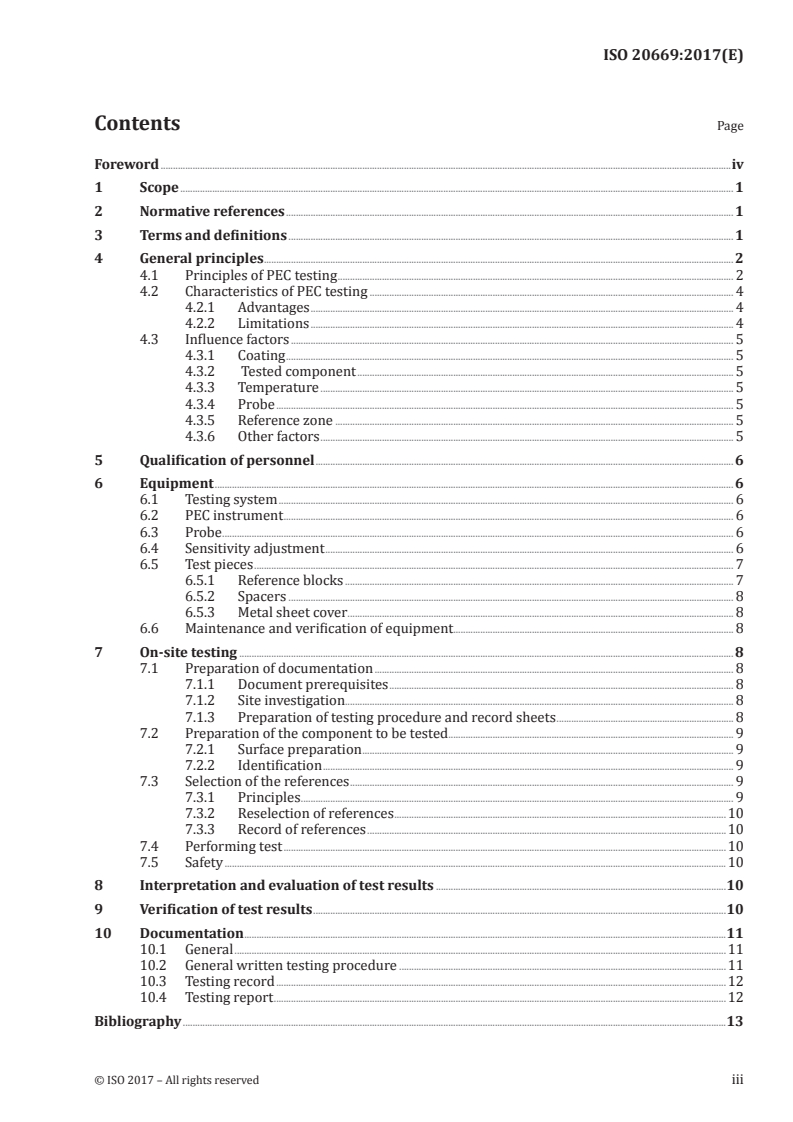
ISO 20669:2017 - Non-destructive testing — Pulsed eddy current testing of ferromagnetic metallic components/13/2017


ISO 20669:2017 - Essais non destructifs -- Contrôle par courants de Foucault pulsés de composants métalliques ferromagnétiques
ISO 20669:2017 - Essais non destructifs — Contrôle par courants de Foucault pulsés de composants métalliques ferromagnétiques/13/2017
Overview
ISO 20669:2017 - "Non-destructive testing - Pulsed eddy current testing of ferromagnetic metallic components" specifies the pulsed eddy current (PEC) testing technique for non-destructive thickness measurement of ferromagnetic metals. It covers in-service carbon steel and low-alloy steel components (including piping ≥ 50 mm diameter) across temperatures from −100 °C to 500 °C, wall thicknesses 3 mm to 65 mm, and coating thicknesses 0 mm to 200 mm. The standard defines principles, equipment, on-site procedures, influence factors and documentation, but does not set acceptance/evaluation criteria (these must be agreed contractually). It also excludes detection of cracks and local pitting.
Key Topics
- Principles of PEC testing: generation of pulsed electromagnetic fields, transmit/receive probe design, and analysis of decay curves (e.g., characteristic time, bending point, decay slope).
- Measurement ranges & limits: applicable metal/coating thickness and temperature ranges; sensitivity to component geometry - applying PEC outside scope may produce unpredictable inaccuracies.
- Equipment & probes: requirements for PEC instruments that generate pulses and separate transmit–receive probes; sensitivity adjustment and verification procedures.
- Influence factors: coating/insulation properties (conductivity, permeability, thickness), component material variability, temperature effects, probe selection, reference zone choice, vibration, and geometry.
- On-site testing procedures: documentation, site investigation, surface preparation, reference selection and recording, test execution, safety and result verification.
- Personnel & quality: qualification of operators, maintenance and verification of equipment, and mandatory documentation (test procedures, records, reports).
- Limitations: not suitable for crack detection or pitting evaluation; geometry knowledge required for reliable setup.
Applications
ISO 20669:2017 is designed for practical use where access or coating removal is difficult:
- Inspection of insulated or coated pipelines and pressure equipment in petrochemical, oil & gas, power generation and industrial plants.
- In-service thickness monitoring during operation (no coupling medium required).
- Situations requiring rapid screening of wall thickness through insulation or weather sheeting. Who uses it: NDT technicians and inspectors, asset owners/operators, integrity engineers, inspection service providers, and PEC equipment manufacturers developing procedures and calibration references.
Related Standards
- ISO 15548-3 (Eddy current equipment characteristics & verification)
- ISO 16809 (Ultrasonic thickness measurement)
- ISO 12718 (Terminology for pulsed eddy currents) These referenced standards support equipment verification, complementary thickness methods, and consistent terminology for PEC-based NDT.
Relations
- Consolidated By
ISO 3861:2021 - Rubber hoses and hose assemblies for sand and grit blasting — Specification - Effective Date
- 06-Jun-2022
Buy Documents
ISO 20669:2017 - Non-destructive testing -- Pulsed eddy current testing of ferromagnetic metallic components
ISO 20669:2017 - Non-destructive testing — Pulsed eddy current testing of ferromagnetic metallic components/13/2017
ISO 20669:2017 - Essais non destructifs -- Contrôle par courants de Foucault pulsés de composants métalliques ferromagnétiques
ISO 20669:2017 - Essais non destructifs — Contrôle par courants de Foucault pulsés de composants métalliques ferromagnétiques/13/2017
Get Certified
Connect with accredited certification bodies for this standard

IMP NDT d.o.o.
Non-destructive testing services. Radiography, ultrasonic, magnetic particle, penetrant, visual inspection.
Inštitut za kovinske materiale in tehnologije
Institute of Metals and Technology. Materials testing, metallurgical analysis, NDT.
Q Techna d.o.o.
NDT and quality assurance specialist. 30+ years experience. NDT personnel certification per ISO 9712, nuclear and thermal power plant inspections, QA/
Sponsored listings
Frequently Asked Questions
ISO 20669:2017 is a standard published by the International Organization for Standardization (ISO). Its full title is "Non-destructive testing — Pulsed eddy current testing of ferromagnetic metallic components". This standard covers: ISO 20669:2017 specifies the pulsed eddy current (PEC) testing technique used to perform thickness measurement on ferromagnetic metallic components with or without the presence of coating, insulation and weather sheeting. ISO 20669:2017 applies to the testing of in-service components made of carbon steel and low-alloy steel in the temperature of −100 °C to 500 °C (temperature measured at metal surface). The range of wall thickness of components is from 3 mm to 65 mm and the range of thickness of coatings is from 0 mm to 200 mm. The tested components also include piping of diameter not less than 50 mm. The technique described in this document is sensitive to the geometry of the component and applying the technique to components outside of its scope will result in unpredictable inaccuracy. This document does not apply to the testing of crack defects and local metal loss caused by pitting. ISO 20669:2017 does not establish evaluation criteria. The evaluation criteria shall be specified by the contractual agreement between parties.
ISO 20669:2017 specifies the pulsed eddy current (PEC) testing technique used to perform thickness measurement on ferromagnetic metallic components with or without the presence of coating, insulation and weather sheeting. ISO 20669:2017 applies to the testing of in-service components made of carbon steel and low-alloy steel in the temperature of −100 °C to 500 °C (temperature measured at metal surface). The range of wall thickness of components is from 3 mm to 65 mm and the range of thickness of coatings is from 0 mm to 200 mm. The tested components also include piping of diameter not less than 50 mm. The technique described in this document is sensitive to the geometry of the component and applying the technique to components outside of its scope will result in unpredictable inaccuracy. This document does not apply to the testing of crack defects and local metal loss caused by pitting. ISO 20669:2017 does not establish evaluation criteria. The evaluation criteria shall be specified by the contractual agreement between parties.
ISO 20669:2017 is classified under the following ICS (International Classification for Standards) categories: 19.100 - Non-destructive testing. The ICS classification helps identify the subject area and facilitates finding related standards.
ISO 20669:2017 has the following relationships with other standards: It is inter standard links to ISO 3861:2021. Understanding these relationships helps ensure you are using the most current and applicable version of the standard.
ISO 20669:2017 is available in PDF format for immediate download after purchase. The document can be added to your cart and obtained through the secure checkout process. Digital delivery ensures instant access to the complete standard document.
Standards Content (Sample)
INTERNATIONAL ISO
STANDARD 20669
First edition
2017-03
Non-destructive testing — Pulsed
eddy current testing of ferromagnetic
metallic components
Essais non destructifs — Contrôle par courants de Foucault pulsés de
composants métalliques ferromagnétiques
Reference number
©
ISO 2017
© ISO 2017, Published in Switzerland
All rights reserved. Unless otherwise specified, no part of this publication may be reproduced or utilized otherwise in any form
or by any means, electronic or mechanical, including photocopying, or posting on the internet or an intranet, without prior
written permission. Permission can be requested from either ISO at the address below or ISO’s member body in the country of
the requester.
ISO copyright office
Ch. de Blandonnet 8 • CP 401
CH-1214 Vernier, Geneva, Switzerland
Tel. +41 22 749 01 11
Fax +41 22 749 09 47
copyright@iso.org
www.iso.org
ii © ISO 2017 – All rights reserved
Contents Page
Foreword .iv
1 Scope . 1
2 Normative references . 1
3 Terms and definitions . 1
4 General principles . 2
4.1 Principles of PEC testing . 2
4.2 Characteristics of PEC testing . 4
4.2.1 Advantages . 4
4.2.2 Limitations . 4
4.3 Influence factors . 5
4.3.1 Coating . 5
4.3.2 Tested component . 5
4.3.3 Temperature . 5
4.3.4 Probe . 5
4.3.5 Reference zone . 5
4.3.6 Other factors . 5
5 Qualification of personnel . 6
6 Equipment . 6
6.1 Testing system . 6
6.2 PEC instrument . 6
6.3 Probe . 6
6.4 Sensitivity adjustment . 6
6.5 Test pieces . 7
6.5.1 Reference blocks . 7
6.5.2 Spacers . 8
6.5.3 Metal sheet cover . 8
6.6 Maintenance and verification of equipment. 8
7 On-site testing . 8
7.1 Preparation of documentation . 8
7.1.1 Document prerequisites . 8
7.1.2 Site investigation. 8
7.1.3 Preparation of testing procedure and record sheets . 8
7.2 Preparation of the component to be tested . 9
7.2.1 Surface preparation . 9
7.2.2 Identification . 9
7.3 Selection of the references . 9
7.3.1 Principles . 9
7.3.2 Reselection of references .10
7.3.3 Record of references .10
7.4 Performing test .10
7.5 Safety .10
8 Interpretation and evaluation of test results .10
9 Verification of test results .10
10 Documentation .11
10.1 General .11
10.2 General written testing procedure .11
10.3 Testing record .12
10.4 Testing report .12
Bibliography .13
Foreword
ISO (the International Organization for Standardization) is a worldwide federation of national standards
bodies (ISO member bodies). The work of preparing International Standards is normally carried out
through ISO technical committees. Each member body interested in a subject for which a technical
committee has been established has the right to be represented on that committee. International
organizations, governmental and non-governmental, in liaison with ISO, also take part in the work.
ISO collaborates closely with the International Electrotechnical Commission (IEC) on all matters of
electrotechnical standardization.
The procedures used to develop this document and those intended for its further maintenance are
described in the ISO/IEC Directives, Part 1. In particular, the different approval criteria needed for the
different types of ISO documents should be noted. This document was drafted in accordance with the
editorial rules of the ISO/IEC Directives, Part 2 (see www .iso .org/ directives).
Attention is drawn to the possibility that some of the elements of this document may be the subject of
patent rights. ISO shall not be held responsible for identifying any or all such patent rights. Details of
any patent rights identified during the development of the document will be in the Introduction and/or
on the ISO list of patent declarations received (see www .iso .org/ patents).
Any trade name used in this document is information given for the convenience of users and does not
constitute an endorsement.
For an explanation on the voluntary nature of standards, the meaning of ISO specific terms and
expressions related to conformity assessment, as well as information about ISO’s adherence to the
World Trade Organization (WTO) principles in the Technical Barriers to Trade (TBT) see the following
URL: w w w . i s o .org/ iso/ foreword .html.
This document was prepared by Technical Committee ISO/TC 135, Non-destructive testing,
Subcommittee SC 4, Eddy current methods.
iv © ISO 2017 – All rights reserved
INTERNATIONAL STANDARD ISO 20669:2017(E)
Non-destructive testing — Pulsed eddy current testing of
ferromagnetic metallic components
1 Scope
This document specifies the pulsed eddy current (PEC) testing technique used to perform thickness
measurement on ferromagnetic metallic components with or without the presence of coating, insulation
and weather sheeting.
This document applies to the testing of in-service components made of carbon steel and low-alloy steel
in the temperature of −100 °C to 500 °C (temperature measured at metal surface). The range of wall
thickness of components is from 3 mm to 65 mm and the range of thickness of coatings is from 0 mm to
200 mm. The tested components also include piping of diameter not less than 50 mm.
The technique described in this document is sensitive to the geometry of the component and applying
the technique to components outside of its scope will result in unpredictable inaccuracy. This document
does not apply to the testing of crack defects and local metal loss caused by pitting.
This document does not establish evaluation criteria. The evaluation criteria shall be specified by the
contractual agreement between parties.
2 Normative references
The following documents are referred to in text in such a way that some or all of their content
constitutes requirements of this document. For dated references, only the edition cited applies. For
undated references, the latest edition of the referenced document (including any amendments) applies.
ISO 15548-3, Non-destructive testing — Equipment for eddy current examination — Part 3: System
characteristics and verification
ISO 16809, Non-destructive testing — Ultrasonic thickness measurement
3 Terms and definitions
For the purposes of this document, the terms and definitions given in ISO 12718 and the following apply.
ISO and IEC maintain terminological databases for use in standardization at the following addresses:
— IEC Electropedia: available at http:// www .electropedia .org/
— ISO Online browsing platform: available at http:// www .iso .org/ obp
3.1
coating
material which covers the surface of a tested component in the forms of adhesive, adsorbed layer,
bundle, twine or inlay, etc. such as paint, plastic, asphalt, rock-wool, foam, metal mesh, cement, carbon
(glass) fibre, marine organism, etc.
Note 1 to entry: For the purpose of this document, the word coating is used to describe any protective or
insulative layer on the component to be tested.
3.2
cover
sheet metal protective layer on the outside of the coating
3.3
excitation pulse duration
time needed for the energy to travel through the actual thickness of the component
Note 1 to entry: It needs to be long enough to penetrate the full thickness
3.4
decay rate
rate of change in electromagnetic field measured by the receiver sensor after the transmitter has been
switched off
Note 1 to entry: For example, the bending point of one of the typical measurement methods (see Figure 1).
3.5
bending point
point where the received signal decay rate changes from linear to exponential
3.6
characteristic time
time measured between the end of the excitation pulse and the bending point
Note 1 to entry: Its value is proportional to the magnetic permeability, electrical conductivity and the thickness
squared.
3.7
pulse repetition frequency
prf
number of pulses generated per second, expressed in Hertz (Hz)
4 General principles
4.1 Principles of PEC testing
According to ISO 12718, pulsed eddy currents are eddy currents generated by a pulsed
electromagnetic field.
Similar to sinusoidal eddy currents, induced pulsed eddy currents are modified by any local variation
in the material properties.
The pulse is characterized by its duration (T), which enables to generate induced currents with a very
high intensity.
The time interval between two measurements is linked to the material thickness.
2 © ISO 2017 – All rights reserved
Key
1 excitation signal waveform
2 detection signal waveform
3 decay curve
4 bending point
Figure 1 — Pulsed eddy current signal
The transmission signal from the probe shows a very broad spectrum of frequencies.
The received signal also has a frequency (or time) spectrum, the analysis of which p
...
INTERNATIONAL ISO
STANDARD 20669
First edition
2017-03
Non-destructive testing — Pulsed
eddy current testing of ferromagnetic
metallic components
Essais non destructifs — Contrôle par courants de Foucault pulsés de
composants métalliques ferromagnétiques
Reference number
©
ISO 2017
© ISO 2017, Published in Switzerland
All rights reserved. Unless otherwise specified, no part of this publication may be reproduced or utilized otherwise in any form
or by any means, electronic or mechanical, including photocopying, or posting on the internet or an intranet, without prior
written permission. Permission can be requested from either ISO at the address below or ISO’s member body in the country of
the requester.
ISO copyright office
Ch. de Blandonnet 8 • CP 401
CH-1214 Vernier, Geneva, Switzerland
Tel. +41 22 749 01 11
Fax +41 22 749 09 47
copyright@iso.org
www.iso.org
ii © ISO 2017 – All rights reserved
Contents Page
Foreword .iv
1 Scope . 1
2 Normative references . 1
3 Terms and definitions . 1
4 General principles . 2
4.1 Principles of PEC testing . 2
4.2 Characteristics of PEC testing . 4
4.2.1 Advantages . 4
4.2.2 Limitations . 4
4.3 Influence factors . 5
4.3.1 Coating . 5
4.3.2 Tested component . 5
4.3.3 Temperature . 5
4.3.4 Probe . 5
4.3.5 Reference zone . 5
4.3.6 Other factors . 5
5 Qualification of personnel . 6
6 Equipment . 6
6.1 Testing system . 6
6.2 PEC instrument . 6
6.3 Probe . 6
6.4 Sensitivity adjustment . 6
6.5 Test pieces . 7
6.5.1 Reference blocks . 7
6.5.2 Spacers . 8
6.5.3 Metal sheet cover . 8
6.6 Maintenance and verification of equipment. 8
7 On-site testing . 8
7.1 Preparation of documentation . 8
7.1.1 Document prerequisites . 8
7.1.2 Site investigation. 8
7.1.3 Preparation of testing procedure and record sheets . 8
7.2 Preparation of the component to be tested . 9
7.2.1 Surface preparation . 9
7.2.2 Identification . 9
7.3 Selection of the references . 9
7.3.1 Principles . 9
7.3.2 Reselection of references .10
7.3.3 Record of references .10
7.4 Performing test .10
7.5 Safety .10
8 Interpretation and evaluation of test results .10
9 Verification of test results .10
10 Documentation .11
10.1 General .11
10.2 General written testing procedure .11
10.3 Testing record .12
10.4 Testing report .12
Bibliography .13
Foreword
ISO (the International Organization for Standardization) is a worldwide federation of national standards
bodies (ISO member bodies). The work of preparing International Standards is normally carried out
through ISO technical committees. Each member body interested in a subject for which a technical
committee has been established has the right to be represented on that committee. International
organizations, governmental and non-governmental, in liaison with ISO, also take part in the work.
ISO collaborates closely with the International Electrotechnical Commission (IEC) on all matters of
electrotechnical standardization.
The procedures used to develop this document and those intended for its further maintenance are
described in the ISO/IEC Directives, Part 1. In particular, the different approval criteria needed for the
different types of ISO documents should be noted. This document was drafted in accordance with the
editorial rules of the ISO/IEC Directives, Part 2 (see www .iso .org/ directives).
Attention is drawn to the possibility that some of the elements of this document may be the subject of
patent rights. ISO shall not be held responsible for identifying any or all such patent rights. Details of
any patent rights identified during the development of the document will be in the Introduction and/or
on the ISO list of patent declarations received (see www .iso .org/ patents).
Any trade name used in this document is information given for the convenience of users and does not
constitute an endorsement.
For an explanation on the voluntary nature of standards, the meaning of ISO specific terms and
expressions related to conformity assessment, as well as information about ISO’s adherence to the
World Trade Organization (WTO) principles in the Technical Barriers to Trade (TBT) see the following
URL: w w w . i s o .org/ iso/ foreword .html.
This document was prepared by Technical Committee ISO/TC 135, Non-destructive testing,
Subcommittee SC 4, Eddy current methods.
iv © ISO 2017 – All rights reserved
INTERNATIONAL STANDARD ISO 20669:2017(E)
Non-destructive testing — Pulsed eddy current testing of
ferromagnetic metallic components
1 Scope
This document specifies the pulsed eddy current (PEC) testing technique used to perform thickness
measurement on ferromagnetic metallic components with or without the presence of coating, insulation
and weather sheeting.
This document applies to the testing of in-service components made of carbon steel and low-alloy steel
in the temperature of −100 °C to 500 °C (temperature measured at metal surface). The range of wall
thickness of components is from 3 mm to 65 mm and the range of thickness of coatings is from 0 mm to
200 mm. The tested components also include piping of diameter not less than 50 mm.
The technique described in this document is sensitive to the geometry of the component and applying
the technique to components outside of its scope will result in unpredictable inaccuracy. This document
does not apply to the testing of crack defects and local metal loss caused by pitting.
This document does not establish evaluation criteria. The evaluation criteria shall be specified by the
contractual agreement between parties.
2 Normative references
The following documents are referred to in text in such a way that some or all of their content
constitutes requirements of this document. For dated references, only the edition cited applies. For
undated references, the latest edition of the referenced document (including any amendments) applies.
ISO 15548-3, Non-destructive testing — Equipment for eddy current examination — Part 3: System
characteristics and verification
ISO 16809, Non-destructive testing — Ultrasonic thickness measurement
3 Terms and definitions
For the purposes of this document, the terms and definitions given in ISO 12718 and the following apply.
ISO and IEC maintain terminological databases for use in standardization at the following addresses:
— IEC Electropedia: available at http:// www .electropedia .org/
— ISO Online browsing platform: available at http:// www .iso .org/ obp
3.1
coating
material which covers the surface of a tested component in the forms of adhesive, adsorbed layer,
bundle, twine or inlay, etc. such as paint, plastic, asphalt, rock-wool, foam, metal mesh, cement, carbon
(glass) fibre, marine organism, etc.
Note 1 to entry: For the purpose of this document, the word coating is used to describe any protective or
insulative layer on the component to be tested.
3.2
cover
sheet metal protective layer on the outside of the coating
3.3
excitation pulse duration
time needed for the energy to travel through the actual thickness of the component
Note 1 to entry: It needs to be long enough to penetrate the full thickness
3.4
decay rate
rate of change in electromagnetic field measured by the receiver sensor after the transmitter has been
switched off
Note 1 to entry: For example, the bending point of one of the typical measurement methods (see Figure 1).
3.5
bending point
point where the received signal decay rate changes from linear to exponential
3.6
characteristic time
time measured between the end of the excitation pulse and the bending point
Note 1 to entry: Its value is proportional to the magnetic permeability, electrical conductivity and the thickness
squared.
3.7
pulse repetition frequency
prf
number of pulses generated per second, expressed in Hertz (Hz)
4 General principles
4.1 Principles of PEC testing
According to ISO 12718, pulsed eddy currents are eddy currents generated by a pulsed
electromagnetic field.
Similar to sinusoidal eddy currents, induced pulsed eddy currents are modified by any local variation
in the material properties.
The pulse is characterized by its duration (T), which enables to generate induced currents with a very
high intensity.
The time interval between two measurements is linked to the material thickness.
2 © ISO 2017 – All rights reserved
Key
1 excitation signal waveform
2 detection signal waveform
3 decay curve
4 bending point
Figure 1 — Pulsed eddy current signal
The transmission signal from the probe shows a very broad spectrum of frequencies.
The received signal also has a frequency (or time) spectrum, the analysis of which p
...
NORME ISO
INTERNATIONALE 20669
Première édition
2017-03
Essais non destructifs — Contrôle
par courants de Foucault pulsés
de composants métalliques
ferromagnétiques
Non-destructive testing — Pulsed eddy current testing of
ferromagnetic metallic components
Numéro de référence
©
ISO 2017
DOCUMENT PROTÉGÉ PAR COPYRIGHT
© ISO 2017, Publié en Suisse
Droits de reproduction réservés. Sauf indication contraire, aucune partie de cette publication ne peut être reproduite ni utilisée
sous quelque forme que ce soit et par aucun procédé, électronique ou mécanique, y compris la photocopie, l’affichage sur
l’internet ou sur un Intranet, sans autorisation écrite préalable. Les demandes d’autorisation peuvent être adressées à l’ISO à
l’adresse ci-après ou au comité membre de l’ISO dans le pays du demandeur.
ISO copyright office
Ch. de Blandonnet 8 • CP 401
CH-1214 Vernier, Geneva, Switzerland
Tel. +41 22 749 01 11
Fax +41 22 749 09 47
copyright@iso.org
www.iso.org
ii © ISO 2017 – Tous droits réservés
Sommaire Page
Avant-propos .iv
1 Domaine d’application . 1
2 Références normatives . 1
3 Termes et définitions . 1
4 Principes généraux . 2
4.1 Principes du contrôle par courants de Foucault pulsés. 2
4.2 Caractéristiques du contrôle par courants de Foucault pulsés . 4
4.2.1 Avantages . 4
4.2.2 Limites . 4
4.3 Facteurs ayant une incidence . 5
4.3.1 Revêtement . 5
4.3.2 Composant contrôlé . 5
4.3.3 Température . 5
4.3.4 Capteur . 5
4.3.5 Zone de référence . 5
4.3.6 Autres facteurs . 6
5 Qualification du personnel . 6
6 Matériel . 6
6.1 Système de contrôle . 6
6.2 Appareil à courants de Foucault pulsés . 6
6.3 Capteur . 6
6.4 Ajustement de la sensibilité . 7
6.5 Éprouvettes . 7
6.5.1 Blocs de référence . 7
6.5.2 Cales d’éloignement . 8
6.5.3 Coffrage en métal laminé . 8
6.6 Entretien et vérification du matériel. 8
7 Mise en œuvre sur site . 8
7.1 Préparation de la documentation . 8
7.1.1 Documents préalablement requis . 8
7.1.2 Examen du site. 9
7.1.3 Préparation de la procédure de contrôle et des fiches d’enregistrement . 9
7.2 Préparation du composant à contrôler . 9
7.2.1 Préparation de la surface . 9
7.2.2 Identification . 9
7.3 Choix des références .10
7.3.1 Principes .10
7.3.2 Choix de nouvelles références .10
7.3.3 Enregistrement des références .10
7.4 Réalisation du contrôle .11
7.5 Sécurité .11
8 Interprétation et évaluation des résultats de contrôle .11
9 Vérification des résultats de contrôle.11
10 Documentation .11
10.1 Généralités .11
10.2 Procédure générale de contrôle écrite .11
10.3 Enregistrements relatifs au contrôle .12
10.4 Rapport de contrôle .13
Bibliographie .14
Avant-propos
L’ISO (Organisation internationale de normalisation) est une fédération mondiale d’organismes
nationaux de normalisation (comités membres de l’ISO). L’élaboration des Normes internationales est
en général confiée aux comités techniques de l’ISO. Chaque comité membre intéressé par une étude
a le droit de faire partie du comité technique créé à cet effet. Les organisations internationales,
gouvernementales et non gouvernementales, en liaison avec l’ISO participent également aux travaux.
L’ISO collabore étroitement avec la Commission électrotechnique internationale (IEC) en ce qui
concerne la normalisation électrotechnique.
Les procédures utilisées pour élaborer le présent document et celles destinées à sa mise à jour sont
décrites dans les Directives ISO/IEC, Partie 1. Il convient, en particulier de prendre note des différents
critères d’approbation requis pour les différents types de documents ISO. Le présent document a été
rédigé conformément aux règles de rédaction données dans les Directives ISO/IEC, Partie 2 (voir www
.iso .org/ directives).
L’attention est appelée sur le fait que certains des éléments du présent document peuvent faire l’objet de
droits de propriété intellectuelle ou de droits analogues. L’ISO ne saurait être tenue pour responsable
de ne pas avoir identifié de tels droits de propriété et averti de leur existence. Les détails concernant
les références aux droits de propriété intellectuelle ou autres droits analogues identifiés lors de
l’élaboration du document sont indiqués dans l’Introduction et/ou dans la liste des déclarations de
brevets reçues par l’ISO (voir www .iso .org/ brevets).
Les appellations commerciales éventuellement mentionnées dans le présent document sont données
pour information, par souci de commodité, à l’intention des utilisateurs et ne sauraient constituer un
engagement.
Pour une explication de la signification des termes et expressions spécifiques de l’ISO liés à l’évaluation
de la conformité, ou pour toute information au sujet de l’adhésion de l’ISO aux principes de l’OMC
concernant les obstacles techniques au commerce (OTC), voir le lien suivant: w w w . i s o .org/ iso/ avant
-propos .html.
Le comité chargé de l’élaboration du présent document est le Comité technique ISO/TC 135, Essais non
destructifs, Sous-comité SC 4, Méthodes par courants de Foucault.
iv © ISO 2017 – Tous droits réservés
NORME INTERNATIONALE ISO 20669:2017(F)
Essais non destructifs — Contrôle par courants de Foucault
pulsés de composants métalliques ferromagnétiques
1 Domaine d’application
Le présent document spécifie la technique de contrôle par courants de Foucault pulsés, utilisée
pour mesurer l’épaisseur de composants métalliques ferromagnétiques, qu’ils présentent ou non un
revêtement, une isolation et une tôle de protection contre les intempéries.
Le présent document s’applique aux contrôles effectués sur des composants en service, fabriqués en
acier au carbone et en acier faiblement allié, dans la plage de température comprise entre – 100 °C et
500 °C (température mesurée à la surface du métal). La gamme des épaisseurs de paroi des composants
est comprise entre 3 mm et 65 mm, et la gamme des épaisseurs des revêtements est comprise entre
0 mm et 200 mm. Les composants contrôlés comprennent également des tuyauteries de diamètre
supérieur ou égal à 50 mm.
La géométrie des composants a une incidence sur la technique décrite dans le présent document, et
l’inexactitude sera impossible à prévoir si cette technique est utilisée sur des composants qui ne
correspondent pas à son domaine d’application. Le présent document n’est pas applicable au contrôle
des fissures et des pertes de métal localisées dues à des piqûres.
Le présent document ne spécifie aucun critère d’évaluation. Les critères d’évaluation doivent être
spécifiés par l’accord contractuel entre les parties.
2 Références normatives
Les documents suivants, en tout ou partie, sont référencés de manière normative dans le présent
document et sont indispensables pour son application. Pour les références datées, seule l’édition citée
s’applique. Pour les références non datées, la dernière édition du document de référence s’applique (y
compris les éventuels amendements).
ISO 15548-3, Essais non destructifs — Appareillage pour examen par courants de Foucault — Partie 3:
Caractéristiques du système et vérifications
ISO 16809, Essais non destructifs — Mesurage de l’épaisseur par ultrasons
3 Termes et définitions
Pour les besoins du présent document, les termes et définitions donnés dans l’ISO 12718 ainsi que les
suivants s’appliquent.
L’ISO et l’IEC tiennent à jour des bases de données terminologiques destinées à être utilisées en
normalisation, consultables aux adresses suivantes:
— IEC Electropedia: disponible à l’adresse http:// www .electropedia .org/
— ISO Online browsing platform: disponible à l’adresse http:// www .iso .org/ obp
3.1
revêtement
matériau qui recouvre la surface d’un composant contrôlé, sous la forme d’un adhésif, d’une couche
adsorbée, d’un faisceau, d’un tissage ou d’une gaine, par exemple, peinture, produit plastique, enrobé,
laine de roche, mousse, treillis métallique, ciment, fibre de carbone (ou de verre), produit issu d’un
organisme marin
Note 1 à l’article: Pour les besoins du présent document, le terme « revêtement » est utilisé pour décrire toute
couche protectrice ou isolante appliquée sur le composant à contrôler.
3.2
coffrage
couche protectrice en tôle présente sur l’extérieur du revêtement
3.3
durée de l’impulsion d’excitation
durée nécessaire pour que l’énergie traverse l’épaisseur réelle du composant
Note 1 à l’article: Elle doit être suffisante pour que l’épaisseur soit entièrement traversée.
3.4
taux de décroissance
taux de variation du champ électromagnétique mesuré par le capteur après la mise hors tension de
l’émetteur
Note 1 à l’article: Par exemple, le premier point de changement de pente est une des méthodes de mesure types
(voir Figure 1).
3.5
point de changement de pente
point où le taux linéaire de décroissance du signal reçu devient exponentiel
3.6
temps caractéristique
durée mesurée entre la fin de l’impulsion d’excitation et le point de changement de pente
Note 1 à l’article: Sa valeur est proportionnelle à la perméabilité magnétique, à la conductivité électrique et au
carré de l’épaisseur.
3.7
fréquence de récurrence
nombre d’impulsions émises par seconde, exprimé en hertz (Hz)
4 Principes généraux
4.1 Principes du contrôle par courants de Foucault pulsés
Conformément à l’ISO 12718, les courants de Foucault pulsés sont des courants de Foucault générés par
un champ magnétique impulsionnel.
De même que les courants de Foucault sinusoïdaux, les courants de Foucault pulsés induits sont modifiés
par toute variation locale des propriétés du matériau.
L’impulsion est caractérisée par sa durée (T), qui permet de générer des courants induits de très haute
intensité.
L’intervalle de temps entre deux mesurages dépend de l’épaisseur du matériau.
2 © ISO 2017 – Tous droits réservés
Légende
1 forme d’onde du signal d’excitation
2 forme d’onde du signal de détection
3 courbe de décroissance
4 point de changement de pente
Figure 1 — Signal des courants de Foucault pulsés
Le signal émis par le capteur présente un très large spectre de fréquences.
Le signal mesuré présente également un spectre de fréquences (ou de temps) dont l’analyse permet
d’obtenir des informations concernant différentes profondeurs du matériau.
L’appareil est spécifique de cette technique, car il doit permettre de générer des impulsions.
Les capteurs sont des capteurs à fonctions séparées.
La technique de mesure varie d’un appareil à l’autre, en fonction du fabricant.
Par exemple, la technique de mesure peut reposer sur:
— l’utilisation du temps caractéristique au point de changement de pente;
— le mesurage de la période requise pour une décroissance spécifique;
— le mesurage de la pente de la courbe de décroissance, etc.
Voir Figure 2.
Légende
1 enroulement d’excitation
2 dispositifs récepteurs
3 champ magnétique d’excitation
4 champ magnétique en retour
5 courants de Foucault
6 couche extérieure
7 isolation
8 composant soumis au contrôle
NOTE La couche extérieure et l’isolation constituent le revêtement.
Figure 2 — Principe fondamental de la technique de contrôle par courants de Foucault pulsés
4.2 Caractéristiques du contrôle par courants de Foucault pulsés
4.2.1 Avantages
Les caractéristiques de la méthode indiquées ci-dessous constituent les principaux avantages de la
technique de contrôle par courants de Foucault pulsés:
— la méthode ne nécessite pas de retirer l’isolation du produit contrôlé;
— le contrôle peut être effectué pendant le fonctionnement de l’installation;
— aucun milieu couplant, tel que l’eau, n’est nécessaire.
4.2.2 Limites
La géométrie du composant doit être connue pour permettre de régler co
...
NORME ISO
INTERNATIONALE 20669
Première édition
2017-03
Essais non destructifs — Contrôle
par courants de Foucault pulsés
de composants métalliques
ferromagnétiques
Non-destructive testing — Pulsed eddy current testing of
ferromagnetic metallic components
Numéro de référence
©
ISO 2017
DOCUMENT PROTÉGÉ PAR COPYRIGHT
© ISO 2017, Publié en Suisse
Droits de reproduction réservés. Sauf indication contraire, aucune partie de cette publication ne peut être reproduite ni utilisée
sous quelque forme que ce soit et par aucun procédé, électronique ou mécanique, y compris la photocopie, l’affichage sur
l’internet ou sur un Intranet, sans autorisation écrite préalable. Les demandes d’autorisation peuvent être adressées à l’ISO à
l’adresse ci-après ou au comité membre de l’ISO dans le pays du demandeur.
ISO copyright office
Ch. de Blandonnet 8 • CP 401
CH-1214 Vernier, Geneva, Switzerland
Tel. +41 22 749 01 11
Fax +41 22 749 09 47
copyright@iso.org
www.iso.org
ii © ISO 2017 – Tous droits réservés
Sommaire Page
Avant-propos .iv
1 Domaine d’application . 1
2 Références normatives . 1
3 Termes et définitions . 1
4 Principes généraux . 2
4.1 Principes du contrôle par courants de Foucault pulsés. 2
4.2 Caractéristiques du contrôle par courants de Foucault pulsés . 4
4.2.1 Avantages . 4
4.2.2 Limites . 4
4.3 Facteurs ayant une incidence . 5
4.3.1 Revêtement . 5
4.3.2 Composant contrôlé . 5
4.3.3 Température . 5
4.3.4 Capteur . 5
4.3.5 Zone de référence . 5
4.3.6 Autres facteurs . 6
5 Qualification du personnel . 6
6 Matériel . 6
6.1 Système de contrôle . 6
6.2 Appareil à courants de Foucault pulsés . 6
6.3 Capteur . 6
6.4 Ajustement de la sensibilité . 7
6.5 Éprouvettes . 7
6.5.1 Blocs de référence . 7
6.5.2 Cales d’éloignement . 8
6.5.3 Coffrage en métal laminé . 8
6.6 Entretien et vérification du matériel. 8
7 Mise en œuvre sur site . 8
7.1 Préparation de la documentation . 8
7.1.1 Documents préalablement requis . 8
7.1.2 Examen du site. 9
7.1.3 Préparation de la procédure de contrôle et des fiches d’enregistrement . 9
7.2 Préparation du composant à contrôler . 9
7.2.1 Préparation de la surface . 9
7.2.2 Identification . 9
7.3 Choix des références .10
7.3.1 Principes .10
7.3.2 Choix de nouvelles références .10
7.3.3 Enregistrement des références .10
7.4 Réalisation du contrôle .11
7.5 Sécurité .11
8 Interprétation et évaluation des résultats de contrôle .11
9 Vérification des résultats de contrôle.11
10 Documentation .11
10.1 Généralités .11
10.2 Procédure générale de contrôle écrite .11
10.3 Enregistrements relatifs au contrôle .12
10.4 Rapport de contrôle .13
Bibliographie .14
Avant-propos
L’ISO (Organisation internationale de normalisation) est une fédération mondiale d’organismes
nationaux de normalisation (comités membres de l’ISO). L’élaboration des Normes internationales est
en général confiée aux comités techniques de l’ISO. Chaque comité membre intéressé par une étude
a le droit de faire partie du comité technique créé à cet effet. Les organisations internationales,
gouvernementales et non gouvernementales, en liaison avec l’ISO participent également aux travaux.
L’ISO collabore étroitement avec la Commission électrotechnique internationale (IEC) en ce qui
concerne la normalisation électrotechnique.
Les procédures utilisées pour élaborer le présent document et celles destinées à sa mise à jour sont
décrites dans les Directives ISO/IEC, Partie 1. Il convient, en particulier de prendre note des différents
critères d’approbation requis pour les différents types de documents ISO. Le présent document a été
rédigé conformément aux règles de rédaction données dans les Directives ISO/IEC, Partie 2 (voir www
.iso .org/ directives).
L’attention est appelée sur le fait que certains des éléments du présent document peuvent faire l’objet de
droits de propriété intellectuelle ou de droits analogues. L’ISO ne saurait être tenue pour responsable
de ne pas avoir identifié de tels droits de propriété et averti de leur existence. Les détails concernant
les références aux droits de propriété intellectuelle ou autres droits analogues identifiés lors de
l’élaboration du document sont indiqués dans l’Introduction et/ou dans la liste des déclarations de
brevets reçues par l’ISO (voir www .iso .org/ brevets).
Les appellations commerciales éventuellement mentionnées dans le présent document sont données
pour information, par souci de commodité, à l’intention des utilisateurs et ne sauraient constituer un
engagement.
Pour une explication de la signification des termes et expressions spécifiques de l’ISO liés à l’évaluation
de la conformité, ou pour toute information au sujet de l’adhésion de l’ISO aux principes de l’OMC
concernant les obstacles techniques au commerce (OTC), voir le lien suivant: w w w . i s o .org/ iso/ avant
-propos .html.
Le comité chargé de l’élaboration du présent document est le Comité technique ISO/TC 135, Essais non
destructifs, Sous-comité SC 4, Méthodes par courants de Foucault.
iv © ISO 2017 – Tous droits réservés
NORME INTERNATIONALE ISO 20669:2017(F)
Essais non destructifs — Contrôle par courants de Foucault
pulsés de composants métalliques ferromagnétiques
1 Domaine d’application
Le présent document spécifie la technique de contrôle par courants de Foucault pulsés, utilisée
pour mesurer l’épaisseur de composants métalliques ferromagnétiques, qu’ils présentent ou non un
revêtement, une isolation et une tôle de protection contre les intempéries.
Le présent document s’applique aux contrôles effectués sur des composants en service, fabriqués en
acier au carbone et en acier faiblement allié, dans la plage de température comprise entre – 100 °C et
500 °C (température mesurée à la surface du métal). La gamme des épaisseurs de paroi des composants
est comprise entre 3 mm et 65 mm, et la gamme des épaisseurs des revêtements est comprise entre
0 mm et 200 mm. Les composants contrôlés comprennent également des tuyauteries de diamètre
supérieur ou égal à 50 mm.
La géométrie des composants a une incidence sur la technique décrite dans le présent document, et
l’inexactitude sera impossible à prévoir si cette technique est utilisée sur des composants qui ne
correspondent pas à son domaine d’application. Le présent document n’est pas applicable au contrôle
des fissures et des pertes de métal localisées dues à des piqûres.
Le présent document ne spécifie aucun critère d’évaluation. Les critères d’évaluation doivent être
spécifiés par l’accord contractuel entre les parties.
2 Références normatives
Les documents suivants, en tout ou partie, sont référencés de manière normative dans le présent
document et sont indispensables pour son application. Pour les références datées, seule l’édition citée
s’applique. Pour les références non datées, la dernière édition du document de référence s’applique (y
compris les éventuels amendements).
ISO 15548-3, Essais non destructifs — Appareillage pour examen par courants de Foucault — Partie 3:
Caractéristiques du système et vérifications
ISO 16809, Essais non destructifs — Mesurage de l’épaisseur par ultrasons
3 Termes et définitions
Pour les besoins du présent document, les termes et définitions donnés dans l’ISO 12718 ainsi que les
suivants s’appliquent.
L’ISO et l’IEC tiennent à jour des bases de données terminologiques destinées à être utilisées en
normalisation, consultables aux adresses suivantes:
— IEC Electropedia: disponible à l’adresse http:// www .electropedia .org/
— ISO Online browsing platform: disponible à l’adresse http:// www .iso .org/ obp
3.1
revêtement
matériau qui recouvre la surface d’un composant contrôlé, sous la forme d’un adhésif, d’une couche
adsorbée, d’un faisceau, d’un tissage ou d’une gaine, par exemple, peinture, produit plastique, enrobé,
laine de roche, mousse, treillis métallique, ciment, fibre de carbone (ou de verre), produit issu d’un
organisme marin
Note 1 à l’article: Pour les besoins du présent document, le terme « revêtement » est utilisé pour décrire toute
couche protectrice ou isolante appliquée sur le composant à contrôler.
3.2
coffrage
couche protectrice en tôle présente sur l’extérieur du revêtement
3.3
durée de l’impulsion d’excitation
durée nécessaire pour que l’énergie traverse l’épaisseur réelle du composant
Note 1 à l’article: Elle doit être suffisante pour que l’épaisseur soit entièrement traversée.
3.4
taux de décroissance
taux de variation du champ électromagnétique mesuré par le capteur après la mise hors tension de
l’émetteur
Note 1 à l’article: Par exemple, le premier point de changement de pente est une des méthodes de mesure types
(voir Figure 1).
3.5
point de changement de pente
point où le taux linéaire de décroissance du signal reçu devient exponentiel
3.6
temps caractéristique
durée mesurée entre la fin de l’impulsion d’excitation et le point de changement de pente
Note 1 à l’article: Sa valeur est proportionnelle à la perméabilité magnétique, à la conductivité électrique et au
carré de l’épaisseur.
3.7
fréquence de récurrence
nombre d’impulsions émises par seconde, exprimé en hertz (Hz)
4 Principes généraux
4.1 Principes du contrôle par courants de Foucault pulsés
Conformément à l’ISO 12718, les courants de Foucault pulsés sont des courants de Foucault générés par
un champ magnétique impulsionnel.
De même que les courants de Foucault sinusoïdaux, les courants de Foucault pulsés induits sont modifiés
par toute variation locale des propriétés du matériau.
L’impulsion est caractérisée par sa durée (T), qui permet de générer des courants induits de très haute
intensité.
L’intervalle de temps entre deux mesurages dépend de l’épaisseur du matériau.
2 © ISO 2017 – Tous droits réservés
Légende
1 forme d’onde du signal d’excitation
2 forme d’onde du signal de détection
3 courbe de décroissance
4 point de changement de pente
Figure 1 — Signal des courants de Foucault pulsés
Le signal émis par le capteur présente un très large spectre de fréquences.
Le signal mesuré présente également un spectre de fréquences (ou de temps) dont l’analyse permet
d’obtenir des informations concernant différentes profondeurs du matériau.
L’appareil est spécifique de cette technique, car il doit permettre de générer des impulsions.
Les capteurs sont des capteurs à fonctions séparées.
La technique de mesure varie d’un appareil à l’autre, en fonction du fabricant.
Par exemple, la technique de mesure peut reposer sur:
— l’utilisation du temps caractéristique au point de changement de pente;
— le mesurage de la période requise pour une décroissance spécifique;
— le mesurage de la pente de la courbe de décroissance, etc.
Voir Figure 2.
Légende
1 enroulement d’excitation
2 dispositifs récepteurs
3 champ magnétique d’excitation
4 champ magnétique en retour
5 courants de Foucault
6 couche extérieure
7 isolation
8 composant soumis au contrôle
NOTE La couche extérieure et l’isolation constituent le revêtement.
Figure 2 — Principe fondamental de la technique de contrôle par courants de Foucault pulsés
4.2 Caractéristiques du contrôle par courants de Foucault pulsés
4.2.1 Avantages
Les caractéristiques de la méthode indiquées ci-dessous constituent les principaux avantages de la
technique de contrôle par courants de Foucault pulsés:
— la méthode ne nécessite pas de retirer l’isolation du produit contrôlé;
— le contrôle peut être effectué pendant le fonctionnement de l’installation;
— aucun milieu couplant, tel que l’eau, n’est nécessaire.
4.2.2 Limites
La géométrie du composant doit être connue pour permettre de régler co
...