

ISO/IEC 15291:1999
(Main)Information technology — Programming languages — Ada Semantic Interface Specification (ASIS)
General Information
- Abstract
The Ada Semantic Interface Specification (ASIS) is an interface between an Ada environment (as defined by ISO/IEC 8652:1995) and any tool requiring information from this environment. An Ada environment includes valuable semantic and syntactic information. ASIS is an open and published callable interface which gives CASE tool and application developers access to this information. ASIS has been designed to be independent of underlying Ada environment implementations, thus supporting portability of software engineering tools while relieving tool developers from needing to understand the complexities of an Ada environment’s proprietary internal representation. Examples of tools that benefit from the ASIS interface include: automated code monitors, browsers, call tree tools, code reformators, coding standards compliance tools, correctness verifiers, debuggers, dependency tree analysis tools, design tools, document generators, metrics tools, quality assessment tools, reverse engineering tools, re-engineering tools, safety and security tools, style checkers, test tools, timing estimators, and translators. This International Standard specifies the form and meaning of the ASIS interface to the Ada compilation environment. This International Standard is applicable to tools and applications needing syntactic and semantic information in the Ada compilation environment.
- Status
- Published
- Publication Date
- 28-Apr-1999
- Technical Committee
- ISO/IEC JTC 1/SC 22 - Programming languages, their environments and system software interfaces
- Drafting Committee
- ISO/IEC JTC 1/SC 22/WG 9 - Ada
- Current Stage
- 9093 - International Standard confirmed
- Start Date
- 03-Sep-2026
- Completion Date
- 12-Sep-2026


Overview
ISO/IEC 15291:1999 - the Ada Semantic Interface Specification (ASIS) - defines a standard, callable interface between an Ada compilation environment (as defined by ISO/IEC 8652:1995) and external tools that need syntactic and semantic information. ASIS exposes the rich semantic and textual model of an Ada environment through a portable API so tool developers can access program structure, declarations, expressions, statements, text spans, and more without depending on proprietary compiler internals.
Key topics and technical scope
- Standardized, implementation‑independent API for querying an Ada environment’s semantic and syntactic information.
- Packages and domains covered (examples from the specification): ASIS.IMPLEMENTATION, ASIS.ADA_ENVIRONMENTS, ASIS.ELEMENTS, ASIS.TEXT, ASIS.COMPILATION_UNITS, ASIS.DECLARATIONS, ASIS.DEFINITIONS, ASIS.EXPRESSIONS, ASIS.STATEMENTS, ASIS.DATA_DECOMPOSITION (optional), ASIS.ITERATOR, ASIS.ERRORS, and ASIS.IDS.
- Capabilities specified include identification of element kinds, traversal mechanisms, text span and line/column positioning, relationships among compilation units, semantic dependence and elaboration order, and optional portable data decomposition for runtime data inspection.
- Design requirements: open and published callable interface; independence from internal compiler representations to maximize portability of tools; ability to supply both syntactic and semantic queries and debug or diagnostic information.
- Error handling and implementation metadata: provisions to report implementation version, permissions, initialization/finalization status, and diagnostics.
Practical applications and users
ASIS is aimed at developers of tools that require deep program understanding of Ada systems. Typical users and applications include:
- Static analysis and correctness tools (coding standards, safety & security analyzers, style checkers)
- Development productivity tools (browsers, call-tree generators, code reformatters, document generators)
- Testing and verification (test tools, timing estimators, metrics and quality assessment)
- Reverse engineering and re‑engineering tools, translators, and dependency/tree analysis tools
- Debuggers and profiling tools that can benefit from semantic mappings and source spans
By using ASIS, tool vendors and integrators get a stable, portable mechanism to perform code analysis, generate documentation, enforce standards, and build IDE/CASE integrations without needing to parse or replicate Ada compiler internals.
Related standards
- ISO/IEC 8652:1995 - Ada programming language (defines the Ada environment that ASIS interfaces to).
Keywords: ISO/IEC 15291:1999, ASIS, Ada Semantic Interface Specification, Ada tools, semantic interface, code analysis, programming languages standard, Ada environment, compiler portability.
Relations
- Consolidated By
ISO 8067:2008 - Flexible cellular polymeric materials — Determination of tear strength - Effective Date
- 06-Jun-2022
Get Certified
Connect with accredited certification bodies for this standard

BSI Group
BSI (British Standards Institution) is the business standards company that helps organizations make excellence a habit.

NYCE
Mexican standards and certification body.
Sponsored listings
Frequently Asked Questions
ISO/IEC 15291:1999 is a standard published by the International Organization for Standardization (ISO). Its full title is "Information technology — Programming languages — Ada Semantic Interface Specification (ASIS)". This standard covers: The Ada Semantic Interface Specification (ASIS) is an interface between an Ada environment (as defined by ISO/IEC 8652:1995) and any tool requiring information from this environment. An Ada environment includes valuable semantic and syntactic information. ASIS is an open and published callable interface which gives CASE tool and application developers access to this information. ASIS has been designed to be independent of underlying Ada environment implementations, thus supporting portability of software engineering tools while relieving tool developers from needing to understand the complexities of an Ada environment’s proprietary internal representation. Examples of tools that benefit from the ASIS interface include: automated code monitors, browsers, call tree tools, code reformators, coding standards compliance tools, correctness verifiers, debuggers, dependency tree analysis tools, design tools, document generators, metrics tools, quality assessment tools, reverse engineering tools, re-engineering tools, safety and security tools, style checkers, test tools, timing estimators, and translators. This International Standard specifies the form and meaning of the ASIS interface to the Ada compilation environment. This International Standard is applicable to tools and applications needing syntactic and semantic information in the Ada compilation environment.
The Ada Semantic Interface Specification (ASIS) is an interface between an Ada environment (as defined by ISO/IEC 8652:1995) and any tool requiring information from this environment. An Ada environment includes valuable semantic and syntactic information. ASIS is an open and published callable interface which gives CASE tool and application developers access to this information. ASIS has been designed to be independent of underlying Ada environment implementations, thus supporting portability of software engineering tools while relieving tool developers from needing to understand the complexities of an Ada environment’s proprietary internal representation. Examples of tools that benefit from the ASIS interface include: automated code monitors, browsers, call tree tools, code reformators, coding standards compliance tools, correctness verifiers, debuggers, dependency tree analysis tools, design tools, document generators, metrics tools, quality assessment tools, reverse engineering tools, re-engineering tools, safety and security tools, style checkers, test tools, timing estimators, and translators. This International Standard specifies the form and meaning of the ASIS interface to the Ada compilation environment. This International Standard is applicable to tools and applications needing syntactic and semantic information in the Ada compilation environment.
ISO/IEC 15291:1999 is classified under the following ICS (International Classification for Standards) categories: 35.060 - Languages used in information technology. The ICS classification helps identify the subject area and facilitates finding related standards.
ISO/IEC 15291:1999 has the following relationships with other standards: It is inter standard links to ISO 8067:2008. Understanding these relationships helps ensure you are using the most current and applicable version of the standard.
ISO/IEC 15291:1999 is available in PDF format for immediate download after purchase. The document can be added to your cart and obtained through the secure checkout process. Digital delivery ensures instant access to the complete standard document.
Standards Content (Sample)
INTERNATIONAL ISO/IEC
STANDARD 15291
First edition
1999-04-15
Information technology — Programming
languages — Ada Semantic Interface
Specification (ASIS)
Technologies de l'information — Langages de programmation, leurs
environnements et interfaces de logiciel de système — Spécification
d'interface pour la sémantique Ada
Reference number
bc
© ISO/IEC ISO/IEC 15291:1999(E)
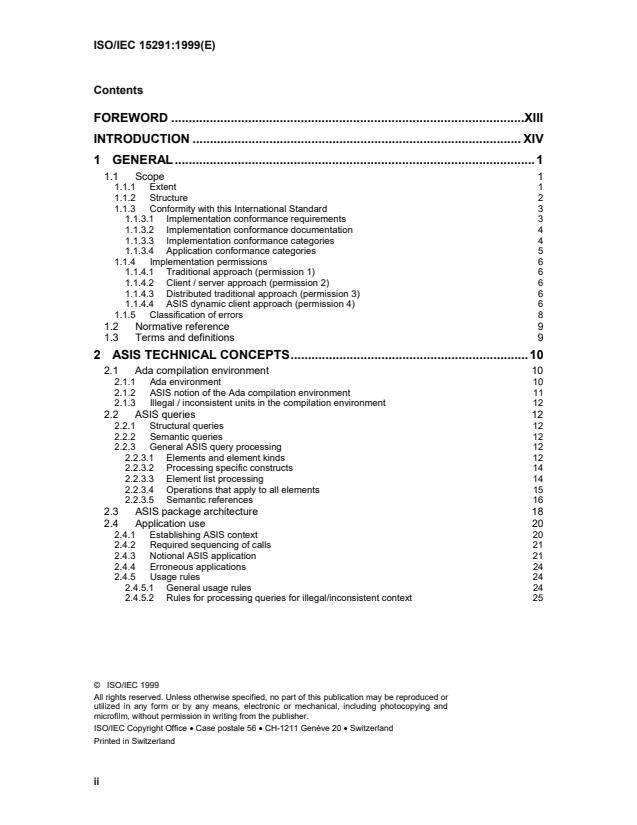
3 PACKAGE ASIS .27
3.1 type ASIS_Integer 28
3.2 type ASIS_Natural 28
3.3 type ASIS_Positive 28
3.4 type List_Index 28
3.5 type Context 28
3.6 type Element 29
3.7 type Element_List 30
3.8 subtypes of Element and Element_List 30
3.9 Element Kinds 31
3.9.1 type Element_Kinds 31
3.9.2 type Pragma_Kinds 32
3.9.3 type Defining_Name_Kinds 33
3.9.4 type Declaration_Kinds 33
3.9.5 type Trait_Kinds 35
3.9.6 type Declaration_Origins 36
3.9.7 type Mode_Kinds 36
3.9.8 type Subprogram_Default_Kinds 36
3.9.9 type Definition_Kinds 36
3.9.10 type Type_Kinds 37
3.9.11 type Formal_Type_Kinds 37
3.9.12 type Access_Type_Kinds 38
3.9.13 type Root_Type_Kinds 38
3.9.14 type Constraint_Kinds 39
3.9.15 type Discrete_Range_Kinds 39
3.9.16 type Association_Kinds 39
3.9.17 type Expression_Kinds 39
3.9.18 type Operator_Kinds 40
3.9.19 type Attribute_Kinds 41
3.9.20 type Statement_Kinds 42
3.9.21 type Path_Kinds 43
3.9.22 type Clause_Kinds 44
3.9.23 type Representation_Clause_Kinds 44
3.10 type Compilation_Unit 44
3.11 type Compilation_Unit_List 45
3.12 Unit Kinds 45
3.12.1 type Unit_Kinds 45
3.12.2 type Unit_Classes 47
3.12.3 type Unit_Origins 47
3.12.4 type Relation_Kinds 47
3.13 type Traverse_Control 49
3.14 type Program_Text 49
4 PACKAGE ASIS.ERRORS .51
4.1 type Error_Kinds 51
5 PACKAGE ASIS.EXCEPTIONS .52
6 PACKAGE ASIS.IMPLEMENTATION .53
6.1 function ASIS_Version 53
6.2 function ASIS_Implementor 53
6.3 function ASIS_Implementor_Version 53
6.4 function ASIS_Implementor_Information 53
6.5 function Is_Initialized 53
6.6 procedure Initialize 53
6.7 function Is_Finalized 54
6.8 procedure Finalize 54
6.9 function Status 54
iii
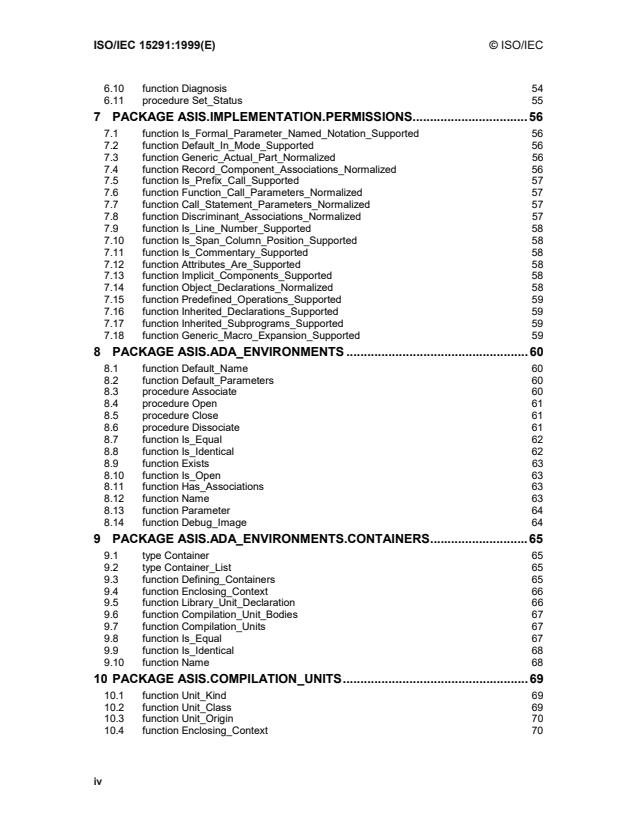
6.10 function Diagnosis 54
6.11 procedure Set_Status 55
7 PACKAGE ASIS.IMPLEMENTATION.PERMISSIONS.56
7.1 function Is_Formal_Parameter_Named_Notation_Supported 56
7.2 function Default_In_Mode_Supported 56
7.3 function Generic_Actual_Part_Normalized 56
7.4 function Record_Component_Associations_Normalized 56
7.5 function Is_Prefix_Call_Supported 57
7.6 function Function_Call_Parameters_Normalized 57
7.7 function Call_Statement_Parameters_Normalized 57
7.8 function Discriminant_Associations_Normalized 57
7.9 function Is_Line_Number_Supported 58
7.10 function Is_Span_Column_Position_Supported 58
7.11 function Is_Commentary_Supported 58
7.12 function Attributes_Are_Supported 58
7.13 function Implicit_Components_Supported 58
7.14 function Object_Declarations_Normalized 58
7.15 function Predefined_Operations_Supported 59
7.16 function Inherited_Declarations_Supported 59
7.17 function Inherited_Subprograms_Supported 59
7.18 function Generic_Macro_Expansion_Supported 59
8 PACKAGE ASIS.ADA_ENVIRONMENTS .60
8.1 function Default_Name 60
8.2 function Default_Parameters 60
8.3 procedure Associate 60
8.4 procedure Open 61
8.5 procedure Close 61
8.6 procedure Dissociate 61
8.7 function Is_Equal 62
8.8 function Is_Identical 62
8.9 function Exists 63
8.10 function Is_Open 63
8.11 function Has_Associations 63
8.12 function Name 63
8.13 function Parameter 64
8.14 function Debug_Image 64
9 PACKAGE ASIS.ADA_ENVIRONMENTS.CONTAINERS.65
9.1 type Container 65
9.2 type Container_List 65
9.3 function Defining_Containers 65
9.4 function Enclosing_Context 66
9.5 function Library_Unit_Declaration 66
9.6 function Compilation_Unit_Bodies 67
9.7 function Compilation_Units 67
9.8 function Is_Equal 67
9.9 function Is_Identical 68
9.10 function Name 68
10 PACKAGE ASIS.COMPILATION_UNITS.69
10.1 function Unit_Kind 69
10.2 function Unit_Class 69
10.3 function Unit_Origin 70
10.4 function Enclosing_Context 70
iv
© ISO/IEC ISO/IEC 15291:1999(E)
10.5 function Enclosing_Container 70
10.6 function Library_Unit_Declaration 71
10.7 function Compilation_Unit_Body 71
10.8 function Library_Unit_Declarations 71
10.9 function Compilation_Unit_Bodies 72
10.10 function Compilation_Units 72
10.11 function Corresponding_Children 72
10.12 function Corresponding_Parent_Declaration 73
10.13 function Corresponding_Declaration 74
10.14 function Corresponding_Body 76
10.15 function Is_Nil 77
10.16 function Is_Nil 77
10.17 function Is_Equal 77
10.18 function Is_Identical 78
10.19 function Unit_Full_Name 78
10.20 function Unique_Name 78
10.21 function Exist 79
10.22 function Can_Be_Main_Program 79
10.23 function Is_Body_Required 79
10.24 function Text_Name 79
10.25 function Text_Form 80
10.26 function Object_Name 80
10.27 function Object_Form 80
10.28 function Compilation_Command_Line_Options 81
10.29 function Has_Attribute 81
10.30 function Attribute_Value_Delimiter 81
10.31 function Attribute_Values 81
10.32 function Subunits 82
10.33 function Corresponding_Subunit_Parent_Body 82
10.34 function Debug_Image 83
11 PACKAGE ASIS.COMPILATION_UNITS.TIMES.84
11.1 type Time 84
11.2 function Time_Of_Last_Update 84
11.3 function Compilation_CPU_Duration 84
11.4 function Attribute_Time 85
12 PACKAGE ASIS.COMPILATION_UNITS.RELATIONS .86
12.1 type Relationship 86
12.2 constant Nil_Relationship 88
12.3 function Semantic_Dependence_Order 88
12.4 function Elaboration_Order 89
13 PACKAGE ASIS.ELEMENTS.91
13.1 function Unit_Declaration 91
13.2 function Enclosing_Compilation_Unit 91
13.3 function Context_Clause_Elements 92
13.4 function Configuration_Pragmas 92
13.5 function Compilation_Pragmas 93
13.6 function Element_Kind 94
13.7 function Pragma_Kind 94
13.8 function Defining_Name_Kind 95
13.9 function Declaration_Kind 95
13.10 function Trait_Kind 95
13.11 function Declaration_Origin 96
13.12 function Mode_Kind 96
v
13.13 function Default_Kind 96
13.14 function Definition_Kind 97
13.15 function Type_Kind 97
13.16 function Formal_Type_Kind 97
13.17 function Access_Type_Kind 97
13.18 function Root_Type_Kind 98
13.19 function Constraint_Kind 98
13.20 function Discrete_Range_Kind 98
13.21 function Expression_Kind 99
13.22 function Operator_Kind 99
13.23 function Attribute_Kind 99
13.24 function Association_Kind 99
13.25 function Statement_Kind 100
13.26 function Path_Kind 100
13.27 function Clause_Kind 100
13.28 function Representation_Clause_Kind 100
13.29 function Is_Nil 101
13.30 function Is_Nil 101
13.31 function Is_Equal 101
13.32 function Is_Identical 101
13.33 function Is_Part_Of_Implicit 102
13.34 function Is_Part_Of_Inherited 103
13.35 function Is_Part_Of_Instance 103
13.36 function Enclosing_Element 103
13.37 function Pragmas 105
13.38 function Corresponding_Pragmas 106
13.39 function Pragma_Name_Image 106
13.40 function Pragma_Argument_Associations 106
13.41 function Debug_Image 107
13.42 function Hash 107
14 PACKAGE ASIS.ITERATOR .108
14.1 procedure Traverse_Element 108
15 PACKAGE ASIS.DECLARATIONS .110
15.1 function Names 110
15.2 function Defining_Name_Image 111
15.3 function Position_Number_Image 111
15.4 function Representation_Value_Image 112
15.5 function Defining_Prefix 112
15.6 function Defining_Selector 112
15.7 function Discriminant_Part 113
15.8 function Type_Declaration_View 113
15.9 function Object_Declaration_View 114
15.10 function Initialization_Expression 115
15.11 function Corresponding_Constant_Declaration 115
15.12 function Declaration_Subtype_Mark 116
15.13 function Corresponding_Type_Declaration 117
15.14 function Corresponding_First_Subtype 117
15.15 function Corresponding_Last_Constraint 118
15.16 function Corresponding_Last_Subtype 118
15.17 function Corresponding_Representation_Clauses 119
15.18 function Specification_Subtype_Definition 119
15.19 function Parameter_Profile 120
15.20 function Result_Profile 120
15.21 function Body_Declarative_Items 121
vi
© ISO/IEC ISO/IEC 15291:1999(E)
15.22 function Body_Statements 121
15.23 function Body_Exception_Handlers 122
15.24 function Body_Block_Statement 122
15.25 function Is_Name_Repeated 123
15.26 function Corresponding_Declaration 123
15.27 function Corresponding_Body 125
15.28 function Corresponding_Subprogram_Derivation 127
15.29 function Corresponding_Type 127
15.30 function Corresponding_Equality_Operator 128
15.31 function Visible_Part_Declarative_Items 128
15.32 function Is_Private_Present 129
15.33 function Private_Part_Declarative_Items 129
15.34 function Renamed_Entity 130
15.35 function Corresponding_Base_Entity 130
15.36 function Protected_Operation_Items 131
15.37 function Entry_Family_Definition 132
15.38 function Entry_Index_Specification 133
15.39 function Entry_Barrier 133
15.40 function Corresponding_Subunit 133
15.41 function Is_Subunit 134
15.42 function Corresponding_Body_Stub 134
15.43 function Generic_Formal_Part 135
15.44 function Generic_Unit_Name 137
15.45 function Generic_Actual_Part 137
15.46 function Formal_Subprogram_Default 138
15.47 function Corresponding_Generic_Element 139
15.48 function Is_Dispatching_Operation 139
16 PACKAGE ASIS.DEFINITIONS.140
16.1 function Corresponding_Type_Operators 140
16.2 function Parent_Subtype_Indication 141
16.3 function Record_Definition 141
16.4 function Implicit_Inherited_Declarations 141
16.5 function Implicit_Inherited_Subprograms 142
16.6 function Corresponding_Parent_Subtype 143
16.7 function Corresponding_Root_Type 143
16.8 function Corresponding_Type_Structure 144
16.9 function Enumeration_Literal_Declarations 144
16.10 function Integer_Constraint 145
16.11 function Mod_Static_Expression 145
16.12 function Digits_Expression 145
16.13 function Delta_Expression 146
16.14 function Real_Range_Constraint 146
16.15 function Index_Subtype_Definitions 147
16.16 function Discrete_Subtype_Definitions 147
16.17 function Array_Component_Definition 147
16.18 function Access_To_Object_Definition 148
16.19 function Access_To_Subprogram_Parameter_Profile 148
16.20 function Access_To_Function_Result_Profile 149
16.21 function Subtype_Mark 149
16.22 function Subtype_Constraint 150
16.23 function Lower_Bound 150
16.24 function Upper_Bound 151
16.25 function Range_Attribute 151
16.26 function Discrete_Ranges 152
vii
16.27 function Discriminant_Associations 152
16.28 function Component_Subtype_Indication 153
16.29 function Discriminants 154
16.30 function Record_Components 154
16.31 function Implicit_Components 155
16.32 function Discriminant_Direct_Name 155
16.33 function Variants 156
16.34 function Variant_Choices 156
16.35 function Ancestor_Subtype_Indication 157
16.36 function Visible_Part_Items 157
16.37 function Private_Part_Items 157
16.38 function Is_Private_Present 158
17 PACKAGE ASIS.EXPRESSIONS.159
17.1 function Corresponding_Expression_Type 159
17.2 function Value_Image 160
17.3 function Name_Image 160
17.4 function References 161
17.5 function Is_Referenced 161
17.6 function Corresponding_Name_Definition 162
17.7 function Corresponding_Name_Definition_List 164
17.8 function Corresponding_Name_Declaration 164
17.9 function Prefix 165
17.10 function Index_Expressions 165
17.11 function Slice_Range 166
17.12 function Selector 166
17.13 function Attribute_Designator_Identifier 166
17.14 function Attribute_Designator_Expressions 167
17.15 function Record_Component_Associations 167
17.16 function Extension_Aggregate_Expression 168
17.17 function Array_Component_Associations 168
17.18 function Array_Component_Choices 169
17.19 function Record_Component_Choices 169
17.20 function Component_Expression 170
17.21 function Formal_Parameter 170
17.22 function Actual_Parameter 171
17.23 function Discriminant_Selector_Names 172
17.24 function Discriminant_Expression 173
17.25 function Is_Normalized 173
17.26 function Is_Defaulted_Association 174
17.27 function Expression_Parenthesized 174
17.28 function Is_Prefix_Call 175
17.29 function Corresponding_Called_Function 175
17.30 function Function_Call_Parameters 176
17.31 function Short_Circuit_Operation_Left_Expression 177
17.32 function Short_Circuit_Operation_Right_Expression 177
17.33 function Membership_Test_Expression 177
17.34 function Membership_Test_Range 178
17.35 function Membership_Test_Subtype_Mark 178
17.36 function Converted_Or_Qualified_Subtype_Mark 178
17.37 function Converted_Or_Qualified_Expression 179
17.38 function Allocator_Subtype_Indication 179
17.39 function Allocator_Qualified_Expression 179
viii
© ISO/IEC ISO/IEC 15291:1999(E)
18 PACKAGE ASIS.STATEMENTS .181
18.1 function Label_Names 181
18.2 function Assignment_Variable_Name 181
18.3 function Assignment_Expression 181
18.4 function Statement_Paths 182
18.5 function Condition_Expression 182
18.6 function Sequence_Of_Statements 182
18.7 function Case_Expression 183
18.8 function Case_Statement_Alternative_Choices 183
18.9 function Statement_Identifier 183
18.10 function Is_Name_Repeated 184
18.11 function While_Condition 184
18.12 function For_Loop_Parameter_Specification 184
18.13 function Loop_Statements 185
18.14 function Is_Declare_Block 185
18.15 function Block_Declarative_Items 185
18.16 function Block_Statements 186
18.17 function Block_Exception_Handlers 186
18.18 function Exit_Loop_Name 186
18.19 function Exit_Condition 187
18.20 function Corresponding_Loop_Exited 187
18.21 function Return_Expression 187
18.22 function Goto_Label 188
18.23 function Corresponding_Destination_Statement 188
18.24 function Called_Name 188
18.25 function Corresponding_Called_Entity 189
18.26 function Call_Statement_Parameters 190
18.27 function Accept_Entry_Index 191
18.28 function Accept_Entry_Direct_Name 191
18.29 function Accept_Parameters 191
18.30 function Accept_Body_Statements 192
18.31 function Accept_Body_Exception_Handlers 192
18.32 function Corresponding_Entry 192
18.33 function Requeue_Entry_Name 193
18.34 function Delay_Expression 193
18.35 function Guard 193
18.36 function Aborted_Tasks 194
18.37 function Choice_Parameter_Specification 194
18.38 function Exception_Choices 194
18.39 function Handler_Statements 195
18.40 function Raised_Exception 195
18.41 function Qualified_Expression 195
18.42 function Is_Dispatching_Call 196
18.43 function Is_Call_On_Dispatching_Operation 196
19 PACKAGE ASIS.CLAUSES .197
19.1 function Clause_Names 197
19.2 function Representation_Clause_Name 197
19.3 function Representation_Clause_Expression 198
19.4 function Mod_Clause_Expression 198
19.5 function Component_Clauses 198
19.6 function Component_Clause_Position 199
19.7 function Component_Clause_Range 199
ix
20 PACKAGE ASIS.TEXT .200
20.1 type Line 200
20.2 type Line_Number 200
20.3 type Line_Number_Positive 201
20.4 type Line_List 201
20.5 type Character_Position 201
20.6 type Character_Position_Positive 201
20.7 type Span 201
20.8 function First_Line_Number 202
20.9 function Last_Line_Number 202
20.10 function Element_Span 202
20.11 function Compilation_Unit_Span 203
20.12 function Compilation_Span 203
20.13 function Is_Nil 203
20.14 function Is_Nil 203
20.15 function Is_Nil 204
20.16 function Is_Equal 204
20.17 function Is_Identical 204
20.18 function Length 204
20.19 function Lines 204
20.20 function Lines 205
20.21 function Lines 206
20.22 function Delimiter_Image 206
20.23 function Element_Image 206
20.24 function Line_Image 207
20.25 function Non_Comment_Image 207
20.26 function Comment_Image 207
20.27 function Is_Text_Available 208
20.28 function Debug_Image 208
21 PACKAGE ASIS.IDS .209
21.1 type Id 209
21.2 function Hash 209
21.3 function "<" 209
21.4 function ">" 209
21.5 function Is_Nil 210
21.6 function Is_Equal 210
21.7 function Create_Id 210
21.8 function Create_Element 210
21.9 function Debug_Image 211
22 PACKAGE ASIS.DATA_DECOMPOSITION (OPTIONAL).212
22.1 type Record_Component 214
22.2 type Record_Component_List 214
22.3 type Array_Component 215
22.4 type Array_Component_List 215
22.5 type Dimension_Indexes 215
22.6 type Array_Component_Iterator 216
22.7 type Portable_Data 216
22.8 type Type_Model_Kinds 218
22.9 function Type_Model_Kind 218
22.10 function Is_Nil 218
22.11 function Is_Equal 218
22.12 function Is_Identical 219
22.13 function Is_Array 219
x
© ISO/IEC ISO/IEC 15291:1999(E)
22.14 function Is_Record 219
22.15 function Done 220
22.16 procedure Next 220
22.17 procedure Reset 220
22.18 function Array_Index 220
22.19 function Array_Indexes 220
22.20 function Discriminant_Components 221
22.21 function Record_Components 221
22.22 function Record_Components 222
22.23 function Array_Components 223
22.24 function Array_Iterator 223
22.25 function Component_Data_Stream 224
22.26 function Component_Declaration 224
22.27 function Component_Indication 225
22.28 function All_Named_Components 225
22.29 function Array_Length 225
22.30 function Array_Length 226
22.31 function Size 226
22.32 function Size 226
22.33 function Position 227
22.34 function First_Bit 227
22.35 function Last_Bit 228
22.36 function Portable_Constrained_Subtype 228
22.37 function Construct_Artificial_Data_Stream 229
23 PACKAGE ASIS.DATA_DECOMPOSITION.PORTABLE_TRANSFER .231
23.1 generic package Portable_Constrained_Subtype 231
23.2 generic package Portable_Unconstrained_Record_Type 231
23.3 generic package Portable_Array_Type_1 232
23.4 generic package Portable_Array_Type_2 232
23.5 generic package Portable_Array_Type_3 232
ANNEXES
A GLOSSARY .234
B ASIS APPLICATION EXAMPLES .237
B.1 Use to traverse compilation unit 237
B.2 Use to build call tree 240
C MISCELLANEOUS ASIS I/O AND IDL APPROACHES.244
C.1 package Portable_Data_Io 244
C.2 package Asis.Ids.Id_Io 247
C.3 Implementation approach for IDL 250
C.3.1 ASIS API server 250
C.3.2 ASIS API client tool 251
C.3.3 Approach to implement the Traverse_Element generic 251
C.3.4 IDL to implement the Traverse_Element generic 252
C.3.5 Ada code output by the IDL compiler 253
xi
D RATIONALE .254
D.1 Benefits of code analysis 254
D.1.1 Definition 254
D.1.2 Applicability 254
D.1.3 Motivation 255
D.2 Technology for code analysis 255
D.2.1 Code parsers 255
D.2.2 DIANA 256
D.2.3 LRM-interface 257
D.2.4 ASIS 257
D.2.5 Benefits of ASIS standard 259
D.3 Design considerations for ASIS 259
D.3.1 Design goals 259
D.3.2 Major changes from ASIS for ISO 8652:1987 261
D.3.3 Essence of Ada and ASIS 261
D.4 Major issues regarding ASIS 262
D.4.1 Ada environment and compilation units 262
D.4.2 ASIS context and inconsistency 262
D.4.3 Implicit declarations 264
D.4.4 Abstract "=" for private types 264
D.4.5 Usage names and expressions 265
D.4.6 Select alternative 265
D.4.7 Attribute definition clauses 265
D.4.8 Configuration pragmas 265
D.4.9 Queries with additional context parameter 266
D.4.10 Ids 266
D.4.11 Data decomposition 266
D.5 Conclusion 267
D.6 Acronyms 268
BIBLIOGRAPHY .269
INDEX.270
Figures
Figure 1 ASIS implementation permissions 7
Figure 2 ASIS as interface to Ada compilation environment 10
Figure 3 Application interface to ASIS Context 11
Figure 4 Syntactic tree representation of an Ada object declaration 13
Figure 5 Operations on elements 15
Figure 6 Semantic reference using corresponding queries 17
Figure 7 ASIS package architecture 18
Figure C.1 Generation of client/server ASIS artifacts 250
xii
© ISO/IEC ISO/IEC 15291:1999(E)
Foreword
ISO (the International Organization for Standardization) and IEC (the International Electrotechnical
Commission) form the specialized system for worldwide standardization. National bodies that are
members of ISO or IEC participate in the development of International Standards through
technical committees established by the respective organization to deal with particular fields of
technical activity. ISO and IEC technical committees collaborate in fields of mutual interest. Other
international organizations, governmental and non-governmental, in liaison with ISO and IEC, also
take part in the work.
In the field of information technology, ISO and IEC have established a joint technical committee,
ISO/IEC JTC 1. Draft International Standards adopted by the joint technical committee are
circulated to national bodies for voting. Publication as an International Standard requires approval
by at least 75% of the national bodies casting a vote.
International Standard ISO/IEC 15291 was prepared by Joint Technical Committee ISO/IEC
JTC 1, Information technology, Subcommittee 22, Programming languages, their environments
and system software interfaces.
Annexes A, B, C, and D of this International Standard are for information only.
xiii
Introduction
The Ada Semantic Interface Specification (ASIS) is an interface between an Ada environment (as
defined by ISO/IEC 8652:1995) and any tool requiring information from it. An Ada environment
includes valuable semantic and syntactic information. ASIS is an open and published callable
interface which gives CASE tool and application developers access to this information. ASIS has
been designed to be independent of underlying Ada environment implementations, thus
supporting portability of software engineering tools while relieving tool developers from needing to
understand the complexities of an Ada environment’s proprietary internal representation.
Examples of tools that benefit from the ASIS interface include: automated code monitors,
browsers, call tree tools, code reformators, coding standards compliance tools, correctness
verifiers, debuggers, dependency tree analysis tools, design tools, document generators, metrics
tools, quality assessment tools, reverse engineering tools, re-engineering tools, style checkers,
test tools, timing estimators, and translators.
The word “may” as used in this International Standard consistently means “is allowed to” (or “are
allowed to”). It is used only to express permission, as in the commonly occurring phrase “an
implementation may”; other words (such as “can,” “could” or “might”) are used to express ability,
possibility, capacity, or consequentiality.
The ASIS interface consists of a set of types, subtypes, and subprograms which provide a
capability to query the Ada compilation environment for syntactic and semantic information.
Package Asis is the root of the ASIS interface. It contains common types used throughout the
ASIS interface. Important common abstractions include Context, Element, and Compilation_Unit.
Type Context helps identify the compilation units considered to be analyzable as part of the Ada
compilation environment. Type Element is an abstraction of entities within a logical Ada syntax
tree. Type Compilation_Unit is an abstraction for Ada compilation units. In addition, there are two
sets of enumeration types called Element Kinds and Unit Kinds. Element Kinds are a set of
enumeration types providing a mapping to the Ada syntax. Unit Kinds are a set of enumeration
types describing the various kinds of compilation units.
All ASIS subprogram interfaces are provided using child packages. Some child packages also
contain type and subtype interfaces local to the child package.
The child package Asis.Implementation provides queries to initialize, finalize, and query the error
status of the ASIS implementation. The child package Asis.Ada_Environments encapsulates a set
of queries that map physical Ada compilation and program execution environments to logical ASIS
environments.
The child package Asis.Compilation_Units defines queries that deal with compilation units and
serves as the gateway between Compilation_Units, Elements, and Ada_Environments. The child
package Asis.Compilation_Units.Times encapsulates the time related functions used within ASIS.
The child package Asis.Compilation_Units.Relations encapsulates semantic relationship concepts
used in ASIS.
The child package Asis.Elements defines general Element queries and queries for pragmas. It
provides information on the element kinds for further semantic analysis.
The child package Asis.Iterator provides a mechanism to perform an iterative traversal of a logical
syntax tree. During the syntax tree traversal, ASIS can analyze the various elements contained
within the syntax tree. ASIS can provide the application additional processing via generic
procedures, which are instantiated by the application. These additional processing queries
xiv
© ISO/IEC ISO/IEC 15291:1999(E)
decompose as ASIS elements from the logical Ada semantic tree. Queries are provided in the
child packages: Clauses, Declarations, Definitions, Expressions, and Statements.
• child package Asis.Clauses - Defines queries dealing with context clauses and representation
clauses.
• child package Asis.Declarations - Defines queries dealing with Ada declarations.
• child package Asis.Definitions - Defines queries dealing with the definition portion of Ada
object, type, and subtype declarations.
• child package Asis.Expressions - Defines all queries dealing with Ada expressions.
• child package Asis.Statements - Defines queries dealing with Ada statements.
The child package Asis.Text encapsulates a set of operations to access the text of ASIS
elements. It defines the operations for obtaining compilation text spans, lines, and images of
elements.
The child package Asis.Ids provides a mechanism to efficiently reference ASIS elements in a
persistent manner.
To support portability amongst a variety of implementors’ compilation environments, certain types
and constants have been identified as implementation-defined.
The child package Asis.Errors defines the kinds of errors. The exceptions that can be raised
across the ASIS interface are defined in the child package Asis.Exceptions.
The interface supports one optional child package and its single child package:
• child package Asis.Data_Decomposition - The interface also includes an optional capability to
decompose data values using the ASIS type information and portable data stream,
representing a data value of that type.
xv
©
INTERNATIONAL STANDARD ISO/IEC ISO/IEC 15291:1999(E)
Information technology —
Programming languages —
Ada Semantic Interface Specification (ASIS)
1 General
1.1 Scope
The Ada Semantic Interface Specification (ASIS) is an interface between an Ada environment (as
defined by ISO/IEC 8652:1995) and any tool requiring information from this environment. An Ada
environment includes valuable semantic and syntactic information. ASIS is an open and published
callable interface which gives CASE tool and application developers access to this information.
ASIS has been designed to be independent of underlying Ada environment implementations, thus
supporting portability of software engineering tools while relieving tool developers from needing to
understand the complexities of an Ada environment’s proprietary internal representation.
Examples of tools that benefit from the ASIS interface include: automated code monitors,
browsers, call tree tools, code reformators, coding standards compliance tools, correctness
verifiers, debuggers, dependency tree analysis tools, design tools, document generators, metrics
tools, quality assessment tools, reverse engineering tools, re-engineering tools, safety and security
tools, style checkers, test tools, timing estimators, and translators.
This International Standard specifies the form and meaning of the ASIS interface to the Ada
compilation environment.
This International Standard is applicable to tools and applications needing syntactic and semantic
information in the Ada compilation environment.
1.1.1 Extent
This International Standard specifies:
• The form of the ASIS interface;
• Sequencing of ASIS calls;
• The permissible variations within this International Standard, and the manner in which they are
to be documented;
• Those violations of this International Standard that a conforming implementation is required to
detect, and the effect of attempting to execute a program containing such violations;
This International Standard does not specify:
• Semantics of the interface in the face of simultaneous updates to the Ada compilation
environment.
• Semantics of the interface for more than one thread of control.
1.1.2 Structure
This International Standard contains twenty-three clauses and four annexes.
Clause 1 is general in nature providing the scope of this International Standard, normative
references, and definitions.
Clause 2 identifies the ASIS technical concepts. Here the Ada compilation environment to which
ASIS interfaces is described. The concept of queries is presented. The ASIS package architecture
is presented.
The packages that comprise the ASIS International Standard are provided in Clauses 3 through
23. These packages are provided in the correct compilation order and when presented in
electronic format are compilable.
• Clause 3 package Asis
• Clause 4 package Asis.Errors
• Clause 5 package Asis.Exceptions
• Clause 6 package Asis.Implementation
• Clause 7 package Asis.Implementation.Permissions
• Clause 8 package Asis.Ada_Environments
• Clause 9 package Asis.Ada_Environments.Containers
• Clause 10 package Asis.Compilation_Units
• Clause 11 package Asis.Compilation_Units.Times
• Clause 12 package Asis.Compilation_Units.Relations
• Clause 13 package Asis.Elements
• Clause 14 package Asis.Iterator
• Clause 15 package Asis.Declarations
• Clause 16 package Asis.Definitions
• Clause 17 package Asis.Expressions
• Clause 18 package Asis.Statements
• Clause 19 package Asis.Clauses
• Clause 20 package Asis.Text
• Clause 21 package Asis.Ids
• Clause 22 package Asis.Data_Decomposition (optional package)
• Clause 23 package Asis.Data_Decomposition.Portable_Transfer
The following annexes are informative:
Annex A: Glossary
Annex B: ASIS Application Examples
Annex C: Miscellaneous ASIS I/O and IDL Approaches
Annex D: Rationale
The major package interfaces visible to ASIS users are identified as clauses facilitating access
from the table of contents.
© ISO/IEC ISO/IEC 15291:1999(E)
The ASIS interface is compilable. Consequently, Sentinels have been used to mark portions of the
ASIS text with comments appropriate to an ASIS implementor and an ASIS user.
The sentinels and their meanings are:
--|ER (Element Reference) These comments mark an element kind reference which acts as a
header for those queries that work on this element kind.
--|CR (Child Reference) These sentinel comments follow sentinel comments marking element
references (--ER) and reference child element queries that decompose the element into
its children.
--|AN (Application Note) These comments describe suggested uses, further analysis, or other
notes of interest to ASIS applications.
--|IP (Implementation Permissions) These comments describe permissions given an
implementor when implementing the associated type or query.
--|IR (Implementation Requirements) These comments describe additional requirements for
conforming implementations.
1.1.3 Conformity with this International Standard
1.1.3.1 Implementation conformance requirements
An ASIS implementation includes all the hardware and software that implements the ASIS
specification for a given Ada implementation and that provides the functionality required by the
ASIS specification. An ASIS implementor is a company, institution, or other group (such as a
vendor) who develops an ASIS implementation. A conforming ASIS implementation shall meet all
of the following criteria:
a) The system shall support all required interfaces defined within this International Standard.
These interfaces shall support the functional behavior described herein. All interfaces in the
ASIS specification are required unless the interface is specifically identified as being optional.
The ASIS specification defines one optional package: Asis.Data_Decomposition.
Asis.Data_Decomposition has one child package,
Asis.Data_Decomposition.Portable_Transfer.
b) The system may provide additional facilities not required by this International Standard.
Extensions are non-standard facilities (e.g., other library units, non-standard children of
standard ASIS library units, subprograms, etc.) which provide additional information from ASIS
types, or modify the behavior of otherwise standard ASIS facilities to provide alternative or
additional functionality. Nonstandard extensions shall be identified as such in the system
documentation. Nonstandard extensions, when used by an application, may change the
behavior of functions or facilities defined by this International Standard. The conformance
document shall define an environment in which an application can be run with the behavior
specified by this International Standard. In no case except package name conflicts shall such
an environment require modification of a Basic Conforming or Fully Conforming ASIS
Application. An implementation shall not change package specifications in this International
Standard except by:
• Adding “with” clauses, pragmas, representation specifications, comments, and
allowable pragmas. Allowable pragmas are those which do not change the semantics
of the interface (e.g., List, Optimize, Page).
• Replacing instances of the words with appropriate value(s).
• Adding or changing private parts.
• Making any other changes that are lexically transparent to Ada compilers.
c) An ASIS implementation shall not raise Program_Error on elaboration of an ASIS package, or
on execution of an ASIS subprogram, due to elaboration order dependencies in the ASIS
implementation.
d) Except as explicitly provided for in this International Standard, Standard.Storage_Error is the
only exception that should be raised by operations declared in this International Standard.
e) When executed, an implementation of this International Standard shall not be erroneous, as
defined by ISO/IEC 8652:1995.
1.1.3.2 Implementation conformance documentation
A conformance document shall be available for an implementation claiming conformance to this
International Standard. The conformance document shall have the same structure as this
International Standard, with the information presented in the equivalently numbered clauses, and
subclauses. The conformance document shall not contain information about extended facilities or
capabilities outside the scope of this International Standard.
The conformance document shall contain a statement that indicates the full name, number, and
date of the International Standard that applies. The conformance document may also list software
standards approved by ISO/IEC or any ISO/IEC member body that are available for use by a Basic
or Fully Conforming ASIS Application. Applicable characteristics whose documentation is required
by one of these standards, or by standards of government bodies, may also be included.
The conformance document shall describe the behavior of the implementation for all
implementation-defined features defined in this International Standard. This requirement shall be
met by listing these features and providing either a specific reference to the system documentation
or providing full syntax and semantics of these features. The conformance document shall specify
the behavior of the implementation for those features where this International Standard states that
implementations may vary.
No specifications other than those described in this subclause shall be present in the conformance
document.
The phrase “shall be documented” in this International Standard means that documentation of the
feature shall appear in the conformance document, as described previously, unless the system
documentation is explicitly mentioned.
The system documentation should also contain the information found in the conformance
document.
1.1.3.3 Implementation conformance categories
An implementation is required to define all of the subprograms for all of the operations defined in
this International Standard, including those whose implementation is optional. Required
functionality is the subset of ASIS facilities which are not explicitly identified in the ASIS standard
as optional. Optional functionality is the subset of ASIS facilities which are explicitly identified in the
ASIS standard as optional which may legitimately be omitted from a Basic Conforming ASIS
implementation. Optional interfaces shall be included in any Fully Conforming ASIS
implementation, unless stated otherwise in the ASIS specification. An application that accesses an
Ada environment’s semantic tree (e.g., Diana Tree) directly using work-arounds is not considered
to be a conformant application. All Conforming Applications fall within one of the categories
defined below.
If an unimplemented feature is used, the exception Asis.ASIS_Failed shall be raised and
Asis.Implementation_Status shall return the value for Error_Kinds of Not_Implemented_Error.
There are four categories of conforming ASIS implementations:
© ISO/IEC ISO/IEC 15291:1999(E)
1.1.3.3.1 Basic conforming ASIS implementation
A Basic Conforming ASIS Implementation is an ASIS implementation supporting all required
interfaces defined within this International Standard.
1.1.3.3.2 Fully conforming ASIS implementation
A Fully Conforming ASIS Implementation is an ASIS implementation supporting all required and all
optional interfaces defined within this International Standard.
1.1.3.3.3 Basic conforming ASIS implementation using extensions
A Basic Conforming ASIS Implementation Using Extensions is an ASIS implementation that differs
from a Basic Conforming ASIS Implementation only in that it uses nonstandard extensions that are
consistent with this International Standard. Such an implementation shall fully document its
extended facilities, in addition to the documentation required for a Basic Conforming ASIS
Implementation.
1.1.3.3.4 Fully conforming ASIS implementation using extensions
A Fully Conforming ASIS Implementation Using Extensions is an ASIS implementation that differs
from a Fully Conforming ASIS Implementation only in that it uses nonstandard extensions that are
consistent with this International Standard. Such an implementation shall fully document its
extended facilities, in addition to the documentation required for a Fully Conforming ASIS
Implementation.
1.1.3.4 Application conformance categories
An ASIS application is any programming system or any set of software components making use of
ASIS queries to obtain information about any set of Ada components. All ASIS applications
claiming conformance to this International Standard shall use a Conforming ASIS Implementation
with or without extensions.
1.1.3.4.1 Basic conforming ASIS application
A Basic Conforming ASIS Application is an application that only uses the required facilities defined
within this International Standard. It shall be portable to any Conforming ASIS Implementation.
1.1.3.4.2 Fully conforming ASIS application
A Fully Conforming ASIS Application is an application that only uses the required facilities and the
optional facilities defined within this International Standard. It shall be portable to any Fully
Conforming ASIS Implementation.
1.1.3.4.3 Basic conforming ASIS application using extensions
A Basic Conforming ASIS Application Using Extensions is an application that differs from a Basic
Conforming ASIS Application only in that it uses nonstandard, implementation provided, extended
facilities that are consistent with this International Standard. Such an application should fully
document its requirements for these extended facilities. A Basic Conforming ASIS Application
Using Extensions may or may not be portable to other Basic or Fully Conforming ASIS
Implementation Using Extensions.
1.1.3.4.4 Fully conforming ASIS application using extensions
A Fully Conforming ASIS Application Using Extensions is an application that differs from a Fully
Conforming ASIS Application only in that it uses nonstandard, implementation provided, extended
facilities that are consistent with this International Standard. Such an application should fully
document its requirements for these extended facilities. A Fully Conforming ASIS Application
Using Extensions may or may not be portable to other Fully Conforming ASIS Implementation
Using Extensions.
1.1.4 Implementation permissions
The ASIS Application Program Interface (API) may be implemented through a variety of
approaches. Approaches permitted by this International Standard are based on the traditional
approach and the client /server approach. These implementation permissions are depicted in
Figure 1 and described below:
1.1.4.1 Traditional approach (permission 1)
Traditionally, the ASIS API implementation is intended to execute on the node containing the
implementor’s Ada software engineering environment and the desired Ada compilation
environment. Because the ASIS API interfaces directly, ASIS performs at its best. It is expected
that most ASIS implementors will support this approach as it requires little additional effort when
alternative approaches are supported. In Figure 1, the client tool using Permission 1 uses the
ASIS specification exactly as specified in this International Standard. ASIS tools and applications
are compiled in the implementor's environment.
1.1.4.2 Client / server approach (permission 2)
As an alternative, a client / server approach can be used to implement the ASIS API. Here the
ASIS API is supported by a server; ASIS client tools can request ASIS services within the
supported network.
Figure 1 identifies four ASIS client tools using permission 2 capable of interfacing with an ASIS
Object Request Broker (ORB) server. One client tool is written in Ada, one in Java, one in C++,
and one in Smalltalk. The ORB serves as a broker between the client and server on a network
consisting of many nodes. Server location and services are registered with the ORB. A client
needing the services interfaces with the ORB, who brokers the needed server interface
information. The interface between a client and server is written as an interface specification in the
Interface Definition Language (IDL). IDL is very different from most computer languages; when
IDL is compiled, the interface specification is produced in either Ada, Java, C++, or Smalltalk. In
addition, the necessary artifacts are produced to register the client or server interfac
...