


ISO 2635:2003/Amd 1:2017
(Amendment)Aircraft - Conductors for general purpose aircraft electrical cables and aerospace applications - Dimensions and characteristics - Amendment 1: Correction of table 1
Aircraft - Conductors for general purpose aircraft electrical cables and aerospace applications - Dimensions and characteristics - Amendment 1: Correction of table 1
Aéronefs — Conducteurs pour câbles électriques pour usage général aéronautique et pour applications aérospatiales — Dimensions et caractéristiques — Amendement 1: Correction du tableau 1
General Information
- Status
- Published
- Publication Date
- 19-Jun-2017
- Technical Committee
- ISO/TC 20/SC 1 - Aerospace electrical requirements
- Drafting Committee
- ISO/TC 20/SC 1 - Aerospace electrical requirements
- Current Stage
- 6060 - International Standard published
- Start Date
- 20-Jun-2017
- Due Date
- 09-Oct-2016
- Completion Date
- 09-Oct-2016
Relations
- Effective Date
- 07-Aug-2021
Overview
ISO 2635:2003/Amd 1:2017 is an international standard developed by the International Organization for Standardization (ISO) that specifies dimensions and characteristics for conductors used in general purpose aircraft electrical cables and aerospace applications. This amendment addresses a correction of Table 1, which details the conductor specifications such as nominal cross-sectional areas, mechanical properties, and electrical resistance.
The standard is essential for manufacturers, designers, and engineers involved in aerospace electrical systems, ensuring reliability, consistency, and safety for aircraft wiring components. By harmonizing conductor parameters, ISO 2635 supports interoperability and compliance within the aerospace industry.
Key Topics
- Conductor Dimensions: The corrected Table 1 lists precise nominal cross-sectional areas (in mm²) for copper and copper alloy conductors used in aircraft electrical cables, aligned with American Wire Gauge (AWG) references.
- Electrical Resistance: Maximum electrical resistance values at 20°C are defined for each conductor size to guarantee efficient electrical performance in aerospace environments.
- Mechanical Properties: Characteristics such as elongation percentages, ultimate tensile load, and strand composition (number and diameter of wires per conductor) are detailed to ensure mechanical robustness.
- Material Specification: Conductors consist primarily of copper and high-strength copper alloys, offering optimal conductivity and mechanical strength for aeronautical applications.
- Correction Details: Amendment 1 focuses specifically on updating Table 1 to correct previously published conductor data, improving the accuracy and reliability of the standard.
Applications
- Aircraft Electrical Systems: Standardized conductors are critical for wiring electrical power, communication signals, and instrumentation within aircraft, subject to rigorous mechanical and environmental demands.
- Aerospace Manufacturing: OEMs and cable manufacturers apply ISO 2635 to design and produce electrical cables that meet internationally recognized quality norms.
- Maintenance and Repairs: Airlines and aerospace maintenance organizations use the standard as a reference to verify conductor compatibility and performance during aircraft servicing.
- Quality Assurance: Regulatory bodies and certification agencies reference this standard to ensure aerospace electrical components meet safety and reliability benchmarks.
- Aerospace R&D: Research and development of new aerospace electrical components rely on established conductor characteristics for testing and innovation.
Related Standards
- ISO/IEC Directives, Part 1 & 2: Defines procedures and editorial rules followed in drafting and maintaining ISO standards, including ISO 2635.
- IEC Standards for Aerospace Electrical Systems: Complementary standards detailing electrical testing, insulation, and cable assembly in the aerospace sector.
- ISO 9001 (Quality Management Systems): Often applied alongside ISO 2635 to maintain consistent quality in aerospace component manufacturing.
- FAA and EASA Wiring Standards: Regional aviation authorities’ standards that align with or reference ISO conductor specifications to ensure compliance.
Keywords: ISO 2635, aircraft conductor standard, aerospace electrical cables, conductor dimensions, copper alloy conductors, aviation wiring, electrical cable specifications, aerospace standards, aircraft electrical components, conductor mechanical properties

Frequently Asked Questions
ISO 2635:2003/Amd 1:2017 is a standard published by the International Organization for Standardization (ISO). Its full title is "Aircraft - Conductors for general purpose aircraft electrical cables and aerospace applications - Dimensions and characteristics - Amendment 1: Correction of table 1". This standard covers: Aircraft - Conductors for general purpose aircraft electrical cables and aerospace applications - Dimensions and characteristics - Amendment 1: Correction of table 1
Aircraft - Conductors for general purpose aircraft electrical cables and aerospace applications - Dimensions and characteristics - Amendment 1: Correction of table 1
ISO 2635:2003/Amd 1:2017 is classified under the following ICS (International Classification for Standards) categories: 49.060 - Aerospace electric equipment and systems. The ICS classification helps identify the subject area and facilitates finding related standards.
ISO 2635:2003/Amd 1:2017 has the following relationships with other standards: It is inter standard links to ISO 2635:2003. Understanding these relationships helps ensure you are using the most current and applicable version of the standard.
ISO 2635:2003/Amd 1:2017 is available in PDF format for immediate download after purchase. The document can be added to your cart and obtained through the secure checkout process. Digital delivery ensures instant access to the complete standard document.
Standards Content (Sample)
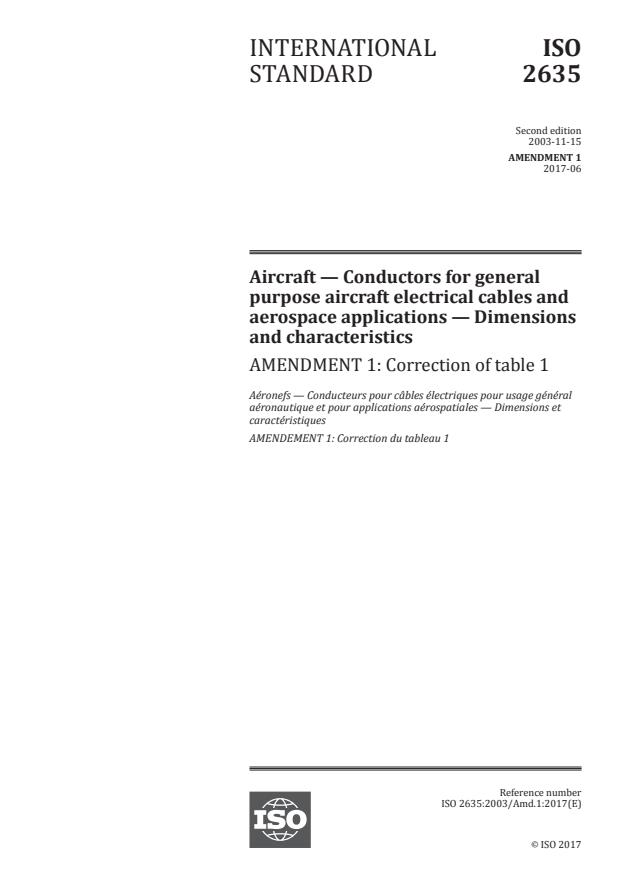
INTERNATIONAL ISO
STANDARD 2635
Second edition
2003-11-15
AMENDMENT 1
2017-06
Aircraft — Conductors for general
purpose aircraft electrical cables and
aerospace applications — Dimensions
and characteristics
AMENDMENT 1: Correction of table 1
Aéronefs — Conducteurs pour câbles électriques pour usage général
aéronautique et pour applications aérospatiales — Dimensions et
caractéristiques
AMENDEMENT 1: Correction du tableau 1
Reference number
ISO 2635:2003/Amd.1:2017(E)
©
ISO 2017
ISO 2635:2003/Amd.1:2017(E)
© ISO 2017, Published in Switzerland
All rights reserved. Unless otherwise specified, no part of this publication may be reproduced or utilized otherwise in any form
or by any means, electronic or mechanical, including photocopying, or posting on the internet or an intranet, without prior
written permission. Permission can be requested from either ISO at the address below or ISO’s member body in the country of
the requester.
ISO copyright office
Ch. de Blandonnet 8 • CP 401
CH-1214 Vernier, Geneva, Switzerland
Tel. +41 22 749 01 11
Fax +41 22 749 09 47
copyright@iso.org
www.iso.org
ii © ISO 2017 – All rights reserved
ISO 2635:2003/Amd.1:2017(E)
Foreword
ISO (the International Organization for Standardization) is a worldwide federation of national standards
bodies (ISO member bodies). The work of preparing International Standards is normally carried out
through ISO technical committees. Each member body interested in a subject for which a technical
committee has been established has the right to be represented on that committee. International
organizations, governmental and non-governmental, in liaison with ISO, also take part in the work.
ISO collaborates closely with the International Electrotechnical Commission (IEC) on all matters of
electrotechnical standardization.
The procedures used to develop this document and those intended for its further maintenance are
described in the ISO/IEC Directives, Part 1. In particular, the different approval criteria needed for the
different types of ISO documents should be noted. This document was drafted in accordance with the
editorial rules of the ISO/IEC Directives, Part 2 (see www .iso .org/ directives).
Attention is drawn to the possibility that some of the elements of this document may be the subject of
patent rights. ISO shall not be held responsible for identifying any or all such patent rights. Details of
any patent rights identified during the development of the document will be in the Int
...
Questions, Comments and Discussion
Ask us and Technical Secretary will try to provide an answer. You can facilitate discussion about the standard in here.
Loading comments...