

ISO/IEC 18009:1999
(Main)Information technology — Programming languages — Ada: Conformity assessment of a language processor
General Information
- Abstract
1.1 This International Standard establishes requirements for certifying an assessment that an Ada language processor conforms to the requirements of the Ada language standard, ISO/IEC 8652. It places requirements on the organization that performs the assessment, the assessment procedures, and the test suite used in the assessment. Finally, it places requirements on the form for the certificate of conformity. 1.2 This International Standard concerns only the assessment of conformity to the language requirements of ISO/IEC 8652. It does not concern the assessment of any other characteristics of a language processor or of the construction process used by the manufacturer of the language processor. NOTE In the sense of [ISO/IEC Guide 23], the Ada language standard, ISO/IEC 8652, is to be regarded as a standard for a specific property rather than a comprehensive product standard. 1.3 This International Standard is intended to be primarily suitable for use by a third party authority although portions of it may also be applied by a supplier (first party) or by a user or purchaser (second party). 1.4 An Ada language processor may be claimed to conform to the requirements of ISO/IEC 8652 regardless of the application of this International Standard. This International Standard prescribes the method for obtaining a certification that an Ada language processor conforms to ISO/IEC 8652. Customers desiring to acquire a language processor certified as conforming should explicitly require that certification by citing this International Standard. 1.5 Certification should not be construed as guaranteeing that the certified product is free of non-conformities or defects; it only certifies that no evidence of non-conformity was found during the certification process.
- Status
- Published
- Publication Date
- 15-Dec-1999
- Technical Committee
- ISO/IEC JTC 1/SC 22 - Programming languages, their environments and system software interfaces
- Drafting Committee
- ISO/IEC JTC 1/SC 22/WG 9 - Ada
- Current Stage
- 9093 - International Standard confirmed
- Start Date
- 06-Mar-2026
- Completion Date
- 29-Aug-2026


Overview
ISO/IEC 18009:1999 defines a standardized method for the conformity assessment of Ada language processors against the Ada language standard ISO/IEC 8652. It specifies requirements for the organizations that perform assessments, the assessment procedures, the test suite used, and the form of the certificate of conformity. The standard focuses exclusively on conformity to the Ada language requirements - not on other product characteristics or the manufacturer’s development process. It is primarily intended for third‑party certification but can also be applied by suppliers or purchasers.
Keywords: ISO/IEC 18009, Ada conformity assessment, Ada language processor, ISO/IEC 8652, certification
Key topics and requirements
- Assessment bodies: Requirements for an Ada Conformity Assessment Laboratory (ACAL) and an Ada Conformity Assessment Authority (ACAA), including organization, management, personnel, quality systems, recordkeeping, and handling of test items.
- Test suite and procedure: Use of a managed Ada Conformity Assessment Test Suite (ACATS) and a defined Ada Conformity Assessment Procedure (ACAP) to perform and document testing.
- Testing modes: Provisions for self‑testing, witness testing, and evaluation of self‑test results; rules for documentation and resolution of test issues.
- Certification output: Requirements for the form and issuance of a certificate of conformity, including approval workflow and marks of conformity.
- Governance and maintenance: Test issue management, maintenance and revision of the test suite, and procedures for certifying closely related processors.
- Scope limits: Clarifies that certification indicates no evidence of non‑conformity was found during assessment, but does not guarantee absence of defects.
Keywords: ACAL, ACAA, ACATS, ACAP, certificate of conformity, test issue management
Applications and who uses it
- Software vendors and compiler developers seeking a recognized certification that their Ada language processor conforms to ISO/IEC 8652.
- Third‑party test laboratories implementing ACAL requirements to deliver accredited conformity assessments.
- Procurement teams and system integrators who require certified Ada compilers for safety‑critical, defense, or regulated systems.
- Standards bodies and accreditation organizations that oversee conformity assessment frameworks and certificate recognition.
Practical value: Enables consistent, repeatable certification of Ada compilers, facilitates international acceptance of test results, and reduces ambiguity in procurement requirements by referencing a formal conformity assessment method.
Keywords: Ada compiler certification, conformity assessment laboratory, certified Ada processor, procurement requirement
Related standards
- ISO/IEC 8652 - Ada programming language standard (target of conformity).
- ISO/IEC Guide 23 - Context for regarding language standards as standards for a specific property.
- Other ISO/IEC conformity and accreditation guidance referenced for terminology and assessment practices.
Get Certified
Connect with accredited certification bodies for this standard

BSI Group
BSI (British Standards Institution) is the business standards company that helps organizations make excellence a habit.

NYCE
Mexican standards and certification body.
Sponsored listings
Frequently Asked Questions
ISO/IEC 18009:1999 is a standard published by the International Organization for Standardization (ISO). Its full title is "Information technology — Programming languages — Ada: Conformity assessment of a language processor". This standard covers: 1.1 This International Standard establishes requirements for certifying an assessment that an Ada language processor conforms to the requirements of the Ada language standard, ISO/IEC 8652. It places requirements on the organization that performs the assessment, the assessment procedures, and the test suite used in the assessment. Finally, it places requirements on the form for the certificate of conformity. 1.2 This International Standard concerns only the assessment of conformity to the language requirements of ISO/IEC 8652. It does not concern the assessment of any other characteristics of a language processor or of the construction process used by the manufacturer of the language processor. NOTE In the sense of [ISO/IEC Guide 23], the Ada language standard, ISO/IEC 8652, is to be regarded as a standard for a specific property rather than a comprehensive product standard. 1.3 This International Standard is intended to be primarily suitable for use by a third party authority although portions of it may also be applied by a supplier (first party) or by a user or purchaser (second party). 1.4 An Ada language processor may be claimed to conform to the requirements of ISO/IEC 8652 regardless of the application of this International Standard. This International Standard prescribes the method for obtaining a certification that an Ada language processor conforms to ISO/IEC 8652. Customers desiring to acquire a language processor certified as conforming should explicitly require that certification by citing this International Standard. 1.5 Certification should not be construed as guaranteeing that the certified product is free of non-conformities or defects; it only certifies that no evidence of non-conformity was found during the certification process.
1.1 This International Standard establishes requirements for certifying an assessment that an Ada language processor conforms to the requirements of the Ada language standard, ISO/IEC 8652. It places requirements on the organization that performs the assessment, the assessment procedures, and the test suite used in the assessment. Finally, it places requirements on the form for the certificate of conformity. 1.2 This International Standard concerns only the assessment of conformity to the language requirements of ISO/IEC 8652. It does not concern the assessment of any other characteristics of a language processor or of the construction process used by the manufacturer of the language processor. NOTE In the sense of [ISO/IEC Guide 23], the Ada language standard, ISO/IEC 8652, is to be regarded as a standard for a specific property rather than a comprehensive product standard. 1.3 This International Standard is intended to be primarily suitable for use by a third party authority although portions of it may also be applied by a supplier (first party) or by a user or purchaser (second party). 1.4 An Ada language processor may be claimed to conform to the requirements of ISO/IEC 8652 regardless of the application of this International Standard. This International Standard prescribes the method for obtaining a certification that an Ada language processor conforms to ISO/IEC 8652. Customers desiring to acquire a language processor certified as conforming should explicitly require that certification by citing this International Standard. 1.5 Certification should not be construed as guaranteeing that the certified product is free of non-conformities or defects; it only certifies that no evidence of non-conformity was found during the certification process.
ISO/IEC 18009:1999 is classified under the following ICS (International Classification for Standards) categories: 35.060 - Languages used in information technology. The ICS classification helps identify the subject area and facilitates finding related standards.
ISO/IEC 18009:1999 is available in PDF format for immediate download after purchase. The document can be added to your cart and obtained through the secure checkout process. Digital delivery ensures instant access to the complete standard document.
Standards Content (Sample)
INTERNATIONAL ISO/IEC
STANDARD 18009
First edition
1999-12-01
Information technology — Programming
languages — Ada: Conformity assessment
of a language processor
Technologies de l'information — Langages de programmation — Ada:
Évaluation de conformité d'un processeur de langage
Reference number
©
ISO/IEC 1999
PDF disclaimer
This PDF file may contain embedded typefaces. In accordance with Adobe's licensing policy, this file may be printed or viewed but shall not
be edited unless the typefaces which are embedded are licensed to and installed on the computer performing the editing. In downloading
this file, parties accept therein the responsibility of not infringing Adobe's licensing policy. The ISO Central Secretariat accepts no liability in
this area.
Adobe is a trademark of Adobe Systems Incorporated.
Details of the software products used to create this PDF file can be found in the General Info relative to the file; the PDF-creation
parameters were optimized for printing. Every care has been taken to ensure that the file is suitable for use by ISO member bodies. In the
unlikely event that a problem relating to it is found, please inform the Central Secretariat at the address given below.
© ISO/IEC 1999
All rights reserved. Unless otherwise specified, no part of this publication may be reproduced or utilized in any form or by any means, electronic
or mechanical, including photocopying and microfilm, without permission in writing from either ISO at the address below or ISO's member body
in the country of the requester.
ISO copyright office
Case postale 56 � CH-1211 Geneva 20
Tel. + 41 22 749 01 11
Fax + 41 22 734 10 79
E-mail copyright@iso.ch
Web www.iso.ch
Printed in Switzerland
ii © ISO/IEC 1999 – All rights reserved
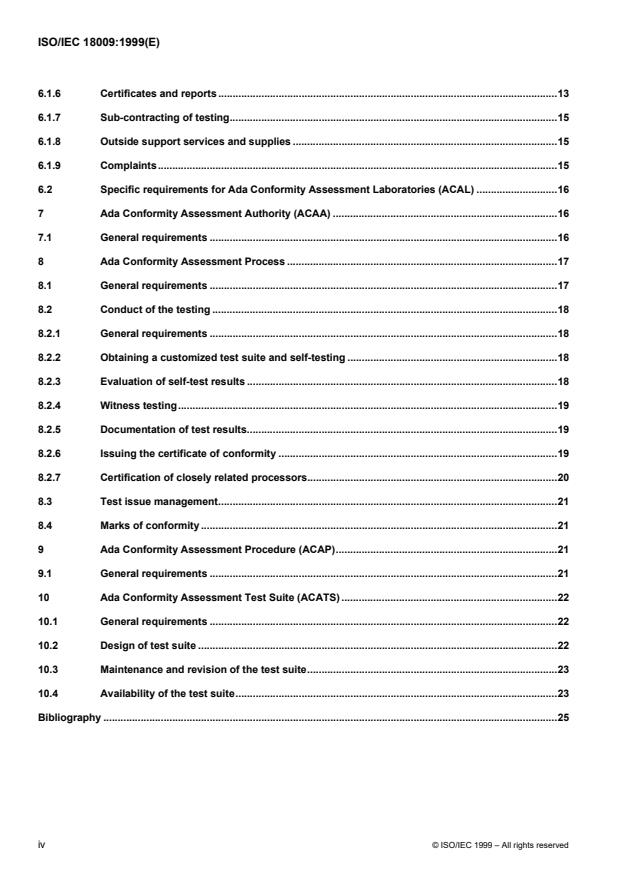
Contents Page
1 Scope.1
2 Conformity .1
3 Normative reference.2
4 Terms and definitions.2
4.1 Standardization .2
4.2 Aims of standardization .2
4.3 Normative documents .2
4.4 Bodies responsible for standards and regulations .3
4.5 Type of standards .3
4.6 Content of normative documents.4
4.7 Conformity assessment in general .5
4.8 Determination of characteristics .6
4.9 Conformity evaluation .7
4.10 Assurance of conformity.7
4.11 Approval and recognition arrangements.8
4.12 Accreditation of conformity assessment bodies and persons .8
4.13 Programming language processor test methods .9
4.14 Miscellaneous.10
4.15 Terms and definitions of this International Standard.10
5 General.11
6 Ada Conformity Assessment Laboratory (ACAL).11
6.1 General requirements .11
6.1.1 Organization and management.12
6.1.2 Quality system and review .12
6.1.3 Personnel.13
6.1.4 Handling of test items.13
6.1.5 Records.13
© ISO/IEC 1999 – All rights reserved iii
6.1.6 Certificates and reports .13
6.1.7 Sub-contracting of testing.15
6.1.8 Outside support services and supplies .15
6.1.9 Complaints.15
6.2 Specific requirements for Ada Conformity Assessment Laboratories (ACAL) .16
7 Ada Conformity Assessment Authority (ACAA) .16
7.1 General requirements .16
8 Ada Conformity Assessment Process .17
8.1 General requirements .17
8.2 Conduct of the testing .18
8.2.1 General requirements .18
8.2.2 Obtaining a customized test suite and self-testing .18
8.2.3 Evaluation of self-test results .18
8.2.4 Witness testing.19
8.2.5 Documentation of test results.19
8.2.6 Issuing the certificate of conformity .19
8.2.7 Certification of closely related processors.20
8.3 Test issue management.21
8.4 Marks of conformity .21
9 Ada Conformity Assessment Procedure (ACAP).21
9.1 General requirements .21
10 Ada Conformity Assessment Test Suite (ACATS) .22
10.1 General requirements .22
10.2 Design of test suite .22
10.3 Maintenance and revision of the test suite.23
10.4 Availability of the test suite.23
Bibliography .25
iv © ISO/IEC 1999 – All rights reserved
Foreword
ISO (the International Organization for Standardization) and IEC (the International Electrotechnical Commission)
form the specialized system for worldwide standardization. National bodies that are members of ISO or IEC
participate in the development of International Standards through technical committees established by the
respective organization to deal with particular fields of technical activity. ISO and IEC technical committees
collaborate in fields of mutual interest. Other international organizations, governmental and non-governmental, in
liaison with ISO and IEC, also take part in the work.
International Standards are drafted in accordance with the rules given in the ISO/IEC Directives, Part 3.
In the field of information technology, ISO and IEC have established a joint technical committee, ISO/IEC JTC 1.
Draft International Standards adopted by the joint technical committee are circulated to national bodies for voting.
Publication as an International Standard requires approval by at least 75 % of the national bodies casting a vote.
Attention is drawn to the possibility that some of the elements of this International Standard may be the subject of
patent rights. ISO and IEC shall not be held responsible for identifying any or all such patent rights.
International Standard ISO/IEC 18009 was prepared by Joint Technical Committee ISO/IEC JTC 1, Information
technology, Subcommittee SC 22, Programming languages, their environments and system software interfaces.
© ISO/IEC 1999 – All rights reserved v
Introduction
The Ada language community has a strong tradition of “compiler validation,” meaning conformity assessment.
Originally, the validation program was administered under the auspices of the United States Department of Defense,
as the use of “validated” compilers was a condition of usage in defense programs. Three key elements of this
validation program were the conduct of testing by independent testing laboratories, resolution of any test issues
by a single authority (the “Ada Validation Organization”), and world-wide acceptance of the “validation certificates”
resulting from successful conformity testing. In 1998, the U.S. DoD elected to turn the responsibility for
conformity assessment over to the private sector. This International Standard provides the basis for private
sector conformity assessment. It is the intent of this International Standard to ratify existing practices for Ada
conformity assessment.
In general terms, this International Standard states that independent Ada Conformity Assessment Laboratories
(ACAL) would perform the conformity assessment. The various ACALs would collaborate on the formation or
designation of a single Ada Conformity Assessment Authority (ACAA). The ACAA would manage and
administer an Ada Conformity Assessment Test Suite (ACATS). Each ACAL would perform conformity
assessments by applying the ACATS in accordance with an Ada Conformity Assessment Procedure (ACAP).
Each ACAL would issue certificates of conformity.The ACAA would resolve any test issues that may arise
during conformity assessments performed by ACALs and would approve test reports and certificates of
conformity before they are issued to the clients of the ACAL.
The ACAA would act in the role of the current de facto “Ada Validation Organization” and its “Fast Reaction Team”
and would also participate in the work of ISO/IEC JTC1/SC22/WG9 in order to apprise that group of possible defects
discovered in the language standard as a result of conformity assessment.
This International Standard does not reuse an existing test method designed for any other language [as
suggested by ISO/IEC Guide 2, 6.7.1] but instead describes a method that, although new to standardization, has a
long de facto tradition within the Ada community. This method is based upon a well established method that has
already been in uniformly applied usage for 15 years. Continuity with this tradition is considered essential to the
success of the Ada language standard.
This International Standard has the following goals:
�This International Standard should permit a smooth transition from the current de facto method of “Ada
compiler validation” to the standardized method.
�Users of Ada processor certifications should gain the same degree of assurance as is gained with the current
de facto certification mechanism.
This International Standard was prepared by Working Group 9 (Ada) of Subcommittee 22 (Programming
languages, their environments and system software interfaces) of Joint Technical Committee 1 (Information
technology). It establishes requirements for assessing the conformity of Ada language processors to the
requirements of the Ada language standard.
Portions of this International Standard are based upon U.S. Department of Defense procedures for Ada compiler
“validation.” The co-operation of the U.S. DoD in contributing the appropriate documents is gratefully acknowledged.
ISO, IEC, JTC1 and SC22 have already prepared a number of documents related to conformity assessment.
Rather than make normative references to these documents,this International Standard incorporates appropriate
excerpts of their text, in some cases paraphrasing the text, changing the normative strength, or adapting the
provision to the specific circumstances. In each case, the original source of the provision is noted in brackets.
Therefore, these documents are listed in the bibliography of this International Standard, rather than in Clause 3,
Normative reference.
vi © ISO/IEC 1999 – All rights reserved
In order to relate better to the large body of existing work, particular attention has been paid to terminology. Terms
defined in this International Standard have been presented in bold typeface.
© ISO/IEC 1999 – All rights reserved vii
INTERNATIONAL STANDARD ISO/IEC 18009:1999(E)
Information technology — Programming languages — Ada:
Conformity assessment of a language processor
1 Scope
1.1 This International Standard establishes requirements for certifying an assessment that an Ada language
processor conforms to the requirements of the Ada language standard, ISO/IEC 8652. It places requirements
on the organization that performs the assessment, the assessment procedures, and the test suite used in the
assessment. Finally, it places requirements on the form for the certificate of conformity.
1.2 This International Standard concerns only the assessment of conformity to the language requirements of
ISO/IEC 8652. It does not concern the assessment of any other characteristics of a language processor or of the
construction process used by the manufacturer of the language processor.
NOTE In the sense of [ISO/IEC Guide 23], the Ada language standard, ISO/IEC 8652, is to be regarded as a standard for
a specific property rather than a comprehensive product standard.
1.3 This International Standard is intended to be primarily suitable for use by a third party authority although
portions of it may also be applied by a supplier (first party) or by a user or purchaser (second party).
1.4 An Ada language processor may be claimed to conform to the requirements of ISO/IEC 8652 regardless of
the application of this International Standard.This International Standard prescribes the method for obtaining a
certification that an Ada language processor conforms to ISO/IEC 8652. Customers desiring to acquire a
language processor certified as conforming should explicitly require that certification by citing this International
Standard.
1.5 Certification should not be construed as guaranteeing that the certified product is free of non-conformities or
defects; it only certifies that no evidence of non-conformity was found during the certification process.
2 Conformity
2.1 An Ada language processor is said to be “certified as conforming” if so assessed by an Ada Conformity
Assessment Laboratory (ACAL) and the Ada Conformity Assessment Authority (ACAA). In performing this
certification,the ACAL and the ACAA shall consider the results of testing performed by the ACAL.The ACAL
testing shall be performed in accordance with the Ada Conformity Assessment Procedure (ACAP)using the
Ada Conformity Assessment Test Suite (ACATS).
2.2 This International Standard places requirements upon the ACAL, ACAA, ACAP and ACATS.
NOTES
1 Conformity of an “implementation” of the Ada language standard is defined by subclause 1.1.3 of ISO/IEC 8652.
The term “language processor” or “compiler” in this International Standard is to be regarded as synonymous with the term
“implementation” as used in ISO/IEC 8652. This International Standard prescribes requirements for the assessment that a
language processor conforms to the requirements of ISO/IEC 8652.
2An International Standard on test methods, such as this one, does not imply any obligation to carry out any kind
of test. It merely states the method by which the assessment, if required and referred to (for example, in the same or another
standard,orina regulation, or in contract documents), should be carried out. [ISO/IEC Directives, Part 2, subclause 6.5]
© ISO/IEC 1999 – All rights reserved 1
3 Normative reference
The following normative documents contain provisions which, through reference in this text, constitute
provisions of this International Standard. For dated references, subsequent amendments to, or revisions of, any
of these publications do not apply. However, parties to agreements based on this International Standard are
encouraged to investigate the possibility of applying the most recent editions of the normative documents
indicated below. For undated references, the latest edition of the normative document referred to applies.
Members of ISO and IEC maintain registers of currently valid International Standards.
ISO/IEC 8652, Information technology — Programming languages — Ada.
4 Terms and definitions
For the purposes of this International Standard, the following terms and definitions apply.
4.1 Standardization
4.1.1
consensus
general agreement, characterized by the absence of sustained opposition to substantial issues by any important part
of the concerned interests and by a process that involves seeking to take into account the views of all parties
concerned and to reconcile any conflicting arguments
NOTE Consensus need not imply unanimity.
[ISO/IEC Guide 2, 1.7]
4.2 Aims of standardization
4.2.1
fitness for purpose
ability of a product, process or service to serve a defined purpose under specific conditions [ISO/IEC Guide 2, 2.1]
4.3 Normative documents
4.3.1
document
any medium with information recorded on or in it [ISO/IEC Guide 2, 3.1]
4.3.2
normative document
document that provides rules, guidelines or characteristics for activities or their results
NOTES
1Theterm“normative document” is a generic term that covers such documents as standards, technical
specifications, codes of practice and regulations.
2 The terms for different kinds of normative documents are defined considering the document and its content as a
single entity.
[ISO/IEC Guide 2, 3.1]
4.3.3
standard
document, established by consensus and approved by a recognized body, that provides, for common and
repeated use, rules, guidelines or characteristics for activities or their results, aimed at the achievement of the
optimum degree of order in a given context [ISO/IEC Guide 2, 3.2]
2 © ISO/IEC 1999 – All rights reserved
4.3.4
International Standard
standard that is adopted by an international standardizing/standards organization and made available to the
public [ISO/IEC Guide 2, 3.2.1.1]
4.3.5
technical specification
document that prescribes technical requirements to be fulfilled by a product, process or service
NOTES
1A technical specification would indicate, whenever appropriate, the procedure(s) by means of which it may be
determined whether the requirements given are fulfilled.
2A technical specification may be a standard,apartofa standard or independent of a standard.
[ISO/IEC Guide 2, 3.4]
4.3.6
regulation
document providing binding legislative rules, that is adopted by an authority [ISO/IEC Guide 2, 3.6]
4.4 Bodies responsible for standards and regulations
4.4.1
body
legal or administrative entity that has specific tasks and composition
NOTE Examples of bodies are organizations, authorities, companies and foundations.
[ISO/IEC Guide 2, 4.1]
4.4.2
organization
body that is based on the membership of other bodies or individuals and has an established constitution and its
own administration [ISO/IEC Guide 2, 4.2]
4.4.3
international standardizing organization
standardizing organization whose membership is open to the relevant national body from every country [ISO/IEC
Guide 2, 4.3.2]
4.4.4
authority
body that has legal powers and rights
NOTE An authority can be regional, national or local.
[ISO/IEC Guide 2, 4.5]
4.5 Type of standards
4.5.1
testing standard
standard that is concerned with test methods, sometimes supplemented with other provisions related to testing,
such as sampling, use of statistical methods, sequence of tests [ISO/IEC Guide 2, 5.3]
© ISO/IEC 1999 – All rights reserved 3
4.5.2
product standard
standard that specifies requirements to be fulfilled by a product or a group of products, to establish its fitness for
purpose [ISO/IEC Guide 2, 5.4]
4.6 Content of normative documents
4.6.1
provision
expression in the content of a normative document, that takes the form of a statement,an instruction,a
recommendation or a requirement
NOTE These types of provision are distinguished by the form of wording they employ; e.g. instructions are expressed in
the imperative mood, recommendations by the use of the auxiliary “should” and requirements by the use of the auxiliary
“shall.”
[ISO/IEC Guide 2, 7.1]
4.6.2
statement
provision that conveys information [ISO/IEC Guide 2, 7.2]
4.6.3
instruction
provision that conveys an action to be performed [ISO/IEC Guide 2, 7.3]
4.6.4
recommendation
provision that conveys advice or guidance [ISO/IEC Guide 2, 7.4]
4.6.5
requirement
provision that conveys criteria to be fulfilled [ISO/IEC Guide 2, 7.5]
4.6.6
exclusive requirement
requirement of a normative document that must necessarily be fulfilled in order to comply with that document
NOTE The term “mandatory requirement” should be used to mean only a requirement made compulsory by law or
regulation.
[ISO/IEC Guide 2, 7.5.1]
4.6.7
optional requirement
requirement of a normative document that must be fulfilled in order to comply with a particular option permitted by
that document
NOTE An optional requirement may be either
(a) one of two or more alternative requirements;or
(b) an additional requirement that must be fulfilled only if applicable and that may otherwise be disregarded.
[ISO/IEC Guide 2, 7.5.2]
4.6.8
deemed-to-satisfy provision
provision that indicates one or more means of compliance with a requirement of a normative document [ISO/IEC
Guide 2, 7.6]
4 © ISO/IEC 1999 – All rights reserved
4.6.9
descriptive provision
provision for fitness for purpose that concerns the characteristics of a product, process or service
NOTE A descriptive provision usually conveys design, constructional details, etc. with dimensions and material
composition.
[ISO/IEC Guide 2, 7.7]
4.7 Conformity assessment in general
4.7.1
conformity
fulfillment by a product, process or service of specified requirements [ISO/IEC Guide 2, 12.1]
4.7.2
conformity assessment
any activity concerned with determining directly or indirectly that relevant requirements are fulfilled
NOTE Typical examples of conformity assessment activities are sampling, testing and inspection; evaluation,
verification and assurance of conformity (supplier’s declaration, certification); registration, accreditation and approval
as well as their combinations.
[ISO/IEC Guide 2, 12.2; ISO/IEC Guide 7, 3.1]
4.7.3
conformity assessment body
body that conducts conformity assessment [ISO/IEC Guide 2, 12.3]
4.7.4
conformity assessment system
system that has its own rules of procedure and management for carrying out conformity assessment
NOTES
1 Conformity assessment systems may be operated at, for example, national, regional or international level.
2 Typical examples of conformity assessment systems are testing systems, inspection systems, and certification
systems.
[ISO/IEC Guide 2, 12.4]
4.7.5
conformity assessment scheme
conformity assessment system as related to specified products, processes or services to which the same
particular standards and rules, and the same procedure, apply
NOTE The term “program” is used in some countries to cover the same concept as “scheme.”
[ISO/IEC Guide 2, 12.5]
4.7.6
access to a conformity assessment system
opportunity for an applicant to obtain conformity assessment under the rules of the system [ISO/IEC Guide 2,
12.6]
4.7.7
participant in a conformity assessment system
conformity assessment body that operates under the rules of the system without having the opportunity to take
part in the management of the system [ISO/IEC Guide 2, 12.7]
© ISO/IEC 1999 – All rights reserved 5
4.7.8
member of a conformity assessment system
conformity assessment body that operates under the rules of the system and has the opportunity to take part in
the management of the system [ISO/IEC Guide 2, 12.8]
4.7.9
third party
person or body that is recognized as being independent of the parties involved, as concerns the issue in question
NOTE Parties involved are usually supplier (“first party”) and purchaser (“second party”) interests.
[ISO/IEC Guide 2, 12.9]
4.7.10
registration
procedure by which a body indicates relevant characteristics of a product, process or service, or particulars of a
body or person, in an appropriate, publicly available list [ISO/IEC Guide 2, 12.10]
4.7.11
accreditation
procedure by which an authoritative body gives formal recognition that a body or person is competent to carry out
specific tasks [ISO/IEC Guide 2, 12.11]
4.7.12
reciprocity
bilateral relationship where both parties have the same rights and obligations towards each other [ISO/IEC Guide 2,
12.12]
4.7.13
equal treatment
treatment accorded to products, processes or services originating in other countries that is no less favorable than
that accorded to like products, processes or services of national origin, in a comparable situation [ISO/IEC Guide 2,
12.13]
4.8 Determination of characteristics
4.8.1
test
technical operation that consists of the determination of one or more characteristics of a given product, process or
service according to a specified procedure [ISO/IEC Guide 2, 13.1]
4.8.2
testing
action of carrying out one or more tests [ISO/IEC Guide 2, 13.1.1]
4.8.3
test method
specified technical procedure for performing a test [ISO/IEC Guide 2, 13.2]
4.8.4
test report
document that presents test results and other information relevant to a test [ISO/IEC Guide 2, 13.3]
4.8.5
laboratory
body that calibrates and/or tests [ISO/IEC Guide 25, 3.1]
4.8.6
testing laboratory
laboratory that performs tests
6 © ISO/IEC 1999 – All rights reserved
NOTE The term “testing laboratory” can be used in the sense of a legal entity, a technical entity or both.
[ISO/IEC Guide 2, 13.4]
4.9 Conformity evaluation
4.9.1
conformity evaluation
systematic examination of the extent to which a product, process or service fulfills specified requirements [ISO/IEC
Guide 2, 14.1]
4.9.2
inspection
conformity evaluation by observation and judgment accompanied as appropriate by measurement, testing or
gauging [ISO/IEC Guide 2, 14.2]
4.9.3
inspection body
body that performs inspection [ISO/IEC Guide 2, 14.3]
4.9.4
verification
confirmation by examination and provision of evidence that specified requirements have been met [ISO/IEC Guide
25, 3.8]
4.9.5
conformity testing
conformity evaluation by means of testing [ISO/IEC Guide 2, 14.4]
4.9.6
type testing
conformity testing on the basis of one or more specimens of a product representative of the production [ISO/IEC
Guide 2, 14.5]
4.10 Assurance of conformity
4.10.1
assurance of conformity
activity resulting in a statement giving confidence that a product, process or service fulfills specified requirements
NOTE For a product, the statement may beinthe form of a document, a label or other equivalent means. It may also be
printed in or applied on a communication, a catalogue, an invoice, a user instructions manual, etc. relating to the product.
[ISO/IEC Guide 2, 15.1]
4.10.2
supplier’s declaration
procedure by which a supplier gives written assurance that a product, process or service conforms to specified
requirements
NOTE In order to avoid any confusion, the expression “self-certification” should not be used.
[ISO/IEC Guide 2, 15.1.1]
4.10.3
certification
procedure by which a third party gives written assurance that a product, process or service conforms to specified
requirements [ISO/IEC Guide 2, 15.1.2]
© ISO/IEC 1999 – All rights reserved 7
4.10.4
certification body
body that conducts certification
NOTE A certification body may operate its own testing and inspection activities or oversee these activities carried out
on its behalf by other bodies.
[ISO/IEC Guide 2, 15.2]
4.10.5
certificate of conformity
a document issued under the procedures of a third party certification system and attesting that a product or
service is in conformity with specific standards or other technical specifications [ISO/IEC Guide 23, 3.2;
ISO/IEC Guide 2, 15.5]
4.10.6
mark of conformity
a legally registered certification mark applied by or issued under the procedures of a third party certification
system for a product or service which is in conformity with specific standards or other technical specifications
[ISO/IEC Guide 23, 3.1; superseding ISO/IEC Guide 2, 15.6]
4.11 Approval and recognition arrangements
4.11.1
approval
permission for a product, process or service to be marketed or used for stated purposes or under stated conditions
[ISO/IEC Guide 2, 16.1]
4.11.2
type approval
approval based on type testing [ISO/IEC Guide 2, 16.1.1]
4.11.3
recognition arrangement
agreement that is based on the acceptance by one party of results, presented by another party, from the
implementation of one or more designated functional elements of a conformity assessment system
NOTES
1 Typical examples of recognition arrangements are testing arrangements, inspection arrangements and
certification arrangements.
2 Recognition arrangements may be established at, for example, national, regional or international level.
3 An agreement limited to declaration of equivalence of procedures without acceptance of results does not meet the
above definition.
[ISO/IEC Guide 2, 16.2]
4.11.4
multilateral arrangement
recognition arrangement that covers the acceptance of each other’s results by more than two parties [ISO/IEC
Guide 2, 16.5]
4.12 Accreditation of conformity assessment bodies and persons
4.12.1
accreditation system
system that has its own rules of procedure and management for carrying out accreditation
8 © ISO/IEC 1999 – All rights reserved
NOTE Accreditation of conformity assessment bodies is normally awarded following successful assessment and is
followed by appropriate surveillance.
[ISO/IEC Guide 2, 17.1]
4.12.2
accreditation body
body that conducts and administers an accreditation system and grants accreditation [ISO/IEC Guide 2, 17.2]
4.12.3
accredited body
body to which accreditation has been granted [ISO/IEC Guide 2, 17.3]
4.12.4
accreditation criteria
set of requirements that is used by an accreditation body, to be fulfilled by a conformity assessment body in
order to be accredited [ISO/IEC Guide 2, 17.4]
4.13 Programming language processor test methods
4.13.1
configuration
host and target computers, any operating system(s) and software used to operate a processor [ISO TR 9547, 2.1]
4.13.2
extension
a facility in the implemented language that is not given in the language standard but that does not cause any
ambiguity or contradiction when added to the language standard (although, in some languages, it may serve to lift a
restriction) [ISO TR 9547, 2.2]
4.13.3
implementation defined
dependent on the processor but required by the language standard to be defined and documented by the
implementer [ISO TR 9547, 2.3]
4.13.4
processor
a compiler, translator or interpreter working in combination with a configuration [ISO TR 9547, 2.4]
4.13.5
test program
a sequence of characters intended to be submitted to a processor in order to determine whether or not this
processor exhibits a specific instance of a certain property [ISO TR 9547, 2.7]
4.13.6
test suite
a reference set of test programs that is designed to assess conformity of a processor with a language standard
[ISO TR 9547, 2.9]
4.13.7
test tools
any additional means that can improve the efficiency, the reliability and the ease of use of the different phases of
testing (e.g. implementation of the test suite, ensuring integrity, processing of the test suite, collecting test results,
analysis of test results, producing a test report) [ISO TR 9547, 2.10]
4.13.8
required documents
the set of documents required by the programming language standard [ISO TR 9547, 2.11]
© ISO/IEC 1999 – All rights reserved 9
4.13.9
subset
a subset S of a programming language L is a programming language such that every program in S
— is also a program in L and
— has the same meaning in S as it has in L
[ISO TR 9547, 2.12]
4.14 Miscellaneous
4.14.1
quality manual
a document stating the quality policy, quality system and quality practices of an organization
NOTES
1The quality manual may call up other documentation relating to the organization’s quality arrangements.
2The quality manual may be a distinct part of other documentation.
[ISO/IEC Guide 25, 3.10]
4.14.2
Core Language
the provisions of clauses 1-13 and Annexes A, B, and J of ISO/IEC 8652
NOTE Conformity to the Core Language is required by any Ada language processor.
[ISO/IEC 8652, 1.1.2]
4.14.3
Specialized Needs Annexes
Annexes C through H of ISO/IEC 8652
NOTE An Ada language processor may conform to some or none of these Annexes.
[ISO/IEC 8652, 1.1.2]
4.15 Terms and definitions of this International Standard
4.15.1
Ada Conformity Assessment Process
the process by which conformity of Ada language processors to the language standard, ISO/IEC 8652, is
assessed
4.15.2
Ada Conformity Assessment Procedure (ACAP)
detailed provisions, instructions, requirements and descriptions of processes regarding all aspects of the Ada
Conformity Assessment Process collected in a document
4.15.3
Ada Conformity Assessment Laboratory (ACAL)
an independent testing laboratory conducting conformity assessment tests in accordance with this
International Standard
4.15.4
Ada Conformity Assessment Authority (ACAA)
an organization that ensures world-wide commonality of the Ada Conformity Assessment Process
10 © ISO/IEC 1999 – All rights reserved
4.15.5
Ada Conformity Assessment Test Suite (ACATS)
the test suite used in the Ada Conformity Assessment Process
4.15.6
certification by derivation
registration of conforming processors obtained by adaptive and perfective maintenance from a processor for
which conformity of the processor was successfully assessed by witness-testing on the same or a closely
related configuration
4.15.7
certification by extension
registration of a conforming processor on configurations closely related to the configuration on which
conformity of the processor was successfully assessed by witness-testing
4.15.8
Declaration of Conformity
a statement, signed by an authorized officer of the manufacturer of an Ada language processor, asserting that the
manufacturer has no knowledge of an intentional deviation of the Ada language processor from the Ada language
standard
4.15.9
client
an organization that obtains conformity assessment services from an ACAL
4.15.10
manufacturer
an organization responsible for the production and maintenance of a language processor
4.15.11
self-testing
the processing of an appropriately customized version of the ACATS, but not under the observation of an ACAL
4.15.12
test issue
any disagreement between an ACAL and its client over the conduct of the conformity assessment and, in
particular, any disagreement over the fitness for purpose of any test in the ACATS
4.15.13
witness testing
the processing of an appropriately customized version of the ACATS under the observation of an ACAL
5 General
The provisions of this International Standard create a framework in which conformity assessment of Ada
language processors to the Ada language standard, ISO/IEC 8652, can be conducted world-wide, while ensuring
complete uniformity in test methods, assessment criteria, and test issue resolution, thus facilitating international
recognition arrangements of test reports and certificates of conformity.
6 Ada Conformity Assessment Laboratory (ACAL)
6.1 General requirements
In accordance with the provisions of [ISO/IEC Guide 25, 1.1], this subclause sets out the general requirements in
accordance with which a laboratory has to demonstrate that it operates, if it is to be recognized as competent to
carry out specific tests. In this subclause the provisions of [ISO/IEC Guide 25] have been tailored to Ada
© ISO/IEC 1999 – All rights reserved 11
Conformity Assessment Laboratories (ACAL). Additional provisions specific to Ada Conformity Assessment
Laboratories are given in subclause 6.2.
6.1.1 Organization and management
6.1.1.1 The laboratory shall be legally identifiable. It shall be organized and shall operate in such a way that its
permanent, temporary and mobile facilities meet the requirements of this International Standard. [ISO/IEC Guide
25, 4.1]
6.1.1.2 The laboratory shall
a) have a managerial staff with the authority and resources needed to discharge its duties;
b) have arrangements to ensure that its personnel are free from any commercial, financial and other pressures
which might adversely affect the quality of their work;
c) be organized in such a way that confidence in its independence of judgment and integrity is maintained at all
times;
d) have a technical manager (however named) who has overall responsibility for the technical operations;
e) have a quality manager (however named) who has responsibility for the quality system and its implementation.
The quality manager shall have direct access to the highest level of management at which decisions are taken
on laboratory policy or resources, and to the technical manager. In some laboratories, the quality manager
may also be the technical manager or deputy technical manager;
f) where appropriate, participate in interlaboratory comparisons and proficiency testing programs.
[ISO/IEC Guide 25, 4.2]
6.1.2 Quality system and review
6.1.2.1 The laboratory shall establish and maintain a quality system appropriate for the needs of conformity
testing of Ada language processors. The elements of this system shall be documented. The quality documentation
shall be available for use by the laboratory personnel. The laboratory shall define and document its policies and
objectives for, and its commitment to, good laboratory practice and quality of testing services. The laboratory
management shall ensure that these policies and objectives are documented in a quality manual and
communicated to, understood, and implemented by all laboratory personnel concerned. The quality manual shall
be maintained current under the responsibility of the quality manager. [ISO/IEC Guide 25, 5.1]
6.1.2.2 The quality manual, and related quality documentation, shall state the laboratory’s policies and
operational procedures established in order to meet the requirements of this International Standard.The quality
manual and related quality documentation shall also contain:
a) a quality policy statement, including objectives and commitments, by top management;
b) the organization and management structure of the laboratory, its place in any parent organization and
relevant organizational charts;
c) the relations between management, technical operations, support services and the quality system;
d) procedures for controlled maintenance of documentation;
e) job descriptions of key staff and reference to the job descriptions of other staff;
f) identification of the laboratory’s approved signatories (where this concept is appropriate);
g) the laboratory’s scope of tests;
h) reference to the test procedures used;
12 © ISO/IEC 1999 – All rights reserved
i) procedures to be followed for feedback and corrective action whenever testing discrepancies are detected, or
departures from documented policies and procedures occur;
j) procedures for dealing with complaints;
k) procedures for protecting confidentiality and proprietary rights;
l) procedures for audit and review.
NOTE “Top management” refers to the highest level of management of the laboratory.
[ISO/IEC Guide 25, 5.2]
6.1.2.3 The quality system adopted to satisfy the requirements of this International Standard shall be reviewed
at least once a year by the management to ensure its continuing suitability and effectiveness and to introduce
necessary changes or improvements. [ISO/IEC Guide 25, 5.4]
6.1.2.4 All review findings and any corrective actions that arise from them shall be documented. The quality
manager shall ensure that these actions are discharged within the agreed timescale. [ISO/IEC Guide 25, 5.5]
6.1.3 Personnel
6.1.3.1 The laboratory shall have sufficient personnel, having the necessary education, training, technical
knowledge and experience for their assigned functions. [ISO/IEC Guide 25, 6.1]
6.1.3.2 The laboratory shall ensure that the training of its personnel is kept up-to-date. [ISO/IEC Guide 25, 6.2]
6.1.3.3 Records on the relevant qualifications, training, skills and experience of the technical personnel shall be
maintained by the laboratory. [ISO/IEC Guide 25, 6.3]
6.1.4 Handling of test items
6.1.4.1 The laboratory shall have a documented system for uniquely identify
...