

ISO 21266-2:2018
(Main)Road vehicles — Compressed gaseous hydrogen (CGH2) and hydrogen/natural gas blends fuel systems — Part 2: Test methods
General Information
- Abstract
This document specifies the test methods for checking the minimum safety requirements specified in ISO 21266‑1. It is applicable to the functionality of the fuel systems designed to operate on compressed gaseous hydrogen and hydrogen/natural gas blends of motor vehicles as defined in ISO 3833. For tests of individual components, refer to the parts of ISO 12619, ISO 16380, ISO 17268, ISO 19881[1] and ISO/TS 15869 as applicable [1] Under preparation. Stage at the time of publication: ISO/FDIS 19881.
- Status
- Published
- Publication Date
- 25-Sep-2018
- Technical Committee
- ISO/TC 22/SC 41 - Specific aspects for gaseous fuels
- Current Stage
- 9060 - Close of review
- Completion Date
- 04-Mar-2029
Buy Documents

ISO 21266-2:2018 - Road vehicles -- Compressed gaseous hydrogen (CGH2) and hydrogen/natural gas blends fuel systems
ISO 21266-2:2018 - Road vehicles — Compressed gaseous hydrogen (CGH2) and hydrogen/natural gas blends fuel systems — Part 2: Test methods/26/2018
Overview
ISO 21266-2:2018 specifies standardized test methods to verify the minimum safety requirements for fuel systems that operate on compressed gaseous hydrogen (CGH2) and hydrogen/natural gas blends in road vehicles. Part 2 supports the safety criteria defined in ISO 21266‑1 and applies to complete vehicle fuel-system functionality as defined for motor vehicles (see ISO 3833). It is intended for OEMs, after‑market converters, test laboratories and regulatory or notified bodies responsible for vehicle approval.
Key Topics
- Cylinder mounting strength tests
- Inertia test: cylinders mounted to the vehicle (or representative body) are filled to at least 90% of capacity (gas density considered 0.2 kg/l); trolley deceleration is recorded (CFC 60) and maintained per ISO 21266‑1 for ≥30 ms.
- Static test: traction force applied to cylinder centre of gravity using the formula F = (M + 0.9 ρV) a, held and released per procedure.
- Alternative compliance: equivalent crash tests or validated calculations may be accepted.
- Acceptance: cylinders must remain attached and not interfere with seating.
- Leak test
- Performed after installation and at ambient temperature. System is filled upstream of the first-stage regulator at 1 MPa ± 0.1 MPa; connections are checked (gas detector, foaming liquid, or equivalent). Test repeated at service pressure ±1 MPa. Detected leaks must be relieved, repaired and re‑tested.
- Functional tests
- Main shut‑off valve must close when ignition is off, engine stalls, cranking occurs on another fuel, or the engine is not running on CGH2/blend.
- Receptacle clearance verification to conform with ISO 21266‑1.
- Receptacle mounting tests
- With the fuelling nozzle connected and system at service pressure, receptacle gas tightness must be maintained after a 670 N axial pull and a 200 N·m moment; followed by a leak check.
- Engineering guidance (Annex A)
- Practical recommendations for steel cylinder mountings: minimum attachment points, reinforcement plates, fastener classes and band dimensions.
Applications / Who Uses It
- Vehicle manufacturers and system integrators validating CGH2 and H2/CNG fuel systems.
- After‑market converters designing retrofit cylinder packs and mountings.
- Test laboratories and certification bodies executing standardized mechanical, leak and functional tests.
- Regulatory authorities and notified bodies reviewing type-approval evidence.
Related Standards
- ISO 21266‑1 (Safety requirements)
- ISO 12619 series (fuel system components)
- ISO 6487 (impact instrumentation)
- ISO/TS 15869, ISO 16380, ISO 17268 and ISO 19881 (as applicable)
Keywords: ISO 21266-2:2018, CGH2, compressed gaseous hydrogen, hydrogen/natural gas blends, fuel system test methods, cylinder mounting, leak test, receptacle mounting, vehicle fuel safety.
Relations
- Effective Date
- 06-Jun-2022
Buy Documents
ISO 21266-2:2018 - Road vehicles -- Compressed gaseous hydrogen (CGH2) and hydrogen/natural gas blends fuel systems
ISO 21266-2:2018 - Road vehicles — Compressed gaseous hydrogen (CGH2) and hydrogen/natural gas blends fuel systems — Part 2: Test methods/26/2018
Get Certified
Connect with accredited certification bodies for this standard

TÜV Rheinland
TÜV Rheinland is a leading international provider of technical services.

TÜV SÜD
TÜV SÜD is a trusted partner of choice for safety, security and sustainability solutions.

DEKRA Certification Inc.
DEKRA US certification services.
Sponsored listings
Frequently Asked Questions
ISO 21266-2:2018 is a standard published by the International Organization for Standardization (ISO). Its full title is "Road vehicles — Compressed gaseous hydrogen (CGH2) and hydrogen/natural gas blends fuel systems — Part 2: Test methods". This standard covers: This document specifies the test methods for checking the minimum safety requirements specified in ISO 21266‑1. It is applicable to the functionality of the fuel systems designed to operate on compressed gaseous hydrogen and hydrogen/natural gas blends of motor vehicles as defined in ISO 3833. For tests of individual components, refer to the parts of ISO 12619, ISO 16380, ISO 17268, ISO 19881[1] and ISO/TS 15869 as applicable [1] Under preparation. Stage at the time of publication: ISO/FDIS 19881.
This document specifies the test methods for checking the minimum safety requirements specified in ISO 21266‑1. It is applicable to the functionality of the fuel systems designed to operate on compressed gaseous hydrogen and hydrogen/natural gas blends of motor vehicles as defined in ISO 3833. For tests of individual components, refer to the parts of ISO 12619, ISO 16380, ISO 17268, ISO 19881[1] and ISO/TS 15869 as applicable [1] Under preparation. Stage at the time of publication: ISO/FDIS 19881.
ISO 21266-2:2018 is classified under the following ICS (International Classification for Standards) categories: 43.060.40 - Fuel systems. The ICS classification helps identify the subject area and facilitates finding related standards.
ISO 21266-2:2018 has the following relationships with other standards: It is inter standard links to ISO 14341:2020. Understanding these relationships helps ensure you are using the most current and applicable version of the standard.
ISO 21266-2:2018 is available in PDF format for immediate download after purchase. The document can be added to your cart and obtained through the secure checkout process. Digital delivery ensures instant access to the complete standard document.
Standards Content (Sample)
INTERNATIONAL ISO
STANDARD 21266-2
First edition
2018-10
Road vehicles — Compressed gaseous
hydrogen (CGH2) and hydrogen/
natural gas blends fuel systems —
Part 2:
Test methods
Véhicules routiers — Systèmes d'alimentation pour hydrogène gazeux
comprimé (CGH2) et mélanges d'hydrogène et de gaz naturel —
Partie 2: Méthodes d'essai
Reference number
©
ISO 2018
© ISO 2018
All rights reserved. Unless otherwise specified, or required in the context of its implementation, no part of this publication may
be reproduced or utilized otherwise in any form or by any means, electronic or mechanical, including photocopying, or posting
on the internet or an intranet, without prior written permission. Permission can be requested from either ISO at the address
below or ISO’s member body in the country of the requester.
ISO copyright office
CP 401 • Ch. de Blandonnet 8
CH-1214 Vernier, Geneva
Phone: +41 22 749 01 11
Fax: +41 22 749 09 47
Email: copyright@iso.org
Website: www.iso.org
Published in Switzerland
ii © ISO 2018 – All rights reserved
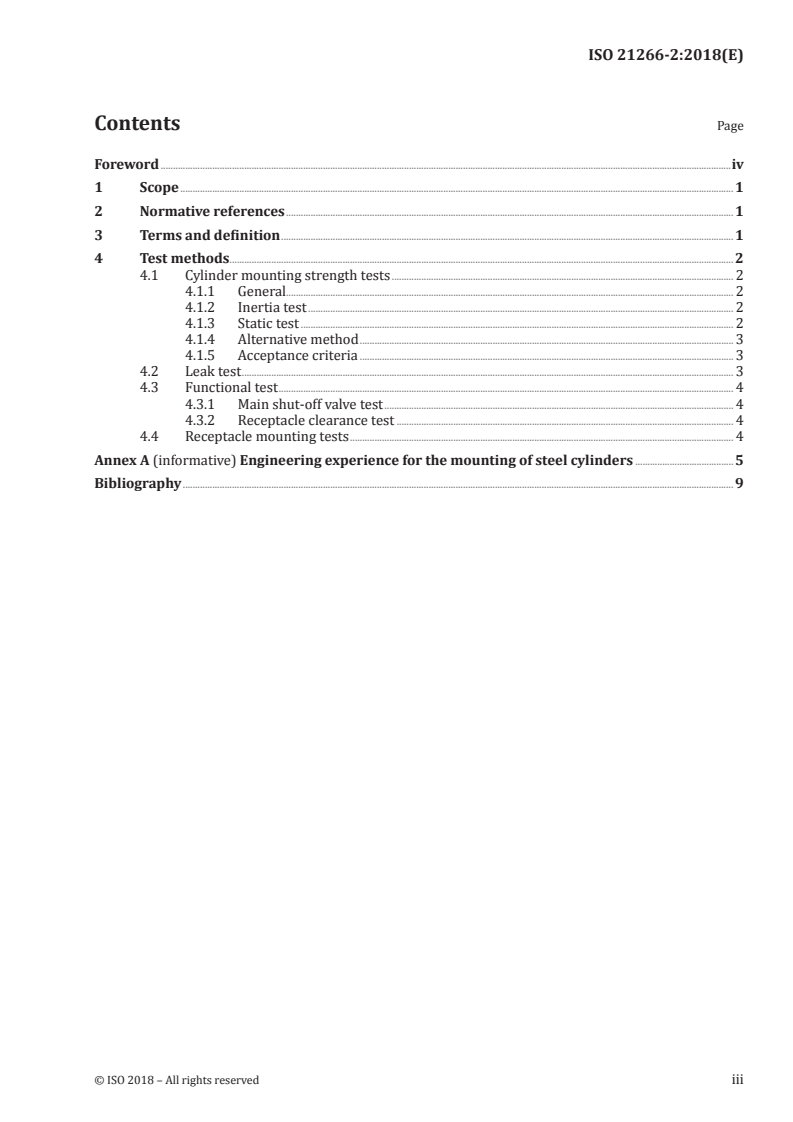
Contents Page
Foreword .iv
1 Scope . 1
2 Normative references . 1
3 Terms and definition . 1
4 Test methods . 2
4.1 Cylinder mounting strength tests . 2
4.1.1 General. 2
4.1.2 Inertia test . 2
4.1.3 Static test . 2
4.1.4 Alternative method . 3
4.1.5 Acceptance criteria . 3
4.2 Leak test . 3
4.3 Functional test . 4
4.3.1 Main shut-off valve test . 4
4.3.2 Receptacle clearance test . 4
4.4 Receptacle mounting tests . 4
Annex A (informative) Engineering experience for the mounting of steel cylinders .5
Bibliography . 9
Foreword
ISO (the International Organization for Standardization) is a worldwide federation of national standards
bodies (ISO member bodies). The work of preparing International Standards is normally carried out
through ISO technical committees. Each member body interested in a subject for which a technical
committee has been established has the right to be represented on that committee. International
organizations, governmental and non-governmental, in liaison with ISO, also take part in the work.
ISO collaborates closely with the International Electrotechnical Commission (IEC) on all matters of
electrotechnical standardization.
The procedures used to develop this document and those intended for its further maintenance are
described in the ISO/IEC Directives, Part 1. In particular, the different approval criteria needed for the
different types of ISO documents should be noted. This document was drafted in accordance with the
editorial rules of the ISO/IEC Directives, Part 2 (see www .iso .org/directives).
Attention is drawn to the possibility that some of the elements of this document may be the subject of
patent rights. ISO shall not be held responsible for identifying any or all such patent rights. Details of
any patent rights identified during the development of the document will be in the Introduction and/or
on the ISO list of patent declarations received (see www .iso .org/patents).
Any trade name used in this document is information given for the convenience of users and does not
constitute an endorsement.
For an explanation of the voluntary nature of standards, the meaning of ISO specific terms and
expressions related to conformity assessment, as well as information about ISO's adherence to the
World Trade Organization (WTO) principles in the Technical Barriers to Trade (TBT) see www .iso
.org/iso/foreword .html.
This document was prepared by Technical Committee 22, Road vehicles, Subcommittee SC 41, Specific
aspects for gaseous fuels.
Any feedback or questions on this document should be directed to the user’s national standards body. A
complete listing of these bodies can be found at www .iso .org/members .html.
A list of all the parts in the ISO 21266 series, can be found on the ISO website.
iv © ISO 2018 – All rights reserved
INTERNATIONAL STANDARD ISO 21266-2:2018(E)
Road vehicles — Compressed gaseous hydrogen (CGH2)
and hydrogen/natural gas blends fuel systems —
Part 2:
Test methods
1 Scope
This document specifies the test methods for checking the minimum safety requirements specified in
ISO 21266-1. It is applicable to the functionality of the fuel systems designed to operate on compressed
gaseous hydrogen and hydrogen/natural gas blends of motor vehicles as defined in ISO 3833.
1)
For tests of individual components, refer to the parts of ISO 12619, ISO 16380, ISO 17268, ISO 19881
and ISO/TS 15869 as applicable
2 Normative references
The following documents are referred to in the text in such a way that some or all of their content
constitutes requirements of this document. For dated references, only the edition cited applies. For
undated references, the latest edition of the referenced document (including any amendments) applies.
ISO 6487, Road vehicles — Measurement techniques in impact tests — Instrumentation
ISO 12619-1, Road vehicles — Compressed gaseous hydrogen (CGH2) and hydrogen/natural gas blends fuel
system components
ISO 21266-1:2018, Road vehicles — Compressed gaseous hydrogen (CGH2) and hydrogen/natural gas
blends fuel systems — Part 1: Safety requirements
3 Terms and definition
For the purposes of this document, the terms and definitions given in ISO 12619-1, ISO 21266-1 and the
following apply.
ISO and IEC maintain terminological databases for use in standardization at the following addresses:
— ISO Online browsing platform: available at https: //www .iso .org/obp
— IEC Electropedia: available at http: //www .electropedia .org/
3.1
notified body
government-appointed body mandated to approve or disapprove
1) Under preparation. Stage at the time of publication: ISO/FDIS 19881.
4 Test methods
4.1 Cylinder mounting strength tests
4.1.1 General
When a vehicle is equipped with several cylinders, they should preferably be tested as a unit.
When groups of cylinders are installed on a vehicle such that they are separately anchored to the
original structure of the vehicle, then each separate group of cylinders may be tested individually.
When performing these tests, accessories and piping shall not contribute to reinforcing the cylinder
mounting.
The requirements of ISO 21266-1:2018, 4.4.3, shall be verified by the test specified in 4.1.2, 4.1.3, 4.1.4
or 4.1.5 of this document.
4.1.2 Inertia test
The cylinder or cylinders to be tested shall be mounted on the vehicle body or a part of the vehicle
body, according to the specifications of the original equipment manufacturer (OEM) or after-market
converter.
The vehicle body or part of the vehicle body shall be firmly anchored to the test trolley. The method
used for anchoring the vehicle body to the test trolley shall not result in reinforcement of the cylinder
anchorages or the part of the vehicle structure participating in anchoring the cylinder or cylinders.
Testing performed with a trolley shall geometrically match original vehicle conditions.
The test shall be carried out using the following procedure.
a) Fill the cylinder or cylinders with a mass corresponding to at least 90 % of the mass of compressed
gaseous hydrogen and hydrogen/natural gas blends capacity at ser
...
INTERNATIONAL ISO
STANDARD 21266-2
First edition
2018-10
Road vehicles — Compressed gaseous
hydrogen (CGH2) and hydrogen/
natural gas blends fuel systems —
Part 2:
Test methods
Véhicules routiers — Systèmes d'alimentation pour hydrogène gazeux
comprimé (CGH2) et mélanges d'hydrogène et de gaz naturel —
Partie 2: Méthodes d'essai
Reference number
©
ISO 2018
© ISO 2018
All rights reserved. Unless otherwise specified, or required in the context of its implementation, no part of this publication may
be reproduced or utilized otherwise in any form or by any means, electronic or mechanical, including photocopying, or posting
on the internet or an intranet, without prior written permission. Permission can be requested from either ISO at the address
below or ISO’s member body in the country of the requester.
ISO copyright office
CP 401 • Ch. de Blandonnet 8
CH-1214 Vernier, Geneva
Phone: +41 22 749 01 11
Fax: +41 22 749 09 47
Email: copyright@iso.org
Website: www.iso.org
Published in Switzerland
ii © ISO 2018 – All rights reserved
Contents Page
Foreword .iv
1 Scope . 1
2 Normative references . 1
3 Terms and definition . 1
4 Test methods . 2
4.1 Cylinder mounting strength tests . 2
4.1.1 General. 2
4.1.2 Inertia test . 2
4.1.3 Static test . 2
4.1.4 Alternative method . 3
4.1.5 Acceptance criteria . 3
4.2 Leak test . 3
4.3 Functional test . 4
4.3.1 Main shut-off valve test . 4
4.3.2 Receptacle clearance test . 4
4.4 Receptacle mounting tests . 4
Annex A (informative) Engineering experience for the mounting of steel cylinders .5
Bibliography . 9
Foreword
ISO (the International Organization for Standardization) is a worldwide federation of national standards
bodies (ISO member bodies). The work of preparing International Standards is normally carried out
through ISO technical committees. Each member body interested in a subject for which a technical
committee has been established has the right to be represented on that committee. International
organizations, governmental and non-governmental, in liaison with ISO, also take part in the work.
ISO collaborates closely with the International Electrotechnical Commission (IEC) on all matters of
electrotechnical standardization.
The procedures used to develop this document and those intended for its further maintenance are
described in the ISO/IEC Directives, Part 1. In particular, the different approval criteria needed for the
different types of ISO documents should be noted. This document was drafted in accordance with the
editorial rules of the ISO/IEC Directives, Part 2 (see www .iso .org/directives).
Attention is drawn to the possibility that some of the elements of this document may be the subject of
patent rights. ISO shall not be held responsible for identifying any or all such patent rights. Details of
any patent rights identified during the development of the document will be in the Introduction and/or
on the ISO list of patent declarations received (see www .iso .org/patents).
Any trade name used in this document is information given for the convenience of users and does not
constitute an endorsement.
For an explanation of the voluntary nature of standards, the meaning of ISO specific terms and
expressions related to conformity assessment, as well as information about ISO's adherence to the
World Trade Organization (WTO) principles in the Technical Barriers to Trade (TBT) see www .iso
.org/iso/foreword .html.
This document was prepared by Technical Committee 22, Road vehicles, Subcommittee SC 41, Specific
aspects for gaseous fuels.
Any feedback or questions on this document should be directed to the user’s national standards body. A
complete listing of these bodies can be found at www .iso .org/members .html.
A list of all the parts in the ISO 21266 series, can be found on the ISO website.
iv © ISO 2018 – All rights reserved
INTERNATIONAL STANDARD ISO 21266-2:2018(E)
Road vehicles — Compressed gaseous hydrogen (CGH2)
and hydrogen/natural gas blends fuel systems —
Part 2:
Test methods
1 Scope
This document specifies the test methods for checking the minimum safety requirements specified in
ISO 21266-1. It is applicable to the functionality of the fuel systems designed to operate on compressed
gaseous hydrogen and hydrogen/natural gas blends of motor vehicles as defined in ISO 3833.
1)
For tests of individual components, refer to the parts of ISO 12619, ISO 16380, ISO 17268, ISO 19881
and ISO/TS 15869 as applicable
2 Normative references
The following documents are referred to in the text in such a way that some or all of their content
constitutes requirements of this document. For dated references, only the edition cited applies. For
undated references, the latest edition of the referenced document (including any amendments) applies.
ISO 6487, Road vehicles — Measurement techniques in impact tests — Instrumentation
ISO 12619-1, Road vehicles — Compressed gaseous hydrogen (CGH2) and hydrogen/natural gas blends fuel
system components
ISO 21266-1:2018, Road vehicles — Compressed gaseous hydrogen (CGH2) and hydrogen/natural gas
blends fuel systems — Part 1: Safety requirements
3 Terms and definition
For the purposes of this document, the terms and definitions given in ISO 12619-1, ISO 21266-1 and the
following apply.
ISO and IEC maintain terminological databases for use in standardization at the following addresses:
— ISO Online browsing platform: available at https: //www .iso .org/obp
— IEC Electropedia: available at http: //www .electropedia .org/
3.1
notified body
government-appointed body mandated to approve or disapprove
1) Under preparation. Stage at the time of publication: ISO/FDIS 19881.
4 Test methods
4.1 Cylinder mounting strength tests
4.1.1 General
When a vehicle is equipped with several cylinders, they should preferably be tested as a unit.
When groups of cylinders are installed on a vehicle such that they are separately anchored to the
original structure of the vehicle, then each separate group of cylinders may be tested individually.
When performing these tests, accessories and piping shall not contribute to reinforcing the cylinder
mounting.
The requirements of ISO 21266-1:2018, 4.4.3, shall be verified by the test specified in 4.1.2, 4.1.3, 4.1.4
or 4.1.5 of this document.
4.1.2 Inertia test
The cylinder or cylinders to be tested shall be mounted on the vehicle body or a part of the vehicle
body, according to the specifications of the original equipment manufacturer (OEM) or after-market
converter.
The vehicle body or part of the vehicle body shall be firmly anchored to the test trolley. The method
used for anchoring the vehicle body to the test trolley shall not result in reinforcement of the cylinder
anchorages or the part of the vehicle structure participating in anchoring the cylinder or cylinders.
Testing performed with a trolley shall geometrically match original vehicle conditions.
The test shall be carried out using the following procedure.
a) Fill the cylinder or cylinders with a mass corresponding to at least 90 % of the mass of compressed
gaseous hydrogen and hydrogen/natural gas blends capacity at ser
...