


ISO/PRF 10295-1
(Main)Fire tests for building elements and components — Fire testing of service installations — Part 1: Penetration seals
Fire tests for building elements and components — Fire testing of service installations — Part 1: Penetration seals
ISO 10295-1:2007 specifies the heating condition, method of test and criteria for the evaluation of the ability of a penetration sealing system to maintain the integrity and insulation of a fire separating element at the position at which it has been penetrated, for example by a service. ISO 10295-1:2007 assesses the effect of such penetrations on the integrity and insulation performance of the element concerned, the integrity and insulation performance of the penetration sealing system, the insulation performance of the penetrating service or services, and where appropriate, the integrity failure of a service. ISO 10295-1:2007 does not provide information concerning the influence of the inclusion of such penetrations and sealing systems on the load-bearing capacity of the element. It is possible that a penetration seal is a component of, or contributes to the performance of, a system to which special requirements apply. In such cases additional tests, relevant to the system and its function, can be necessary. Examples are chimneys and fire-rated ducts in air distribution systems. ISO 10295-1:2007 is not intended to provide quantitative information on the rate of leakage of smoke and/or hot gases or on the transmission or generation of fumes. Such phenomena are to be noted in describing the general behaviour of specimens during test. ISO 10295-1:2007 does not provide information on the ability of the seal to withstand stresses that can be caused by the movement or displacement of the penetration services in practice.
Essais au feu pour les éléments et composants de bâtiment — Essai au feu des installations de service — Partie 1: Joints d'étanchéité
General Information
- Status
- Not Published
- Technical Committee
- ISO/TC 92/SC 2 - Fire containment
- Drafting Committee
- ISO/TC 92/SC 2 - Fire containment
- Current Stage
- 5020 - FDIS ballot initiated: 2 months. Proof sent to secretariat
- Start Date
- 13-Feb-2026
- Completion Date
- 15-Feb-2026
Relations
- Effective Date
- 28-Jan-2023
Overview
ISO/PRF 10295-1: Fire tests for building elements and components - Fire testing of service installations - Part 1: Penetration seals is an international standard developed by ISO Technical Committee 92 (Fire Safety), Subcommittee 2 (Fire Resistance). This standard outlines test methods to assess how well penetration sealing systems maintain the fire-resistant integrity and insulation of building elements-such as walls or floors-once they have been penetrated by services like cables, pipes, or ducts.
ISO 10295-1 provides procedures for fire tests to evaluate the performance of seals used to close penetrations. The standard specifies the heating conditions, testing method, and pass/fail criteria for penetration sealing systems, focusing on their ability to help a fire-separating building element maintain its integrity and insulation when service installations pass through.
Key Topics
- Evaluation of Fire Resistance: The standard assesses a penetration sealing system’s ability to prevent fire and heat passage through penetrations in fire-separating elements.
- Integrity and Insulation Performance: It establishes criteria for the continued integrity (preventing passage of flames and hot gases) and insulation (limiting temperature rise) at the location of the penetration.
- Services and Seals: The standard applies to a variety of service penetrations, including cables, conduits, pipes, ducts, and chimneys, as well as the seals intended to maintain fire separation.
- Test Conditions and Procedures:
- Detailed requirements for specimen preparation, including number and size of test samples.
- Heating regimes and pressure conditions applied during testing.
- Instrumentation and measurement techniques for integrity and insulation.
- Optional Leakage Tests: Inclusion of optional water and air leakage tests to further understand the seal’s performance.
Applications
ISO/PRF 10295-1 is widely used by building product manufacturers, fire testing laboratories, regulatory authorities, and construction professionals to:
- Test and Classify Penetration Seals: To ensure that products used as fire stopping materials meet international fire performance criteria.
- Building Design and Compliance: Assure designers and authorities that service installations do not compromise the fire resistance of walls, floors, or ceilings.
- Product Certification: Penetration sealing systems tested to this standard can achieve recognized certification, which is vital for code compliance and market acceptance.
- Risk Mitigation: Help building owners and facility managers select tested and certified products to improve overall fire safety in new or renovated buildings.
This standard applies to both standard and non-standard constructions, including rigid, flexible wall or floor elements, and accounts for a broad range of practical applications. While it primarily focuses on fire integrity and insulation, it also provides insight into optional performance characteristics such as air or water tightness.
Related Standards
Users of ISO/PRF 10295-1 may also be interested in related fire testing and building safety standards, such as:
- ISO 834-1: Fire-resistance tests - Elements of building construction - Part 1: General requirements (referenced for test conditions and definitions).
- ISO 13943: Fire safety - Vocabulary (applies for standardized terminology).
- Other parts of ISO 10295: Covering additional systems and applications.
- Relevant National Standards: Such as ASTM E814 (UL 1479) for penetration firestop systems.
For those involved in fire safety engineering, building design, construction, or regulatory compliance, ISO/PRF 10295-1 serves as a key resource for the standardized fire testing of service penetrations, helping ensure safer buildings globally.
Buy Documents


ISO/PRF 10295-1 - Fire tests for building elements and components — Fire testing of service installations — Part 1: Penetration seals/27/2024


ISO/PRF 10295-1 - Fire tests for building elements and components — Fire testing of service installations — Part 1: Penetration seals/13/2026

REDLINE ISO/PRF 10295-1 - Fire tests for building elements and components — Fire testing of service installations — Part 1: Penetration seals/13/2026
Get Certified
Connect with accredited certification bodies for this standard

ICC Evaluation Service
Building products evaluation and certification.

NSF International
Global independent organization facilitating standards development and certification.

QAI Laboratories
Building and construction product testing and certification.
Sponsored listings
Frequently Asked Questions
ISO/PRF 10295-1 is a draft published by the International Organization for Standardization (ISO). Its full title is "Fire tests for building elements and components — Fire testing of service installations — Part 1: Penetration seals". This standard covers: ISO 10295-1:2007 specifies the heating condition, method of test and criteria for the evaluation of the ability of a penetration sealing system to maintain the integrity and insulation of a fire separating element at the position at which it has been penetrated, for example by a service. ISO 10295-1:2007 assesses the effect of such penetrations on the integrity and insulation performance of the element concerned, the integrity and insulation performance of the penetration sealing system, the insulation performance of the penetrating service or services, and where appropriate, the integrity failure of a service. ISO 10295-1:2007 does not provide information concerning the influence of the inclusion of such penetrations and sealing systems on the load-bearing capacity of the element. It is possible that a penetration seal is a component of, or contributes to the performance of, a system to which special requirements apply. In such cases additional tests, relevant to the system and its function, can be necessary. Examples are chimneys and fire-rated ducts in air distribution systems. ISO 10295-1:2007 is not intended to provide quantitative information on the rate of leakage of smoke and/or hot gases or on the transmission or generation of fumes. Such phenomena are to be noted in describing the general behaviour of specimens during test. ISO 10295-1:2007 does not provide information on the ability of the seal to withstand stresses that can be caused by the movement or displacement of the penetration services in practice.
ISO 10295-1:2007 specifies the heating condition, method of test and criteria for the evaluation of the ability of a penetration sealing system to maintain the integrity and insulation of a fire separating element at the position at which it has been penetrated, for example by a service. ISO 10295-1:2007 assesses the effect of such penetrations on the integrity and insulation performance of the element concerned, the integrity and insulation performance of the penetration sealing system, the insulation performance of the penetrating service or services, and where appropriate, the integrity failure of a service. ISO 10295-1:2007 does not provide information concerning the influence of the inclusion of such penetrations and sealing systems on the load-bearing capacity of the element. It is possible that a penetration seal is a component of, or contributes to the performance of, a system to which special requirements apply. In such cases additional tests, relevant to the system and its function, can be necessary. Examples are chimneys and fire-rated ducts in air distribution systems. ISO 10295-1:2007 is not intended to provide quantitative information on the rate of leakage of smoke and/or hot gases or on the transmission or generation of fumes. Such phenomena are to be noted in describing the general behaviour of specimens during test. ISO 10295-1:2007 does not provide information on the ability of the seal to withstand stresses that can be caused by the movement or displacement of the penetration services in practice.
ISO/PRF 10295-1 is classified under the following ICS (International Classification for Standards) categories: 13.220.50 - Fire-resistance of building materials and elements; 91.140.01 - Installations in buildings in general. The ICS classification helps identify the subject area and facilitates finding related standards.
ISO/PRF 10295-1 has the following relationships with other standards: It is inter standard links to ISO 10295-1:2007. Understanding these relationships helps ensure you are using the most current and applicable version of the standard.
ISO/PRF 10295-1 is available in PDF format for immediate download after purchase. The document can be added to your cart and obtained through the secure checkout process. Digital delivery ensures instant access to the complete standard document.
Standards Content (Sample)
DRAFT
International
Standard
ISO/DIS 10295-1
ISO/TC 92/SC 2
Fire tests for building elements
Secretariat: ANSI
and components — Fire testing of
Voting begins on:
service installations —
2025-02-21
Part 1:
Voting terminates on:
2025-05-16
Penetration seals
Essais au feu pour les éléments et composants de bâtiment —
Essai au feu des installations de service —
Partie 1: Joints d'étanchéité
ICS: ISO ics
THIS DOCUMENT IS A DRAFT CIRCULATED
FOR COMMENTS AND APPROVAL. IT
IS THEREFORE SUBJECT TO CHANGE
AND MAY NOT BE REFERRED TO AS AN
INTERNATIONAL STANDARD UNTIL
PUBLISHED AS SUCH.
IN ADDITION TO THEIR EVALUATION AS
BEING ACCEPTABLE FOR INDUSTRIAL,
TECHNOLOGICAL, COMMERCIAL AND
USER PURPOSES, DRAFT INTERNATIONAL
STANDARDS MAY ON OCCASION HAVE TO
This document is circulated as received from the committee secretariat.
BE CONSIDERED IN THE LIGHT OF THEIR
POTENTIAL TO BECOME STANDARDS TO
WHICH REFERENCE MAY BE MADE IN
NATIONAL REGULATIONS.
RECIPIENTS OF THIS DRAFT ARE INVITED
TO SUBMIT, WITH THEIR COMMENTS,
NOTIFICATION OF ANY RELEVANT PATENT
RIGHTS OF WHICH THEY ARE AWARE AND TO
PROVIDE SUPPORTING DOCUMENTATION.
Reference number
ISO/DIS 10295-1:2025(en)
DRAFT
ISO/DIS 10295-1:2025(en)
International
Standard
ISO/DIS 10295-1
ISO/TC 92/SC 2
Fire tests for building elements
Secretariat: ANSI
and components — Fire testing of
Voting begins on:
service installations —
Part 1:
Voting terminates on:
Penetration seals
Essais au feu pour les éléments et composants de bâtiment —
Essai au feu des installations de service —
Partie 1: Joints d'étanchéité
ICS: ISO ics
THIS DOCUMENT IS A DRAFT CIRCULATED
FOR COMMENTS AND APPROVAL. IT
IS THEREFORE SUBJECT TO CHANGE
AND MAY NOT BE REFERRED TO AS AN
INTERNATIONAL STANDARD UNTIL
PUBLISHED AS SUCH.
IN ADDITION TO THEIR EVALUATION AS
BEING ACCEPTABLE FOR INDUSTRIAL,
© ISO 2025
TECHNOLOGICAL, COMMERCIAL AND
USER PURPOSES, DRAFT INTERNATIONAL
All rights reserved. Unless otherwise specified, or required in the context of its implementation, no part of this publication may
STANDARDS MAY ON OCCASION HAVE TO
be reproduced or utilized otherwise in any form or by any means, electronic or mechanical, including photocopying, or posting on
This document is circulated as received from the committee secretariat. BE CONSIDERED IN THE LIGHT OF THEIR
the internet or an intranet, without prior written permission. Permission can be requested from either ISO at the address below
POTENTIAL TO BECOME STANDARDS TO
WHICH REFERENCE MAY BE MADE IN
or ISO’s member body in the country of the requester.
NATIONAL REGULATIONS.
ISO copyright office
RECIPIENTS OF THIS DRAFT ARE INVITED
CP 401 • Ch. de Blandonnet 8
TO SUBMIT, WITH THEIR COMMENTS,
CH-1214 Vernier, Geneva
NOTIFICATION OF ANY RELEVANT PATENT
Phone: +41 22 749 01 11
RIGHTS OF WHICH THEY ARE AWARE AND TO
PROVIDE SUPPORTING DOCUMENTATION.
Email: copyright@iso.org
Website: www.iso.org
Published in Switzerland Reference number
ISO/DIS 10295-1:2025(en)
ii
ISO/DIS 10295-1:2025(en)
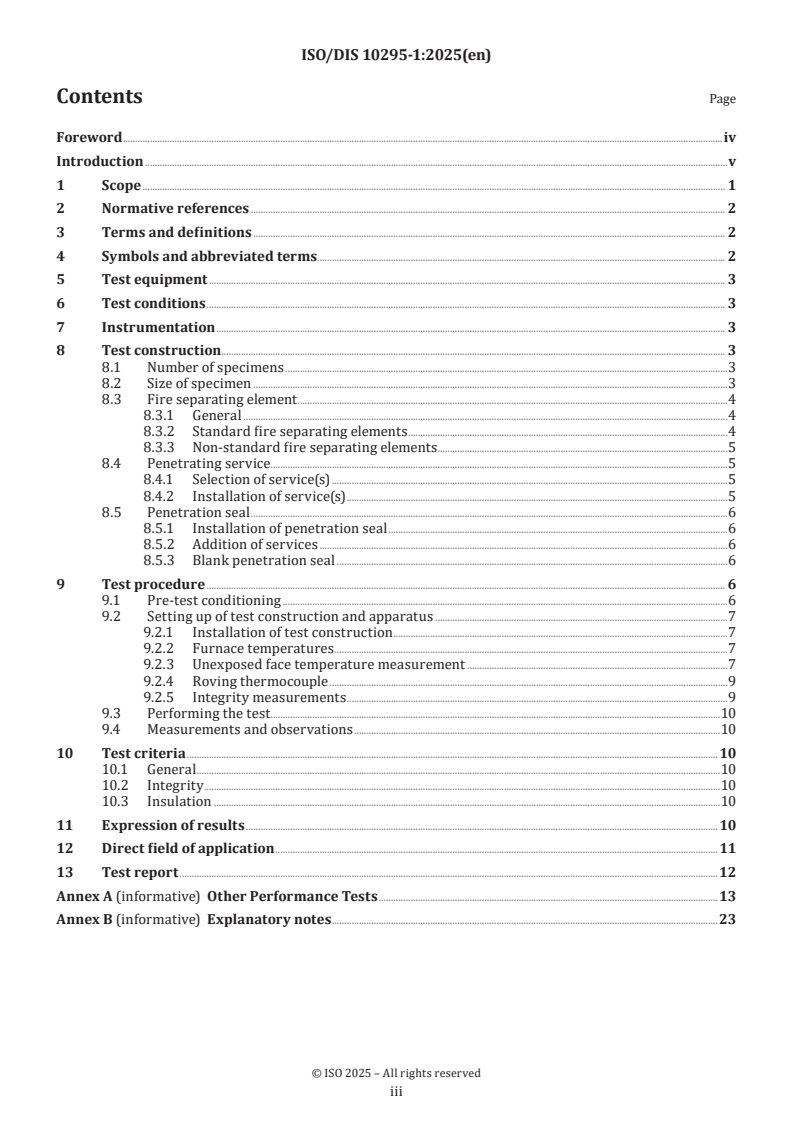
Contents Page
Foreword .iv
Introduction .v
1 Scope . 1
2 Normative references . 2
3 Terms and definitions . 2
4 Symbols and abbreviated terms. 2
5 Test equipment . 3
6 Test conditions . 3
7 Instrumentation . 3
8 Test construction. 3
8.1 Number of specimens .3
8.2 Size of specimen .3
8.3 Fire separating element .4
8.3.1 General .4
8.3.2 Standard fire separating elements .4
8.3.3 Non-standard fire separating elements .5
8.4 Penetrating service.5
8.4.1 Selection of service(s) .5
8.4.2 Installation of service(s) .5
8.5 Penetration seal .6
8.5.1 Installation of penetration seal .6
8.5.2 Addition of services .6
8.5.3 Blank penetration seal .6
9 Test procedure . 6
9.1 Pre-test conditioning .6
9.2 Setting up of test construction and apparatus .7
9.2.1 Installation of test construction .7
9.2.2 Furnace temperatures .7
9.2.3 Unexposed face temperature measurement .7
9.2.4 Roving thermocouple .9
9.2.5 Integrity measurements .9
9.3 Performing the test.10
9.4 Measurements and observations .10
10 Test criteria . 10
10.1 General .10
10.2 Integrity .10
10.3 Insulation .10
11 Expression of results . 10
12 Direct field of application .11
13 Test report .12
Annex A (informative) Other Performance Tests .13
Annex B (informative) Explanatory notes .23
iii
ISO/DIS 10295-1:2025(en)
Foreword
ISO (the International Organization for Standardization) is a worldwide federation of national standards
bodies (ISO member bodies). The work of preparing International Standards is normally carried out through
ISO technical committees. Each member body interested in a subject for which a technical committee
has been established has the right to be represented on that committee. International organizations,
governmental and non-governmental, in liaison with ISO, also take part in the work. ISO collaborates closely
with the International Electrotechnical Commission (IEC) on all matters of electrotechnical standardization.
International Standards are drafted in accordance with the rules given in the ISO/IEC Directives, Part 2.
The main task of technical committees is to prepare International Standards. Draft International Standards
adopted by the technical committees are circulated to the member bodies for voting. Publication as an
International Standard requires approval by at least 75 % of the member bodies casting a vote.
Attention is drawn to the possibility that some of the elements of this document may be the subject of patent
rights. ISO shall not be held responsible for identifying any or all such patent rights.
ISO 10295-1 was prepared by Technical Committee ISO/TC 92, Fire safety, Subcommittee SC 2, Fire
containment.
ISO 10295 consists of the following parts, under the general title Fire tests for building elements and
components — Fire testing of service installations:
Part 1: Penetration seals
Part 2: Linear joint (gap) seals
Part 3: Single component penetration seals — Guidance on the construction and use of test configurations and
simulated services to characterise sealing materials
iv
ISO/DIS 10295-1:2025(en)
Introduction
This part of ISO 10295 has been prepared to provide a method of test for assessing the contribution of a
penetration sealing system to the fire resistance of separating elements when they have been penetrated
by a service. It should be read in conjunction with ISO 834-1. This part of ISO 10295 contains specific
requirements for fire resistance testing that are unique to the elements of building construction described
as a penetration sealing system. The requirements for these penetration sealing systems are intended to be
applied as appropriate in conjunction with the detailed and general requirements contained in ISO 834-1.
v
DRAFT International Standard ISO/DIS 10295-1:2025(en)
Fire tests for building elements and components — Fire
testing of service installations —
Part 1:
Penetration seals
WARNING — The attention of all persons concerned with managing and carrying out this fire
resistance test is drawn to the fact that fire testing can be hazardous and there is a possibility that
toxic and/or harmful smoke and gases can be evolved during the test. Mechanical and operational
hazards can also arise during the construction of the test elements or structures, their testing and
disposal of test residues.
WARNING — An assessment of all potential hazards and risks to health shall be made and safety
precautions shall be identified and provided. Written safety instructions shall be issued. Appropriate
training shall be given to relevant personnel. Laboratory personnel shall ensure that they follow
written safety instructions at all times.
1 Scope
This part of ISO 10295 specifies the heating condition, method of test and criteria for the evaluation of the
ability of a penetration sealing system to maintain the integrity and insulation of a fire separating element
at the position at which it has been penetrated.
This part of ISO 10295 assesses
a) the effect of such penetrations on the integrity and insulation performance of the element concerned,
b) the integrity and insulation performance of the penetration sealing system,
c) the insulation performance of the penetrating service or services, and where appropriate, the integrity
failure of a service.
This part of ISO 10295 does not provide information concerning the influence of the inclusion of such
penetrations and sealing systems on the load-bearing capacity of the element.
It is possible that a penetration seal is a component of, or contributes to the performance of, a system to
which special requirements apply. In such cases additional tests, relevant to the system and its function, can
be necessary. Examples are chimneys and fire-rated ducts in air distribution systems.
This part of ISO 10295 is not intended to provide quantitative information on the rate of leakage of
smoke and/or hot gases or on the transmission or generation of fumes during the fire exposure test. Such
phenomena are to be noted in describing the general behaviour of specimens during test.
This part of ISO 10295 does not provide information on the ability of the seal to withstand stresses that can
be caused by the movement or displacement of the penetration services in practice.
NOTE Optional water and air leakage tests are included in Annex A.
NOTE Explanatory notes are included in Annex B.
ISO/DIS 10295-1:2025(en)
2 Normative references
The following referenced documents are indispensable for the application of this document. For dated
references, only the edition cited applies. For undated references, the latest edition of the referenced
document (including any amendments) applies.
ISO 13943, Fire safety — Vocabulary
ISO 834-1, Fire-resistance tests — Elements of building construction — Part 1: General requirements
3 Terms and definitions
For the purposes of this document, the terms and definitions given in ISO 13943 and ISO 834-1 and the
following apply.
3.1
fire separating element
floors, walls and other separating elements of construction having a period of fire resistance determined in
accordance with ISO 834-1
3.2
penetration
aperture within a fire separating element usually present to accommodate the passage of a service through
that element
3.3
service
penetrating item for example a cable, conduit, pipe with or without any insulation, duct, chimney, or
trunking, excluding air ventilation systems and fire-rated ventilation ducts, smoke extract ducts and fire-
rated service ducts and shafts
3.4
penetration seal
system used to maintain the fire resistance of a separating element at the position where one or more
services pass through or where there is provision for services to pass through a separating element
3.5
penetration sealing system
assembly for test consisting of the penetrating service or services and the penetration seal, materials or
devices, together with any service support construction, designed to maintain the integrity and insulation
performance of the separating element for the duration of the fire test
3.6
service support
mechanical support provided in the form of clips, ties, hangers, ladder racks of trays, or any device designed
to carry the load imposed by the penetrating services
3.7
blank penetration seal
system sealing or closing an aperture in the fire separating element without services passing through
3.8
test construction
complete assembly, consisting of the separating element and penetration sealing system
4 Symbols and abbreviated terms
Symbols and designations appropriate to this test are given in ISO 834-1.
ISO/DIS 10295-1:2025(en)
5 Test equipment
5.1 Equipment employed in the conduct of this test consists of a furnace, restraint and support frames and
instrumentation as specified in ISO 834-1 and this part of ISO 10295.
5.2 The internal dimensions of the test furnace shall have a minimum size of 1 m × 1 m × 1 m and shall be
such that a distance of at least 200 mm exists between any point of the periphery of any penetration seal and
the wall of the furnace.
6 Test conditions
6.1 All test conditions, except those noted herein, shall conform to those given in ISO 834-1.
6.2 Where a penetration sealing system is intended for use in both floors and walls, then each orientation
shall be tested.
6.3 A pressure of (20 ± 2) Pa shall be established at the bottom of the lowest penetration in a vertical
assembly.
6.4 For horizontal elements a static pressure of (20 ± 2) Pa in the horizontal plane (100 ± 10) mm below
the underside of the separating element shall exist.
6.5 For optional water leakage test see Annex A.1
6.6 For optional air leakage test see Annex A.2
7 Instrumentation
The control, monitoring and recording equipment necessary to carry out tests in accordance with this part
of ISO 10295 shall be as described in ISO 834-1.
8 Test construction
8.1 Number of specimens
8.1.1 In the case of asymmetrical vertical elements, normally two tests shall be carried out; one from each
direction of exposure. Where it can be established clearly in an asymmetrical vertical element that there is
a weaker direction of exposure, it is required to test only the weaker. A full justification for the procedure
adopted shall be included in the test report. Where the penetration sealing system is fully symmetrical, only
one specimen is required to be tested with either face exposed to the heating regime.
8.1.2 Penetration seals in horizontal elements shall be tested with the fire exposure from the underside.
8.2 Size of specimen
8.2.1 A penetration and the accompanying penetration seal shall be full size. To avoid boundary effects,
the distance between the perimeter of the penetration sealing system and the outer perimeter of the heated
part of the separating element shall be not less than 200 mm at any point.
8.2.2 Where multiple penetrations are included in a single test construction, the minimum distance
between adjacent penetration sealing systems shall be not less than 200 mm. Each penetration with its
ISO/DIS 10295-1:2025(en)
associated service(s) and penetration seal(s) shall be the subject of a separate evaluation providing the
specified conditions are maintained with respect to the penetration sealing system being evaluated.
8.3 Fire separating element
8.3.1 General
8.3.1.1 The fire separating element shall be either a standard configuration which covers a wide range of
constructions (see 8.3.2) or fully representative of the specific construction in a non-standard configuration
(see 8.3.3).
8.3.1.2 A rating obtained using a specific separating element shall apply only to that particular type of
separating element.
8.3.1.3 The direct field of application as outlined in Section 12 applies to both standard and non-standard
fire separating elements.
8.3.2 Standard fire separating elements
When the test construction is intended for use in a form of construction covered by the standard fire
separating elements, the standard fire separating elements described in Tables 1, 2 or 3 shall be used.
Table 1 — Standard rigid wall construction
Type of construction Thickness Density Test duration
mm kg/m t
min
Normal concrete/masonry 110 ± 10 2 200 ± 200 t = 120
150 ± 10 2 200 ± 200 120 < t ≤ 180
175 ± 10 2 200 ± 200 180 < t ≤ 240
a
Aerated concrete 110 ± 10 650 ± 200 t = 120
150 ± 10 650 ± 200 120 < t ≤ 240
a
This supporting construction may be made from blocks bonded together with mortar or adhesive.
Table 2 — Standard flexible-wall construction (gypsum plasterboard)
Fire resistance Wall constructions
min a b
Number of layers Thickness Insulation Thickness
on each side
mm D/ρ mm
30 1 12,5 40/40 75
60 2 12,5 40/40 100
90 2 12,5 60/50 125
120 2 12,5 60/100 150
180 3 12,5 60/100 175
240 3 15,0 80/100 190
a 3
D is the thickness in mm of mineral wool insulation inside the wall; ρ is the density in kg/m of mineral wool insulation inside
the wall.
b
Tolerance of ±10 %.
ISO/DIS 10295-1:2025(en)
Table 3 — Standard floor construction
Type of construction Thickness Density Test duration
mm kg/m t
min
Normal concrete 110 ± 10 2 200 ± 200 t = 90
150 ± 10 2 200 ± 200 90 < t ≤ 180
175 ± 10 2 200 ± 200 180 < t ≤ 240
Aerated concrete 125 ± 10 650 ± 200 t = 120
150 ± 10 650 ± 200 120 < t ≤ 240
8.3.3 Non-standard fire separating elements
8.3.3.1 The fire separating element shall be fully representative of the specific construction intended for use.
8.3.3.2 The direct field of application in Section 12 is restricted to the fire separating element tested.
8.4 Penetrating service
8.4.1 Selection of service(s)
8.4.1.1 The type of service or services passing through the penetration in the fire resisting element shall
be selected to be representative of the service which the penetration seal is designed to accommodate.
8.4.1.2 When more than one penetration sealing system is incorporated into a test on a single fire
separating element, care shall be taken to ensure that there is no interaction between penetrations. Examples
include; where the early failure of one penetration sealing system invalidates the time-temperature or
pressure conditions specified, or where one penetration sealing system directly influences another by
flaming, melting or other means.
8.4.1.3 The direct field of application as outlined in Section 12 applies to penetrating services.
8.4.2 Installation of service(s)
8.4.2.1 Install service(s) to extend (300 ± 25) mm on the exposed side and (900 ± 25) mm on the unexposed
side, except for the following conditions.
a) When additional insulation, coating, wrapping, or other protection is installed as part of the penetration
sealing system for a limited length on the exposed side, install the service so that its length without
insulation extends 300 mm on the exposed side.
b) When additional insulation, coating, wrapping, or other protection is installed as part of the penetration
sealing system for a limited length on the unexposed side, install the service so that its length without
insulation extends 500 mm on the unexposed side.
8.4.2.2 Maintain minimum separation requirements for penetration sealing systems in accordance with 8.2.
8.4.2.3 For the purpose of the test, the possibilities for support provided to the services are as follows:
a) unsupported condition;
b) notional support, agreed between the sponsor and the laboratory;
c) either full-scale simulation (representative of practical conditions); or
ISO/DIS 10295-1:2025(en)
d) calculation and application of a load to simulate practical conditions. This will determine the field of
direct application.
8.4.2.4 In each case, the procedure adopted and the validity of the test result shall be fully described in
the report.
8.4.2.5 Service end options shall be selected according to Table 4 and the conditions used shall be
considered in the corresponding classification of the test result.
Table 4 — Service end arrangements
Service end options
inside the furnace outside the furnace
uncapped uncapped
capped uncapped
uncapped capped
capped capped
8.4.2.6 The capping of pipes shall be carried out by closing the pipe end with a mineral wool or ceramic
fibre disc of a thickness of (50 ± 10) mm and a density of (150 ± 50) kg/m fixed in place with an appropriate
adhesive e.g. sodium silicate adhesive, ceramic adhesive. Alternatively, pipes may be sealed by welding a
disc of the same material as the pipe to the end. In cases where vertical pipes are tested, the mineral wool or
ceramic fibre discs shall be fixed additionally by mechanical means.
8.5 Penetration seal
8.5.1 Installation of penetration seal
The penetration sealing system shall be installed, together with services chosen to represent the field of
application. Install these services in accordance with the manufacturer’s instructions or in a manner
representative of site practice. The installation procedures shall be described in the test report.
8.5.2 Addition of services
In the case where a penetration sealing system is designed to allow for the alteration of the service content
after first installation, a representative penetration sealing system shall be prepared and fully conditioned.
After this period, any required modifications shall be made to the service loading and a further conditioning
period shall be allowed if necessary. Such procedures shall be fully described in the report.
8.5.3 Blank penetration seal
A blank penetration seal shall be tested in accordance with this part of ISO 10295. The test results of the
blank penetration seal shall not be applied after the penetrating item is installed.
9 Test procedure
9.1 Pre-test conditioning
After completion of the test construction, it shall be subject to a conditioning procedure in accordance with
ISO 834-1.
ISO/DIS 10295-1:2025(en)
9.2 Setting up of test construction and apparatus
9.2.1 Installation of test construction
When the conditioning procedures are satisfied the test construction shall be mounted to form the vertical
or horizontal face of the test furnace as appropriate. Measuring equipment and ancillary apparatus shall be
provided in accordance with the provisions of this part of ISO 10295.
9.2.2 Furnace temperatures
Plate thermometers in accordance with ISO 834-1 for the measurement and control of furnace temperature
shall be uniformly distributed to give a reliable indication of the average gas temperature in the vicinity of
the heated face of the test construction. The face of the plate thermometers shall be located initially in a
plane (100 ± 10) mm from the exposed face of the separating element. In addition, no plate thermometer shall
be closer than 100 mm to any projecting part of the seal, a penetrating service or any part of the furnace at
the start of the test. At least one plate thermometer shall be provided for every 1,5 m of the heated area of
the test construction, subject to a minimum number of four plate thermometers for each test construction.
9.2.3 Unexposed face temperature measurement
9.2.3.1 Generally, surface-temperature measurements shall be made using thermocouples in accordance
with ISO 834-1. In the case of non-planar surfaces, the disc and pad shall be deformed to follow the surface
profile. If there is difficulty in fixing the standard pad, the size of the pad shall be reduced in size subject to a
minimum dimension of 12 mm.
9.2.3.2 Thermocouples shall be provided at the following locations; see also Figures 1 and 2.
a) Location A: On the surface of the service protruding from the unexposed face, at a position corresponding
to a distance of 25 mm from the point where the service emerges from the penetration seal. At this
location, a measurement shall be made on each different type and/or size of penetrating service included
in the penetration. On each selected service, one thermocouple shall be provided for every 500 mm of
the service perimeter.
1) In the case of tightly bunched or grouped services, the grouped assembly shall be treated as a single
service. Thermocouples at the specified positions shall be evenly distributed around the perimeters
of the service. If the service passes through a vertical element, one of these thermocouples shall
be attached to the uppermost surface of the service. Also, in the case of vertical elements, when
similar services are included in the penetration, the service nearest the top of the penetration shall
be chosen for temperature measurement.
2) Surface thermocouples shall also be placed on the service at a distance of 25 mm from the
termination of any coating or insulation extending along the surface from the penetration.
b) Location B: On the surface of the penetration seal at the following locations:
1) Where possible, 25 mm from each type of penetrating service (or group of services) with a minimum
of one thermocouple provided for each 500 mm of the service perimeter.
2) Where possible, equidistant from the perimeter of the service to the edge of the penetration.
— at the location of maximum separation, or
— where there is more than one penetrating service, at the nominal mid-position of the largest
uninterrupted area of the penetration seal.
c) Location C: At the mid-section of the unexposed surface on any supporting frame at the periphery
of the penetration. In the case of vertical elements, this measurement shall be made at the top of the
penetration.
ISO/DIS 10295-1:2025(en)
d) Location D: On the surface of each rack, tray or any service support construction that passes through
the fire seal at distances of 25 mm from the point of emergence from the seal.
e) Location E: On the surface of the separating element 25 mm from the edge of the penetration with a
minimum of one thermocouple per penetration.
f) Location F: If, in the opinion of the laboratory, potential weak spots can be identified; additional fixed
thermocouples shall be attached at those points.
Figure 1 — Typical thermocouple locations
I
...
International
Standard
ISO 10295-1
Second edition
Fire tests for building elements
and components — Fire testing of
service installations —
Part 1:
Penetration seals
Essais au feu pour les éléments et composants de bâtiment —
Essai au feu des installations de service —
Partie 1: Joints d'étanchéité
PROOF/ÉPREUVE
Reference number
ISO 10295-1:2026(en) © ISO 2026
ISO 10295-1:2026(en)
© ISO 2026
All rights reserved. Unless otherwise specified, or required in the context of its implementation, no part of this publication may
be reproduced or utilized otherwise in any form or by any means, electronic or mechanical, including photocopying, or posting on
the internet or an intranet, without prior written permission. Permission can be requested from either ISO at the address below
or ISO’s member body in the country of the requester.
ISO copyright office
CP 401 • Ch. de Blandonnet 8
CH-1214 Vernier, Geneva
Phone: +41 22 749 01 11
Email: copyright@iso.org
Website: www.iso.org
Published in Switzerland
PROOF/ÉPREUVE
ii
ISO 10295-1:2026(en)
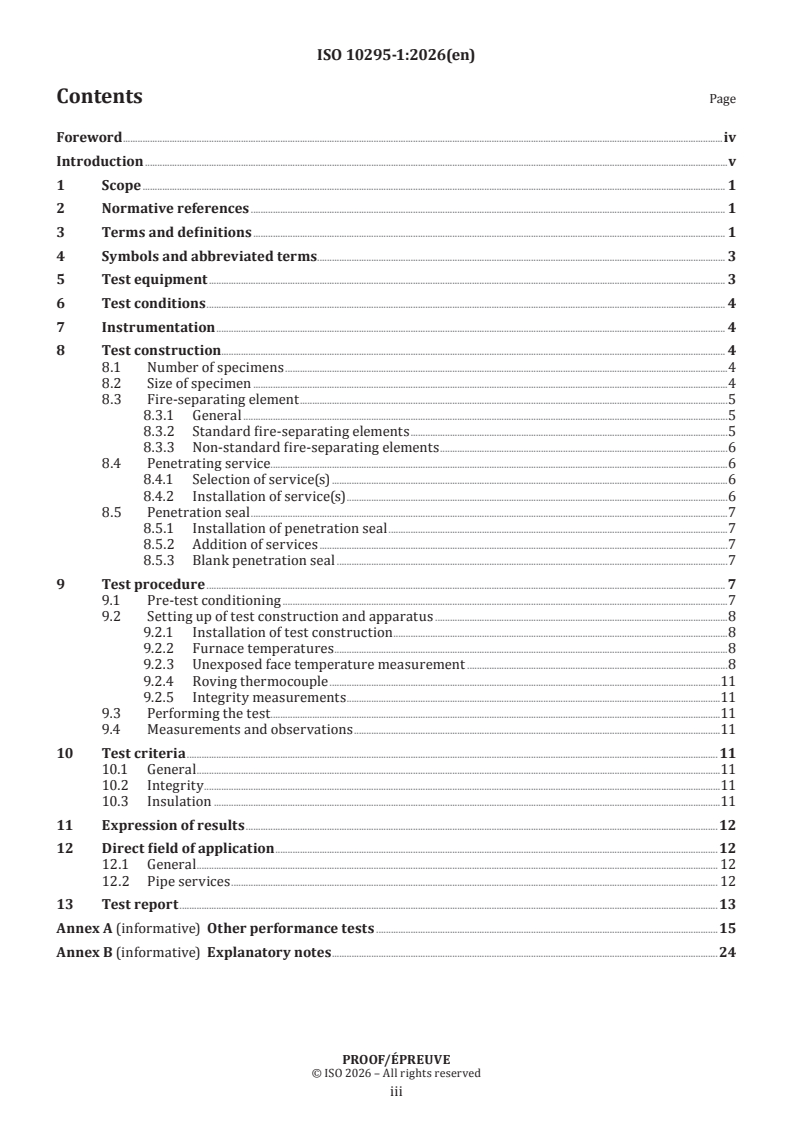
Contents Page
Foreword .iv
Introduction .v
1 Scope . 1
2 Normative references . 1
3 Terms and definitions . 1
4 Symbols and abbreviated terms. 3
5 Test equipment . 3
6 Test conditions . 4
7 Instrumentation . 4
8 Test construction. 4
8.1 Number of specimens .4
8.2 Size of specimen .4
8.3 Fire-separating element .5
8.3.1 General .5
8.3.2 Standard fire-separating elements .5
8.3.3 Non-standard fire-separating elements .6
8.4 Penetrating service.6
8.4.1 Selection of service(s) .6
8.4.2 Installation of service(s) .6
8.5 Penetration seal .7
8.5.1 Installation of penetration seal .7
8.5.2 Addition of services .7
8.5.3 Blank penetration seal .7
9 Test procedure . 7
9.1 Pre-test conditioning .7
9.2 Setting up of test construction and apparatus .8
9.2.1 Installation of test construction .8
9.2.2 Furnace temperatures .8
9.2.3 Unexposed face temperature measurement .8
9.2.4 Roving thermocouple .11
9.2.5 Integrity measurements .11
9.3 Performing the test.11
9.4 Measurements and observations .11
10 Test criteria .11
10.1 General .11
10.2 Integrity .11
10.3 Insulation .11
11 Expression of results .12
12 Direct field of application .12
12.1 General . 12
12.2 Pipe services . 12
13 Test report .13
Annex A (informative) Other performance tests .15
Annex B (informative) Explanatory notes .24
PROOF/ÉPREUVE
iii
ISO 10295-1:2026(en)
Foreword
ISO (the International Organization for Standardization) is a worldwide federation of national standards
bodies (ISO member bodies). The work of preparing International Standards is normally carried out through
ISO technical committees. Each member body interested in a subject for which a technical committee
has been established has the right to be represented on that committee. International organizations,
governmental and non-governmental, in liaison with ISO, also take part in the work. ISO collaborates closely
with the International Electrotechnical Commission (IEC) on all matters of electrotechnical standardization.
The procedures used to develop this document and those intended for its further maintenance are described
in the ISO/IEC Directives, Part 1. In particular, the different approval criteria needed for the different types
of ISO document should be noted. This document was drafted in accordance with the editorial rules of the
ISO/IEC Directives, Part 2 (see www.iso.org/directives).
ISO draws attention to the possibility that the implementation of this document may involve the use of (a)
patent(s). ISO takes no position concerning the evidence, validity or applicability of any claimed patent
rights in respect thereof. As of the date of publication of this document, ISO had not received notice of (a)
patent(s) which may be required to implement this document. However, implementers are cautioned that
this may not represent the latest information, which may be obtained from the patent database available at
www.iso.org/patents. ISO shall not be held responsible for identifying any or all such patent rights.
Any trade name used in this document is information given for the convenience of users and does not
constitute an endorsement.
For an explanation of the voluntary nature of standards, the meaning of ISO specific terms and expressions
related to conformity assessment, as well as information about ISO's adherence to the World Trade
Organization (WTO) principles in the Technical Barriers to Trade (TBT), see www.iso.org/iso/foreword.html.
This document was prepared by Technical Committee ISO/TC 92, Fire safety, Subcommittee SC 2, Fire
Resistance.
This second edition cancels and replaces the first edition (ISO 10295-1:2007), which has been technically
revised.
The main changes are as follows:
— details of an optional water leakage test and an optional air leakage test have been added in Annex A;
— the Terms and definitions have been revised (Clause 3);
— Clause 8, Test construction, has been updated to include language for both specific construction and
standard construction;
— typical thermocouple location figures have been updated;
— the direct field of application for pipe services has been revised.
A list of all parts in the ISO 10295 series can be found on the ISO website.
Any feedback or questions on this document should be directed to the user’s national standards body. A
complete listing of these bodies can be found at www.iso.org/members.html.
PROOF/ÉPREUVE
iv
ISO 10295-1:2026(en)
Introduction
This document has been prepared to provide a test method for assessing the contribution of a penetration
sealing system to the fire resistance of separating elements when they have been penetrated by a service.
It should be read in conjunction with ISO 834-1. This document contains specific requirements for fire
resistance testing that are unique to the elements of building construction described as a penetration sealing
system. The requirements for these penetration sealing systems are intended to be applied as appropriate in
conjunction with the detailed and general requirements contained in ISO 834-1.
PROOF/ÉPREUVE
v
International Standard ISO 10295-1:2026(en)
Fire tests for building elements and components — Fire
testing of service installations —
Part 1:
Penetration seals
WARNING — The attention of all persons concerned with managing and carrying out this fire
resistance test is drawn to the fact that fire testing can be hazardous and there is a possibility that
toxic and/or harmful smoke and gases can be evolved during the test. Mechanical and operational
hazards can also arise during the construction of the test elements or structures, their testing and
disposal of test residues.
WARNING — An assessment of all potential hazards and risks to health shall be made and safety
precautions shall be identified and provided. Written safety instructions shall be issued. Appropriate
training shall be given to relevant personnel. Laboratory personnel shall ensure that they follow
written safety instructions at all times.
1 Scope
This document specifies the heating condition, method of test and criteria for the evaluation of the ability
of a penetration sealing system to maintain the integrity and insulation of a fire-separating element at the
position at which it has been penetrated.
This document assesses:
a) the effect of such penetrations on the integrity and insulation performance of the element concerned,
b) the integrity and insulation performance of the penetration sealing system, and
c) the insulation performance of the penetrating service or services, and where appropriate, the integrity
failure of a service.
NOTE 1 Optional water and air leakage tests are included in Annex A.
NOTE 2 Explanatory notes are included in Annex B.
2 Normative references
The following documents are referred to in the text in such a way that some or all of their content constitutes
requirements of this document. For dated references, only the edition cited applies. For undated references,
the latest edition of the referenced document (including any amendments) applies.
ISO 834-1, Fire-resistance tests — Elements of building construction — Part 1: General requirements
ISO 13943, Fire safety — Vocabulary
3 Terms and definitions
For the purposes of this document, the terms and definitions given in ISO 13943 and ISO 834-1 and the
following apply.
PROOF/ÉPREUVE
ISO 10295-1:2026(en)
ISO and IEC maintain terminology databases for use in standardization at the following addresses:
— ISO Online browsing platform: available at https:// www .iso .org/ obp
— IEC Electropedia: available at https:// www .electropedia .org/
3.1
fire-separating element
floors, walls and other separating elements of construction having a period of fire resistance
Note 1 to entry: The period of fire resistance is determined in accordance with ISO 834-1.
3.2
penetration
aperture within a fire-separating element (3.1) usually present to accommodate the passage of a service
through that element
3.3
service
penetrating item for example a cable, conduit, pipe with or without any insulation, duct, chimney, or
trunking, excluding air ventilation systems and fire-rated ventilation ducts, smoke extract ducts and fire-
rated service ducts and shafts
3.4
penetration seal
system used to maintain the fire resistance of a separating element at the position where one or more
services (3.3) pass through or where there is provision for services (3.3) to pass through a separating element
3.5
penetration sealing system
assembly for test consisting of the penetrating service (3.3) or services and the penetration seal (3.4),
materials or devices, together with any service support (3.6) construction, designed to maintain the integrity
and insulation performance of the separating element for the duration of the fire test
3.6
service support
mechanical support provided in the form of clips, ties, hangers, ladder racks of trays, or any device designed
to carry the load imposed by the penetrating services (3.3)
3.7
blank penetration seal
system sealing or closing an aperture in the fire-separating element (3.1) without services passing through
3.8
test construction
complete assembly, consisting of the separating element and penetration sealing system (3.5)
3.9
air-flow metering system
device used to measure the air flow such as a rotameter or equivalent air flow meter.
Note 1 to entry: The device shall have a measurement resolution better than 3 % of the measured value.
3.10
air leakage
q
volume of air flowing, per unit of time, through the openings around the test sample under a test pressure
difference
Note 1 to entry: Air leakage is expressed as m /s.
Note 2 to entry: Within the test method described in Annex A, air leakage volume is reported under standardized
conditions.
PROOF/ÉPREUVE
ISO 10295-1:2026(en)
3.11
air leakage test chamber
sealed chamber or box with an opening, a removable mounting panel, or one open side in which or against
which the test sample is installed and sealed
3.12
air system
controllable blower, compressed air supply, exhaust system, or reversible blower designed to provide an
essentially constant required air flow at the specified fixed test pressure difference for the period required
to obtain readings of air leakage
3.13
ambient temperature exposure
ambient temperature at the exposed face of the test sample
3.14
elevated temperature exposure
elevated temperature at the exposed face of the test sample
3.15
extraneous leakage rate
q
L
difference between the metered air flow, q , and the air leakage, q
m
3.16
metered air flow rate
q
m
volume of air flowing per unit of time through the air flow metering system
Note 1 to entry: Metered air flow is expressed as m /s.
3.17
rate of air leakage
L
total air leakage per sample
Note 1 to entry: The rate of air leakage is expressed as l/s per m of opening or l/s per unit.
3.18
replacement air
volume of air, at ambient temperature, added to the test chamber, to replace the air leakage, q, volume of air
in either the ambient or elevated temperature exposure tests
4 Symbols and abbreviated terms
Symbols and designations appropriate to this test are given in ISO 834-1.
5 Test equipment
5.1 Equipment employed in the conduct of this test consists of a furnace, restraint and support frames and
instrumentation as specified in ISO 834-1 and in this document.
5.2 The internal dimensions of the test furnace shall have a minimum size of 1 m × 1 m × 1 m and shall be
such that a distance of at least 200 mm exists between any point of the periphery of any penetration seal and
the wall of the furnace.
PROOF/ÉPREUVE
ISO 10295-1:2026(en)
6 Test conditions
6.1 All test conditions, except those noted herein, shall conform to those given in ISO 834-1. The standard
time/temperature curve will be used.
6.2 Where a penetration sealing system is intended for use in both floors and walls, then each orientation
shall be tested.
6.3 A pressure of (20 ± 2) Pa shall be established at the bottom of the lowest penetration in a vertical
assembly.
NOTE See 12.4.1 and 12.4.2 for additional guidance.
6.4 For horizontal elements, a static pressure of (20 ± 2) Pa in the horizontal plane (100 ± 10) mm below
the underside of the separating element shall exist.
6.5 For an optional water leakage test, see Clause A.1.
6.6 For an optional air leakage test, see Clause A.2.
7 Instrumentation
The control, monitoring and recording equipment necessary to carry out tests in accordance with this
document shall be as described in ISO 834-1.
8 Test construction
8.1 Number of specimens
8.1.1 In the case of asymmetrical vertical elements, two tests shall normally be carried out; one from
each direction of exposure. Where it can be established clearly in an asymmetrical vertical element that
there is a weaker direction of exposure, it is required to test only the weaker direction. A full justification
for the procedure adopted shall be included in the test report. Where the penetration sealing system is fully
symmetrical, only one specimen is required to be tested with either face exposed to the heating regime.
8.1.2 Penetration seals in horizontal elements shall be tested with the fire exposure from the underside.
8.2 Size of specimen
8.2.1 A penetration and the accompanying penetration seal shall be full size. To avoid boundary effects,
the distance between the perimeter of the penetration sealing system and the outer perimeter of the heated
part of the separating element shall be not less than 200 mm at any point.
8.2.2 Where multiple penetrations are included in a single test construction, the minimum distance
between adjacent penetration sealing systems shall be not less than 200 mm. Each penetration with its
associated service(s) and penetration seal(s) shall be the subject of a separate evaluation, provided that the
specified conditions are maintained with respect to the penetration sealing system being evaluated.
PROOF/ÉPREUVE
ISO 10295-1:2026(en)
8.3 Fire-separating element
8.3.1 General
8.3.1.1 The fire-separating element shall be either a standard configuration which covers a wide range of
constructions (see 8.3.2) or fully representative of the specific construction in a non-standard configuration
(see 8.3.3).
8.3.1.2 A rating obtained using a specific separating element shall apply only to that particular type of
separating element.
8.3.1.3 The direct field of application as outlined in Clause 12 applies to both standard and non-standard
fire-separating elements.
8.3.2 Standard fire-separating elements
When the test construction is intended for use in a form of construction covered by the standard fire-
separating elements, the standard fire-separating elements described in Table 1, Table 2 or Table 3 shall be
used.
Table 1 — Standard rigid wall construction
Type of construction Thickness Density Test duration
mm kg/m t
min
Normal concrete/masonry 110 ± 10 2 200 ± 200 t = 120
150 ± 10 2 200 ± 200 120 < t ≤ 180
175 ± 10 2 200 ± 200 180 < t ≤ 240
a
Aerated concrete 110 ± 10 650 ± 200 t = 120
150 ± 10 650 ± 200 120 < t ≤ 240
a
This supporting construction may be made from blocks bonded together with mortar or adhesive.
Table 2 — Standard flexible-wall construction (gypsum plasterboard)
Fire resistance Wall constructions
min a b
Number of layers Thickness Insulation Thickness
on each side
mm D/ρ mm
30 1 12,5 40/40 75
60 2 12,5 40/40 100
90 2 12,5 60/50 125
120 2 12,5 60/100 150
180 3 12,5 60/100 175
240 3 15,0 80/100 190
a 3
D is the thickness in mm of mineral wool insulation inside the wall; ρ is the density in kg/m of mineral wool insulation inside
the wall.
b
Tolerance of ±10 %.
PROOF/ÉPREUVE
ISO 10295-1:2026(en)
Table 3 — Standard floor construction
Type of construction Thickness Density Test duration
mm kg/m t
min
Normal concrete 110 ± 10 2 200 ± 200 t = 90
150 ± 10 2 200 ± 200 90 < t ≤ 180
175 ± 10 2 200 ± 200 180 < t ≤ 240
Aerated concrete 125 ± 10 650 ± 200 t = 120
150 ± 10 650 ± 200 120 < t ≤ 240
8.3.3 Non-standard fire-separating elements
8.3.3.1 The fire-separating element shall be fully representative of the specific construction intended for
use.
8.3.3.2 The direct field of application in Clause 12 is restricted to the fire-separating element tested.
8.4 Penetrating service
8.4.1 Selection of service(s)
8.4.1.1 The type of service or services passing through the penetration in the fire resisting element shall
be selected to be representative of the service which the penetration seal is designed to accommodate.
8.4.1.2 When more than one penetration sealing system is incorporated into a test on a single fire-
separating element, care shall be taken to ensure that there is no interaction between penetrations. Examples
include; where the early failure of one penetration sealing system invalidates the time-temperature or
pressure conditions specified, or where one penetration sealing system directly influences another by
flaming, melting or other means.
8.4.1.3 The direct field of application as outlined in Clause 12 applies to penetrating services.
8.4.2 Installation of service(s)
8.4.2.1 Install service(s) to extend (300 ± 25) mm on the exposed side and (900 ± 25) mm on the unexposed
side, except for the following conditions.
a) When additional insulation, coating, wrapping, or other protection is installed as part of the penetration
sealing system for a limited length on the exposed side, install the service so that its length without
insulation extends 300 mm on the exposed side.
b) When additional insulation, coating, wrapping, or other protection is installed as part of the penetration
sealing system for a limited length on the unexposed side, install the service so that its length without
insulation extends 500 mm on the unexposed side.
8.4.2.2 Maintain minimum separation requirements for penetration sealing systems in accordance with
8.2.
8.4.2.3 For the purpose of the test, the possibilities for support provided to the services are as follows:
a) unsupported condition;
b) notional support, agreed between the sponsor and the laboratory;
PROOF/ÉPREUVE
ISO 10295-1:2026(en)
c) either full-scale simulation (representative of practical conditions);
d) calculation and application of a load to simulate practical conditions. This will determine the field of
direct application.
8.4.2.4 In each case, the procedure adopted and the validity of the test result shall be fully described in the
report.
8.4.2.5 Service end options shall be selected according to Table 4 and the conditions used shall be
considered in the corresponding classification of the test result.
Table 4 — Service end arrangements
Service end options
Inside the furnace Outside the furnace
uncapped uncapped
capped uncapped
uncapped capped
capped capped
8.4.2.6 The capping of pipes shall be carried out by closing the pipe end with a mineral wool or ceramic
fibre disc of a thickness of (50 ± 10) mm and a density of (150 ± 50) kg/m fixed in place with an appropriate
adhesive, e.g. sodium silicate adhesive, ceramic adhesive. Alternatively, pipes may be sealed by welding a
disc of the same material as the pipe to the end. In cases where vertical pipes are tested, the mineral wool or
ceramic fibre discs shall be fixed additionally by mechanical means.
8.5 Penetration seal
8.5.1 Installation of penetration seal
The penetration sealing system shall be installed, together with services chosen to represent the field of
application. Install these services in accordance with the manufacturer’s instructions or in a manner
representative of site practice. The installation procedures shall be described in the test report.
8.5.2 Addition of services
In the case where a penetration sealing system is designed to allow for the alteration of the service content
after first installation, a representative penetration sealing system shall be prepared and fully conditioned.
After this period, any required modifications shall be made to the service loading and a further conditioning
period shall be allowed if necessary. Such procedures shall be fully described in the report.
8.5.3 Blank penetration seal
A blank penetration seal shall be tested in accordance with this document. The test results of the blank
penetration seal shall not be applied after the penetrating item is installed.
9 Test procedure
9.1 Pre-test conditioning
After completion of the test construction, it shall be subject to a conditioning procedure in accordance with
ISO 834-1.
PROOF/ÉPREUVE
ISO 10295-1:2026(en)
9.2 Setting up of test construction and apparatus
9.2.1 Installation of test construction
When the conditioning procedures are satisfied the test construction shall be mounted to form the vertical
or horizontal face of the test furnace as appropriate. Measuring equipment and ancillary apparatus shall be
provided in accordance with the provisions of this document.
9.2.2 Furnace temperatures
Plate thermometers in accordance with ISO 834-1 for the measurement and control of furnace temperature
shall be uniformly distributed to give a reliable indication of the average gas temperature in the vicinity of
the heated face of the test construction. The face of the plate thermometers shall be located initially in a
plane (100 ± 10) mm from the exposed face of the separating element. In addition, no plate thermometer shall
be closer than 100 mm to any projecting part of the seal, a penetrating service or any part of the furnace at
the start of the test. At least one plate thermometer shall be provided for every 1,5 m of the heated area of
the test construction, subject to a minimum number of four plate thermometers for each test construction.
9.2.3 Unexposed face temperature measurement
9.2.3.1 Generally, surface-temperature measurements shall be made using thermocouples in accordance
with ISO 834-1. In the case of non-planar surfaces, the disc and pad shall be deformed to follow the surface
profile. If there is difficulty in fixing the standard pad, the size of the pad shall be reduced in size subject to a
minimum dimension of 12 mm.
9.2.3.2 Thermocouples shall be provided at the following locations; see also Figures 1 and 2.
a) Location A: On the surface of the service protruding from the unexposed face, at a position corresponding
to a distance of 25 mm from the point where the service emerges from the penetration seal. At this
location, a measurement shall be made on each different type and/or size of penetrating service included
in the penetration. On each selected service, one thermocouple shall be provided for every 500 mm of
the service perimeter.
1) In the case of tightly bunched or grouped services, the grouped assembly shall be treated as a single
service. Thermocouples at the specified positions shall be evenly distributed around the perimeters
of the service. If the service passes through a vertical element, one of these thermocouples shall
be attached to the uppermost surface of the service. Also, in the case of vertical elements, when
similar services are included in the penetration, the service nearest the top of the penetration shall
be chosen for temperature measurement.
2) Surface thermocouples shall also be placed on the service at a distance of 25 mm from the
termination of any coating or insulation extending along the surface from the penetration.
b) Location B: On the surface of the penetration seal at the following locations:
1) Where possible, 25 mm from each type of penetrating service (or group of services) with a minimum
of one thermocouple provided for each 500 mm of the service perimeter.
2) Where possible, equidistant from the perimeter of the service to the edge of the penetration:
— at the location of maximum separation, or
— where there is more than one penetrating service, at the nominal mid-position of the largest
uninterrupted area of the penetration seal.
c) Location C: At the mid-section of the unexposed surface on any supporting frame at the periphery
of the penetration. In the case of vertical elements, this measurement shall be made at the top of the
penetration.
PROOF/ÉPREUVE
ISO 10295-1:2026(en)
d) Location D: On the surface of each rack, tray or any service support construction that passes through
the fire seal at distances of 25 mm from the point of emergence from the seal.
e) Location E: On the surface of the separating element 25 mm from the edge of the penetration with a
minimum of one thermocouple per penetration.
f) Location F: If, in the opinion of the laboratory, potential weak spots can be identified, additional fixed
thermocouples shall be attached at those points.
Figure 1 — Typical thermocouple locations
PROOF/ÉPREUVE
ISO 10295-1:2026(en)
Dimensions in millimetres
Figure 2 — Locations A and D: examples of separation of unexposed face thermocouples from
supporting construction
9.2.3.3 On thermoplastic, fibrous, intumescent materials or paints, the pad and the thermocouple shall
be fixed so that they remain in contact with the surface during the test without adversely affecting the
performance of the penetration system.
PROOF/ÉPREUVE
ISO 10295-1:2026(en)
9.2.4 Roving thermocouple
The information obtained on unexposed face surface temperatures shall be supplemented by additional
data derived from measurements obtained using a roving thermocouple as specified in ISO 834-1, applied to
identify any local hot spots or points at which temperatures measured by the fixed thermocouples are not
reliable.
9.2.5 Integrity measurements
Where difficulties arise in attempting to use the cotton pad for the assessment of loss of integrity in
accordance with ISO 834-1 when the penetration carries a high density of services, the size of the cotton pad
shall be reduced to 20 mm × 20 mm × 20 mm. The wire supporting frame described in ISO 834-1 shall be
adapted to the small pad size but still maintain the 30 mm clearance required from adjacent surfaces. Gap
gauges shall not be used for the determination of integrity loss.
9.3 Performing the test
A test on the specimen shall be carried out in accordance with ISO 834-1.
9.4 Measurements and observations
Subject to the modifications referred to in the previous clauses, measurement and observations during the
test shall be made in accordance with ISO 834-1.
10 Test criteria
10.1 General
10.1.1 After selecting the criteria for performance, it is necessary to consider the methods by which fire
can be transmitted through such elements, including the following:
a) through a space formed between a service and the penetration seal, or between the penetration seal
and the fire-separating element it penetrates, or through an opening formed within the service itself, or
in the penetration seal material;
b) by a temperature rise on the unexposed surface of the fire-separating element in the vicinity of the
penetration;
c) by a rise in the surface temperature of that part of the service that is on the un-heated side of the fire-
separating element, or on the unexposed surface of the penetration sealing system.
10.1.2 The purpose of the test is to establish the effect of the inclusion of a sealed penetration in a fire-
separating element, on the fire resistance of that element. In this respect the relevant criteria for integrity
and insulation are based on those specified in ISO 834-1.
10.2 Integrity
Integrity shall be recorded as the time before the occurrence of flaming or other conditions on the unexposed
face of the penetration sealing system which ignite the cotton pad.
10.3 Insulation
10.3.1 Insulation shall be recorded as the time when the maximum unexposed face temperature rise,
determined either by any of the thermocouples in specified positions, or by the roving thermocouple,
exceeds 180 °C.
PROOF/ÉPREUVE
ISO 10295-1:2026(en)
10.3.2 Temperatures recorded from thermocouples that become embedded in softening material or covered
by intumescent material shall be disregarded.
11 Expression of results
11.1 The result shall be stated to the nearest completed minute of test in terms of elapsed time between
the commencement of heating and the time at which the integrity and insulation criteria are no longer met
in accordance with this document. Any failure with respect to a single service incorporated in a penetration
seal system shall constitute a failure of that system. If multiple penetrations are included in a single test,
then the performance of each penetration seal system shall be judged separately subject to the constraints
of 8.4.1.
11.2 Test results are valid only as long as the services do not receive additional support (e.g. from the floor
of the furnace).
12 Direct field of application
12.1 General
The test results obtained are valid only for the same service used in the test. The service is identified by:
a) type of material used with same specification;
b) dimensions (e.g. the nominal outside diameter and the nominal wall thickness);
c) other dimensions of the installed configurations (e.g. annular space);
d) insulation used with same specification (e.g. type, dimension).
12.2 Pipe services
12.2.1 For test results obtained from tests with pipes using the service end arrangement from Table 4, the
following rules apply for plastic pipe and metal pipe end arrangements.
12.2.2 Test results obtained from tests with single layer plastic pipes are valid for all other test pipe end
arrangements in accordance with Table 5.
Table 5 — Rules for pipe end arrangements of single layer plastic pipes
End arrangement End arrangement
tested acceptable to use
Outside fur- uncapped(inside) capped(inside) uncapped(inside) capped(inside)
Inside furnace
nace uncapped(outside) uncapped(outside) capped(outside) capped(outside)
uncapped uncapped yes yes yes yes
capped uncapped no yes yes yes
uncapped capped no no yes yes
capped capped no no no yes
PROOF/ÉPREUVE
ISO 10295-1:2026(en)
12.2.3 Test results obtained from tests with metal pipes are valid for all other test pipe end arrangements
in accordance with Table 6.
Table 6 — Rules for pipe end arrangements metal pipes
End arrangement End arrangement
tested acceptable to use
Outside fur- uncapped(inside) capped(inside) uncapped(inside) capped(inside)
Inside furnace
nace uncapped(outside) uncapped(outside) capped(outside) capped(outside)
uncapped uncapped yes yes yes yes
capped uncapped no yes no yes
uncapped capped no yes yes yes
capped capped no no no yes
12.3 Cable services
12.3.1 Test results obtained from tests with cables apply if the diameter of a single cable is reduced or the
number of cables in a bundle is reduced.
12.3.2 Test results obtained from tests with cables apply only to the number, size and type (e.g. specification)
of cables or cable bundles (including insulation) as tested.
12.4 Concrete and masonry separating elements
12.4.1 Test results obtained with penetration sealing systems tested in vertical separating elements cannot
be used to assess performance in horizontal separating elements.
12.4.2 Test results obtained with penetration sealing systems tested in horizontal separating elements
can be used to assess performance in vertical separating elements providing that they are installed
symmetrically on both sides of the wall and consideration is given to the effect of the orientation on the
penetrating item.
NOTE The orientation of the penetrating item can create a more severe condition resulting in failure of the firestop
system. As an example, penetrants containing multiple layers of cable can represent a more severe condition in a wall
orientation. Additionally, the rigidity of the penetration sealing system can also create a more severe condition.
12.4.3 Test results obtained with separating elements of concrete or masonry can be applied to concrete or
masonry separating elements of a thickness and density equal to or greater than that of the element used in
the test.
12.4.4 Test results obtained with flexible separating elements can be applied to concrete or masonry
elements of a thickness equal to or greater than, and with the same or higher fire resistance rating than that
of the element used in the tests.
13 Test report
The test report shall include the following information:
a) name of the testing laboratory;
b) date of the test;
c) a reference to this document, i.e. ISO 10295-1:2026;
d) names of the sponsor, the manufacturer and the product;
PROOF/ÉPREUVE
ISO 10295-1:2026(en)
e) all details of the complete penetration sealing system(s) tested to uniquely define and identify that
system and the materials, where appropriate by reference to standards and/or approvals, including
classification of fire behaviour;
f) description of the installation procedures, including the selection of service support system and details
of work access (e.g. penetration seal installed from one or both faces, description of fixing);
g) for asymmetrical assemblies, a full justification for the direction chosen for the fire exposure test;
h) distance between services and distance between the service and edge of aperture;
i) description of the test procedure and a statement that the procedures of this document have been
conformed to;
j) records of measurement (e.g. temperatures) and observations (e.g. smoke on the unexposed side of the
furnace) obtained during the test;
k) statement of the performance of the penetration sealing system with respect to integrity and insulation,
determined in accordance with the provisions of this document;
l) statement of the service end test condition according to Table 1;
m) maximum dimension of blank penetration seal;
n) any deviations from the procedure;
o) any unusual features observed.
PROOF/ÉPREUVE
ISO 10295-1:2026(en)
Annex A
(informative)
Other performance tests
A.1 Optional water leakage test
A.1.1 Overview
This annex describes an optional water leakage test to determine the ability of penetration sealing systems
to resist the passage of water under a one-metre pressure head. This method does not evaluate the ability of
uncured penetration sealing systems to resist such exposure.
The W-rating is based on the water resistance of the test sample. To obtain a W-rating, the fire exposure test
shall be performed after the water leakage test.
The following applies when
...
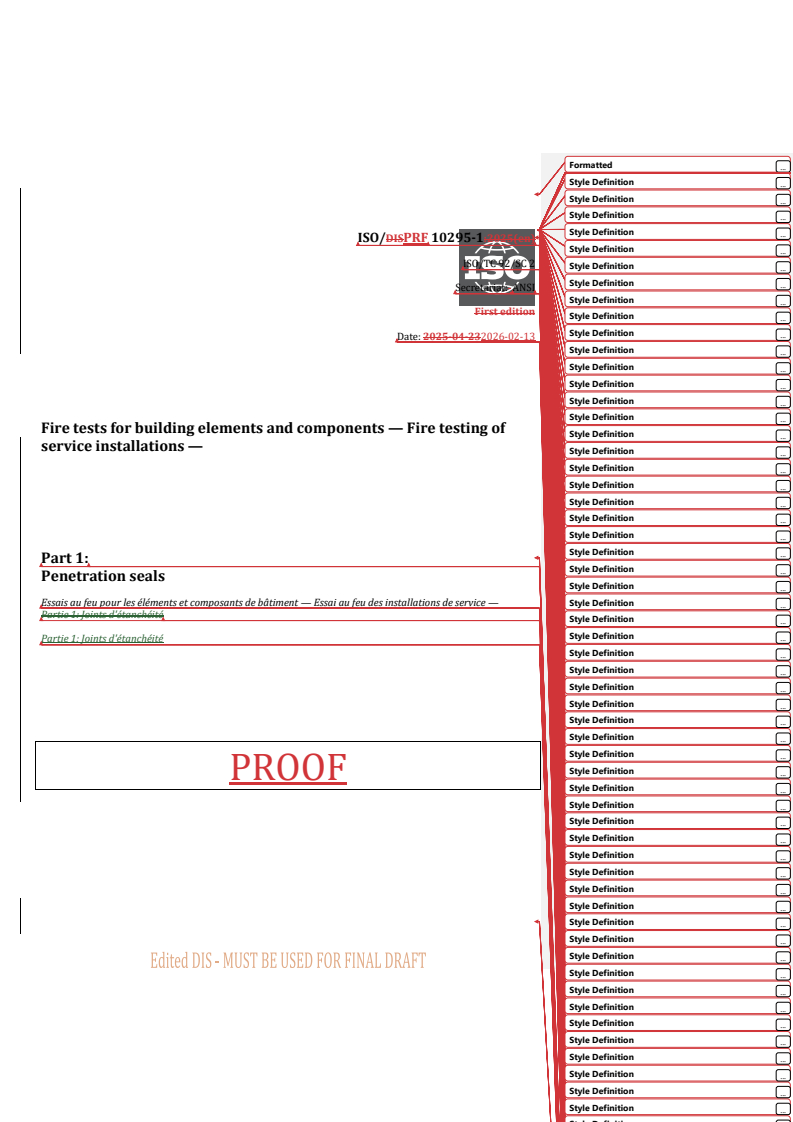
Formatted
...
Style Definition
...
Style Definition
...
Style Definition
...
Style Definition
...
ISO/DISPRF 10295-1:2025(en)
Style Definition
...
ISO/TC 92/SC 2
Style Definition
...
Style Definition
...
Secretariat: ANSI
Style Definition
...
First edition
Style Definition
...
Style Definition
...
Date: 2025-04-232026-02-13
Style Definition
...
Style Definition
...
Style Definition
...
Style Definition
...
Style Definition
...
Fire tests for building elements and components — Fire testing of
Style Definition
...
service installations —
Style Definition
...
Style Definition
...
Style Definition
...
Style Definition
...
Style Definition
...
Style Definition
...
Style Definition
...
Part 1:
Style Definition
...
Penetration seals
Style Definition
...
Essais au feu pour les éléments et composants de bâtiment — Essai au feu des installations de service — Style Definition
...
Partie 1: Joints d'étanchéité
Style Definition
...
Style Definition
...
Partie 1: Joints d'étanchéité
Style Definition
...
Style Definition
...
Style Definition
...
Style Definition
...
Style Definition
...
Style Definition
...
Style Definition
...
Style Definition
...
PROOF
Style Definition
...
Style Definition
...
Style Definition
...
Style Definition
...
Style Definition
...
Style Definition
...
Style Definition
...
Style Definition
...
Style Definition
...
Style Definition
...
Style Definition
...
Style Definition
...
Style Definition
...
Style Definition
...
Style Definition
...
Style Definition
...
Style Definition
...
Style Definition
...
Style Definition
...
Style Definition
...
St l D fi iti
ISO /PRF 10295-1:2007(E2026(en)
Formatted: HeaderCentered
Formatted: Default Paragraph Font, French (France)
Formatted: French (France)
All rights reserved. Unless otherwise specified, or required in the context of its implementation, no part of this publication
may be reproduced or utilized otherwise in any form or by any means, electronic or mechanical, including photocopying,
Formatted: French (France)
or posting on the internet or an intranet, without prior written permission. Permission can be requested from either ISO
Formatted: Adjust space between Latin and Asian text,
at the address below or ISO’s member body in the country of the requester.
Adjust space between Asian text and numbers
ISO copyright office
CP 401 • Ch. de Blandonnet 8
CH-1214 Vernier, Geneva
Formatted: English (United Kingdom)
Phone: + 41 22 749 01 11
Formatted: French (France)
E-mail: copyright@iso.org
Website: www.iso.org
Formatted: English (United Kingdom)
Formatted: English (United Kingdom)
Published in Switzerland
Formatted: Hyperlink
Formatted: English (United Kingdom)
Field Code Changed
Formatted: FooterPageRomanNumber
ii © ISO 20072026 – All rights reserved
ii
ISO/DISPRF 10295-1:20252026(en) Formatted: Font: 11 pt
Formatted: Font: 11 pt
Formatted: Font: 11 pt
Contents
Formatted: HeaderCentered, Left, Space After: 0 pt,
Line spacing: single, Tab stops: Not at 0.71 cm
Foreword . v
Formatted: Adjust space between Latin and Asian text,
Introduction . vi
Adjust space between Asian text and numbers
1 Scope . 1
2 Normative references . 1
3 Terms and definitions . 2
4 Symbols and abbreviated terms . 4
5 Test equipment . 4
6 Test conditions . 4
7 Instrumentation . 4
8 Test construction . 4
8.1 Number of specimens . 4
8.2 Size of specimen . 4
8.3 Fire-separating element . 5
8.4 Penetrating service . 6
8.5 Penetration seal . 7
9 Test procedure . 8
9.1 Pre-test conditioning . 8
9.2 Setting up of test construction and apparatus . 8
9.3 Performing the test . 14
9.4 Measurements and observations . 14
10 Test criteria . 14
10.1 General. 14
10.2 Integrity . 14
10.3 Insulation . 14
11 Expression of results . 15
12 Direct field of application . 15
12.1 General. 15
12.2 Pipe services . 15
13 Test report . 16
Annex A (informative) Other performance tests . 18
Annex B (informative) Explanatory notes . 32
1. Scope . 1
2. Normative references . 1
3. Terms and definitions . 2
Formatted: Font: 10 pt
4. Symbols and abbreviated terms . 2
Formatted: Font: 10 pt
5. Test equipment . 2
Formatted: FooterCentered, Left, Space Before: 0 pt,
Tab stops: Not at 17.2 cm
6. Test conditions . 3
Formatted: Font: 11 pt
7. Instrumentation . 3
Formatted: FooterPageRomanNumber, Left, Space
8. Test construction . 3
After: 0 pt, Tab stops: Not at 17.2 cm
iii
ISO /PRF 10295-1:2007(E2026(en)
Formatted: HeaderCentered
9. Test procedure . 7
10. Test criteria . 10
11. Expression of results . 10
12. Direct field of application . 11
13. Test report . 12
Annex A (informative) Other Performance Tests. 14
A.1 Optional Water Leakage Test . 14
A.2 Optional Air Leakage Test. 18
Annex B (informative) Explanatory notes . 24
Formatted: FooterPageRomanNumber
iv © ISO 20072026 – All rights reserved
iv
ISO/DISPRF 10295-1:20252026(en) Formatted: Font: 11 pt
Formatted: Font: 11 pt
Formatted: Font: 11 pt
Foreword
Formatted: HeaderCentered, Left, Space After: 0 pt,
Line spacing: single, Tab stops: Not at 0.71 cm
ISO (the International Organization for Standardization) is a worldwide federation of national standards
bodies (ISO member bodies). The work of preparing International Standards is normally carried out through Formatted: Adjust space between Latin and Asian text,
Adjust space between Asian text and numbers
ISO technical committees. Each member body interested in a subject for which a technical committee has been
established has the right to be represented on that committee. International organizations, governmental and
non-governmental, in liaison with ISO, also take part in the work. ISO collaborates closely with the
International Electrotechnical Commission (IEC) on all matters of electrotechnical standardization.
The procedures used to develop this document and those intended for its further maintenance are described
in the ISO/IEC Directives, Part 1. In particular, the different approval criteria needed for the different types of
ISO document should be noted. This document was drafted in accordance with the editorial rules of the
ISO/IEC Directives, Part 2 (see www.iso.org/directives).
Formatted: English (United Kingdom)
Formatted: English (United Kingdom)
ISO draws attention to the possibility that the implementation of this document may involve the use of (a)
patent(s). ISO takes no position concerning the evidence, validity or applicability of any claimed patent rights
in respect thereof. As of the date of publication of this document, ISO had not received notice of (a) patent(s)
Formatted: Font color: Auto
which may be required to implement this document. However, implementers are cautioned that this may not
represent the latest information, which may be obtained from the patent database available at
www.iso.org/patents.www.iso.org/patents. ISO shall not be held responsible for identifying any or all such
patent rights.
Any trade name used in this document is information given for the convenience of users and does not
constitute an endorsement.
For an explanation of the voluntary nature of standards, the meaning of ISO specific terms and expressions
related to conformity assessment, as well as information about ISO's adherence to the World Trade
Organization (WTO) principles in the Technical Barriers to Trade (TBT), see www.iso.org/iso/foreword.html.
Formatted: English (United Kingdom)
Formatted: English (United Kingdom)
This document was prepared by Technical Committee ISO/TC 92, Fire safety, Subcommittee SC 2, Fire
Formatted: English (United Kingdom)
containmentResistance.
Field Code Changed
Formatted: Default Paragraph Font
This second edition cancels and replaces the first edition (ISO 10295-1:2007), which has been technically
Formatted: Adjust space between Latin and Asian text,
revised. Adjust space between Asian text and numbers
The main changes are as follows:
Formatted: Font: Cambria
— details of an optional water leakage test and an optional air leakage test have been added in Annex A;
Formatted: English (United Kingdom)
— the Terms and definitions have been revised (Clause 3);
Formatted: English (United Kingdom)
— Clause 8, Test construction, has been updated to include language for both specific construction and
Formatted: English (United Kingdom)
standard construction;
Formatted: English (United Kingdom)
Field Code Changed
— typical thermocouple location figures have been updated;
Formatted: Font: 10 pt
— the direct field of application for pipe services has been revised.
Formatted: Font: 10 pt
A list of all parts in the ISO 10295 series can be found on the ISO website.
Formatted: FooterCentered, Left, Space Before: 0 pt,
Tab stops: Not at 17.2 cm
Any feedback or questions on this document should be directed to the user’s national standards body. A
Formatted: Font: 11 pt
complete listing of these bodies can be found at www.iso.org/members.html.
Formatted: FooterPageRomanNumber, Left, Space
After: 0 pt, Tab stops: Not at 17.2 cm
v
ISO /PRF 10295-1:2007(E2026(en)
Formatted: HeaderCentered
Formatted: Adjust space between Latin and Asian text,
Introduction
Adjust space between Asian text and numbers
This document has been prepared to provide a test method of test for assessing the contribution of a
penetration sealing system to the fire resistance of separating elements when they have been penetrated by a
service. It should be read in conjunction with ISO 834-1. This document contains specific requirements for fire
Formatted: Default Paragraph Font
resistance testing that are unique to the elements of building construction described as a penetration sealing
Formatted: Default Paragraph Font
system. The requirements for these penetration sealing systems are intended to be applied as appropriate in
Formatted: Default Paragraph Font
conjunction with the detailed and general requirements contained in ISO 834-1.
Formatted: Default Paragraph Font
Formatted: Default Paragraph Font
Formatted: Default Paragraph Font
Formatted: FooterPageRomanNumber
vi © ISO 20072026 – All rights reserved
vi
DRAFT International Standard ISO/DIS 10295-1:2025(en)
Formatted: Left
Fire tests for building elements and components — Fire testing of
service installations —
Formatted: Main Title 2, None, Adjust space between
Part 1:
Latin and Asian text, Adjust space between Asian text
Penetration seals
and numbers
WARNING — The attention of all persons concerned with managing and carrying out this fire
resistance test is drawn to the fact that fire testing can be hazardous and there is a possibility that toxic
and/or harmful smoke and gases can be evolved during the test. Mechanical and operational hazards
can also arise during the construction of the test elements or structures, their testing and disposal of
test residues.
WARNING — An assessment of all potential hazards and risks to health shall be made and safety
precautions shall be identified and provided. Written safety instructions shall be issued. Appropriate
Formatted: Adjust space between Latin and Asian text,
training shall be given to relevant personnel. Laboratory personnel shall ensure that they follow
Adjust space between Asian text and numbers
written safety instructions at all times.
Formatted: Numbered + Level: 1 + Numbering Style: a,
b, c, … + Start at: 1 + Alignment: Left + Aligned at: 0
1 Scope
cm + Indent at: 0 cm, Adjust space between Latin and
Asian text, Adjust space between Asian text and
This document specifies the heating condition, method of test and criteria for the evaluation of the ability of a
numbers, Tab stops: Not at 0.7 cm + 1.4 cm + 2.1 cm
penetration sealing system to maintain the integrity and insulation of a fire -separating element at the position
+ 2.8 cm + 3.5 cm + 4.2 cm + 4.9 cm + 5.6 cm + 6.3
at which it has been penetrated.
cm + 7 cm
Formatted: Adjust space between Latin and Asian text,
This document assesses:
Adjust space between Asian text and numbers
a) a) the effect of such penetrations on the integrity and insulation performance of the element
Formatted: Default Paragraph Font
concerned,
Formatted: Default Paragraph Font
Formatted: Default Paragraph Font
b) b) the integrity and insulation performance of the penetration sealing system, and
Formatted: Default Paragraph Font
c) c) the insulation performance of the penetrating service or services, and where appropriate, the
Formatted: Default Paragraph Font
integrity failure of a service.
Formatted: Default Paragraph Font
NOTE 1 Optional water and air leakage tests are included in Annex A.Annex A.
Formatted: Default Paragraph Font
NOTE 2 Explanatory notes are included in Annex B.Annex B. Formatted: Default Paragraph Font, Font: 11 pt
Formatted: Adjust space between Latin and Asian text,
2 Normative references
Adjust space between Asian text and numbers, Tab
stops: Not at 0.7 cm + 1.4 cm + 2.1 cm + 2.8 cm +
The following documents are referred to in the text in such a way that some or all of their content constitutes
3.5 cm + 4.2 cm + 4.9 cm + 5.6 cm + 6.3 cm + 7 cm
requirements of this document. For dated references, only the edition cited applies. For undated references,
Formatted: Default Paragraph Font
the latest edition of the referenced document (including any amendments) applies.
Formatted: Default Paragraph Font
Formatted: Default Paragraph Font
Formatted: Font: 11 pt
ISO 834--1, Fire-resistance tests — Elements of building construction — Part 1: General requirements
Formatted: Footer, Left, Space After: 0 pt, Tab stops:
ISO 13943, Fire safety — Vocabulary
Not at 17.2 cm
ISO /PRF 10295-1:2007(E2026(en)
Formatted: HeaderCentered
3 Terms and definitions
Formatted: Adjust space between Latin and Asian text,
Adjust space between Asian text and numbers
For the purposes of this document, the terms and definitions given in ISO 13943 and ISO 834-1 and the
Formatted: Default Paragraph Font
following apply.
Formatted: Default Paragraph Font
ISO and IEC maintain terminology databases for use in standardization at the following addresses:
Formatted: Default Paragraph Font
Formatted: Default Paragraph Font
— — ISO Online browsing platform: available at https://www.iso.org/obphttps://www.iso.org/obp
Formatted: Default Paragraph Font
— — IEC Electropedia: available at https://www.electropedia.org/https://www.electropedia.org/
Formatted: English (United Kingdom)
Formatted: Font: 11 pt, English (United Kingdom)
3.1 3.1
fire -separating element
Formatted: English (United Kingdom)
floors, walls and other separating elements of construction having a period of fire resistance
Formatted: English (United Kingdom)
Note 1 to entry: The period of fire resistance is determined in accordance with ISO 834-1. Formatted: TermNum2, Adjust space between Latin
and Asian text, Adjust space between Asian text and
3.2 3.2 numbers
penetration
Formatted: Default Paragraph Font
aperture within a fire -separating element (3.1)(3.1) usually present to accommodate the passage of a service
Formatted: Default Paragraph Font
through that element
Formatted: Default Paragraph Font
3.3 3.3
Formatted: TermNum2, Adjust space between Latin
service
and Asian text, Adjust space between Asian text and
penetrating item for example a cable, conduit, pipe with or without any insulation, duct, chimney, or trunking,
numbers
excluding air ventilation systems and fire-rated ventilation ducts, smoke extract ducts and fire-rated service
ducts and shafts
3.4 3.4
penetration seal
system used to maintain the fire resistance of a separating element at the position where one or more services
(3.3)(3.3) pass through or where there is provision for services (3.3)(3.3) to pass through a separating element
3.5 3.5
penetration sealing system
assembly for test consisting of the penetrating service (3.3)(3.3) or services and the penetration seal (3.4),(3.4),
materials or devices, together with any service support (3.6)(3.6) construction, designed to maintain the
integrity and insulation performance of the separating element for the duration of the fire test
3.6 3.6
service support
mechanical support provided in the form of clips, ties, hangers, ladder racks of trays, or any device designed
to carry the load imposed by the penetrating services (3.3)(3.3)
3.7 3.7
blank penetration seal
system sealing or closing an aperture in the fire -separating element (3.1)(3.1) without services passing
through
3.8 3.8
test construction
complete assembly, consisting of the separating element and penetration sealing system (3.5)(3.5)
3.9
air-flow metering system
device used to measure the air flow such as a rotameter or equivalent air flow meter.
Formatted: FooterPageNumber
ISO/DISPRF 10295-1:20252026(en) Formatted: Font: 11 pt
Formatted: Font: 11 pt
Formatted: Font: 11 pt
Note 1 to entry: The device shall have a measurement resolution better than 3 % of the measured value.
Formatted: HeaderCentered, Left, Space After: 0 pt,
Line spacing: single, Tab stops: Not at 0.71 cm
3.10
air leakage
q
volume of air flowing, per unit of time, through the openings around the test sample under a test pressure
difference
Note 1 to entry: Air leakage is expressed as m /s.
Note 2 to entry: Within the test method described in Annex A, air leakage volume is reported under standardized
conditions.
3.11
air leakage test chamber
sealed chamber or box with an opening, a removable mounting panel, or one open side in which or against
which the test sample is installed and sealed
3.12
air system
controllable blower, compressed air supply, exhaust system, or reversible blower designed to provide an
essentially constant required air flow at the specified fixed test pressure difference for the period required to
obtain readings of air leakage
3.13
ambient temperature exposure
ambient temperature at the exposed face of the test sample
3.14
elevated temperature exposure
elevated temperature at the exposed face of the test sample
3.15
extraneous leakage rate
q
L
difference between the metered air flow, qm, and the air leakage, q
Formatted: Font: Not Italic
3.16
metered air flow rate
q
m
volume of air flowing per unit of time through the air flow metering system
Note 1 to entry: Metered air flow is expressed as m /s.
3.17
rate of air leakage
L
total air leakage per sample
Formatted: Font: 10 pt
Note 1 to entry: The rate of air leakage is expressed as l/s per m of opening or l/s per unit.
Formatted: Font: 10 pt
Formatted: FooterCentered, Left, Space Before: 0 pt,
3.18
Tab stops: Not at 17.2 cm
replacement air
volume of air, at ambient temperature, added to the test chamber, to replace the air leakage, q, volume of air
Formatted: Font: 11 pt
in either the ambient or elevated temperature exposure tests
Formatted: FooterPageNumber, Left, Space After: 0 pt,
Tab stops: Not at 17.2 cm
ISO /PRF 10295-1:2007(E2026(en)
Formatted: HeaderCentered
4 Symbols and abbreviated terms
Formatted: Adjust space between Latin and Asian text,
Adjust space between Asian text and numbers
Symbols and designations appropriate to this test are given in ISO 834-1.
Formatted
...
5 Test equipment
Formatted: Font: 11 pt, Not Bold
5.1 5.1 Equipment employed in the conduct of this test consists of a furnace, restraint and support
frames and instrumentation as specified in ISO 834-1 and in this document. Formatted: Adjust space between Latin and Asian text,
Adjust space between Asian text and numbers, Tab
stops: Not at 0.7 cm + 1.4 cm + 2.1 cm + 2.8 cm +
5.2 5.2 The internal dimensions of the test furnace shall have a minimum size of 1 m × 1 m × 1 m and
3.5 cm + 4.2 cm + 4.9 cm + 5.6 cm + 6.3 cm + 7 cm
shall be such that a distance of at least 200 mm exists between any point of the periphery of any penetration
seal and the wall of the furnace.
Formatted
...
Formatted: Font: 11 pt, Not Bold
6 Test conditions
Formatted: Font: Not Bold
6.1 6.1 All test conditions, except those noted herein, shall conform to those given in ISO 834-1. The
Formatted: Adjust space between Latin and Asian text,
standard time/temperature curve will be used.
Adjust space between Asian text and numbers
Formatted
...
6.2 6.2 Where a penetration sealing system is intended for use in both floors and walls, then each
orientation shall be tested. Formatted: Adjust space between Latin and Asian text,
Adjust space between Asian text and numbers, Tab
6.3 6.3 A pressure of (20 ± 2) Pa shall be established at the bottom of the lowest penetration in a stops: Not at 0.7 cm + 1.4 cm + 2.1 cm + 2.8 cm +
vertical assembly. 3.5 cm + 4.2 cm + 4.9 cm + 5.6 cm + 6.3 cm + 7 cm
Formatted: Font: Not Bold
Note see section 12.4.1NOTE See 12.4.1 and 12.4.212.4.2 for additional guidance.
Formatted: Font: 11 pt, Not Bold
6.4 6.4 For horizontal elements, a static pressure of (20 ± 2) Pa in the horizontal plane (100 ± 10) mm
Formatted: Font: Not Bold
below the underside of the separating element shall exist.
Formatted: Font: 11 pt, Not Bold
6.5 6.5 For an optional water leakage test, see A.1Clause A.1. Formatted: Font: Not Bold
Formatted
...
6.6 6.6 For an optional air leakage test, see A.2Clause A.2.
Formatted: Font: Not Bold
7 Instrumentation
Formatted
...
Formatted: Font: Not Bold
The control, monitoring and recording equipment necessary to carry out tests in accordance with this
Formatted
document shall be as described in ISO 834-1. .
Formatted: Font: Not Bold
8 Test construction
Formatted: Adjust space between Latin and Asian text,
Adjust space between Asian text and numbers
8.1 Number of specimens
Formatted
...
8.1.1 8.1.1 In the case of asymmetrical vertical elements, normally two tests shall normally be carried
Formatted: Adjust space between Latin and Asian text,
out; one from each direction of exposure. Where it can be established clearly in an asymmetrical vertical
Adjust space between Asian text and numbers, Tab
element that there is a weaker direction of exposure, it is required to test only the weaker direction. A full
stops: Not at 0.71 cm
justification for the procedure adopted shall be included in the test report. Where the penetration sealing
Formatted
system is fully symmetrical, only one specimen is required to be tested with either face exposed to the heating
...
regime.
Formatted
...
Formatted: Font: Not Bold
8.1.2 8.1.2 Penetration seals in horizontal elements shall be tested with the fire exposure from the
underside.
Formatted: Font: Not Bold
Formatted
8.2 Size of specimen .
Formatted: Font: Not Bold
8.2.1 8.2.1 A penetration and the accompanying penetration seal shall be full size. To avoid boundary
Formatted
...
effects, the distance between the perimeter of the penetration sealing system and the outer perimeter of the
heated part of the separating element shall be not less than 200 mm at any point.
Formatted: FooterPageNumber
Formatted
...
Formatted
...
ISO/DISPRF 10295-1:20252026(en)
Formatted
...
Formatted
...
Formatted
...
8.2.2 8.2.2 Where multiple penetrations are included in a single test construction, the minimum distance
between adjacent penetration sealing systems shall be not less than 200 mm. Each penetration with its
Formatted
...
associated service(s) and penetration seal(s) shall be the subject of a separate evaluation providing, provided
Formatted
...
that the specified conditions are maintained with respect to the penetration sealing system being evaluated.
Formatted
...
8.3 Fire -separating element
Formatted
...
8.3.1 General Formatted
...
Formatted
...
8.3.1.1 8.3.1.1 The fire -separating element shall be either a standard configuration which
covers a wide range of constructions (see 8.3.2)8.3.2) or fully representative of the specific construction in a
Formatted
...
non-standard configuration (see 8.3.3).8.3.3).
Formatted
...
8.3.1.2 8.3.1.2 A rating obtained using a specific separating element shall apply only to that Formatted
...
particular type of separating element.
Formatted
...
8.3.1.3 8.3.1.3 The direct field of application as outlined in Clause 12Clause 12 applies to both Formatted
...
standard and non-standard fire -separating elements.
Formatted
...
Formatted
8.3.2 Standard fire -separating elements
...
Formatted
...
When the test construction is intended for use in a form of construction covered by the standard fire -
Formatted Table
...
separating elements, the standard fire -separating elements described in Tables 1, 2Table 1, Table 2 or
3Table 3 shall be used.
Formatted
...
Formatted
...
Table 1 — Standard rigid wall construction
Formatted
...
Type of construction Thickness Density Test duration
Formatted
...
mm kg/m t
Formatted
...
min
Formatted
...
Normal concrete/masonry 110 ± 10 2 200 ± 200 t = 120
Formatted
...
150 ± 10 2 200 ± 200 120 < t ≤ 180
Formatted
...
175 ± 10 2 200 ± 200 180 < t ≤ 240
Formatted
...
a
Aerated concrete 110 ± 10 650 ± 200 t = 120
Formatted
...
150 ± 10 650 ± 200 120 < t ≤ 240
Formatted
...
a This supporting construction may be made from blocks bonded together with mortar or adhesive.
Formatted
...
Formatted
...
Table 2 — Standard flexible-wall construction (gypsum plasterboard)
Formatted
...
Fire resistance Wall constructions
Formatted
...
min a b
Number of layers Thickness Insulation Thickness
Formatted
...
on each side
mm D/ρ mm
Formatted
...
30 1 12,5 40/40 75
Formatted
...
60 2 12,5 40/40 100
Formatted
...
90 2 12,5 60/50 125
Formatted
...
120 2 12,5 60/100 150
Formatted
...
180 3 12,5 60/100 175
Formatted
...
240 3 15,0 80/100 190
Formatted
...
a D is the thickness in mm of mineral wool insulation inside the wall; ρ is the density in kg/m of mineral wool insulation inside
Formatted
...
the wall.
Formatted
...
Formatted
...
Formatted
...
Formatted
...
Formatted
...
Formatted
...
Formatted Table
...
Formatted
...
Formatted
...
Formatted
...
Formatted
...
Formatted
...
Formatted Table
...
F tt d
Formatted
...
Formatted
...
ISO /PRF 10295-1:2007(E2026(en)
Formatted
...
Formatted
...
Formatted Table
...
Fire resistance Wall constructions
Formatted
...
min a b
Number of layers Thickness Insulation Thickness
Formatted
...
on each side
mm D/ρ mm
Formatted
...
b Tolerance of ±10 %.
Formatted
...
Table 3 — Standard floor construction
Formatted
...
Type of Thickness Density Test duration
Formatted
...
construction 3
mm kg/m t
Formatted
...
min
Formatted
...
Normal concrete 110 ± 10 2 200 ± 200 t = 90
Formatted
...
150 ± 10 2 200 ± 200 90 < t ≤ 180
Formatted
...
175 ± 10 2 200 ± 200 180 < t ≤ 240
Formatted
...
Aerated concrete 125 ± 10 650 ± 200 t = 120
Formatted
...
150 ± 10 650 ± 200 120 < t ≤ 240 Formatted
...
Formatted
...
8.3.3 Non-standard fire -separating elements
Formatted
...
8.3.3.1 8.3.3.1 The fire -separating element shall be fully representative of the specific Formatted
...
construction intended for use.
Formatted
...
8.3.3.2 8.3.3.2 The direct field of application in Section 12Clause 12 is restricted to the fire - Formatted
...
separating element tested.
Formatted
...
8.4 Penetrating service Formatted
...
Formatted
...
8.4.1 Selection of service(s)
Formatted
...
8.4.1.1 8.4.1.1 The type of service or services passing through the penetration in the fire
Formatted
...
resisting element shall be selected to be representative of the service which the penetration seal is designed
Formatted
to accommodate.
...
Formatted
...
8.4.1.2 8.4.1.2 When more than one penetration sealing system is incorporated into a test on
Formatted
a single fire -separating element, care shall be taken to ensure that there is no interaction between .
penetrations. Examples include; where the early failure of one penetration sealing system invalidates the time-
Formatted
...
temperature or pressure conditions specified, or where one penetration sealing system directly influences
Formatted
another by flaming, melting or other means. .
Formatted
...
8.4.1.3 8.4.1.3 The direct field of application as outlined in Section 12Clause 12 applies to
Formatted
penetrating services.
...
Formatted
...
8.4.2 Installation of service(s)
Formatted
...
8.4.2.1 8.4.2.1 Install service(s) to extend (300 ± 25) mm on the exposed side and
Formatted
...
(900 ± 25) mm on the unexposed side, except for the following conditions.
Formatted
...
a) a) When additional insulation, coating, wrapping, or other protection is installed as part of the
Formatted
...
penetration sealing system for a limited length on the exposed side, install the service so that its length
Formatted
...
without insulation extends 300 mm on the exposed side.
Formatted
...
b) b) When additional insulation, coating, wrapping, or other protection is installed as part of the
Formatted
...
penetration sealing system for a limited length on the unexposed side, install the service so that its length
Formatted
...
without insulation extends 500 mm on the unexposed side.
Formatted
...
Formatted
...
Formatted
...
Formatted
...
Formatted
...
Formatted
...
Formatted
...
Formatted
...
Formatted
...
Formatted
...
Formatted
...
Formatted
...
Formatted
...
F tt d
ISO/DISPRF 10295-1:20252026(en) Formatted
...
Formatted
...
Formatted
...
8.4.2.2 8.4.2.2 Maintain minimum separation requirements for penetration sealing systems in
accordance with 8.2.8.2. Formatted
...
Formatted
...
8.4.2.3 8.4.2.3 For the purpose of the test, the possibilities for support provided to the services
are as follows: Formatted
...
Formatted
...
a) a) unsupported condition;
b) b) notional support, agreed between the sponsor and the laboratory;
Formatted
...
c) c) either full-scale simulation (representative of practical conditions); Formatted
...
Formatted
...
d) d) calculation and application of a load to simulate practical conditions. This will determine the
Formatted
field of direct application. .
Formatted
...
8.4.2.4 8.4.2.4 In each case, the procedure adopted and the validity of the test result shall be
Formatted
...
fully described in the report.
Formatted Table
...
8.4.2.5 8.4.2.5 Service end options shall be selected according to Table 4Table 4 and the
Formatted
...
conditions used shall be considered in the corresponding classification of the test result.
Formatted
...
Table 4 — Service end arrangements
Formatted
...
Service end options
Formatted
...
insideInside the furnace outsideOutside the furnace Formatted
...
Formatted
uncapped uncapped .
Formatted
capped uncapped .
Formatted
...
uncapped capped
Formatted
...
capped capped
Formatted
...
Formatted
...
8.4.2.6 8.4.2.6 The capping of pipes shall be carried out by closing the pipe end with a mineral
Formatted
...
wool or ceramic fibre disc of a thickness of (50 ± 10) mm and a density of (150 ± 50) kg/m fixed in place with
Formatted
an appropriate adhesive, e.g. sodium silicate adhesive, ceramic adhesive. Alternatively, pipes may be sealed
...
by welding a disc of the same material as the pipe to the end. In cases where vertical pipes are tested, the
Formatted
...
mineral wool or ceramic fibre discs shall be fixed additionally by mechanical means.
Formatted
...
8.5 Penetration seal
Formatted
...
Formatted
8.5.1 Installation of penetration seal .
Formatted
...
The penetration sealing system shall be installed, together with services chosen to represent the field of
Formatted
...
application. Install these services in accordance with the manufacturer’s instructions or in a manner
Formatted
representative of site practice. The installation procedures shall be described in the test report.
...
Formatted
...
8.5.2 Addition of services
Formatted
...
In the case where a penetration sealing system is designed to allow for the alteration of the service content
Formatted
...
after first installation, a representative penetration sealing system shall be prepared and fully conditioned.
Formatted
...
After this period, any required modifications shall be made to the service loading and a further conditioning
period shall be allowed if necessary. Such procedures shall be fully described in the report. Formatted
...
Formatted
...
Formatted
...
Formatted
...
ISO /PRF 10295-1:2007(E2026(en)
Formatted: HeaderCentered
8.5.3 Blank penetration seal
Formatted: Adjust space between Latin and Asian text,
Adjust space between Asian text and numbers, Tab
A blank penetration seal shall be tested in accordance with this document. The test results of the blank
stops: Not at 0.71 cm + 0.99 cm + 1.27 cm
penetration seal shall not be applied after the penetrating item is installed.
Formatted: Adjust space between Latin and Asian text,
Adjust space between Asian text and numbers
9 Test procedure
9.1 Pre-test conditioning
Formatted: Adjust space between Latin and Asian text,
Adjust space between Asian text and numbers, Tab
After completion of the test construction, it shall be subject to a conditioning procedure in accordance with
stops: Not at 0.71 cm
ISO 834-1.
Formatted: Adjust space between Latin and Asian text,
Adjust space between Asian text and numbers
9.2 Setting up of test construction and apparatus
Formatted: Default Paragraph Font
9.2.1 Installation of test construction
Formatted: Default Paragraph Font
Formatted: Default Paragraph Font
When the conditioning procedures are satisfied the test construction shall be mounted to form the vertical or
horizontal face of the test furnace as appropriate. Measuring equipment and ancillary apparatus shall be
Formatted: Adjust space between Latin and Asian text,
provided in accordance with the provisions of this document.
Adjust space between Asian text and numbers, Tab
stops: Not at 0.71 cm
9.2.2 Furnace temperatures
Formatted: Adjust space between Latin and Asian text,
Adjust space between Asian text and numbers, Tab
Plate thermometers in accordance with ISO 834-1 for the measurement and control of furnace temperature
stops: Not at 0.71 cm + 0.99 cm + 1.27 cm
shall be uniformly distributed to give a reliable indication of the average gas temperature in the vicinity of the
Formatted: Adjust space between Latin and Asian text,
heated face of the test construction. The face of the plate thermometers shall be located initially in a plane
Adjust space between Asian text and numbers
(100 ± 10) mm from the exposed face of the separating element. In addition, no plate thermometer shall be
closer than 100 mm to any projecting part of the seal, a penetrating service or any part of the furnace at the Formatted: Adjust space between Latin and Asian text,
Adjust space between Asian text and numbers, Tab
start of the test. At least one plate thermometer shall be provided for every 1,5 m of the heated area of the
stops: Not at 0.71 cm + 0.99 cm + 1.27 cm
test construction, subject to a minimum number of four plate thermometers for each test construction.
Formatted: Default Paragraph Font
9.2.3 Unexposed face temperature measurement
Formatted: Default Paragraph Font
9.2.3.1 9.2.3.1 Generally, surface-temperature measurements shall be made using
Formatted: Default Paragraph Font
thermocouples in accordance with ISO 834-1. In the case of non-planar surfaces, the disc and pad shall be
Formatted: Adjust space between Latin and Asian text,
deformed to follow the surface profile. If there is difficulty in fixing the standard pad, the size of the pad shall
Adjust space between Asian text and numbers
be reduced in size subject to a minimum dimension of 12 mm.
Formatted: Adjust space between Latin and Asian text,
9.2.3.2 9.2.3.2 Thermocouples shall be provided at the following locations; see also
Adjust space between Asian text and numbers, Tab
Figures 1Figures 1 and 2.2.
stops: Not at 0.71 cm + 0.99 cm + 1.27 cm
Formatted: Font: Not Bold
a) a) Location A: On the surface of the service protruding from the unexposed face, at a position
corresponding to a distance of 25 mm from the point where the service emerges from the penetration Formatted
...
seal. At this location, a measurement shall be made on each different type and/or size of penetrating
Formatted: Default Paragraph Font, Font: Not Bold
service included in the penetration. On each selected service, one thermocouple shall be provided for
Formatted: Font: Not Bold
every 500 mm of the service perimeter.
Formatted: Default Paragraph Font, Font: Not Bold
1) 1) In the case of tightly bunched or grouped services, the grouped assembly shall be treated as a
Formatted: Font: Not Bold
single service. Thermocouples at the specified positions shall be evenly distributed around the
Formatted: Default Paragraph Font, Font: Not Bold
perimeters of the service. If the service passes through a vertical element, one of these thermocouples
shall be attached to the uppermost surface of the service. Also, in the case of vertical elements, when
Formatted: Font: Not Bold
similar services are included in the penetration, the service nearest the top of the penetration shall
Formatted: Font: Not Bold
be chosen for temperature measurement.
Formatted: Default Paragraph Font, Font: Not Bold
2) 2) Surface thermocouples shall also be placed on the service at a distance of 25 mm from the
Formatted: Font: Not Bold
termination of any coating or insulation extending along the surface from the penetration.
Formatted: FooterPageNumber
---------
...
Questions, Comments and Discussion
Ask us and Technical Secretary will try to provide an answer. You can facilitate discussion about the standard in here.
Loading comments...