

ISO/PAS 15118-202:2025
(Main)Road vehicles — Vehicle to grid communication interface — Part 202: Extensible SECC Discovery Protocol and Event Notification Protocol
General Information
- Abstract
This document specifies the Extensible SECC Discovery Protocol (ESDP) as well as the Event Notification Protocol (ENP) that are intended to be used in conjunction with other protocols as defined in ISO 15118-2 and ISO 15118-20 as well as documents from other organizations such as DIN or SAE (e.g. DIN/TS 70121 or SAE J2847/2). These protocols can be used in addition to the existing SECC Discovery Protocol defined by the aforementioned documents. They offer additional functionality that makes the digital communication for EV charging more robust and allows to better determine the reason of failures. In this document, the scope is limited to the already existing communication protocols. Thus, it is only an addition to already existing communication protocols. Basic requirements regarding for example IP communication, or the Vehicle-To-Grid Transport Protocol (V2GTP) are not needed, as they are already specified in the respective document of the used communication protocol.
- Status
- Published
- Publication Date
- 17-Sep-2025
- Technical Committee
- ISO/TC 22/SC 31 - Data communication
- Drafting Committee
- ISO/TC 22/SC 31 - Data communication
- Current Stage
- 9092 - International Standard to be revised
- Start Date
- 06-Feb-2026
- Completion Date
- 29-Aug-2026


Overview
ISO/PAS 15118-202:2025 is an ISO Publicly Available Specification that defines addition protocols for road vehicles in the context of electric charging, specifically focusing on the Extensible SECC Discovery Protocol (ESDP) and the Event Notification Protocol (ENP). These protocols enhance digital communication between Electric Vehicles (EVs) and Electric Vehicle Supply Equipment (EVSE), aiming to improve interoperability, robustness, and fault diagnosis for EV charging. Rather than replacing existing protocols, ESDP and ENP complement standards such as ISO 15118-2, ISO 15118-20, DIN/TS 70121, and SAE J2847/2 with additional features that facilitate extended discovery and event reporting during the charging process.
Key Topics
Extensible SECC Discovery Protocol (ESDP):
- Facilitates mutual detection between an EV and a charging station (EVSE), clarifying supported capabilities early in the charging handshake process.
- Addresses interoperability and helps minimize charging session failures by enabling both parties to confirm compatible feature sets and configurations.
Event Notification Protocol (ENP):
- Offers structured communication to notify relevant parties (EV, EVSE, backend systems) about key events and possible failure reasons during the charging process.
- Supports more detailed and timely event notifications, improving visibility, diagnostics, and overall network reliability for vehicle-to-grid (V2G) communication.
Protocol Integration:
- Designed for use in tandem with existing protocols, including network and application layers specified in ISO 15118-2 and ISO 15118-20.
- ESDP and ENP do not redefine fundamental requirements like IP communication or the Vehicle-To-Grid Transport Protocol (V2GTP), but extend communication functionality.
Robustness and Failure Diagnosis:
- Provides additional messages and extensions for exchanging supported features, security capabilities, and charging parameters.
- Enables better determination of reasons for session failures, contributing to improved operational robustness and serviceability.
Applications
ISO/PAS 15118-202:2025 is relevant for a range of applications within the global electric vehicle charging infrastructure:
- EV Manufacturers: Facilitate smoother interoperability testing and reduce customer complaints by minimizing failed charging sessions caused by protocol mismatches.
- Charging Station Operators (CPOs): Enhance the reliability and service continuity of public and private charging infrastructure.
- E-Mobility Service Providers (EMSPs): Utilize improved event notification and discovery to integrate diverse hardware in roaming networks.
- Fleet Managers: Benefit from detailed diagnostics and event notifications that support better maintenance planning and operational insights.
- System Integrators: Combine with existing ISO and IEC charging standards to build more extensible and future-proof V2G communication stacks.
- Standardization and Interoperability Testing: Accelerates validation processes and enables more comprehensive conformance testing between EVs and charging equipment from different vendors.
By specifying standard extension points and event reporting mechanisms, this specification supports a faster adoption of new charging features and supports seamless upgrades as the EV ecosystem evolves.
Related Standards
- ISO 15118-2: Road vehicles - Vehicle-to-Grid Communication Interface - Network and application protocol requirements.
- ISO 15118-20: Road vehicles - Vehicle to grid communication interface - 2nd generation network and application layer requirements.
- DIN/TS 70121: Digital communication between electric vehicle and charging station.
- SAE J2847/2: Communication between plug-in vehicles and the electric power grid.
- IEC 61851-1: Electric vehicle conductive charging system - General requirements.
- IEC 61851-23: DC electric vehicle charging stations.
- ISO/IEC 8824-1 and 8825-7: Specifications for Abstract Syntax Notation One (ASN.1) and Octet Encoding Rules (OER).
Practical Value
Implementing ISO/PAS 15118-202:2025 will drive greater reliability, scalability, and transparency in EV charging communication. By extending discovery and event notifications across the charging lifecycle, stakeholders in the electric mobility value chain can offer improved user experiences, support fast troubleshooting, and prepare for future enhancements in vehicle-to-grid (V2G) integration. This standard is key to ensuring robust and interoperable EV charging networks worldwide.
Get Certified
Connect with accredited certification bodies for this standard

TÜV Rheinland
TÜV Rheinland is a leading international provider of technical services.

TÜV SÜD
TÜV SÜD is a trusted partner of choice for safety, security and sustainability solutions.

DEKRA Certification Inc.
DEKRA US certification services.
Sponsored listings
Frequently Asked Questions
ISO/PAS 15118-202:2025 is a technical specification published by the International Organization for Standardization (ISO). Its full title is "Road vehicles — Vehicle to grid communication interface — Part 202: Extensible SECC Discovery Protocol and Event Notification Protocol". This standard covers: This document specifies the Extensible SECC Discovery Protocol (ESDP) as well as the Event Notification Protocol (ENP) that are intended to be used in conjunction with other protocols as defined in ISO 15118-2 and ISO 15118-20 as well as documents from other organizations such as DIN or SAE (e.g. DIN/TS 70121 or SAE J2847/2). These protocols can be used in addition to the existing SECC Discovery Protocol defined by the aforementioned documents. They offer additional functionality that makes the digital communication for EV charging more robust and allows to better determine the reason of failures. In this document, the scope is limited to the already existing communication protocols. Thus, it is only an addition to already existing communication protocols. Basic requirements regarding for example IP communication, or the Vehicle-To-Grid Transport Protocol (V2GTP) are not needed, as they are already specified in the respective document of the used communication protocol.
This document specifies the Extensible SECC Discovery Protocol (ESDP) as well as the Event Notification Protocol (ENP) that are intended to be used in conjunction with other protocols as defined in ISO 15118-2 and ISO 15118-20 as well as documents from other organizations such as DIN or SAE (e.g. DIN/TS 70121 or SAE J2847/2). These protocols can be used in addition to the existing SECC Discovery Protocol defined by the aforementioned documents. They offer additional functionality that makes the digital communication for EV charging more robust and allows to better determine the reason of failures. In this document, the scope is limited to the already existing communication protocols. Thus, it is only an addition to already existing communication protocols. Basic requirements regarding for example IP communication, or the Vehicle-To-Grid Transport Protocol (V2GTP) are not needed, as they are already specified in the respective document of the used communication protocol.
ISO/PAS 15118-202:2025 is classified under the following ICS (International Classification for Standards) categories: 43.120 - Electric road vehicles. The ICS classification helps identify the subject area and facilitates finding related standards.
ISO/PAS 15118-202:2025 is available in PDF format for immediate download after purchase. The document can be added to your cart and obtained through the secure checkout process. Digital delivery ensures instant access to the complete standard document.
Standards Content (Sample)
Publicly
Available
Specification
ISO/PAS 15118-202
First edition
Road vehicles — Vehicle to grid
2025-09
communication interface —
Part 202:
Extensible SECC Discovery Protocol
and Event Notification Protocol
Véhicules routiers — Interface de communication entre véhicule
et réseau électrique —
Partie 202: Protocole de découverte SECC extensible et protocole
de notification d'événements
Reference number
© ISO 2025
All rights reserved. Unless otherwise specified, or required in the context of its implementation, no part of this publication may
be reproduced or utilized otherwise in any form or by any means, electronic or mechanical, including photocopying, or posting on
the internet or an intranet, without prior written permission. Permission can be requested from either ISO at the address below
or ISO’s member body in the country of the requester.
ISO copyright office
CP 401 • Ch. de Blandonnet 8
CH-1214 Vernier, Geneva
Phone: +41 22 749 01 11
Email: copyright@iso.org
Website: www.iso.org
Published in Switzerland
ii
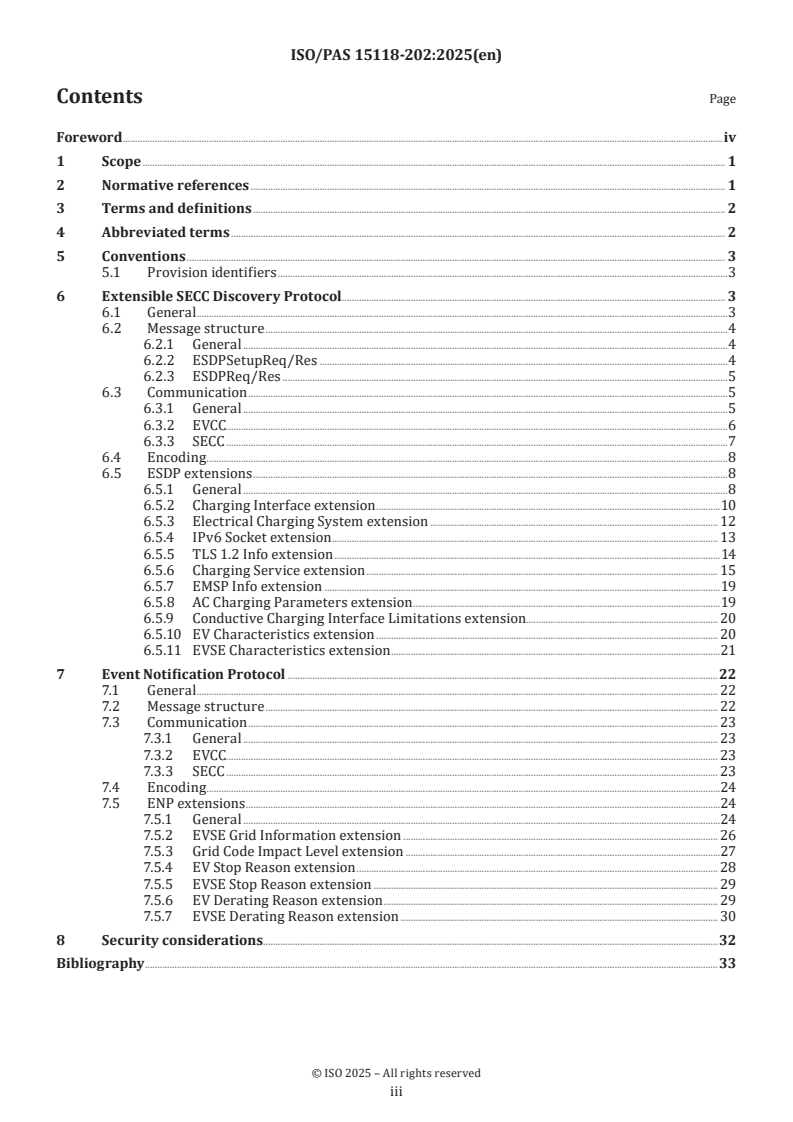
Contents Page
Foreword .iv
1 Scope . 1
2 Normative references . 1
3 Terms and definitions . 2
4 Abbreviated terms . 2
5 Conventions . 3
5.1 Provision identifiers .3
6 Extensible SECC Discovery Protocol . . 3
6.1 General .3
6.2 Message structure .4
6.2.1 General .4
6.2.2 ESDPSetupReq/Res .4
6.2.3 ESDPReq/Res .5
6.3 Communication .5
6.3.1 General .5
6.3.2 EVCC.6
6.3.3 SECC .7
6.4 Encoding .8
6.5 ESDP extensions .8
6.5.1 General .8
6.5.2 Charging Interface extension .10
6.5.3 Electrical Charging System extension . 12
6.5.4 IPv6 Socket extension . 13
6.5.5 TLS 1.2 Info extension .14
6.5.6 Charging Service extension . 15
6.5.7 EMSP Info extension .19
6.5.8 AC Charging Parameters extension .19
6.5.9 Conductive Charging Interface Limitations extension. 20
6.5.10 EV Characteristics extension . 20
6.5.11 EVSE Characteristics extension .21
7 Event Notification Protocol .22
7.1 General . 22
7.2 Message structure . 22
7.3 Communication . 23
7.3.1 General . 23
7.3.2 EVCC. 23
7.3.3 SECC . 23
7.4 Encoding .24
7.5 ENP extensions .24
7.5.1 General .24
7.5.2 EVSE Grid Information extension . 26
7.5.3 Grid Code Impact Level extension .27
7.5.4 EV Stop Reason extension . 28
7.5.5 EVSE Stop Reason extension . 29
7.5.6 EV Derating Reason extension . 29
7.5.7 EVSE Derating Reason extension . 30
8 Security considerations.32
Bibliography .33
iii
Foreword
ISO (the International Organization for Standardization) is a worldwide federation of national standards
bodies (ISO member bodies). The work of preparing International Standards is normally carried out through
ISO technical committees. Each member body interested in a subject for which a technical committee
has been established has the right to be represented on that committee. International organizations,
governmental and non-governmental, in liaison with ISO, also take part in the work. ISO collaborates closely
with the International Electrotechnical Commission (IEC) on all matters of electrotechnical standardization.
The procedures used to develop this document and those intended for its further maintenance are described
in the ISO/IEC Directives, Part 1. In particular, the different approval criteria needed for the different types
of ISO documents should be noted. This document was drafted in accordance with the editorial rules of the
ISO/IEC Directives, Part 2 (see www.iso.org/directives).
ISO draws attention to the possibility that the implementation of this document may involve the use of (a)
patent(s). ISO takes no position concerning the evidence, validity or applicability of any claimed patent
rights in respect thereof. As of the date of publication of this document, ISO had not received notice of (a)
patent(s) which may be required to implement this document. However, implementers are cautioned that
this may not represent the latest information, which may be obtained from the patent database available at
www.iso.org/patents. ISO shall not be held responsible for identifying any or all such patent rights.
Any trade name used in this document is information given for the convenience of users and does not
constitute an endorsement.
For an explanation of the voluntary nature of standards, the meaning of ISO specific terms and expressions
related to conformity assessment, as well as information about ISO's adherence to the World Trade
Organization (WTO) principles in the Technical Barriers to Trade (TBT), see www.iso.org/iso/foreword.html.
This document was prepared by Technical Committee ISO/TC 22, Road vehicles, Subcommittee SC 31, Data
communication.
A list of all parts in the ISO 15118 series can be found on the ISO website.
Any feedback or questions on this document should be directed to the user’s national standards body. A
complete listing of these bodies can be found at www.iso.org/members.html.
iv
Publicly Available Specification ISO/PAS 15118-202:2025(en)
Road vehicles — Vehicle to grid communication interface —
Part 202:
Extensible SECC Discovery Protocol and Event Notification
Protocol
1 Scope
This document specifies the Extensible SECC Discovery Protocol (ESDP) as well as the Event Notification
Protocol (ENP) that are intended to be used in conjunction with other protocols as defined in ISO 15118-2
and ISO 15118-20 as well as documents from other organizations such as DIN or SAE (e.g. DIN/TS 70121 or
SAE J2847/2).
These protocols can be used in addition to the existing SECC Discovery Protocol defined by the
aforementioned documents. They offer additional functionality that makes the digital communication for
EV charging more robust and allows to better determine the reason of failures.
In this document, the scope is limited to the already existing communication protocols. Thus, it is only
an addition to already existing communication protocols. Basic requirements regarding for example IP
communication, or the Vehicle-To-Grid Transport Protocol (V2GTP) are not needed, as they are already
specified in the respective document of the used communication protocol.
2 Normative references
The following documents are referred to in the text in such a way that some or all of their content constitutes
requirements of this document. For dated references, only the edition cited applies. For undated references,
the latest edition of the referenced document (including any amendments) applies.
ISO 3779, Road vehicles — Vehicle identification number (VIN) — Content and structure
ISO 15118-2, Road vehicles — Vehicle-to-Grid Communication Interface — Part 2: Network and application
protocol requirements
ISO 15118-20, Road vehicles — Vehicle to grid communication interface — Part 20: 2nd generation network
layer and application layer requirements
ISO 5474-2, Electrically propelled road vehicles — Functional and safety requirements for power transfer
between vehicle and external electric circuit — Part 2: AC power transfer
ISO 5474-3, Electrically propelled road vehicles — Functional and safety requirements for power transfer
between vehicle and external electric circuit — Part 3: DC power transfer
ISO/IEC 8824-1, Information technology — Abstract Syntax Notation One (ASN.1) — Part 1: Specification of
basic notation,
ISO/IEC 8825-7, Information technology — ASN.1 encoding rules — Part 7: Specification of Octet Encoding
Rules (OER)
IEC 61851-1, Electric vehicle conductive charging system - Part 1: General requirements
IEC 61851-23, Electric conductive charging system - Part 23: DC electric vehicle charging station
RFC 4122, A Universally Unique IDentifier (UUID) URN Namespace
RFC 6066, Transport Layer Security (TLS) Extensions: Extension Definitions
3 Terms and definitions
For the purposes of this document, the terms and definitions given in ISO 15118-2, ISO 15118-20, IEC 61851-1,
IEC 61851-23 and the following apply.
ISO and IEC maintain terminology databases for use in standardization at the following addresses:
— ISO Online browsing platform: available at https:// www .iso .org/ obp
— IEC Electropedia: available at https:// www .electropedia .org/
3.1
SI unit
unit of measurement
[SOURCE: Reference [12]]
3.2
element
complex structure which can contain other complex structures or parameters (3.4)
EXAMPLE A SEQUENCE or SEQUENCE OF.
3.3
local grid
electrical grid to which the EV is connected to
Note 1 to entry: It includes all attached energy providers and energy consumers until the grid connection point.
3.4
parameter
variable whose name and type of values are specified
EXAMPLE Types may be INTEGER or UTF8 string.
[SOURCE: ISO 13584-31:1999, 3.2.4]
4 Abbreviated terms
ASN.1 Abstract Syntax Notation One
CCS Combined Charging System
CSMS Charging Station Management System
EMSP E-Mobility Service Provider
ENP Event Notification Protocol
ENPMsg Event Notification Protocol Message
ESDP Extensible SECC Discovery Protocol
ESDPReq Extensible SECC Discovery Protocol Request
ESDPRes Extensible SECC Discovery Protocol Response
EV Electric Vehicle
EVCC Electric Vehicle Communication Controller
EVSE Electric Vehicle Supply Equipment
IPv6 Internet Protocol version 6
LSB Least Significant Byte
MCS Megawatt Charging System
MSS Maximum Segment Size
OER Octet Encoding Rules
SDP SECC Discovery Protocol
SDPReq SECC Discovery Protocol Request
SDPRes SECC Discovery Protocol Response
SECC Supply Equipment Communication Controller
TCP Transmission Control Protocol
TLS Transport Layer Security
UDP User Datagram Protocol
V2GTP Vehicle-to-Grid Transfer Protocol
5 Conventions
5.1 Provision identifiers
This document uses a provision structure, i.e. a unique number identifies each individual provision included
in this document. This provision structure allows for easier provision tracking and test case specification.
The following format is used:
[V2G-] ; where:
— "V2G" represents the ISO 15118 series,
— represents the document part of the ISO 15118 series,
— represents the individual provision number, and
— includes the actual text of the provision.
Please note that a provision can include different types:
— requirements, indicated by “shall”;
— recommendations, indicated by “should”;
— permissions, indicated by “may”.
6 Extensible SECC Discovery Protocol
6.1 General
The ESDP allows both the electric vehicle and the EV supply equipment to detect what the other entity
supports. Based on this information, both entities can decide how to proceed. If they find a common ground,
they can continue with the communication, otherwise they will already know at this point that proceeding
with the communication will not lead to a successful charging session. The information provided in ESDP
can allow manufacturers and operators of EVs and EV supply equipment to reduce unsuccessful charging
sessions in the future.
6.2 Message structure
6.2.1 General
This subclause describes the structure of the messages that are part of the ESDP. Namely, the ESDPSetupReq/
Res message pair and the ESDPReq/Res message pair. Table 1 provides an overview of the ESDP messages
defined in this subclause.
Table 1 — Overview of the available ESDP messages
Message name Message description V2GTP payload
type
ESDPSetupReq Extensible SECC Discovery Protocol Setup Request message. 0x2021
Used by the EVCC to find an ESDP capable SECC and negotiate the supported
ESDP version as well as the maximum supported V2GTP message size.
ESDPSetupRes Extensible SECC Discovery Protocol Setup Response message. 0x2022
Used by the SECC to confirm the support of ESDP and inform the EVCC about
the supported ESDP version as well as the maximum supported V2GTP mes-
sage size.
ESDPReq Extensible SECC Discovery Protocol Request message. 0x2023
Used by the EVCC to send its supported ESDP extensions to the SECC.
ESDPRes Extensible SECC Discovery Protocol Response message. 0x2024
Used by the SECC to send its supported ESDP extensions to the EVCC.
6.2.2 ESDPSetupReq/Res
The ESDPSetupReq and the ESDPSetupRes ensure that both entities can receive each other’s ESDPReq/
ESDPRes message. For this purpose, the supported ESDP version as well as the maximum V2GTP message
size are exchanged.
Table 2 — ESDPSetupReq/Res message structure
Byte (0 == LSB) 0-7 8-9 10-11 12
Content V2GTP header ESDP Version Maximum V2GTP Mes- Multiplexed ENP
sage Size
[V2G202-0001] The EVCC and the SECC shall implement the ESDPSetupReq message and the ESDPSet-
upRes message respectively as defined in Table 2.
[V2G202-0002] The EVCC and the SECC shall set the value of the ESDP Version parameter to 0x0100,
unless they support an updated version of this document with the same major version
but a higher minor version. In that case, they shall set the value to the highest supported
minor version.
NOTE 1 The first byte of the ESDP version (byte 8) represents the major version and the second byte (byte 9)
represents the minor version. Major versions indicate a breaking change in the protocol, while minor versions indicate
newly supported extensions or extended extensions.
NOTE 2 With new editions of this document, the value of the ESDP Version parameter will increase.
[V2G202-0003] The EVCC and the SECC shall set the value of the Maximum V2GTP Message Size pa-
rameter to the number of bytes they can receive at most, including the V2GTP header.
[V2G202-0004] If the EVCC or the SECC cannot receive ENPMsg messages via the transport layer con-
nection used for the V2G Communication Session, the EVCC or the SECC shall set the
value of the multiplexed ENP parameter to '0x00'.
[V2G202-0005] If the EVCC or the SECC can receive ENPMsg messages via the transport layer connection
used for the V2G Communication Session, the EVCC or the SECC shall set the value of the
Multiplexed ENP parameter to '0x01'.
NOTE 3 Sending the ENPMsg message via the transport layer connection used for the V2G Communication Session
increases the reliability of ENP, as TCP will try to ensure that the ENPMsg message arrives at the other entity. If
additionally, TLS is used, the ENPMsg message can be sent in a confidential and authentic way.
6.2.3 ESDPReq/Res
The ESDPReq message and the ESDPRes message (see Table 3) provide information to the opposite entity to
ensure both entities can successfully establish a charging session based on a shared standard.
Table 3 — ESDPReq/Res message structure
Byte (0 == LSB) 0-7 8-9 10-11 12+
Content V2GTP header ESDP Version ESDP Extensions Offset ESDP extensions
[V2G202-0006] The EVCC and the SECC shall implement the ESDPReq message and the ESDPRes message
as defined in Table 3.
[V2G202-0007] The EVCC and the SECC shall set the value of the ESDP Extensions Offset parameter to
the number of bytes following the ESDP Extensions Offset parameter up until but not
including the first byte of the ESDP extensions.
[V2G202-0008] When trying to access the ESDP extensions, the EVCC and the SECC shall take the byte
position of the first byte after the ESDP Extensions Offset parameter and add the value
of the ESDP Extension Offset parameter.
NOTE In future editions of this document, additional parameters could be added after the ESDP Extensions
Offset. In that case, an implementation only supporting this edition of this document would not know when the
ESDP extensions start. Using the offset, an implementation can skip all unsupported bytes until it reaches the ESDP
extensions. For this edition of this document, the value of the ESDP Extensions Offset parameter will be set to 0.
[V2G202-0009] The EVCC and the SECC shall implement ESDP extensions as defined in 6.5.
6.3 Communication
6.3.1 General
This subclause defines requirements for both the EVCC and the SECC regarding the transmission and
reception of the ESDPSetupReq/Res message pair and the ESDPReq/Res message pair.
[V2G202-0010] The EVCC and the SECC shall be able to receive V2GTP messages (including the V2GTP
header) with a size at least equal to the Maximum Segment Size (MSS).
NOTE For IPv6 networks, the minimum value for the MSS is 1220 bytes. However, as this value is negotiated
depending on the network, the actual value can be different.
6.3.2 EVCC
[V2G202-0011] Before sending an ESDPSetupReq message, the EVCC shall ensure that it is able to receive
ESDPSetupRes messages and ESDPRes messages on UDP port 15202.
[V2G202-0012] If the EVCC receives an ESDPSetupRes message that has a larger size than what is spec-
ified in this edition of this document, the EVCC shall continue processing this message
and ignore all bytes following the last supported parameter.
NOTE 1 For an implementation that supports this edition of this document, any bytes after the Multiplexed ENP
parameter inside the ESDPSetupRes can be ignored.
[V2G202-0013] Once it is possible to send data via the transport layer, the EVCC shall send an ESDPSet-
upReq message to the link-local All Nodes IPv6 address (FF02::1) via UDP to port 15202.
[V2G202-0014] The EVCC shall set the value of the PayloadType parameter in the V2GTP header of an
ESDPSetupReq message to 0x2021.
[V2G202-0015] If the EVCC receives a V2GTP message where the value of the PayloadType parameter in
the V2GTP header is set to 0x2022, the EVCC shall parse the payload as an ESDPSetupRes
message. If parsing fails, the EVCC shall ignore this received V2GTP message.
[V2G202-0016] If the EVCC receives an ESDPSetupRes message where the first byte of the ESDP Version
parameter is higher than what it supports, the EVCC shall ignore this message.
[V2G202-0017] The EVCC shall set the value of the PayloadType parameter in the V2GTP header of an
ESDPReq message to 0x2023.
[V2G202-0018] The EVCC shall not send an ESDPReq message with a size larger than the value of the
Maximum V2GTP Message Size parameter provided in the ESDPSetupRes message.
[V2G202-0019] If the EVCC receives a V2GTP message where the value of the PayloadType parameter
in the V2GTP header is set to 0x2024, the EVCC shall parse the payload as an ESDPRes
message. If parsing fails, the EVCC shall ignore this received V2GTP message.
[V2G202-0020] After the EVCC has sent an ESDPSetupReq message and has not received an ESDPSetupRes
message within 50 ms, the EVCC shall send another ESDPSetupReq message within 50 ms.
[V2G202-0021] If the EVCC has received an SDPRes message for the first time during this coupling ses-
sion, the EVCC shall wait for ESDP to finish before taking further actions caused by the
received SDPRes message, such as opening a connection to the network socket indicated
in the SDPRes message.
NOTE 2 Waiting for ESDP to finish can mean that either ESDP completes successfully or that it terminates with an
error, for example, in case of a timeout.
[V2G202-0022] If the EVCC has not received an ESDPSetupRes message within 250 ms after having
received an SDPRes message, the EVCC shall no longer send ESDPSetupReq messages
and ignore any received ESDPSetupRes messages until the next coupling session. In-
stead, the EVCC shall continue with SDP as specified in the standard that was used to
implement SDP.
[V2G202-0023] After having received an ESDPSetupRes message, the EVCC shall not send another ES-
DPSetupReq message and ignore any further received ESDPSetupRes messages until
the next coupling session. Instead, the EVCC shall send an ESDPReq message via UDP to
port 15202 to the IPv6 address used as source address in the ESDPSetupRes message.
[V2G202-0024] After the EVCC has sent an ESDPReq message, if the EVCC has not received an ESDPRes
message within 50 ms, the EVCC shall send another ESDPReq message within 50 ms.
[V2G202-0025] If the EVCC has received an ESDPRes message, the EVCC shall ignore all further ESDPRes
messages until the next coupling session.
[V2G202-0026] If the EVCC has not received an ESDPRes message within 500 ms after having sent the
first ESDPReq message within the current coupling session, the EVCC shall no longer
send ESDPReq messages and ignore any received ESDPRes messages until the next
coupling session. Instead, the EVCC shall continue with SDP as specified in the standard
that was used to implement SDP.
6.3.3 SECC
[V2G202-0027] Once it is possible to receive data via the transport layer, the SECC shall be able to receive
ESDPSetupReq messages and ESDPReq messages on UDP port 15202.
[V2G202-0028] If the SECC receives an ESDPSetupReq message that has a larger size than what is spec-
ified in this edition of this document, the EVCC shall continue processing this message
and ignore all bytes following the last supported parameter.
NOTE For an implementation that supports this edition of this document, any bytes after the Multiplexed ENP
parameter inside the ESDPSetupRes can be ignored.
[V2G202-0029] If the SECC receives a V2GTP message where the value of the PayloadType parameter in
the V2GTP header is set to 0x2021, the SECC shall parse the payload as an ESDPSetupReq
message. If parsing fails, the SECC shall ignore this received V2GTP message.
[V2G202-0030] If the SECC receives an ESDPSetupReq message where the first byte of the ESDP Version
parameter is higher than what it supports, the SECC shall ignore this message.
[V2G202-0031] The SECC shall set the value of the PayloadType parameter in the V2GTP header of an
ESDPSetupRes message to 0x2022.
[V2G202-0032] If the SECC receives a V2GTP message where the value of the PayloadType parameter
in the V2GTP header is set to 0x2023, the SECC shall parse the payload as an ESDPReq
message. If parsing fails, the SECC shall ignore this received V2GTP message.
[V2G202-0033] The SECC shall set the value of the PayloadType parameter in the V2GTP header of an
ESDPRes message to 0x2024.
[V2G202-0034] The SECC shall not send an ESDPRes message with a size larger than the value of the
Maximum V2GTP Message Size parameter provided in the ESDPSetupReq message.
[V2G202-0035] After having received an ESDPSetupReq message, the SECC shall respond with an ES-
DPSetupRes message within 50 ms, sent to the EVCC’s IPv6 address and the UDP port
used as source port for the ESDPSetupReq message.
[V2G202-0036] After having received an ESDPReq message, the SECC shall respond with an ESDPRes
message within 100 ms, sent directly to the EVCC’s network address on the source port
of the ESDPReq message.
6.4 Encoding
[V2G202-0037] The EVCC and the SECC shall use an ASN.1 compiler implemented according to ISO/IEC
8824-1:2021 to process the ASN.1 schemas provided in 6.5.
[V2G202-0038] The EVCC and the SECC shall use the Canonical Octet Encoding Rules (CANONICAL-OER)
according to ISO/IEC 8825-7:2021 to encode and decode the ESDP extensions described
in 6.5.
[V2G202-0039] The EVCC and the SECC shall use the ASN.1 schema for ESDP as provided here:
https:// standards .iso .org/ iso/ pas/ 15118/ -202/ ed -1/ en/ ESDPExtensions .asn
[V2G202-0040] In case of a mismatch between the ASN.1 schema file and the ASN.1 schema snippets
shown in the tables, the ASN.1 schema file shall be considered as the correct way to
implement this document.
6.5 ESDP extensions
6.5.1 General
[V2G202-0041] The ESDP extensions listed in this subclause shall only be used within the ESDPReq
message and the ESDPRes message respectively.
[V2G202-0042] Unless otherwise specified, the EVCC and the SECC shall send any ESDP extension at
most once in the same ESDPReq message and ESDPRes message respectively.
[V2G202-0043] Unless otherwise specified, the EVCC and the SECC shall only process the first occur-
rence of any ESDP extension in an ESDPReq message or ESDPRes message respectively.
[V2G202-0044] Unless otherwise specified, the SECC shall send the ESDP extensions within the ESDPRes
message independent of the ESDP extensions the SECC received from the EVCC in the
ESDPReq message.
NOTE The ESDP is not intended as a negotiation. Therefore, both the EVCC and the SECC transmit their full
capabilities to the other entity.
Table 4 — ASN.1 schema of the basic ESDP extension types
ESDPExtensions ::= SEQUENCE {
esdpExtensionsList SEQUENCE (SIZE (1.MAX)) OF ESDPExtension,
...
}
ESDPExtension ::= SEQUENCE {
extensionID EXTENSION.
&id ({ExtensionSet}),
extensionValue EXTENSION.
&Type({ExtensionSet}{@.extensionID}),
...
}
EXTENSION ::= CLASS {
&id OCTET STRING (SIZE (16)) UNIQUE,
&Type
} WITH SYNTAX {&id &Type}
TTabablele 4 4 ((ccoonnttiinnueuedd))
ExtensionSet EXTENSION ::= {
{ '3EAE3DCBE9554A1D84C6B4EEF86460F3'H ChargingInterfaceExtension } |
{ '25992AFF1A58455FAFFDE58EB6F32600'H ElectricalChargingSystemExtension } |
{ 'A2398E1B3C79495D9CE1BD108DEC564E'H IPv6SocketExtension } |
{ '7C704049C4DD4353967EDAF21C9D453A'H TLS12InfoExtension } |
{ 'FAE82704EEBA4892ABCCFE8093B86312'H ChargingServiceExtension } |
{ 'AFF57F501E6E4868910C4D76BF35296B'H EMSPInfoExtension } |
{ 'F7F4265C3844447C8D7FBB3857A9B6AB'H ACChargingParametersExtension } |
{ '27D71E41EA8C4FB2BA431E1E7E60E360'H ConductiveChargingInterfaceLimitationsExtension } |
{ '5FD6334458DC4173B92608F63117D411'H EVCharacteristicsExtension } |
{ 'F0E77C3ADC41477398C9F177F44775BB'H EVSECharacteristicsExtension },
...
}
[V2G202-0045] The EVCC and the SECC shall implement the basic types as defined in Table 4.
[V2G202-0046] For every ESDP extension, a unique extensionID shall be generated. The extensionID
shall be generated using a version 4 UUID according to RFC 4122.
[V2G202-0047] If the EVCC or the SECC does not recognize the value of an extensionID parameter within
an ESDPExtension element, it shall ignore that ESDPExtension element and proceed
with the next ESDPExtension element in the esdpExtensionsList element, if available.
[V2G202-0048] If a requirement defines an ESDP extension as mandatory ("shall"), the EVCC and/or
the SECC shall implement the ESDP extension as defined in the respective subclause.
[V2G202-0049] If a requirement defines an ESDP extension as optional ("should") and if that ESDP
extension is implemented by the EVCC or the SECC, all requirements in that respective
subclause shall be implemented.
[V2G202-0050] Unless otherwise specified, whenever a physical value is transmitted in an ESDP exten-
sion, the respective SI unit shall be used.
Table 5 — Overview of the ESDP extensionID values
extensionID value Description
'3EAE3DCBE9554A1D84C6B4EEF86460F3'H Charging Interface extension as defined in 6.5.2.
'25992AFF1A58455FAFFDE58EB6F32600'H Electrical Charging System extension as defined in 6.5.3.
'A2398E1B3C79495D9CE1BD108DEC564E'H IPv6 Socket extension as defined in 6.5.4.
'7C704049C4DD4353967EDAF21C9D453A'H TLS 1.2 Info extension as defined in 6.5.5.
'FAE82704EEBA4892ABCCFE8093B86312'H Charging Service extension as defined in 6.5.6.
'AFF57F501E6E4868910C4D76BF35296B'H EMSP Info extension as defined in 6.5.7.
'F7F4265C3844447C8D7FBB3857A9B6AB'H AC Charging Parameters extension as defined in 6.5.8.
'27D71E41EA8C4FB2BA431E1E7E60E360'H Conductive Charging Interface Limitations extension as de-
fined in 6.5.9
'5FD6334458DC4173B92608F63117D411'H EV Characteristics extension as defined in 6.5.10.
'F0E77C3ADC41477398C9F177F44775BB'H EVSE Characteristics extension as defined in 6.5.11.
[V2G202-0051] SEQUENCE types and ENUMERATED types defined by this document shall not be ex-
tended outside of this document. When additional information needs to be transmitted
that is not covered by the extensions provided in this document, a new extension shall
be created.
[V2G202-0052] The EVCC and the SECC shall use the extensionID values as defined in Table 5.
[V2G202-0053] The EVCC and the SECC shall support the Charging Interface extension as defined in 6.5.2.
[V2G202-0054] The EVCC and the SECC shall support the Electrical Charging System extension as de-
fined in 6.5.3.
[V2G202-0055] The EVCC and the SECC shall support the IPv6 Socket extension as defined in 6.5.4.
[V2G202-0056] If the EVCC or the SECC support at least one of the security profiles 'iso-15118-2-2014'
and 'iso-15118-2-2026' respectively, they shall support the TLS 1.2 Info extension as
defined in 6.5.5.
[V2G202-0057] The EVCC and the SECC shall support the Charging Service extension as defined in 6.5.6.
[V2G202-0058] If the EVCC supports Plug and Charge, the EVCC should support the EMSP Info extension
as defined in 6.5.7.
[V2G202-0059] If the SECC supports Plug and Charge, the SECC shall support the EMSP Info extension
as defined in 6.5.7.
[V2G202-0060] If the EVCC or the SECC support AC charging, they shall support the AC Charging Pa-
rameters extension as defined in 6.5.8.
[V2G202-0061] If DC charging is supported by the EVCC or the SECC, they should support the Conductive
Charging Interface Limitations extension as defined in 6.5.9.
[V2G202-0062] The EVCC and the SECC should support the EV Characteristics extension as defined in
6.5.10.
[V2G202-0063] The EVCC and the SECC should support the EVSE Characteristics extension as defined
in 6.5.11.
6.5.2 Charging Interface extension
The Charging Interface extension informs the other entity about the type of charging interface used for the
power transfer. It allows detecting the usage of an adaptor.
Table 6 — ASN.1 schema of the Charging Interface extension
ChargingInterfaceExtension ::= SEQUENCE {
chargingInterface ChargingInterface,
interfaceType InterfaceType,
...
}
ChargingInterface ::= ENUMERATED {
iec-62196-2-type-1 (0),
iec-62196-2-type-2 (1),
iec-62196-2-type-4 (2), -- GB/T 20234.2
iec-62196-3-aa (10), -- CHAdeMO
iec-62196-3-bb (11), -- GB/T 20234.3
iec-62196-3-ee (12), -- Combo1/CCS1
TTabablele 6 6 ((ccoonnttiinnueuedd))
iec-62196-3-ff (13), -- Combo2/CCS2
iec-62196-3-gg (14), -- ChaoJi
iec-62196-3-jj (15), -- Ultra ChaoJi
iec-62196-3-hh (16), -- MCS
sae-j3400 (30), -- NACS
...
}
InterfaceType ::= ENUMERATED {
socket-inlet,
connector-plug,
...
}
[V2G202-0064] The EVCC and the SECC shall implement the Charging Interface extension as defined in
Table 6, Table 7 and Table 8.
Table 7 — Overview of the Charging Interface enumeration values
ChargingInterface enumeration Description
iec-62196-2-type-1 Type 1 configuration as specified by IEC 62196-2.
iec-62196-2-type-2 Type 2 configuration as specified by IEC 62196-2.
iec-62196-2-type-4 Type 4 configuration as specified by IEC 62196-2.
Also specified by GB/T 20234.2.
iec-62196-3-aa AA configuration as specified by IEC 62196-3.
Also specified by CHAdeMO.
iec-62196-3-bb BB configuration as specified by IEC 62196-3.
Also specified by GB/T 20234.3.
iec-62196-3-ee EE configuration as specified by IEC 62196-3.
Also known as CCS1 or Combo1.
iec-62196-3-ff FF configuration as specified by IEC 62196-3.
Also known as CCS2 or Combo2.
iec-62196-3-gg GG configuration as specified by IEC 62196-3.
Also known as ChaoJi.
iec-62196-3-jj JJ configuration as specified by IEC 62196-3.
Also known as Ultra ChaoJi.
iec-62196-3-hh HH configuration as specified by IEC 62196-3.
Also known as MCS.
sae-j3400 As specified by SAE J3400.
Table 8 — Overview of the InterfaceType enumeration values
InterfaceType enumeration Description
socket-inlet The charging interface is a socket or an inlet.
connector-plug The charging interface is a connector or a plug.
This implies that a cable with either a connector or plug at the end is
mounted to the EV/EVSE.
[V2G202-0065] The EVCC and the SECC shall include the ChargingInterface extension in the ESDPReq
message and the ESDPRes message respectively.
[V2G202-0066] The EVCC and the SECC shall set the values of the ChargingInterface parameter and the
InterfaceType parameter to the one that matches the charging interface that is available
via this communication channel.
6.5.3 Electrical Charging System extension
The Electrical Charging System extension informs the other entity of the supported electrical charging
system, such as IEC 61851-23 ED2 for DC charging.
Table 9 — ASN.1 schema of the Electrical Charging System extension
ElectricalChargingSystemExtension ::= SEQUENCE {
electricalChargingSystemsList SEQUENCE (SIZE (1.MAX)) OF
ElectricalChargingSystem,
controlPilotBCBToggleSupportList SEQUENCE (SIZE (1.MAX)) OF
ControlPilotBCBToggleSupport OPTIONAL,
...
}
ElectricalChargingSystem ::= ENUMERATED {
iec61851-1-ed2 (1),
iec61851-1-ed3 (2),
iec61851-1-ed4 (3),
iec61851-23-ed1 (10),
iec61851-23-ed2 (11),
iec61851-23-ed3 (12),
iec61851-23-3-ed1 (20),
sae-j1772-201602 (30),
sae-j1772-201710 (31),
sae-j1772-202401 (32),
sae-j3068-202207 (40),
sae-j3068-202409 (41),
sae-j3400-202409 (50),
...
}
ControlPilotBCBToggleSupport ::= ENUMERATED {
slacValidation,
wakeup,
...
}
[V2G202-0067] The EVCC and the SECC shall implement the Electrical Charging System extension as
defined in Table 9, Table 10 and Table 11.
[V2G202-0068] The EVCC and the SECC shall create one ElectricalChargingSystem parameter inside the
electricalChargingSystemList element for each electrical charging system they support
on the charging interface that was provided in the Charging Interface extension.
Table 10 — Overview of the ElectricalChargingSystem enumeration values
ElectricalChargingSystem enumeration Description
iec61851-1-ed2 According to IEC 61851-1:2010 (Edition 2)
iec61851-1-ed3 According to IEC 61851-1:2017 (Edition 3)
iec61851-1-ed4 According to IEC 61851-1 Edition 4 (WIP)
iec61851-23-ed1 According to IEC 61851-23:2014 (Edition 1)
iec61851-23-ed2 According to IEC 61851-23:2023 (Edition 2)
iec61851-23-ed3 According to IEC 61851-23 Edition 3 (WIP)
iec61851-23-3-ed1 According to IEC 61851-23-3 Edition 1 (WIP)
sae-j1772-201602 According to SAE J1772_201602
sae-j1772-201710 According to SAE J1772_201710
sae-j1772-202401 According to SAE J1772_202401
sae-j3068-202207 According to SAE J3068_202207
sae-j3068-202409 According to SAE J3068_202409
sae-j3400-202409 According to SAE J3400_202409
[V2G202-0069] If the EVCC or the SECC support BCB toggles on the control pilot line for SLAC validation
according to ISO 15118-3, the EVCC or the SECC should add a ControlPilotBCBToggle-
Support parameter to the controlPilotBCBToggleSupportList element and set its value
to 'slacValidation'.
[V2G202-0070] If the EVCC or the SECC support BCB toggles on the control pilot line for wakeup of the
SECC, the EVCC or the SECC should add a ControlPilotBCBToggleSupport parameter to
the con
...