

ISO 15236-2:2017
(Main)Steel cord conveyor belts — Part 2: Preferred belt types
General Information
- Abstract
ISO 15236-2:2017 specifies preferred types of conveyor belts with steel cords in the longitudinal direction as reinforcement. The belt type series in this document are based on the general requirements for construction given in ISO 15236‑1.
- Status
- Published
- Publication Date
- 08-Jan-2017
- Technical Committee
- ISO/TC 41/SC 3 - Conveyor belts
- Drafting Committee
- ISO/TC 41/SC 3 - Conveyor belts
- Current Stage
- 9093 - International Standard confirmed
- Start Date
- 28-Sep-2022
- Completion Date
- 29-Aug-2026
Buy Documents


ISO 15236-2:2017 - Steel cord conveyor belts — Part 2: Preferred belt types/9/2017



ISO 15236-2:2017 - Courroies transporteuses a câbles d'acier

ISO 15236-2:2017 - Courroies transporteuses à câbles d'acier — Partie 2: Types de courroies recommandées/9/2017
Overview
ISO 15236-2:2017 is an international standard that specifies preferred types of steel cord conveyor belts used as reinforcement in the longitudinal direction. These conveyor belts are designed for heavy-duty material handling and are constructed according to the general requirements outlined in ISO 15236-1. The standard focuses on preferred belt types, ensuring compatibility and interchangeability among belts manufactured by different suppliers. This harmonization facilitates reliable splicing and optimal performance in demanding conveyor systems.
Key Topics
- Steel Cord Conveyor Belts: Belts reinforced with longitudinal steel cords for enhanced strength and durability.
- Preferred Belt Types: Defines specific belt type categories (A, B, C) and subtypes with details on construction, cord diameter, cord pitch, and breaking strength.
- Design Parameters: Includes specifications for cord diameter, spacing (pitch), carcass thickness, and cover thickness to support varied applications.
- Belt Joints: Describes suitable vulcanized joint types-such as interlaced stepped, plain stepped, and finger joints-compatible with belt types.
- Construction Details:
- Type A belts: Steel cords coated by hot dip zinc, tailored for interlaced stepped joints.
- Type B belts: Incorporate transverse reinforcement with either high elongation or standard elongation warp cords, supporting finger and stepped joints.
- Type C belts: Fabric-like tension members with brass or zinc coated steel cords, adaptable to finger and plain stepped joints.
- Mechanical Requirements: Break strengths are calculated to meet minimum safety margins and ensure consistent performance.
- Compatibility & Standardization: Emphasizes standard cord dimensions and pitch to enable effective jointing and dynamic capability in conveyor operations.
Applications
Steel cord conveyor belts specified in ISO 15236-2:2017 are widely used in industries requiring robust, high-capacity conveying solutions. Typical applications include:
- Mining and Quarrying: Transporting heavy materials like ores, coal, and aggregates over long distances.
- Cement and Steel Plants: Handling raw materials and finished products with high tensile strength and durability demands.
- Bulk Material Handling: Ports, logistics, and container terminals adopting conveyor belts for continuous material flow.
- Power Generation: Coal and biomass conveyors requiring wear-resistant and reliable belting.
- Industrial Manufacturing: Conveying systems for diverse manufacturing processes needing durable reinforcement.
The standard ensures users select belt types with optimal tensile strength, carcass flexibility, and jointing compatibility, reducing downtime and maintenance costs.
Related Standards
ISO 15236-1:2016 - Steel cord conveyor belts - Part 1: Design, dimensions, and mechanical requirements for conveyor belts for general use
Provides foundational design criteria and mechanical performance benchmarks referenced by ISO 15236-2.ISO 15236-4 - Steel cord conveyor belts - Part 4: Vulcanized belt joints
Defines jointing methods critical for selecting compatible belt types from ISO 15236-2.ISO/IEC Directives, Part 1 & 2
Governs the development and maintenance processes of ISO standards, ensuring consistency and quality in technical documentation.
Summary
ISO 15236-2:2017 standardizes preferred steel cord conveyor belt types, focusing on belt construction and joint compatibility to meet industrial demands for durability and performance. By specifying cord dimensions, pitch, and tensile strength requirements, it supports reliable conveyor belt manufacturing, installation, and maintenance. Industries utilizing heavy material handling benefit from using belts that conform to these internationally agreed parameters, achieving enhanced operational efficiency and reduced equipment failures. This standard is an essential reference for engineers, manufacturers, and end-users involved in conveyor belt selection and system design.
Relations
- Consolidates
EN ISO 15236-2:2017 - Steel cord conveyor belts - Part 2: Preferred belt types (ISO 15236-2:2017) - Effective Date
- 12-Feb-2026
- Effective Date
- 19-Dec-2015
Buy Documents
ISO 15236-2:2017 - Steel cord conveyor belts — Part 2: Preferred belt types/9/2017
ISO 15236-2:2017 - Courroies transporteuses a câbles d'acier
ISO 15236-2:2017 - Courroies transporteuses à câbles d'acier — Partie 2: Types de courroies recommandées/9/2017
Frequently Asked Questions
ISO 15236-2:2017 is a standard published by the International Organization for Standardization (ISO). Its full title is "Steel cord conveyor belts — Part 2: Preferred belt types". This standard covers: ISO 15236-2:2017 specifies preferred types of conveyor belts with steel cords in the longitudinal direction as reinforcement. The belt type series in this document are based on the general requirements for construction given in ISO 15236‑1.
ISO 15236-2:2017 specifies preferred types of conveyor belts with steel cords in the longitudinal direction as reinforcement. The belt type series in this document are based on the general requirements for construction given in ISO 15236‑1.
ISO 15236-2:2017 is classified under the following ICS (International Classification for Standards) categories: 53.040.20 - Components for conveyors. The ICS classification helps identify the subject area and facilitates finding related standards.
ISO 15236-2:2017 has the following relationships with other standards: It is inter standard links to EN ISO 15236-2:2017, ISO 15236-2:2004. Understanding these relationships helps ensure you are using the most current and applicable version of the standard.
ISO 15236-2:2017 is available in PDF format for immediate download after purchase. The document can be added to your cart and obtained through the secure checkout process. Digital delivery ensures instant access to the complete standard document.
Standards Content (Sample)
INTERNATIONAL ISO
STANDARD 15236-2
Second edition
2017-01
Steel cord conveyor belts —
Part 2:
Preferred belt types
Courroies transporteuses à câbles d’acier —
Partie 2: Types de courroies recommandées
Reference number
©
ISO 2017
© ISO 2017, Published in Switzerland
All rights reserved. Unless otherwise specified, no part of this publication may be reproduced or utilized otherwise in any form
or by any means, electronic or mechanical, including photocopying, or posting on the internet or an intranet, without prior
written permission. Permission can be requested from either ISO at the address below or ISO’s member body in the country of
the requester.
ISO copyright office
Ch. de Blandonnet 8 • CP 401
CH-1214 Vernier, Geneva, Switzerland
Tel. +41 22 749 01 11
Fax +41 22 749 09 47
copyright@iso.org
www.iso.org
ii © ISO 2017 – All rights reserved
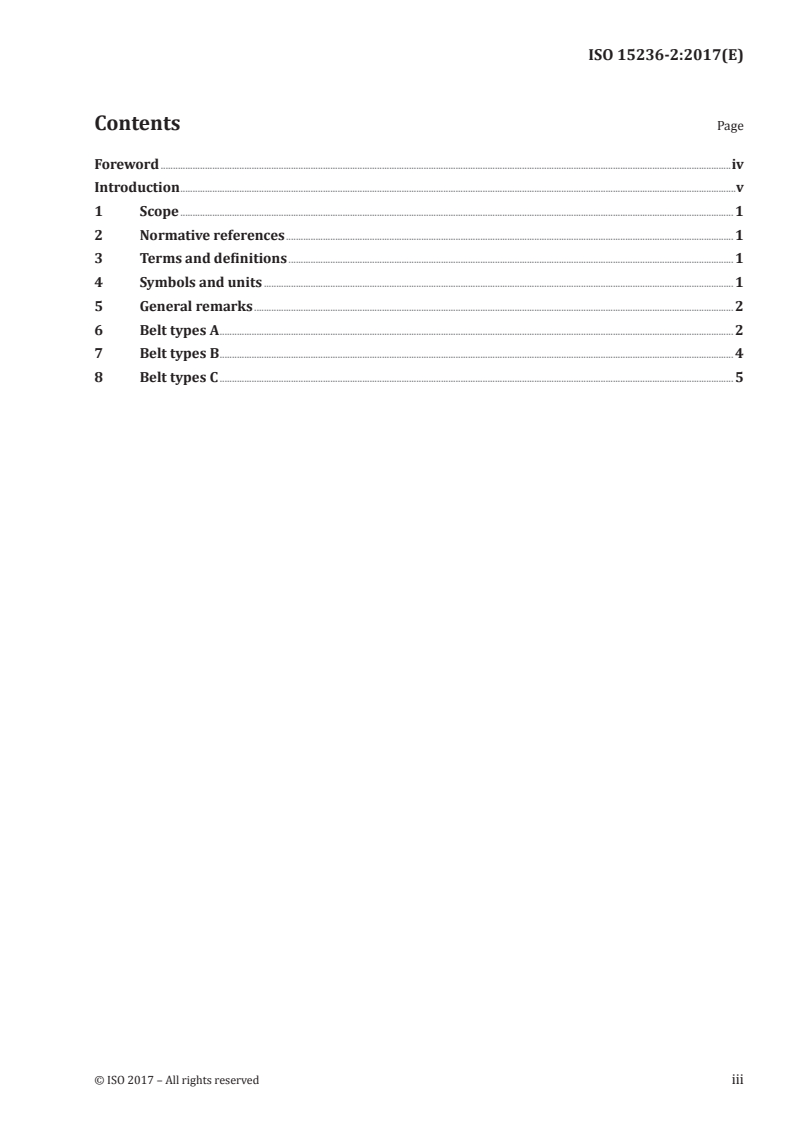
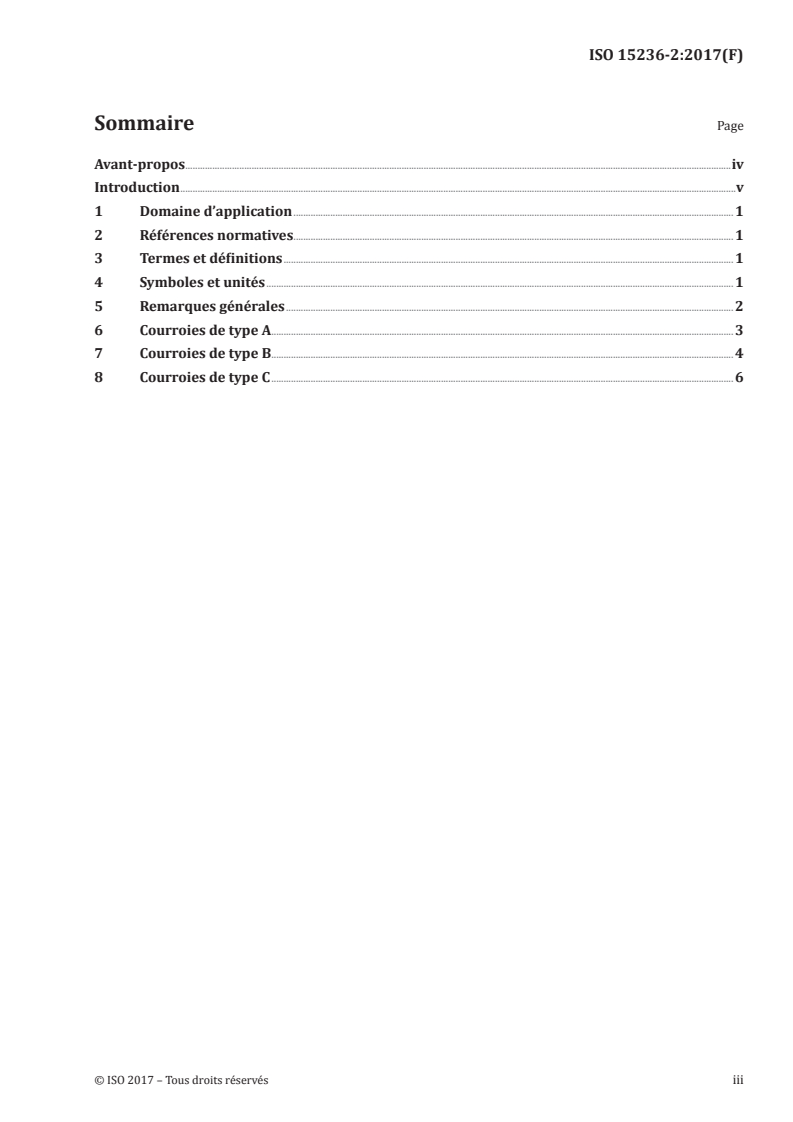
Contents Page
Foreword .iv
Introduction .v
1 Scope . 1
2 Normative references . 1
3 Terms and definitions . 1
4 Symbols and units . 1
5 General remarks . 2
6 Belt types A . 2
7 Belt types B . 4
8 Belt types C . 5
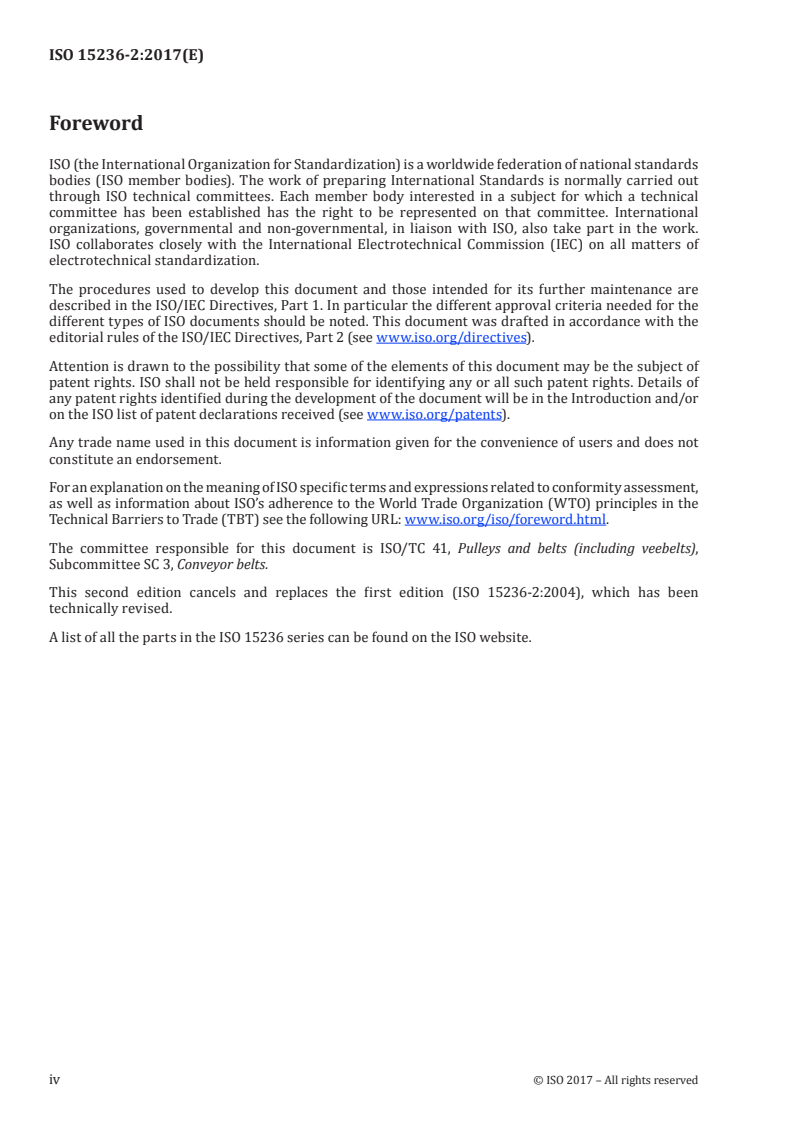
Foreword
ISO (the International Organization for Standardization) is a worldwide federation of national standards
bodies (ISO member bodies). The work of preparing International Standards is normally carried out
through ISO technical committees. Each member body interested in a subject for which a technical
committee has been established has the right to be represented on that committee. International
organizations, governmental and non-governmental, in liaison with ISO, also take part in the work.
ISO collaborates closely with the International Electrotechnical Commission (IEC) on all matters of
electrotechnical standardization.
The procedures used to develop this document and those intended for its further maintenance are
described in the ISO/IEC Directives, Part 1. In particular the different approval criteria needed for the
different types of ISO documents should be noted. This document was drafted in accordance with the
editorial rules of the ISO/IEC Directives, Part 2 (see www.iso.org/directives).
Attention is drawn to the possibility that some of the elements of this document may be the subject of
patent rights. ISO shall not be held responsible for identifying any or all such patent rights. Details of
any patent rights identified during the development of the document will be in the Introduction and/or
on the ISO list of patent declarations received (see www.iso.org/patents).
Any trade name used in this document is information given for the convenience of users and does not
constitute an endorsement.
For an explanation on the meaning of ISO specific terms and expressions related to conformity assessment,
as well as information about ISO’s adherence to the World Trade Organization (WTO) principles in the
Technical Barriers to Trade (TBT) see the following URL: www.iso.org/iso/foreword.html.
The committee responsible for this document is ISO/TC 41, Pulleys and belts (including veebelts),
Subcommittee SC 3, Conveyor belts.
This second edition cancels and replaces the first edition (ISO 15236-2:2004), which has been
technically revised.
A list of all the parts in the ISO 15236 series can be found on the ISO website.
iv © ISO 2017 – All rights reserved
Introduction
Steel cord conveyor belts are mainly long belts which are manufactured by joining several delivery
lengths on the site. To achieve joints with a high dynamic capability from belts supplied by various
manufacturers, it is necessary to standardize some features, e.g. thickness of carcass or cord pitch and
cord diameter.
INTERNATIONAL STANDARD ISO 15236-2:2017(E)
Steel cord conveyor belts —
Part 2:
Preferred belt types
1 Scope
This document specifies preferred types of conveyor belts with steel cords in the longitudinal direction
as reinforcement. The belt type series in this document are based on the general requirements for
construction given in ISO 15236-1.
2 Normative references
The following documents are referred to in the text in such a way that some or all of their content
constitutes requirements of this document. For dated references, only the edition indicated applies. For
undated references, the latest edition of the referenced document (including any amendments) applies.
ISO 15236-1:2016, Steel cord conveyor belts — Part 1: Design, dimensions and mechanical requirements for
conveyor belts for general use
ISO 15236-4, Steel cord conveyor belts — Part 4: Vulcanized belt joints
3 Terms and definitions
No terms and definitions are listed in this document.
ISO and IEC maintain terminological databases for use in standardization at the following addresses:
— IEC Electropedia: available at http://www.electropedia.org/
— ISO Online browsing platform: available at http://www.iso.org/obp
4 Symbols and units
For the purposes of this document, the symbols and the units given in Table 1 apply.
Table 1 — Symbols and units
Symbol Explanation Unit
B Belt width mm
F Breaking strength of the cord taken from the cured belt kN
bs
K Nominal breaking strength per width of belt N/mm
N
b Calculated edge width mm
K
d Cord diameter mm
n Number of cords —
s Cover thickness mm
s Carcass thickness mm
Table 1 (continued)
Symbol Explanation Unit
t Cord spacing/pitch mm
Minimum value —
min
Maximum value —
max
5 General remarks
The belt types described in this document are a selection out of the unlimited number of possible
constructions; belts of the types A and B have been manufactured and installed in large quantities.
It is the general conception of these belt types that belts of a certain nominal breaking strength have
equal cords and cord pitches or at least equal thickness of the carcass.
The requirements regarding belt design, i.e. cord diameter and cord pitch, depend on the mode of joint
that will be applied. In accordance with ISO 15236-4, there are three types of vulcanized joints:
— interlaced stepped joints;
— plain stepped joints;
— finger joints.
For high performance stepped joints, it is essential that the belts to be joined have equal cord pitch
and cord diameter. For belts to be joined by finger joints, the cord pitch and cord diameter are of less
importance; what matters is a similar thickness of the carcass. In Tables 2, 3, 4 and 5, therefore, cord
diameter, cord pitch and number of cords are specified only for those types which are usually joined by
stepped joints, i.e. belt types A1, A2 and B2.
The cord numbers given in Tables 2, 3 and 5 are for guidance only. They result from Formula (1):
KB×
N
n = (1)
min
F ×1000
bs
and from the requirement that the edge width shall be not larger than 40 mm and not sm
...
INTERNATIONAL ISO
STANDARD 15236-2
Second edition
2017-01
Steel cord conveyor belts —
Part 2:
Preferred belt types
Courroies transporteuses à câbles d’acier —
Partie 2: Types de courroies recommandées
Reference number
©
ISO 2017
© ISO 2017, Published in Switzerland
All rights reserved. Unless otherwise specified, no part of this publication may be reproduced or utilized otherwise in any form
or by any means, electronic or mechanical, including photocopying, or posting on the internet or an intranet, without prior
written permission. Permission can be requested from either ISO at the address below or ISO’s member body in the country of
the requester.
ISO copyright office
Ch. de Blandonnet 8 • CP 401
CH-1214 Vernier, Geneva, Switzerland
Tel. +41 22 749 01 11
Fax +41 22 749 09 47
copyright@iso.org
www.iso.org
ii © ISO 2017 – All rights reserved
Contents Page
Foreword .iv
Introduction .v
1 Scope . 1
2 Normative references . 1
3 Terms and definitions . 1
4 Symbols and units . 1
5 General remarks . 2
6 Belt types A . 2
7 Belt types B . 4
8 Belt types C . 5
Foreword
ISO (the International Organization for Standardization) is a worldwide federation of national standards
bodies (ISO member bodies). The work of preparing International Standards is normally carried out
through ISO technical committees. Each member body interested in a subject for which a technical
committee has been established has the right to be represented on that committee. International
organizations, governmental and non-governmental, in liaison with ISO, also take part in the work.
ISO collaborates closely with the International Electrotechnical Commission (IEC) on all matters of
electrotechnical standardization.
The procedures used to develop this document and those intended for its further maintenance are
described in the ISO/IEC Directives, Part 1. In particular the different approval criteria needed for the
different types of ISO documents should be noted. This document was drafted in accordance with the
editorial rules of the ISO/IEC Directives, Part 2 (see www.iso.org/directives).
Attention is drawn to the possibility that some of the elements of this document may be the subject of
patent rights. ISO shall not be held responsible for identifying any or all such patent rights. Details of
any patent rights identified during the development of the document will be in the Introduction and/or
on the ISO list of patent declarations received (see www.iso.org/patents).
Any trade name used in this document is information given for the convenience of users and does not
constitute an endorsement.
For an explanation on the meaning of ISO specific terms and expressions related to conformity assessment,
as well as information about ISO’s adherence to the World Trade Organization (WTO) principles in the
Technical Barriers to Trade (TBT) see the following URL: www.iso.org/iso/foreword.html.
The committee responsible for this document is ISO/TC 41, Pulleys and belts (including veebelts),
Subcommittee SC 3, Conveyor belts.
This second edition cancels and replaces the first edition (ISO 15236-2:2004), which has been
technically revised.
A list of all the parts in the ISO 15236 series can be found on the ISO website.
iv © ISO 2017 – All rights reserved
Introduction
Steel cord conveyor belts are mainly long belts which are manufactured by joining several delivery
lengths on the site. To achieve joints with a high dynamic capability from belts supplied by various
manufacturers, it is necessary to standardize some features, e.g. thickness of carcass or cord pitch and
cord diameter.
INTERNATIONAL STANDARD ISO 15236-2:2017(E)
Steel cord conveyor belts —
Part 2:
Preferred belt types
1 Scope
This document specifies preferred types of conveyor belts with steel cords in the longitudinal direction
as reinforcement. The belt type series in this document are based on the general requirements for
construction given in ISO 15236-1.
2 Normative references
The following documents are referred to in the text in such a way that some or all of their content
constitutes requirements of this document. For dated references, only the edition indicated applies. For
undated references, the latest edition of the referenced document (including any amendments) applies.
ISO 15236-1:2016, Steel cord conveyor belts — Part 1: Design, dimensions and mechanical requirements for
conveyor belts for general use
ISO 15236-4, Steel cord conveyor belts — Part 4: Vulcanized belt joints
3 Terms and definitions
No terms and definitions are listed in this document.
ISO and IEC maintain terminological databases for use in standardization at the following addresses:
— IEC Electropedia: available at http://www.electropedia.org/
— ISO Online browsing platform: available at http://www.iso.org/obp
4 Symbols and units
For the purposes of this document, the symbols and the units given in Table 1 apply.
Table 1 — Symbols and units
Symbol Explanation Unit
B Belt width mm
F Breaking strength of the cord taken from the cured belt kN
bs
K Nominal breaking strength per width of belt N/mm
N
b Calculated edge width mm
K
d Cord diameter mm
n Number of cords —
s Cover thickness mm
s Carcass thickness mm
Table 1 (continued)
Symbol Explanation Unit
t Cord spacing/pitch mm
Minimum value —
min
Maximum value —
max
5 General remarks
The belt types described in this document are a selection out of the unlimited number of possible
constructions; belts of the types A and B have been manufactured and installed in large quantities.
It is the general conception of these belt types that belts of a certain nominal breaking strength have
equal cords and cord pitches or at least equal thickness of the carcass.
The requirements regarding belt design, i.e. cord diameter and cord pitch, depend on the mode of joint
that will be applied. In accordance with ISO 15236-4, there are three types of vulcanized joints:
— interlaced stepped joints;
— plain stepped joints;
— finger joints.
For high performance stepped joints, it is essential that the belts to be joined have equal cord pitch
and cord diameter. For belts to be joined by finger joints, the cord pitch and cord diameter are of less
importance; what matters is a similar thickness of the carcass. In Tables 2, 3, 4 and 5, therefore, cord
diameter, cord pitch and number of cords are specified only for those types which are usually joined by
stepped joints, i.e. belt types A1, A2 and B2.
The cord numbers given in Tables 2, 3 and 5 are for guidance only. They result from Formula (1):
KB×
N
n = (1)
min
F ×1000
bs
and from the requirement that the edge width shall be not larger than 40 mm and not sm
...
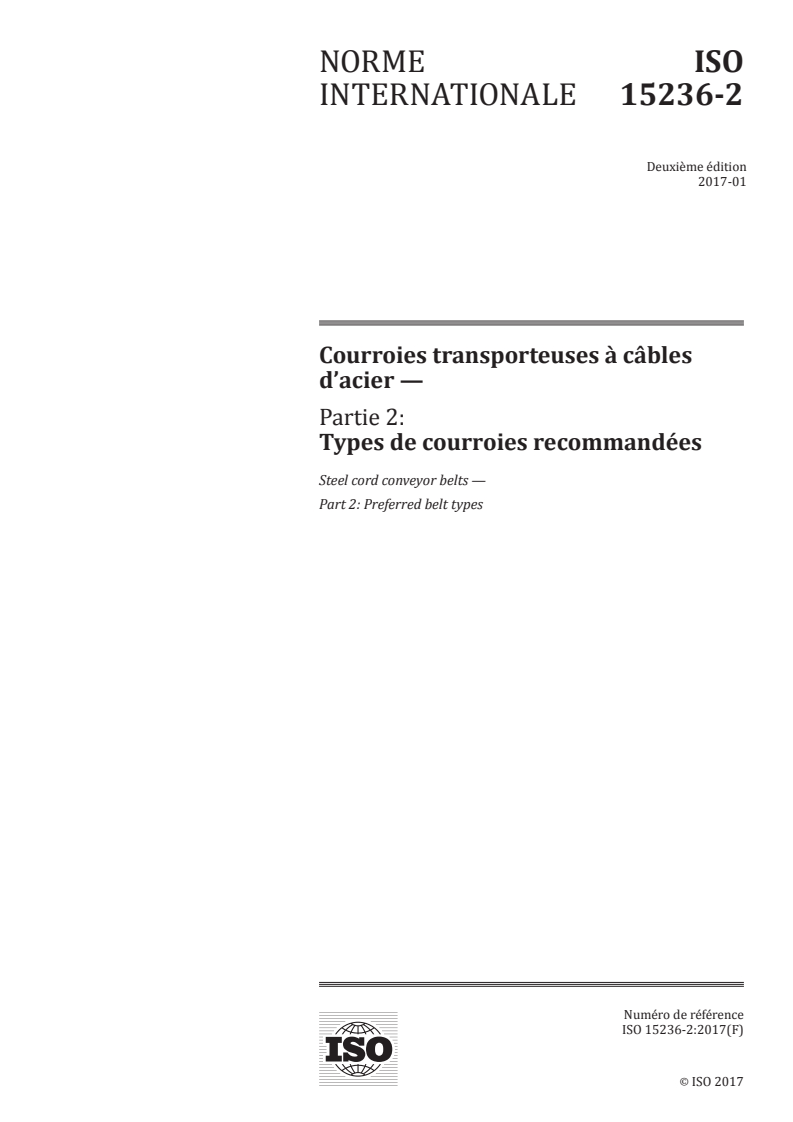
NORME ISO
INTERNATIONALE 15236-2
Deuxième édition
2017-01
Courroies transporteuses à câbles
d’acier —
Partie 2:
Types de courroies recommandées
Steel cord conveyor belts —
Part 2: Preferred belt types
Numéro de référence
©
ISO 2017
DOCUMENT PROTÉGÉ PAR COPYRIGHT
© ISO 2017, Publié en Suisse
Droits de reproduction réservés. Sauf indication contraire, aucune partie de cette publication ne peut être reproduite ni utilisée
sous quelque forme que ce soit et par aucun procédé, électronique ou mécanique, y compris la photocopie, l’affichage sur
l’internet ou sur un Intranet, sans autorisation écrite préalable. Les demandes d’autorisation peuvent être adressées à l’ISO à
l’adresse ci-après ou au comité membre de l’ISO dans le pays du demandeur.
ISO copyright office
Ch. de Blandonnet 8 • CP 401
CH-1214 Vernier, Geneva, Switzerland
Tel. +41 22 749 01 11
Fax +41 22 749 09 47
copyright@iso.org
www.iso.org
ii © ISO 2017 – Tous droits réservés
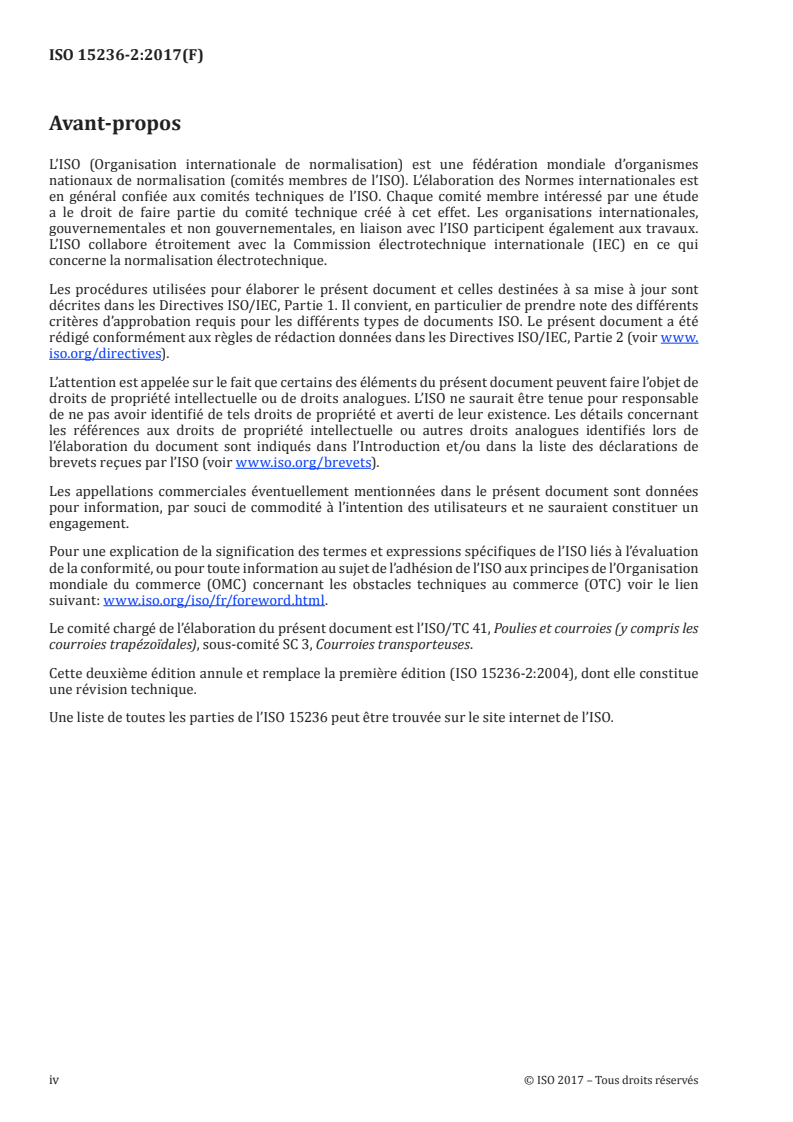
Sommaire Page
Avant-propos .iv
Introduction .v
1 Domaine d’application . 1
2 Références normatives . 1
3 Termes et définitions . 1
4 Symboles et unités . 1
5 Remarques générales . 2
6 Courroies de type A . 3
7 Courroies de type B . 4
8 Courroies de type C . 6
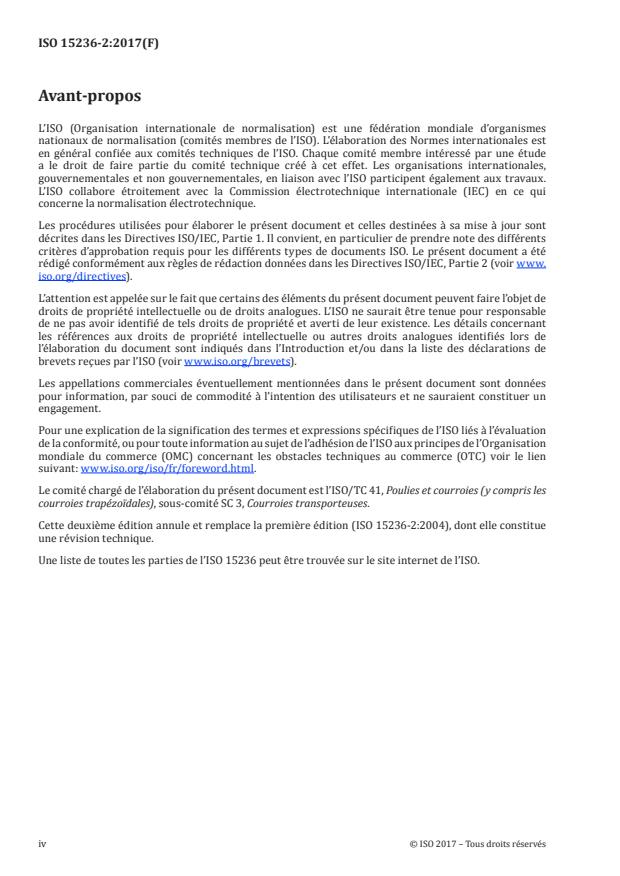
Avant-propos
L’ISO (Organisation internationale de normalisation) est une fédération mondiale d’organismes
nationaux de normalisation (comités membres de l’ISO). L’élaboration des Normes internationales est
en général confiée aux comités techniques de l’ISO. Chaque comité membre intéressé par une étude
a le droit de faire partie du comité technique créé à cet effet. Les organisations internationales,
gouvernementales et non gouvernementales, en liaison avec l’ISO participent également aux travaux.
L’ISO collabore étroitement avec la Commission électrotechnique internationale (IEC) en ce qui
concerne la normalisation électrotechnique.
Les procédures utilisées pour élaborer le présent document et celles destinées à sa mise à jour sont
décrites dans les Directives ISO/IEC, Partie 1. Il convient, en particulier de prendre note des différents
critères d’approbation requis pour les différents types de documents ISO. Le présent document a été
rédigé conformément aux règles de rédaction données dans les Directives ISO/IEC, Partie 2 (voir www.
iso.org/directives).
L’attention est appelée sur le fait que certains des éléments du présent document peuvent faire l’objet de
droits de propriété intellectuelle ou de droits analogues. L’ISO ne saurait être tenue pour responsable
de ne pas avoir identifié de tels droits de propriété et averti de leur existence. Les détails concernant
les références aux droits de propriété intellectuelle ou autres droits analogues identifiés lors de
l’élaboration du document sont indiqués dans l’Introduction et/ou dans la liste des déclarations de
brevets reçues par l’ISO (voir www.iso.org/brevets).
Les appellations commerciales éventuellement mentionnées dans le présent document sont données
pour information, par souci de commodité à l’intention des utilisateurs et ne sauraient constituer un
engagement.
Pour une explication de la signification des termes et expressions spécifiques de l’ISO liés à l’évaluation
de la conformité, ou pour toute information au sujet de l’adhésion de l’ISO aux principes de l’Organisation
mondiale du commerce (OMC) concernant les obstacles techniques au commerce (OTC) voir le lien
suivant: www.iso.org/iso/fr/foreword.html.
Le comité chargé de l’élaboration du présent document est l’ISO/TC 41, Poulies et courroies (y compris les
courroies trapézoïdales), sous-comité SC 3, Courroies transporteuses.
Cette deuxième édition annule et remplace la première édition (ISO 15236-2:2004), dont elle constitue
une révision technique.
Une liste de toutes les parties de l’ISO 15236 peut être trouvée sur le site internet de l’ISO.
iv © ISO 2017 – Tous droits réservés
Introduction
Les courroies transporteuses à câbles d’acier sont principalement des courroies longues qui sont
fabriquées en raccordant des longueurs livrées sur le site. Afin de réaliser des jonctions possédant une
capacité dynamique élevée à partir de courroies fournies par différents fabricants, il est nécessaire de
normaliser certaines caractéristiques, par exemple, l’épaisseur de la carcasse ou le pas et le diamètre
des câbles.
NORME INTERNATIONALE ISO 15236-2:2017(F)
Courroies transporteuses à câbles d’acier —
Partie 2:
Types de courroies recommandées
1 Domaine d’application
Le présent document spécifie les types préférentiels de courroies transporteuses à câbles d’acier placés
dans le sens longitudinal en tant qu’armature. Les séries de types de courroies du présent document
sont basées sur les exigences générales relatives à la construction données dans l’ISO 15236-1.
2 Références normatives
Les documents suivants sont référencés dans le texte de sorte qu’une partie ou la totalité de leur
contenu constitue les exigences du présent document. Pour les références datées, seule l’édition citée
s’applique. Pour les références non datées, la dernière édition du document de référence s’applique (y
compris les éventuels amendements).
ISO 15236-1:2016, Courroies transporteuses à câbles d’acier — Partie 1: Exigences de conception, de
dimensions et mécaniques des courroies transporteuses à usage général
ISO 15236-4, Courroies transporteuses à câbles d’acier — Partie 4: Jonctions vulcanisées des courroies
3 Termes et définitions
Aucun terme n’est défini dans le présent document.
L’ISO et l’IEC maintiennent des bases de données terminologiques pour utilisation dans le domaine de la
normalisation aux adresses suivantes:
— IEC Electropedia: disponible à http://www.electropedia.org/
— ISO Online browsing platform: disponible à http://www.iso.org/obp
4 Symboles et unités
Pour les besoins du présent document, les symboles et les unités donnés dans le Tableau 1 s’appliquent.
Tableau 1 — Symboles et unités
Symbole Explication Unité
B Largeur de la courroie mm
Résistance à la rupture du câble dans la courroie vulcani-
F kN
bs
sée
K Résistance à la rupture nominale par largeur de courroie N/mm
N
b Largeur calculée du talon mm
K
d Diamètre du câble mm
n Nombre de câbles —
s Épaisseur du revêtement mm
S Épaisseur de la carcasse mm
Tableau 1 (suite)
Symbole Explication Unité
t Espacement des câbles/pas mm
Valeur minimale —
min
Valeur maximale —
max
5 Remarques générales
Les types de courroies décrits dans le présent document ont été sélectionnés parmi le nombre illimité
de construction possibles; un grand nombre de courroies de type A et B a été fabriqué et installé.
Ces types de courroies sont conçus de telle manière que les courroies qui présentent une certaine
résistance nominale à la rupture ont des câbles et des pas de câbles identiques, ou au moins des
épaisseurs de carcasse identiques.
Les exigences relatives à la conception des courroies, c’est-à-dire le diamètre et le pas des câbles,
dépendent du type de jonction qui sera utilisé. Conformément à l’ISO 15236-4, il existe trois types de
jonctions vulcanisées:
— jonctions par imbrications échelonnées;
— jonctions par faisceaux échelonnés;
— jonctions en pointes.
Pour les jonctions par imbrications haute performance, il est essentiel que le pas et le diamètre des
câbles des courroies à raccorder soient égaux. Pour les courroies destinées à être raccordées par des
jonctions en pointes, le pas et le diamètre des câbles sont moins importants; l’important est que les
carcasses soient d’épaisseur similaire. C’est pourquoi, dans les Tableaux 2, 3, 4 et 5 le diamètre, le pas et
le nombre de câbles sont uniquement spécifiés pour les types qui sont habituellement raccordés par des
jonctions par imbrications, c’est-à-dire les courroies de type A1, A2 et B2.
Le nombre de câbles indiqué dans les Tableaux 2, 3 et 5 n’est donné qu’à titre indicatif. Il est obtenu à
l’aide de la Formule (1):
KB×
N
n = (1)
min
F ×1000
bs
et de l’exigence selon laquelle la largeur du talon ne doit pas être supérieure à 40 mm ni inférieure à
15 mm, c’est-à-dire:
15 ≤ b ≤ 40
k
Un
...
NORME ISO
INTERNATIONALE 15236-2
Deuxième édition
2017-01
Courroies transporteuses à câbles
d’acier —
Partie 2:
Types de courroies recommandées
Steel cord conveyor belts —
Part 2: Preferred belt types
Numéro de référence
©
ISO 2017
DOCUMENT PROTÉGÉ PAR COPYRIGHT
© ISO 2017, Publié en Suisse
Droits de reproduction réservés. Sauf indication contraire, aucune partie de cette publication ne peut être reproduite ni utilisée
sous quelque forme que ce soit et par aucun procédé, électronique ou mécanique, y compris la photocopie, l’affichage sur
l’internet ou sur un Intranet, sans autorisation écrite préalable. Les demandes d’autorisation peuvent être adressées à l’ISO à
l’adresse ci-après ou au comité membre de l’ISO dans le pays du demandeur.
ISO copyright office
Ch. de Blandonnet 8 • CP 401
CH-1214 Vernier, Geneva, Switzerland
Tel. +41 22 749 01 11
Fax +41 22 749 09 47
copyright@iso.org
www.iso.org
ii © ISO 2017 – Tous droits réservés
Sommaire Page
Avant-propos .iv
Introduction .v
1 Domaine d’application . 1
2 Références normatives . 1
3 Termes et définitions . 1
4 Symboles et unités . 1
5 Remarques générales . 2
6 Courroies de type A . 3
7 Courroies de type B . 4
8 Courroies de type C . 6
Avant-propos
L’ISO (Organisation internationale de normalisation) est une fédération mondiale d’organismes
nationaux de normalisation (comités membres de l’ISO). L’élaboration des Normes internationales est
en général confiée aux comités techniques de l’ISO. Chaque comité membre intéressé par une étude
a le droit de faire partie du comité technique créé à cet effet. Les organisations internationales,
gouvernementales et non gouvernementales, en liaison avec l’ISO participent également aux travaux.
L’ISO collabore étroitement avec la Commission électrotechnique internationale (IEC) en ce qui
concerne la normalisation électrotechnique.
Les procédures utilisées pour élaborer le présent document et celles destinées à sa mise à jour sont
décrites dans les Directives ISO/IEC, Partie 1. Il convient, en particulier de prendre note des différents
critères d’approbation requis pour les différents types de documents ISO. Le présent document a été
rédigé conformément aux règles de rédaction données dans les Directives ISO/IEC, Partie 2 (voir www.
iso.org/directives).
L’attention est appelée sur le fait que certains des éléments du présent document peuvent faire l’objet de
droits de propriété intellectuelle ou de droits analogues. L’ISO ne saurait être tenue pour responsable
de ne pas avoir identifié de tels droits de propriété et averti de leur existence. Les détails concernant
les références aux droits de propriété intellectuelle ou autres droits analogues identifiés lors de
l’élaboration du document sont indiqués dans l’Introduction et/ou dans la liste des déclarations de
brevets reçues par l’ISO (voir www.iso.org/brevets).
Les appellations commerciales éventuellement mentionnées dans le présent document sont données
pour information, par souci de commodité à l’intention des utilisateurs et ne sauraient constituer un
engagement.
Pour une explication de la signification des termes et expressions spécifiques de l’ISO liés à l’évaluation
de la conformité, ou pour toute information au sujet de l’adhésion de l’ISO aux principes de l’Organisation
mondiale du commerce (OMC) concernant les obstacles techniques au commerce (OTC) voir le lien
suivant: www.iso.org/iso/fr/foreword.html.
Le comité chargé de l’élaboration du présent document est l’ISO/TC 41, Poulies et courroies (y compris les
courroies trapézoïdales), sous-comité SC 3, Courroies transporteuses.
Cette deuxième édition annule et remplace la première édition (ISO 15236-2:2004), dont elle constitue
une révision technique.
Une liste de toutes les parties de l’ISO 15236 peut être trouvée sur le site internet de l’ISO.
iv © ISO 2017 – Tous droits réservés
Introduction
Les courroies transporteuses à câbles d’acier sont principalement des courroies longues qui sont
fabriquées en raccordant des longueurs livrées sur le site. Afin de réaliser des jonctions possédant une
capacité dynamique élevée à partir de courroies fournies par différents fabricants, il est nécessaire de
normaliser certaines caractéristiques, par exemple, l’épaisseur de la carcasse ou le pas et le diamètre
des câbles.
NORME INTERNATIONALE ISO 15236-2:2017(F)
Courroies transporteuses à câbles d’acier —
Partie 2:
Types de courroies recommandées
1 Domaine d’application
Le présent document spécifie les types préférentiels de courroies transporteuses à câbles d’acier placés
dans le sens longitudinal en tant qu’armature. Les séries de types de courroies du présent document
sont basées sur les exigences générales relatives à la construction données dans l’ISO 15236-1.
2 Références normatives
Les documents suivants sont référencés dans le texte de sorte qu’une partie ou la totalité de leur
contenu constitue les exigences du présent document. Pour les références datées, seule l’édition citée
s’applique. Pour les références non datées, la dernière édition du document de référence s’applique (y
compris les éventuels amendements).
ISO 15236-1:2016, Courroies transporteuses à câbles d’acier — Partie 1: Exigences de conception, de
dimensions et mécaniques des courroies transporteuses à usage général
ISO 15236-4, Courroies transporteuses à câbles d’acier — Partie 4: Jonctions vulcanisées des courroies
3 Termes et définitions
Aucun terme n’est défini dans le présent document.
L’ISO et l’IEC maintiennent des bases de données terminologiques pour utilisation dans le domaine de la
normalisation aux adresses suivantes:
— IEC Electropedia: disponible à http://www.electropedia.org/
— ISO Online browsing platform: disponible à http://www.iso.org/obp
4 Symboles et unités
Pour les besoins du présent document, les symboles et les unités donnés dans le Tableau 1 s’appliquent.
Tableau 1 — Symboles et unités
Symbole Explication Unité
B Largeur de la courroie mm
Résistance à la rupture du câble dans la courroie vulcani-
F kN
bs
sée
K Résistance à la rupture nominale par largeur de courroie N/mm
N
b Largeur calculée du talon mm
K
d Diamètre du câble mm
n Nombre de câbles —
s Épaisseur du revêtement mm
S Épaisseur de la carcasse mm
Tableau 1 (suite)
Symbole Explication Unité
t Espacement des câbles/pas mm
Valeur minimale —
min
Valeur maximale —
max
5 Remarques générales
Les types de courroies décrits dans le présent document ont été sélectionnés parmi le nombre illimité
de construction possibles; un grand nombre de courroies de type A et B a été fabriqué et installé.
Ces types de courroies sont conçus de telle manière que les courroies qui présentent une certaine
résistance nominale à la rupture ont des câbles et des pas de câbles identiques, ou au moins des
épaisseurs de carcasse identiques.
Les exigences relatives à la conception des courroies, c’est-à-dire le diamètre et le pas des câbles,
dépendent du type de jonction qui sera utilisé. Conformément à l’ISO 15236-4, il existe trois types de
jonctions vulcanisées:
— jonctions par imbrications échelonnées;
— jonctions par faisceaux échelonnés;
— jonctions en pointes.
Pour les jonctions par imbrications haute performance, il est essentiel que le pas et le diamètre des
câbles des courroies à raccorder soient égaux. Pour les courroies destinées à être raccordées par des
jonctions en pointes, le pas et le diamètre des câbles sont moins importants; l’important est que les
carcasses soient d’épaisseur similaire. C’est pourquoi, dans les Tableaux 2, 3, 4 et 5 le diamètre, le pas et
le nombre de câbles sont uniquement spécifiés pour les types qui sont habituellement raccordés par des
jonctions par imbrications, c’est-à-dire les courroies de type A1, A2 et B2.
Le nombre de câbles indiqué dans les Tableaux 2, 3 et 5 n’est donné qu’à titre indicatif. Il est obtenu à
l’aide de la Formule (1):
KB×
N
n = (1)
min
F ×1000
bs
et de l’exigence selon laquelle la largeur du talon ne doit pas être supérieure à 40 mm ni inférieure à
15 mm, c’est-à-dire:
15 ≤ b ≤ 40
k
Un
...