

ISO 6362-4:2022
(Main)Wrought aluminium and aluminium alloys — Extruded rods/bars, tubes and profiles — Part 4: Tolerances on form and dimensions for profiles
General Information
- Abstract
This document specifies the tolerances on dimensions and shape of wrought aluminium and aluminium alloy extruded profiles with a cross-section contained within a circumscribing circle not greater than 800 mm. It is applicable to extruded profiles for general engineering applications only.
- Status
- Published
- Publication Date
- 30-Jun-2022
- Technical Committee
- ISO/TC 79/SC 6 - Wrought aluminium and aluminium alloys
- Drafting Committee
- ISO/TC 79/SC 6 - Wrought aluminium and aluminium alloys
- Current Stage
- 6060 - International Standard published
- Start Date
- 01-Jul-2022
- Due Date
- 05-Apr-2023
- Completion Date
- 01-Jul-2022
Overview
ISO 6362-4:2022 - "Wrought aluminium and aluminium alloys - Extruded rods/bars, tubes and profiles - Part 4: Tolerances on form and dimensions for profiles" - defines the permissible dimensions and geometric form tolerances for extruded aluminium profiles whose cross-section fits within a circumscribing circle up to 800 mm. It applies to extruded profiles for general engineering applications and complements other parts of the ISO 6362 series (notably ISO 6362-1 and ISO 6362-7).
Key topics and technical requirements
- Scope limits: Profiles with a circumscribing circle ≤ 800 mm; general engineering use only.
- Dimensional tolerances: Tables (ordinary and special classes) provide tolerances by nominal section sizes, alloy group and feature type. Tolerance values vary with:
- cross‑section size (A, D etc.),
- whether the profile is solid or hollow,
- alloy group (Group I and Group II as listed in ISO 6362-7),
- and the local geometry (e.g., thin walls, openings).
- Tolerances on form: Requirements and definitions for:
- Straightness
- Convexity / concavity
- Curved cross-section or contour
- Twist
- Angularity
- Corner and fillet radii
- Length and end conditions: Rules for acceptable lengths and squareness of cut ends.
- Special cases & purchaser-supplier agreement:
- When wall-thickness ratios, hollow-space percentages or angled features occur, tolerances can require mutual agreement.
- Purchaser must specify whether ordinary or special tolerances are required and whether outside or inside dimensions are to be controlled.
Practical applications - who uses ISO 6362-4
- Extrusion mills and manufacturers - to set production tolerances and quality targets for extruded aluminium profiles.
- Design and mechanical engineers - to specify realistic tolerances during product design and ensure interchangeability.
- Purchasers and procurement teams - to define inspection and delivery conditions in contracts (ordinary vs special class).
- Quality managers and inspection labs - to verify conformity against the standard’s tolerance tables and form criteria.
- Fabricators and assemblers - to anticipate fit, function and machining allowances when using extruded profiles.
Related standards and references
- ISO 6362 series - other parts cover inspection/delivery (ISO 6362-1) and alloy listings (ISO 6362-7).
- The standard references the ISO/IEC Directives for development and maintenance.
Keywords: ISO 6362-4, aluminium extruded profiles tolerances, tolerances on form and dimensions, wrought aluminium, extrusion tolerances, aluminium alloys, profile tolerances.
Relations
- Consolidated By
ISO/FDIS 14116 - Protective clothing — Protection against flame — Limited flame spread materials, material assemblies and clothing - Effective Date
- 08-Oct-2022
- Effective Date
- 23-Apr-2020
Get Certified
Connect with accredited certification bodies for this standard

Element Materials Technology
Materials testing and product certification.

Inštitut za kovinske materiale in tehnologije
Institute of Metals and Technology. Materials testing, metallurgical analysis, NDT.
Sponsored listings
Frequently Asked Questions
ISO 6362-4:2022 is a standard published by the International Organization for Standardization (ISO). Its full title is "Wrought aluminium and aluminium alloys — Extruded rods/bars, tubes and profiles — Part 4: Tolerances on form and dimensions for profiles". This standard covers: This document specifies the tolerances on dimensions and shape of wrought aluminium and aluminium alloy extruded profiles with a cross-section contained within a circumscribing circle not greater than 800 mm. It is applicable to extruded profiles for general engineering applications only.
This document specifies the tolerances on dimensions and shape of wrought aluminium and aluminium alloy extruded profiles with a cross-section contained within a circumscribing circle not greater than 800 mm. It is applicable to extruded profiles for general engineering applications only.
ISO 6362-4:2022 is classified under the following ICS (International Classification for Standards) categories: 77.150.10 - Aluminium products. The ICS classification helps identify the subject area and facilitates finding related standards.
ISO 6362-4:2022 has the following relationships with other standards: It is inter standard links to ISO/FDIS 14116, ISO 6362-4:2012. Understanding these relationships helps ensure you are using the most current and applicable version of the standard.
ISO 6362-4:2022 is available in PDF format for immediate download after purchase. The document can be added to your cart and obtained through the secure checkout process. Digital delivery ensures instant access to the complete standard document.
Standards Content (Sample)
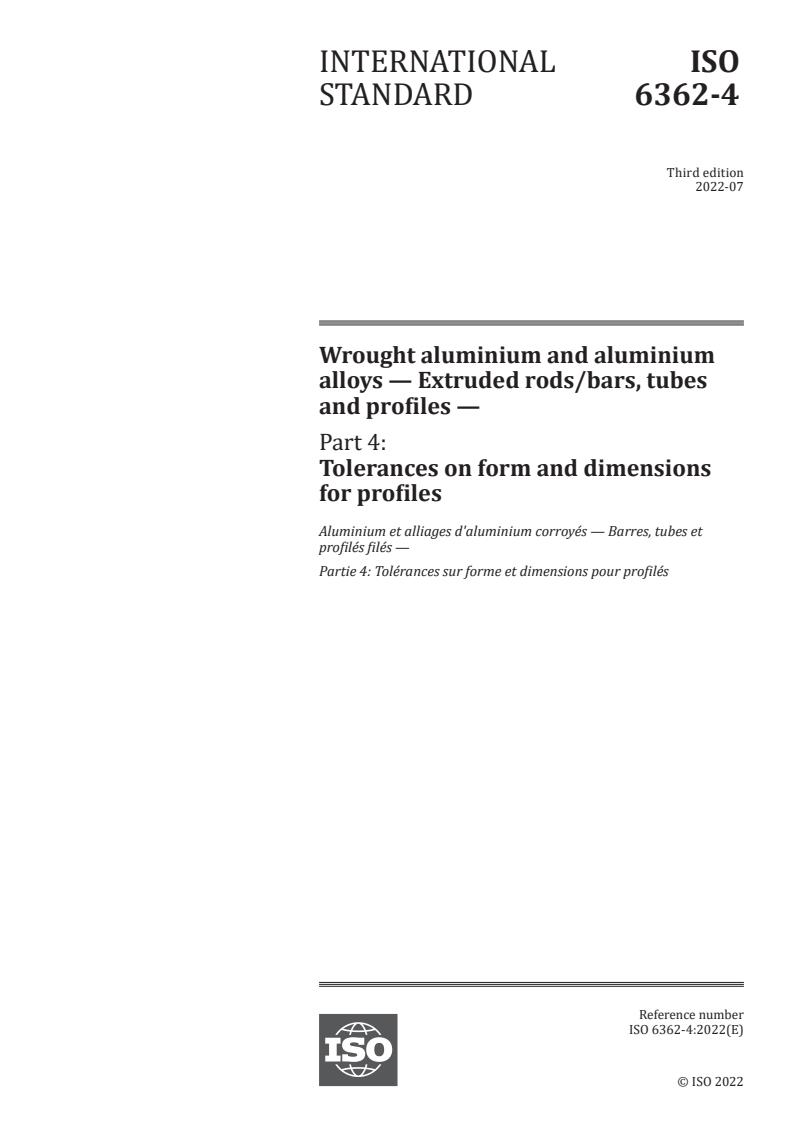
INTERNATIONAL ISO
STANDARD 6362-4
Third edition
2022-07
Wrought aluminium and aluminium
alloys — Extruded rods/bars, tubes
and profiles —
Part 4:
Tolerances on form and dimensions
for profiles
Aluminium et alliages d'aluminium corroyés — Barres, tubes et
profilés filés —
Partie 4: Tolérances sur forme et dimensions pour profilés
Reference number
© ISO 2022
All rights reserved. Unless otherwise specified, or required in the context of its implementation, no part of this publication may
be reproduced or utilized otherwise in any form or by any means, electronic or mechanical, including photocopying, or posting on
the internet or an intranet, without prior written permission. Permission can be requested from either ISO at the address below
or ISO’s member body in the country of the requester.
ISO copyright office
CP 401 • Ch. de Blandonnet 8
CH-1214 Vernier, Geneva
Phone: +41 22 749 01 11
Email: copyright@iso.org
Website: www.iso.org
Published in Switzerland
ii
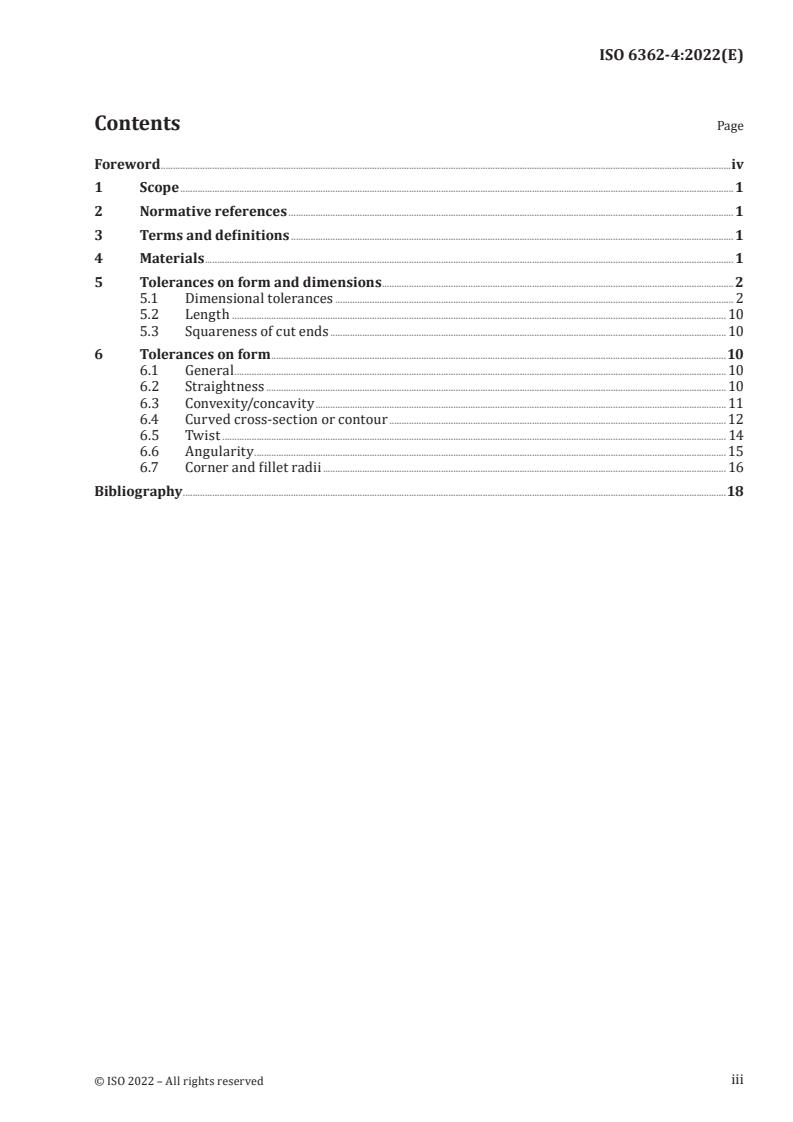
Contents Page
Foreword .iv
1 Scope . 1
2 Normative references . 1
3 Terms and definitions . 1
4 Materials . 1
5 Tolerances on form and dimensions .2
5.1 Dimensional tolerances . 2
5.2 Length . 10
5.3 Squareness of cut ends . 10
6 Tolerances on form .10
6.1 General . 10
6.2 Straightness . 10
6.3 Convexity/concavity . 11
6.4 Curved cross-section or contour .12
6.5 Twist . 14
6.6 Angularity . 15
6.7 Corner and fillet radii . 16
Bibliography .18
iii
Foreword
ISO (the International Organization for Standardization) is a worldwide federation of national standards
bodies (ISO member bodies). The work of preparing International Standards is normally carried out
through ISO technical committees. Each member body interested in a subject for which a technical
committee has been established has the right to be represented on that committee. International
organizations, governmental and non-governmental, in liaison with ISO, also take part in the work.
ISO collaborates closely with the International Electrotechnical Commission (IEC) on all matters of
electrotechnical standardization.
The procedures used to develop this document and those intended for its further maintenance are
described in the ISO/IEC Directives, Part 1. In particular, the different approval criteria needed for the
different types of ISO documents should be noted. This document was drafted in accordance with the
editorial rules of the ISO/IEC Directives, Part 2 (see www.iso.org/directives).
Attention is drawn to the possibility that some of the elements of this document may be the subject of
patent rights. ISO shall not be held responsible for identifying any or all such patent rights. Details of
any patent rights identified during the development of the document will be in the Introduction and/or
on the ISO list of patent declarations received (see www.iso.org/patents).
Any trade name used in this document is information given for the convenience of users and does not
constitute an endorsement.
For an explanation of the voluntary nature of standards, the meaning of ISO specific terms and
expressions related to conformity assessment, as well as information about ISO’s adherence to
the World Trade Organization (WTO) principles in the Technical Barriers to Trade (TBT), see
www.iso.org/iso/foreword.html.
This document was prepared by Technical Committee ISO/TC 79, Light metals and their alloys,
Subcommittee SC 6, Wrought aluminium and aluminium alloys.
This third edition cancels and replaces the second edition (ISO 6362-4:2012), which has been technically
revised. The main changes are as follows:
— errors have been corrected and expressions modified throughout.
A list of all parts in the ISO 6362 series can be found on the ISO website.
Any feedback or questions on this document should be directed to the user’s national standards body. A
complete listing of these bodies can be found at www.iso.org/members.html.
iv
INTERNATIONAL STANDARD ISO 6362-4:2022(E)
Wrought aluminium and aluminium alloys — Extruded
rods/bars, tubes and profiles —
Part 4:
Tolerances on form and dimensions for profiles
1 Scope
This document specifies the tolerances on dimensions and shape of wrought aluminium and aluminium
alloy extruded profiles with a cross-section contained within a circumscribing circle not greater than
800 mm.
It is applicable to extruded profiles for general engineering applications only.
2 Normative references
The following documents are referred to in the text in such a way that some or all of their content
constitutes requirements of this document. For dated references, only the edition cited applies. For
undated references, the latest edition of the referenced document (including any amendments) applies.
ISO 6362-1, Wrought aluminium and aluminium alloys — Extruded rods/bars, tubes and profiles — Part 1:
Technical conditions for inspection and delivery
3 Terms and definitions
For the purposes of this document, the terms and definitions given in ISO 6362-1 and the following
apply.
ISO and IEC maintain terminology databases for use in standardization at the following addresses:
— ISO Online browsing platform: available at https:// www .iso .org/ obp
— IEC Electropedia: available at https:// www .electropedia .org/
3.1
circumscribing circle
smallest circle which encloses entirely the cross-section of the shape
Note 1 to entry: This dimension may have to be increased when shapes are subjected to corrections of the uneven
thickness or in the case of hollow shapes for which the centre of the circumscribing circle needs to be considered,
based on the void. These matters should be confirmed with the supplier beforehand as required.
4 Materials
Alloys mentioned in this document are listed in ISO 6362-7.
NOTE Four-digit numerical designations are completely identical with Registration of International Alloy
Designations and Chemical Composition Limits for Wrought Aluminum and Wrought Aluminum Alloys (known
[1]
as “Teal sheets”) .
For the purposes of this document, wrought aluminium and aluminium alloys are divided into two
groups, which correspond to varying difficulty when manufacturing the products.
The division of the most commonly alloys used in general engineering into Group I and Group II is
specified in Table 1 and Table 2, respectively.
Grouping of other alloys is subject to agreement between the purchaser and the supplier.
Table 1 — Alloy Group I
Alloy system Alloy number
Pure aluminium 1070, 1070A, 1060, 1050, 1050A, 1100, 1200, 1350
Al-Mn system alloy 3021, 3003, 3102, 3103, 3203
Al-Mg system alloy 5005, 5005A, 5051A, 5251
Al-Mg-Si system alloy 6005, 6005A, 6005C, 6008, 6012, 6014, 6018, 6023, 6060, 6061, 6063, 6063A, 6065,
6081, 6082, 6182, 6101, 6101A, 6101B, 6106, 6110A, 6261, 6262, 6262A, 6351, 6360, 6463
Table 2 — Alloy Group II (all aluminium alloys except those given in alloy Group I)
Alloy system Alloy number
Al-Mg system alloy 5019, 5049, 5052, 5083, 5086, 5154A, 5454, 5754
Al-Cu-Mg system alloy 2007, 2014, 2014A, 2017, 2017A, 2024, 2030
Al-Zn-Mg system alloy 7204, 7003, 7005, 7020, 7021, 7022, 7049A, 7050, 7075, 7108, 7108A
5 Tolerances on form and dimensions
5.1 Dimensional tolerances
Tolerances on dimensions (see Figures 1 and 2) are specified in Tables 3 to 5.
The tolerances to be applied to the sectional dimensions as shown in Figure 1, where the nominal
thickness of one wall is equal to or greater than three times the thickness of the other wall, t, shall be
agreed between the purchaser and the supplier, see Figure 1 b) to e).
The purchaser should specify whether ordinary or special tolerances are required.
In the case of angled shapes as shown in Figure 3, the tolerances shall be decided not on the base of the
length of dimension X, but on the base of the angle α (see 6.6).
Even when value Y in Figure 3 is equal to or greater than 75 % of value X, these tolerances are not
applied to the dimension X or Z. The tolerances for X and Y shall conform to the column corresponding
to space dimension Ci and Ce depending on the distance from the reference base.
a)
b) c) d) e)
Key
A to A dimensions of metallic parts except the thickness of wall surface at hollow place (B)
1 5
B to B thickness of wall surface at hollow place
1 4
C , C dimensions of empty space at opening
e i
D dimensions of empty space at hollow place
Figure 1 — Sectional dimensions
Key
α , α distance between specified point and root of let
1 2
Figure 2 — Definition of α , α on sectional dimensions
1 2
Figure 3 — Sectional dimensions
Table 3 — Tolerance (ordinary class) on sectional dimensions
Dimensions in millimetres
a
Tolerance
Metallic part Hollow part (where more than 25 % is hollow space, i.e. less than 75 % is metal)
b
(where 75 % or more is metal) C or C
i e
Dimension at
Diameter of
d
Metallic part other Thickness of Distance between specified point and root of let α
specified part
circumscribing
than that in the right wall surface at
circle
c
column hollow part
5 < α ≤ 15 15 < α ≤ 30 30 < α ≤ 60 60 < α ≤ 100 100 < α ≤ 150 150 < α ≤ 200
A , A B
1 2
Alloy Group I II I II I II I II I II I II I II I II
A ≤ 3,20 ±0,23 ±0,35 ±0,33 ±0,43 ±0,38 ±0,48 — — — — — — — —
3,20 < A ≤ 6,30 ±0,27 ±0,42 ±0,39 ±0,53 ±0,45 ±0,58 ±0,51 ±0,64 — — — — — —
6,30 < A ≤ 12,50 ±0,30 ±0,45 ±0,47 ±0,60 ±0,51 ±0,64 ±0,58 ±0,70 ±0,61 ±0,73 — — — —
12,50 < A ≤ 20,00 ±0,35 ±0,54 ±15 % ±20 % ±0,53 ±0,69 ±0,58 ±0,73 ±0,64 ±0,80 ±0,67 ±0,83 — — — —
but but
20,00 < A ≤ 25,00 ±0,38 ±0,57 ±0,60 ±0,75 ±0,64 ±0,80 ±0,70 ±0,86 ±0,77 ±0,91 ±0,89 ±1,0 — —
±2,3 ±3,4
250 ≤ D 25,00 < A ≤ 40,00 ±0,45 ±0,69 ±0,69 ±0,90 ±0,73 ±0,93 ±0,83 ±1,0 ±0,91 ±1,1 ±1,0 ±1,2 — —
max. max.
40,00 < A ≤ 50,00 ±0,54 ±0,80 ±0,79 ±1,0 ±0,83 ±1,1 ±0,99 ±1,2 ±1,1 ±1,3 ±1,2 ±1,4 ±1,4 ±1,7
±0,38 ±0,57
50,00 < A ≤ 100,00 ±0,92 ±1,4 min. min. ±1,1 ±1,5 ±1,2 ±1,6 ±1,5 ±1,9 ±1,7 ±2,1 ±2,0 ±2,4 ±2,3 ±2,7
100,00 < A ≤ 150,00 ±1,3 ±2,0 ±1,5 ±2,0 ±1,6 ±2,1 ±2,0 ±2,6 ±2,4 ±2,9 ±2,8 ±3,3 ±3,2 ±3,7
150,00 < A ≤ 200,00 ±1,7 ±2,5 ±1,8 ±2,5 ±2,0 ±2,7 ±2,6 ±3,3 ±3,0 ±3,7 ±3,6 ±4,2 ±4,1 ±4,7
200,00 < A ≤ 250,00 ±2,1 ±3,1 ±2,1 ±3,0 ±2,4 ±3,2 ±3,2 ±4,0 ±3,7 ±4,5 ±4,3 ±5,4 ±4,9 ±5,7
A ≤ 3,20 ±0,54 ±0,80 ±0,64 ±0,90 ±0,69 ±0,93 — — — — — — — —
3,20 < A ≤ 6,30 ±0,57 ±0,84 ±0,67 ±0,92 ±0,76 ±1,0 ±0,89 ±1,1 — — — — — —
6,30 < A ≤ 12,50 ±0,62 ±0,92 ±0,71 ±0,99 ±0,82 ±1,1 ±0,95 ±1,2 ±1,5 ±1,7 — — — —
12,50 < A ≤ 20,00 ±0,65 ±0,96 ±20 % ±20 % ±0,78 ±1,1 ±0,93 ±1,2 ±1,3 ±1,6 ±1,7 ±2,0 — — — —
but but
20,00 < A ≤ 25,00 ±0,69 ±1,0 ±0,81 ±1,1 ±1,0 ±1,3 ±1,6 ±1,8 ±2,0 ±2,3 ±2,7 ±2,9 — —
±3,4 ±3,4
250 < D ≤ 800 25,00 < A ≤ 40,00 ±0,72 ±1,1 ±0,85 ±1,2 ±1,2 ±1,5 ±1,9 ±2,2 ±2,3 ±2,6 ±3,0 ±3,2 — —
max. max.
40,00 < A ≤ 50,00 ±0,92 ±1,4 ±1,2 ±1,6 ±1,5 ±1,9 ±2,2 ±2,6 ±2,6 ±3,0 ±3,3 ±3,6 ±4,6 ±4,9
±0,57 ±0,95
50,00 < A ≤ 100,00 ±1,3 ±2,0 min. min. ±1,6 ±2,2 ±1,8 ±2,4 ±2,5 ±3,1 ±2,9 ±3,4 ±3,6 ±4,1 ±4,9 ±5,4
100,00 < A ≤ 150,00 ±1,7 ±2,5 ±1,9 ±2,7 ±2,2 ±2,9 ±2,9 ±3,6 ±3,2 ±3,9 ±3,8 ±4,5 ±5,2 ±5,8
150,00 < A ≤ 200,00 ±2,1 ±3,1 ±2,3 ±3,2 ±2,5 ±3,5 ±3,2 ±4,0 ±3,5 ±4,3 ±4,1 ±4,9 ±5,4 ±6,2
200,00 < A ≤ 250,00 ±2,4 ±3,7 ±2,6 ±3,8 ±2,9 ±4,0 ±3,5 ±4,5 ±3,8 ±4,7 ±4,4 ±5,4 ±5,7 ±6,6
Table 3 (continued)
a
Tolerance
Metallic part Hollow part (where more than 25 % is hollow space, i.e. less than 75 % is metal)
b
(where 75 % or more is metal) C or C
i e
Dimension at
Diameter of
d
Metallic part other Thickness of Distance between specified point and root of let α
specified part
circumscribing
than that in the right wall surface at
circle
c
column hollow part
5 < α ≤ 15 15 < α ≤ 30 30 < α ≤ 60 60 < α ≤ 100 100 < α ≤ 150 150 < α ≤ 200
A , A B
1 2
Alloy Group I II I II I II I II I II I II I II I II
250,00 < A ≤ 300,00 ±2,8 ±4,2 ±3,0 ±4,3 ±3,2 ±4,5 ±3,8 ±5,0 ±4,1 ±5,2 ±4,7 ±5,8 ±6,0 ±7,0
300,00 < A ≤ 350,00 ±3,2 ±4,8 ±20 % ±20 % ±3,3 ±4,8 ±3,6 ±5,0 ±4,1 ±5,5 ±4,4 ±5,6 ±5,0 ±6,3 ±6,2 ±7,4
but but
350,00 < A ≤ 400,00 ±3,6 ±5,4 ±3,7 ±5,4 ±3,9 ±5,5 ±4,5 ±5,9 ±4,7 ±6,0 ±5,3 ±6,7 ±6,5 ±7,8
±3,4 ±3,4
250 < D ≤ 800 400,00 < A ≤ 450,00 ±4,0 ±5,9 ±4,1 ±5,9 ±4,3 ±6,0 ±4,8 ±6,4 ±5,0 ±6,5 ±5,6 ±7,2 ±6,8 ±8,2
max. max.
450,00 < A ≤ 500,00 ±4,4 ±6,5 ±4,4 ±6,4 ±4,6 ±6,5 ±5,1 ±6,9 ±5,3 ±6,9 ±5,9 ±7,6 ±7,1 ±8,6
±0,57 ±0,95
500,00 < A ≤ 550,00 ±4,7 ±7,1 min. min. ±4,8 ±7,0 ±4,9 ±7,1 ±5,4 ±7,4 ±5,6 ±7,4 ±6,2 ±8,1 ±7,3 ±9,0
550,00 < A ≤ 800,00
...