


ISO 14520-1:2006
(Main)Gaseous fire-extinguishing systems — Physical properties and system design — Part 1: General requirements
Gaseous fire-extinguishing systems — Physical properties and system design — Part 1: General requirements
ISO 14520-1:2005 specifies requirements and gives recommendations for the design, installation, testing, maintenance and safety of gaseous fire fighting systems in buildings, plant or other structures, and the characteristics of the various extinguishants and types of fire for which they are a suitable extinguishing medium. It covers total flooding systems primarily related to buildings, plant and other specific applications, utilizing electrically non-conducting gaseous fire extinguishants that do not leave a residue after discharge and for which there are sufficient data currently available to enable validation of performance and safety characteristics by an appropriate independent authority. ISO 14520-1:2005 is not applicable to explosion suppression. ISO 14520-1:2005 is not intended to indicate approval of the extinguishants listed therein by the appropriate authorities, as other extinguishants may be equally acceptable. CO2 is not included as it is covered by other International Standards.
Systèmes d'extinction d'incendie utilisant des agents gazeux — Propriétés physiques et conception des systèmes — Partie 1: Exigences générales
Naprave za gašenje s plinom - Fizikalne lastnosti in projektiranje - 1. del: Splošne zahteve
General Information
- Status
- Withdrawn
- Publication Date
- 14-Feb-2006
- Withdrawal Date
- 14-Feb-2006
- Technical Committee
- ISO/TC 21/SC 8 - Gaseous media and firefighting systems using gas
- Drafting Committee
- ISO/TC 21/SC 8 - Gaseous media and firefighting systems using gas
- Current Stage
- 9599 - Withdrawal of International Standard
- Start Date
- 08-Dec-2015
- Completion Date
- 12-Feb-2026
Relations
- Consolidated By
ISO 6506-2:2014 - Metallic materials — Brinell hardness test — Part 2: Verification and calibration of testing machines - Effective Date
- 06-Jun-2022
- Effective Date
- 12-Feb-2014
- Effective Date
- 03-Oct-2009
- Effective Date
- 15-Apr-2008
- Effective Date
- 15-Apr-2008







Get Certified
Connect with accredited certification bodies for this standard

NSF International
Global independent organization facilitating standards development and certification.

CIS Institut d.o.o.
Personal Protective Equipment (PPE) certification body. Notified Body NB-2890 for EU Regulation 2016/425 PPE.

Kiwa BDA Testing
Building and construction product certification.
Sponsored listings
Frequently Asked Questions
ISO 14520-1:2006 is a standard published by the International Organization for Standardization (ISO). Its full title is "Gaseous fire-extinguishing systems — Physical properties and system design — Part 1: General requirements". This standard covers: ISO 14520-1:2005 specifies requirements and gives recommendations for the design, installation, testing, maintenance and safety of gaseous fire fighting systems in buildings, plant or other structures, and the characteristics of the various extinguishants and types of fire for which they are a suitable extinguishing medium. It covers total flooding systems primarily related to buildings, plant and other specific applications, utilizing electrically non-conducting gaseous fire extinguishants that do not leave a residue after discharge and for which there are sufficient data currently available to enable validation of performance and safety characteristics by an appropriate independent authority. ISO 14520-1:2005 is not applicable to explosion suppression. ISO 14520-1:2005 is not intended to indicate approval of the extinguishants listed therein by the appropriate authorities, as other extinguishants may be equally acceptable. CO2 is not included as it is covered by other International Standards.
ISO 14520-1:2005 specifies requirements and gives recommendations for the design, installation, testing, maintenance and safety of gaseous fire fighting systems in buildings, plant or other structures, and the characteristics of the various extinguishants and types of fire for which they are a suitable extinguishing medium. It covers total flooding systems primarily related to buildings, plant and other specific applications, utilizing electrically non-conducting gaseous fire extinguishants that do not leave a residue after discharge and for which there are sufficient data currently available to enable validation of performance and safety characteristics by an appropriate independent authority. ISO 14520-1:2005 is not applicable to explosion suppression. ISO 14520-1:2005 is not intended to indicate approval of the extinguishants listed therein by the appropriate authorities, as other extinguishants may be equally acceptable. CO2 is not included as it is covered by other International Standards.
ISO 14520-1:2006 is classified under the following ICS (International Classification for Standards) categories: 13.220.10 - Fire-fighting. The ICS classification helps identify the subject area and facilitates finding related standards.
ISO 14520-1:2006 has the following relationships with other standards: It is inter standard links to ISO 6506-2:2014, ISO/TS 20885:2003, ISO 14520-1:2015, ISO 14520-1:2000, ISO 14520-1:2000/Cor 1:2002. Understanding these relationships helps ensure you are using the most current and applicable version of the standard.
ISO 14520-1:2006 is available in PDF format for immediate download after purchase. The document can be added to your cart and obtained through the secure checkout process. Digital delivery ensures instant access to the complete standard document.
Standards Content (Sample)
INTERNATIONAL ISO
STANDARD 14520-1
Second edition
2006-02-15
Gaseous fire-extinguishing systems —
Physical properties and system design —
Part 1:
General requirements
Systèmes d'extinction d'incendie utilisant des agents gazeux —
Propriétés physiques et conception des systèmes —
Partie 1: Exigences générales
Reference number
©
ISO 2006
PDF disclaimer
This PDF file may contain embedded typefaces. In accordance with Adobe's licensing policy, this file may be printed or viewed but shall
not be edited unless the typefaces which are embedded are licensed to and installed on the computer performing the editing. In
downloading this file, parties accept therein the responsibility of not infringing Adobe's licensing policy. The ISO Central Secretariat
accepts no liability in this area.
Adobe is a trademark of Adobe Systems Incorporated.
Details of the software products used to create this PDF file can be found in the General Info relative to the file; the PDF-creation
parameters were optimized for printing. Every care has been taken to ensure that the file is suitable for use by ISO member bodies. In the
unlikely event that a problem relating to it is found, please inform the Central Secretariat at the address given below.
All rights reserved. Unless otherwise specified, no part of this publication may be reproduced or utilized in any form or by any means,
electronic or mechanical, including photocopying and microfilm, without permission in writing from either ISO at the address below or
ISO's member body in the country of the requester.
ISO copyright office
Case postale 56 CH-1211 Geneva 20
Tel. + 41 22 749 01 11
Fax + 41 22 749 09 47
E-mail copyright@iso.org
Web www.iso.org
Published in Switzerland
©
ii ISO 2006 – All rights reserved
Contents Page
1 Scope . 1
2 Normative references . 2
3 Terms and definitions . 2
4 Use and limitations . 5
5 Safety . 7
6 System design . 10
7 Extinguishant system design . 16
8 Commissioning and acceptance . 24
9 Inspection, maintenance, testing and training . 27
Annex A (normative) Working documents . 30
Annex B (normative) Determination of flame-extinguishing concentration of gaseous
extinguishants by the cup burner method . 32
Annex C (normative) Fire extinguishment/area coverage fire test procedure for engineered
and pre-engineered extinguishing units . 38
Annex D (normative) Method of evaluating inerting concentration of a fire extinguishant . 58
Annex E (normative) Door fan test for determining of minimum hold time . 60
Annex F (informative) System performance verification . 75
Annex G (informative) Safe personnel exposure guidelines . 76
Annex H (informative) Flow calculation implementation method and flow calculation verification
and testing for approvals . 83
©
ISO 2006 – All rights reserved iii
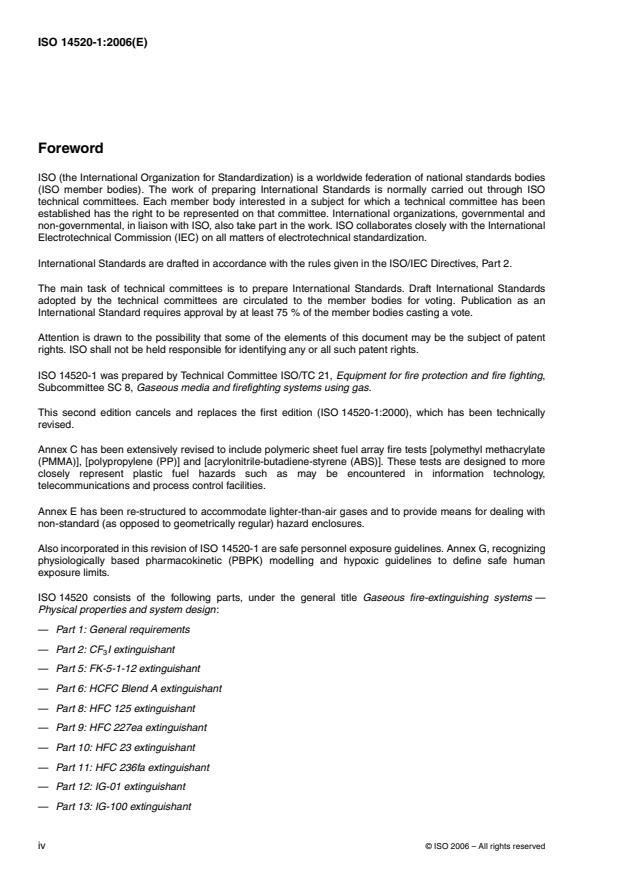
Foreword
ISO (the International Organization for Standardization) is a worldwide federation of national standards bodies
(ISO member bodies). The work of preparing International Standards is normally carried out through ISO
technical committees. Each member body interested in a subject for which a technical committee has been
established has the right to be represented on that committee. International organizations, governmental and
non-governmental, in liaison with ISO, also take part in the work. ISO collaborates closely with the International
Electrotechnical Commission (IEC) on all matters of electrotechnical standardization.
International Standards are drafted in accordance with the rules given in the ISO/IEC Directives, Part 2.
The main task of technical committees is to prepare International Standards. Draft International Standards
adopted by the technical committees are circulated to the member bodies for voting. Publication as an
International Standard requires approval by at least 75 % of the member bodies casting a vote.
Attention is drawn to the possibility that some of the elements of this document may be the subject of patent
rights. ISO shall not be held responsible for identifying any or all such patent rights.
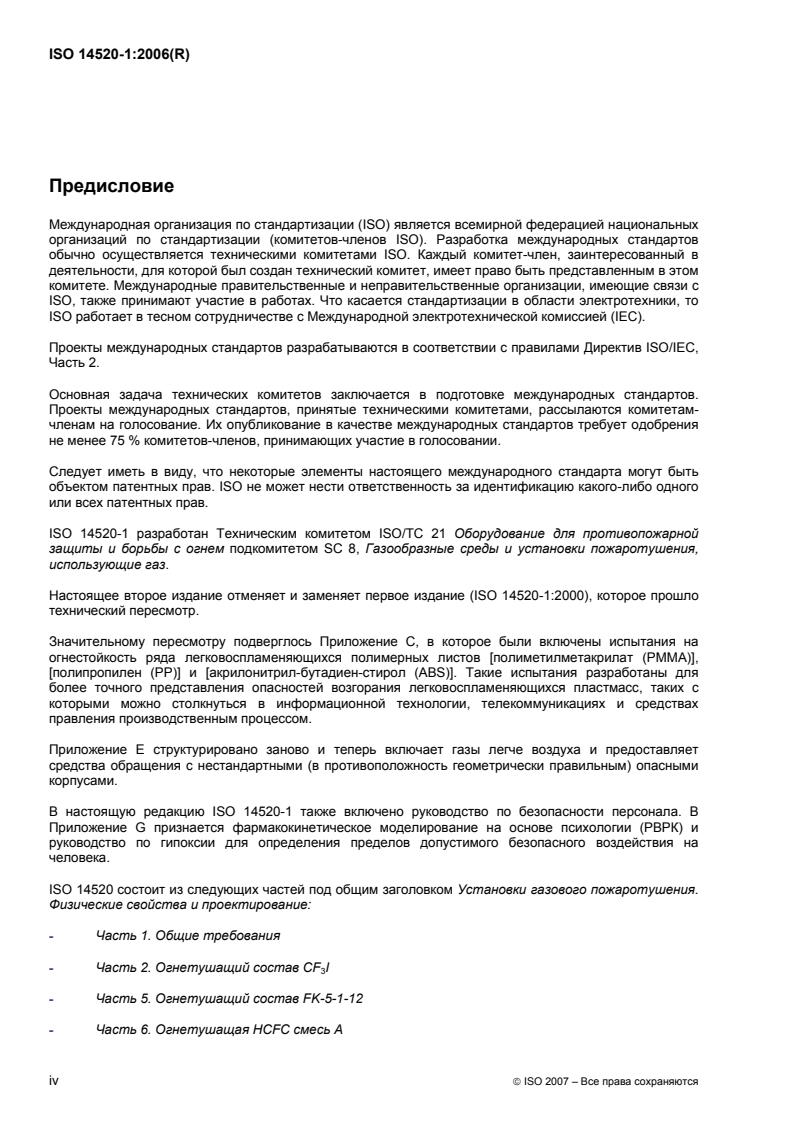
ISO 14520-1 was prepared by Technical Committee ISO/TC 21, Equipment for fire protection and fire fighting,
Subcommittee SC 8, Gaseous media and firefighting systems using gas.
This second edition cancels and replaces the first edition (ISO 14520-1:2000), which has been technically
revised.
Annex C has been extensively revised to include polymeric sheet fuel array fire tests [polymethyl methacrylate
(PMMA)], [polypropylene (PP)] and [acrylonitrile-butadiene-styrene (ABS)]. These tests are designed to more
closely represent plastic fuel hazards such as may be encountered in information technology,
telecommunications and process control facilities.
Annex E has been re-structured to accommodate lighter-than-air gases and to provide means for dealing with
non-standard (as opposed to geometrically regular) hazard enclosures.
Also incorporated in this revision of ISO 14520-1 are safe personnel exposure guidelines. Annex G, recognizing
physiologically based pharmacokinetic (PBPK) modelling and hypoxic guidelines to define safe human
exposure limits.
ISO 14520 consists of the following parts, under the general title Gaseous fire-extinguishing systems —
Physical properties and system design:
— Part 1: General requirements
— Part 2: CF I extinguishant
— Part 5: FK-5-1-12 extinguishant
— Part 6: HCFC Blend A extinguishant
— Part 8: HFC 125 extinguishant
— Part 9: HFC 227ea extinguishant
— Part 10: HFC 23 extinguishant
— Part 11: HFC 236fa extinguishant
— Part 12: IG-01 extinguishant
— Part 13: IG-100 extinguishant
©
iv ISO 2006 – All rights reserved
— Part 14: IG-55 extinguishant
— Part 15: IG-541 extinguishant
Parts 3, 4 and 7, which dealt with FC-2-1-8, FC-3-1-10 and HCFC 124 extinguishants, respectively, have been
withdrawn, as these types are no longer manufactured.
©
ISO 2006 – All rights reserved v
Introduction
Fire fighting systems covered in this part of ISO14520 are designed to provide a supply of gaseous
extinguishing medium for the extinction of fire.
Several different methods of supplying extinguishant to, and applying it at, the required point of discharge for fire
extinction have been developed in recent years, and there is a need for dissemination of information on
established systems and methods. This part of ISO 14520 has been prepared to meet this need.
In particular, new requirements to eliminate the need to release extinguishants during testing and
commissioning procedures are included. These are linked to the inclusion of enclosure integrity testing.
The requirements of this part of ISO 14520 are made in the light of the best technical data known to the working
group at the time of writing but, since a wide field is covered, it has been impracticable to consider every
possible factor or circumstance that might affect implementation of the recommendations.
It has been assumed in the preparation of this part of ISO 14520 that the execution of its provisions is entrusted
to people appropriately qualified and experienced in the specification, design, installation, testing, approval,
inspection, operation and maintenance of systems and equipment, for whose guidance it has been prepared,
and who can be expected to exercise a duty of care to avoid unnecessary release of extinguishant.
Attention is drawn to the Montreal Protocol on substances that deplete the ozone layer.
It is important that the fire protection of a building or plant be considered as a whole. Gaseous extinguishant
systems form only a part, though an important part, of the available facilities, but it should not be assumed that
their adoption necessarily removes the need to consider supplementary measures, such as the provision of
portable fire extinguishers or other mobile appliances for first aid or emergency use, or to deal with special
hazards.
Gaseous extinguishants have for many years been a recognized effective medium for the extinction of
inflammable liquid fires and fires in the presence of electrical and ordinary Class A hazards, but it should not be
forgotten, in the planning of comprehensive schemes, that there may be hazards for which these media are not
suitable, or that in certain circumstances or situations there may be dangers in their use requiring special
precautions.
Advice on these matters can be obtained from the appropriate manufacturer of the extinguishant or the
extinguishing system. Information may also be sought from the appropriate fire authority, the health and safety
authorities and insurers. In addition, reference should be made as necessary to other national standards and
statutory regulations of the particular country.
It is essential that fire fighting equipment be carefully maintained to ensure instant readiness when required.
Routine maintenance is liable to be overlooked or given insufficient attention by the owner of the system. It is,
however, neglected at peril to the lives of occupants of the premises and at the risk of crippling financial loss.
The importance of maintenance cannot be too highly emphasized. Installation and maintenance should only be
done by qualified personnel.
Inspection preferably by a third party, should include an evaluation that the extinguishing system continues to
provide adequate protection for the risk (protected zones as well as state of the art can change over time).
The test protocol contained in Annex C of this part of ISO 14520 was developed by a special working group of
ISO/TC 21/SC 8. Annex C deals with the tests for determination of the extinguishing concentrations and system
performance and they are designed in such a way to allow individual installers to use his/her/system and carry
out all of the extinguishing tests. The need for the tests presented in Annex C was established by the fact that
the previously used Class A fire test involved wood crib, heptane pan and heptane can test fires in an enclosure
of 100 m , and did not necessarily indicate extinguishing concentrations suitable for the protection of plastic fuel
©
vi ISO 2006 – All rights reserved
hazards such as may be encountered in information technology, telecommunications and process control
facilities.
As a consequence of the above, the current Annex C of this part of ISO 14520 has been revised as described
in the Foreword.
Specific parts 3, 4 and 7 have been withdrawn on the basis that the extinguishing media have not been
commercialized, and a new agent specific part5 has been introduced to cover FK-5-1-12
(dodecafluoro-2-methylpentan-3-one) systems.
©
ISO 2006 – All rights reserved vii
INTERNATIONAL STANDARD ISO 14520-1:2006(E)
Gaseous fire-extinguishing systems — Physical properties and
system design —
Part 1:
General requirements
1Scope
This part of ISO 14520 specifies requirements and gives recommendations for the design, installation, testing,
maintenance and safety of gaseous fire fighting systems in buildings, plant or other structures, and the
characteristics of the various extinguishants and types of fire for which they are a suitable extinguishing
medium.
It covers total flooding systems primarily related to buildings, plant and other specific applications, utilizing
electrically non-conducting gaseous fire extinguishants that do not leave a residue after discharge and for which
there are sufficient data currently available to enable validation of performance and safety characteristics by an
appropriate independent authority. This part of ISO 14520 is not applicable to explosion suppression.
This part of ISO14520 is not intended to indicate approval of the extinguishants listed therein by the
appropriate authorities, as other extinguishants may be equally acceptable. CO is not included as it is covered
by other International Standards.
This part of ISO 14520 is applicable to the extinguishants listed in Table 1. It is essential that it be used in
conjunction with the separate parts of ISO 14520 for specific extinguishants, as cited in Table 1.
Table 1 — Listed extinguishant
International
Extinguishant Chemical Formula CAS No.
Standard
CF l Trifluoroiodomethane CF l 2314-97-8 ISO 14520-2
3 3
FK-5-1-12 Dodecafluoro-2-methylpentan-3-one CF CF C(O)CF(CF ) 756-13-8 ISO 14520-5
3 2 3 2
HCFC Blend A
HCFC-123 Dichlorotrifluoroethane CHCl CF 306-83-2
2 3
HCFC-22 Chlorodifluoromethane CHClF 75-45-6 ISO 14520-6
HCFC-124 Chlorotetrafluoroethane CFClFCF 2837-89-0
Isopropenyl-1-methylcyclohexene C H 5989-27-5
10 16
HFC 125 Pentafluoroethane CHF CF 354-33-6 ISO 14520-8
2 3
HFC 227ea Heptafluoropropane CF CHFCF 2252-84-8 ISO 14520-9
3 3
HFC 23 Trifluoromethane CHF 75-46-7 ISO 14520-10
HFC 236fa Hexafluoropropane CF CH CF 27070-61-7 ISO 14520-11
3 2 3
IG-01 Argon Ar 74040-37-1 ISO 14520-12
IG-100 Nitrogen N 7727-37-9 ISO 14520-13
Nitrogen (50 %) N 7727-37-9
IG-55 Argon (50 %) Ar 74040-37-1 ISO 14520-14
Nitrogen (52 %) N
IG-541 Argon (40 %) Ar 74040-37-1 ISO 14520-15
Carbon dioxide (8%) CO 124-38-9
©
ISO 2006 – All rights reserved 1
2 Normative references
The following referenced documents are indispensable for the application of this document. For dated
references, only the edition cited applies. For undated references, the latest edition of the referenced document
(including any amendments) applies.
ISO 3941, Classification of fires
ISO 5660-1, Reaction-to-fire tests — Heat release, smoke production and mass loss rate — Part 1: Heat
release rate (cone calorimeter method)
ISO 14520-2, Gaseous fire-extinguishing systems — Physical properties and system design — Part 2: CF I
extinguishant
ISO 14520-5, Gaseous fire-extinguishing systems— Physical properties and system design— Part5:
FK-5-1-12 extinguishant
ISO 14520-6, Gaseous fire-extinguishing systems — Physical properties and system design — Part 6: HCFC
Blend A extinguishant
ISO 14520-8, Gaseous fire-extinguishing systems— Physical properties and system design— Part8:
HFC 125 extinguishant
ISO 14520-9, Gaseous fire-extinguishing systems— Physical properties and system design— Part9:
HFC 227ea extinguishant
ISO 14520-10, Gaseous fire-extinguishing systems— Physical properties and system design— Part10:
HFC 23 extinguishant
ISO 14520-11, Gaseous fire-extinguishing systems— Physical properties and system design— Part11:
HFC 236fa extinguishant
ISO 14520-12, Gaseous fire-extinguishing systems — Physical properties and system design — Part 12: IG-01
extinguishant
ISO 14520-13, Gaseous fire-extinguishing systems— Physical properties and system design— Part13:
IG-100 extinguishant
ISO 14520-14, Gaseous fire-extinguishing systems — Physical properties and system design — Part 14: IG-55
extinguishant
ISO 14520-15, Gaseous fire-extinguishing systems— Physical properties and system design— Part15:
IG-541 extinguishant
ASTM E1354-04a, Standard Test Method for Heat and Visible Smoke Release Rates for Materials and Products
Using an Oxygen Consumption Calorimeter
3 Terms and definitions
For the purposes of this document, the following terms and definitions apply.
NOTE For the purposes of this document, the term “bar” shall be taken as “gauge”, unless otherwise indicated.
Concentrations or quantities expressed in percentages (%) shall be taken as by volume, unless otherwise indicated.
3.1
approved
acceptable to a relevant authority (see 3.2)
NOTE In determining the acceptability of installations or procedures, equipment or materials, the authority can base
acceptance on compliance with the appropriate standards.
©
2 ISO 2006 – All rights reserved
3.2
authority
organization, office or individual responsible for approving equipment, installations or procedures
3.3
automatic/manual switch
means of converting the system from automatic to manual actuation
NOTE This can be in the form of a manual switch on the control panel or other units, or a personnel door interlock. In all
cases, this changes the actuation mode of the system from automatic and manual to manual only or vice versa.
3.4
extinguishant
electrically non-conducting gaseous fire extinguishant that, upon evaporation, does not leave a residue (see
Table 1)
3.5
clearance
air gap between equipment, including piping and nozzles and unenclosed or uninsulated live electrical
components at other than ground potential
3.6 Concentration
3.6.1
design concentration
concentration of extinguishant, including a safety factor, required for system design purposes
3.6.2
maximum concentration
concentration achieved from the actual extinguishant quantity at the maximum ambient temperature in the
protected area
3.6.3
extinguishing concentration
minimum concentration of extinguishant required to extinguish a fire involving a particular fuel under defined
experimental conditions excluding any safety factor
3.7
engineered system
system in which the supply of extinguishant stored centrally is discharged through a system of pipes and
nozzles in which the size of each section of pipe and nozzle orifice has been calculated in accordance with
relevant parts of ISO 14520
3.8
fill density
mass of extinguishant per unit volume of container
3.9
flooding quantity
mass or volume of extinguishant required to achieve the design concentration within the protected volume
3.10
nett volume
volume enclosed by the building elements around the protected enclosure, minus the volume of any permanent
impermeable building elements within the enclosure
3.11
hold time
period of time during which a concentration of extinguishant greater than the fire extinguishing concentration
surrounds the hazard
©
ISO 2006 – All rights reserved 3
3.12
inspection
visual check to give reasonable assurance that the extinguishing system is fully charged and operable
NOTE This is done by seeing that the system is in place, that it has not been activated or tampered with, and that there is
no obvious physical damage or condition to prevent operation.
3.13
liquefied gas
gas or gas mixture (normally a halocarbon) which is liquid at the container pressurization level at room
◦
temperature (20 C)
3.14
lock-off device
manual shut-off valve installed in the discharge piping downstream of the agent containers or another type of
device that mechanically prevents agent container actuation
NOTE 1 The actuation of this device provides an indication of system isolation.
NOTE 2 The intent is to prevent the discharge of agent into the hazard area when the lock-off device is activated.
3.15
lowest observed adverse effect level
LOAEL
lowest concentration at which an adverse toxicological or physiological effect has been observed
3.16
maintenance
thorough check, comprising a thorough examination and any necessary repair or replacement of system
component, to give maximum assurance that the extinguishing system will operate as intended
3.17
maximum working pressure
equilibrium pressure within a container at the maximum working temperature
NOTE 1 For liquefied gases this is at the maximum fill density and can include superpressurization.
NOTE 2 The equilibrium pressure for a container in transit can differ from that in storage within a building.
3.18
no observed adverse effect level
NOAEL
highest concentration at which no adverse toxicological or physiological effect has been observed
3.19
non-liquefied gas
gas or gas mixture (normally an inert gas) which, under service pressure and permissible service temperature
conditions, is always present in the gaseous form
3.20
normally occupied area
area intended for occupancy
3.21
normally unoccupied area
area not normally occupied by people but which may be entered occasionally for brief periods
©
4 ISO 2006 – All rights reserved
3.22
pre-engineered systems
system consisting of a supply of extinguishant of specified capacity coupled to pipework with a balanced nozzle
arrangement up to a maximum permitted design
NOTE No deviation is permitted from the limits specified by the manufacturer or authority.
3.23
safety factor
multiplier of the agent extinguishing concentration to determine the agent minimum design concentration
3.24
sea level equivalent of agent
the agent concentration (volume percent) at sea level for which the partial pressure of agent matches the
ambient partial pressure of agent at a given altitude
3.25
sea level equivalent of oxygen
the oxygen concentration (volume percent) at sea level for which the partial pressure of oxygen matches the
ambient partial pressure of oxygen at a given altitude
3.26
selector valve
valve installed in the discharge piping downstream of the agent containers, to direct the agent to the appropriate
hazard enclosure
NOTE It is used where one or more agent containers are arranged in order to selectively discharge agent to any of several
separate hazard enclosures.
3.27
superpressurization
addition of a gas to the extinguishant container, where necessary, to achieve the required pressure for proper
system operation
3.28
total flooding system
system arranged to discharge extinguishant into an enclosed space to achieve the appropriate design
concentration
3.29
unoccupiable area
area which cannot be occupied due to dimensional or other physical constraints
EXAMPLE Shallow voids and cabinets.
4 Use and limitations
4.1 General
Throughout this part of ISO 14520 the word “shall” indicates a mandatory requirement; the word "should"
indicates a recommendation or that which is advised but not required.
The design, installation, service and maintenance of gaseous fire-extinguishing systems shall be performed by
those competent in fire extinguishing system technology. Maintenance and installation shall only be done by
qualified personnel and companies.
The hazards against which these systems offer protection, and any limitations on their use, shall be contained
in the system supplier's design manual.
©
ISO 2006 – All rights reserved 5
Total flooding fire-extinguishing systems are used primarily for protection against hazards that are in enclosures
or equipment that, in itself, includes an enclosure to contain the extinguishant. The following are typical of such
hazards, but the list is not exhaustive:
a) electrical and electronic hazards;
b) telecommunications facilities;
c) inflammable and combustible liquids and gases;
d) other high-value assets.
4.2 Extinguishants
Any agent that is to be recognized by this part of ISO 14520 or proposed for inclusion in this part of ISO 14520,
shall first be evaluated in a manner equivalent to the process used by the U.S. Environmental Protection
Agency's (EPA) SNAP Programme or other internationally recognized extinguishing agent approval institutions.
The extinguishants referred to in this part of ISO 14520 are electrically non-conductive media.
The extinguishants and specialized system parameters are each covered individually in the parts of ISO 14520
for specific extinguishants. These parts shall be used in conjunction with this part of ISO 14520.
Unless relevant testing has been carried out to the satisfaction of the authority, the extinguishants referred to in
the specific parts of ISO 14520 shall not be used on fires involving the following:
a) chemicals containing their own supply of oxygen, such as cellulose nitrate;
b) mixtures containing oxidizing materials, such as sodium chlorate or sodium nitrate;
c) chemicals capable of undergoing autothermal decomposition, such as some organic peroxides;
d) reactive metals (such as sodium, potassium, magnesium, titanium and zirconium), reactive hydrides, or
metal amides, some of which may react violently with some gaseous extinguishants;
e) environments where significant surface areas exist at temperatures greater than the breakdown
temperature of the extinguishing agent and are heated by means other than the fire.
4.3 Electrostatic discharge
Care shall be taken when discharging extinguishant into potentially explosive atmospheres. Electrostatic
charging of conductors not bonded to earth may occur during the discharge of extinguishant. These conductors
may discharge to other objects with sufficient energy to initiate an explosion. Where the system is used for
inerting, pipework shall be adequately bonded and earthed.
4.4 Compatibility with other extinguishants
Mixing of extinguishants in the same container shall be permitted only if the system is approved for use with
such a mixture.
Systems using the simultaneous discharge of different extinguishants to protect the same enclosed space shall
not be permitted.
4.5 Temperature limitations
All devices shall be designed for the service they will encounter and shall not readily be rendered inoperative or
◦
susceptible to accidental operation. Devices normally shall be designed to function properly from −20 C to
◦
+50 C, or marked to indicate temperature limitations, or in accordance with manufacturers' specifications
which shall be marked on the name-plate, or (where there is no name-plate) in the manufacturer's instruction
manual.
©
6 ISO 2006 – All rights reserved
5 Safety
5.1 Hazard to personnel
Any hazard to personnel created by the discharge of gaseous extinguishants shall be considered in the design
of the system, in particular with reference to the hazards associated with particular extinguishants in the
supplementary parts of ISO 14520. Unnecessary exposure to all gaseous extinguishants shall be avoided.
Adherence to ISO 14520 does not remove the user's statutory responsibility to comply with the appropriate
safety regulations.
The decomposition products generated by the clean agent breaking down in the presence of very high degrees
of heat can be hazardous. All of the present halocarbon agents contain fluorine. In the presence of available
hydrogen (from water vapour, or the combustion process itself), the main decomposition product is hydrogen
fluoride (HF).
These decomposition products have a sharp, acrid odour, even in minute concentrations of only a few parts per
million. This characteristic provides a built-in warning system for the agent, but at the same time creates a
noxious, irritating atmosphere for those who must enter the hazard following a fire.
The amount of agent that can be expected to decompose in extinguishing a fire depends to a large extent on the
size of the fire, the particular clean agent, the concentration of the agent, and the length of time the agent is in
contact with the flame or heated surface. If there is a very rapid build-up of concentration to the critical value,
then the fire will be extinguished quickly and the decomposition will be limited to the minimum possible with that
agent. Should that agent's specific composition be such that it could generate large quantities of decomposition
products, and the time to achieve the critical value is lengthy, then the quantity of decomposition products can
be quite great. The actual concentration of the decomposition products then depends on the volume of the room
in which the fire was burning and on the degree of mixing and ventilation.
Clearly, longer exposure of the agent to high temperatures would produce greater concentrations of these
gases. The type and sensitivity of detection, coupled with the rate of discharge, should be selected to minimize
the exposure time of the agent to the elevated temperature if the concentration of the breakdown products is to
be minimized.
Non-liquefied agents do not decompose measurably in extinguishing a fire. As such, toxic or corrosive
decomposition products are not found. However, breakdown products of the fire itself can still be substantial and
could make the area untenable for human occupancy.
5.2 Safety precautions
5.2.1 General
As acceptable alternatives to the requirements of 4.2 and 4.3, either the requirements of Annex G for safe
personnel exposure guidelines or those requirements specified by appropriate national standards may be
followed.
The safety precautions required by this part of ISO 14520 do not address toxicological or physiological effects
associated with the products of combustion caused by fire. The maximum exposure time assumed by the safety
precautions in this standard is 5 min. Exposure times longer than 5 min may involve physiological or
toxicological effects not addressed by this part of ISO 14520.
©
ISO 2006 – All rights reserved 7
5.2.2 For normally occupied areas
The minimum safety precautions taken shall be in accordance with Table 2.
Table 2 — Minimum safety precautions
Maximum concentration Time delay device Automatic/manual switch Lock-off device
Up to and including the NOAEL Required Not required Not required
Above the NOAEL and up to the LOAEL Required Required Not required
LOAEL and above Required Required Required
NOTE The intent of this table is to avoid unnecessary exposure of occupants to the discharged extinguishant. Factors such as the time
for egress and the risk to the occupants, by the fire, should be considered when determining the system discharge time delay. Where
national standards require other precautions, these should be implemented.
5.2.3 For normally unoccupied areas
The maximum concentration shall not exceed the LOAEL for the extinguishant used unless a lock-off device is
fitted.
It is recommended that systems where the NOAEL is expected to be exceeded be placed in non-automatic
mode whilst the room is occupied.
WARNING — Any change to the enclosure volume, or addition or removal of fixed contents that was not
covered in the original design will affect the concentration of extinguishant. In such instances the
system shall be recalculated to ensure that the required design concentration is achieved and the
maximum concentration is consistent with Table 2.
5.2.4 For unoccupiable areas
The maximum concentration may exceed the LOAEL for the extinguishant used, without the need for a lock-off
device to be fitted.
5.3 Occupiable areas
In areas that are protected by total flooding systems and that are capable of being occupied, the following shall
be provided.
a) Time delay devices:
1) for applications where a discharge delay does not significantly increase the threat to life or property,
from fire, extinguishing systems shall incorporate a pre-discharge alarm with a time delay sufficient to
allow personnel evacuation prior to discharge;
2) time delay devices shall be used only for personnel evacuation or to prepare the hazard area for
discharge.
b) Automatic/manual switch, and lock-off devices where required in accordance with 5.2.
NOTE Although lock-off devices are not always required, they are essential in some situations, particularly for some
specific maintenance functions.
c) Exit routes, which shall be kept clear at all times, and emergency lighting and adequate direction signs to
minimize travel distances.
d) Outward-swinging self-closing doors that can be opened from the inside, including when locked from the
outside.
e) Continuous visual and audible alarms at entrances and designated exits inside the protected area and
continuous visual alarms outside the protected area, which operate until the protected area has been made
safe.
f) Appropriate warning and instructions signs.
©
8 ISO 2006 – All rights reserved
g) Where required, pre-discharge alarms within such areas, which are distinctive from all other alarm signals,
and which, upon detection of the fire, will operate immediately on commencement of time delay.
h) Means for prompt natural or forced-draft ventilation of such areas after any discharge of extinguishant.
Forced-draft ventilation will often be necessary. Care shall be taken to completely dissipate hazardous
atmospheres and not just move them to other locations, as most extinguishants are heavier than air.
i) Instructions and drills of all personnel within or in the vicinity of protected areas, including maintenance or
construction personnel who may be brought into the area, to ensure their correct actions when the system
operates.
In addition to the above requirements, the following are recommended:
— self-contained breathing apparatus should be supplied and personnel trained in its use;
— personnel should not enter the enclosure until it has been verified as being safe to do so.
5.4 Electrical hazards
Where exposed electrical conductors are present, clearances no smaller than those given in Table 3 shall be
provided, where practicable, between the electrical conductors and all parts of the system that may be
approached during maintenance. Where these clearance distances cannot be achieved, warning notices shall
be provided and a safe system of maintenance work shall be adopted.
The system should be so arranged that all normal operations can be carried out with safety to the operator.
Table 3 — Safety clearances to enable operation, inspection, cleaning, repairs, painting and normal
maintenance work to be carried out
Minimum clearance from any point on or about the permanent equipment where a person
a
may be required to stand
Maximum rated voltage
To the nearest part not at earth potential of an
To the nearest unscreened live conductor in
b
insulator supporting a live conductor
air (section clearance)
(ground clearance)
kV m m
15 2,6
33 2,75
44 2,90
66 3,10
88 3,20
2,5
110 3,35
132 3,50
165 3,80
220 4,30
275 4,60
a
Measured from position of the feet.
b
The term insulator includes all forms of insulating supports, such as pedestal and suspension insulators, bushings, cable sealing ends
and the insulating supports of certain types of circuit breaker.
5.5 Electrical earthing
Systems within electrical substations or switchrooms shall be efficiently bonded and earthed to prevent the
metalwork becoming electrically charged.
©
ISO 2006 – All rights reserved 9
5.6 Electrostatic discharge
The system shall be adequately bonded and earthed to minimize the risk of electrostatic discharge.
6 System design
6.1 General
This clause sets out the requirements for the design of the extinguishing system.
All ancillary systems and components shall comply with the relevant national or International Standards.
6.2 Extinguishant supply
6.2.1 Quantity
6.2.1.1 The amount of extinguishant in the system shall be at least sufficient for the largest single hazard or
group of hazards that are to be protected against simultaneously.
6.2.1.2 Where required, the reserve quantity shall be as many multiples of the main supply as the authority
considers necessary.
6.2.1.3 Where uninterrupted protection is required, both the main and reserve supply shall be permanently
connected to the distribution piping and arranged for easy changeover.
6.2.2 Quality
The extinguishant shall comply with the relevant part of ISO 14520.
6.2.3 Container arrangement
6.2.3.1 Arrangements shall be made for container and valve assemblies and accessories to be accessible for
inspection, testing and other maintenance when required.
6.2.3.2 Containers shall be adequately mounted and suitably supported according to the systems installation
manual so as to provide for convenient individual servicing of the container and its contents.
6.2.3.3 Containers shall be located as near as is practical to the enclosure they protect, preferably outside the
enclosure. Containers can be located within the enclosure only if sited so as to minimize the risk of exposure to
fire and explosion.
6.2.3.4 Storage containers shall not be located where they will be subjected to severe weather conditions or to
potential damage due to mechanical, chemical or other causes. Where potentially damaging exposure or
unauthorized interference are likely, suitable enclosures or guards shall be provided.
NOTE Direct sunlight has the potential to increase the container temperature above that of the surrounding atmospheric
temperature.
6.2.4 Storage containers
6.2.4.1 General
Containers shall be designed to hold the specific extinguishant. Containers shall not be charged to a fill density
greater than specified in this part of ISO 14520 relating to the specific extinguishant.
©
10 ISO 2006 – All rights reserved
The containers used in these systems shall be designed to meet the requirements of relevant national
standards.
Where required, the container and valve assembly should be fitted with a pressure relief device complying with
the appropriate national standard.
6.2.4.2 Contents indication
Means shall be provided to indicate that each container is correctly charged.
6.2.4.3 Marking
Each halocarbon container shall have a permanent name-plate or other permanent marking specifying the
extinguishant, tare and gross mass, and the superpressurization level (where applicable) of the container. Each
inert gas container shall have a permanent marking specifying the extinguishant, pressurization level of the
container and nominal volume.
6.2.4.4 Manifolded containers
When two or more containers are connected to the same manifold, automatic means (such as check valves)
shall be provided to prevent extinguishant loss from the manifold if the system is operated when any containers
are removed for maintenance.
Containers connected to a common manifold in a system shall be:
a) of the same nominal form and capacity;
b) filled with the same nominal mass of extinguishant;
c) pressurized to the same nominal working pressure.
Different sized storage containers connected to a common manifold may be used for non-liquefied gas
containers, provided they are all pressurized to the same nominal working pressure.
6.2.4.5 Operating temperatures
Unless otherwise approved, in-service container operating temperatures for total flooding systems shall not
◦ ◦
exceed nor be less than . (See also 7.3.1.)
50 C −20 C
External heating or cooling should be used to keep the temperature of the storage container within the specified
range unless the system is designed for proper operation with operating temperatures outside this range.
6.3 Distribution
6.3.1 General
6.3.1.1 Pipework and fittings shall comply with the appropriate national standards, shall be non-combustible
and able to withstand the expected pressures and temperatures without damage.
6.3.1.2 Before final assembly, pipe and fittings shall be inspected visually to ensure they are clean and free of
burrs and rust, and that no foreign matter is inside and the full bore is clear. After assembly, the system shall be
thoroughly blown through with dry air or other compressed gas.
A dirt trap consisting of a tee with a capped nipple, at least 50 mm long, shall be installed at the end of each pipe
run. Drain traps protected against interference by unauthorized personnel should be fitted at the lowest points
in the pipework system if there is any possibility of a build up of water.
©
ISO 2006 – All rights reserved 11
6.3.1.3 In systems where valve arrangements introduce sections of closed piping, such sections shall be
equipped with the following:
a) indication of extinguishant trapped in piping;
b) means for safe manual venting (see 6.3.1.4);
c) automatic relief of over pressures, where required.
Over-pressure relief devices shall be designed to operate at a pressure no greater than the test pressure of the
pipework, or as required by the appropriate national standard.
6.3.1.4 Pressure relief devices, which can include the selector valve, shall be fitted so that the discharge, in the
event of operation, will not injure or endanger personnel and, if necessary, so that the discharge is piped to an
area where it will not become a hazard to personnel.
6.3.1.5 In systems using pressure-operated container valves, automatic means shall be provided to vent any
container leakage that could build up pressure in the pilot system and cause unwanted opening of the container
valve. The means of pressure venting shall not prevent operation of the container valve.
6.3.1.6 The manifolds to the container and valve assembly shall be hydraulically tested by the manufacturer to
a minimum pressure of 1,5× maximum working pressure (see 3.17), or as required by the appropriate national
standards.
6.3.1.7 Adequate protection shall be given to pipes, fittings or support brackets and steelwork that are likely to
be affected by corrosion. Special corrosion-resistant materials or coatings shall be used in highly corrosive
atmospheres.
6.3.2 Piping
6.3.2.1 Piping shall be of non-combustible material having physical and chemical characteristics such that its
integrity under stress can be predicted with reliability. The thickness of the pipe wall shall be calculated in
accordance with the relevant national standard. The pressure for this calculation shall be the developed
◦
pressure at a maximum storage temperature of not less than 50 C. If higher operating temperatures are
approved for a given system, the design pressure shall be adjusted to the developed pressure at maximum
temperature. In performing this calculation, all joint factors and threading, grooving or welding allowances shall
be taken into account. If selector valves are used, this lower maximum working pressure shall not be used
upstream of the selector valves.
Where a static pressure-reducing device is used in a non-liquefied gas system, the maximum working pressure
in the distribution pipework downstream of the device shall be used in the calculation of the downstream pipe
wall thickness.
6.3.2.2 Cast iron and non-metallic pipes shall not be used.
6.3.2.3 Flexible tubing or hoses (including connections) shall be of approved materials and shall be suitable for
service at the anticipated extinguishant pressure and maximum and minimum temperatures.
6.3.3 Fittings
6.3.3.1 Fittings shall have a minimum rated working pressure equal to or greater than the maximum pressure
◦
in the container at 50 C, or the temperature specified in the national standard, when filled to the maximum
permissible fill density for the extinguishant being used. For systems that use a pressure-reducing device in the
distribution piping, the fittings downstream of the device shall have a minimum rated working pressure equal to
or greater than the maximum anticipated pressure in the downstream piping. If selector
...
SLOVENSKI STANDARD
01-november-2006
Naprave za gašenje s plinom - Fizikalne lastnosti in projektiranje - 1. del: Splošne
zahteve
Gaseous fire-extinguishing systems - Physical properties and system design - Part 1:
General requirements
Ta slovenski standard je istoveten z:
ICS:
13.220.10 Gašenje požara Fire-fighting
2003-01.Slovenski inštitut za standardizacijo. Razmnoževanje celote ali delov tega standarda ni dovoljeno.
INTERNATIONAL ISO
STANDARD 14520-1
Second edition
2006-02-15
Gaseous fire-extinguishing systems —
Physical properties and system design —
Part 1:
General requirements
Systèmes d'extinction d'incendie utilisant des agents gazeux —
Propriétés physiques et conception des systèmes —
Partie 1: Exigences générales
Reference number
©
ISO 2006
PDF disclaimer
This PDF file may contain embedded typefaces. In accordance with Adobe's licensing policy, this file may be printed or viewed but shall
not be edited unless the typefaces which are embedded are licensed to and installed on the computer performing the editing. In
downloading this file, parties accept therein the responsibility of not infringing Adobe's licensing policy. The ISO Central Secretariat
accepts no liability in this area.
Adobe is a trademark of Adobe Systems Incorporated.
Details of the software products used to create this PDF file can be found in the General Info relative to the file; the PDF-creation
parameters were optimized for printing. Every care has been taken to ensure that the file is suitable for use by ISO member bodies. In the
unlikely event that a problem relating to it is found, please inform the Central Secretariat at the address given below.
All rights reserved. Unless otherwise specified, no part of this publication may be reproduced or utilized in any form or by any means,
electronic or mechanical, including photocopying and microfilm, without permission in writing from either ISO at the address below or
ISO's member body in the country of the requester.
ISO copyright office
Case postale 56 CH-1211 Geneva 20
Tel. + 41 22 749 01 11
Fax + 41 22 749 09 47
E-mail copyright@iso.org
Web www.iso.org
Published in Switzerland
©
ii ISO 2006 – All rights reserved
Contents Page
1 Scope . 1
2 Normative references . 2
3 Terms and definitions . 2
4 Use and limitations . 5
5 Safety . 7
6 System design . 10
7 Extinguishant system design . 16
8 Commissioning and acceptance . 24
9 Inspection, maintenance, testing and training . 27
Annex A (normative) Working documents . 30
Annex B (normative) Determination of flame-extinguishing concentration of gaseous
extinguishants by the cup burner method . 32
Annex C (normative) Fire extinguishment/area coverage fire test procedure for engineered
and pre-engineered extinguishing units . 38
Annex D (normative) Method of evaluating inerting concentration of a fire extinguishant . 58
Annex E (normative) Door fan test for determining of minimum hold time . 60
Annex F (informative) System performance verification . 75
Annex G (informative) Safe personnel exposure guidelines . 76
Annex H (informative) Flow calculation implementation method and flow calculation verification
and testing for approvals . 83
©
ISO 2006 – All rights reserved iii
Foreword
ISO (the International Organization for Standardization) is a worldwide federation of national standards bodies
(ISO member bodies). The work of preparing International Standards is normally carried out through ISO
technical committees. Each member body interested in a subject for which a technical committee has been
established has the right to be represented on that committee. International organizations, governmental and
non-governmental, in liaison with ISO, also take part in the work. ISO collaborates closely with the International
Electrotechnical Commission (IEC) on all matters of electrotechnical standardization.
International Standards are drafted in accordance with the rules given in the ISO/IEC Directives, Part 2.
The main task of technical committees is to prepare International Standards. Draft International Standards
adopted by the technical committees are circulated to the member bodies for voting. Publication as an
International Standard requires approval by at least 75 % of the member bodies casting a vote.
Attention is drawn to the possibility that some of the elements of this document may be the subject of patent
rights. ISO shall not be held responsible for identifying any or all such patent rights.
ISO 14520-1 was prepared by Technical Committee ISO/TC 21, Equipment for fire protection and fire fighting,
Subcommittee SC 8, Gaseous media and firefighting systems using gas.
This second edition cancels and replaces the first edition (ISO 14520-1:2000), which has been technically
revised.
Annex C has been extensively revised to include polymeric sheet fuel array fire tests [polymethyl methacrylate
(PMMA)], [polypropylene (PP)] and [acrylonitrile-butadiene-styrene (ABS)]. These tests are designed to more
closely represent plastic fuel hazards such as may be encountered in information technology,
telecommunications and process control facilities.
Annex E has been re-structured to accommodate lighter-than-air gases and to provide means for dealing with
non-standard (as opposed to geometrically regular) hazard enclosures.
Also incorporated in this revision of ISO 14520-1 are safe personnel exposure guidelines. Annex G, recognizing
physiologically based pharmacokinetic (PBPK) modelling and hypoxic guidelines to define safe human
exposure limits.
ISO 14520 consists of the following parts, under the general title Gaseous fire-extinguishing systems —
Physical properties and system design:
— Part 1: General requirements
— Part 2: CF I extinguishant
— Part 5: FK-5-1-12 extinguishant
— Part 6: HCFC Blend A extinguishant
— Part 8: HFC 125 extinguishant
— Part 9: HFC 227ea extinguishant
— Part 10: HFC 23 extinguishant
— Part 11: HFC 236fa extinguishant
— Part 12: IG-01 extinguishant
— Part 13: IG-100 extinguishant
©
iv ISO 2006 – All rights reserved
— Part 14: IG-55 extinguishant
— Part 15: IG-541 extinguishant
Parts 3, 4 and 7, which dealt with FC-2-1-8, FC-3-1-10 and HCFC 124 extinguishants, respectively, have been
withdrawn, as these types are no longer manufactured.
©
ISO 2006 – All rights reserved v
Introduction
Fire fighting systems covered in this part of ISO14520 are designed to provide a supply of gaseous
extinguishing medium for the extinction of fire.
Several different methods of supplying extinguishant to, and applying it at, the required point of discharge for fire
extinction have been developed in recent years, and there is a need for dissemination of information on
established systems and methods. This part of ISO 14520 has been prepared to meet this need.
In particular, new requirements to eliminate the need to release extinguishants during testing and
commissioning procedures are included. These are linked to the inclusion of enclosure integrity testing.
The requirements of this part of ISO 14520 are made in the light of the best technical data known to the working
group at the time of writing but, since a wide field is covered, it has been impracticable to consider every
possible factor or circumstance that might affect implementation of the recommendations.
It has been assumed in the preparation of this part of ISO 14520 that the execution of its provisions is entrusted
to people appropriately qualified and experienced in the specification, design, installation, testing, approval,
inspection, operation and maintenance of systems and equipment, for whose guidance it has been prepared,
and who can be expected to exercise a duty of care to avoid unnecessary release of extinguishant.
Attention is drawn to the Montreal Protocol on substances that deplete the ozone layer.
It is important that the fire protection of a building or plant be considered as a whole. Gaseous extinguishant
systems form only a part, though an important part, of the available facilities, but it should not be assumed that
their adoption necessarily removes the need to consider supplementary measures, such as the provision of
portable fire extinguishers or other mobile appliances for first aid or emergency use, or to deal with special
hazards.
Gaseous extinguishants have for many years been a recognized effective medium for the extinction of
inflammable liquid fires and fires in the presence of electrical and ordinary Class A hazards, but it should not be
forgotten, in the planning of comprehensive schemes, that there may be hazards for which these media are not
suitable, or that in certain circumstances or situations there may be dangers in their use requiring special
precautions.
Advice on these matters can be obtained from the appropriate manufacturer of the extinguishant or the
extinguishing system. Information may also be sought from the appropriate fire authority, the health and safety
authorities and insurers. In addition, reference should be made as necessary to other national standards and
statutory regulations of the particular country.
It is essential that fire fighting equipment be carefully maintained to ensure instant readiness when required.
Routine maintenance is liable to be overlooked or given insufficient attention by the owner of the system. It is,
however, neglected at peril to the lives of occupants of the premises and at the risk of crippling financial loss.
The importance of maintenance cannot be too highly emphasized. Installation and maintenance should only be
done by qualified personnel.
Inspection preferably by a third party, should include an evaluation that the extinguishing system continues to
provide adequate protection for the risk (protected zones as well as state of the art can change over time).
The test protocol contained in Annex C of this part of ISO 14520 was developed by a special working group of
ISO/TC 21/SC 8. Annex C deals with the tests for determination of the extinguishing concentrations and system
performance and they are designed in such a way to allow individual installers to use his/her/system and carry
out all of the extinguishing tests. The need for the tests presented in Annex C was established by the fact that
the previously used Class A fire test involved wood crib, heptane pan and heptane can test fires in an enclosure
of 100 m , and did not necessarily indicate extinguishing concentrations suitable for the protection of plastic fuel
©
vi ISO 2006 – All rights reserved
hazards such as may be encountered in information technology, telecommunications and process control
facilities.
As a consequence of the above, the current Annex C of this part of ISO 14520 has been revised as described
in the Foreword.
Specific parts 3, 4 and 7 have been withdrawn on the basis that the extinguishing media have not been
commercialized, and a new agent specific part5 has been introduced to cover FK-5-1-12
(dodecafluoro-2-methylpentan-3-one) systems.
©
ISO 2006 – All rights reserved vii
INTERNATIONAL STANDARD ISO 14520-1:2006(E)
Gaseous fire-extinguishing systems — Physical properties and
system design —
Part 1:
General requirements
1Scope
This part of ISO 14520 specifies requirements and gives recommendations for the design, installation, testing,
maintenance and safety of gaseous fire fighting systems in buildings, plant or other structures, and the
characteristics of the various extinguishants and types of fire for which they are a suitable extinguishing
medium.
It covers total flooding systems primarily related to buildings, plant and other specific applications, utilizing
electrically non-conducting gaseous fire extinguishants that do not leave a residue after discharge and for which
there are sufficient data currently available to enable validation of performance and safety characteristics by an
appropriate independent authority. This part of ISO 14520 is not applicable to explosion suppression.
This part of ISO14520 is not intended to indicate approval of the extinguishants listed therein by the
appropriate authorities, as other extinguishants may be equally acceptable. CO is not included as it is covered
by other International Standards.
This part of ISO 14520 is applicable to the extinguishants listed in Table 1. It is essential that it be used in
conjunction with the separate parts of ISO 14520 for specific extinguishants, as cited in Table 1.
Table 1 — Listed extinguishant
International
Extinguishant Chemical Formula CAS No.
Standard
CF l Trifluoroiodomethane CF l 2314-97-8 ISO 14520-2
3 3
FK-5-1-12 Dodecafluoro-2-methylpentan-3-one CF CF C(O)CF(CF ) 756-13-8 ISO 14520-5
3 2 3 2
HCFC Blend A
HCFC-123 Dichlorotrifluoroethane CHCl CF 306-83-2
2 3
HCFC-22 Chlorodifluoromethane CHClF 75-45-6 ISO 14520-6
HCFC-124 Chlorotetrafluoroethane CFClFCF 2837-89-0
Isopropenyl-1-methylcyclohexene C H 5989-27-5
10 16
HFC 125 Pentafluoroethane CHF CF 354-33-6 ISO 14520-8
2 3
HFC 227ea Heptafluoropropane CF CHFCF 2252-84-8 ISO 14520-9
3 3
HFC 23 Trifluoromethane CHF 75-46-7 ISO 14520-10
HFC 236fa Hexafluoropropane CF CH CF 27070-61-7 ISO 14520-11
3 2 3
IG-01 Argon Ar 74040-37-1 ISO 14520-12
IG-100 Nitrogen N 7727-37-9 ISO 14520-13
Nitrogen (50 %) N 7727-37-9
IG-55 Argon (50 %) Ar 74040-37-1 ISO 14520-14
Nitrogen (52 %) N
IG-541 Argon (40 %) Ar 74040-37-1 ISO 14520-15
Carbon dioxide (8%) CO 124-38-9
©
ISO 2006 – All rights reserved 1
2 Normative references
The following referenced documents are indispensable for the application of this document. For dated
references, only the edition cited applies. For undated references, the latest edition of the referenced document
(including any amendments) applies.
ISO 3941, Classification of fires
ISO 5660-1, Reaction-to-fire tests — Heat release, smoke production and mass loss rate — Part 1: Heat
release rate (cone calorimeter method)
ISO 14520-2, Gaseous fire-extinguishing systems — Physical properties and system design — Part 2: CF I
extinguishant
ISO 14520-5, Gaseous fire-extinguishing systems— Physical properties and system design— Part5:
FK-5-1-12 extinguishant
ISO 14520-6, Gaseous fire-extinguishing systems — Physical properties and system design — Part 6: HCFC
Blend A extinguishant
ISO 14520-8, Gaseous fire-extinguishing systems— Physical properties and system design— Part8:
HFC 125 extinguishant
ISO 14520-9, Gaseous fire-extinguishing systems— Physical properties and system design— Part9:
HFC 227ea extinguishant
ISO 14520-10, Gaseous fire-extinguishing systems— Physical properties and system design— Part10:
HFC 23 extinguishant
ISO 14520-11, Gaseous fire-extinguishing systems— Physical properties and system design— Part11:
HFC 236fa extinguishant
ISO 14520-12, Gaseous fire-extinguishing systems — Physical properties and system design — Part 12: IG-01
extinguishant
ISO 14520-13, Gaseous fire-extinguishing systems— Physical properties and system design— Part13:
IG-100 extinguishant
ISO 14520-14, Gaseous fire-extinguishing systems — Physical properties and system design — Part 14: IG-55
extinguishant
ISO 14520-15, Gaseous fire-extinguishing systems— Physical properties and system design— Part15:
IG-541 extinguishant
ASTM E1354-04a, Standard Test Method for Heat and Visible Smoke Release Rates for Materials and Products
Using an Oxygen Consumption Calorimeter
3 Terms and definitions
For the purposes of this document, the following terms and definitions apply.
NOTE For the purposes of this document, the term “bar” shall be taken as “gauge”, unless otherwise indicated.
Concentrations or quantities expressed in percentages (%) shall be taken as by volume, unless otherwise indicated.
3.1
approved
acceptable to a relevant authority (see 3.2)
NOTE In determining the acceptability of installations or procedures, equipment or materials, the authority can base
acceptance on compliance with the appropriate standards.
©
2 ISO 2006 – All rights reserved
3.2
authority
organization, office or individual responsible for approving equipment, installations or procedures
3.3
automatic/manual switch
means of converting the system from automatic to manual actuation
NOTE This can be in the form of a manual switch on the control panel or other units, or a personnel door interlock. In all
cases, this changes the actuation mode of the system from automatic and manual to manual only or vice versa.
3.4
extinguishant
electrically non-conducting gaseous fire extinguishant that, upon evaporation, does not leave a residue (see
Table 1)
3.5
clearance
air gap between equipment, including piping and nozzles and unenclosed or uninsulated live electrical
components at other than ground potential
3.6 Concentration
3.6.1
design concentration
concentration of extinguishant, including a safety factor, required for system design purposes
3.6.2
maximum concentration
concentration achieved from the actual extinguishant quantity at the maximum ambient temperature in the
protected area
3.6.3
extinguishing concentration
minimum concentration of extinguishant required to extinguish a fire involving a particular fuel under defined
experimental conditions excluding any safety factor
3.7
engineered system
system in which the supply of extinguishant stored centrally is discharged through a system of pipes and
nozzles in which the size of each section of pipe and nozzle orifice has been calculated in accordance with
relevant parts of ISO 14520
3.8
fill density
mass of extinguishant per unit volume of container
3.9
flooding quantity
mass or volume of extinguishant required to achieve the design concentration within the protected volume
3.10
nett volume
volume enclosed by the building elements around the protected enclosure, minus the volume of any permanent
impermeable building elements within the enclosure
3.11
hold time
period of time during which a concentration of extinguishant greater than the fire extinguishing concentration
surrounds the hazard
©
ISO 2006 – All rights reserved 3
3.12
inspection
visual check to give reasonable assurance that the extinguishing system is fully charged and operable
NOTE This is done by seeing that the system is in place, that it has not been activated or tampered with, and that there is
no obvious physical damage or condition to prevent operation.
3.13
liquefied gas
gas or gas mixture (normally a halocarbon) which is liquid at the container pressurization level at room
◦
temperature (20 C)
3.14
lock-off device
manual shut-off valve installed in the discharge piping downstream of the agent containers or another type of
device that mechanically prevents agent container actuation
NOTE 1 The actuation of this device provides an indication of system isolation.
NOTE 2 The intent is to prevent the discharge of agent into the hazard area when the lock-off device is activated.
3.15
lowest observed adverse effect level
LOAEL
lowest concentration at which an adverse toxicological or physiological effect has been observed
3.16
maintenance
thorough check, comprising a thorough examination and any necessary repair or replacement of system
component, to give maximum assurance that the extinguishing system will operate as intended
3.17
maximum working pressure
equilibrium pressure within a container at the maximum working temperature
NOTE 1 For liquefied gases this is at the maximum fill density and can include superpressurization.
NOTE 2 The equilibrium pressure for a container in transit can differ from that in storage within a building.
3.18
no observed adverse effect level
NOAEL
highest concentration at which no adverse toxicological or physiological effect has been observed
3.19
non-liquefied gas
gas or gas mixture (normally an inert gas) which, under service pressure and permissible service temperature
conditions, is always present in the gaseous form
3.20
normally occupied area
area intended for occupancy
3.21
normally unoccupied area
area not normally occupied by people but which may be entered occasionally for brief periods
©
4 ISO 2006 – All rights reserved
3.22
pre-engineered systems
system consisting of a supply of extinguishant of specified capacity coupled to pipework with a balanced nozzle
arrangement up to a maximum permitted design
NOTE No deviation is permitted from the limits specified by the manufacturer or authority.
3.23
safety factor
multiplier of the agent extinguishing concentration to determine the agent minimum design concentration
3.24
sea level equivalent of agent
the agent concentration (volume percent) at sea level for which the partial pressure of agent matches the
ambient partial pressure of agent at a given altitude
3.25
sea level equivalent of oxygen
the oxygen concentration (volume percent) at sea level for which the partial pressure of oxygen matches the
ambient partial pressure of oxygen at a given altitude
3.26
selector valve
valve installed in the discharge piping downstream of the agent containers, to direct the agent to the appropriate
hazard enclosure
NOTE It is used where one or more agent containers are arranged in order to selectively discharge agent to any of several
separate hazard enclosures.
3.27
superpressurization
addition of a gas to the extinguishant container, where necessary, to achieve the required pressure for proper
system operation
3.28
total flooding system
system arranged to discharge extinguishant into an enclosed space to achieve the appropriate design
concentration
3.29
unoccupiable area
area which cannot be occupied due to dimensional or other physical constraints
EXAMPLE Shallow voids and cabinets.
4 Use and limitations
4.1 General
Throughout this part of ISO 14520 the word “shall” indicates a mandatory requirement; the word "should"
indicates a recommendation or that which is advised but not required.
The design, installation, service and maintenance of gaseous fire-extinguishing systems shall be performed by
those competent in fire extinguishing system technology. Maintenance and installation shall only be done by
qualified personnel and companies.
The hazards against which these systems offer protection, and any limitations on their use, shall be contained
in the system supplier's design manual.
©
ISO 2006 – All rights reserved 5
Total flooding fire-extinguishing systems are used primarily for protection against hazards that are in enclosures
or equipment that, in itself, includes an enclosure to contain the extinguishant. The following are typical of such
hazards, but the list is not exhaustive:
a) electrical and electronic hazards;
b) telecommunications facilities;
c) inflammable and combustible liquids and gases;
d) other high-value assets.
4.2 Extinguishants
Any agent that is to be recognized by this part of ISO 14520 or proposed for inclusion in this part of ISO 14520,
shall first be evaluated in a manner equivalent to the process used by the U.S. Environmental Protection
Agency's (EPA) SNAP Programme or other internationally recognized extinguishing agent approval institutions.
The extinguishants referred to in this part of ISO 14520 are electrically non-conductive media.
The extinguishants and specialized system parameters are each covered individually in the parts of ISO 14520
for specific extinguishants. These parts shall be used in conjunction with this part of ISO 14520.
Unless relevant testing has been carried out to the satisfaction of the authority, the extinguishants referred to in
the specific parts of ISO 14520 shall not be used on fires involving the following:
a) chemicals containing their own supply of oxygen, such as cellulose nitrate;
b) mixtures containing oxidizing materials, such as sodium chlorate or sodium nitrate;
c) chemicals capable of undergoing autothermal decomposition, such as some organic peroxides;
d) reactive metals (such as sodium, potassium, magnesium, titanium and zirconium), reactive hydrides, or
metal amides, some of which may react violently with some gaseous extinguishants;
e) environments where significant surface areas exist at temperatures greater than the breakdown
temperature of the extinguishing agent and are heated by means other than the fire.
4.3 Electrostatic discharge
Care shall be taken when discharging extinguishant into potentially explosive atmospheres. Electrostatic
charging of conductors not bonded to earth may occur during the discharge of extinguishant. These conductors
may discharge to other objects with sufficient energy to initiate an explosion. Where the system is used for
inerting, pipework shall be adequately bonded and earthed.
4.4 Compatibility with other extinguishants
Mixing of extinguishants in the same container shall be permitted only if the system is approved for use with
such a mixture.
Systems using the simultaneous discharge of different extinguishants to protect the same enclosed space shall
not be permitted.
4.5 Temperature limitations
All devices shall be designed for the service they will encounter and shall not readily be rendered inoperative or
◦
susceptible to accidental operation. Devices normally shall be designed to function properly from −20 C to
◦
+50 C, or marked to indicate temperature limitations, or in accordance with manufacturers' specifications
which shall be marked on the name-plate, or (where there is no name-plate) in the manufacturer's instruction
manual.
©
6 ISO 2006 – All rights reserved
5 Safety
5.1 Hazard to personnel
Any hazard to personnel created by the discharge of gaseous extinguishants shall be considered in the design
of the system, in particular with reference to the hazards associated with particular extinguishants in the
supplementary parts of ISO 14520. Unnecessary exposure to all gaseous extinguishants shall be avoided.
Adherence to ISO 14520 does not remove the user's statutory responsibility to comply with the appropriate
safety regulations.
The decomposition products generated by the clean agent breaking down in the presence of very high degrees
of heat can be hazardous. All of the present halocarbon agents contain fluorine. In the presence of available
hydrogen (from water vapour, or the combustion process itself), the main decomposition product is hydrogen
fluoride (HF).
These decomposition products have a sharp, acrid odour, even in minute concentrations of only a few parts per
million. This characteristic provides a built-in warning system for the agent, but at the same time creates a
noxious, irritating atmosphere for those who must enter the hazard following a fire.
The amount of agent that can be expected to decompose in extinguishing a fire depends to a large extent on the
size of the fire, the particular clean agent, the concentration of the agent, and the length of time the agent is in
contact with the flame or heated surface. If there is a very rapid build-up of concentration to the critical value,
then the fire will be extinguished quickly and the decomposition will be limited to the minimum possible with that
agent. Should that agent's specific composition be such that it could generate large quantities of decomposition
products, and the time to achieve the critical value is lengthy, then the quantity of decomposition products can
be quite great. The actual concentration of the decomposition products then depends on the volume of the room
in which the fire was burning and on the degree of mixing and ventilation.
Clearly, longer exposure of the agent to high temperatures would produce greater concentrations of these
gases. The type and sensitivity of detection, coupled with the rate of discharge, should be selected to minimize
the exposure time of the agent to the elevated temperature if the concentration of the breakdown products is to
be minimized.
Non-liquefied agents do not decompose measurably in extinguishing a fire. As such, toxic or corrosive
decomposition products are not found. However, breakdown products of the fire itself can still be substantial and
could make the area untenable for human occupancy.
5.2 Safety precautions
5.2.1 General
As acceptable alternatives to the requirements of 4.2 and 4.3, either the requirements of Annex G for safe
personnel exposure guidelines or those requirements specified by appropriate national standards may be
followed.
The safety precautions required by this part of ISO 14520 do not address toxicological or physiological effects
associated with the products of combustion caused by fire. The maximum exposure time assumed by the safety
precautions in this standard is 5 min. Exposure times longer than 5 min may involve physiological or
toxicological effects not addressed by this part of ISO 14520.
©
ISO 2006 – All rights reserved 7
5.2.2 For normally occupied areas
The minimum safety precautions taken shall be in accordance with Table 2.
Table 2 — Minimum safety precautions
Maximum concentration Time delay device Automatic/manual switch Lock-off device
Up to and including the NOAEL Required Not required Not required
Above the NOAEL and up to the LOAEL Required Required Not required
LOAEL and above Required Required Required
NOTE The intent of this table is to avoid unnecessary exposure of occupants to the discharged extinguishant. Factors such as the time
for egress and the risk to the occupants, by the fire, should be considered when determining the system discharge time delay. Where
national standards require other precautions, these should be implemented.
5.2.3 For normally unoccupied areas
The maximum concentration shall not exceed the LOAEL for the extinguishant used unless a lock-off device is
fitted.
It is recommended that systems where the NOAEL is expected to be exceeded be placed in non-automatic
mode whilst the room is occupied.
WARNING — Any change to the enclosure volume, or addition or removal of fixed contents that was not
covered in the original design will affect the concentration of extinguishant. In such instances the
system shall be recalculated to ensure that the required design concentration is achieved and the
maximum concentration is consistent with Table 2.
5.2.4 For unoccupiable areas
The maximum concentration may exceed the LOAEL for the extinguishant used, without the need for a lock-off
device to be fitted.
5.3 Occupiable areas
In areas that are protected by total flooding systems and that are capable of being occupied, the following shall
be provided.
a) Time delay devices:
1) for applications where a discharge delay does not significantly increase the threat to life or property,
from fire, extinguishing systems shall incorporate a pre-discharge alarm with a time delay sufficient to
allow personnel evacuation prior to discharge;
2) time delay devices shall be used only for personnel evacuation or to prepare the hazard area for
discharge.
b) Automatic/manual switch, and lock-off devices where required in accordance with 5.2.
NOTE Although lock-off devices are not always required, they are essential in some situations, particularly for some
specific maintenance functions.
c) Exit routes, which shall be kept clear at all times, and emergency lighting and adequate direction signs to
minimize travel distances.
d) Outward-swinging self-closing doors that can be opened from the inside, including when locked from the
outside.
e) Continuous visual and audible alarms at entrances and designated exits inside the protected area and
continuous visual alarms outside the protected area, which operate until the protected area has been made
safe.
f) Appropriate warning and instructions signs.
©
8 ISO 2006 – All rights reserved
g) Where required, pre-discharge alarms within such areas, which are distinctive from all other alarm signals,
and which, upon detection of the fire, will operate immediately on commencement of time delay.
h) Means for prompt natural or forced-draft ventilation of such areas after any discharge of extinguishant.
Forced-draft ventilation will often be necessary. Care shall be taken to completely dissipate hazardous
atmospheres and not just move them to other locations, as most extinguishants are heavier than air.
i) Instructions and drills of all personnel within or in the vicinity of protected areas, including maintenance or
construction personnel who may be brought into the area, to ensure their correct actions when the system
operates.
In addition to the above requirements, the following are recommended:
— self-contained breathing apparatus should be supplied and personnel trained in its use;
— personnel should not enter the enclosure until it has been verified as being safe to do so.
5.4 Electrical hazards
Where exposed electrical conductors are present, clearances no smaller than those given in Table 3 shall be
provided, where practicable, between the electrical conductors and all parts of the system that may be
approached during maintenance. Where these clearance distances cannot be achieved, warning notices shall
be provided and a safe system of maintenance work shall be adopted.
The system should be so arranged that all normal operations can be carried out with safety to the operator.
Table 3 — Safety clearances to enable operation, inspection, cleaning, repairs, painting and normal
maintenance work to be carried out
Minimum clearance from any point on or about the permanent equipment where a person
a
may be required to stand
Maximum rated voltage
To the nearest part not at earth potential of an
To the nearest unscreened live conductor in
b
insulator supporting a live conductor
air (section clearance)
(ground clearance)
kV m m
15 2,6
33 2,75
44 2,90
66 3,10
88 3,20
2,5
110 3,35
132 3,50
165 3,80
220 4,30
275 4,60
a
Measured from position of the feet.
b
The term insulator includes all forms of insulating supports, such as pedestal and suspension insulators, bushings, cable sealing ends
and the insulating supports of certain types of circuit breaker.
5.5 Electrical earthing
Systems within electrical substations or switchrooms shall be efficiently bonded and earthed to prevent the
metalwork becoming electrically charged.
©
ISO 2006 – All rights reserved 9
5.6 Electrostatic discharge
The system shall be adequately bonded and earthed to minimize the risk of electrostatic discharge.
6 System design
6.1 General
This clause sets out the requirements for the design of the extinguishing system.
All ancillary systems and components shall comply with the relevant national or International Standards.
6.2 Extinguishant supply
6.2.1 Quantity
6.2.1.1 The amount of extinguishant in the system shall be at least sufficient for the largest single hazard or
group of hazards that are to be protected against simultaneously.
6.2.1.2 Where required, the reserve quantity shall be as many multiples of the main supply as the authority
considers necessary.
6.2.1.3 Where uninterrupted protection is required, both the main and reserve supply shall be permanently
connected to the distribution piping and arranged for easy changeover.
6.2.2 Quality
The extinguishant shall comply with the relevant part of ISO 14520.
6.2.3 Container arrangement
6.2.3.1 Arrangements shall be made for container and valve assemblies and accessories to be accessible for
inspection, testing and other maintenance when required.
6.2.3.2 Containers shall be adequately mounted and suitably supported according to the systems installation
manual so as to provide for convenient individual servicing of the container and its contents.
6.2.3.3 Containers shall be located as near as is practical to the enclosure they protect, preferably outside the
enclosure. Containers can be located within the enclosure only if sited so as to minimize the risk of exposure to
fire and explosion.
6.2.3.4 Storage containers shall not be located where they will be subjected to severe weather conditions or to
potential damage due to mechanical, chemical or other causes. Where potentially damaging exposure or
unauthorized interference are likely, suitable enclosures or guards shall be provided.
NOTE Direct sunlight has the potential to increase the container temperature above that of the surrounding atmospheric
temperature.
6.2.4 Storage containers
6.2.4.1 General
Containers shall be designed to hold the specific extinguishant. Containers shall not be charged to a fill density
greater than specified in this part of ISO 14520 relating to the specific extinguishant.
©
10 ISO 2006 – All rights reserved
The containers used in these systems shall be designed to meet the requirements of relevant national
standards.
Where required, the container and valve assembly should be fitted with a pressure relief device complying with
the appropriate national standard.
6.2.4.2 Contents indication
Means shall be provided to indicate that each container is correctly charged.
6.2.4.3 Marking
Each halocarbon container shall have a permanent name-plate or other permanent marking specifying the
extinguishant, tare and gross mass, and the superpressurization level (where applicable) of the container. Each
inert gas container shall have a permanent marking specifying the extinguishant, pressurization level of the
container and nominal volume.
6.2.4.4 Manifolded containers
When two or more containers are connected to the same manifold, automatic means (such as check valves)
shall be provided to prevent extinguishant loss from the manifold if the system is operated when any containers
are removed for maintenance.
Containers connected to a common manifold in a system shall be:
a) of the same nominal form and capacity;
b) filled with the same nominal mass of extinguishant;
c) pressurized to the same nominal working pressure.
Different sized storage containers connected to a common manifold may be used for non-liquefied gas
containers, provided they are all pressurized to the same nominal working pressure.
6.2.4.5 Operating temperatures
Unless otherwise approved, in-service container operating temperatures for total flooding systems shall not
◦ ◦
exceed nor be less than . (See also 7.3.1.)
50 C −20 C
External heating or cooling should be used to keep the temperature of the storage container within the specified
range unless the system is designed for proper operation with operating temperatures outside this range.
6.3 Distribution
6.3.1 General
6.3.1.1 Pipework and fittings shall comply with the appropriate national standards, shall be non-combustible
and able to withstand the expected pressures and temperatures without damage.
6.3.1.2 Before final assembly, pipe and fittings shall be inspected visually to ensure they are clean and free of
burrs and rust, and that no foreign matter is inside and the full bore is clear. After assembly, the system shall be
thoroughly blown through with dry air or other compressed gas.
A dirt trap consisting of a tee with a capped nipple, at least 50 mm long, shall be installed at the end of each pipe
run. Drain traps protected against interference by unauthorized personnel should be fitted at the lowest points
in the pipework system if there is any possibility of a build up of water.
©
ISO 2006 – All rights reserved 11
6.3.1.3 In systems where valve arrangements introduce sections of closed piping, such sections shall be
equipped with the following:
a) indication of extinguishant trapped in piping;
b) means for safe manual venting (see 6.3.1.4);
c) automatic relief of over pressures, where required.
Over-pressure relief devices shall be designed to operate at a pressure no greater than the test pressure of the
pipework, or as required by the appropriate national standard.
6.3.1.4 Pressure relief devices, which can include the selector valve, shall be fitted so that the discharge, in the
event of operation, will not injure or endanger personnel and, if necessary, so that the discharge is piped to an
area where it will not become a hazard to personnel.
6.3.1.5 In systems using pressure-operated container valves, automatic means shall be provided to vent any
container leakage that could build up pressure in the pilot system and cause unwanted opening of the container
valve. The means of pressure venting shall not prevent operation of the container valve.
6.3.1.6 The manifolds to the container and valve assembly shall be hydraulically tested by the manufacturer to
a minimum pressure of 1,5× maximum working pressure (see 3.17), or as required by the appropriate national
standards.
6.3.1.7 Adequate protection shall be given to pipes, fittings or support brackets and steelwork that are likely to
be affected by corrosion. Special corrosion-resistant materials or coatings shall be used in highly corrosive
atmospheres.
6.3.2 Piping
6.3.2.1 Piping shall be of non-combustible material having physical and chemical characteristics such that its
integrity under stress can be predicted with reliability. The thickness of the pipe wall shall be calculated in
accordance with the relevant national standard. The pressure for this calculation shall be the developed
◦
pressure at a maximum storage temperature of not less than 50 C. If higher operating temperatures are
approved for a given system, the design pressure shall be adjusted to the developed pressure at maximum
temperature. In performing this calculation, all joint factors and threading, grooving or welding allowances shall
be taken into account. If selector valves are used, this lower maximum working pressure shall not be used
upstream of the selector valves.
Where a static pressure-reducing device is used in a non-liquefied gas system, the maximum working pressure
in the distribution pipework downstream of the device shall be used in the calculation of the downstream pipe
wall thickness.
6.3.2.2 Cast iron and non-metallic pipes shall not be used.
6.3.2.3 Flexible tubing or hoses (including connections) shall be of approved materials and shall be suitable for
service at the anticipated extinguishant pressure and maximum
...
МЕЖДУНАРОДНЫЙ ISO
СТАНДАРТ 14520-1
Второе издание
2006-02-15
Установки газового пожаротушения.
Физические свойства и
проектирование.
Часть 1.
Общие требования
Gaseous fire-extinguishing systems – Physical properties and system
design – Part 1:General requirements
Ответственность за подготовку русской версии несёт GOST R
(Российская Федерация) в соответствии со статьёй 18.1 Устава ISO
Ссылочный номер
©
ISO 2006
Отказ от ответственности при работе в PDF
Настоящий файл PDF может содержать интегрированные шрифты. В соответствии с условиями лицензирования, принятыми
фирмой Adobe, этот файл можно распечатать или смотреть на экране, но его нельзя изменить, пока не будет получена
лицензия на интегрированные шрифты и они не будут установлены на компьютере, на котором ведется редактирование. В
случае загрузки настоящего файла заинтересованные стороны принимают на себя ответственность за соблюдение
лицензионных условий фирмы Adobe. Центральный секретариат ISO не несет никакой ответственности в этом отношении.
Adobe - торговый знак фирмы Adobe Systems Incorporated.
Подробности, относящиеся к программным продуктам, использованные для создания настоящего файла PDF, можно найти в
рубрике General Info файла; параметры создания PDF были оптимизированы для печати. Были приняты во внимание все
меры предосторожности с тем, чтобы обеспечить пригодность настоящего файла для использования комитетами-членами
ISO. В редких случаях возникновения проблемы, связанной со сказанным выше, просьба проинформировать Центральный
секретариат по адресу, приведенному ниже.
ДОКУМЕНТ ЗАЩИЩЁН АВТОРСКИМ ПРАВОМ
Все права сохраняются. Если не указано иное, никакую часть настоящей публикации нельзя копировать или использовать в
какой-либо форме или каким-либо электронным или механическим способом, включая фотокопии и микрофильмы, без
предварительного письменного согласия ISO, которое должно быть получено после запроса о разрешении, направленного по
адресу, приведенному ниже, или в комитет-член ISO в стране запрашивающей стороны.
ISO copyright office
Case postale 56 • CH-1211 Geneva 20
Tel. + 41 22 749 01 11
Fax + 41 22 749 09 47
E-mail copyright@iso.org
Web www.iso.org
Опубликовано в Швейцарии
ii © ISO 2006 – Все права сохраняются
Содержание Страница
1 Область применения .1
2 Нормативные ссылки .2
3 Термины и определения .2
4 Применение и ограничения .6
5 Безопасность.8
6 Конструкция установки .11
7 Проектирование установки газового пожаротушения.19
8 Ввод в эксплуатацию и приемка .26
9 Контроль, техническое обслуживание, испытания и обучение.31
Приложение A (нормативное) Рабочие документы.34
Приложение B (нормативное) Определение огнетушащей концентрации газообразных
огнетушащих составов методом с применением горелки в форме стакана.36
Приложение С (нормативное) Метод огневых испытаний для определения тушения
огня/площади охвата для централизованных и модульных установок
пожаротушения .42
Приложение D (нормативное) Метод оценки подавляющей концентрации огнетушащего
состава.62
Приложение E (нормативное) Испытание с применением вентиляции через дверной проем
для определения минимального времени удержания .64
Приложение F (информативное) Верификация работы системы .81
Приложение G (информативное) Руководство по безопасности персонала.82
Приложение Н (информативное) Метод выполнения расчет потоков и верификация расчета
потоков, испытания для утверждения.89
Предисловие
Международная организация по стандартизации (ISO) является всемирной федерацией национальных
организаций по стандартизации (комитетов-членов ISO). Разработка международных стандартов
обычно осуществляется техническими комитетами ISO. Каждый комитет-член, заинтересованный в
деятельности, для которой был создан технический комитет, имеет право быть представленным в этом
комитете. Международные правительственные и неправительственные организации, имеющие связи с
ISO, также принимают участие в работах. Что касается стандартизации в области электротехники, то
ISO работает в тесном сотрудничестве с Международной электротехнической комиссией (IEC).
Проекты международных стандартов разрабатываются в соответствии с правилами Директив ISO/IEC,
Часть 2.
Основная задача технических комитетов заключается в подготовке международных стандартов.
Проекты международных стандартов, принятые техническими комитетами, рассылаются комитетам-
членам на голосование. Их опубликование в качестве международных стандартов требует одобрения
не менее 75 % комитетов-членов, принимающих участие в голосовании.
Следует иметь в виду, что некоторые элементы настоящего международного стандарта могут быть
объектом патентных прав. ISO не может нести ответственность за идентификацию какого-либо одного
или всех патентных прав.
ISO 14520-1 разработан Техническим комитетом ISO/ТC 21 Оборудование для противопожарной
защиты и борьбы с огнем подкомитетом SC 8, Газообразные среды и установки пожаротушения,
использующие газ.
Настоящее второе издание отменяет и заменяет первое издание (ISO 14520-1:2000), которое прошло
технический пересмотр.
Значительному пересмотру подверглось Приложение C, в которое были включены испытания на
огнестойкость ряда легковоспламеняющихся полимерных листов [полиметилметакрилат (РММА)],
[полипропилен (РР)] и [акрилонитрил-бутадиен-стирол (АВS)]. Такие испытания разработаны для
более точного представления опасностей возгорания легковоспламеняющихся пластмасс, таких с
которыми можно столкнуться в информационной технологии, телекоммуникациях и средствах
правления производственным процессом.
Приложение E структурировано заново и теперь включает газы легче воздуха и предоставляет
средства обращения с нестандартными (в противоположность геометрически правильным) опасными
корпусами.
В настоящую редакцию ISO 14520-1 также включено руководство по безопасности персонала. В
Приложение G признается фармакокинетическое моделирование на основе психологии (РВРК) и
руководство по гипоксии для определения пределов допустимого безопасного воздействия на
человека.
ISO 14520 состоит из следующих частей под общим заголовком Установки газового пожаротушения.
Физические свойства и проектирование:
- Часть 1. Общие требования
- Часть 2. Огнетушащий состав CF I
- Часть 5. Огнетушащий состав FK-5-1-12
- Часть 6. Огнетушащая HCFC смесь A
iv © ISO 2007 – Все права сохраняются
- Часть 8. Огнетушащий состав HFC 125
- Часть 9. Огнетушащий состав HFC 227еа
- Часть 10. Огнетушащий состав HFC 23
- Часть 11. Огнетушащий состав HFC 236fa
- Часть 12. Огнетушащий состав IG-01
- Часть 13. Огнетушащий состав IG-100
- Часть 14. Огнетушащий состав IG-55
- Часть 15. Огнетушащий состав IG-541
Части 3, 4 и 7, в которых были описаны огнетушащие составы FC-2-1-8, FC-3-1-10 и HCFC 124
соответственно, отменены, поскольку эти три состава больше не производят.
Введение
Установки пожаротушения, подпадающие под данную часть ISO 14520, предназначены для
обеспечения подачи газообразной среды для тушения огня.
В последние годы разработаны несколько различных методов подачи огнетушащего состава к
требуемой точке выпуска и применения нагнетания для тушения огня, и существует необходимость
распространения информации на созданные системы и методы. Данная часть ISO 14520 разработана
для удовлетворения этой потребности.
В частности, включены новые требования, чтобы устранить необходимость выпуска огнетушащих
составов в ходе испытаний и ввода в эксплуатацию. Они связаны с включением испытаний
целостности баллона.
Требования данной части ISO 14520 установлены в свете наилучших технических данных из известных
на момент разработки стандарта группе разработчиков, но поскольку рассматривается широкая
область, было непрактично учитывать каждый возможный фактор или обстоятельство, которые могли
бы повлиять на внедрение предложенных рекомендаций.
При разработке данной части ISO 14520 было принято, что выполнение его положений возлагается на
людей, имеющих соответствующую квалификацию и опыт работы в разработке технических
требований, конструкции, установке, испытаниях, утверждении, контроле, эксплуатации и техническом
обслуживании систем и оборудования, для которых разработано руководство, и которые могли бы
соблюдать должную осторожность, чтобы избежать случайного выпуска огнетушащего состава.
Необходимо обратить внимание на Монреальский протокол по веществам, которые разрушают
озоновый слой.
Важно, чтобы защита от возгорания зданий или растений рассматривалась как одно целое. Установки
газового пожаротушения образуют только часть, хотя и важную часть, имеющихся средств, но не
следует делать вывод, что их принятие обязательно устранит необходимость в дополнительных мерах,
таких как использование переносных огнетушителей или других мобильных приспособлений для
оказания первой помощи или использования в экстренных случаях или борьбы с конкретными
опасностями.
Газообразные огнетушащие составы в течение многих лет признаются эффективной средой для
тушения пожаров, вызванных легко воспламеняемыми жидкостями, или пожаров в присутствии
опасностей за счет электричества или обычных опасностей класса A, но не следует одновременно
забывать при разработке комплексных схем, что могут возникать опасности, для которых эти
газообразные среды не подходят, или что в определенных обстоятельствах или ситуациях может
возникнуть опасность от использования таких сред, требующих специальных мер предосторожности.
Консультации по этим вопросам можно получить от изготовителя огнетушащего состава или установки
пожаротушения. Информацию можно также поискать в соответствующем органе здравоохранения,
пожаротушения и безопасности страхования. Кроме того, по мере необходимости, необходимо делать
ссылку на национальные стандарты и установленные регламенты данной страны.
Важно осуществлять тщательное техническое обслуживание противопожарного оборудования, чтобы
обеспечить его постоянную готовность в случае необходимости. Владелец установки пожаротушения
часто допускает недосмотр или уделяет недостаточно внимания плановому техническому
обслуживанию. Однако, такое пренебрежение ведет к риску для жизни находящихся в помещениях
людей и риску больших финансовых потерь. Важность технического обслуживания невозможно
преувеличить. Установку и техническое обслуживание должен выполнять квалифицированным
персоналом.
vi © ISO 2007 – Все права сохраняются
Контроль, предпочтительно осуществляемый третьей стороной, должен включать оценку пригодности
установки пожаротушения к адекватной защите в случае риска (защищаемых зон, а также учитывая то,
что состояние дел может со временем меняться).
Протокол испытания, описанный в Приложении C данной части ISO 14520, был разработан
специальной рабочей группой ISO/TC 21/SC 8. Приложение C описывает испытания для определения
концентраций огнетушащих составов и характеристик установки; эти испытания предназначены, таким
образом, для того, чтобы позволить отдельным монтажникам использовать свою установку и
выполнить все испытания по огнетушению. Необходимость испытаний, представленных в Приложении
C, была подтверждена тем фактом, что ранее использовавшееся испытание на огнестойкость класса A
включало определение температуры возгорания деревянного сруба, резервуара с гептаном и канистры
с гептаном в закрытом помещении объемом 100 м и не всегда показывало концентрации тушения,
подходящие для защиты от возгорания легковоспламеняющихся пластмасс, таких как могут
встречаться в информационной технологии, телекоммуникациях и средствах управления
производственным процессом.
Как следствие вышесказанного настоящее Приложение C данной части ISO 14520 было пересмотрено,
как указано в предисловии.
Части 3, 4 и 7 данного международного стандарта были отменены на основании того, что описанные в
них огнетушащие среды сняты с производства, и введена новая часть 5 для описания вещества
системы FK-5-1-12 (додекафторо-2-метилпентан-3-он).
МЕЖДУНАРОДНЫЙ СТАНДАРТ ISO 14520-1:2006(R)
Установки газового пожаротушения. Физические свойства и
проектирование.
Часть 1.
Общие требования
1 Область применения
Данная часть ISO 14520 устанавливает требования и дает рекомендации по конструкции, установке,
испытаниям, техническому обслуживанию и безопасности установок газового пожаротушения в
зданиях производственных помещениях и других структурах, и характеристикам различных
огнетушащих составов и типах возгораний, для тушения которых они являются подходящей
огнетушащей средой.
Стандарт охватывает установки полного орошения (объемного пожаротушения), касающиеся, в
первую очередь, зданий, предприятий и других конкретных задач, с использованием непроводящих
электрический ток газообразных огнетушащих составов, которые не оставляют остатка после выпуска
и для которых имеется достаточно данных в настоящее время, чтобы облегчить валидацию рабочих
характеристик и показателей безопасности независимым компетентным органом. Данная часть ISO
14520 не применяется для взрывоподавления.
Данная часть ISO 14520 не преследует цели требовать одобрения перечисленных в данном документе
огнетушащих составов соответствующими органами, поскольку другие огнетушащие составы могут
быть в равной степени приемлемы. В приведенный список СО не включен, поскольку диоксид
углерода подпадает под другие международные стандарты.
Данная часть ISO 14520 применима к огнетушащим составам, перечисленным в Таблице 1. Важно
использовать этот стандарт наряду с другими частями ISO 14520 по конкретным огнетушащим средам,
приведенным в Таблице 1.
Таблица 1 – Перечень огнетушащих сред
Международный
(газовый)
Химическое название Формула Номер CAS стандарт
огнетушащий
состав (ГОС)
CF L Трифторойодометан CF L 2314-97-8 ISO 14520-2
3 3
FK-5-1-12 Додекафторо-2-метилпентан-3-(кет)он CF CF C(O)CF(CF ) 756-13-8 ISO 14520-5
3 2 3 2
HCFC Blend A
HCFC-123 Дихлоротрифтороэтан CHCL CF 306-83-2
2 3
HCFC-22 Хлородифторометан CHCLF 75-45-6 ISO 14520-6
HCFC-124 Хлоротетрафтороэтан CFCLFCF 2837-89-0
Изопропенил-1-метилциклогексен C H 5989-27-5
10 16
HFC 125 Пентафтороэтан CHF CF 354-33-6 ISO 14520-8
2 3
HFC 227ea Гептафторопропан CF CHFCF 2252-84-8 ISO 14520-9
3 3
HFC 23 Трифторометан CHF 75-46-7 ISO 14520-10
HFC236fa Гексафторопропан CF CH CF 27070-61-7 ISO 14520-11
3 2 3
IG-01 Аргон Ar 74040-37-1 ISO 14520-12
IG-100 Азот N 7727-37-9 ISO 14520-13
Азот (50 %) N 7727-37-9
IG-55 Аргон (50 %) Ar 74040-37-1 ISO 14520-14
Азот (52 %) N
IG-541 Аргон (40 %) Ar 74040-37-1 ISO 14520-15
Диоксид углерода (8 %) CO 124-38-9
2 Нормативные ссылки
Следующие ниже нормативные документы необходимы для применения данного документа. Для
жестких ссылок применяются только издания, указанные ниже. Для плавающих ссылок применяется
самое последнее издание указанного документа (включая все изменения).
ISO 3941, Пожары. Классификация
ISO 5660-1, Проверка реакции на огонь. Скорость выделения тепла, образования дыма и потери
массы. Часть 1. Скорость выделения тепла (метод конического калориметра)
ISO 14520-2, Установки газового пожаротушения. Физические свойства и проектирование. Часть 2.
Огнетушащий состав CF I
ISO 14520-5, Установки газового пожаротушения. Физические свойства и проектирование. Часть 5.
Огнетушащий состав FK-5-1-12
ISO 14520-6, Установки газового пожаротушения. Физические свойства и проектирование. Часть 6.
Огнетушащая HCFC смесь A
ISO 14520-8, Установки газового пожаротушения. Физические свойства и проектирование. Часть 8.
Огнетушащий состав HFC 125
ISO 14520-9 Установки газового пожаротушения. Физические свойства и проектирование. Часть 9.
Огнетушащий состав HFC 227еа
ISO 14520-10, Установки газового пожаротушения. Физические свойства и проектирование. Часть 10.
Огнетушащий состав HFC 23
ISO 14520-11, Установки газового пожаротушения. Физические свойства и проектирование. Часть 11.
Огнетушащий состав HFC 236fa
ISO 14520-12, Установки газового пожаротушения. Физические свойства и проектирование. Часть 12.
Огнетушащий состав IG-01
ISO 14520-13 Установки газового пожаротушения. Физические свойства и проектирование. Часть 13.
Огнетушащий состав IG-100
ISO 14520-14, Установки газового пожаротушения. Физические свойства и проектирование. Часть 14.
Огнетушащий состав IG-55
ISO 14520-15, Установки газового пожаротушения. Физические свойства и проектирование. Часть 15.
Огнетушащий состав IG-541
ASTM E 1354-04a, Стандартный метод определения скорости выделения тепла и видимого дыма
для материалов и изделий с помощью калориметра с потреблением кислорода
3 Термины и определения
Для целей настоящего международного стандарта используются следующие термины и определения.
ПРИМЕЧАНИЕ Применительно к данному документу термин “планка” должен применяться как “мера”, если нет
иных указаний. Концентрации или количества, выраженные в процентах (%), должны браться по объему, если нет
иных указаний.
2 © ISO 2006 – Все права сохраняются
3.1
утвержденный
approved
принятый соответствующим органом (см. 3.2)
ПРИМЕЧАНИЕ При определении приемлемости установок или методов, оборудования или материалов,
уполномоченный орган может обосновать приемку на соответствии конкретным стандартам.
3.2
(полномочный) орган
authority
организация, служба или лицо, несущее ответственность за утверждение оборудования, установок или
методов
3.3
переключатель режима (автоматический/ручной)
automatic/manual switch
средство переключения установки с автоматического режима в ручной
ПРИМЕЧАНИЕ Это может представлять собой ручной переключатель на панели управления или других блоках,
или блокировка дверей персонала. В любом случае это изменяет режим действия установки с автоматического и
ручного только на ручной и наоборот.
3.4
(газовый) огнетушащий состав (ГОС)
extinguishant
газообразная смесь, не проводящая электрический ток, для тушения огня, которая при распылении не
оставляет осадка (см. Таблицу 1)
3.5
зазор
clearance
воздушный зазор между оборудованием, включающим трубки и насадки, и незакрытыми или
неизолированными активными электрическими элементами, имеющими потенциал, отличный от
нулевого
3.6 Концентрация
3.6.1
расчетная концентрация
design concentration
концентрация огнетушащего состава, учитывая коэффициент безопасности, требуемый для целей
разработки установки
3.6.2
максимальная концентрация
maximum concentration
концентрация, достигаемая определенным количеством огнетушащего состава при максимальной
окружающей температуре в защищаемой зоне
3.6.3
огнетушащая концентрация
extinguishing concentration
минимальная концентрация огнетушащего состава, требуемого для тушения огня при использовании
определенного топлива в определенных условиях эксперимента, исключая любой коэффициент
безопасности
3.7
централизованная установка
engineered system
установка, в которой подача огнетушащего состава, который хранится централизованно,
распространяется через систему труб и насадок, в которой размер каждой секции трубы и отверстия
насадки рассчитаны согласно соответствующим частям ISO 14520
3.8
плотность заполнения
fill density
масса огнетушащего состава на единицу объема сосуда (баллона)
3.9
орошающее количество
flooding quantity
масса или объем огнетушащего состава, требуемого для достижения расчетной концентрации в
пределах защищаемого объема
3.10
чистый объем
nett volume
объем, ограниченный строительными элементами вокруг защищаемой зоны, минус объем всех
постоянных непроницаемых строительных элементов в пределах этой зоны
3.11
время удержания
hold time
период времени, в течение которого концентрация огнетушащего состава выше, чем огнетушащая
концентрация вокруг очага опасности
3.12
контроль
inspection
визуальная проверка для того, чтобы убедиться, что установка пожаротушения заряжена и полностью
работоспособна
ПРИМЕЧАНИЕ Это выполняется путем осмотра и выяснения., что установка находится в установленном месте,
что она не активирована и не испорчена, что нет очевидных физических повреждений и состояние установки не
препятствует ее эксплуатации.
3.13
сжиженный газ
liquefied gas
газ или газовая смесь (обычно углеводородная), которая является жидкостью при уровне сжатия в
баллоне при комнатной температуре (20 °С)
3.14
блокирующее устройство
lock-off device
клапан ручного выключения, установленный ниже выпускной трубки баллона с веществом, или
устройство другого типа, которое механически предотвращает приведение в действие огнетушителя
ПРИМЕЧАНИЕ 1 Приведение в действие блокирующего устройства обеспечивает индикаторный сигнал
изолирующей системы.
ПРИМЕЧАНИЕ 2 Назначение этого устройства заключается в предотвращении выпуска вещества в опасную зону.
4 © ISO 2006 – Все права сохраняются
3.15
самый низкий уровень наблюдаемого неблагоприятного воздействия
lowest observed adverse effect level
LOAEL
самая низкая концентрация, при которой наблюдается неблагоприятное токсичное или
физиологическое действие
3.16
техническое обслуживание
maintenance
тщательная проверка, заключающаяся в тщательном обследовании и необходимом ремонте или
замене элемента установки, чтобы получить максимальную уверенность, что установка огнетушения
будет работать надлежащим образом
3.17
максимальное рабочее давление
maximum working pressure
равновесное давление в пределах баллона при максимальной рабочей температуре
ПРИМЕЧАНИЕ 1 Для сжиженных газов это берется при максимальной плотности заполнения и может включать
сверхсжатие.
ПРИМЕЧАНИЕ 2 Равновесное давление для баллона при перевозке может отличаться от равновесного
давления при содержании внутри помещения.
3.18
уровень, на котором не наблюдается неблагоприятных воздействий
no observed adverse effect level
NOAEL
самая высокая концентрация, при которой не наблюдается неблагоприятных токсикологических или
физиологических воздействий
3.19
не сжиженный газ
non-liquefied gas
газ или газовая смесь (обычно инертный газ), которая при эксплуатационном давлении и допустимой
температуре эксплуатации всегда присутствует в газообразной форме
3.20
зона, в которой обычно находятся люди
normally occupied area
зона, предназначенная для присутствия в ней людей
3.21
зона, в которой люди обычно не находятся
normally unoccupied area
зона, в которой обычно люди не присутствуют, но которую могут посещать в течение коротких
периодов
3.22
модульные установки
pre-engineered systems
установка, включающая подачу огнетушащего состава заданной мощности, сопряженная с
трубопроводом с симметричной системой насадок до максимально допустимого расчетом
ПРИМЕЧАНИЕ Не допускается отклонений от пределов, установленных изготовителем или полномочным
органом.
3.23
коэффициент безопасности
safety factor
множитель концентрации огнетушащего вещества, применяемый для определения минимальной
расчетной концентрации этого вещества
3.24
эквивалент данного вещества по уровню моря
sea level equivalent of agent
концентрация вещества (объемный процент) на уровне моря, для которого парциальное давление
вещества совпадает с внешним парциальным давлением вещества на данной высоте
3.25
эквивалент кислорода по уровню моря
sea level equivalent of oxygen
концентрация кислорода (объемный процент) на уровне моря, для которого парциальное давление
кислорода совпадает с внешним парциальным давлением кислорода на данной высоте
3.26
клапан-распределитель
selector valve
клапан, установленный в нисходящем потоке на выпускной трубке баллонов с веществами, чтобы
направлять вещество в соответствующий очаг возгорания
ПРИМЕЧАНИЕ Он используется, там где один или несколько баллонов с огнетушащим составом расположены
в порядке избирательно подаваемого состава на любой из нескольких отдельных очагов возгорания.
3.27
дополнительное сжатие
superpressurization
добавление газа в баллон с огнетушащим составом, если необходимо достичь требуемого давления
для надлежащей работы установки
3.28
установка полного орошения
total flooding system
установка, устроенная таким образом, чтобы выпускать огнетушащий состав в замкнутое пространство,
чтобы достичь соответствующей расчетной концентрации
3.29
зона, не приспособленная для нахождения в ней людей
unoccupiable area
зона, в которую нельзя попасть людям ввиду размерных или физических ограничений
ПРИМЕР Неглубокие пустоты и отсеки.
4 Применение и ограничения
4.1 Общие положения
По все тексту данной части ISO 14520 слово “shall” (должен) указывает на обязательное требование;
слово “should” (следует) указывает на рекомендацию или то, что рекомендуется, но не требуется.
Расчет, установка, эксплуатация и техническое обслуживание газовых установок пожаротушения
должны выполняться персоналом, компетентным в устройстве установок пожаротушения. Техническое
обслуживание и установка должны выполняться квалифицированным персоналом и
специализированными компаниями.
6 © ISO 2006 – Все права сохраняются
Опасности, против которых данные установки предлагают защиту, и любые ограничения по их
использованию, должны быть включены в справочник поставщика по конструкции установки
пожаротушения.
Установки пожаротушения с полным орошением используются, в первую очередь, для защиты от
опасностей, которые возникают в замкнутом пространстве или оборудовании, которое в свою очередь,
включает оболочку, содержащую огнетушащий состав. Следующие опасности являются типичными,
хотя приведенным перечень не является исчерпывающим:
а) электрические и электронные очаги;
b) телекоммуникационные установки;
с) легко воспламеняемые и горючие жидкости и газы;
d) другое ценное имущество.
4.2 Огнетушащие составы
Любое вещество, которое признано данной частью ISO 14520 или предложено для включения в
данную часть ISO 14520, должно сначала получить оценку аналогично процессу, используемому
Программой SNAP Агенства по защите окружающей среды США (EPA) или другими признанными на
международном уровне учреждениями по утверждению огнетушащих веществ.
Огнетушащие вещества, относящиеся к данной части ISO 14520, являются средами, не проводящими
электрический ток.
Параметры централизованных установок и огнетушащих составов каждый по отдельности подпадают
под части ISO 14520. Эти части должны использоваться наряду с данной частью ISO 14520.
Если не выполняется соответствующее испытание, удовлетворяющее полномочный орган,
огнетушащие составы, описанные в конкретных частях ISO 14520, нельзя использовать при
следующих загораниях:
а) химических веществ, имеющих свой собственный резерв кислорода, таких как нитрат целлюлозы;
b) смесей, содержащих окисляющие материалы, такие как хлорат натрия или нитрат натрия;
с) химических веществ, способных подвергаться автотермическому разложению, таких как некоторые
органические пероксиды;
d) химически активных металлов (таких как натрий, калий, магний, титан и цирконий), гидридов или
амидов металлов, некоторые из которых могут энергично реагировать с некоторыми
газообразными огнетушащими составами;
е) окружения, в котором значительные площади поверхности находятся при температурах выше
температуры разрушения огнетушащего вещества и нагреваемые способом, отличающимся от
открытого огня.
4.3 Электростатический разряд
Необходимо соблюдать осторожность при распылении огнетушащего вещества в потенциально
взрывоопасных атмосферах. Образование электростатического заряда на незаземленных проводниках
может произойти при выпуске огнетушащего вещества. Такие проводники могут разрядиться на другие
объекты, обладающие достаточной энергией для инициации взрыва. Там где используется система
для дезактивации, трубки должны быть соединены соответствующим образом и заземлены.
4.4 Совместимость с другими огнетушащими веществами
Смешивание огнетушащих веществ в одном баллоне должно допускаться только, если установка
утверждена для применения с такой смесью.
Установки, использующие одновременный выпуск разных огнетушащих веществ для защиты одного и
того же закрытого пространства, не допускаются.
4.5 Ограничения температуры
Все устройства должны быть рассчитана на эксплуатацию, для которой они предназначены, и не
должны легко выходить из строя или срабатывать случайно. Обычно устройства рассчитывают на
безотказную работу при температурах от –20 °C до +50 °C или маркируют для указания ограничений
температуры, или в соответствии с инструкциями изготовителя, ограничения температуры должны
быть нанесены на паспортную дощечку, или (если паспортных табличек не имеется) в инструкциях
изготовителя.
5 Безопасность
5.1 Опасность для персонала
Любая опасность для персонала, создаваемая при выпуске газообразного огнетушащего состава,
должна учитываться при проектировании установок пожаротушения, в частности, со ссылкой на
опасности, связанные с конкретными огнетушащими веществами, описанными в дополнительных
частях ISO 14520. Необходимо избегать ненужного воздействия газообразных огнетушащих веществ.
Выполнение требований международного стандарта ISO 14520 не снимает с пользователя
предписанную законом ответственность за выполнение требований соответствующих регламентов по
безопасности.
Продукты разложения, образованные при разрушении чистого вещества при очень высокой степени
нагревания, могут оказаться опасными. Все из имеющихся углеводородных веществ содержат фтор. В
присутствии водорода (из водяного пара или собственно процесса сгорания) основным продуктом
разложения является фтористый водород (HF).
Эти продукты разложения имеют резкий раздражающий запах, даже в минимальных концентрациях
нескольких частей на миллион. Такое свойство позволяет создать встроенную систему
предупреждения, но одновременно образуется вредная раздражающая атмосфера для тех, кто
должен входить в зону возгорания.
Количество огнетушащего вещества, которое может разложиться при тушении огня, зависит в большой
степени от степени возгорания, самого вещества, его концентрации и продолжительности контакта
этого вещества с пламенем или нагретой поверхностью. Если очень быстро концентрация достигает
критического значения, то пожар будет потушен быстро и разложение будет ограничено до
минимально возможного для данного вещества. Если конкретный состав огнетушащего вещества
таков, что может образовать продукты разложения в больших количествах, а время достижения
критической концентрации продолжительно, то количество продуктов разложения может быть
довольно велико. Фактическая концентрация продуктов разложения тогда будет зависеть от объема
помещения, в котором произошло возгорание и от степени смешения и вентиляции.
Очевидно, более длительное воздействие на огнетушащее вещество высоких температур даст
большую концентрацию этих газов. Необходимо подобрать тип и чувствительность детектирования
наряду со скоростью выпуска вещества, чтобы свести к минимуму время воздействия на это вещество
высокой температуры, если необходимо свести к минимуму концентрацию продуктов разложения.
Не сжиженные вещества не разлагаются в заметной степени при тушении огня. Как таковые таксичные
и коррозионно-агрессивные продукты разложения не обнаружены. Однако продукты разложения
8 © ISO 2006 – Все права сохраняются
(горения), образовавшиеся при пожаре, могут образовываться в больших количествах и создавать
зоны, непригодные для нахождения людей.
5.2 Меры предосторожности
5.2.1 Общие положения
В качестве приемлемой альтернативы требованиям 4.2 и 4.3 можно руководствоваться либо
требованиями Приложения G по технике безопасности персонала при тушении пожара, либо
требованиями, установленными в соответствующих национальных стандартах.
Меры предосторожности, требуемые данной частью ISO 14520, не касаются токсикологических или
физиологических воздействий, связанных с продуктами горения, образовавшихся при пожаре.
Максимальное время воздействия, предполагаемое мерами предосторожности в данном стандарте,
составляет 5 мин. Время воздействия, превышающее 5 мин, может включать физиологические и
токсикологические воздействия, не подпадающие под данную часть ISO 14520.
5.2.2 Для зон, в которых обычно находятся люди
Минимальные меры предосторожности должны соответствовать таблице 2.
Таблица 2 – Минимальные меры предосторожности
Устройство выдержки Переключатель Блокирующее
Максимальная концентрация
времени режима устройство
До и включая NOAEL Требуется Не требуется Не требуется
После NOAEL и до LOAEL Требуется Требуется Не требуется
LOAEL и дальше Требуется Требуется Требуется
ПРИМЕЧАНИЕ Эта таблица предназначена для того, чтобы избежать ненужного воздействия применяемого
огнетушащего состава на находящихся в помещении людей. Такие факторы как время выхода и риск для
находящихся в помещении от пожара необходимо учитывать при определении задержки времени выпуска
огнетушащего состава из установки. Там где национальные стандарты требуют других мер предосторожности,
такие меры необходимо принимать.
5.2.3 Для зон, в которых обычно люди не находятся
Максимальная концентрация не должна превышать LOAEL для используемого огнетушащего состава,
если не используется блокирующее устройство.
Рекомендуется, чтобы установки, там где ожидается превышение NOAEL, устанавливать в
неавтоматический режим, пока в помещении находятся люди.
ПРЕДУПРЕЖДЕНИЕ – Любое изменение объема оболочки или добавление или удаление
фиксированного содержимого, которое не предусмотрено исходным проектом, будет влиять на
концентрацию огнетушащего состава. В таких случаях установку необходимо рассчитать
заново, чтобы обеспечить достижение требуемой расчетной концентрации и максимальной
концентрации в соответствии с Таблицей 2.
5.2.4 Для зон, неприспособленных для нахождения людей
Максимальная концентрация может превысить LOAEL для используемого огнетушащего состава без
необходимости применения блокирующего устройства.
5.3 Зоны, в которых обычно находятся люди
В зонах, защищенных установками полного орошения, в которых могут находиться люди, необходимо
обеспечить следующее:
а) Устройства выдержки времени:
1) для применения, там где задержка выпуска огнетушащего состава незначительно увеличит
угрозу жизни или имуществу от пожара, установки пожаротушения должны включать сигнал
перед выпуском состава с задержкой времени, достаточной для того, чтобы эвакуировать
персонал до выпуска:
2) устройства выдержки времени должны использоваться только для эвакуации персонала
или подготовки зоны возгорания к обработке огнетушащим составом.
b) Переключатель режима (автоматический/ручной режим) и блокирующие устройства, там где
требуется в соответствии с 5.2.
ПРИМЕЧАНИЕ Хотя блокирующие устройства требуются не всегда, они важны в некоторых ситуациях,
особенно для некоторых конкретных функций технического обслуживания.
с) План эвакуации, который всегда должен иметься в наличии и аварийное освещение с
соответствующими знаками, указывающими направление, чтобы сократить расстояние до выхода.
d) Открывающиеся наружу и самозакрывающиеся двери, которые можно открыть изнутри, даже
если они заперты снаружи.
е) Непрерывный визуальный и звуковой сигнал тревоги на входах и определенных выходах внутри
защищаемой зоны и непрерывный визуальный сигнал снаружи защищаемой зоны, которые
работают, пока защищаемая зона не станет безопасной.
f) Соответствующие предупреждающие и информирующие сигналы.
g) Там где требуется, сигнал перед выпуском огнетушащего состава в пределах указанных зон,
который будет отличаться от всех других сигналах опасности и который после обнаружения
возгорания будут срабатывать сразу по истечении времени выдержки.
h) Средства для обеспечения естественной и принудительной вентиляции указанных зон после
выпуска огнетушащего вещества. Часто требуется принудительная вентиляция. Необходимо
следить, чтобы полностью рассеять опасную газовую среду, а не просто перегнать ее в другие
помещения, поскольку большинство огнетушащих сред тяжелее воздуха.
i) Инструкции и обучение всего персонала внутри или вблизи защищаемых зон, включая персонал,
занятый техническим обслуживанием и строительством, который может оказаться в защищаемой
зоне, чтобы обеспечить их правильное поведение при срабатывании установки.
Кроме вышеуказанных требований рекомендуется следующее:
- рекомендуется оснащать персонал автономным дыхательным аппаратом и обучать, как им
пользоваться;
- не рекомендуется персоналу входить в огороженное пространство, пока не будет подтверждена
безопасность входа.
5.4 Электрические источники опасности
Если имеются открытые электрические провода, должны быть обеспечены зазоры, не меньше
указанных в Таблице 3, там, где возможно, между проводами и всеми частями установки, к которым
имеется доступ в процессе технического обслуживания. Там, где таких зазоров обеспечить
невозможно, необходимо обеспечить предупреждающие надписи, а система безопасности
технического обслуживания должна быть утверждена.
Эта система должна быть устроена таким образом, чтобы все обычные операции оператор мог
осуществлять в полной безопасности.
10 © ISO 2006 – Все права сохраняются
Таблица 3 – Безопасные зазоры для обеспечения работы, контроля, очистки, ремонта, окраски
и обычных операций технического обслуживания
Минимальный зазор от любой точки на или около стационарного
а
оборудования, где может потребоваться нахождение оператора
b
До ближайшего незащищенного До ближайшей части изолятора
Максимальное
действующего провода в воздухе имеющего ненулевой потенциал и
номинальное напряжение
(зазор между участками проводов) поддерживающего действующий провод
(расстояние до земли)
м
кВ
м
15 2,6
33 2,75
44 2,90
66 3,10
88 3,20 2,5
110 3,35
132 3,50
165 3,80
220 4,30
275 4,60
а
Измеряется от положения ступней ног.
b
Термин “изолятор” включает все формы изолирующих опор, такие как опорные и подвесные изоляторы,
проходные изоляторы, торцевое уплотнение кабеля и изолирующие опоры определенных типов рубильников.
5.5 Электрическое заземление
Установки на электрических подстанциях или коммутаторах должны должным образом соединяться и
заземляться, чтобы предотвратить электрический заряд металлических конструкций.
5.6 Электростатический разряд
Установка должна должным образом соединяться и заземляться, чтобы свести к минимуму
возможность электростатического разряда.
6 Конструкция установки
6.1 Общие положения
В данном разделе устанавливаются требования к конструкции установок пожаротушения.
Все вспомогательные системы и элементы должны отвечать соответствующему национальному или
международному стандарту.
6.2 Подача огнетушащего состава
6.2.1 Количество
6.2.1.1 Количество огнетушащего состава в установке должно быть, по крайней мере, достаточным
для самого большого одного или группы загораний, от которых необходимо защищаться одновременно.
6.2.1.2 Там, где требуется резервное количество должно быть кратно основной подаче в такой
степени, в которой считается полномочным органом.
6.2.1.3 Там, где требуется непрерывная защита, основная подача и резервный запас должны быть
постоянно подсоединены к распределительным трубам и устроены таким образом, чтобы легко было
осуществлять замену.
6.2.2 Качество
Огнетушащий состав должен соответствовать требованиям соответствующей части ISO 14520.
6.2.3 Компоновка баллона
6.2.3.1 Необходимо подготовить баллон и клапан в сборе и вспомогательные устройства, чтобы они
были доступны для контроля, испытаний и технического обслуживания, когда требуется.
6.2.3.2 Баллоны должны быть адекватным образом смонтированы и помещены на опоры согласно
справочнику по установке системы, так чтобы обеспечить удобное индивидуальное обслуживание
баллона и его содержимого.
6.2.3.3 Баллоны должны располагаться максимально близко к зоне, которую они должны защищать,
предпочтительно снаружи этого помещения. Баллоны можно расположить в пределах помещения
только, если свести к минимуму риск их попадания в зону возгорания и взрыва.
6.2.3.4 Баллоны для хранения не должны располагаться там, где они могут подвергнуться
воздействию жестких климатических условий или потенциальному повреждению в результате
механических, химических или других воздействий. Там, где возможно потенциально повреждающее
воздействие или несанкционированный доступ, необходимо обеспечить надлежащее заграждение или
запоры.
ПРИМЕЧАНИЕ Прямой солнечный свет может увеличить температуру баллона выше температуры
окружающей среды.
6.2.4 Баллоны для хранения
6.2.4.1 Общие положения
Баллоны должны быть сконструированы таким образом, чтобы держать в них определенный
огнетушащий состав. Баллоны не должны заполняться до такой степени, чтобы плотность заполнения
была выше, чем установлено в данной части ISO 14520 в отношении конкретного огнетушащего
состава.
Баллоны, используемые в таких установках, должны быть сконструированы согласно требованиям
соответствующих национальных стандартов.
Если требуется, баллон и клапан в сборе должны оснащаться устройством для стравливания
давления, соответствующим требованиям национального стандарта.
6.2.4.2 Индикация содержимого
Необходимо обеспечить средства для указания, что каждый баллон заряжен должным образом.
6.2.4.3 Маркировка
Каждый баллон для галоидоуглеродов должен быть оснащен постоянной паспортной табличкой или
другой постоянной маркировкой, идентифицирующей огнетушащий состав, массу тары и брутто и
уровень возможного дополнительного сжатия (там, где применяется) баллона. Каждый баллон для
инертного газа должен иметь постоянную маркировку, идентифицирующую огнетушащее вещество,
уровень сжатия баллона и номинальный объем.
6.2.4.4 Баллоны на распределительном трубопроводе
Если два или более контейнеров присоединены к одному и тому же распределительному
трубопроводу, должны быть обесп
...
Questions, Comments and Discussion
Ask us and Technical Secretary will try to provide an answer. You can facilitate discussion about the standard in here.
Loading comments...