

ISO 11519-3:1994/Amd 1:1995
(Amendment)Road vehicles — Low-speed serial data communication — Part 3: Vehicle area network (VAN) — Amendment 1
General Information
- Abstract
Inserts a new page v and a new introduction. Adds, on page 79, a new clause before clause 8.
- Status
- Published
- Publication Date
- 05-Apr-1995
- Technical Committee
- ISO/TC 22/SC 31 - Data communication
- Drafting Committee
- ISO/TC 22/SC 31/WG 3 - In-vehicle networks
- Current Stage
- 6060 - International Standard published
- Start Date
- 06-Apr-1995
- Completion Date
- 29-Aug-2026
Overview
ISO 11519-3:1994/Amd 1:1995 is an international standard issued by the International Organization for Standardization (ISO) that focuses on low-speed serial data communication in road vehicles. Specifically, it addresses Part 3 of the ISO 11519 series, which defines the Vehicle Area Network (VAN). This amendment introduces enhancements to the existing standard to increase data transmission speeds up to 250 kTS/s while maintaining reliability.
The Vehicle Area Network (VAN) is an established communication protocol used in automotive electronics for reliable, low-speed serial data communication among nodes within a vehicle. This amendment refines system parameters, transceiver characteristics, and filter specifications to support improved performance and robustness in automotive network communications.
Key Topics
Increased Data Transmission Speed
The amendment enables data transfer rates up to 250 kTS/s, improving system responsiveness without compromising reliability. This enhancement corresponds to 125 kbit/s using Manchester coding and 200 kbit/s in Enhanced Manchester coding.Detailed System and Filter Specifications
It provides comprehensive descriptions and parameter values for system components such as filters and transceivers. For example:- Recommended capacitance and resistance values for filter design ensure signal quality.
- Cable characteristics including capacitance and insulation parameters are defined for optimal network performance.
Transceiver Specifications
Detailed transceiver design parameters include driver and receiver sections, with specific electrical characteristic ranges ensuring robust communication. Emphasis is placed on current output behavior, propagation delays, input hysteresis, and comparator offsets.Transient and Continuous Stress Capability
The network interface complies with automotive transient pulse requirements (ISO 7637 part 1), and it is designed to operate reliably under continuous +/- 24 V conditions on communication lines, reflecting real automotive electrical environments.Network Topology and Timing
The amendment supports up to 12 connected nodes in a VAN, with precise timing definitions to maintain protocol integrity at higher speeds. It specifies timing characteristics like sample points, propagation delays, and timing slot definitions.Ground Offset Handling
Provisions for nominal and degraded communication modes account for possible line or node failures, enhancing network resilience.
Applications
ISO 11519-3:1994/Amd 1:1995 is highly relevant for automotive manufacturers and suppliers focused on vehicle electronic systems. Key practical applications include:
In-Vehicle Network Design
Automotive engineers designing CAN alternatives or complementary VAN systems benefit from standardized communication protocols supporting up to 250 kTS/s data rates.Electronic Control Units (ECUs)
Development of ECUs that require robust, low-speed data interchange within vehicle subsystems such as body control, climate control, diagnostics, and infotainment.Automotive Component Integration
Facilitates interoperability of electronic components from different suppliers by adhering to common data link and physical layer requirements.Automotive Testing and Validation
Validation engineers apply the amendment’s specifications to ensure network systems meet stringent operational criteria, including transient stress and continuous voltage tolerance.
Related Standards
ISO 11519-1 / ISO 11519-2
These parts of ISO 11519 address other aspects of low-speed serial data communication, including general definitions and the Controller Area Network (CAN) standard.ISO 7637 Part 1
Defines transient pulse requirements for automotive electronic equipment, referenced by this amendment for stress tolerance tests.ISO 11898 (CAN)
Though distinct from VAN, CAN protocols often integrate or co-exist with VAN systems in vehicle networks.ISO 14229 (UDS - Unified Diagnostic Services)
Provides higher-layer diagnostic protocols often implemented over physical layers such as VAN.
Summary
ISO 11519-3:1994/Amd 1:1995 amendment enhances the Vehicle Area Network standard by supporting higher reliability communication at increased data speeds up to 250 kTS/s while maintaining automotive-grade robustness. By specifying precise filter designs, transceiver parameters, and system characteristics, this amendment ensures the VAN remains a reliable and interoperable communication solution within modern road vehicles.
Keywords: ISO 11519-3 Amendment, Vehicle Area Network, VAN protocol, automotive serial communication, low-speed data communication, automotive transceiver standards, automotive network timing, VAN filters, automotive network stress tolerance, ISO 7637 compliance.
Relations
- Effective Date
- 06-Jun-2022
- Effective Date
- 15-Apr-2008
Get Certified
Connect with accredited certification bodies for this standard

TÜV Rheinland
TÜV Rheinland is a leading international provider of technical services.

TÜV SÜD
TÜV SÜD is a trusted partner of choice for safety, security and sustainability solutions.

DEKRA Certification Inc.
DEKRA US certification services.
Sponsored listings
Frequently Asked Questions
ISO 11519-3:1994/Amd 1:1995 is a standard published by the International Organization for Standardization (ISO). Its full title is "Road vehicles — Low-speed serial data communication — Part 3: Vehicle area network (VAN) — Amendment 1". This standard covers: Inserts a new page v and a new introduction. Adds, on page 79, a new clause before clause 8.
Inserts a new page v and a new introduction. Adds, on page 79, a new clause before clause 8.
ISO 11519-3:1994/Amd 1:1995 is classified under the following ICS (International Classification for Standards) categories: 43.040.15 - Car informatics. On board computer systems. The ICS classification helps identify the subject area and facilitates finding related standards.
ISO 11519-3:1994/Amd 1:1995 has the following relationships with other standards: It is inter standard links to ISO 11519-3:1994; is excused to ISO 11519-3:1994. Understanding these relationships helps ensure you are using the most current and applicable version of the standard.
ISO 11519-3:1994/Amd 1:1995 is available in PDF format for immediate download after purchase. The document can be added to your cart and obtained through the secure checkout process. Digital delivery ensures instant access to the complete standard document.
Standards Content (Sample)
INTERNATIONAL ISO
STANDARD 11519-3
First edition
1994-06-15
AMENDMENT 1
1995-04-0 1
Road vehicles - Low-Speed serial data
communication -
Part 3:
Vehicle area network (VAN)
AMENDMENT 1
V&hicules routiers - Communication en s&ie de donnees a
vitesse basse -
Partie 3: R&eau local de &hicule (VAN)
AMENDEMENT 1
Reference number
ISO 11519-3:1994/Amd.l:1995(E)
ISO ‘M519-3:1994/Amd.l:1995(E)
Foreword
ISO (the International Organization for Standardization) is a worldwide
federation of national Standards bodies (ISO member bodies). The work of
preparing International Standards is normally carried out through ISO
technical committees. Esch member body interested in a subject for which
a technical committee has been established has the right to be
represented on that committee. International organizations, governmental
and non-governmental, in liaison with ISO, also take part in the work. ISO
collaborates closely with the International Electrotechnical Commission
(IEC) on all matters of electrotechnical standardization.
Draft International Standards adopted by the technical committees are
circulated to the member bodies for voting. Publication as an International
Standard requires approval by at least 75 % of the member bodies casting
a vote.
Amendment 1 to International Standard ISO 11519-3:1994 was prepared
by Technical Committee ISOflC 22, Road vehicles, Subcommittee SC 3,
Electrical and electronie equipment.
ISO 11519 consists of the following Parts, under the general title Road
- Low-Speed serial data communication :
vehicles
Part 7: General and definitions
Part 2: Low-Speed con troller area ne twork (CA N)
- Part 3: Vehicle area network (VAN)
0 ISO 1995
All rights reserved. Unless otherwise specified, no part of this publication may be reproduced
or utilized in any form or by any means, electronie or mechanical, including photocopying and
microfilm, without Permission in writing from the publisher.
International
Organization for Standardization
Case postale
56 . CH-1211 Geneve 20 0 Switze
Printed in Switzerland
ii
0 ISO ISO 11519-3:1994/Amd.l:1995(E)
Road vehides - Low-Speed serial data communication -
Part 3:
Vehicle area network (VAN)
AMENDMENT 1
Page iv
Insert new page v and the following Introduction.
Introduction
Validation tests on vehicles have been conducted on the basis of ISO 11519-3:1994. The Speed of data
transmission has been increased up to 250 kTS/s with the same reliability providing that:
- Filter description and System characteristics are more precisely given, and
- Parameter specifications of the transceiver are improved.
Amendment 1 to ISO 11519-3 details the necessary changes to the 1994 Standard.
Page 79
Add a new clause before clause 8, to read as follows.
7.6 Alternative up to 250 kTS/s
This clause describes the network interface up to 250 kTS/s.
The definition of TS (Time Slot) is according to clause 7.2.3 Bit encoding of ISO 11519-3 (VAN).
250 kTS/s is corresponding to 125 kbit/s in Manchester coding and 200 kbit/s in Enhanced Manchester coding.
7.6.1 System description
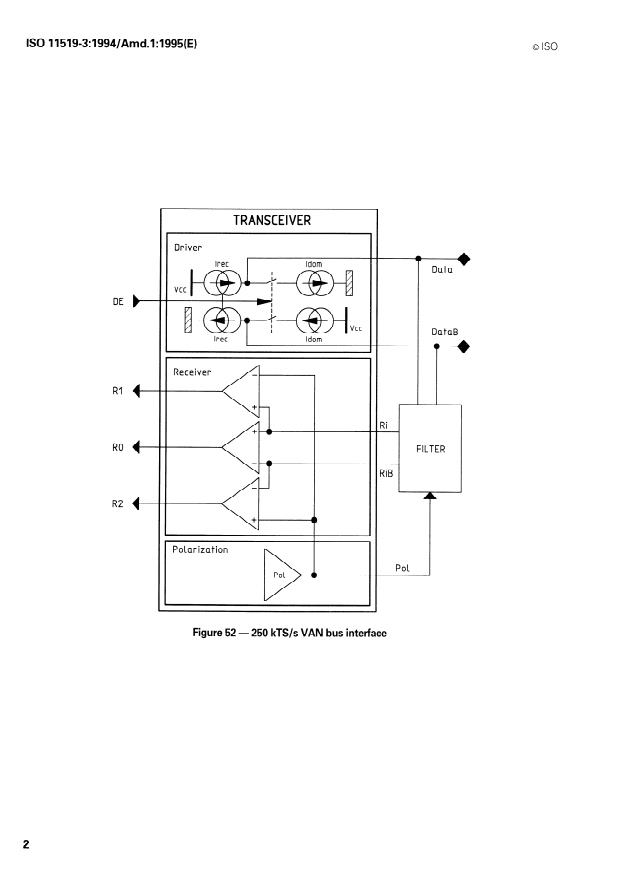
7.6.1 .l Functional block diagram
This block diagram is given in figure 52.
ISO 11519-3:1994/Amd.l:1995(E)
0 ISO
TRANSCEIVER
Dataß
R1 t
Ri
r
FILTER
R” t
RiB
--l-
R2 t
Figure 52 - 250 kTS/s VAN bus interface
0 ISO ISO 11519-3:1994/Amd.l:1995(E)
7.6.1.2 Filter section
The diagram is given in figure 53, together with the Parameters.
m
a m
1 Rl w 1 R3 7 v ) Ri
Data c2
Cl
R2
i!i
POL
WV
T
RZ
Cl c2
DataB
,
1 Rl - S R3 s Riß
b
Parameter Recommended value Tolerante Comments
I I I I I
Cl 100 pF 3 50 v
c2 120 pF f 10 % 2 25 V
Rl 1/4 W continuous
100 R
l 1 I I I
Figure 53 - 250 kTS/s filter
7.6.1.3 Cable characteristics
Value
Parameter Test condition and description
min. typical 1 max. Unit
0 1 200 1 pF/module
Cg-data Overall capacitance between ground and Data
I I I
Cg-dataB Overall capacitance between ground and DataB 0 1 200 1 pF/module
I I I
Cdata-dataB Overall capacitance between Data and DataB 0 1 100 1 pF/module
I I I
= Cg-data + CgdataB + 2 CgData-DataB; by node connected and
/ 0 / / 200 / pF/module
Coverall 2,0 V offset
...