


ISO/IEC 13250:2000
(Main)Information technology — SGML Applications — Topic Maps
Information technology — SGML Applications — Topic Maps
Technologies de l'information — Applications SGML — Plans relatifs à des sujets
General Information
- Status
- Withdrawn
- Publication Date
- 09-Feb-2000
- Withdrawal Date
- 09-Feb-2000
- Technical Committee
- ISO/IEC JTC 1/SC 34 - Document description and processing languages
- Drafting Committee
- ISO/IEC JTC 1/SC 34 - Document description and processing languages
- Current Stage
- 9599 - Withdrawal of International Standard
- Start Date
- 13-May-2003
- Completion Date
- 12-Feb-2026
Relations
- Consolidated By
ISO 105-B10:2011 - Textiles — Tests for colour fastness — Part B10: Artificial weathering — Exposure to filtered xenon-arc radiation - Effective Date
- 06-Jun-2022
- Effective Date
- 15-Apr-2008
Get Certified
Connect with accredited certification bodies for this standard

BSI Group
BSI (British Standards Institution) is the business standards company that helps organizations make excellence a habit.

NYCE
Mexican standards and certification body.
Sponsored listings
Frequently Asked Questions
ISO/IEC 13250:2000 is a standard published by the International Organization for Standardization (ISO). Its full title is "Information technology — SGML Applications — Topic Maps". This standard covers: Information technology — SGML Applications — Topic Maps
Information technology — SGML Applications — Topic Maps
ISO/IEC 13250:2000 is classified under the following ICS (International Classification for Standards) categories: 35.240.30 - IT applications in information, documentation and publishing. The ICS classification helps identify the subject area and facilitates finding related standards.
ISO/IEC 13250:2000 has the following relationships with other standards: It is inter standard links to ISO 105-B10:2011, ISO/IEC 13250:2003. Understanding these relationships helps ensure you are using the most current and applicable version of the standard.
ISO/IEC 13250:2000 is available in PDF format for immediate download after purchase. The document can be added to your cart and obtained through the secure checkout process. Digital delivery ensures instant access to the complete standard document.
Standards Content (Sample)
INTERNATIONAL ISO/IEC
STANDARD 13250
First edition
2000-02-01
Information technology— SGML
Applications— Topic Maps
Technologies de l'information — Applications SGML — Plans relatifs à des
sujets
Reference number
©
ISO/IEC 2000
PDF disclaimer
This PDF file may contain embedded typefaces. In accordance with Adobe's licensing policy, this file may be printed or viewed but shall not
be edited unless the typefaces which are embedded are licensed to and installed on the computer performing the editing. In downloading this
file, parties accept therein the responsibility of not infringing Adobe's licensing policy. The ISO Central Secretariat accepts no liability in this
area.
Adobe is a trademark of Adobe Systems Incorporated.
Details of the software products used to create this PDF file can be found in the General Info relative to the file; the PDF-creation parameters
were optimized for printing. Every care has been taken to ensure that the file is suitable for use by ISO member bodies. In the unlikely event
that a problem relating to it is found, please inform the Central Secretariat at the address given below.
© ISO/IEC 2000
All rights reserved. Unless otherwise specified, no part of this publication may be reproduced or utilized in any form or by any means, electronic
or mechanical, including photocopying and microfilm, without permission in writing from either ISO at the address below or ISO's member body
in the country of the requester.
ISO copyright office
Case postale 56 � CH-1211 Geneva 20
Tel. + 41 22 749 01 11
Fax + 41 22 734 10 79
E-mail copyright@iso.ch
Web www.iso.ch
Printed in Switzerland
ii © ISO/IEC 2000 – All rights reserved
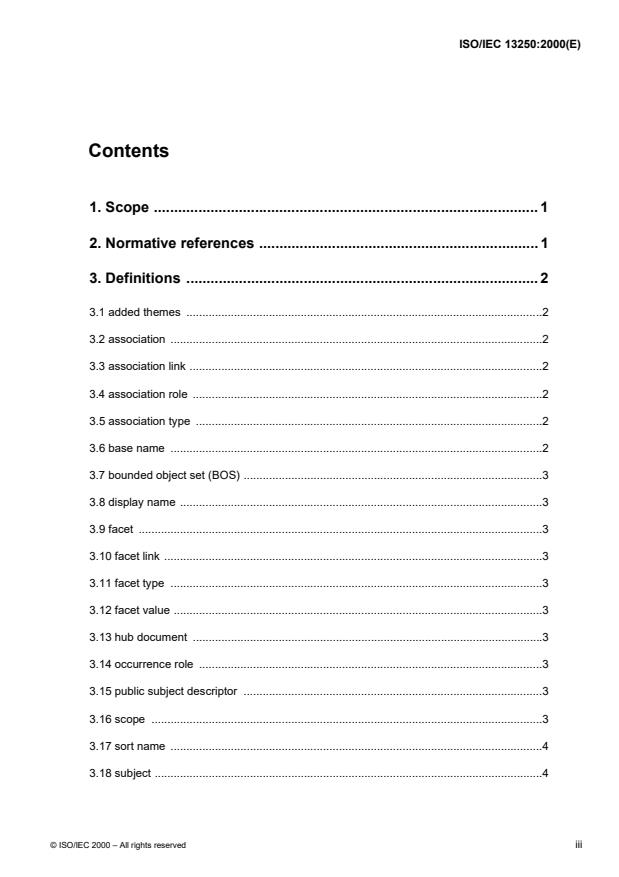
Contents
1. Scope . 1
2. Normative references . 1
3. Definitions . 2
3.1 added themes .2
3.2 association .2
3.3 association link .2
3.4 association role .2
3.5 association type .2
3.6 base name .2
3.7 bounded object set (BOS) .3
3.8 display name .3
3.9 facet .3
3.10 facet link .3
3.11 facet type .3
3.12 facet value .3
3.13 hub document .3
3.14 occurrence role .3
3.15 public subject descriptor .3
3.16 scope .3
3.17 sort name .4
3.18 subject .4
© ISO/IEC 2000 – All rights reserved iii
3.19 subject descriptor .4
3.20 theme .4
3.21 topic .5
3.22 topic association .5
3.23 topic characteristic .5
3.24 topic characteristic assignment .5
3.25 topic link .5
3.26 topic map .5
3.27 topic name .6
3.28 topic occurrence .6
3.29 topic type .6
3.30 unconstrained scope .6
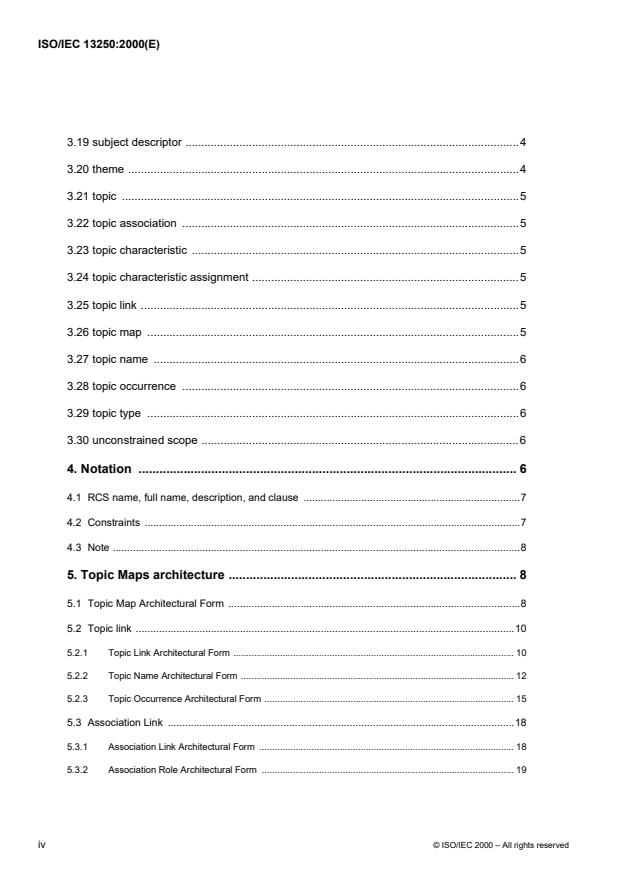
4. Notation . 6
4.1 RCS name, full name, description, and clause .7
4.2 Constraints .7
4.3 Note .8
5. Topic Maps architecture . 8
5.1 Topic Map Architectural Form .8
5.2 Topic link .10
5.2.1 Topic Link Architectural Form . 10
5.2.2 Topic Name Architectural Form . 12
5.2.3 Topic Occurrence Architectural Form . 15
5.3 Association Link .18
5.3.1 Association Link Architectural Form . 18
5.3.2 Association Role Architectural Form . 19
iv © ISO/IEC 2000 – All rights reserved
5.4 Themes To Be Added Architectural Form .21
5.5 Facet Linking .22
5.5.1 Facet Link Architectural Form . 23
5.5.2 Facet Value Architectural Form . 24
6. Conformance .25
Annexes .27
A. Annex A: Topic Maps Meta-DTD (Normative) .27
B. Annex B: Example Architectural Support Declaration for the Topic Maps
Architecture (Informative) .39
© ISO/IEC 2000 – All rights reserved v
Foreword
ISO (the International Organization for Standardization) and IEC (the International
Electrotechnical Commission) form the specialized system for worldwide standardization.
National bodies that are members of ISO or IEC participate in the development of International
Standards through technical committees established by the respective organization to deal with
particular fields of technical activity. ISO and IEC technical committees collaborate in fields of
mutual interest. Other international organizations, governmental and non-governmental, in liaison
with ISO and IEC, also take part in the work.
International Standards are drafted in accordance with the rules given in the ISO/IEC Directives,
Part 3.
In the field of information technology, ISO and IEC have established a joint technical committee,
ISO/IEC JTC 1. Draft International Standards adopted by the joint technical committee are
circulated to national bodies for voting. Publication as an International Standard requires approval
by at least 75 % of the national bodies casting a vote.
Attention is drawn to the possibility that some of the elements of this International Standard may be
the subject of patent rights. ISO and IEC shall not be held responsible for identifying any or all
such patent rights.
International Standard ISO/IEC 13250 was prepared by Joint Technical Committee ISO/IEC JTC 1,
Information technology, Subcommittee SC 34, Document description and processing languages.
Annex A forms a normative part of this International Standard. Annex B is for information only.
vi © ISO/IEC 2000 – All rights reserved
Introduction
This International Standard provides a standardized notation for interchangeably representing
information about the structure of information resources used to define topics, and the relationships
between topics. A set of one or more interrelated documents that employs the notation defined by
this International Standard is called a topic map. In general, the structural information conveyed
by topic maps includes:
— groupings of addressable information objects around topics (‘occurrences’), and
— relationships between topics (‘associations’).
A topic map defines a multidimensional topic space — a space in which the locations are topics,
and in which the distances between topics are measurable in terms of the number of intervening
topics which must be visited in order to get from one topic to another, and the kinds of
relationships that define the path from one topic to another, if any, through the intervening topics,
if any.
NOTE 1 Two topics may be connected through an association, and they can also be connected by virtue of sharing an
occurrence.
In addition, information objects can have properties, as well as values for those properties,
assigned to them externally. These properties are called facet types.
NOTE 2 The word facet can mean one side of a many-sided, polished object, or one segment of a compound eye (e.g. an
insect's). Its metaphorical use here captures the idea that a facet is a property of a set of information objects that can be
used to create a view of them.
Several topic maps can provide topical structure information about the same information resources.
The Topic Maps architecture is designed to facilitate merging topic maps without requiring the
merged topic maps to be copied or modified. Because of their extrinsic character, topic maps can
be thought of as overlays on, or extensions to, sets of information objects.
The base notation of Topic Maps is SGML; an interchangeable topic map always consists of at
least one SGML document, and it may include and/or refer to other kinds information resources. A
set of information resources that comprise a complete interchangeable topic map can be specified
using the ‘bounded object set (BOS)’ facility defined by the HyTime architecture in ISO/IEC
10744:1997.
As the Extensible Markup Language (XML), a World Wide Web Consortium recommendation, is
a subset of SGML, as explained in Annex K of SGML (1997), also known as WebSGML, XML
can be also used as a base notation for Topic Maps.
The topic map notation is defined as an SGML Architecture, and this International Standard takes
the form of an architecture definition document expressed in conformance with Normative Annex
A.3 of ISO/IEC 10744:1997, the SGML Architectural Form Definition Requirements (AFDR). The
formal definition of the topic map notation is expressed as a meta-DTD.
© ISO/IEC 2000 – All rights reserved vii
© ISO/IEC
INTERNATIONAL STANDARD ISO/IEC 13250:2000(E)
Information technology — SGML Applications — Topic Maps
1 Scope
NOTE 1 This clause defines the scope of this International standard. It should not be confused with the concept of
"scope" defined in 3.16, which only applies in the context of Topic Maps.
Topic maps enable multiple, concurrent views of sets of information objects. The structural nature
of these views is unconstrained; they may reflect an object oriented approach, or they may be
relational, hierarchical, ordered, unordered, or any combination of the foregoing. Moreover, an
unlimited number of topic maps may be overlaid on a given set of information resources.
Topic maps can be used:
— To qualify the content and/or data contained in information objects as topics to enable
navigational tools such as indexes, cross-references, citation systems, or glossaries.
— To link topics together in such a way as to enable navigation between them. This capability can
be used for virtual document assembly, and for creating thesaurus-like interfaces to corpora,
knowledge bases, etc.
— To filter an information set to create views adapted to specific users or purposes. For example,
such filtering can aid in the management of multilingual documents, management of access
modes depending on security criteria, delivery of partial views depending on user profiles and/
or knowledge domains, etc.
— To structure unstructured information objects, or to facilitate the creation of topic-oriented user
interfaces that provide the effect of merging unstructured information bases with structured
ones. The overlay mechanism of topic maps can be considered as a kind of external markup
mechanism, in the sense that an arbitrary structure is imposed on the information without
altering its original form.
This International Standard does not require or disallow the use of any scheme for addressing
information objects. Except for the requirement that topic map documents themselves be expressed
using SGML (or WebSGML) and HyTime, using the syntax described herein, neither does it
require or disallow the use of any notation used to express information.
2 Normative references
The following normative documents contain provisions which, through reference in this text, constitute
provisions of this International Standard. For dated references, subsequent amendments to, or revisions of,
any of these publications do not apply. However, parties to agreements based on this International Standard
are encouraged to investigate the possibility of applying the most recent editions of the normative documents
indicated below. For undated references, the latest edition of the normative document referred to applies.
Members of ISO and IEC maintain registers of currently valid International Standards.
ISO 8879:1986, Information processing — Text and office systems — Standard Generalized
Markup Language (SGML), including Technical Corrigenda 1, 2, and 3.
ISO 10744:1997, Information processing — Text and office systems — Hypermedia/Time-based
Structuring Language (HyTime), including Amendment 1.
3 Definitions
For the purposes of this International Standard; the following definitions apply.
The definitions provided in ISO 8879:1986 (including TC1, TC2 and TC3) and ISO/IEC
10744:1997 (including Amendment 1) shall apply to this International Standard.
3.1 added themes
Topics added to the sets of themes comprising the scopes within which topics have their topic
characteristics. Added themes can be specified in two ways:
a) Within the topic map document whose scopes are affected, by means of the added themes
(addthems) attribute of the document element. The specified themes are added to the scopes of
all of the topic characteristics which are assigned to topics via the topic links and association
links contained in the document.
b) Inside or outside the topic map document whose scopes are affected, by means of elements
conforming to the themes to be added (addthms) architectural form. The specified themes are
added to the topic characteristics assigned to topics via:
— entire topic map documents (specified via the tmdocs attribute),
— topic links (that is, the name characteristics and occurrence characteristics assigned to topics via
topic links) (specified via the cassign attribute),
— association links (that is, the roles played in associations by topics, as assigned to topics via
association links) (specified via the cassign attribute), or
— any combination of the foregoing.
3.2 association
See ‘topic association’.
3.3 association link
A hyperlink element conforming to the association link architectural form defined by this
International Standard. See 5.3.
3.4 association role
One of the roles that topics play in a given topic association.
3.5 association type
a) A subject which is a class of topic associations.
b) One of the classes of topic associations of which a particular association link is an instance. The
association types of which a given association link is an instance can be specified by its optional
types attribute.
3.6 base name
a) A subelement (basename) of a topname subelement of a topic link.
© ISO/IEC
b) A name characteristic of a topic that is specified in the content of a basename element.
3.7 bounded object set (BOS)
A set of one or more documents and other information objects, all of which are known to the
processing application and which are processed collectively. See ISO/IEC 10744:1997 for details;
see also the definition of ‘hub document’.
3.8 display name
a) A subelement (dispname) of a topname subelement of a topic link, containing the identifying
information intended to be displayed by the application to represent the subject of the topic link.
b) A name characteristic of a topic that is specified in the content of a dispname element.
3.9 facet
a) The subset of information objects that share an externally-applied property.
b) The values given to a particular property externally applied to a set of information objects.
3.10 facet link
A hyperlink that applies values for a given property (as well as the property itself) to one or more
information objects.
3.11 facet type
A property applied by one or more facet links to one or more objects.
3.12 facet value
A member of the set of all values of a particular facet type.
3.13 hub document
The HyTime document used to define the set of information resources (the bounded object set
(BOS)) that comprise a HyTime hyperdocument. Applications may regard the HyTime document
used as the entry point for a browsing session within a hyperdocument as the hub document. See
ISO/IEC 10744:1997 for details. By definition, a topic map is a HyTime hyperdocument, and any
topic map document can be regarded as a hub document.
3.14 occurrence role
The sense in which some set of occurrences is relevant to a topic. In the Topic Maps architecture,
occurrence roles are specified as anchor roles (as defined in the HyTime architecture) of topic links.
3.15 public subject descriptor
A subject descriptor (see the definition of ‘subject descriptor’) which is used (or, especially, which
is designed to be used) as a common referent of the identity attributes of many topic links in many
topic maps. The subject described by the subject descriptor is thus easily recognized as the
common binding point of all the topic links that reference it, so that they will be merged.
3.16 scope
NOTE 2 The definition of scope provided here should not be confused with 1, entitled ‘Scope’, which defines the scope
of this International Standard.
The extent of the validity of a topic characteristic assignment (see the definition of ‘topic
characteristic assignment’): the context in which a name or an occurrence is assigned to a given
topic, and the context in which topics are related through associations. This International Standard
does not require that scopes be specified explicitly. If the scope of a topic characteristic assignment
is not explicitly specified via one or more scope attributes, the scope within which the topic
characteristic applies to the topic includes all the topics in the entire topic map; this special scope is
called ‘the unconstrained scope’. If a scope is specified, the specification consists of a set of topics,
which, in the context of their role as members of such a set, are called ‘themes’. Each theme
contributes to the extent of the scope that the themes collectively define; a given scope is the union
of the subjects of the set of themes used to specify that scope.
NOTE 3 If it is desired to specify a scope which is the intersection (rather than the union) of two topics, this can be
accomplished by creating a topic whose subject is that intersection, and then by using that topic as a theme.
3.17 sort name
a) A subelement (sortname) of a topname subelement of a topic link, containing a string that is an
alternative representation of a topic name that is intended to be used for alphabetic or other
ordering.
b) A name characteristic of a topic that is specified in the content of a sortname element.
3.18 subject
In the most generic sense, a ‘subject’ is any thing whatsoever, regardless of whether it exists or has
any other specific characteristics, about which anything whatsoever may be asserted by any means
whatsoever.
NOTE 4 The invisible heart of every topic link is the subject that its author had in mind when it was created. In some
sense, a topic link reifies a subject. The identity attribute of a topic link is provided to allow the author of the topic link
to indicate, as unambiguously as possible, the subject he had in mind as the organizing principle of the topic. See the
definition of ‘subject descriptor’.
3.19 subject descriptor
Information which is intended to provide a positive, unambiguous indication of the identity of a
subject, and which is the referent of an identity attribute of a topic link. (See also the definition of
‘public subject descriptor’.)
NOTE 5 There is no requirement that a subject descriptor be text, although it can be the text of a definition of the subject.
It can also, for example, be a listing in a catalog of subjects, such as an acquisition number of an asset in a museum
collection, a catalog number in a sales catalog, or a subject heading in a catalog of library subject headings. The
distinction between a subject descriptor that happens to be a definition and an ordinary occurrence of a definition is that,
in the case of the subject descriptor, the topic link's author has indicated (by referring to it by means of the value of the
identity attribute) that it is to be regarded as the authoritative definition of the organizing principle of the topic link. In the
other case, by characterizing a definition as a definitional occurrence, the author is merely acknowledging the existence
of the definition and its possible relevance to the subject of the topic link.
NOTE 6 Subject descriptors may be offline resources.
3.20 theme
A member of the set of topics comprising a scope within which a topic characteristic assignment is
valid. See also the definitions of ‘scope’ and ‘topic’.
© ISO/IEC
3.21 topic
a) An aggregate of topic characteristics, including zero or more names, occurrences, and roles
played in associations with other topics, whose organizing principle is a single subject.
b) A topic link element. See 5.2.
3.22 topic association
a) A specific relationship among specific topics that is asserted by an association link element.
b) An association link element. See 5.3.
3.23 topic characteristic
Any defining characteristic of a topic. There are three kinds of topic characteristics:
a) names,
b) occurrences, and
c) roles played in relationships (‘associations’) with other topics.
For example, a name of a topic is a ‘name characteristic’ of that topic.
3.24 topic characteristic assignment
a) The mechanism whereby a topic characteristic becomes a characteristic of a topic. For example,
topname subelements of topic link elements are used to assign names to topics as topic
characteristics, so, in topic map documents, they perform the function of assigning topic name
characteristics.
b) The fact that a particular topic characteristic is a characteristic of a particular topic.
3.25 topic link
A hyperlink element conforming to the topic link architectural form defined in 5.2 by this
International Standard.
NOTE 7 In this International Standard, the foregoing definition is invoked by the phrase ‘topic link’, or, since the default
SGML name of the topic link architectural form is ‘topic’, by the special typography used to distinguish SGML names
(i.e., topic).
NOTE 8 See also the definition of ‘topic’.
3.26 topic map
a) A set of information resources regarded by a topic map application as a bounded object set
whose hub document is a topic map document conforming to the SGML architecture defined by
this International Standard.
b) Any topic map document conforming to the SGML architecture defined by this International
Standard, or the document element (topicmap) of such a document.
c) The document element type (topicmap) of the topic map document architecture.
3.27 topic name
a) A string of characters specified as a name of a topic; a name characteristic of a topic.
b) A topic name (topname) element, as defined by this International Standard.
c) Either a base name (basename), display name (dispname) or name to be used as sort key
(sortname) element, as defined by this International Standard, and/or the information that such
an element contains.
d) A combination of the foregoing definitions.
3.28 topic occurrence
Information that is specified as relevant to a given subject.
NOTE 9 Topic occurrences may be offline resources.
3.29 topic type
a) A subject which is a class of topics.
b) One of the classes of topics of which a particular topic link is an instance. The topic types of
which a given topic link is an instance can be specified via its optional types attribute.
3.30 unconstrained scope
The scope comprised of all of the topics in a topic map. When no applicable scope attributes are
explicitly specified as governing a topic characteristic assignment, the scope within which the topic
characteristic assignment is made is the unconstrained scope.
NOTE 10 In other words, the unconstrained scope is the default scope. Thus, for example, in a given topic map, if no
scope attributes are explicitly specified for the name characteristics of any topics, any two topic links that have any of the
same names will be merged, due to the effect of the topic naming constraint.
4 Notation
Topic Maps is an enabling document architecture whose definition (this International Standard)
conforms to the Architectural Form Definition Requirements in Normative Annex A.3 of ISO/IEC
10744:1997, the SGML Architectural Form Definition Requirements (AFDR). The formal
definition of the topic map notation is expressed as a meta-DTD. The specification of the Topic
Maps architecture is accomplished by a combination of narrative text and formal definitions.
Any references in this document to industry and proprietary standards, products, user groups, and
publications are not normative, and do not imply endorsement by ISO, IEC, or their national
member bodies or affiliates. Any brand names or trademarks mentioned are the property of their
respective owners.
The formal definitions are expressed in SGML.
© ISO/IEC
The formal SGML definitions are part of the text of this International Standard and are protected by
copyright. In order to facilitate conformance to the Topic Maps architecture, the formal SGML
definitions may be copied as specified in the following copyright notice: Copyright (C) 1999
International Organization for Standardization. Permission to copy in any form is granted for use
with conforming Topic Maps systems and applications as defined in ISO/IEC 13250:1999, provided
this notice is included in all copies. The permission to copy does not apply to any other material in
this International Standard.
NOTE 11 This document uses editorial conventions mandated by the ISO with which the reader should be familiar in
order to understand the implications of certain words.
The text describing each construct emphasizes semantics, while the formal SGML definition
provides the rigorous syntactic definitions underlying the text descriptions.
NOTE 12 For this reason, it is recommended that the reader refer to the SGML definitions while reading the textual
descriptions. Although the SGML definition always follows the related text, the user may find it helpful to read the
SGML first in some cases. The meta-DTD is found in ”Annex A: Topic Maps Meta-DTD (Normative)”.
When a construct is first introduced, it is described in the text. If the construct occurs in the formal
SGML specification, both the formal SGML name and a full name in English are presented, as
follows:
— The element form full construct name (SGMLname) .
— The attribute full construct name (SGMLname) .
The declarations include comments, called "conventional comments", that follow conventions
established in the HyTime standard to specify syntactic and semantic constraints and other
information that is known to an architecture engine such as a Topic Maps engine. The conventional
comments do not extend SGML in any way. They are used in the architecture definitions only, as a
notation for the documentation of the architecture. They need not be included in application DTDs
and, if they are included, the SGML parser will treat them as it would any other comment.
4.1 RCS name, full name, description, and clause
Every form name is followed by comments giving the full name, a description of the form, and the
number of the clause in this International Standard in which the form is defined.
Individual attributes have a full name and description comment.
4.2 Constraints
Comments labeled "Constraints" define additional semantic or syntactic constraints on the
constructs they follow. Constraint comments that follow the name of a form define constraints on
the use of that form in general. Constraint comments that follow a component of a declaration (for
example, the default value prescription of an attribute declaration), define the specific constraints
on that component.
4.3 Note
Note comments provide additional information not provided by the other comment types and are
informational rather than constraining.
5 Topic Maps architecture
This clause defines the syntax of topic maps. The Topic Maps syntax makes use of the base,
location address, and hyperlinking modules of the HyTime architecture as defined in clauses 6, 7
and 8 of ISO/IEC 10744:1997.
NOTE 13 The entire formal definition of the Topic Maps syntax, the Topic Maps meta-DTD, is found in normative
Annex A of this International Standard.
When interchanged, topic maps are HyTime bounded object sets (BOSs). The hub document of
such a BOS must contain a Topic Maps architectural support declaration (see Annex B for
examples).
Only one of the hyperlink syntaxes defined by HyTime is used in the topic map syntax: variable
link (varlink).
The HyTime architecture provides a comprehensive set of addressing mechanisms and a standard
syntax for using them. In addition, it provides means whereby any addressing syntax can be
declared and used. The topic map architecture preserves these features of HyTime. Thus, the Topic
Maps architecture allows topic map authors to use any addressing scheme, including proprietary
addressing mechanisms driven by expressions in any notations, provided each such notation is
formally declared as a notation in the manner prescribed by the SGML and HyTime International
Standards.
NOTE 14 For example, in an XML environment, location addressing can be accomplished using IETF Uniform
Resource Locator (URL) notation.
5.1 Topic Map Architectural Form
The topic map (topicmap) element form is used as the document element of all documents that
conform to the Topic Maps architecture defined by this International Standard.
The effect of specifying the added themes (addthems) attribute is to add the themes that it
references to the scopes of all of the topic characteristic assignments made throughout the
document of which the element is the root element.
NOTE 15 See the definition of ‘added themes’.
NOTE 16 The addthems attribute can be used to acknowledge and document the fact that the document specifies only
topic characteristic assignments that are within the scope defined by the set of themes that it specifies. It can be used to
avoid specifying these common themes explicitly in every scope. After a topic map document is merged with other topic
map documents, the contributions that it made to the resulting merged topic map can be distinguished from the
contributions of all others by virtue of the fact that everything it contributed continues to appear within the scopes of the
topics specified by the addthems attribute of its document element.
© ISO/IEC
The topicmap element type is derived from the document element type of the HyTime architecture
(HyDoc). All of the remaining attributes (maxbos, boslevel and grovplan) are inherited from
HyDoc. The optional maxbos and boslevel attributes are used in hub documents in specifying the
members of the HyTime bounded object set rooted at the document. The optional grovplan
attribute is used in HyTime addressing. (See ISO/IEC 10744:1997.)
NOTE 17 As the use of the TMCFC parameter entity indicates, valid topic map documents may or may not have any topic
links, association links or facet links in them. Some conforming applications may support only facet element types, while
others may not support facet element types.
TMCFC -- Topic map context-free content --
"topic|assoc|facet|bosspec|addthms|TMBrid"
>
TMBrid -- Topic map bridge element --
- O
ANY
>
topicmap -- Topic map document element --
-- Clause: 5.1 --
- O
(%TMCFC;)*
>
topicmap
HyTime -- HyTime architectural form name --
NAME
HyDoc -- HyTime document element. (This
attribute definition is redundant; it
appears here as an aid to
understanding.) --
addthems -- Added themes --
-- Themes to add to all scopes that govern
the assignments of topic names,
occurrences, and roles played in
associations in this topic map
document. --
CDATA -- Reference --
-- Reftype: topic+ --
#IMPLIED -- Default: No themes added via this
attribute. --
-- bos -- -- HyTime bounded object set --
-- HyTime Clause: 6.5.1 --
maxbos -- Maximum bounded object set level --
-- Bounding level of HyTime bounded object
set when document is a hub or
subhub. --
NUMBER -- Constraint: Depth of nested entities to
include in BOS (0=no limit, 1=hub only)
--
boslevel -- Bounded object set level --
-- Default BOS level used by data entities
declared in hub document. --
NUMBER -- Constraint: Depth of nested entities to
include in BOS (0=no limit, 1=this
entity only) --
#IMPLIED -- Default: No HyTime BOS --
-- bosspcat -- -- BOS exception specification attributes
--
-- HyTime Clause: 6.5.3 --
bosspec -- Bounded object set exception
specification --
-- Adjustments to be made to the bounded
object set. --
IDREFS -- Reference --
-- Reftype: bosspec+ --
-- Constraint: Must be internal reference
--
#IMPLIED -- Default: No BOS exception specification
--
-- dgrvplan -- -- HyTime document grove plan --
-- HyTime Clause: 7.1.4.1 --
grovplan -- Grove plan --
-- Grove plan for HyTime extended SGML
document grove --
CDATA -- Reference --
-- Reftype: grovplan --
#IMPLIED -- Default: HyTime default grove plan --
>
5.2 Topic link
5.2.1 Topic Link Architectural Form
The topic link (topic) element form is used to assign topic name characteristics and topic
occurrence characteristics to a topic.
Every topic link is intended by its author to be organized around exactly one subject, regardless of
whether that subject is explicitly defined anywhere. A topic link may declare zero or more names
and zero or more pieces of information (‘occurrences’) that are relevant to its subject. Names, and
the scopes within which the names are applicable to the subject, are declared by means of topname
subelements. Occurrences are the anchors of the topic link; these, and the scopes within which the
occurrences are applicable to the subject, are specified by means of occurs subelements.
The required unique identifier (id) attribute facilitates the addressing of topics by association
links, by the identity attributes of other topic links, and, in their roles as themes in scopes, by scope
and addthems attributes.
The optional subject identity (identity) attribute refers to one or more indications (‘subject
descriptors’) of the identity of the subject (the organizing principle) of the topic link. All of the
other topic characteristics specified by the topic link are regarded as elaborating, and in no way
contradicting, the subject described by the subject descriptor(s), if any. There are no restrictions on
the kinds of information that may be referenced by an identity attribute.
NOTE 18 The information referenced by an identity attribute may or may not take the form of a topic link in a topic map
document, may or may not be text, may or may not be machine-interpretable, and may or may not be online.
Any two or more topic links that reference the same subject by means of their identity attributes are
equivalent to a single topic link that has the union of the characteristics (the names, occurrences,
and associations) of both topic links. The two or more topic links may be merged, and/or
applications may process and/or render them as if they have been merged.
NOTE 19 The two or more topic links do not have to refer to the same subject descriptor in order to be merged under this
rule. It is only necessary that the subject that is somehow indicated by the two identity attributes be one and the same
subject. If two or more topics refer to exactly the same subject descriptor, the subject descriptor may be described as a
© ISO/IEC
‘public subject descriptor’, and it becomes possible to automate the merging of all such topics by making the assumption
that, if they all share the same subject descriptor, they all share the same subject identity.
Similarly, if the identity attribute references one or more topic links, topic map processing
applications must regard the referencing topic link, and all the referenced topic links, as having one
and the same subject, and therefore they may all be merged.
The optional topic types (types) attribute references one or more topic links. The subject of each
such referenced topic link is a class of subject of which the subject of the referencing topic link is
an instance. The class-instance relationship established between the subject of each referenced
topic link and the subject of the referencing topic link could alternatively be established by a topic
association link whose semantic is the relationship between a class and an instance of that class.
NOTE 20 In other words, the types attribute establishes a relationship between topics (a topic association), rather than
being a means whereby the referencing topic becomes an occurrence of each of the referenced topics.
The topic relationships established by the types attribute are not superclass-subclass relationships.
They are only class-instance relationships.
NOTE 21 Superclass-subclass relationships between topics can be asserted by topic associat
...
Questions, Comments and Discussion
Ask us and Technical Secretary will try to provide an answer. You can facilitate discussion about the standard in here.
Loading comments...