

ISO 22241-1
(Main)Diesel engines — NOx reduction agent AUS 32 — Part 1: Quality requirements
- Abstract
This document specifies the quality characteristics of the NOx reduction agent AUS 32 (aqueous urea solution) which is needed to operate selective catalytic reduction (SCR) converter systems in motor vehicles with diesel engines. SCR converter systems are particularly suitable for selectively reducing the nitrogen oxide (NOx) emissions of diesel engines.
- Status
- Not Published
- Technical Committee
- ISO/TC 22/SC 34 - Propulsion, powertrain and powertrain fluids
- Drafting Committee
- ISO/TC 22/SC 34/WG 14 - NOx reduction additive
- Current Stage
- 6000 - International Standard under publication
- Start Date
- 24-Sep-2026
- Completion Date
- 10-Oct-2026
Buy Documents
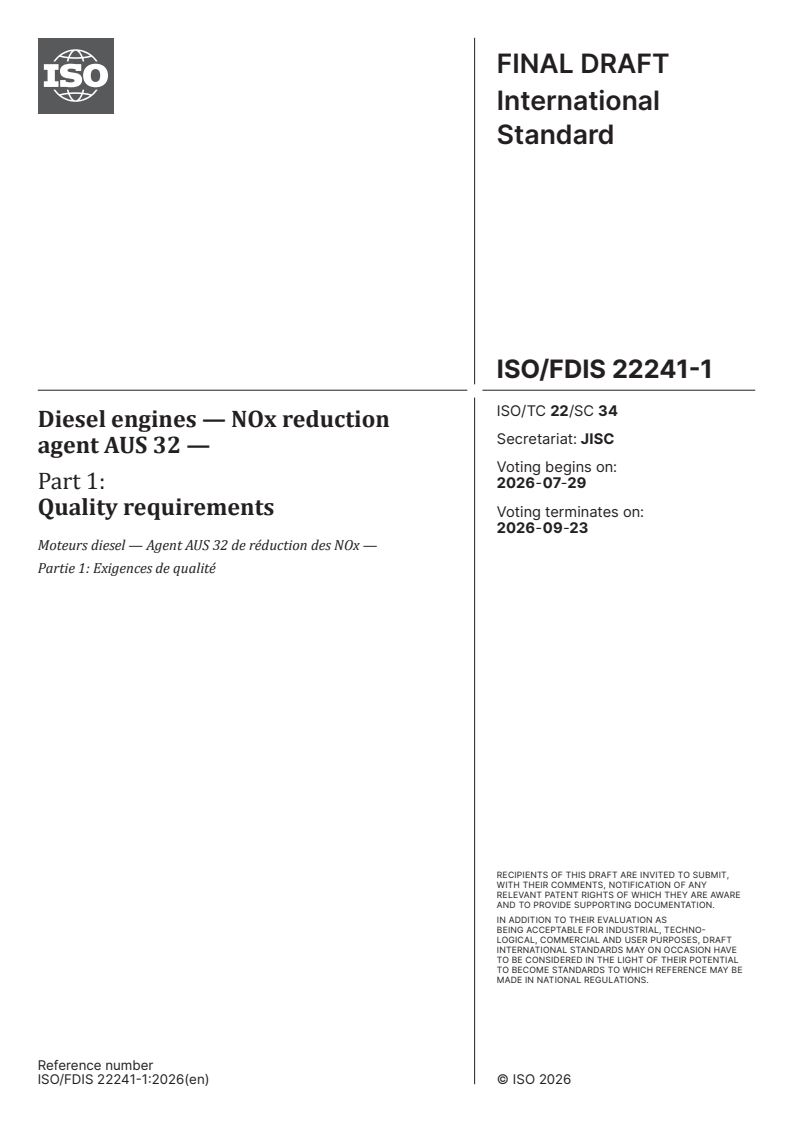
ISO/FDIS 22241-1 - Diesel engines — NOx reduction agent AUS 32 — Part 1: Quality requirements
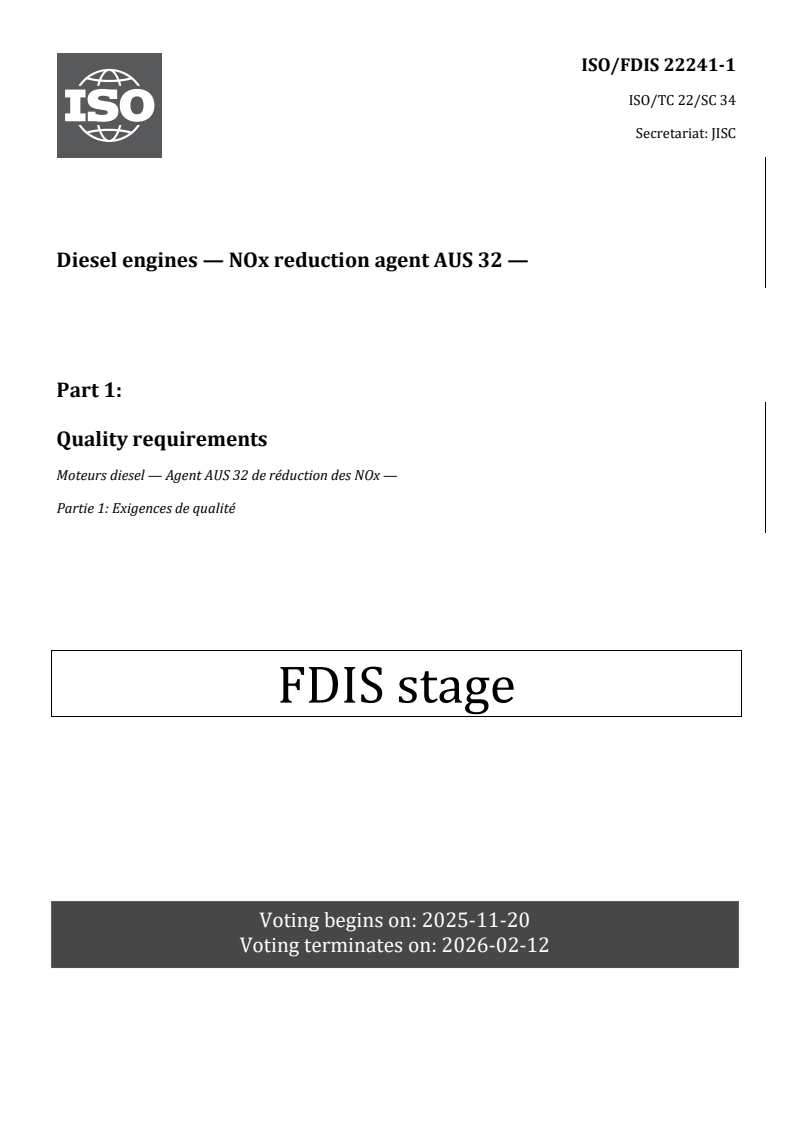
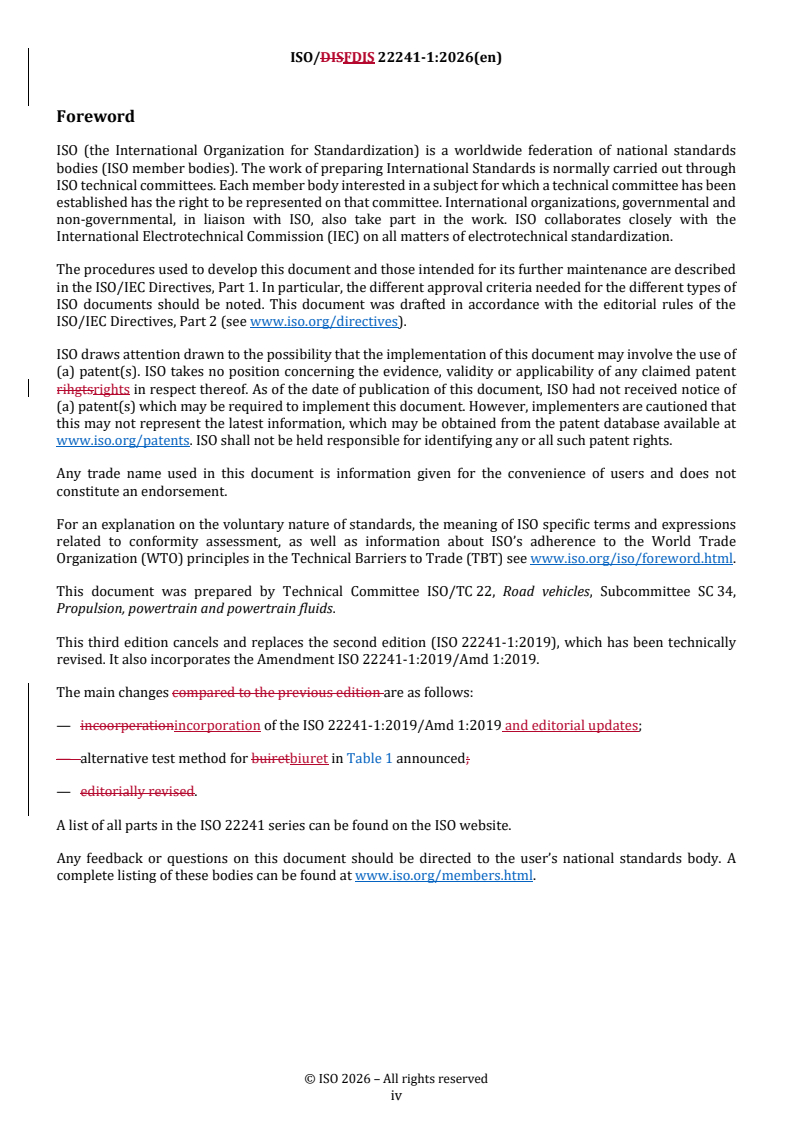
REDLINE ISO/FDIS 22241-1 - Diesel engines — NOx reduction agent AUS 32 — Part 1: Quality requirements
ISO 22241-1 is an ISO standard for the quality requirements of AUS 32, the aqueous urea solution used as the NOx reduction agent in SCR converter systems for motor vehicles with diesel engines. It tells manufacturers, distributors, and vehicle or engine makers what quality characteristics to control, how to test them, how to designate the product, and how to handle, store, and mark it.
What does ISO 22241-1 specify?
ISO 22241-1 specifies the quality characteristics of AUS 32 and organizes them into clauses on designation, requirements and testing, handling, transportation and storage, and marking. The standard is focused on the product quality needed for SCR converter systems, while handling and storage are referred to ISO 22241-3 and test methods to ISO 22241-2.
| Annex | What it covers |
|---|---|
| Annex A | Chemical characteristics, including chemical description and physical properties of AUS 32 |
| Annex B | Precision of test methods |
What are the key requirements of ISO 22241-1?
ISO 22241-1 sets quality limits for AUS 32 in Table 1 and requires the manufacturer to monitor them continuously through a production control plan. In practice, this means the producer has to control the product during serial production, not just test finished batches once in a while.
Quality characteristics and test methods
The standard covers the main composition and impurity limits for AUS 32, including urea content, refractive index, alkalinity as NH3, biuret, aldehydes, insoluble matter, phosphate, and several metals such as aluminium, calcium, chromium, copper, iron, potassium, magnesium, sodium, nickel, and zinc. For a buyer or quality manager, this is the core acceptance check for whether a delivered fluid matches the standard.
The specified test methods in Table 1 are the referee methods in case of dispute. The document also says that other methods from a recognized standard may be used for routine verification, but if there is disagreement, the Table 1 method governs.
Designation and marking
Clause 4 requires AUS 32 meeting the standard to be designated with the term AUS 32, or a regional alternative such as DEF, followed by reference to ISO 22241-1. Clause 7 then requires retail distribution pumps and containers to be marked with that designation. This matters because users need to identify the fluid correctly at the point of filling and distribution.
Handling and logistics
Clause 6 directs users to ISO 22241-3 for handling, transportation, and storage requirements and best practice recommendations. That link is important because product quality can be lost after production if the fluid is contaminated or poorly managed in the logistics chain.
Practical cautions in the table notes
The standard notes that the refractive index values compensate for the maximum allowable biuret content and should not be compared directly with urea mass fraction values. It also notes that if a tracer is added, it should not impair the quality of AUS 32 or damage the SCR system.
What terms does ISO 22241-1 define?
- AUS 32 / aqueous urea solution / DEF - A solution of technically pure urea and pure water with a nominal urea content of 32.5 % mass fraction, used as a NOx reduction agent in SCR systems.
- Technically pure urea - Industrial urea grade with only trace biuret, ammonia, and water, and without aldehydes or listed contaminants such as chloride or nitrate compounds.
- Pure water - Water with very low inorganic, organic, or colloidal contamination, such as water produced by distillation, deionization, ultrafiltration, or reverse osmosis.
- Manufacturer - The entity that produces finished AUS 32 by dilution or dissolution processes.
- nD20 - The refractive index measured at 20 °C, used as one of the product quality checks.
- Production control plan - Documentation of product and process characteristics, process controls, tests, and measurement systems used during serial production.
- Mass fraction - The mass of a solute divided by the total mass of the solution.
Who uses ISO 22241-1?
ISO 22241-1 is used by manufacturers of motor vehicles and engines, SCR converter manufacturers, producers and distributors of AUS 32, and fleet operators. These users rely on it to specify product quality, verify incoming and outgoing material, control production, manage storage and transport, and label distribution equipment correctly.
What changed in ISO 22241-1 from the previous edition?
ISO 22241-1 is the third edition and replaces ISO 22241-1:2019. The document says it incorporates ISO 22241-1:2019/Amd 1:2019 and includes editorial updates.
The stated main changes are:
- incorporation of ISO 22241-1:2019/Amd 1:2019
- an alternative test method for biuret in Table 1
- editorial revision
Which standards are used with ISO 22241-1?
- ISO 22241-2 - Provides the test methods used to verify the quality characteristics in Table 1.
- ISO 22241-3 - Covers handling, transportation, and storage of AUS 32.
- ISO 3696 - Appears in the definition of pure water as an example source for Water grade 3.
- IATF 16949:2016 - Is named in the note on production control plans.
- ISO 4259-1 to ISO 4259-5 - Are cited in Annex B in connection with precision data for the test methods.
What does the ISO 22241-1 document contain?
ISO 22241-1 contains a requirements clause with Table 1 for quality limits and test methods, a designation clause with examples, and a handling clause that points to ISO 22241-3. It also includes Annex A, which gives chemical description and physical properties, and Annex B, which gives precision values for the test methods.
The document uses tables for the quality characteristics, the chemical and physical descriptions, and the precision values. It also includes notes that help users interpret refractive index, biuret, and tracer use in practical testing and product control.
Relations
- Effective Date
- 07-Jan-2025
- Revises
ISO 22241-1:2019 - Diesel engines — NOx reduction agent AUS 32 — Part 1: Quality requirements - Effective Date
- 07-Jan-2025
Buy Documents
ISO/FDIS 22241-1 - Diesel engines — NOx reduction agent AUS 32 — Part 1: Quality requirements
REDLINE ISO/FDIS 22241-1 - Diesel engines — NOx reduction agent AUS 32 — Part 1: Quality requirements
Get Certified
Connect with accredited certification bodies for this standard

TÜV Rheinland
TÜV Rheinland is a leading international provider of technical services.

TÜV SÜD
TÜV SÜD is a trusted partner of choice for safety, security and sustainability solutions.

DEKRA Certification Inc.
DEKRA US certification services.
Sponsored listings
Frequently Asked Questions
ISO 22241-1 is a draft published by the International Organization for Standardization (ISO). Its full title is "Diesel engines — NOx reduction agent AUS 32 — Part 1: Quality requirements". This standard covers: This document specifies the quality characteristics of the NOx reduction agent AUS 32 (aqueous urea solution) which is needed to operate selective catalytic reduction (SCR) converter systems in motor vehicles with diesel engines. SCR converter systems are particularly suitable for selectively reducing the nitrogen oxide (NOx) emissions of diesel engines.
This document specifies the quality characteristics of the NOx reduction agent AUS 32 (aqueous urea solution) which is needed to operate selective catalytic reduction (SCR) converter systems in motor vehicles with diesel engines. SCR converter systems are particularly suitable for selectively reducing the nitrogen oxide (NOx) emissions of diesel engines.
ISO 22241-1 is classified under the following ICS (International Classification for Standards) categories: 43.060.40 - Fuel systems. The ICS classification helps identify the subject area and facilitates finding related standards.
ISO 22241-1 has the following relationships with other standards: It is inter standard links to ISO 22241-1:2019/Amd 1:2019, ISO 22241-1:2019. Understanding these relationships helps ensure you are using the most current and applicable version of the standard.
ISO 22241-1 is available in PDF format for immediate download after purchase. The document can be added to your cart and obtained through the secure checkout process. Digital delivery ensures instant access to the complete standard document.
Standards Content (Sample)
FINAL DRAFT
International
Standard
ISO/FDIS 22241-1
ISO/TC 22/SC 34
Diesel engines — NOx reduction
Secretariat: JISC
agent AUS 32 —
Voting begins on:
2026-07-29
Part 1:
Quality requirements
Voting terminates on:
2026-09-23
Moteurs diesel — Agent AUS 32 de réduction des NOx —
Partie 1: Exigences de qualité
RECIPIENTS OF THIS DRAFT ARE INVITED TO SUBMIT,
WITH THEIR COMMENTS, NOTIFICATION OF ANY
RELEVANT PATENT RIGHTS OF WHICH THEY ARE AWARE
AND TO PROVIDE SUPPOR TING DOCUMENTATION.
IN ADDITION TO THEIR EVALUATION AS
BEING ACCEPTABLE FOR INDUSTRIAL, TECHNO-
LOGICAL, COMMERCIAL AND USER PURPOSES, DRAFT
INTERNATIONAL STANDARDS MAY ON OCCASION HAVE
TO BE CONSIDERED IN THE LIGHT OF THEIR POTENTIAL
TO BECOME STAN DARDS TO WHICH REFERENCE MAY BE
MADE IN NATIONAL REGULATIONS.
Reference number
ISO/FDIS 22241-1:2026(en) © ISO 2026
FINAL DRAFT
ISO/FDIS 22241-1:2026(en)
International
Standard
ISO/FDIS 22241-1
ISO/TC 22/SC 34
Diesel engines — NOx reduction
Secretariat: JISC
agent AUS 32 —
Voting begins on:
Part 1:
Quality requirements
Voting terminates on:
Moteurs diesel — Agent AUS 32 de réduction des NOx —
Partie 1: Exigences de qualité
RECIPIENTS OF THIS DRAFT ARE INVITED TO SUBMIT,
WITH THEIR COMMENTS, NOTIFICATION OF ANY
RELEVANT PATENT RIGHTS OF WHICH THEY ARE AWARE
AND TO PROVIDE SUPPOR TING DOCUMENTATION.
© ISO 2026
IN ADDITION TO THEIR EVALUATION AS
All rights reserved. Unless otherwise specified, or required in the context of its implementation, no part of this publication may
BEING ACCEPTABLE FOR INDUSTRIAL, TECHNO-
LOGICAL, COMMERCIAL AND USER PURPOSES, DRAFT
be reproduced or utilized otherwise in any form or by any means, electronic or mechanical, including photocopying, or posting on
INTERNATIONAL STANDARDS MAY ON OCCASION HAVE
the internet or an intranet, without prior written permission. Permission can be requested from either ISO at the address below
TO BE CONSIDERED IN THE LIGHT OF THEIR POTENTIAL
or ISO’s member body in the country of the requester.
TO BECOME STAN DARDS TO WHICH REFERENCE MAY BE
MADE IN NATIONAL REGULATIONS.
ISO copyright office
CP 401 • Ch. de Blandonnet 8
CH-1214 Vernier, Geneva
Phone: +41 22 749 01 11
Email: copyright@iso.org
Website: www.iso.org
Published in Switzerland Reference number
ISO/FDIS 22241-1:2026(en) © ISO 2026
ii
ISO/FDIS 22241-1:2026(en)
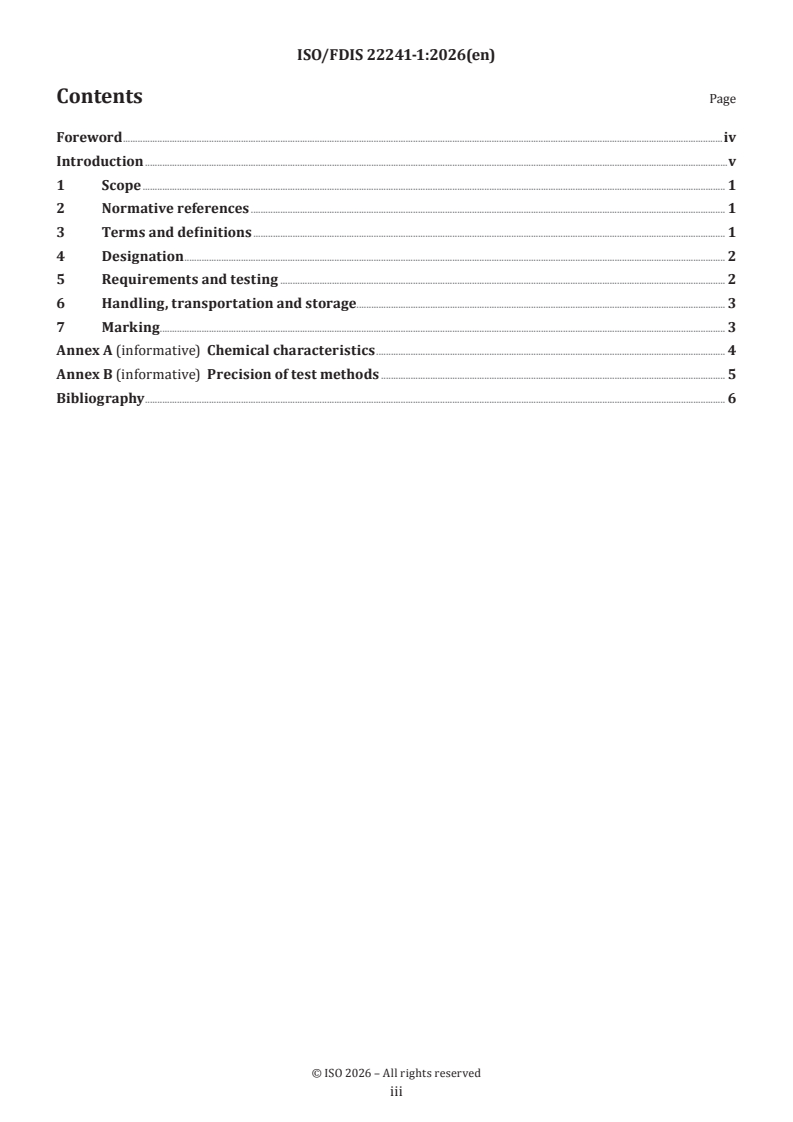
Contents Page
Foreword .iv
Introduction .v
1 Scope . 1
2 Normative references . 1
3 Terms and definitions . 1
4 Designation . 2
5 Requirements and testing . 2
6 Handling, transportation and storage. 3
7 Marking . . 3
Annex A (informative) Chemical characteristics . 4
Annex B (informative) Precision of test methods . 5
Bibliography . 6
iii
ISO/FDIS 22241-1:2026(en)
Foreword
ISO (the International Organization for Standardization) is a worldwide federation of national standards
bodies (ISO member bodies). The work of preparing International Standards is normally carried out through
ISO technical committees. Each member body interested in a subject for which a technical committee
has been established has the right to be represented on that committee. International organizations,
governmental and non-governmental, in liaison with ISO, also take part in the work. ISO collaborates closely
with the International Electrotechnical Commission (IEC) on all matters of electrotechnical standardization.
The procedures used to develop this document and those intended for its further maintenance are described
in the ISO/IEC Directives, Part 1. In particular, the different approval criteria needed for the different types
of ISO documents should be noted. This document was drafted in accordance with the editorial rules of the
ISO/IEC Directives, Part 2 (see www.iso.org/directives).
ISO draws attention drawn to the possibility that the implementation of this document may involve the use
of (a) patent(s). ISO takes no position concerning the evidence, validity or applicability of any claimed patent
rights in respect thereof. As of the date of publication of this document, ISO had not received notice of (a)
patent(s) which may be required to implement this document. However, implementers are cautioned that
this may not represent the latest information, which may be obtained from the patent database available at
www.iso.org/patents. ISO shall not be held responsible for identifying any or all such patent rights.
Any trade name used in this document is information given for the convenience of users and does not
constitute an endorsement.
For an explanation on the voluntary nature of standards, the meaning of ISO specific terms and expressions
related to conformity assessment, as well as information about ISO’s adherence to the World Trade
Organization (WTO) principles in the Technical Barriers to Trade (TBT) see www.iso.org/iso/foreword.html.
This document was prepared by Technical Committee ISO/TC 22, Road vehicles, Subcommittee SC 34,
Propulsion, powertrain and powertrain fluids.
This third edition cancels and replaces the second edition (ISO 22241-1:2019), which has been technically
revised. It also incorporates the Amendment ISO 22241-1:2019/Amd 1:2019.
The main changes are as follows:
— incorporation of the ISO 22241-1:2019/Amd 1:2019 and editorial updates;
— alternative test method for biuret in Table 1 announced.
A list of all parts in the ISO 22241 series can be found on the ISO website.
Any feedback or questions on this document should be directed to the user’s national standards body. A
complete listing of these bodies can be found at www.iso.org/members.html.
iv
ISO/FDIS 22241-1:2026(en)
Introduction
In order to protect the environment, keeping the air quality as clean as possible, exhaust emissions
regulations around the world have been strengthened considerably. In motor vehicles with diesel engines,
particulate matters (PM) and nitrogen oxide (NOx) emissions are the main concern, and efforts have
been focused on the development of technology which can reduce them effectively with minimum fuel
economy penalty. Selective catalytic reduction (SCR) converters using aqueous urea solution (AUS 32)
as the reduction agent are considered to be a key technology for reducing NOx emissions. The quality of
the urea solution used for that technology needs to be specified to ensure reliable and stable operation of
[1]
the SCR converter systems. ISO 22241 (all parts) provides the specifications for quality characteristics,
handling, transportation and storage, and refilling interface. It also outlines the test methods needed by the
manufacturers of motor vehicles and their engines, converter manufacturers, producers and distributors of
the urea solution, as well as fleet operators.
The aqueous urea solution (AUS 32), as specified in this document, is commercially available and may exist
1)
under various trade names, as for example AdBlue®, ARLA 32 .
1) Trade names of products AdBlue®, ARLA 32, DEF, etc., are examples of suitable products available commercially. This
information is given for the convenience of users of this document and does not constitute an endorsement by ISO of the
products named.
v
FINAL DRAFT International Standard ISO/FDIS 22241-1:2026(en)
Diesel engines — NOx reduction agent AUS 32 —
Part 1:
Quality requirements
1 Scope
This document specifies the quality characteristics of the nitrogen oxide (NOx) reduction agent aqueous
urea solution (AUS 32), which is needed to operate selective catalytic reduction (SCR) converter systems in
motor vehicles with diesel engines. SCR converter systems are particularly suitable for selectively reduci
...
ISO/FDIS 22241-1
ISO/TC 22/SC 34
Secretariat: JISC
Diesel engines — NOx reduction agent AUS 32 —
Part 1:
Quality requirements
Moteurs diesel — Agent AUS 32 de réduction des NOx —
Partie 1: Exigences de qualité
FDIS stage
VVVVVVoooooottttttiiiiiing bng ng bng bng bng bbeeeeeeggigigigigiinnsnsnsnsnss o o o o o on:n:n:n:n:n: 202 202 202 202 202 202555555------111111111111------202020202020
VoVoVoVoVoVotintintintintintingggggg t t t t t tererererererminminminminminminatatatatatateseseseseses o o o o o onnnnnn:::::: 222222000000222222666666------000000222222------121212121212
ISO/DISFDIS 22241-1:2026(en)
All rights reserved. Unless otherwise specified, or required in the context of its implementation, no part of this publication
may be reproduced or utilized otherwise in any form or by any means, electronic or mechanical, including photocopying,
or posting on the internet or an intranet, without prior written permission. Permission can be requested from either ISO
at the address below or ISO’s member body in the country of the requester.
ISO copyright office
CP 401 • Ch. de Blandonnet 8
CH-1214 Vernier, Geneva
Phone: + 41 22 749 01 11
E-mail: copyright@iso.org
Website: www.iso.org
Published in Switzerland
ii
ISO/DISFDIS 22241-1:2026(en)
Contents
Foreword . iv
Introduction . v
1 Scope . 1
2 Normative references . 1
3 Terms and definitions . 1
4 Designation . 2
5 Requirements and testing. 2
6 Handling, transportation and storage . 3
7 Marking . 3
Annex A (informative) Chemical characteristics . 5
Annex B (informative) Precision of test methods . 6
Bibliography . 7
iii
ISO/DISFDIS 22241-1:2026(en)
Foreword
ISO (the International Organization for Standardization) is a worldwide federation of national standards
bodies (ISO member bodies). The work of preparing International Standards is normally carried out through
ISO technical committees. Each member body interested in a subject for which a technical committee has been
established has the right to be represented on that committee. International organizations, governmental and
non-governmental, in liaison with ISO, also take part in the work. ISO collaborates closely with the
International Electrotechnical Commission (IEC) on all matters of electrotechnical standardization.
The procedures used to develop this document and those intended for its further maintenance are described
in the ISO/IEC Directives, Part 1. In particular, the different approval criteria needed for the different types of
ISO documents should be noted. This document was drafted in accordance with the editorial rules of the
ISO/IEC Directives, Part 2 (see www.iso.org/directives).
ISO draws attention drawn to the possibility that the implementation of this document may involve the use of
(a) patent(s). ISO takes no position concerning the evidence, validity or applicability of any claimed patent
rihgtsrights in respect thereof. As of the date of publication of this document, ISO had not received notice of
(a) patent(s) which may be required to implement this document. However, implementers are cautioned that
this may not represent the latest information, which may be obtained from the patent database available at
www.iso.org/patents. ISO shall not be held responsible for identifying any or all such patent rights.
Any trade name used in this document is information given for the convenience of users and does not
constitute an endorsement.
For an explanation on the voluntary nature of standards, the meaning of ISO specific terms and expressions
related to conformity assessment, as well as information about ISO’s adherence to the World Trade
Organization (WTO) principles in the Technical Barriers to Trade (TBT) see www.iso.org/iso/foreword.html.
This document was prepared by Technical Committee ISO/TC 22, Road vehicles, Subcommittee SC 34,
Propulsion, powertrain and powertrain fluids.
This third edition cancels and replaces the second edition (ISO 22241-1:2019), which has been technically
revised. It also incorporates the Amendment ISO 22241-1:2019/Amd 1:2019.
The main changes compared to the previous edition are as follows:
— incoorperationincorporation of the ISO 22241-1:2019/Amd 1:2019 and editorial updates;
— alternative test method for buiretbiuret in Table 1 announced;
— editorially revised.
A list of all parts in the ISO 22241 series can be found on the ISO website.
Any feedback or questions on this document should be directed to the user’s national standards body. A
complete listing of these bodies can be found at www.iso.org/members.html.
iv
ISO/DISFDIS 22241-1:2026(en)
Introduction
In order to protect the environment, keeping the air quality as clean as possible, exhaust emissions regulations
around the world have been strengthened considerably. In motor vehicles with diesel engines, particulate
matters (PM) and nitrogen oxide (NOx) emissions are the main concern, and efforts have been focused on the
development of technology which can reduce them effectively with minimum fuel economy penalty. Selective
catalytic reduction (SCR) converters using aqueous urea solution (AUS 32) as the reduction agent are
considered to be a key technology for reducing NOx emissions. The quality of the urea solution used for that
technology needs to be specified to ensure reliable and stable operation of the SCR converter systems. ISO
22241 (all parts)The ISO 22241 series provides the specifications for quality characteristics, handling,
transportation and storage, and refilling interface. It also outlines the test methods needed by the
manufacturers of motor vehicles and their engines, converter manufacturers, producers and distributors of
the urea solution, as well as fleet operators.
The aqueous urea solution (AUS 32), as specified in this document, is commercially available and may exist
1)
under various trade names, as for example AdBlue®, ARLA 32 .
1)
Trade names of products AdBlue®, ARLA 32, DEF, etc., are examples of suitable products available commercially as
AUS 32. This information is given for the convenience of users of this document and does not constitute an endorsement
by ISO of the products named.
v
ISO/FDIS 22241-1:2026(en)
Diesel engines — NOx reduction agent AUS 32 —
Part 1:
Quality requirements
1 Scope
This document specifies the quality characteristics of the nitrogen oxide (NOx) reduction agent aqueous urea
solution (AUS 32), which is needed to operate selective catalytic reduction (SCR) converter systems in motor
vehicles with diesel engines. SCR converter systems are particularly suitable for selectively reducing the NOx
emissions of diesel engines.
2 Normative references
The following documents are referred to in the text in such a way that some or all of their content constitutes
requirements of this document. For dated references, only the edition cited applies. For undated references,
the latest edition of the referenced document (including any amendments) applies.
ISO 22241-2:2019, Diesel engines — NOx reduction agent AUS 32 — Part 2: Test methods
ISO 22241-2, Diesel engines — NOx reduction agent AUS 32 — Part 2: Test methods
ISO 22241-3, Diesel engines — NOx reduction agent AUS 32 — Part 3: Handling, transportation, and storage
3 Terms and definitions
For the purposes of this document, the following terms and definitions app
...