


ISO 7513:1990/Amd 1:2012
(Amendment)Instant tea in solid form — Determination of moisture content (loss in mass at 103 degrees C) — Amendment 1
Instant tea in solid form — Determination of moisture content (loss in mass at 103 degrees C) — Amendment 1
Thé soluble sous forme solide — Détermination de la teneur en eau (perte de masse à 103 degrés C) — Amendement 1
General Information
- Status
- Published
- Publication Date
- 07-May-2012
- Technical Committee
- ISO/TC 34/SC 8 - Tea
- Drafting Committee
- ISO/TC 34/SC 8 - Tea
- Current Stage
- 6060 - International Standard published
- Start Date
- 08-May-2012
- Due Date
- 22-Oct-2012
- Completion Date
- 22-Oct-2012
Relations
- Effective Date
- 04-Sep-2021
Overview
ISO 7513:1990/Amd 1:2012 is an international standard developed by the International Organization for Standardization (ISO) that specifies the method for determining the moisture content in instant tea in solid form. The moisture content is measured as the loss in mass when the tea is heated at 103 °C. This amendment updates the original 1990 standard to clarify testing procedures and ensure consistent, reliable measurement of moisture content in instant tea products worldwide.
Maintaining accurate moisture content is crucial for quality control, product stability, and shelf life of instant tea. This standard provides a reliable and reproducible approach tailored specifically to instant tea powders and granules, making it a critical reference for food manufacturers, quality laboratories, and regulatory authorities.
Key Topics
- Scope of Measurement: Moisture content is defined as the percentage loss in mass of solid instant tea when heated in air at approximately 103 °C until a constant mass is achieved, typically over 4 hours.
- Clarification on Volatiles: The standard acknowledges that other volatile substances may contribute minimally to mass loss but are considered negligible for practical moisture determination.
- Updated Drying Procedure: Amendment 1 refines drying time, specifying heating to constant mass rather than a fixed 2-hour duration to enhance accuracy.
- Equipment and Conditions: The loss in mass measurement requires accurate weighing bottles or dishes, an oven with precise temperature control (103 ± 2 °C), and consistent handling techniques.
- Technical Committee Oversight: Prepared by ISO Technical Committee ISO/TC 34 (Food products), Subcommittee SC 8 (Tea), ensuring expert input and industry relevance.
Applications
- Quality Control in Tea Manufacturing: Ensures instant tea products meet moisture specifications to prevent caking, microbial growth, and loss of flavor.
- Shelf Life Estimation: Accurate moisture content helps predict storage stability and packaging requirements.
- Regulatory Compliance: Assists manufacturers and regulators in verifying product conformity with food safety and labeling standards.
- Research and Development: Supports product formulation improvements and evaluation of processing conditions affecting moisture retention.
- International Trade: Establishes a uniform testing method recognized globally, facilitating international commerce of instant tea.
Related Standards
- ISO 3676 - Determination of dry matter content for foods related to instant powders.
- ISO/IEC Guide 98-3 - Guide to the expression of uncertainty in measurement, relevant for precise moisture analysis.
- Codex Alimentarius Standards for Tea - Provides complementary regulations on tea product safety and quality.
- ISO 1442 - Meat and meat products moisture content determination, useful for principles in moisture testing.
- ISO 17025 - General requirements for the competence of testing laboratories, applicable for certification of moisture testing facilities.
By following ISO 7513:1990/Amd 1:2012, stakeholders in the instant tea industry can ensure moisture content is accurately measured, contributing to product excellence and consumer safety. This standard is essential for laboratories and manufacturers aiming to uphold international quality benchmarks in tea production.


Get Certified
Connect with accredited certification bodies for this standard

BSI Group
BSI (British Standards Institution) is the business standards company that helps organizations make excellence a habit.

Bureau Veritas
Bureau Veritas is a world leader in laboratory testing, inspection and certification services.

DNV
DNV is an independent assurance and risk management provider.
Sponsored listings
Frequently Asked Questions
ISO 7513:1990/Amd 1:2012 is a standard published by the International Organization for Standardization (ISO). Its full title is "Instant tea in solid form — Determination of moisture content (loss in mass at 103 degrees C) — Amendment 1". This standard covers: Instant tea in solid form — Determination of moisture content (loss in mass at 103 degrees C) — Amendment 1
Instant tea in solid form — Determination of moisture content (loss in mass at 103 degrees C) — Amendment 1
ISO 7513:1990/Amd 1:2012 is classified under the following ICS (International Classification for Standards) categories: 67.140.10 - Tea. The ICS classification helps identify the subject area and facilitates finding related standards.
ISO 7513:1990/Amd 1:2012 has the following relationships with other standards: It is inter standard links to ISO 7513:1990. Understanding these relationships helps ensure you are using the most current and applicable version of the standard.
ISO 7513:1990/Amd 1:2012 is available in PDF format for immediate download after purchase. The document can be added to your cart and obtained through the secure checkout process. Digital delivery ensures instant access to the complete standard document.
Standards Content (Sample)
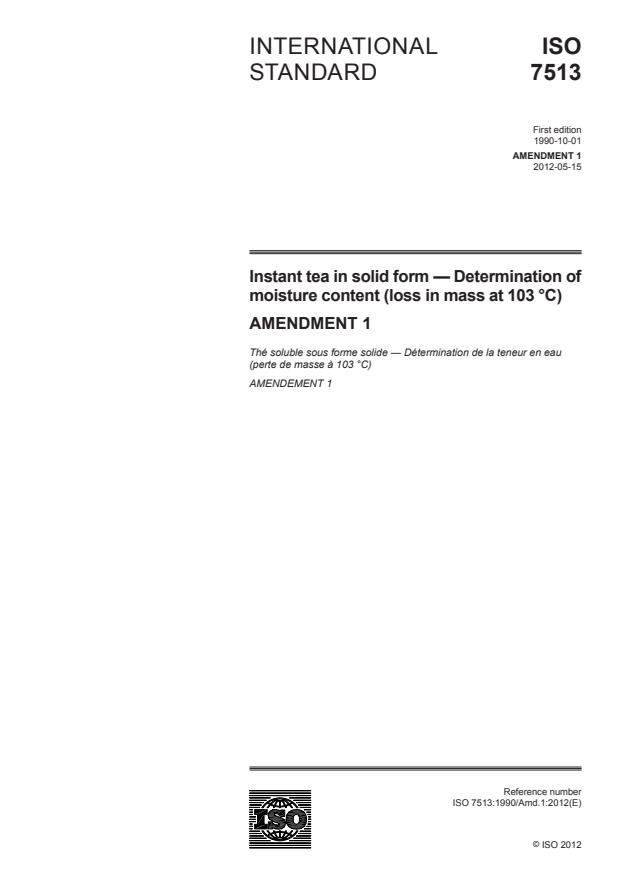
INTERNATIONAL ISO
STANDARD 7513
First edition
1990-10-01
AMENDMENT 1
2012-05-15
Instant tea in solid form — Determination of
moisture content (loss in mass at 103 °C)
AMENDMENT 1
Thé soluble sous forme solide — Détermination de la teneur en eau
(perte de masse à 103 °C)
AMENDEMENT 1
Reference number
ISO 7513:1990/Amd.1:2012(E)
©
ISO 2012
ISO 7513:1990/Amd.1:2012(E)
All rights reserved. Unless otherwise specified, no part of this publication may be reproduced or utilized in any form or by any means,
electronic or mechanical, including photocopying and microfilm, without permission in writing from either ISO at the address below or ISO’s
member body in the country of the requester.
ISO copyright office
Case postale 56 • CH-1211 Geneva 20
Tel. + 41 22 749 01 11
Fax + 41 22 749 09 47
E-mail copyright@iso.org
Web www.iso.org
Published in Switzerland
ii © ISO 2012 – All rights reserved
ISO 7513:1990/Amd.1:2012(E)
Foreword
ISO (the International Organization for Standardization) is a worldwide federation of national standards bodies
(ISO member bodies). The work of preparing International Standards is normally carried out through ISO
technical committees. Each member body interested in a subject for which a technical committee has been
established has the right to be represented on that committee. International organizations, governmental and
non-governmental, in liaison with ISO, also take part in the work. ISO collaborates closely with the International
Electrotechnical Commission (IEC) on all matters of electrotechnical standardization.
International Standards are drafted in accordance with the rules given in the ISO/IEC Directives, Part 2.
The main task of technical committees is to prepa
...
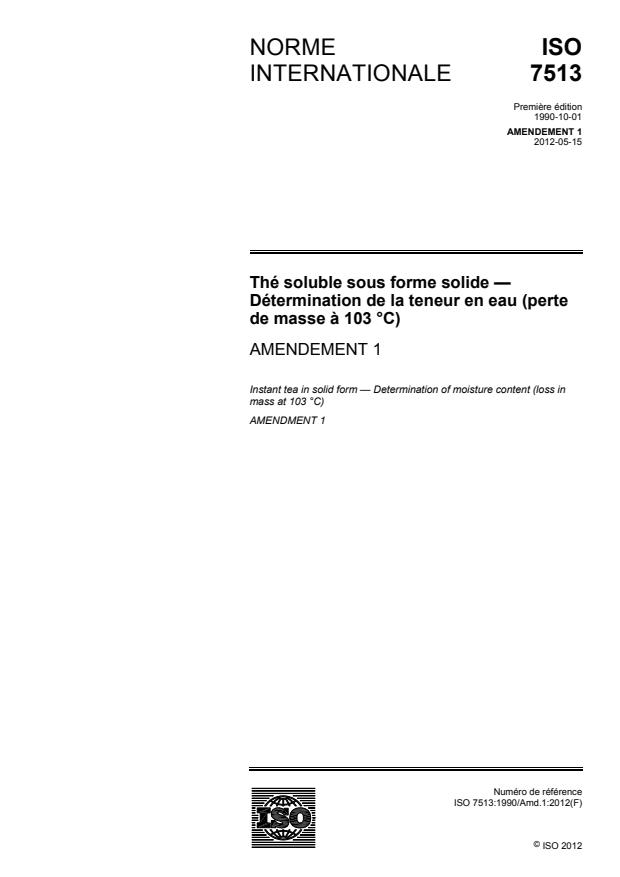
NORME ISO
INTERNATIONALE 7513
Première édition
1990-10-01
AMENDEMENT 1
2012-05-15
Thé soluble sous forme solide —
Détermination de la teneur en eau (perte
de masse à 103 °C)
AMENDEMENT 1
Instant tea in solid form — Determination of moisture content (loss in
mass at 103 °C)
AMENDMENT 1
Numéro de référence
ISO 7513:1990/Amd.1:2012(F)
©
ISO 2012
ISO 7513:1990/Amd.1:2012(F)
DOCUMENT PROTÉGÉ PAR COPYRIGHT
© ISO 2012
Droits de reproduction réservés. Sauf prescription différente, aucune partie de cette publication ne peut être reproduite ni utilisée sous
quelque forme que ce soit et par aucun procédé, électronique ou mécanique, y compris la photocopie et les microfilms, sans l'accord écrit
de l'ISO à l'adresse ci-après ou du comité membre de l'ISO dans le pays du demandeur.
ISO copyright office
Case postale 56 CH-1211 Geneva 20
Tel. + 41 22 749 01 11
Fax + 41 22 749 09 47
E-mail copyright@iso.org
Web www.iso.org
Publié en Suisse
ii © ISO 2012 – Tous droits réservés
ISO 7513:1990/Amd.1:2012(F)
Avant-propos
L'ISO (Organisation internationale de normalisation) est une fédération mondiale d'organismes nationaux de
normalisation (comités membres de l'ISO). L'élaboration des Normes internationales est en général confiée
aux comités techniques de l'ISO. Chaque comité membre intéressé par une étude a le droit de faire partie du
comité technique créé à cet effet. Les organisations internationales, gouvernementales et non
gouvernementales, en liaison avec l'ISO participent également aux travaux. L'ISO collabore étroitement avec
la Commission électrotechnique internationale (CEI) en ce qui concerne la normalisation électrotechnique.
Les Normes internationales sont rédigées conformément aux règles données dans les Directives ISO/CEI,
Partie 2.
La tâche principale des comités techniques est d'élaborer les Normes internationales. Les projets de Normes
internationales adopt
...
Questions, Comments and Discussion
Ask us and Technical Secretary will try to provide an answer. You can facilitate discussion about the standard in here.
Loading comments...