


ISO 39004:2026
(Main)Road traffic safety — Good practice for service providers using digital platform
Road traffic safety — Good practice for service providers using digital platform
This document provides good practice that can be adopted by any service provider, not limited to e-hailing and p-hailing operators, for the implementation of work-related road traffic safety (RTS) management. This document is applicable to any service provider to offer further protection to the drivers for digital platform providers as well as other road users through the adoption of a proactive approach to manage work-related road risks.
Sécurité routière — Bonnes pratiques pour les prestataires de services qui utilisent une plateforme numérique
General Information
- Status
- Published
- Publication Date
- 18-Jun-2026
- Technical Committee
- ISO/TC 241 - Road traffic safety management systems
- Current Stage
- 6060 - International Standard published
- Start Date
- 19-Jun-2026
- Due Date
- 06-Oct-2026
- Completion Date
- 19-Jun-2026


Overview
ISO 39004:2026 – Road traffic safety - Good practice for service providers using digital platform outlines comprehensive guidelines for service providers to implement effective work-related road traffic safety (RTS) management. Recognizing the growing impact of the digital platform economy-including sectors like e-hailing and p-hailing-the standard supports organizations in protecting drivers, passengers, and other road users through proactive risk management and the promotion of a safety-first culture. ISO 39004:2026 serves as an internationally recognized reference for internal improvement of RTS policies, offering value to any service provider operating in the digital platform space.
Key Topics
Scope and Applicability
- Applies to all service providers using digital platforms, not limited to e-hailing or delivery operations.
- Can be used by organizations of any size to enhance protection for drivers and road users.
Factors Contributing to Road Traffic Crashes
- Identifies key risk areas: driver competency, health and behavior; vehicle condition and suitability; road and environmental hazards; and business management practices.
Roles and Responsibilities
- Outlines the responsibilities of service providers, drivers, customers, merchants, senders, government agencies, and the public in the context of RTS.
- Emphasizes leadership commitment, risk assessment, and stakeholder communication for successful RTS programs.
Good Practice Recommendations
- Establishment of comprehensive work-related RTS policies, regular policy reviews, and clear communication.
- Driver management through recruitment standards, ongoing training, safe driving procedures, and fitness-to-drive assessments.
- Vehicle management, including daily safety checks and maintenance.
- Route and journey planning, considering external risk factors such as weather and road conditions.
- Periodic safety campaigns, emergency response protocols, and incident investigation.
- Engagement with government and stakeholders on RTS matters and performance evaluations.
Continual Improvement and Awareness
- Encourages a plan-do-check-act (PDCA) approach for continual enhancement of RTS management.
- Supports technology adoption and regular review of safety initiatives.
Applications
ISO 39004:2026 provides practical guidance for:
- E-hailing and P-hailing Operators: Improving driver safety and reducing incident rates in gig economy transport and delivery services.
- Digital Marketplace Platforms: Ensuring road safety for logistics and transport partners.
- Corporate Fleet Managers: Benchmarking and enhancing existing road safety management systems.
- Startups and SMEs in the Platform Economy: Establishing robust, scalable RTS practices without certification overhead.
- Government and Regulatory Bodies: Developing policy guidance and encouraging industry best practices.
- Community Stakeholders: Promoting public awareness on road traffic safety in the digital services context.
By applying this standard, service providers can reduce crash risks, improve operational efficiency, demonstrate corporate responsibility, and foster trust among users.
Related Standards
ISO 39001: Road traffic safety (RTS) management systems - Requirements with guidance for use
- Provides comprehensive management system requirements for RTS and is referenced throughout ISO 39004:2026 for organizations seeking certification.
Other ISO/TC 241 Documents
- Offer additional RTS guidance and best practices relevant to various aspects of road safety.
National and International Road Safety Legislation
- ISO 39004:2026 aligns with global regulatory frameworks and supports compliance with evolving safety regulations.
Keywords: ISO 39004:2026, road traffic safety, digital platform, service provider, e-hailing, p-hailing, work-related road safety, driver management, vehicle safety, RTS management, best practice, gig economy safety, route management, fleet safety, plan-do-check-act, risk reduction, delivery platform safety.
Get Certified
Connect with accredited certification bodies for this standard

BSI Group
BSI (British Standards Institution) is the business standards company that helps organizations make excellence a habit.

NYCE
Mexican standards and certification body.
Sponsored listings
Frequently Asked Questions
ISO 39004:2026 is a standard published by the International Organization for Standardization (ISO). Its full title is "Road traffic safety — Good practice for service providers using digital platform". This standard covers: This document provides good practice that can be adopted by any service provider, not limited to e-hailing and p-hailing operators, for the implementation of work-related road traffic safety (RTS) management. This document is applicable to any service provider to offer further protection to the drivers for digital platform providers as well as other road users through the adoption of a proactive approach to manage work-related road risks.
This document provides good practice that can be adopted by any service provider, not limited to e-hailing and p-hailing operators, for the implementation of work-related road traffic safety (RTS) management. This document is applicable to any service provider to offer further protection to the drivers for digital platform providers as well as other road users through the adoption of a proactive approach to manage work-related road risks.
ISO 39004:2026 is classified under the following ICS (International Classification for Standards) categories: 35.240.60 - IT applications in transport. The ICS classification helps identify the subject area and facilitates finding related standards.
ISO 39004:2026 is available in PDF format for immediate download after purchase. The document can be added to your cart and obtained through the secure checkout process. Digital delivery ensures instant access to the complete standard document.
Standards Content (Sample)
International
Standard
ISO 39004
First edition
Road traffic safety — Good practice
2026-06
for service providers using digital
platform
Sécurité routière — Bonnes pratiques pour les prestataires de
services qui utilisent une plateforme numérique
Reference number
© ISO 2026
All rights reserved. Unless otherwise specified, or required in the context of its implementation, no part of this publication may
be reproduced or utilized otherwise in any form or by any means, electronic or mechanical, including photocopying, or posting on
the internet or an intranet, without prior written permission. Permission can be requested from either ISO at the address below
or ISO’s member body in the country of the requester.
ISO copyright office
CP 401 • Ch. de Blandonnet 8
CH-1214 Vernier, Geneva
Phone: +41 22 749 01 11
Email: copyright@iso.org
Website: www.iso.org
Published in Switzerland
ii
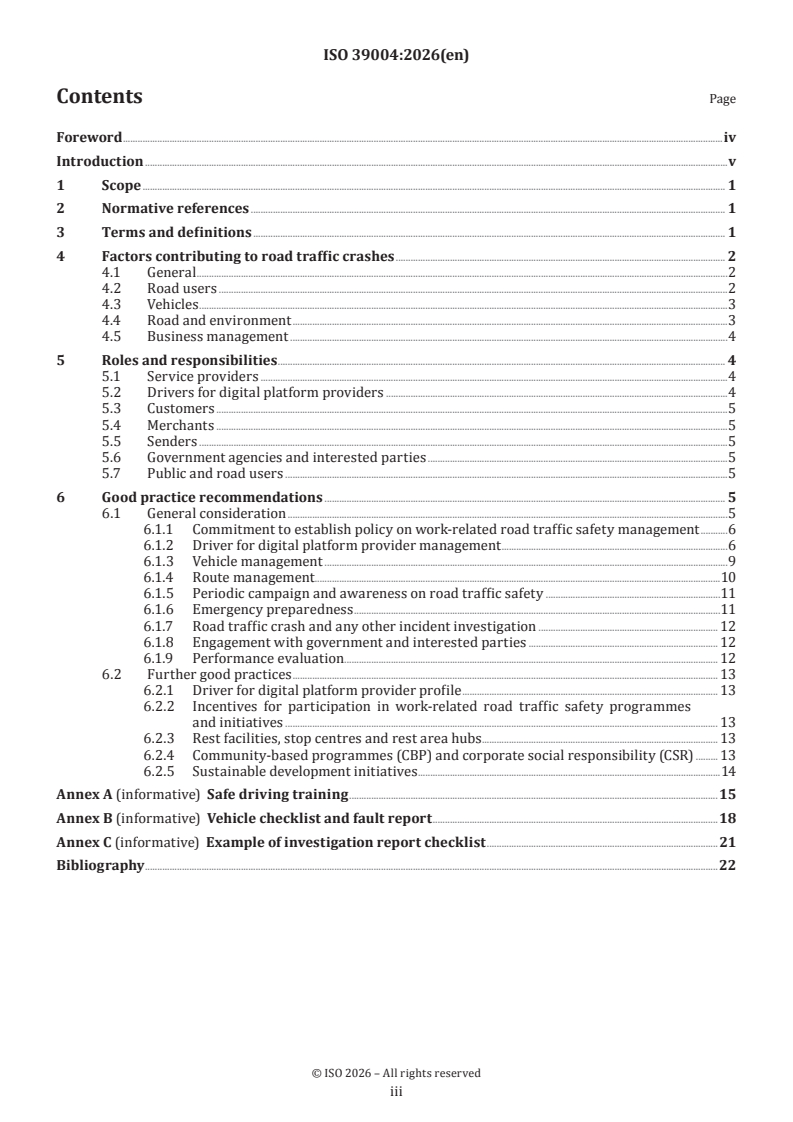
Contents Page
Foreword .iv
Introduction .v
1 Scope . 1
2 Normative references . 1
3 Terms and definitions . 1
4 Factors contributing to road traffic crashes . 2
4.1 General .2
4.2 Road users .2
4.3 Vehicles .3
4.4 Road and environment .3
4.5 Business management .4
5 Roles and responsibilities . 4
5.1 Service providers .4
5.2 Drivers for digital platform providers .4
5.3 Customers .5
5.4 Merchants .5
5.5 Senders .5
5.6 Government agencies and interested parties .5
5.7 Public and road users .5
6 Good practice recommendations . 5
6.1 General consideration .5
6.1.1 Commitment to establish policy on work-related road traffic safety management .6
6.1.2 Driver for digital platform provider management .6
6.1.3 Vehicle management .9
6.1.4 Route management.10
6.1.5 Periodic campaign and awareness on road traffic safety .11
6.1.6 Emergency preparedness .11
6.1.7 Road traffic crash and any other incident investigation . 12
6.1.8 Engagement with government and interested parties . 12
6.1.9 Performance evaluation . . 12
6.2 Further good practices . 13
6.2.1 Driver for digital platform provider profile . 13
6.2.2 Incentives for participation in work-related road traffic safety programmes
and initiatives . 13
6.2.3 Rest facilities, stop centres and rest area hubs . 13
6.2.4 Community-based programmes (CBP) and corporate social responsibility (CSR) . 13
6.2.5 Sustainable development initiatives .14
Annex A (informative) Safe driving training .15
Annex B (informative) Vehicle checklist and fault report .18
Annex C (informative) Example of investigation report checklist .21
Bibliography .22
iii
Foreword
ISO (the International Organization for Standardization) is a worldwide federation of national standards
bodies (ISO member bodies). The work of preparing International Standards is normally carried out through
ISO technical committees. Each member body interested in a subject for which a technical committee
has been established has the right to be represented on that committee. International organizations,
governmental and non-governmental, in liaison with ISO, also take part in the work. ISO collaborates closely
with the International Electrotechnical Commission (IEC) on all matters of electrotechnical standardization.
The procedures used to develop this document and those intended for its further maintenance are described
in the ISO/IEC Directives, Part 1. In particular, the different approval criteria needed for the different types
of ISO document should be noted. This document was drafted in accordance with the editorial rules of the
ISO/IEC Directives, Part 2 (see www.iso.org/directives).
ISO draws attention to the possibility that the implementation of this document may involve the use of (a)
patent(s). ISO takes no position concerning the evidence, validity or applicability of any claimed patent
rights in respect thereof. As of the date of publication of this document, ISO had not received notice of (a)
patent(s) which may be required to implement this document. However, implementers are cautioned that
this may not represent the latest information, which may be obtained from the patent database available at
www.iso.org/patents. ISO shall not be held responsible for identifying any or all such patent rights.
Any trade name used in this document is information given for the convenience of users and does not
constitute an endorsement.
For an explanation of the voluntary nature of standards, the meaning of ISO specific terms and expressions
related to conformity assessment, as well as information about ISO's adherence to the World Trade
Organization (WTO) principles in the Technical Barriers to Trade (TBT), see www.iso.org/iso/foreword.html.
This document was prepared by Technical Committee ISO/TC 241, Road traffic safety management systems.
Any feedback or questions on this document should be directed to the user’s national standards body. A
complete listing of these bodies can be found at www.iso.org/members.html.
iv
Introduction
0.1 General
The emergence of the digital platform economy has transformed the traditional way of working. Participation
in the digital platform economy has grown drastically over the past few years and expanded exponentially
since the onset of the coronavirus pandemic. Job flexibilities, internet reliance and "fast money" makes
this sector attractive to those job seekers. This economic platform is one of the most important new
transformations in the world of work. An important component of the platform economy is digital labour
platforms which includes both web-based platforms, where work is outsourced through an open call to a
geographically dispersed crowd ("crowd work"), and location-based applications (apps) which allocate work
to individuals in a specific geographical area, typically to perform local, service-oriented tasks such as food
or parcel delivery services. These changes have potentially increased exposure to road traffic crashes and
incidents among drivers for digital platform providers.
The service provider is the party responsible for connecting customer requests with the merchant or vendor
through the provision of systems and commercial network interfaces. The service provider determines
service system setting offered to interested suppliers, customers and drivers (work resources). Service
providers can influence and inculcate road traffic safety (RTS) culture among their drivers for digital
platform providers. They can also help to minimize work-related crashes through the provision of adequate
and relevant policies, processes and training on RTS, vehicles, and planning of safe journeys. Service
providers must be fully committed in building a "safety first" culture, which will consequently promote
the prevention of work-related crashes. It is recognized that implementation of good practices can deliver
societal, environmental and economic benefits to the service providers in addition to the safety deliverables
addressed therein.
This document provides guidelines for good practices that can be adopted by service providers to manage
their work-related RTS management with a systematic and flexible approach while at the same time ensuring
continual improvement to their practices and systems. It highlights measures and initiatives that can be
taken to mitigate work-related RTS risks. Service providers are encouraged to adopt as many good practices
as possible in this document.
This document is a guidance standard, one of the documents on RTS management systems developed by
ISO/TC 241. This document cannot be used for certification purposes but does provide guidance for internal
or external audit programmes. Service provider organizations using it can compare their RTS management
practices with an internationally recognized benchmark, providing sound principles for effective
management and corporate governance.
However, it is recognized that certain markets can require service providers to demonstrate that they have
embraced the guidance of this document. For those organizations, the following approach can be taken.
— Address the requirements of ISO 39001.
— Address all recommendations given in this document.
— Ensure the scope of the ISO 39001 management system contains reference to this document.
— Obtain certification to ISO 39001.
0.2 Concept of implementing good practices for road safety management
This document recognizes the use of an iterative plan-do-check-act (PDCA) approach to guide organizations
toward achieving maximum commuting safety management results (see Figure 1).
a) Plan: Establish objectives and targets on commuting safety management in accordance with the
organization's policy under top management’s leadership and commitment and plan the processes
necessary to achieve them.
b) Do: Ensure that sufficient capacity and resources are provided and implement the processes for
commuting safety management as planned.
v
c) Check: Monitor and measure the process performance against objectives and targets and identify the
opportunities for continual improvement.
d) Act: Take actions to continually improve process performance with the aim of reducing the incidence
and risk of death and serious injuries in road traffic crashes.
Figure 1 — Plan-do-check-act (PDCA) approach to RTS management
0.3 Implementation of good practices
The implementation of good practices for work-related RTS management can be categorized into different
levels. They can be used to educate, to increase awareness and to consistently remind about the importance
of always inculcating a "safety first" culture (see Figure 2). Service providers can consider engineering
approaches (for example, standardization of box design, placement, materials, and safety application
features) to improve RTS performance.
The implementation of continual and sustainable RTS programmes and initiatives will positively affect
the mindset and behaviours. These programmes and initiatives are conducted periodically, scheduled, and
assessed to examine their adequacy and effectiveness, while opportunities for continual improvement are
also identified.
The service providers establish process(es) for the recognition, planning, implementation, evaluation,
reporting and control of new technological solutions that can impact work-related RTS.
The evaluation gives due consideration to the potential benefits of such technology in respect of crash
avoidance, and injury or damage minimization. It must also ensure that potential risks such as driver or
rider distraction or complacency are fully assessed.
The service providers communicate to the management team and their drivers for digital platform providers
the outcomes of assessments of the technological advancements on work-related RTS management and
provide appropriate influence regarding the adoption of such technologies. The service providers take
proactive measures to make adoption possible.
vi
The management team and drivers for digital platform providers are encouraged to be continually exposed
to the technological advancements of work-related RTS management, especially those proven scientifically,
and the service providers can influence the adoption of such in work-related road activities.
Figure 2 — Steps towards the safety-first culture
vii
International Standard ISO 39004:2026(en)
Road traffic safety — Good practice for service providers
using digital platform
1 Scope
This document provides good practice that can be adopted by any service provider, not limited to e-hailing
and p-hailing operators, for the implementation of work-related road traffic safety (RTS) management.
This document is applicable to any service provider to offer further protection to the drivers for digital
platform providers as well as other road users through the adoption of a proactive approach to manage
work-related road risks.
2 Normative references
The following documents are referred to in the text in such a way that some or all of their content constitutes
requirements of this document. For dated references, only the edition cited applies. For undated references,
the latest edition of the referenced document (including any amendments) applies.
ISO 39001, Road traffic safety (RTS) management systems — Requirements with guidance for use
3 Terms and definitions
For the purposes of this document, the terms and definitions given in ISO 39001 and the following apply.
ISO and IEC maintain terminology databases for use in standardization at the following addresses:
— ISO Online browsing platform: available at https:// www .iso .org/ obp
— IEC Electropedia: available at https:// www .electropedia .org/
3.1
customer
party who buys or receives goods or services through a digital platform
3.2
digital platform
end-to-end business incorporating any online platform process involving customers, vendors or merchants,
senders or drivers for digital platform providers
3.2.1
e-hailing
service provided to book public transport services through electronic applications
3.2.2
p-hailing
service provided for ordering the collection or delivery of goods
3.3
merchant
business or person that offers or sells a particular type of product or services that uses a digital platform or
application registered with a service provider
Note 1 to entry: In the context of digital platform, a merchant is also known as a vendor or seller.
3.4
driver for digital platform provider
driver, rider or cyclist who performs the transport operations on the road either on permanent basis, short-
term contract, freelance or flexible working hours with support from digital platforms or applications
3.5
service provider
organization using a digital platform which provides a system and interfaces form a commercial network or
market facilitating business-to-business (B2B), business-to-customer (B2C), or customer-to-customer (C2C)
transaction using any digital device for communication
Note 1 to entry: Digital devices for communication can include desktop, mobile, social and email software.
3.6
sender
person or organization that is involved in the preparation and packaging of parcel, package, or goods to be
delivered
3.7
work-related road traffic safety
management of hazards and risks to persons engaged in or affected by work or service-related driving or
work or service activities on or near a road
4 Factors contributing to road traffic crashes
4.1 General
Four main factors that contribute to road traffic crashes are: road users (i.e. driver, rider, bicyclist,
micromobility user, pedestrian and passenger), vehicles, road and environment, and business management.
4.2 Road users
There are three elements that influence the physical and psychological conditions of drivers for digital
platform providers:
a) Competency:
Driving knowledge, experience and skill are essential for a driver for a digital platform provider to
ensure a safe journey. For example, new drivers are often associated with a lack of experience on the
road and likely to be involved in road traffic crashes, and have lower priorities with regards to RTS, but
are more comfortable with changing technological solutions. Experienced drivers, are more likely to
have hands-on driving experience, as well as familiarity with the roads and surroundings, but are more
likely to have difficulty adjusting to modern technologies.
In addition to safe driving, a driver for digital platform provider requires additional competency to
ensure safe delivery. Lack of occupational competency in the industry, such as information processing
(on the road and mobile application), load management, stress management and customer service skills
can contribute to road traffic crashes.
b) Health and fitness:
Physical health (e.g. chronic diseases and infectious disease, visual problems), mental health (e.g.
depression, anxiety) and behavioural health (e.g. insufficient sleep, substance abuse including drugs
and alcohol) are factors that can affect road safety.
Emotional instability, anger, panic, stress and lack of motivation, are examples of psychological
conditions that can cause road traffic crashes.
c) Behaviour:
Risky driving behaviour refers to all unsafe operations that a driver for a digital platform provider
performs when manoeuvring the vehicle.
These types of behaviour, which can include speeding, running red lights, making illegal U-turn, driving
against traffic flow, unsafe use of mobile phones while driving, improper use of safety equipment, idling
in the no-parking area such as yellow box or zebra crossing can become a habit when demonstrated over
time and inappropriate trespassing or passing on sidewalks. This behaviour does not only endanger
drivers and their passengers and load, but also implicates other road users.
Driving behaviour can be influenced by various factors, including internal (e.g. driver’s skill, driving
experience, physiological status, and psychological state), as well as external (e.g. passengers, traffic
density, local weather, road conditions, and culture) factors, among others. Together, these factors can
shape one’s driving style.
4.3 Vehicles
Vehicle safety devices, suitability and condition are three factors that can contribute to work-related road
traffic crashes, and they are described in the following detail:
a) Lack of and inadequate safety features and devices, including:
1) unsafe vehicle engineering, design and structure; and
2) inadequate passive and active safety devices, e.g. electronic stability control (ESC), anti-lock braking
system (ABS), side impact protection or seatbelt reminder system.
b) Suitability:
The vehicle must be suitable according to its design, construction and use. The use of inappropriate
vehicles including any improper or unauthorised modifications, not only causes discomfort throughout
the journey, but it also leads to incidents and road traffic crashes since it is implicating the vehicle's
stability and control. Overloading or improper load securement, or both, also increase the risk of injury
in the event of a road traffic crash.
c) Condition:
Poor vehicle condition due to age of the vehicle or lack of maintenance causes drivers’ fatigue, discomfort
and increases the risk of road traffic accidents.
Lack of cleanliness, insufficient vehicle maintenance and improper load management also causes drivers
to become less conspicuous to other road users and increases the risk of road traffic accidents.
4.4 Road and environment
Road and environment conditions are also considered as contributing factors to road traffic crashes,
specifically:
a) Road conditions:
1) road surface (e.g. potholes, slippery, greasy);
2) geometric features (e.g. bumpy road, sag curves, crest curves, lane width);
3) road construction work;
4) road furniture and facilities along the route (e.g. unsuitable type of guardrail used, inadequate or
confusing or blocked road signage, faded road markings and line).
b) Road environment:
1) topographical condition (e.g. flat, undulating, hilly, mountainous);
2) inadequate lighting condition;
3) haze;
4) thick fog;
5) weather condition (e.g. heavy rain, flood, landslide, crosswind);
6) animal crossing;
7) illegally parked vehicles and potential impact on sightlines; and
8) any significant change to the road environment and condition affecting safety, such as fallen objects,
etc.
c) Traffic volume and condition (e.g. during peak hours, festive seasons).
4.5 Business management
a) Management system:
Lack of understanding on the importance of work-related RTS management, leadership and commitment
creates unsafe working environments for drivers for digital platform providers.
b) Job requirement:
The nature of drivers for digital platform providers to deliver to certain locations requires them to use
mobile phones continuously which can distract their attention and focus while driving.
5 Roles and responsibilities
5.1 Service providers
The service providers’ leadership and commitment are crucial success factors of work-related RTS
management programmes and initiatives in the workplace. This is directly related to the knowledge of the
health and safety of their drivers for digital platform providers, their attitude, vision and mission, and their
willingness to commit thus make an impact on work-related RTS.
One of the main responsibilities as service providers is to understand and implement the work-related RTS
management. Top management should be knowledgeable in the principle of safe system approach and able to
monitor related activities including the monitoring of driving behaviour and assessment of its achievement
and effectiveness.
The service providers should also identify relevant road authorities that are responsible for the routes
within their coverage so that they can report any damage to the road or unsafe conditions.
The service providers should conduct a risk assessment to properly identify risks, implement measures,
evaluate and report the work-related RTS performance to ensure the safety and health of the drivers for
digital platform providers. The service providers should also ensure that they hold adequate protection for
the welfare of the drivers for digital platform providers.
The service providers should identify all relevant government agencies and interested parties and should
establish a reporting channel so that the progress and achievement of its overall RTS management can be
shared. With such, good practices and impactful initiatives by the service providers can then be recognized
and shared to improve further work-related RTS.
5.2 Drivers for digital platform providers
The drivers for digital platform providers should ensure that they are properly licensed, insured for work,
fit to drive, plan journeys safely and have full knowledge of traffic laws. In addition, the drivers for digital
platform providers should also provide adequate support, cooperation and feedback in all programmes and
initiatives to ensure the success of work-related road traffic management. Therefore, drivers for digital
platform providers are responsible for taking reasonable care for the health and safety of themselves, goods
and other persons who can be affected by their actions.
5.3 Customers
The customers should give full cooperation and provide feedback on services provided by the service
providers and on the performance of the drivers for digital platform providers to improve and ensure safe
services. The customers can also play their role in promoting and advocating RTS messages for safe service.
5.4 Merchants
The merchants are responsible to maintain the supply flow of products or services, coordinate with
drivers for digital platform providers, and maintain positive relationships with customers to strengthen
the customer base. As a merchant, it is important to ensure the quality and punctuality of the product
preparation and safety handling of the products or services they provide.
5.5 Senders
The senders are responsible to ensure the products and goods to be delivered meet the requirements set by
the service providers including on type, size and weight as well as the packaging and loading of the products
and goods.
5.6 Government agencies and interested parties
Proactive roles by the government agencies, private sectors and non-profit organization significantly
influence the outcome and the sustainability of the work-related RTS management programmes.
The government and other relevant agencies can support and collaborate with service providers to reduce
work-related road traffic crashes. The involvement and cooperation of these agencies can further encourage
service providers to develop programmes and initiatives that are necessary to ensure the health and safety
of drivers for digital platform providers.
The government and other relevant agencies can also take proactive actions and provide prompt response
to concerns raised by the service providers or drivers for digital platform providers or the public concerning
RTS.
The government and interested parties should continually disseminate information regarding RTS campaign
and awareness through media communication including social media. A continuous and sustainable RTS
promotion will positively influence the mindset and behaviour of the public.
5.7 Public and road users
Public and road users can contribute towards RTS services by reporting any unsafe driving behaviour
during the journey. Complimenting good driving behaviour would also motivate drivers for digital platform
providers to behave better on the road. A continuous and sustainable RTS reminder will positively influence
the mindset and behaviour of the drivers for digital platform providers. Public and road users should also
portray safe behaviour on the road.
6 Good practice recommendations
6.1 General consideration
Basic good practices are generic good practices that are applicable to most service providers and situations
regardless of the type and nature of their service or scope of activities. Basic good practices are highly
recommended for effective implementation of work-related RTS management. Some of these practices do
not require substantial investment or resources but have been proven to get buy-in and support.
Further good practices as explained in 6.2 are additional initiatives that can be implemented based on
the service provider’s needs and resources to complement the basic good practices explained in 6.1. The
implementation of these additional initiatives, which can be seen as best possible practices, provide value
added benefits to service providers.
6.1.1 Commitment to establish policy on work-related road traffic safety management
The work-related RTS management should be incorporated in the relevant policy of the service providers. It
should be communicated and made readily accessible to all interested parties. In addition, the policy should
also be constantly reviewed and updated in-line with any relevant developments.
EXAMPLE Relevant developments can be changes in work or social environment or regulations.
The service providers should:
a) provide leadership;
b) appoint a road safety representative (e.g. safety and health officer or occupational safety and health
coordinator);
c) establish a clear, comprehensive and practical set of RTS objectives and targets, including reporting to
interested parties;
d) allocate resources (e.g. staff and financial support).
6.1.2 Driver for digital platform provider management
In order to maintain the driver for digital platform provider’s safety, health and welfare at optimum
levels, the service providers should provide a practical and workable driver for digital platform provider
management programme.
6.1.2.1 Recruitment procedure
The service providers should set the minimum criteria for the recruitment process as follows:
a) holding valid documentations e.g. identity card, driving licence, vehicle permit, insurance and other
documents deemed necessary;
b) acceptable driving and crime records (especially for e-hailing) from the responsible authorities such as
police and road transport department whenever accessible;
c) undergoing health screening at any hospital or clinic or health centre accepted by the service providers
and the cost of such health screening can be borne by the service providers; and
d) undergoing aptitude test or competency assessment on RTS (e.g. online training on usage of the
application and knowledge on RTS).
6.1.2.2 Continual training
The service providers should provide sufficient platforms for continual training associated with RTS and
health to all drivers for digital platform providers. The training should include:
a) training of a technically skilled nature such as safe driving (see Annex A), vehicle handling and control,
inspection, maintenance, journey management, emergency response, health awareness, fatigue
management and other fit and proper trainings;
b) soft skills training such as communication, positive thinking, anger and stress management and other
appropriate trainings; and
c) service provider’s applications, standards operating procedures (SOP) and guidance on parcel handling
including on dangerous goods.
A combination of technical skills, soft skills and skills on using service provider’s application are important
because with such training provided by the service providers, it is hoped the drivers for digital platform
providers are able to carry out their work properly while reducing the risk of road traffic crashes or
minimizing the impact of road traffic crashes if they do occur. All of the training should be conducted in
periodical and scheduled manners. Each and every training session conducted should be properly recorded.
Trainers can be developed from within the service providers and given the necessary training to ensure
continuity of training programmes and to retain expertise within the organization. Trainers should be
selected based on their competence, qualifications and experience to ensure the quality and the effectiveness
of the training.
6.1.2.3 Driving procedure
The service providers can periodically monitor the driver for digital platform provider records of license,
and insurance. The service providers can notify the drivers for digital platform providers to update the
latest and valid documentation within a reasonable timeframe.
The service providers should further consider providing a checklist or notification wherever possible for the
drivers for digital platform providers to:
a) be physically and mentally fit which can be implemented through self-declaration via service provider’s
application;
NOTE For a service provider with scheduled drivers at hub, the driver for digital platform provider can be
assessed periodically by a qualified supervisor to ensure they are in a fit state to drive.
b) bring along important documents deemed necessary;
c) carry out daily vehicle checks which may include through digital platform application in ensuring the
safety of vehicle before and after the journey;
d) understand the relevant road traffic rules such as wearing personal protective equipment (e.g. protective
helmet, reflective vest, uniform, windbreaker, rider’s box, glove, proper shoes) and not bringing pillion
while carrying the box;
e) understand the specification and basic technology of the vehicle such as engine type, number of cylinders,
fuel supply system, displacement etc. and ensure goods being delivered meet vehicle specification;
f) have access to latest news or information from the management, weather forecast e.g. flood, etc. via
online application or scheduled gathering;
g) ensure that the customer is aware of the relevant road traffic rules such as seatbelt wearing;
h) ensure the load is according to allowable requirements (see subclause 6.1.3.3);
i) ensure any interaction with the application is minimized i.e. employ voice activated system for order
acceptance.
The service providers may further consider any other checklists or notifications that is deemed relevant and
practical for RTS.
The service providers should promote a flexible schedule according to the ability and availability of the driver
for digital platform provider, considering the maximum working hours to ensure their safety. The driver
for digital platform provider is not encouraged to work long hours and is reminded to take regular breaks.
This matter should be given due attention as it can pose a greater risk of road traffic crash involvement due
to fatigue and sleepiness issues. Where multiple deliveries are being assigned to a single driver for digital
platform provider, service providers must ensure that reasonable delivering time is being allocated. This
may involve historical data to estimate the delivery time.
The driver for digital platform providers should also ensure that they select parking areas that are safe, upon
arrival, especially during multi-drop deliveries, to prevent potential hazards or obstructions. Consideration
should be given to appropriate signage on the vehicle to warn other road users.
6.1.2.4 Health and fitness to drive
A programme for monitoring health and fitness should be established by the service provider, in order to
safeguard the well-being of all drivers for digital platform providers.
The service providers should periodically arrange health and fitness programmes. They should provide
guidance on maintaining health and fitness by considering the following:
a) Encouragement to undergo regular medical check-up including eyesight assessment through:
i) service provider’s medical benefit;
ii) in-house medical screening programme;
iii) government health screening programme; or
iv) any other health screening scheme such as partnership with health facility to ensure drivers
for digital platform providers obtain discounts when visiting panel clinics for health screening
programmes nationwide.
b) Arrange alcohol and drug screening tests using a breathalyser or urine test.
c) Organize physical fitness programmes (e.g. aerobics, walkathon).
d) Provide tips on maintaining health and alertness especially when driving (e.g. a manual on physical
exercise during rest).
e) Provide information and educate on methods to manage stress, tiredness and fatigue resulting from
driving and work pressure.
f) Design controls into the application which remind the driver for digital platform provider to take
sufficient breaks and prevent from working excessive hours.
6.1.2.5 Technology integration
Quickly and equitably harnessing the potential of existing and emerging technologies for road safety—
including telematics, camera systems, sensory devices, connectivity methods, and artificial intelligence—
service providers should actively participate in the development, application, and deployment of these
innovations within their operations.
For instance, by using telematics, driver for digital platform provider management can track real-time
location, monitor driving behaviour, optimize routes, and assess and detect of unsafe practices (e.g.,
speeding, hard braking) and fostering conformance through targeted feedback and rewards systems.
Additionally, telematics and similar technology further enable efficient driver deployment through shift
scheduling, fatigue management, and geo-fencing, promoting safer, more efficient operations tailored to
real-time demand.
6.1.2.6 Consequence management
Incentives and demerit systems should be introduced within the service providers to inculcate safety
conscious behaviour as it can change attitudes, improve habits, and increase skills to build a "safety first"
culture. Care should be taken to evaluate all outcomes.
a) Incentives and recognition:
The reward system is given to service providers who have shown good traffic safety performance
in their work (free from road incidents and road traffic crashes, good discipline, positive customer
feedback, etc.). The rewards also should include incentives in various forms (not necessarily monetary),
such as recognition or special privileges, depending on the service provider’s creativity and initiatives,
for example:
i) allocation for vehicle service and partnership with the appointed workshop for tyre replacement,
lubricant, battery etc. with discounted price;
ii) provision of loan with low interest rate of financing scheme or collaboration with vehicle
manufacturer to purchase vehicle and for major maintenance;
iii) free cafeteria service or health food allowance;
iv) cash reward to selected driver for digital platform provider for high performance and good
behaviour; and
v) star rating or award to the driver for digital platform provider that has no record of complaints or
report received from customer.
NOTE Driver for digital platform provider s will be more enthusiastic and motivated if they are valued and
appreciated by their service providers. A reward system is one of the means whereby service providers can
demonstrate appreciation.
b) Discipline:
Failure to abide by the rules should be addressed through appropriate means. Apart from frequent
monitoring, feedback should also be sourced from public and customer complaints.
The actions taken should be commensurate with the identified non-conformance. It should not be
intended to be punitive but to provide a lesson and instruction to be more cautious and responsible on
the road.
EXAMPLE Non-conformance with rules and regulations pertaining to RTS specified by the management can be
in the form of exceeding maximum speed limit, not wearing appropriate personal protective equipment (PPE) (e.g.
helmets, safety vest, etc.) and others.
Reminder, warning and service review should be issued due to non-conformance with currently enforced
rules and regulations. A driver for digital platform provider should be suspended and deactivated
immediately in cases involving criminal cases that affect public safety, e.g. sexual harassment.
6.1.3 Vehicle management
Vehicle management is important to ensure the safety of the drivers for digital platform providers. The
drivers f
...