


ISO/IEC 15444-8:2007
(Main)Information technology — JPEG 2000 image coding system: Secure JPEG 2000 — Part 8:
Information technology — JPEG 2000 image coding system: Secure JPEG 2000 — Part 8:
ISO/IEC 15444-8:2007 specifies the framework, concepts, and methodology for securing JPEG 2000 codestreams. It defines a normative codestream syntax containing information for interpreting secure image data; a normative process for registering JPSEC tools with a registration authority delivering a unique identifier; informative examples of JPSEC tools in typical use cases; informative guidelines on how to implement security services and related metadata. It does not describe specific secure imaging applications or limit secure imaging to specific techniques, but creates a framework that enables future extensions as secure imaging techniques evolve.
Technologies de l'information — Système de codage d'images JPEG 2000: JPEG 2000 sécurisé — Partie 8:
L'ISO/CEI 15444-8:2007 spécifie le cadre, les concepts et les méthodes permettant de sécuriser les flux à codage JPEG 2000. Elle définit ce qui suit: une syntaxe normative de flux codé contenant des informations permettant d'interpréter des données d'image sécurisées; un processus normatif permettant d'enregistrer des outils JPSEC auprès d'un organisme d'enregistrement délivrant un identificateur unique; des exemples informatifs d'outils JPSEC dans des cas de figure typiques; des directives informatives sur la façon de mettre en oeuvre des services de sécurité et les métadonnées associées. Elle ne décrit pas des applications spécifiques d'imagerie sécurisée ni ne limite l'imagerie sécurisée à des techniques spécifiques, mais crée un cadre autorisant de futures extensions au fur et à mesure de l'évolution des techniques d'imagerie sécurisée.
General Information
- Status
- Withdrawn
- Publication Date
- 03-Apr-2007
- Current Stage
- 9599 - Withdrawal of International Standard
- Start Date
- 16-Oct-2023
- Completion Date
- 12-Feb-2026
Relations
- Effective Date
- 06-Jun-2022
- Effective Date
- 11-Dec-2021
- Effective Date
- 15-Apr-2008
ISO/IEC 15444-8:2007 - Information technology -- JPEG 2000 image coding system: Secure JPEG 2000
ISO/IEC 15444-8:2007 - Technologies de l'information -- Systeme de codage d'images JPEG 2000: JPEG 2000 sécurisé
Get Certified
Connect with accredited certification bodies for this standard

BSI Group
BSI (British Standards Institution) is the business standards company that helps organizations make excellence a habit.

NYCE
Mexican standards and certification body.
Sponsored listings
Frequently Asked Questions
ISO/IEC 15444-8:2007 is a standard published by the International Organization for Standardization (ISO). Its full title is "Information technology — JPEG 2000 image coding system: Secure JPEG 2000 — Part 8:". This standard covers: ISO/IEC 15444-8:2007 specifies the framework, concepts, and methodology for securing JPEG 2000 codestreams. It defines a normative codestream syntax containing information for interpreting secure image data; a normative process for registering JPSEC tools with a registration authority delivering a unique identifier; informative examples of JPSEC tools in typical use cases; informative guidelines on how to implement security services and related metadata. It does not describe specific secure imaging applications or limit secure imaging to specific techniques, but creates a framework that enables future extensions as secure imaging techniques evolve.
ISO/IEC 15444-8:2007 specifies the framework, concepts, and methodology for securing JPEG 2000 codestreams. It defines a normative codestream syntax containing information for interpreting secure image data; a normative process for registering JPSEC tools with a registration authority delivering a unique identifier; informative examples of JPSEC tools in typical use cases; informative guidelines on how to implement security services and related metadata. It does not describe specific secure imaging applications or limit secure imaging to specific techniques, but creates a framework that enables future extensions as secure imaging techniques evolve.
ISO/IEC 15444-8:2007 is classified under the following ICS (International Classification for Standards) categories: 35.040 - Information coding; 35.040.30 - Coding of graphical and photographical information. The ICS classification helps identify the subject area and facilitates finding related standards.
ISO/IEC 15444-8:2007 has the following relationships with other standards: It is inter standard links to ISO/IEC 15444-8:2007/Amd 1:2008, ISO/IEC 15444-8:2023; is excused to ISO/IEC 15444-8:2007/Amd 1:2008. Understanding these relationships helps ensure you are using the most current and applicable version of the standard.
ISO/IEC 15444-8:2007 is available in PDF format for immediate download after purchase. The document can be added to your cart and obtained through the secure checkout process. Digital delivery ensures instant access to the complete standard document.
Standards Content (Sample)
INTERNATIONAL ISO/IEC
STANDARD 15444-8
First edition
2007-04-15
Information technology — JPEG 2000
image coding system —
Part 8:
Secure JPEG 2000
Technologies de l'information — Système de codage d'image
JPEG 2000 —
Partie 8: JPEG 2000 sécurisé
Reference number
©
ISO/IEC 2007
PDF disclaimer
This PDF file may contain embedded typefaces. In accordance with Adobe's licensing policy, this file may be printed or viewed but
shall not be edited unless the typefaces which are embedded are licensed to and installed on the computer performing the editing. In
downloading this file, parties accept therein the responsibility of not infringing Adobe's licensing policy. The ISO Central Secretariat
accepts no liability in this area.
Adobe is a trademark of Adobe Systems Incorporated.
Details of the software products used to create this PDF file can be found in the General Info relative to the file; the PDF-creation
parameters were optimized for printing. Every care has been taken to ensure that the file is suitable for use by ISO member bodies. In
the unlikely event that a problem relating to it is found, please inform the Central Secretariat at the address given below.
© ISO/IEC 2007
All rights reserved. Unless otherwise specified, no part of this publication may be reproduced or utilized in any form or by any means,
electronic or mechanical, including photocopying and microfilm, without permission in writing from either ISO at the address below or
ISO's member body in the country of the requester.
ISO copyright office
Case postale 56 • CH-1211 Geneva 20
Tel. + 41 22 749 01 11
Fax + 41 22 749 09 47
E-mail copyright@iso.org
Web www.iso.org
Published in Switzerland
ii © ISO/IEC 2007 – All rights reserved
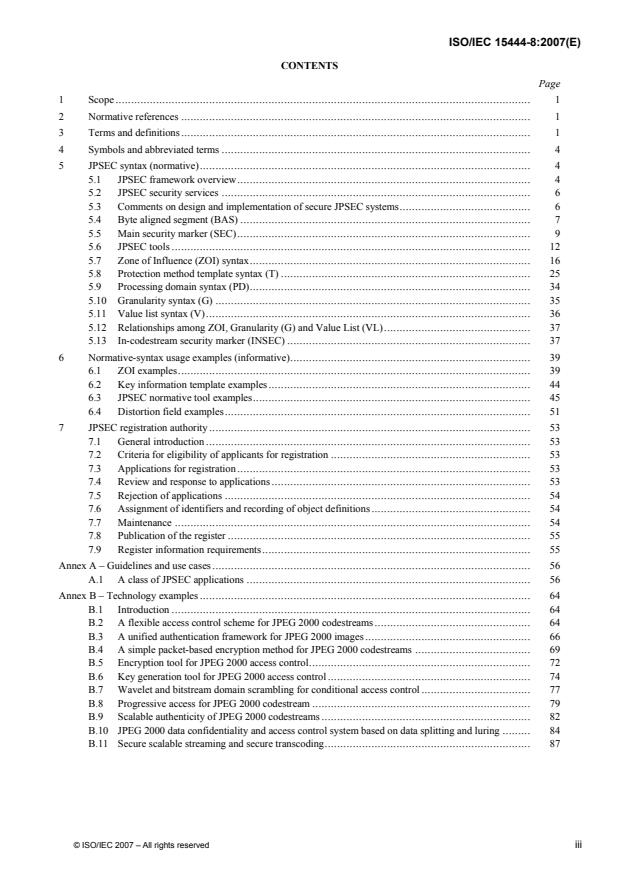
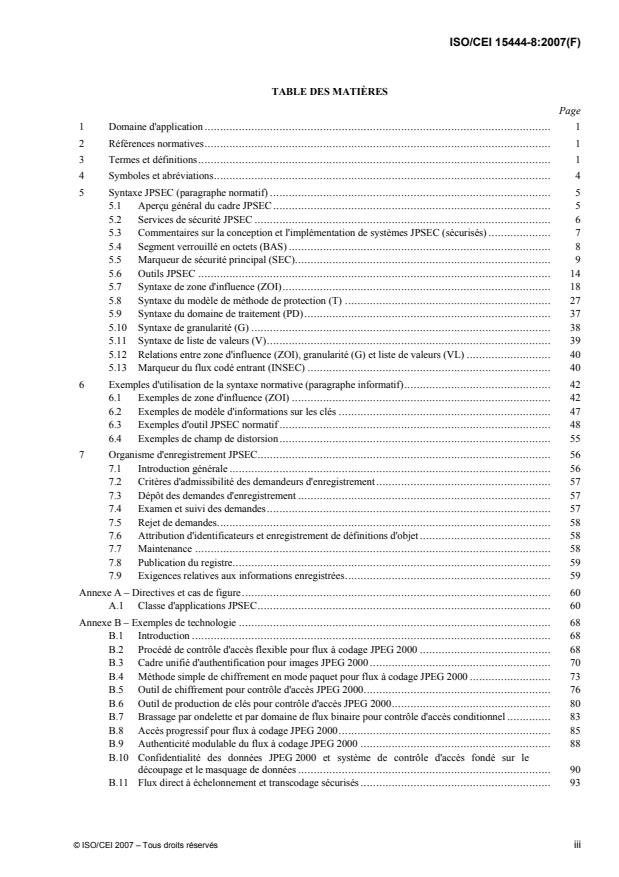
CONTENTS
Page
1 Scope. 1
2 Normative references . 1
3 Terms and definitions. 1
4 Symbols and abbreviated terms . 4
5 JPSEC syntax (normative). 4
5.1 JPSEC framework overview. 4
5.2 JPSEC security services . 6
5.3 Comments on design and implementation of secure JPSEC systems. 6
5.4 Byte aligned segment (BAS) . 7
5.5 Main security marker (SEC). 9
5.6 JPSEC tools . 12
5.7 Zone of Influence (ZOI) syntax. 16
5.8 Protection method template syntax (T) . 25
5.9 Processing domain syntax (PD). 34
5.10 Granularity syntax (G) . 35
5.11 Value list syntax (V). 36
5.12 Relationships among ZOI, Granularity (G) and Value List (VL). 37
5.13 In-codestream security marker (INSEC) . 37
6 Normative-syntax usage examples (informative). 39
6.1 ZOI examples. 39
6.2 Key information template examples. 44
6.3 JPSEC normative tool examples. 45
6.4 Distortion field examples. 51
7 JPSEC registration authority. 53
7.1 General introduction . 53
7.2 Criteria for eligibility of applicants for registration . 53
7.3 Applications for registration. 53
7.4 Review and response to applications. 53
7.5 Rejection of applications . 54
7.6 Assignment of identifiers and recording of object definitions. 54
7.7 Maintenance . 54
7.8 Publication of the register . 55
7.9 Register information requirements. 55
Annex A – Guidelines and use cases. 56
A.1 A class of JPSEC applications . 56
Annex B – Technology examples. 64
B.1 Introduction . 64
B.2 A flexible access control scheme for JPEG 2000 codestreams. 64
B.3 A unified authentication framework for JPEG 2000 images. 66
B.4 A simple packet-based encryption method for JPEG 2000 codestreams . 69
B.5 Encryption tool for JPEG 2000 access control. 72
B.6 Key generation tool for JPEG 2000 access control. 74
B.7 Wavelet and bitstream domain scrambling for conditional access control. 77
B.8 Progressive access for JPEG 2000 codestream . 79
B.9 Scalable authenticity of JPEG 2000 codestreams . 82
B.10 JPEG 2000 data confidentiality and access control system based on data splitting and luring . 84
B.11 Secure scalable streaming and secure transcoding. 87
© ISO/IEC 2007 – All rights reserved iii
ISO/IEC 15444 -8:2007(E)
Page
Annex C – Interoperability. 91
C.1 Part 1. 91
C.2 Part 2. 91
C.3 JPIP. 91
C.4 JPWL . 92
Annex D – Patent statements. 95
BIBLIOGRAPHY. 96
iv © ISO/IEC 2007 – All rights reserved
Foreword
ISO (the International Organization for Standardization) and IEC (the International Electrotechnical
Commission) form the specialized system for worldwide standardization. National bodies that are members of
ISO or IEC participate in the development of International Standards through technical committees
established by the respective organization to deal with particular fields of technical activity. ISO and IEC
technical committees collaborate in fields of mutual interest. Other international organizations, governmental
and non-governmental, in liaison with ISO and IEC, also take part in the work. In the field of information
technology, ISO and IEC have established a joint technical committee, ISO/IEC JTC 1.
International Standards are drafted in accordance with the rules given in the ISO/IEC Directives, Part 2.
The main task of the joint technical committee is to prepare International Standards. Draft International
Standards adopted by the joint technical committee are circulated to national bodies for voting. Publication as
an International Standard requires approval by at least 75 % of the national bodies casting a vote.
The International Organization for Standardization (ISO) and International Electrotechnical Commission (IEC)
draw attention to the fact that it is claimed that compliance with this document may involve the use of patents,
as indicated in Annex D.
ISO/IEC 15444-8 was prepared by Joint Technical Committee ISO/IEC JTC 1, Information technology,
Subcommittee SC 29, Coding of audio, picture, multimedia and hypermedia information in collaboration with
ITU-T. The identical text is published as ITU-T Rec. T.807.
ISO/IEC 15444 consists of the following parts, under the general title Information technology — JPEG 2000
image coding system:
⎯ Part 1: Core coding system
⎯ Part 2: Extensions
⎯ Part 3: Motion JPEG 2000
⎯ Part 4: Conformance testing
⎯ Part 5: Reference software
⎯ Part 6: Compound image file format
⎯ Part 8: Secure JPEG 2000
⎯ Part 9: Interactivity tools, APIs and protocols
⎯ Part 10: Extensions for three-dimensional data
⎯ Part 11: Wireless
⎯ Part 12: ISO base media file format
⎯ Part 13: An entry level JPEG 2000 encoder
© ISO/IEC 2007 – All rights reserved v
ISO/IEC 15444 -8:2007(E)
Introduction
In the "Digital Age", the Internet provides many new opportunities for rightholders regarding the electronic distribution
of their work (books, videos, music, images, etc.).
At the same time, new information technology radically simplifies the access of content for the user. This goes hand in
hand with the all pervasive problem of pirated digital copies – with the same quality as the originals – and "file-sharing"
in peer-to-peer networks, which gives rise to continued complaints about great losses by the content industry.
World Intellectual Property Organization (WIPO) and its Member countries (170) have an important role to play in
assuring that copyright, and the cultural and intellectual expression it fosters, remains well protected in the 21st century.
The new Digital economy and the creative people in every country of the world depend on it. Also in December 1996,
WIPO Copyright Treaty (WCT) has been promulgated with two important articles (11 and 12) about technological
measures and obligations concerning Right Management Information:
Article 11
Obligations concerning
Technological Measures
Contracting Parties shall provide adequate legal protection and effective legal remedies against the circumvention of effective
technological measures that are used by authors in connection with the exercise of their rights under this Treaty or the Berne
Convention and that restrict acts, in respect of their works, which are not authorized by the authors concerned or permitted by law.
Article 12
Obligations concerning Rights
Management Information
(1) Contracting Parties shall provide adequate and effective legal remedies against any person knowingly performing any of the
following acts knowing, or with respect to civil remedies having reasonable grounds to know, that it will induce, enable, facilitate or
conceal an infringement of any right covered by this Treaty or the Berne Convention:
(i) to remove or alter any electronic rights management information without authority;
(ii) to distribute, import for distribution, broadcast or communicate to the public, without authority, works or copies of works
knowing that electronic rights management information has been removed or altered without authority.
(2) As used in this Article, "rights management information" means information which identifies the work, the author of the work, the
owner of any right in the work, or information about the terms and conditions of use of the work, and any numbers or codes that
represent such information, when any of these items of information is attached to a copy of a work or appears in connection with the
communication of a work to the public.
This treaty provides a solid foundation to protect Intellectual Property. As of 2004, about 50 countries ratified this
important treaty. Therefore, it is expected that tools and protective methods that are recommended in JPEG 2000 must
ensure the security of transaction, protection of content (IPR), and protection of technologies.
Security issues, such as authentication, data integrity, protection of copyright and Intellectual Property, privacy,
conditional access, confidentiality, transaction tracing, to mention a few, are among important features in many imaging
applications targeted by JPEG 2000.
The technological means of protecting digital content are described and can be achieved in many ways such as digital
watermarking, digital signature, encryption, metadata, authentication, and integrity checking.
Part 8 of the JPEG 2000 standard intends to provide tools and solutions in terms of specifications that allow applications
to generate, consume, and exchange Secure JPEG 2000 codestreams. This is referred to as JPSEC.
.
vi © ISO/IEC 2007 – All rights reserved
INTERNATIONAL STANDARD
ITU-T RECOMMENDATION
Information technology – JPEG 2000 image coding system:
Secure JPEG 2000
1 Scope
This Recommendation | International Standard specifies the framework, concepts, and methodology for securing
JPEG 2000 codestreams. The scope of this Recommendation | International Standard is to define:
1) a normative codestream syntax containing information for interpreting secure image data;
2) a normative process for registering JPSEC tools with a registration authority delivering a unique
identifier;
3) informative examples of JPSEC tools in typical use cases;
4) informative guidelines on how to implement security services and related metadata.
The scope of this Recommendation | International Standard is not to describe specific secure imaging applications or to
limit secure imaging to specific techniques, but to create a framework that enables future extensions as secure imaging
techniques evolve.
2 Normative references
The following Recommendations and International Standards contain provisions which, through reference in this text,
constitute provisions of this Recommendation | International Standard. At the time of publication, the editions indicated
were valid. All Recommendations and Standards are subject to revision, and parties to agreements based on this
Recommendation | International Standard are encouraged to investigate the possibility of applying the most recent
edition of the Recommendations and Standards listed below. Members of IEC and ISO maintain registers of currently
valid International Standards. The Telecommunication Standardization Bureau of the ITU maintains a list of currently
valid ITU-T Recommendations'.
– ITU-T Recommendation T.800 (2002) | ISO/IEC 15444-1:2004, Information technology – JPEG 2000
image coding system: Core coding system.
– ITU-T Recommendation T.801 (2002) | ISO/IEC 15444-2:2004, Information technology – JPEG 2000
image coding system: Extensions.
3 Terms and definitions
For the purposes of this Recommendation | International Standard, the following definitions apply. The definitions
defined in ITU-T Rec. T.800 | ISO/IEC 15444-1 clause 3 apply to this Recommendation | International Standard.
3.1 access control: Prevention of unauthorized use of a resource, including the prevention of use of a resource in
an unauthorized manner.
3.2 authentication: Process of verifying an identity claimed by or for a system entity.
3.2.1 source authentication: Verification that a source entity (say, user/party) is in fact the claimed source entity.
3.2.2 fragile/semi-fragile image authentication: Process for both image source authentication and image
data/image content integrity verification that should be able to detect any change in the signal and identify where it has
taken place and possibly what the signal was before modification.
NOTE – It serves at proving the authenticity of a document. The difference between fragile and semi-fragile image authentication
is that the former is to verify the image data integrity and the latter to verify the image content integrity.
3.3 confidentiality: Property that information is not made available or disclosed to unauthorized individuals,
entities or processes.
ITU-T Rec. T.807 (05/2006) 1
3.4 data splitting: Method to protect sensitive data from unauthorized access by encrypting the data and storing
different portions of the file on different servers.
NOTE – When split data is accessed the parts are retrieved, combined and decrypted. An unauthorized person would need to
know the locations of the servers containing the parts, be able to get access to each server, know what data to combine, and how
to decrypt it.
3.5 decryption, deciphering: Inverse transformation of the encryption.
3.6 digital signature: Data appended to, or a cryptographic transformation of, a data unit that allows a recipient
of the data unit to prove the source and integrity of the data unit and protect against forgery, e.g., by the recipient.
3.7 encryption: Reversible transformation of data by a cryptographic algorithm to produce ciphertext, i.e., to hide
the information content of the data.
NOTE – An alternative term for an encryption algorithm is cipher.
3.8 fingerprints: Characteristics of an object that tend to distinguish it from other similar objects to enable the
owner to trace authorized users distributing them illegally.
NOTE – In this respect, fingerprinting is usually discussed in the context of the traitor tracing problem.
3.9 hash function: Function which maps strings of bits to fixed-length strings of bits, satisfying the following
two properties:
NOTE – For a given output, it is computationally infeasible to find an input which maps to this output. For a given input, it is
computationally infeasible to find a second input which maps to the same output. Computational feasibility depends on the user's
specific security requirements and environment.
3.10 integrity: Property of being able to safeguard the accuracy and the completeness of assets.
3.10.1 image data integrity: Property that data has not been altered or destroyed in an unauthorized manner.
3.10.2 image content integrity: Assurance the image content has not been modified by unauthorized parties in such
a way that its perceptual meaning is changed.
NOTE – It allows the content-preserving operations to be performed on the image without triggering the integrity alarm.
3.11 JPSEC application: Any software or hardware process that is capable of consuming JPSEC codestreams by
interpreting the JPSEC syntax in order to provide the specified security services.
NOTE – A JPSEC application makes use of one or several JPSEC tools.
EXAMPLE – A JPSEC application would be able to read encrypted JPSEC codestreams, decrypt them when provided with the
appropriate key and render the JPEG 2000 original clear-text image data.
3.12 JPSEC codestream: Sequence of bits resulting from coding and securing an image using JPEG 2000 coding
and JPSEC security tools.
3.12.1 JPSEC creator: Entity who creates a JPSEC codestream from an image, a JPEG 2000 codestream, or another
JPSEC codestream in order to provide some JPSEC services.
3.12.2 JPSEC consumer: Entity who receives a JPSEC codestream and renders a JPSEC service based on the
codestream.
3.13 JPSEC service: Service that provides security for consumption of JPEG 2000 images. The service counters
security attacks and makes use of one or several JPSEC tools.
3.14 JPSEC registration authority: Entity in charge of delivering a unique ID to reference a JPSEC tool and
storing the parameter list of the JPSEC tool's description.
3.15 JPSEC tool: Hardware or software process that uses security techniques to implement a security service.
3.15.1 JPSEC normative tool: JPSEC tool that uses predefined tool templates for decryption, authentication, or
hashing specified by the normative part of this Recommendation ⏐ International Standard.
3.15.2 JPSEC non-normative tool: JPSEC tool that is specified by an identification number given by the
JPSEC registration authority or by a user-defined application.
3.15.3 JPSEC user-defined tool: JPSEC non-normative tool that is defined by a user-defined application.
3.15.4 JPSEC registration authority tool: JPSEC non-normative tool that is defined by the JPSEC registration
authority.
2 ITU-T Rec. T.807 (05/2006)
3.16 JPSEC tool description: A description of the parameters used by the JPSEC tool.
NOTE – However, JPSEC tool description does not describe the algorithm or method used. A JPSEC tool description consists of
two parts: the parameter list and its values. In the case of JPSEC normative tools, the parameter list is given by the standard. In
the case of JPSEC non-normative tools, the parameter list may be given by the registration authority. In both cases, the parameter
values are specified in the SEC and INSEC marker segments.
3.17 key: Sequence of symbols that controls the operations of encipherment and decipherment.
3.17.1 symmetric keys: Pair of keys for which both the originator and the recipient use the same secret key or two
keys that can be easily computed from each other in a cryptographic system.
3.17.2 asymmetric key pair: Pair of related keys where the private key defines the private transformation and the
public key defines the public transformation.
3.17.2.1 private key: Key of an entity's asymmetric key pair which should not be disclosed.
3.17.2.2 public key: Key of an entity's asymmetric key pair which can be made public.
3.18 key generation, key generating function: Function which takes as input a number of parameters, at least one
of which shall be secret, and which gives as output keys appropriate for the intended algorithm and application.
NOTE – The function shall have the property that it shall be computationally infeasible to deduce the output without prior
knowledge of the secret input.
3.19 key management: Generation, storage, distribution, deletion, archiving and application of keys in accordance
with a security policy.
3.20 marker emulation: Cipher text resulting from the encryption process that contains a JPEG start code.
3.21 message authentication code algorithm, cryptographic check function, cryptographic checksum
function: Algorithm for computing a function which maps strings of bits and a secret key to fixed-length strings of bits,
satisfying the following two properties:
• for any key and any input string the function can be computed efficiently;
• for any fixed key, and given no prior knowledge of the key, it is computationally infeasible to compute
the function value on any new input string, even given knowledge of the set of input strings and
corresponding function values, where the value of the ith input string may have been chosen after
observing the value of the first i-1 function values.
NOTE – Computational feasibility depends on the user's specific security requirements and environment.
3.21.1 message authentication code (MAC): String of bits which is the output of a MAC algorithm.
3.22 non-repudiation: Binding of an entity to a transaction in which it participates, so that the transaction cannot
later be repudiated (denied).
NOTE – That is, the receiver of a transaction is able to demonstrate to a neutral third party that the claimed sender did indeed
send the transaction.
3.23 packet: A part of the JPEG 2000 Part 1 bit stream comprising a packet header and the compressed image data
from one layer of the precinct of one resolution of one tile-component.
NOTE – This is different from the term "packet" used in data transmission through network.
3.24 protection: Process to secure content.
3.24.1 protection template: Template or list of parameter fields necessary for the operation of a protection method.
3.24.2 protection method: Method used to create or consume protected content such as encryption, decryption,
authentication, and integrity checking.
3.25 security: All aspects related to defining, achieving, and maintaining confidentiality, integrity, availability,
accountability, authenticity, and reliability.
NOTE – A product, system, or service is considered to be secure to the extent that its users can rely that it functions (or will
function) in the intended way. This is usually considered in the context of an assessment of actual or perceived threats.
3.26 signalling syntax: Specification of the format of the JPSEC codestream that contains all the required
information for consuming secure JPEG 2000 images.
3.27 transcoding: Operation of taking an input compressed codestream and adapting or converting it to produce an
output compressed codestream that has some desired property.
EXAMPLE – The output compressed codestream may represent an image with a lower spatial resolution or
lower bit rate than the input compressed codestream.
ITU-T Rec. T.807 (05/2006) 3
3.27.1 secure transcoding: Operation of performing transcoding, or adaptation, of a protected input compressed
content, without unprotecting the content.
NOTE – The term secure transcoding is used, as opposed to transcoding, to stress that the transcoding operation is performed
without compromising security. Secure transcoding may also be referred to as performing transcoding in the encrypted domain.
3.28 watermark: Signal imperceptibly added to the cover-signal in order to convey hidden data.
3.28.1 watermarking: Process that imperceptibly inserts data representing some information into multimedia data in
one of the following two ways:
• The lossy way which means the exact cover-signal will never be able to be recovered once the watermark
is embedded.
• The lossless way which means the exact cover-signal could be recovered after watermark extraction.
4 Symbols and abbreviations
For the purposes of this Recommendation | International Standard, the following abbreviations apply.
BAS Byte Aligned Segment
FBAS Field Byte Aligned Segment
G Granularity
GL Granularity Level
INSEC In-codestream security marker
IP Intellectual Property related to technology
IPR Intellectual Property Rights related to content
JPSEC Secure JPEG 2000
KT Key Template
LSB Least Significant Bit
MAC Message Authentication Code
MSB Most Significant Bit
PD Processing Domain
PKI Public Key Infrastructure
PO Processing Order
RA Registration Authority
RBAS Range Byte Aligned Segment
SEC Security marker
T Template
V Values
VL Value List
ZOI Zone of Influence
5 JPSEC syntax (normative)
5.1 JPSEC framework overview
JPSEC defines a framework for the securing of JPEG 2000 coded data. The core of this Recommendation | International
Standard is the specification of the syntax of the secure JPEG 2000 image, the JPSEC codestream. The syntax is
targeted toward JPEG 2000 coded data and allows for protection of the entire codestream or of parts of the codestream.
In all cases the protected data (i.e., the JPSEC codestream) must follow the normative syntax defined in this
Recommendation | International Standard.
To the JPSEC codestream are associated a number of JPSEC security services including confidentiality and
authentication of origin and of content.
4 ITU-T Rec. T.807 (05/2006)
The signalling syntax specifies:
– what security services are associated with the image data;
– which JPSEC tools are required to deliver the corresponding services;
– how the JPSEC tools are applied;
– which parts of the image data are protected.
Figure 1 – Overview of the conceptual steps in JPSEC framework
The syntax of the JPSEC codestream is normative. The purpose is to allow JPSEC applications to consume
JPSEC codestreams in an interoperable way (see Figure 1). The JPSEC consumer application interprets the
JPSEC codestream, identifies and applies the signalled JPSEC tools, delivers the corresponding security services and
then passes on the output JPEG 2000 codestream or image for subsequent processing, for example by an image viewer.
As shown in case C of Figure 1, the JPSEC codestream may be created from another JPSEC codestream. This may arise
when multiple JPSEC tools are applied to the same content, but at different times or by different entities. When this
occurs, the ordering in which the JPSEC tools are applied during the creation and consumption operations may be
significant.
The signalling syntax identifies tools that are used by a JPSEC consumer. Tools are either defined by the normative part
of the standard, or by the registration authority, or by private tools. The normatively defined tools support
confidentiality (through encryption tools), and authentication of the source and of the content. They allow for the
highest type of interoperability since independent implementations of the consuming process are able to process the
same JPSEC codestream and render the corresponding services with the same behaviour.
The way in which the JPSEC codestream is created is out of scope of this Recommendation | International Standard. To
be compliant, JPSEC creators must generate JPSEC codestreams that include the appropriate JPSEC signalling.
JPSEC codestreams can be created in a number of ways. For example, a JPSEC tool can be applied to image pixels or it
can be applied on wavelet coefficients, or on quantized coefficients, or on packets.
A consumer can implement one or more JPSEC tools. For example, it could be capable of performing decryption using
AES block cipher in ECB mode and signature verification using SHA-128 hash and an RSA public key. With these
capabilities, it would be capable of performing the security services of confidentiality and authentication.
In the JPSEC framework, JPSEC tools are specified by templates, defined privately, or registered by a JPSEC
Registration Authority. JPSEC tools specified by the templates have unique processing behaviour and therefore do not
require unique identification. Those specified by the registration authority are associated with a unique identification
number provided by the common registry.
ITU-T Rec. T.807 (05/2006) 5
5.2 JPSEC security services
The objective in this subclause is to list and to explain the functionalities which are included in the scope of this
Recommendation | International Standard.
JPSEC tools are used to implement security functions. JPSEC is an open framework which means that it is extensible in
the future. Currently it focuses on the following aspects:
– Confidentiality via encryption and selective encryption
A JPSEC file can support a transformation of the (image and/or metadata) data (plaintext) into a form
(cipher text) that conceals the data's original meaning. By selective encryption we mean that not the
entire image and/or metadata but only parts of the image and/or metadata can be encrypted.
– Integrity verification
A JPSEC file can support means of detecting manipulations to the image and/or metadata and thereby
verify their integrity. There are two classes of integrity verification:
1) Image data integrity verification where even only one bit of image data in error results in
verification failure (i.e., the verification returns "no integrity"). This verification is also often
referred to as fragile image (integrity) verification.
2) Image content integrity verification where even some incidental alteration of image data results in
verification success as long as the alteration does not change image content from the human visual
system point of view; in other words, the image perceptual meaning does not change. This
verification is also often referred to as semi-fragile image (integrity) verification.
Those fragile or semi-fragile image integrity verifications might identify locations in the image
data/image content where the integrity is put into question. Solutions may include:
1) Cryptographic methods such as Message Authentication Codes (MAC), digital signatures,
cryptographic checksums or keyed hash.
2) Watermarking-based methods. This Recommendation | International Standard does not define
normative template for watermarking technology, although it supports non-normative tools using
watermarking technology.
3) Combination of the above two types of methods.
– Source authentication
A JPSEC file can support a verification of the identity of a user/party which generated the JPSEC file.
This can comprise methods of e.g., digital signatures or message authentication code (MAC).
– Conditional access
A JPSEC file can support a mechanism and policy to grant or restrict access to image data or portions of
those. This could allow for instance to view a low resolution (preview) of an image without being able to
visualize a higher resolution.
– Registered Content identification
A JPSEC file can be registered at a Content Registration Authority. It can support a method of matching
the (claimed) image data/image content to the registered image data/image content. For example such a
method could be: Reading a file identifier (Licence Plate) which was placed inside the metadata,
checking the coherence between this Licence Plate and the information that has been uploaded when the
registration process was done. The Licence Plate might contain enough information to be able to request
information from the Content Registration Authority where the file was registered and verify that the file
corresponds to the identifier.
– Secure Scalable Streaming and Secure Transcoding
A JPSEC file or sequence of packets can support methods such that the same or different nodes can
perform streaming and transcoding without requiring decryption or unprotecting the content. An example
is the case where protected JPEG 2000 content is streamed to a mid-network node or proxy that in turn
transcodes the protected JPEG 2000 content in a manner that preserves end-to-end security.
5.3 Comments on design and implementation of secure JPSEC systems
This Recommendation | International Standard supports a rich and flexible set of security services. For example, the
encryption primitives may be applied in a variety of different ways to achieve different goals, ranging from encryption
of the entire JPEG 2000 codestream to selective encryption of only a small portion of the codestream. However, it is
important to stress that significant care must be taken when implementing any security system, including one based on
JPSEC.
6 ITU-T Rec. T.807 (05/2006)
It is strongly recommended that the designers of any security system carefully consider the recommended guidelines for
the security primitives that are being employed. For most of the security primitives signalled using JPSEC, the
associated ISO/IEC standards provide important guidance on their correct use. For example, for encryption using a
block cipher and an associated block cipher mode (Table 29), guidelines for block cipher mode choice and operation are
given in ISO/IEC 10116.
In addition, in many security applications authentication is the most important security service. Even when
confidentiality is the targeted security service, it should be augmented by authentication to prevent various forms of
attacks. Specifically, even in many imaging applications where the primary goal is confidentiality, it is recommended
that authentication also be employed.
Key management is outside the scope of JPSEC, however its criticality must still be stressed. Of paramount importance
in any cryptographic system is the management of the cryptographic keys that control the operations. If these keys are
compromised, then the security of the whole system is compromised and in such a way that the compromise may not be
detected. It is therefore imperative that the keys are generated, distributed, stored and destroyed at a security level that is
at least equal to that of the data that it is protecting. Furthermore, since the chances a key is compromised increase over
time, it is also imperative that keys only be used for a fixed key lifetime. For more information on the use and
management of cryptographic keys, see ISO/IEC 11770.
As with all security systems, the use of cryptographic operations must be completely opaque to the user. That is, the
user should not be able to discover any information about the cryptographic operations except for the output. For
example, the user should not be able to access information about why a cryptographic operation failed to produce an
output. Similarly, a user should not be able to find out any extra information even if he/she resorts to measuring "side
channels" such as timing and/or power analysis. In short, the user should not be able to notice any difference in any of
the applications outputs, regardless of what the application is currently doing, for if this is not the case the resulting
leakage of information may potentially compromise the security of the system.
To summarize, it is strongly recommended that the designer of any security system, including one based on JPSEC, pay
special attention to the details of the system design to ensure a secure system.
5.4 Byte aligned segment (BAS)
5.4.1 Byte aligned segment
In order to provide extensible signalling for classes and modes, this Recommendation | International Standard uses a
variable length data structure called a "byte aligned segment" (BAS). Parameter fields with an extensible number of
fields are represented with the Field BAS (FBAS) structure. Parameter values with large ranges are represented
extensibly with the Range BAS (RBAS) structure.
As illustrated in Figure 2, the BAS is composed of a sequence of one or more BAS bytes. The most significant bit
(MSB) of each BAS byte indicates the existence of a following BAS byte. Specifically, if MSB = 1 then a subsequent
BAS byte follows, while if MSB = 0 then a subsequent BAS byte does not exist and the BAS structure is terminated.
The remaining least significant bits of each BAS byte are concatenated to form a list of bits which are used in different
ways for different BAS parameters. Often, they are used in conjunction with a parameter list that has a number of
elements, and each BAS bit is set to 1 or 0 to flag information about its corresponding element. This flexible structure
was chosen because of its extensibility for future evolutions of the standard, since it allows new parameters to be
signalled in an extensible way.
Figure 2 – Byte aligned segment (BAS) structure
5.4.2 Field BAS (FBAS)
A Field BAS (FBAS) is a type of BAS where the remaining bits of the BAS bytes are used to set fields to 1 or 0. An
example of FBAS usage is the description class of the zone of influence (DCzoi), where we can specify multiple image
descriptions such as tile index, resolution level, and colour component. If we do this, we would flag the three BAS bits
corresponding to tile, resolution, and colour to 1.
ITU-T Rec. T.807 (05/2006) 7
For example, if we wanted to represent a Field BAS with 9 fields, f1 through f9, then we would need to use at most two
BAS bytes. If the two bytes were byte "a" and byte "b", and the most significant bit of each byte were a0 and b0, then
the FBAS would look like:
a0 a1 a2 a3 a4 a5 a6 a7 | b0 b1 b2 b3 b4 b5 b6 b7
a0 and b0 are the indicator bits. Field f1 through f7 are represented in bits a1 through a7, and field f8 is in bit b1 and
field f9 is in bit b2. The remaining bits b3 through b7 are reserved and set to 0.
a0 f1 f2 f3 f4 f5 f6 f7 | b0 f8 f9 0 0 0 0 0
When used in a JPSEC stream, the FBAS in this example can be represented with one or two bytes, depending on the
actual values of the field. This stems from the fact that the default value of the fields is 0. Thus, if fields f8 and f9 are
not set (i.e., their value is 0), then the second byte of the BAS is not needed, and a0 is set to 0. On the other hand, if
field 8 or field 9 is set, then two bytes are needed. In this case, a0 is set to 1 and b0 is set to 0.
Notice that the field bits are "left aligned". This allows us to add more fields over time in a compatible manner.
5.4.3 Range BAS (RBAS)
The Range BAS (RBAS) is used to extend the range or the number of bits used to represent a value. There are two types
of RBAS, RBAS-8 and RBAS-16.
The RBAS-8 contains one or more RBAS bytes that contain the bits of the value. As in the FBAS, the first bit of each
byte indicates whether another RBAS byte follows.
Unlike the FBAS, the RBAS is "right aligned". Thus, if a value has 9 significant bits v1 through v9, where v1 is the
most significant bit, then it would be represented with two BAS bytes:
a0 a1 a2 a3 a4 a5 a6 a7 | b0 b1 b2 b3 b4 b5 b6 b7
as follows:
1 0 0 0 0 0 v1 v2 | 0 v3 v4 v5 v6 v7 v8 v9
If the value was small such that bits v1 and v2 were zero, then the two-byte representation above could be used with v1
and v2 set to zero, or a one-byte RBAS could be used as shown below:
0 v3 v4 v5 v6 v7 v8 v9
The RBAS-16 may be used to represent values that are typically more than 7 bits but less than 15. In this case, the first
RBAS chunk is two bytes where the first bit is the indicator and then next 15 bits are value bits, then the remaining
bytes extended one byte at a time using the typical BAS structure where the first bit of each byte is the indicator of
following BAS bytes.
a0 a1 a2 a3 a4 a5 a6 a7 | b0 b1 b2 b3 b4 b5 b6 b7 | c0 c1 c2 c3 c4 c5 c6 c7
If a parameter value had 22 bits, then it could be represented with the three-byte RBAS-16 structure shown below,
where a0 and c0 are indicator bits to specify whether a BAS byte follows. Any remaining BAS bytes are traditional
one-byte BAS segments.
a0 v1 v2 v3 v4 v5 v6 v7 | v8 v9 v10 v11 v12 v13 v14 v15 | c0 v16 v17 v18 v19 v20 v21 v22
Thus, the ind
...
NORME ISO/CEI
INTERNATIONALE 15444-8
Première édition
2007-04-15
Technologies de l'information — Système
de codage d'images JPEG 2000:
JPEG 2000 sécurisé
Information technology — JPEG 2000 image coding system:
Secure JPEG 2000
Numéro de référence
ISO/CEI 15444-8:2007(F)
©
ISO/CEI 2007
ISO/CEI 15444-8:2007(F)
PDF – Exonération de responsabilité
Le présent fichier PDF peut contenir des polices de caractères intégrées. Conformément aux conditions de licence d'Adobe, ce fichier
peut être imprimé ou visualisé, mais ne doit pas être modifié à moins que l'ordinateur employé à cet effet ne bénéficie d'une licence
autorisant l'utilisation de ces polices et que celles-ci y soient installées. Lors du téléchargement de ce fichier, les parties concernées
acceptent de fait la responsabilité de ne pas enfreindre les conditions de licence d'Adobe. Le Secrétariat central de l'ISO décline toute
responsabilité en la matière.
Adobe est une marque déposée d'Adobe Systems Incorporated.
Les détails relatifs aux produits logiciels utilisés pour la création du présent fichier PDF sont disponibles dans la rubrique General Info
du fichier; les paramètres de création PDF ont été optimisés pour l'impression. Toutes les mesures ont été prises pour garantir
l'exploitation de ce fichier par les comités membres de l'ISO. Dans le cas peu probable où surviendrait un problème d'utilisation,
veuillez en informer le Secrétariat central à l'adresse donnée ci-dessous.
DOCUMENT PROTÉGÉ PAR COPYRIGHT
© ISO/CEI 2007
Droits de reproduction réservés. Sauf prescription différente, aucune partie de cette publication ne peut être reproduite ni utilisée sous
quelque forme que ce soit et par aucun procédé, électronique ou mécanique, y compris la photocopie et les microfilms, sans l'accord écrit
de l'ISO à l'adresse ci-après ou du comité membre de l'ISO dans le pays du demandeur.
ISO copyright office
Case postale 56 • CH-1211 Geneva 20
Tel. + 41 22 749 01 11
Fax. + 41 22 749 09 47
E-mail copyright@iso.org
Web www.iso.org
Version française parue en 2008
Publié en Suisse
ii © ISO/CEI 2007 – Tous droits réservés
ISO/CEI 15444-8:2007(F)
TABLE DES MATIÈRES
Page
1 Domaine d'application . 1
2 Références normatives. 1
3 Termes et définitions. 1
4 Symboles et abréviations. 4
5 Syntaxe JPSEC (paragraphe normatif) . 5
5.1 Aperçu général du cadre JPSEC. 5
5.2 Services de sécurité JPSEC . 6
5.3 Commentaires sur la conception et l'implémentation de systèmes JPSEC (sécurisés) . 7
5.4 Segment verrouillé en octets (BAS) . 8
5.5 Marqueur de sécurité principal (SEC). 9
5.6 Outils JPSEC . 14
5.7 Syntaxe de zone d'influence (ZOI). 18
5.8 Syntaxe du modèle de méthode de protection (T) . 27
5.9 Syntaxe du domaine de traitement (PD). 37
5.10 Syntaxe de granularité (G) . 38
5.11 Syntaxe de liste de valeurs (V). 39
5.12 Relations entre zone d'influence (ZOI), granularité (G) et liste de valeurs (VL) . 40
5.13 Marqueur du flux codé entrant (INSEC) . 40
6 Exemples d'utilisation de la syntaxe normative (paragraphe informatif). 42
6.1 Exemples de zone d'influence (ZOI) . 42
6.2 Exemples de modèle d'informations sur les clés . 47
6.3 Exemples d'outil JPSEC normatif. 48
6.4 Exemples de champ de distorsion. 55
7 Organisme d'enregistrement JPSEC. 56
7.1 Introduction générale . 56
7.2 Critères d'admissibilité des demandeurs d'enregistrement. 57
7.3 Dépôt des demandes d'enregistrement . 57
7.4 Examen et suivi des demandes. 57
7.5 Rejet de demandes. 58
7.6 Attribution d'identificateurs et enregistrement de définitions d'objet. 58
7.7 Maintenance . 58
7.8 Publication du registre. 59
7.9 Exigences relatives aux informations enregistrées. 59
Annexe A – Directives et cas de figure. 60
A.1 Classe d'applications JPSEC. 60
Annexe B – Exemples de technologie . 68
B.1 Introduction . 68
B.2 Procédé de contrôle d'accès flexible pour flux à codage JPEG 2000 . 68
B.3 Cadre unifié d'authentification pour images JPEG 2000. 70
B.4 Méthode simple de chiffrement en mode paquet pour flux à codage JPEG 2000 . 73
B.5 Outil de chiffrement pour contrôle d'accès JPEG 2000. 76
B.6 Outil de production de clés pour contrôle d'accès JPEG 2000. 80
B.7 Brassage par ondelette et par domaine de flux binaire pour contrôle d'accès conditionnel . 83
B.8 Accès progressif pour flux à codage JPEG 2000. 85
B.9 Authenticité modulable du flux à codage JPEG 2000 . 88
B.10 Confidentialité des données JPEG 2000 et système de contrôle d'accès fondé sur le
découpage et le masquage de données . 90
B.11 Flux direct à échelonnement et transcodage sécurisés. 93
© ISO/CEI 2007 – Tous droits réservés iii
ISO/CEI 15444-8:2007(F)
Page
Annexe C – Interopérabilité . 97
C.1 Partie 1 . 97
C.2 Partie 2 . 97
C.3 Protocole JPIP. 97
C.4 Protocole JPWL. 99
Annexe D – Déclarations relatives aux brevets. 101
BIBLIOGRAPHIE . 102
iv © ISO/CEI 2007 – Tous droits réservés
ISO/CEI 15444-8:2007(F)
Avant-propos
L'ISO (Organisation internationale de normalisation) et la CEI (Commission électrotechnique internationale)
forment le système spécialisé de la normalisation mondiale. Les organismes nationaux membres de l'ISO ou
de la CEI participent au développement de Normes internationales par l'intermédiaire des comités techniques
créés par l'organisation concernée afin de s'occuper des domaines particuliers de l'activité technique. Les
comités techniques de l'ISO et de la CEI collaborent dans des domaines d'intérêt commun. D'autres
organisations internationales, gouvernementales et non gouvernementales, en liaison avec l'ISO et la CEI
participent également aux travaux. Dans le domaine des technologies de l'information, l'ISO et la CEI ont créé
un comité technique mixte, l'ISO/CEI JTC 1.
Les Normes internationales sont rédigées conformément aux règles données dans les Directives ISO/CEI,
Partie 2.
La tâche principale du comité technique mixte est d'élaborer les Normes internationales. Les projets de
Normes internationales adoptés par le comité technique mixte sont soumis aux organismes nationaux pour
vote. Leur publication comme Normes internationales requiert l'approbation de 75 % au moins des
organismes nationaux votants.
L'attention est appelée sur le fait que certains des éléments du présent document peuvent faire l'objet de
droits de propriété intellectuelle ou de droits analogues. L'ISO et la CEI ne sauraient être tenues pour
responsables de ne pas avoir identifié de tels droits de propriété et averti de leur existence.
L'ISO/CEI 15444-8 a été élaborée par le comité technique mixte ISO/CEI JTC 1, Technologies de
l'information, sous-comité SC 29, Codage du son, de l’image, de l’information multimédia et hypermédia en
collaboration avec l'UIT-T. Le texte identique est publié en tant que Rec. UIT-T T.807.
L’ISO/CEI 15444 comprend les parties suivantes, présentées sous le titre général Technologies de
l'information — Système de codage d’images JPEG 2000:
⎯ Partie 1: Système de codage de noyau
⎯ Partie 2: Extensions
⎯ Partie 3: Images JPEG 2000 animées
⎯ Partie 4: Tests de conformité
⎯ Partie 5: Logiciel de référence
⎯ Partie 6: Format de fichier d'image de composant
⎯ Partie 8: JPEG 2000 sécurisé
⎯ Partie 9: Outils d'interactivité, interfaces de programmes d'application et protocoles
⎯ Partie 10: Extensions pour données tridimensionnelles
⎯ Partie 11: Communications sans fil
⎯ Partie 12: Format ISO de base pour les fichiers médias
La partie suivante est en préparation:
⎯ Partie 13: Un encodeur JPEG 2000 de niveau d'entrée
© ISO/CEI 2007 – Tous droits réservés v
ISO/CEI 15444-8:2007(F)
Introduction
A "l'ère numérique", le réseau Internet offre aux ayants droit de nombreuses et nouvelles opportunités concernant la
distribution électronique de leurs œuvres (livres, films, partitions musicales, images, etc.).
En même temps, de nouvelles technologies de l'information simplifient radicalement l'accès aux contenus par les
utilisateurs. Cela va de pair avec le problème généralisé des copies numériques piratées – avec la même qualité que
l'original – et avec celui du "partage de fichiers" dans les réseaux d'homologue à homologue, ce qui engendre des
plaintes récurrentes, concernant de grandes pertes, de la part de l'industrie des contenus.
L'Organisation mondiale de la propriété intellectuelle (OMPI) et ses (170) pays Membres ont un important rôle à jouer
afin de garantir que le droit d'auteur, ainsi que l'expression culturelle et intellectuelle qu'il suscite, restera bien protégé
e
au cours du 21 siècle. La nouvelle économie numérique et les créateurs de chaque pays du monde en dépendent. C'est
pourquoi, en décembre 1996, le Traité de l'OMPI sur le droit d'auteur (WCT) a été promulgué avec deux importants
articles (11 et 12) sur les obligations relatives aux mesures techniques et aux informations sur le régime des droits:
Article 11
Obligations relatives aux mesures techniques
Les Parties contractantes doivent prévoir une protection juridique appropriée et des sanctions juridiques efficaces
contre la neutralisation des mesures techniques efficaces qui sont mises en œuvre par les auteurs dans le cadre de
l'exercice de leurs droits en vertu du présent traité ou de la Convention de Berne et qui restreignent l'accomplissement,
à l'égard de leurs œuvres, d'actes qui ne sont pas autorisés par les auteurs concernés ou permis par la loi.
Article 12
Obligations relatives aux informations sur le régime des droits
(1) Les Parties contractantes doivent prévoir des sanctions juridiques appropriées et efficaces contre toute
personne qui accomplit l'un des actes suivants en sachant, ou, pour ce qui relève des sanctions civiles, en ayant des
raisons valables de penser que cet acte va entraîner, permettre, faciliter ou dissimuler une atteinte à un droit prévu par
le présent traité ou la Convention de Berne:
(i) supprimer ou modifier, sans y être habilitée, toute information relative au régime des droits se présentant
sous forme électronique;
(ii) distribuer, importer aux fins de distribution, radiodiffuser ou communiquer au public, sans y être habilitée,
des œuvres ou des exemplaires d'œuvres en sachant que des informations relatives au régime des droits se présentant
sous forme électronique ont été supprimées ou modifiées sans autorisation.
(2) Dans le présent article, l'expression "les informations sur le régime des droits" s'entend des informations
permettant d'identifier l'œuvre, l'auteur de l'œuvre, le titulaire de tout droit sur l'œuvre ou des informations sur les
conditions et modalités d'utilisation de l'œuvre, et de tout numéro ou code représentant ces informations, lorsque l'un
quelconque de ces éléments d'information est joint à l'exemplaire d'une œuvre ou apparaît en relation avec la
communication d'une œuvre au public.
Ce traité fournit une base solide afin de protéger la propriété intellectuelle. En 2004, une cinquantaine de pays avaient
ratifié cet important traité. L'on s'attend donc que les outils et méthodes de protection qui sont recommandés dans le
système JPEG 2000 ne manqueront pas d'assurer la sécurité des transactions, la protection des contenus (droits de
propriété intellectuelle (IPR, Intellectual Property Rights)) et la protection des technologies.
Les questions de sécurité telles que l'authentification, l'intégrité des données, la protection du droit d'auteur et de la
propriété intellectuelle, la protection de la sphère privée, l'accès conditionnel, la confidentialité, le suivi des
transactions, pour n'en mentionner que quelques-unes, font partie des caractéristiques importantes dans de nombreuses
applications d'imagerie visées par le système JPEG 2000.
Les moyens techniques permettant de protéger un contenu numérique sont décrits et peuvent être réalisés par de
nombreux procédés tels que le filigranage numérique, la signature numérique, le chiffrement, les données
métalinguistiques (métadonnées), l'authentification et la vérification d'intégrité.
La présente Partie 8 de la norme JPEG 2000 vise à offrir des outils et des solutions en termes de spécifications
permettant aux applications de produire, de consommer et d'échanger des flux à codage JPEG 2000 sécurisé. C'est ce
qui est désigné par le terme de syntaxe JPSEC.
vi © ISO/CEI 2007 – Tous droits réservés
ISO/CEI 15444-8:2007 (F)
NORME INTERNATIONALE
RECOMMANDATION UIT-T
Technologies de l'information – Système de codage d'images JPEG 2000:
JPEG 2000 sécurisé
1 Domaine d'application
La présente Recommandation | Norme internationale spécifie le cadre, les concepts et les méthodes permettant de
sécuriser les flux à codage JPEG 2000. Le domaine d'application de la présente Recommandation | Norme
internationale consiste à définir:
1) une syntaxe normative de flux codé contenant des informations permettant d'interpréter des données
d'image sécurisées;
2) un processus normatif permettant d'enregistrer des outils JPSEC auprès d'un organisme d'enregistrement
délivrant un identificateur unique;
3) des exemples informatifs d'outils JPSEC dans des cas de figure typiques;
4) des directives informatives sur la façon de mettre en œuvre des services de sécurité et les métadonnées
associées.
Le domaine d'application de la présente Recommandation | Norme internationale ne vise pas à décrire des applications
spécifiques d'imagerie sécurisée ni à limiter l'imagerie sécurisée à des techniques spécifiques, mais à créer un cadre
autorisant de futures extensions au fur et à mesure de l'évolution des techniques d'imagerie sécurisée.
2 Références normatives
Les Recommandations et Normes internationales suivantes contiennent des dispositions qui, par suite de la référence
qui y est faite, constituent des dispositions valables pour la présente Recommandation | Norme internationale. Au
moment de la publication, les éditions indiquées étaient en vigueur. Toutes Recommandations et Normes sont sujettes à
révision et les parties prenantes aux accords fondés sur la présente Recommandation | Norme internationale sont
invitées à rechercher la possibilité d'appliquer les éditions les plus récentes des Recommandations et Normes indiquées
ci-après. Les membres de la CEI et de l'ISO possèdent le registre des Normes internationales en vigueur. Le Bureau de
la normalisation des télécommunications de l'UIT (TSB) tient à jour une liste des Recommandations de l'UIT-T en
vigueur.
– Recommandation UIT-T T.800 (2002) | ISO/CEI 15444-1:2004, Technologies de l'information – Système de
codage d'images JPEG 2000: Système de codage noyau.
– Recommandation UIT-T T.801 (2002) | ISO/CEI 15444-2:2004, Technologies de l'information – Système de
codage d'images JPEG 2000: Extensions.
3 Termes et définitions
Pour les besoins de la présente Recommandation | Norme internationale, les définitions suivantes s'appliquent. Les
définitions données dans la Rec. UIT-T T.800 | ISO/CEI 15444-1, § 3, s'appliquent à la présente Recommandation |
Norme internationale.
3.1 contrôle d'accès: prévention d'un usage non autorisé d'une ressource, y compris la prévention de l'utilisation
d'une ressource de façon non autorisée.
3.2 authentification: processus de vérification d'une identité revendiquée par ou pour une entité systémique.
3.2.1 authentification de la source: vérification du fait qu'une entité d'origine (p. ex. un utilisateur/correspondant)
est réellement l'entité d'origine revendiquée.
3.2.2 authentification d'image fragile/semi-fragile: processus visant à la fois l'authentification d'image de la
source et la vérification de l'intégrité des données ou du contenu d'image, qui devrait être en mesure de détecter toute
Rec. UIT-T T.807 (05/2006) 1
ISO/CEI 15444-8:2007 (F)
modification du signal et de déterminer où cette modification a eu lieu, en précisant éventuellement quelle était la nature
du signal avant sa modification.
NOTE – Ce processus sert à prouver l'authenticité d'un document. La différence entre authentification fragile et authentification
semi-fragile d'une image est que la première consiste à vérifier l'intégrité des données d'image et la seconde à vérifier l'intégrité
du contenu d'image.
3.3 confidentialité: propriété par laquelle des informations ne sont pas mises à la disposition ni révélées à des
individus, entités ou processus non autorisés.
3.4 découpage des données: méthode visant à protéger des données sensibles contre un accès non autorisé en
chiffrant ces données et en mémorisant différentes portions du fichier dans différents serveurs distants.
NOTE – Quand des données découpées font l'objet d'un accès, les parties sont extraites, combinées et déchiffrées. Une personne
non autorisée aurait besoin de connaître les emplacements des serveurs contenant les parties, d'être en mesure d'avoir accès à
chaque serveur, de savoir quelles sont les données à combiner et de savoir comment les déchiffrer.
3.5 déchiffrement: transformation inverse du chiffrement
3.6 signature numérique: donnée adjointe à une unité de données – ou transformation cryptographique de cette
unité – qui permet à un destinataire de cette unité de données d'en prouver l'origine et l'intégrité, et qui permet de la
protéger contre une création frauduleuse, p. ex. par son destinataire.
3.7 chiffrement: transformation réversible de données par un algorithme cryptographique afin de produire un
cryptogramme, c'est-à-dire afin de masquer le contenu informationnel des données.
NOTE – Un synonyme du terme algorithme de chiffrement est: chiffre.
3.8 empreinte digitale: caractéristique d'un objet qui tend à distinguer d'autres objets similaires afin de permettre
à son propriétaire de retrouver la trace d'utilisateurs autorisés les distribuant illégalement.
NOTE – A cet égard, la prise d'empreintes digitales est habituellement analysée dans le contexte du problème de la recherche
criminelle.
3.9 fonction de hachage: fonction qui fait correspondre des chaînes de bits à des chaînes de bits de longueur fixe
en répondant aux deux conditions suivantes.
NOTE – Pour une sortie donnée, il est mathématiquement impossible de trouver une entrée qui mappe à cette sortie; pour une
entrée donnée, il est mathématiquement impossible de trouver une seconde entrée qui mappe à la même sortie. La faisabilité
mathématique dépend des exigences de sécurité propres à l'utilisateur et à son environnement.
3.10 intégrité: propriété d'être en mesure de sauvegarder la précision et la complétude de ressources.
3.10.1 intégrité des données d'image: propriété par laquelle des données n'ont pas été altérées ni détruites de façon
non autorisée.
3.10.2 intégrité du contenu d'image: assurance que le contenu d'image n'a pas été modifié par des utilisateurs non
autorisés au point de modifier la perception de sa signification.
NOTE – Cette propriété permet d'appliquer à l'image des opérations de protection du contenu sans déclencher l'alarme d'intégrité.
3.11 application JPSEC: tout processus logiciel ou matériel qui est capable de consommer des flux à codage
JPSEC en interprétant la syntaxe JPSEC afin d'offrir les services de sécurité spécifiés.
NOTE – Une application JPSEC fait usage d'un ou de plusieurs outils JPSEC.
EXEMPLE – Une application JPSEC sera en mesure de lire des flux JPSEC codés et chiffrés, de les déchiffrer si la
clé appropriée lui a été fournie et de restituer sans codage les données d'image JPEG 2000 originales.
3.12 flux à codage JPSEC: séquence de bits résultant du codage et de la sécurisation d'une image au moyen du
codage JPEG 2000 et des outils de sécurité JPSEC.
3.12.1 créateur JPSEC: entité qui crée un flux à codage JPSEC à partir d'une image, d'un flux à codage JPEG 2000,
ou d'un autre flux à codage JPSEC afin d'offrir certains services JPSEC.
3.12.2 consommateur JPSEC: entité qui reçoit un flux à codage JPSEC et qui rend un service JPSEC fondé sur le
flux codé.
3.13 service JPSEC: service qui protège la consommation d'images à codage JPEG 2000. Ce service déjoue les
attaques compromettant la sécurité et fait usage d'un ou de plusieurs outils JPSEC.
3.14 organisme d'enregistrement JPSEC: entité chargée de délivrer un identificateur unique afin de faire
référence à un outil JPSEC et chargée de mémoriser la liste des paramètres contenus dans la description d'outil JPSEC.
3.15 outil JPSEC: processus matériel ou logiciel qui utilise des techniques de sécurité afin de mettre en œuvre un
service de sécurité
2 Rec. UIT-T T.807 (05/2006)
ISO/CEI 15444-8:2007 (F)
3.15.1 outil JPSEC normatif: outil JPSEC qui utilise des modèles d'outil prédéfinis pour le déchiffrement, pour
l'authentification ou pour le hachage comme spécifié par la partie normative de la présente Recommandation | Norme
internationale.
3.15.2 outil JPSEC non normatif: outil JPSEC spécifié par un numéro d'identification attribué par l'organisme
d'enregistrement JPSEC ou par une application définie par l'utilisateur.
3.15.3 outil JPSEC défini par l'utilisateur: outil JPSEC non normatif qui est défini par une application définie par
l'utilisateur.
3.15.4 outil JPSEC défini par l'organisme d'enregistrement: outil JPSEC non normatif qui est défini par
l'organisme d'enregistrement JPSEC.
3.16 description d'outil JPSEC: description des paramètres utilisés par l'outil JPSEC.
NOTE – La description d'outil JPSEC ne décrit toutefois pas l'algorithme ou la méthode que l'on utilise. Une description d'outil
JPSEC se compose de deux parties: la liste des paramètres et ses valeurs. Dans le cas d'outils JPSEC normatifs, la liste des
paramètres est donnée par la norme. Dans le cas d'outils JPSEC non normatifs, la liste des paramètres peut être fournie par
l'organisme d'enregistrement. Dans les deux cas, les valeurs paramétriques sont spécifiées dans les segments marqueurs SEC et
INSEC.
3.17 clé: séquence de symboles qui commande les opérations de chiffrement et de déchiffrement.
3.17.1 clés symétriques: paire de clés pour lesquelles aussi bien l'expéditeur que le destinataire utilisent la même clé
secrète ou deux clés qui peuvent être facilement calculées, l'une à partir de l'autre, dans un système cryptographique.
3.17.2 paire de clés asymétriques: paire de clés associées où la clé privée définit la transformation privée et où la
clé publique définit la transformation publique.
3.17.2.1 clé privée: clé faisant partie d'une paire de clés asymétriques d'entité, qui ne devrait pas être révélée.
3.17.2.2 clé publique: clé faisant partie d'une paire de clés asymétriques d'entité, qui peut être rendue publique.
3.18 production de clé, fonction de production de clé: fonction qui reçoit en entrée un certain nombre de
paramètres dont au moins un doit être secret, et qui envoie en sortie des clés appropriées à l'algorithme et à l'application
que l'on envisage.
NOTE – La fonction doit avoir la propriété qu'il doit être mathématiquement impossible de déduire la sortie sans connaissance
préalable de l'entrée secrète.
3.19 gestion des clés: production, mémorisation, distribution, suppression, archivage et application de clés
conformément à une politique de sécurité.
3.20 émulation de marqueur: cryptogramme résultant du processus de chiffrement, qui contient un code de
déclenchement JPEG.
3.21 algorithme d'un code d'authentification de message, fonction de contrôle cryptographique, fonction de
somme de contrôle cryptographique: algorithme permettant de calculer une fonction qui affecte des chaînes de bits et
une clé secrète à des chaînes de bits de longueur fixe, en satisfaisant les deux propriétés suivantes:
• pour toute clé et toute chaîne d'entrée, la fonction peut être calculée efficacement;
• pour toute clé fixe, sans aucune connaissance préalable de la clé, il est mathématiquement impossible de
calculer la valeur de la fonction d'après une quelconque nouvelle chaîne d'entrée, même avec la
connaissance de l'ensemble des chaînes d'entrée et des valeurs correspondantes de la fonction, où la
valeur de la ième chaîne d'entrée peut avoir été choisie après observation de la valeur des i-1 premières
valeurs de la fonction.
NOTE – La faisabilité mathématique dépend des exigences de sécurité propres à l'utilisateur et de son environnement.
3.21.1 code d'authentification de message (code MAC, message authentication code): chaîne de bits qui est la
sortie d'un algorithme de codage MAC.
3.22 non-répudiation: association d'une entité à une transaction à laquelle elle participe, de façon que cette
transaction ne puisse pas être ultérieurement répudiée (refusée).
NOTE – C'est-à-dire que le récepteur d'une transaction est en mesure de démontrer à une tierce partie neutre que l'expéditeur
revendiqué a effectivement envoyé la transaction.
3.23 paquet: partie du flux de bits conforme à la Partie 1 de la norme JPEG 2000, composée d'un en-tête de paquet
et des données d'image comprimées extraites d'une couche donnée du district d'une composante de pavé donnée, à une
résolution donnée.
NOTE – Ce terme possède un acception différente du terme "paquet" qui est utilisé en transmission de données dans un réseau.
3.24 protection: processus visant à sécuriser un contenu.
Rec. UIT-T T.807 (05/2006) 3
ISO/CEI 15444-8:2007 (F)
3.24.1 modèle de protection: champs de modèle ou de liste de paramètres, nécessaires au fonctionnement d'une
méthode de protection.
3.24.1 méthode de protection: méthode servant à créer ou à consommer un contenu protégé, telle que le
chiffrement, le déchiffrement, l'authentification et la vérification d'intégrité.
3.25 sécurité: tous les aspects contribuant à définir, à réaliser et à conserver la confidentialité, l'intégrité, la
disponibilité, l'imputabilité, l'authenticité et la fiabilité.
NOTE – Un produit, système ou service est considéré comme étant sécurisé si ses utilisateurs peuvent partir du principe qu'il
fonctionne (ou va fonctionner) de la façon prévue. La sécurité est habituellement considérée dans le contexte d'une évaluation de
dangers, réels ou perçus comme tels.
3.26 syntaxe de signalisation: spécification du format du flux à codage JPSEC qui contient toutes les informations
requises pour consommer des images à codage JPEG 2000 sécurisé.
3.27 transcodage: opération consistant à recevoir en entrée un flux codé comprimé et à l'adapter ou à le convertir
afin d'émettre en sortie un flux codé comprimé qui possède une certaine propriété recherchée.
EXEMPLE – Le flux codé comprimé de sortie peut représenter une image avec une résolution spatiale
inférieure ou avec un débit binaire inférieur au flux codé comprimé d'entrée.
3.27.1 transcodage sécurisé: opération consistant à exécuter le transcodage ou l'adaptation d'une entrée de contenu
comprimé protégé sans compromettre cette protection.
NOTE – Le terme transcodage sécurisé est utilisé, par opposition à transcodage, afin de souligner le fait que l'opération de
transcodage est effectuée sans compromettre la sécurité. Le transcodage sécurisé peut également être considéré comme
l'exécution d'un transcodage dans le domaine cryptographique.
3.28 filigrane: signal imperceptiblement ajouté au signal de masquage afin d'acheminer des données masquées.
3.28.1 filigranage: processus qui insère imperceptiblement, dans des données multimédias de l'une des deux façons
suivantes, des données représentant certaines informations:
• la méthode avec perte qui signifie que le signal de masquage exact ne pourra jamais être récupéré une
fois le filigrane imbriqué;
• la méthode sans perte qui signifie que le signal de masquage exact pourra être récupéré après extraction
du filigrane.
4 Symboles et abréviations
Pour les besoins de la présente Recommandation | Norme internationale, les abréviations suivantes s'appliquent.
BAS Segment verrouillé en octets (byte aligned segment)
FBAS Segment verrouillé en octets d'un champ (field byte aligned segment)
G Granularité
GL Niveau de granularité (granularity level)
INSEC Marqueur de sécurité de flux binaire entrant (in-codestream security marker)
IP Propriété intellectuelle associée à une technologie (intellectual property related to technology)
IPR Droits de propriété intellectuelle associés à un contenu (intellectual property rights related to
content)
JPSEC Codage JPEG 2000 sécurisé (secure JPEG 2000)
KT Modèle de clé (key template)
LSB Bit de plus faible poids (least significant bit)
MAC Code d'authentification de message (message authentication code)
MSB Bit de plus fort poids (most significant bit)
PD Domaine de traitement (processing domain)
PKI Infrastructure de clés publiques (public key infrastructure)
PO Ordre de traitement (processing order)
RA Organisme d'enregistrement (registration authority)
RBAS Segment verrouillé en octets d'une étendue (range byte aligned segment)
SEC Marqueur de sécurité (security marker)
4 Rec. UIT-T T.807 (05/2006)
ISO/CEI 15444-8:2007 (F)
T Modèle (template)
V Valeurs
VL Liste de valeurs (value list)
ZOI Zone d'influence
5 Syntaxe JPSEC (paragraphe normatif)
5.1 Aperçu général du cadre JPSEC
La syntaxe JPSEC définit un cadre pour la sécurisation de données à codage JPEG 2000. Le noyau de la présente
Recommandation | Norme internationale est la spécification de la syntaxe de l'image à codage JPEG 2000 sécurisé: le
flux à codage JPSEC. La syntaxe est orientée vers les données à codage JPEG 2000. Elle permet la protection de tout ou
partie du flux codé. En toutes circonstances, les données protégées (c'est-à-dire les flux à codage JPSEC) doivent suivre
la syntaxe normative définie dans la présente Recommandation | Norme internationale.
Au flux à codage JPSEC sont associés un certain nombre de services de sécurité JPSEC, y compris la confidentialité et
l'authentification de l'origine et du contenu.
La syntaxe de signalisation spécifie:
– quels services de sécurité sont associés aux données d'image;
– quels outils JPSEC sont requis afin de fournir les services correspondants;
– comment les outils JPSEC sont appliqués;
– quelles parties des données d'image sont protégées.
Figure 1 – Aperçu général des étapes théoriques dans le cadre JPSEC
La syntaxe du flux à codage JPSEC est normative. L'objectif consiste à permettre aux applications JPSEC de
consommer des flux à codage JPSEC de façon interopérable (voir Figure 1): l'application consommatrice JPSEC
interprète le flux à codage JPSEC, recherche et applique les outils JPSEC signalés, achemine les services
correspondants de sécurité, puis transmet le flux ou l'image à codage JPEG 2000 pour traitement subséquent, p. ex. par
un visionneur d'images.
Comme représenté dans le cas C de la Figure 1, le flux à codage JPSEC peut être créé à partir d'un autre flux à codage
JPSEC. Cela peut se produire quand de multiples outils JPSEC sont appliqués au même contenu, mais à différents
moments ou par différentes entités. Quand cela se produit, l'ordre dans lequel les outils JPSEC sont appliqués pendant
les opérations de création et de consommation peut être significatif.
Rec. UIT-T T.807 (05/2006) 5
ISO/CEI 15444-8:2007 (F)
La syntaxe de signalisation identifie les outils qui sont utilisés par un consommateur JPSEC. Ces outils sont définis soit
par la partie normative de la norme, ou par l'organisme d'enregistrement, ou par des outils privés. Les outils définis de
façon normative prennent en charge la confidentialité (au moyen d'outils de chiffrement) ainsi que l'authentification de
la source et du contenu. Ils autorisent le type le plus élevé d'interopérabilité car des implémentations indépendantes du
processus de consommation sont en mesure de traiter le même flux à codage JPSEC et de rendre les services
correspondants avec le même comportement.
La façon dont le flux à codage JPSEC est créé est hors du domaine d'application de la présente Recommandation |
Norme internationale. Pour être conformes, les créateurs JPSEC doivent produire des flux à codage JPSEC qui
comprennent la signalisation JPSEC appropriée. Des flux à codage JPSEC peuvent être créés d'un certain nombre de
façons. Par exemple, un outil JPSEC peut être appliqué à des éléments d'image (pixels) ou à des coefficients d'ondelette,
ou à des coefficients quantifiés, ou à des paquets.
Un consommateur peut implémenter un ou plusieurs outils JPSEC. Par exemple, il pourra exécuter un déchiffrement en
utilisant l'analyse par blocs AES en mode ECB et une vérification de signature en utilisant le hachage SHA-128 et une
clé publique RSA. Avec ces capacités, il sera capable d'exécuter des services de sécurité comme la confidentialité et
l'authentification.
Dans le cadre de la syntaxe JPSEC, les outils JPSEC sont spécifiés par des modèles définis secrètement, ou sont
enregistrés par un organisme d'enregistrement JPSEC. Les outils JPSEC spécifiés par les modèles ont un comportement
de traitement unique et ne nécessitent donc pas d'identification unique. Ceux qui sont spécifiés par l'organisme
d'enregistrement sont associés à un numéro unique d'identification fourni par le registre commun.
5.2 Services de sécurité JPSEC
L'objectif du présent paragraphe consiste à énumérer et à expliquer les fonctionnalités qui sont incluses dans le domaine
d'application de la présente Recommandation | Norme internationale.
Les outils JPSEC servent à peut implémenter des fonctions de sécurité. La syntaxe JPSEC est un cadre ouvert,
c'est-à-dire extensible dans le temps. Actuellement, il est centré sur les aspects suivants:
– Confidentialité via chiffrement, sélectif ou non sélectif
Un fichier JPSEC peut prendre en charge une transformation de données non codées (image et/ou
métadonnées) en une forme (cryptogramme) qui masque la signification originale de ces données. Par
chiffrement sélectif, l'on entend que ce n'est pas la totalité, mais seulement des parties de l'image et/ou
des métadonnées qui peuvent être chiffrées.
– Vérification d'intégrité
Un fichier JPSEC peut prendre en charge des moyens permettant de détecter des manipulations apportées
à l'image et/ou aux métadonnées et ainsi vérifier leur intégrité. Il y a deux classes de vérification de
l'intégrité:
1) vérification de l'intégrité des données d'image où même un seul bit de données d'image erroné se
traduit par un échec de vérification (c'est-à-dire que la vérification renvoie le message: "pas
d'intégrité"). Cette vérification est par ailleurs souvent désignée par le terme de vérification fragile
(d'intégrité) d'image;
2) vérification de l'intégrité du contenu d'image, où même une certaine altération occasionnelle des
données d'image se traduit par un succès de vérification tant que cette altération ne change pas le
contenu d'image du point de vue du système visuel humain ou, en d'autres termes, tant que la
perception du sens de l'image ne change pas. Cette vérification est également souvent désignée par
le terme de vérification semi-fragile (d'intégrité) d'image.
Cette vérification fragile ou semi-fragile de l'intégrité pourrait identifier des emplacements dans les
données d'image/le contenu d'image où l'intégrité est mise en question. Solutions possibles:
1) méthodes cryptographiques telles que codes d'authentification de message (MAC, message
authentication code), signatures numériques, sommes de contrôle cryptographique ou adressage
dispersé sur clés calculées;
2) méthodes fondées sur un filigranage. La présente Recommandation | Norme internationale ne définit
pas de modèle normatif pour la technique de filigranage, bien qu'elle prenne en charge les outils non
normatifs utilisant cette technique;
3) combinaison des deux types de méthode précédents.
6 Rec. UIT-T T.807 (05/2006)
ISO/CEI 15444-8:2007 (F)
– Authentification de l'origine
Un fichier JPSEC peut prendre en charge une vérification de l'identité d'un utilisateur/correspondant qui
a produit le fichier JPSEC. Cette vérification peut faire appel à des méthodes telles que les signatures
numériques ou le code d'authentification de message (MAC).
– Accès conditionnel
Un fichier JPSEC peut prendre en charge un mécanisme et une politique permettant d'octroyer ou
d'interdire l'accès à des données d'image ou à des portions de celles-ci. Ce procédé pourrait par exemple
autoriser une (pré)visualisation à basse résolution d'une image sans qu'il soit possible de visualiser une
résolution supérieure.
– Identification d'un contenu enregistré
Un fichier JPSEC peut être enregistré auprès d'un organisme d'enregistrement de contenu. Il peut prendre
en charge une méthode de vérification de concordance entre les données d'image/le contenu d'image (que
l'on revendique) et les données d'image/le contenu d'image que l'on a enregistré. Par exemple, de telles
méthodes pourraient être les suivantes: lecture d'un identificateur de fichier (plaque d'immatriculation)
qui a été placé à l'intérieur des métadonnées, vérification de la cohérence entre cette plaque
d'immatriculation et les informations qui ont été téléchargées en exportation quand le processus
d'enregistrement a été effectué. La plaque d'immatriculation pourrait contenir assez d'informations pour
être en mesure de demander des renseignements auprès de l'organisme d'enregistrement de contenu où le
fichier a été enregistré et de vérifier que ce fichier correspondent à l'identificateur.
– Flux direct à échelonnement et transcodage sécurisés
Un fichier JPSEC ou une séquence de paquets JPSEC peut prendre en charge des méthodes telles que le
même nœud (ou un nœud différent) puisse exécuter la transmission en flux direct et le transcodage sans
nécessiter de déchiffrement ni de déprotection du contenu. Un exemple est le cas où un contenu
JPEG 2000 protégé est transmis en flux direct à un nœud ou à un serveur intermédiaire à mi-réseau, qui à
son tour transcode le contenu JPEG 2000 protégé d'une façon qui préserve la sécurité de bout en bout.
5.3 Commentaires sur la conception et l'implémentation de systèmes JPSEC (sécurisés)
La présente Recommandation | Norme internationale prend en charge un riche et flexible ensemble de services de
sécurité. Par exemple, les primitives de chiffrement peuvent être appliquées de différentes façons afin d'atteindre
différents objectifs, allant du chiffrement de la totalité du flux à codage JPEG 2000 au chiffrement sélectif d'une petite
portion seulement du flux codé. Il importe toutefois de souligner que des précautions particulières doivent être prises
lors de l'implémentation d'un quelconque système de sécurité, même fondé sur la syntaxe JPSEC.
Il est fortement recommandé que les concepteurs de tous les systèmes de sécurité examinent de près les directives
recommandées au sujet des primitives de sécurité qui peuvent être employées. Pour la plupart des primitives de sécurité
signalées au moyen de la syntaxe JPSEC, les normes ISO/CEI associées offrent d'importantes indications sur leur usage
correct. Par exemple, pour un chiffrement utilisant un algorithme par blocs et un mode associé de chiffrement par blocs
(Tableau 29), des directives sur le choix et le fonctionnement du mode de chiffrement par blocs sont données dans
l'ISO/CEI 10116.
Par ailleurs, dans de nombreuses applications de sécurité, l'authentification est le plus important service de sécurité.
Même quand la confidentialité est le service de sécurité recherché, celui-ci devrait être augmenté par une
authentification afin d'empêcher diverses formes d'attaques. Spécifiquement, même dans de nombreuses applications
d'imagerie où l'objectif premier est la confidentialité, il est recommandé que l'authentification soit également employée.
La gestion des clés est hors du domaine d'application de la syntaxe JPSEC; cependant sa criticité doit encore être
soulignée. Dans tout système crypt
...
Questions, Comments and Discussion
Ask us and Technical Secretary will try to provide an answer. You can facilitate discussion about the standard in here.
Loading comments...