

ISO/TS 21056:2025
(Main)Recycled aggregate concrete — Additional provisions and guidance for specification, performance, production and execution
General Information
- Abstract
This document provides principles and a framework for the specification, performance, production and execution of recycled aggregate concrete (RAC). This document applies to concrete for structures cast in situ, pre-cast structures and non-structural concrete. The concrete can be mixed on site, ready-mixed concrete or produced in a plant for pre-cast concrete products.
- Status
- Published
- Publication Date
- 13-Aug-2025
- Technical Committee
- ISO/TC 71/SC 3 - Concrete production and execution of concrete structures
- Current Stage
- 6060 - International Standard published
- Start Date
- 14-Aug-2025
- Due Date
- 25-May-2025
- Completion Date
- 14-Aug-2025
Overview
ISO/TS 21056:2025 - Recycled aggregate concrete (RAC) provides a practical framework and additional provisions for the specification, performance, production and execution of concrete that uses recycled aggregates. Intended as guidance to complement ISO 22965, this Technical Specification covers RAC for structures cast in situ, precast elements and non-structural concrete, and applies to on‑site mixed, ready‑mixed and plant‑produced precast concrete. ISO/TS 21056 aims to promote the safe, consistent and sustainable use of recycled aggregates recovered from construction and demolition waste.
Key topics and technical requirements
The document addresses the full RAC lifecycle with emphasis on materials, testing and workmanship:
- Constituent materials: requirements and quality inspection criteria for recycled coarse and recycled fine aggregates, plus handling, storage and transport considerations (see ISO 18985).
- Performance parameters: guidance on consistence (workability), mechanical properties (compressive strength, elastic modulus), deformation (drying shrinkage, creep), and durability metrics such as carbonation resistance, permeability, chloride resistance and thermal parameters.
- Durability concerns: assessment of alkali–silica reactivity and other long‑term aspects specific to recycled aggregates.
- Mix proportioning: methods for determining target compressive strength, total water content (net vs additional water for saturated surface‑dry condition), cementitious content, and coarse/fine aggregate proportions.
- Production & execution: production controls, mixing procedures, delivery and transport of ready‑mixed RAC, pumping, casting and curing practices tailored for recycled aggregates.
- Testing & compliance: references to relevant test methods (ISO 1920 series, ISO 12439, ISO 19595/96, ISO 22904, ISO 22965 parts 1–2) for sampling, fresh and hardened concrete assessment.
Practical applications and users
ISO/TS 21056 is aimed at professionals implementing RAC in construction projects:
- Specifiers and design engineers - for performance‑based specification and mix design guidance.
- Concrete producers and precast manufacturers - to adapt production processes and quality control when using recycled aggregates.
- Contractors and site teams - for execution practices such as pumping, casting and curing of RAC.
- Testing laboratories and compliance bodies - for verifying RAC performance and conformity with test methods.
- Sustainability and waste‑management planners - to support circular economy goals by reducing landfill and natural aggregate consumption.
Related standards
- ISO 22965-1 / ISO 22965-2 (concrete specification and compliance)
- ISO 18985 (recycled aggregates for concrete)
- ISO 1920 series (testing of concrete)
- ISO 22966 (execution of concrete structures)
Keywords: ISO/TS 21056:2025, recycled aggregate concrete, RAC, recycled aggregates, mix proportion, durability, specification, production, execution, sustainable concrete.
Get Certified
Connect with accredited certification bodies for this standard

DIBt (Deutsches Institut für Bautechnik)
German Institute for Building Technology.
DIN CERTCO
DIN Group product certification.

Aboma Certification B.V.
Specialized in construction, metal, and transport sectors.
Sponsored listings
Frequently Asked Questions
ISO/TS 21056:2025 is a technical specification published by the International Organization for Standardization (ISO). Its full title is "Recycled aggregate concrete — Additional provisions and guidance for specification, performance, production and execution". This standard covers: This document provides principles and a framework for the specification, performance, production and execution of recycled aggregate concrete (RAC). This document applies to concrete for structures cast in situ, pre-cast structures and non-structural concrete. The concrete can be mixed on site, ready-mixed concrete or produced in a plant for pre-cast concrete products.
This document provides principles and a framework for the specification, performance, production and execution of recycled aggregate concrete (RAC). This document applies to concrete for structures cast in situ, pre-cast structures and non-structural concrete. The concrete can be mixed on site, ready-mixed concrete or produced in a plant for pre-cast concrete products.
ISO/TS 21056:2025 is classified under the following ICS (International Classification for Standards) categories: 91.100.30 - Concrete and concrete products. The ICS classification helps identify the subject area and facilitates finding related standards.
ISO/TS 21056:2025 is available in PDF format for immediate download after purchase. The document can be added to your cart and obtained through the secure checkout process. Digital delivery ensures instant access to the complete standard document.
Standards Content (Sample)
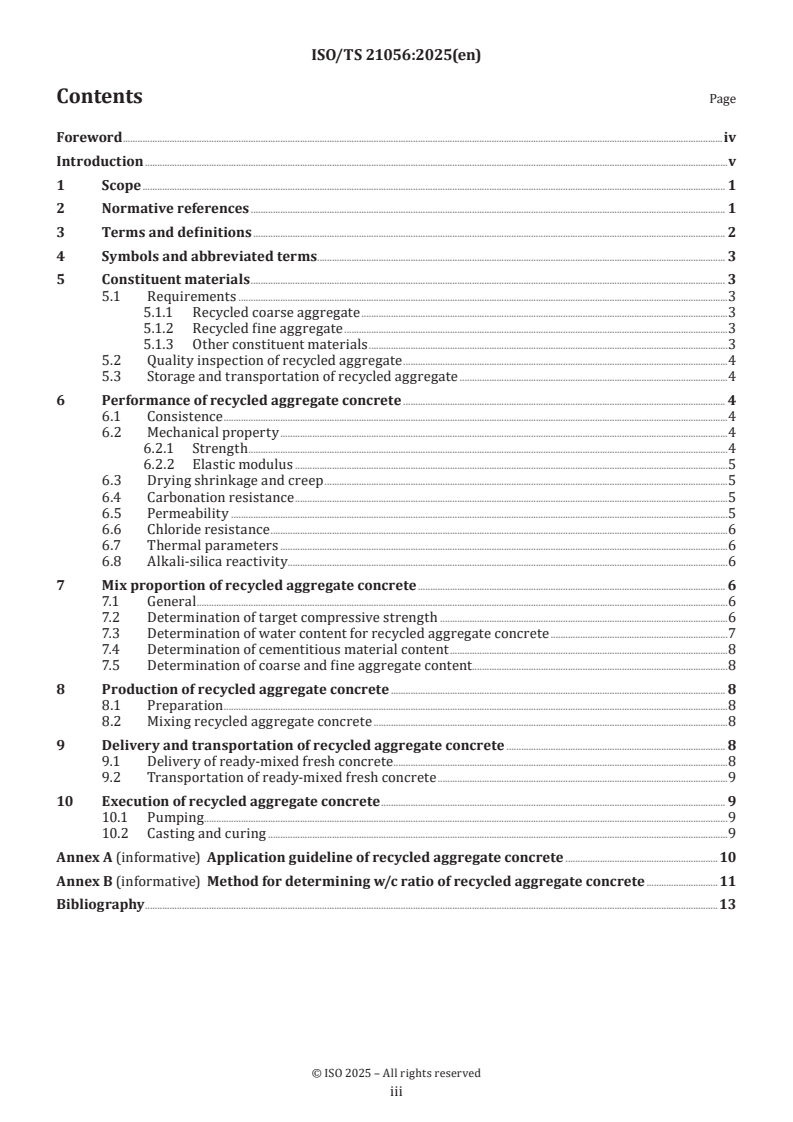
Technical
Specification
ISO/TS 21056
First edition
Recycled aggregate concrete —
2025-08
Additional provisions and guidance
for specification, performance,
production and execution
Béton de granulats recyclés — Dispositions et recommandations
supplémentaires pour la spécification, la performance, la
production et l'exécution
Reference number
© ISO 2025
All rights reserved. Unless otherwise specified, or required in the context of its implementation, no part of this publication may
be reproduced or utilized otherwise in any form or by any means, electronic or mechanical, including photocopying, or posting on
the internet or an intranet, without prior written permission. Permission can be requested from either ISO at the address below
or ISO’s member body in the country of the requester.
ISO copyright office
CP 401 • Ch. de Blandonnet 8
CH-1214 Vernier, Geneva
Phone: +41 22 749 01 11
Email: copyright@iso.org
Website: www.iso.org
Published in Switzerland
ii
Contents Page
Foreword .iv
Introduction .v
1 Scope . 1
2 Normative references . 1
3 Terms and definitions . 2
4 Symbols and abbreviated terms. 3
5 Constituent materials . 3
5.1 Requirements .3
5.1.1 Recycled coarse aggregate .3
5.1.2 Recycled fine aggregate .3
5.1.3 Other constituent materials .3
5.2 Quality inspection of recycled aggregate .4
5.3 Storage and transportation of recycled aggregate .4
6 Performance of recycled aggregate concrete . 4
6.1 Consistence .4
6.2 Mechanical property .4
6.2.1 Strength .4
6.2.2 Elastic modulus .5
6.3 Drying shrinkage and creep .5
6.4 Carbonation resistance .5
6.5 Permeability .5
6.6 Chloride resistance .6
6.7 Thermal parameters .6
6.8 Alkali-silica reactivity.6
7 Mix proportion of recycled aggregate concrete . 6
7.1 General .6
7.2 Determination of target compressive strength .6
7.3 Determination of water content for recycled aggregate concrete .7
7.4 Determination of cementitious material content .8
7.5 Determination of coarse and fine aggregate content.8
8 Production of recycled aggregate concrete . 8
8.1 Preparation .8
8.2 Mixing recycled aggregate concrete .8
9 Delivery and transportation of recycled aggregate concrete . 8
9.1 Delivery of ready-mixed fresh concrete .8
9.2 Transportation of ready-mixed fresh concrete .9
10 Execution of recycled aggregate concrete . 9
10.1 Pumping . .9
10.2 Casting and curing .9
Annex A (informative) Application guideline of recycled aggregate concrete .10
Annex B (informative) Method for determining w/c ratio of recycled aggregate concrete .11
Bibliography .13
iii
Foreword
ISO (the International Organization for Standardization) is a worldwide federation of national standards
bodies (ISO member bodies). The work of preparing International Standards is normally carried out through
ISO technical committees. Each member body interested in a subject for which a technical committee
has been established has the right to be represented on that committee. International organizations,
governmental and non-governmental, in liaison with ISO, also take part in the work. ISO collaborates closely
with the International Electrotechnical Commission (IEC) on all matters of electrotechnical standardization.
The procedures used to develop this document and those intended for its further maintenance are described
in the ISO/IEC Directives, Part 1. In particular, the different approval criteria needed for the different types
of ISO document should be noted. This document was drafted in accordance with the editorial rules of the
ISO/IEC Directives, Part 2 (see www.iso.org/directives).
ISO draws attention to the possibility that the implementation of this document may involve the use of (a)
patent(s). ISO takes no position concerning the evidence, validity or applicability of any claimed patent
rights in respect thereof. As of the date of publication of this document, ISO had not received notice of (a)
patent(s) which may be required to implement this document. However, implementers are cautioned that
this may not represent the latest information, which may be obtained from the patent database available at
www.iso.org/patents. ISO shall not be held responsible for identifying any or all such patent rights.
Any trade name used in this document is information given for the convenience of users and does not
constitute an endorsement.
For an explanation of the voluntary nature of standards, the meaning of ISO specific terms and expressions
related to conformity assessment, as well as information about ISO's adherence to the World Trade
Organization (WTO) principles in the Technical Barriers to Trade (TBT), see www.iso.org/iso/foreword.html.
This document was prepared by Technical Committee ISO/TC 71, Concrete, reinforced concrete and pre-
stressed concrete, Subcommittee SC 3, Concrete production and execution of concrete structures.
Any feedback or questions on this document should be directed to the user’s national standards body. A
complete listing of these bodies can be found at www.iso.org/members.html.
iv
Introduction
With the development of the construction industry, the wastes from the construction phase and the
demolition phase (often called the construction and demolition wastes) are increasing. The landfill of
the construction and demolition wastes will cause the shortage of available land area and environmental
pollution. After being crushed and sorted, the construction and demolition wastes can be upcycled in the
form of recycled aggregates. Recycled aggregate concrete can be produced by substituting all or part of
natural aggregates with recycled aggregates. Recycled aggregate concrete can reduce the amount of the
construction and demolition wastes as well as alleviate the consumption of natural aggregates through the
use of recycled aggregates. In addition, it can reduce landfill area and environmental impact. As a result,
recycled aggregate concrete has become the subject of growing interest. Its primary objective is to promote
the use of recycled aggregates, which are produced from construction and demolition wastes, in structural
and non-structural concrete.
The properties of recycled aggregates are different from those of natural aggregates, resulting in the
variation of mix proportion, consistence, strength, deformation, durability between recycled aggregate
concrete and natural aggregate concrete. This technical specification is primarily concerned with promoting
the application of recycled aggregate concrete and provides additional provisions for ISO 22965 to address
the differences between recycled aggregate concrete and natural aggregate concrete.
The relationship of this document (TS 21056) with other International Standards is shown in Fig 1.
Key
information flow: standard A provides information to standard B
hierarchy: standard B complements standard A
Figure 1 — Relationship of this document to other International Standards
v
Technical Specification ISO/TS 21056:2025(en)
Recycled aggregate concrete — Additional provisions and
guidance for specification, performance, production and
execution
1 Scope
This document provides principles and a framework for the specification, performance, production and
execution of recycled aggregate concrete (RAC).
This document applies to concrete for structures cast in situ, pre-cast structures and non-structural
concrete. The concrete can be mixed on site, ready-mixed concrete or produced in a plant for pre-cast
concrete products.
2 Normative references
The following documents are referred to in the text in such a way that some or all of their content constitutes
requirements of this document. For dated references, only the edition cited applies. For undated references,
the latest edition of the referenced document (including any amendments) applies.
ISO 1920-1, Testing of concrete — Part 1: Sampling of fresh concrete
ISO 1920-2, Testing of concrete — Part 2: Properties of fresh concrete
ISO 1920-4, Testing of concrete — Part 4: Strength of hardened concrete
ISO 1920-5, Testing of concrete — Part 5: Density and water penetration depth
ISO 1920-8, Testing of concrete — Part 8: Determination of drying shrinkage of concrete for samples prepared
in the field or in the laboratory
ISO 1920-9, Testing of concrete — Part 9: Determination of creep of concrete cylinders in compression
ISO 1920-10, Testing of concrete — Part 10: Determination of static modulus of elasticity in compression
ISO 1920-11, Testing of concrete — Part 11: Determination of the chloride resistance of concrete, unidirectional
diffusion
ISO 1920-12, Testing of concrete — Part 12: Determination of the carbonation resistance of concrete —
Accelerated carbonation method
ISO 12439, Mixing water for concrete
ISO 18985, Recycled aggregates for concrete
ISO 19595, Natural aggregates for concrete
ISO 19596, Admixtures for concrete
ISO 22904, Additions for concrete
ISO 22965-1, Concrete — Part 1: Method of specifying and guidance for the specifier
ISO 22965-2, Concrete — Part 2: Specification of constituent materials, production of concrete and compliance
of concrete
ISO 22966, Execution of concrete structures
ASTM C1293, Standard test method for determination of length change of concrete due to alkali-Silica reaction
3 Terms and definitions
For the purposes of this document, the following terms and definitions apply.
ISO and IEC maintain terminology databases for use in standardization at the following addresses:
— ISO Online browsing platform: available at https:// www .iso .org/ obp
— IEC Electropedia: available at https:// www .electropedia .org/
3.1
recycled coarse aggregate
recycled concrete aggregate and/or recycled mix aggregate with aggregate size greater than 4,75 mm
[SOURCE: ISO 18985: 2025, 3.2]
3.2
recycled fine aggregate
recycled concrete aggregate and/or recycled mix aggregate with aggregate size equal to 4,75 mm or smaller
[SOURCE: ISO 18985:2025, 3.3]
3.3
recycled aggregate concrete
concrete made using recycled aggregates where all or partial fractions of the natural aggregates are replaced
by recycled concrete aggregates and/or recycled mix aggregates
3.4
natural aggregate concrete
concrete made using natural aggregates
3.5
recycled concrete aggregates
recycled aggregates produced by processing waste concrete
[SOURCE: ISO 18985:2025 3.6]
3.6
recycled mix aggregates
recycled aggregates that include both recycled concrete aggregates and recycled aggregates produced from
source materials other than concrete
[SOURCE: ISO 18985:2025 3.7]
3.7
replacement ratio of recycled coarse aggregate
percentage of the volume of recycled coarse aggregate to the total volume of coarse aggregate (the sum of
the volume of recycled and natural coarse aggregate)
3.8
replacement ratio of recycled fine aggregate
percentage of the volume of recycled fine aggregate to the total volume of fine aggregate (the sum of the
volume of recycled and natural fine aggregate)
3.9
total water content
sum of additional water content and net water content
3.10
additional water content
content of water absorbed by recycled aggregate to bring air-dry or oven-dry condition to a saturated
surface-dry condition in a concrete mix
3.11
net water content
content of free-water available for the hydration of cement and for the consistence of concrete in a concrete mix
Note 1 to entry: Net water content is equal to the total water content subtract the additional water content.
4 Symbols and abbreviated terms
B Compressive strength class of recycled aggregate concrete
RAC Recycled aggregate concrete
NAC Natural aggregate concrete
f
Compressive strength of concrete determined by testing cylinders (MPa)
c,cyl
f
Compressive strength of concrete determined by testing cubes (MPa)
c,cube
f
Target cube compressive strength of RAC (MPa)
co,cube
f
Characteristic value of compressive strength of RAC determined by testing cylinders (MPa)
ck,cyl
f
Characteristic value of compressive strength of RAC determined by testing cubes (MPa)
ck,cube
σ
Standard deviation of compressive strength of RAC (MPa)
f
Characteristic value of flexural strength of RAC (MPa)
rk
m
Mass of cementitious material
c
wc/
Water/cement ratio
5 Constituent materials
5.1 Requirements
5.1.1 Recycled coarse aggregate
The class and requirements of recycled coarse aggregates shall conform to ISO 18985. Application guideline
of RAC with recycled coarse aggregate is given in Annex A.
5.1.2 Recycled fine aggregate
The class and requirements of recycled fine aggregates shall conform to ISO 18985. Application guideline of
RAC with recycled fine aggregate is given in Annex A.
5.1.3 Other constituent materials
Natural coarse aggregates and natural fine aggregates shall conform to ISO 19595.
Cement shall conform to ISO 22965-2.
Mixing water shall conform to ISO 12439.
Additions shall conform to ISO 22904.
Admixtures shall conform to ISO 19596.
5.2 Quality inspection of recycled aggregate
When recycled aggregate comes onto the site, the type, class, and quality shall be inspected in specified
batches, using the document such as test report, certificate of quality, and other documents of the recycled
aggregate producer.
The results of the incoming inspection of recycled aggregates shall conform to the provisions of 5.1.1 and
5.1.2 of this document.
5.3 Storage and transportation of recycled aggregate
Recycled aggregate shall be stored separately according by type and class, and measures shall be taken to
prevent inclusion of impurities and contamination.
Recycled aggregate and natural aggregate shall be stored separately in stockyards and storage bins.
When transporting recycled aggregate, measures shall be taken to prevent inclusion of impurities and
dust flying.
6 Performance of recycled aggregate concrete
6.1 Consistence
Test methods for the consistence of RAC shall conform to ISO 1920-1 and ISO 1920-2.
The tolerances for slump shall conform to ISO 22965-2.
The consistence of RAC shall satisfy the construction requirements at the time of use or, in
...