

ISO 12439:2025
(Main)Mixing water for concrete
General Information
- Abstract
This document specifies requirements for the treatment of water that is suitable for making concrete in accordance with ISO 22965 (all parts) and describes methods for assessing its suitability.
- Status
- Published
- Publication Date
- 05-Mar-2025
- Technical Committee
- ISO/TC 71/SC 3 - Concrete production and execution of concrete structures
- Current Stage
- 6060 - International Standard published
- Start Date
- 06-Mar-2025
- Due Date
- 04-May-2025
- Completion Date
- 06-Mar-2025
Overview
ISO 12439:2025 - Mixing water for concrete defines requirements and test methods for assessing and treating water used to make concrete (in accordance with ISO 22965). The standard covers potable, surface, recovered and combined waters, and sets chemical and performance criteria to ensure mixing water does not adversely affect setting, strength development or reinforcement durability.
Key topics and technical requirements
- Preliminary assessment: visual and simple tests for oils/fats, detergents, colour, suspended matter, odour, pH (≥5) and humic matter (qualitative colour after NaOH). Water failing preliminary checks requires further testing or demonstration of suitability.
- Chemical limits:
- Chlorides: maximum recommended mixing-water chloride concentrations depend on end use - e.g., 500 mg/l for prestressed concrete/grout, 1 000 mg/l for reinforced concrete, 4 500 mg/l for concrete without embedded metal.
- Sulfates: maximum 2 000 mg/l (expressed as SO4 2−).
- Alkali: equivalent sodium‑oxide content should not exceed 1 500 mg/l if alkali‑reactive aggregates are used unless mitigation is demonstrated.
- Harmful contaminants: the standard requires screening for sugars, phosphates, nitrates and heavy metals. Specified maximums include 100 mg/l for sugars, lead (Pb) and zinc (Zn); further limits for phosphates/nitrates are provided in the standard.
- Performance tests:
- Setting time: initial set ≥ 1 hour and within ±25% of control (distilled/de‑ionized water); final set ≤ 10 hours and within ±25%.
- Strength: mean compressive strength at 7 and 28 days must be at least 90% of specimens made with distilled/de‑ionized water.
- Sampling and testing: minimum sample size 5 L, rules for representative sampling from surface water, groundwater, process-recovered water and combined sources; storage and identification requirements; specified test methods and test-frequency provisions.
- Annexes: requirements for water recovered from concrete-industry processes, testing schemes, recommended test methods, and radioactivity screening.
Applications and who uses it
ISO 12439:2025 is essential for:
- Ready-mix and precast concrete producers
- Construction quality managers and laboratory technicians
- Materials engineers and concrete technologists
- Specifiers, designers and infrastructure owners concerned with durability and reinforcement corrosion
- Facilities assessing reuse of process water or alternative water sources for concrete production
Use cases include validating alternative water sources (recycled or surface water), establishing plant water-acceptance criteria, and ensuring compliance with durability requirements in structural concrete projects.
Related standards
Key references linked in ISO 12439: ISO 22965 (concrete specification), ISO 1920-3/4 (making and testing specimens), ISO 10523 (pH), and other ISO water‑quality and cement test methods. See the standard for the full normative reference list.
Relations
- Effective Date
- 06-Jun-2022
Get Certified
Connect with accredited certification bodies for this standard

DIBt (Deutsches Institut für Bautechnik)
German Institute for Building Technology.
DIN CERTCO
DIN Group product certification.

Aboma Certification B.V.
Specialized in construction, metal, and transport sectors.
Sponsored listings
Frequently Asked Questions
ISO 12439:2025 is a standard published by the International Organization for Standardization (ISO). Its full title is "Mixing water for concrete". This standard covers: This document specifies requirements for the treatment of water that is suitable for making concrete in accordance with ISO 22965 (all parts) and describes methods for assessing its suitability.
This document specifies requirements for the treatment of water that is suitable for making concrete in accordance with ISO 22965 (all parts) and describes methods for assessing its suitability.
ISO 12439:2025 is classified under the following ICS (International Classification for Standards) categories: 91.100.30 - Concrete and concrete products. The ICS classification helps identify the subject area and facilitates finding related standards.
ISO 12439:2025 has the following relationships with other standards: It is inter standard links to ISO 12439:2010. Understanding these relationships helps ensure you are using the most current and applicable version of the standard.
ISO 12439:2025 is available in PDF format for immediate download after purchase. The document can be added to your cart and obtained through the secure checkout process. Digital delivery ensures instant access to the complete standard document.
Standards Content (Sample)
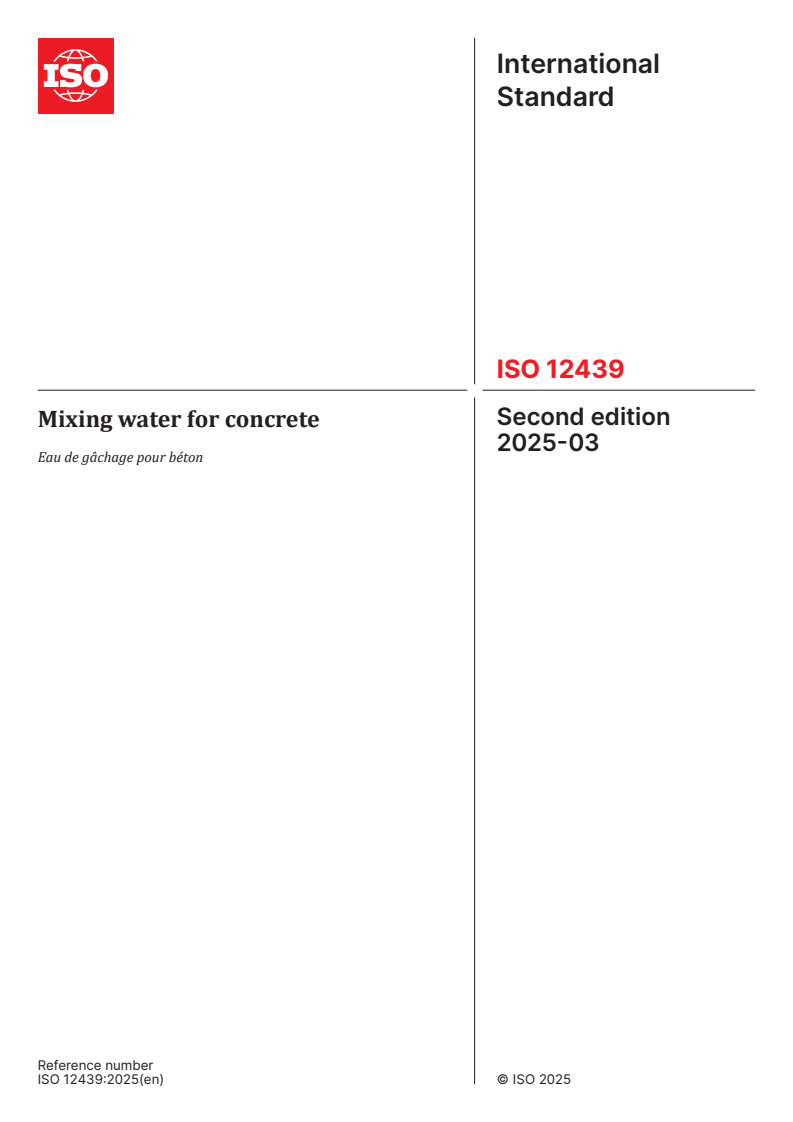
International
Standard
ISO 12439
Second edition
Mixing water for concrete
2025-03
Eau de gâchage pour béton
Reference number
© ISO 2025
All rights reserved. Unless otherwise specified, or required in the context of its implementation, no part of this publication may
be reproduced or utilized otherwise in any form or by any means, electronic or mechanical, including photocopying, or posting on
the internet or an intranet, without prior written permission. Permission can be requested from either ISO at the address below
or ISO’s member body in the country of the requester.
ISO copyright office
CP 401 • Ch. de Blandonnet 8
CH-1214 Vernier, Geneva
Phone: +41 22 749 01 11
Email: copyright@iso.org
Website: www.iso.org
Published in Switzerland
ii
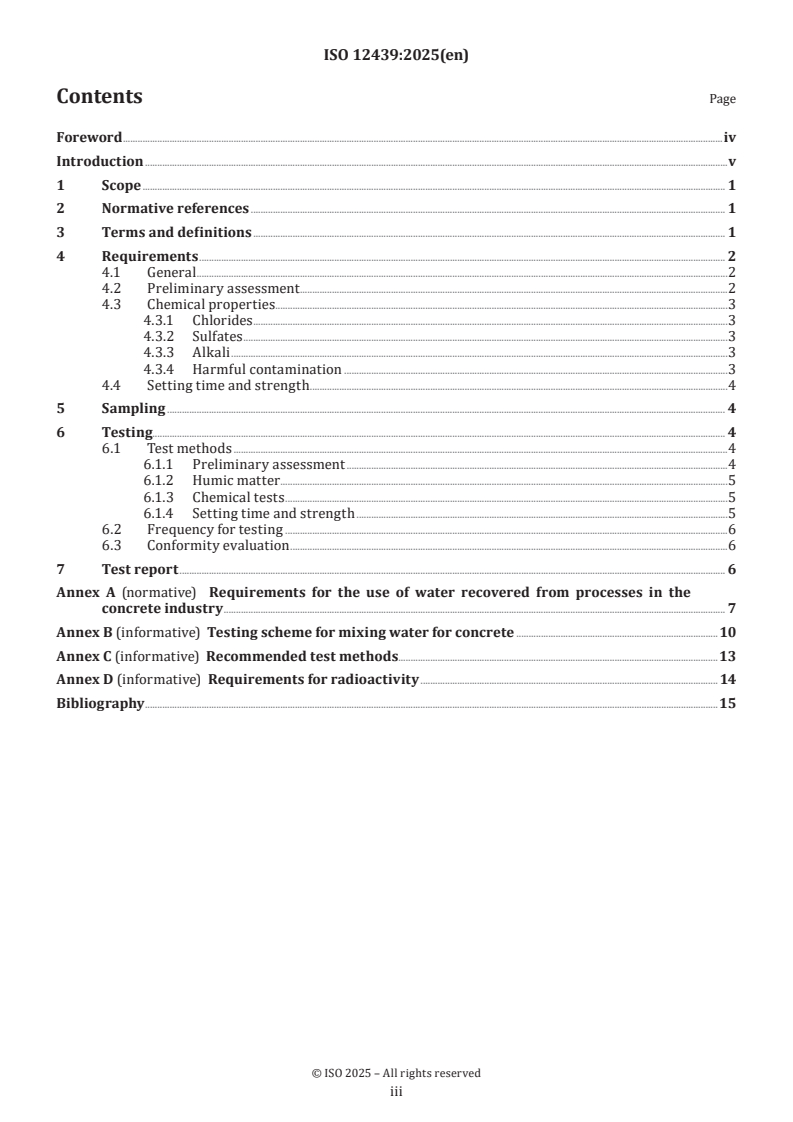
Contents Page
Foreword .iv
Introduction .v
1 Scope . 1
2 Normative references . 1
3 Terms and definitions . 1
4 Requirements . 2
4.1 General .2
4.2 Preliminary assessment .2
4.3 Chemical properties . .3
4.3.1 Chlorides .3
4.3.2 Sulfates .3
4.3.3 Alkali .3
4.3.4 Harmful contamination .3
4.4 Setting time and strength . .4
5 Sampling . 4
6 Testing. 4
6.1 Test methods .4
6.1.1 Preliminary assessment .4
6.1.2 Humic matter .5
6.1.3 Chemical tests .5
6.1.4 Setting time and strength .5
6.2 Frequency for testing .6
6.3 Conformity evaluation .6
7 Test report . 6
Annex A (normative) Requirements for the use of water recovered from processes in the
concrete industry . 7
Annex B (informative) Testing scheme for mixing water for concrete .10
Annex C (informative) Recommended test methods.13
Annex D (informative) Requirements for radioactivity . 14
Bibliography .15
iii
Foreword
ISO (the International Organization for Standardization) is a worldwide federation of national standards
bodies (ISO member bodies). The work of preparing International Standards is normally carried out through
ISO technical committees. Each member body interested in a subject for which a technical committee
has been established has the right to be represented on that committee. International organizations,
governmental and non-governmental, in liaison with ISO, also take part in the work. ISO collaborates closely
with the International Electrotechnical Commission (IEC) on all matters of electrotechnical standardization.
The procedures used to develop this document and those intended for its further maintenance are described
in the ISO/IEC Directives, Part 1. In particular, the different approval criteria needed for the different types
of ISO document should be noted. This document was drafted in accordance with the editorial rules of the
ISO/IEC Directives, Part 2 (see www.iso.org/directives).
ISO draws attention to the possibility that the implementation of this document may involve the use of (a)
patent(s). ISO takes no position concerning the evidence, validity or applicability of any claimed patent
rights in respect thereof. As of the date of publication of this document, ISO had not received notice of (a)
patent(s) which may be required to implement this document. However, implementers are cautioned that
this may not represent the latest information, which may be obtained from the patent database available at
www.iso.org/patents. ISO shall not be held responsible for identifying any or all such patent rights.
Any trade name used in this document is information given for the convenience of users and does not
constitute an endorsement.
For an explanation of the voluntary nature of standards, the meaning of ISO specific terms and expressions
related to conformity assessment, as well as information about ISO's adherence to the World Trade
Organization (WTO) principles in the Technical Barriers to Trade (TBT), see www.iso.org/iso/foreword.html.
This document was prepared by Technical Committee ISO/TC 71, Concrete, reinforced concrete and pre-
stressed concrete, Subcommittee SC 3, Concrete production and execution of concrete structures.
This second edition cancels and replaces the first edition (ISO 12439:2010), which has been technically
revised.
The main changes are as follows:
— addition of some new normative references;
— addition of the definition of water types;
— inclusion of requirements regarding radioactive testing (subclause 4.3.4).
Any feedback or questions on this document should be directed to the user’s national standards body. A
complete listing of these bodies can be found at www.iso.org/members.html.
iv
Introduction
The quality of the mixing water for production of concrete can influence the setting time, the strength
development of concrete and the protection of the reinforcement against corrosion.
When assessing the suitability of water of unknown quality for the production of concrete, both the
composition of the water and the application of the concrete being produced must be considered.
v
International Standard ISO 12439:2025(en)
Mixing water for concrete
1 Scope
This document specifies requirements for the treatment of water that is suitable for making concrete in
accordance with ISO 22965 (all parts) and describes methods for assessing its suitability.
2 Normative references
The following documents are referred to in the text in such a way that some or all of their content constitutes
requirements of this document. For dated references, only the edition cited applies. For undated references,
the latest edition of the referenced document (including any amendments) applies.
ISO 1920-3, Testing of concrete — Part 3: Making and curing test specimens
ISO 1920-4, Testing of concrete — Part 4: Strength of hardened concrete
ISO 23696-1, Water quality — Determination of nitrate in water using small-scale sealed tubes — Part 1:
Dimethylphenol colour reaction
ISO 6878, Water quality — Determination of phosphorus — Ammonium molybdate spectrometric method
ISO 13163, Water quality — Lead-210 — Test method using liquid scintillation counting
ISO 29581-1, Cement — Test methods — Part 1: Analysis by wet chemistry
ISO 9597, Cement — Test methods — Determination of setting time and soundness
ISO 22965-2, Concrete — Part 2: Specification of constituent materials, production of concrete and compliance
of concrete
ISO 10523, Water quality — Determination of pH
3 Terms and definitions
For the purposes of this document, the following terms and definitions apply.
ISO and IEC maintain terminology databases for use in standardization at the following addresses:
— ISO Online browsing platform: available at https:// www .iso .org/ obp
— IEC Electropedia: available at https:// www .electropedia .org/
3.1
potable water
water intended for human consumption
Note 1 to entry: This water is generally considered as suitable for use in concrete. The water shall not be further
tested, if already tested and certified by concerned authorities. Otherwise, the water shall be tested and shall conform
to the requirements specified in 4.3.
3.2
natural surface water
water which flows over, or rests on, the surface of a land mass
Note 1 to entry: This water can be suitable for use in concrete but shall be tested to determine whether it is suitable
for use in concrete.
3.3
sewage water
wastewater conveyed in underground pipes
Note 1 to entry: This water is not suitable for use in concrete.
3.4
combined water
mixture of water recovered from processes in the concrete industry and water of some other origin.
Note 1 to entry: This water can be suitable for use in concrete but shall be tested to determine whether it is suitable
for use in concrete.
4 Requirements
4.1 General
Water for use in concrete shall conform to 4.2, 4.3.1, 4.3.2 and 4.3.3. The water shall conform to either the
chemical requirements in 4.3.4, or the requirements for setting time and compressive strength in 4.4.
NOTE When waters are mixed (see 3.4), the requirements apply to the combined water.
4.2 Preliminary assessment
The water shall be examined in accordance with the test procedures stated in Table 1. Water not in
accordance with one or more of the requirements in Table 1 may be used only if it can be shown to be suitable
for use in concrete in accordance with 4.4.
Table 1 — Requirements and test procedures for preliminary assessment of mixing water
Number Parameter Requirement Test procedure
1 Oils and fats Not more than visible traces. 6.1.1
2 Detergents Foam shall disappear within 2 min except for 6.1.1
small residues.
3 Colour Water not from sources classified as potable:
the colour shall be assessed qualitatively as pale 6.1.1
yellow or paler.
4 Suspended Water from sources classified as potable. A.4.4
matter
Water from other sources: max. 4 ml of sediment. 6.1.1
5 Odour Water from sources classified as potable: no smell,
except the odour allowed for potable water and a
slight smell of cement; where blast-furnace slag
is present in the water, a slight smell of hydrogen
6.1.1
sulfide.
Water from other sources: no smell, except the
odour allowed for potable water; no smell of hy-
drogen sulfide after addition of hydrochloric acid.
6 pH value pH ≥5 6.1.1
7 Humic mat- The colour shall be assessed qualitatively as yel-
6.1.2
ter lowish brown or paler after addition of NaOH.
4.3 Chemical properties
4.3.1 Chlorides
−
The chloride content of the water, tested in accordance with 6.1.3 and expressed as Cl , shall not exceed the
levels given in Table 2, unless it can be shown that the chloride content of the concrete does not exceed the
maximum value permitted for the total chloride content specified in ISO 22965-2.
ISO 22965-2 recommends that limits for the total chloride content in concrete be given in a national annex
to ISO 22965-2. The values may be different depending on the end use. It can be necessary to amend the
recommended values in Table 2 to fit with the limits for the total chloride content.
Table 2 — Maximum recommended values for the chloride content of mixing water
Chloride concentration
Test proce-
End use
dure
max. mg/l
Pre-stressed concrete or grout 500
Concrete with reinforcement or embedded metal 1 000 6.1.3
Concrete without reinforcement or embedded metal 4 500
4.3.2 Sulfates
2-
The sulfate content of the water, tested in accordance with 6.1.3 and expressed as SO shall not exceed
2 000 mg/l.
4.3.3 Alkali
If it is expected to use alkali-reactive aggregates in the concrete and the exposure conditions of the concrete
can promote deleterious alkali-related reactions to occur, the water shall be tested for its alkali content in
accordance with 6.1.3. The equivalent sodium oxide content of the water shall not exceed 1 500 mg/l, unless
it can be shown that the alkali content of the concrete does not exceed the maximum value recommended.
If these limits are exceeded, the water may be used only if it can be shown that actions have been taken to
prevent deleterious alkali-silica reactions.
NOTE Guidance can be found in technical literature, such as CEN CR 1901.
4.3.4 Harmful contamination
In the first instance, qualitative tests for sugars, phosphates, nitrates, lead and zinc may be carried out. If the
qualitative tests show a positive result, tests for setting time and compressive strength shall be performed
or chemical analysis shall be chosen.
If chemical analysis is chosen, the water shall conform to the limits given in Table 3.
When specified, the radioactivity of the water may be tested. See additional information in Annex D.
Table 3 — Requirements for harmful substances
Maximum concentration
Substance Test procedure
mg/l
Sugars 100
Phosphates; expressed as P O 100
2 5
−
6.1.3
Nitrates; expressed as NO
2+
Lead; expressed as Pb 100
2+
Zinc; expressed as Zn 100
4.4 Setting time and strength
When tested in accordance with 6.1.4, the initial setting time obtained on paste samples made with the
water shall be not less than 1 h and not differ by more than 25 % from the initial setting time obtained on
specimens made with distilled or de-ionized water. The final setting time shall not exceed 10 h and not differ
by more than 25 % from the final setting time obtained on specimens made with distilled or de-ionized
water. Potable water may be used, provided it has been demonstrated that it gives results similar to those
obtained with distilled or de-ionized water.
The mean compressive strength at 7 days and 28 days of the concrete or mortar specimens prepared with
the water shall be at least 90 % of the mean compressive strength of corresponding specimens prepared
with distilled or de-ionized water.
5 Sampling
A sample of water of not less than 5 l shall be taken. The sample shall be correctly identified. It shall be
representative of the water being used, with due regard being given to the possible effects of seasonal
fluctuations.
Natural surface water shall be collected from the centre of the water area and below 100 mm from the water
surface. The water from underground sources
...