


ISO 10713:1992
(Main)Jewellery — Gold alloy coatings
Jewellery — Gold alloy coatings
Specifies the coating thickness requirements and the gold fineness of the coating. Also defines current terms (in English, French, German) concerning gold alloy coatings. Does not apply to watch bracelets if they are permanently attached to the case.
Joaillerie — Revêtements d'alliages d'or
General Information
- Status
- Withdrawn
- Publication Date
- 18-Nov-1992
- Technical Committee
- ISO/TC 174 - Jewellery and precious metals
- Drafting Committee
- ISO/TC 174 - Jewellery and precious metals
- Current Stage
- 9599 - Withdrawal of International Standard
- Start Date
- 27-Feb-2025
- Completion Date
- 14-Feb-2026
Relations
- Effective Date
- 06-Jun-2022
Overview
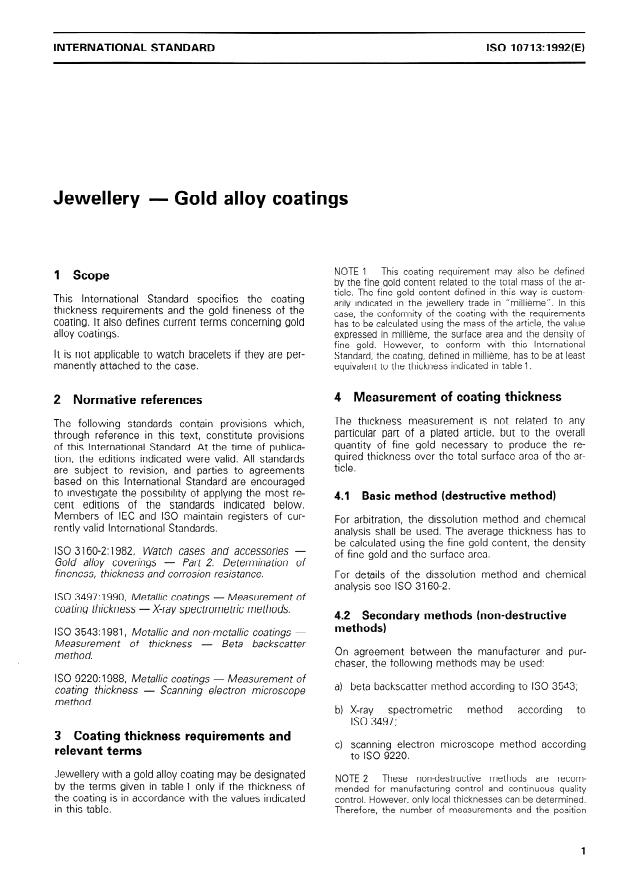
ISO 10713:1992 specifies minimum coating thickness requirements, the gold fineness of coatings and current terms (English, French, German) used for gold-alloy jewellery coatings. The Standard addresses how to measure and mark coated jewellery and clarifies applicability; it does not apply to watch bracelets permanently attached to a case.
This International Standard is designed to support consistent production, inspection and trade of coated jewellery by providing clear criteria and agreed measurement methods.
Key Topics
Coating thickness categories (minimum values):
- Category A - 5 µm min.
- Category B - 3 µm min.
- Category C - 0.5 µm min.
Fineness and process groupings:
- Rolled gold (mechanical process) examples: fine-gold reference shown at 375/1000.
- Gold plated (other processes) examples: fine-gold reference shown at 585/1000.
- Gilt: coatings < 0.5 µm are described separately.
Equivalence for alloyed coatings: the Standard shows how the fine-gold equivalent maps to actual alloy thickness. Example conversions (equivalent to 0.5 µm fine gold):
- 375/1000 → 2.3 µm applied alloy
- 417/1000 → 1.9 µm
- 585/1000 → 1.2 µm
- 667/1000 → 1.0 µm
- 750/1000 → 0.835 µm
- 1000/1000 → 0.5 µm
Marking rules:
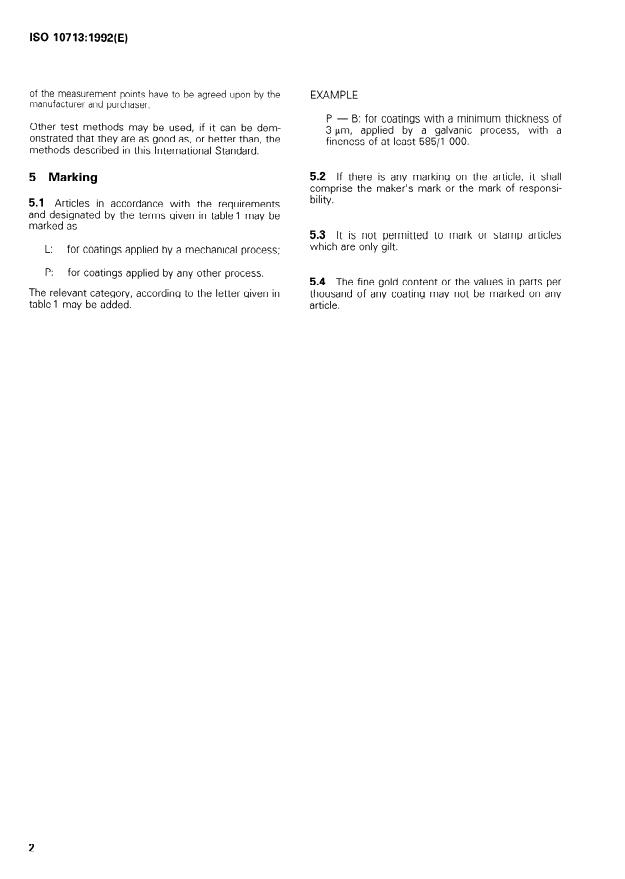
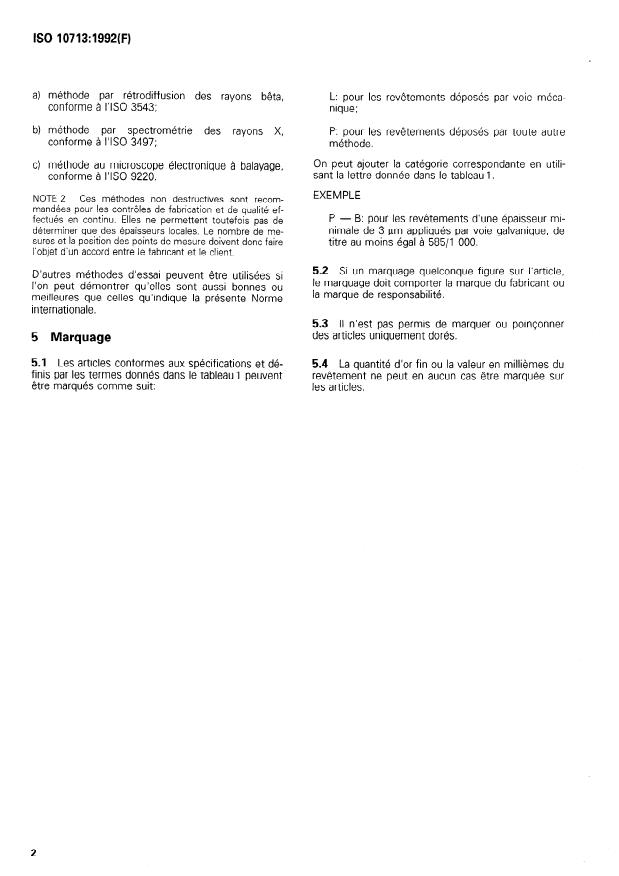
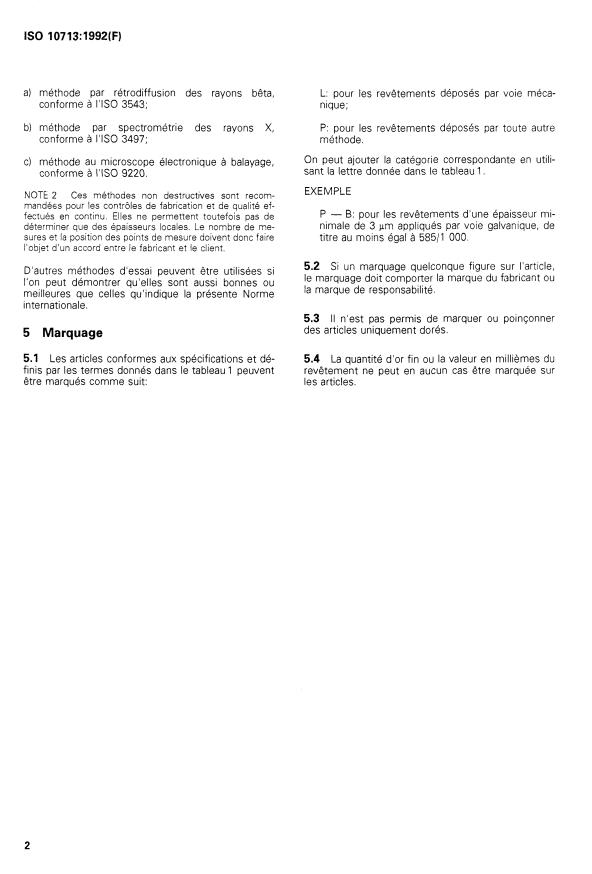
- Articles conforming to table categories may be marked with the category letter (A, B, C).
- Use of process identifiers: L for coatings applied by a mechanical process and P for coatings applied by any other process.
- Marking must include the maker’s mark or mark of responsibility. It is not permitted to mark articles that are only gilt.
Measurement principles:
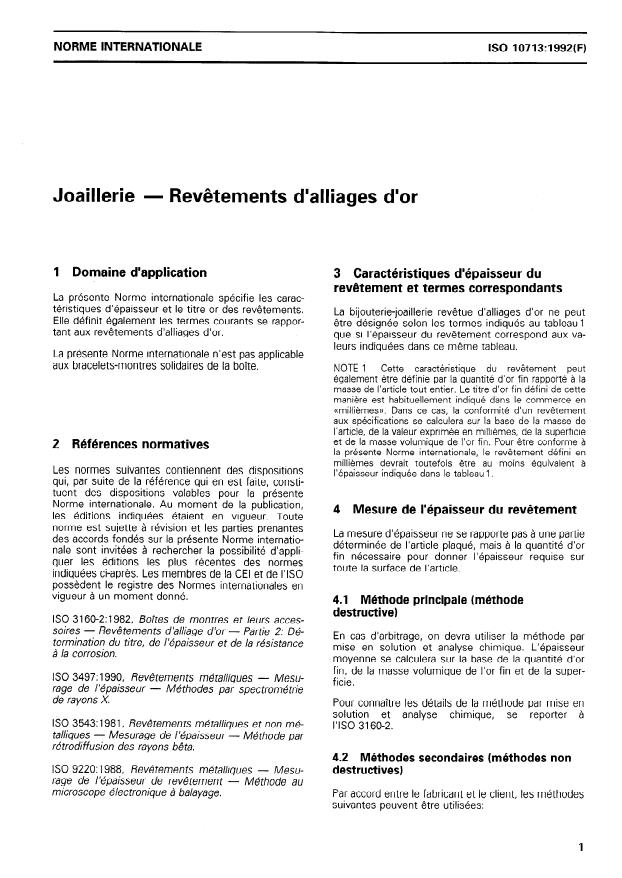
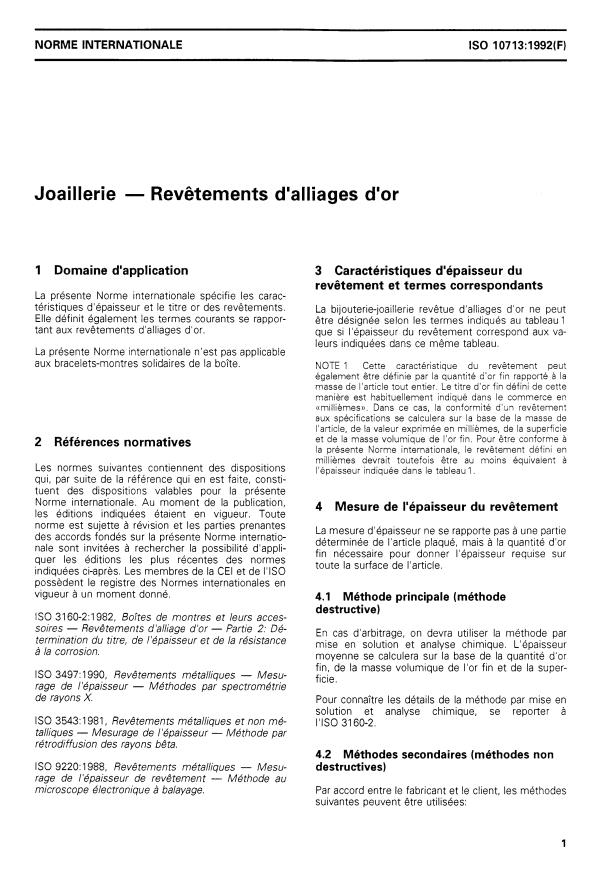
- Thickness is defined by the overall quantity of fine gold required to produce the stated thickness over the article’s total surface area.
- For arbitration, the destructive dissolution and chemical analysis method per ISO 3160-2 is required; average thickness is calculated from fine-gold content, density and surface area.
- For production control, approved non-destructive methods include:
- Beta backscatter (ISO 3543)
- X-ray spectrometric methods (ISO 3497)
- Scanning electron microscope methods (ISO 9220)
- Non-destructive methods measure local thickness; number and positions of measurements must be agreed between manufacturer and purchaser.
Applications
- Quality control and acceptance testing of gold-alloy coated jewellery
- Trade classification and marking for retail and wholesale
- Production process control using non-destructive thickness measurement
Related Standards
- ISO 3160-2: Determination of fineness, thickness and corrosion resistance (dissolution and chemical analysis)
- ISO 3497: X-ray spectrometric measurement of coating thickness
- ISO 3543: Beta backscatter method for coating thickness
- ISO 9220: SEM methods for coating thickness
This Standard supports consistent terminology, reliable measurement and transparent marking to help manufacturers, testers and traders ensure compliance and consumer confidence in gold-alloy coatings.
Buy Documents
ISO 10713:1992 - Jewellery — Gold alloy coatings Released:11/19/1992
ISO 10713:1992 - Joaillerie — Revetements d'alliages d'or Released:11/19/1992
ISO 10713:1992 - Joaillerie — Revetements d'alliages d'or Released:11/19/1992
Frequently Asked Questions
ISO 10713:1992 is a standard published by the International Organization for Standardization (ISO). Its full title is "Jewellery — Gold alloy coatings". This standard covers: Specifies the coating thickness requirements and the gold fineness of the coating. Also defines current terms (in English, French, German) concerning gold alloy coatings. Does not apply to watch bracelets if they are permanently attached to the case.
Specifies the coating thickness requirements and the gold fineness of the coating. Also defines current terms (in English, French, German) concerning gold alloy coatings. Does not apply to watch bracelets if they are permanently attached to the case.
ISO 10713:1992 is classified under the following ICS (International Classification for Standards) categories: 39.060 - Jewellery. The ICS classification helps identify the subject area and facilitates finding related standards.
ISO 10713:1992 has the following relationships with other standards: It is inter standard links to ISO 10713:2025. Understanding these relationships helps ensure you are using the most current and applicable version of the standard.
ISO 10713:1992 is available in PDF format for immediate download after purchase. The document can be added to your cart and obtained through the secure checkout process. Digital delivery ensures instant access to the complete standard document.
Standards Content (Sample)
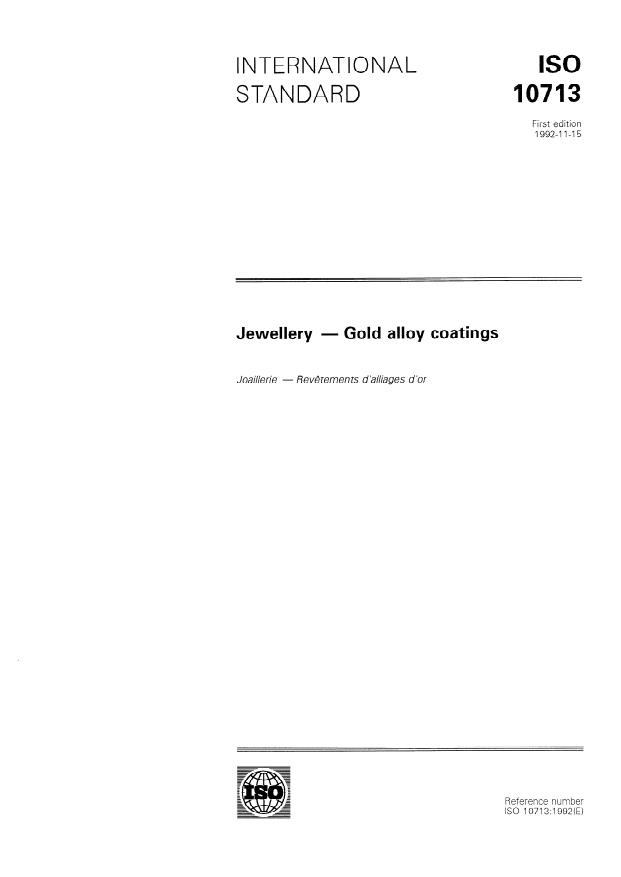
INTERNATIONAL
STANDARD
First edition
1992-I l-l 5
Jewellery
- Gold alloy coatings
Joaillerie - Revhemen ts d’alliages d ‘or
Reference number
IS0 10713:1992(E)
IS0 10713:1992(E)
Foreword
IS0 (the International Organization for Standardization) is a worldwide
federation of national standards bodies (IS0 member bodies). The work
of preparing International Standards is normally carried out through IS0
technical committees. Each member body interested in a subject for
which a technical committee has been established has the right to be
represented on that committee. International organizations, governmental
and non-governmental, in liaison with ISO, also take part in the work. IS0
collaborates closely with the International Electrotechnical Commission
(IEC) on all matters of electrotechnical standardization.
Draft International Standards adopted by the technical committees are
circulated to the member bodies for voting. Publication as an International
Standard requires approval by at least 75 % of the member bodies casting
a vote.
International Standard IS0 10713 was prepared by Technical Committee
ISO/TC 174, Jewelery.
0 IS0 1992
All rights reserved. No part of this publication may be reproduced or utilized in any form or
by any means, electronic or mechanical, including photocopying and microfilm, without per-
mission in writing from the publisher.
International Organization for Standardization
Case Postale 56 l CH-1211 Geneve 20 l Switzerland
Printed in Switzerland
INTERNATIONAL STANDARD IS0 10713:1992(E)
Jewellery - Gold alloy coatings
NOTE 1 This coating requirement may also be defined
1 Scope
by the fine gold content related to the total mass of the ar-
ticle. The fine gold content defined in this way is custom-
This International Standard specifies the coating
arily indicated in the jewellery trade in “millieme”. In this
thickness requirements and the gold fineness of the
case, the conformity of the coating with the requirements
coating. It also defines current terms concerning gold
has to be calculated using the mass of the article, the value
alloy coatings. expressed in millieme, the surface area and the density of
fine gold. However, to conform with this International
It is not applicable to watch bracelets if they are per-
Standard, the coating, defined in millieme, has to be at least
manently attached to the case. equivalent to the thickness indicated in table 1.
4 Measurement of coating thickness
2 Normative references
The thickness measurement is not related to any
The following standards contain provisions which,
particular part of a plated article, but to the overall
through reference in this text, constitute provisions
quantity of fine gold necessary to produce the re-
of this International Standard. At the time of publica-
quired thickness over the total surface area of the ar-
tion, the editions indicated were valid. All standards
ticle.
are subject to revision, and parties to agreements
based on this International Standard are encouraged
to investigate the possibility of applying the most re-
4.1 Basic method (destructive method)
cent editions of the standards indicated below.
Members of IEC and IS0 maintain registers of cur-
For arbitration, the dissolution method and chemical
rently valid International Standards.
analysis shall be used. The average thickness has to
be calculated using the fine gold content, the density
IS0 3160-2:1982, Watch cases and accessories -
of fine gold and the surface area.
Gold alloy coverings - Part 2: Determination of
fineness, thickness and corrosion resistance.
For details of the dissolution method and c
...
NORME
ISO
INTERNATIONALE
Première édition
1992-l 1-i 5
Joaillerie - Revêtements d’alliages d’or
Je wellery - Gold alloy coatings
Numéro de référence
Avant-propos
L’ISO (Organisation internationale de normalisation) est une fédération
mondiale d’organismes nationaux de normalisation (comités membres de
I’ISO). L’élaboration des Normes internationales est en général confiée aux
comités techniques de I’ISO. Chaque comité membre intéressé par une
étude a le droit de faire partie du comité technique créé à cet effet. Les
organisations internationales, gouvernementales et non gouvernemen-
tales, en liaison avec I’ISO participent également aux travaux. L’ISO colla-
bore étroitement avec la Commission électrotechnique internationale (CEI)
en ce qui concerne la normalisation électrotechnique.
Les projets de Normes internationales adoptés par les comités techniques
sont soumis aux comités membres pour vote. Leur publication comme
Normes internationales requiert l’approbation de 75 % au moins des co-
mités membres votants.
La Norme internationale ISO 10713 a été élaborée par le comité technique
ISO/K 174, Joaillerie, bijouterie.
0 ISO 1992
Qroits de reproduction réservés. Aucune partie de cette publication ne peut être reproduite
ni utilisée sous quelque forme que ce soit et par aucun procédé, électronique ou mécanique,
y compris la photocopie et les microfilms, sans l’accord écrit de l’éditeur.
Organisation internationale de normalisation
Case Postale 56 l CH-1 211 Genève 20 l Suisse
Imprimé en Suisse
NORME INTERNATIONALE ISO 10713:1992(F)
Joaillerie
- Revêtements d’alliages d’or
1 Domaine d’application 3 Caractéristiques d’épaisseur du
revêtement et termes correspondants
La présente Norme internationale spécifie les carac-
téristiques d’épaisseur et le titre or des revêtements.
La bijouterie-joaillerie revêtue d’alliages d’or ne peut
Elle définit également les termes courants se rappor-
être désignée selon les termes indiqués au tableau 1
tant aux revêtements d’alliages d’or.
que si l’épaisseur du revêtement correspond aux va-
leurs indiquées dans ce même tableau.
La présente Norme internationale n’est pas applicable
aux bracelets-montres solidaires de la boîte.
NOTE 1 Cette caractéristique du revêtement peut
également être définie par la quantité d’or fin rapporté à la
masse de l’article tout entier. Le titre d’or fin défini de cette
manière est habituellement indiqué dans le commerce en
((millièmes). Dans ce cas, la conformité d’un revêtement
aux spécifications se calculera sur la base de la masse de
l’article, de la valeur exprimée en millièmes, de la superficie
et de la masse volumique de l’or fin. Pour être conforme à
2 Références normatives
la présente Norme internationale, le revêtement défini en
millièmes devrait toutefois être au moins équivalent à
Les normes suivantes contiennent des dispositions
l’épaisseur indiquée dans le tableau 1.
qui, par suite de la référence qui en est faite, consti-
tuent des dispositions valables pour la présente
Norme internationale. Au moment de la publication,
4 Mesure de l’épaisseur du revêtement
les éditions indiquées étaient en vigueur. Toute
norme est sujette à révision et les parties prenantes
La mesure d’épaisseur ne se rapporte pas à une partie
des accords fondés sur la présente Norme internatio-
déterminée de l’article plaqué, mais à la quantité d’or
nale sont invitées à rechercher la possibilité d’appli-
fin nécessaire pour donner l’épaisseur requise sur
quer les éditions les plus récentes des normes
toute la surface de l’article.
indiquées ci-après. Les membres de la CEI et de I’ISO
possèdent le registre des Normes internationales en
vigueur à un moment donné.
4.1 Méthode principale (méthode
destructive)
ISO 3160-21982, Boîtes de montres et leurs acces-
- Revêtements d’alliage d’or - Partie 2: Dé-
soires
En cas d’arbitrage, on devra utiliser la méthode par
termination du titre, de l’épaisseur et de la résistance
mis
...
NORME IS0
I N TERN AT I O NA LE 10713
Première édition
1992-1 1-1 5
Joaillerie - Revêtements d'alliages d'or
Jewellery - Gold alloy coatings
Numéro de référence
IS0 1071 3:1992(F)
IS0 107 13: 1992( F)
Avant-propos
L'ISO (Organisation internationale de normalisation) est une fédération
mondiale d'organismes nationaux de normalisation (comités membres de
I'ISO). L'élaboration des Normes internationales est en général confiée aux
comités techniques de I'ISO. Chaque comité membre intéressé par une
étude a le droit de faire partie du comité technique créé à cet effet. Les
organisations internationales, gouvernementales et non gouvernemen-
tales, en liaison avec I'ISO participent également aux travaux. L'ISO colla-
bore étroitement avec la Commission électrotechnique internationale (CEI)
en ce qui concerne la normalisation électrotechnique.
Les projets de Normes internationales adoptés par les comités techniques
sont soumis aux comités membres pour vote. Leur publication comme
Normes internationales requiert l'approbation de 75 % au moins des co-
mités membres votants.
La Norme internationale IS0 10713 a été élaborée par le comité technique
ISO/TC 174, Joaillerie, bijouterie.
8 IS0 1992
Droits de reDroduction réservés Aucune partie de cette publication ne peut être reproduite
ni utilisee sous quelque forme que ce soit et par aucun procede, électronique ou mécanique,
y compris la photocopie et les microfilms, sans l'accord écrit de I'editeur
Organisation internationale de normalisation
Case Postale 56 CH-1 21 1 Genève 20 Suisse
Imprimé en Suisse
II
NORME INTERNATIONALE IS0 107 13:1992(F)
Joaillerie - Revêtements d'alliages d'or
1 Domaine d'application 3 Caractéristiques d'épaisseur du
revêtement et termes correspondants
La présente Norme internationale spécifie les carac-
téristiques d'épaisseur et le titre or des revêtements.
La bijou terie-joa il le r ie revêtue d 'a I I iag es d ' or ne peut
Elle définit également les termes courants se rappor-
être désignée selon les termes indiqués au tableau 1
tant aux revêtements d'alliages d'or.
que si I'épaisseur du revêtement correspond aux va-
leurs indiquées dans ce même tableau.
La présente Norme internationale n'est pas applicable
aux bracelets-montres solidaires de la boîte.
NOTE 1 Cette caractéristique du revêtement peut
également être définie par la quantité d'or fin rapporté à la
masse de l'article tout entier. Le titre d'or fin défini de cette
manière est habituellement indiqué dans le commerce en
ccmillièmesn. Dans ce cas, la conformité d'un revêtement
aux spécifications se calculera sur la base de la masse de
la superficie
l'article, de la valeur exprimée en millièmes, de
et de la masse volumique de l'or fin. Pour être conforme à
2 Références normatives
la présente Norme internationale, le revêtement défini en
millièmes devrait toutefois être au moins équivaient à
Les normes suivantes contiennent des dispositions
I'épaisseur indiquée dans le tableau 1.
la référence qui en est faite, consti-
qui, par suite de
tuent des dispositions valables pour la présente
Norme internationale. Au moment de la publication,
4 Mesure de I'épaisseur du revêtement
les éditions indiquées étaient en vigueur. Toute
norme est sujette à révision et les parties prenantes
La mesure d'épaisseur ne se rapporte pas à une partie
des accords fondés sur la présente Norme internatio-
déterminée de l'article plaqué, mais à la quantité d'or
nale sont invitées à rechercher la possibilité d'appli-
pour donner I'épaisseur requise sur
fin nécessaire
quer les éditions les plus récentes des normes
toute la surface de l'article.
indiquées ci-après. Les membres de la CE
...
Questions, Comments and Discussion
Ask us and Technical Secretary will try to provide an answer. You can facilitate discussion about the standard in here.
Loading comments...