


ISO 10602:1995
(Main)Photography — Processed silver-gelatin type black-and-white film — Specifications for stability
Photography — Processed silver-gelatin type black-and-white film — Specifications for stability
Establishes the specifications for photographic films intended for the storage of records. Applies specifically to films with a base of safety cellulose ester or polyester Äpoly(ethylene terephthalate)Ü having silver-gelatin emulsions, processed to produce a black-and-white silver image by negative or full-reversal processing. The films that may have ultrasonic or dielectric (induction heated) splices are processed by a monobath which includes thiosulfate as the fixing agent followed by a conventional wash. Also applies to silver films given a stabilizing treatment by partial or full conversion to silver sulfide, silver selenide or gold.
Photographie — Film de type gélatino-argentique noir et blanc traité — Spécifications relatives à la stabilité
General Information
- Status
- Withdrawn
- Publication Date
- 25-Jan-1995
- Withdrawal Date
- 25-Jan-1995
- Technical Committee
- ISO/TC 42 - Photography
- Current Stage
- 9599 - Withdrawal of International Standard
- Start Date
- 07-Mar-2002
- Completion Date
- 12-Feb-2026
Relations
- Effective Date
- 15-Apr-2008
- Effective Date
- 15-Apr-2008
Frequently Asked Questions
ISO 10602:1995 is a standard published by the International Organization for Standardization (ISO). Its full title is "Photography — Processed silver-gelatin type black-and-white film — Specifications for stability". This standard covers: Establishes the specifications for photographic films intended for the storage of records. Applies specifically to films with a base of safety cellulose ester or polyester Äpoly(ethylene terephthalate)Ü having silver-gelatin emulsions, processed to produce a black-and-white silver image by negative or full-reversal processing. The films that may have ultrasonic or dielectric (induction heated) splices are processed by a monobath which includes thiosulfate as the fixing agent followed by a conventional wash. Also applies to silver films given a stabilizing treatment by partial or full conversion to silver sulfide, silver selenide or gold.
Establishes the specifications for photographic films intended for the storage of records. Applies specifically to films with a base of safety cellulose ester or polyester Äpoly(ethylene terephthalate)Ü having silver-gelatin emulsions, processed to produce a black-and-white silver image by negative or full-reversal processing. The films that may have ultrasonic or dielectric (induction heated) splices are processed by a monobath which includes thiosulfate as the fixing agent followed by a conventional wash. Also applies to silver films given a stabilizing treatment by partial or full conversion to silver sulfide, silver selenide or gold.
ISO 10602:1995 is classified under the following ICS (International Classification for Standards) categories: 37.040.20 - Photographic paper, films and plates. Cartridges. The ICS classification helps identify the subject area and facilitates finding related standards.
ISO 10602:1995 has the following relationships with other standards: It is inter standard links to ISO 10602:1993, ISO 18901:2002. Understanding these relationships helps ensure you are using the most current and applicable version of the standard.
ISO 10602:1995 is available in PDF format for immediate download after purchase. The document can be added to your cart and obtained through the secure checkout process. Digital delivery ensures instant access to the complete standard document.
Standards Content (Sample)
INTERNATIONAL
ISO
STANDARD
Second edition
1995-02-01
Photography - Processed silver-gelatin
type black-and-white film - Specifications
for stability
Photographie - Film de type g6la tino-argen tique noir et blanc trait6 -
Spkifica Gons rela tjves 2 Ia s tabilit6
Reference number
ISO 10602: 1995(E)
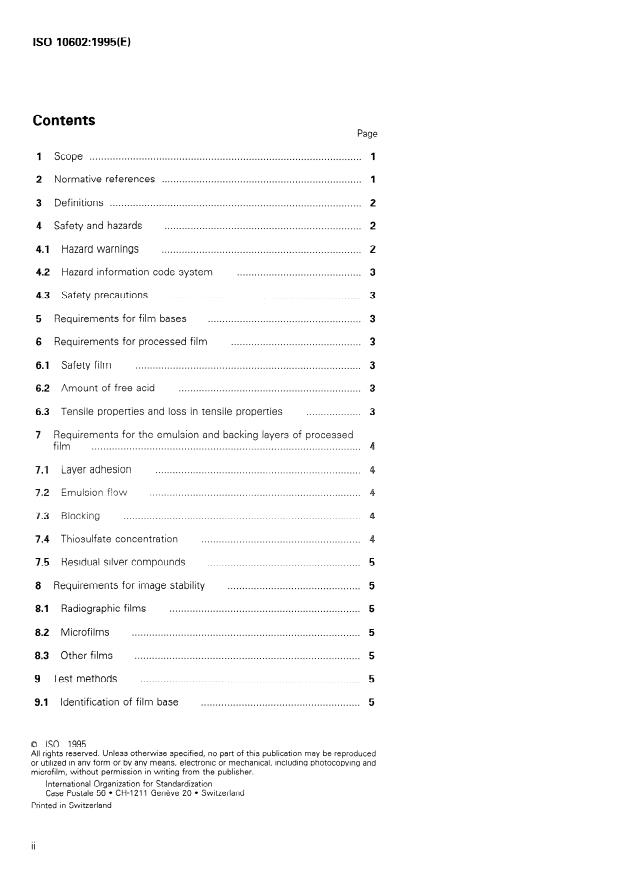
Contents
Page
................................... 1
1 Scope .
2 Normative references . .
.................................. ..................................................... 2
3 Definitions
................................................... ................. 2
4 Safety and hazards
..................................................... ................ 2
4.1 Hazard warnings
Hazard information code System .
4.2
Safety precautions . 3
4.3
..................................................... 3
5 Requirements for film bases
6 Requirements for processed film .
Safety film . . 3
6.1
Amount of free acid . . 3
6.2
................... 3
63 . Tensile properties and loss in tensile properties
Requirements for the emulsion and backing layers sf processed
.... ............................................... ..........................................
film
. . . .
7.1 Layer adhesion
i!&
.......................... ...............................................
7.2 Emulsion flojti
.....................................
Biocking .
7."
Thiosulfate concentration . .
7.4
Residual silver compounds . . . 5
7.5
8 Requirements for image stability .
Radiographit films . 5
81 .
82 . Microfilms .
............................. 5
Other films .
83 .
............................................................................ 5
9 Test methods
....................................................... 5
91 . Identification of film base
0 ISO 1995
All rights reserved. Unless otherwise specified, no part of this publication may be reproduced
or utilized in any form or by any means, electronie or mechanical, including photocopying and
microfilm, without Permission in writing from the publisher.
International Organization for Standardization
Case Postale 56 l CH-l 211 Geneve 20 l Switzerland
Printed in Switzerland
ii
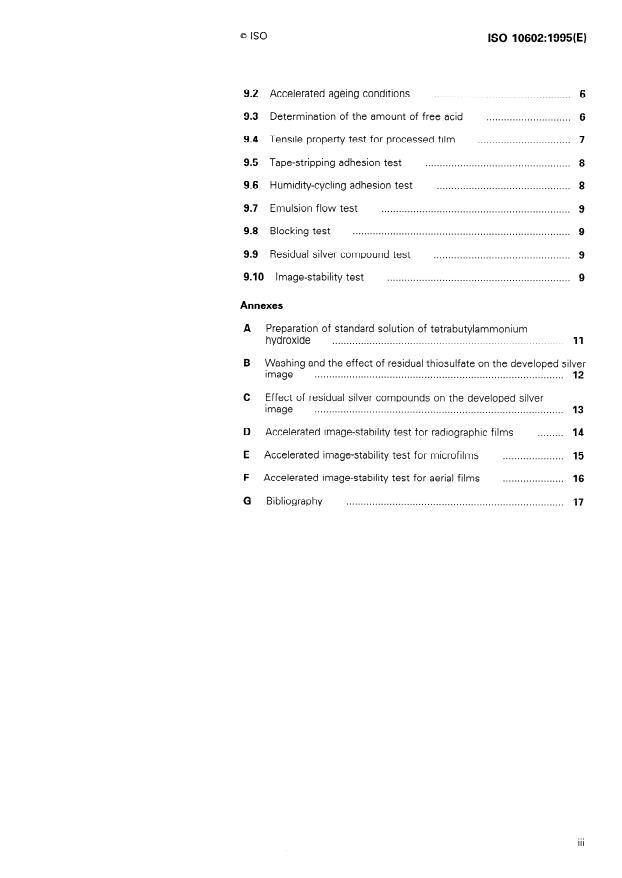
0 ISO
..............
9.2 Accelerated ageing conditions . 6
9.3 Determination of the amount of free acid . . . . . . . . . . . . . . . . . . . . . . . . . . . . . 6
9.4 Tensile property test for processed film . . . . . . . . . . . . . . . . . .*.
9.5 Tape-stripping adhesion test . . . . . . . . . . . . . . . . . . . . . . . . . . . . . . . . . . .*. 8
9.6 Humidity-cycling adhesion test . . . . .*. 8
9.7 Emulsion flow test . . . . . . . . . . . . . . . . . . . . . . . . . . . . . . . . . . . . . . . . . . . . . . . . . . . . . . . . . . . . . . . . . 9
9.8 Blocking test . . 9
9.9 Residual silver compound test . . 9
9.10 Image-stability test . . . . . . . . . . . . . . . . . . . . . . . . . . . . . . . . . . . . . . . . . . . . . . . . . . . . . . . . . . . . . . . 9
Annexes
A Preparation of Standard Solution of tetrabutylammonium
hydroxide . . . . . . . . . . . . . . . . . . . . . . . . . . . . . . . . . . . . . . . . . . . . . . . . . . . . . . . . . . . . . . . . . . . . . . . . . . . . . . . .
B Washing and the effect of residual thiosulfate on the developed silver
. . . . . . . . . . . .*. . . . . . . . . . . . . . . . . . . . . . . . . . . . . . . . . . . . . 12
image
C Effect of residual silver compounds on the developed silver
...... 13
image . .
. . . . . . . . . 14
D Accelerated image-stability test for radiographic films
E Accelerated image-stability test for microfilms . . . . . . . . . . . . . . . . . . . . . 15
F Accelerated image-stability test for aerial films . . . . . . . . . . . . . . . . . . . . . 16
G Bibliography . . 17
0 ISO
Foreword
ISO (the International Organization for Standardization) is a worldwide
federation of national Standards bodies (ISO member bodies). The work
of preparing International Standards is normally carried out through ISO
technical committees. Esch member body interested in a subject for
which a technical committee has been established has the right to be
represented on that committee. International organizations, governmental
and non-governmental, in liaison with ISO, also take part in the work. ISO
collaborates closely with the International Electrotechnical Commission
(IEC) on all matters of electrotechnical standardization.
Draft International Standards adopted by the technical committees are
circulated to the member bodies for voting. Publication as an International
Standard requires approval by at least 75 % of the member bodies casting
a vote.
International Standard ISO 10602 was prepared by Technical Committee
ISO/TC 42, Photography.
This second edition cancels and replaces the first edition
(ISO 10602:1993), which has been technically revised.
Annex A forms an integral part of this International Standard. Annexes B,
C, D, E, F and G are for information only.
0 ISO
Introduction
Since 1930 great advances have been made in the use of photographic
films for the preservation of records. The preservation of film records by
governments, banks, insurance companies, industry and other enterprises
has been stimulated by a recognition of the economies in storage space,
organization, accessibility and ease of reproduction that result from the
use of film records.
During the early development period of the art of copying documents,
35 mm nitrate motion-picture film was sometimes used. This material is
highly flammable and is not a safety film as specified in ISO 543. Nitrate
film is not acceptable for any record film. The manufacture of nitrate
film declined after World War II and was discontinued in most countries
in the 1950 ’s.
For many years the only safety films in commercial use were made on
some type of cellulose ester base, such as cellulose acetate, cellulose
acetate propionate or cellulose acetate butyrate. The useful life of safety
cellulose-ester-type films is somewhat conjectural, since actual experience
with commercial material extends back only to about 1908. However,
these materials show severe degradation when exposed to high tem-
peratures and particularly to high humidities. Laboratory incubation studies
predict a useful life of at least a century when stored under recommended
conditionsLX CU Pl1 Pl.
A second type of polymer safety film base belonging to the Polyester
class, known chemically as poly(ethylene terephthalate), was introduced
commercially in 1956. This material has a number of advantages over the
cellulose ester base such as greater strength, stiffness, tear resistance,
flexibility, dimensional stability and other characteristics, which make it
superior for many photographic applicationsl% VI. Actual experience with
Polyester film is considerably less than with cellulose ester film although
this material has been used for over 35 years.
Practical experience to date and accelerated ageing tests indicate that this
film support is more stable than safety cellulose ester film base and is
expected to have a useful life of 500 yearsC1ll IN.
This second edition eliminates the film classifications of “archival ”,
“long-term” and “medium-term” and replaces them with the LE (life ex-
pectancy) rating. In addition, residual hypo limits and image-stability tests
are given for radiographic film, microfilm and all other films.
Studies on the stability of silver-gelatin-type films have investigated the
effect of residual hypo on the image permanente of radiographic filmsC71,
microfiImsC*l and aerial filmsN. This work suggested modifications to the
residual hypo limits and a more quantitative image-stability test was in-
cluded in the first edition of ISO 10602. Residual hypo Iimits and image-
stability tests are now included for all film categories.
V
0 ISO
Former annex D, “Microsocopic spots and blemishes ”, and annex E,
” Emulsion adhesion ”,
have been eliminated; an annex F, “Accelerated
image-stability test for aerial films ”, has been added.
This International Standard identifies certain hazards to permanente at-
tributable to the Chemical or physical characteristics of processed film and
gives methods of evaluating them. Some of these characteristics are the
responsibility of the film manufacturer, some of the film processor, and
some are influenced by both. However, specifying the Chemical and
physical characteristics of the material does not, by itself, ensure satis-
factory keeping behaviour. lt is essential to provide proper storage tem-
perature and humidity, and protection from the hazards of fire, water,
fungus and certain atmospheric pollutants. lt is important that films be
stored under the conditions specified in ISO 5466 and ISO 10214.
INTERNATIONAL STANDARD 0 ISO
- Processed silver-gelatin type
Photography
black-and-white film - Specifications for stability
1 Scope 2 Normative references
1 .l This International Standard establishes the
specifications for photographic films intended for the
The following Standards contain provisions which,
storage of records.
through reference in this text, constitute provisions
of this International Standard. At the time of publi-
cation, the editions indicated were valid. All Standards
1.2 lt applies specifically to films with a base of
are subject to revision, and Parties to agreements
safety cellulose ester or Polyester [poly(ethylene
based on this International Standard are encouraged
terephthalate)] having silver-gelatin emulsions, pro-
to investigate the possibility of applying the most re-
cessed to produce a black-and-white silver image by
cent editions of the Standards indicated below.
negative or full-reversal processing. lt applies to film
Members of IEC and ISO maintain registers of cur-
processed by a monobath which includes thiosulfate
rently valid International Standards.
as the fixing agent followed by a conventional wash.
lt also applies to silver films given a stabilizing treat-
ISO 5-l : 1984, Photography - Density measurements
ment by partial or full conversion to silver sulfide, sil-
- Part 1: Terms, Symbols and notations.
ver selenide or gold.
ISO 5-2: 1991, Photography - Density measurements
1.3 This International Standard does not apply to
- Part 2: Geometrie conditions for transmission
films with colour images of any type, nor to films with
density.
a magnetic recording track. lt does not apply to films
with silver images produced by dry or thermal pro-
ISO 5-3: -*), Photography - Density measuremen ts
cessing or by diffusion-reversal processing. lt does
- Part 3: Spectral conditions.
not apply to films that have been processed by a
monobath using other than a thiosulfate-type fixing ISO 417:1993, Photography - Determination of re-
Solution. lt is not applicable to films where the silver sidual thiosulfate and o ther rela ted chemicals in pro-
salts are removed by means other than thiosulfate cessed photographic materials - Methods using
solutionsCW.
iodine-amylose, me thylene blue and silver sulfide.
ISO 543:1990, Photography - Photographit films -
1.4 This International Standard does not apply to
Specifica tions for sa fe ty film.
films to which lacquers have been applied.
ISO 1184:1983, Plastics
- Determination of tensile
1.5 This International Standard applies to films
properties of films.
having ultrasonic or dielectric (induction heated)
splices. lt does not cover films with splices made by ISO 5466:1992, Photography - Processed safety
means of adhesive tape or solvent-type splices.1) photographic films - Storage practices.
1) Solvent-type splices are suspect since they may retain traces of residual solvents containing peroxide which tan pose some
risk of oxidative attack on the silver image.
2) To be published. (Revision of ISO 5-3:1984)
0 ISO
NOTE 4 Antihalation or other layers removed in process-
ISO 10214:1991, Photography - Processed photo-
ing are excluded from this definition.
graphic ma terials - Filing enclosures f or s torage.
3.9 safety photographic film: Photographit film
which Passes the ignition time test and burning time
3 Definitions
test as specified in ISO 543.
For the purposes of this lnternationa Standard, the
3.10 safety cellulose-ester base: A film base com-
definitions given in ISO 5-l and the following defi-
posed mainly of the cellulose esters of acetic,
nitions apply.
propionic or butyric acids, or mixtures thereof.
3.1 archiwal medium: A recording material that tan
3.1 l safety poly(ethylene terephthalate) base: A
be expected to retain information forever so that it
Polyester film base composed mainly of a polymer of
tan be retrieved without significant loss when prop-
ethylene glycol and terephthalic acid.
erly stored.
3.12 full-reversal processing: Processing that in-
There is, however, no such material and it is not
NOTE l
cludes development, bleach, clear, re-exposure and
a term to be used in International Standards or System
second development, followed by fixing and washing.
specifications.
3.2 life expectancy (LE): The length of time that
4 Safety and hazards
information is predicted to be retrievable in a System
under extended-term storage conditions.
4.1 Hazard warnings
However, the actual useful life of film is very
NOTE 2
Some of the chemicals specified in the test pro-
dependent upon the existing storage conditions (see
cedures are caustic, toxic or otherwise hazardous.
ISO 5466 and ISO 10214).
Safe laboratory practice for the handling of chemicals
requires the use of safety glasses or goggles, rubber
3.3 LE designation: A rating for the “life
gloves and other protective apparel such as face
expectancy” of recording materials and associated
masks or aprons where appropriate. Specific danger
retrieval Systems. The number following the LE sym-
notices are given in the text and footnotes for par-
bol is a prediction of the minimum life expectancy, in
ticularly dangerous materials, but normal precautions
years, for which information tan be retrieved without
are required during the Performance of any Chemical
significant loss when stored under extended term
procedures at all times. The first time that a hazardous
storage conditions.
material is noted in the test procedure section, the
hazard will be indicated by the word “DANGER” fol-
For example, LE-100 indicates that information
NOTE 3
lowed by a Symbol consisting of angle brackets
tan be retrieved for at least 100 years’ storage.
‘I < > ” containing a Ietter which designates the
specific hazard. A double bracket “<< >>” will be
3.4 extended-term storage conditions: Storage
used for particularly perilous situations- In subsequent
conditions suitable for the preservation of recorded
Statements involving handling of these hazardous
Information having permanent value.
materials, only the hazard Symbol consisting of the
brackets and letter(s) will be displayed. Furthermore,
3.5 medium-term storage conditions: Storage
for a given material, the hazard Symbol will be used
conditions suitable for the preservation of recorded
only once in a Single Paragraph.
information for a minimum of 10 years.
Detailed warnings for handling chemicals and their
3.6 film base: The plastic support for the emulsion
diluted solutions are beyond the scope of this Inter-
and backing layers.
national Standard.
3.7 emulsion layers(s): The image or image-
Employers shall prowide training and health and
forming layer(s) of photographic films, Papers and
safety information in conformance with legal re-
plates.
quirements.
3.8 noncurl backing layer: A layer, usually made The hazard Symbol System used in this International
of gelatin, applied to the side of the film base opposite Standard is intended to provide information to the
that of the emulsion layer, for the purpose of pre- User-s and is not meant for compliance with any legal
requirements for labelling as these vary from country
venting curl. It is comparable to the emulsion layer in
thickness and is not removed in processing. to country.
0 ISO ISO 10602:1995(E)
lt is strongly recommended that anyone using
6 Reql rirements for processed film
these chemicals obtain from the manufacturer
pertinent information about the hazards, hand-
Films shal I be stored under the conditions specified in
ling, use and disposal of these chemicals.
ISO 5466 and ISO 10214.
Hazard information code System
42 .
Harmful if inhaled. Avoid breathing dust,
vapour, mist or gas. Use only with ad-
6.1 Safety film
equate Ventilation.
Harmful if contact occurs. Avoid contact
The film shall meet the requirements specified in
with eyes, skin or clothing. Wash
ISO 543.
thoroughly after handling. Harmful if swallowed. Wash thoroughly
after handling. If swallowed, obtain medi-
cal attention immediately.
6.2 Amount of free acid
<< S >> May be fatal if swallowed. If swallowed,
obtain medical attention immediately.
Different specifications and test methods are given
for Polyester base and cellulose-ester base films. The
Will burn. Keep away from heat, Sparks
Polyester base shall not have an amount of free acid
and open flame. Use with adequate venti-
greater than the equivalent of 1 ,O ml of 0,l mol/1
lation3).
sodium hydroxide Solution per gram of film, and the
cellulose-ester base shall not have an amount of free
Oxidizer. Contact with other material may
CO>
acid greater than the equivalent of 0,5 ml of
Cause fire. DO not store near combustible
0,l mol/1 sodium hydroxide Solution per gram of film.
materials.
The amount of free acidity shall be measured in ac-
cordante with 9.3.
4.3 Safety precautions
The volume of 0,l mol/1 sodium hydroxide equivalent
All pipette operations shall be performed with a
to the amount of free acid of the processed film shall
pipette bulb or plunger pipette.
not increase by more than 0,5 ml/l over its original
value after the accelerated ageing described in 9.2.
Safety glasses shall be worn for all laboratory
work.
5 Requirements for film bases
The base used for record films, as specified in this
6.3 Tensile properties and loss in tensile
International Standard, shall be of a safety Polyester
properties
[i.e. poly(ethylene terephthalate)] or a cellulose-ester
type, and tan be identified by the method described
The film samples shall be processed and dried under
in 9.1.
the conditions used for the film records. Processed
films shall be tested for tensile properties as de-
Some films on a cellulose-ester-type base tan have a
scribed in 9.4 and shall have a tensile stress and
maximum LE rating of 100. Some films on a Polyester
elongation at break as specified in table 1 (unheated
base tan have a maximum LE rating of 500.
film). The loss in tensile properties after accelerated
ageing as described in 9.2 shall not exceed the per-
NOTE 5 These limitations are based on historical experi-
ences as discussed in the introduction. centage specified in table 1 (heated film).
3) The flammable warning Symbol < F > will not be used for quantities of common solvents under 1 litre.
0 ISO
7.2 Emulsion flow
Table 1 - Limits for tensile properties and loss
The processed film shall not show any visual evidente
in tensile properties on ageing
of emulsion flow (caused by partial emulsion remelt-
ing) as a result of accelerated ageing of the processed
Tensile
Elongation
film. Emulsion flow shall be determined as described
Film type stress at
at break
in 9.7 when the accelerated ageing is performed as
break
described in 9.2.
Unheated film
7.3 Blocking
Minimum permissible
tensile properties:
Processed film shall show no evidente of blocking
80 MPal) 15%
Cellulose-ester base
(sticking), delamination or surface darnage when
140 MPa 75%
Polyester base
tested as described in 9.8. A slight sticking of the film
Heated film
samples that does not result in physical darnage or a
Change in the gloss of the surface shall be acceptable.
Maximum permissible
loss in tensile properties
compared with unheated
7.4 Thiosulfate concentration
film:
Cellulose-ester base 15% 30 %
Films shall be fixed in solutions containing either
sodium thiosulfate (hypo) or ammonium thiosul-
Polyester base 15% 30 %
fateCW. Hypo-eliminating agents containing oxidizing
1) 1 MPa=106N/m2
agents such as Peroxides or hypochlorites shall not
be used.
NOTE 6 Hypo-eliminating agent contains chemicals,
7 Requirements for the emulsion and
usually strong oxidizing agents, which decompose thiosul-
backing layers of processed film fate (see annexes B and D). These are to be distinguished
from hypo-Clearing baths, which are high ionic strength salt
solutions. These facilitate the washing of thiosulfate from
7.1 Layer adhesion the film, but do not chemically alter the thiosulfate.
After processing, the film shall not contain a greater
7.1 .l Tape-stripping adhesion
concentration sf residual thiosulfate calculated as
thiosulfate ions (S,O,* - ) than that specified in table2
The processed film shall not show any removal of the
when determined by one of the test methods de-
emulsion layer or backing layer when tested as de-
scribed in ISO 4174).
scribed in 9.5.
The analysis for thiosulfate shall be made on a film
Sample from a clear area and shall be made within
7.1.2 Humidity-cycling adhesion
2 weeks after processing (see annex B). The test
method does not measure any Change in the Sample
The emulsion layer or backing layer of the processed
between the time of processing and the time of
film shall not show Separation or cracking that tan
impair its intended use, when tested as described in analysis, but is used to judge the keeping of the film
96 . a following the time of the test.
4) Three methods for measuring residual thiosulfate based chemicals in film are described in ISO 417. All three methods are
considered sufficiently reliable to report thiosulfate concentrations at the level of 0,014 g/m* of S,O,*-. The methylene blue
method is considered reliable for thiosulfate concentrations of 0,007 g/m*. The methylene blue and iodine amylose methods
measure thiosulfate ions only. They must be run within 2 weeks of processing. The silver sulfide densitometric test method
measures polythionate decomposition products and other residual chemicals in addition to thiosulfate. The method may be run
more than 2 weeks after processing. To determine thiosulfate levels accurately with this method, a calibration curve for the
particular film is necessary.
0 ISO ISO 10602:1995(E)
Table 2 - Limits for thiosulfate (SO2 2-) concentration
Maximum permissible concentration
of thiosulfate*) 3)
Film type Film classificationl)
am*
Radiographit films LE-10 0,100
LE-100 0,050
LE-500 0,020
Microfilms LE-100 0,030
LE-500 0,014
Other films LE-10 0,100
LE-100
0,050
LE-500 0,014
1) LE-500 film only applies to polyester base film.
2) Values are for each side of the film which has a photographic layer or a noncurl backing layer.
3) The concentration of thiosulfate is expressed in grams per Square metre, which conforms to SI units.
0,010 g/m2 = 1pg/cm2
8.2.1 LE-100 film
7.5 Residual silver compounds
The area of minimum density shall have a visual dif-
The processed film shall not show more than a barely
fuse density of less than 0,4 after incubation. The
perceptible tint when tested in accordance with 9.9
differente in visual density between the two test
(see annex C).
areas shall be at least 0,8 after incubation.
8 Requirements for image stability
8.2.2 LE-500 film
The specifications and test methods for image stab-
Neither the minimum-density nor the high-density
ility are different for the different product types. ISO
area shall Change by more than + 0,l in visual diffuse
visual diffuse density or Status A blue density shall be
density units after incubation.
measured on a densitometer which has spectral con-
formante to ISO 5-3 and geometric conformance to
8.3 Other films
ISO 5-2. Processed film samples shall be incubated
as described in 9.10.
A minimum-density area and a 1 ,O + 0,l Status A blue
density patch of processed film-shall be tested.
Neither the minimum-density area nor the high-
8.1 Radiographit films
density patch shall Change by more than + 0,l
-
Status A blue density units after incubation. This re-
An area of unexposed processed film shall be tested.
quirement shall apply to LE-10, LE-100 and LE-500
The Status A blue density Change of the unexposed
films.
area shall be no greater than 0,05 density units after
incubation. This requirement shall apply to LE-10,
LE-100 and LE-500 films.
9 Test methods
8.2 Microfilms 9.1 ldentification of film base
An area of minimum density and another having a Remove all emulsion and backing layers from a
visual diffuse density of 1,2 + 0,l on the processed Sample of unknown film, either by scraping or by the
use of enzyme Solution. Then remove all sublayers by
film Sample shall be tested. The criteria given in 8.2.1
scraping. Prepare a Sample of the base material by
and 8.2.2 shall apply to the different film categories.
0 ISO
NOTE 8 In the subsequent text, samples subjected to
scuffing the surface with a suitable tool such as a
these accelerated ageing conditions are designated “heated
razor blade. The general procedure is to move the
film ”. Comparison samples kept at room conditions are
scuffing device back and forth over the Sample
designated “unheated film ”.
manually while exerting a very slight pressure. This
removes the top layer of the base as a very fine dust.
Carefully brush this into a mortar.
9.3 Determination of the amount of free acid
Mix the Sample with about 100 times its mass of
9.3.1 Specimen preparation
potassium bromide, previously ground to about
75 Pm. Prepare a Strip or pellet as described in refer-
Measurements shall be made on two unheated and
ence [Ill.
two heated specimens of imaged film that weigh ap-
proximately 1 g to 2 g each. Weigh the specimens to
Obtain an infrared absorption curve from the prepared
the nearest 0,Ol g. Heat the films in accordance with
pellet by means of an infrared absorption spec-
9.2. Remove all coatings from the film base by
trometer. By comparing the infrared absorption curve
scraping. Cut each specimen into small pieces and
for the unknown with curves for known polymers, the
accurately weigh it Prior to dissolving it in the appro-
identity of the unknown tan be established[IV.
priate solvents.
NOTE 7 lt is difficult, although not impossible, to dis-
tinguish between cellulose acetate, cellulose acetate
9.3.2 Solution preparation
propionate and cellulose acetate butryate bases by this
method, but such Separation is not necessary for the pur-
The Polyester base and the cellulose-ester base re-
poses of this International Standard.
quire different solvents.
Immerse the Polyester specimens in 30 ml of a
70/30 (m/m) mixture of purified o-cresoI/chIoroform
92 . Accelerated ageing conditions
(DANGER: < B > < C > < S >).
Processed film shall be subjected to accelerated age-
WARNING - Chloroform is harmful if inhaled.
ing conditions to meet the requirements for increase
Avoid breathing vapour, mist or gas. Use with
in the amount of free acid, loss in tensile properties,
adequate Ventilation. If inhaled, move to fresh air.
and emulsion flow.
Contact should be avoided between chloroform
and the eyes, skin or clothing. In case of contact,
The test specimens shall be conditioned at
obtain medical attention immediately.
(23 + 1) “C and (50 + 2) % relative humidity for at
least-l 5 h. After conditioning, place the specimens in
s-Cresol is toxic if swallowed. Contact should be
a moisture-proof envelope and heat-seal the envel-
avoided between o-cresol and the eyes, skin or
ope? To prevent sticking between adjacent speci-
clothing. Wash after handling. In case of contact,
mens, it may be necessary to interleave them with
flush eyes and skin thoroughly with water. Obtain
aluminium foil. Ensure a high ratio of film to air vol-
medical attention immediately.
ume by squeezing out excess air Prior to heat-sealing.
Use a separate envelope for each film Sample. Double
Take care to dispose of chloroform and o-cresol in
bagging is recommended to reduce any effect of
accordance with national and local hazardous
pinholes in the envelopes. Heat the envelopes in an
waste disposal regulations.
oven for 72 h at (100 + 2) ‘C6).
-
Dissolve the Polyester support by heating it at
An alternative method of incubating the specimens in
(93 + 2) “C for 30 min or until the specimen has dis-
-
a closed environment is by placing them in 25 mm
solved. ‘Precautions should be taken to prevent ex-
borosilicate glass tubesF31. Esch tube shall have two
cessive evaporation of the solvent. Cool the dissolved
flanged sections separated by a gasket to provide a
specimens to room temperature.
moisture Seal71 and shall be held together by a metal
clamp. Sufficient film specimens shall be used to
Immerse the cellulose ester specimens in approxi-
provide a high ratio of film to air volume.
mately 80 ml of methylene chloride (DANGER: < B >
5) A suitable moisture-proof envelope is a metal foil bag that is coated on the inside with polyethylene for he&sealing.
6) Incubation is accomplished in a closed environment to prevent escape of any acid that may be produced during incubation.
Such acid may catalyse further film base degradation.
7) A suitable inert gasket tan be made from polytetrafluoroethylene.
0 ISO ISO 10602:1995(E)
< C > < S >), then slowly add 40 ml of denatured m is the mass, in grams, of the specimen.
ethanol.
Carry out the titration in duplicate on separately pre-
pared solutions. The average amount of free acid for
WARNING - Methylene chloride is harmful if
the unheated and heated film specimens shall be cal-
inhaled. Avoid breathing vapour, mist or gas. Use
culated and reported separately.
with adequate Ventilation. If inhaled, move to
fresh air. Contact should be avoided between
methylene chloride and the eyes, skin or clothing.
In case of contact, obtain medical attention im- 9.4 Tensile property test for processed film
mediately.
9.4.1 Specimen preparation
Take care to dispose of methylene chloride in ac-
cordante with national and local hazardous waste
Processed film already in 16 mm format may be
disposal regulations.
tested in this width. In the case of perforated 16 mm
film, specimens shall be tut from between the per-
9.3.3 Titration
forations. Film in other sizes shall be tut into sections
15 mm to 16 mm wide and at least 150 mm long,
Titrate the Polyester Solution potentiometrically with
using a sharp tool that does not nick the edges of the
standardized 0,l mol/1 tetrabutylammonium hydroxide
specimen. Five specimens are required for the un-
using an automatic recording titrimeter and a
heated film and five specimens for the heated film.
glass/calomel electrode System. The electrodes shall
The specimens to be heated and the control speci-
preconditioned for 24 h in the
have been
mens shall be tut alternately and contiguously from
ocresoI/chloroform solvent mixture (< B > < C >
a Single piece of film. The thickness of each specimen
< S >) to prevent excessive instrumentation noise.
shall be measured with a suitable gauge to the near-
est 0,002 mm and the width to the nearest 0,l mm.
During titration, the burette tip shall be immersed into
the Solution as far as possible, and shall also be as far
from the electrodes as is practical. The stirring rate
9.4.2 Accelerated ageing
shall be as rapid as tan be maintained without causing
bubbles. Also titrate 30 ml of a blank Solution which
Five specimens shall be subjected to accelerated
has been heated for the Same length of time as the
ageing as described in 9.2.
Polyester Solution. Details of the preparation of
standardized tetrabutylammonium hydroxide are given
9.4.3 Conditioning
in annex A.
All specimens, both unheated and heated, shall be
Titrate the cellulose ester Solution with 0,l mol/1
conditioned at (23 + 1) “C and at (50 + 2) % relative
sodium hydroxide, using cresol purple as indicator.
humidity for at least 15 h. This tan be accomplished
Also carry out a blank titration on the solvent mixture.
by means of an air-conditioned room or a
conditioning-air cabinet. The specimens shall be sup-
9.3.4 Calculation
ported in such a way as to permit free circulation of
air around the film and the linear air velocity shall be
The amount of free acid, A, expressed in equivalent
at least 150 mm/s.
millilitres of 0,l mol/1 sodium hydroxide per gram of
film base, is calculated as follows for each specimen:
9.4.4 Procedure
A cvS - vBkT
-
-
0,Im
The film specimens shall not be removed from the
conditioning atmosphere for testing. The tensile
where
stress and percent elongation at break of unheated
and heated film specimens shall be tested alternately
is the volume, in millilitres, of titrant used
VS
by means of a tensile machine, as specified in
for the specimen;
ISO 1184.
is the volume, in millilitres, of titrant used
The initial grip Separation shall be 100 mm and the
for the blank;
rate of grip Separation shall be 50 mm/min. The
is the concentration, in moles per litre, of tensile stress and elongation at break shall be calcu-
the titrant; lated separately for the unheated and heated film.
9.6 Humidity-cycling adhesion test
9.5 Tape-stripping adhesion test
9.6.1 Specimen preparation
Specimen preparation
9.51
Two specimens of processed film shall be selected
Although the dimensions of the processed film
from an area of high silver density. The specimens
specimen are not critical, one dimension shall be at
should be 50 mm x 50 mm or 50 mm long x the film
least 150 mm. Four specimens shall be used for the
width where the size of the film permits, but the di-
emulsion surface and four specimens for the backing
mensions are not critical provided all specimens are
layer, if present.
of uniform size.
9.6.2 Procedure
9.52 Conditioning
Mount the test specimens in a specimen rack and
conditioned as described in
Spetimens shall be
place them in a glass laboratory desiccator jar in such
9.4.3.
a way that they are freely exposed to the required
conditioning atmosphere. Place the jar in a forced-air
circulating oven for 8 h at (50 + 2) “C. The atmos-
phere within the jar shall be maintained at 96 % rela-
9.5.3 Procedure
tive humidity, which tan be obtained by keeping a
saturated Solution of potassium sulfate in watet-C141 in
The film specimens shall not be removed from the
the bottom of the jar*) Take care to ensure that the
conditioning atmosphere for testing. Apply a Strip of
saturated Solution contains an excess of undissolved
pressure-sensitive plastic-base adhesive tape about
crystals at 50 “C. The undissolved crystals shall be
150 mm long to the surface of the processed film.
completely covered by a layer of saturated salt sol-
Press the tape down with thumb pressure to ensure
ution and the surface area of the Solution should be
adequate contact, leaving enough tape at one end to
as large as practical. The jar and salt Solution shall be
grasp. No Portion of the tape shall extend to the
kept at 50 “C for at least 20 h Prior to use to ensure
edges of the film specimens or extend to film perfor-
adequate equilibrium.
ations. Hold the specimen firmly on a flat surface and
remove the tape rapidly from the film surface. This
After 8 h, place the specimens and specimen rack for
shall be accomplished by peeling the tape back on it-
16 h in a second desiccator jar that is also in the same
self and pulling the end so that it is removed from the
oven. The atmosphere within the second jar shall be
film at an angle of approximately 180 ”. Removal by
maintained at 11 % relative humidity, which tan be
the tape of any Portion of the surface layer on any of
obtained by keeping a saturated Solution of lithium
the specimens shall be considered failure.
chloride in waterW1 in the bottom of the jar*).
The results of the tape-stripping test may be very de-
Time periods of 8 h at the high humidity and 16 h at
pendent upon the adhesive tape used if the bonding
the low humidity constitute one cycle? Esch film
forte between it and the particular film surface under
specimen shall be subjected to 12 humidity cycles.
test is not sufficiently high. For this reason, a mini-
After this, remove the film specimens from the
mum bonding forte is specified for this test. This
specimen rack and examine the emulsion and any
bonding forte shall be determined by applying the
backing layer for any evidente of peeling, flaking or
adhesive tape to the film surface in the same manner
cracking produced as a result of the humidity-cycling
as described in the tape-stripping test. The tape shall
treatment.
be rapidly peeled back from the film surface at an
angle of approximately 180 ”. The peelback forte re-
NOTE 9 Films may sometimes exhibit what appear to be
quired to separate the tape from the film shall be
small pinholes in the image after processing. These tan be
measured by a suitable device such as a strain gauge
caused by dir-t or dust particles on the emulsion surface at
or spring scale capable of reading the maximum forte
the time the raw film is exposed and should not be con-
used. A bonding forte of at least 0,9 N per millimetre
fused with holes or Cracks in the emulsion layer. The exist-
of tape width is required. ence of such pinholes in the image Prior to humidity cycling
8) The relative humidity is based on the normal vapour pressure of the salt Solution but the relative humidity tolerantes cannot
be specif ied.
9) This tan be most easily accomplished by placing the specimens in the 96 % relative humidity jar in the morning and in the
11 % relative humidity jar in the evening.
0 ISO
shou ld be noted so that their presence does not lead to a
Alternatively, the temperature and humidity conditions
false interpretation of ad hesion weakness.
tan be achieved by means of conditioning-air cabinets
or air-conditioned rooms.
The film shall be examined under magnification and
lighting conditions that are normal for the end use of Remove the film Stack from the oven and allow it to
the product. During an interruption in the cycling pro- cool. Individually remove the film specimens from the
cedure, the film specimens shall be kept at Stack and observe each for evidente of film blocking
(50 & 2) “C and 11 % relative humidity. (sticking) (see 7.3).
9.9 Residual silver compound test
9.7 Emulsion flow test
Two specimens of processed film of any available size
shall be tested on both sides. These specimens shall
Measurements shall be made on two heated speci-
be taken from the end of the processing run. Blot the
mens of processed film. Esch specimen shall contain
film dry, if necessary, and spot a clean image-free
a photographic image of a grid Pattern or of printed
area with a freshly prepared 0,2 % aqueous Solution
material. Subject the film specimens to accelerated
of sodium sulfide. Wash away or blot up the reagent
ageing as described in 9.2. After incubation, visually
after 3 min.
examine the photographic images on the heated
samples for any image Change caused by flow of the
If there is more than a barely perceptible tint, a refer-
emulsion. This visual examination tan be facilitated
ence specimen shall be prepared. The reference
by comparison with the images on unheated speci-
specimen shall be
mens.
- of the same film type, preferably the Same lot,
9.8 Blocking test - fixed successively for 5 min in each of two dupli-
cate fresh fixing baths containing 240 g/l of
At least five specimens of processed film shall be
sodium thiosulfate (Na,S,O,.5H,O), and
relative
conditioned at 62 % humidity and
- washed for 30 min in running water that is flowing
(40 + 2) “C. The preferred specimen size is
at a rate that will fill the vessel once every 5 min.
50 mm x 50 mm but the dimensions are not critical
provided all specimens are of uniform size. Place the
Air-dry the film and test it with the sodium sulfide
specimens in a glass laboratory desiccator jar so that
Solution as stated in the previous Paragraph. Any stain
they are freely exposed to the required conditioning
in the test specimen greater than that of the refer-
atmosphere for at least 15 h. Place the jar containing
ence specimen is an indication of residual silver salts.
the specimens in a forced-air circulating oven at
(40 + 2) “C. A relative humidity of approximately
62 % tan be obtained by keeping a saturated Solution 9.10 Image-stability test
of sodium nitritel-153 in water at the bottom of the
jar? Take care to ensure that the saturated Solution 9.10.1 Specimen preparation
contains an excess of undissolved crystals at 40 “C.
Spetimens of film shall be exposed to the specified
The undissolved crystals shall be completely covered
densities as indicated in table3. These differ for the
by a layer of saturated salt Solution and the surface
different film types. An appropriate specimen size is
area of the Solution should be as large as is practical.
50 mm x 50 mm for sheet film products or 50 mm in
The jar and salt Solution shall be kept at 40 “C for at
length x the film width for roll film products.
least 20 h Prior to use to ensure adequate equilibrium.
After moisture equilibrium is attained, remove the jar
9.10.2 Specimen incubation
from the oven. Without removing the film specimens
from the jar, Stack at least five film specimens so that The specimens shall be conditioned at 60 % relative
the emulsion surface of one specimen is against the
humidity for at least 8 h at ambient temperature. This
back surface of the adjacent specimen. Place the
tan be accomplished by means of an air-conditioning
Stack under a uniform pressure of 35 kPa. This tan
room or a conditioning-air cabinet. Support the speci-
be accomplished by placing a weight on the film
mens in the conditioning-air cabinet in such a way as
Stack, the dimensions of the weight being greater
to permit free circulation of air around the film. The
than those of the film specimens. The jar containing
linear air velocity shall be at least 150 mm/s. Then
the weighted Stack shall be put back into th
...
Questions, Comments and Discussion
Ask us and Technical Secretary will try to provide an answer. You can facilitate discussion about the standard in here.
Loading comments...