

ISO 16544:2012
(Main)Thermal insulating products for building applications — Conditioning to moisture equilibrium under specified temperature and humidity conditions
General Information
- Abstract
This International Standard specifies equipment and procedures to condition a thermal insulating product to equilibrium moisture content at (23 ± 2) °C and (50 ± 5) % relative humidity. It is also applicable to thermal insulating products with moulded skins but is not normally relevant for faced products or for products with other surface treatments. NOTE 1 The normally specified moisture content is the result of the equilibrium between the atmosphere and the product at (23 ± 2) °C and (50 ± 5) % relative humidity. This International Standard can also be used if a product has to be conditioned to other relative humidities. NOTE 2 The moisture equilibrium may, due to hysteresis effects, differ depending on whether the equilibrium has been reached by absorption or by desorption. In addition, perfect equilibrium can require a very long time to be reached. Therefore, it is necessary to accept equilibrium within a certain accuracy. NOTE 3 For products that do not absorb moisture, conditioning is not needed. It should, nevertheless, be ensured that there is no water on the surface before testing.
- Status
- Published
- Publication Date
- 10-May-2012
- Technical Committee
- ISO/TC 163/SC 1 - Test and measurement methods
- Drafting Committee
- ISO/TC 163/SC 1 - Test and measurement methods
- Current Stage
- 9093 - International Standard confirmed
- Start Date
- 04-Dec-2023
- Completion Date
- 29-Aug-2026
Overview
ISO 16544:2012 specifies equipment and procedures to condition thermal insulating products for building applications to an equilibrium moisture content under defined temperature and humidity. The default conditioning atmosphere is (23 ± 2) °C and (50 ± 5) % relative humidity (RH). The standard covers un-faced products and products with moulded skins (faced or surface-treated products are normally excluded). It also provides provisions for conditioning and testing in tropical countries using different temperature/RH conditions.
Key topics & technical requirements
- Purpose: Bring test specimens to equilibrium moisture content before physical or thermal testing.
- Conditioning atmospheres: Primary atmosphere 23/50; alternative tropical atmosphere (27 ± 5 °C / 65 ± 5 % RH) where relevant.
- Apparatus:
- Temperature-and-humidity controlled chamber capable of maintaining 23/50.
- Temperature-controlled ventilated oven (taking air from 23/50) able to hold elevated temperatures such as 40 ± 5 °C, 70 ± 5 °C or 105 ± 5 °C as specified in product standards.
- Specimen preparation:
- Retain full-size product skin/facing/coating where present.
- Square specimens of (200 ± 1) mm sides; thickness equals original product thickness.
- Number of specimens as per product standard, otherwise at least three.
- Conditioning procedure:
- Two-step approach: Step 1 bring moisture into the hygroscopic range, Step 2 condition to equilibrium in 23/50.
- Alternative single-step (Step 2) if specimen already within hygroscopic range.
- Special notes on hysteresis: sorption by absorption vs desorption can lead to different equilibria; perfect equilibrium may take long and is accepted within defined accuracy.
- Measurements and calculations:
- Linear dimensions per ISO 29768; volume used for moisture calculations.
- Annexes provide methods to determine limiting moisture-change values and calculate conditioning time (including use of Fourier-number based calculations).
Applications & users
ISO 16544 is used to ensure consistent pre-test moisture conditions for:
- Manufacturers of insulation materials (EPS, XPS, PUR, MW, ICB, etc.)
- Independent testing and certification laboratories
- Product specifiers and building-material researchers
- Quality control and compliance testing for performance properties (thermal resistance, dimensional stability, mechanical tests)
Proper moisture conditioning reduces variability in downstream tests (thermal performance, mechanical properties, water absorption) and ensures comparability of results.
Related standards
- ISO 12571 - Hygrothermal performance of building materials (sorption properties)
- ISO 29768 - Determination of linear dimensions of test specimens
- ISO 16536 - (referenced for increasing moisture content procedures)
- This standard is part of a family of ISO/EN test methods for thermal insulating products (see ISO 16544 introduction for related test methods).
Keywords: ISO 16544, thermal insulating products, conditioning to moisture equilibrium, 23 ± 2 °C, 50 ± 5 % RH, hygroscopic range, conditioning procedure, test specimens, ventilated oven, tropical conditioning.
Relations
- Effective Date
- 09-Feb-2026
- Effective Date
- 09-Feb-2026
Get Certified
Connect with accredited certification bodies for this standard

DIBt (Deutsches Institut für Bautechnik)
German Institute for Building Technology.
DIN CERTCO
DIN Group product certification.

Aboma Certification B.V.
Specialized in construction, metal, and transport sectors.
Sponsored listings
Frequently Asked Questions
ISO 16544:2012 is a standard published by the International Organization for Standardization (ISO). Its full title is "Thermal insulating products for building applications — Conditioning to moisture equilibrium under specified temperature and humidity conditions". This standard covers: This International Standard specifies equipment and procedures to condition a thermal insulating product to equilibrium moisture content at (23 ± 2) °C and (50 ± 5) % relative humidity. It is also applicable to thermal insulating products with moulded skins but is not normally relevant for faced products or for products with other surface treatments. NOTE 1 The normally specified moisture content is the result of the equilibrium between the atmosphere and the product at (23 ± 2) °C and (50 ± 5) % relative humidity. This International Standard can also be used if a product has to be conditioned to other relative humidities. NOTE 2 The moisture equilibrium may, due to hysteresis effects, differ depending on whether the equilibrium has been reached by absorption or by desorption. In addition, perfect equilibrium can require a very long time to be reached. Therefore, it is necessary to accept equilibrium within a certain accuracy. NOTE 3 For products that do not absorb moisture, conditioning is not needed. It should, nevertheless, be ensured that there is no water on the surface before testing.
This International Standard specifies equipment and procedures to condition a thermal insulating product to equilibrium moisture content at (23 ± 2) °C and (50 ± 5) % relative humidity. It is also applicable to thermal insulating products with moulded skins but is not normally relevant for faced products or for products with other surface treatments. NOTE 1 The normally specified moisture content is the result of the equilibrium between the atmosphere and the product at (23 ± 2) °C and (50 ± 5) % relative humidity. This International Standard can also be used if a product has to be conditioned to other relative humidities. NOTE 2 The moisture equilibrium may, due to hysteresis effects, differ depending on whether the equilibrium has been reached by absorption or by desorption. In addition, perfect equilibrium can require a very long time to be reached. Therefore, it is necessary to accept equilibrium within a certain accuracy. NOTE 3 For products that do not absorb moisture, conditioning is not needed. It should, nevertheless, be ensured that there is no water on the surface before testing.
ISO 16544:2012 is classified under the following ICS (International Classification for Standards) categories: 91.100.60 - Thermal and sound insulating materials. The ICS classification helps identify the subject area and facilitates finding related standards.
ISO 16544:2012 has the following relationships with other standards: It is inter standard links to EN ISO 18097:2022, EN ISO 18096:2022. Understanding these relationships helps ensure you are using the most current and applicable version of the standard.
ISO 16544:2012 is available in PDF format for immediate download after purchase. The document can be added to your cart and obtained through the secure checkout process. Digital delivery ensures instant access to the complete standard document.
Standards Content (Sample)
INTERNATIONAL ISO
STANDARD 16544
First edition
2012-05-15
Thermal insulating products for building
applications — Conditioning to moisture
equilibrium under specified temperature
and humidity conditions
Produits isolants thermiques destinés aux applications du bâtiment —
Conditionnement jusqu’à l’équilibre hygroscopique dans des conditions
de température et d’humidité spécifiées
Reference number
©
ISO 2012
All rights reserved. Unless otherwise specified, no part of this publication may be reproduced or utilized in any form or by any means,
electronic or mechanical, including photocopying and microfilm, without permission in writing from either ISO at the address below or ISO’s
member body in the country of the requester.
ISO copyright office
Case postale 56 • CH-1211 Geneva 20
Tel. + 41 22 749 01 11
Fax + 41 22 749 09 47
E-mail copyright@iso.org
Web www.iso.org
Published in Switzerland
ii © ISO 2012 – All rights reserved
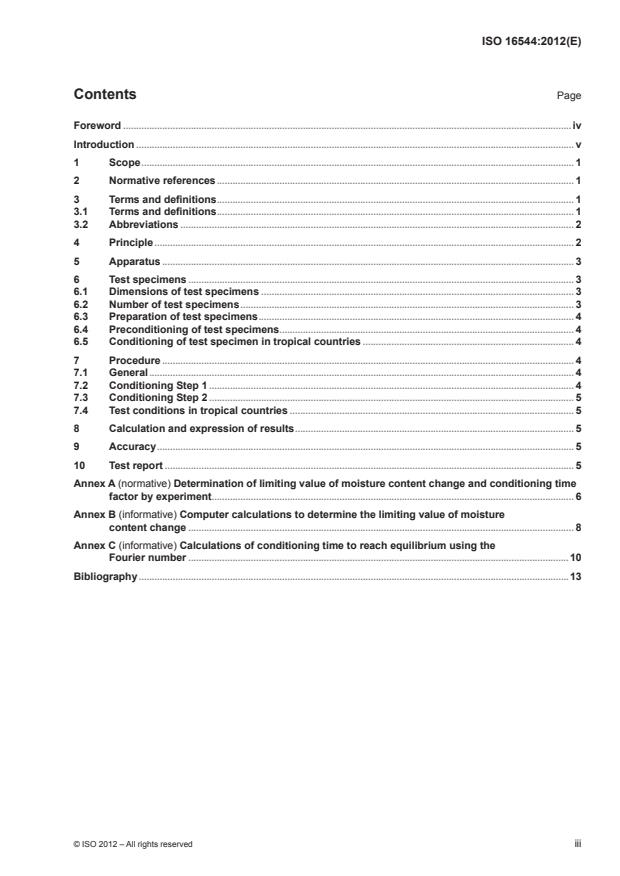
Contents Page
Foreword .iv
Introduction . v
1 Scope . 1
2 Normative references . 1
3 Terms and definitions . 1
3.1 Terms and definitions . 1
3.2 Abbreviations . 2
4 Principle . 2
5 Apparatus . 3
6 Test specimens . 3
6.1 Dimensions of test specimens . 3
6.2 Number of test specimens . 3
6.3 Preparation of test specimens . 4
6.4 Preconditioning of test specimens . 4
6.5 Conditioning of test specimen in tropical countries . 4
7 Procedure . 4
7.1 General . 4
7.2 Conditioning Step 1 . 4
7.3 Conditioning Step 2 . 5
7.4 Test conditions in tropical countries . 5
8 Calculation and expression of results . 5
9 Accuracy . 5
10 Test report . 5
Annex A (normative) Determination of limiting value of moisture content change and conditioning time
factor by experiment . 6
Annex B (informative) Computer calculations to determine the limiting value of moisture
content change . 8
Annex C (informative) Calculations of conditioning time to reach equilibrium using the
Fourier number .10
Bibliography .13
Foreword
ISO (the International Organization for Standardization) is a worldwide federation of national standards bodies
(ISO member bodies). The work of preparing International Standards is normally carried out through ISO
technical committees. Each member body interested in a subject for which a technical committee has been
established has the right to be represented on that committee. International organizations, governmental and
non-governmental, in liaison with ISO, also take part in the work. ISO collaborates closely with the International
Electrotechnical Commission (IEC) on all matters of electrotechnical standardization.
International Standards are drafted in accordance with the rules given in the ISO/IEC Directives, Part 2.
The main task of technical committees is to prepare International Standards. Draft International Standards
adopted by the technical committees are circulated to the member bodies for voting. Publication as an
International Standard requires approval by at least 75 % of the member bodies casting a vote.
Attention is drawn to the possibility that some of the elements of this document may be the subject of patent
rights. ISO shall not be held responsible for identifying any or all such patent rights.
ISO 16544 was prepared by Technical Committee ISO/TC 163, Thermal performance and energy use in the
built environment, Subcommittee SC 1, Test and measurement methods.
ISO 16544 includes the original EN 12429 prepared by Technical Committee CEN/TC 88 “Thermal insulating
materials and products”, with the following clauses modified to reflect the conditions for tropical countries:
— Clause 6.5: Conditioning of test specimen in tropical countries;
— Clause 7.4: Test conditions in tropical countries;
— Clause 10: Test report.
iv © ISO 2012 – All rights reserved
Introduction
ISO 16544 is one of a series of existing European Standards on test methods which were adopted by ISO. This
group of International Standards comprises the following group of interrelated standards:
ISO Title Respective
EN
standard
12344 Thermal insulating products for building applications — Determination of EN 12089
bending behaviour
12968 Thermal insulation products for building applications — Determination of the EN 13495
pull-off resistance of external thermal insulation composite systems (ETICS)
(foam block test)
29465 Thermal insulating products for building applications — Determination of length EN 822
and width
29466 Thermal insulating products for building applications — Determination of EN 823
thickness
29467 Thermal insulating products for building applications — Determination of EN 824
squareness
29468 Thermal insulating products for building applications — Determination of flatness EN 825
29469 Thermal insulating products for building applications — Determination of EN 826
compression behaviour
29470 Thermal insulating products for building applications — Determination of the EN 1602
apparent density
29471 Thermal insulating products for building applications — Determination of EN 1603
dimensional stability under constant normal laboratory conditions (23 degrees
C/50 % relative humidity)
29472 Thermal insulating products for building applications — Determination of EN 1604
dimensional stability under specified temperature and humidity conditions
29764 Thermal insulating products for building applications — Determination of EN 1605
deformation under specified compressive load and temperature conditions
29765 Thermal insulating products for building applications — Determination of tensile EN 1607
strength perpendicular to faces
29766 Thermal insulating products for building applications — Determination of tensile EN 1608
strength parallel to faces
29767 Thermal insulating products for building applications — Determination of short- EN 1609
term water absorption by partial immersion
29768 Thermal insulating products for building applications — Determination of linear EN 12085
dimensions of test specimens
29769 Thermal insulating products for building applications — Determination of EN 12430
behaviour under point load
29770 Thermal insulating products for building applications — Determination of EN 12431
thickness for floating-floor insulating products
29771 Thermal insulating materials for building applications — Determination of EN 13820
organic content
29803 Thermal insulation products for building applications — Determination of the EN 13497
resistance to impact of external thermal insulation composite systems (ETICS)
29804 Thermal insulation products for building applications — Determination of the EN 13494
tensile bond strength of the adhesive and of the base coat to the thermal
insulation material
29805 Thermal insulation products for building applications — Determination of the EN 13496
mechanical properties of glass fibre meshes
16534 Thermal insulating products for building applications — Determination of EN 1606
compressive creep
16535 Thermal insulating products for building applications — Determination of long- EN 12087
term water absorption by immersion
16536 Thermal insulating products for building applications — Determination of long- EN 12088
term water absorption by diffusion
16537 Thermal insulating products for building applications — Determination of shear EN 12090
behaviour
16546 Thermal insulating products for building applications —Determination of freeze- EN 12091
thaw resistance
16544 Thermal insulating products for building applications — Conditioning to moisture EN 12429
equilibrium under specified temperature and humidity conditions
16545 Thermal insulating products for building applications — Determination of EN 13793
behaviour under cyclic loading
A further group of existing European Standards on test methods for products used to insulate building equipment
and industrial installations comprises the following group of interrelated International Standards:
ISO 12623 Thermal insulating products for building equipment and industrial installations — EN 13472
Determination of short-term water absorption by partial immersion of preformed
pipe insulation
ISO 12624 Thermal insulating products for building equipment and industrial installations — EN 13468
Determination of trace quantities of water soluble chloride, fluoride, silicate,
sodium ions and pH
ISO 12628 Thermal insulating products for building equipment and industrial installations — EN 13467
Determination of dimensions, squareness and linearity of preformed pipe
insulation
ISO 12629 Thermal insulating products for building equipment and industrial installations — EN 13469
Determination of water vapour transmission properties of preformed pipe
insulation
vi © ISO 2012 – All rights reserved
INTERNATIONAL STANDARD ISO 16544:2012(E)
Thermal insulating products for building applications —
Conditioning to moisture equilibrium under specified
temperature and humidity conditions
1 Scope
This International Standard specifies equipment and procedures to condition a thermal insulating product to
equilibrium moisture content at (23 ± 2) °C and (50 ± 5) % relative humidity.
It is also applicable to thermal insulating products with moulded skins but is not normally relevant for faced
products or for products with other surface treatments.
NOTE 1 The normally specified moisture content is the result of the equilibrium between the atmosphere and the
product at (23 ± 2) °C and (50 ± 5) % relative humidity. This International Standard can also be used if a product has to be
conditioned to other relative humidities.
NOTE 2 The moisture equilibrium may, due to hysteresis effects, differ depending on whether the equilibrium has
been reached by absorption or by desorption. In addition, perfect equilibrium can require a very long time to be reached.
Therefore, it is necessary to accept equilibrium within a certain accuracy.
NOTE 3 For products that do not absorb moisture, conditioning is not needed. It should, nevertheless, be ensured that
there is no water on the surface before testing.
2 Normative references
The following referenced documents are indispensable for the application of this document. For dated
references, only the edition cited applies. For undated references, the latest edition of the referenced document
(including any amendments) applies.
ISO 29768, Thermal insulating products for building applications — Determination of linear dimensions of
test specimens
ISO 12571, Hygrothermal performance of building materials — Determination of hygroscopic sorption properties
3 Terms and definitions
For the purposes of this document, the following definitions apply.
3.1 Terms and definitions
3.1.1
atmosphere 23/50
controlled atmosphere at a temperature of (23 ± 2) °C and a relative humidity of (50 ± 5) %
3.1.2
hygroscopic range
moisture content in equilibrium with 98 % relative humidity or lower
3.1.3
equivalent time
Δt
e
d hours, where d is the numerical value of the test specimen thickness, in centimetres
3.1.4
limiting value of moisture content change
Δw
change in moisture content during a specified period of equivalent time, Δt , at the upper limit of the
e
hygroscopic range
3.1.5
conditioning time factor
γ
factor by which the equivalent time, Δt , has to be multiplied to determine the required conditioning period in
e
the hygroscopic range
3.2 Abbreviations
EPS expanded polystyrene
ICB insulation cork board
MW mineral wool
PUR polyurethane foam
XPS extruded polystyrene foam
4 Principle
The conditioning is carried out using one or two steps (see Figure 1).
Step 1 is conditioning the test specimen to a moisture content within the hygroscopic range. This conditioning
may take place in an atmosphere 23/50 or in a ventilated oven. The choice of condition depends on the type of
material. Alternative I shows drying in atmosphere 23/50 and alternative II drying in a heated oven.
Step 2 is conditioning the test specimen to equilibrium with an atmosphere 23/50, after the moisture content
has reached the hygroscopic range.
a)
2 © ISO 2012 – All rights reserved
b)
Key
X time
Y moisture content
1 alternative I
2 alternative II
w is the initial moisture content
w is the moisture content at upper limit of hygroscopic range
w is the moisture content in equilibrium with atmosphere 23/50
e
Figure 1 — Moisture content versus time during Step 1 and Step 2
5 Apparatus
5.1 Temperature and humidity controlled chamber, capable of maintaining the atmosphere 23/50.
5.2 Temperature controlled ventilated oven, that takes the air from an environment of 23/50. The oven
shall be capable of maintaining a temperature of (40 ± 5) °C or (70 ± 5) °C or (105 ± 5) °C as specified in the
relevant product standard or any other European technical specification.
5.3 Measuring instruments, capable of measuring the linear dimensions of te
...