


ISO 2811-3:2011
(Main)Paints and varnishes — Determination of density — Part 3: Oscillation method
Paints and varnishes — Determination of density — Part 3: Oscillation method
ISO 2811-3:2011 specifies a method for determining the density of paints, varnishes and related products using an oscillator. The method is suitable for all materials, including paste-like coatings. If a pressure-resistant type of apparatus is used, the method is also applicable to aerosols.
Peintures et vernis — Détermination de la masse volumique — Partie 3: Méthode par oscillation
L'ISO 2811-3:2011 spécifie une méthode de détermination de la masse volumique des peintures, vernis et produits assimilés au moyen d'un oscillateur. La méthode convient pour tous les produits, y compris les revêtements de consistance pâteuse. Si un type d'appareillage résistant à la pression est utilisé, la méthode est également applicable aux aérosols.
General Information
- Status
- Withdrawn
- Publication Date
- 15-Feb-2011
- Technical Committee
- ISO/TC 35/SC 9 - General test methods for paints and varnishes
- Current Stage
- 9599 - Withdrawal of International Standard
- Start Date
- 27-Oct-2023
- Completion Date
- 12-Feb-2026
Relations
- Effective Date
- 09-Feb-2026
- Effective Date
- 09-Feb-2026
- Effective Date
- 09-Feb-2026
- Effective Date
- 09-Feb-2026
- Effective Date
- 09-Feb-2026
- Effective Date
- 09-Feb-2026
- Effective Date
- 09-Feb-2026
- Effective Date
- 09-Feb-2026
- Effective Date
- 09-Feb-2026
- Effective Date
- 09-Feb-2026
- Effective Date
- 09-Feb-2026
- Effective Date
- 09-Feb-2026
- Effective Date
- 09-Feb-2026
- Effective Date
- 12-Feb-2026
- Effective Date
- 06-Jun-2022
Frequently Asked Questions
ISO 2811-3:2011 is a standard published by the International Organization for Standardization (ISO). Its full title is "Paints and varnishes — Determination of density — Part 3: Oscillation method". This standard covers: ISO 2811-3:2011 specifies a method for determining the density of paints, varnishes and related products using an oscillator. The method is suitable for all materials, including paste-like coatings. If a pressure-resistant type of apparatus is used, the method is also applicable to aerosols.
ISO 2811-3:2011 specifies a method for determining the density of paints, varnishes and related products using an oscillator. The method is suitable for all materials, including paste-like coatings. If a pressure-resistant type of apparatus is used, the method is also applicable to aerosols.
ISO 2811-3:2011 is classified under the following ICS (International Classification for Standards) categories: 87.040 - Paints and varnishes. The ICS classification helps identify the subject area and facilitates finding related standards.
ISO 2811-3:2011 has the following relationships with other standards: It is inter standard links to EN ISO 11890-2:2020, EN ISO 3233-3:2015, EN ISO 3233-2:2019, EN ISO 6504-3:2019, EN ISO 15741:2021, EN ISO 12944-9:2018, EN ISO 8623:2015, EN ISO 19403-3:2020, EN ISO 21809-1:2011, EN ISO 3233-1:2019, EN ISO 21809-1:2018, EN ISO 11890-2:2013, EN ISO 3233-2:2014, EN ISO 2811-3:2011, ISO 15637-1:2002. Understanding these relationships helps ensure you are using the most current and applicable version of the standard.
ISO 2811-3:2011 is available in PDF format for immediate download after purchase. The document can be added to your cart and obtained through the secure checkout process. Digital delivery ensures instant access to the complete standard document.
Standards Content (Sample)
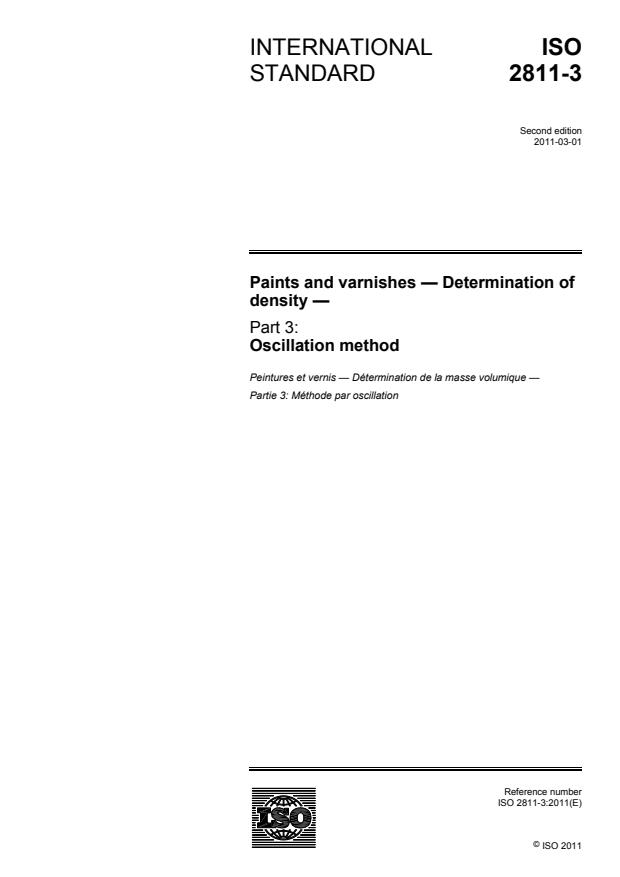
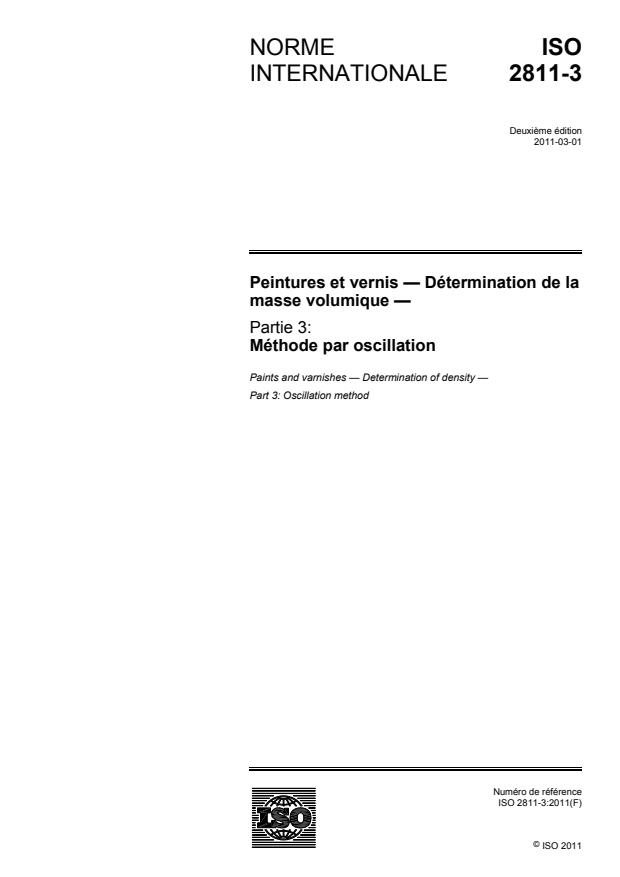
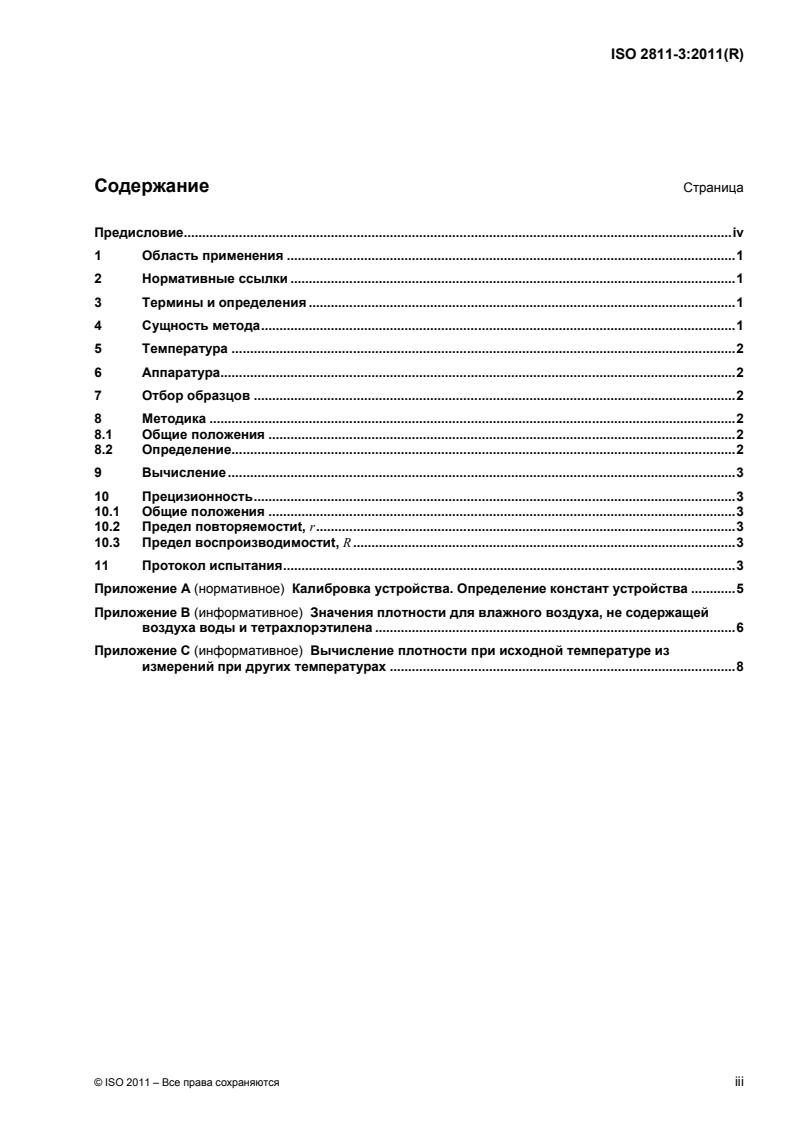
INTERNATIONAL ISO
STANDARD 2811-3
Second edition
2011-03-01
Paints and varnishes — Determination of
density —
Part 3:
Oscillation method
Peintures et vernis — Détermination de la masse volumique —
Partie 3: Méthode par oscillation
Reference number
©
ISO 2011
PDF disclaimer
This PDF file may contain embedded typefaces. In accordance with Adobe's licensing policy, this file may be printed or viewed but
shall not be edited unless the typefaces which are embedded are licensed to and installed on the computer performing the editing. In
downloading this file, parties accept therein the responsibility of not infringing Adobe's licensing policy. The ISO Central Secretariat
accepts no liability in this area.
Adobe is a trademark of Adobe Systems Incorporated.
Details of the software products used to create this PDF file can be found in the General Info relative to the file; the PDF-creation
parameters were optimized for printing. Every care has been taken to ensure that the file is suitable for use by ISO member bodies. In
the unlikely event that a problem relating to it is found, please inform the Central Secretariat at the address given below.
© ISO 2011
All rights reserved. Unless otherwise specified, no part of this publication may be reproduced or utilized in any form or by any means,
electronic or mechanical, including photocopying and microfilm, without permission in writing from either ISO at the address below or
ISO's member body in the country of the requester.
ISO copyright office
Case postale 56 • CH-1211 Geneva 20
Tel. + 41 22 749 01 11
Fax + 41 22 749 09 47
E-mail copyright@iso.org
Web www.iso.org
Published in Switzerland
ii © ISO 2011 – All rights reserved
Contents Page
Foreword .iv
1 Scope.1
2 Normative references.1
3 Terms and definitions .1
4 Principle .1
5 Temperature.2
6 Apparatus.2
7 Sampling .2
8 Procedure.2
8.1 General .2
8.2 Determination .2
9 Calculation .3
10 Precision .3
10.1 General .3
10.2 Repeatability limit, r .3
10.3 Reproducibility limit, R.3
11 Test report.3
Annex A (normative) Calibration of the apparatus — Determination of the apparatus constants .5
Annex B (informative) Density values for damp air, air-free water and tetrachloroethylene.6
Annex C (informative) Calculation of density at the reference temperature from measurements at
other temperatures.8
Foreword
ISO (the International Organization for Standardization) is a worldwide federation of national standards bodies
(ISO member bodies). The work of preparing International Standards is normally carried out through ISO
technical committees. Each member body interested in a subject for which a technical committee has been
established has the right to be represented on that committee. International organizations, governmental and
non-governmental, in liaison with ISO, also take part in the work. ISO collaborates closely with the
International Electrotechnical Commission (IEC) on all matters of electrotechnical standardization.
International Standards are drafted in accordance with the rules given in the ISO/IEC Directives, Part 2.
The main task of technical committees is to prepare International Standards. Draft International Standards
adopted by the technical committees are circulated to the member bodies for voting. Publication as an
International Standard requires approval by at least 75 % of the member bodies casting a vote.
Attention is drawn to the possibility that some of the elements of this document may be the subject of patent
rights. ISO shall not be held responsible for identifying any or all such patent rights.
ISO 2811-3 was prepared by Technical Committee ISO/TC 35, Paints and varnishes, Subcommittee SC 9,
General test methods for paints and varnishes.
This second edition cancels and replaces the first edition (ISO 2811-3:1997), which has been technically
revised.
The main changes are:
a) The unit for the density has been changed from grams per millilitre to grams per cubic centimetre,
because this is the more common SI unit.
b) The determination in duplicate has been changed to a single determination.
c) The precision data has been corrected.
d) The normative references have been updated.
ISO 2811 consists of the following parts, under the general title Paints and varnishes — Determination of
density:
⎯ Part 1: Pyknometer method
⎯ Part 2: Immersed body (plummet) method
⎯ Part 3: Oscillation method
⎯ Part 4: Pressure cup method
iv © ISO 2011 – All rights reserved
INTERNATIONAL STANDARD ISO 2811-3:2011(E)
Paints and varnishes — Determination of density —
Part 3:
Oscillation method
1 Scope
This part of ISO 2811 specifies a method for determining the density of paints, varnishes and related products
using an oscillator.
The method is suitable for all materials, including paste-like coatings. If a pressure-resistant type of apparatus
is used, the method is also applicable to aerosols.
2 Normative references
The following referenced documents are indispensable for the application of this document. For dated
references, only the edition cited applies. For undated references, the latest edition of the referenced
document (including any amendments) applies.
ISO 1513, Paints and varnishes — Examination and preparation of test samples
ISO 3696, Water for analytical laboratory use — Specification and test methods
ISO 15528, Paints, varnishes and raw materials for paints and varnishes — Sampling
3 Terms and definitions
For the purposes of this document, the following terms and definitions apply.
3.1
density
ρ
mass divided by the volume of a portion of a material
NOTE This is expressed in grams per cubic centimetre.
4 Principle
A glass or stainless-steel U-tube is filled with the product under test. The tube is clamped at both ends and
then subjected to oscillation. The resonance frequency of the filled tube varies with the mass contained in the
tube, i.e. the density of the product under test.
5 Temperature
The effect of temperature on density is highly significant with respect to filling properties, and varies with the
type of product.
Carry out the test at (23,0 ± 0,5) °C.
NOTE For some purposes a different temperature, for example (20,0 ± 0,5) °C, might be needed.
The test sample, tube and oscillator shall be conditioned to the specified or agreed temperature, and it shall
be ensured that the temperature variation does not exceed 0,5 °C during testing.
6 Apparatus
Ordinary laboratory apparatus and glassware, together with the following.
6.1 Oscillator, consisting of a glass or stainless-steel
...
NORME ISO
INTERNATIONALE 2811-3
Deuxième édition
2011-03-01
Peintures et vernis — Détermination de la
masse volumique —
Partie 3:
Méthode par oscillation
Paints and varnishes — Determination of density —
Part 3: Oscillation method
Numéro de référence
©
ISO 2011
PDF – Exonération de responsabilité
Le présent fichier PDF peut contenir des polices de caractères intégrées. Conformément aux conditions de licence d'Adobe, ce fichier
peut être imprimé ou visualisé, mais ne doit pas être modifié à moins que l'ordinateur employé à cet effet ne bénéficie d'une licence
autorisant l'utilisation de ces polices et que celles-ci y soient installées. Lors du téléchargement de ce fichier, les parties concernées
acceptent de fait la responsabilité de ne pas enfreindre les conditions de licence d'Adobe. Le Secrétariat central de l'ISO décline toute
responsabilité en la matière.
Adobe est une marque déposée d'Adobe Systems Incorporated.
Les détails relatifs aux produits logiciels utilisés pour la création du présent fichier PDF sont disponibles dans la rubrique General Info
du fichier; les paramètres de création PDF ont été optimisés pour l'impression. Toutes les mesures ont été prises pour garantir
l'exploitation de ce fichier par les comités membres de l'ISO. Dans le cas peu probable où surviendrait un problème d'utilisation,
veuillez en informer le Secrétariat central à l'adresse donnée ci-dessous.
DOCUMENT PROTÉGÉ PAR COPYRIGHT
© ISO 2011
Droits de reproduction réservés. Sauf prescription différente, aucune partie de cette publication ne peut être reproduite ni utilisée sous
quelque forme que ce soit et par aucun procédé, électronique ou mécanique, y compris la photocopie et les microfilms, sans l'accord écrit
de l'ISO à l'adresse ci-après ou du comité membre de l'ISO dans le pays du demandeur.
ISO copyright office
Case postale 56 • CH-1211 Geneva 20
Tel. + 41 22 749 01 11
Fax + 41 22 749 09 47
E-mail copyright@iso.org
Web www.iso.org
Publié en Suisse
ii © ISO 2011 – Tous droits réservés
Sommaire Page
Avant-propos .iv
1 Domaine d'application .1
2 Références normatives.1
3 Termes et définitions .1
4 Principe .1
5 Température.2
6 Appareillage .2
7 Échantillonnage.2
8 Mode opératoire.2
8.1 Généralités .2
8.2 Détermination .2
9 Calcul.3
10 Fidélité .3
10.1 Généralités .3
10.2 Limite de répétabilité, r .3
10.3 Limite de reproductibilité, R .3
11 Rapport d'essai.3
Annexe A (normative) Étalonnage de l'appareillage — Détermination des constantes de
l'appareillage.5
Annexe B (informative) Valeurs de masse volumique pour l'air humide, l'eau désaérée et le
tétrachloroéthylène .6
Annexe C (informative) Calcul de la masse volumique à la température de référence à partir de
mesurages à d'autres températures.8
Avant-propos
L'ISO (Organisation internationale de normalisation) est une fédération mondiale d'organismes nationaux de
normalisation (comités membres de l'ISO). L'élaboration des Normes internationales est en général confiée
aux comités techniques de l'ISO. Chaque comité membre intéressé par une étude a le droit de faire partie du
comité technique créé à cet effet. Les organisations internationales, gouvernementales et non
gouvernementales, en liaison avec l'ISO participent également aux travaux. L'ISO collabore étroitement avec
la Commission électrotechnique internationale (CEI) en ce qui concerne la normalisation électrotechnique.
Les Normes internationales sont rédigées conformément aux règles données dans les Directives ISO/CEI,
Partie 2.
La tâche principale des comités techniques est d'élaborer les Normes internationales. Les projets de Normes
internationales adoptés par les comités techniques sont soumis aux comités membres pour vote. Leur
publication comme Normes internationales requiert l'approbation de 75 % au moins des comités membres
votants.
L'attention est appelée sur le fait que certains des éléments du présent document peuvent faire l'objet de
droits de propriété intellectuelle ou de droits analogues. L'ISO ne saurait être tenue pour responsable de ne
pas avoir identifié de tels droits de propriété et averti de leur existence.
L'ISO 2811-3 a été élaborée par le comité technique ISO/TC 35, Peintures et vernis, sous-comité SC 9,
Méthodes générales d'essais des peintures et vernis.
Cette deuxième édition annule et remplace la première édition (ISO 2811-3:1997), qui a fait l'objet d'une
révision technique.
Les principales modifications apportées sont les suivantes.
a) L'unité de masse volumique a été changée de grammes par millilitre en grammes par centimètre cube,
car il s'agit de l'unité SI la plus couramment utilisée.
b) La détermination en double a été changée en détermination simple.
c) Les données de fidélité ont été corrigées.
d) Les références normatives ont été mises à jour.
L'ISO 2811 comprend les parties suivantes, présentées sous le titre général Peintures et vernis —
Détermination de la masse volumique:
⎯ Partie 1: Méthode pycnométrique
⎯ Partie 2: Méthode par immersion d'un corps (plongeur)
⎯ Partie 3: Méthode par oscillation
⎯ Partie 4: Méthode du cylindre sous pression
iv © ISO 2011 – Tous droits réservés
NORME INTERNATIONALE ISO 2811-3:2011(F)
Peintures et vernis — Détermination de la masse volumique —
Partie 3:
Méthode par oscillation
1 Domaine d'application
La présente partie de l'ISO 2811 spécifie une méthode de détermination de la masse volumique des peintures,
vernis et produits assimilés au moyen d'un oscillateur.
La méthode convient pour tous les produits, y compris les revêtements de consistance pâteuse. Si un type
d'appareillage résistant à la pression est utilisé, la méthode est également applicable aux aérosols.
2 Références normatives
Les documents de référence suivants sont indispensables pour l'application du présent document. Pour les
références datées, seule l'édition citée s'applique. Pour les références non datées, la dernière édition du
document de référence s'applique (y compris les éventuels amendements).
ISO 1513, Peintures et vernis — Examen et préparation des échantillons pour essai
ISO 3696, Eau pour laboratoire à usage analytique — Spécification et méthodes d'essai
ISO 15528, Peintures, vernis et matières premières pour peintures et vernis — Échantillonnage
3 Termes et définitions
Pour les besoins du présent document, les termes et définitions suivants s'appliquent.
3.1
masse volumique
ρ
quotient de la masse par le volume d'une prise d'essai d'un produit
NOTE La masse volumique est exprimée en grammes par centimètre cube.
4 Principe
Un tube en U, en verre ou en acier inoxydable, est rempli du produit soumis à essai. Le tube est fixé aux deux
extrémités, puis soumis à des oscillations. La fréquence de résonance du tube rempli varie en fonction de la
masse contenue dans le tube, c'est-à-dire de la masse volumique du produit soumis à essai.
5 Température
L'influence de la température sur la masse volumique est très importante pour les propriétés du remplissage,
et varie selon le type de produit.
Effectuer l'essai à (23,0 ± 0,5) °C.
NOTE On pourrait avoir besoin, pour d'autres applications, d'une température différente, par exemple (20,0 ± 0,5) °C.
L'échantillon pour essai, le tube et l'oscillateur doivent être conditionnés à la température convenue ou
spécifiée, et il faut s'assurer que les variations de température ne dépassent pas 0,5 °C au cours de l'essai.
6 Appareillage
Matérie
...
МЕЖДУНАРОДНЫЙ ISO
СТАНДАРТ 2811-3
Второе издание
2011-03-01
Краски и лаки. Определение
плотности.
Часть 3.
Осцилляционный метод
Paints and varnishes — Determination of density —
Part 3: Oscillation method
Ответственность за подготовку русской версии несѐт GOST R
(Российская Федерация) в соответствии со статьѐй 18.1 Устава ISO
Ссылочный номер
©
ISO 2011
Отказ от ответственности при работе в PDF
Настоящий файл PDF может содержать интегрированные шрифты. В соответствии с условиями лицензирования, принятыми
фирмой Adobe, этот файл можно распечатать или смотреть на экране, но его нельзя изменить, пока не будет получена
лицензия на интегрированные шрифты и они не будут установлены на компьютере, на котором ведется редактирование. В
случае загрузки настоящего файла заинтересованные стороны принимают на себя ответственность за соблюдение
лицензионных условий фирмы Adobe. Центральный секретариат ISO не несет никакой ответственности в этом отношении.
Adobe – торговый знак фирмы Adobe Системаs Incorporated.
Подробности, относящиеся к программным продуктам, использованные для создания настоящего файла PDF, можно найти в
рубрике Общее Info файла; параметры создания PDF были оптимизированы для печати. Были приняты во внимание все
меры предосторожности с тем, чтобы обеспечить пригодность настоящего файла для использования комитетами-членами
ISO. В редких случаях возникновения проблемы, связанной со сказанным выше, просьба проинформировать Центральный
секретариат по адресу, приведенному ниже.
ДОКУМЕНТ ЗАЩИЩЕН АВТОРСКИМ ПРАВОМ
© ISO 2011
Все права сохраняются. Если не указано иное, никакую часть настоящей публикации нельзя копировать или использовать в
какой-либо форме или каким-либо электронным или механическим способом, включая фотокопии и микрофильмы, без
предварительного письменного согласия ISO, которое должно быть получено после запроса о разрешении, направленного по
адресу, приведенному ниже, или в комитет-член ISO в стране запрашивающей стороны.
ISO copyright office
Case postale 56 CH-1211 Geneva 20
Tel. + 41 22 749 01 11
Fax + 41 22 749 09 47
E-mail copyright@iso.org
Web www.iso.org
Опубликовано в Швейцарии
ii © ISO 2011 – Все права сохраняются
Содержание Страница
Предисловие. iv
1 Область применения . 1
2 Нормативные ссылки . 1
3 Термины и определения . 1
4 Сущность метода . 1
5 Температура . 2
6 Аппаратура . 2
7 Отбор образцов . 2
8 Методика . 2
8.1 Общие положения . 2
8.2 Определение. 2
9 Вычисление . 3
10 Прецизионность . 3
10.1 Общие положения . 3
10.2 Предел повторяемостиt, r . 3
10.3 Предел воспроизводимостиt, R . 3
11 Протокол испытания . 3
Приложение А (нормативное) Калибровка устройства. Определение констант устройства . 5
Приложение В (информативное) Значения плотности для влажного воздуха, не содержащей
воздуха воды и тетрахлорэтилена . 6
Приложение С (информативное) Вычисление плотности при исходной температуре из
измерений при других температурах . 8
Предисловие
Международная организация по стандартизации (ISO) является всемирной федерацией,
объединяющей национальные органы по стандартизации (комитеты-члены ISO). Разработка
международных стандартов, как правило, ведется в технических комитетах ISO. Каждый комитет-член,
заинтересованной в разработке теме, ради которой был образован данный технический комитет,
имеет право быть представленным в этом комитете. Международные организации, правительственные
и неправительственные, поддерживающие связь с ISO, также принимают участие в ее работе. ISO
тесно сотрудничает с Международной электротехнической комиссией (IEC) по всем вопросам
стандартизации в области электротехники.
Международные стандарты разрабатываются в соответствии с правилами, приведенными в Части 2
Директив ISO/IEC.
Основное назначение технических комитетов заключается в разработке Международных стандартов.
Проекты международных стандартов, принятые техническими комитетами, рассылаются комитетам-
членам на голосование. Для опубликования международного стандарта требуется собрать не менее
75 % положительных голосов комитетов-членов, принявших участие в голосовании.
Обращается внимание на вероятность того, что некоторые элементы настоящего документа могут
быть предметов патентных прав. ISO не несет ответственность за идентификацию части или всех
подобных прав.
ISO 2881-3 был разработан Техническим комитетом ISO/TC 35, Краски и лаки, Подкомитетом SC 9,
Общие методы испытания для красок и лаков.
Настоящее второе издание отменяет и заменяет первое издание (ISO 2811-3:1997), которое было
пересмотрено в техническом отношении.
Основные изменения коснулись следующего:
a) Единица измерения плотности была изменена с грамм на миллиметр на грамм на кубический
сантиметр, поскольку она является более распространенной единицей системы измерения СИ.
b) Дублирующее определение было заменено однократным.
c) Данные прецизионности были исправлены;
d) Нормативные ссылки были уточнены.
ISO 2811 состоит из следующих частей под общим заголовком Краски и лаки. Определение
плотности:
Часть 1. Пикнометрический метод
Часть 2. Метод погруженного тела (метод отвеса)
Часть 3. Осцилляционный метод
Часть 4. Метод давления чаши
iv © ISO 2011 – Все права сохраняются
МЕЖДУНАРОДНЫЙ СТАНДАРТ ISO 2811-3:2011(R)
Краски и лаки. Определение плотности.
Часть 3.
Осцилляционный метод
1 Область применения
Настоящая часть ISO 2811 устанавливает метод определения плотности красок, лаков и родственных
продуктов, используя осциллятор.
Данный метод пригоден для всех материалов, включая пастообразные покрытия. Если используется
стойкое к сжатию устройство, метод также пригоден для аэрозолей.
2 Нормативные ссылки
Нижеследующие ссылочные документы обязательны для применения настоящего документа. В
отношении датированных ссылок действительны только указанные издания. В отношении
недатированных ссылок применимо последнее издание упоминаемого документа, включая любые к
нему изменения.
ISO 1513, Краски и лаки. Контроль и подготовка образцов для испытания
ISO 3696, Вода для лабораторного анализа. Технические требования и методы испытания
ISO 15528, Краски, лаки и сырье для них. Отбор образцов
3 Термины и определения
Исходя из назначения настоящего документа, применимы следующие термины и определения.
3.1
плотность
density
масса, деленная на объем части материала
ПРИМЕЧАНИЕ Выражается в граммах на кубический сантиметр.
4 Сущность метода
U-образную трубку из стекла или нержавеющей стали заполняют исследуемым продуктом. Трубку
зажимают с обоих концов и затем подвергают осцилляции. Резонансная частота заполненной трубки
изменяется с массой, содержащейся в ней, т.е. плотности исследуемого продукта.
5 Температура
Влияние температуры на плотность является весьма значительным относительно свойств наполнения
и зависит от типа продукта.
Испытание проводят при (23,0 0,5) °C.
ПРИМЕЧАНИЕ Для некоторых целей необходима отличная температура, например (20,0 0,5) °C.
Пробный образец, трубка и осциллятор выдерживают при заданной или согласованной температуре и
убеждаются в том, чтобы колебания температуры в ходе испытания не превышали 0,5 °C.
6 Аппаратура
Обычная
...
Questions, Comments and Discussion
Ask us and Technical Secretary will try to provide an answer. You can facilitate discussion about the standard in here.
Loading comments...