


ISO/FDIS 16921-2
(Main)Biotechnology — Gene delivery systems — Part 2: Quantification methods for viral vectors
Biotechnology — Gene delivery systems — Part 2: Quantification methods for viral vectors
This document provides minimum requirements for quantifying viral vectors in term of physical titer and functional titer. It provides key considerations for general methods for viral vector quantification as well as for method selection, measurement process, data analysis, and reporting. This document is applicable to all types of viral vectors (e.g., adeno-associated, adenovirus, retrovirus, lentivirus, herpesvirus) for therapeutic use, including their research and development. This document is not intended for viral vectors for non-health sectors.
Biotechnologie — Systèmes de transfert de gènes — Partie 2: Méthodes de quantification des vecteurs viraux
General Information
- Status
- Not Published
- Technical Committee
- ISO/TC 276 - Biotechnology
- Drafting Committee
- ISO/TC 276 - Biotechnology
- Current Stage
- 5020 - FDIS ballot initiated: 2 months. Proof sent to secretariat
- Start Date
- 25-Nov-2025
- Completion Date
- 25-Nov-2025
Overview
ISO/FDIS 16921-2 (ISO/TC 276/SC 1) defines requirements and guidance for the quantification of viral vectors used in therapeutic research and development. The draft document covers both physical titer (particle count) and functional titer (activity/transduction), and provides a structured approach to method selection, sampling, measurement, data analysis and reporting. This part of the ISO 16921 series is aimed at viral vectors such as adeno-associated virus (AAV), adenovirus, retrovirus, lentivirus and herpesvirus intended for health applications (not for non-health sectors).
Note: ISO/FDIS 16921-2 is distributed at the DIS/FDIS stage and may be subject to change.
Key Topics
Physical titer vs functional titer
- Physical titer: direct or indirect particle counting methods to determine particle concentration.
- Functional titer: cell-based activity assays that quantify the concentration of particles capable of accomplishing transduction.
Measurement approaches
- Direct particle counting requires well-dispersed samples to avoid bias from aggregates or debris.
- Indirect particle counting uses surrogate signals (e.g., nucleic acid or protein measures) calibrated to particle count.
Assay selection and fit-for-purpose
- Select assays based on the attribute to be measured (quantity vs activity) and the intended use (R&D, process control, release testing).
- Consider matrix effects, sample preparation, cell lines for activity assays and the relevance to product mechanism of action.
Qualification, validation and verification
- Instrument qualification, method qualification and formal validation/verification steps are described to demonstrate method performance and reliability.
- Use of appropriate reference materials and controls is emphasized.
Data processing and reporting
- Standardized reporting of titer, uncertainty, method details and sampling context supports comparability and regulatory review.
Applications
ISO/FDIS 16921-2 is directly applicable to:
- Development and characterization of viral vector products in therapeutic programs.
- Process development and in-process control where accurate titering informs purification and yield.
- Release and stability testing when paired with validated potency assays.
Practical benefits include improved assay reproducibility, clearer method selection rationale, and harmonized reporting that aids regulatory submissions and cross-laboratory comparison.
Related Standards
- ISO 16921-1 - Vocabulary for gene delivery systems (provides definitions used throughout the series).
- ISO 20395 - Performance requirements for nucleic acid quantification methods (qPCR, dPCR) referenced for method evaluation.
Annexes in the draft (A, B, C) give informative examples of quantification methods, general workflows and an example lentivirus transducing titer workflow to support method implementation and training. Use this document as a practical framework for establishing robust viral vector quantification programs in therapeutic R&D and manufacturing.


ISO/FDIS 16921-2 - Biotechnology — Gene delivery systems — Part 2: Quantification methods for viral vectors Released:11. 11. 2025


REDLINE ISO/FDIS 16921-2 - Biotechnology — Gene delivery systems — Part 2: Quantification methods for viral vectors Released:11. 11. 2025
Frequently Asked Questions
ISO/FDIS 16921-2 is a draft published by the International Organization for Standardization (ISO). Its full title is "Biotechnology — Gene delivery systems — Part 2: Quantification methods for viral vectors". This standard covers: This document provides minimum requirements for quantifying viral vectors in term of physical titer and functional titer. It provides key considerations for general methods for viral vector quantification as well as for method selection, measurement process, data analysis, and reporting. This document is applicable to all types of viral vectors (e.g., adeno-associated, adenovirus, retrovirus, lentivirus, herpesvirus) for therapeutic use, including their research and development. This document is not intended for viral vectors for non-health sectors.
This document provides minimum requirements for quantifying viral vectors in term of physical titer and functional titer. It provides key considerations for general methods for viral vector quantification as well as for method selection, measurement process, data analysis, and reporting. This document is applicable to all types of viral vectors (e.g., adeno-associated, adenovirus, retrovirus, lentivirus, herpesvirus) for therapeutic use, including their research and development. This document is not intended for viral vectors for non-health sectors.
ISO/FDIS 16921-2 is classified under the following ICS (International Classification for Standards) categories: 07.080 - Biology. Botany. Zoology. The ICS classification helps identify the subject area and facilitates finding related standards.
ISO/FDIS 16921-2 is available in PDF format for immediate download after purchase. The document can be added to your cart and obtained through the secure checkout process. Digital delivery ensures instant access to the complete standard document.
Standards Content (Sample)
FINAL DRAFT
International
Standard
ISO/TC 276/SC 1
Biotechnology — Gene delivery
Secretariat: ANSI
systems —
Voting begins on:
2025-11-25
Part 2:
Quantification methods for viral
Voting terminates on:
2026-01-20
vectors
RECIPIENTS OF THIS DRAFT ARE INVITED TO SUBMIT,
WITH THEIR COMMENTS, NOTIFICATION OF ANY
RELEVANT PATENT RIGHTS OF WHICH THEY ARE AWARE
AND TO PROVIDE SUPPOR TING DOCUMENTATION.
IN ADDITION TO THEIR EVALUATION AS
BEING ACCEPTABLE FOR INDUSTRIAL, TECHNO-
LOGICAL, COMMERCIAL AND USER PURPOSES, DRAFT
INTERNATIONAL STANDARDS MAY ON OCCASION HAVE
TO BE CONSIDERED IN THE LIGHT OF THEIR POTENTIAL
TO BECOME STAN DARDS TO WHICH REFERENCE MAY BE
MADE IN NATIONAL REGULATIONS.
Reference number
FINAL DRAFT
International
Standard
ISO/TC 276/SC 1
Biotechnology — Gene delivery
Secretariat: ANSI
systems —
Voting begins on:
Part 2:
Quantification methods for viral
Voting terminates on:
vectors
RECIPIENTS OF THIS DRAFT ARE INVITED TO SUBMIT,
WITH THEIR COMMENTS, NOTIFICATION OF ANY
RELEVANT PATENT RIGHTS OF WHICH THEY ARE AWARE
AND TO PROVIDE SUPPOR TING DOCUMENTATION.
© ISO 2025
IN ADDITION TO THEIR EVALUATION AS
All rights reserved. Unless otherwise specified, or required in the context of its implementation, no part of this publication may
BEING ACCEPTABLE FOR INDUSTRIAL, TECHNO-
LOGICAL, COMMERCIAL AND USER PURPOSES, DRAFT
be reproduced or utilized otherwise in any form or by any means, electronic or mechanical, including photocopying, or posting on
INTERNATIONAL STANDARDS MAY ON OCCASION HAVE
the internet or an intranet, without prior written permission. Permission can be requested from either ISO at the address below
TO BE CONSIDERED IN THE LIGHT OF THEIR POTENTIAL
or ISO’s member body in the country of the requester.
TO BECOME STAN DARDS TO WHICH REFERENCE MAY BE
MADE IN NATIONAL REGULATIONS.
ISO copyright office
CP 401 • Ch. de Blandonnet 8
CH-1214 Vernier, Geneva
Phone: +41 22 749 01 11
Email: copyright@iso.org
Website: www.iso.org
Published in Switzerland Reference number
ii
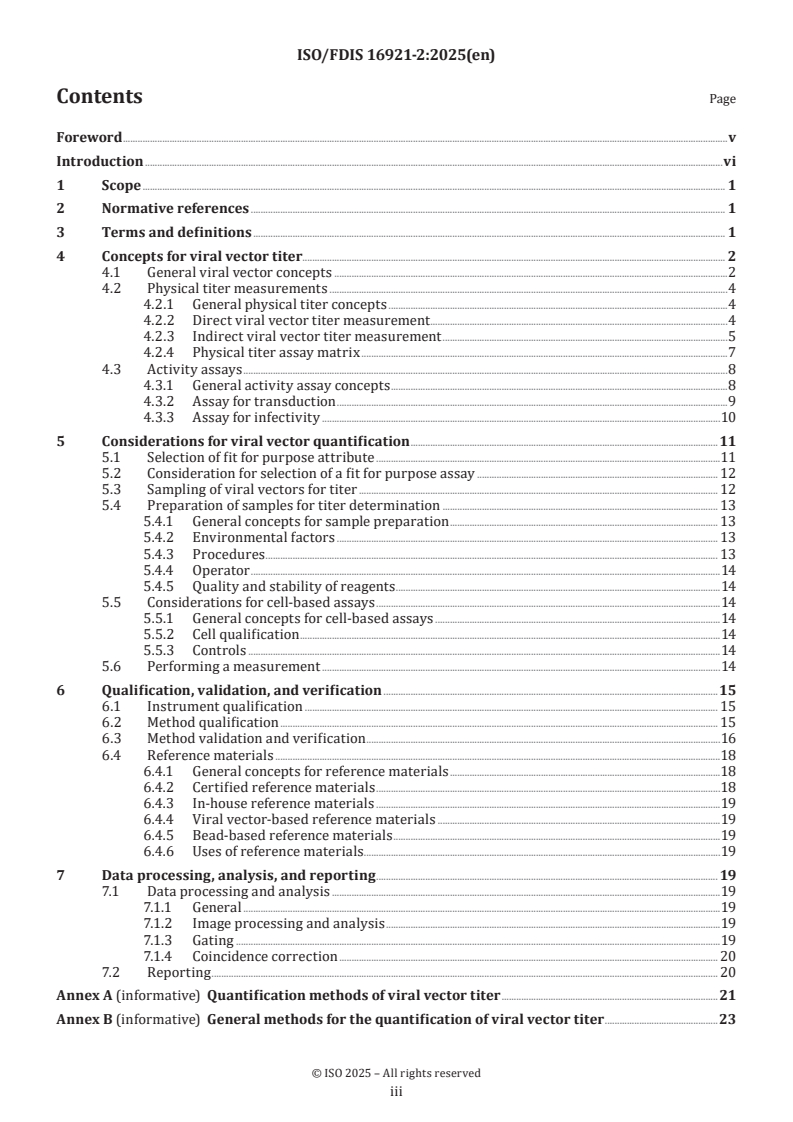
Contents Page
Foreword .v
Introduction .vi
1 Scope . 1
2 Normative references . 1
3 Terms and definitions . 1
4 Concepts for viral vector titer . . 2
4.1 General viral vector concepts .2
4.2 Physical titer measurements .4
4.2.1 General physical titer concepts .4
4.2.2 Direct viral vector titer measurement .4
4.2.3 Indirect viral vector titer measurement .5
4.2.4 Physical titer assay matrix .7
4.3 Activity assays .8
4.3.1 General activity assay concepts .8
4.3.2 Assay for transduction .9
4.3.3 Assay for infectivity .10
5 Considerations for viral vector quantification .11
5.1 Selection of fit for purpose attribute .11
5.2 Consideration for selection of a fit for purpose assay . 12
5.3 Sampling of viral vectors for titer . 12
5.4 Preparation of samples for titer determination . 13
5.4.1 General concepts for sample preparation . 13
5.4.2 Environmental factors . 13
5.4.3 Procedures . 13
5.4.4 Operator .14
5.4.5 Quality and stability of reagents .14
5.5 Considerations for cell-based assays .14
5.5.1 General concepts for cell-based assays .14
5.5.2 Cell qualification .14
5.5.3 Controls .14
5.6 Performing a measurement .14
6 Qualification, validation, and verification .15
6.1 Instrument qualification . 15
6.2 Method qualification . 15
6.3 Method validation and verification .16
6.4 Reference materials .18
6.4.1 General concepts for reference materials .18
6.4.2 Certified reference materials .18
6.4.3 In-house reference materials .19
6.4.4 Viral vector-based reference materials .19
6.4.5 Bead-based reference materials .19
6.4.6 Uses of reference materials . .19
7 Data processing, analysis, and reporting . 19
7.1 Data processing and analysis .19
7.1.1 General .19
7.1.2 Image processing and analysis .19
7.1.3 Gating .19
7.1.4 Coincidence correction . 20
7.2 Reporting . 20
Annex A (informative) Quantification methods of viral vector titer .21
Annex B (informative) General methods for the quantification of viral vector titer .23
iii
Annex C (informative) Example workflow of lentivirus (LV) transducing titer determination
method .28
Bibliography .31
iv
Foreword
ISO (the International Organization for Standardization) is a worldwide federation of national standards
bodies (ISO member bodies). The work of preparing International Standards is normally carried out through
ISO technical committees. Each member body interested in a subject for which a technical committee
has been established has the right to be represented on that committee. International organizations,
governmental and non-governmental, in liaison with ISO, also take part in the work. ISO collaborates closely
with the International Electrotechnical Commission (IEC) on all matters of electrotechnical standardization.
The procedures used to develop this document and those intended for its further maintenance are described
in the ISO/IEC Directives, Part 1. In particular, the different approval criteria needed for the different types
of ISO document should be noted. This document was drafted in accordance with the editorial rules of the
ISO/IEC Directives, Part 2 (see www.iso.org/directives).
ISO draws attention to the possibility that the implementation of this document may involve the use of (a)
patent(s). ISO takes no position concerning the evidence, validity or applicability of any claimed patent
rights in respect thereof. As of the date of publication of this document, ISO had not received notice of (a)
patent(s) which may be required to implement this document. However, implementers are cautioned that
this may not represent the latest information, which may be obtained from the patent database available at
www.iso.org/patents. ISO shall not be held responsible for identifying any or all such patent rights.
Any trade name used in this document is information given for the convenience of users and does not
constitute an endorsement.
For an explanation of the voluntary nature of standards, the meaning of ISO specific terms and expressions
related to conformity assessment, as well as information about ISO's adherence to the World Trade
Organization (WTO) principles in the Technical Barriers to Trade (TBT), see www.iso.org/iso/foreword.html.
This document was prepared by Technical Committee ISO/TC 276, Biotechnology, Subcommittee SC 1,
Analytical methods.
A list of all parts in the ISO 16921 series can be found on the ISO website.
Any feedback or questions on this document should be directed to the user’s national standards body. A
complete listing of these bodies can be found at www.iso.org/members.html.
v
Introduction
Modern biotechnology relies on the ability to manipulate genes and genomes in living systems. Gene
delivery systems are foundational to genome engineering. Gene delivery technology is evolving rapidly with
numerous types of gene delivery systems providing a comprehensive set of tools and capabilities for in vitro
or in vivo targeted delivery.
The ISO 16921 series consists of multiple parts to provide common understanding, guides, analytical
methods and, data reporting for characterizing these emerging biotechnology tools. ISO 16921-1 specifies
Vocabulary related to gene delivery systems. This document (ISO 16921-2) focuses on quantification of one
type of gene delivery system, viral vectors.
Viral vectors are engineered viruses for delivering the desired genetic payload into target cells. Viral vectors
are powerful molecular biology tools and have been increasingly used in broad biotechnology applications
and products. Various types of viral vectors are used as advanced gene therapies, as vaccines, and as critical
reagents for cellular therapies. They have also been increasingly used in genome editing applications. Viral
vector titer (titre) is central to all applications. Robust measurements for the quantification and reporting of
viral vector titer are important for the industry. This document provides general guidance for viral vector
titer as well as aspects of functional analysis including method selection, sample preparation, measurement,
qualification and validation, data analysis and reporting.
vi
FINAL DRAFT International Standard ISO/FDIS 16921-2:2025(en)
Biotechnology — Gene delivery systems —
Part 2:
Quantification methods for viral vectors
1 Scope
This document specifies minimum requirements for quantifying viral vectors in terms of physical titer
and their associated activity. This document specifies key considerations for quantification methods for
viral vector titer as well as activity, including method selection, measurement process, data analysis, and
reporting.
2 Normative references
The following documents are referred to in the text in such a way that some or all of their content constitutes
requirements of this document. For dated references, only the edition cited applies. For undated references,
the latest edition of the referenced document (including any amendments) applies.
ISO 16921-1, Biotechnology — Gene Delivery Systems — Part 1: Vocabulary
ISO 20395, Biotechnology — Requirements for evaluating the performance of quantification methods for nucleic
acid target sequences — qPCR and dPCR
3 Terms and definitions
For the purposes of this document, the terms and definitions given in ISO 16921-1 and the following apply.
ISO and IEC maintain terminology databases for use in standardization at the following addresses:
— ISO Online browsing platform: available at https:// www .iso .org/ obp
— IEC Electropedia: available at https:// www .electropedia .org/
3.1
direct particle counting
counting method in which one signal is (or several signals are) detected for each single event
Note 1 to entry: Each single event represents a single viral particle in an idealized measurement
3.2
indirect particle counting
counting method during which a signal (or a set of signals) is measured from a population of viral particles
and that signal is then related to viral titer based on a measurement-specific mathematical model (e.g.
calibration curve)
4 Concepts for viral vector titer
4.1 General viral vector concepts
Viral vectors are genetically engineered viruses designed to deliver nucleic acid into a cell. As such, viral
vectors are almost always replication incompetent, so that no new viral vectors can be produced within the
target cell.
NOTE 1 Viral vectors can be made to be replication competent in the presence of a helper virus or complementary
replicative genes in a cell.
NOTE 2 Replication competent viral vectors are generally not used in therapeutic applications due to safety
concerns.
A functional viral vector generally consists of three components:
— the protein capsid with or without the envelope that encapsulates the payload, and defines the vector’s
tissue or cell tropism and antigen recognition;
— the gene of interest, which when expressed in cells, serves to confer a desired functional outcome; and
— the regulatory components including the combined enhancer, promoter, and auxiliary elements that
control stable or transient somatic expression of the transgene as an episome or as a chromosomal
integrant.
NOTE 3 Some viral vectors designs do not precisely follow the transgene and regulatory cassette descriptions
stated above. Examples include those utilizing micro RNAs, guide RNAs, multiple transgenes/promoters, and dual
vectors (which utilize in vivo splicing).
The process to engineer and manufacture viral vectors is complex and evolving. Current technologies
generally produce a mixture of functional viral vectors that can deliver the appropriate payload into the
target cells as well as non-functional viral vectors and free capsid proteins (Figure 1). Other potential
impurities in the viral vector mixture include free DNA from the host cell or residual plasmid components,
all of which may be encapsulated as well.
Key
1 functional particles
2 nonfunctional particles (empty and immature particles)
3 free capsid proteins
Figure 1 — Products from viral vector production that include functional particles, nonfunctional
particles, and free capsid protein. Adapted from “Understanding viral titration- behind the
[1]
science” .
Non-functional viral vector particles do not have all the necessary components to complete the transduction
process, express the intended protein, and result in the functional outcome. Non-functional viral vector
particles include various types of defects, including for example:
— vectors with defective capsids that can affect its tissue or cell tropism and antigen recognition,
— vectors that contain missing or defective payloads,
— vectors that contain missing or defective regulatory components.
Viral vectors are characterized according to critical quality attributes, such as quantity, potency, safety,
and identity. This document focuses on quantity. General methods for a) quantification of physical titer of
viral vectors and b) functional characterization of viral vectors using cell-based measurements are shown
in figure 2.
a
Additional potency assays for titer quantification are often specific to the product and mechanism of action and is
beyond the scope of this document.
Figure 2 — Analytical methods for quantification of viral vectors based on physical methods or
their interactions with cells. This figure of quantification methods is not exhaustive and can be
further developed.
Physical titer of viral vectors refers to the particle count, which is determined by direct particle counting or
indirect particle counting methods.
Direct particle counting involves the recording of a signal or a set of signals from individual viral particles
(3.1). Direct particle counting requires well-dispersed particles for optimal performance. The presence of
debris and aggregated or agglomerated particle can lead to over- or underestimated virus titer. Whenever
possible, a process should be established to prepare well- dispersed samples with minimized debris,
aggregate, and agglomerate content.
Indirect particle counting (3.2) methods use a surrogate measure to evaluate the count. The accuracy of
these methods depends on the accuracy of the measurement and the accuracy of a calibration curve, if a
calibration curve is needed. Indirect particle counting methods include:
— the use of a calibration to estimate a count (e.g. fluorescence, qPCR, ELISA, or another method to back
calculate count using a calibration curve);
— the measuring a component of the particle to infer the count (e.g. quantifying the total capsid protein
concentration to estimate particle count).
Activity methods are used to measure the interaction between viral vector particles and target cells.
Activity measures determine the concentration of functional particles in a viral vector preparation. Activity
measurements can be further divided into transduction and other potency measures to gain insight into
general transduction activity and product specific potency.
Transduction assays measure viral vector transgene entry into target cells for non-replication competent
viral systems. Vector copy number per cell or transduction efficiency can be measured in the target cells. A
dilution series of virus to cells is generally used to specify at which dilutions the multiplicity of infection to
transduction efficiency is linear. The transduction units in the original virus preparation can be determined
from the specified range of the dilution series.
Infectivity assays may include a viral vector, a helper virus, and a complementary cell line that enables the
viral vector to replicate. Viral replication can result in target cells undergoing cytopathic effect. Replication
and cytopathic effect can be visualized and quantified as plaques or foci in the cells. Viral vector replication
in target cells enables quantification of virus activity and infectivity assay titer.
Potency assays measure transgene expression and transgene activity. Transduction assays can be considered
one part of potency measures which can measure transgene insertion, integration, and expression.
Additional potency measures beyond transduction and transgene expression are often production specific
measures of transgene mechanism of action. Due to the product specific nature of such assays, use of potency
assays for viral vector quantification are beyond the scope of this document.
See Table A.1for attributes, biological properties, analytical methods, measurement principles, and units for
the quantification of viral vector titer.
4.2 Physical titer measurements
4.2.1 General physical titer concepts
Physical titer refers to the total concentration of viral vectors or the concentration of a predefined, subset of
viral vectors.
Physical titer of viral vectors shall be expressed as amount per volume (1/mL).
Physical titer can be determined via several analytical methods, including direct particle counting methods
and indirect particle counting methods.
An appropriate measurement shall be selected to determine the total quantity or the quantity of a predefined,
subset of viral vectors.
Assessment of the quality of the viral vectors may involve the use of two or more titers, such as filled to
empty ratio.
See Annex B.2.1 for additional physical titer methods.
4.2.2 Direct viral vector titer measurement
Direct viral vector titer methods identify and enumerate single particles. Direct viral vector titer can be
used for total viral vector enumeration or enumeration of particles of a specific predefined attribute.
Direct viral vector titer measurements can include electron microscopy-based counting, flow virometry,
resistive pulse sensing, nanoparticle tracking analysis, and other methods capable of capturing single
entities (i.e., viral vector particles).
Results of direct particle counting methods shall be reported in terms of particles/mL or specified units
of volume.
Due to sample heterogeneity, direct viral vector counting methods can inadvertently count impurities, such
as extracellular vesicles, as viral vectors. Counting methods targeting only the viral vectors within a sample
may therefore be more appropriate. Combining methods specific for impurities, such as flow cytometry that
targets extracellular vesicles, can also be used to correct direct particle count measurements to be more
accurate for viral particles.
4.2.3 Indirect viral vector titer measurement
4.2.3.1 General indirect viral vector titer concepts
Indirect viral vector titer measurements include all methods to extrapolate the viral vector quantity not
associated with enumeration.
Indirect methods generally involve the use of a calibration curve to determine quantity. These include
methods that quantify a defined attribute of the viral vector, such as capsid protein quantification and
genome quantification methods.
4.2.3.2 Capsid titer quantification
Capsid titer or capsid concentration is a measurement of protein quantification used to characterize viral
vectors. An example of a method used to determine capsid titer is the enzyme-linked immunosorbent
assay (ELISA). Other example methods for capsid titer can be found in Table A.1. ELISA capsid protein
measurements reported as virus particles/mL is ambiguous to what the actual measurand is. Capsid titer
shall be reported as capsids/mL. The specific capsid protein (e.g. p24 for lentivirus) being targeted shall
be included in the measurement reporting. The method of determining the capsids/mL and associated
calculations shall be documented. A standard curve shall be included for capsid titer determination using a
well characterized and known concentration of the target protein.
NOTE 1 Capsid protein measurements measure free soluble capsid protein and encapsulated capsid protein as a
quality measure of a viral vector preparation.
NOTE 2 ELISA measurements report absorbance values for the samples being measured. Depending on the viral
vector, the absorbance values can be converted to mass and then to capsids/mL, or directly from absorbance values to
capsids/mL.
The calculations to perform these conversions are based on literature assumptions and should be considered
when evaluating the accuracy for capsid quantification. For example, p24 capsid quantification by ELISA
[2]
relies on the assumption that there are approximately 2 000 molecules of p24 per lentivirus particle . The
accuracy of this estimate affects the calculated capsid titer.
4.2.3.3 Genome titer quantification
4.2.3.3.1 General genome titer quantification
Indirect physical titer methods for genome titer include absorbance, fluorescence, and qPCR/dPCR.
4.2.3.3.2 Absorbance
Absorbance can be used to measure total nucleic acid content of the viral vector. Absorbance at OD260 nm
represents all nucleic acids species present in a sample (DNA, RNA, free nucleotides). Absorbance
measurements are calculated as nucleic acid concentration and shall be reported as ng/µL or µg/mL. The
vector genome concentration can be determined from absorbance, the molecular mass of the viral vector,
and the extinction coefficient as vector genome (vg)/mL.
Nucleic acid quantification using absorbance is impacted by impurities in the sample, such as proteins, and
shall be considered when interpreting results (ISO 20395:2019, 5.2). In some cases, viral particles are lysed
using a detergent, such as SDS, to denature proteins and release viral nucleic acid to allow for nucleic acid
quantification. The absorbance of viral vectors at OD260 nm depends on the molecular mass of the vector
[3]
DNA and the amount of capsid protein .
Acceptable purity for applying absorbance measurement can be assessed by inspecting the ratios of
absorbance at different wavelengths that are altered by common contaminants. The purity of a particular
viral vector preparation, such as AAV and AdV, can be determined based on the OD 260/280 nm ratio which
accounts for the nucleic acid and the capsid protein content. These ratios can provide insight into the quality
of the viral vector preparation.
NOTE It is possible that the OD 260/280 nm ratio is not appropriate for certain viral vectors, such as LVV. In
addition, OD measurements can vary due to other factors such as pH and ionic strength.
4.2.3.3.3 Fluorescence
Similar to absorbance, fluorescence can be used to measure nucleic acid content of viral vectors. For the
nucleic acid content to be quantified, fluorescent stains may be used.
[4,5]
NOTE 1 Common nucleic acid fluorescent stains include PicoGreen or GelGreen.
A standard curve shall be used for fluorescent assays using a calibrant nucleic acid material. Examples of
calibrants include plasmid DNA, genomic nucleic acid, and fragmented nucleic acid. The type of calibrant
used (e.g. single-stranded DNA or double-stranded DNA) shall be taken into consideration based on the viral
vector being analyzed.
Using a standard curve, fluorescent units are converted to nucleic acid concentration and shall be reported
as ng/µL or µg/mL. Nucleic acid concentration can then be converted to vector genome concentration as vg/
mL based on the molecular mass of the viral vector.
NOTE 2 The accuracy of the conversion from nucleic acid concentration to vector genome concentration depends on
the sample purity.
4.2.3.3.4 Quantitative PCR (qPCR) and Digital PCR (dPCR) Methods
For viral vector titer determination, genome counting methods (i.e., dPCR) do not directly enumerate virus
particles but rather targeted nucleic acid content and therefore is considered an indirect physical titer method.
ISO 20395 shall be referred to for information on qPCR and dPCR quality control, methodologies, and
minimal information needed for reporting.
Specific primers that target a known sequence in the viral vector shall be optimized and tested for optimal
parameters, including concentration, annealing temperature, and cycling parameters. A probe can be used
to complement the primers to enhance the specificity of the assay. Reverse transcription-PCR (RT-PCR) is
needed to convert RNA to cDNA for quantitation of RNA samples. The efficiency of the reverse transcriptase
reaction shall be determined.
For qPCR, a calibration or standard curve of known concentration or copies of DNA shall be used to obtain
DNA quantitation for an unknown sample. The efficiency of the PCR assay shall be determined based on the
data from the standard curve and unknown samples. The DNA standard curve should match the unknown
sample in terms of conformation and structure to not bias PCR efficiency between standard and sample.
PCR efficiency is impacted by supercoiled or linear states and proximity of the amplicon to hairpins and
other secondary structure in the DNA. Plasmids shall be linearized prior to performing qPCR.
When using purified DNA, e.g. plasmid as a standard, the number of target copies in the plasmid shall be
taken into account when quantifying the target copy number in the genomic DNA (e.g. ratio of the number of
ITR sequences per linearized plasmid versus number of ITR sequences in the genomic DNA).
NOTE 1 Indirect titer measurements assume the sample to be free of any impurities or obstacles that interfere
with the intended measurement purpose. PCR efficiency is affected by inhibitors in the sample and nucleic acid
configuration.
Samples shall be assessed for PCR inhibitors by performing a dilution series and looking for quantitation
across the dilutions.
Digital PCR partitions the PCR reaction into nanolitre sized reactions (generally in droplets or chambers)
and uses Poisson statistics to determine concentration. Absolute quantitation of amplifiable nucleic acid in a
sample can be performed using dPCR without a standard curve.
For dPCR assays involving intact viral vectors without the need for nucleic acid extraction, aggregation,
buffer selection, capsid lysis, and enzyme treatment shall be considered when designing dPCR methods for
[6,7]
accurate absolute quantitation .
For dPCR assays where nucleic acid extraction is needed, extraction efficiency shall be determined with
[6,8]
appropriate controls .
Results from qPCR and dPCR genome titer methods shall be reported as copies/mL and shall include the name
of the target and the associated sequence. The results of copies/mL can be converted to vector genomes/mL
and the method used shall be reported. The sample to be measured shall fall within the concentration range
of the standard curve for qPCR.
NOTE 2 PCR-based genomic titer measurements detect a specific target sequence determined by primers and
probes selected. The sequence is generally ~100 to 150 base pairs long. PCR-based genomic titer measures target
copies and does not measure the entire genome. Multiplexed PCR targeting of multiple target sequences can enable
more quantitative measures of vector genome copies and genomic integrity.
Other units that can be used for genome titer include vector genomes (vg)/mL, genome copies (gc)/mL, and
DNAse-resistant particles (DRP)/mL. For accuracy and to enable comparability, the conversion from copies/
mL to these other units shall be reported.
Proper controls shall be included in each assay to assess the quality of the assay. Positive controls, such
as a reference material with a known concentration if available, shall be included to generate a standard
curve in qPCR and be used in dPCR to ensure the primers, probes, and other reagents are working properly.
Negative controls shall be included to ensure PCR reagents are not contaminated with the test material or
other unwanted reagents. Additional negative controls shall be included for each nucleic acid target for all
qPCR and dPCR assays. Examples of negative controls include PCR grade water or appropriate buffer in place
of the test material. Negative controls shall remain negative for the presence of the target nucleic acid.
[9] [10,11]
Minimum information requirements documented in the MIQE guidelines for qPCR and dPCR shall be
[12]
reported according to data formatting guidelines .
NOTE 3 There can be commercial kits and reagents that contain proprietary information which can result in some
information not being able to be included in the reporting guidelines listed in the MIQE.
4.2.4 Physical titer assay matrix
A matrix of assays should be considered when determining viral vector titer. A matrix of assays can be used
to infer purity attributes in the population.
The ratio of genomic titer to capsid titer can be used to infer the presence of empty and full particle
populations. This can be determined from the ratio of genomic PCR to capsid ELISA measurements, but also
the ratio of absorbance at 260 nm to 280 nm.
Additionally, the ratio of the capsid titer and total particle count can be used to infer presence of free capsid
particles in solution.
Measurement of free nucleic acid in solution and encapsulated nucleic acid contained within viral particles
as measured by fluorescence can be used to measure the encapsulation ratio of a preparation.
Counts for full and empty particles using electron microscopy and mass photometry can determine the
capsid content ratio.
Methods such as analytical ultracentrifugation and charge detection mass spectrometry can characterize
the percentage of empty, partial, and full viral vectors in a preparation but do not provide a titer and may
require an additional method to determine total particles and quantify the titer of the subpopulations.
Such measurements of purity attributes can be used to measure changes in viral vector quality through
production and downstream processing to quantify product and process related impurities. Large
discrepancies between assays can suggest the presence of impurities and biases in results.
Viral vector heterogeneity including full, partial, and empty particles (Figure 1) can impact purity
and agreement of physical titer measurements. Partially filled particles with partial genomes might
not be detected by genomic titer tests. Full particles contaminated by host cell DNA (detected using a
separate assay) are not detected by genomic titer tests but would be included in the capsid titer. Capsid
titer measurement would differ from total particle count if the capsid assay cannot distinguish between
assembled and unassembled capsid proteins.
The physical titer measurements are biased for measuring different attributes. Genome titer methods
measure viral vectors containing the full target sequence whereas the capsid titer measurements measure
protein content. In a sample of 100 % full particles without any impurities, genome titer and capsid titer
measurements can have high agreement. However, in samples with impurities, such as soluble capsid protein
or partial filled particles, there can be low correlation and agreement. The measurement bias of these
different methods should be considered when characterizing the viral vector. Selection of assay measurands
and implications of measurands in the context of a process pipeline should be considered.
4.3 Activity assays
4.3.1 General activity assay concepts
Assays to determine the activity of viral vectors provide a measure of the concentration of viral vector
particles that can transduce cells and/or induce the desired function or phenotypic change.
Assays for activity of viral vectors involve the use of cells. This can include in vitro and in vivo assays such
as PCR, in vivo fluorescence, and immunohistology staining. Results for viral activity assays are cell line
and protocol dependent. The measured activity can be different for the sample tested on the same cells if
a different protocol is used. Additionally, protocol considerations such as inoculum volume and resulting
[13]
diffusion distance between viruses and cells can affect the reproducibility of viral activity assay results .
The timing of an activity assay is application specific and shall be recorded along with other pertinent assay
protocol details. Experimental metadata shall be documented. Metadata should include information such as
cell passage number, media components, reagent lot numbers, and expiration dates.
Reagents shall be qualified for use in activity assays (including cells) for identity, the presence of adventitious
agents, expiration dates, etc. as these can affect many aspects of the assay including reproducibility (see 5.5).
Reported viral vector activity titer shall be derived in the assay’s specified range. The specified range can be
determined using a dilution series of virus to cells where identified dilutions demonstrate a linear response.
Refer to 5.5 for activity assay cell qualification and controls. See Annex B.3 for activity assay readout
methods and Figure B.1 for example usage in a lentivirus activity assay.
4.3.2 Assay for transduction
4.3.2.1 General concepts for transduction assays
Transduction assays measure the concentration of viral vectors capable of delivering a transgene in a viral
vector preparation through a cell-based assay. Virus transduction assays are used to assess activity for non-
replication competent viral vectors, such as recombinant lentivirus and adeno-associated virus. Target cells
can be assessed for transgene expression using flow cytometry, qPCR or dPCR, and microscopy methods.
The assays involve taking viral vectors containing a transgene and exposing target cells to the viral vector.
A dilution series of virus to cells is generally used to specify at which dilutions the multiplicity of infection
to the measure of transgene expression is linear. The transduction units in the original virus preparation
can be determined from the specified range of the dilution series. Assuming a single virus particle delivers
a transgene to a cell, the number of cells expressing the transgene is used to determine the number of virus
particles in a virus preparation.
4.3.2.2 PCR methods
Quantitative PCR and dPCR can be used to measure transgene expression in the target cell. In the case of
lentivirus or other genome integrating viruses, measurement of the transgene copies per cell is known as
vector copy number (VCN). Using a dilution series experiment of known volumes of virus to vector copy
number per cell, one can determine the transduction units in the original viral vector preparation.
ISO 20395 shall be referenced for extensive information on qPCR and dPCR quality control and methodologies.
The resulting measure of transduction shall be reported as transducing units (TU)/mL as determined by
copies/mL for a particular target. The target shall be specific to a sequence on the product transgene or
be specific to a regulatory element of the viral vector. The method, target, primers, and probes used shall
[9]
be reported. Minimum information requirements documented in the MIQE guidelines for qPCR and
[10,11] [12]
dPCR shall be reported according to data formatting guidelines .
Fo
...
ISO/DISFDIS 16921-2
ISO/TC 276/SC 1
Secretariat: ANSI
Date: 2025-09-25
Biotechnology — Gene delivery systems —
Part 2:
Quantification methods for viral vectors
DISFDIS stage
Warning for WD’s and CD’s
This document is not an ISO International Standard. It is distributed for review and comment. It is subject to change
without notice and may not be referred to as an International Standard.
Recipients of this draft are invited to submit, with their comments, notification of any relevant patent rights of which
they are aware and to provide supporting documentation.
ISO/DISFDIS 16921-2:20242025(en)
All rights reserved. Unless otherwise specified, or required in the context of its implementation, no part of this publication
may be reproduced or utilized otherwise in any form or by any means, electronic or mechanical, including photocopying,
or posting on the internet or an intranet, without prior written permission. Permission can be requested from either ISO
at the address below or ISO’s member body in the country of the requester.
ISO copyright office
CP 401 • Ch. de Blandonnet 8
CH-1214 Vernier, Geneva
Phone: + 41 22 749 01 11
E-mail: copyright@iso.org
Website: www.iso.org
Published in Switzerland
iii
ISO/DISFDIS 16921-2:20242025(en)
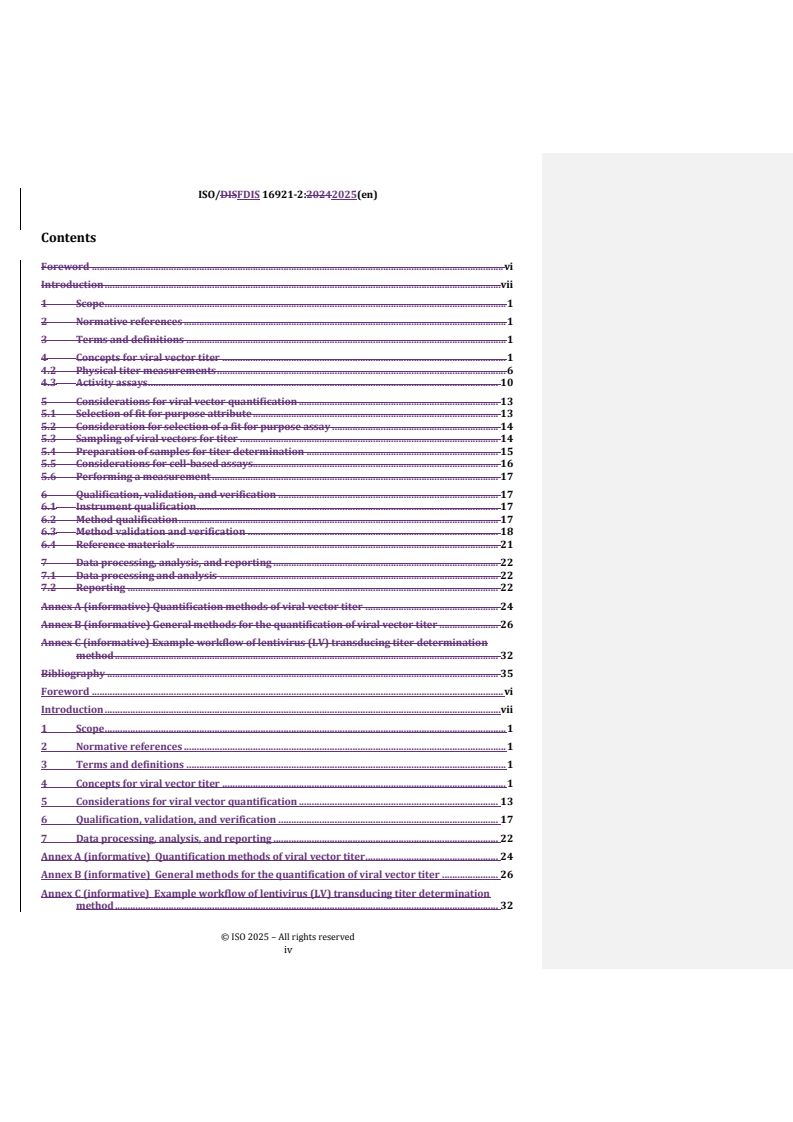
Contents
Foreword . vi
Introduction .vii
1 Scope . 1
2 Normative references . 1
3 Terms and definitions . 1
4 Concepts for viral vector titer . 1
4.2 Physical titer measurements . 6
4.3 Activity assays . 10
5 Considerations for viral vector quantification . 13
5.1 Selection of fit for purpose attribute . 13
5.2 Consideration for selection of a fit for purpose assay . 14
5.3 Sampling of viral vectors for titer . 14
5.4 Preparation of samples for titer determination . 15
5.5 Considerations for cell-based assays. 16
5.6 Performing a measurement . 17
6 Qualification, validation, and verification . 17
6.1 Instrument qualification . 17
6.2 Method qualification . 17
6.3 Method validation and verification . 18
6.4 Reference materials . 21
7 Data processing, analysis, and reporting . 22
7.1 Data processing and analysis . 22
7.2 Reporting . 22
Annex A (informative) Quantification methods of viral vector titer . 24
Annex B (informative) General methods for the quantification of viral vector titer . 26
Annex C (informative) Example workflow of lentivirus (LV) transducing titer determination
method . 32
Bibliography . 35
Foreword . vi
Introduction .vii
1 Scope . 1
2 Normative references . 1
3 Terms and definitions . 1
4 Concepts for viral vector titer . 1
5 Considerations for viral vector quantification . 13
6 Qualification, validation, and verification . 17
7 Data processing, analysis, and reporting . 22
Annex A (informative) Quantification methods of viral vector titer . 24
Annex B (informative) General methods for the quantification of viral vector titer . 26
Annex C (informative) Example workflow of lentivirus (LV) transducing titer determination
method . 32
iv
ISO/DISFDIS 16921-2:20242025(en)
Bibliography . 35
v
ISO/DISFDIS 16921-2:20242025(en)
Foreword
ISO (the International Organization for Standardization) is a worldwide federation of national standards
bodies (ISO member bodies). The work of preparing International Standards is normally carried out through
ISO technical committees. Each member body interested in a subject for which a technical committee has been
established has the right to be represented on that committee. International organizations, governmental and
non-governmental, in liaison with ISO, also take part in the work. ISO collaborates closely with the
International Electrotechnical Commission (IEC) on all matters of electrotechnical standardization.
The procedures used to develop this document and those intended for its further maintenance are described
in the ISO/IEC Directives, Part 1. In particular, the different approval criteria needed for the different types of
ISO document should be noted. This document was drafted in accordance with the editorial rules of the
ISO/IEC Directives, Part 2 (see www.iso.org/directives).
ISO draws attention to the possibility that the implementation of this document may involve the use of (a)
patent(s). ISO takes no position concerning the evidence, validity or applicability of any claimed patent rights
in respect thereof. As of the date of publication of this document, ISO had not received notice of (a) patent(s)
which may be required to implement this document. However, implementers are cautioned that this may not
represent the latest information, which may be obtained from the patent database available at
www.iso.org/patents.www.iso.org/patents. ISO shall not be held responsible for identifying any or all such
patent rights.
Any trade name used in this document is information given for the convenience of users and does not
constitute an endorsement.
For an explanation of the voluntary nature of standards, the meaning of ISO specific terms and expressions
related to conformity assessment, as well as information about ISO's adherence to the World Trade
Organization (WTO) principles in the Technical Barriers to Trade (TBT), see www.iso.org/iso/foreword.html.
Field Code Changed
This document was prepared by Technical Committee ISO/TC 276, Biotechnology, Subcommittee SC 1,
Analytical methods.
A list of all parts in the ISO 16921 series can be found on the ISO website.
Any feedback or questions on this document should be directed to the user’s national standards body. A
complete listing of these bodies can be found at www.iso.org/members.html.
Field Code Changed
vi
ISO/DISFDIS 16921-2:20242025(en)
Introduction
Modern and emerging biotechnology is underpinned byrelies on the ability to manipulate the genes and
genomes ofin living systems. Gene delivery systems are foundational to genome engineering. Gene delivery
technology is evolving rapidly with numerous types of gene delivery systems providing a comprehensive set
of tools and capabilities for in vitro or in vivo targeted delivery.
The ISO 16921 series consists of multiple parts to provide common understanding, guides, analytical methods
and, data reporting for characterizing these emerging biotechnology tools. ISO 16921-1 of the series specifies
Vocabulary related to gene delivery systems. This document (ISO 16921-2) focuses on quantification of one
type of gene delivery system, viral vectors.
Viral vectors are engineered viruses for delivering the desired genetic payload into target cells. Viral vectors
are powerful molecular biology tools and have been increasingly used in broad biotechnology applications
and products. Various types of viral vectors are used as advanced gene therapies, as vaccines, and as critical
reagents for cellular therapies. They have also been increasingly used in genome editing applications. Viral
vector titer (titre) is central to all applications. Robust measurements for the quantification and reporting of
viral vector titer are important for the industry. This document provides general guidance for viral vector titer
as well as aspects of functional analysis including method selection, sample preparation, measurement,
qualification and validation, data analysis and reporting.
vii
ISO/DISFDIS 16921-2:20242025(en)
Biotechnology — Gene delivery systems —
Part 2:
Quantification methods for viral vectors
1 Scope
This document specifies minimum requirements for quantifying viral vectors in terms of physical titer and
their associated activity. This document specifies key considerations for quantification methods for viral
vector titer as well as activity, including method selection, measurement process, data analysis, and reporting.
2 Normative references
The following documents are referred to in the text in such a way that some or all of their content constitutes
requirements of this document. For dated references, only the edition cited applies. For undated references,
the latest edition of the referenced document (including any amendments) applies.
ISO 16921-1, Biotechnology — Gene Delivery Systems — Part 1: Vocabulary
ISO 20395, Biotechnology — Requirements for evaluating the performance of quantification methods for nucleic
acid target sequences — qPCR and dPCR
3 Terms and definitions
For the purposes of this document, the terms and definitions given in ISO 16921-1 and the following apply.
ISO and IEC maintain terminology databases for use in standardization at the following addresses:
— — ISO Online browsing platform: available at https://www.iso.org/obphttps://www.iso.org/obp
— — IEC Electropedia: available at https://www.electropedia.org/https://www.electropedia.org/
3.1
direct particle counting
counting method in which one signal is (or several signals are) detected for each single event
Note 1 to entry: Each single event represents a single viral particle in an idealized measurement
3.2
indirect particle counting
counting method during which a signal (or a set of signals) is measured from a population of viral particles
and that signal is then related to viral titer based on a measurement-specific mathematical model (e.g.
calibration curve)
4 Concepts for viral vector titer
4.1 General viral vector concepts
Viral vectors are genetically engineered viruses designed to deliver nucleic acid into a cell. As such, viral
vectors are almost always replication incompetent, so that no new viral vectors can be produced within the
target cell.
ISO/DISFDIS 16921-2:20242025(en)
NOTE 1 Viral vectors can be made to be replication competent in the presence of a helper virus or complementary
replicative genes in a cell.
NOTE 2 Replication competent viral vectors are generally not used in therapeuticaltherapeutic applications due to
safety concerns.
A functional viral vector generally consists of three components:
— the protein capsid with or without the envelope that encapsulates the payload, and defines the vector’s
tissue or cell tropism and antigen recognition;
— the gene of interest, which when expressed in cells, serves to confer a desired functional outcome; and
— the regulatory components including the combined enhancer, promoter, and auxiliary elements that
control stable or transient somatic expression of the transgene as an episome or as a chromosomal
integrant.
NOTE 3 Some viral vectors designs do not precisely follow the transgene and regulatory cassette descriptions stated
above. Examples include those utilizing micro RNAs, guide RNAs, multiple transgenes/promoters, and dual vectors
(which utilize in vivo splicing).
The process to engineer and manufacture viral vectors is complex and evolving. Current technologies
generally produce a mixture of functional viral vectors that can deliver the appropriate payload into the target
cells as well as non-functional viral vectors and free capsid proteins (Figure 1).0). Other potential impurities
in the viral vector mixture include free DNA from the host cell or residual plasmid components, all of which
may be encapsulated as well.
Key
1 functional particles
2 nonfunctional particles (empty and immature particles)
3 free capsid proteins
ISO/DISFDIS 16921-2:20242025(en)
Figure 1 — Products from viral vector production that include functional particles, nonfunctional
particles, and free capsid protein. Adapted from “Understanding viral titration- behind the
[1] ]
science” .0 .
Non-functional viral vector particles do not have all the necessary components to complete the transduction
process, express the intended protein, and result in the functional outcome. Non-functional viral vector
particles include various types of defects, including for example:
— vectors with defective capsids that maycan affect its tissue or cell tropism and antigen recognition,
— vectors that contain missing or defective payloads,
— vectors that contain missing or defective regulatory components.
Viral vectors are characterized according to critical quality attributes, such as quantity, potency, safety, and
identity. This document focuses on quantity. General methods for a) quantification of physical titer of viral
vectors and b) functional characterization of viral vectors using cell-based measurements are shown in figure
2.0.
ISO/DISFDIS 16921-2:20242025(en)
ISO/DISFDIS 16921-2:20242025(en)
a
Additional potency assays for titer quantification are often specific to the product and mechanism of action and is beyond the
scope of this document.
Key
a
Additional potency assays for titer quantification are often specific to the product and mechanism of action
and is beyond the scope of this document
Figure 2 — Analytical methods for quantification of viral vectors based on physical methods or their
interactions with cells. This figure of quantification methods is not exhaustive and can be further
developed.
Physical titer of viral vectors refers to the particle count, which is determined by direct particle counting or
indirect particle counting methods.
Direct particle counting involves the recording of a signal or a set of signals from individual viral particles
(3.1Error! Reference source not found.). Direct particle counting requires well-dispersed particles for
optimal performance. The presence of debris and aggregated or agglomerated particle maycan lead to over-
or underestimated virus titer. Whenever possible, a process should be established to prepare well- dispersed
samples with minimized debris, aggregate, and agglomerate content.
Indirect particle counting (3.2)Error! Reference source not found.) methods use a surrogate measure to
evaluate the count. The accuracy of these methods depends on the accuracy of the measurement and the
accuracy of a calibration curve, if a calibration curve is needed. Indirect particle counting methods include:
— the use of a calibration to estimate a count (e.g. fluorescence, qPCR, ELISA, or another method to back
calculate count using a calibration curve);
— the measuring a component of the particle to infer the count (e.g. quantifying the total capsid protein
concentration to estimate particle count).
Activity methods are used to measure the interaction between viral vector particles and target cells. Activity
measures determine the concentration of functional particles in a viral vector preparation. Activity
measurements can be further divided into transduction and other potency measures to gain insight into
general transduction activity and product specific potency.
Transduction assays measure viral vector transgene entry into target cells for non-replication competent viral
systems. Vector copy number per cell or transduction efficiency can be measured in the target cells. A dilution
series of virus to cells is generally used to specify at which dilutions the multiplicity of infection to transduction
efficiency is linear. The transduction units in the original virus preparation can be determined from the
specified range of the dilution series.
Infectivity assays may include a viral vector, a helper virus, and a complementary cell line that enables the
viral vector to replicate. Viral replication can result in target cells undergoing cytopathic effect. Replication
and cytopathic effect can be visualized and quantified as plaques or foci in the cells. Viral vector replication in
target cells enables quantification of virus activity and infectivity assay titer.
Potency assays measure transgene expression and transgene activity. Transduction assays can be considered
one part of potency measures which can measure transgene insertion, integration, and expression. Additional
potency measures beyond transduction and transgene expression are often production specific measures of
transgene mechanism of action. Due to the product specific nature of such assays, use of potency assays for
viral vector quantification are beyond the scope of this document.
See Table A.10 for attributes, biological properties, analytical methods, measurement principles, and units for
the quantification of viral vector titer.
ISO/DISFDIS 16921-2:20242025(en)
4.2 Physical titer measurements
4.2.1 General physical titer concepts
Physical titer refers to the total concentration of viral vectors or the concentration of a predefined, subset of
viral vectors.
Physical titer of viral vectors shall be expressed as amount per volume (1/mL).
Physical titer can be determined via several analytical methods, including direct particle counting methods
and indirect particle counting methods.
An appropriate measurement shall be selected to determine the total quantity or the quantity of a predefined,
subset of viral vectors.
Assessment of the quality of the viral vectors may involve the use of two or more titers, such as filled to empty
ratio.
See Annex B.1.1See Annex B.2.1 for additional physical titer methods.
4.2.2 Direct viral vector titer measurement
Direct viral vector titer methods identify and enumerate single particles. Direct viral vector titer can be used
for total viral vector enumeration or enumeration of particles of a specific predefined attribute.
Direct viral vector titer measurements can include electron microscopy-based counting, flow virometry,
resistive pulse sensing, nanoparticle tracking analysis, and other methods capable of capturing single entities
(i.e., viral vector particles).
Results of direct particle counting methods shall be reported in terms of particles/mL or specified units of
volume.
Due to sample heterogeneity, direct viral vector counting methods maycan inadvertently count impurities,
such as extracellular vesicles, as viral vectors. Counting methods targeting only the viral vectors within a
sample may therefore be more appropriate. Combining methods specific for impurities, such as flow
cytometry that targets extracellular vesicles, can also be used to correct direct particle count measurements
to be more accurate for viral particles.
4.2.3 Indirect viral vector titer measurement
4.2.3.1 General indirect viral vector titer concepts
Indirect viral vector titer measurements include all methods to extrapolate the viral vector quantity not
associated with enumeration.
Indirect methods generally involve the use of a calibration curve to determine quantity. These include
methods that quantify a defined attribute of the viral vector, such as capsid protein quantification and genome
quantification methods.
4.2.3.2 Capsid titer quantification
Capsid titer or capsid concentration is a measurement of protein quantification used to characterize viral
vectors. An example of a method used to determine capsid titer is the enzyme-linked immunosorbent assay
(ELISA). Other example methods for capsid titer can be found in Table A.1.0. ELISA capsid protein
measurements reported as virus particles/mL is ambiguous to what the actual measurand is. Capsid titer shall
be reported as capsids/mL. The specific capsid protein (e.g. p24 for lentivirus) being targeted shall be included
ISO/DISFDIS 16921-2:20242025(en)
in the measurement reporting. The method of determining the capsids/mL and associated calculations shall
be documented. A standard curve shall be included for capsid titer determination using a well characterized
and known concentration of the target protein.
NOTE 1 Capsid protein measurements measure free soluble capsid protein and encapsulated capsid protein as a
quality measure of a viral vector preparation.
NOTE 2 ELISA measurements report absorbance values for the samples being measured. Depending on the viral
vector, the absorbance values can be converted to mass and then to capsids/mL, or directly from absorbance values to
capsids/mL.
The calculations to perform these conversions are based on literature assumptions and should be considered
when evaluating the accuracy for capsid quantification. For example, p24 capsid quantification by ELISA relies
[2][ ]
on the assumption that there are approximately 2000 2 000 molecules of p24 per lentivirus particle. 0 . The
accuracy of this estimate affects the calculated capsid titer.
4.2.3.3 Genome titer quantification
4.2.3.3.1 General genome titer quantification
Indirect physical titer methods for genome titer include absorbance, fluorescence, and qPCR/dPCR.
4.2.3.3.2 Absorbance
Absorbance can be used to measure total nucleic acid content of the viral vector. Absorbance at OD260 nm
represents all nucleic acids species present in a sample (DNA, RNA, free nucleotides). Absorbance
measurements are calculated as nucleic acid concentration and shall be reported as ng/µL or µg/mL. The
vector genome concentration can be determined from absorbance, the molecular mass of the viral vector, and
the extinction coefficient as vector genome (vg)/mL.
Nucleic acid quantification using absorbance is impacted by impurities in the sample, such as proteins, and
shall be considered when interpreting results (ISO 20395:2019, 5.2). In some cases, viral particles are lysed
using a detergent, such as SDS, to denature proteins and release viral nucleic acid to allow for nucleic acid
quantification. The absorbance of viral vectors at OD260 nm depends on the molecular mass of the vector
[3][ ]
DNA and the amount of capsid protein. 0 .
Acceptable purity for applying absorbance measurement can be assessed by inspecting the ratios of
absorbance at different wavelengths that are altered by common contaminants. The purity of a particular viral
vector preparation, such as AAV and AdV, can be determined based on the OD 260/280 nm ratio which
accounts for the nucleic acid and the capsid protein content. These ratios can provide insight into the quality
of the viral vector preparation.
NOTE It is possible that the OD 260/280 nm ratio is not appropriate for certain viral vectors, such as LVV. In
addition, OD measurements can vary due to other factors such as pH and ionic strength.
4.2.3.3.3 Fluorescence
Similar to absorbance, fluorescence can be used to measure nucleic acid content of viral vectors. For the
nucleic acid content to be quantified, fluorescent stains may be used.
[4,5] [ , ]
NOTE 1 Common nucleic acid fluorescent stains include PicoGreen or GelGreen. . 0 0
A standard curve shall be used for fluorescent assays using a calibrant nucleic acid material. Examples of
calibrants include plasmid DNA, genomic nucleic acid, and fragmented nucleic acid. The type of calibrant used
(e.g. single-stranded DNA or double-stranded DNA) shall be taken into consideration based on the viral vector
being analyzed.
ISO/DISFDIS 16921-2:20242025(en)
Using a standard curve, fluorescent units are converted to nucleic acid concentration and shall be reported as
ng/µL or µg/mL. Nucleic acid concentration can then be converted to vector genome concentration as vg/mL
based on the molecular mass of the viral vector.
NOTE 2 The accuracy of the conversion from nucleic acid concentration to vector genome concentration depends on
the sample purity.
4.2.3.3.4 Quantitative PCR (qPCR) and Digital PCR (dPCR) Methods
For viral vector titer determination, genome counting methods (i.e., dPCR) do not directly enumerate virus
particles but rather targeted nucleic acid content and therefore is considered an indirect physical titer method.
ISO 20395 shall be referred to for information on qPCR and dPCR quality control, methodologies, and minimal
information needed for reporting.
Specific primers that target a known sequence in the viral vector shall be optimized and tested for optimal
parameters, including concentration, annealing temperature, and cycling parameters. A probe can be used to
complement the primers to enhance the specificity of the assay. Reverse transcription-PCR (RT-PCR) is
needed to convert RNA to cDNA for quantitation of RNA samples. The efficiency of the reverse transcriptase
reaction shall be determined.
For qPCR, a calibration or standard curve of known concentration or copies of DNA shall be used to obtain
DNA quantitation for an unknown sample. The efficiency of the PCR assay shall be determined based on the
data from the standard curve and unknown samples. The DNA standard curve should match the unknown
sample in terms of conformation and structure to not bias PCR efficiency between standard and sample. PCR
efficiency is impacted by supercoiled or linear states and proximity of the amplicon to hairpins and other
secondary structure in the DNA. Plasmids shall be linearized prior to performing qPCR.
When using purified DNA, e.g. plasmid as a standard, the number of target copies in the plasmid shall be taken
into account when quantifying the target copy number in the genomic DNA (e.g. ratio of the number of ITR
sequences per linearized plasmid versus number of ITR sequences in the genomic DNA).
NOTE 1 Indirect titer measurements assume the sample to be free of any impurities or obstacles that interfere with
the intended measurement purpose. PCR efficiency is affected by inhibitors in the sample and nucleic acid configuration.
Samples shall be assessed for PCR inhibitors by performing a dilution series and looking for quantitation
across the dilutions.
Digital PCR partitions the PCR reaction into nanolitre sized reactions (generally in droplets or chambers) and
uses Poisson statistics to determine concentration. Absolute quantitation of amplifiable nucleic acid in a
sample can be performed using dPCR without a standard curve.
For dPCR assays involving intact viral vectors without the need for nucleic acid extraction, aggregation, buffer
selection, capsid lysis, and enzyme treatment shall be considered when designing dPCR methods for accurate
[6,7][ , ]
absolute quantitation. 0 0 .
For dPCR assays where nucleic acid extraction is needed, extraction efficiency shall be determined with
[6,8][ , ]
appropriate controls. 0 0 .
Results from qPCR and dPCR genome titer methods shall be reported as copies/mL and shall include the name
of the target and the associated sequence. The results of copies/mL can be converted to vector genomes/mL
and the method used shall be reported. The sample to be measured shall fall within the concentration range
of the standard curve for qPCR.
NOTE 2 PCR-based genomic titer measurements detect a specific target sequence determined by primers and probes
selected. The sequence is generally ~100 to 150 base pairs long. PCR-based genomic titer measures target copies and
ISO/DISFDIS 16921-2:20242025(en)
does not measure the entire genome. Multiplexed PCR targeting of multiple target sequences can enable more
quantitative measures of vector genome copies and genomic integrity.
Other units that can be used for genome titer include vector genomes (vg)/mL, genome copies (gc)/mL, and
DNAse-resistant particles (DRP)/mL. For accuracy and to enable comparability, the conversion from
copies/mL to these other units shall be reported.
Proper controls shall be included in each assay to assess the quality of the assay. Positive controls, such as a
reference material with a known concentration if available, shall be included to generate a standard curve in
qPCR and be used in dPCR to ensure the primers, probes, and other reagents are working properly. Negative
controls shall be included to ensure PCR reagents are not contaminated with the test material or other
unwanted reagents. Additional negative controls shall be included for each nucleic acid target for all qPCR and
dPCR assays. Examples of negative controls include PCR grade water or appropriate buffer in place of the test
material. Negative controls shall remain negative for the presence of the target nucleic acid.
[9] ] [10,11] , ]
Minimum information requirements documented in the MIQE guidelines for qPCR 0 and dPCR 0 0 shall
[12] [ ]
be reported according to data formatting guidelines. 0 .
NOTE 3 There can be commercial kits and reagents that contain proprietary information which can result in some
information not being able to be included in the reporting guidelines listed in the MIQE.
4.2.4 Physical titer assay matrix
A matrix of assays should be considered when determining viral vector titer. A matrix of assays can be used
to infer purity attributes in the population.
The ratio of genomic titer to capsid titer can be used to infer the presence of empty and full particle
populations. This can be determined from the ratio of genomic PCR to capsid ELISA measurements, but also
the ratio of absorbance at 260 nm to 280 nm.
Additionally, the ratio of the capsid titer and total particle count can be used to infer presence of free capsid
particles in solution.
Measurement of free nucleic acid in solution and encapsulated nucleic acid contained within viral particles as
measured by fluorescence can be used to measure the encapsulation ratio of a preparation.
Counts for full and empty particles using electron microscopy and mass photometry can determine the capsid
content ratio.
Methods such as analytical ultracentrifugation and charge detection mass spectrometry can characterize the
percentage of empty, partial, and full viral vectors in a preparation but do not provide a titer and may require
an additional method to determine total particles and quantify the titer of the subpopulations.
Such measurements of purity attributes can be used to measure changes in viral vector quality through
production and downstream processing to quantify product and process related impurities. Large
discrepancies between assays can suggest the presence of impurities and biases in results.
Viral vector heterogeneity including full, partial, and empty particles (Figure 10) can impact purity and
agreement of physical titer measurements. Partially filled particles with partial genomes might not be
detected by genomic titer tests. Full particles contaminated by host cell DNA (detected using a separate assay)
are not detected by genomic titer tests but would be included in the capsid titer. Capsid titer measurement
would differ from total particle count if the capsid assay cannot distinguish between assembled and
unassembled capsid proteins.
The physical titer measurements are biased for measuring different attributes. Genome titer methods measure
viral vectors containing the full target sequence whereas the capsid titer measurements measure protein
ISO/DISFDIS 16921-2:20242025(en)
content. In a sample of 100 % full particles without any impurities, genome titer and capsid titer
measurements maycan have high agreement. However, in samples with impurities, such as soluble capsid
protein or partial filled particles, there maycan be low correlation and agreement. The measurement bias of
these different methods should be considered when characterizing the viral vector. Selection of assay
measurands and implications of measurands in the context of a process pipeline should be considered.
4.3 Activity assays
4.3.1 General activity assay concepts
Assays to determine the activity of viral vectors provide a measure of the concentration of viral vector
particles that can transduce cells and/or induce the desired function or phenotypic change.
Assays for activity of viral vectors involve the use of cells. This can include in vitro and in vivo assays such as
PCR, in vivo fluorescence, and immunohistology staining. Results for viral activity assays are cell line and
protocol dependent. The measured activity can be different for the sample tested on the same cells if a
different protocol is used. Additionally, protocol considerations such as inoculum volume and resulting
[13] ]
diffusion distance between viruses and cells can affect the reproducibility of viral activity assay results .0 .
The timing of an activity assay is application specific and shall be recorded along with other pertinent assay
protocol details. Experimental metadata shall be documented. Metadata should include information such as
cell passage number, media components, reagent lot numbers, and expiration dates.
Reagents shall be qualified for use in activity assays (including cells) for identity, the presence of adventitious
agents, expiration dates, etc. as these maycan affect many aspects of the assay including reproducibility (see
5.55.5).
Reported viral vector activity titer shall be derived in the assay’s specified range. The specified range can be
determined using a dilution series of virus to cells where identified dilutions demonstrate a linear response.
Refer to 5.55.5 for activity assay cell qualification and controls. See Annex B.1.3See Annex B.3 for activity assay
readout methods and Figure B.10 for example usage in a lentivirus activity assay.
4.3.2 Assay for transduction
4.3.2.1 General concepts for transduction assays
Transduction assays measure the concentration of viral vectors capable of delivering a transgene in a viral
vector preparation through a cell-based assay. Virus transduction assays are used to assess activity for non-
replication competent viral vectors, such as recombinant lentivirus and adeno-associated virus. Target cells
can be assessed for transgene expression using flow cytometry, qPCR or dPCR, and microscopy methods.
The assays involve taking viral vectors containing a transgene and exposing target cells to the viral vector. A
dilution series of virus to cells is generally used to specify at which dilutions the multiplicity of infection to the
measure of transgene expression is linear. The transduction units in the original virus preparation can be
determined from the specified range of the dilution series. Assuming a single virus particle delivers a
transgene to a cell, the number of cells expressing the transgene is used to determine the number of virus
particles in a virus preparation.
4.3.2.2 PCR methods
Quantitative PCR and dPCR can be used to measure transgene expression in the target cell. In the case of
lentivirus or other genome integrating viruses, measurement of the transgene copies per cell is known as
vector copy number (VCN). Using a dilution series experiment of known volumes of virus to vector copy
number per cell, one can determine the transduction units in the original viral vector preparation.
ISO/DISFDIS 16921-2:20242025(en)
ISO 20395 shall be referenced for extensive information on qPCR and dPCR quality control and methodologies.
The resulting measure of transduction shall be reported as transducing units (TU)/mL as determined by
copies/mL for a particular target. The target shall be specific to a sequence on the product transgene or be
specific to a regulatory element of the viral vector. The method, target, primers, and probes used shall be
[9] ]
reported. Minimum information requirements documented in the MIQE guidelines for qPCR 0 and
[10,11] , ] [12][ ]
dPCR 0 0 shall be reported according to data formatting guidelines. 0 .
For additional details regarding controls and calibration, see 4.2.3.4.3.4.2.3.4.3.
4.3.2.3 Flow cytometry methods
Flow cytometry is a measurement procedure which involves using a flow cytometer instrument to quantify
viral vector transduction in cells. Expression of a transgene protein can be quantified using a fluorescently
tagged antibody against the transgene protein. Additionally, a reporter protein (e.g. fluorescence reporter)
can be expressed simultaneously with the transgene to report expression of the transgene.
Measurement of transduction at the population level shall be determined as percent transduction efficiency.
In an experiment using a dilution series of virus to target cells, the percent transduction efficiency can be used
to determine the number of transducing units in the viral vector preparation.
Transduction assay results using flow cytometry shall be reported as transducing units (TU)/mL. The method,
target and antibody used to measure transduction by flow cytometry shall be reported. Minimum information
requirements for flow cytometry measurements should follow MIFlowCyt and data formatting
[12,14][ , ]
guidelines. 0 0 . Experimental metadata shall be documented. The metadata should include the cell line,
media components, any drug selection information, and cell passage number at the time of the assay.
4.3.2.4 Microscopy methods
Similar to flow cytometry, microscopy approaches can be used to perform automated imaging and image
analysis of virus transduced cells. This includes identification of the transgene expression by a fluorescence
reporter or antibody staining for the transgene protein. Individual cells or cell area can be enumerated to
determine the total number of cells. The ratio of the fluorescently stained cells to the total number of cells can
determine the percentage of transduced cells in the total population.
Measurement of transduction at the population level shall be determined as percent transduction efficiency.
The percent transduction efficiency can be used to determine the number of transducing units in the viral
vector preparation. These experiments often involve the use of a dilution series of virus to target cells to give
higher confidence in the determined transducing titer.
Transduction assay results using microscopy shall be reported as transducing units (TU)/mL. If using
[12] [ ]
automated microscopy, reporting should follow data formatting guidelines . 0 The method, target and
antibody used to measure transduction by microscopy shall be reported. Experimental metadata shall be
documented. Metadata should include the cell line, media components, any drug selection information, and
cell passage number at the time of the assay.
4.3.2.5 Colony forming assay
A specific type of transduction assay utilizing microscopy is the colony forming assay. In cases where the viral
vector transgene contains an antibiotic resistance marker, a cell-based colony formation assay can be used to
quantify transduction.
A monolayer of target cells is prepared and then exposed to viral vector to allow for viral vector transduction.
Following transduction, the target cells are challenged with exposure to antibiotics. Cells not transduced by
the viral vector will die from antibiotic exposure. Cells successfully transduced by the viral vector with the
ISO/DISFDIS 16921-2:20242025(en)
antibiotic selection marker will survive and continue to proliferate as a cell colony. For virus transduction
performed at a sufficiently low dilution where each cell colony is formed by a single antibiotic resistant cell,
microscopic counting of colonies can be used to determine colony forming units.
The colony forming units can be used to determine the transducing units in the viral vector preparation. The
dilutions used in the assay shall enable quantification of individual colonies. Multiple dilutions with coun
...
Questions, Comments and Discussion
Ask us and Technical Secretary will try to provide an answer. You can facilitate discussion about the standard in here.
Loading comments...