


ISO 18944:2012
(Main)Imaging materials — Reflection colour photographic prints — Test print construction and measurement
Imaging materials — Reflection colour photographic prints — Test print construction and measurement
Matériaux pour l'image — Réflexion des impressions photographiques en couleurs — Mesurage et construction d'une impression d'essai
General Information
- Status
- Withdrawn
- Publication Date
- 12-Apr-2012
- Withdrawal Date
- 12-Apr-2012
- Technical Committee
- ISO/TC 42 - Photography
- Current Stage
- 9599 - Withdrawal of International Standard
- Start Date
- 30-May-2014
- Completion Date
- 12-Feb-2026
Relations
- Effective Date
- 17-Nov-2012

Frequently Asked Questions
ISO 18944:2012 is a standard published by the International Organization for Standardization (ISO). Its full title is "Imaging materials — Reflection colour photographic prints — Test print construction and measurement". This standard covers: Imaging materials — Reflection colour photographic prints — Test print construction and measurement
Imaging materials — Reflection colour photographic prints — Test print construction and measurement
ISO 18944:2012 is classified under the following ICS (International Classification for Standards) categories: 37.040.20 - Photographic paper, films and plates. Cartridges. The ICS classification helps identify the subject area and facilitates finding related standards.
ISO 18944:2012 has the following relationships with other standards: It is inter standard links to ISO 18944:2014. Understanding these relationships helps ensure you are using the most current and applicable version of the standard.
ISO 18944:2012 is available in PDF format for immediate download after purchase. The document can be added to your cart and obtained through the secure checkout process. Digital delivery ensures instant access to the complete standard document.
Standards Content (Sample)
INTERNATIONAL ISO
STANDARD 18944
First edition
2012-04-15
Imaging materials — Reflection colour
photographic prints — Test print
construction and measurement
Matériaux pour l’image — Réflexion des impressions photographiques
en couleurs — Mesurage et construction d’une impression d’essai
Reference number
©
ISO 2012
All rights reserved. Unless otherwise specified, no part of this publication may be reproduced or utilized in any form or by any means,
electronic or mechanical, including photocopying and microfilm, without permission in writing from either ISO at the address below or ISO’s
member body in the country of the requester.
ISO copyright office
Case postale 56 • CH-1211 Geneva 20
Tel. + 41 22 749 01 11
Fax + 41 22 749 09 47
E-mail copyright@iso.org
Web www.iso.org
Published in Switzerland
ii © ISO 2012 – All rights reserved
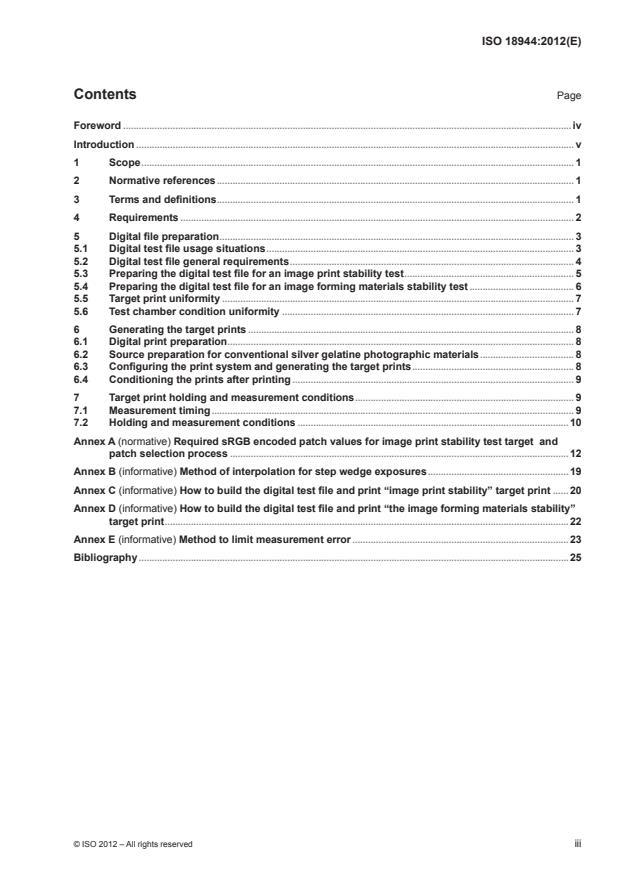
Contents Page
Foreword .iv
Introduction . v
1 Scope . 1
2 Normative references . 1
3 Terms and definitions . 1
4 Requirements . 2
5 Digital file preparation . 3
5.1 Digital test file usage situations . 3
5.2 Digital test file general requirements . 4
5.3 Preparing the digital test file for an image print stability test . 5
5.4 Preparing the digital test file for an image forming materials stability test . 6
5.5 Target print uniformity . 7
5.6 Test chamber condition uniformity . 7
6 Generating the target prints . 8
6.1 Digital print preparation . 8
6.2 Source preparation for conventional silver gelatine photographic materials . 8
6.3 Configuring the print system and generating the target prints . 8
6.4 Conditioning the prints after printing . 9
7 Target print holding and measurement conditions . 9
7.1 Measurement timing . 9
7.2 Holding and measurement conditions .10
Annex A (normative) Required sRGB encoded patch values for image print stability test target and
patch selection process .12
Annex B (informative) Method of interpolation for step wedge exposures .19
Annex C (informative) How to build the digital test file and print “image print stability” target print .20
Annex D (informative) How to build the digital test file and print “the image forming materials stability”
target print .22
Annex E (informative) Method to limit measurement error .23
Bibliography .25
Foreword
ISO (the International Organization for Standardization) is a worldwide federation of national standards bodies
(ISO member bodies). The work of preparing International Standards is normally carried out through ISO
technical committees. Each member body interested in a subject for which a technical committee has been
established has the right to be represented on that committee. International organizations, governmental and
non-governmental, in liaison with ISO, also take part in the work. ISO collaborates closely with the International
Electrotechnical Commission (IEC) on all matters of electrotechnical standardization.
International Standards are drafted in accordance with the rules given in the ISO/IEC Directives, Part 2.
The main task of technical committees is to prepare International Standards. Draft International Standards
adopted by the technical committees are circulated to the member bodies for voting. Publication as an
International Standard requires approval by at least 75 % of the member bodies casting a vote.
Attention is drawn to the possibility that some of the elements of this document may be the subject of patent
rights. ISO shall not be held responsible for identifying any or all such patent rights.
ISO 18944 was prepared by Technical Committee ISO/TC 42, Photography.
iv © ISO 2012 – All rights reserved
Introduction
This International Standard is one of a series of International Standards prepared by ISO/TC 42 on the physical
properties, stability and permanence of imaging materials.
This International Standard provides constraints on factors pertaining to target print preparation and resulting
target print measurement which can cause a confounding test-process-induced variation in measured colour
values and densities.
The requirements in this International Standard are intended to be used with test methods that produce test
data to be shared publicly, with the aim that test results can be duplicated in an alternate test facility.
Topics addressed include:
— description of test types (image print stability testing versus image forming materials testing);
— digital file preparation;
— digital test file usage;
— addressing target print uniformity;
— managing test equipment non-uniformity;
— print system configuration and control;
— test print conditioning;
— measurement timing and measurement conditions;
— required sRGB encoded patch set for image print stability test target and the corresponding patch
selection process;
— informative guidance for test file construction and use;
— informative guidance on statistical approaches to minimize measurement error.
INTERNATIONAL STANDARD ISO 18944:2012(E)
Imaging materials — Reflection colour photographic prints —
Test print construction and measurement
IMPORTANT — The electronic file of this International Standard contains colours which are considered
to be useful for the correct understanding of this International Standard. Users should therefore
consider printing with a colour printer.
1 Scope
This International Standard specifies requirements and recommendations for the digital test file content,
number of print replicates, printer setups and printing procedures that are used to generate target prints for test
method standards and specifications for image stability in the context of reflection colour photographic prints.
2 Normative references
The following referenced documents are indispensable for the application of this document. For dated
references, only the edition cited applies. For undated references, the latest edition of the referenced document
(including any amendments) applies.
ISO 5-3, Photography and graphic technology — Density measurements — Part 3: Spectral conditions
ISO 5-4, Photography and graphic technology — Density measurements — Part 4: Geometric conditions for
reflection density
ISO 2471:2008 Paper and board — Determination of opacity (paper backing) — Diffuse reflectance method
ISO 11664-4, Colorimetry — Part 4: CIE 1976 L*a*b* Colour space
ISO 12640-3, Graphic technology — Prepress digital data exchange — Part 3: CIELAB standard colour image
data (CIELAB/SCID)
ISO 13655, Graphic technology — Spectral measurement and colorimetric computation for graphic arts images
ISO 18941, Imaging materials — Colour reflection prints — Test method for ozone gas fading stability
IEC 61966-2-1, Multimedia systems and equipment — Colour measurement and management — Part 2‑1:
Colour management — Default RGB colour space — sRGB
TIFF, Revision 6.0. Adobe Systems Incorporated 1992
http://partners.adobe.com/public/developer/en/tiff/TIFF6.pdf
3 Terms and definitions
For the purposes of this document, the following terms and definitions apply.
3.1
CMYK printer
printer configured to accept digital files with colours encoded for CMYK printer colourants and print without
further colour conversion
3.2
image forming materials stability test
test to evaluate the print stability of the component materials that comprise image prints, intended for
manufacturers who are designing new colourants or for customers who are specifying colourant characteristics
3.3
image print stability test
test to evaluate the print stability of images printed in end-user-typical fashion
3.4
operational control point
set point for equilibrium conditions measured at sensor location(s) in an exposure device
NOTE Adapted from ASTM G 113.
3.5
operational fluctuations
positive and negative deviations from the setting of the sensor at the operational control set point during
equilibrium conditions in a laboratory-accelerated weathering device
NOTE 1 The operational fluctuations are the result of unavoidable machine variables and do not include measurement
uncertainty. The operational fluctuations apply only at the location of the control sensor and do not imply uniformity of
conditions throughout the test chamber.
NOTE 2 Adapted from ASTM G 113.
3.6
operational uniformity
range around the operational control point for measured parameters within the intended exposure area within
the limits of intended operational range
NOTE 1 Operational uniformity evaluates the measured parameters throughout the volume of a test chamber so
that regions of the test chamber volume can be determined to comply within the required stated limits of the measured
parameter operating aim.
NOTE 2 Adapted from ASTM G 113.
3.7
RGB printer
printer configured to accept digital files with RGB printer-independent encoded colours and apply a conversion
to obtain printer colourant code values
3.8
uncertainty (of measurement)
parameter associated with the result of a measurement that characterizes the dispersion of the values that
could be reasonably attributed to the measurand
NOTE 1 The parameter may be, for example, a standard deviation (or a given multiple of it), or the half-width of an
interval having a stated confidence level. Uncertainty of measurement comprises, in general, many components. Some
of these components may be evaluated from statistical distribution of the results of series of measurements and can be
characterized by experimental standard deviations. The other components, which can also be characterized by standard
deviations, are evaluated from assumed probability distributions based on experience or other information. It is understood
that the result of the measurement is the best estimate of the value of the measurand, and that all components of uncertainty,
including those arising from systematic effects, such as components associated with corrections and reference standards,
contribute to the dispersion.
NOTE 2 Adapted from ASTM G 113.
4 Requirements
This International Standard specifies constraints on factors pertaining to target print preparation and resulting
target print measurement which can cause confounding test-process-induced variation of measured colour
values and densities. The requirements of this International Standard shall be applied in test methods that are
used to make life expectancy claims, such as time-based print lifetime claims, either comparative or absolute,
in accordance with the applicable International Standard(s) for specification of print life.
2 © ISO 2012 – All rights reserved
The requirements of this International Standard should be applied with image stability test methods when those
test methods are used to report stand-alone absolute or comparative stability of image materials with respect
to the specific failure mode of the test method standard.
In alternative test situations, when the conditions and constraints set forth in this International Standard are not
followed, then the test report of that test method result shall include a statement of each condition that differs
from the requirements of this International Standard. Caution shall be used when comparing test results for
different materials and for different target print preparation and measurement conditions. Comparisons shall
only be made when using equipment with matching specifications, under matching test conditions.
5 Digital file preparation
5.1 Digital test file usage situations
For general testing purposes, users of this International Standard are free to choose whatever target patches
and starting densities they feel are appropriate for their testing needs. Applicable International Standard(s) for
specification of print life may require the use of specific targets and starting densities.
Reference target prints should be included in every exposure test to track consistency of the test procedures,
as well as to detect unintended changes in test conditions.
NOTE 1 See ASTM G156.
The target prints of this International Standard can be used for two kinds of image stability testing:
1) a printing system test for image print stability, including substrate discolouration, or
2) a materials test for image forming materials stability (colourant stability and substrate discolouration).
The digital test file is adapted and the target prints are generated differently for these two cases. After the
digital test file is printed, when subjected to the test method standards, the target prints are treated identically.
The image print stability test assesses the stability of images printed in end-user-typical fashion. The test file
in this case is encoded in standard sRGB, as defined in IEC 61966-2-1.
NOTE 2 The sRGB colour encoding is widely used in digital photography. This is a particular RGB encoding that has
a standardized visual colour meaning for each RGB code value. The standardized colour meaning for each sRGB code
value means that “sky blue” and “grass green”, etc. are represented by certain RGB code values. Because the sRGB colour
encoding is well known, printers that print digital photographs can be configured to print sRGB encoded images. Printing
sRGB code values that have standardized colour meanings of cyan, magenta, yellow, red, green, blue and neutral will
result in target print patches that have colourant proportions similar to consumer image prints of those colours produced
through the specific print system.
Real world image print stability is a function of combinations of colourants in real images. Colourant proportion
significantly impacts the results of the stability tests. Using colourant proportions similar to those in consumer prints
for specific well defined colours improves estimation of consumer image stability. The print colourant proportions
in the image stability target print will be slightly different for different print systems, however in each case the target
print is a realistic representation of the colourant proportions in real photos printed via those printers.
Printing the primaries and secondaries and neutrals does not cover all possible kinds of inks that a printer
may contain. Testing for additional colourants is a recommended extension for both the image print and image
forming materials.
The image forming materials stability test assesses the stability of the component materials that comprise the
prints. Care is taken to isolate the materials from influences of the print system as far as is possible.
NOTE 3 This test is intended for manufacturers who are designing new inks or for customers who are specifying ink
characteristics, and require testing on individual components.
5.2 Digital test file general requirements
Print systems can be configured either to accept digital files with colours encoded for the printer colourants,
such as CMYK, or to accept digital files with colours defined using a printer-independent encoding, such as
sRGB. Printers that are configured to accept an RGB printer-independent encoding can process the conversion
from the input RGB to the printer colourant encoding in a proprietary manner. These printers can be referred
to as “RGB printers”. Printers that can be configured to accept (and print without further colour conversion)
digital files with colours encoded for CMYK printer colourants can be referred to as “CMYK printers”. The file
preparation process below describes the necessary file treatment for RGB and CMYK printers.
The digital test file of encoded colour values shall be constructed so that the target print contains areas of
uniform colour (i.e. patches) corresponding to each selected optical density (recommended 0,5; 1,0; and
1,5). The size of each square colour patch area shall be at least 2 mm greater in length and width than the
measurement instrument aperture, plus twice the measurement instrument positioning accuracy specification,
according to the following equation:
S = 2 + (2 * A) + D
where:
S is the minimum size of each square colour patch area, in millimetres;
A is the measurement instrument “measurement positioning accuracy” specified by the instrument
manufacturer, in millimetres;
D is the measurement instrument “measurement aperture diameter” specified by the instrument
manufacturer, in millimetres.
For example, with a measurement positioning accuracy of ± 0,25 mm and a measurement aperture diameter of
4,5 mm, the minimum allowed patch size = (2,0 + 0,50 + 4,5) mm, which is 7 mm . Spacing between patches
shall be adjusted to minimize degrading influence between patches during the testing and measurement
processes. The appropriate inter-patch spacing depends on the materials and the equipment used.
The digital test file shall produce target print patch areas of minimum density (i.e. paper white).
The digital test file shall produce target print patches of selected optical densities utilizing cyan, magenta,
yellow and black printer colourant primaries, and utilizing red, green and blue printer secondaries.
The digital test file shall produce target prints with individual patches having the selected optical densities within
the required “single patch” tolerance limits, or with pairs of “bracketing patches” having the selected optical
densities within the required “bracketing pair” tolerance limits, according to the requirements of Annex A. In
the case of bracketing patch pairs, the selected optical density values shall be obtained using interpolation as
described in Annex B.
The digital test file shall be created and maintained continuously in the tiff file format. No lossy image or file
compression shall be applied to the target file. The digital image file resolution shall be 600 dpi.
NOTE 1 Various lossy compression methods can result in slight changes to colour values, particularly at patch edges.
This in turn can result in additional undesirable mixing of colourants. At the time of writing of this International Standard,
the tiff file format provides the means to carry raster image content in digital files with minimal host application and
operating system dependence.
NOTE 2 The digital test file can be zipped using lossless compression to minimize file size for storage.
4 © ISO 2012 – All rights reserved
Digital test files defined in compliance with this International Standard can be designed and adapted for
1)
particular printing systems in any of the available image programs (such as Adobe Photoshop® ). Ensure that
the image resolution is 600 dpi after editing.
5.3 Preparing the digital test file for an image print stability test
5.3.1 Constructing the digital file for an image print stability test
The image print stability digital test file shall be encoded in sRGB as defined in IEC 61966-2-1 and saved in the
tiff format with the sRGB ICC profile embedded.
NOTE 1 Even though sRGB is a standard, the ICC profiles for sRGB can differ. Retaining the original sRGB ICC profile
with the file contributes to test repeatability.
For image print stability testing, the encoded colour values of the patches in the digital test file shall not be
manipulated to control the colourant proportions in the patches of the target print. Rather, the objective is to obtain
cyan, magenta, yellow, red, green, and blue coloured patches in the target print that are typical in a pleasing
pictorial image. Pure primary colourant patches and two-colourant secondary patches may or may not occur
in the print. When subjected to an image print stability test method, the measurable target print patch density
changes can be compared to image print changes that a user would experience. See Annex A and Annex C.
Colourant proportions in the image print stability target print are recognized as system-specific, dependent on
image processing, ICC profiles, halftoning, and other physical printer characteristics.
The image print stability test requires target prints with selected optical densities in:
a) neutral patches;
NOTE 2 Patches that are treated as neutral are produced from sRGB encoded patch values that equate to CIELAB
values with L* > zero, a* and b* zero, i.e. R=G=B.
b) cyan, magenta, and yellow-coloured patches;
c) red, green, and blue-coloured patches;
d) D patch (i.e. paper white) area (used to evaluate substrate discolouration).
min
NOTE 3 Additional coloured patches, e.g. black, orange, and flesh tones, can also be tested, although such test patches
are not within the scope of this International Standard.
In certain cases, the printer driver software may provide an option to assign neutral code values exclusively to
the black ink. Composite neutral black printed with cyan, magenta and yellow colourants shall be used.
5.3.2 Adapting the digital file for an image print stability test — RGB printers
The image content shall be encoded in sRGB as defined in IEC 61966-2-1. An sRGB digital test file shall be
constructed using the required sRGB patch values provided in Annex A, or a selected subset of those required
sRGB patch values. Whether used in whole or in part, the sRGB code values of the patches given in Annex A
shall not be changed prior to printing.
5.3.3 Adapting the digital file for an image print stability test — CMYK printers
The image content shall be encoded in “device CMYK” that is specific to the printer under test. The device CMYK
digital test file for the specific printer under test shall be obtained from an sRGB digital test file constructed
using the required sRGB patch values provided in Annex A, or a selected subset of those required sRGB patch
values. The CMYK encoded digital test file shall be obtained for the specific printer under test using the photo
print colour management transformation method that is appropriate for consumer users of the printer. For
1) Photoshop is the trade name of a product supplied by Adobe. This information is given for the convenience of users of
this document and does not constitute an endorsement by ISO of the product named. Equivalent products may be used if
they can be shown to lead to the same results.
example, an ICC profile provided by the printing system manufacturer and matched to the print conditions and
media of the test can be used. Whether used in whole or in part, the sRGB code values of the patches given in
Annex A shall not be changed prior to conversion to CMYK for the printer under test; and the resulting printer-
specific CMYK code values shall not be changed prior to printing.
When the image print stability of a specialized configuration of a printing system is being tested, e.g. prints
produced using a specialized configuration in a professional or commercial print environment, a customized
ICC profile may be used. Such a customized ICC profile shall be appropriate to produce end-customer quality
printing in the configuration under test. The use of any such ICC profile shall be reported in the test results.
5.4 Preparing the digital test file for an image forming materials stability test
5.4.1 Constructing the digital file for an image forming materials stability test
For digital print systems, the image forming materials stability test is used to test the stability of the component
materials that comprise digital prints. For example, one cyan dye may exhibit greater resistance to light fade
than another. When testing for primary colourant stability (e.g. C, M, Y, K colourants), it is ideal that each
colourant be printed in a pure form isolated from other colourants. Colourant interactions can produce catalytic
fading effects, whereby a primary colourant in a multi-colourant patch will fade at a different rate than would
be observed had the colourant been printed alone. Additionally for image forming materials stability tests,
secondary (mixed) colour patches (e.g. a red patch comprised of magenta and yellow colourant) are ideally
comprised of equal amounts of two respective primary colourants, as it is known that any variance in these
proportions can result in differing rates of catalytic change. In the image forming materials stability test, “test
ready” target prints shall be produced after careful manipulation of the digital test file colour code values so that
pure printer colourant primaries and correctly proportioned printer colourant secondaries are produced in the
target print for each of the selected optical densities. Evaluation of preliminary printer assessment prints, using,
for example drop count measurements and high resolution inspection, can be useful to determine the colour
code values that produce pure (or closest to pure) colourant primaries and correctly proportioned colourant
secondaries through a given system (see Annex D). Target print generation can also include such steps as
selectively removing and replacing ink cartridges or tanks, cutting and splicing the thermal donor, etc., to
achieve a desired effect in isolating specific colourants.
The image forming materials stability test requires target prints with selected optical densities in:
a) neutral patches containing equal proportions of the printer primary colourants cyan, magenta, and yellow;
b) patches containing isolated primary (pure) printer colourants (e.g. pure cyan, magenta, yellow and
black colourants);
c) patches containing isolated secondary (two equally proportioned primary colourants) printer colours (e.g.
red, green and blue colour patches, each comprised of equal proportions of two printer primary colourants).
As far as is achievable in the printing system under test, isolated C, M, Y, K colourant primaries shall be tested.
As far as is achievable in the printing system under test, secondaries of R, G, B, each comprised of equal parts
of two colourant primaries, shall be tested. The colourant proportion is required, whereas exact colour hue and
colourfulness are not. Additional primary and secondary colourant patches (e.g. red and green primaries and
their associated secondaries) can be tested as needed to address specific system capabilities, understanding
that these capabilities may or may not apply to all or any other printing systems (see Annex D).
5.4.2 Adapting the digital file for an image forming materials stability test — RGB printers
The RGB image forming materials stability digital test file shall be encoded in sRGB as defined in IEC 61966-
2-1 and saved in the tiff format with the sRGB ICC profile embedded.
NOTE Even though sRGB is a standard, the ICC profiles for sRGB can differ. Retaining the ICC profile with the file
contributes to test repeatability.
The image content shall be encoded in sRGB as defined in IEC 61966-2-1. The RGB printer case presents
challenges for the image forming materials stability test due to the lack of direct control over the printer
colourants. Adapt and evaluate the digital test file and the resulting assessment print using the print system
6 © ISO 2012 – All rights reserved
configuration that provides the most direct colour matching control. With an sRGB encoding, neutrals are
typically encoded with R=G=B equal value codes. In certain cases, the printer driver software may provide
an option to assign such neutral values to the black ink. If such a single colourant black can be obtained, then
including additional selected density patches for that case is recommended (see Annex D).
5.4.3 Adapting the digital file for an image forming materials stability test — CMYK printers
The CMYK image forming materials stability digital test file shall be encoded in device CMYK and saved in the
tiff format with the device CMYK ICC profile embedded, if available.
NOTE Take care to associate the CMYK digital test file with the printing system configuration it is tuned for, e.g. using
a coded filename, storing it with an associated metadata file.
The image content shall be encoded in “device CMYK”. The CMYK digital test file shall include patches of
minimum density (paper white), and patches planned to produce the selected optical densities using the cyan,
magenta, yellow and black printer primary colourants, from patch code values with only non-zero C, M, Y, and
K, respectively. In addition, the CMYK digital test file shall include patches planned to produce the selected
optical densities in red, green and blue secondary printer colours, from patch code values with equal M and Y
(zero C), equal C and Y (zero M), and equal C and M (zero Y), respectively. Finally, the CMYK digital test file
shall include patches planned to produce the desired optical densities in composite neutral printer colour, from
patch code values with equal C, M and Y.
5.5 Target print uniformity
Typical digital printing systems exhibit print non-uniformities (in-page and page-to-page) that can affect density
measurements. Digital printing systems also differ in the availability of printer process controls that can be used
to compensate for these non-uniformities. As a result, in a best case scenario, individual patch densities can
be predicted within some tolerance limits of a selected density value, but cannot be ensured to match exactly
to a selected density value, even when patch code values are tuned for the particular printer.
The impact of these non-uniformities and control variabilities shall be minimized through target layout design
and adaptation to the particular system under test. Replicate prints can be printed and duplicate patches can
be included within a single target print page as necessary to obtain target prints that satisfy the selected optical
density requirements. Statistical analysis of the print non-uniformity characteristics of the print system under
test should be conducted to determine the number of replicate prints and number of duplicate patches to use.
At least two replicate prints are required. Replicates shall be positioned for testing in different regions of the test
chamber volume. Refer to Annex E for guidance in determining a measurement plan to limit measurement error.
Many modern imaging systems now employ multiple density inks (i.e. light cyan and dark cyan) with the result
that such printing systems may or may not utilize the same colourant for each density. Furthermore, the light
and dark inks may be printed singularly or combined in various proportions to achieve a specified density. For
such printing systems, monitoring multiple densities throughout each colour tone scale is recommended so
that the stability of each colourant can be evaluated as they occur in various combinations. The image print
stability test is particularly applicable to evaluating such print systems.
5.6 Test chamber condition uniformity
Locally varying environmental conditions in a given test, due to patch position within a target print or due to
target holder position within a chamber, e.g. the amount of light falling on a patch in a light stability test, can
result in different OD changes in patches that are initially identical.
When noticeable effects are determined due to such locally varying conditions, it is recommended to position
the two or more replicate prints to be oriented differently in the test chamber and average the raw measurements
of each two or more duplicate patches in the replicates. The averages of the measurements of the replicas shall
be used as single measurements for the successive computations of test results.
NOTE 1 Such test chamber non-uniformity effects become noticeable when measurement differences between
replicates change after testing by an amount that is greater than the expected ± variation of the measurement instrument
when measuring identical patches.
NOTE 2 Duplicate patches are patches that were printed with the same starting code values, either in replicate prints
or in redundant print areas in one target print.
6 Generating the target prints
6.1 Digital print preparation
If the printing system under test cannot accept tiff image files for printing, convert the digital test file (designed
and saved as a tiff file) to the highest quality (e.g. least compressed) file format that the printing system
can accept just prior to printing. Ensure that the required patch size and patch spacing is maintained in the
converted printable file. Retain the original tiff format digital test file for future testing.
NOTE Lossy compressed files further degrade when they are opened and closed successively in imaging applications.
For this reason, the digital test file creation and editing process uses the uncompressed tiff image, with conversion to the
lossy compressed format only as required for printing.
6.2 Source preparation for conventional silver gelatine photographic materials
Conventional silver gelatine photographic materials can be tested using the image print stability test approach.
Exposures can be controlled to produce desired print density values. Specific proportions of colourants cannot
be directly controlled.
Sensitometrically-exposed specimens designed to achieve the selected optical densities in the target prints
shall be processed using the processing system of primary interest and in accordance with the manufacturer’s
recommendations.
Processing chemicals and procedures can have a significant effect on the dark-keeping and light-keeping
stability of conventional silver gelatine photographic materials. For example, a chromogenic colour negative
print paper processed in a “washless” or “non-plumbed” system with a stabilizer rinse bath instead of a water
wash may have stability characteristics that are different from the same colour paper processed in chemicals
requiring a final water wash or using a final water wash. Therefore, the specific processing chemicals and
procedure shall be reported, along with the name of the colour product in any reference to the test results.
Stability data obtained from a colour material processed in certain processing chemicals shall not pertain to
colour material processed in different chemicals, or using a different processing procedure. Likewise, data
obtained from colour materials that have been subjected to post-processing treatments (e.g. application of
lacquers, plastic laminates, or retouching colours) shall not pertain to colour material that has not been similarly
treated, and vice versa.
6.3 Configuring the print system and generating the target prints
When printing the image print stability target, target prints shall be produced using driver and printer settings
that are appropriate for photo printing. The printer manufacturer recommended print mode for photo printing
shall be used with each printer. When multiple print mode options are available for use with the selected photo
paper, the print mode selection used shall be included in the test report.
If the ink and substrate under test are not an OEM combination, then the closest matching media setup provided
in the driver and printer settings (e.g. “generic glossy photo paper”) shall be chosen. As appropriate in the
typical use of the printing system, ICC profiles provided by the printing system manufacturer for the test paper
and test print conditions may be used in generating image print stability target prints. In such a case using ICC
profiles, do not turn off colour management when initiating the print.
When printing the image forming materials stability target, target prints may be produced using driver and
printer settings that afford the test operator the required control over colourant proportions.
In the digital printing case, the printer manufacturer recommended resolution for photo printing shall be used with
each printer. When multiple photo print resolution options are available, the printing resolution used shall be reported.
8 © ISO 2012 – All rights reserved
If the print system requires image pre-scaling, then pre-scale the image using nearest neighbour interpolation
to the closest available printer resolution.
In accordance with the measurement plan determined during test preparation (see Annex E), necessary
replicate prints shall be printed within the closest possible time proximity.
NOTE 1 The printing system configuration should match the exact conditions that were in place when printer assessment
targets were printed, if the digital test file was adapted (patch selection in the case of an image print stability test or patch
selection and adjustment in the case of an image forming materials stability test) using a print assessment process.
Photographic material shall be printed in accordance with the manufacturer’s recommendations. Manufacturer’s
requirements regarding colourant and print media storage and pre-conditioning and print device operating
environment shall be followed.
The specific printing system configuration used to generate the target print, as far as it can be determined by
the test operator, shall be reported with the test results. The digital test file, as used to generate the digital
target prints, shall be included in the test report, and the measurement plan (e.g. single or bracketing patch
measurements, use of duplicate patch pairs, and number of replicate prints) shall be described.
Image print stability test results shall be documented with respect to the complete printing system: host system
identification and settings, printer driver version and driver settings, associated image processing software,
colour management software and settings, print engine, hardware configuration, colourant set, processing
chemistry, and media.
NOTE 2 Software imaging applications, e.g. Photoshop, provide print options concerning colour management. In such
an application, the options chosen should be the same as those used in a typical user print workflow for the printer under
test. When printing from Photoshop, colour management processing can be assigned either to the printer or to Photoshop.
If the printer ships with ICC profile(s) intended to install on the host computer for use by the host computer in preparing
a typical print job, then assign the colour management task to Photoshop and select the printer profile, from the printer
manufacturer, that is correct for the printer setup and the print media. If the printer does not ship with ICC profiles that
install on the host computer, then when printing from Photoshop assign the colour management task to the printer and use
no colour management in Photoshop.
Image forming materials stability test results shall be documented with respect to the printed components:
colourant set, specific colourant proportions in each patch, processing chemistry, and media.
6.4 Conditioning the prints after printing
Aqueous and solvent inkjet prints, and prints of any type that require curing/stabilization/dry-down shall
be conditioned for two weeks after printing, in an environment with a temperature of (23 ± 2) °C, with a
relative humidity (RH) of (50 ± 5) %. The print conditioning environment shall be ozone-free (≤2 nl/l average
concentration over any 24 hour period) for ozone-sensitive target prints, as determined in accordance with
ISO 18941. During the conditioning period the prints shall be maintained with unrestricted airflow. For example,
it has been observed that colour shifts can occur in the first few hours or days after printing in some systems,
and this conditioning period allows the system to stabilize. This conditioning requirement pertains both to
printer assessment prints used to develop a patch subset target and to the actual target prints that will be used
in image stability testing. Prints of any types that do not require curing/stabilization/dry-down shall be held for
24 hours. Measurements shall be conducted after conditioning or print hold. The required target densities shall
be assessed after conditioning.
7 Target print holding and measurement conditions
7.1 Measurement timing
After the required conditioning and before being subjected to image stability testing, the target prints are
measured to determine initial patch density values.
7.2 Holding and measurement conditions
The measurement environment and target print holding environment can influence measured densities.
Measurements and target print holding for measurement and next test phase preparation shall be conducted
in a controlled environment with no time constraint or may be conducted in a less controlled environment with
a time constraint.
NOTE 1 Target print holding environment refers to the environment in which target prints are held in between test
phases, such as before and after measurement, while the target prints are not in the active test environment.
The controlled target print holding environment with no time constraint shall meet the following set of
...
Questions, Comments and Discussion
Ask us and Technical Secretary will try to provide an answer. You can facilitate discussion about the standard in here.
Loading comments...