

ISO/IEC 10918-5:2013
(Main)Information technology — Digital compression and coding of continuous-tone still images: JPEG File Interchange Format (JFIF) — Part 5:
General Information
- Abstract
ISO/IEC 10918-5:2013 specifies the JPEG File Interchange Format (JFIF).
- Status
- Published
- Publication Date
- 25-Apr-2013
- Current Stage
- 9060 - Close of review
- Completion Date
- 04-Mar-2029
Overview
ISO/IEC 10918-5:2013 specifies the JPEG File Interchange Format (JFIF), a minimal, widely supported file format for exchanging JPEG-encoded still images. JFIF enables interoperable transfer of JPEG images that have 1 or 3 colour channels and 8 bits per channel, and supports optional embedded thumbnails for rapid browsing. The standard complements the JPEG coding rules in ISO/IEC 10918-1 / ITU‑T T.81 by defining file-level conventions needed for reliable interchange across platforms.
Key topics and technical requirements
- Mandatory JFIF APP marker: A JFIF APP0 marker segment must immediately follow the JPEG SOI (Start of Image) marker. This segment carries format metadata (version, pixel density, aspect ratio) and optional thumbnail data.
- Colour space and channel ordering: JFIF uses the YCbCr colour space (based on ITU‑R BT.601 scaling) for 3-component images; single-component images represent the Y (luminance) channel. Component order is Y, Cb, Cr.
- Thumbnails and extensions: Support for optional thumbnails (24-bit RGB or raw byte formats) and an extension APP segment identified by the "JFXX" string to carry JFIF extensions. Decoders must skip unsupported extension segments gracefully.
- RGB ↔ YCbCr conversion: The standard provides precise conversion equations (and clamping rules) between full‑scale 8‑bit RGB and YCbCr values to ensure consistent colour interpretation.
- Conformance rules: Implementations are categorized as JFIF encoders and decoders. A conforming decoder must process conforming JFIF instances without errors (except for resource exhaustion or unsupported non‑baseline JPEG features). A conforming encoder must produce files that follow the defined syntax.
- File syntax and markers: JFIF defines how application marker segments (APPn) are used, restrictions on application identifier strings, and the permitted placement of marker segments in the JPEG stream.
Applications and who uses it
- Software developers building image viewers, web browsers, photo management, or camera firmware rely on JFIF for simple, interoperable JPEG image exchange.
- Content platforms and middleware that need reliable thumbnail embedding, pixel density metadata (DPI/DPcm), or deterministic colour conversion between RGB and YCbCr.
- Tooling and libraries that implement JPEG encoding/decoding for cross‑platform interchange (where minimal, baseline compatibility is required).
Related standards
- ISO/IEC 10918-1 (JPEG requirements and guidelines / ITU‑T T.81)
- ISO/IEC 10918 (other parts: -2 compliance testing, -3 extensions, -4 registration, -6 printing)
- ITU‑T T.871 (identical text)
- ITU‑R BT.601 (studio encoding parameters)
- ISO 15076-1 (ICC profile reference for color management)
Keywords: ISO/IEC 10918-5:2013, JFIF, JPEG File Interchange Format, JPEG, YCbCr, RGB conversion, APP marker, thumbnail, SOI, JFXX, image interchange.
Relations
- Effective Date
- 20-Feb-2026
- Effective Date
- 09-Feb-2026
Get Certified
Connect with accredited certification bodies for this standard

BSI Group
BSI (British Standards Institution) is the business standards company that helps organizations make excellence a habit.

NYCE
Mexican standards and certification body.
Sponsored listings
Frequently Asked Questions
ISO/IEC 10918-5:2013 is a standard published by the International Organization for Standardization (ISO). Its full title is "Information technology — Digital compression and coding of continuous-tone still images: JPEG File Interchange Format (JFIF) — Part 5:". This standard covers: ISO/IEC 10918-5:2013 specifies the JPEG File Interchange Format (JFIF).
ISO/IEC 10918-5:2013 specifies the JPEG File Interchange Format (JFIF).
ISO/IEC 10918-5:2013 is classified under the following ICS (International Classification for Standards) categories: 35.040 - Information coding; 35.040.30 - Coding of graphical and photographical information. The ICS classification helps identify the subject area and facilitates finding related standards.
ISO/IEC 10918-5:2013 has the following relationships with other standards: It is inter standard links to EN 61804-4:2016, EN ISO 22311:2014. Understanding these relationships helps ensure you are using the most current and applicable version of the standard.
ISO/IEC 10918-5:2013 is available in PDF format for immediate download after purchase. The document can be added to your cart and obtained through the secure checkout process. Digital delivery ensures instant access to the complete standard document.
Standards Content (Sample)
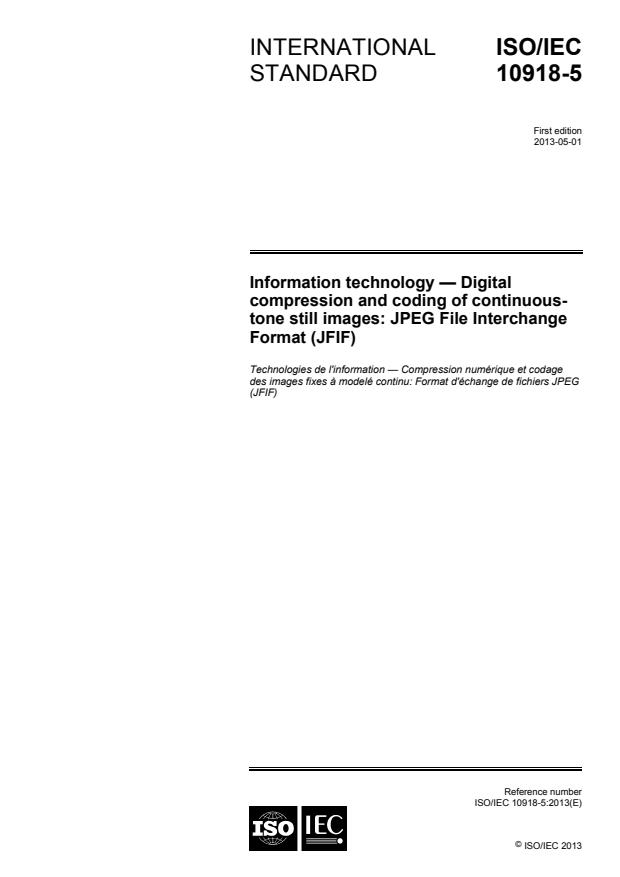
INTERNATIONAL ISO/IEC
STANDARD 10918-5
First edition
2013-05-01
Information technology — Digital
compression and coding of continuous-
tone still images: JPEG File Interchange
Format (JFIF)
Technologies de l'information — Compression numérique et codage
des images fixes à modelé continu: Format d'échange de fichiers JPEG
(JFIF)
Reference number
©
ISO/IEC 2013
© ISO/IEC 2013
All rights reserved. Unless otherwise specified, no part of this publication may be reproduced or utilized otherwise in any form or by any
means, electronic or mechanical, including photocopying, or posting on the internet or an intranet, without prior written permission.
Permission can be requested from either ISO at the address below or ISO’s member body in the country of the requester.
ISO copyright office
Case postale 56 CH-1211 Geneva 20
Tel. + 41 22 749 01 11
Fax + 41 22 749 09 47
E-mail copyright@iso.org
Web www.iso.org
Published in Switzerland
ii © ISO/IEC 2013 – All rights reserved
Foreword
ISO (the International Organization for Standardization) and IEC (the International Electrotechnical
Commission) form the specialized system for worldwide standardization. National bodies that are members of
ISO or IEC participate in the development of International Standards through technical committees
established by the respective organization to deal with particular fields of technical activity. ISO and IEC
technical committees collaborate in fields of mutual interest. Other international organizations, governmental
and non-governmental, in liaison with ISO and IEC, also take part in the work. In the field of information
technology, ISO and IEC have established a joint technical committee, ISO/IEC JTC 1.
International Standards are drafted in accordance with the rules given in the ISO/IEC Directives, Part 2.
The main task of the joint technical committee is to prepare International Standards. Draft International
Standards adopted by the joint technical committee are circulated to national bodies for voting. Publication as
an International Standard requires approval by at least 75 % of the national bodies casting a vote.
Attention is drawn to the possibility that some of the elements of this document may be the subject of patent
rights. ISO and IEC shall not be held responsible for identifying any or all such patent rights.
ISO/IEC 10918-5 was prepared by Joint Technical Committee ISO/IEC JTC 1, Information technology,
Subcommittee SC 29, Coding of audio, picture, multimedia and hypermedia information, in collaboration with
ITU-T. The identical text is published as Rec. ITU-T T.871 (05/2011).
ISO/IEC 10918 consists of the following parts, under the general title Information technology — Digital
compression and coding of continuous-tone still images:
Part 1: Requirements and guidelines
Part 2: Compliance testing
Part 3: Extensions
Part 4: Registration of JPEG profiles, SPIFF profiles, SPIFF tags, SPIFF colour spaces, APPn markers,
SPIFF compression types and Registration Authorities (REGAUT)
Part 5: JPEG File Interchange Format (JFIF)
Part 6: Application to printing systems
© ISO/IEC 2013 – All rights reserved iii
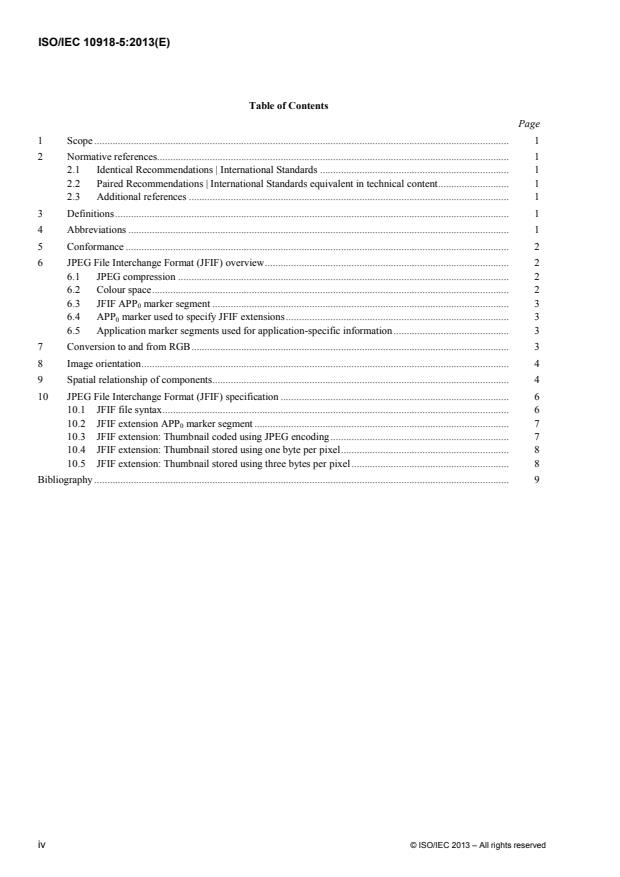
Table of Contents
Page
1 Scope . 1
2 Normative references. 1
2.1 Identical Recommendations | International Standards . 1
2.2 Paired Recommendations | International Standards equivalent in technical content . 1
2.3 Additional references . 1
3 Definitions . 1
4 Abbreviations . 1
5 Conformance . 2
6 JPEG File Interchange Format (JFIF) overview . 2
6.1 JPEG compression . 2
6.2 Colour space . 2
6.3 JFIF APP marker segment . 3
6.4 APP marker used to specify JFIF extensions . 3
6.5 Application marker segments used for application-specific information . 3
7 Conversion to and from RGB . 3
8 Image orientation . 4
9 Spatial relationship of components . 4
10 JPEG File Interchange Format (JFIF) specification . 6
10.1 JFIF file syntax . 6
10.2 JFIF extension APP marker segment . 7
10.3 JFIF extension: Thumbnail coded using JPEG encoding . 7
10.4 JFIF extension: Thumbnail stored using one byte per pixel . 8
10.5 JFIF extension: Thumbnail stored using three bytes per pixel . 8
Bibliography . 9
iv © ISO/IEC 2013 – All rights reserved
INTERNATIONAL STANDARD
RECOMMENDATION ITU-T
Information technology – Digital compression
and coding of continuous-tone still images:
JPEG File Interchange Format (JFIF)
1 Scope
This Recommendation | International Standard specifies the JPEG File Interchange Format (JFIF).
The JPEG File Interchange Format (JFIF) is a minimal file format which enables the exchange of JPEG encoded images
(according to Rec. ITU-T T.81 | ISO/IEC 10918-1) having 1 or 3 colour channels and 8 bits per colour channel between
a wide variety of platforms and applications. This minimal format does not include some advanced features found in
various other specified file formats. The purpose of this format is to provide for a basic form of exchange of JPEG
images. The optional inclusion of thumbnail images for rapid browsing is also supported.
2 Normative references
The following Recommendations and International Standards contain provisions which, through reference in this text,
constitute provisions of this Recommendation | International Standard. At the time of publication, the editions indicated
were valid. All Recommendations and Standards are subject to revision, and parties to agreements based on this
Recommendation | International Standard are encouraged to investigate the possibility of applying the most recent
edition of the Recommendations and Standards listed below. Members of IEC and ISO maintain registers of currently
valid International Standards. The Telecommunication Standardization Bureau of the ITU maintains a list of currently
valid ITU-T Recommendations.
2.1 Identical Recommendations | International Standards
– Recommendation ITU-T T.81 (1992) | ISO/IEC 10918-1:1994, Information technology – Digital
compression and coding of continuous-tone still images – Requirements and guidelines.
2.2 Paired Recommendations | International Standards equivalent in technical content
None.
2.3 Additional references
– Recommendation ITU-R BT.601-6 (2007), Studio encoding parameters of digital television for
standard 4:3 and wide screen 16:9 aspect ratios.
3 Definitions
For the purposes of this Recommendation | International Standard, the following definitions apply.
3.1 JPEG File Interchange Format (JFIF): The interchange format specified in this Recommendation |
International Standard for exchange of images encoded according to the JPEG standard (Rec. ITU-T T.81 |
ISO/IEC 10918-1) having 1 or 3 colour channels and 8 bits per colour channel.
3.2 thumbnail: Reduced resolution representation of the main JPEG (Rec. ITU-T T.81 | ISO/IEC 10918-1) coded
image that can be used to identify the image by its content.
NOTE – Thumbnails are commonly used to browse multiple images quickly using a low resolution visual representation of the
images, rather than using file names or other metadata.
4 Abbreviations
For the purposes of this Recommendation | International Standard, the following abbreviations apply.
Ap Byte i of application data
i
APP Application data marker, type 0
Rec. ITU-T T.871 (05/2011) 1
EOI End of Image
ICC International Color Consortium
JFIF JPEG File Interchange Format
JPEG Joint Photographic Experts Group
Lf Length of frame header
Lp Length of application data segment
Nf Number of components in frame
RGB Red, Green, and Blue (colour component values)
SOF Start of Frame
SOI Start of Image
YC C Luminance (denoted as Y), Chrominance toward Blue, and Chrominance toward Red (colour
B R
component values)
5 Conformance
Some requirements in this Recommendation | International Standard are expressed as format or syntax requirements
rather than as software or hardware implementation requirements. Implementations fall into two categories: JFIF
decoders and JFIF encoders.
In order for a JFIF decoder to be considered conforming, the decoder shall not report errors when processing
conforming instances of the specified format, except when forced to do so by resource exhaustion or when the encoded
image data uses non-baseline features of Rec. ITU-T T.81 | ISO/IEC 10918-1 that are not supported by the decoder.
NOTE – The decoder should report errors when processing non-conforming deviations from the specified format.
In order for a JFIF encoder to be considered conforming, the files produced by the encoder shall be formatted as
specified.
6 JPEG File Interchange Format (JFIF) overview
6.1 JPEG compression
Any JPEG (Rec. ITU-T T.81 | ISO/IEC 10918-1) process is supported by the syntax of the JPEG File Interchange
Format (JFIF), provided the encoded image has 1 or 3 colour channels and 8 bits per colour channel.
NOTE 1 – It is strongly recommended that the JPEG baseline process, as defined in Rec. ITU-T T.81 | ISO/IEC 10918-1, be used
for the purposes of file interchange. This ensures maximum compatibility among applications supporting JPEG coded images.
Files conforming to the JPEG File Interchange Format shall conform to the interchange format specified in
Rec. ITU-T T.81 | ISO/IEC 10918-1. The encoded image in the JPEG File Interchange Format shall have 1 or 3 colour
channels and 8 bits per colour channel. Additionally, the JFIF APP marker (see 6.4) shall be present immediately
following the SOI marker (specified in Rec. ITU-T T.81 | ISO/IEC 10918-1).
NOTE 2 – The interchange format specified in Rec. ITU-T T.81 | ISO/IEC 10918-1 requires that all table specifications used in
the encoding process are coded in the image data prior to their use.
6.2 Colour space
The colour space to be used is YC C as defined by Rec. ITU-R BT.601 (256 levels) but with a different scaling as
B R
specified below. If only one component is used, that component shall be the Y component channel as specified below.
NOTE – The colour space specification herein can provide only a basic level of colour fidelity. The use of supplemental metadata
such as an ICC profile (e.g., as specified in ISO 15076-1) may be necessary to provide a more accurate colour characterization.
If three components are used, they shall be present in the image with the ordering of the components such that the first
component is the Y channel, the second component is the C channel, and the third component is the C channel.
B R
2 Rec. ITU-T T.871 (05/2011)
6.3 JFIF APP marker segment
The JFIF APP marker segment shall immediately follow the SOI marker. The JFIF APP marker segment is defined as
0 0
an APP marker (specified in Rec. ITU-T T.81 | ISO/IEC 10918-1) containing the null-terminated string: "JFIF"
encoded as specified in 10.1 in the first five application data bytes of the marker segment (Ap , for i = 1 to 5).
i
Additional APP marker segments may also be present, provided the associated application data bytes do not begin with
this string. The JFIF APP marker segment provides some information that is not contained in the JPEG
(Rec. ITU-T T.81 | ISO/IEC 10918-1) stream, such as: version number, horizontal and vertical pixel densities
(expressed in dots per inch or dots per cm), pixel aspect ratio (derived from the horizontal and vertical pixel densities),
and an optional thumbnail encoded as 24-bit RGB image data.
NOTE – The "JFIF" string as specified in 10.1 is encoded according to Rec. ITU-T T.50 | ISO 646.
6.4 APP marker used to specify JFIF extensions
Additional APP marker segment(s) can optionally be used for the JFIF extensions specified in clause 10. If used, these
segment(s) must immediately follow the JFIF APP marker segment. Decoders shall skip any unsupported JFIF
extension segments and continue decoding. The JFIF extension APP marker is identified by the zero-terminated string
"JFXX" encoded as specified in 10.2 in the first five application data bytes of the marker segment (Ap , for i = 1 to 5).
i
The JFIF extension APP marker segment contains a 1-byte code with a value specified in clause 10 that identifies the
particular extension type.
NOTE – The encoding of the "JFXX" string as specified in 10.2 is encoded according to Rec. ITU-T T.50 | ISO 646.
6.5 Application marker segments used for application-specific information
Additional APP and other application marker segments may be used to hold application-specific information that does
not affect the ability to decode or display the JFIF file segment. Application-specific marker segments must appear after
the JFIF APP and any JFIF extension APP marker segments. Application-specific APP marker segments shall contain
0 0 0
application data bytes such that the initial application data bytes contain a zero-terminated string value that identifies the
application. For application-specific APP marker segments, this string shall not be the zero-terminated string values
"JFIF" as specified in 10.1 or "JFXX" as specified in 10.2, to avoid conflict with this Recommendation | International
Standard. It is recommended that this string represent an organization name or company trademark. Generic strings
such as "dog", "cat", "tree", etc., should not be used.
7 Conversion to and from RGB
The interpretations of Y, C , and C are derived from the E' , E' , and E' signals defined in the 625-line specification
B R Y C C
B R
of Rec. ITU-R BT.601, but these signals are normalized so as to permit the usage of the full range of 256 levels of the
8-bit binary encoding of the Y component. More precisely, they are specified by the following relationships:
Y = Min( Max( 0, Round( 255 * E' ) ), 255 )
Y
C = Min( Max( 0, Round( 255 * E' + 128 ) ), 255 )
B
...