


ISO 13059:2011
(Main)Round timber — Requirements for the measurement of dimensions and methods for the determination of volume
Round timber — Requirements for the measurement of dimensions and methods for the determination of volume
ISO 13059:2011 establishes requirements for the measurement of dimensions and methods for the determination of round timber volume.
Bois ronds — Exigences pour le mesurage des dimensions et méthodes pour déterminer le volume
General Information
- Status
- Published
- Publication Date
- 11-Sep-2011
- Technical Committee
- ISO/TC 218 - Timber
- Drafting Committee
- ISO/TC 218/WG 2 - Round timber
- Current Stage
- 9093 - International Standard confirmed
- Start Date
- 13-Mar-2023
- Completion Date
- 12-Feb-2026
Relations
- Effective Date
- 04-Sep-2008
Overview
ISO 13059:2011 - Round timber: measurement of dimensions and determination of volume establishes uniform requirements for measuring round timber (logs) and for calculating their volume. Developed by ISO/TC 218 (Timber) and based on EN 1309-2:2006, the standard harmonizes measurement practices to reduce technical barriers in international timber trade and to ensure consistent, reproducible volume reporting.
Key principles in the standard include the use of metric units, certified measurement procedures and measurement instruments, and methods that minimise personal influence on results.
Key Topics
Measurement units and accuracy: Metric units are required. Instruments for diameter measurement must provide ±1 mm accuracy and length measurement ±1 cm.
Dimensions defined: The standard defines diameter, length, nominal length and crosscut allowance, and clarifies measurement positions (butt, top, mid) and special cases (buttress, multiple sweep, undercut/butt trimming).
Rounding rules: Diameter measurements are rounded to whole centimetres (0.5 cm and above rounded up); length is measured to the shortest distance between ends and rounded to 0.01 m.
Measurement methods: Supports direct and indirect measurement methods, including piece-by-piece measurements and group methods (pile, mass, hydrostatic/xylometric, photographic, electron-optical). Conversion rules must be defined when measuring over or under bark.
Volume calculation: Volume is calculated by multiplying cross-sectional area by nominal length. The standard covers piece-by-piece solid volume, piled volume (using a coefficient of timber compactness to convert piled to solid volume), and group determination methods.
Procedural requirements: Measurement procedures must be certified, define the place and number of direct measurements for pile methods, and provide rules for rounding results (e.g., individual log volumes rounded to 0.001 m³, lot volumes to 0.01 m³ or 0.001 m³ depending on method).
Applications
ISO 13059:2011 is practical for:
- Timber producers and sawmills establishing consistent measurement workflows and documentation.
- Forest managers and loggers performing on-site piece-by-piece volume determinations.
- Transporters and traders calculating carload, ship or vehicle volumes (including mass-based methods and gross/net weight approaches).
- Quality control, forestry certification and valuation professionals needing standardized, auditable volume figures for contracts and international trade.
Benefits include improved accuracy, reduced measurement disputes, simplified trade operations, and harmonized reporting across jurisdictions.
Related Standards
- ISO 4476:1983 - Vocabulary for log sizes
- ISO/IEC Guide 99:2007 - Metrology vocabulary (VIM)
- EN 1309-2:2006 - Source for development
Other referenced national standards and norms (e.g., GOST, GB/T, STB) can provide complementary tables, compactness coefficients and local measurement practices. When in doubt, the piece-by-piece method is prescribed if group-method results conflict.
Get Certified
Connect with accredited certification bodies for this standard

Gozdarski inštitut Slovenije
Slovenian Forestry Institute. Forest management certification support, timber testing.
Sponsored listings
Frequently Asked Questions
ISO 13059:2011 is a standard published by the International Organization for Standardization (ISO). Its full title is "Round timber — Requirements for the measurement of dimensions and methods for the determination of volume". This standard covers: ISO 13059:2011 establishes requirements for the measurement of dimensions and methods for the determination of round timber volume.
ISO 13059:2011 establishes requirements for the measurement of dimensions and methods for the determination of round timber volume.
ISO 13059:2011 is classified under the following ICS (International Classification for Standards) categories: 79.040 - Wood, sawlogs and sawn timber. The ICS classification helps identify the subject area and facilitates finding related standards.
ISO 13059:2011 has the following relationships with other standards: It is inter standard links to ISO 4480:1983. Understanding these relationships helps ensure you are using the most current and applicable version of the standard.
ISO 13059:2011 is available in PDF format for immediate download after purchase. The document can be added to your cart and obtained through the secure checkout process. Digital delivery ensures instant access to the complete standard document.
Standards Content (Sample)
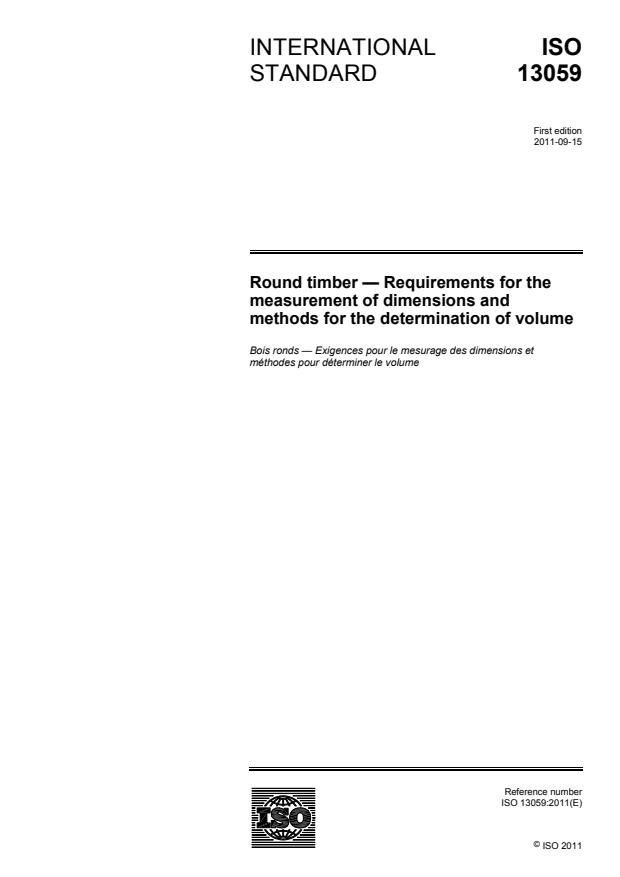
INTERNATIONAL ISO
STANDARD 13059
First edition
2011-09-15
Round timber — Requirements for the
measurement of dimensions and
methods for the determination of volume
Bois ronds — Exigences pour le mesurage des dimensions et
méthodes pour déterminer le volume
Reference number
©
ISO 2011
© ISO 2011
All rights reserved. Unless otherwise specified, no part of this publication may be reproduced or utilized in any form or by any means,
electronic or mechanical, including photocopying and microfilm, without permission in writing from either ISO at the address below or
ISO's member body in the country of the requester.
ISO copyright office
Case postale 56 CH-1211 Geneva 20
Tel. + 41 22 749 01 11
Fax + 41 22 749 09 47
E-mail copyright@iso.org
Web www.iso.org
Published in Switzerland
ii © ISO 2011 – All rights reserved
Foreword
ISO (the International Organization for Standardization) is a worldwide federation of national standards bodies
(ISO member bodies). The work of preparing International Standards is normally carried out through ISO
technical committees. Each member body interested in a subject for which a technical committee has been
established has the right to be represented on that committee. International organizations, governmental and
non-governmental, in liaison with ISO, also take part in the work. ISO collaborates closely with the
International Electrotechnical Commission (IEC) on all matters of electrotechnical standardization.
International Standards are drafted in accordance with the rules given in the ISO/IEC Directives, Part 2.
The main task of technical committees is to prepare International Standards. Draft International Standards
adopted by the technical committees are circulated to the member bodies for voting. Publication as an
International Standard requires approval by at least 75 % of the member bodies casting a vote.
Attention is drawn to the possibility that some of the elements of this document may be the subject of patent
rights. ISO shall not be held responsible for identifying any or all such patent rights.
ISO 13059 was prepared by Technical Committee ISO/TC 218, Timber.
This first edition cancels and replaces ISO 4480:1983 which has been technically revised.
Introduction
The main purpose of this International Standard is to establish common requirements for the measurement of
dimensions and methods for the determination of round timber volume. It has been developed based on
EN 1309-2:2006.
This International Standard aims to:
establish requirements for the measurement of dimensions and methods for the determination of round
timber volume;
harmonize the requirements of the various standardization systems (ISO, CEN, and national
standardization organizations) for the measurement of dimensions and methods for the determination of
round timber volume;
provide technological unity and compatibility of scientific and technical information concerning round
timber;
reduce the technical barriers in the international trade of round timber, simplify the procedures of trading
operations and intercalculations between timber producer, customer and seller.
iv © ISO 2011 – All rights reserved
INTERNATIONAL STANDARD ISO 13059:2011(E)
Round timber — Requirements for the measurement of
dimensions and methods for the determination of volume
1 Scope
This International Standard establishes requirements for the measurement of dimensions and methods for the
determination of round timber volume.
2 Normative reference
The following referenced documents are indispensable for the application of this document. For dated
references, only the edition cited applies. For undated references, the latest edition of the referenced
document (including any amendments) applies.
ISO 4476:1983, Coniferous and broadleaved sawlogs — Sizes — Vocabulary
ISO/IEC Guide 99:2007, International vocabulary of metrology — Basic and general concepts and associated
terms (VIM)
3 Terms and definitions
For the purposes of this document, the terms and definitions, given in ISO 4476:1983, ISO/IEC Guide 99:2007
and the following apply.
3.1
dimension
numerical value of the linear dimension (diameter, length, etc.) in the chosen units of measurement
3.2
diameter of round timber
distance between two parallel lines tangential to a lateral surface of the stem in a place of measurement and
lying in a section perpendicular to a longitudinal axis of round timber
3.3
length of round timber
shortest distance between the ends of round timber
3.4
nominal length of round timber
specified length of round timber, disregarding any crosscut allowance
3.5
crosscut allowance
extension of nominal length for the benefit of loss compensation during cross-cutting
3.6
piece-by-piece determination of round timber volume
determination of round timber volume based on measurement of the diameter (over or under the bark) and the
length of every unit of round timber
3.7
solid volume of round timber
quantity of wood in a round timber based on its dimensions (under the bark) and expressed in cubic metres
3.8
piled volume of round timber
space occupied by a pile of round timber and determined by its external dimensions, including air spaces
3.9
group determination of round timber volume
determination of round timber volume by geometric method, by mass or by hydrostatic weighing (xylometric)
method
3.10
measurement method
generic description of a logical organization of operations used in a measurement
NOTE Measurement method may be qualified in various ways such as direct measurement method and indirect
measurement method.
[ISO/IEC Guide 99:2007, definition 2.5]
3.11
measurement procedure
detailed description of a measurement according to one or more measurement principles and to a given
measurement method, based on a measurement model and including any calculation to obtain a
measurement result
[ISO/IEC Guide 99:2007, definition 2.6]
3.12
direct measurement
measurement when the target value of a physical quantity is obtained directly by measurement instruments
3.13
indirect measurement
determination of the target value of a physical quantity based on the results of direct measurements of the
other physical quantities which are functionally connected with the target value
3.14
coefficient of timber compactness
coefficient of transformation of piled volume into the solid one
4 General requirements for the measurement of dimensions and methods of
determination of round timber volume
4.1 Due to the measuring means, the dimensions of round timber are obtained by direct or indirect
measurements.
NOTE An example of indirect measurements of dimensions is an application of electronic measuring means.
4.2 Determination of round timber volume utilizes indirect measurements, obtained from the results of direct
measurements of round timber dimensions or linear parameters of round timber stack (bunch, bundle, etc.).
2 © ISO 2011 – All rights reserved
4.3 When measuring, metric units shall be used.
4.4 When measuring round timber dimensions, one should aspire to reduce the quantity of measuring
operations in the chain of deliveries of round timber, to reduce errors in measurements and to increase the
accuracy of measurements.
4.5 Determination of dimensions and volume of round timber shall be carried out with measuring
instruments and certified measurement procedures.
4.6 The measurement procedures shall provide particular measurement accuracy taking into account
specified measurement error.
4.7 The instruments applied for the measurement of round timber dimensions shall provide the following
measurement accuracy: 1
...
Questions, Comments and Discussion
Ask us and Technical Secretary will try to provide an answer. You can facilitate discussion about the standard in here.
Loading comments...