


ISO/TS 15311-1:2016
(Main)Graphic technology — Requirements for printed matter for commercial and industrial production — Part 1: Measurement methods and reporting schema
Graphic technology — Requirements for printed matter for commercial and industrial production — Part 1: Measurement methods and reporting schema
ISO/TS 15311-1:2016 defines print metrics, measurement methods and reporting requirements for printed sheets that are suitable for all classes of printed products. Guidance as to which of these metrics to apply to any given category of product along with acceptable conformance criteria is provided in subsequent parts of ISO/TS 15311. Although ISO/TS 15311-1:2016 is expected to be used primarily to measure prints from digital printing systems, the metrics are general and can be applied to other kinds of print.
Technologie graphique — Exigences pour les imprimés pour les productions industrielle et commerciale — Partie 1: Méthodes de mesure et schémas de rapport
General Information
- Status
- Withdrawn
- Publication Date
- 01-May-2016
- Withdrawal Date
- 01-May-2016
- Technical Committee
- ISO/TC 130 - Graphic technology
- Drafting Committee
- ISO/TC 130/WG 3 - Process control and related metrology
- Current Stage
- 9599 - Withdrawal of International Standard
- Start Date
- 06-Feb-2019
- Completion Date
- 12-Feb-2026
Relations
- Effective Date
- 04-Mar-2017


Frequently Asked Questions
ISO/TS 15311-1:2016 is a technical specification published by the International Organization for Standardization (ISO). Its full title is "Graphic technology — Requirements for printed matter for commercial and industrial production — Part 1: Measurement methods and reporting schema". This standard covers: ISO/TS 15311-1:2016 defines print metrics, measurement methods and reporting requirements for printed sheets that are suitable for all classes of printed products. Guidance as to which of these metrics to apply to any given category of product along with acceptable conformance criteria is provided in subsequent parts of ISO/TS 15311. Although ISO/TS 15311-1:2016 is expected to be used primarily to measure prints from digital printing systems, the metrics are general and can be applied to other kinds of print.
ISO/TS 15311-1:2016 defines print metrics, measurement methods and reporting requirements for printed sheets that are suitable for all classes of printed products. Guidance as to which of these metrics to apply to any given category of product along with acceptable conformance criteria is provided in subsequent parts of ISO/TS 15311. Although ISO/TS 15311-1:2016 is expected to be used primarily to measure prints from digital printing systems, the metrics are general and can be applied to other kinds of print.
ISO/TS 15311-1:2016 is classified under the following ICS (International Classification for Standards) categories: 37.100.01 - Graphic technology in general. The ICS classification helps identify the subject area and facilitates finding related standards.
ISO/TS 15311-1:2016 has the following relationships with other standards: It is inter standard links to ISO/TS 15311-1:2019. Understanding these relationships helps ensure you are using the most current and applicable version of the standard.
ISO/TS 15311-1:2016 is available in PDF format for immediate download after purchase. The document can be added to your cart and obtained through the secure checkout process. Digital delivery ensures instant access to the complete standard document.
Standards Content (Sample)
TECHNICAL ISO/TS
SPECIFICATION 15311-1
First edition
2016-05-01
Graphic technology — Requirements
for printed matter for commercial and
industrial production —
Part 1:
Measurement methods and reporting
schema
Technologie graphique — Exigences pour les imprimés pour les
productions industrielle et commerciale —
Partie 1: Méthodes de mesure et schémas de rapport
Reference number
©
ISO 2016
© ISO 2016, Published in Switzerland
All rights reserved. Unless otherwise specified, no part of this publication may be reproduced or utilized otherwise in any form
or by any means, electronic or mechanical, including photocopying, or posting on the internet or an intranet, without prior
written permission. Permission can be requested from either ISO at the address below or ISO’s member body in the country of
the requester.
ISO copyright office
Ch. de Blandonnet 8 • CP 401
CH-1214 Vernier, Geneva, Switzerland
Tel. +41 22 749 01 11
Fax +41 22 749 09 47
copyright@iso.org
www.iso.org
ii © ISO 2016 – All rights reserved
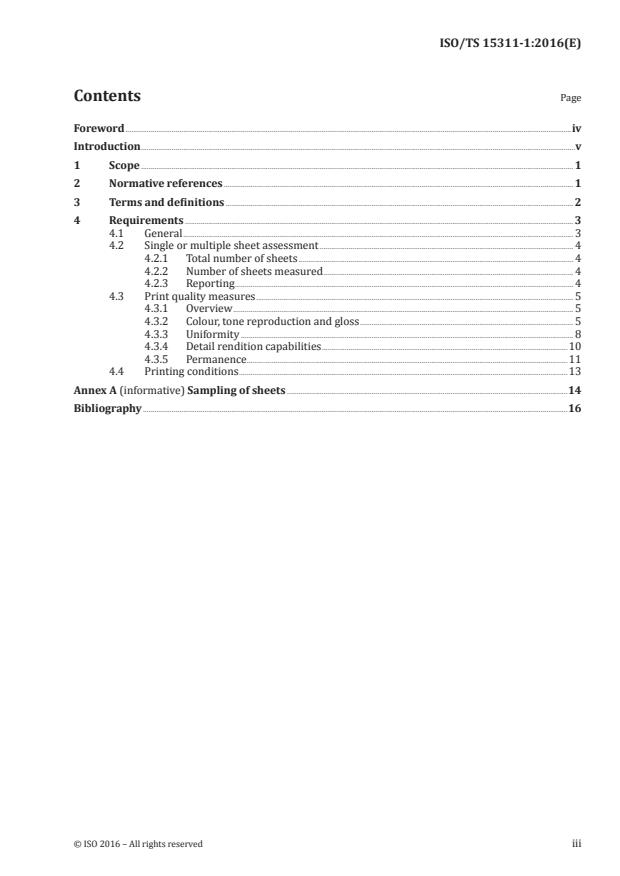
Contents Page
Foreword .iv
Introduction .v
1 Scope . 1
2 Normative references . 1
3 Terms and definitions . 2
4 Requirements . 3
4.1 General . 3
4.2 Single or multiple sheet assessment . 4
4.2.1 Total number of sheets . 4
4.2.2 Number of sheets measured . 4
4.2.3 Reporting . 4
4.3 Print quality measures . 5
4.3.1 Overview . 5
4.3.2 Colour, tone reproduction and gloss . 5
4.3.3 Uniformity . 8
4.3.4 Detail rendition capabilities .10
4.3.5 Permanence . .11
4.4 Printing conditions .13
Annex A (informative) Sampling of sheets .14
Bibliography .16
Foreword
ISO (the International Organization for Standardization) is a worldwide federation of national standards
bodies (ISO member bodies). The work of preparing International Standards is normally carried out
through ISO technical committees. Each member body interested in a subject for which a technical
committee has been established has the right to be represented on that committee. International
organizations, governmental and non-governmental, in liaison with ISO, also take part in the work.
ISO collaborates closely with the International Electrotechnical Commission (IEC) on all matters of
electrotechnical standardization.
The procedures used to develop this document and those intended for its further maintenance are
described in the ISO/IEC Directives, Part 1. In particular the different approval criteria needed for the
different types of ISO documents should be noted. This document was drafted in accordance with the
editorial rules of the ISO/IEC Directives, Part 2 (see www.iso.org/directives).
Attention is drawn to the possibility that some of the elements of this document may be the subject of
patent rights. ISO shall not be held responsible for identifying any or all such patent rights. Details of
any patent rights identified during the development of the document will be in the Introduction and/or
on the ISO list of patent declarations received (see www.iso.org/patents).
Any trade name used in this document is information given for the convenience of users and does not
constitute an endorsement.
For an explanation on the meaning of ISO specific terms and expressions related to conformity
assessment, as well as information about ISO’s adherence to the WTO principles in the Technical
Barriers to Trade (TBT) see the following URL: Foreword - Supplementary information
The committee responsible for this document is ISO/TC 130, Graphic technology.
ISO/TS 15311 consists of the following parts, under the general title Graphic technology — Requirements
for printed matter for commercial and industrial production:
— Part 1: Measurement methods and reporting schema
The following parts are under preparation:
— Part 2: Commercial production printing
iv © ISO 2016 – All rights reserved
Introduction
When producing a colour reproduction, it is important that the persons responsible for data creation,
colour separation, proofing and printing operations have previously agreed a minimum set of
parameters that define the visual characteristics and other technical properties of the planned print
product. This part of ISO/TS 15311 identifies a number of metrics that can be applied to printed sheets
and that can be used as the basis for such communication. The range of metrics is large and it is not
intended that all of these metrics are to be applied to any given printed product and for any given
application, the range of metrics is to be carefully selected, for example based on subsequent parts of
ISO/TS 15311.
The metrics described by this part of ISO/TS 15311 can be applied to any type of print. They are likely
to most often be applied to digitally printed prints.
When selecting the set of metrics, only those metrics that have a clear specification and that correlate
well with human perception are included in this part of ISO/TS 15311. Since this is an area of significant
research activity, new metrics are expected to emerge and existing metrics to be revised in the next
few years. For this reason, we anticipate the need to revise this part of ISO/TS 15311 within a very
short time scale as new metrics are tested and found to be reliable.
Additional tests to those specified in this this part of ISO/TS 15311, for example visual assessment of
smoothness, images and other elements may be required when assessing print quality.
As with any parameter that is used as part of a product specification, it is important for readers to
understand clearly what the metric means. For this reason, a reporting schema is to be followed when
reporting measurements in conformance with this part of ISO/TS 15311.
TECHNICAL SPECIFICATION ISO/TS 15311-1:2016(E)
Graphic technology — Requirements for printed matter for
commercial and industrial production —
Part 1:
Measurement methods and reporting schema
1 Scope
This part of ISO/TS 15311 defines print metrics, measurement methods and reporting requirements
for printed sheets that are suitable for all classes of printed products.
Guidance as to which of these metrics to apply to any given category of product along with acceptable
conformance criteria is provided in subsequent parts of ISO/TS 15311.
Although this part of ISO/TS 15311 is expected to be used primarily to measure prints from digital
printing systems, the metrics are general and can be applied to other kinds of print.
2 Normative references
The following documents, in whole or in part, are normatively referenced in this document and are
indispensable for its application. For dated references, only the edition cited applies. For undated
references, the latest edition of the referenced document (including any amendments) applies.
ISO 2813, Paints and varnishes — Determination of specular gloss of non-metallic paint films at 20 degrees,
60 degrees and 85 degrees
ISO 8254-2, Paper and board — Measurement of specular gloss — Part 2: 75 degree gloss with a parallel
beam, DIN method
ISO 12642-2, Graphic technology — Input data for characterization of 4-colour process printing — Part 2:
Expanded data set
ISO 12647-8:2012, Graphic technology — Process control for the production of half-tone colour separations,
proof and production prints — Part 8: Validation print processes working directly from digital data
ISO 13655, Graphic technology — Spectral measurement and colorimetric computation for graphic
arts images
ISO 18924, Imaging materials — Test method for Arrhenius-type predictions
ISO 18930, Imaging materials — Pictorial colour reflection prints — Methods for evaluating image stability
under outdoor conditions
ISO 18937:2014, Imaging materials — Photographic reflection prints — Methods for measuring indoor
light stability
ISO/IEC TS 24790:2012, Information technology — Office equipment — Measurement of image quality
attributes for hardcopy output — Monochrome text and graphic images
ISO/IEC TS 29112, Information technology — Office equipment — Test charts and methods for measuring
monochrome printer resolution
3 Terms and definitions
For the purposes of this document, the following terms and definitions apply.
3.1
achromatic colour
perceived colour of low chroma, in the perceptual sense
Note 1 to entry: The colour names “white”, “grey” and “black” are commonly used for objects that reflect light.
For objects that transmit light, the words “colourless” and “neutral” are used.
Note 2 to entry: In printing practice, achromatic colours can be produced either by a single black ink or three
chromatic (and one achromatic) inks suitably balanced.
Note 3 to entry: Colours with low chroma are also called near neutral colours.
3.2
banding
appearance of one dimensional bands within an area that should be homogeneous
Note 1 to entry: This is also known as streakiness, while the artefacts are called streaks, bands, or stripes.
Note 2 to entry: Adapted from ISO 24790.
3.3
CIEDE2000 colour difference
total colour difference as defined in ISO/CIE 11664-6:2014 (CIE S 014-6/E:2013)
Note 1 to entry: The unit is ΔE00. The default weights for lightness, chroma and hue are (1:1:1).
3.4
colour deviation
difference between the colour aim value and the mean of a set of colour measurements
3.5
colour variation
colour difference from the mean of a set of colour measurements
Note 1 to entry: Colour variation is also known as colour fluctuation and may be reported as the mean or 95
percentile.
3.6
digital print
print where the image is printed directly from the digital domain
Note 1 to entry: Digital printing is a process for text and image reproduction with a colour marker on a medium
using a marking device, on which the marking information is generated from digital data directly to the medium.
It differs from traditional ink-based printing on which the marking information is generated from a form
produced offline prior to imaging on the medium.
Note 2 to entry: Adapted from ISO 18913.
3.7
permanence
ability to remain chemically and physically stable over long periods of time
[SOURCE: ISO 18913:2012, 3.134]
2 © ISO 2016 – All rights reserved
3.8
image quality
impression of the overall merit or excellence of an image, as perceived by an observer neither associated
with the act of photography, nor closely involved with the subject matter depicted
Note 1 to entry: The purpose of defining image quality in terms of third-party (uninvolved) observers is to
eliminate sources of variability that arise from more idiosyncratic aspects of image perception and pertain to
attributes outside the control of imaging system designers.
3.9
printing condition
set of primary process parameters which describe the conditions associated with a specific printed
output, associated with spectral, colorimetric and/or densitometric aim values
Note 1 to entry: Such parameters usually include (as a minimum) printing process, paper category, printing ink,
screening and printing sequence. The aim values typically comprise the colorant description and tone value
increase aims.
Note 2 to entry: For the purposes of colour management, a printing condition is fully characterized by giving
the relationship between the CMYK digital input values (as stipulated in ISO 12642-2) and the corresponding
measured colorimetric values.
Note 3 to entry: Based on a given set of characterization data according to 3.9, Note 2 entry and a definition of
achromatic perception, a grey condition might be extracted.
3.10
tone value
proportional printing value encoded in a data file and interpreted as defined in the file format
specification
VV−
p 0
A =×100 %
VV−
100 0
where
V is the integer value of the pixel;
p
V is the integer value corresponding to a tone value of 0 %;
V is the integer value corresponding to a tone value of 100 %.
Note 1 to entry: Tone value is expressed in units of percent.
Note 2 to entry: Most files store these data as 8-bit integer values, i.e. 0 to 255. The tone value of a pixel is typically
computed from the formula.
4 Requirements
4.1 General
The following subclauses provide a number of metrics that define attributes of printed sheets and
requirements for reporting them.
In many cases, the existing standards use CIE ΔE rather than CIEDE2000. Although these are not
ab
interchangeable quantities, ΔE has been superseded by CIEDE2000 in ISO/TC 130 standards. For this
ab
reason, CIEDE2000 shall be used to report colour difference metrics in this part of ISO/TS 15311.
Similarly, printing density is seldom used to measure colour and where the referenced standards
specify printing density, approximately equivalent CIELAB colour measurements shall be used.
4.2 Single or multiple sheet assessment
Unless otherwise specified, metrics shall be assumed to apply to the assessment of a single sheet.
In many cases, it is useful to be able to report metrics for a set of sheets; for example, the set of sheets
produced in a single print run or the set of sheets to be delivered as part of an order for print. In these
cases, it is important to be able to indicate the likely variation across the entire set of sheets.
Sheets should be selected randomly with no replacement.
Samples should be selected with the following provisos:
a) sheets should be selected throughout the entire press run;
b) sheets should not be selected synchronous to any press event, e.g. at each roll change or after every
blanket wash.
In cases where metrics are reported for a set of sheets, the report shall indicate the following: the total
number of sheets in the set to be assessed, the number of sheets measured and, unless random selection
with no replacement is used, the sampling method used to select the sheets shall be indicated.
4.2.1 Total number of sheets
The total number of sheets in the set of sheets assessed shall be reported (when metrics are reported).
Details of the printing system used to create the sheets should also be reported.
4.2.2 Number of sheets measured
As a general rule, the higher the number of sheets measured from the set, the lower the uncertainty in
the metric will be. Where there is a large number of sheets in the set, it may be impractical to measure
a high percentage of these sheets and so the uncertainty (likely spread of values) may be high. Table 1
provides guidelines for the suggested number of sheets to be assessed for different sizes of sets of
sheets to ensure that the metric being reported is somewhat representative of the entire set of sheets.
Table 1 — Guidelines for the number of sheets to be assessed
Total number of Suggested number of
sheets in set sheets to be measured
50 12
100 13
1 000 and greater 15
Table 1 provides typical sampling strategies used in the industry today. Users should be aware that
where these values are used, the average value for the total set of sheets may vary substantially from
the average measured for the sample set. Annex A provides details of how the likely difference between
these two values varies with the sample size and provides a method for finding the sampling rate
needed to reduce the uncertainty to a required level.
4.2.3 Reporting
When multiple sheets are assessed, the total number of sheets and the number of samples shall be
reported as shown in the example below.
EXAMPLE 1 Sheets assessed: 13 (500).
When multiple sheets are assessed, the mean and standard deviation for each metric shall be reported
as shown below except when reporting colour difference metrics.
EXAMPLE 2 Average line width: 0,12 mm, σ = 0,01 mm.
4 © ISO 2016 – All rights reserved
When reporting colour difference metrics for a single colour measured on multiple sheets, both the
colour deviation and colour variation should be reported.
EXAMPLE 3 Colour deviation 3,2 DE , colour variation 0,8 DE .
00 00
Where the spread of colour difference values is reported, the average colour difference and the 95
percentile (and not the standard deviation) should be used.
EXAMPLE 4 Average colour difference: 2,8 DE , 95 percentile: 4,2 DE .
00 00
NOTE Standard deviation is not an appropriate measure for colour difference as this assumes a normal
distribution, whereas colour differences generally have a chi-squared (k = 3) distribution. The 95 percentile
provides a more reliable estimate of the spread of values.
4.3 Print quality measures
4.3.1 Overview
Image quality metrics or attributes are aspects, dimensions or components of overall perceived print
image quality.
The visual attributes specified in this part of ISO/TS 15311, to be used by the remaining parts of
ISO/TS 15311, are defined in the following clauses.
4.3.2 Colour, tone reproduction and gloss
4.3.2.1 General
Colour accuracy describes the visual closeness between a defined reference and a reproduction. It is
important to distinguish two concepts: absolute and media relative colour accuracy.
Absolute colour accuracy is usually required for side-by-side viewing, whereas media relative colour
accuracy is usually more desirable for sequential viewing where the prints being compared are never
viewed together.
When selecting a suitable metric, it is important to know which kind of comparison is expected and
when reporting colour metrics, the colour accuracy method and the intended evaluation method should
be indicated.
4.3.2.2 Print substrate
In some cases, it may be desirable to indicate the substrate that is used when reporting other attributes.
For example, the colour accuracy achieved for a particular reference printing condition usually depends
on the substrate. This is only likely to be useful for cases where isotropic (paper-like) substrates are used.
When such substrate attributes are included they shall be reported as shown in Table 2.
Table 2 — Substrate reporting requirements
Print substrate attribute Description Example
Substrate name (Required) A text string that Substrate name: StoraEnso NovaPress
provides details of the substrate
used. This should include suffi-
cient
detail to enable purchase of simi-
lar substrate.
Substrate colour (Required) CIELAB D50/2° M1 Substrate colour: (95,0.5, −2) CIELAB
colour value of the substrate
measured as specified in
ISO 13655
Other metrics from (Optional) Report metric as indicated in ISO 15397
ISO 15397 may be reported
4.3.2.3 Absolute colour reproduction (process colours)
In some cases, particularly when proofing, it is useful to be able to estimate the accuracy to which the
print simulates a reference printing condition and this attribute is called “absolute colour accuracy”.
When reported, assessment of absolute colour accuracy shall be performed by printing and measuring
an ISO 12642-2 characterization data chart or where appropriate a subset of these patches (control
strip patches) according to ISO 12647-8:2012, 5.2.
The values shown in Table 3 shall be reported using the measurement units shown and values shall be
reported to two significant figures.
Table 3 — reporting absolute colour reproduction parameters
Description Full label Abbreviated label Units
Maximum colour difference for all control Control strip maximum CSMax ΔE
strip patches
Average colour difference for control Control strip average CSAve ΔE
strip patches
Average chromaticness difference for CMY Control strip neutrals average CSAveNeutral ΔC
h
neutral control strip patches
Average colour difference for selected Characterization chart surface CCAveSurface ΔE
surface gamut patches patches average
The average colour difference for the Characterization chart average CCAve ΔE
characterization chart
The 95th percentile for the characteriza- Characterization chart 95th CC95 % ΔE
tion chart percentile
EXAMPLE 1 Absolute colour accuracy: CSMax (8,0 ΔE ), CSAve (3,0 ΔE ), CSAveNeutral (2,5 ΔC ),
00 00 h
CCAveSurface (4,0 ΔE ),
...
Questions, Comments and Discussion
Ask us and Technical Secretary will try to provide an answer. You can facilitate discussion about the standard in here.
Loading comments...