


ISO/IEC/IEEE 42010:2011
(Main)Systems and software engineering — Architecture description
Systems and software engineering — Architecture description
ISO/IEC/IEEE 42010:2011 addresses the creation, analysis and sustainment of architectures of systems through the use of architecture descriptions. A conceptual model of architecture description is established. The required contents of an architecture description are specified. Architecture viewpoints, architecture frameworks and architecture description languages are introduced for codifying conventions and common practices of architecture description. The required content of architecture viewpoints, architecture frameworks and architecture description languages is specified. Annexes provide the motivation and background for key concepts and terminology and examples of applying ISO/IEC/IEEE 42010:2011.
Ingénierie des systèmes et des logiciels — Description de l'architecture
General Information
- Status
- Withdrawn
- Publication Date
- 23-Nov-2011
- Technical Committee
- ISO/IEC JTC 1/SC 7 - Software and systems engineering
- Drafting Committee
- ISO/IEC JTC 1/SC 7/WG 42 - Architecture
- Current Stage
- 9599 - Withdrawal of International Standard
- Start Date
- 07-Nov-2022
- Completion Date
- 12-Feb-2026
Relations
- Effective Date
- 26-Aug-2017
- Effective Date
- 28-Feb-2009

Get Certified
Connect with accredited certification bodies for this standard

BSI Group
BSI (British Standards Institution) is the business standards company that helps organizations make excellence a habit.

BSCIC Certifications Pvt. Ltd.
Established 2006, accredited by NABCB, JAS-ANZ, EIAC, IAS. CDSCO Notified Body.

Intertek India Pvt. Ltd.
Delivers Assurance, Testing, Inspection & Certification since 1993 with 26 labs and 32 offices.
Sponsored listings
Frequently Asked Questions
ISO/IEC/IEEE 42010:2011 is a standard published by the International Organization for Standardization (ISO). Its full title is "Systems and software engineering — Architecture description". This standard covers: ISO/IEC/IEEE 42010:2011 addresses the creation, analysis and sustainment of architectures of systems through the use of architecture descriptions. A conceptual model of architecture description is established. The required contents of an architecture description are specified. Architecture viewpoints, architecture frameworks and architecture description languages are introduced for codifying conventions and common practices of architecture description. The required content of architecture viewpoints, architecture frameworks and architecture description languages is specified. Annexes provide the motivation and background for key concepts and terminology and examples of applying ISO/IEC/IEEE 42010:2011.
ISO/IEC/IEEE 42010:2011 addresses the creation, analysis and sustainment of architectures of systems through the use of architecture descriptions. A conceptual model of architecture description is established. The required contents of an architecture description are specified. Architecture viewpoints, architecture frameworks and architecture description languages are introduced for codifying conventions and common practices of architecture description. The required content of architecture viewpoints, architecture frameworks and architecture description languages is specified. Annexes provide the motivation and background for key concepts and terminology and examples of applying ISO/IEC/IEEE 42010:2011.
ISO/IEC/IEEE 42010:2011 is classified under the following ICS (International Classification for Standards) categories: 35.080 - Software. The ICS classification helps identify the subject area and facilitates finding related standards.
ISO/IEC/IEEE 42010:2011 has the following relationships with other standards: It is inter standard links to ISO/IEC/IEEE 42010:2022, ISO/IEC 42010:2007. Understanding these relationships helps ensure you are using the most current and applicable version of the standard.
ISO/IEC/IEEE 42010:2011 is available in PDF format for immediate download after purchase. The document can be added to your cart and obtained through the secure checkout process. Digital delivery ensures instant access to the complete standard document.
Standards Content (Sample)
INTERNATIONAL ISO/IEC/
STANDARD IEEE
First edition
2011-12-01
Systems and software engineering —
Architecture description
Ingénierie des systèmes et des logiciels — Description de l'architecture
Reference number
©
ISO/IEC 2011
©
IEEE 2011
© ISO/IEC 2011
© IEEE 2011
All rights reserved. Unless otherwise specified, no part of this publication may be reproduced or utilized in any form or by any means,
electronic or mechanical, including photocopying and microfilm, without permission in writing from either ISO or IEEE at the respective
address below.
ISO copyright office Institute of Electrical and Electronics Engineers, Inc.
Case postale 56 CH-1211 Geneva 20 3 Park Avenue, New York NY 10016-5997, USA
Tel. + 41 22 749 01 11 E-mail stds.ipr@ieee.org
Fax + 41 22 749 09 47 Web www.ieee.org
E-mail copyright@iso.org
Web www.iso.org
Published in Switzerland
© ISO/IEC 2011 – All rights reserved
ii © IEEE 2011 – All rights reserved
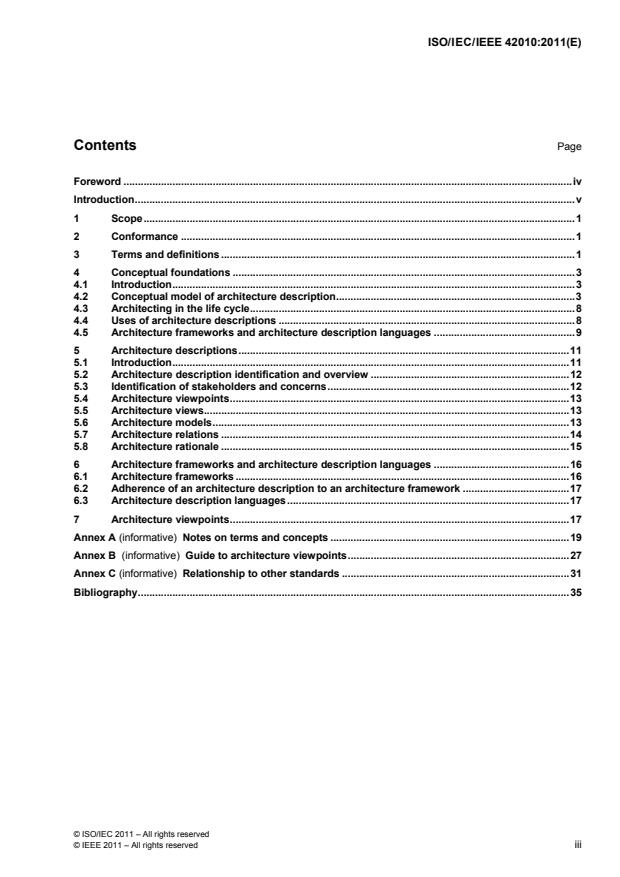
Contents Page
Foreword . iv
Introduction . v
1 Scope . 1
2 Conformance . 1
3 Terms and definitions . 1
4 Conceptual foundations . 3
4.1 Introduction . 3
4.2 Conceptual model of architecture description . 3
4.3 Architecting in the life cycle . 8
4.4 Uses of architecture descriptions . 8
4.5 Architecture frameworks and architecture description languages . 9
5 Architecture descriptions . 11
5.1 Introduction . 11
5.2 Architecture description identification and overview . 12
5.3 Identification of stakeholders and concerns . 12
5.4 Architecture view points . 13
5.5 Architecture views . 13
5.6 Architecture models . 13
5.7 Architecture relations . 14
5.8 Architecture rationale . 15
6 Architecture frameworks and architecture description languages . 16
6.1 Architecture frameworks . 16
6.2 Adherence of an architecture description to an architecture framework . 17
6.3 Architecture description languages . 17
7 Architecture view points . 17
Annex A (informative) Notes on terms and concepts . 19
Annex B (informative) Guide to architecture viewpoints . 27
Annex C (informative) Relationship to other standards . 31
Bibliography . 35
© ISO/IEC 2011 – All rights reserved
© IEEE 2011 – All rights reserved iii
Foreword
ISO (the International Organization for Standardization) and IEC (the International Electrotechnical
Commission) form the specialized system for worldwide standardization. National bodies that are members of
ISO or IEC participate in the development of International Standards through technical committees established
by the respective organization to deal with particular fields of technical activity. ISO and IEC technical
committees collaborate in fields of mutual interest. Other international organizations, governmental and non-
governmental, in liaison with ISO and IEC, also take part in the work. In the field of information technology, ISO
and IEC have established a joint technical committee, ISO/IEC JTC 1.
IEEE Standards documents are developed within the IEEE Societies and the Standards Coordinating
Committees of the IEEE Standards Association (IEEE-SA) Standards Board. The IEEE develops its standards
through a consensus development process, approved by the American National Standards Institute, which
brings together volunteers representing varied viewpoints and interests to achieve the final product. Volunteers
are not necessarily members of the Institute and serve without compensation. While the IEEE administers the
process and establishes rules to promote fairness in the consensus development process, the IEEE does not
independently evaluate, test, or verify the accuracy of any of the information contained in its standards.
International Standards are drafted in accordance with the rules given in the ISO/IEC Directives, Part 2.
The main task of ISO/IEC JTC 1 is to prepare International Standards. Draft International Standards adopted
by the joint technical committee are circulated to national bodies for voting. Publication as an International
Standard requires approval by at least 75 % of the national bodies casting a vote.
Attention is called to the possibility that implementation of this standard may require the use of subject matter
covered by patent rights. By publication of this standard, no position is taken with respect to the existence or
validity of any patent rights in connection therewith. ISO/IEEE is not responsible for identifying essential
patents or patent claims for which a license may be required, for conducting inquiries into the legal validity or
scope of patents or patent claims or determining whether any licensing terms or conditions provided in
connection with submission of a Letter of Assurance or a Patent Statement and Licensing Declaration Form, if
any, or in any licensing agreements are reasonable or non-discriminatory. Users of this standard are expressly
advised that determination of the validity of any patent rights, and the risk of infringement of such rights, is
entirely their own responsibility. Further information may be obtained from ISO or the IEEE Standards
Association.
ISO/IEC/IEEE 42010 was prepared by Joint Technical Committee ISO/IEC JTC 1, Information technology,
Subcommittee SC 7, Software and systems engineering, in cooperation with the Software and Systems
Engineering Standards Committee of the Computer Society of the IEEE, under the Partner Standards
Development Organization cooperation agreement between ISO and IEEE.
This first edition of ISO/IEC/IEEE 42010 cancels and replaces ISO/IEC 42010:2007, which has been
technically revised.
© ISO/IEC 2011 – All rights reserved
iv © IEEE 2011 – All rights reserved
Introduction
The complexity of man-made systems has grown to an unprecedented level. This has led to new
opportunities, but also to increased challenges for the organizations that create and utilize systems. Concepts,
principles and procedures of architecting are increasingly applied to help manage the complexity faced by
stakeholders of systems.
Conceptualization of a system’s architecture, as expressed in an architecture description, assists the
understanding of the system’s essence and key properties pertaining to its behaviour, composition and
evolution, which in turn affect concerns such as the feasibility, utility and maintainability of the system.
Architecture descriptions are used by the parties that create, utilize and manage modern systems to improve
communication and co-operation, enabling them to work in an integrated, coherent fashion. Architecture
frameworks and architecture description languages are being created as assets that codify the conventions
and common practices of architecting and the description of architectures within different communities and
domains of application.
This International Standard addresses the creation, analysis and sustainment of architectures of systems
through the use of architecture descriptions.
This International Standard provides a core ontology for the description of architectures. The provisions of this
International Standard serve to enforce desired properties of architecture descriptions. This International
Standard also specifies provisions that enforce desired properties of architecture frameworks and architecture
description languages (ADLs), in order to usefully support the development and use of architecture
descriptions. This International Standard provides a basis on which to compare and integrate architecture
frameworks and ADLs by providing a common ontology for specifying their contents.
This International Standard can be used to establish a coherent practice for developing architecture
descriptions, architecture frameworks and architecture description languages within the context of a life cycle
and its processes (not defined by this International Standard). This International Standard can further be used
to assess conformance of an architecture description, of an architecture framework, of an architecture
description language, or of an architecture viewpoint to its provisions.
Users of this International Standard are advised to consult Clause 4 to gain appreciation of the provided
ontology, its concepts and principles.
© ISO/IEC 2011 – All rights reserved
© IEEE 2011 – All rights reserved v
INTERNATIONAL STANDARD ISO/IEC/IEEE 42010:2011(E)
Systems and software engineering — Architecture description
1 Scope
This International Standard specifies the manner in which architecture descriptions of systems are organized
and expressed.
This International Standard specifies architecture viewpoints, architecture frameworks and architecture
description languages for use in architecture descriptions.
This International Standard also provides motivations for terms and concepts used; presents guidance on
specifying architecture viewpoints; and demonstrates the use of this International Standard with other
standards.
2 Conformance
The requirements in this International Standard are contained in Clauses 5, 6 and 7. There are four situations
in which claims of conformance with the provisions of this International Standard can be made.
When conformance is claimed for an architecture description, the claim shall demonstrate that the
architecture description meets the requirements listed in Clause 5.
When conformance is claimed for an architecture viewpoint, the claim shall demonstrate that the
architecture viewpoint meets the requirements listed in Clause 7.
When conformance is claimed for an architecture framework, the claim shall demonstrate that the
architecture framework meets the requirements listed in 6.1.
When conformance is claimed for an architecture description language, the claim shall demonstrate that
the architecture description language meets the requirements listed in 6.3.
Requirements of this International Standard are marked by the use of the verb “shall”. Recommendations are
marked by the use of the verb “should”. Permissions are marked by the use of the verb “may”. In the event of
a conflict between normative figures and text, the text takes precedence. Please report any apparent conflicts.
NOTE This International Standard is designed such that “tailoring” is neither required nor permitted for its use when
claims of conformance are made.
3 Terms and definitions
For the purposes of this document, the following terms and definitions apply.
3.1
architecting
process of conceiving, defining, expressing, documenting, communicating, certifying proper implementation
of, maintaining and improving an architecture throughout a system’s life cycle
© ISO/IEC 2011 – All rights reserved
© IEEE 2011 – All rights reserved 1
NOTE Architecting takes place in the context of an organization (“person or a group of people and facilities with an
arrangement of responsibilities, authorities and relationships”) and/or a project (“endeavour with defined start and finish
criteria undertaken to create a product or service in accordance with specified resources and requirements”)
[ISO/IEC 12207, ISO/IEC 15288].
3.2
architecture
system fundamental concepts or properties of a system in its environment embodied in its elements,
relationships, and in the principles of its design and evolution
3.3
architecture description
AD
work product used to express an architecture
3.4
architecture framework
conventions, principles and practices for the description of architectures established within a specific domain
of application and/or community of stakeholders
EXAMPLE 1 Generalised Enterprise Reference Architecture and Methodologies (GERAM) [ISO 15704] is an
architecture framework.
EXAMPLE 2 Reference Model of Open Distributed Processing (RM-ODP) [ISO/IEC 10746] is an architecture
framework.
3.5
architecture view
work product expressing the architecture of a system from the perspective of specific system concerns
3.6
architecture viewpoint
work product establishing the conventions for the construction, interpretation and use of architecture views to
frame specific system concerns
3.7
concern
system interest in a system relevant to one or more of its stakeholders
NOTE A concern pertains to any influence on a system in its environment, including developmental, technological,
business, operational, organizational, political, economic, legal, regulatory, ecological and social influences.
3.8
environment
system context determining the setting and circumstances of all influences upon a system
NOTE The environment of a system includes developmental, technological, business, operational, organizational,
political, economic, legal, regulatory, ecological and social influences.
3.9
model kind
conventions for a type of modelling
NOTE Examples of model kinds include data flow diagrams, class diagrams, Petri nets, balance sheets, organization
charts and state transition models.
3.10
stakeholder
system individual, team, organization, or classes thereof, having an interest in a system
© ISO/IEC 2011 – All rights reserved
2 © IEEE 2011 – All rights reserved
4 Conceptual foundations
4.1 Introduction
This clause introduces the conceptual foundations of architecture description comprising a conceptual model
of architecture description (see 4.2); the role of architecting in the life cycle (see 4.3); uses of architecture
descriptions (see 4.4); and architecture frameworks and architecture description languages (see 4.5). The
concepts introduced in this clause are used in Clauses 5 through 7 to express requirements.
NOTE Annex A provides further discussion of the terms and concepts used in this International Standard and
presents examples of their use.
4.2 Conceptual model of architecture description
4.2.1 Context of architecture description
Figure 1 depicts key concepts pertaining to systems and their architectures as a context for understanding the
practice of architecture description.
NOTE The figure uses the conventions for class diagrams defined in [ISO/IEC 19501].
Figure 1 — Context of architecture description
The term system is used in this International Standard to refer to entities whose architectures are of interest.
The term is intended to encompass, but is not limited to, entities within the following domains:
systems as described in [ISO/IEC 15288]: “systems that are man-made and may be configured with one
or more of the following: hardware, software, data, humans, processes (e.g., processes for providing
service to users), procedures (e.g. operator instructions), facilities, materials and naturally occurring
entities”;
software products and services as described in [ISO/IEC 12207];
© ISO/IEC 2011 – All rights reserved
© IEEE 2011 – All rights reserved 3
software-intensive systems as described in [IEEE Std 1471:2000]: “any system where software
contributes essential influences to the design, construction, deployment, and evolution of the system as a
whole” to encompass “individual applications, systems in the traditional sense, subsystems, systems of
systems, product lines, product families, whole enterprises, and other aggregations of interest”.
This International Standard takes no position on what constitutes a system within those domains—or
elsewhere. The nature of systems is not defined by this International Standard.
This International Standard is intended for use in the domains of systems listed above; however, nothing
herein precludes its use for architecture descriptions of entities of interest outside of those domains (for
example, natural systems and conceptual systems).
The stakeholders of a system are parties with interests in that system. Stakeholders’ interests are expressed
as concerns (see 4.2.3). Stakeholders ascribe various purposes to a system. Purposes are one kind of
concern.
NOTE 1 The term purpose as used in this International Standard derives from its use in ISO/IEC 15288:2008, 4.31: a
system is a combination of interacting elements organized to achieve one or more stated purposes.
A system is situated in an environment. The environment determines the totality of influences upon the system
throughout its life cycle, including its interactions with that environment. The environment of a system can
contain other systems.
NOTE 2 In this International Standard, the environment of a system is bounded by and understood through the
identification and analysis of the system’s stakeholders and their concerns (see 4.2.3).
The architecture of a system constitutes what is essential about that system considered in relation to its
environment. There is no single characterization of what is essential or fundamental to a system; that
characterization could pertain to any or all of:
system constituents or elements;
how system elements are arranged or interrelated;
principles of the system’s organization or design; and
principles governing the evolution of the system over its life cycle.
Architecture descriptions are used to express architectures for systems of interest (see 4.2.2).
NOTE 3 The same system could be understood through several distinct architectures (for example, when considered in
different environments). An architecture could be expressed through several distinct architecture descriptions (for example
when different architecture frameworks are employed). The same architecture could characterise more than one system
(for example a family of systems sharing a common architecture)
4.2.2 Architectures and architecture descriptions
Architecture descriptions are work products of systems and software architecting.
Figure 2 depicts concepts pertaining to the practice of architecture description when applying this International
Standard to produce one architecture description expressing one architecture for one system-of-interest.
In this International Standard, the term system-of-interest (or simply, system) refers to the system whose
architecture is under consideration in the preparation of an architecture description.
The figures and text in the remainder of 4.2 constitute a conceptual model of architecture description.
© ISO/IEC 2011 – All rights reserved
4 © IEEE 2011 – All rights reserved
NOTE 1 The figure uses the conventions for class diagrams defined in [ISO/IEC 19501].
NOTE 2 Figure 3 provides additional details on correspondences and correspondence rules. Figure 4 provides
additional details on architecture rationale.
Figure 2 — Conceptual model of an architecture description
An architecture description expresses an architecture of a system-of-interest.
This International Standard distinguishes an architecture of a system from an architecture description.
Architecture descriptions, not architectures, are the subject of this International Standard. Whereas an
architecture description is a work product, an architecture is abstract, consisting of concepts and properties.
This International Standard specifies requirements on architecture descriptions. There are no requirements in
this International Standard pertaining to architectures, or to systems or to their environments.
This International Standard does not specify any format or media for recording architecture descriptions. It is
intended to be usable for a range of approaches to architecture description including document-centric,
model-based, and repository-based techniques.
This International Standard does not prescribe the process or method used to produce architecture
descriptions. This International Standard does not assume or prescribe specific architecting methods, models,
notations or techniques used to produce architecture descriptions.
© ISO/IEC 2011 – All rights reserved
© IEEE 2011 – All rights reserved 5
4.2.3 Stakeholders and concerns
Stakeholders of a system have concerns with respect to the system-of-interest considered in relation to its
environment. A concern could be held by one or more stakeholders. Concerns arise throughout the life cycle
from system needs and requirements, from design choices and from implementation and operating
considerations. A concern could be manifest in many forms, such as in relation to one or more stakeholder
needs, goals, expectations, responsibilities, requirements, design constraints, assumptions, dependencies,
quality attributes, architecture decisions, risks or other issues pertaining to the system.
EXAMPLES The following are concerns in the terms of this International Standard: functionality, feasibility, usage,
system purposes, system features, system properties, known limitations, structure, behavior, performance, resource
utilization, reliability, security, information assurance, complexity, evolvability, openness, concurrency, autonomy, cost,
schedule, quality of service, flexibility, agility, modifiability, modularity, control, inter-process communication, deadlock,
state change, subsystem integration, data accessibility, privacy, compliance to regulation, assurance, business goals and
strategies, customer experience, maintainability, affordability and disposability. The distribution transparencies described
in the Reference Model of Open Distributed Processing [ISO/IEC 10746-1] are concerns in the terms of this International
Standard. Software properties as described in SQUARE [ISO/IEC 25010:2011, 4.2] name concerns in the terms of this
International Standard.
4.2.4 Architecture views and viewpoints
An architecture description includes one or more architecture views. An architecture view (or simply, view)
addresses one or more of the concerns held by the system’s stakeholders.
An architecture view expresses the architecture of the system-of-interest in accordance with an architecture
viewpoint (or simply, viewpoint). There are two aspects to a viewpoint: the concerns it frames for stakeholders
and the conventions it establishes on views.
An architecture viewpoint frames one or more concerns. A concern can be framed by more than one
viewpoint.
A view is governed by its viewpoint: the viewpoint establishes the conventions for constructing, interpreting
and analyzing the view to address concerns framed by that viewpoint. Viewpoint conventions can include
languages, notations, model kinds, design rules, and/or modelling methods, analysis techniques and other
operations on views.
Figure 2 depicts the relations between views and viewpoints within an architecture description.
NOTE 1 This International Standard does not use phrases such as “business architecture”, “physical architecture”, and
“technical architecture”. In the terms of this International Standard, the architecture of a system is a holistic conception of
that system’s fundamental properties, best understood via multiple views of that architecture. Therefore, approximate
equivalents of the above phrases are “business view”, “physical view”, and “technical view”, respectively.
NOTE 2 Clause 7 specifies requirements on architecture viewpoints. Annex B provides guidance on specifying
viewpoints.
4.2.5 Architecture models
An architecture view is composed of one or more architecture models. An architecture model uses modelling
conventions appropriate to the concerns to be addressed. These conventions are specified by the model kind
governing that model. Within an architecture description, an architecture model can be a part of more than
one architecture view.
Figure 2 depicts the use of architecture models and model kinds within an architecture description.
NOTE This International Standard uses the term model kind rather than “architecture model kind” to emphasize that
model kinds need not be useful exclusively in architecture descriptions.
In this International Standard, the verb frame is used in its ordinary language sense: to formulate or construct in a
particular style or language; to enclose in or as if in a frame; to surround so as to create a sharp or attractive image.
© ISO/IEC 2011 – All rights reserved
6 © IEEE 2011 – All rights reserved
4.2.6 AD elements and correspondences
An AD element is any construct in an architecture description. AD elements are the most primitive constructs
discussed in this International Standard. Every stakeholder, concern, architecture viewpoint, architecture view,
model kind, architecture model, architecture decision and rationale (see 4.2.7) is considered an AD element.
When viewpoints and model kinds are defined and their models are populated, additional AD elements are
introduced.
A correspondence defines a relation between AD elements. Correspondences are used to express
architecture relations of interest within an architecture description (or between architecture descriptions).
Correspondences can be governed by correspondence rules. Correspondence rules are used to enforce
relations within an architecture description (or between architecture descriptions).
Figure 3 depicts the concepts of AD elements and correspondences.
NOTE The figure uses the conventions for class diagrams defined in [ISO/IEC 19501].
Figure 3 — Conceptual model of AD elements and correspondences
EXAMPLES Correspondences and correspondence rules are used to express and enforce architecture relations such
as composition, refinement, consistency, traceability, dependency, constraint and obligation.
NOTE Requirements on using correspondences and correspondence rules are specified in 5.7. Examples of their
use are given in A.6.
4.2.7 Architecture decisions and rationale
Architecture rationale records explanation, justification or reasoning about architecture decisions that have
been made. The rationale for a decision can include the basis for a decision, alternatives and trade-offs
considered, potential consequences of the decision and citations to sources of additional information.
Decisions pertain to system concerns; however, there is often no simple mapping between the two. A decision
can affect the architecture in several ways. These can be reflected in the architecture description as follows:
requiring the existence of AD elements;
changing the properties of AD elements;
triggering trade-off analyses in which some AD elements, including other decisions and concerns, are
revised;
raising new concerns.
Figure 4 depicts concepts pertaining to architecture decisions and rationale.
© ISO/IEC 2011 – All rights reserved
© IEEE 2011 – All rights reserved 7
NOTE The figure uses the conventions for class diagrams defined in [ISO/IEC 19501].
Figure 4 — Conceptual model of architecture decisions and rationale
NOTE Requirements for capturing decisions and rationale within an architecture description are specified in 5.8.
4.3 Architecting in the life cycle
Architecting contributes to the development, operation and maintenance of a system from its initial conception
through its retirement from use and disposal. Architecting takes place within the context of a project and/or
organization. Architecting is performed throughout the system life cycle, not simply within one stage of the life
cycle. Therefore, a system’s architecture potentially influences processes throughout the system’s life cycle.
An architecture description is a work product resulting from the execution of architecting activities within the
life cycle of the system-of-interest. A life cycle prescribes the stages and manner in which the contents of a
conforming architecture description are to be produced. Even when an architecture description results from a
single life cycle activity, its contents are likely to be the result of multiple activities. Alternatively, an
architecture description can be produced by aggregation of information from other work products developed
by life cycle activities.
This International Standard does not depend upon, assume or prescribe any particular life cycle.
NOTE Annex C demonstrates how this International Standard can be used when applying the life cycle processes of
ISO/IEC 12207 and ISO/IEC 15288. ISO/IEC 12207 and ISO/IEC 15288 provide distinct life cycle processes for
architectural design. This does not contradict the concept that architecting is performed throughout the life cycle for two
reasons: (1) Any process of ISO/IEC 12207 or ISO/IEC 15288 can be regarded as executing throughout the life cycle;
(2) the use of “architectural design” in ISO/IEC 12207 and ISO/IEC 15288 is more narrow than the concept of architecting
in this International Standard.
4.4 Uses of architecture descriptions
Architecture descriptions have many uses by a variety of stakeholders throughout the system life cycle. Uses
for architecture descriptions include, but are not limited to:
as basis for system design and development activities;
as basis to analyze and evaluate alternative implementations of an architecture;
© ISO/IEC 2011 – All rights reserved
8 © IEEE 2011 – All rights reserved
as development and maintenance documentation;
documenting essential aspects of a system, such as:
o intended use and environment;
o principles, assumptions and constraints to guide future change;
o points of flexibility or limitations of the system with respect to future changes;
o architecture decisions, their rationales and implications;
as input to automated tools for simulation, system generation and analysis;
specifying a group of systems sharing common features (such as architectural styles, reference
architectures and product line architectures);
communicating among parties involved in the development, production, deployment, operation and
maintenance of a system;
as basis for preparation of acquisition documents (such as requests for proposal and statements of work);
communicating among clients, acquirers, suppliers and developers as a part of contract negotiations;
documenting the characteristics, features and design of a system for potential clients, acquirers, owners,
operators and integrators;
planning for transition from a legacy architecture to a new architecture;
as guide to operational and infrastructure support and configuration management;
as support to system planning, scheduling and budgeting activities;
establishing criteria for certifying implementations for compliance with an architecture;
as compliance mechanism to external and project and/or organization-internal policies (for example,
legislation, overarching architectural principles)
as basis for review, analysis, and evaluation of the system across its life cycle;
as basis to analyze and evaluate alternative architectures;
sharing lessons learned and reusing architectural knowledge through viewpoints, patterns and styles;
training and education of stakeholders and other parties on best practices in architecting and system
evolution.
NOTE Annex C discusses the use of architecture descriptions in the context of other standards.
4.5 Architecture frameworks and architecture description languages
Architecture frameworks and architecture description languages (ADLs) are two mechanisms widely used in
architecting. Architecture frameworks and architecture description languages are specified by building on the
concepts of architecture description presented in this International Standard.
An architecture framework establishes a common practice for creating, interpreting, analyzing and using
architecture descriptions within a particular domain of application or stakeholder community.
© ISO/IEC 2011 – All rights reserved
© IEEE 2011 – All rights reserved 9
Uses of architecture frameworks include, but are not limited to: creating architecture descriptions; developing
architecture modelling tools and architecting methods; and establishing processes to facilitate communication,
commitments and interoperation across multiple projects and/or organizations.
NOTE 1 Architecture frameworks frequently encompass both provisions for architecture description and additional
architecting practices.
EXAMPLES The following are architecture frameworks in the terms of this International Standard: Zachman’s
information systems architecture framework [44], UK Ministry of Defence Architecture Framework [27], The Open Group’s
Architecture Framework (TOGAF) [41], Kruchten’s “4+1” view model [23], Siemens’ 4 views method [10], Reference Model
for Open Distributed Processing (RM-ODP), [ISO/IEC 10746] and Generalized Enterprise Reference Architecture (GERA)
[ISO 15704].
Figure 5 depicts the contents of an architecture framework.
NOTE The figure uses the notation for class diagrams defined in [ISO/IEC 19501].
Figure 5 — Conceptual model of an architecture framework
NOTE 2 Requirements on architecture frameworks are specified in 6.1.
An architecture description language (ADL) is any form of expression for use in architecture descriptions.
An ADL provides one or more model kinds as a means to frame some concerns for its audience of
stakeholders. An ADL can be narrowly focused, defining a single model kind, or widely focused to provide
several model kinds, optionally organized into viewpoints. Often an ADL is supported by automated tools to
aid the creation, use and analysis of its models.
EXAMPLES Rapide [25], Wright [43], SysML [31], ArchiMate [40] and the viewpoint languages of RM-ODP
[ISO 10746] are ADLs in the terms of this International Standard.
© ISO/IEC 2011 – All rights reserved
10 © IEEE 2011 – All rights reserved
Figure 6 depicts the contents of an architecture description language.
NOTE The figure uses the notation for class diagrams defined in [ISO/IEC 19501].
Figure 6 — Conceptual model of an architecture description language
NOTE 3 Requirements on an architecture description language are specified in 6.3.
5 Architecture descriptions
5.1 Introduction
This clause specifies the characteristics of architecture descriptions that enable the uses listed in 4.4.
Architecture descriptions include the following contents, as specified in the remainder of this clause:
architecture description identification and overview information (see 5.2);
identification of the system stakeholders and their concerns (see 5.3);
a definition for each architecture viewpoint used in the architecture description (see 5.4);
an architecture view and architecture models for each architecture viewpoint used (see 5.5 and 5.6);
applicable AD correspondence rules, AD correspondences and a record of known inconsistencies among
the architecture description’s required contents (see 5.7);
rationales for architecture decisions made (see 5.8);
The verb include when used in Clause 5 indicates that either the information is present in the architecture
description or reference to that information is provided therein.
NOTE 1 This International Standard does not specify a format for architecture descriptions.
NOTE 2 In order to produce multiple architecture descriptions of different architectures or alternative expressions of the
same architecture, the user would apply the provisions of this Clause for each architecture description. The results can be
combined or separately presented, in a manner not defined by this International Standard.
© ISO/IEC 2011 – All rights reserved
© IEEE 2011 – All rights reserved 11
5.2 Architecture description identification and overview
An architecture description shall identify the system-of-interest and include supplementary information as
determined by the project and/or organization.
The detailed content of identifying and supplementary information items shall be as specified by the
organization and/or project.
NOTE Examples of identifying and supplementary information in an architecture description are: date of issue and
status; authors, reviewers, approving authority, issuing organization; change history; summary; scope; context; glossary;
version control information; configuration management information and references. See [ISO/IEC 15289] or
[ISO/IEC TR 15504-6:2008, B.1] for examples.
Results from any evaluations of the architecture or its architecture description shall be included.
5.3 Identification of stakeholders and concerns
An architecture description shall identify the system stakeholders having concerns considered fundamental to
the architecture of the system-of-interest.
The following stakeholders shall be considered and when applicable, identified in the architecture description:
users of the system;
operators of the system;
— acquirers of the system;
— owners of the system;
— suppliers of the system;
— developers of the system;
— builders of the system;
— maintainers of the system.
An architecture description shall identify the concerns considered fundamental to the architecture of the
system-of-interest.
The following concerns shall be considered and when applicable, identified in the architecture description:
— the purposes of the system;
— the suitability of the architecture for achieving the system’s purposes;
— the feasibility of constructing and deploying the system;
— the potential risks and impacts of the system to its stakeholders throughout its life cycle;
maintainability and evolvability of the system.
An architecture description shall associate each identified concern with the identified stakeholders having that
concern.
NOTE 1 In general, the association of concerns with stakeholders is many-to-many.
NOTE 2 This International Standard does not prescribe: the granularity of concerns; how concerns interrelate with
other concerns; or how concerns relate to other statements about a system such as stakeholder needs, system goals or
requirements. These issues are subjects for specific architecture frameworks, architecting methods or other practices.
© ISO/IEC 2011 – All rights reserved
12 © IEEE 2011 – All rights reserved
5.4 Architecture viewpoints
An architecture description shall include each architecture viewpoint used therein.
Each included architecture viewpoint shall be specified in accordance with the provisions of Clause 7.
Each concern identified in accordance with 5.3 shall be framed by at least one viewpoint.
NOTE 1 This International Standard does not require any particular viewpoints to be used.
NOTE 2 Annexes B and C provide additional information pertaining to architecture viewpoints.
5.5 Architecture views
An architecture description shall include exactly one architecture view for each architecture viewpoint used.
Each architecture view shall adhere to the conventions of its governing architecture viewpoint.
Each architecture view shall include:
a) identifying and supplementary information as specified by the organization and/or project;
b) identification of its governing viewpoint;
c) architecture models that address all of the concerns framed by its governing viewpoint and cover the
whole system from that viewpoint;
d) recording of any known issues within a view with respect to its governing viewpoint.
NOTE 1 See 5.2 NOTE for examples of identifying and supplementary information per a).
NOTE 2 The requirement per c) that each architecture view covers the whole system with respect to the concerns
framed by its governing viewpoint is essential to the complete allocation of concerns within an architecture description.
Within a view, one or more architecture models can be used to selectively present portions of the system to highlight
points of interest, without violating this requirement (see 5.6).
NOTE 3 “Known issues” per d) include unresolved issues, exceptions and deviations from the conventions. Open
issues can lead to decisions to be made. Exceptions and deviations can be documented as decision outcomes and
rationale (per 5.8).
An architecture description may include information not part of any architecture view.
EXAMPLES Instances of information not part of any view are system overview, model correspondences and
architecture rationale.
5.6 Architecture models
An architecture view shall be composed of one or more architecture models.
Each architecture model shall include version identification as specified by the organization and/or project.
Each architecture model shall identify its governing model kind and adhere to
...
Questions, Comments and Discussion
Ask us and Technical Secretary will try to provide an answer. You can facilitate discussion about the standard in here.
Loading comments...