

ISO 14230-4:2000
(Main)Road vehicles — Diagnostic systems — Keyword Protocol 2000 — Part 4: Requirements for emission-related systems
General Information
- Abstract
This part of ISO 14230 specifies the requirements for the Keyword Protocol 2000 (KWP 2000) data link and connected vehicle and scan tool when used to comply with on-board diagnostic (OBD) requirements for emission-related test data. This part of ISO 14230 only specifies requirements relative to the Keyword Protocol 2000 for OBD purposes. Complete specification can be found in ISO 14230 parts 1 to 3 and in ISO 14229. ISO 14230-1, ISO 14230-2 and ISO 14230-3 are applicable for OBD purposes only as explicitly referenced in this part of ISO 14230.
- Status
- Published
- Publication Date
- 07-Jun-2000
- Technical Committee
- ISO/TC 22/SC 31 - Data communication
- Drafting Committee
- ISO/TC 22/SC 31/WG 2 - Vehicle diagnostic protocols
- Current Stage
- 9093 - International Standard confirmed
- Start Date
- 16-Jul-2026
- Completion Date
- 29-Aug-2026
Buy Documents

ISO 14230-4:2000 - Road vehicles -- Diagnostic systems -- Keyword Protocol 2000

ISO 14230-4:2000 - Road vehicles — Diagnostic systems — Keyword Protocol 2000 — Part 4: Requirements for emission-related systems/8/2000

ISO 14230-4:2000 - Véhicules routiers -- Systemes de diagnostic -- Protocole "Keyword 2000"

ISO 14230-4:2000 - Véhicules routiers — Systèmes de diagnostic — Protocole "Keyword 2000" — Partie 4: Exigences pour les systèmes relatifs aux émissions/8/2000
Overview
ISO 14230-4:2000 specifies the requirements for the Keyword Protocol 2000 (KWP2000) data link and connected vehicle and scan tool when used to comply with on-board diagnostic (OBD) requirements for emission-related test data. This part focuses solely on the OBD-related constraints and behaviours of the KWP2000 protocol; complete protocol specifications are contained in ISO 14230 parts 1–3 and ISO 14229. The standard ensures consistent, interoperable communication between vehicles and diagnostic tools for emission testing.
Key benefits:
- Ensures interoperability between vehicle ECUs and scan tools for emission diagnostics
- Defines constrained message and timing behaviour for reliable emission test data
- Helps manufacturers and tool developers maintain OBD compliance
Key Topics
Message structure: The header shall always consist of three bytes. An optional length byte shall not be used. Data length is limited to 7 bytes for compatibility with ISO 15031-5. Format bits A1A0 distinguish request (11) and response (10) messages and determine addressing mode.
Addressing: Functional address 33H is used as the target address for messages sent to the vehicle. Responses target the source address included in the request; response source addresses are the physical addresses of ECUs.
Timing: Only the normal timing parameter set with default values shall be used for both vehicle and scan tool. Timing exceptions described in ISO 14230-2 are not permitted.
Start/initialisation: ECUs shall support either 5 baud initialisation or fast initialisation; scan tools shall support both. Accepted keywords include 2025, 2027, 2029 and 2031, but only the functionality of keyword 2025 (3-byte header, no length byte, normal timing) shall be used. For 5 baud init, the 5 baud address is 33H and subsequent communication occurs at 10 400 baud.
Services and control: The vehicle shall support StopCommunication. The AccessTimingParameter service shall not be supported by the scan tool. The TesterPresent service must be supported by the vehicle to maintain an active session (with mandatory responses and use within P3).
Negative responses: Modules must reply with a positive or negative response when no transmission error occurred. Allowed negative response codes include 10, 11, 12, 21, 22, 78. Responses containing code 78 must be sent within P2 and followed by a final positive or different negative response.
Applications
- OBD emission testing and verification
- Diagnostic scan tool development and certification
- Vehicle ECU firmware and diagnostic interface design
- Regulatory compliance testing and service workshop diagnostics
Related Standards
- ISO 14230-1:1999 (Physical layer)
- ISO 14230-2:1999 (Data link layer)
- ISO 14230-3:1999 (Application layer)
- ISO 14229:1998 (Diagnostic services specification)
- ISO 15031-5 (Emission-related diagnostic services)
- ISO 9141-2:1994 (CARB interchange requirements)
This part of ISO 14230 provides the OBD-specific constraints and operational rules for KWP2000 to ensure consistent, reliable exchange of emission-related diagnostic data between vehicles and external diagnostic equipment.
Buy Documents
ISO 14230-4:2000 - Road vehicles -- Diagnostic systems -- Keyword Protocol 2000
ISO 14230-4:2000 - Road vehicles — Diagnostic systems — Keyword Protocol 2000 — Part 4: Requirements for emission-related systems/8/2000
ISO 14230-4:2000 - Véhicules routiers -- Systemes de diagnostic -- Protocole "Keyword 2000"
ISO 14230-4:2000 - Véhicules routiers — Systèmes de diagnostic — Protocole "Keyword 2000" — Partie 4: Exigences pour les systèmes relatifs aux émissions/8/2000
Get Certified
Connect with accredited certification bodies for this standard

TÜV Rheinland
TÜV Rheinland is a leading international provider of technical services.

TÜV SÜD
TÜV SÜD is a trusted partner of choice for safety, security and sustainability solutions.

DEKRA Certification Inc.
DEKRA US certification services.
Sponsored listings
Frequently Asked Questions
ISO 14230-4:2000 is a standard published by the International Organization for Standardization (ISO). Its full title is "Road vehicles — Diagnostic systems — Keyword Protocol 2000 — Part 4: Requirements for emission-related systems". This standard covers: This part of ISO 14230 specifies the requirements for the Keyword Protocol 2000 (KWP 2000) data link and connected vehicle and scan tool when used to comply with on-board diagnostic (OBD) requirements for emission-related test data. This part of ISO 14230 only specifies requirements relative to the Keyword Protocol 2000 for OBD purposes. Complete specification can be found in ISO 14230 parts 1 to 3 and in ISO 14229. ISO 14230-1, ISO 14230-2 and ISO 14230-3 are applicable for OBD purposes only as explicitly referenced in this part of ISO 14230.
This part of ISO 14230 specifies the requirements for the Keyword Protocol 2000 (KWP 2000) data link and connected vehicle and scan tool when used to comply with on-board diagnostic (OBD) requirements for emission-related test data. This part of ISO 14230 only specifies requirements relative to the Keyword Protocol 2000 for OBD purposes. Complete specification can be found in ISO 14230 parts 1 to 3 and in ISO 14229. ISO 14230-1, ISO 14230-2 and ISO 14230-3 are applicable for OBD purposes only as explicitly referenced in this part of ISO 14230.
ISO 14230-4:2000 is classified under the following ICS (International Classification for Standards) categories: 43.180 - Diagnostic, maintenance and test equipment. The ICS classification helps identify the subject area and facilitates finding related standards.
ISO 14230-4:2000 is available in PDF format for immediate download after purchase. The document can be added to your cart and obtained through the secure checkout process. Digital delivery ensures instant access to the complete standard document.
Standards Content (Sample)
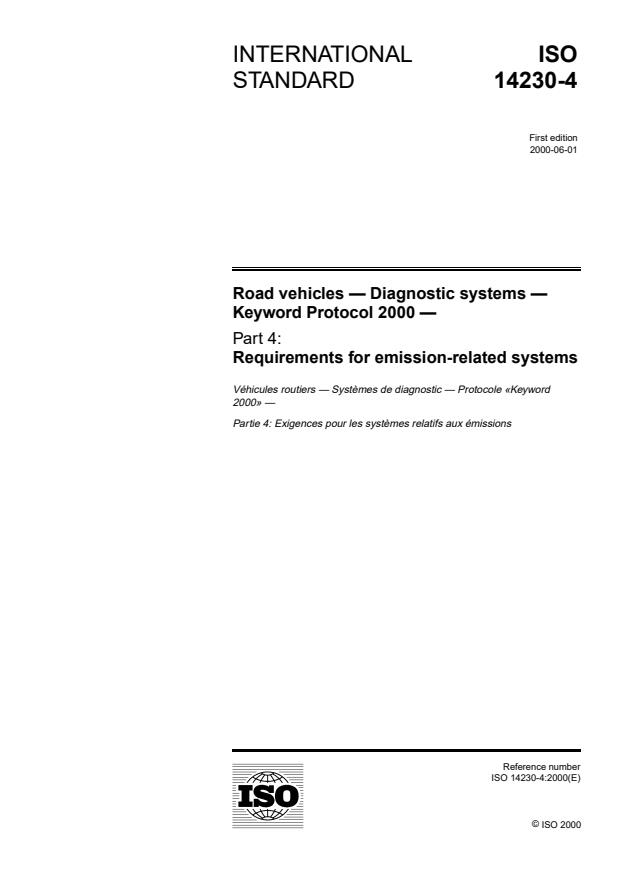
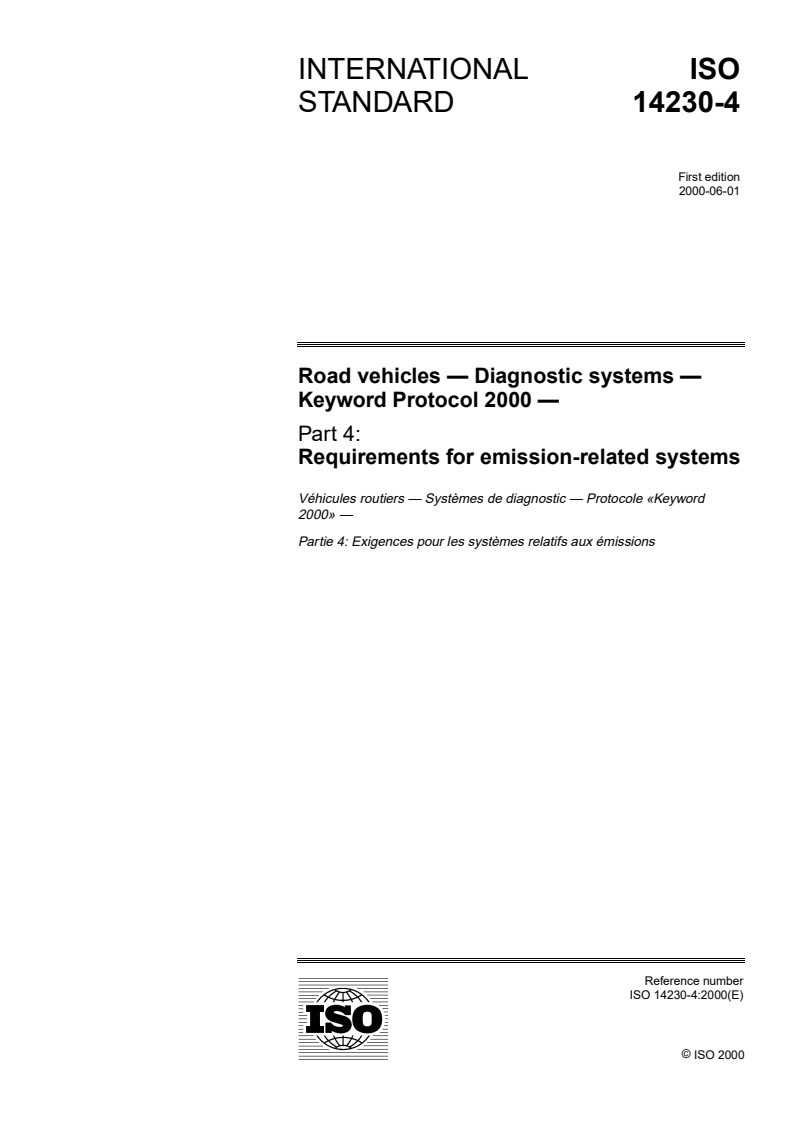
INTERNATIONAL ISO
STANDARD 14230-4
First edition
2000-06-01
Road vehicles — Diagnostic systems —
Keyword Protocol 2000 —
Part 4:
Requirements for emission-related systems
Véhicules routiers — Systèmes de diagnostic — Protocole «Keyword
2000» —
Partie 4: Exigences pour les systèmes relatifs aux émissions
Reference number
PDF disclaimer
This PDF file may contain embedded typefaces. In accordance with Adobe's licensing policy, this file may be printed or viewed but shall not be
edited unless the typefaces which are embedded are licensed to and installed on the computer performing the editing. In downloading this file,
parties accept therein the responsibility of not infringing Adobe's licensing policy. The ISO Central Secretariat accepts no liability in this area.
Adobe is a trademark of Adobe Systems Incorporated.
Details of the software products used to create this PDF file can be found in the General Info relative to the file; the PDF-creation parameters
were optimized for printing. Every care has been taken to ensure that the file is suitable for use by ISO member bodies. In the unlikely event
that a problem relating to it is found, please inform the Central Secretariat at the address given below.
All rights reserved. Unless otherwise specified, no part of this publication may be reproduced or utilized in any form or by any means, elec-
tronic or mechanical, including photocopying and microfilm, without permission in writing from either ISO at the address below or ISO's mem-
ber body in the country of the requester.
ISO copyright office
Case postale 56 • CH-1211 Geneva 20
Tel. + 41 22 749 01 11
Fax + 41 22 734 10 79
E-mail copyright@iso.ch
Web www.iso.ch
Printed in Switzerland
©
ii ISO 2000 – All rights reserved
Foreword
ISO (the International Organization for Standardization) is a worldwide federation of national standards bodies (ISO
member bodies). The work of preparing International Standards is normally carried out through ISO technical com-
mittees. Each member body interested in a subject for which a technical committee has been established has the
right to be represented on that committee. International organizations, governmental and non-governmental, in liai-
son with ISO, also take part in the work. ISO collaborates closely with the International Electrotechnical Commission
(IEC) on all matters of electrotechnical standardization.
International Standards are drafted in accordance with the rules given in the ISO/IEC Directives, Part 3.
Draft International Standards adopted by the technical committees are circulated to the member bodies for voting.
Publication as an International Standard requires approval by at least 75 % of the member bodies casting a vote.
Attention is drawn to the possibility that some of the elements of this part of ISO 14230 may be the subject of patent
rights. ISO shall not be held responsible for identifying any or all such patent rights.
International Standard ISO 14230-4 was prepared by Technical Committee ISO/TC 22, Road vehicles, Subcommit-
tee SC 3, Electrical and electronic equipment.
ISO 14230 consists of the following parts, under the general title Road vehicles — Diagnostic systems — Keyword
Protocol 2000:
— Part 1: Physical layer
— Part 2: Data link layer
— Part 3: Application layer
— Part 4: Requirements for emission-related systems
©
ISO 2000 – All rights reserved iii
INTERNATIONAL STANDARD ISO 14230-4:2000(E)
Road vehicles — Diagnostic systems — Keyword Protocol 2000 —
Part 4:
Requirements for emission-related systems
1 Scope
This part of ISO 14230 specifies the requirements for the Keyword Protocol 2000 (KWP 2000) data link and con-
nected vehicle and scan tool when used to comply with on-board diagnostic (OBD) requirements for emission-related
test data.
This part of ISO 14230 only specifies requirements relative to the Keyword Protocol 2000 for OBD purposes. Com-
plete specification can be found in ISO 14230 parts 1 to 3 and in ISO 14229. ISO 14230-1, ISO 14230-2 and
ISO 14230-3 are applicable for OBD purposes only as explicitly referenced in this part of ISO 14230.
2 Normative references
The following normative documents contain provisions which, through reference in this text, constitute provisions of
this part of ISO 14230. For dated references, subsequent amendments to, or revisions of, any of these publications
do not apply. However, parties to agreements based on this part of ISO 14230 are encouraged to investigate the
possibility of applying the most recent editions of the normative documents indicated below. For undated references,
the latest edition of the normative document referred to applies. Members of ISO and IEC maintain registers of cur-
rently valid International Standards.
ISO 9141-2:1994, Road vehicles — Diagnostic systems — Part 2: CARB requirements for interchange of digital in-
formation.
ISO 14229:1998, Road vehicles — Diagnostic systems
...
INTERNATIONAL ISO
STANDARD 14230-4
First edition
2000-06-01
Road vehicles — Diagnostic systems —
Keyword Protocol 2000 —
Part 4:
Requirements for emission-related systems
Véhicules routiers — Systèmes de diagnostic — Protocole «Keyword
2000» —
Partie 4: Exigences pour les systèmes relatifs aux émissions
Reference number
PDF disclaimer
This PDF file may contain embedded typefaces. In accordance with Adobe's licensing policy, this file may be printed or viewed but shall not be
edited unless the typefaces which are embedded are licensed to and installed on the computer performing the editing. In downloading this file,
parties accept therein the responsibility of not infringing Adobe's licensing policy. The ISO Central Secretariat accepts no liability in this area.
Adobe is a trademark of Adobe Systems Incorporated.
Details of the software products used to create this PDF file can be found in the General Info relative to the file; the PDF-creation parameters
were optimized for printing. Every care has been taken to ensure that the file is suitable for use by ISO member bodies. In the unlikely event
that a problem relating to it is found, please inform the Central Secretariat at the address given below.
All rights reserved. Unless otherwise specified, no part of this publication may be reproduced or utilized in any form or by any means, elec-
tronic or mechanical, including photocopying and microfilm, without permission in writing from either ISO at the address below or ISO's mem-
ber body in the country of the requester.
ISO copyright office
Case postale 56 • CH-1211 Geneva 20
Tel. + 41 22 749 01 11
Fax + 41 22 734 10 79
E-mail copyright@iso.ch
Web www.iso.ch
Printed in Switzerland
©
ii ISO 2000 – All rights reserved
Foreword
ISO (the International Organization for Standardization) is a worldwide federation of national standards bodies (ISO
member bodies). The work of preparing International Standards is normally carried out through ISO technical com-
mittees. Each member body interested in a subject for which a technical committee has been established has the
right to be represented on that committee. International organizations, governmental and non-governmental, in liai-
son with ISO, also take part in the work. ISO collaborates closely with the International Electrotechnical Commission
(IEC) on all matters of electrotechnical standardization.
International Standards are drafted in accordance with the rules given in the ISO/IEC Directives, Part 3.
Draft International Standards adopted by the technical committees are circulated to the member bodies for voting.
Publication as an International Standard requires approval by at least 75 % of the member bodies casting a vote.
Attention is drawn to the possibility that some of the elements of this part of ISO 14230 may be the subject of patent
rights. ISO shall not be held responsible for identifying any or all such patent rights.
International Standard ISO 14230-4 was prepared by Technical Committee ISO/TC 22, Road vehicles, Subcommit-
tee SC 3, Electrical and electronic equipment.
ISO 14230 consists of the following parts, under the general title Road vehicles — Diagnostic systems — Keyword
Protocol 2000:
— Part 1: Physical layer
— Part 2: Data link layer
— Part 3: Application layer
— Part 4: Requirements for emission-related systems
©
ISO 2000 – All rights reserved iii
INTERNATIONAL STANDARD ISO 14230-4:2000(E)
Road vehicles — Diagnostic systems — Keyword Protocol 2000 —
Part 4:
Requirements for emission-related systems
1 Scope
This part of ISO 14230 specifies the requirements for the Keyword Protocol 2000 (KWP 2000) data link and con-
nected vehicle and scan tool when used to comply with on-board diagnostic (OBD) requirements for emission-related
test data.
This part of ISO 14230 only specifies requirements relative to the Keyword Protocol 2000 for OBD purposes. Com-
plete specification can be found in ISO 14230 parts 1 to 3 and in ISO 14229. ISO 14230-1, ISO 14230-2 and
ISO 14230-3 are applicable for OBD purposes only as explicitly referenced in this part of ISO 14230.
2 Normative references
The following normative documents contain provisions which, through reference in this text, constitute provisions of
this part of ISO 14230. For dated references, subsequent amendments to, or revisions of, any of these publications
do not apply. However, parties to agreements based on this part of ISO 14230 are encouraged to investigate the
possibility of applying the most recent editions of the normative documents indicated below. For undated references,
the latest edition of the normative document referred to applies. Members of ISO and IEC maintain registers of cur-
rently valid International Standards.
ISO 9141-2:1994, Road vehicles — Diagnostic systems — Part 2: CARB requirements for interchange of digital in-
formation.
ISO 14229:1998, Road vehicles — Diagnostic systems
...
NORME ISO
INTERNATIONALE 14230-4
Première édition
2000-06-01
Véhicules routiers — Systèmes de
diagnostic — Protocole «Keyword 2000» —
Partie 4:
Exigences pour les systèmes relatifs aux
émissions
Road vehicles — Diagnostic systems — Keyword Protocol 2000 —
Part 4: Requirements for emission-related systems
Numéro de référence
PDF — Exonération de responsabilité
Le présent fichier PDF peut contenir des polices de caractères intégrées. Conformément aux conditions de licence d'Adobe, ce fichier peut
être imprimé ou visualisé, mais ne doit pas être modifié à moins que l'ordinateur employé à cet effet ne bénéficie d'une licence autorisant l'uti-
lisation de ces polices et que celles-ci y soient installées. Lors du téléchargement de ce fichier, les parties concernées acceptent de fait la res-
ponsabilité de ne pas enfreindre les conditions de licence d'Adobe. Le Secrétariat central de l'ISO décline toute responsabilité en la matière.
Adobe est une marque déposée d'Adobe Systems Incorporated.
Les détails relatifs aux produits logiciels utilisés pour la création du présent fichier PDF sont disponibles dans la rubrique General Info du fi-
chier; les paramètres de création PDF ont été optimisés pour l'impression. Toutes les mesures ont été prises pour garantir l'exploitation de ce
fichier par les comités membres de l'ISO. Dans le cas peu probable où surviendrait un problème d'utilisation, veuillez en informer le Secréta-
riat central à l'adresse donnée ci-dessous.
Droits de reproduction réservés. Sauf prescription différente, aucune partie de cette publication ne peut être reproduite ni utilisée sous quel-
que forme que ce soit et par aucun procédé, électronique ou mécanique, y compris la photocopie et les microfilms, sans l'accord écrit de l'ISO
à l'adresse ci-après ou au comité membre de l'ISO dans le pays du demandeur.
ISO copyright office
Case postale 56 • CH-1211 Geneva 20
Tel. + 41 22 749 01 11
Fax + 41 22 734 10 79
E-mail copyright@iso.ch
Web www.iso.ch
ImpriméenSuisse
©
ii ISO 2000 – Tous droits réservés
Avant-propos
L'ISO (Organisation internationale de normalisation) est une fédération mondiale d'organismes nationaux de norma-
lisation (comités membres de l'ISO). L'élaboration des Normes internationales est en général confiée aux comités
techniques de l'ISO. Chaque comité membre intéressé par une étude a le droit de faire partie du comité technique
créé à cet effet. Les organisations internationales, gouvernementales et non gouvernementales, en liaison avec
l'ISO participent également aux travaux. L'ISO collabore étroitement avec la Commission électrotechnique interna-
tionale (CEI) en ce qui concerne la normalisation électrotechnique.
Les Normes internationales sont rédigées conformément aux règles données dans les Directives ISO/CEI, Partie 3.
Les projets de Normes internationales adoptés par les comités techniques sont soumis aux comités membres pour
vote. Leur publication comme Normes internationales requiert l'approbation de 75 % au moins des comités membres
votants.
L'attention est appelée sur le fait que certains des éléments de la présente partie de l'ISO 14230 peuvent faire l'objet
de droits de propriété intellectuelle ou de droits analogues. L'ISO ne saurait être tenue pour responsable de ne pas
avoir identifié de tels droits de propriété et averti de leur existence.
La Norme internationale ISO 14230-4 a été élaborée par le comité technique ISO/TC 22, Véhicules routiers,sous-
comité SC 3, Équipement électrique et électronique.
L'ISO 14230 comprend les parties suivantes, présentées sous le titre général Véhicules routiers — Systèmes de
diagnostic — Protocole «Keyword 2000»:
— Partie 1: Couche physique
— Partie 2: Couche de liaison de données
— Partie 3: Couche application
— Partie 4: Exigences pour les systèmes relatifs aux émissions
©
ISO 2000 – Tous droits réservés iii
NORME INTERNATIONALE ISO 14230-4:2000(F)
Véhicules routiers — Systèmes de diagnostic — Protocole
«Keyword 2000» —
Partie 4:
Exigences pour les systèmes relatifs aux émissions
1 Domaine d'application
La présente partie de l'ISO 14230 spécifie les exigences relatives à la liaison de données du protocole «Keyword
Protocol 2000» (KWP 2000) ainsi qu'au véhicule relié et à l'outil de diagnostic lorsqu'ils sont utilisés pour répondre
aux exigences du diagnostic embarqué (OBD) pour les données d'essais relatives aux émissions.
La présente partie de l'ISO 14230 ne spécifie que les exigences relatives au protocole «Keyword Protocol 2000»
pour le diagnostic embarqué. La spécification complète figure dans l'ISO 14230, parties 1 à 3 et dans l'ISO 14229.
L'ISO 14230-1, l'ISO 14230-2 et l'ISO 14230-3 ne sont applicables aux fins du diagnostic embarqué que dans la me-
sure explicitement mentionnée dans la présente partie de l'ISO 14230.
2 Références normatives
Les documents normatifs suivants contiennent des dispositions qui, par suite de la référence qui y est faite, consti-
tuent des dispositions valables pour la présente partie de l'ISO 14230. Pour les références datées, les amendements
ultérieurs ou les révisions de ces publications ne s'appliquent pas. Toutefois, les parties prenantes aux accords fon-
dés sur la présente partie de l'ISO 14230 sont invitées à rechercher la possibilité d'appliquer les éditions les plus ré-
centes des documents normatifs indiqués ci-après. Pour les références non datées, la dernière édition du document
normatif en référence s'applique. Les membres de l'ISO et de la CEI possèdent le registre des Normes internationa-
les en vigueur.
ISO 9141-2:1994, Véhicules routiers — Systèmes de diagnostic — Partie 2: Caractéristiques CARB de l'échange de
données numériques.
ISO 14229:1998, Véhicules routiers — Systèmes de diagnostic — Spécification des services de diagnostic.
ISO 14230-1:1999, Véhicules routiers — Systèmes de diagnostic — Protocole «Keyword 2000» — Partie 1: Couche
physiq
...
NORME ISO
INTERNATIONALE 14230-4
Première édition
2000-06-01
Véhicules routiers — Systèmes de
diagnostic — Protocole «Keyword 2000» —
Partie 4:
Exigences pour les systèmes relatifs aux
émissions
Road vehicles — Diagnostic systems — Keyword Protocol 2000 —
Part 4: Requirements for emission-related systems
Numéro de référence
PDF — Exonération de responsabilité
Le présent fichier PDF peut contenir des polices de caractères intégrées. Conformément aux conditions de licence d'Adobe, ce fichier peut
être imprimé ou visualisé, mais ne doit pas être modifié à moins que l'ordinateur employé à cet effet ne bénéficie d'une licence autorisant l'uti-
lisation de ces polices et que celles-ci y soient installées. Lors du téléchargement de ce fichier, les parties concernées acceptent de fait la res-
ponsabilité de ne pas enfreindre les conditions de licence d'Adobe. Le Secrétariat central de l'ISO décline toute responsabilité en la matière.
Adobe est une marque déposée d'Adobe Systems Incorporated.
Les détails relatifs aux produits logiciels utilisés pour la création du présent fichier PDF sont disponibles dans la rubrique General Info du fi-
chier; les paramètres de création PDF ont été optimisés pour l'impression. Toutes les mesures ont été prises pour garantir l'exploitation de ce
fichier par les comités membres de l'ISO. Dans le cas peu probable où surviendrait un problème d'utilisation, veuillez en informer le Secréta-
riat central à l'adresse donnée ci-dessous.
Droits de reproduction réservés. Sauf prescription différente, aucune partie de cette publication ne peut être reproduite ni utilisée sous quel-
que forme que ce soit et par aucun procédé, électronique ou mécanique, y compris la photocopie et les microfilms, sans l'accord écrit de l'ISO
à l'adresse ci-après ou au comité membre de l'ISO dans le pays du demandeur.
ISO copyright office
Case postale 56 • CH-1211 Geneva 20
Tel. + 41 22 749 01 11
Fax + 41 22 734 10 79
E-mail copyright@iso.ch
Web www.iso.ch
ImpriméenSuisse
©
ii ISO 2000 – Tous droits réservés
Avant-propos
L'ISO (Organisation internationale de normalisation) est une fédération mondiale d'organismes nationaux de norma-
lisation (comités membres de l'ISO). L'élaboration des Normes internationales est en général confiée aux comités
techniques de l'ISO. Chaque comité membre intéressé par une étude a le droit de faire partie du comité technique
créé à cet effet. Les organisations internationales, gouvernementales et non gouvernementales, en liaison avec
l'ISO participent également aux travaux. L'ISO collabore étroitement avec la Commission électrotechnique interna-
tionale (CEI) en ce qui concerne la normalisation électrotechnique.
Les Normes internationales sont rédigées conformément aux règles données dans les Directives ISO/CEI, Partie 3.
Les projets de Normes internationales adoptés par les comités techniques sont soumis aux comités membres pour
vote. Leur publication comme Normes internationales requiert l'approbation de 75 % au moins des comités membres
votants.
L'attention est appelée sur le fait que certains des éléments de la présente partie de l'ISO 14230 peuvent faire l'objet
de droits de propriété intellectuelle ou de droits analogues. L'ISO ne saurait être tenue pour responsable de ne pas
avoir identifié de tels droits de propriété et averti de leur existence.
La Norme internationale ISO 14230-4 a été élaborée par le comité technique ISO/TC 22, Véhicules routiers,sous-
comité SC 3, Équipement électrique et électronique.
L'ISO 14230 comprend les parties suivantes, présentées sous le titre général Véhicules routiers — Systèmes de
diagnostic — Protocole «Keyword 2000»:
— Partie 1: Couche physique
— Partie 2: Couche de liaison de données
— Partie 3: Couche application
— Partie 4: Exigences pour les systèmes relatifs aux émissions
©
ISO 2000 – Tous droits réservés iii
NORME INTERNATIONALE ISO 14230-4:2000(F)
Véhicules routiers — Systèmes de diagnostic — Protocole
«Keyword 2000» —
Partie 4:
Exigences pour les systèmes relatifs aux émissions
1 Domaine d'application
La présente partie de l'ISO 14230 spécifie les exigences relatives à la liaison de données du protocole «Keyword
Protocol 2000» (KWP 2000) ainsi qu'au véhicule relié et à l'outil de diagnostic lorsqu'ils sont utilisés pour répondre
aux exigences du diagnostic embarqué (OBD) pour les données d'essais relatives aux émissions.
La présente partie de l'ISO 14230 ne spécifie que les exigences relatives au protocole «Keyword Protocol 2000»
pour le diagnostic embarqué. La spécification complète figure dans l'ISO 14230, parties 1 à 3 et dans l'ISO 14229.
L'ISO 14230-1, l'ISO 14230-2 et l'ISO 14230-3 ne sont applicables aux fins du diagnostic embarqué que dans la me-
sure explicitement mentionnée dans la présente partie de l'ISO 14230.
2 Références normatives
Les documents normatifs suivants contiennent des dispositions qui, par suite de la référence qui y est faite, consti-
tuent des dispositions valables pour la présente partie de l'ISO 14230. Pour les références datées, les amendements
ultérieurs ou les révisions de ces publications ne s'appliquent pas. Toutefois, les parties prenantes aux accords fon-
dés sur la présente partie de l'ISO 14230 sont invitées à rechercher la possibilité d'appliquer les éditions les plus ré-
centes des documents normatifs indiqués ci-après. Pour les références non datées, la dernière édition du document
normatif en référence s'applique. Les membres de l'ISO et de la CEI possèdent le registre des Normes internationa-
les en vigueur.
ISO 9141-2:1994, Véhicules routiers — Systèmes de diagnostic — Partie 2: Caractéristiques CARB de l'échange de
données numériques.
ISO 14229:1998, Véhicules routiers — Systèmes de diagnostic — Spécification des services de diagnostic.
ISO 14230-1:1999, Véhicules routiers — Systèmes de diagnostic — Protocole «Keyword 2000» — Partie 1: Couche
physiq
...