

ISO 5409:2024
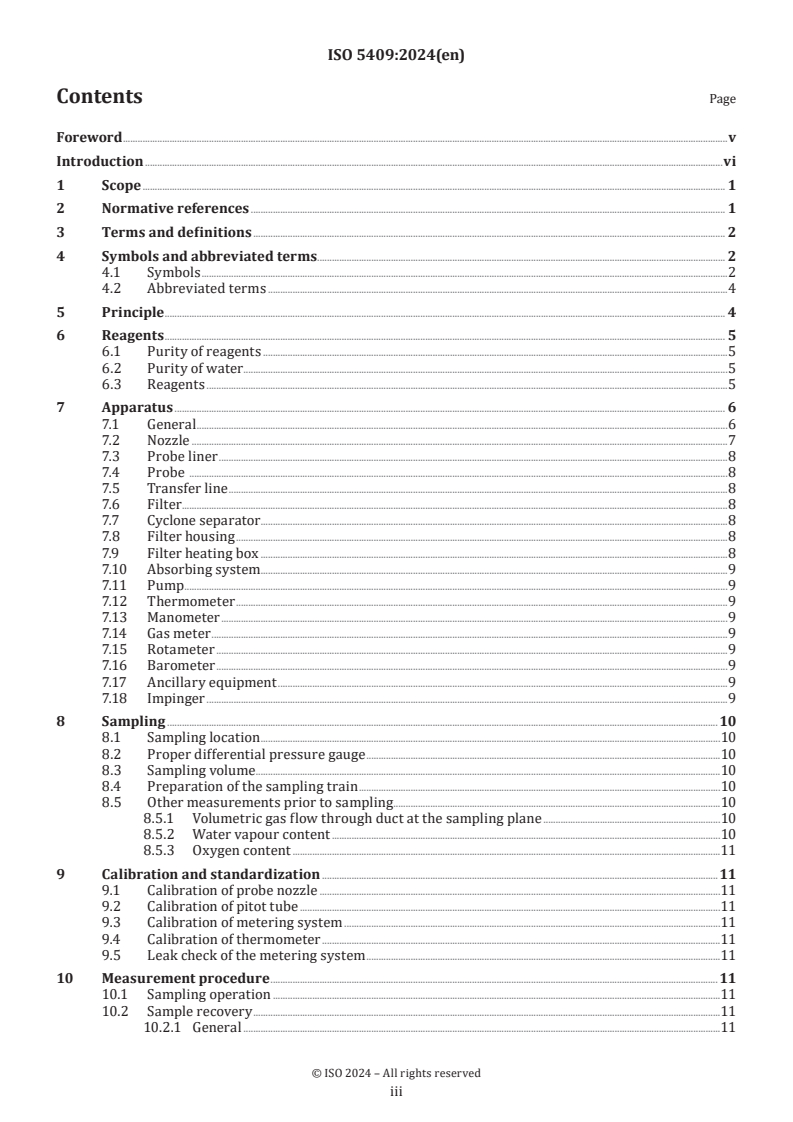
(Main)Stationary source emissions — Chemical absorption method for sampling and determining mercury species in flue gas
General Information
- Abstract
This document describes a method for the sampling and determining mercury species in flue gas passing through ducts or chimney stacks. Mercury generally exists in gaseous elemental form, gaseous oxidized form and particulate-bound form. This method applies to the sampling and determination of gaseous elemental mercury (Hg0), gaseous oxidized mercury (Hg2+), particulate-bound mercury (HgP) and total mercury (HgT) in the flue gas from stationary sources. This method is suitable at locations with high dust content, including locations upstream of the dust removal device with high particulate loadings in flue gas up to 120 g/m3. This method is applicable to locations with sulfur dioxide (SO2) concentration up to 0,25 % when the sampling volume is 0,5 m3 (on a dry basis as corrected to standard conditions). The limit of detection and the limit of determination depend on the instrumental limit of detection, reagent blank, field blank, measurement technique and volume of sampled gas. When the sampling volume is 1,5 m3 (on a dry basis as corrected to standard conditions), the expected limits of detection for Hg0, HgP, Hg2+ and HgT are 0,103 μg/m3, 0,011 μg/m3, 0,035 μg/m3 and 0,127 μg/m3, respectively. The expected limits of determination for Hg0, HgP, Hg2+ and HgT are 0,229 μg/m3, 0,025 μg/m3, 0,082 μg/m3 and 0,263 μg/m3, respectively.
- Status
- Published
- Publication Date
- 05-Nov-2024
- Technical Committee
- ISO/TC 146/SC 1 - Stationary source emissions
- Drafting Committee
- ISO/TC 146/SC 1 - Stationary source emissions
- Current Stage
- 6060 - International Standard published
- Start Date
- 06-Nov-2024
- Due Date
- 10-Jun-2025
- Completion Date
- 06-Nov-2024



Overview
ISO 5409:2024 - "Stationary source emissions - Chemical absorption method for sampling and determining mercury species in flue gas" specifies a validated chemical absorption procedure for measuring mercury species in flue gas from stationary sources. The method differentiates and quantifies gaseous elemental mercury (Hg0), gaseous oxidized mercury (Hg2+), particulate-bound mercury (HgP) and total mercury (HgT). It is designed for demanding conditions including high dust loads (up to 120 g/m3) and is usable upstream of dust removal devices.
Key Topics and Requirements
- Scope and applicability
- Sampling in ducts or stacks from stationary sources.
- Suitable for high particulate loads and for SO2 concentrations up to 0.25 % at a sampling volume of 0.5 m3 (dry, corrected to standard conditions).
- Performance characteristics
- Limits depend on instrument detection, blanks, technique and sample volume.
- For a 1.5 m3 sampled volume, expected limits of detection (LOD): Hg0 0.103 μg/m3, HgP 0.011 μg/m3, Hg2+ 0.035 μg/m3, HgT 0.127 μg/m3.
- Expected limits of determination (LOQ) at 1.5 m3: Hg0 0.229 μg/m3, HgP 0.025 μg/m3, Hg2+ 0.082 μg/m3, HgT 0.263 μg/m3.
- Sampling system components
- Probe, probe liner, transfer line, filters (and heating box), cyclone separator, absorbing system (impingers), pumps and metering devices.
- Quality assurance / Quality control
- Reagent blanks, field blanks, field spikes, leak tests, parallel analyses, and independent checks for ash samples.
- Calibration and checks
- Calibration of probe nozzle, pitot tube, metering system, thermometers; leak checks before sampling.
- Sample handling and analysis
- Defined procedures for sample recovery, storage, preparation, and analytical determination of mercury in prepared solutions.
Applications and Users
ISO 5409 is targeted at professionals and organizations involved in mercury emissions monitoring and regulatory compliance:
- Environmental testing laboratories and stack-testing contractors
- Industrial facilities (power plants, incinerators, cement plants, metal smelters) performing compliance checks and permitting tests
- Environmental regulators and auditors conducting source-specific monitoring and enforcement
- Consulting firms performing emissions inventories, source apportionment, and process optimization
Practical uses include compliance monitoring, permitting, emissions inventory development, control technology evaluation, and operator due diligence for mercury control.
Related Standards
- Relevant to other ISO and national standards on stationary source emissions, stack sampling and air quality monitoring. Consult ISO and national bodies for complementary guidance on sampling locations, flow measurement and reporting conventions.
Keywords: ISO 5409, mercury emissions, flue gas sampling, chemical absorption method, Hg0, Hg2+, HgP, HgT, stationary source emissions, stack testing, limit of detection.
Get Certified
Connect with accredited certification bodies for this standard

CIS Institut d.o.o.
Personal Protective Equipment (PPE) certification body. Notified Body NB-2890 for EU Regulation 2016/425 PPE.

Kiwa BDA Testing
Building and construction product certification.
Kmetijski inštitut Slovenije
Agricultural Institute of Slovenia. Soil testing, plant health, agricultural product analysis.
Sponsored listings
Frequently Asked Questions
ISO 5409:2024 is a standard published by the International Organization for Standardization (ISO). Its full title is "Stationary source emissions — Chemical absorption method for sampling and determining mercury species in flue gas". This standard covers: This document describes a method for the sampling and determining mercury species in flue gas passing through ducts or chimney stacks. Mercury generally exists in gaseous elemental form, gaseous oxidized form and particulate-bound form. This method applies to the sampling and determination of gaseous elemental mercury (Hg0), gaseous oxidized mercury (Hg2+), particulate-bound mercury (HgP) and total mercury (HgT) in the flue gas from stationary sources. This method is suitable at locations with high dust content, including locations upstream of the dust removal device with high particulate loadings in flue gas up to 120 g/m3. This method is applicable to locations with sulfur dioxide (SO2) concentration up to 0,25 % when the sampling volume is 0,5 m3 (on a dry basis as corrected to standard conditions). The limit of detection and the limit of determination depend on the instrumental limit of detection, reagent blank, field blank, measurement technique and volume of sampled gas. When the sampling volume is 1,5 m3 (on a dry basis as corrected to standard conditions), the expected limits of detection for Hg0, HgP, Hg2+ and HgT are 0,103 μg/m3, 0,011 μg/m3, 0,035 μg/m3 and 0,127 μg/m3, respectively. The expected limits of determination for Hg0, HgP, Hg2+ and HgT are 0,229 μg/m3, 0,025 μg/m3, 0,082 μg/m3 and 0,263 μg/m3, respectively.
This document describes a method for the sampling and determining mercury species in flue gas passing through ducts or chimney stacks. Mercury generally exists in gaseous elemental form, gaseous oxidized form and particulate-bound form. This method applies to the sampling and determination of gaseous elemental mercury (Hg0), gaseous oxidized mercury (Hg2+), particulate-bound mercury (HgP) and total mercury (HgT) in the flue gas from stationary sources. This method is suitable at locations with high dust content, including locations upstream of the dust removal device with high particulate loadings in flue gas up to 120 g/m3. This method is applicable to locations with sulfur dioxide (SO2) concentration up to 0,25 % when the sampling volume is 0,5 m3 (on a dry basis as corrected to standard conditions). The limit of detection and the limit of determination depend on the instrumental limit of detection, reagent blank, field blank, measurement technique and volume of sampled gas. When the sampling volume is 1,5 m3 (on a dry basis as corrected to standard conditions), the expected limits of detection for Hg0, HgP, Hg2+ and HgT are 0,103 μg/m3, 0,011 μg/m3, 0,035 μg/m3 and 0,127 μg/m3, respectively. The expected limits of determination for Hg0, HgP, Hg2+ and HgT are 0,229 μg/m3, 0,025 μg/m3, 0,082 μg/m3 and 0,263 μg/m3, respectively.
ISO 5409:2024 is classified under the following ICS (International Classification for Standards) categories: 13.040.40 - Stationary source emissions. The ICS classification helps identify the subject area and facilitates finding related standards.
ISO 5409:2024 is available in PDF format for immediate download after purchase. The document can be added to your cart and obtained through the secure checkout process. Digital delivery ensures instant access to the complete standard document.
Standards Content (Sample)
SLOVENSKI STANDARD
01-september-2025
Emisije nepremičnih virov - Metoda kemične absorpcije za vzorčenje in določanje
oblik živega srebra v odpadnem plinu
Stationary source emissions - Chemical absorption method for sampling and determining
mercury species in flue gas
Émissions de sources fixes - Échantillonnage et détermination du mercure dans les gaz
de combustion en utilisant la méthode d'absorption chimique
Ta slovenski standard je istoveten z: ISO 5409:2024
ICS:
13.040.40 Emisije nepremičnih virov Stationary source emissions
2003-01.Slovenski inštitut za standardizacijo. Razmnoževanje celote ali delov tega standarda ni dovoljeno.
International
Standard
ISO 5409
First edition
Stationary source emissions —
2024-11
Chemical absorption method for
sampling and determining mercury
species in flue gas
Émissions de sources fixes — Échantillonnage et détermination
du mercure dans les gaz de combustion en utilisant la méthode
d'absorption chimique
Reference number
© ISO 2024
All rights reserved. Unless otherwise specified, or required in the context of its implementation, no part of this publication may
be reproduced or utilized otherwise in any form or by any means, electronic or mechanical, including photocopying, or posting on
the internet or an intranet, without prior written permission. Permission can be requested from either ISO at the address below
or ISO’s member body in the country of the requester.
ISO copyright office
CP 401 • Ch. de Blandonnet 8
CH-1214 Vernier, Geneva
Phone: +41 22 749 01 11
Email: copyright@iso.org
Website: www.iso.org
Published in Switzerland
ii
Contents Page
Foreword .v
Introduction .vi
1 Scope . 1
2 Normative references . 1
3 Terms and definitions . 2
4 Symbols and abbreviated terms. 2
4.1 Symbols .2
4.2 Abbreviated terms .4
5 Principle . 4
6 Reagents . 5
6.1 Purity of reagents .5
6.2 Purity of water . .5
6.3 Reagents .5
7 Apparatus . 6
7.1 General .6
7.2 Nozzle .7
7.3 Probe liner .8
7.4 Probe .8
7.5 Transfer line .8
7.6 Filter .8
7.7 Cyclone separator . .8
7.8 Filter housing .8
7.9 Filter heating box .8
7.10 Absorbing system.9
7.11 Pump . .9
7.12 Thermometer .9
7.13 Manometer .9
7.14 Gas meter .9
7.15 Rotameter .9
7.16 Barometer .9
7.17 Ancillary equipment .9
7.18 Impinger .9
8 Sampling . 10
8.1 Sampling location .10
8.2 Proper differential pressure gauge .10
8.3 Sampling volume .10
8.4 Preparation of the sampling train .10
8.5 Other measurements prior to sampling .10
8.5.1 Volumetric gas flow through duct at the sampling plane .10
8.5.2 Water vapour content .10
8.5.3 Oxygen content .11
9 Calibration and standardization .11
9.1 Calibration of probe nozzle .11
9.2 Calibration of pitot tube .11
9.3 Calibration of metering system .11
9.4 Calibration of thermometer .11
9.5 Leak check of the metering system .11
10 Measurement procedure .11
10.1 Sampling operation .11
10.2 Sample recovery .11
10.2.1 General .11
iii
10.2.2 Recovery of ash sample . 12
10.2.3 Recovery of absorber samples. 12
10.2.4 Recovery of silica gel impinger . 12
10.2.5 Storage of recovered samples . 12
10.3 Sample preparation . 12
10.3.1 Preparation of ash sample . 12
10.3.2 Preparation of solution samples . 13
10.4 Analytical procedures . . 13
10.4.1 Reagent blank . 13
10.4.2 Analytical procedure for mercury in prepared solution . 13
11 Quality assurance/quality control . 14
11.1 General .14
11.2 QA/QC for the sampling .14
11.2.1 Absorbing system .14
11.2.2 Operation prior to sampling and during sampling .14
11.2.3 Field blank .14
11.2.4 Field spike . 15
11.2.5 Leak test . 15
11.2.6 Sampling in flue gas with high concentration of SO . 15
11.3 QA/QC for the analysis . 15
11.3.1 Reagent blank . 15
11.3.2 Separate mercury standard solutions. 15
11.3.3 Parallel analysis . 15
11.3.4 Independent QA/QC checks for ash samples .16
12 Expression of results .16
12.1 Dry gas volume .16
12.2 Content of water vapour .16
P
12.3 Mass concentration of Hg .17
2+
12.4 Mass concentration of Hg .18
12.5 Mass concentration of Hg .18
T
12.6 Mass concentration of Hg .19
12.7 Mass concentration of mercury in the gas stream on a dry basis at STP and reference
oxygen volume fraction . 20
13 Performance characteristics .20
13.1 Instrumental limits of detection . 20
13.2 E valuation of the measurement uncertainty . 20
14 Test report .20
Annex A (informative) Evaluation of limit of detection, limit of determination, precision and
accuracy in laboratory tests .23
Annex B (informative) Results of evaluation of measurement uncertainties in field tests .29
Bibliography .37
iv
Foreword
ISO (the International Organization for Standardization) is a worldwide federation of national standards
bodies (ISO member bodies). The work of preparing International Standards is normally carried out through
ISO technical committees. Each member body interested in a subject for which a technical committee
has been established has the right to be represented on that committee. International organizations,
governmental and non-governmental, in liaison with ISO, also take part in the work. ISO collaborates closely
with the International Electrotechnical Commission (IEC) on all matters of electrotechnical standardization.
The procedures used to develop this document and those intended for its further maintenance are described
in the ISO/IEC Directives, Part 1. In particular, the different approval criteria needed for the different types
of ISO document should be noted. This document was drafted in accordance with the editorial rules of the
ISO/IEC Directives, Part 2 (see www.iso.org/directives).
ISO draws attention to the possibility that the implementation of this document may involve the use of (a)
patent(s). ISO takes no position concerning the evidence, validity or applicability of any claimed patent
rights in respect thereof. As of the date of publication of this document, ISO had not received notice of (a)
patent(s) which may be required to implement this document. However, implementers are cautioned that
this may not represent the latest information, which may be obtained from the patent database available at
www.iso.org/patents. ISO shall not be held responsible for identifying any or all such patent rights.
Any trade name used in this document is information given for the convenience of users and does not
constitute an endorsement.
For an explanation of the voluntary nature of standards, the meaning of ISO specific terms and expressions
related to conformity assessment, as well as information about ISO's adherence to the World Trade
Organization (WTO) principles in the Technical Barriers to Trade (TBT), see www.iso.org/iso/foreword.html.
This document was prepared by Technical Committee ISO/TC 146, Air quality, Subcommittee SC 1, Stationary
source emissions.
Any feedback or questions on this document should be directed to the user’s national standards body. A
complete listing of these bodies can be found at www.iso.org/members.html.
v
Introduction
Mercury is a highly toxic environmental pollutant that bioaccumulates in the food chain and can have an
impact on neurological health. Most of the anthropogenic mercury is emitted from stationary sources such
as coal combustion plants, cement kilns, non-ferrous metal smelting operations and waste incineration
facilities. The monitoring and control of mercury mass emissions from stationary sources is increasingly
important for preventing global environmental pollution and health damage caused by mercury.
The transformation and fate of mercury in the atmosphere is defined by its chemical and physical forms.
Additionally, the development and implementation of mercury control technologies is highly dependent on
the mercury speciation at different parts of the industrial process.
vi
International Standard ISO 5409:2024(en)
Stationary source emissions — Chemical absorption method
for sampling and determining mercury species in flue gas
1 Scope
This document describes a method for the sampling and determining mercury species in flue gas passing
through ducts or chimney stacks. Mercury generally exists in gaseous elemental form, gaseous oxidized form
and particulate-bound form. This method applies to the sampling and determination of gaseous elemental
0 2+ P T
mercury (Hg ), gaseous oxidized mercury (Hg ), particulate-bound mercury (Hg ) and total mercury (Hg )
in the flue gas from stationary sources.
This method is suitable at locations with high dust content, including locations upstream of the dust removal
device with high particulate loadings in flue gas up to 120 g/m .
This method is applicable to locations with sulfur dioxide (SO ) concentration up to 0,25 % when the
sampling volume is 0,5 m (on a dry basis as corrected to standard conditions).
The limit of detection and the limit of determination depend on the instrumental limit of detection, reagent
blank, field blank, measurement technique and volume of sampled gas. When the sampling volume is 1,5 m
0 P 2+
(on a dry basis as corrected to standard conditions), the expected limits of detection for Hg , Hg , Hg
T 3 3 3 3
and Hg are 0,103 μg/m , 0,011 μg/m , 0,035 μg/m and 0,127 μg/m , respectively. The expected limits
0 P 2+ T 3 3 3 3
of determination for Hg , Hg , Hg and Hg are 0,229 μg/m , 0,025 μg/m , 0,082 μg/m and 0,263 μg/m ,
respectively.
2 Normative references
The following documents are referred to in the text in such a way that some or all of their content constitutes
requirements of this document. For dated references, only the edition cited applies. For undated references,
the latest edition of the referenced document (including any amendments) applies.
ISO 3696:1987, Water for analytical laboratory use — Specification and test methods
ISO 9096:2017, Stationary source emissions — Manual determination of mass concentration of particulate matter
ISO 10396, Stationary source emissions — Sampling for the automated determination of gas emission
concentrations for permanently-installed monitoring systems
ISO 10780:1994, Stationary source emissions — Measurement of velocity and volume flowrate of gas streams
in ducts
ISO 12141, Stationary source emissions — Determination of mass concentration of particulate matter (dust) at
low concentrations — Manual gravimetric method
ISO 12846:2012, Water quality — Determination of mercury — Method using atomic absorption spectrometry
(AAS) with and without enrichment
ISO 17852:2006, Water quality — Determination of mercury — Method using atomic fluorescence spectrometry
ISO 20988:2007, Air quality — Guidelines for estimating measurement uncertainty
ISO 21741:2020, Stationary source emissions — Sampling and determination of mercury compounds in flue gas
using gold amalgamation trap
3 Terms and definitions
For the purposes of this document, the following terms and definitions apply.
ISO and IEC maintain terminology databases for use in standardization at the following addresses:
— ISO Online browsing platform: available at https:// www .iso .org/ obp
— IEC Electropedia: available at https:// www .electropedia .org/
3.1
gaseous elemental mercury
mercury in its elemental form in flue gas
3.2
gaseous oxidized mercury
mercury in its mercurous or mercuric oxidation states in flue gas
3.3
gaseous mercury
mercury existing both as elemental and oxidized forms passing through a filter having at least 99,5 %
collection efficiency for 0,3 μm diameter particles
3.4
particulate-bound mercury
mercury existing both as elemental or oxidized forms which are bound with particles collected by a filter
having at least 99,5 % collection efficiency for 0,3 μm diameter particles
3.5
sampling train
complete setup including nozzle, probe, probe liner, filter, filter housing, impingers and connectors
3.6
total mercury
summation of gaseous elemental mercury (3.1), gaseous oxidized mercury (3.2) and particulate-bound
mercury (3.4)
3.7
isokinetic sampling
sampling at a flowrate such that the velocity and direction of the gas entering the sampling nozzle is the
same as that of the gas in the duct at the sampling point
4 Symbols and abbreviated terms
4.1 Symbols
content of water vapour in the gas sample, normalized to standard temperature
B g/m
ws
and pressure (STP)
C
concentration of mercury in the prepared sample solution aliquot digested from
SH, g,a
μg/ml
ash of container 1a
C
concentration of mercury in the prepared sample solution aliquot digested from
SH, g,b
μg/ml
ash of container 1b
C concentration of mercury in the probe rinse sample aliquot μg/ml
RS,Hg
C concentration of mercury in the prepared sample solution aliquot in container 2
μg/ml
KClH, g
C concentration of mercury in the KCl reagent blank aliquot μg/ml
KClb,
C concentration of mercury in prepared sample solution aliquot in container 3 μg/ml
HNOH− OH, g
32 2
C concentration of mercury in HNO –H O reagent blank aliquot μg/ml
HNOH− Ob, 3 2 2
32 2
C concentration of mercury in prepared sample solution aliquot in container 4 μg/ml
HSOK− MnOH, g
24 4
C concentration of mercury in H SO –KMnO reagent blank aliquot μg/ml
HSOK− MnOb, 2 4 4
24 4
F
dilution factor obtained by dividing the total mass of ash of container 1a by the
D,a
g
mass of ash analysed
F
dilution factor obtained by dividing the total mass of ash of container 1b by the
D,b
g
mass of ash analysed
P atmospheric pressure kPa
atm
average pressure difference between the sample gas before gas meter and atmos-
P
kPa
av
phere
T average temperature of the sample gas before gas meter K
av
V volume of dry flue gas sample m
m
V final gas meter reading at the end of sampling m
f
V initial gas meter reading at the beginning of sampling m
i
V
volume of air drawn through the gas meter during any intermediate leak test m
l
V total volume of dry gas sampled at STP m
d
V volume of dry flue gas sample in the main stream, normalized to STP m
main,d
V volume of dry flue gas sample in the side stream, normalized to STP m
side,d
V volume of dry flue gas sample for gaseous mercury analysis, normalized to STP m
Gd,
P 3
V volume of dry flue gas sample for Hg analysis, normalized to STP m
Sd,
v
volume of prepared sample solution digested from ash of container 1a ml
S,a
v
volume of prepared sample solution digested from ash of container 1b ml
S,b
v total volume of probe rinse sample ml
RS
v total volume of solution in container 2 from which the sample aliquot was taken ml
KCl
v total volume of KCl reagent blank from which the sample aliquot was taken ml
KClb,
v total volume of solution in container 3 from which the sample aliquot was taken ml
HNOH− O
32 2
total volume of HNO –H O reagent blank from which the sample aliquot was
3 2 2
v ml
HNOH− Ob,
32 2
taken
v total volume of solution in container 4 from which the sample aliquot was taken ml
HSOK− MnO
24 4
total volume of H SO –KMnO reagent blank from which the sample aliquot was
2 4 4
v ml
HSOK− MnOb,
24 4 taken
W mass of impinger after sampling g
il
W mass of impinger before sampling g
i0
P 3
ρ mass concentration of Hg in the gas stream on a dry basis at STP μg/m
SH,,gd
2+
mass concentration of Hg captured by KCl impinger solution in the gas stream on
ρ μg/m
2+
Hg ,d a dry basis at STP
mass concentration of Hg captured by HNO –H O impinger solution on a dry
3 2 2 3
ρ µg/m
Hg ,,HNOH− Od basis at STP
32 2
mass concentration of Hg captured by H SO –KMnO impinger solution on a dry
2 4 4 3
ρ
µg/m
Hg ,,HSOK− MnOd
basis at STP
24 4
0 3
ρ mass concentration of Hg in the gas stream on a dry basis at STP µg/m
Hg ,d
T 3
ρ mass concentration of Hg in the gas stream on a dry basis at STP µg/m
Hg,d
mass concentration of mercury on a dry basis at STP and reference oxygen concen-
ρ μg/m
Hg,,dryref
tration
mass concentration of mercury measured during the sampling on a dry basis at
ρ μg/m
Hg,dry
STP
ϕ volume fraction of the reference oxygen %
Or, ef
volume fraction of the average oxygen on a dry basis measured during the sam-
ϕ
%
Od, ry
pling
4.2 Abbreviated terms
AAS atomic absorption spectrometry
AFS atomic fluorescence spectrometry
CVAAS cold vapour atomic absorption spectrometry
CVAFS cold vapour atomic fluorescence spectrometry
FEP perfluoro(ethylene/propylene), tetrafluoro ethylene/hexafluoropropylene
FGD flue gas desulfurization system
PFA perfluoroalkoxy alkane
PTFE polytetra fluoroethylene
QA/QC quality assurance/quality control
SCR selective catalytic reduction unit
STP standard temperature and pressure, 273,15 K and 101,325 kPa
5 Principle
Sampling for particulate-bound mercury is performed isokinetically and sampling for gaseous mercury is
performed either isokinetically or non-isokinetically. Sampling for particulate-bound mercury is performed
isokinetically in accordance with ISO 9096 or ISO 12141. When the flow rates for the measurement of
gaseous mercury and particulate-bound mercury are the same, a main stream sampling is applied. If the
flow rate for the measurement of gaseous mercury is lower than that for particulate-bound mercury, a side
stream sampling is applied.
Dust in the sampled gas stream is collected on a filter whereafter the gas stream is passed through a series
of impingers in an ice bath. After sampling, the filter and absorber solution are prepared and analysed
for mercury in laboratory. The recovery techniques include acid leaching and digestion. The analytical
techniques include but are not limited to cold vapour atomic absorption spectrometry (CVAAS, see
ISO 12846) or cold vapour atomic fluorescence spectrometry (CVAFS, see ISO 17852) with and without gold
amalgamation.
When sampling at locations with particulate concentration higher than 100 mg/m , such as upstream of the
dust removal device, a cyclone separator is used before the filter, the cyclone separator and filter are placed
in the heated filter box. The particles fall into the ash storage flask of cyclone separator under gravity to
avoid the influence of too much ash on sampling, and ensure the sampling time and speed.
6 Reagents
6.1 Purity of reagents
Unless otherwise indicated, the reagents in 6.3 are required to be of guaranteed purity.
6.2 Purity of water
Unless otherwise indicated, references to water shall be conform with grade 1 specified in ISO 3696:1987
for all sample preparations and dilutions.
6.3 Reagents
6.3.1 Concentrated hydrochloric acid, ω(HCl) = 37 %, ρ(HCl) = 1,19 g/ml.
6.3.2 Hydrogen peroxide, of a volume fraction of 30 %.
6.3.3 Concentrated nitric acid, ω(HNO ) = 65 %, ρ(HNO ) = 1,4 g/ml.
3 3
6.3.4 Concentrated sulfuric acid, ω(H SO ) = 98,3 %, ρ(H SO ) = 1,84 g/ml.
2 4 2 4
6.3.5 Potassium chloride solution, c(KCl) = 1 mol/l.
Add 74,56 g of KCl slowly to a 1 000 ml volumetric flask containing approximately 500 ml of water with
stirring, and then add water to make a volume of 1 000 ml with stirring. A new batch of solution should be
made prior to each field test.
6.3.6 HNO -H O solution, of a volume fraction of 5 % HNO and of 10 % H O .
3 2 2 3 2 2
Add 50 ml of concentrated HNO (6.3.3) to a 1 000 ml volumetric flask containing approximately 500 ml of
water slowly with stirring, and then add 333 ml of a volume fraction of 30 % of H O (6.3.2) with stirring.
2 2
Dilute with water to make a volume of 1 000 ml with stirring. A new batch of solution should be made prior
to each field test.
6.3.7 H SO -KMnO solution, ω(KMnO ) = 4 %, and a volume fraction of 10 % of H SO .
2 4 4 4 2 4
Add slowly 100 ml of concentrated sulfuric acid (6.3.4) to a 1 000 ml volumetric flask containing
approximately 600 ml of water while cooling and stirring, and then add water with stirring to make a
volume of 1 000 ml. This solution is a volume fraction of 10 % of H SO .
2 4
Mix slowly 40 g of KMnO to a 1 000 ml volumetric flask containing approximately 800 ml of a volume
fraction of 10 % of H SO with stirring, and then add a volume fraction of 10 % of H SO with stirring to
2 4 2 4
make a volume of 1 000 ml.
6.3.8 Concentrated hydrofluoric acid, ω(HF) = 40 %, ρ(HF) = 1,16 g/ml.
6.3.9 Rinse solution, ω(HNO ) = 50 g/kg.
In accordance with ISO 21741, take 77 g of concentrated nitric acid (6.3.3) in a fluoroplastic bottle made of
PTFE, PFA or FEP, and add water to make a total weight of 1 kg.
6.3.10 Potassium permanganate solution, of ω = 5 %.
Mix 25 g of KMnO into water, dilute to 500 ml and stir vigorously.
6.3.11 Hydroxylamine hydrochloride solution, of ω = 10 %.
Mix 50 g of NH OH·HCl slowly to a 500 ml volumetric flask containing approximately 300 ml of water with
stirring and then add water while stirring to make a volume of 500 ml.
6.3.12 Mercury stock solution, conforming with mercury standard solution as specified in ISO 12846 and
ISO 17852.
6.3.13 Silica gel, of a self-indicating coarse grade.
6.3.14 Boric acid (H BO ), solid.
3 3
7 Apparatus
7.1 General
Two types of sampling systems, a main stream arrangement and a side stream arrangement, can be
employed. Schematics of both systems are given in Figure 1. In the main stream system all the sampled flue
gas is passed through the filter and impinger solution, while in the side stream arrangement only a part of
the sampled flue gas is passed through the impingers. The main stream sampling is used if the flow rate and
total sampling volume for the measurements of gaseous mercury and particulate-bound mercury are the
same. The side stream sampling is used when the flow rate or total sampling volume for the measurements
of gaseous mercury and particulate-bound mercury is different. For example, to some measurement objects,
such as non-ferrous metal smelting industry, the concentration of SO and mercury is extremely high, and
this can cause the sampling train to be over-loaded even with small amount of sampled flue gas.
The apparatus consists of a sampling probe including a nozzle and filter assembly that shall be heated if
the flue gas temperature is lower than 393 K. The absorbing system consists of eight impingers immersed
in an ice bath, a manometer, a pump, a gas meter and a rotameter. A thermometer and manometer shall be
included in the sampling train to measure the temperature and pressure of the metered gas. A barometer
shall be used to measure atmospheric pressure during the test in order that the volume of the gas sampled
can be normalized to the STP condition.
a) Main stream sampling
b) Side stream sampling
Key
1a nozzle 6 HNO -H O impinger
3 2 2
1b probe 7 H SO -KMnO impingers
2 4 4
1c probe liner 8 silica gel impinger
2a cyclone separator (in case the particulate 9 pump
concentration is >100 mg/m )
10 manometer
2b filter and filter housing 11 thermometer
2c heated filter box 12 gas meter
3 heated transfer line 13 rotameter
4 T-piece 14 main stream
5 KCl impingers 15 side stream
Figure 1 — Schematic diagram of the sampling train
7.2 Nozzle
The diameter of nozzle shall be chosen to be compatible with the required gas sampling volume flow rate.
The choice of the nozzle shall be in accordance with ISO 12141 or ISO 9096.
The nozzle shall be capable of withstanding the temperature in the duct. It shall be resistant to chemical
attack from various pollutants in the duct. Suitable materials for mercury sampling are silica glass and
PTFE. Glass nozzles are required unless alternate nozzles are constructed of materials that are free from
contamination and will not interact with the sample. Probe fittings constructed of PTFE, polypropylene,
etc., are required instead of metal fittings to prevent contamination.
7.3 Probe liner
If the sampling train is out-of-stack filtration, the probe liner should be constructed of quartz or borosilicate
glass. If an in-stack filtration sampling configuration is used, the probe liner may be constructed of
borosilicate glass, quartz or PTFE depending on the flue gas temperature.
7.4 Probe
In order to reduce the adsorption of gaseous mercury by dust, and prevent water and acid condensation, the
probe shall be equipped with a heating system. The heating system shall increase the probe temperature to
higher than 393 K or at the temperature of flue gas, whichever is greater. In the case of sampling at locations
with high temperature, such as above 533 K, the heating system shall be removed to prevent damage to the
heating mantle. However, note that higher temperatures can lead to the thermal degradation of mercury
compounds and the overestimation of Hg concentrations.
7.5 Transfer line
The transfer line should be resistant to chemical attack from gases and aerosols present in the sample gas.
Suitable materials for gaseous mercury sampling are silica glass, PTFE or PFA.
The transfer line should be cleaned thoroughly using rinse solution (6.3.9) and distilled water in sequence
and dried thoroughly before sampling.
The transfer line shall have a heating system capable of maintaining exit gas temperature at 393 K ± 5 K or at
least 20 K above the dew point temperature, whichever is higher.
7.6 Filter
Consistent with ISO 21741, the filter shall be capable of withstanding prolonged exposures up to 40 K above
the sample gas temperature to prevent a change in filter quality. The filter efficiency shall be better than
99,5 % on a test aerosol with a mean particle diameter of 0,3 μm at the maximum flow rate anticipated. The
filter material shall be unreactive to SO or sulfur trioxide (SO ). A maximum mercury content in the original
2 3
filter should be less than one tenth of the corresponding amounts which is calculated from the lower range
of determination. Silica fibre filters without binders are recommended. The filter shall be dried, equilibrated
and weighed in accordance with ISO 9096 or ISO 12141.
In the case of in-stack filtration, the filter is placed in the duct between the nozzle and the transfer line.
7.7 Cyclone separator
In the case of particulate concentration higher than 100 mg/m , it is recommended to use a cyclone separator.
Such as the sampling at upstream of dust removal device, a cyclone separator is added between the filter and
the probe liner, as shown in Figure 1. Suitable material for cyclone separator is quartz or borosilicate glass.
7.8 Filter housing
The filter housing shall have an airtight seal against leakage. If the flue gas temperature is below the dew
point or the filter housing cannot be inserted in the duct, the filter housing shall be placed outside the duct
(out-stack filtration) in accordance with ISO 9096 or ISO 12141. The filter housing shall be cleaned thoroughly
using the rinse solution (6.3.9) and distilled water in sequence and dried thoroughly before sampling.
7.9 Filter heating box
The filter heating box should have a heating system.
In the case of out-stack filtration, the cyclone separator, filter and filter housing are placed in the filter
heating box. In order to reduce the adsorption of gaseous mercury by dust on the filter, and to prevent water
and acid condensation, the filter heating box should be maintained at a temperature of 393 K ± 5 K or at the
flue gas temperature, whichever is greater.
7.10 Absorbing system
The absorbing system consists of eight impingers immersed in an ice bath and connected in series with leak-
free
...
International
Standard
ISO 5409
First edition
Stationary source emissions —
2024-11
Chemical absorption method for
sampling and determining mercury
species in flue gas
Émissions de sources fixes — Échantillonnage et détermination
du mercure dans les gaz de combustion en utilisant la méthode
d'absorption chimique
Reference number
© ISO 2024
All rights reserved. Unless otherwise specified, or required in the context of its implementation, no part of this publication may
be reproduced or utilized otherwise in any form or by any means, electronic or mechanical, including photocopying, or posting on
the internet or an intranet, without prior written permission. Permission can be requested from either ISO at the address below
or ISO’s member body in the country of the requester.
ISO copyright office
CP 401 • Ch. de Blandonnet 8
CH-1214 Vernier, Geneva
Phone: +41 22 749 01 11
Email: copyright@iso.org
Website: www.iso.org
Published in Switzerland
ii
Contents Page
Foreword .v
Introduction .vi
1 Scope . 1
2 Normative references . 1
3 Terms and definitions . 2
4 Symbols and abbreviated terms. 2
4.1 Symbols .2
4.2 Abbreviated terms .4
5 Principle . 4
6 Reagents . 5
6.1 Purity of reagents .5
6.2 Purity of water . .5
6.3 Reagents .5
7 Apparatus . 6
7.1 General .6
7.2 Nozzle .7
7.3 Probe liner .8
7.4 Probe .8
7.5 Transfer line .8
7.6 Filter .8
7.7 Cyclone separator . .8
7.8 Filter housing .8
7.9 Filter heating box .8
7.10 Absorbing system.9
7.11 Pump . .9
7.12 Thermometer .9
7.13 Manometer .9
7.14 Gas meter .9
7.15 Rotameter .9
7.16 Barometer .9
7.17 Ancillary equipment .9
7.18 Impinger .9
8 Sampling . 10
8.1 Sampling location .10
8.2 Proper differential pressure gauge .10
8.3 Sampling volume .10
8.4 Preparation of the sampling train .10
8.5 Other measurements prior to sampling .10
8.5.1 Volumetric gas flow through duct at the sampling plane .10
8.5.2 Water vapour content .10
8.5.3 Oxygen content .11
9 Calibration and standardization .11
9.1 Calibration of probe nozzle .11
9.2 Calibration of pitot tube .11
9.3 Calibration of metering system .11
9.4 Calibration of thermometer .11
9.5 Leak check of the metering system .11
10 Measurement procedure .11
10.1 Sampling operation .11
10.2 Sample recovery .11
10.2.1 General .11
iii
10.2.2 Recovery of ash sample . 12
10.2.3 Recovery of absorber samples. 12
10.2.4 Recovery of silica gel impinger . 12
10.2.5 Storage of recovered samples . 12
10.3 Sample preparation . 12
10.3.1 Preparation of ash sample . 12
10.3.2 Preparation of solution samples . 13
10.4 Analytical procedures . . 13
10.4.1 Reagent blank . 13
10.4.2 Analytical procedure for mercury in prepared solution . 13
11 Quality assurance/quality control . 14
11.1 General .14
11.2 QA/QC for the sampling .14
11.2.1 Absorbing system .14
11.2.2 Operation prior to sampling and during sampling .14
11.2.3 Field blank .14
11.2.4 Field spike . 15
11.2.5 Leak test . 15
11.2.6 Sampling in flue gas with high concentration of SO . 15
11.3 QA/QC for the analysis . 15
11.3.1 Reagent blank . 15
11.3.2 Separate mercury standard solutions. 15
11.3.3 Parallel analysis . 15
11.3.4 Independent QA/QC checks for ash samples .16
12 Expression of results .16
12.1 Dry gas volume .16
12.2 Content of water vapour .16
P
12.3 Mass concentration of Hg .17
2+
12.4 Mass concentration of Hg .18
12.5 Mass concentration of Hg .18
T
12.6 Mass concentration of Hg .19
12.7 Mass concentration of mercury in the gas stream on a dry basis at STP and reference
oxygen volume fraction . 20
13 Performance characteristics .20
13.1 Instrumental limits of detection . 20
13.2 E valuation of the measurement uncertainty . 20
14 Test report .20
Annex A (informative) Evaluation of limit of detection, limit of determination, precision and
accuracy in laboratory tests .23
Annex B (informative) Results of evaluation of measurement uncertainties in field tests .29
Bibliography .37
iv
Foreword
ISO (the International Organization for Standardization) is a worldwide federation of national standards
bodies (ISO member bodies). The work of preparing International Standards is normally carried out through
ISO technical committees. Each member body interested in a subject for which a technical committee
has been established has the right to be represented on that committee. International organizations,
governmental and non-governmental, in liaison with ISO, also take part in the work. ISO collaborates closely
with the International Electrotechnical Commission (IEC) on all matters of electrotechnical standardization.
The procedures used to develop this document and those intended for its further maintenance are described
in the ISO/IEC Directives, Part 1. In particular, the different approval criteria needed for the different types
of ISO document should be noted. This document was drafted in accordance with the editorial rules of the
ISO/IEC Directives, Part 2 (see www.iso.org/directives).
ISO draws attention to the possibility that the implementation of this document may involve the use of (a)
patent(s). ISO takes no position concerning the evidence, validity or applicability of any claimed patent
rights in respect thereof. As of the date of publication of this document, ISO had not received notice of (a)
patent(s) which may be required to implement this document. However, implementers are cautioned that
this may not represent the latest information, which may be obtained from the patent database available at
www.iso.org/patents. ISO shall not be held responsible for identifying any or all such patent rights.
Any trade name used in this document is information given for the convenience of users and does not
constitute an endorsement.
For an explanation of the voluntary nature of standards, the meaning of ISO specific terms and expressions
related to conformity assessment, as well as information about ISO's adherence to the World Trade
Organization (WTO) principles in the Technical Barriers to Trade (TBT), see www.iso.org/iso/foreword.html.
This document was prepared by Technical Committee ISO/TC 146, Air quality, Subcommittee SC 1, Stationary
source emissions.
Any feedback or questions on this document should be directed to the user’s national standards body. A
complete listing of these bodies can be found at www.iso.org/members.html.
v
Introduction
Mercury is a highly toxic environmental pollutant that bioaccumulates in the food chain and can have an
impact on neurological health. Most of the anthropogenic mercury is emitted from stationary sources such
as coal combustion plants, cement kilns, non-ferrous metal smelting operations and waste incineration
facilities. The monitoring and control of mercury mass emissions from stationary sources is increasingly
important for preventing global environmental pollution and health damage caused by mercury.
The transformation and fate of mercury in the atmosphere is defined by its chemical and physical forms.
Additionally, the development and implementation of mercury control technologies is highly dependent on
the mercury speciation at different parts of the industrial process.
vi
International Standard ISO 5409:2024(en)
Stationary source emissions — Chemical absorption method
for sampling and determining mercury species in flue gas
1 Scope
This document describes a method for the sampling and determining mercury species in flue gas passing
through ducts or chimney stacks. Mercury generally exists in gaseous elemental form, gaseous oxidized form
and particulate-bound form. This method applies to the sampling and determination of gaseous elemental
0 2+ P T
mercury (Hg ), gaseous oxidized mercury (Hg ), particulate-bound mercury (Hg ) and total mercury (Hg )
in the flue gas from stationary sources.
This method is suitable at locations with high dust content, including locations upstream of the dust removal
device with high particulate loadings in flue gas up to 120 g/m .
This method is applicable to locations with sulfur dioxide (SO ) concentration up to 0,25 % when the
sampling volume is 0,5 m (on a dry basis as corrected to standard conditions).
The limit of detection and the limit of determination depend on the instrumental limit of detection, reagent
blank, field blank, measurement technique and volume of sampled gas. When the sampling volume is 1,5 m
0 P 2+
(on a dry basis as corrected to standard conditions), the expected limits of detection for Hg , Hg , Hg
T 3 3 3 3
and Hg are 0,103 μg/m , 0,011 μg/m , 0,035 μg/m and 0,127 μg/m , respectively. The expected limits
0 P 2+ T 3 3 3 3
of determination for Hg , Hg , Hg and Hg are 0,229 μg/m , 0,025 μg/m , 0,082 μg/m and 0,263 μg/m ,
respectively.
2 Normative references
The following documents are referred to in the text in such a way that some or all of their content constitutes
requirements of this document. For dated references, only the edition cited applies. For undated references,
the latest edition of the referenced document (including any amendments) applies.
ISO 3696:1987, Water for analytical laboratory use — Specification and test methods
ISO 9096:2017, Stationary source emissions — Manual determination of mass concentration of particulate matter
ISO 10396, Stationary source emissions — Sampling for the automated determination of gas emission
concentrations for permanently-installed monitoring systems
ISO 10780:1994, Stationary source emissions — Measurement of velocity and volume flowrate of gas streams
in ducts
ISO 12141, Stationary source emissions — Determination of mass concentration of particulate matter (dust) at
low concentrations — Manual gravimetric method
ISO 12846:2012, Water quality — Determination of mercury — Method using atomic absorption spectrometry
(AAS) with and without enrichment
ISO 17852:2006, Water quality — Determination of mercury — Method using atomic fluorescence spectrometry
ISO 20988:2007, Air quality — Guidelines for estimating measurement uncertainty
ISO 21741:2020, Stationary source emissions — Sampling and determination of mercury compounds in flue gas
using gold amalgamation trap
3 Terms and definitions
For the purposes of this document, the following terms and definitions apply.
ISO and IEC maintain terminology databases for use in standardization at the following addresses:
— ISO Online browsing platform: available at https:// www .iso .org/ obp
— IEC Electropedia: available at https:// www .electropedia .org/
3.1
gaseous elemental mercury
mercury in its elemental form in flue gas
3.2
gaseous oxidized mercury
mercury in its mercurous or mercuric oxidation states in flue gas
3.3
gaseous mercury
mercury existing both as elemental and oxidized forms passing through a filter having at least 99,5 %
collection efficiency for 0,3 μm diameter particles
3.4
particulate-bound mercury
mercury existing both as elemental or oxidized forms which are bound with particles collected by a filter
having at least 99,5 % collection efficiency for 0,3 μm diameter particles
3.5
sampling train
complete setup including nozzle, probe, probe liner, filter, filter housing, impingers and connectors
3.6
total mercury
summation of gaseous elemental mercury (3.1), gaseous oxidized mercury (3.2) and particulate-bound
mercury (3.4)
3.7
isokinetic sampling
sampling at a flowrate such that the velocity and direction of the gas entering the sampling nozzle is the
same as that of the gas in the duct at the sampling point
4 Symbols and abbreviated terms
4.1 Symbols
content of water vapour in the gas sample, normalized to standard temperature
B g/m
ws
and pressure (STP)
C
concentration of mercury in the prepared sample solution aliquot digested from
SH, g,a
μg/ml
ash of container 1a
C
concentration of mercury in the prepared sample solution aliquot digested from
SH, g,b
μg/ml
ash of container 1b
C concentration of mercury in the probe rinse sample aliquot μg/ml
RS,Hg
C concentration of mercury in the prepared sample solution aliquot in container 2
μg/ml
KClH, g
C concentration of mercury in the KCl reagent blank aliquot μg/ml
KClb,
C concentration of mercury in prepared sample solution aliquot in container 3 μg/ml
HNOH− OH, g
32 2
C concentration of mercury in HNO –H O reagent blank aliquot μg/ml
HNOH− Ob, 3 2 2
32 2
C concentration of mercury in prepared sample solution aliquot in container 4 μg/ml
HSOK− MnOH, g
24 4
C concentration of mercury in H SO –KMnO reagent blank aliquot μg/ml
HSOK− MnOb, 2 4 4
24 4
F
dilution factor obtained by dividing the total mass of ash of container 1a by the
D,a
g
mass of ash analysed
F
dilution factor obtained by dividing the total mass of ash of container 1b by the
D,b
g
mass of ash analysed
P atmospheric pressure kPa
atm
average pressure difference between the sample gas before gas meter and atmos-
P
kPa
av
phere
T average temperature of the sample gas before gas meter K
av
V volume of dry flue gas sample m
m
V final gas meter reading at the end of sampling m
f
V initial gas meter reading at the beginning of sampling m
i
V
volume of air drawn through the gas meter during any intermediate leak test m
l
V total volume of dry gas sampled at STP m
d
V volume of dry flue gas sample in the main stream, normalized to STP m
main,d
V volume of dry flue gas sample in the side stream, normalized to STP m
side,d
V volume of dry flue gas sample for gaseous mercury analysis, normalized to STP m
Gd,
P 3
V volume of dry flue gas sample for Hg analysis, normalized to STP m
Sd,
v
volume of prepared sample solution digested from ash of container 1a ml
S,a
v
volume of prepared sample solution digested from ash of container 1b ml
S,b
v total volume of probe rinse sample ml
RS
v total volume of solution in container 2 from which the sample aliquot was taken ml
KCl
v total volume of KCl reagent blank from which the sample aliquot was taken ml
KClb,
v total volume of solution in container 3 from which the sample aliquot was taken ml
HNOH− O
32 2
total volume of HNO –H O reagent blank from which the sample aliquot was
3 2 2
v ml
HNOH− Ob,
32 2
taken
v total volume of solution in container 4 from which the sample aliquot was taken ml
HSOK− MnO
24 4
total volume of H SO –KMnO reagent blank from which the sample aliquot was
2 4 4
v ml
HSOK− MnOb,
24 4 taken
W mass of impinger after sampling g
il
W mass of impinger before sampling g
i0
P 3
ρ mass concentration of Hg in the gas stream on a dry basis at STP μg/m
SH,,gd
2+
mass concentration of Hg captured by KCl impinger solution in the gas stream on
ρ μg/m
2+
Hg ,d a dry basis at STP
mass concentration of Hg captured by HNO –H O impinger solution on a dry
3 2 2 3
ρ µg/m
Hg ,,HNOH− Od basis at STP
32 2
mass concentration of Hg captured by H SO –KMnO impinger solution on a dry
2 4 4 3
ρ
µg/m
Hg ,,HSOK− MnOd
basis at STP
24 4
0 3
ρ mass concentration of Hg in the gas stream on a dry basis at STP µg/m
Hg ,d
T 3
ρ mass concentration of Hg in the gas stream on a dry basis at STP µg/m
Hg,d
mass concentration of mercury on a dry basis at STP and reference oxygen concen-
ρ μg/m
Hg,,dryref
tration
mass concentration of mercury measured during the sampling on a dry basis at
ρ μg/m
Hg,dry
STP
ϕ volume fraction of the reference oxygen %
Or, ef
volume fraction of the average oxygen on a dry basis measured during the sam-
ϕ
%
Od, ry
pling
4.2 Abbreviated terms
AAS atomic absorption spectrometry
AFS atomic fluorescence spectrometry
CVAAS cold vapour atomic absorption spectrometry
CVAFS cold vapour atomic fluorescence spectrometry
FEP perfluoro(ethylene/propylene), tetrafluoro ethylene/hexafluoropropylene
FGD flue gas desulfurization system
PFA perfluoroalkoxy alkane
PTFE polytetra fluoroethylene
QA/QC quality assurance/quality control
SCR selective catalytic reduction unit
STP standard temperature and pressure, 273,15 K and 101,325 kPa
5 Principle
Sampling for particulate-bound mercury is performed isokinetically and sampling for gaseous mercury is
performed either isokinetically or non-isokinetically. Sampling for particulate-bound mercury is performed
isokinetically in accordance with ISO 9096 or ISO 12141. When the flow rates for the measurement of
gaseous mercury and particulate-bound mercury are the same, a main stream sampling is applied. If the
flow rate for the measurement of gaseous mercury is lower than that for particulate-bound mercury, a side
stream sampling is applied.
Dust in the sampled gas stream is collected on a filter whereafter the gas stream is passed through a series
of impingers in an ice bath. After sampling, the filter and absorber solution are prepared and analysed
for mercury in laboratory. The recovery techniques include acid leaching and digestion. The analytical
techniques include but are not limited to cold vapour atomic absorption spectrometry (CVAAS, see
ISO 12846) or cold vapour atomic fluorescence spectrometry (CVAFS, see ISO 17852) with and without gold
amalgamation.
When sampling at locations with particulate concentration higher than 100 mg/m , such as upstream of the
dust removal device, a cyclone separator is used before the filter, the cyclone separator and filter are placed
in the heated filter box. The particles fall into the ash storage flask of cyclone separator under gravity to
avoid the influence of too much ash on sampling, and ensure the sampling time and speed.
6 Reagents
6.1 Purity of reagents
Unless otherwise indicated, the reagents in 6.3 are required to be of guaranteed purity.
6.2 Purity of water
Unless otherwise indicated, references to water shall be conform with grade 1 specified in ISO 3696:1987
for all sample preparations and dilutions.
6.3 Reagents
6.3.1 Concentrated hydrochloric acid, ω(HCl) = 37 %, ρ(HCl) = 1,19 g/ml.
6.3.2 Hydrogen peroxide, of a volume fraction of 30 %.
6.3.3 Concentrated nitric acid, ω(HNO ) = 65 %, ρ(HNO ) = 1,4 g/ml.
3 3
6.3.4 Concentrated sulfuric acid, ω(H SO ) = 98,3 %, ρ(H SO ) = 1,84 g/ml.
2 4 2 4
6.3.5 Potassium chloride solution, c(KCl) = 1 mol/l.
Add 74,56 g of KCl slowly to a 1 000 ml volumetric flask containing approximately 500 ml of water with
stirring, and then add water to make a volume of 1 000 ml with stirring. A new batch of solution should be
made prior to each field test.
6.3.6 HNO -H O solution, of a volume fraction of 5 % HNO and of 10 % H O .
3 2 2 3 2 2
Add 50 ml of concentrated HNO (6.3.3) to a 1 000 ml volumetric flask containing approximately 500 ml of
water slowly with stirring, and then add 333 ml of a volume fraction of 30 % of H O (6.3.2) with stirring.
2 2
Dilute with water to make a volume of 1 000 ml with stirring. A new batch of solution should be made prior
to each field test.
6.3.7 H SO -KMnO solution, ω(KMnO ) = 4 %, and a volume fraction of 10 % of H SO .
2 4 4 4 2 4
Add slowly 100 ml of concentrated sulfuric acid (6.3.4) to a 1 000 ml volumetric flask containing
approximately 600 ml of water while cooling and stirring, and then add water with stirring to make a
volume of 1 000 ml. This solution is a volume fraction of 10 % of H SO .
2 4
Mix slowly 40 g of KMnO to a 1 000 ml volumetric flask containing approximately 800 ml of a volume
fraction of 10 % of H SO with stirring, and then add a volume fraction of 10 % of H SO with stirring to
2 4 2 4
make a volume of 1 000 ml.
6.3.8 Concentrated hydrofluoric acid, ω(HF) = 40 %, ρ(HF) = 1,16 g/ml.
6.3.9 Rinse solution, ω(HNO ) = 50 g/kg.
In accordance with ISO 21741, take 77 g of concentrated nitric acid (6.3.3) in a fluoroplastic bottle made of
PTFE, PFA or FEP, and add water to make a total weight of 1 kg.
6.3.10 Potassium permanganate solution, of ω = 5 %.
Mix 25 g of KMnO into water, dilute to 500 ml and stir vigorously.
6.3.11 Hydroxylamine hydrochloride solution, of ω = 10 %.
Mix 50 g of NH OH·HCl slowly to a 500 ml volumetric flask containing approximately 300 ml of water with
stirring and then add water while stirring to make a volume of 500 ml.
6.3.12 Mercury stock solution, conforming with mercury standard solution as specified in ISO 12846 and
ISO 17852.
6.3.13 Silica gel, of a self-indicating coarse grade.
6.3.14 Boric acid (H BO ), solid.
3 3
7 Apparatus
7.1 General
Two types of sampling systems, a main stream arrangement and a side stream arrangement, can be
employed. Schematics of both systems are given in Figure 1. In the main stream system all the sampled flue
gas is passed through the filter and impinger solution, while in the side stream arrangement only a part of
the sampled flue gas is passed through the impingers. The main stream sampling is used if the flow rate and
total sampling volume for the measurements of gaseous mercury and particulate-bound mercury are the
same. The side stream sampling is used when the flow rate or total sampling volume for the measurements
of gaseous mercury and particulate-bound mercury is different. For example, to some measurement objects,
such as non-ferrous metal smelting industry, the concentration of SO and mercury is extremely high, and
this can cause the sampling train to be over-loaded even with small amount of sampled flue gas.
The apparatus consists of a sampling probe including a nozzle and filter assembly that shall be heated if
the flue gas temperature is lower than 393 K. The absorbing system consists of eight impingers immersed
in an ice bath, a manometer, a pump, a gas meter and a rotameter. A thermometer and manometer shall be
included in the sampling train to measure the temperature and pressure of the metered gas. A barometer
shall be used to measure atmospheric pressure during the test in order that the volume of the gas sampled
can be normalized to the STP condition.
a) Main stream sampling
b) Side stream sampling
Key
1a nozzle 6 HNO -H O impinger
3 2 2
1b probe 7 H SO -KMnO impingers
2 4 4
1c probe liner 8 silica gel impinger
2a cyclone separator (in case the particulate 9 pump
concentration is >100 mg/m )
10 manometer
2b filter and filter housing 11 thermometer
2c heated filter box 12 gas meter
3 heated transfer line 13 rotameter
4 T-piece 14 main stream
5 KCl impingers 15 side stream
Figure 1 — Schematic diagram of the sampling train
7.2 Nozzle
The diameter of nozzle shall be chosen to be compatible with the required gas sampling volume flow rate.
The choice of the nozzle shall be in accordance with ISO 12141 or ISO 9096.
The nozzle shall be capable of withstanding the temperature in the duct. It shall be resistant to chemical
attack from various pollutants in the duct. Suitable materials for mercury sampling are silica glass and
PTFE. Glass nozzles are required unless alternate nozzles are constructed of materials that are free from
contamination and will not interact with the sample. Probe fittings constructed of PTFE, polypropylene,
etc., are required instead of metal fittings to prevent contamination.
7.3 Probe liner
If the sampling train is out-of-stack filtration, the probe liner should be constructed of quartz or borosilicate
glass. If an in-stack filtration sampling configuration is used, the probe liner may be constructed of
borosilicate glass, quartz or PTFE depending on the flue gas temperature.
7.4 Probe
In order to reduce the adsorption of gaseous mercury by dust, and prevent water and acid condensation, the
probe shall be equipped with a heating system. The heating system shall increase the probe temperature to
higher than 393 K or at the temperature of flue gas, whichever is greater. In the case of sampling at locations
with high temperature, such as above 533 K, the heating system shall be removed to prevent damage to the
heating mantle. However, note that higher temperatures can lead to the thermal degradation of mercury
compounds and the overestimation of Hg concentrations.
7.5 Transfer line
The transfer line should be resistant to chemical attack from gases and aerosols present in the sample gas.
Suitable materials for gaseous mercury sampling are silica glass, PTFE or PFA.
The transfer line should be cleaned thoroughly using rinse solution (6.3.9) and distilled water in sequence
and dried thoroughly before sampling.
The transfer line shall have a heating system capable of maintaining exit gas temperature at 393 K ± 5 K or at
least 20 K above the dew point temperature, whichever is higher.
7.6 Filter
Consistent with ISO 21741, the filter shall be capable of withstanding prolonged exposures up to 40 K above
the sample gas temperature to prevent a change in filter quality. The filter efficiency shall be better than
99,5 % on a test aerosol with a mean particle diameter of 0,3 μm at the maximum flow rate anticipated. The
filter material shall be unreactive to SO or sulfur trioxide (SO ). A maximum mercury content in the original
2 3
filter should be less than one tenth of the corresponding amounts which is calculated from the lower range
of determination. Silica fibre filters without binders are recommended. The filter shall be dried, equilibrated
and weighed in accordance with ISO 9096 or ISO 12141.
In the case of in-stack filtration, the filter is placed in the duct between the nozzle and the transfer line.
7.7 Cyclone separator
In the case of particulate concentration higher than 100 mg/m , it is recommended to use a cyclone separator.
Such as the sampling at upstream of dust removal device, a cyclone separator is added between the filter and
the probe liner, as shown in Figure 1. Suitable material for cyclone separator is quartz or borosilicate glass.
7.8 Filter housing
The filter housing shall have an airtight seal against leakage. If the flue gas temperature is below the dew
point or the filter housing cannot be inserted in the duct, the filter housing shall be placed outside the duct
(out-stack filtration) in accordance with ISO 9096 or ISO 12141. The filter housing shall be cleaned thoroughly
using the rinse solution (6.3.9) and distilled water in sequence and dried thoroughly before sampling.
7.9 Filter heating box
The filter heating box should have a heating system.
In the case of out-stack filtration, the cyclone separator, filter and filter housing are placed in the filter
heating box. In order to reduce the adsorption of gaseous mercury by dust on the filter, and to prevent water
and acid condensation, the filter heating box should be maintained at a temperature of 393 K ± 5 K or at the
flue gas temperature, whichever is greater.
7.10 Absorbing system
The absorbing system consists of eight impingers immersed in an ice bath and connected in series with leak-
free ground glass fittings or other non-contaminating leak-free fittings.
The first impinger, the second impinger and the third impinger contain the KCl solution (6.3.5). The fourth
impinger contains the HNO -H O solution (6.3.6). The fifth impinger, the sixth impinger and the seventh
3 2 2
impinger contain the H SO -KMnO solution (6.3.7). The last impinger contains silica gel (6.3.13) or an
2 4 4
equivalent desiccant.
In order to ensure the complete capture of gaseous mercury, the temperature of the eight impingers should
be maintained at approximately 273 K to 277 K during the entire sampling process.
The silicon grease or other greases shall not be used for this method.
7.11 Pump
The pump is used to extract the sample through the sampling train. It shall be an airtight pump capable of
maintaining the selected sampling flow rate throughout the sampling period and shall be adjusted using a
flow regulator.
7.12 Thermometer
It shall be fitted into the sampling train between the drying unit and the gas meter. The maximum allowable
error of the thermometer shall be within 1 % of the full range.
7.13
...