


ISO/IEC TR 10000-1:1992
(Main)Information technology — Framework and taxonomy of International Standardized Profiles — Part 1: Framework
Information technology — Framework and taxonomy of International Standardized Profiles — Part 1: Framework
Technologies de l'information — Cadre et taxonomie des profils internationaux normalisés — Partie 1: Cadre
General Information
- Status
- Withdrawn
- Publication Date
- 16-Dec-1992
- Withdrawal Date
- 16-Dec-1992
- Technical Committee
- ISO/IEC JTC 1 - Information technology
- Drafting Committee
- ISO/IEC JTC 1 - Information technology
- Current Stage
- 9599 - Withdrawal of International Standard
- Start Date
- 27-Dec-1995
- Completion Date
- 12-Feb-2026
Relations
- Effective Date
- 15-Apr-2008
- Effective Date
- 15-Apr-2008
Get Certified
Connect with accredited certification bodies for this standard

BSI Group
BSI (British Standards Institution) is the business standards company that helps organizations make excellence a habit.

NYCE
Mexican standards and certification body.
Sponsored listings
Frequently Asked Questions
ISO/IEC TR 10000-1:1992 is a technical report published by the International Organization for Standardization (ISO). Its full title is "Information technology — Framework and taxonomy of International Standardized Profiles — Part 1: Framework". This standard covers: Information technology — Framework and taxonomy of International Standardized Profiles — Part 1: Framework
Information technology — Framework and taxonomy of International Standardized Profiles — Part 1: Framework
ISO/IEC TR 10000-1:1992 is classified under the following ICS (International Classification for Standards) categories: 35.100.05 - Multilayer applications. The ICS classification helps identify the subject area and facilitates finding related standards.
ISO/IEC TR 10000-1:1992 has the following relationships with other standards: It is inter standard links to ISO/IEC TR 10000-1:1990, ISO/IEC TR 10000-1:1995. Understanding these relationships helps ensure you are using the most current and applicable version of the standard.
ISO/IEC TR 10000-1:1992 is available in PDF format for immediate download after purchase. The document can be added to your cart and obtained through the secure checkout process. Digital delivery ensures instant access to the complete standard document.
Standards Content (Sample)
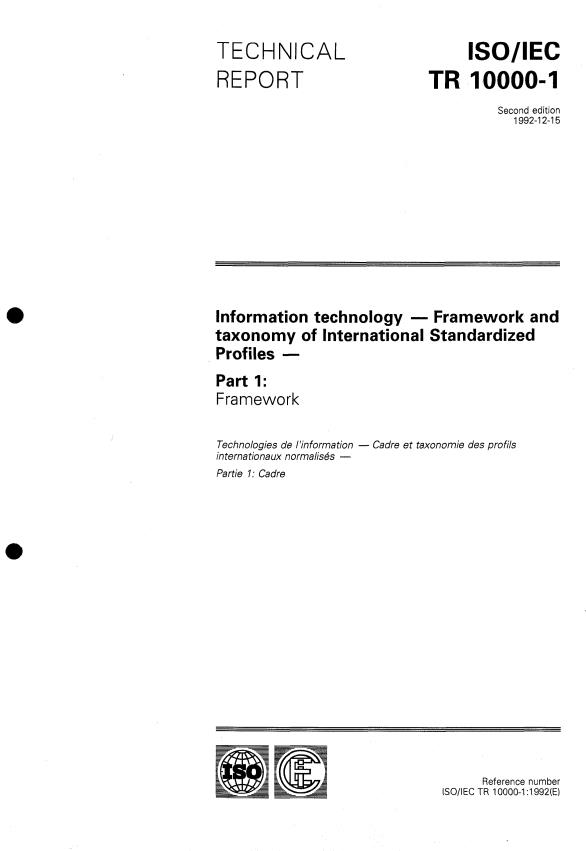
TECHNICAL
ISO/IEC
REPORT
TR 10000-1
Second edition
1992-1 2-1
Information technology - Framework and
taxonomy of International Standardized
Profiles -
Part I:
Framework
Technologies de l'information - Cadre et taxonomie des profils
internationaux normalisés -
Partie I: Cadre
Reference number
ISO/IEC TR 10000-1 :1992(E)
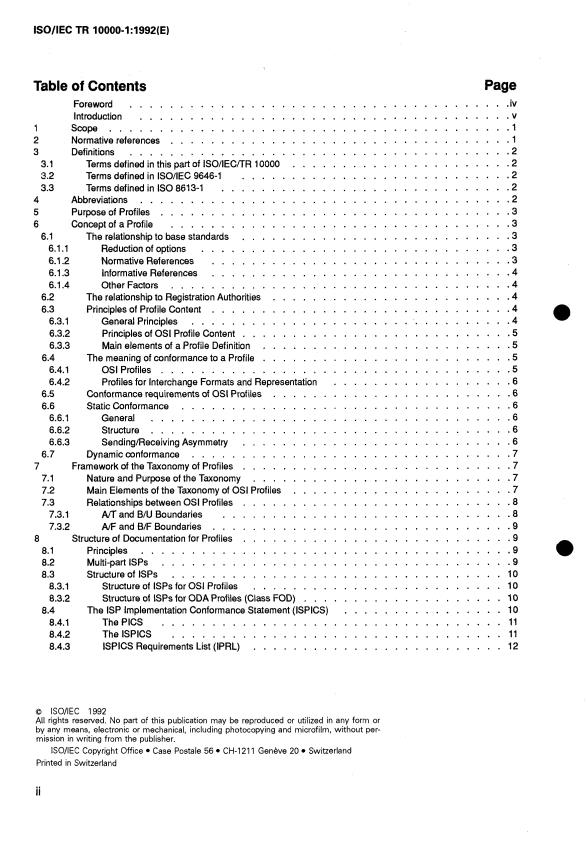
Table of Contents Page
Foreword . iv
Introduction . v
1 Scope . 1
2 Normative references . 1
3 Definitions . 2
3.1 Terms defined in this part of ISO/IEC/TR 1 O000 . 2
3.2 Terms defined in ISO/IEC 9646-1 . -2
3.3 Terms defined in IS0 8613-1 . 2
4 Abbreviations . 2
5 Purpose of Profiles . 3
6 Concept of a Profile . 3
6.1 The relationship to base standards . 3
6.1.1 Reduction of options . 3
6.1.2 Normative References . 3
6.1.3 Informative References . 4
6.1.4 Other Factors . 4
6.2 The relationship to Registration Authorities . 4
6.3 Principles of Profile Content . 4
6.3.1 General Principles . 4
6.3.2 Principles of OS1 Profile Content . 5
6.3.3 Main elements of a Profile Definition . 5
6.4 The meaning of conformance to a Profile . 5
6.4.1 OS1 Profiles . 5
6.4.2 Profiles for Interchange Formats and Representation . 6
6.5 Conformance requirements of OS1 Profiles . 6
6.6 Static Conformance . 6
6.6.1 General . 6
6.6.2 Structure . 6
6.6.3 Sending/Receiving Asymmetry . 6
6.7 Dynamic conformance . 7
7 Framework of the Taxonomy of Profiles . 7
7.1 Nature and Purpose of the Taxonomy . 7
7.2 Main Elements of the Taxonomy of OS1 Profiles . 7
7.3 Relationships between OS1 Profiles . 8
7.3.1 A/T and B/U Boundaries . 8
7.3.2 A/F and B/F Boundaries . 9
8 Structure of Documentation for Profiles . 9
8.1 Principles . 9
8.2 Multi-part ISPs . 9
8.3 Structure of lSPs . 10
8.3.1 Structure of lSPs for OS1 Profiles . 10
8.3.2 Structure of ISPs for ODA Profiles (Class FOD) . 10
8.4 The ISP Implementation Conformance Statement (ISPICS) . 10
8.4.1 ThePlCS . 11
8.4.2 TheISPICS . 11
8.4.3 ISPICS Requirements List (IPRL) . 12
0 ISO/IEC 1992
All rights reserved . No part of this publication may be reproduced or utilized in any form or
. electronic or mechanical. including photocopying and microfilm. without per-
by any means
mission in writing from the publisher .
ISO/IEC Copyright Office Case Postale 56 CH-I211 Genève 20 Switzerland
Printed in Switzerland
ii
O ISO/IEC
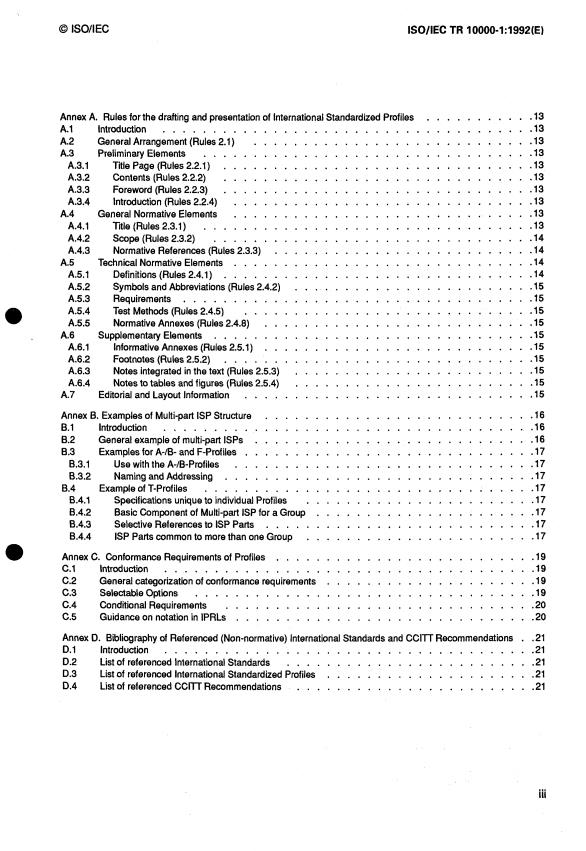
Annex A . Rules for the drafting and presentation of International Standardized Profiles . . . 13
.... 13
A.l Introduction . . .
.... 13
A.2 General Arrangement (Rules 2.1) . . .
A.3 Preliminary Elements . . . . 13
.... 13
A.3.1 Title Page (Rules 2.2.1) . . .
A.3.2 Contents (Rules 2.2.2) . . . . 13
.... 13
A.3.3 Foreword (Rules 2.2.3) . . .
....... .. .... 13
A.3.4 Introduction (Rules 2.2.4) .
A.4 General Normative Elements . . . . 13
.... 13
A.4.1 Title (Rules 2.3.1) . . .
....... .. .... 14
A.4.2 Scope (Rules 2.3.2) .
A.4.3 Normative References (Rules 2.3.3) . . . . 14
.... 14
A.5 Technical Normative Elements . . .
A.5.1 Definitions (Rules 2.4.1) . . . . 14
A.5.2 Symbols and Abbreviations (Rules 2.4.2) . . . . 15
A.5.3 Requirements . . . . . * . 15
A.5.4 Test Methods (Rules 2.4.5) . . . . 15
.... 15
A.5.5 Normative Annexes (Rules 2.4.8) . . .
....... .. .... 15
A.6 Supplementary Elements .
A.6.1 Informative Annexes (Rules 2.5.1) . . . . 15
.. .... 15
A.6.2 Footnotes (Rules 2.5.2) . .
.... 15
A.6.3 Notes integrated in the text (Rules 2.5.3) . . .
A.6.4 Notes to tables and figures (Rules 2.5.4) . . . . 15
.. .... 15
A.7 Editorial and Layout Information . .
.. .... 16
Annex B . Examples of Multi-part ISP Structure . .
B.1 introduction . . . . 16
8.2 General example of multi-part lSPs . . . . 16
.. .... 17
8.3 Examples for A-/B- and F-Profiles . .
8.3.1 Use with the A-/B-Profiles . . . . $17
8.3.2 Naming and Addressing . . . . 17
.. .... 17
B.4 Example of T-Profiles . .
.... 17
B.4.1 Specifications unique to individual Profiles . . .
.. .... 17
8.4.2 Basic Component of Multi-part ISP for a Group . .
8.4.3 Selective References to ISP Parts . . . . 17
.... 17
8.4.4 ISP Parts common to more than one Group . . .
Annex C . Conformance Requirements of Profiles . . 19
........... .......
C.l Introduction . 19
...................... ....... ..
C.2 General categorization of conformance requirements . . . 19
.......
C.3 Selectable Options . . . . 19
C.4 Conditional Requirements . . 20
....... ..
C.5 Guidance on notation in IPRLs . . . . 20
Annex D . Bibliography of Referenced (Non-normative) International Standards and CCIlT Recommendations . . 21
D.l Introduction . 21
D.2 List of referenced International Standards . 21
D.3 List of referenced International Standardized Profiles . 21
D.4 List of referenced CCllT Recommendations . 21
iii
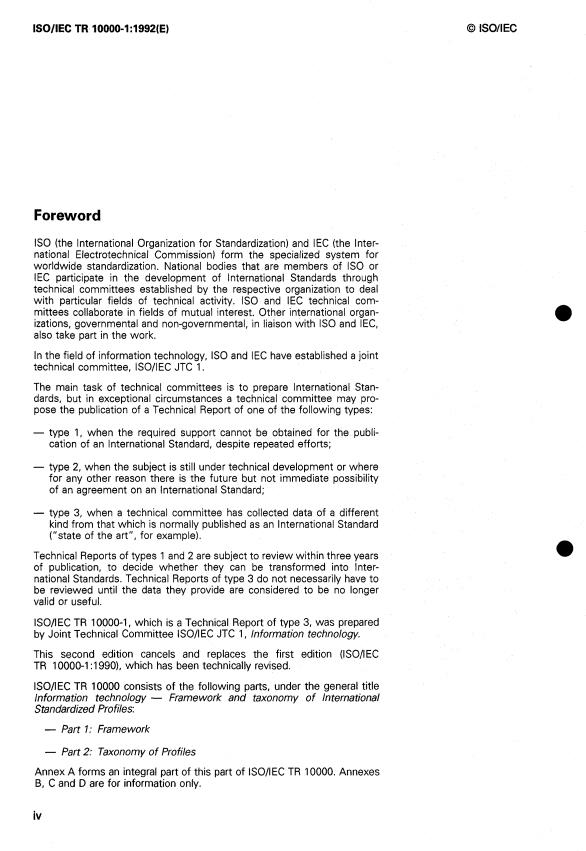
Foreword
IS0 (the International Organization for Standardization) and IEC (the Inter-
national Electrotechnical Commission) form the specialized system for
worldwide standardization. National bodies that are members of IS0 or
IEC participate in the development of International Standards through
technical committees established by the respective organization to deal
with particular fields of technical activity. IS0 and IEC technical com-
mittees collaborate in fields of mutual interest. Other international organ-
izations, governmental and non-governmental, in liaison with IS0 and IEC,
also take part in the work.
In the field of information technology, IS0 and IEC have established a joint
technical committee, ISO/IEC JTC 1.
The main task of technical committees is to prepare International Stan-
dards, but in exceptional circumstances a technical committee may pro-
pose the publication of a Technical Report of one of the following types:
- type 1, when the required support cannot be obtained for the publi-
cation of an International Standard, despite repeated efforts;
- type 2, when the subject is still under technical development or where
for any other reason there is the future but not immediate possibility
of an agreement on an International Standard;
I - type 3, when a technical committee has collected data of a different
kind from that which is normally published as an International Standard
("state of the art", for example).
Technical Reports of types 1 and 2 are subject to review within three years
of publication, to decide whether they can be transformed into Inter-
national Standards. Technical Reports of type 3 do not necessarily have to
be reviewed until the data they provide are considered to be no longer
i
valid or useful.
ISO/IEC TR 10000-1, which is a Technical Report of type 3, was prepared
by Joint Technical Committee ISO/IEC JTC 1, information technology.
This second edition cancels and replaces the first edition (ISO/IEC
TR 10000-1 :I 9901, which has been technically revised.
ISO/IEC TR 10000 consists of the following parts, under the general title
lnformation technology - Framework and taxonomy of International
Standardized Profiles:
- Part 1: Framework
- Part 2: Taxonomy of Profiles
Annex A forms an integral part of this part of ISO/IEC TR 10000. Annexes
B, C and D are for information only.
O ISOAEC
Introduction
The context of Functional Standardization is one part of the overall field of IT standardization activities covering
Base Standards, which define fundamentals and generalized procedures. They provide an infrastructure that can be
used by a variety of applications, each of which can make its own selection from the options offered by them.
Profiles, wh'ich define conforming subsetsor combinationsof base standards used to provide specific functions. Profiles
identify the use of particular options available in the base standards, and provide a basis for the development of uniform,
internationally recognized, conformance tests.
Registration Mechanisms, which provide the means to specify detailed parameterization within the framework of the
base standards or Profiles.
Within ISOllEC JTC 1, the process of Functional Standardization is concerned with the methodology of defining Profiles,
and their publication in documents called "International Standardized Profiles" (ISPs).
In addition to ISO/IEC/TR 10000, the secretariat of the Special Group on Functional Standardization maintains a standing
document (SD-4) entitled: "Directory of ISPs and Profiles contained therein" This is a factual record of which lSPs exist,
or are in preparation, together with an executive summary of each Profile. It is subject to regular updating by the Secretariat
of ISOAEC JTC l/SGFS.
V
a
a
TECHNICAL REPORT @ ISO/IEC ISO/IEC TR 10000-1:1992(E)
Information technolo y - Framework and taxonomy
of International Stan ? ardized Profiles -
Part 1:
Framework
1 scope
* interchange formats defined for particular application
areas (e.g. trade data interchange formats in ISO/TC
This pari of ISO/IEC/TR 10000 defines the concept of
154);
Profiles, and the way in which they are documented in
International Standardized Profiles. It gives guidance to
protocols used in particular application areas (e.g.
organizations making proposals for Draft International
documentation (bibliographic) protocols in ISO/TC 46,
Standardized Profiles, on the nature and content of the
banking protocols in ISO/TC 68, industrial automation
documents they are producing.
protocols in ISO/TC 184), which may also specify
particular uses of the more generic Profiles included in
This part of ISO/IEC/TR 10000 outlines concepts of
this Taxonomy.
Profiles, the general Taxonomy (or Classification
Scheme), and the format and content of ISPs. Annex A
gives details of the format and content of ISPs as re- 2 Normative references
quired by ISO/IEC JTC 1. Annex B gives examples of the
The following standards contain provisions which,
ways in which Profile definitions are incorporated in lSPs
through reference in this text, constitute provisions of this
for publication. Annex C gives guidance on confor-
part of ISO/IEC/TR 10000. At the time of publication, the
mance aspects of Profiles, and indicates the direction in
editions indicated were valid. All standards are subject
which ISO/IEC/TR 10000 may be developed in the fu-
to revision, and parties to agreements based on this part
ture. Annex D lists those ISO/IEC Standards and CCliT
of ISO/IEC/TR 1 O000 are encouraged to investigate the
Recommendations which are quoted in examples.
possibility of applying the most recent editions of the
standards listed below. Members of IEC and IS0 inain-
ISO/IEC/TR 10000-2 provides a full classification for
tain registers of currently valid International Standards.
Profiles which may be or have been submitted for ratifi-
cation as International Standardized Profiles.
IS0 7498:1984, Information processing systems - Open
Systems Interconnection - Basic Reference Model.
ISO/IEC/TR 1 O000 is applicable to Profiles in the area of
(Corresponds to CClïTX.200)
competence of ISO/IEC JTC 1, and within this, priority
consideration has been given to Profiles in the OS1 area,
IS0 861 3-1 : 1989, Information processing - Text and of-
i.e. those which specify OS1 base standards, and those
fice systems - Office Document Architecture (ODA) and
concerned with interchange formats and data repre-
interchange format - Part 1: Introduction and general
sentation which are expected to be used in conjunction
principles.
with them. In addition, as a lower priority, it is also
(Corresponds to CCITT T4 11)
applicable to Profiles specifying the use of other ISO/IEC
JTC 1 base standards, for example:
ISO/IEC 9545: 1989, Information technology - Open
Systems lniercunnectjon - Application Layer structure,
Open Distributed Processing;
ISO/IEC 9646-1 : 1991, Information technology - Open
the representation of information or objects on storage
Systems Interconnection - Conformance testing metho-
media (as opposed to the current limitation to use with
dology and framework - Part 1: General Concepts.
communications protocols);
(Corresponds to CCITTX.290)
logical and physical storage structures.
ISO/IEC 9646-2: 1991, Information technology - Open
However, it is recognized that the scope of the concept
Systems Interconnection - Conformance testing metho-
of Profiles will be wider than that of ISO/IEC JTC 1.
dology and framework - Part2: Abstract test suite speci-
Examples of other areas to which the concept may be
fication.
extended by other Technical Committees are:
(Corresponds to CCIïTX.291)
O ISO/IEC
ISO/IEC 9646-6: .'), Information technology - Open 3.1.4 Group: Aset of Profiles that are compatible, in the
Systems Interconnection - Conformance testing metho- sense that a system implementing one Profile from a
dology and framework - Pari 6: Protocol Profile test Group can interwork, according to OSI, with another
system implementing a different Profile from the same
specifications.
Group, in terms of the operation of the protocols specified
ISO/IEC 9646-7: .'I, Information technology - Open within those Profiles.
Systems Interconnection - Conformance testing metho-
3.1.5 Base Standard: An approved International Stand-
dology and framework - Part 7: Implementation confor-
ard or CCllT Recommendation which is used in the
mance statements.
definition of a Profile.
ISO/IEC 9834-1 : .'I, Information technology - Open
Systems Interconnection - Procedures for the operation
3.2 Terms defined in ISO/IEC 9646-1
of OS1 registration authorities - Part 7: General proce-
This part of ISO/IEC/TR 10000 uses the following terms
dures,
defined in ISO/IEC 9646-1 :
(Corresponds to CCITT X. 660)
a) Conformance testing
ISO/IEC/TR 10000-2:1992, Information technology -
Framework and taxonomy of International Standardized
b) Conforming implementation
Profiles - Part 2: Taxonomy of profiles.
c) Dynamic conformance requirements
ISO/IEC/FR 1 O1 83: . 'I, Information processing - Text
and Office Systems - Office Document Architecture
d) Protocol Implementation Conformance Statement
(ODA) and interchange format - Technical Report on
IS0 8613 Implementation testing - e) PICS proforma
Part 7: Testing Methodology
f) Static conformance requirements
Part 2 : Framework for Abstract Test Cases
Terms defined in IS0 8613-1
3.3
IEC/ISO Directives Part 3:1989, Drafting andpresenta-
tion of International Standards
This pari of ISO/IEC/TR 1 O000 uses the following term
defined in IS0 8613-1 :
A number of other IS0 Standards and CClTT Recom-
mendations are quoted in examples which do not con-
a) Document Application Profile
stitute provisions of this part of ISO/IEC/TR 10000. They
are listed in annex D.
4 Abbreviations
3 Definitions
ISP International Standardized Profile
For the purposes of this part of ISO/IEC/TR 10000, the
ISPICS Requirements List
IPRL
following definitions apply:-
ISPICS ISP Implementation Conformance State-
3.1 Terms defined in this part of
ment
ISO/IEC/TR loo00
Protocol Implementation Conformance
PICS
3.1.1 International Standardized Profile: An interna- Statement
tionally agreed-to, harmonized document which ident-
Application Profile (requiring Connec-
A-Prof ile
ifies a standard or group of standards, together with
tion-mode Transport Service)
options and parameters, necessary to accomplish a
B-Prof ile Application Profile (requiring Connec-
function or set of functions.
tionless-mode Transport Service)
3.1.2 Profile: Aset of one or more base standards, and,
F-Prof i le Interchange Format and Representation
where applicable, the identification of chosen classes,
Profile
subsets, options and parameters of those base stand-
R-Prof ile Relay Profile
ards, necessary for accomplishing a particular function.
Transport Profile (providing Connection-
T-Prof ile
NOTE - An International Standardized Profile includes the
mode Transport Service)
specification of one or more Profiles.
U-Profile Transport Profile (providing Connection-
3.1.3 ISP Implementation Conformance Statement: A
less-mode Transport Service)
statement made by the supplier of asystem which claims
to conform to an ISP, stating the capabilities and options
which have been implemented, and all optional features
which have been omitted.
1) To be published.
O ISO/IEC
ISO/IEC TR 10000-1 : 1992(E)
5 Purpose of Profiles
Profiles for the use of standards which define the format and
content of the data that is carried beween end system by
Profiles define combinations of base standards for the
means of the OS1 protocols.
purpose of
6 Concept of a Profile
identifying the base standards, together with appropri-
ate classes, subsets, options and parameters, which
The concept of a Profile, which fulfils the purposes
are nekessary to accomplish identified functions for
defined in clause 5, is considered first in an abstract
purposes such as interoperability;
sense, with particular emphasis on the significance of the
claim of conformance to a Profile. This concept of an
providing a system of referencing the various uses of
individual Profile is then extended to include defining its
base standards which is meaningful to both users and
relationship to other Profiles, i.e. the concept of a Taxo-
suppliers;
nomy of Profiles, and its place within it. Finally, since a
Profile has to have a concrete existence in order for it to
providing a means to enhance the availability for pro-
be used effectively, these conceptual aspects are related
curement of consistent implementations of functionally
to a formal documentation system.
defined groups of base standards, which are expected
to be the major components of real application sys-
Clauses 6 and 7 concentrate on defining the concept and
tems;
taxonomy of the Profiles, independently of the way they
are documented in ISPs. Clause 8 defines the actual
promoting uniformity in the development of confor-
documentation scheme and shows how there is not
mance tests for systems that implement the functions
necessarily one separate document (ISP) for each
associated with the Profiles.
Profile definition.
Various bodies throughout the world are undertaking
Profiles are related to Base Standards, to Registration
work, in either regional or topic-oriented groups, in the
Mechanisms, and to Conformance Tests of the systems
area of Functional Standardization. Various names are
which implement them. The practical implications of
given to the results of this work (such as Profiles, Func-
these relationships are developed in the following sub-
tional Standards, Implementation Agreements, Specifi-
clauses, some of which specify requirements that shall
cations) and various approaches are being taken to the
be satisfied by Profiles defined in ISPs.
scope of the Profiles and to the style in which they are
documented. This Taxonomy of International Stand-
NOTE - ISO/IEC 9646 is under development in the area of
ardized Profiles has been developed by ISO/IEC JTC 1
protocol profile conformance testing concepts and methodo-
in order to create a common classification scheme, and
logy. When this work is mature, it will be referenced from this
documentation scope and style, into which the work of
Technical Report.
Functional Standardization bodies can be submitted,
along with corresponding work from the members and
6.1 The relationship to base standards
subcommittees of ISOAEC JTC 1.
6.1.1 Reduction of options
It is not sufficient, however, just to create a framework of
Base standards specify procedures and formats that
this sort. Interoperability, and product development and
facilitate the exchange of information between systems.
procurement, need to be seen on a global, and not just
They provide options, anticipating the needs of a variety
on a regional or sectional scale. Therefore an objective
of applications and taking into account different capa-
of ISO/IEC JTC 1 is to create the climate for the produc-
bilities of real systems and networks.
tion of harmonized Profiles, where a wide measure of
agreement is reached before proposals are submitted to
Profiles promote interoperability by defining how to use
ISOAEC JTC 1.
a combination of base standards for a given function and
environment. In addition to the selection of base stand-
One of the most important roles for an International
ards, a choice is made of permitted options for each base
Standardized Profile is to serve as the basis for the
standard and of suitable values for parameters left un-
establishment of internationally recognized confor-
specified in the base standard.
mance test suites and test laboratories. ISPs are pro-
duced not simply to "legitimize" a particular choice of
Profiles shall not contradict base standards but shall
base standards and options, but to promote real system
make specific choices where options and ranges of
interoperability. The development and widespread ac-
values are available. The choice of the base standard
ceptance of conformance testing based on lSPs is cru-
options should be restricted so as to maximise the prob-
cial to the successful realization of this goal.
ability of interworking between systems implementing
different selections of such Profile options, consistent
NOTE - The remainder of this part of ISO/IEC/TR 10000 is
with achieving the objective of the Profile.
concerned with the concepts and structures of Profiles as they
apply to the use of standards in the area of competence of
6.1.2 Normative References
ISO/IEC JTC 1, and primarily as they apply to the use of OS1
and OSI-related standards. This means:
An approved ISP shall make normative reference only to
base standards or other ISPs (see 3.1.5).
Profiles for the use of OS1 protocol standards for systems
interoperability ;
In exceptional circumstances, described below, norma-
6.2 The relationship to Registration
tive reference may be made to ISOAEC Technical Re-
Authorities
ports. Such reference, which requires that the following
conditions are met, shall be justified on a case-by-case
The base standards referenced in Profiles may include
basis:
objects such as abstract syntaxes, document types,
Virtual Terminal Environments and control objects,
which require a Registration Authority to administer
no base standard addressing the requirements is avail-
them. Profiles should specifically define the use of such
able, but a Technical Report is;
objects (i.e. indicate whether they are included in the
the use is identified and discussed in the Explanatory Profile or not) and shall refer to the objects using the
registered name in the base standard. Profiles may, in
Report which accompanies the proposed draft for an
ISP, justifying that use; addition to the registered name, define particular regis-
tered values associated with the name for use in the
the JTC 1 body responsible for that Technical Report Profile.
agrees that a normative reference is an appropriate
When a type of information object requires a registration
use of that Technical Report,;
agent with a technical rôle as defined in ISOAEC 9834-1,
and the type of information object concerned falls within
the National Bodies approve this usage in the draft ISP
the scope of one of the classes of Profile defined in
ballot.
clause 7, a multi-part ISP may be used as the registration
NOTE - In this Technical Report, any text which describes the
agent concerned. In this case, the provisions of this part
relationship of an ISP to a base standard, shall be taken to be
of ISOAEC TR 10000, of ISOAEC 9834-1, and of any
referring also to its relationship to any Technical Reports which
other part or parts of ISOAEC 9834 that concern this type
have been accepted according to the criteria given above.
of information object, shall all be applicable.
6.1.3 Informative References
Where registration mechanisms are not yet set up, ob-
When it is useful to make informative reference to other jects of this kind shall in the meantime be maintained in
documents in the process of defining a Profile, reference an informative annex to the ISP which defines the Profile.
may be made to applicable regional or national stand- Entry of an object into such an annex does not imply
ards. Examplesof the functionality which may require the registration.
use of this expedient are:-
NOTE - It is for further study whether a Profile could create the
requirement to register a type of object that is not already
* physical connectors
accommodated by the Registration Authority mechanism for the
base standards referenced.
electrical characteristics
6.3 Principles of Profile Content
safety requirements
6.3.1 General Principles
character repertoires
A Profile makes explicit the relationships between a set
be of base standards used together (relationships which are
Such reference to regional or national standards shall
placed in an informative annex to the ISP, or in a separ- implicit in the definitions of the base standards them-
ate, non-normative, pari of a multi-part ISP. Such usage selves), and may also specify particular details of each
shall be justified on a case-by-case basis, either as a base standard being used.
consequence of the lack of appropriate functionality in
It follows that a Profile
International Standards, or because of the existence of
national or regional regulatory requirements. It shall be
shall restrict the choice of base standard options to
a)
accompanied by details of the body responsible for the
the extent necessary to maximise the probablility of
distribution and maintenance of the standard.
interworking between systems implementing the
Profile; thus a Profile may retain base standard op-
6.1.4 Other Factors
tions as options of the Profile provided that they do
Approval of an ISP by ISOAEC members does not
not affect interworking;
change the status of any documents referenced by it.
shall not specify any requirements that would contra-
b)
The development of an ISP may indicate the need to
dict or cause nonconformance to the base standards
modify or to add to the requirements specified in a base
to which it refers;
standard. In this case, it is necessary for the ISP de-
veloper to liaise with the standards group responsible for
may contain conformance requirements which are
c)
that base standard so that the required changes may be
more specific and limited in scope than those of the
made through established methods such as defect re-
base standards to which it refers. Whilst the capa-
porting, amendment procedures, or the introduction of
bilities and behaviour specified in a Profile will always
new work.
be valid in terms of the base standards, a Profile may
exclude some valid optional capabilities and optional
Entry of a Profile into the Taxonomy may occur before
behaviour permitted in those base standards.
the referenced base standards are all stable and ap-
proved. In these circumstances, regional or sectional
bodies may make use of interim or preliminary draft
versions of Profiles in their own controlled environment.
O ISO/IEC
Thus conformance to a Profile implies by definition con-
identify the separate roles which may be adopted by a
formance to the set of base standards which it refer-
system, and these shall be stated as either mandatory
ences. However, conformance to that set of base
requirements or options of the Profile, as appropriate.
standards does not necessarily imply conformance to
NOTE - Clause 8 and annex A provide information on the way
the Profile.
an ISP.
in which a Profile shall be defined in
6.3.2 Principles of Os1 Profile Content
The meaning of conformance to a Profile
6.4
An OSi Profile specifies the application of one or more
OS1 base standards in support of a specific requirement
6.4.1 OÇI Profiles
for interworking between systems. While it adheres to
The concepts of static conformance, dynamic confor-
the structure defined by the Basic Reference Model for
mance and Protocol Implementation Conformance
OSi, it does not define the total OS1 functionality of a
Statements (see ISO/IEC 9646 parts 1 and 2) are incor-
system, but only that part relevant to the function being
porated in the concept of Profiles.
defined.
in the context of OSi, a real system is said to exhibit
In the case of Profiles which reference a standard or
conformance if it complies with the requirements of ap-
standards from the Application Layer (Layer 7) of the
plicable OS1 standards in its communication with other
Basic Reference Model for OS1 (known as A- or B-
real systems.
Profiles - see clause 7), there may also exist a com-
plementary element of definition known as an Application
Since OS1 standards form a set of inter-related standards
Context (see ISOiiEC 9545). This defines the relation-
which combine to define behaviour of open systems in
ship among referenced base standards in Layer 7,
their communication, it is necessary to express confor-
together with the rules for their combined operation. An
mance of real systems with reference to this set.
A- or B-Profile may reference a published Application
Context (or Application Context Proforma), thus obviat-
A Profile shall address the following two topics:
ing the need for the Profile to document explicitly the
rules for cooperation of Application Service Entities.
static conformance requirements (details as given in
6.6);
6.3.3 Main elements of a Profile Definition
The definition of a Profile shall comprise the following dynamic conformance requirements (details as given
elements: in 6.7);
These requirements are stated in an ISP Implementation
a concise definition of the scope of the function for
Conformance Statement (ISPICS), using the PICS Pro-
which the Profile is defined, and of its purpose;
formas of the referenced base standards and an ISPICS
an illustration of the scenario within which the function Requirements List (IPRL - details as given in 8.4)-
is applicable; where a Profile is a member of a Group
In order to conform to a Profile, a system shall perform
(7.2 and ISO/IEC/TR 10000-2, subclause 4.3), the
correctly all the capabilities defined in the ISPiCS as
scenario includes reference to the possibilities for
mandatory and also any options of the ISP which it
interoperation that this provides (see also A.4.2);
claims to include. Conformance to a base standard in this
normative reference to a single set of base standards,
context is conformance to a particular identified publica-
including precise identification of the actual texts of
tion of a referenced base standard as defined in 6.3.3
the base standards being used and of any approved (c), irrespective of however many additional technical
amendments and technical corrigenda (errata), con- corrigenda to it may have been published.
formance to which is identified as potentially having
But a system may have the ability to operate according
an impact on achieving interoperation using the
to several Profiles which make use of different capa-
Profile;
bilities of the same base standards, and either to nego-
informative reference to any other relevant source
tiate between such different uses, or to be configured
documents; appropriately.
specifications of the application of each referenced A Profile shall be defined in such a way that testing of an
base standard, covering recommendations on the
implementation of it can be carried out in the most
choice of classes or subsets, and on the selection of
complete way possible, given the available testing meth-
options, ranges of parameter values, etc, and refer-
odologies.
ence to registered objects or application contexts
NOTE - ISOiIEC 9646 is under development to include the
where appropriate;
subject of testing concepts and methodology for such Profiles,
and will be referenced from this Technical Report when these
a statement defining the requirements to be observed
extensions have been completed. In the mean time, nothing in
by systems claiming conformance to the Profile, in-
this Technical Report shall be taken to contradict statements
cluding any remaining permitted options of the refer-
made in subsequently published ISOiIEC standards.
enced base standards, which thus become options of
the Profile.
lnteroperable systems can perform different but com-
plementary roles (e.g. an initiator-responder or a master-
slave relationship). In such a situation the Profile shall
O ISO/IEC
NOTE - Exclusion of an optional feature in a base
6.4.2 Prof iles for Interchange Formats and
standard should be done only with great care. An
Representation
example of an appropriate situation would be when use
The concept of static conformance (as given in 6.6) shall
of an optional feature would lead directly to future
be applied to Interchange Format and Representation interoperability problems.
Profiles.
Non-applicable features in the base standards:
d)
Interchange Format and Representation Profiles should (i.e. those that are logically impossible, according to
if appropriate include an IPRL based on a PICS-style
the base standard) these shall remain non-applicable
proforma, which may vary from the PICS defined in
in the Profile.
ISOiIEC 9646 Parts 1 and 2.
e) Excluded requirements in the base standards:
In the case of Profiles for Office Document Architecture,
these shall remain excluded in the Profile.
conformance centres on the requirements for valid ODA
See 8.4 for the way in which these types of conformance
data streams. The conformance methodology for ODA
requirements are handled in the ISP Implementation
data streams (defined in IS0 8613-1) is differentiated
from the implementation testing methodology (defined in Conformance Statement (ISPICS).
ISO/IEC/TR 10183), which deals with the way that data
NOTE - See also Annex C for further information about the way
streams are generated and received.
in which these concepts may be applied in writing ISPs.
Other sub-classes of Interchange Format and Repre-
6.6 Static Conforniance
sentation Profiles will similarly have specific definitions
of conformance methodology.
6.6.1 General
6.5 Conforniance requirements of OSi The choices of options made in a Profile's static confor-
mance requirements are specific to that Profile and
Profiles
provide added value to the base standards.
The conformance requirements of an OS1 protocol
The choices are not, therefore, arbitrary but need to be
Profile shall relate to the conformance requirements in
consistent with the purpose of the Profile and consistent
the base standards in the following ways, based on the
across all base standards referenced by it.
definitions in ISO/IEC 9646-2:
In order to avoid ambiguity between the Profiles and the
a) Mandatory requirements in the base standards:
base standards, the static conformance requirements of
these shall remain mandatory in the Profile.
a Profile shall be specified, where possible, by reference
b) Conditional requirements in the base standards: to the conformance requirements of the referenced base
these shall remain conditional in the Profile with the
standards (see 8.4.3).
exception that if the condition always evaluates to
6.6.2 Structure
True or False given the requirements of the Profile,
then the statuscan be changed to the result obtained.
The statement of static conformance r
(See clause C.4 for additional information).
be structured as follows:
Optional requirements in the base standards:
c)
An overview of major subsets or implementation ca-
a)
these may be changed in various ways within the
tegories which provides an overall rationale for the
profile:
more detailed selection of classes and options made
in the Profile.
Mandatory: support may be made mandatory.
The major conformance requirements which relate to
b)
these subsets or implementation categories.
Optional: support may remain optional.
For each base standard selected in the Profile, a set
c)
Out of Scope: optional requirements which are
of static conformance requirements referring both to
not relevant to the Profile. For example, func-
the base standard static conformance requirements
tional units of layer (n-1) which are unused by
and to the choices made for the Profile (details as
layer (n) in the context of the Profile.
given in 6.5).
See clause 8, and especially figure 3, for the way in which
Conditional: optional requirements may be made
these requirements are reflected in the ISPICS Require-
conditional within the Profile.
ments List.
Excluded: the use of an optional feature may be
6.6.3 SendingiReceiving Asymmetry
prohibited in the context of the Profile. This
Static conformance requirements may be different in
should only be used to restrict the dynamic beha-
respect of sending and receiving, or initiating and re-
viour in terms of the transmission of protocol
elements. sponding. This asymmetry may apply at any level of
detail, from the capability of an implementation to initiate
or respond to a connection, to the capability of receiving
and correctly interpreting a wider range of parameter
encodings than those used for sending.
O ISOAEC
Many base standards specifically identify only the con-
system. ISO/IEC/TR 10000-2 provides the detail of this
nection initiate-respond asymmetry under static confor-
system; only the main principles and primary classifica-
mance in the conformance clause. There is a need to
tions as they relate to OS1 are used in this clause for
make it clear in the Profile either that there is no asym-
illustrative purposes.
metry, or, if there are asymmetrical requirements, what
they are.
7.2
Main Elements of the Taxonomy of OS1
Profiles
6.7 Dynamic conformance
In order to decouple representation of information or
Given the implementation choices made in the ISP Im-
objects from communications protocol support, and ap-
plementation Conformance Statement, the dynamic con-
plication-related protocol from subnetwork types, OS1
formance requirements for a system are mostly already
and OSI-related Profiles are currently divided into the
specified by the referenced base standards. Hence, a
following classes:
Profile shall specify dynamic conformance requirements
by reference to those base standards, together with any
F - Interchange Format and Representation Profiles.
further constraining requirements necessary to fulfil the
stated purposes of the Profile.
A -Application Profiles using Connection-mode
Transport Service (i.e. using T-Profiles).
Restrictions by a Profile on dynamic conformance re-
quirements of a base standard are exceptions, and B -Application Profiles using Connectionless-mode
Transport Service (i.e. using U-Profiles).
should only apply to transmission. Restrictions should
not apply to reception. Consequently, it is possible that
T - Connection-mode Transport Profiles, related to
receipt of an excluded option may cause the receiving
a
subnetwork type.
system to operate outside the Profile. Refertoclause C.2
for more information on a general categorization of con-
U - Connectionless-mode Transport Profiles, related
formance requirements.
to subnetwork type.
R - Relay functions between T-Profiles or between
7 Framework of the Taxonomy of
U-Profiles.
Profiles
Other classes or sub-classes may be required, particu-
larly when the Taxonomy is extended beyond the current
7.1
Nature and Purpose of the Taxonomy
OSI-orientation.
The Taxonomy is the structure and classification within
T- and U-Profiles are further subdivided into Groups. A
which Profiles will fit. It gives a first-level specification of
Group is a set of Profiles that are identified by labels of
Profiles, including any determined technical constraints
the form YXnnn, where Y is the class identifier and X is
dueto their position in the structure, it classifies them and
a letter identifying the Group (see ISO/IEC/TR 10000-2
it specifies a number of relationships between them.
for detailed structures). These Profiles are compatible,
in the sense that a system implementing one Profile from
The process of drafting and approving lSPs requires a
a Group can interwork, according to OSI, with another
technical framework within which to operate. lSPs will,
system implementing a different Profile from the same
in general, be written, evaluated and used by experts in
Group, in terms of the operation of the protocols specified
specific areas of standardization. There is therefore a
within those Profiles. This Group concept, though poten-
prima facie case for identifying classes of Profiles which
tially of general applicability, is currently only used for
correspond to these main areas of expertise. It is also
defining sub-classes of T- and U-Profiles.
the case that the sub-committee structure of ISOiIEC
a
JTC 1 provides some clear pointers to where the boun-
Groups for T- and U-Profiles are further defined in terms
daries between classes of Profiles should be made.
of the protocols and modes of transport and network
These conceptual boundaries often coincide with real
service supported by members of a Group. lnterworking
boundaries within implementations of real systems. (For
may occur not only on an unrestricted basis between
example, the Taxonomy of OS1 Profiles makes a distinc-
members of a Group, but also, under defined circumstan-
tion between classes at the Transport Service Definition,
ces, between members of different Groups. These pro-
a boundary which corresponds to that between the re-
visions are described in detail in I
...
Questions, Comments and Discussion
Ask us and Technical Secretary will try to provide an answer. You can facilitate discussion about the standard in here.
Loading comments...