

ISO/FDIS 20680
(Main)White tea — Definition and basic requirements
- Abstract
This document specifies the parts of a named plant that are suitable for the production of white tea for consumption as a beverage, the processing methods, and the chemical requirements for white tea that are used to indicate that tea from that source has been produced in accordance with good manufacturing practice. It also specifies the packaging and storage requirements for white tea in containers. It does not apply to scented, flavoured or decaffeinated teas.
- Status
- Not Published
- Technical Committee
- ISO/TC 34/SC 8 - Tea
- Drafting Committee
- ISO/TC 34/SC 8/WG 7 - Oolong tea and white tea
- Current Stage
- 5000 - Final text received or FDIS registered for formal approval - 50 Approval
- Start Date
- 06-Oct-2026
- Due Date
- 15-Jan-2026
- Completion Date
- 15-Jan-2026
Buy Documents
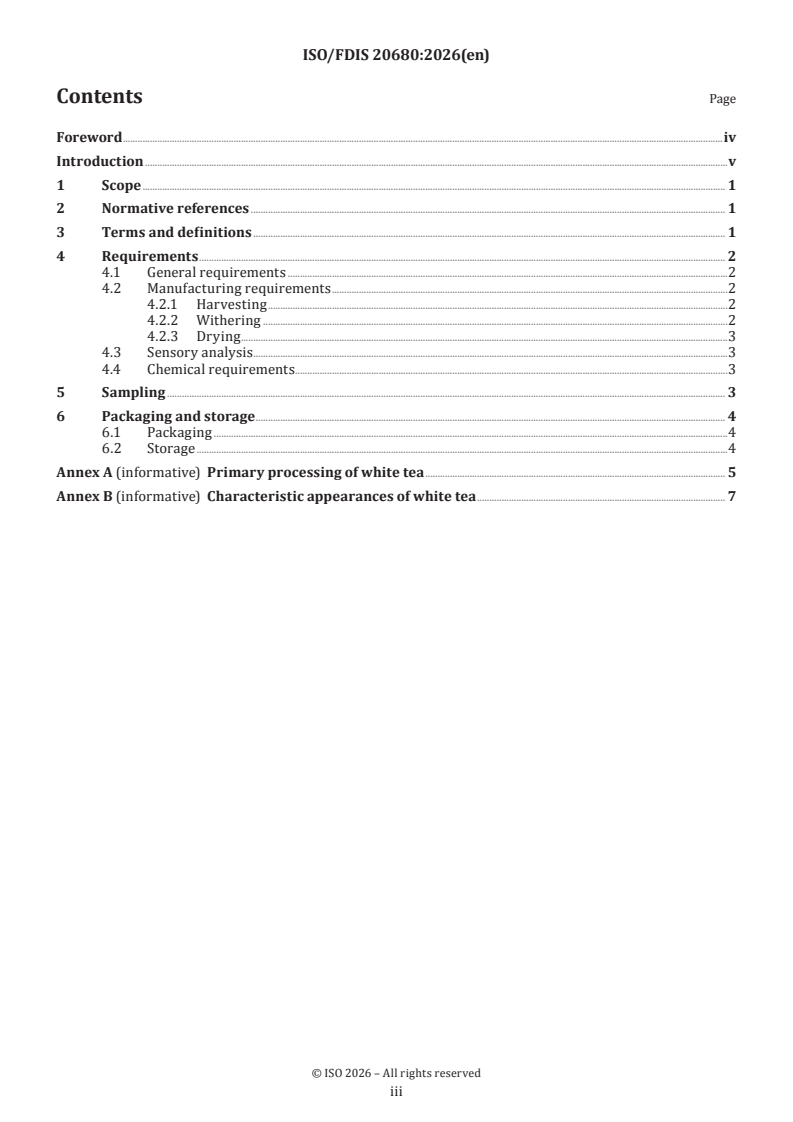
ISO/FDIS 20680 - White tea — Definition and basic requirements

REDLINE ISO/FDIS 20680 - White tea — Definition and basic requirements
ISO/FDIS 20680 is an ISO document for white tea. It defines the plant material, processing methods, chemical limits, packaging and storage conditions for white tea intended for use as a beverage. The standard is aimed at tea producers, processors, testers, and buyers who need a shared basis for identifying and checking white tea.
What does ISO/FDIS 20680 specify?
ISO/FDIS 20680 specifies the parts of a named plant that may be used for white tea, how the tea is processed, and the chemical requirements used to show that the tea has been produced under good manufacturing practice. It also covers packaging and storage in containers.
The document applies to tea made from buds, buds and tender leaves, or leaves of Camellia sinensis (L.) O. Kuntze that are suitable for beverage tea. It does not apply to scented, flavoured, or decaffeinated teas.
| Annex | What it covers |
|---|---|
| Annex A | Primary processing of white tea, including natural, heated, and combined withering, plus refining steps and process notes |
| Annex B | Characteristic appearances of white tea, including the main types and compressed forms |
What are the key requirements of ISO/FDIS 20680?
ISO/FDIS 20680 combines visual, sensory, processing, and chemical requirements. In practice, a producer or buyer uses these points to decide whether a tea should be treated as white tea and whether it meets the standard.
General product condition
- The tea shall be clean and free from extraneous matter. This matters because visible contamination or foreign material affects marketability and acceptance.
- The tea shall be free from taint and shall show the appearance, colour, and taste of white tea in sensory analysis. This means the product must still behave like white tea when assessed by trained tasters.
- The tea shall be free from additives, including colouring agents and flavourings. This keeps the product within the document’s definition of white tea.
Harvesting and processing
- Only tender shoots may be used for processing into white tea, namely buds, or one to five leaves, or both. This links the product to a defined raw material.
- Withering is required, and it may be natural, heated, or combined. This is the core processing step that creates the characteristic white tea profile.
- Drying should bring the leaves to suitable quality and should use a heating temperature not above 100 °C. Annex A gives further detail on primary processing and shows when withering and drying may be merged.
Sensory identification
- Trained tea tasters shall assess dry leaf appearance, aroma, taste, liquor colour, and the infused leaf. This is the main practical check for identity and quality.
- The document notes that traditional loose-leaf white tea is typically unrolled and generally unbroken, while processed white tea may have different sensory characteristics because of further operations such as steaming, pressing, cutting, or bagging.
Chemical checks
- Table 1 gives chemical requirements for water extract, total ash, total catechins, total polyphenols, the ratio of catechins to polyphenols, crude fibre, and caffeine. These are used when chemical confirmation is needed.
- The chemical requirements are based on material dried to constant mass at (103 ± 2) °C, and the test sample is prepared as a ground sample. That makes the test basis consistent between laboratories.
Sampling, packaging, and storage
- Sampling shall follow ISO 1839. This links the standard to a defined sampling method before testing.
- Tea shall be packed in clean, dry containers made of materials that do not affect quality.
- Stored tea shall be kept in clean, dry conditions, separated from harmful, odorous substances. In practice, this helps protect flavour and aroma during storage.
What terms does ISO/FDIS 20680 define?
- White tea - Tea made only by acceptable harvesting, withering, and drying processes from buds, buds and tender leaves, or leaves of Camellia sinensis suitable for beverage tea.
- Processed white tea - White tea without rolling, with a more natural and loose appearance, made by acceptable methods for transport, storage, or brewing.
- Compressed white tea - White tea made into forms such as bricks, cakes, or balls by blending, homogenizing, steaming, pressing, and drying.
- Other white tea - White tea made into products such as broken white tea and white tea bags by cutting, mixing, drying, and bagging.
Who uses ISO/FDIS 20680?
ISO/FDIS 20680 is used by tea processors, packers, quality managers, laboratory staff, and trained tea tasters. It is also useful for buyers and specifiers who need to define what counts as white tea and what evidence to ask for in inspection, sensory evaluation, or chemical testing.
Which standards are used with ISO/FDIS 20680?
ISO/FDIS 20680 refers to these standards for supporting test and sampling methods:
- ISO 1572 - preparation of a ground sample of known dry matter content
- ISO 1573 - determination of loss in mass at 103 degrees C
- ISO 1575 - determination of total ash
- ISO 1839 - sampling of tea
- ISO 9768 - determination of water extract
- ISO 10727 - determination of caffeine content by high-performance liquid chromatography
- ISO 14502-1 - determination of total polyphenols by a colorimetric method using Folin-Ciocalteu reagent
- ISO 14502-2 - determination of catechins by high-performance liquid chromatography
- ISO 15598 - determination of crude fibre content
What does the ISO/FDIS 20680 document contain?
ISO/FDIS 20680 contains a short technical structure: scope, normative references, terms and definitions, requirements, sampling, and packaging and storage. Clause 4 gives the core product rules, including general condition, manufacturing requirements, sensory analysis, and chemical requirements in Table 1.
Annex A provides processing guidance for white tea, including primary processing steps and additional notes on handling fresh leaves and drying. Annex B provides figures of the main white tea appearances, including the three typical categories and compressed forms, which helps with visual identification, training, and product description.
Buy Documents
ISO/FDIS 20680 - White tea — Definition and basic requirements
REDLINE ISO/FDIS 20680 - White tea — Definition and basic requirements
Get Certified
Connect with accredited certification bodies for this standard

BSI Group
BSI (British Standards Institution) is the business standards company that helps organizations make excellence a habit.

Bureau Veritas
Bureau Veritas is a world leader in laboratory testing, inspection and certification services.

DNV
DNV is an independent assurance and risk management provider.
Sponsored listings
Frequently Asked Questions
ISO/FDIS 20680 is a draft published by the International Organization for Standardization (ISO). Its full title is "White tea — Definition and basic requirements". This standard covers: This document specifies the parts of a named plant that are suitable for the production of white tea for consumption as a beverage, the processing methods, and the chemical requirements for white tea that are used to indicate that tea from that source has been produced in accordance with good manufacturing practice. It also specifies the packaging and storage requirements for white tea in containers. It does not apply to scented, flavoured or decaffeinated teas.
This document specifies the parts of a named plant that are suitable for the production of white tea for consumption as a beverage, the processing methods, and the chemical requirements for white tea that are used to indicate that tea from that source has been produced in accordance with good manufacturing practice. It also specifies the packaging and storage requirements for white tea in containers. It does not apply to scented, flavoured or decaffeinated teas.
ISO/FDIS 20680 is classified under the following ICS (International Classification for Standards) categories: 67.140.10 - Tea. The ICS classification helps identify the subject area and facilitates finding related standards.
ISO/FDIS 20680 is available in PDF format for immediate download after purchase. The document can be added to your cart and obtained through the secure checkout process. Digital delivery ensures instant access to the complete standard document.
Standards Content (Sample)
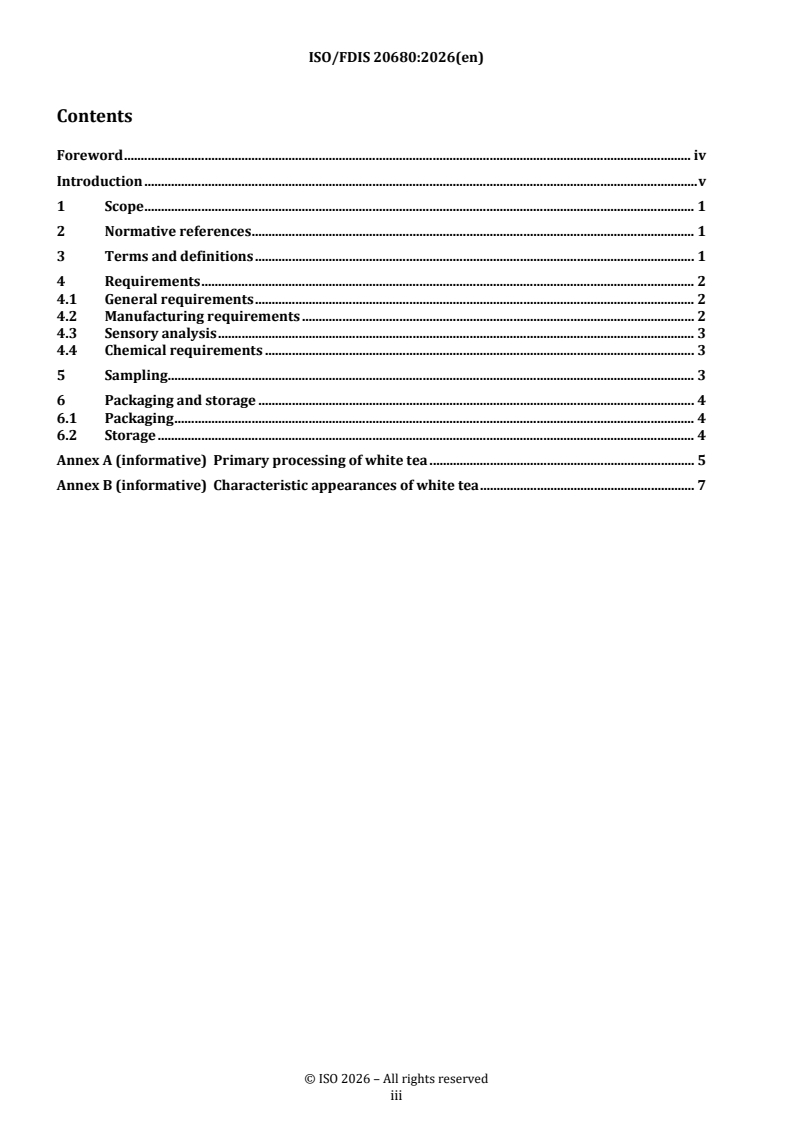
Contents
- Introduction
- 1 Scope
- 2 Normative references
- 3 Terms and definitions
- 3.1 white tea
- 3.2 processed white tea
- 3.3 compressed white tea
- 3.4 other white tea
- 4 Requirements
- 4.1 General requirements
- 4.2 Manufacturing requirements
- 4.3 Sensory analysis
- 4.4 Chemical requirements
- 5 Sampling
- 6 Packaging and storage
- 6.1 Packaging
- 6.2 Storage
- Annex A
- Annex B
Introduction
Tea is grown and produced in many countries around the world and is blended or consumed in many more. The desired characteristics of white tea and the resulting liquor depend on a number of factors, including the type of water used for brewing, the method of preparation, the variety of tea plant and the unique processing methods of withering and drying. White tea is a lightly aerated/oxidized tea. Traditional looseleaf white tea is characterized by unrolled, generally unbroken withered leaves. This document specifies the plant source from which to make the tea, the process by which to make the white tea, and certain physical and chemical requirements which, if met, indicate that the tea has been subjected to good manufacturing practice.
The quality of white tea is usually judged sensorially by trained tea tasters, who render their judgements based on their previous experience with white tea, their knowledge of the conditions in the producing areas and the preferences of consuming countries. A number of factors are considered when judging the quality of white tea, including the appearance of the dry tea leaf (such as tenderness, shape, colour, cleanliness and uniformity), the appearance and odour of the infused leaf, and the appearance, odour and taste of the tea liquor. In practice, teas are submitted for chemical analysis only if a tea taster suspects that the product is adulterated or has abnormal characteristics.
FINAL DRAFT International Standard ISO/FDIS 20680:2026(en) White tea — Definition and basic requirements
1 Scope
This document specifies the parts of a named plant that are suitable for the production of white tea for consumption as a beverage, the processing methods and the chemical requirements for white tea that are used to indicate that tea from that source has been produced in accordance with good manufacturing practice.
It also specifies the packaging and storage requirements for white tea in containers. It does not apply to scented, flavoured or decaffeinated teas.
2 Normative references
The following documents are referred to in the text in such a way that some or all of their content constitutes requirements of this document. For dated references, only the edition cited applies. For undated references, the latest edition of the referenced document (including any amendments) applies. ISO 1572, Tea — Preparation of ground sample of known dry matter content ISO 1573, Tea — Determination of loss in mass at 103 degrees C ISO 1575, Tea — Determination of total ash ISO 1839, Tea — Sampling ISO 9768, Tea — Determination of water extract ISO 10727, Tea and instant tea in solid form — Determination of caffeine content — Method using highperformance liquid chromatography ISO 14502-1, Determination of substances characteristic of green and black tea — Part 1: Content of total polyphenols in tea — Colorimetric method using Folin-Ciocalteu reagent ISO 14502-2, Determination of substances characteristic of green and black tea — Part 2: Content of catechins in green tea — Method using high-performance liquid chromatography ISO 15598, Tea — Determination of crude fibre content
3 Terms and definitions
For the purposes of this document, the following terms and definitions apply. ISO and IEC maintain terminology databases for use in standardization at the following addresses:
- ISO Online browsing platform: available at https:// www .iso .org/ obp
- IEC Electropedia: available at https:// www .electropedia .org/
ISO/FDIS 20680:2026(en)
3.1 white tea
tea obtained solely and exclusively by acceptable processes of harvesting, withering and drying, made from the buds, or the buds and tender leaves, or the leaves of Camellia sinensis (L.) O. Kuntze varieties that are suitable for the preparation of tea for consumption as a beverage Note 1 to entry: There are three main subtypes of white tea which differ significantly in appearance based on the raw material harvesting/selection and, as such, are worth noting here:
...
Contents
- Introduction
- 1 Scope
- 2 Normative references
- 3 Terms and definitions
- 3.1 white tea
- 3.2 processed white tea
- 3.3 compressed white tea
- 3.4 other white tea
- 4 Requirements
- 4.1 General requirements
- 4.2 Manufacturing requirements
- 4.3 Sensory analysis
- 4.4 Chemical requirements
- 5 Sampling
- 6 Packaging and storage
- 6.1 Packaging
- 6.2 Storage
- Annex A
- Annex B
Introduction
Tea is grown and produced in many countries around the world and is blended or consumed in many more. The desired characteristics of white tea and the resulting liquor depend on a number of factors, including the type of water used for brewing, the method of preparation, the variety of tea plant and the unique processing methods of withering and drying. White tea is a lightly aerated/oxidized tea, traditional. Traditional loose-leaf white tea is characterized by unrolled, generally unbroken withered leaves. This document specifies the plant source from which to make the tea, the process by which to make the white tea, and certain physical and chemical requirements which, if met, indicate that the tea has been subjected to good manufacturing practice.
The quality of white tea is usually judged sensorially by trained tea tasters, who render their judgements based on their previous experience with white tea, their knowledge of the conditions in the producing areas and the preferences of consuming countries. A number of factors are considered when judging the quality of white tea, including the appearance of the dry tea leaf (such as tenderness, shape, colour, cleanliness and uniformity), the appearance and odour of the infused leaf, and the appearance, odour and taste of the tea liquor. In practice, teas are submitted for chemical analysis only if a tea taster suspects that the product is adulterated or has abnormal characteristics.
White tea — Definition and basic requirements
1 Scope
This document specifies the parts of a named plant that are suitable for the production of white tea for consumption as a beverage, the processing methods, and the chemical requirements for white tea that are used to indicate that tea from that source has been produced in accordance with good manufacturing practice. It also specifies the packaging and storage requirements for white tea in containers. It does not apply to scented, flavoured or decaffeinated teas.
2 Normative references
The following documents are referred to in the text in such a way that some or all of their content constitutes requirements of this document. For dated references, only the edition cited applies. For undated references, the latest edition of the referenced document (including any amendments) applies. ISO 1572, Tea — Preparation of ground sample of known dry matter content ISO 1573, Tea — Determination of loss in mass at 103 degrees C ISO 1575, Tea — Determination of total ash ISO 1839, Tea — Sampling ISO 9768, Tea — Determination of water extract ISO 10727, Tea and instant tea in solid form — Determination of caffeine content — Method using highperformance liquid chromatography ISO 14502-1, Determination of substances characteristic of green and black tea — Part 1: Content of total polyphenols in tea — Colorimetric method using Folin-Ciocalteu reagent ISO 14502-2, Determination of substances characteristic of green and black tea — Part 2: Content of catechins in green tea — Method using high-performance liquid chromatography ISO 15598, Tea — Determination of crude fibre content
3 Terms and definitions
For the purposes of this document, the following terms and definitions apply. ISO and IEC maintain terminology databases for use in standardization at the following addresses:
- ISO Online browsing platform: available at https://www.iso.org/obp
- IEC Electropedia: available at https://www.electropedia.org/
3.1 white tea
tea obtained solely and exclusively by acceptable processes of harvesting, withering and drying, made from the buds, or the buds and tender leaves, or the leaves of Camellia sinensis (L.) O. Kuntze varieties that are suitable for the preparation of tea for consumption as a beverage
ISO/FDIS 20680:2026(en) Note 1 to entry: There are three main subtypes of white tea which differ significantly in appearance based uponon the raw material harvesting/selection and, as such, are worth noting here:
...