

ISO 1041:1973
(Main)Essential oils — Determination of freezing point
General Information
- Abstract
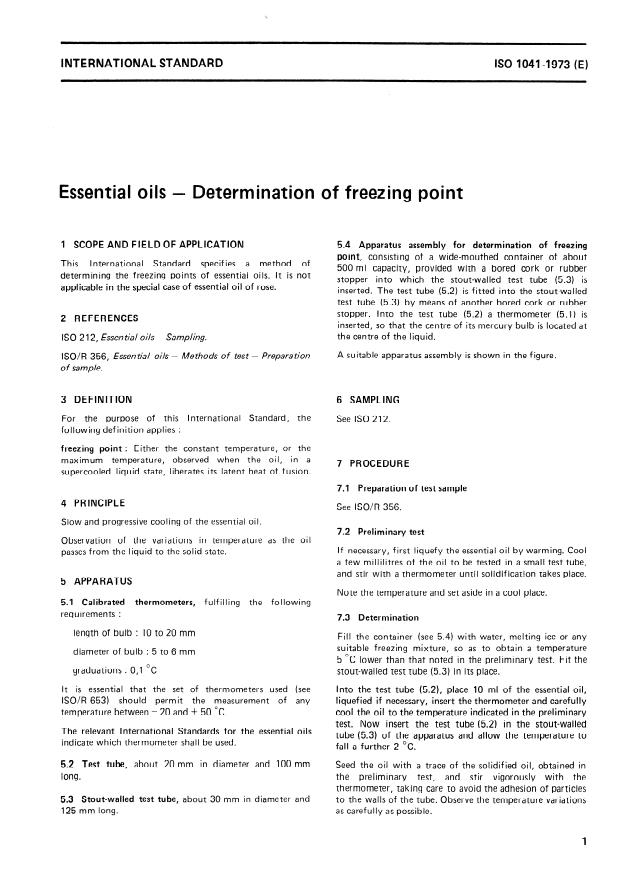
The determination consists in slow and progressive cooling of the essential oil and observation of the variations in temperature as the oil passes from the liquid to the solid state. The apparatur for determination of freezing point consists of a wide-mouthed container of about 500 ml capacity, provided with a bored cork or rubber stopper into which a stout-walled test tube is inserted. Another smaller test tube is fitted into the stout-walled test tube by means of another bored cork or rubber stopper. Into the smaller test tube a thermometer is inserted.
- Status
- Published
- Publication Date
- 30-Nov-1973
- Technical Committee
- ISO/TC 54 - Essential oils
- Drafting Committee
- ISO/TC 54 - Essential oils
- Current Stage
- 9093 - International Standard confirmed
- Start Date
- 03-Dec-2025
- Completion Date
- 29-Aug-2026
Buy Documents

ISO 1041:1973 - Essential oils — Determination of freezing point Released:12/1/1973
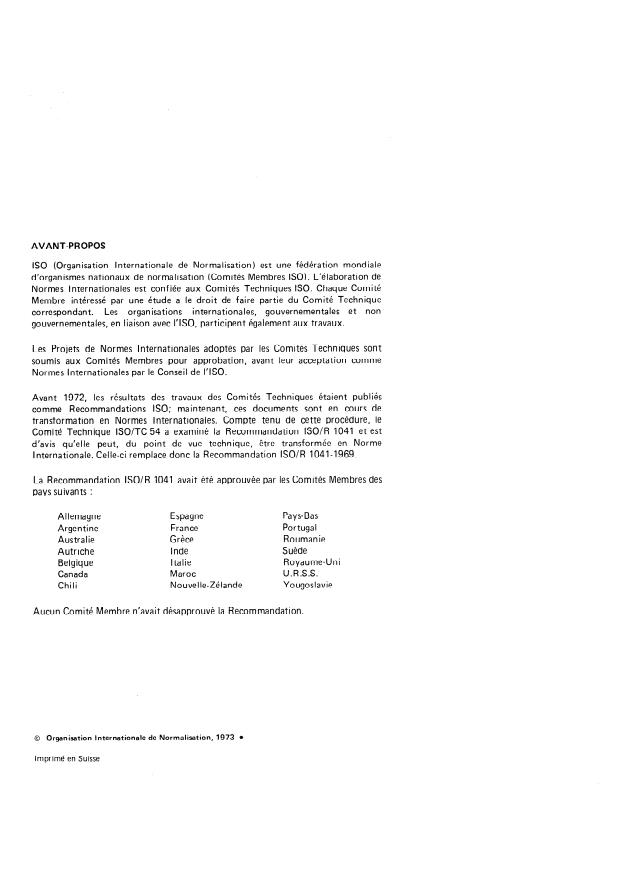
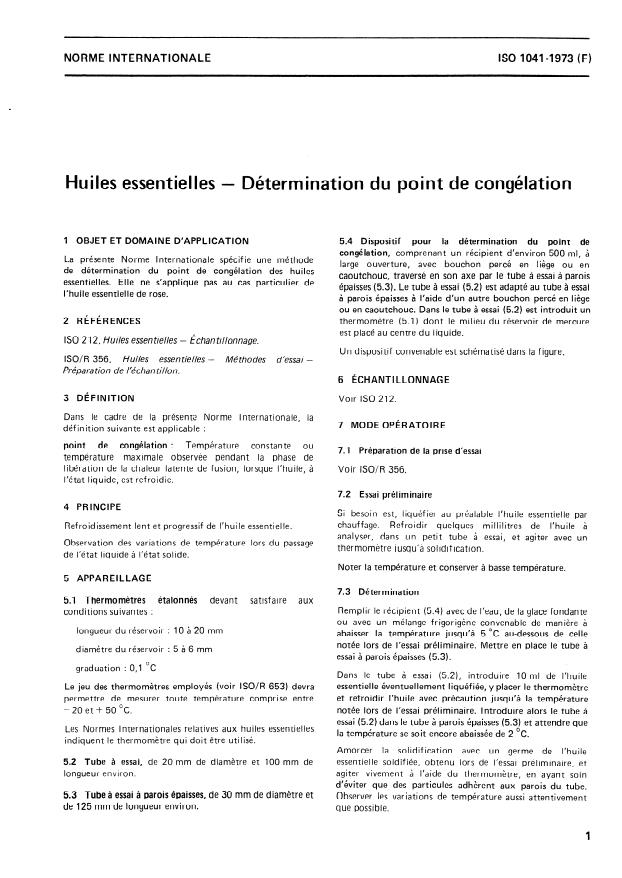

ISO 1041:1973 - Huiles essentielles — Détermination du point de congélation Released:12/1/1973
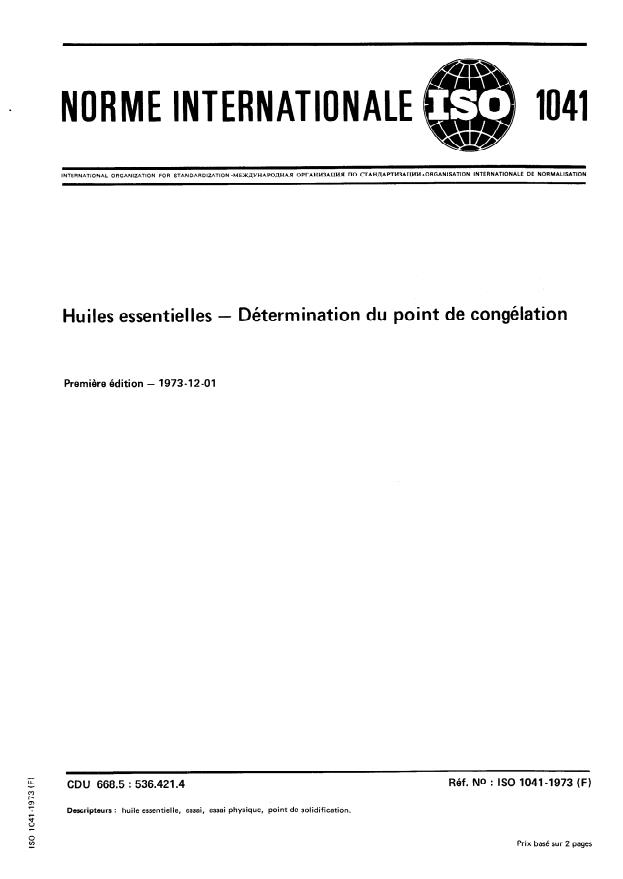
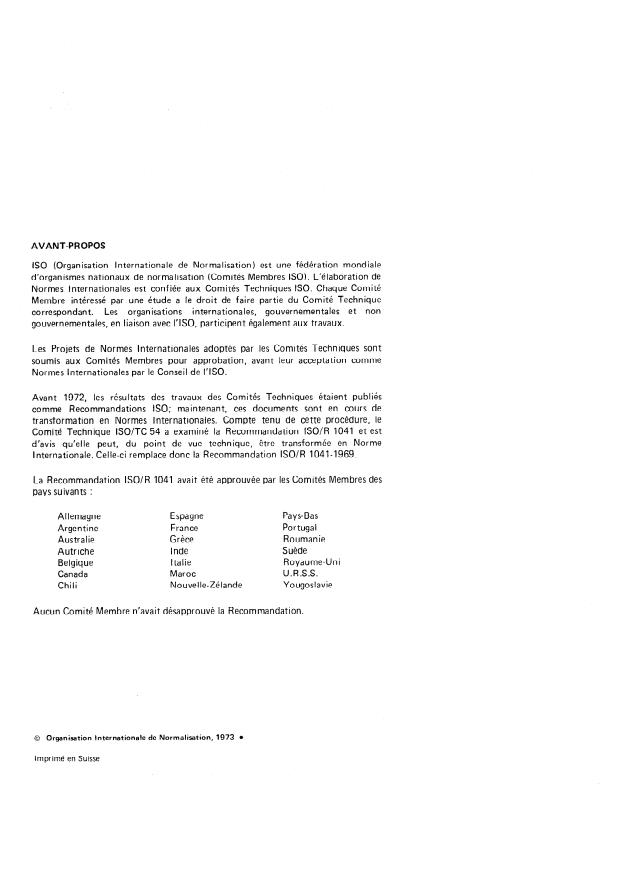

ISO 1041:1973 - Huiles essentielles — Détermination du point de congélation Released:12/1/1973
Overview
ISO 1041:1973 defines a laboratory method for the determination of the freezing point of essential oils by slow, progressive cooling and observation of temperature changes as the oil passes from liquid to solid. The method is intended for routine physical testing and quality control of essential oils, with a specified apparatus and repeatable procedure. Note: the standard does not apply to rose essential oil.
Key Topics
Principle: Controlled cooling of a small oil sample while recording temperature; identification of a maximum or a plateau in the temperature–time curve during latent heat release marks the freezing point.
Apparatus: A wide-mouthed container (~500 ml) with a bored cork or rubber stopper holds a stout-walled test tube. A smaller test tube is fitted inside the stout-walled tube; the thermometer is placed in the inner tube. A schematic device is provided in the standard.
Thermometer requirements: The thermometer must be calibrated and suitable to measure in the range from about –20 °C to +50 °C. Recommended reservoir dimensions are:
- reservoir length: 10–20 mm
- reservoir diameter: 5–6 mm
- graduation: 0.1 °C (Thermometers should conform to the related ISO thermometer guidance.)
Test tube dimensions:
- inner test tube (sample): ~20 mm diameter × 100 mm length
- stout-walled outer tube: ~30 mm diameter × 125 mm length
Procedure summary:
- Prepare a preliminary test: liquefy the oil if necessary, cool a few millilitres in a small tube and agitate until solidification to create a seed crystal and to record an initial temperature.
- Fill the apparatus bath with ice and water or a suitable refrigerant to about 5 °C below the preliminary temperature.
- Introduce 10 ml of the oil into the inner test tube with the thermometer centered in the liquid. Cool to the preliminary temperature, then insert the inner tube into the outer tube and wait for an additional 2 °C drop.
- Initiate solidification with the seed crystal and agitate with the thermometer to avoid wall-adhering particles. Observe temperature closely until a maximum or a plateau lasting more than 1 minute is seen.
- Repeat until two successive determinations differ by no more than 0.2 °C. The mean of the last two determinations is reported to 0.1 °C.
Expression of results: Final freezing point reported in °C to one decimal place.
Applications
- Quality control and batch verification of essential oils
- Specification compliance and physical property profiling
- Laboratory testing where a reproducible freezing point measurement is required
Practical benefits include a standardized, repeatable approach to detect freezing/solidification behaviour and to support product specification limits.
Related Standards
- ISO 212 - Essential oils - Sampling (reference for sampling practice)
- ISO/R 356 - Essential oils - Test methods - Sample preparation
- ISO/R 653 - Thermometer selection and requirements (referenced for thermometer performance)
For test reporting, ISO 1041:1973 requires inclusion of method reference, numeric results and their expression, details of any deviations or special operations, and any particular observations recorded during the test.
Relations
- Effective Date
- 09-Feb-2026
Buy Documents
ISO 1041:1973 - Essential oils — Determination of freezing point Released:12/1/1973
ISO 1041:1973 - Huiles essentielles — Détermination du point de congélation Released:12/1/1973
ISO 1041:1973 - Huiles essentielles — Détermination du point de congélation Released:12/1/1973
Get Certified
Connect with accredited certification bodies for this standard

ECOCERT
Organic and sustainability certification.

Eurofins Food Testing Global
Global leader in food, environment, and pharmaceutical product testing.

Intertek Bangladesh
Intertek certification and testing services in Bangladesh.
Sponsored listings
Frequently Asked Questions
ISO 1041:1973 is a standard published by the International Organization for Standardization (ISO). Its full title is "Essential oils — Determination of freezing point". This standard covers: The determination consists in slow and progressive cooling of the essential oil and observation of the variations in temperature as the oil passes from the liquid to the solid state. The apparatur for determination of freezing point consists of a wide-mouthed container of about 500 ml capacity, provided with a bored cork or rubber stopper into which a stout-walled test tube is inserted. Another smaller test tube is fitted into the stout-walled test tube by means of another bored cork or rubber stopper. Into the smaller test tube a thermometer is inserted.
The determination consists in slow and progressive cooling of the essential oil and observation of the variations in temperature as the oil passes from the liquid to the solid state. The apparatur for determination of freezing point consists of a wide-mouthed container of about 500 ml capacity, provided with a bored cork or rubber stopper into which a stout-walled test tube is inserted. Another smaller test tube is fitted into the stout-walled test tube by means of another bored cork or rubber stopper. Into the smaller test tube a thermometer is inserted.
ISO 1041:1973 is classified under the following ICS (International Classification for Standards) categories: 71.100.60 - Essential oils. The ICS classification helps identify the subject area and facilitates finding related standards.
ISO 1041:1973 has the following relationships with other standards: It is inter standard links to EN ISO 16061:2009. Understanding these relationships helps ensure you are using the most current and applicable version of the standard.
ISO 1041:1973 is available in PDF format for immediate download after purchase. The document can be added to your cart and obtained through the secure checkout process. Digital delivery ensures instant access to the complete standard document.
Standards Content (Sample)
INTERNATIONAL STAND
INTERNATIONAL ORGANIZATION FOR STANDARDIZATION l MEX~YHAPC)AHAII OPTAHM3A4My I-IO CTAHAAPTM3ALW-i l 0RGANISATION INTERNATIONALE DE NORMALISATION
Essential oils - Determination of freezing point
First edition - 1973-12-01
Ref. No. IS0 1041-1973 (E)
UDC 668.5 : 536.421.4
Essential oils, tests, physical tests, solidification points.
Descriptors :
Price based on 2 pages
FOREWORD
IS0 (the International Organization for Standardization) is a worldwide federation
of national standards institutes (IS0 Member Bodies). The work of developing
International Standards is carried out through IS0 Technical Committees, Every
Member Body interested in a subject for which a Technical Committee has been set
up has the right to be represented on that Committee. International organizations,
governmental and non-governmental, in liaison with ISO, also take part in the work.
Draft International Standards adopted by the Technical Committees are circulated
to the Member Bodies for approval before their acceptance as International
Standards by the IS0 Council.
Prior to 1972, the results of the work of the Technical Committees were published
as IS0 Recommendations; these documents are now in the process of being
transformed into International Standards. As part of this process, Technical
Committee ISO/TC 54 has reviewed IS0 Recommendation R 1041 and found it
suitable for transformation. International Standard IS0 therefore replaces IS0
Recommendation R 104 I- 1969.
IS0 Recommendati on R 1041 was approved by the Member Bodies of the
folio wing countries :
Portugal
Argentina Germany
Australia Greece Roman ia
Austria India Spain
Sweden
Belgium Italy
Canada Morocco United Kingdom
Chile Nether lands U.S.S.R.
France New Zealand Yugoslavia
No Member Body expressed disapproval of the Recommendation.
0 International Organization for Standardization, 1973 l
Printed in Switzerland
INTERNATIONAL STANDARD IS0 1041-1973 (E)
Essential oils - Determination of freezing point
1 SCOPE AND FIELD OF APPLICATION 5.4 Apparatus assembly for determination of freezing
point, consisting of a wide-mouthed container of about
This International Standard specifies a method of
500 ml capacity, provided with a bored cork or rubber
determining the freezing points of essential oils. It is not
stopper into which the stout-walled test tube (5.3) is
applicable in the special case of essential oil of rose.
inserted. The test tube (5.2) is fitted into the stout-walled
test tube (5.3) by means of another bored cork or rubber
stopper. Into the test tube (5.2) a thermometer (5.1) is
2 REFERENCES
inserted, so that the centre of its mercury bulb is located at
the centre of the liquid.
IS0 2 12, Essential oils - Sampling.
A suitable apparatus assembly is shown in the figure.
ISO/R 356, Essential oils - Methods of test - Preparation
of sample.
3 DEFINITION 6 SAMPLING
For the purpose of this International Standard, the See IS0 212.
following definition applies :
freezing point : Either the constant temperature, or the
...
NORME INTERNATIONALE
INTERNATIONAL ORGANIZATION FOR STANDARDIZATION l MEX~YHAPO~HAR OPrAHM3ALUiII l-I0 CZAHAAPTW3AWiW.ORGANISATION INTERNATIONALE DE NORMALISATION
Huiles essentielles - Détermination du point de congélation
Première édition - 1973-I 2-01
CDU 668.5 : 536.421.4
Réf. No : ISO 1041-1973 (F)
Descripteurs : huile essentielle, essai, essai physique, point de solidification.
Prix basé sur 2 pages
AVANT-PROPOS
ISO (Organisation Internationale de Normalisation) est une fédération mondiale
d’organismes nationaux de normalisation (Comités Membres ISO). L’élaboration de
Normes Internationales est confiée aux Comités Techniques ISO. Chaque Comité
Membre intéressé par une étude a le droit de faire partie du Comité Technique
correspondant. Les organisations internationales, gouvernementales et non
gouvernementales, en liaison avec I’ISO, participent également aux travaux.
Les Projets de Normes Internationales adoptés par les Comités Techniques sont
soumis aux Comités Membres pour approbation, avant leur acceptation comme
Normes Internationales par le Conseil de I’ISO.
Avant 1972, les résultats des travaux des Comités Techniques étaient publiés
comme Recommandations ISO; maintenant, ces documents sont en cours de
transformation en Normes Internationales. Compte tenu de cette procédure, le
Comité Technique ISO/TC 54 a examiné la Recommandation ISO/R 1041 et est
d’avis qu’elle peut, du point de vue technique, être transformée en Norme
Internationale. Celle-ci remplace donc la Recommandation ISO/R 1041-1969.
La Recommandation lSO/R 1041 avait été approuvée par les Comités Membres des
pays suivants :
Allemagne Espagne Pays-Bas
Argentine France Portugal
Australie Grèce Roumanie
Autriche Inde Suède
Belgique Italie Royaume-Uni
Canada Maroc U.R.S.S.
Chili Nouvelle-Zélande Yougoslavie
Aucun Comité Membre n’avait désapprouvé la Recommandation.
0 Organisation Internationale de Normalisation, 1973 l
Imf3rimé en Suisse
ISO 1041-1973 (F)
NORME INTERNATIONALE
Huiles essentielles - Détermination du point de congélation
5.4 Dispositif pour la détermination du point de
1 OBJET ET DOMAINE D’APPLICATION
congélation, comprenant un récipient d’environ 500 ml, à
L.a présente Norme Internationale spécifie une méthode
large ouverture, avec bouchon percé en liège ou en
de détermination du point de congélation des huiles
caoutchouc, traversé en son axe par le tube à essai à parois
essentielles. Elle ne s’applique pas au cas particulier de
épaisses (5.3). Le tube à essai (5.2) est adapté au tube à essai
I’huile essentielle de rose.
à parois épaisses à l’aide d’un autre bouchon percé en liège
ou en caoutchouc. Dans le tube à essai (5.2) est introduit un
thermomètre (5.1) dont le milieu du réservoir de mercure
2 RÉFÉRENCES
est placé au centre du liquide.
ISO 2 12, Huiles essentielles - Échantillonnage.
Un dispositif convenable est schématisé dans la figure.
ISO/R 356, Huiles essentielles - Méthodes d’essai -
Préparation de l’échan tilion.
6 ÉCHANTILLONNAGE
Voir ISO 212.
3 DÉFINITION
Dans le cadre de la présente Norme Internationale, la
7 MODE OPÉRATOIRE
définition suivante est applicable :
point de congélation : Température constante ou
7.1 Préparation de la prise d’essai
température maximale observée pendant la phase de
libérati
...
NORME INTERNATIONALE
INTERNATIONAL ORGANIZATION FOR STANDARDIZATION l MEX~YHAPO~HAR OPrAHM3ALUiII l-I0 CZAHAAPTW3AWiW.ORGANISATION INTERNATIONALE DE NORMALISATION
Huiles essentielles - Détermination du point de congélation
Première édition - 1973-I 2-01
CDU 668.5 : 536.421.4
Réf. No : ISO 1041-1973 (F)
Descripteurs : huile essentielle, essai, essai physique, point de solidification.
Prix basé sur 2 pages
AVANT-PROPOS
ISO (Organisation Internationale de Normalisation) est une fédération mondiale
d’organismes nationaux de normalisation (Comités Membres ISO). L’élaboration de
Normes Internationales est confiée aux Comités Techniques ISO. Chaque Comité
Membre intéressé par une étude a le droit de faire partie du Comité Technique
correspondant. Les organisations internationales, gouvernementales et non
gouvernementales, en liaison avec I’ISO, participent également aux travaux.
Les Projets de Normes Internationales adoptés par les Comités Techniques sont
soumis aux Comités Membres pour approbation, avant leur acceptation comme
Normes Internationales par le Conseil de I’ISO.
Avant 1972, les résultats des travaux des Comités Techniques étaient publiés
comme Recommandations ISO; maintenant, ces documents sont en cours de
transformation en Normes Internationales. Compte tenu de cette procédure, le
Comité Technique ISO/TC 54 a examiné la Recommandation ISO/R 1041 et est
d’avis qu’elle peut, du point de vue technique, être transformée en Norme
Internationale. Celle-ci remplace donc la Recommandation ISO/R 1041-1969.
La Recommandation lSO/R 1041 avait été approuvée par les Comités Membres des
pays suivants :
Allemagne Espagne Pays-Bas
Argentine France Portugal
Australie Grèce Roumanie
Autriche Inde Suède
Belgique Italie Royaume-Uni
Canada Maroc U.R.S.S.
Chili Nouvelle-Zélande Yougoslavie
Aucun Comité Membre n’avait désapprouvé la Recommandation.
0 Organisation Internationale de Normalisation, 1973 l
Imf3rimé en Suisse
ISO 1041-1973 (F)
NORME INTERNATIONALE
Huiles essentielles - Détermination du point de congélation
5.4 Dispositif pour la détermination du point de
1 OBJET ET DOMAINE D’APPLICATION
congélation, comprenant un récipient d’environ 500 ml, à
L.a présente Norme Internationale spécifie une méthode
large ouverture, avec bouchon percé en liège ou en
de détermination du point de congélation des huiles
caoutchouc, traversé en son axe par le tube à essai à parois
essentielles. Elle ne s’applique pas au cas particulier de
épaisses (5.3). Le tube à essai (5.2) est adapté au tube à essai
I’huile essentielle de rose.
à parois épaisses à l’aide d’un autre bouchon percé en liège
ou en caoutchouc. Dans le tube à essai (5.2) est introduit un
thermomètre (5.1) dont le milieu du réservoir de mercure
2 RÉFÉRENCES
est placé au centre du liquide.
ISO 2 12, Huiles essentielles - Échantillonnage.
Un dispositif convenable est schématisé dans la figure.
ISO/R 356, Huiles essentielles - Méthodes d’essai -
Préparation de l’échan tilion.
6 ÉCHANTILLONNAGE
Voir ISO 212.
3 DÉFINITION
Dans le cadre de la présente Norme Internationale, la
7 MODE OPÉRATOIRE
définition suivante est applicable :
point de congélation : Température constante ou
7.1 Préparation de la prise d’essai
température maximale observée pendant la phase de
libérati
...