


ISO 5952:2019
(Main)Steel sheet, hot-rolled, of structural quality with improved atmospheric corrosion resistance
Steel sheet, hot-rolled, of structural quality with improved atmospheric corrosion resistance
This document specifies requirements for steel sheet hot-rolled of structural quality with improved atmospheric corrosion resistance, also known as weather-resistant structural steel. It is produced in the grades and classes listed in Table 1. The product is intended for applications where requirements are for mechanical properties and increased resistance to atmospheric corrosion. It is generally used in the delivered condition and is intended for bolted, riveted or welded structures. This document does not apply to the following steel qualities: — steels intended for boilers and pressure vessels, and steels designated as commercial quality and drawing qualities (see ISO 3573); — steels produced on reversing mills and designated with improved atmospheric corrosion resistance (see ISO 630-5); — steels designated with structural quality (see ISO 4995), and high yield strength structural quality (see ISO 4996); — steels designated with higher yield strength with improved formability (see ISO 5951).
Tôles en acier de construction laminées à chaud en continu à résistance améliorée à la corrosion atmosphérique
General Information
- Status
- Published
- Publication Date
- 06-Jan-2019
- Technical Committee
- ISO/TC 17/SC 12 - Continuous mill flat rolled products
- Drafting Committee
- ISO/TC 17/SC 12 - Continuous mill flat rolled products
- Current Stage
- 9093 - International Standard confirmed
- Start Date
- 09-Aug-2024
- Completion Date
- 13-Dec-2025
Relations
- Effective Date
- 25-Feb-2017
Overview - ISO 5952:2019 (Hot‑rolled weather‑resistant structural steel)
ISO 5952:2019 specifies requirements for hot‑rolled steel sheet of structural quality with improved atmospheric corrosion resistance (commonly called weather‑resistant structural steel). The standard covers product form, required mechanical properties, chemical composition, testing, inspection, marking and purchaser information for sheets and coils produced in the grades and classes listed in the standard. The product is intended for applications requiring mechanical performance plus increased resistance to atmospheric corrosion and is generally supplied in the delivered condition for bolted, riveted or welded structures.
Key topics and technical requirements
- Scope & product form: Hot‑rolled sheet typically 1.6 mm to 12.5 mm thickness and widths ≥ 600 mm (coils and cut lengths); narrower sheets may be slit from wide sheet.
- Chemical composition: Heat analysis requirements (grades/classes given in Table 1) and limits on alloying elements used to achieve improved atmospheric corrosion resistance.
- Chemical testing: Manufacturer heat analysis required; purchaser product analysis allowed with specified tolerances (see Table 2).
- Mechanical properties & testing: Mechanical properties required at delivery; tensile testing procedures follow referenced methods (e.g., ISO 6892‑1). Sampling, retests and resubmission rules are specified.
- Corrosion resistance: Defined as improvement produced by controlled alloying (P, Cu, Cr, Ni, etc.) to promote a protective oxide layer; performance depends on environment and design (guidance in Annex A and B).
- Weldability & workmanship: Guidance on welding suitability and surface condition (scale/oxide, descaling effects). Oiling practices, dimensional and shape tolerances, coil size, marking and inspection/acceptance rules are included.
- Documentation: Requirements for marking and purchaser information to ensure traceability and correct application.
Applications and practical value
ISO 5952:2019 is used where structural components require both strength and increased resistance to atmospheric corrosion - for example, outdoor structural steel elements and general structural fabrications exposed to the environment. The standard helps:
- Ensure consistent material quality and weather‑resistant structural steel performance.
- Facilitate procurement, inspection and acceptance between manufacturers and purchasers.
- Support design and fabrication practices (welding, bolting, riveting) with traceable test and composition data.
Who uses this standard
- Steel producers and mills manufacturing hot‑rolled weather‑resistant sheet
- Structural fabricators and welders
- Purchasing/specification engineers and procurement teams
- Quality/inspection personnel and testing laboratories
- Designers and structural engineers specifying durable steel for atmospheric exposure
Related standards
Referenced and related standards include ISO 148‑1, ISO 6892‑1, ISO 16160 and other ISO grades/quality documents (e.g., ISO 3573, ISO 630‑5, ISO 4995, ISO 4996, ISO 5951) for complementary requirements and testing methods.

Frequently Asked Questions
ISO 5952:2019 is a standard published by the International Organization for Standardization (ISO). Its full title is "Steel sheet, hot-rolled, of structural quality with improved atmospheric corrosion resistance". This standard covers: This document specifies requirements for steel sheet hot-rolled of structural quality with improved atmospheric corrosion resistance, also known as weather-resistant structural steel. It is produced in the grades and classes listed in Table 1. The product is intended for applications where requirements are for mechanical properties and increased resistance to atmospheric corrosion. It is generally used in the delivered condition and is intended for bolted, riveted or welded structures. This document does not apply to the following steel qualities: — steels intended for boilers and pressure vessels, and steels designated as commercial quality and drawing qualities (see ISO 3573); — steels produced on reversing mills and designated with improved atmospheric corrosion resistance (see ISO 630-5); — steels designated with structural quality (see ISO 4995), and high yield strength structural quality (see ISO 4996); — steels designated with higher yield strength with improved formability (see ISO 5951).
This document specifies requirements for steel sheet hot-rolled of structural quality with improved atmospheric corrosion resistance, also known as weather-resistant structural steel. It is produced in the grades and classes listed in Table 1. The product is intended for applications where requirements are for mechanical properties and increased resistance to atmospheric corrosion. It is generally used in the delivered condition and is intended for bolted, riveted or welded structures. This document does not apply to the following steel qualities: — steels intended for boilers and pressure vessels, and steels designated as commercial quality and drawing qualities (see ISO 3573); — steels produced on reversing mills and designated with improved atmospheric corrosion resistance (see ISO 630-5); — steels designated with structural quality (see ISO 4995), and high yield strength structural quality (see ISO 4996); — steels designated with higher yield strength with improved formability (see ISO 5951).
ISO 5952:2019 is classified under the following ICS (International Classification for Standards) categories: 77.140.50 - Flat steel products and semi-products. The ICS classification helps identify the subject area and facilitates finding related standards.
ISO 5952:2019 has the following relationships with other standards: It is inter standard links to ISO 5952:2011. Understanding these relationships helps ensure you are using the most current and applicable version of the standard.
You can purchase ISO 5952:2019 directly from iTeh Standards. The document is available in PDF format and is delivered instantly after payment. Add the standard to your cart and complete the secure checkout process. iTeh Standards is an authorized distributor of ISO standards.
Standards Content (Sample)
INTERNATIONAL ISO
STANDARD 5952
Fifth edition
2019-01
Steel sheet, hot-rolled, of structural
quality with improved atmospheric
corrosion resistance
Tôles en acier de construction laminées à chaud en continu à
résistance améliorée à la corrosion atmosphérique
Reference number
©
ISO 2019
© ISO 2019
All rights reserved. Unless otherwise specified, or required in the context of its implementation, no part of this publication may
be reproduced or utilized otherwise in any form or by any means, electronic or mechanical, including photocopying, or posting
on the internet or an intranet, without prior written permission. Permission can be requested from either ISO at the address
below or ISO’s member body in the country of the requester.
ISO copyright office
CP 401 • Ch. de Blandonnet 8
CH-1214 Vernier, Geneva
Phone: +41 22 749 01 11
Fax: +41 22 749 09 47
Email: copyright@iso.org
Website: www.iso.org
Published in Switzerland
ii © ISO 2019 – All rights reserved
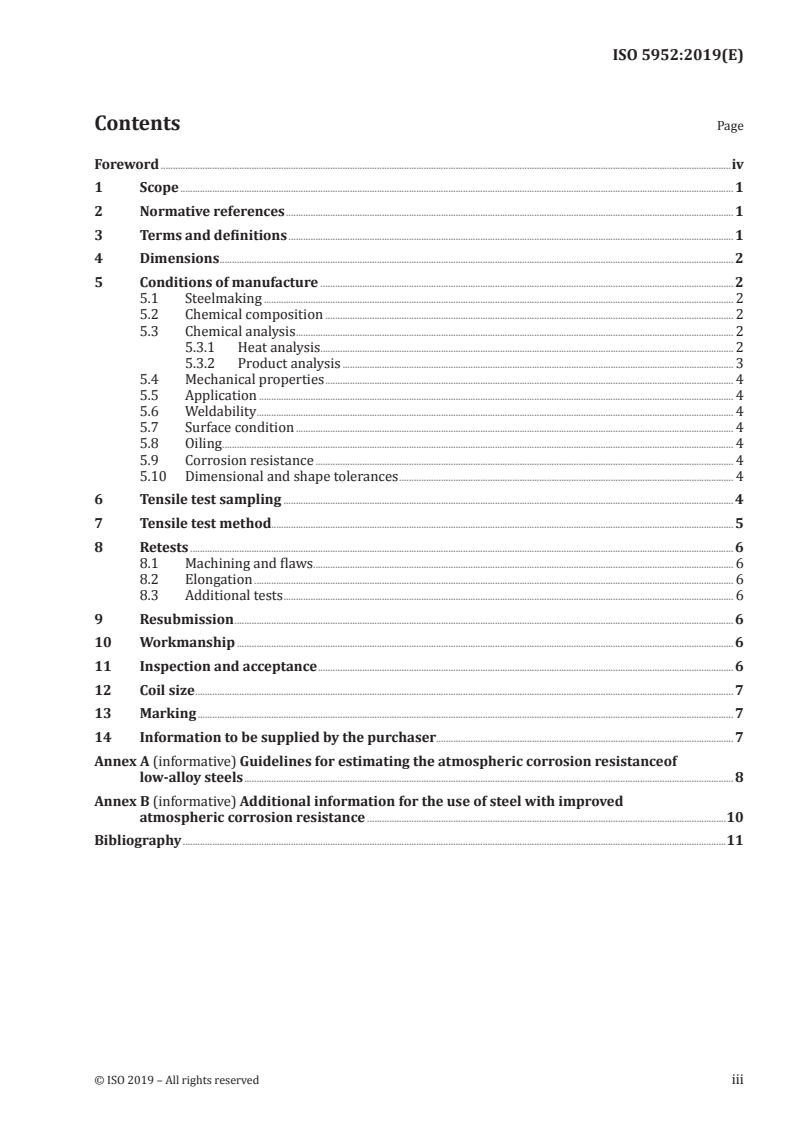
Contents Page
Foreword .iv
1 Scope . 1
2 Normative references . 1
3 Terms and definitions . 1
4 Dimensions . 2
5 Conditions of manufacture . 2
5.1 Steelmaking . 2
5.2 Chemical composition . 2
5.3 Chemical analysis . 2
5.3.1 Heat analysis . . 2
5.3.2 Product analysis . 3
5.4 Mechanical properties . 4
5.5 Application . 4
5.6 Weldability . 4
5.7 Surface condition . 4
5.8 Oiling . 4
5.9 Corrosion resistance . 4
5.10 Dimensional and shape tolerances . 4
6 Tensile test sampling . 4
7 Tensile test method. 5
8 Retests . 6
8.1 Machining and flaws. 6
8.2 Elongation . 6
8.3 Additional tests . 6
9 Resubmission . 6
10 Workmanship . 6
11 Inspection and acceptance . 6
12 Coil size . 7
13 Marking . 7
14 Information to be supplied by the purchaser. 7
Annex A (informative) Guidelines for estimating the atmospheric corrosion resistanceof
low-alloy steels . 8
Annex B (informative) Additional information for the use of steel with improved
atmospheric corrosion resistance .10
Bibliography .11
Foreword
ISO (the International Organization for Standardization) is a worldwide federation of national standards
bodies (ISO member bodies). The work of preparing International Standards is normally carried out
through ISO technical committees. Each member body interested in a subject for which a technical
committee has been established has the right to be represented on that committee. International
organizations, governmental and non-governmental, in liaison with ISO, also take part in the work.
ISO collaborates closely with the International Electrotechnical Commission (IEC) on all matters of
electrotechnical standardization.
The procedures used to develop this document and those intended for its further maintenance are
described in the ISO/IEC Directives, Part 1. In particular, the different approval criteria needed for the
different types of ISO documents should be noted. This document was drafted in accordance with the
editorial rules of the ISO/IEC Directives, Part 2 (see www .iso .org/directives).
Attention is drawn to the possibility that some of the elements of this document may be the subject of
patent rights. ISO shall not be held responsible for identifying any or all such patent rights. Details of
any patent rights identified during the development of the document will be in the Introduction and/or
on the ISO list of patent declarations received (see www .iso .org/patents).
Any trade name used in this document is information given for the convenience of users and does not
constitute an endorsement.
For an explanation of the voluntary nature of standards, the meaning of ISO specific terms and
expressions related to conformity assessment, as well as information about ISO's adherence to the
World Trade Organization (WTO) principles in the Technical Barriers to Trade (TBT) see www .iso
.org/iso/foreword .html.
This document was prepared by Technical Committee ISO/TC 17, Steel, Subcommittee SC 12, Continuous
mill flat rolled products.
This fifth edition cancels and replaces the fourth edition (ISO 5952:2011), which has been technically
revised.
The main changes compared to the previous edition are as follows:
— tables have been updated throughout for clarity;
— additional editorial changes for clarity.
Any feedback or questions on this document should be directed to the user’s national standards body. A
complete listing of these bodies can be found at www .iso .org/members .html.
iv © ISO 2019 – All rights reserved
INTERNATIONAL STANDARD ISO 5952:2019(E)
Steel sheet, hot-rolled, of structural quality with improved
atmospheric corrosion resistance
1 Scope
This document specifies requirements for steel sheet hot-rolled of structural quality with improved
atmospheric corrosion resistance, also known as weather-resistant structural steel. It is produced in
the grades and classes listed in Table 1. The product is intended for applications where requirements
are for mechanical properties and increased resistance to atmospheric corrosion. It is generally used in
the delivered condition and is intended for bolted, riveted or welded structures.
This document does not apply to the following steel qualities:
— steels intended for boilers and pressure vessels, and steels designated as commercial quality and
drawing qualities (see ISO 3573);
— steels produced on reversing mills and designated with improved atmospheric corrosion resistance
(see ISO 630-5);
— steels designated with structural quality (see ISO 4995), and high yield strength structural quality
(see ISO 4996);
— steels designated with higher yield strength with improved formability (see ISO 5951).
2 Normative references
The following documents are referred to in the text in such a way that some or all of their content
constitutes requirements of this document. For dated references, only the edition cited applies. For
undated references, the latest edition of the referenced document (including any amendments) applies.
ISO 148-1, Metallic materials — Charpy pendulum impact test — Part 1: Test method
ISO 6892-1, Metallic materials — Tensile testing — Part 1: Method of test at room temperature
ISO 16160, Hot-rolled steel sheet products — Dimensional and shape tolerances
3 Terms and definitions
For the purposes of this document, the following terms and definitions apply.
ISO and IEC maintain terminological databases for use in standardization at the following addresses:
— ISO Online browsing platform: available at https: //www .iso .org/obp
— IEC Electropedia: available at http: //www .electropedia .org/
3.1
improved atmospheric corrosion resistance
characteristic achieved by intentional addition of a certain number of alloying elements, such as P, Cu,
Cr, Ni, etc., providing a chemical composition which promotes the formation of a protective oxide layer
on the product
Note 1 to entry: The degree of corrosion resistance is based on data acceptable to the purchaser.
3.2
hot-rolled steel sheet
product obtained by rolling heated steel through a continuous-type wide strip mill to the required
sheet thickness
Note 1 to entry: The product has a surface covered with oxide or scale resulting from the hot-rolling operation.
3.3
hot-rolled, descaled steel sheet
hot-rolled steel sheet (3.2) from which oxide or scale has been removed by pickling in an acid solution or
by mechanical means such as grit blasting
Note 1 to entry: Some change in properties can result from mechanical descaling.
3.4
lot
up to a specified quantity of steel sheet of the same designation rolled to the same thickness and coating
condition
4 Dimensions
4.1 This product is commonly produced in the range of thicknesses 1,6 mm up to and including
12,5 mm and widths of 600 mm and over, in coils and cut lengths.
4.2 Hot-rolled sheet less than 600 mm wide can be slit from wide sheet and will be considered as
not strip.
NOTE Hot-rolled sheet up to but not including 3 mm in thickness is commonly known as sheet. Hot-rolled
sheet 3 mm and over in thickness is commonly known as either “sheet” or “plate”.
5 Conditions of manufacture
5.1 Steelmaking
Unless otherwise agreed upon, the processes used in making the steel and in manufacturing hot-rolled
sheet are left to the discretion of the manufacturer. On request, the purchaser shall be informed of the
steelmaking process being used.
5.2 Chemical composition
5.2.1 The chemical composition (heat analysis) shall conform to the requirements given in Table 1.
5.2.2 When selecting the grade or chemical composition to be used, attention should be directed to the
appropriate welding procedure to be followed (see 5.6).
5.3 Chemical analysis
5.3.1 Heat analysis
An analysis of each heat shall be made by the manufacturer in order to determine conformity with the
requirements given in Table 1. On request, a report of the heat analysis shall be made available to the
purchaser or the purchaser’s representative. Each of the elements listed in Table 1 shall be included in
the report of the heat analysis.
2 © ISO 2019 – All rights reserved
Table 1 — Chemical composition (heat analysis)
Mass fractions in percent
Method
C S
a
Grade Class of deoxi- Mn Si P Cu Ni Cr Mo Zr
max. max.
b
dation
HSA B NE 0,13 0,20 to 0,10 to 0,040 0,035 0,25 to 0,65 0,40 to
c c
235W 0,60 max. 0,55 max. 0,80
D CS 0,40
HSA B NE 0,18 1,25 0,15 to 0,035 0,035 0,30 to 0,05 to 0,45 to
c c
245W max. 0,65 max. 0,50 0,30 0,75
D CS
HSA A NE 0,12 1,00 0,20 to 0,06 to 0,035 0,25 to 0,65 0,30 to
c c
355W1 max. 0,75 0,15 0,55 max. 1,25
D CS
HSA C NE 0,16 0,50 to 0,50 0,035 0,035 0,25 to 0,65 0,40 to 0,30 0,15
355W2 1,50 max. max. 0,55 max. 0,80 max. max.
D CS
HSA B NE 0,18 1,40 0,15 to 0,035 0,035 0,30 to 0,05 to 0,45 to
c c
365W max. 0,65 max. 0,50 0,30 0,75
D CS
NOTE Each grade can contain one or more microalloying elements, such as vanadium, titanium, niobium, etc.
a
Class A steels satisfy only moderate loading conditions.
Class B steels are intended for use in welded structures or structural parts, subjected to normal loading conditions.
Class C steels are to be used in cases where, owing to loading conditions and the general design of the structure, some
resistance to brittle fracture is necessary.
Class D steels are to be used for structures or structural parts where, owing to loading conditions and the general design of
the structure, a high resistance to brittle fracture is necessary.
b
NE — non-rimming.
CS — aluminium killed (0,020 % minimum total aluminium).
c
The total content of Mo, Nb, Ti, V and Zr is not to exceed 0,15 %.
5.3.2 Product analysis
A product analysis may be made by the purchaser i
...
記事のタイトル: ISO 5952:2019 - 大気腐食性耐性向上構造用熱延鋼板 記事の内容: 本文書は、大気腐食性耐性が向上した構造用の熱延鋼板、または耐候性構造鋼板の要件を規定しています。表1にリストされた等級とクラスで製造されます。この製品は、機械的特性と大気腐食性への耐性の両方が要求される用途に使用されます。一般的には納入状態で使用され、ボルト、リベット、または溶接された構造に適しています。ただし、この文書は次の鋼材品質には適用されません。- ボイラーや圧力容器向けに意図された鋼板、商業品質および引張り品質として指定された鋼板(ISO 3573を参照)- 反転圧延機で生産され、大気腐食性耐性向上と指定された鋼板(ISO 630-5を参照)- 構造用として指定された鋼板(ISO 4995を参照)および高屈服強度構造用(ISO 4996を参照)- 成形性が向上した高屈服強度で指定された鋼板(ISO 5951を参照)は含まれません。
ISO 5952:2019 is a standard that specifies the requirements for hot-rolled steel sheets of structural quality with improved resistance to atmospheric corrosion. These sheets, also known as weather-resistant structural steel, are produced in various grades and classes. The product is intended for applications requiring both mechanical properties and increased resistance to atmospheric corrosion. It is commonly used in its delivered condition and is suitable for bolted, riveted, or welded structures. However, this standard does not apply to certain steel qualities, such as those intended for boilers and pressure vessels, commercial quality and drawing qualities, and so on, as specified in other ISO standards.
기사 제목: ISO 5952:2019 - 대기식 부식 저항성 향상 구조용 열간압연 강판 기사 내용: 이 문서는 대기식 부식 저항성이 향상된 구조용 열간압연 강판, 즉 날씨에 강한 구조용 강판에 대한 요구사항을 명시합니다. 테이블 1에 나열된 등급과 종류로 제조됩니다. 이 제품은 기계적 특성과 대기식 부식에 대한 저항성이 증가한 요구사항이 필요한 응용 분야에 사용됩니다. 일반적으로 납품 상태로 제공되며 볼트, 리벳 또는 용접된 구조물에 사용되도록 설계되었습니다. 이 문서는 다음과 같은 강판 품질에는 적용되지 않습니다. – 보일러와 압력 용기용으로 의도된 강판 및 상업적 품질 및 도장 품질로 지정된 강판(ISO 3573 참조) – 역압압연기에서 생산되고 대기식 부식 저항성이 향상된 것으로 지정된 강판(ISO 630-5 참조) – 구조용으로 지정된 강판(ISO 4995 참조)과 고 항복강도 구조용 강판(ISO 4996 참조) – 향상된 성형성을 갖는 고 항복강도로 지정된 강판(ISO 5951 참조).
Questions, Comments and Discussion
Ask us and Technical Secretary will try to provide an answer. You can facilitate discussion about the standard in here.
Loading comments...