


ISO 13822:2001
(Main)Bases for design of structures — Assessment of existing structures
Bases for design of structures — Assessment of existing structures
Bases du calcul des constructions — Évaluation des constructions existantes
General Information
- Status
- Withdrawn
- Publication Date
- 19-Dec-2001
- Withdrawal Date
- 19-Dec-2001
- Technical Committee
- ISO/TC 98/SC 2 - Reliability of structures
- Drafting Committee
- ISO/TC 98/SC 2 - Reliability of structures
- Current Stage
- 9599 - Withdrawal of International Standard
- Start Date
- 22-Jul-2010
- Completion Date
- 12-Feb-2026
Relations
- Effective Date
- 26-Sep-2008
Get Certified
Connect with accredited certification bodies for this standard

ICC Evaluation Service
Building products evaluation and certification.

QAI Laboratories
Building and construction product testing and certification.

Aboma Certification B.V.
Specialized in construction, metal, and transport sectors.
Sponsored listings
Frequently Asked Questions
ISO 13822:2001 is a standard published by the International Organization for Standardization (ISO). Its full title is "Bases for design of structures — Assessment of existing structures". This standard covers: Bases for design of structures — Assessment of existing structures
Bases for design of structures — Assessment of existing structures
ISO 13822:2001 is classified under the following ICS (International Classification for Standards) categories: 91.080.01 - Structures of buildings in general. The ICS classification helps identify the subject area and facilitates finding related standards.
ISO 13822:2001 has the following relationships with other standards: It is inter standard links to ISO 13822:2010. Understanding these relationships helps ensure you are using the most current and applicable version of the standard.
ISO 13822:2001 is available in PDF format for immediate download after purchase. The document can be added to your cart and obtained through the secure checkout process. Digital delivery ensures instant access to the complete standard document.
Standards Content (Sample)
INTERNATIONAL ISO
STANDARD 13822
First edition
2001-12-15
Corrected version
2003-02-15
Bases for design of structures —
Assessment of existing structures
Bases du calcul des constructions — Évaluation des constructions
existantes
Reference number
©
ISO 2001
PDF disclaimer
This PDF file may contain embedded typefaces. In accordance with Adobe's licensing policy, this file may be printed or viewed but shall not
be edited unless the typefaces which are embedded are licensed to and installed on the computer performing the editing. In downloading this
file, parties accept therein the responsibility of not infringing Adobe's licensing policy. The ISO Central Secretariat accepts no liability in this
area.
Adobe is a trademark of Adobe Systems Incorporated.
Details of the software products used to create this PDF file can be found in the General Info relative to the file; the PDF-creation parameters
were optimized for printing. Every care has been taken to ensure that the file is suitable for use by ISO member bodies. In the unlikely event
that a problem relating to it is found, please inform the Central Secretariat at the address given below.
© ISO 2001
All rights reserved. Unless otherwise specified, no part of this publication may be reproduced or utilized in any form or by any means, electronic
or mechanical, including photocopying and microfilm, without permission in writing from either ISO at the address below or ISO's member body
in the country of the requester.
ISO copyright office
Case postale 56 • CH-1211 Geneva 20
Tel. + 41 22 749 01 11
Fax + 41 22 749 09 47
E-mail copyright@iso.org
Web www.iso.org
Published in Switzerland
ii © ISO 2001 – All rights reserved
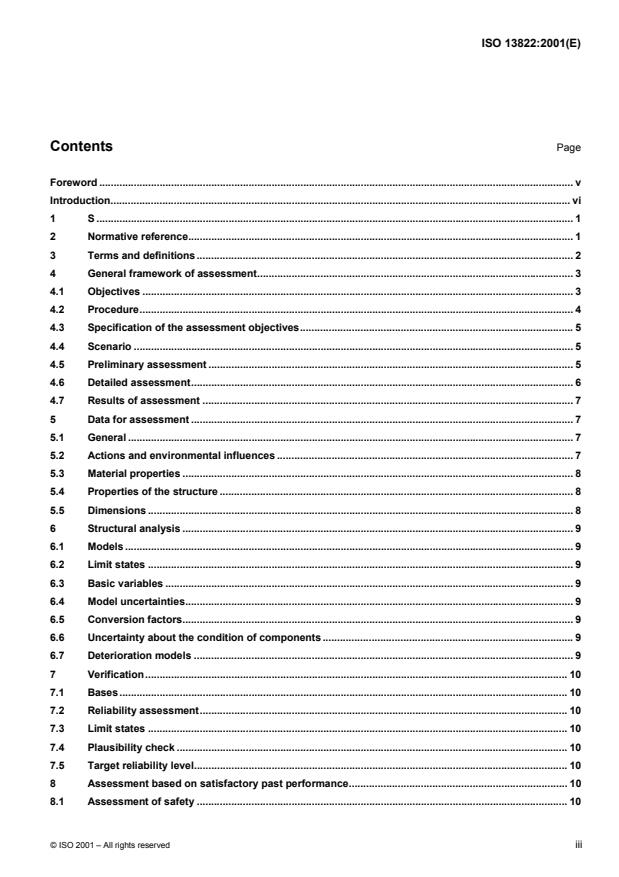
Contents Page
Foreword . v
Introduction. vi
1 S . 1
2 Normative reference. 1
3 Terms and definitions. 2
4 General framework of assessment. 3
4.1 Objectives . 3
4.2 Procedure. 4
4.3 Specification of the assessment objectives. 5
4.4 Scenario . 5
4.5 Preliminary assessment . 5
4.6 Detailed assessment. 6
4.7 Results of assessment . 7
5 Data for assessment . 7
5.1 General . 7
5.2 Actions and environmental influences . 7
5.3 Material properties . 8
5.4 Properties of the structure . 8
5.5 Dimensions . 8
6 Structural analysis . 9
6.1 Models . 9
6.2 Limit states . 9
6.3 Basic variables . 9
6.4 Model uncertainties. 9
6.5 Conversion factors. 9
6.6 Uncertainty about the condition of components . 9
6.7 Deterioration models . 9
7 Verification. 10
7.1 Bases. 10
7.2 Reliability assessment. 10
7.3 Limit states . 10
7.4 Plausibility check . 10
7.5 Target reliability level. 10
8 Assessment based on satisfactory past performance. 10
8.1 Assessment of safety . 10
8.2 Assessment of serviceability. 11
9 Interventions. 11
10 Report . 11
10.1 General . 11
10.2 Conclusions . 11
10.3 Sufficient reliability . 11
10.4 Insufficient reliability . 11
10.5 Recommendations for interventions. 12
10.6 Inspection and maintenance plan. 12
10.7 Documented information. 12
10.8 Reporting style . 12
11 Judgement and decision . 12
11.1 Decision. 12
11.2 Change in use. 12
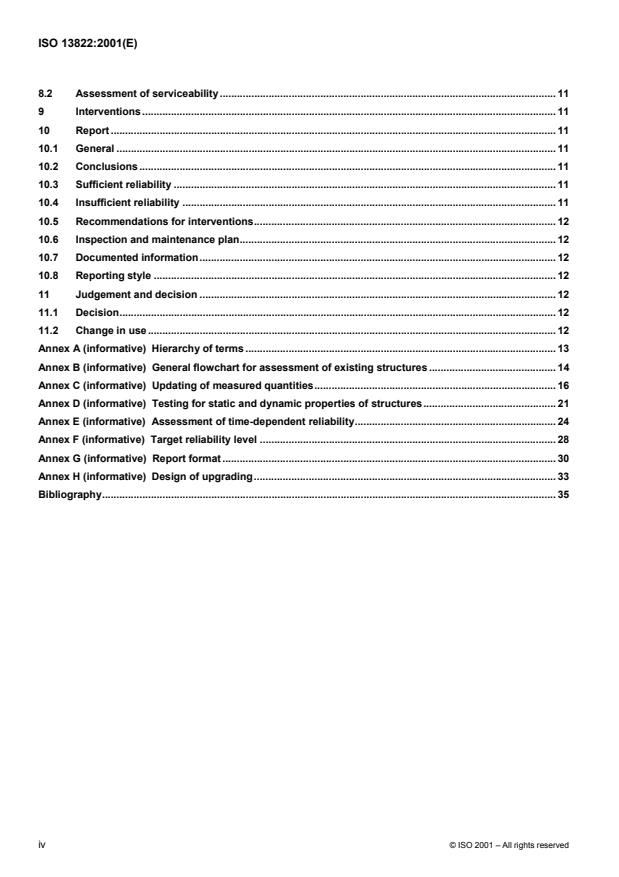
Annex A (informative) Hierarchy of terms . 13
Annex B (informative) General flowchart for assessment of existing structures . 14
Annex C (informative) Updating of measured quantities. 16
Annex D (informative) Testing for static and dynamic properties of structures. 21
Annex E (informative) Assessment of time-dependent reliability. 24
Annex F (informative) Target reliability level . 28
Annex G (informative) Report format. 30
Annex H (informative) Design of upgrading. 33
Bibliography. 35
iv © ISO 2001 – All rights reserved
Foreword
ISO (the International Organization for Standardization) is a worldwide federation of national standards bodies (ISO
member bodies). The work of preparing International Standards is normally carried out through ISO technical
committees. Each member body interested in a subject for which a technical committee has been established has
the right to be represented on that committee. International organizations, governmental and non-governmental, in
liaison with ISO, also take part in the work. ISO collaborates closely with the International Electrotechnical
Commission (IEC) on all matters of electrotechnical standardization.
International Standards are drafted in accordance with the rules given in the ISO/IEC Directives, Part 3.
Draft International Standards adopted by the technical committees are circulated to the member bodies for voting.
Publication as an International Standard requires approval by at least 75 % of the member bodies casting a vote.
Attention is drawn to the possibility that some of the elements of this International Standard may be the subject of
patent rights. ISO shall not be held responsible for identifying any or all such patent rights.
International Standard ISO 13822 was prepared by Technical Committee ISO/TC 98, Bases for design of
structures, Subcommittee SC 2, Reliability of structures.
Annexes A to H of this International Standard are for information only.
This corrected version of ISO 13822:2001 incorporates the following corrections. The flowchart in Annex B has
been corrected and the year of publication of reference [8] in the Bibliography has been changed.
Introduction
The continued use of existing structures is of great importance because the built environment is a huge economic
and political asset, growing larger every year. The assessment of existing structures is now a major engineering
task. The structural engineer is increasingly called upon to devise ways for extending the life of structures whilst
observing tight cost constraints. The establishment of principles for the assessment of existing structures is needed
because it is based on an approach that is substantially different from the design of new structures, and requires
knowledge beyond the scope of design codes. This document is intended not only as a standard of principles and
procedures for the assessment of existing structures but also as a guide for use by structural engineers and clients.
Engineers can apply specific methods for assessment in order to save structures and to reduce a client's
expenditure. The ultimate goal is to limit construction intervention to a strict minimum, a goal that is clearly in
agreement with the principles of sustainable development.
The basis for the reliability assessment is contained in the performance requirements for safety and serviceability of
ISO 2394. Economic, social, and sustainability considerations, however, result in a greater differentiation in
structural reliability for the assessment of existing structures than for the design of new structures
vi © ISO 2001 – All rights reserved
INTERNATIONAL STANDARD ISO 13822:2001(E)
Bases for design of structures — Assessment of existing
structures
1 Scope
1.1 This International Standard provides general requirements and procedures for the assessment of existing
structures (buildings, bridges, industrial structures, etc.) based on the principles of structural reliability and
consequences of failure. It is based on ISO 2394.
1.2 It is applicable to the assessment of any type of existing structure that was originally designed, analysed and
specified based on accepted engineering principles and/or design rules, as well as structures constructed on the
basis of good workmanship, historic experience and accepted professional practice. The assessment can be
initiated under the following circumstances:
an anticipated change in use or extension of design working life;
a reliability check (e.g. for earthquakes, increased traffic actions) as required by authorities, insurance
companies, owners, etc.;
structural deterioration due to time-dependent actions (e.g. corrosion, fatigue);
structural damage by accidental actions (see ISO 2394).
NOTE 1 This International Standard is applicable to historical structures, provided additional considerations are taken into
account concerning the preservation of the historical appearance of the structure and the preservation of its historical materials.
1.3 This International Standard is applicable to existing structures of any material, although specific adaptation
can be required depending on the type of material, such as concrete, steel, timber, masonry, etc.
1.4 This International Standard provides principles regarding actions and environmental influences. Further
detailed consideration will be necessary for accidental actions such as fire and earthquake.
NOTE 2 Fire resistance requires properties different from those for structural safety and integrity. Also fire hazards can be
created by change in use. Special requirements are necessary for seismic hazards, taking the dynamic action and structural
response into account.
1.5 This International Standard is intended to serve as a basis for preparing national standards or codes of
practice in accordance with current engineering practice and the economic conditions.
2 Normative reference
The following normative document contains provisions which, through reference in this text, constitute provisions of
this International Standard. For dated references, subsequent amendments to, or revisions of, any of these
publications do not apply. However, parties to agreements based on this International Standard are encouraged to
investigate the possibility of applying the most recent edition of the normative document indicated below. For
undated references, the latest edition of the normative document referred to applies. Members of ISO and IEC
maintain registers of currently valid International Standards.
ISO 2394:1998, General principles on reliability for structures
3 Terms and definitions
For the purposes of this International Standard, the terms and definitions given in ISO 2394 and the following apply.
(See also annex A.)
3.1
assessment
set of activities performed in order to verify the reliability of an existing structure for future use
3.2
damage
unfavourable change in the condition of a structure that can affect structural performance
3.3
deterioration
process that adversely affects the structural performance, including reliability over time due to
naturally occurring chemical, physical or biological actions,
repeated actions such as those causing fatigue,
normal or severe environmental influences,
wear due to use, or
improper operation and maintenance of the structure
3.4
deterioration model
mathematical model that describes structural performance as a function of time, taking deterioration into account
3.5
inspection
on-site non-destructive examination to establish the present condition of the structure
3.6
investigation
collection and evaluation of information through inspection, document search, load testing and other testing
3.7
load testing
test of the structure or part thereof by loading to evaluate its behaviour or properties, or to predict its load-bearing
capacity
3.8
maintenance
routine intervention to preserve appropriate structural performance
3.9
material properties
mechanical, physical or chemical properties of structural materials
3.10
monitoring
frequent or continuous, normally long-term, observation or measurement of structural conditions or actions
2 © ISO 2001 – All rights reserved
3.11
reference period
chosen period of time which is used as a basis for assessing values of variable actions, time-dependent material
properties, etc.
NOTE The remaining working life or the minimum standard period for safety of an existing structure can be taken as
reference period (see annex F).
3.12
rehabilitation
work required to repair, and possibly upgrade, an existing structure
3.13
remaining working life
period for which an existing structure is intended/expected to operate with planned maintenance
3.14
repair, verb
·of a structureÒ improve the condition of a structure by restoring or replacing existing components that have been
damaged
3.15
safety plan
plan specifying the performance objectives, the scenarios to be considered for the structure, and all present and
future measures (design, construction, or operation, such as monitoring) to ensure the safety of the structure
3.16
structural performance
qualitative or quantitative representation of the behaviour of a structure (e.g. load-bearing capacity, stiffness) in
terms of its safety and serviceability
3.17
target reliability level
level of reliability required to ensure acceptable safety and serviceability
3.18
upgrading
modifications to an existing structure to improve its structural performance
3.19
utilization plan
plan containing the intended use (or uses) of the structure, and listing the operational conditions of the structure
including maintenance requirements, and the corresponding performance requirements
4 General framework of assessment
4.1 Objectives
The objective of the assessment of an existing structure in terms of its required future structural performance shall
be specified in consultation with the client (the owner, the authority, insurance companies, etc.) based on the
following performance levels.
a) Safety performance level, which provides appropriate safety for the users of the structure.
b) Continued function performance level, which provides continued function for special structures such as
hospitals, communication buildings or key bridges, in the event of an earthquake, impact, or other foreseen
hazard.
c) Special performance requirements of the client related to property protection (economic loss) or serviceability.
The level of this performance is generally based on life cycle cost and special functional requirements.
4.2 Procedure
The assessment procedure is composed in general of the following steps so that the assessment is carried out
taking into account the actual conditions of the structures (see the flowchart in annex B). The procedure depends
on the assessment objectives (see 4.1), and on specific circumstances (e.g. the availability of the design
documents, the observation of damage, the use of the structure). A site visit is recommended prior to initiating the
procedure.
a) Specification of the assessment objectives.
b) Scenarios.
c) Preliminary assessment:
1) study of documents and other evidence;
2) preliminary inspection;
3) preliminary checks;
4) decisions on immediate actions;
5) recommendation for detailed assessment.
d) Detailed assessment:
1) detailed documentary search and review;
2) detailed inspection and material testing;
3) determination of actions;
4) determination of properties of the structure;
5) structural analysis;
6) verification.
e) Results of assessment:
1) report;
2) conceptual design of construction interventions;
3) control of risk.
f) Repeat the sequence if necessary.
The procedure outlined above may be applied to both the assessment of one specific structure and the assessment
of a group of structures.
4 © ISO 2001 – All rights reserved
4.3 Specification of the assessment objectives
At the outset, the objective of the assessment of the structure shall be clearly specified in terms of its future
performance in an agreement between the client, the authorities when relevant and the assessing engineer
(see 4.1). The required future performance shall be specified in the utilization plan and safety plan.
4.4 Scenario
Scenarios related to a change in structural conditions or actions should be specified in the safety plan in order to
identify possible critical situations for the structure. Each scenario is characterized by a predominant process or
action and, where appropriate, by one or more accompanying processes or actions. The identification of scenarios
represents the basis for the assessment and design of interventions to be taken to ensure structural safety and
serviceability.
4.5 Preliminary assessment
4.5.1 Study of documents and other evidence
Design and inspection documents contain important information that is necessary for a thorough assessment of an
existing structure. It shall be verified that the documents are correct, and that they are updated to include
information of any previous intervention to the structure. Other evidence, such as the occurrence of significant
environmental or seismic actions, large actions, changes in soil conditions, corrosion, and misuse of the structure,
shall be recorded and documented.
4.5.2 Preliminary inspection
The aim of a preliminary inspection is to identify the structural system and possible damage to the structure by
visual observation with simple tools. The information collected is related to aspects such as surface characteristics,
visible deformations, cracks, spalling, corrosion. The results of the preliminary inspection are expressed in terms of
a qualitative grading of structural conditions (e.g. none, minor, moderate, severe, destructive, unknown) for
possible damage.
4.5.3 Preliminary checks
The purpose of the preliminary checks is to identify the critical deficiencies related to the future safety and
serviceability of the structure with a view to focussing resources on these aspects in subsequent assessment.
Based on these results, it is then judged whether a further investigation is necessary or not.
4.5.4 Decisions on immediate actions
When the preliminary inspections and/or checks clearly indicate that the structure is in a dangerous condition, it is
necessary to report to the client that interventions should be taken immediately to reduce the danger with respect to
public safety. If there is uncertainty, the critical deficiencies should be assessed immediately and actions taken, if
necessary.
4.5.5 Recommendations for detailed assessment
The preliminary checks may clearly show the specific deficiencies of the structure, or that the structure is reliable
for its intended use over the remaining working life, in which case a detailed assessment is not required. Where
there is uncertainty in the actions, action effects or properties of the structure, a detailed assessment should be
recommended in accordance with 4.6.
4.6 Detailed assessment
4.6.1 Detailed documentary search and review
The following documents, if available, should be reviewed:
drawings, specifications, structural calculations, construction records, inspection and maintenance records,
details of modifications;
regulations and by-laws, codes of practice which were used for constructing the structure;
topography, subsoil conditions, groundwater level at the site.
4.6.2 Detailed inspection and material testing
The details and dimensions of the structure as well as characteristic values of material properties can be obtained
from design documents, provided that the documents exist and that there is no reason for doubt. In case of any
doubts, the details and dimensions of components and properties of materials assumed for the analysis shall be
determined from a detailed inspection and material testing. The planning of such an inspection is based on
information that is already available. The detailed quantitative inspection will result in a set of updated values or
distributions for certain relevant parameters that affect the properties of the structure (see annex C).
4.6.3 Determination of actions
Actions and, in particular, environmental actions on structures shall be determined by analysis in accordance with
ISO 2394, taking into account provisions laid down in the safety and utilization plan.
4.6.4 Determination of properties of the structures
Testing of the structure is used to measure its properties and/or to predict the load-bearing capacity when other
approaches such as detailed structural analysis or inspection alone do not provide clear indication or have failed to
demonstrate adequate structural reliability (see annex D).
4.6.5 Structural analysis
Structural analysis in accordance with ISO 2394 shall be carried out to determine the effects of the actions on the
structure. The capacity of structural components to resist action effects shall also be determined. The deterioration
of an existing structure shall be taken into consideration. When deterioration of an existing structure is observed,
the reliability assessment of the structure becomes a time-dependent deterioration problem as described in
ISO 2394, and an appropriate analysis method shall be used. In the case of deteriorated structures, it is essential
to understand the causes for the observed damage or misbehaviour.
Some examples of appropriate analysis methods to assess time-dependent reliability can be found in annex E.
NOTE For deterioration, it is often more practical to use service-life predictors (such as S-N curves for fatigue or time-to
spalling models for corrosion of reinforcement) based on test data.
4.6.6 Verification
The verification of an existing structure should normally be carried out to ensure a target reliability level that
represents the required level of structural performance (see 4.1 and annex F). Current codes or codes equivalent to
ISO 2394 which have produced sufficient reliability over a long period of application may be used. Former codes
that were valid at the time of construction of an existing structure should be used as informative documents.
Alternatively, verification may be based on satisfactory past performance (see clause 8).
6 © ISO 2001 – All rights reserved
4.7 Results of assessment
4.7.1 Report
The results of assessment shall be documented in a report (see annex G for an example).
4.7.2 Conceptual design of construction interventions
If the structural safety or serviceability is shown to be inadequate, the results of the assessment should be used to
recommend construction interventions for repair, rehabilitation, or upgrading of the structure to perform in
accordance with the objective of the assessment for its remaining working life (see annex H).
4.7.3 Control of risk
An alternative approach to construction interventions, which may be appropriate in some circumstances, is to
control or modify the risk. Various measures to control the risk environment include imposing load restrictions,
altering aspects of the use of the structure, and implementing some form of in-service monitoring and control
regime.
5 Data for assessment
5.1 General
Data for assessment should be related to the material properties, structural properties, dimensions, and other
conditions as actually established for the existing structure and for previous and/or future actions on the structure.
NOTE Current codes are normally design codes and therefore cannot be used directly for assessment. First, the actual
condition is considered, which is not normally foreseen in a design code. Secondly, if current codes have more severe
requirements than the codes that were applied at the time of design, the existing structure may be judged to be unsafe.
However, as discussed in clause 7 and annex F, reduced service life and target reliability level may be considered for an
existing structure. Furthermore, refined analyses, testing and a consideration of the actual behaviour of a structure can help in
this respect.
5.2 Actions and environmental influences
5.2.1 Actions
Actions shall be determined in accordance with current codes. Changes of actions caused by the change in use or
modification of an existing structure shall be taken into consideration.
5.2.2 Environmental infuences
Environmental influences of a physical, chemical or biological nature that can have an effect on the material
properties of an existing structure shall be taken into account. Changes in environmental influences as a result of
change in use or modification of an existing structure shall be taken into consideration.
5.2.3 Original drawings and design specifications
The actions and environmental influences for which the structure was originally designed, may be determined from
drawings and design specifications when there is no uncertainty about their validity.
5.2.4 Inspection
Environmental influences should be determined by inspection in cases of uncertainty. In such cases, some types of
actions may also be determined by inspection, for example by measurement of dimensions of components.
5.2.5 Site-specific data
It can be advantageous to consider the specific characteristics of a structure or its surrounding or to observe
actions when determining actions and environmental influences. It is important to adjust long-term and extreme
effects that cannot be measured directly when collecting information on actions and environmental influences.
5.3 Material properties
5.3.1 Actual material properties
Material properties used in the assessment shall be the estimated actual material properties of the existing
structure, not material properties specified in the original design of the structure or in a code or standard. The
material properties shall be assessed by considering deterioration and possible influences of actions (e.g. fire)
during the history of the structure.
5.3.2 Original drawings and design specifications
Material properties may be determined from drawings and design specifications when there is no uncertainty about
their validity.
5.3.3 Material testing
In cases of uncertainty, material properties should be determined by testing, including non-destructive or
destructive material testing. The testing should be planned to produce data which is of direct concern to the
required safety and serviceability of the structure as shown by structural analysis. The use of the structure and the
environmental influences on the structure shall be taken into account.
5.3.4 Sampling and testing procedure
Sampling and testing methods should be in accordance with the relevant International Standards. Sampling
locations and methods which may jeopardize structural reliability shall be avoided. Repair and/or reinforcement
shall be carried out immediately after sampling.
5.3.5 Analysis of test results
When samples are tested, the material properties of the structure shall be determined, statistically if possible, from
the test results.
5.4 Properties of the structure
5.4.1 Testing for static and dynamic properties of structure
If the properties of the structure are not sufficiently understood or if it is not feasible to establish the required
dimensions and material properties by measurement, testing of the structure may be required to define structural
properties. Dynamic testing shall be carried out if the dynamic properties of an existing structure are required and
are not available from other sources (see annex D).
5.4.2 Geotechnical investigation
Geotechnical and subsoil influences on structural behaviour shall be investigated.
5.5 Dimensions
5.5.1 Actual dimensions
In determining dimensions of components in an existing structure, the actual dimension should be used.
8 © ISO 2001 – All rights reserved
5.5.2 Determination of dimensions
Dimensions may be determined from drawings and design specifications when there is no uncertainty about their
validity. In cases of uncertainty, dimensions should be determined by inspection and measurement.
6 Structural analysis
6.1 Models
Structural performance shall be analysed using models that reliably represent the actions on the structure, the
behaviour of the structure, and the resistance of its components. The analytical model should reflect the actual
condition of the existing structure.
6.2 Limit states
The structure shall be analysed for the ultimate limit states and serviceability limit states, using the basic variables
and taking account of relevant deterioration processes.
6.3 Basic variables
The following basic variables for use in structural analysis shall be determined by updating information about the
actual condition of the structure:
a) actions;
b) material properties and geotechnical conditions;
c) dimensions of the structural components and subsoil geometry;
d) model uncertainties.
6.4 Model uncertainties
The uncertainty associated with the validity and accuracy of the models should be considered during assessment,
either by adopting appropriate partial factors in deterministic verifications or by introducing probabilistic model
factors in reliability analyses.
6.5 Conversion factors
Conversion factors reflecting the influence of shape and size effect of specimens, temperature, moisture, duration-
of-load effects, etc., shall be taken into account.
6.6 Uncertainty about the condition of components
When an existing structure is analysed, the level of knowledge about the condition of components shall be taken
into account. This may be achieved by adjusting the assumed variability in either the load-carrying capacity of the
components or the dimensions of their cross sections, depending on the type of structure.
6.7 Deterioration models
When deterioration of an existing structure is observed, the deterioration mechanisms shall be identified and a
deterioration model predicting the future performance of the structure shall be determined on the basis of
theoretical or experimental investigation, inspection and experience.
7 Verification
7.1 Bases
The assessment of an existing structure shall be based on the verification of structural safety and serviceability.
7.2 Reliability assessment
The reliability assessment shall be made taking into account the remaining working life of an existing structure, the
reference period, and changes in the environment of a structure associated with an anticipated change in use.
Economic, social and sustainability considerations result in a greater differentiation in structural reliability for
assessment of existing structures than for the design of new structures.
7.3 Limit states
Verifications shall be based on the limit state concept. Attention should be paid to both the ultimate and
serviceability limit states. Verification may be carried out using partial safety factor or structural reliability methods
with consideration of structural system and ductility of components.
Partial safety factors given in current codes may be modified to take into account the inspection and test results
(concerning, for example, quality of workmanship, conditions of maintenance and strength variation of materials).
7.4 Plausibility check
The conclusion from the assessment shall withstand a plausibility check. In particular, discrepancies between the
results of structural analysis (e.g. insufficient safety) and the real structural condition (e.g. no sign of distress or
failure, satisfactory structural performance) shall be explained.
NOTE Many engineering models are conservative and cannot always be used directly to explain an actual situation. See
also clause 8.
7.5 Target reliability level
The target reliability level used for verification can be taken as the level of reliability implied by acceptance criteria
defined in proven and accepted design codes. The acceptance criteria shall be stated together with clearly defined
limit state functions and specific models of the basic variables.
The target reliability level can also be established taking into account the required performance level for the
structure (see 4.1), the reference period, and possible failure consequences. Lower target reliability levels for
existing structures may be used if they can be justified on the basis of socio-economic criteria (see annex F).
8 Assessment based on satisfactory past performance
8.1 Assessment of safety
Structures designed and constructed based on earlier codes, or designed and constructed in accordance with good
construction practice when no codes applied, may be considered safe to resist actions other than accidental
actions (including earthquakes) provided that
careful inspection does not reveal any evidence of significant damage, distress or deterioration,
the structural system is reviewed, including investigation of critical details and checking them for stress
transfer,
10 © ISO 2001 – All rights reserved
the structure has demonstrated satisfactory performance for a sufficiently long period of time for extreme
actions due to use and environmental effects to have occurred,
predicted deterioration taking into account the present condition and planned maintenance ensures sufficient
durability, and
there have been no changes for a sufficiently long period of time that could significantly increase the actions on
the structure or affect its durability, and no such changes are anticipated.
8.2 Assessment of serviceability
Structures designed and constructed based on earlier codes, or designed and constructed in accordance with good
construction practice when no codes applied, may be considered serviceable for future use provided that
careful inspection does not reveal any evidence of significant damage, distress, deterioration or displacement,
the structure has demonstrated satisfactory performance for a sufficiently long period of time for damage,
distress, deterioration, displacement or vibration to occur,
there will be no changes to the structure or in its use that could significantly alter the actions including
environmental actions on the structure or part thereof, and
predicted deterioration taking into account the present condition and planned maintenance ensures sufficient
durability.
9 Interventions
Responding to the requirements defined in the utilization plan, assessment of existing structures may result in
several possible interventions including repair, rehabilitation, performance monitoring and maintenance of critical
components, upgrading (see annex H), and demolition. The cost and risk associated with each of the interventions
should be estimated.
10 Report
10.1 General
Assessment of an existing structure is typically carried out in a manner involving a number of phases of work.
Some form of report is usually required at the end of each phase of the work. The following clauses are related
primarily to the form of the final report which should be issued upon the completion of the assessment.
10.2 Conclusions
Clear conclusions with regard to the objective of the assessment in terms of performance requirement (see 4.3)
and the scenarios (see 4.4) should be stated after careful assessment of the structural reliability and cost of
interventions as well as public safety, structure preservation and life cycle cost.
10.3 Sufficient reliability
If the existing structure is verified to have sufficient reliability, no further action is required.
10.4 Insufficient reliability
If an assessment concludes that the reliability of a structure is insufficient, appropriate interventions should be
proposed.
10.5 Recommendations for interventions
Recommendations for possible construction and/or operational interventions that are available to the client as a
logical follow-up to the conclusions should be presented. While the engineer should indicate a preferred solution, it
should be noted that the client makes the final decision on interventions. Temporary intervention for unsafe
condition may also be required immediately.
10.6 Inspection and maintenance plan
In all cases, an inspection and maintenance plan during the remaining working life should be specified depending
on the results of assessment and the utilization plan, and submitted to the client. The date or conditions for the next
assessment should be recommended.
10.7 Documented information
All the information obtained in the assessment should be documented in a report for the client, including the
objective of the assessment, name of engineer (or firm), description of the structure, methods and results of the
assessment, as well as recommendations for relevant further steps, if necessary (see an
...
Questions, Comments and Discussion
Ask us and Technical Secretary will try to provide an answer. You can facilitate discussion about the standard in here.
Loading comments...